

You block 30 minutes every week for a 1:1. It turns into a status update. The rep reads their tasks aloud, you nod, and nobody writes down what happens next. Two weeks later, neither of you remembers what you agreed.
That is the real problem with most one-on-ones. Not the cadence. The follow-through.
The gap costs more than a wasted half hour. When 1:1s drift into status reporting, coaching stops. Development conversations get deferred. And for anyone responsible for how a team learns and executes, that failure compounds. Rep ramp slows. Talk tracks drift. Adoption of the right plays never sticks, because the coaching loop that reinforces them never runs.
The market is moving fast here. The AI meeting assistant category, used to augment one-on-one and team meetings, is estimated at USD 3.47 billion in 2025 and projected to reach USD 21.48 billion by 2033 at a 25.8% CAGR, according to Grand View Research (2025). Around 72% of knowledge workers now have access to AI meeting assistants embedded in platforms like Teams, Zoom, or Google Meet, per the Microsoft Work Trend Index via Stealth Agents (2025).
So the tools exist. The question is which one turns your 1:1s into a system for coaching, accountability, and performance alignment, rather than another calendar block that produces nothing.
What's inside
This guide is for managers, HR and People Ops leaders, and enablement operators who want 1:1s that actually change behavior. We looked past the marketing pages and sorted these tools by the workflow that matters.
Tools were selected on seven criteria:
- Shared agendas that managers and reports can coauthor before the meeting
- Action items that persist and carry across recurring meetings
- Goals and feedback tied to the 1:1, not siloed elsewhere
- AI meeting notes and summaries to reduce manual capture
- Meeting analytics and manager visibility across the team
- Integrations with calendar, Slack, and HR systems
- Ease of use, so the tool gets adopted instead of ignored
TL;DR
- Best for AI meeting notes in a full people platform: Lattice, which pairs AI-assisted 1:1s with goals, engagement, and performance context.
- Best for performance-management-heavy orgs: Quantum Workplace, with 1:1 analytics, templates, and goals in one place.
- Best for tying 1:1s to review cycles: PerformYard, built around configurable performance workflows.
- Best for lightweight manager adoption and AI notes: Fellow, focused on collaborative agendas and meeting rituals.
- Best for standardized performance management: Leapsome, an all-in-one people platform for reviews, goals, and coaching.
- Best for goal alignment and execution visibility: Betterworks, built around continuous performance and OKRs.
- Best for engagement plus development in the 1:1 motion: 15Five, combining check-ins, coaching, and manager effectiveness tools.
What is one on one meeting software?
One on one meeting software is a tool that helps managers and their direct reports run recurring 1:1 meetings with shared agendas, notes, action items, and follow-up, often connected to goals and performance data.
Unlike a generic note-taker or a shared doc, one-on-one meeting software is built around the manager-report relationship and the cadence of recurring meetings. It keeps context in one place so nothing resets between sessions.
Core capabilities to expect:
- Shared agendas: an agenda builder both people can add to before the meeting
- Notes: persistent notes tied to each recurring 1:1 series
- Action items: follow-up tracking that carries forward until closed
- Cadence: recurring meetings with automated scheduling and reminders
- Goals: links between 1:1 conversations and individual or team goals
- Feedback: continuous feedback captured in or around the meeting
- Analytics: meeting analytics on participation, frequency, and completion
- Integrations: calendar, Slack, and HR software integration
The strongest one to one meeting software treats the 1:1 as a coaching system, not a logging exercise. That distinction shows up in whether goals and feedback flow into the conversation, and whether managers get visibility across their whole team.
When to use one on one meeting software
For manager coaching
Use it when your team needs better follow-up and more consistent development conversations. If your 1:1s keep sliding into status updates, a dedicated agenda builder and persistent action items force the conversation toward coaching. Manager coaching software gives frontline managers a repeatable structure, so a strong 1:1 does not depend on which manager happens to be good at it.
For remote and hybrid teams
Use it when asynchronous prep and shared notes matter. Remote team collaboration breaks down when context lives in someone's memory. Shared agendas let both people add topics before the call, and shared notes mean nobody has to reconstruct what was decided. For hybrid teams spread across time zones, that async layer is often the difference between a real conversation and a rushed one.
For performance alignment
Use it when one-on-ones should connect to goals and reviews. Employee one on ones become far more useful when the weekly conversation feeds performance review alignment instead of running parallel to it. If a manager can see goal progress and past feedback inside the 1:1, coaching gets specific and reviews stop being a surprise.
Comparison table
Here is how the seven tools compare on intent, differentiation, pricing, and rating. Pricing reflects each vendor's public pricing page as of mid-2026. Use this as a shortlist filter, then read the sections below for fit.
| # | Product | Intent | Key differentiation | Pricing | G2 rating |
|---|---|---|---|---|---|
| 1 | Lattice | Full people platform with AI 1:1s | Performance, goals, engagement, and comp in one platform | From $4 seat/month, annual | 4.7/5 |
| 2 | Quantum Workplace | Engagement and performance suite | Employee listening plus performance and 1:1 analytics | Packages from $15,000/year | 4.3/5 |
| 3 | PerformYard | Performance-cycle 1:1s | Configurable reviews with Meetings as an add-on | From $5-10 per person/month, annual | 4.7/5 |
| 4 | Fellow | Lightweight AI meeting workflows | AI notes and collaborative agendas, free tier available | Free; paid from $7 per user/month | Capterra 4.9/5 |
| 5 | Leapsome | Standardized performance management | All-in-one people platform with AI agents | Quote-based | 4.8/5 |
| 6 | Betterworks | Goals and execution visibility | OKRs and continuous performance with skills intelligence | Custom pricing | Not listed |
| 7 | 15Five | Engagement plus development | Check-ins, coaching, and manager effectiveness tools | From $4 per user/month, annual | 4.6/5 |
The split is clear. Lattice, Quantum Workplace, Leapsome, Betterworks, and 15Five are people platforms where 1:1s sit inside a broader performance and engagement system. Fellow is the outlier, built for meeting workflow and AI notes across any team. PerformYard sits between them, anchored in performance cycles with meetings as a module you add on.
Best one on one meeting software for 2026
1. Lattice
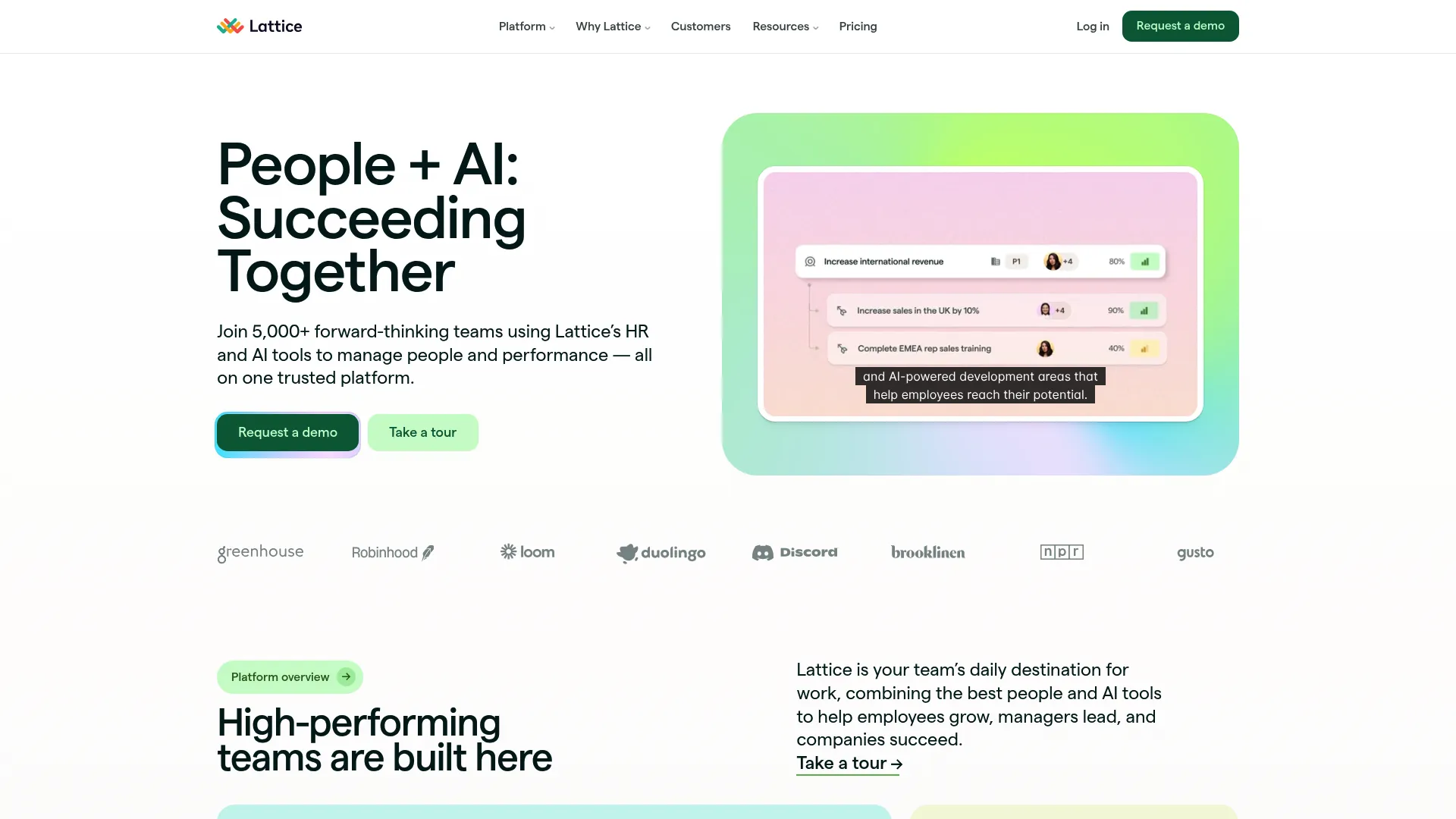
Lattice is an AI-powered people platform covering performance, goals, engagement, growth, and compensation. Its one-on-ones live inside that broader system, so a weekly 1:1 pulls in goals, past feedback, and performance context instead of sitting off to the side. For managers running development conversations at scale, that connection is the point.
The AI meeting notes and summaries reduce the manual capture that usually kills follow-through. Shared agendas let both people prep, action items persist across recurring meetings, and coaching insights surface patterns a manager might miss week to week.
Best for: HR and people teams that want performance, goals, engagement, and compensation workflows in one platform, with 1:1s connected to all of it.
Key strengths
- AI-assisted 1:1s with agendas and summaries
- Action items that carry across recurring meetings
- Goals and OKRs linked to the conversation
- Engagement surveys and performance context in one place
- Coaching insights for managers
Why choose Lattice: Pick it when you want the 1:1 to be one surface inside a coherent performance system, not a standalone meeting tool. It fits people teams standardizing how managers coach across the org.
Lattice pricing: Modular pricing with a $4,000 minimum annual agreement, billed annually in USD. Public plans include Engagement at $4 seat/month, Grow at $4 seat/month, Goals & OKRs at $8 seat/month, Performance at $10 seat/month, and Foundations at $13 seat/month. No free tier.
2. Quantum Workplace
Quantum Workplace is an all-in-one HR platform for employee engagement, performance, development, and recognition. Its one-on-ones sit alongside engagement surveys and goal setting, which suits organizations that treat 1:1s as part of a wider employee listening and talent management motion.
The template library and agenda builder speed up prep, recurring cadence keeps meetings on track, and 1:1 analytics give managers and leaders visibility into participation and trends. Action items, goals, and continuous feedback all connect back to the meeting, and mobile access means managers can prep or review on the go.
Best for: Mid-market and enterprise teams that want a unified employee engagement and performance platform, with 1:1s reinforcing both.
Key strengths
- Template library and agenda builder
- Recurring cadence automation
- One-on-one analytics for managers and leaders
- Goals, feedback, and recognition in one platform
- Mobile access for prep and review
Why choose Quantum Workplace: Choose it when engagement data and performance management matter as much as the meeting itself. It fits performance-heavy orgs that want survey insights and 1:1s in the same system.
Quantum Workplace pricing: Packages start at $15,000 per year. Solutions can be purchased together, separately, or à la carte, with customized quotes. No free tier and no detailed public per-seat pricing.
3. PerformYard
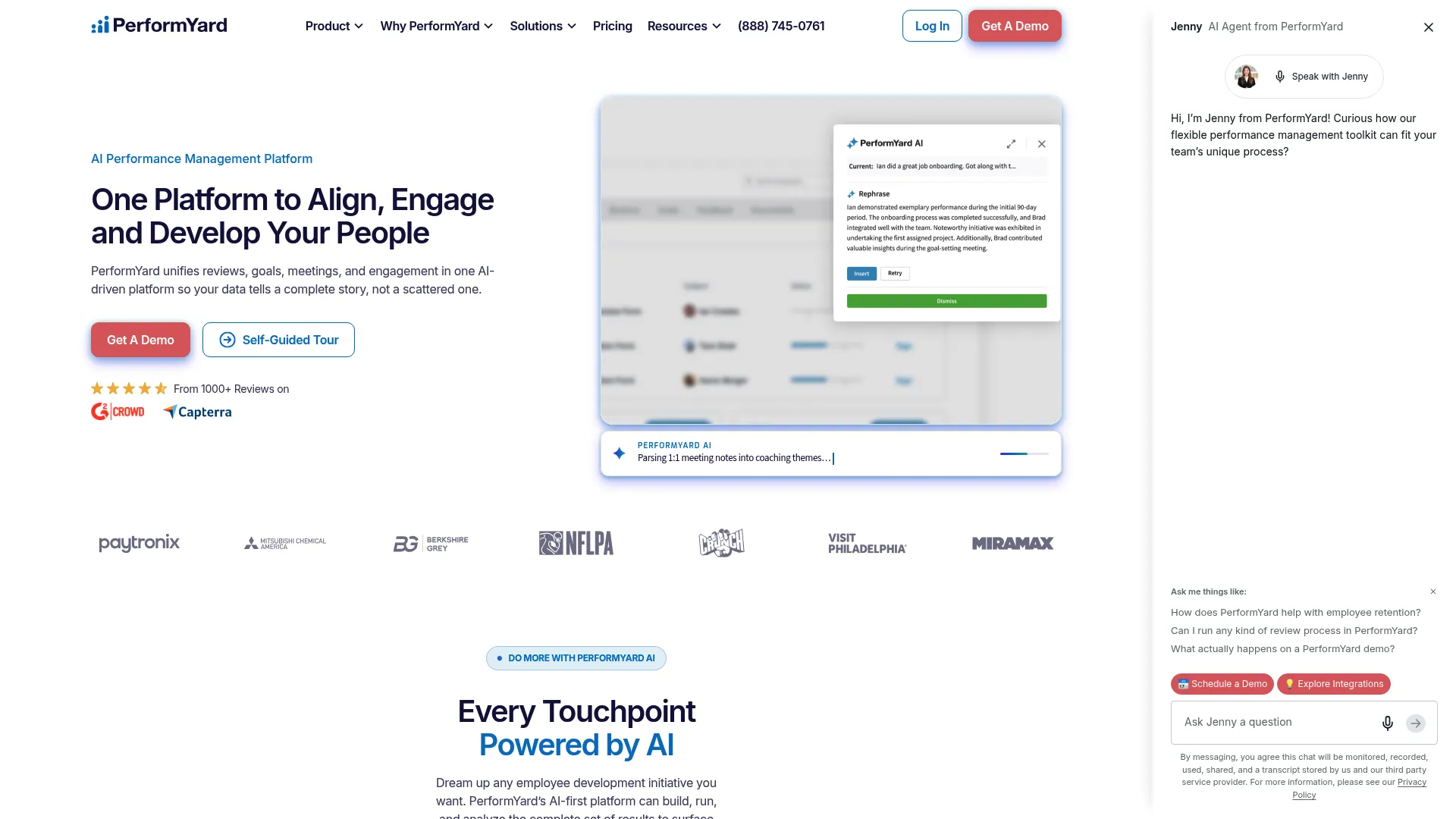
PerformYard is performance management software covering reviews, goals, feedback, engagement, meetings, and surveys. Its Meetings module puts 1:1s directly in the same system as review cycles, so the weekly conversation and the formal review draw on the same data. That tight coupling is why it suits teams that want performance review alignment built in.
Flexible agendas let managers and reports coauthor topics, task tracking keeps action items visible, and persistent notes carry across sessions. Goal progress shows up in the meeting, and managers get visibility into where each person stands heading into a review.
Best for: HR teams that want configurable performance management, with 1:1s tied closely to review and goal cycles.
Key strengths
- Flexible, coauthored agendas
- Task tracking and persistent notes
- Goal progress visible in the meeting
- Review integration across the performance cycle
- AI summaries and review assist
Why choose PerformYard: Pick it when your 1:1s should feed directly into structured reviews rather than run parallel to them. It fits HR teams that value configurability and a clear line from weekly check-in to formal review.
PerformYard pricing: Custom per-seat pricing billed annually. Performance Management is the core module at $5-10 per person/month, with add-ons including Meetings at +$2-4 per person/month, plus AI, Employee Engagement, and Surveys. Minimum pricing applies, and volume pricing is available. No free tier.
4. Fellow
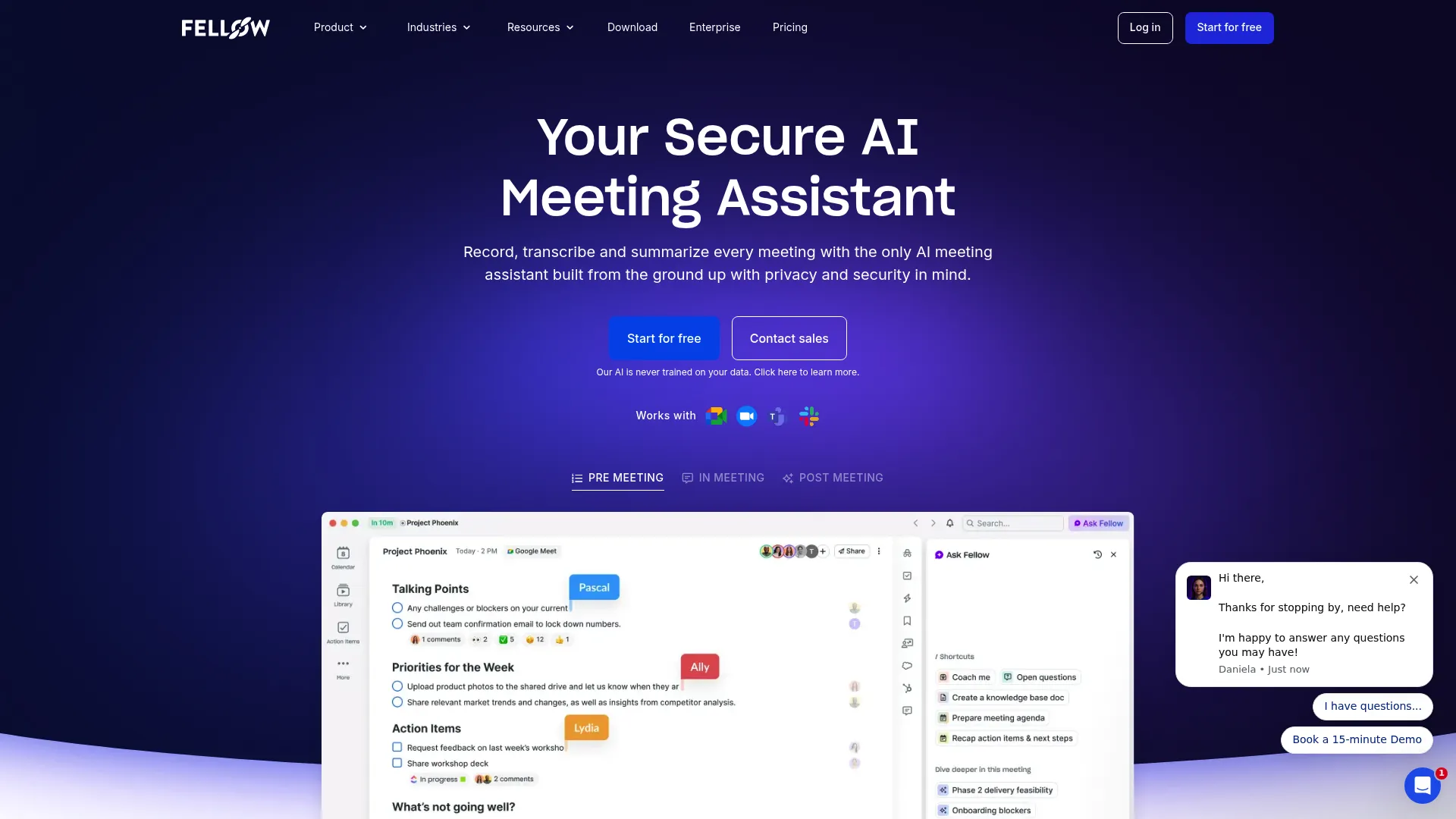
Fellow is an AI meeting assistant for notes, transcription, summaries, action items, and meeting workflows. Unlike the people platforms on this list, it is built around the meeting itself, which makes it the lightest to adopt when your priority is running better 1:1s without a full performance suite.
Collaborative agendas let both people add topics before the call, AI meeting notes and summaries capture the conversation, and action items get tracked and carried forward. Meeting rituals and automations help managers keep a consistent cadence, and the integrations plug into the calendar and chat tools teams already use.
Best for: Teams that want an AI meeting note-taker with collaborative agendas and workflow features, without committing to a broader HR platform.
Key strengths
- AI meeting notes, transcription, and summaries
- Collaborative shared agendas
- Action items with follow-up tracking
- Meeting rituals and automations
- Free tier to start
Why choose Fellow: Choose it when manager adoption and a lightweight workflow matter more than tying 1:1s to formal reviews. It fits teams that want strong meeting hygiene and AI notes fast, with room to layer performance processes elsewhere.
Fellow pricing: Free plan at $0 per user/month. Paid plans are Team at $7 per user/month, Business at $15 per user/month, and Enterprise at $25 per user/month, all billed annually with a 14-day trial of paid features. Capterra shows a 4.9/5 rating.
5. Leapsome

Leapsome is an AI-powered HR software and people platform spanning HRIS, recruiting, performance reviews, goals, surveys, and learning. Its one-on-ones fit into a wider talent workflow, which makes it a strong choice for companies already standardizing performance management across the org.
The 1:1 sits alongside reviews, goals, feedback, and coaching, so managers can pull performance data straight into the conversation. AI agents and people analytics add another layer, helping surface patterns and keep development conversations grounded in real data rather than gut feel.
Best for: Growing companies that want an all-in-one people platform for HRIS and talent workflows, with 1:1s as part of a standardized performance motion.
Key strengths
- Performance reviews, goals, and surveys
- Continuous feedback and coaching in the 1:1
- HRIS and recruiting in the same platform
- AI agents and people analytics
- Learning tied to development conversations
Why choose Leapsome: Pick it when you want 1:1s inside a single people platform that also handles HRIS, reviews, and learning. It fits companies consolidating talent processes rather than adding a standalone meeting tool.
Leapsome pricing: Quote-based, depending on employee count, modules, and contract length. Leapsome lists a 14-day free trial and no setup fee, with customer success support available on annual contracts of US$6,000 or more.
6. Betterworks
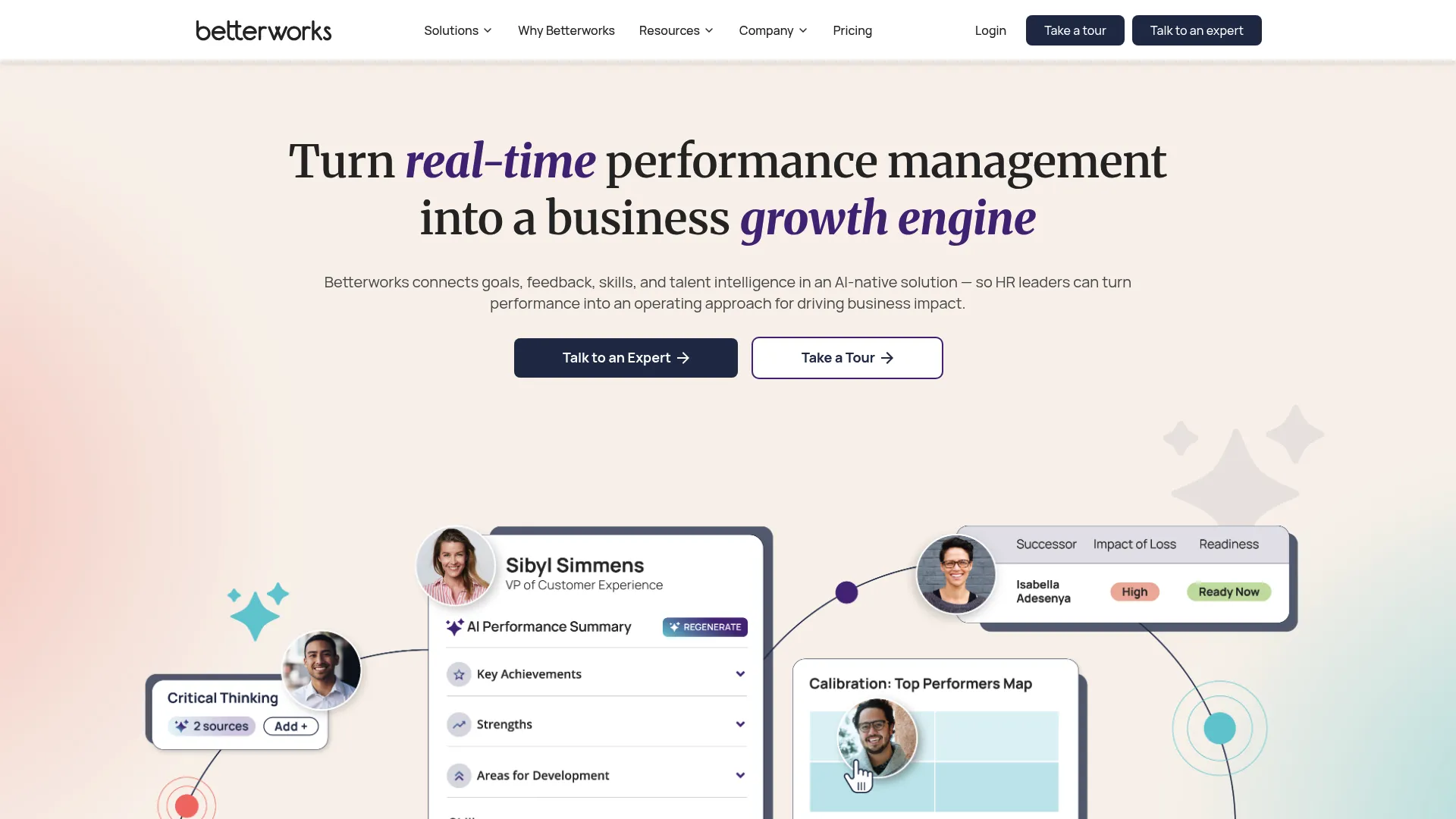
Betterworks is enterprise performance management and talent intelligence software for aligning goals, feedback, skills, and performance decisions in real time. Its check-ins and 1:1s are built around goal alignment, which fits organizations that prioritize execution visibility and clear accountability.
Goals and OKRs sit at the center, continuous feedback and 1:1s keep the conversation tied to progress, and skills intelligence adds talent analytics on top. For teams where the 1:1 exists to keep goals on track and surface where execution is stalling, that structure is the draw.
Best for: Mid-market and enterprise HR teams managing continuous performance and talent decisions, with 1:1s anchored to goals.
Key strengths
- Goals and OKRs at the core
- Continuous feedback and 1:1s
- Skills intelligence and talent analytics
- Real-time alignment across teams
- Performance conversation structure
Why choose Betterworks: Choose it when goal alignment and execution visibility are the reason you run 1:1s at all. It fits larger organizations that want the weekly conversation tied directly to OKRs and performance decisions.
Betterworks pricing: Betterworks does not publish plan pricing on its site, so pricing is custom and quote-based. Contact the vendor for a quote based on team size and modules.
7. 15Five
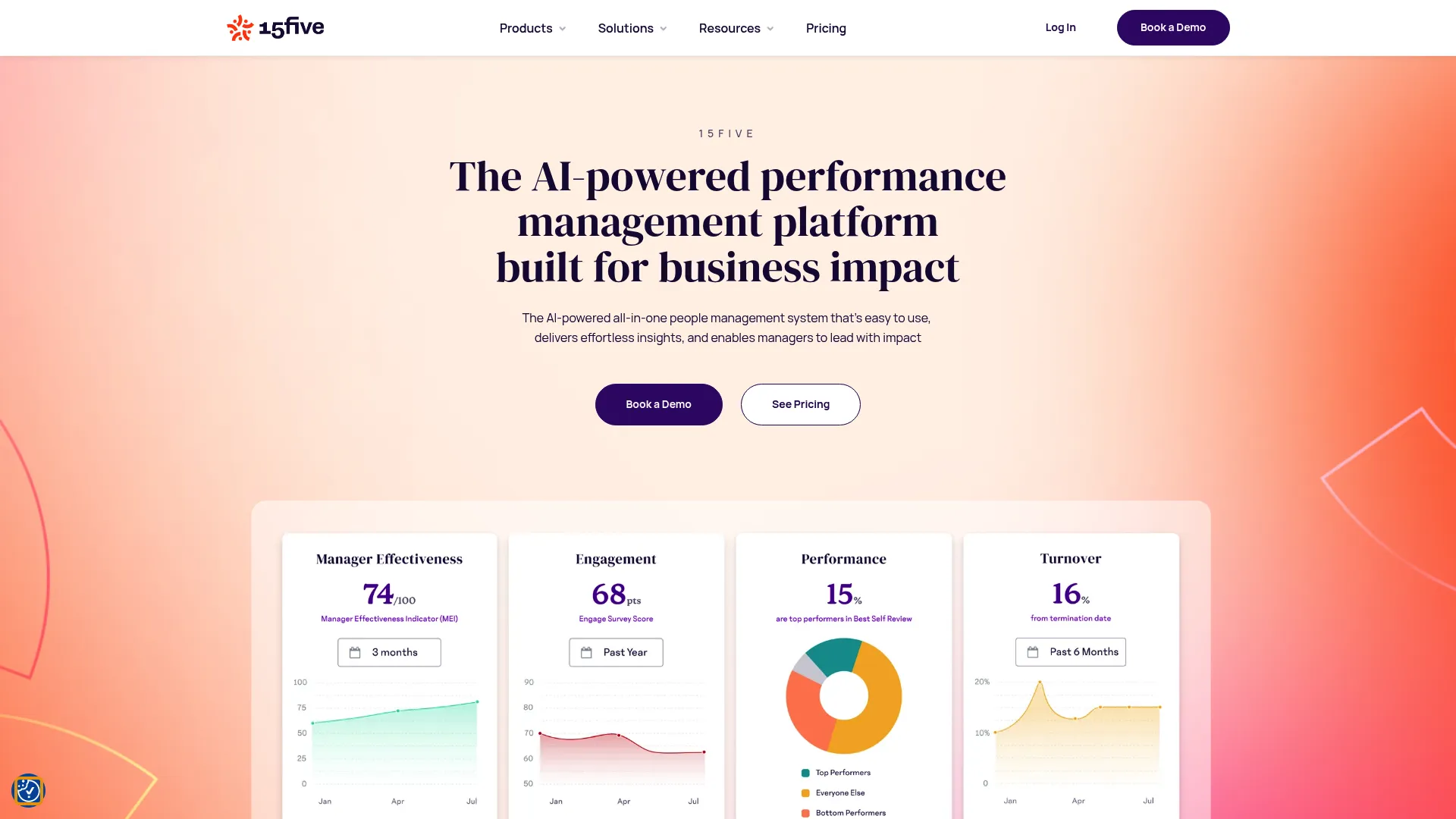
15Five is an AI-powered performance management and employee engagement platform. Its manager-employee check-ins sit alongside coaching, goals, and feedback, and it leans harder than most into manager effectiveness, which makes it useful where engagement and development are core to the 1:1 motion.
Weekly check-ins keep a steady cadence, continuous feedback and goals connect to the conversation, and manager training tools help frontline managers coach better over time. Engagement surveys round it out, so the 1:1 becomes one input into a fuller picture of how people are doing.
Best for: Mid-market and enterprise teams that want engagement, performance, and manager effectiveness in one platform, with development built into the 1:1.
Key strengths
- Manager-employee check-ins with cadence
- Coaching and manager training tools
- Goals and OKRs
- Continuous feedback
- Employee engagement surveys
Why choose 15Five: Pick it when developing your managers matters as much as the meeting structure. It fits teams that see the 1:1 as a coaching and engagement moment, not just a task review.
15Five pricing: Billed annually in USD. Engage is $4 per user/month, Perform is $11 per user/month, and Total Platform is $16 per user/month. Manager Products pricing is listed as contact us. No free tier.
Considerations
Before you commit, run each shortlisted tool against the criteria that actually determine whether 1:1s improve.
Agenda quality
Verify that agendas are easy to coauthor and reuse. A good agenda builder lets both manager and report add topics before the meeting, and reusable one on one templates keep recurring meetings consistent. If building an agenda takes more effort than a shared doc, adoption stalls.
Action follow-through
Check whether action items persist across meetings. The single biggest failure in 1:1s is losing what was agreed. Look for follow-up tracking that carries open items forward until they close, not notes that reset every session.
Goals and feedback
Confirm how tightly the tool connects 1:1s to performance data. If feedback and goals live in the meeting instead of a separate system, coaching gets specific and reviews stop being a surprise. Loose coupling means the 1:1 drifts back into status reporting.
Integrations
Look for calendar, Slack, email, and HR system connections. In-workflow delivery beats another tab nobody opens. Google Calendar, Microsoft Teams, and Slack integration keep the tool where managers already work, and HR software integration keeps performance data in sync.
Analytics and adoption
Make sure managers and leaders can see participation and trends without the tool feeling heavy. Meeting analytics on frequency and completion tell you whether 1:1s are actually happening. But weigh that against adoption risk: a tool that feels heavy for simple manager workflows gets abandoned, and abandoned tools measure nothing.
Conclusion
The right one on one meeting software depends on what your 1:1s need to do.
If you want AI notes inside a full people platform, Lattice fits. For engagement plus performance in one system, Quantum Workplace works. When 1:1s should feed directly into reviews, PerformYard is built for it. For the lightest path to better meetings and AI notes, Fellow is the easiest to adopt. For standardized performance management across the org, Leapsome consolidates it. When goals and execution visibility drive everything, Betterworks anchors to OKRs. And when engagement and manager development are the point, 15Five leans hardest into coaching.
The next step is not another sales call. Shortlist two or three tools that match your scenario, then pilot them with a handful of managers for a full review cycle. Watch whether action items actually close and whether coaching conversations improve. The tool that survives contact with your real managers is the one to standardize on.
FAQs
One-on-one meeting software helps managers and direct reports run recurring 1:1s with shared agendas, notes, action items, and follow-up. Most tools connect the meeting to goals and feedback, so the conversation stays focused on coaching and development rather than status reporting. It keeps context in one place across recurring meetings.
The essentials are a shared agenda builder, persistent notes, and action items that carry across meetings. Beyond that, look for cadence automation, goals and feedback tied to the conversation, meeting analytics, and integrations with your calendar, Slack, and HR system. The features that matter most are the ones that improve follow-through, since weak follow-up is what breaks most 1:1s.
It gives managers a repeatable structure, so a strong 1:1 does not depend on individual skill. Persistent action items and shared agendas push the conversation toward development instead of task review. Tools that surface goals, past feedback, and coaching insights help managers get specific, which is where real coaching happens.
Yes. Async prep and shared notes are exactly where these tools help remote and hybrid teams. Shared agendas let both people add topics before the call across time zones, and shared notes mean nobody has to reconstruct what was decided. That visibility keeps distributed 1:1s from becoming rushed or forgotten.
In most cases, yes. When the weekly 1:1 feeds goal progress and continuous feedback into the review, performance review alignment improves and reviews stop surprising anyone. Tools like PerformYard, Lattice, and Betterworks tie the two together directly, so coaching stays grounded in real performance data.
Start with calendar (Google Calendar or Microsoft Teams) so meetings sync automatically, and Slack for reminders and in-workflow prompts. Email integration helps with notifications, and HR software integration keeps goals and performance data in sync across systems. In-workflow delivery drives adoption, so prioritize the integrations that keep the tool where managers already work.
Match the tool to your company's maturity and how tightly 1:1s should connect to performance. A lightweight one-on-one meeting tool like Fellow fits teams that want strong meeting hygiene and AI notes fast, without a full HR platform. A performance suite like Lattice, Leapsome, or 15Five fits when you are standardizing reviews, goals, and coaching across the org and want the 1:1 to live inside that system.