

You built a list of 200 accounts on Monday. By Wednesday, a third of the emails bounced. By Friday, you'd burned an afternoon manually fixing phone numbers that were three job changes out of date.
Most reps think this is a targeting problem. It isn't. It's a data and workflow problem.
Your calendar doesn't care how good your talk track is if half your contacts don't exist anymore. The scarce resource in prospecting isn't leads. It's your time. Every stale record, every extra tab, every copy-paste into the CRM is time you didn't spend talking to a real buyer.
The category has matured fast. Gartner data reported by WorldMetrics (2023) found 68% of B2B companies use at least one sales prospecting tool, up from 59% in 2020. And MarketGrowthReports (2024) noted that 57% of B2B companies run three or more platforms in their stack. More tools isn't the goal. Fewer manual steps is.
What's inside
This guide is for SDRs and SDR managers who want cleaner data, faster workflows, and more booked meetings. Here's what you'll get:
- A plain definition of what B2B prospecting software actually does
- How these tools layer into your existing sales stack
- What to check before you buy: data quality, workflow fit, CRM integration, and adoption
- A side-by-side comparison table of 10 tools
- Detailed breakdowns of each tool, ranked by relevance to SDR prospecting
We picked tools based on four things: data accuracy and refresh cadence, workflow speed, integration depth, and how well real reps actually adopt them.
TL;DR
- Best overall for enterprise data and intelligence: ZoomInfo, for depth, intent signals, and scale.
- Best all-in-one prospecting stack for SMB and mid-market: Apollo, for database plus outreach in one place.
- Best for LinkedIn-led prospecting: LinkedIn Sales Navigator, for account research and relationship mapping.
- Best for verified contact data and EMEA coverage: Cognism, for compliance-sensitive teams selling into Europe.
- Best for enrichment and workflow automation: Clay for building custom systems, Clearbit for infrastructure-grade enrichment.
What is a B2B prospecting tool
A B2B prospecting tool is software that helps sales teams find, verify, prioritize, and reach the right buyers, then track responses across channels. It sits between your raw target market and your booked meetings.
The category covers a few overlapping jobs. Some tools focus on one, some try to cover the full workflow.
Core jobs a prospecting tool supports:
- Find leads: search a contact and company database by firmographic, technographic, and role filters.
- Enrich data: fill in missing emails, phone numbers, and company fields on records you already have.
- Prioritize accounts: surface intent signals, buyer signals, and technographics to rank who to touch first.
- Automate outreach: run multi-channel sequences with personalization at scale.
- Track responses: measure opens, replies, connects, and meeting conversion.
Common features you'll see across sales prospecting software:
- Contact and company databases with verified contact data
- Email verification and phone validation
- Browser extensions for LinkedIn and company sites
- CRM integration and bi-directional sync
- Sequencing and outreach automation
- Intent data and buyer signals
- Analytics on deliverability and reply rates
One clarification that saves confusion. A CRM is your system of record. It stores what happened with an account. A prospecting tool is a workflow layer. It helps you find new accounts and act on them. The CRM remembers; the prospecting tool discovers and moves. They work best together, not as substitutes.
How B2B prospecting tools fit into the sales stack
Think of prospecting as a layered stack, not one product. Each layer does a distinct job, and the handoffs between them decide how much time you waste.
Here's how the layers map:
| Layer | What it does | Typical tools |
|---|---|---|
| CRM | System of record for accounts and deals | Salesforce, HubSpot |
| Database | Source of new contact and company records | ZoomInfo, Apollo, Cognism |
| Enrichment | Fills and refreshes missing fields | Clearbit, Clay, Lusha |
| Prioritization | Ranks accounts by intent and fit | ZoomInfo, Cognism |
| Sequencing | Runs multi-channel outreach | Salesloft, Outreach, Apollo |
| Automation | Chains enrichment and workflow steps | Clay, LeadIQ |
| Reporting | Tracks deliverability and reply rates | Salesloft, Outreach |
The SDR path through this stack is simple. Build a target list from the database. Enrich and verify it. Prioritize by intent. Push clean records into the CRM and sequencer. Run outreach. Track what replies. The fewer manual handoffs between these steps, the more time you keep for selling.
What SDRs should look for in a B2B prospecting tool
Not every tool that demos well survives contact with your daily reality. Here's what actually matters.
Data quality and refresh cadence
Stale data is the silent tax on prospecting. A bad email hurts deliverability. A bad phone number burns a dial. When you evaluate a tool, ask how often records refresh, what accuracy rate they claim, and how they validate emails and phones. Test it on real accounts before you trust a headline number.
Workflow fit and speed
The best tool is the one reps actually use. Count the clicks. A Chrome extension that captures a contact in two clicks beats a database that needs six screens. Check for bulk actions, saved searches, and clean CRM sync. Every step you remove is a step reps won't skip.
Personalization and segmentation
Volume without relevance kills reply rates. Look for account-level and persona-level personalization that still lets you hit your numbers. Good segmentation filters (role, seniority, tech stack, intent) mean the difference between a generic blast and a message that books a meeting.
Integrations and governance
A prospecting tool that doesn't sync cleanly creates duplicate work and dirty data. Check CRM integration depth, field mapping, and how it connects to your sequencer, dialer, and Slack. Verify compliance controls too, not just feature checkboxes. And watch tool sprawl: a stack that adds more tabs than it removes hurts adoption.
When SDRs should use prospecting tools
Different motions call for different tools. Match the moment to the job.
Building target lists from scratch
For outbound teams starting cold, you need a database with strong filters. Territory buildout and account research live here. This is where sales intelligence tools earn their keep, turning a blank spreadsheet into a prioritized list.
Cleaning and enriching inbound or stale CRM data
Reactivating old leads and filling missing fields is a lead enrichment job. If half your CRM records are missing phone numbers, an enrichment layer fixes segmentation and stops wasted touches before they happen.
Scaling outreach without losing quality
When you need to send more without sounding like a robot, sequencing and outreach automation carry the load. Trigger-based outreach and personalization at scale keep quality up as volume climbs.
Prioritizing the right accounts
When you can't touch every account, intent data and technographics tell you who's in-market. High-value account filters focus your limited hours on the buyers most likely to reply.
Comparison table
Here's a fast side-by-side, ranked by relevance to SDR prospecting workflows. Pricing and ratings are pulled from each vendor's current listings; several enterprise tools use custom pricing.
| # | Product | Best for | Key differentiator | Pricing | G2 rating |
|---|---|---|---|---|---|
| 1 | ZoomInfo | Enterprise data and intelligence | Deep database plus intent signals | Usage and license based | 4.5/5 |
| 2 | Apollo | All-in-one SMB and mid-market stack | Database plus outreach in one tool | Free plan available | 4.7/5 |
| 3 | LinkedIn Sales Navigator | LinkedIn-led prospecting | 50+ filters and account insights | From $119.99/mo/license | 4.4/5 |
| 4 | Cognism | Verified data and EMEA coverage | Compliance-focused mobile data | Custom (Standard, Pro) | 4.5/5 |
| 5 | Lusha | Fast contact discovery | Browser-based reveal workflow | Free tier available | 4.3/5 |
| 6 | Clearbit | Enrichment infrastructure | Real-time record enrichment | Custom | 4.4/5 |
| 7 | LeadIQ | Outbound workflow support | Capture plus CRM enrichment | Free; Pro $200/mo | 4.2/5 |
| 8 | Salesloft | Engagement and orchestration | Full revenue orchestration | Custom | - |
| 9 | Outreach | Structured outbound | Sequencing plus forecasting | Custom | 4.3/5 |
| 10 | Clay | Enrichment automation | Multi-provider data waterfalls | Free; Launch $185/mo | 4.7/5 |
Best 10 B2B prospecting tools for 2026
1. ZoomInfo
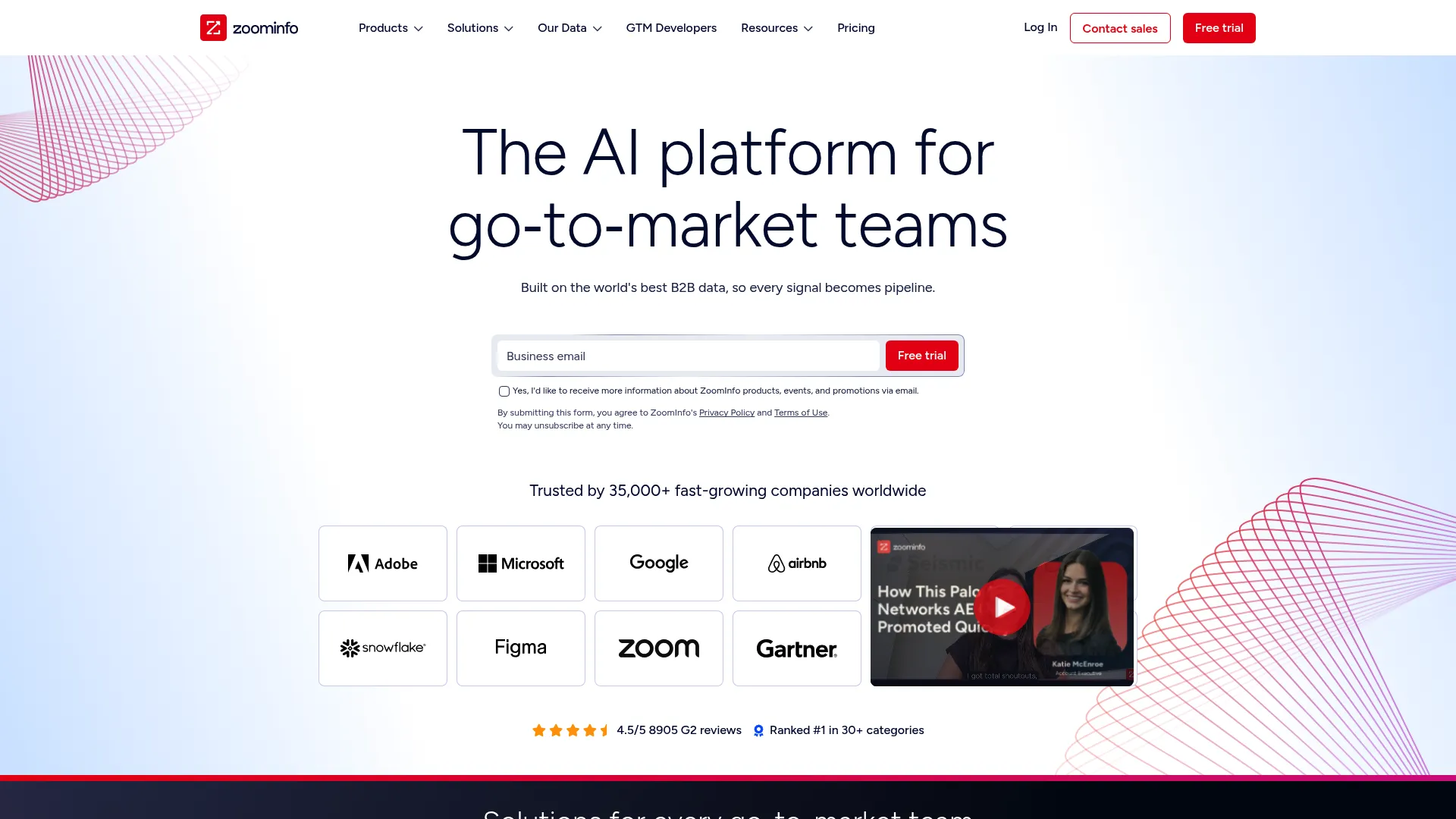
ZoomInfo is a B2B go-to-market platform for sales, marketing, and operations teams. It pairs one of the largest contact and company databases with buyer intent signals and CRM enrichment. For SDRs who need depth and scale, it's the reference point most other tools get compared against.
Best for: B2B teams that need sales intelligence, intent data, and enrichment at scale.
Key strengths
- B2B contact and company database
- Buyer intent signals
- CRM enrichment and workflow automation
Why choose ZoomInfo: If your territory is large and your accounts are enterprise, the depth of ZoomInfo's data and its intent layer help you find and prioritize buyers faster than a lighter tool. Teams choose it when data breadth and signal quality matter more than a low entry price.
ZoomInfo pricing: Pricing is based on features, number of licenses, and credit usage, and is not publicly listed. A free trial is available. Contact ZoomInfo for a quote.
2. Apollo
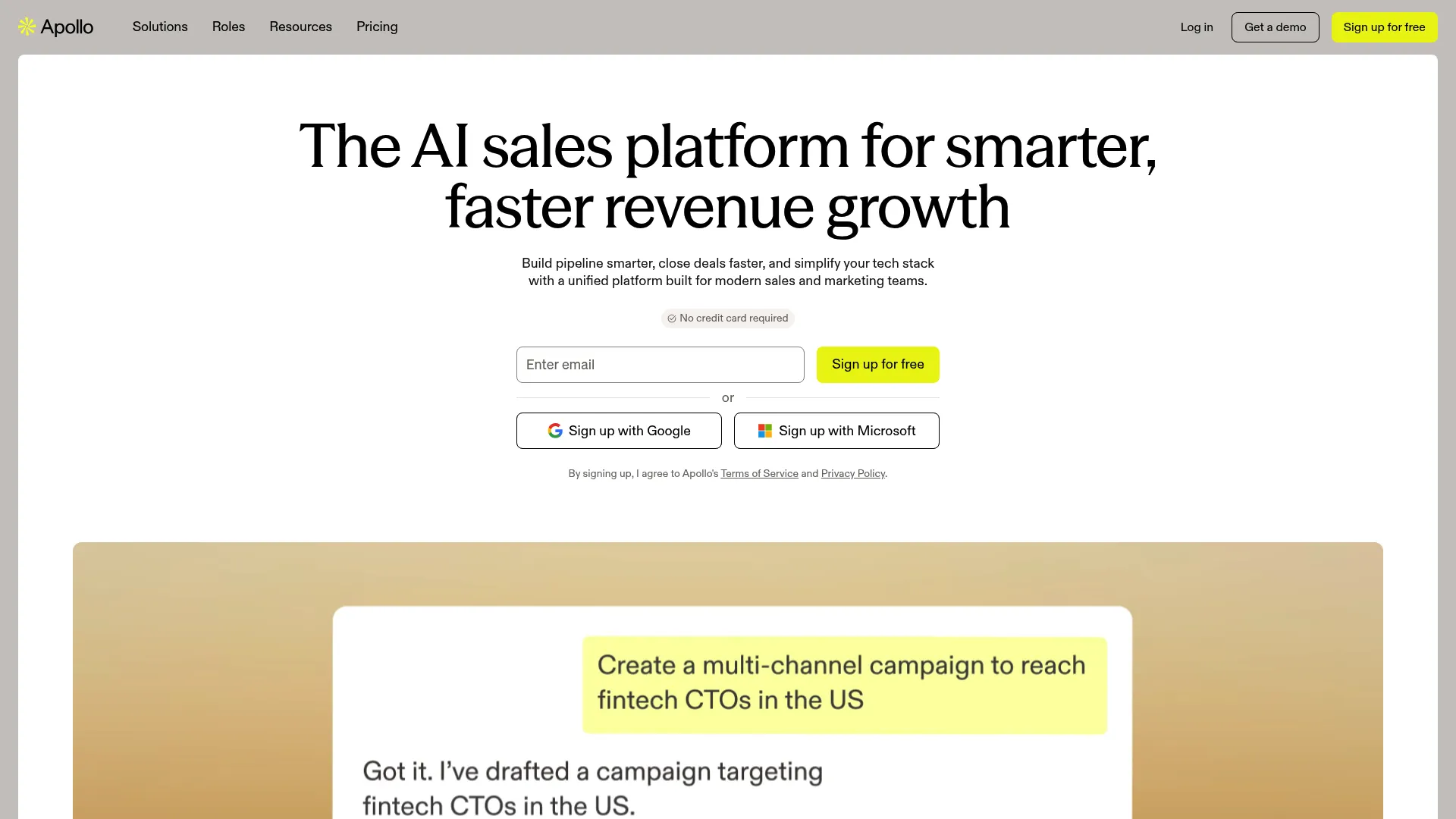
Apollo is a B2B sales intelligence and prospecting platform that combines a contact database, enrichment, and outreach in one place. For SDRs who want fewer tools and fewer tabs, it covers most of the prospecting workflow without stitching together three vendors.
Best for: Teams that want prospecting, enrichment, and outreach in one platform.
Key strengths
- B2B contact database
- CRM and CSV enrichment
- Saved searches and alerts
Why choose Apollo: It's the strongest all-in-one for SMB and mid-market teams standardizing their stack. You get list building, verification, and sequencing under one login, which cuts the handoff friction that slows down multi-tool setups. Larger enterprise teams sometimes outgrow it and layer on a dedicated database.
Apollo pricing: After a trial, users can downgrade to a Starter plan that is free forever. Trial plans include 50 credits and 5 mobile credits. Paid tiers are available on Apollo's pricing page.
3. LinkedIn Sales Navigator

LinkedIn Sales Navigator is a B2B sales tool for finding leads, researching accounts, and reaching prospects on LinkedIn. With 50+ search filters and AI-powered account insights, it turns the world's largest professional network into a targeting engine for social selling.
Best for: Sales teams and individual sellers who prospect and research accounts on LinkedIn.
Key strengths
- 50+ search filters for finding buyers
- AI-powered account and lead insights
- CRM integrations, alerts, and InMail outreach
Why choose LinkedIn Sales Navigator: For relationship mapping and territory planning, nothing matches LinkedIn's data on who works where and who moved recently. It works best paired with a data source for verified emails and a sequencer for outreach, since it's built for research and targeting rather than bulk sending.
LinkedIn Sales Navigator pricing: Core starts at US$119.99/month/license and Advanced starts at US$159.99/month/license, billed monthly or annually. Advanced Plus is custom and requires a quote. Free trials are available for Core and Advanced.
4. Cognism
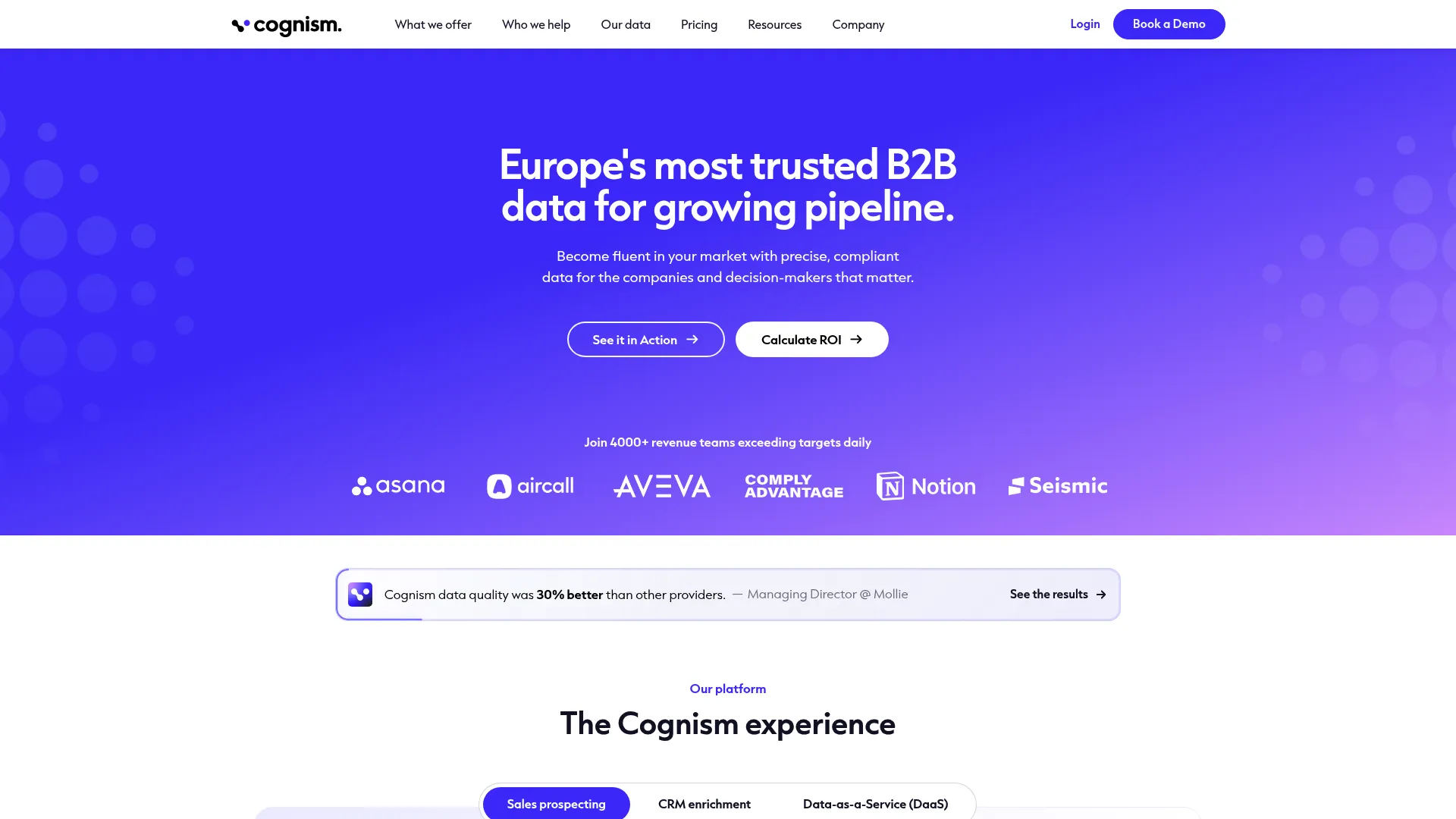
Cognism is a B2B sales intelligence and data platform for prospecting, CRM enrichment, and data delivery. Its calling card is verified contact data with strong coverage across EMEA, plus a compliance posture that matters when you're dialing into regulated markets.
Best for: Teams needing EU-focused B2B prospecting and verified mobile and contact data.
Key strengths
- Verified contact and company data
- AI search and account research
- Intent data, job changes, funding, and technographic signals
Why choose Cognism: If you sell into Europe or care deeply about phone-verified mobile numbers, Cognism's data quality and GDPR-sensitive approach reduce wasted dials and compliance risk. Teams pick it when connect rates and clean data outweigh the appeal of a free entry tier.
Cognism pricing: Cognism lists Standard and Pro plans, with pricing tailored to business needs. No public dollar amount is shown; contact Cognism for a quote.
5. Lusha
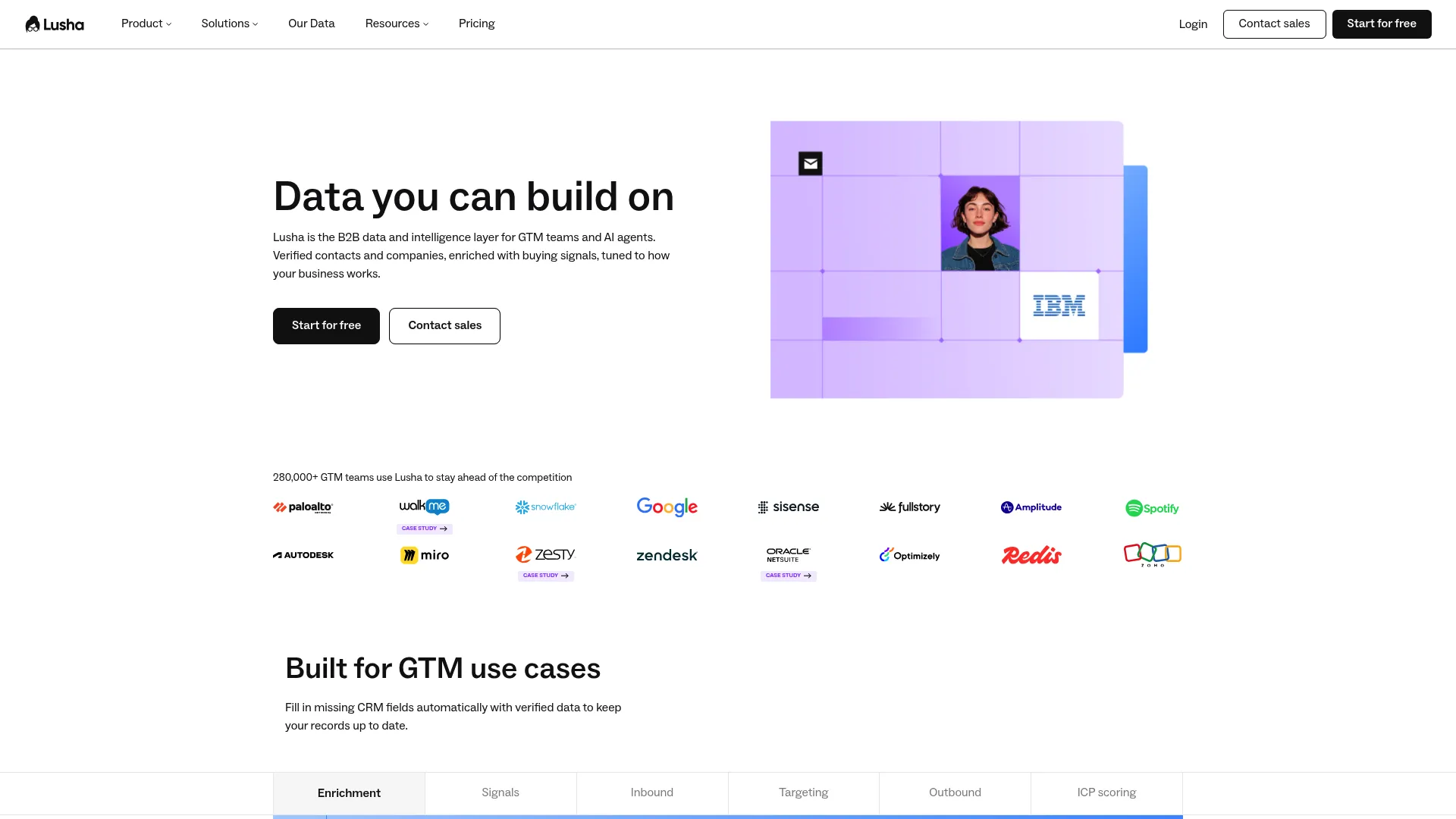
Lusha is a B2B sales intelligence and prospecting platform for finding, enriching, and using contact and company data. SDRs like it for speed: a browser extension reveals phone and email on LinkedIn, Sales Navigator, and company sites without leaving the tab you're already in.
Best for: Teams needing quick B2B contact data, prospecting, and enrichment.
Key strengths
- AI-powered Workspace for table-building and prospecting
- Prospect Search with phone and email reveal
- Browser extension for LinkedIn, Sales Navigator, and company websites
Why choose Lusha: The simplicity is the point. For smaller teams that want fast contact discovery without a heavy database setup, Lusha's browser-first workflow gets reps prospecting in minutes. It fits leaner motions where a lightweight enrichment layer beats a full sales intelligence suite.
Lusha pricing: Lusha offers Free, Starter, Pro, Premium, and Scale plans on credit-based pricing. The Free plan includes up to 40 credits per month. Paid tier prices are available on Lusha's pricing page.
6. Clearbit
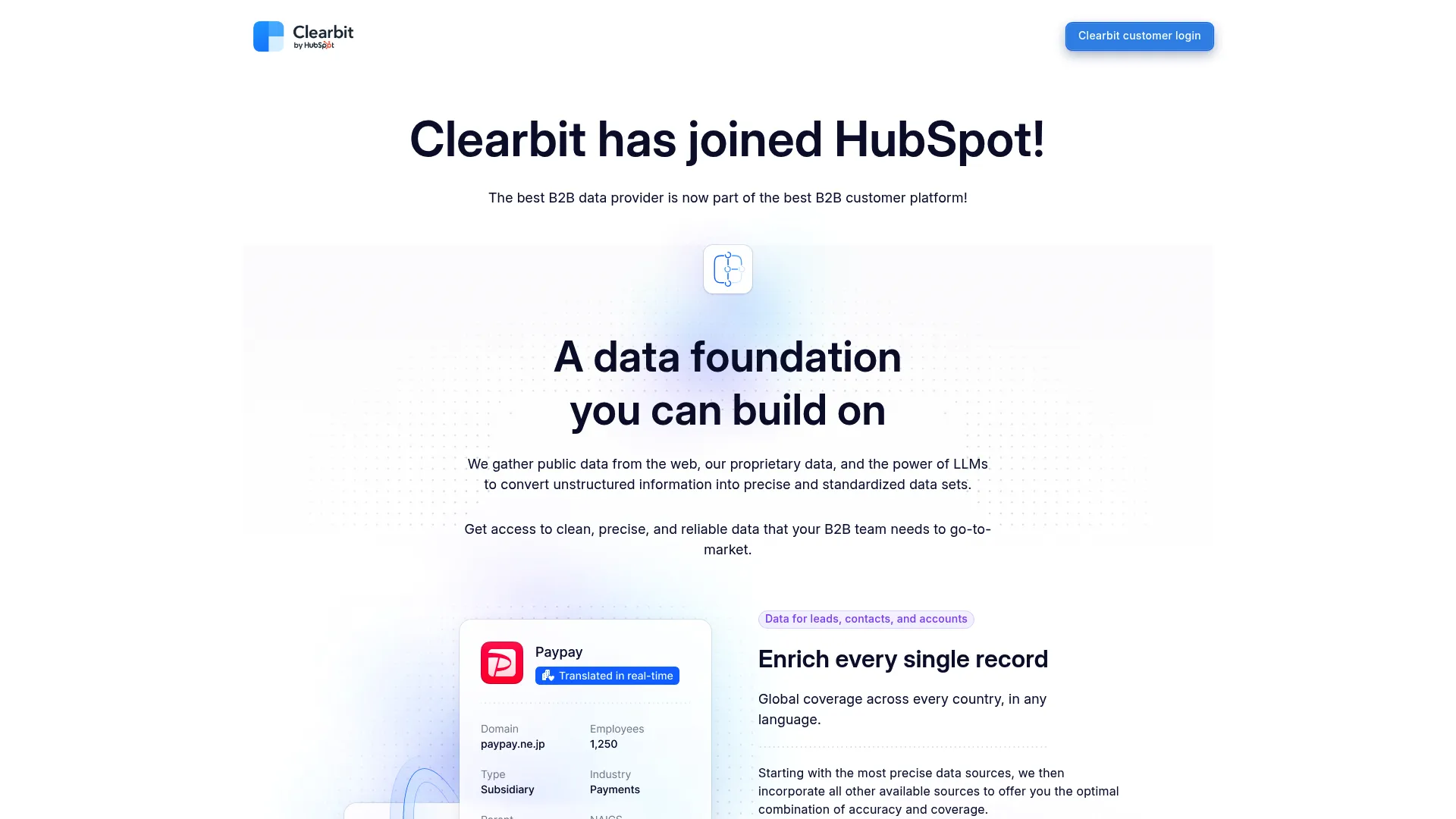
Clearbit is B2B data enrichment and revenue intelligence software. Rather than a list-building tool, think of it as infrastructure: it enriches records in real time across 100+ attributes and powers lead scoring, routing, and form shortening behind the scenes.
Best for: B2B teams needing company and contact enrichment inside their CRM and web flows.
Key strengths
- Real-time B2B record enrichment
- 100+ B2B attributes across company and person data
- Lead scoring, routing, and form shortening
Why choose Clearbit: It shines for cleaning both inbound and outbound workflows. When a form fill hits your CRM, Clearbit fills the missing firmographic fields so routing and segmentation just work. Teams choose it as the enrichment layer under their stack, not as the tool reps open every morning.
Clearbit pricing: Clearbit's help center references Growth, Business, and Platform plans, with the free version discontinued in April 2025. No public starting price is listed; contact Clearbit for a quote.
7. LeadIQ
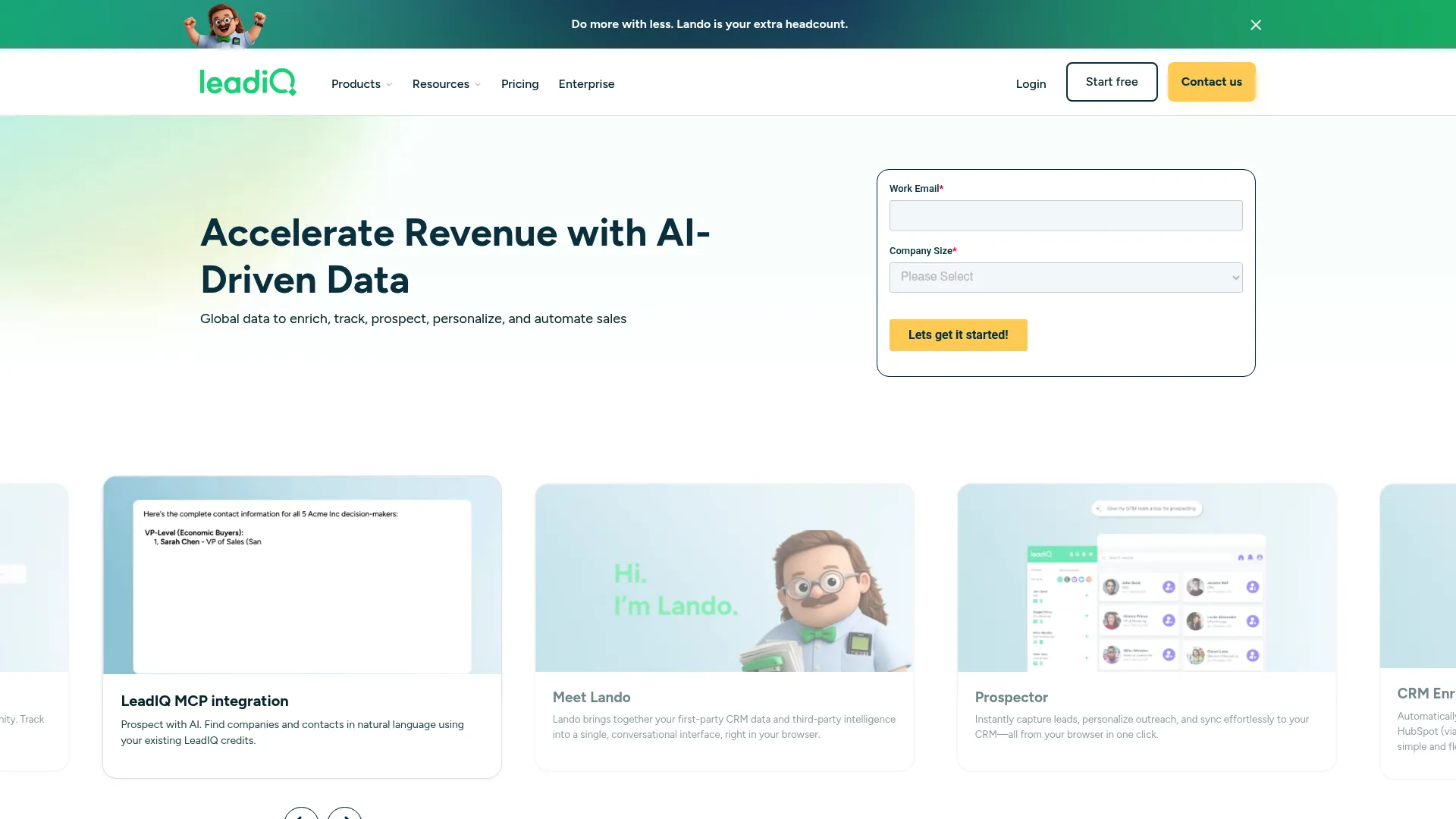
LeadIQ is a B2B prospecting platform for finding contacts, tracking sales triggers, enriching CRM data, and generating outreach with AI. It's built for outbound teams who live between LinkedIn and their CRM tabs and want to capture and route contacts without breaking flow.
Best for: Sales teams that need prospecting, enrichment, and outreach workflow tooling.
Key strengths
- People search for email and mobile numbers
- CRM and webform enrichment
- Chrome extension prospecting and integrations
Why choose LeadIQ: Speed and workflow fit are its edge. The Chrome extension lets reps capture a prospect and push it into the CRM and sequencer in a couple of clicks, which keeps outbound moving. It suits teams that value capture speed and clean handoffs over a giant standalone database.
LeadIQ pricing: LeadIQ offers a Free plan at $0, a Pro plan at $200/month, and a quote-based Enterprise plan. A Lando Agent plan is available on an annual basis. Annual billing is 25% off.
8. Salesloft
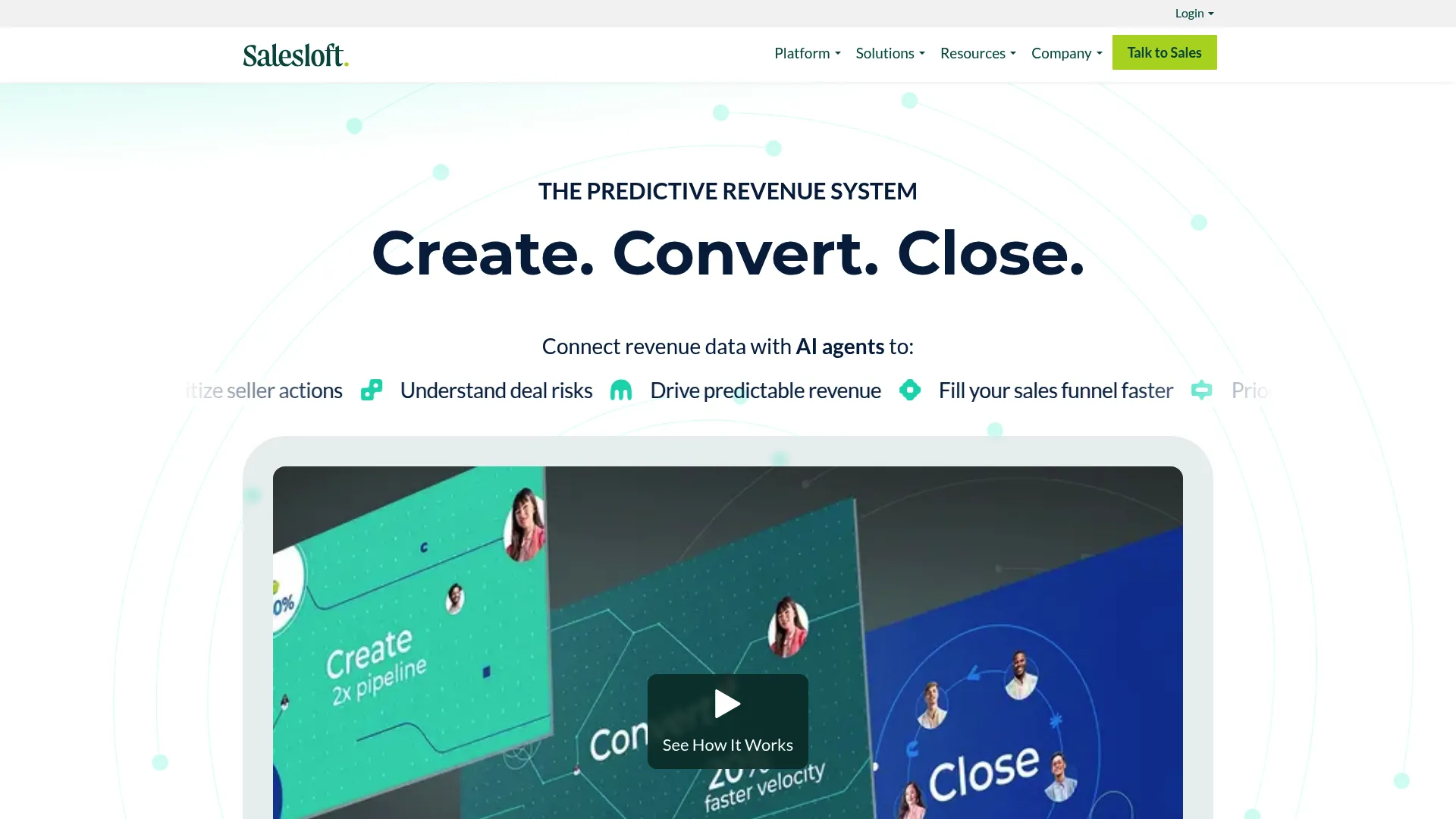
Salesloft is an AI-powered revenue orchestration platform covering sales engagement, revenue intelligence, coaching, deals, forecasting, and analytics. It's more engagement platform than pure database, which is exactly why it sits at the sequencing and reporting layer of the stack.
Best for: B2B revenue teams needing sales engagement and revenue orchestration in one platform.
Key strengths
- Bi-directional CRM sync
- Coaching
- Reporting and analytics
Why choose Salesloft: When your list is already built and clean, Salesloft is where you run and measure the outreach. It orchestrates multi-touch sequences and gives managers the pipeline visibility to coach reps. Pair it with a database and enrichment layer, and it becomes the execution engine for your prospecting motion.
Salesloft pricing: Salesloft does not publish public pricing. The pricing page references Enterprise and Sell plans and directs visitors to contact sales for a quote.
9. Outreach

Outreach is an AI revenue workflow platform for sales and revenue teams. It combines sales engagement, pipeline management, and conversation intelligence, which makes it a fit for structured outbound teams with heavier process and mature sales operations.
Best for: Mid-market and enterprise revenue teams that need sales engagement plus forecasting and pipeline visibility.
Key strengths
- Sales engagement
- Pipeline management
- Conversation intelligence
Why choose Outreach: For teams with defined plays and a RevOps function to run them, Outreach standardizes sequencing and adds forecasting on top. It rewards process maturity: the more structured your outbound motion, the more value you pull from it. Smaller teams may find it more platform than they need day one.
Outreach pricing: Outreach does not display public numeric pricing on its site. Contact Outreach for a quote based on team size and needs.
10. Clay

Clay is a GTM automation platform for data enrichment, prospecting, and outbound workflows. Its power move is chaining multiple data providers into waterfalls, so if one source misses an email, the next one fills it. For ops-minded SDR teams building custom systems, it's a different category of control.
Best for: GTM teams automating enrichment and outbound workflows.
Key strengths
- Unlimited seats and tables
- Multi-provider waterfalls and Claygent AI enrichment
- Signals, CRM sync, webhooks, HTTP API, and Sequencer email workflows
Why choose Clay: It fits power users and ops-heavy teams who'd rather build their own prospecting engine than accept a fixed workflow. The waterfall approach maximizes data coverage and the automation chains cut repetitive steps. Teams new to prospecting may want a simpler tool first, then graduate to Clay as their process matures.
Clay pricing: Clay offers a Free plan at $0 with 500 actions and 100 data credits per month, Launch at $185/month, Growth at $495/month, and custom Enterprise pricing on an annual commitment.
Considerations
Before you sign anything, run this checklist.
Data quality comes first
Never trust a headline accuracy number. Ask for a trial and test the tool on a sample of your real target accounts. Check bounce rates on the emails, connect quality on the phones, and how complete the fields come back. Data quality is revenue quality, and a demo dataset won't tell you the truth.
Match the tool to the motion
Not every team needs an enterprise database. An outbound-heavy team building cold lists has different needs than an inbound team enriching form fills. A hybrid team needs both, carefully. Map your dominant motion first, then buy for it, not for the feature list that looks most impressive in a demo.
Count the hidden cost of complexity
Every tool carries implementation time, training, and adoption risk. A platform that removes three tabs but takes a quarter to roll out may not pay off before your next quota. Weigh the setup against the time it actually saves reps in week one.
Verify compliance and governance
Privacy, consent, and regional rules matter, especially if you're dialing into Europe. Check the actual controls: opt-out handling, data sourcing, and how the vendor stays compliant. Feature checkboxes aren't the same as governance you can defend.
Understand where CRM ends and prospecting begins
Your CRM is the system of record. Prospecting tools are workflow enhancers that feed it. A shallow integration creates duplicate records and dirty data, which costs more time than it saves. Confirm sync depth and field mapping before you commit.
Conclusion
The right B2B prospecting tool isn't the one with the longest feature list. It's the one that improves your data quality, speeds up your workflow, and lifts your reply rates, without adding tabs your team won't use.
Match it to your motion. For enterprise depth and intent, ZoomInfo leads. For an all-in-one SMB and mid-market stack, Apollo. For LinkedIn-led social selling, Sales Navigator. For verified data and EMEA coverage, Cognism. For enrichment, Clearbit and Clay each solve different halves of the problem, and Lusha and LeadIQ keep contact discovery fast. Salesloft and Outreach carry the sequencing and orchestration layer once your list is clean.
Your next step: build a shortlist of two or three from the categories above, run a real trial on your own accounts, and measure bounce rates and connect quality before you buy. The tool that books more meetings with fewer manual steps is the one worth paying for.
FAQs
B2B prospecting tools are software that helps sales teams find, verify, prioritize, and reach the right buyers, then track responses. They cover jobs like list building, lead enrichment, intent signals, and outreach automation. The goal is fewer wasted touches and more qualified meetings.
A CRM is your system of record. It stores accounts, contacts, and deal history. A prospecting tool is a workflow layer that finds new contacts, enriches data, and drives outreach. The CRM remembers what happened; the prospecting tool discovers and acts. They work best together, with clean sync between them.
Most pull from large contact databases built from public sources, partnerships, and user contributions. They layer on verification to confirm emails and phone numbers, browser extensions to capture contacts from LinkedIn and company sites, and enrichment to fill missing fields on records you already have. The best tools refresh data often to keep it accurate.
Test for data quality on a sample of your real accounts, check workflow fit and click count, confirm CRM integration depth, and gauge how easily reps adopt it. Then weigh pricing against your use case. A cheaper tool reps ignore costs more than a pricier one they use every day.
Most teams need a small stack, not a sprawling one. A common baseline is one database for finding contacts, one enrichment layer for keeping records clean, and one sequencing tool for outreach. Add more only when a real gap appears, since every extra tool adds tabs and adoption risk.
Pricing ranges widely. Some tools offer free tiers or entry plans in the low hundreds per month, while enterprise databases use custom, usage-based contracts. Evaluate total stack cost, not just one tool, and factor in credits, seats, and integrations. The right question is cost per booked meeting, not sticker price.
Yes, most integrate with Salesforce, HubSpot, and major sequencers. But verify sync depth and field mapping before you commit, not just whether an integration exists. A shallow integration creates duplicate records and manual cleanup. Integration quality often decides whether reps actually adopt the tool.
There's no single winner; it depends on budget and depth. For an all-in-one stack, Apollo covers database and outreach together. For LinkedIn-led research and targeting, Sales Navigator leads. For enterprise depth and intent signals, ZoomInfo is the reference. Match the choice to your motion and your budget.