You do not need another AI demo. You need an assistant your VP of Operations, compliance lead, and client-facing team can all live with.
That bar is harder to clear than it sounds. According to Gartner (2025), 59% of finance leaders already report AI use in their finance function. The tools exist. The question is which ones survive contact with regulated workflows, sensitive client data, and a team that cannot afford a 12-month science project to get value.
Picking the wrong category of AI assistant is the common mistake. Advisor-specific workflow tools, general chat assistants, enterprise productivity copilots, and custom implementation partners each solve different problems. Use the wrong category and you spend budget on something that sits unused or creates compliance exposure you did not anticipate.
This guide cuts through the noise. It compares 10 AI assistants and implementation partners across four categories, with verified pricing, real G2 ratings, and a practical framework for choosing the right fit without your VP of Sales becoming a bottleneck.
What's inside
This guide is for financial-services teams, fintech founders, and operators evaluating AI tools that can support regulated workflows at scale.
- Who it covers: Advisory firms, RIAs, wealth management teams, fintech operators, and B2B SaaS founders selling into financial services
- Selection criteria: Financial-services workflow fit, data handling and governance, integrations with existing CRMs and productivity tools, and time to first measurable outcome
- What you'll get: A side-by-side comparison of advisor-specific platforms, general AI assistants, enterprise copilots, and custom AI partners, plus a practical buying framework
TL;DR
- Best overall for financial advisors: Jump, for meeting prep, AI notes, CRM sync, onboarding, and advisor workflow automation end to end
- Best for advisor meeting intelligence: Zocks, for teams focused on client conversations, follow-up, and CRM data quality
- Best general assistant for broad finance tasks: ChatGPT, for analysis, drafting, and financial research with human review
- Best for long document analysis: Claude, for policy documents, planning files, and dense client materials requiring careful synthesis
- Best for Google Workspace teams: Google Gemini, for advisory firms operating across Gmail, Docs, Sheets, and Drive
- Best for Microsoft 365 teams: Microsoft Copilot, for firms already embedded in Outlook, Word, Excel, and Teams
- Best for custom financial-services AI builds: Neurons Lab, Capco, Synechron, and Wipro, when workflows need internal data, proprietary systems, and bespoke governance
What is AI assistants for financial services?
AI assistants for financial services are software tools or custom AI systems that help financial-services teams analyze information, draft communications, automate workflows, summarize meetings, support client service, and surface decision support under human supervision.
The category covers four distinct subtypes, and confusing them is what leads to bad buying decisions:
1. Advisor workflow assistants: Purpose-built for financial advisory practices. They handle meeting prep, notes, follow-up, CRM updates, client onboarding, and account opening. Tools like Jump and Zocks fall here.
2. General AI chat assistants: Flexible tools for analysis, drafting, document review, and research. ChatGPT and Claude are the most widely used. They require clear internal policies on data handling and output review.
3. Enterprise productivity copilots: AI embedded inside Microsoft 365 or Google Workspace. Best for firms already standardized on one of those ecosystems. Microsoft Copilot and Google Gemini are the primary options.
4. Custom AI assistants and implementation partners: Consulting and engineering firms that build bespoke assistants connected to proprietary workflows, core banking systems, custodial feeds, and internal data stores. Neurons Lab, Capco, Synechron, and Wipro operate here.
Key capabilities across the category:
- Meeting preparation, capture, and summaries
- CRM updates and advisor follow-up automation
- Document analysis and client communication drafts
- Financial planning and investment research support
- Onboarding, form completion, and workflow automation
- Compliance supervision, audit trails, and human approval workflows
- Integrations with CRMs, planning tools, productivity suites, and custodians
Important boundaries: AI assistants in financial services should support workflows, not replace fiduciary judgment. Human review is essential for financial recommendations. Sensitive client data requires explicit vendor approval before it enters any system.
When to use AI assistants for financial services
Prepare client meetings without founder or advisor heroics
Meeting prep is where advisory firms lose the most time per client. A well-configured AI assistant can pull prior meeting notes, summarize portfolio changes, flag follow-up items, and draft an agenda before the advisor opens the calendar. For a Series B founder building toward repeatable operations, this means client service quality stops depending on one senior person's memory and starts running as a process.
Turn conversations into follow-up and CRM updates
Manual note-taking after client meetings creates inconsistency, compliance gaps, and CRM data that nobody trusts. AI meeting assistants can capture conversation summaries, extract action items, and sync them to your CRM automatically. The risk in regulated environments is that manual copy-paste workflows miss details that matter during an audit or client dispute.
Analyze documents and support financial planning faster
Policy documents, retirement plan summaries, investment research packs, and onboarding materials all consume time that could go to client work. General AI assistants can help teams read faster and prepare better questions. The firm's compliance and licensed professionals must review output before it reaches clients or influences advice.
Build custom AI around internal data
General assistants cannot access your proprietary portfolio models, custodial feeds, or internal approval chains. When those workflows are the bottleneck, a custom AI build makes more sense than a ready-made tool. The tradeoff is implementation time and cost. The best AI meeting assistants for advisory workflows often cover the first 80% of use cases. Custom builds fill the remaining gap specific to your architecture.
AI assistants for financial services comparison
The table below compares each tool on fit, pricing, and current G2 rating. For tools that price by engagement or project, the pricing column reflects that reality.
| # | Product | Best for | Key differentiator | Pricing | G2 rating |
|---|---|---|---|---|---|
| 1 | Jump | Advisor workflow automation | Purpose-built financial advisor AI platform | From $100/advisor/mo | 4.6/5 |
| 2 | Zocks | Advisor meeting intelligence | Client conversation capture without recordings | From $67/user/mo (annual) | 4.7/5 |
| 3 | ChatGPT | Broad financial-services productivity | Flexible assistant with file analysis and custom GPTs | Free; paid from $8/mo | 4.6/5 |
| 4 | Claude | Long document analysis | Strong long-context reasoning for dense materials | Free; paid from $20/mo | 4.7/5 |
| 5 | Google Gemini | Google Workspace finance teams | Native AI across Gmail, Docs, Sheets, and Drive | Free; paid from $19.99/mo | 4.4/5 |
| 6 | Microsoft Copilot | Microsoft 365 financial teams | Native AI across Outlook, Word, Excel, and Teams | From $9.99/mo | 4.3/5 |
| 7 | Neurons Lab | Custom advisor AI builds | AI engineering with financial-services governance | Custom pricing | N/A |
| 8 | Capco | Enterprise financial-services consulting | AI strategy, operating model, and implementation | Custom pricing | N/A |
| 9 | Synechron | Large financial-institution AI programs | Digital transformation and AI delivery at scale | Custom pricing | 3.0/5 |
| 10 | Wipro | Global banking and finance AI transformation | Scaled AI implementation with managed services | Custom pricing | 4.1/5 |
Best 10 AI assistants for financial services
1. Jump

Jump is a purpose-built AI platform for financial advisors covering the full advisory workflow: Meeting prep, AI note capture, follow-up automation, CRM synchronization, client onboarding, account opening, and revenue opportunity tracking. It was designed specifically for RIAs, IBDs, hybrid advisors, and wealth management teams rather than adapted from a general productivity tool.
Best for: RIA and wealth management teams that want advisor-specific AI automation rather than a general assistant configured for financial services.
Key features
- AI meeting notetaker with unlimited capture
- Pre-meeting preparation and portfolio context
- Customizable follow-up emails and task assignments
- CRM and financial planning tool synchronization
- AI-assisted account opening and document intake
- Meeting analytics, advisor coaching, and revenue opportunity signals
Why choose Jump: Choose Jump when advisor adoption matters and the team needs a tool that covers the meeting-to-CRM workflow without custom configuration. It fits firms where compliance review and CRM integration are non-negotiable from day one.
Jump pricing: Jump's core platform starts at $100 per advisor per month. Onboard and Grow are add-ons at $50 per advisor per month each, billed monthly or annually. Annual billing saves up to 20%.
G2 rating: 4.6/5 based on 181 reviews.
2. Zocks
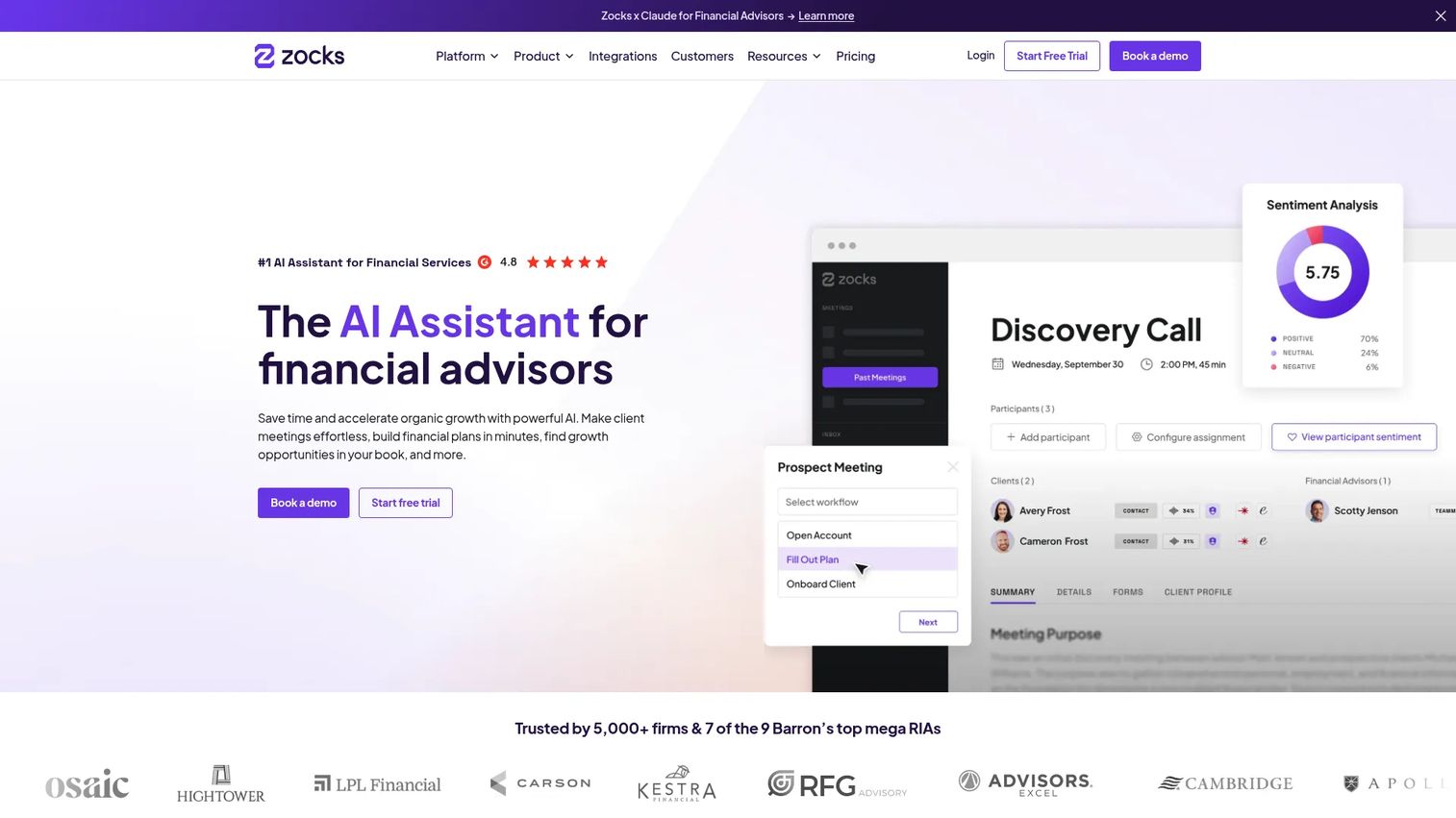
Zocks is an AI assistant for financial advisors that automates meeting preparation, notes, follow-up emails, form filling, and client data synchronization. Its notable design choice is that it captures meeting intelligence without requiring call recordings, which matters for firms with client consent and data retention concerns.
Best for: Advisory teams where post-meeting admin and CRM data quality are the primary operational bottlenecks.
Key features
- AI meeting prep and note-taking without recordings
- Automated client follow-up emails
- Form filling and workflow automation
- CRM, financial planning, and portfolio management integrations
- Client profiles, signals, and mobile workflows
Why choose Zocks: Choose Zocks when client conversations are the operational drag point. It is especially relevant when advisors spend significant time turning meetings into follow-up emails and CRM entries that then need correction.
Zocks pricing: Zocks starts at $67 per user per month on an annual plan (Essentials). Professional runs $117 per user per month annually, and Ultimate runs $184 per user per month annually. Monthly billing raises each tier by roughly 20%. A 14-day free trial is available. Enterprise pricing requires contacting sales.
G2 rating: 4.7/5.
3. ChatGPT
ChatGPT, built by OpenAI, is a general-purpose AI assistant that financial-services teams use for drafting, analysis, document interpretation, internal research, and structured financial questions. It is not purpose-built for advisory workflows, but its flexibility makes it useful for a wide range of finance-adjacent tasks when paired with clear internal policies.
Best for: Teams that need a flexible AI assistant across many finance tasks and have the internal governance to define approved use cases.
Key features
- Prompt-based analysis and research
- Document and file uploads with data interpretation
- Draft communications and summaries
- Custom GPTs for firm-specific workflows
- Voice conversations and web search
Why choose ChatGPT: Choose ChatGPT when the team needs breadth and experimentation speed. It works best when the firm has clear policies on sensitive data, model training controls, and mandatory output review before anything reaches clients or influences decisions.
ChatGPT pricing: A free plan is available with limited access. The Go plan is $8 per month. Plus is $20 per month. Pro starts at $100 per month. Business and Enterprise plans are available at higher tiers with organizational controls and security features.
G2 rating: 4.6/5.
4. Claude

Claude, built by Anthropic, is an AI assistant known for its strong long-context reasoning, careful summarization, and writing quality. Financial-services teams use it for dense document analysis: Policy reviews, due diligence packs, client file synthesis, internal research memos, and meeting prep from long source materials.
Best for: Teams that review large documents regularly and need careful, structured summaries before human decision-making.
Key features
- Long-context document analysis and upload
- Writing support and structured summaries
- Research synthesis with nuanced reasoning
- Projects with shared knowledge bases for teams
- Image analysis and web search
Why choose Claude: Choose Claude when the work involves reading dense materials and preparing decision-ready outputs. It is a strong fit for founders and operators who want faster synthesis without handing final judgment to the model.
Claude pricing: A free plan is available with limited usage. Pro is $20 per month (or $17 per month billed annually). Max plans run $100 to $200 per month for higher usage. Team is $30 per person per month (minimum five members), or $25 billed annually. Enterprise pricing requires contacting Anthropic.
G2 rating: 4.7/5.
5. Google Gemini
Google Gemini is Google's AI assistant for individuals and organizations already operating inside Google Workspace. For financial-services firms standardized on Gmail, Docs, Sheets, Drive, and Meet, it reduces context switching by bringing AI directly into the tools the team already uses.
Best for: Financial-services teams standardized on Google Workspace who want AI integrated into daily operations without adding a separate tool.
Key features
- Gmail drafting and email management
- Document summarization in Google Docs
- Data analysis and formula support in Sheets
- Drive search and knowledge retrieval
- Deep Research and Gemini Live conversations
Why choose Google Gemini: Choose Gemini when the firm's operational knowledge already lives in Google Workspace. The integration advantage matters most for teams with heavy email, shared document, and spreadsheet workflows.
Google Gemini pricing: A free plan is available with a Google account. Google AI Pro is $19.99 per month. Google AI Ultra starts at $99.99 per month with higher usage limits and additional model access.
G2 rating: 4.4/5.
6. Microsoft Copilot
Microsoft Copilot is the AI assistant for organizations embedded in Microsoft 365. It operates inside Outlook, Word, Excel, Teams, and SharePoint, which means financial-services firms that already run client communication, internal documentation, and meeting management on Microsoft get AI without a separate adoption curve.
Best for: Financial-services firms already embedded in Microsoft 365 where IT and security teams want AI adoption inside existing Microsoft governance controls.
Key features
- Outlook email drafting and thread summaries
- Word document drafting and editing
- Excel data analysis and formula generation
- Teams meeting recaps and action item capture
- SharePoint knowledge retrieval
Why choose Microsoft Copilot: Choose Copilot when the team's documents, spreadsheets, meetings, and client communication all run through Microsoft. It is strongest when IT and security have already vetted the Microsoft 365 environment. See also our roundup of AI copilot software for a broader category comparison.
Microsoft Copilot pricing: Microsoft 365 Personal starts at $9.99 per month. Family is $12.99 per month. Premium is $19.99 per month, and Pro is $99.99 per month, with Copilot features included at varying levels across plans.
G2 rating: 4.3/5.
7. Neurons Lab
Neurons Lab is an AI engineering partner that builds custom AI agents and assistants for financial-services organizations. Rather than a ready-made tool, it delivers governed, production-grade AI systems connected to proprietary workflows, internal data pipelines, and financial-services infrastructure. It also runs AI training and enablement programs for leadership and technical teams.
Best for: Financial-services firms that need a custom AI assistant connected to proprietary workflows and internal systems, not a configured version of a general tool.
Key features
- Custom AI agent development from discovery through production
- Advisor workflow automation connected to internal data
- AI training and enablement for leadership and technical teams
- Governed, auditable AI systems for regulated environments
- MCP integrations and data pipeline development
Why choose Neurons Lab: Choose Neurons Lab when a ready-made assistant cannot cover the workflow. It fits firms with unique data models, complex system architecture, or a need to build AI into existing operational processes with governance requirements that standard tools do not meet.
Neurons Lab pricing: Neurons Lab prices projects by engagement. Cost drivers include data access scope, integration depth, security and compliance requirements, and delivery timeline. Contact sales for a project estimate.
8. Capco

Capco is a global management and technology consultancy focused on financial services and energy. For AI programs, it helps institutions design operating models, build governance frameworks, align regulatory requirements, and deliver implementation programs across banking, capital markets, wealth management, and insurance.
Best for: Enterprise financial institutions that need AI strategy, process redesign, stakeholder alignment, and delivery support across teams.
Key features
- AI strategy and operating model design
- Financial-services consulting and delivery
- Cloud, data, and emerging technology services
- Product strategy and experience transformation
- Cybersecurity and regulatory alignment
Why choose Capco: Choose Capco when the problem is larger than a single AI assistant. It fits banks, insurers, and wealth firms that need help deciding what to build, who owns it, and how to change the operating model to make it stick.
Capco pricing: Capco prices by engagement. Cost drivers include scope, delivery timeline, team composition, and implementation complexity. Contact Capco directly for an estimate.
9. Synechron
Synechron is a digital transformation consulting and technology services firm specializing in AI, cloud, data engineering, and software delivery for regulated industries. Its financial-services practice covers AI agents, data modernization, enterprise architecture, and delivery across large institutions.
Best for: Large financial institutions building AI into core business and technology workflows at scale.
Key features
- AI engineering and agent development
- Data modernization and analytics
- Cloud and DevOps delivery
- Digital experience across Salesforce, ServiceNow, and Appian
- Cybersecurity and software engineering
Why choose Synechron: Choose Synechron when AI assistants need to connect with enterprise architecture, legacy systems, and institution-wide technology programs. It is a fit for large-scale delivery programs rather than a team-level assistant rollout. For firms exploring governance frameworks first, our guide to AI governance tools covers the adjacent category.
Synechron pricing: Synechron prices by project or engagement. Cost drivers include delivery model, integration complexity, and program length. Contact sales for a scoping conversation.
G2 rating: 3.0/5
10. Wipro
Wipro is a global technology services and consulting firm supporting AI transformation across banking, financial services, and insurance. It delivers enterprise AI implementation, managed services, cloud modernization, process automation, and strategic consulting at the scale that large institutions require.
Best for: Large financial-services organizations that need global delivery capacity, managed AI implementation, and long-term operational support.
Key features
- Enterprise AI and machine-learning implementation
- Managed services for ongoing AI operations
- Cloud advisory, migration, and infrastructure
- Process automation and finance transformation
- IT consulting across AI advisory, sales, supply chain, and operations
Why choose Wipro: Choose Wipro when the project requires global scale, deep system integration, and multi-year operational support. The focus is building AI into the operating model, not deploying a single assistant. For comparison, our roundup of agentic AI platforms covers the product layer that often sits above this implementation work.
Wipro pricing: Wipro prices by engagement. Cost drivers include implementation scope, managed services requirements, integration complexity, and staffing model. Contact Wipro for a project estimate.
G2 rating: 4.1/5 based on 41 reviews.
Considerations when choosing AI assistants for financial services
Start with the workflow, not the model
The question is not "which AI is best." The question is which workflow currently costs the most time or creates the most risk when done manually. Meeting notes, CRM updates, document review, and client onboarding all have measurable bottleneck costs. Pick the workflow first, then find the tool that eliminates it.
Verify data handling before any pilot
Financial-services data includes PII, account details, portfolio information, and client communications. Before entering any regulated or sensitive data into an AI assistant, confirm the vendor's data retention policy, model training controls, encryption standards, access controls, and whether your compliance team has approved the workflow. This is not a checklist item. It is the gate.
Require human review for advice and client-facing output
AI can prepare meeting summaries, draft follow-up emails, analyze documents, and flag relevant information. Licensed professionals and responsible humans must review output before it reaches clients or influences financial decisions. Financial recommendations, investment commentary, retirement planning outputs, and compliance-sensitive communications are not AI outputs. They are human decisions informed by AI.
Check integrations with the systems your team already uses
A tool that does not connect to your CRM, financial planning software, portfolio management system, or email becomes another tab that advisors will stop using within weeks. Verify integration depth before committing, not just integration availability. Check whether the data flows both directions or only one.
Measure adoption and payback in the first quarter
The tool should show measurable impact within 90 days or the ROI case gets harder to defend. Track hours saved per advisor per week, meetings processed, CRM update completion rates, and time from meeting to follow-up. For a Series B founder building repeatable operations, those numbers belong in your weekly data review, not an end-of-year retrospective.
Conclusion
The right AI assistant for financial services is the one that reduces drag in a specific workflow your team already runs, without creating compliance or data exposure you cannot manage.
For advisor-specific workflow automation, Jump handles the most ground: Meeting prep, notes, CRM sync, onboarding, and revenue signals in one platform. Zocks is the sharper choice when client conversations and post-meeting follow-up are the primary bottleneck. ChatGPT and Claude serve teams that need flexible analysis and document synthesis with strong human review in place. Google Gemini and Microsoft Copilot make the most sense for firms already standardized on those ecosystems. Neurons Lab, Capco, Synechron, and Wipro cover the custom and enterprise-grade programs that ready-made tools cannot reach.
The practical next step: Pick one workflow with measurable drag, choose one tool from this list that targets it directly, involve compliance and security before client data enters the system, and run a 90-day pilot. Prove it in one workflow before you scale it to ten.
For teams building the demo and product experience layer that sits above your AI workflow stack, Start your journey with Guideflow today!
FAQs
AI assistants for financial services are software tools or custom AI systems that help financial-services teams automate workflows, analyze documents, draft communications, summarize meetings, and support client service under human oversight. They include advisor-specific platforms, general AI chat tools, enterprise productivity copilots, and custom-built assistants connected to proprietary systems. All require human review for financial decisions and advice.
For end-to-end advisor workflow automation, Jump covers the most ground: Meeting prep, AI notes, CRM sync, follow-up, onboarding, and revenue signals. Zocks is the stronger pick when client conversation capture and post-meeting follow-up are the primary bottleneck. For general research and document drafting, ChatGPT and Claude work well when the firm has clear data handling policies in place.
AI assistants can explain financial concepts, summarize documents, draft educational materials, and support analysis. They should not deliver financial advice to clients as a final output. Licensed professionals and responsible humans must review AI-generated content before it reaches clients or influences investment, planning, or insurance decisions. This is a regulatory and professional obligation, not a product limitation.
Safety depends on the vendor's specific controls: Data retention policies, encryption, access controls, model training settings, and your firm's internal approval process. No AI assistant is automatically safe for sensitive client data. Financial-services firms should conduct a formal vendor security review and obtain compliance team sign-off before any regulated or personally identifiable information enters a system. For a broader view of governance frameworks, see our guide to AI governance tools.
Verify data handling and retention policies, compliance with relevant regulations for your firm type, audit trail capabilities, integration depth with existing systems, permission controls, output accuracy for your specific use cases, and the vendor's support model. Design a pilot with measurable success criteria before committing to a broader rollout. The best AI sales assistant software guide covers adjacent evaluation criteria for revenue-facing teams.
Ready-made tools fit common workflows: Meetings, notes, document review, and productivity inside existing ecosystems. Custom builds make sense when workflows involve proprietary data, core banking or custodial systems, unique compliance processes, or approval chains that standard tools cannot replicate. The cost and timeline for a custom build are significantly higher. Most firms benefit from piloting a ready-made tool first and identifying the specific gaps that require custom development.
Microsoft Copilot is the first option to evaluate for firms standardized on Outlook, Word, Excel, Teams, and SharePoint. It operates natively inside those tools and uses your existing Microsoft governance infrastructure. Confirm the specific Copilot plan included in your Microsoft 365 licensing before assuming access, as availability varies by plan. Our broader roundup of AI copilot software compares the category across vendors.
Google Gemini is the natural starting point for teams using Gmail, Docs, Sheets, Drive, and Meet. It integrates directly into those surfaces without requiring a separate login or workflow change. Test it against real tasks like document summarization, Sheets data analysis, and Gmail drafting before making a purchasing decision on the paid plans. For teams also evaluating best AI writing assistants for content work, Gemini's integration advantage applies there as well.