Your team wants to ship an AI feature. Maybe it's support-ticket summarization, intent classification, or an in-product guidance assistant. The instinct is to route every request to the largest hosted model available. Two weeks later, the cost per request is higher than expected, latency is inconsistent, and the security review has questions about where user data goes.
A small language model, or SLM, is not a downgraded version of a large one. It's a better fit for bounded tasks with clear evaluation criteria and constrained deployment requirements. The global SLM market reached $1.05 billion in 2025 and is projected to grow at a 28.71% CAGR through 2031, according to Mordor Intelligence (2026), driven precisely by teams that need inference closer to the user and closer to the budget line.
The right choice depends on what you need the model to do, where it runs, and what failure looks like in your product.
What's inside
This guide compares seven small language models for product teams planning local, edge, or cost-sensitive AI features. Models were selected based on:
- Model size and deployment target: Parameter count, effective-parameter design, and verified deployment contexts
- Modality and context-window fit: Whether the model handles text only, or adds image, audio, or video input
- Commercial licensing: Apache 2.0, Gemma terms, Meta community license, and usage-based API pricing
- Product use case: Local inference, mobile deployment, multilingual workflows, and hybrid routing
Model details, licenses, and supported modalities should be verified against current vendor documentation before production deployment.
TL;DR
- Best overall for compact multimodal workloads: Qwen3.5-4B, with text and vision support plus a 262K-token native context window under Apache 2.0
- Best for mobile and laptop multimodal experiences: Gemma 3n E4B, built for resource-aware deployment on lower-memory devices with text, image, and audio inputs
- Best for long-context text workflows in Microsoft environments: Phi-4-mini-instruct, with a 131K-token input window available through Azure AI Foundry
- Best for focused on-device text features: Llama 3.2 3B, a compact 128K-context option for classification and generation experiments
- Best for compact open-model experimentation: SmolLM3-3B, a fully open 3B model with hybrid reasoning and tool-calling support
- Best for multilingual product features: Qwen2.5-3B, covering 29-plus languages with Apache 2.0 licensing
- Best for teams already in the Mistral ecosystem: Ministral 3B, priced at $0.10 per million tokens via API
Treat these as starting points for a task-specific evaluation, not universal rankings.
What are small language models?
A small language model, or SLM, is a compact language model designed to perform language or multimodal tasks with lower memory, latency, and infrastructure requirements than a typical large language model.
"Small" has no fixed parameter cutoff. SLMs commonly range from a few hundred million to around 7 billion parameters, but what matters more than raw count is whether the model fits your deployment target: A mobile device, a single GPU, a private cloud instance, or a local developer machine.
Effective parameters, total parameters, modality encoders, precision settings, and context length all affect actual deployment behavior. A 4B model with a vision encoder uses more memory than a 4B text-only model at the same precision.
Small language models vs large language models
| Dimension | Small language models | Large language models |
|---|---|---|
| Best fit | Narrow, repeatable tasks | Broad reasoning and complex synthesis |
| Deployment | Local, edge, private cloud, single GPU | Hosted APIs or larger infrastructure |
| Latency | Often lower | Often higher |
| Cost per request | Often lower | Often higher |
| Privacy control | Can support local inference | Often requires external inference |
| Capability ceiling | Lower on complex, open-ended work | Higher on difficult reasoning and broad generalization |
Optimization techniques that shape SLM behavior
- Knowledge distillation: A smaller model is trained to imitate a larger model's outputs
- Quantization: Weights are stored at lower precision, reducing memory use at the cost of some output fidelity
- Pruning: Low-value weights or structures are removed to shrink the model
- Low-rank adaptation (LoRA): A parameter-efficient technique for task-specific fine-tuning without retraining the full model
Compression and quantization can affect output quality. Test on the exact task and deployment configuration before committing.
When to use small language models
Run low-latency product features
Use an SLM when the task is narrow and measurable: Classifying support tickets by category, extracting structured fields from user input, or generating short suggested replies. The task needs a defined success criterion and a labeled evaluation set before you pick a model. Routing everything to a hosted large model for jobs a compact one handles well adds cost and latency your users will notice.
Keep sensitive workflows closer to the device or private infrastructure
Local inference means user data doesn't leave the device or your environment. For teams building features that handle personal, financial, or health-adjacent data, this changes the security review conversation. Local deployment does not automatically satisfy legal or compliance requirements, but it removes one class of data-handling risk from the architecture discussion.
Route routine requests away from larger models
Build a hybrid architecture early. Send predictable, well-scoped requests to an SLM. Measure confidence, task fit, and failure conditions. Escalate ambiguous or complex requests to a larger model or a human review queue. This approach keeps costs predictable, gives you clear observability into where the model struggles, and avoids committing every request to the highest-cost inference path.
Small language models comparison
The table below is a shortlist for scoping, not a benchmark leaderboard. Test each candidate against your own prompts, data formats, and target hardware before narrowing to one.
| # | Product | Best for | Key differentiator | Pricing | G2 rating |
|---|---|---|---|---|---|
| 1 | Qwen3.5-4B | Compact multimodal product features | Text and vision support with 262K native context, Apache 2.0 | Open weights | N/A |
| 2 | Gemma 3n E4B | Mobile and laptop multimodal AI | Effective-parameter architecture for resource-aware deployment | Open weights, Gemma terms | N/A |
| 3 | Phi-4-mini-instruct | Long-context text tasks | 131K input context in Azure AI Foundry, free access available | Free on Foundry; Azure pay-as-you-go | N/A |
| 4 | Llama 3.2 3B | On-device text experiences | 128K context, multilingual, Meta community license | Open weights | N/A |
| 5 | SmolLM3-3B | Lightweight open-model experimentation | Hybrid reasoning, tool calling, 128K context via YaRN | Open weights | N/A |
| 6 | Qwen2.5-3B | Multilingual text tasks | 29-plus languages, structured JSON output, Apache 2.0 | Open weights | N/A |
| 7 | Ministral 3B | Compact Mistral-family deployment | Usage-based API at $0.10 per million tokens | $0.10/M tokens | N/A |
These model families are not conventional SaaS products with G2 listings, so G2 ratings are not applicable. Pricing and feature details verified against official vendor documentation as of October 2026.
Best 7 small language models for 2026
1. Qwen3.5-4B
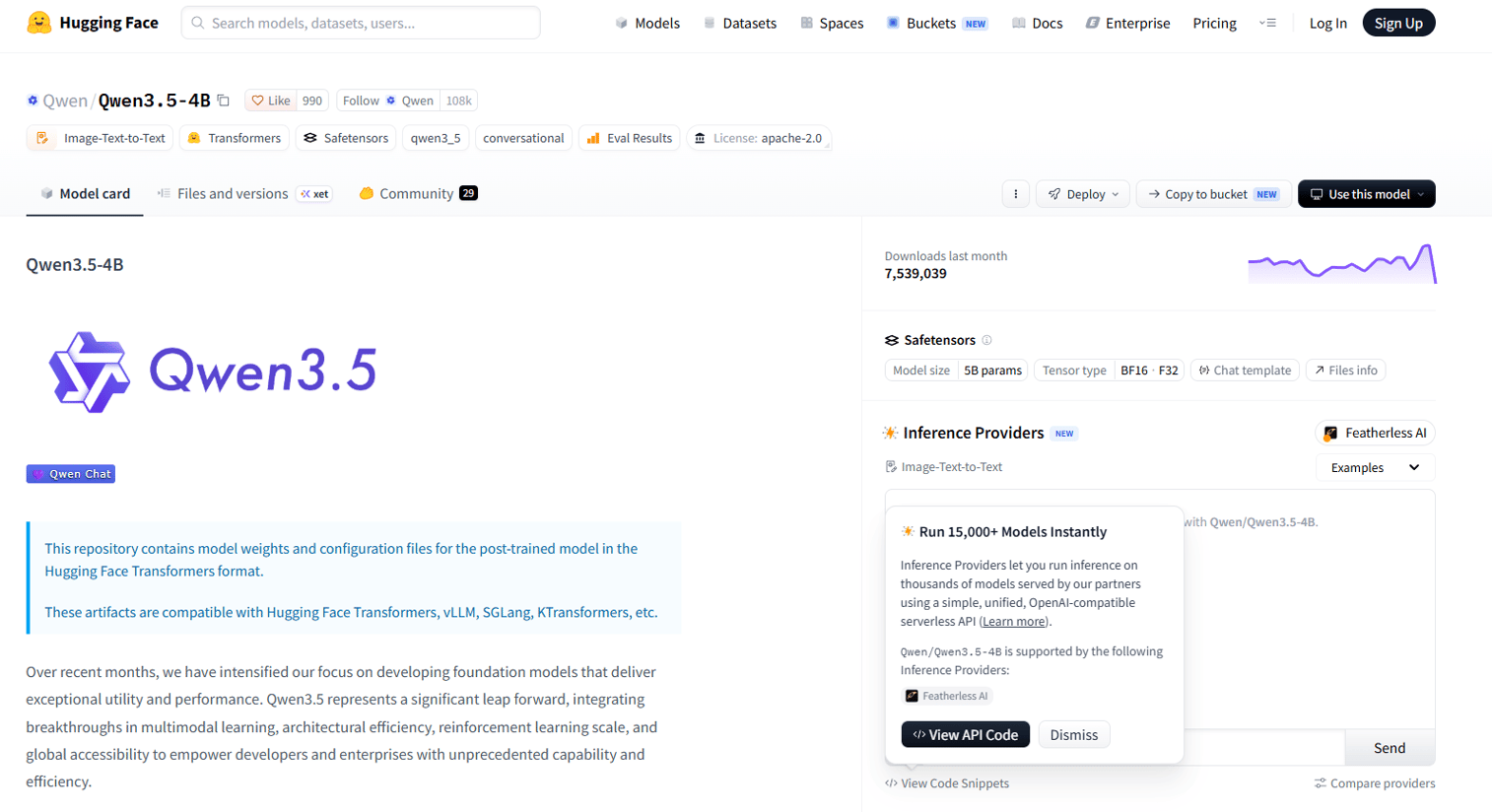
Qwen3.5-4B is an open-weight 4-billion-parameter multimodal causal language model with a vision encoder for text and image understanding. The official Hugging Face model card verifies 4B language-model parameters, a native 262,144-token context window (extensible up to 1,010,000 tokens), and compatibility with common inference frameworks including Transformers, vLLM, and SGLang.
Best for: Product teams building compact multimodal assistants that need to interpret screenshots, documents, or image-plus-text inputs without provisioning a large hosted model.
Key features
- Vision-language input support with text and image understanding
- 262,144-token native context window, extensible to 1,010,000 tokens
- Compatible with Transformers, vLLM, SGLang, and KTransformers
- Apache 2.0 license for commercial use
- Supports local and managed inference deployment
Why choose Qwen3.5-4B: Use it when your roadmap requires more than plain text but can't justify a large multimodal model for every request. It's a strong candidate for document extraction, visual support workflows, and multilingual product assistants where the context window and image input genuinely matter.
Qwen3.5-4B pricing: Open weights are available under Apache 2.0 at no license cost. Budget for inference infrastructure, storage, and any managed serving layer your team selects.
PM evaluation prompts: Ask engineering to measure p95 latency with realistic image sizes, accuracy on screenshots from your actual product UI, and context retention on the longest inputs your users realistically submit. Track cost per successful workflow completion, not just raw inference speed.
2. Gemma 3n E4B
Gemma 3n E4B is Google's open-weight multimodal model built for efficient execution on mobile devices and laptops. The official model card confirms text, image, and audio inputs with text output, a 32K-token context window, a MatFormer architecture with selective parameter activation, Per-Layer Embedding caching, conditional parameter loading, and training data covering more than 140 languages.
Best for: Product managers prioritizing mobile, laptop, or offline-adjacent experiences where multimodal input adds user value but device memory is a hard constraint.
Key features
- Text, image, and audio inputs with text output
- 32K-token context window
- MatFormer architecture with conditional parameter loading
- Per-Layer Embedding caching for efficient memory use
- More than 140 languages in training data
Why choose Gemma 3n E4B: Choose it when device constraints are a product requirement, not an engineering afterthought. Its effective-parameter approach and conditional loading create a practical evaluation path for multimodal features that must run within tighter device budgets, without requiring the team to start from scratch on a custom architecture.
Gemma 3n E4B pricing: Open weights are available under Gemma's terms of use. Confirm the current terms with legal before commercial distribution or fine-tuning, as the Gemma license differs from Apache 2.0 in some commercial scenarios.
PM evaluation prompts: Test on the actual target device class. Measure battery impact, cold-start time, memory footprint, and user-perceived latency under realistic concurrent load. Offline behavior should be validated against the failure modes your product needs to handle gracefully.
3. Phi-4-mini-instruct
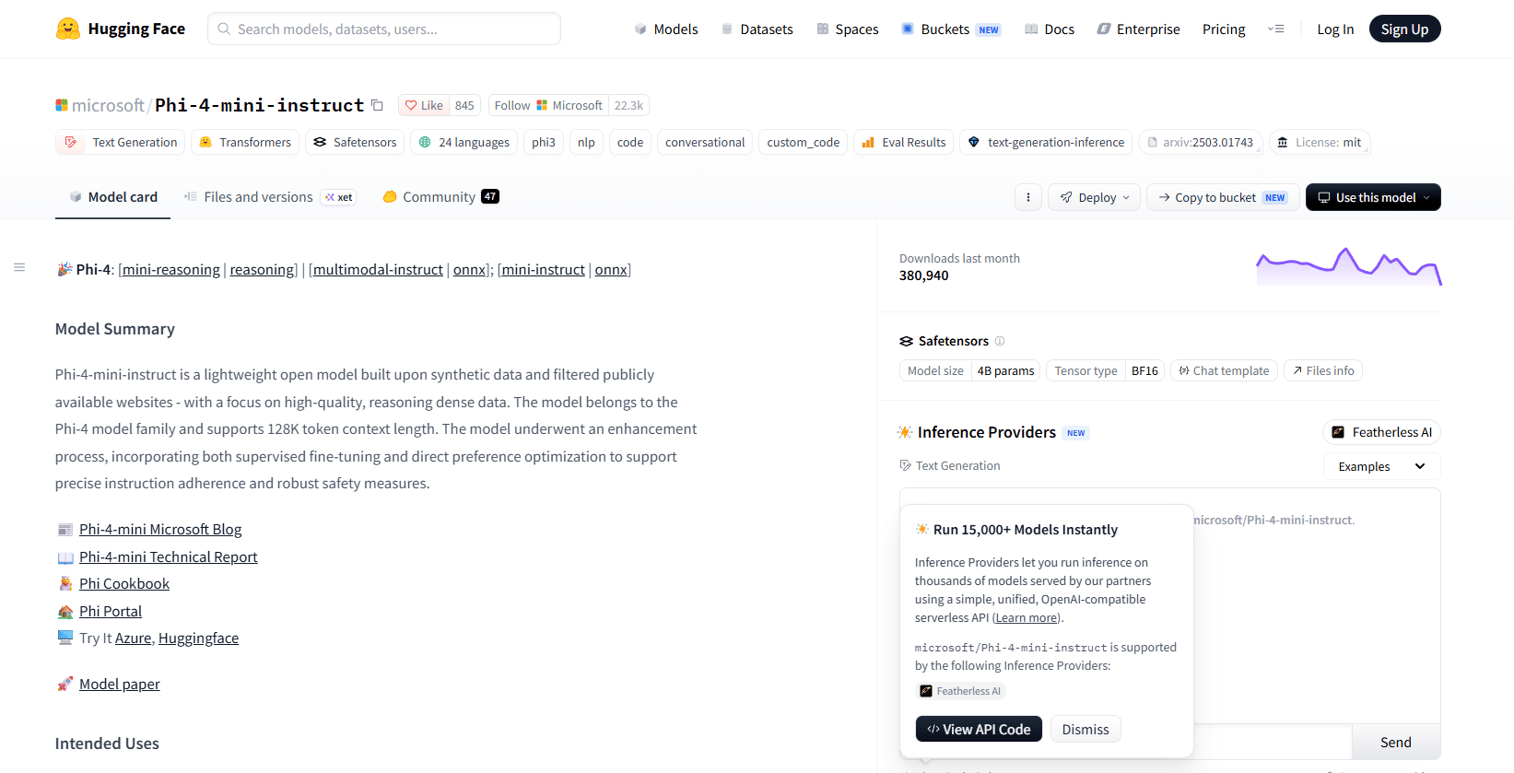
Phi-4-mini-instruct is Microsoft's compact chat-completion language model available through Azure AI Foundry. Microsoft Learn documentation confirms a 131,072-token input context window, a 4,096-token maximum output, and multilingual support covering English, Spanish, French, German, Japanese, Korean, Chinese, and additional languages.
Best for: Teams already working in Azure or Microsoft Foundry that need long-context summarization, extraction, or knowledge-assistant tasks without moving outside their existing infrastructure.
Key features
- 131,072-token input context window
- 4,096-token maximum output per response
- Chat-completion format, text input and text output
- Multilingual support across major languages
- Available through Azure AI Foundry and Hugging Face
Why choose Phi-4-mini-instruct: It's a practical shortlist candidate when long documents are central to the user workflow and your infrastructure already runs on Azure. A PM should still validate retrieval quality, hallucination behavior, and latency on full-length inputs before assuming the context window translates to usable product performance.
Phi-4-mini-instruct pricing: Microsoft states Phi models can be accessed free for real-time deployment through Foundry. Azure Foundry pricing beyond that tier follows a pay-as-you-go model; verify current capacity limits and regional availability on the Azure pricing page before finalizing architecture.
PM evaluation prompts: Benchmark on realistic knowledge-base articles, support threads, and long user-submitted documents. Track answer completeness, hallucination rate on factual queries, and the percentage of responses that require human correction before reaching users.
4. Llama 3.2 3B
Llama 3.2 3B is a 3-billion-parameter multilingual text-generation model developed by Meta. Official Meta documentation confirms a 128K-token context length, multilingual text input, and instruction-tuned versions optimized for dialogue, agentic retrieval, and summarization workflows.
Best for: Focused text tasks such as classification, short-form assistance, intent routing, and constrained in-product help where compact local deployment matters more than multimodal capability.
Key features
- 3B parameters with 128K-token context length
- Multilingual text input and text output
- Instruction-tuned variants for dialogue and retrieval
- Broad tooling ecosystem across inference frameworks
- Fine-tuning support via LoRA and compatible methods
Why choose Llama 3.2 3B: Use it as a widely supported compact baseline in your evaluation. Engineering teams have extensive familiarity with the Llama family, which shortens the time from model selection to a working prototype. The question is whether the task you've scoped actually needs generative output, or whether retrieval and structured rules should carry more of the work.
Llama 3.2 3B pricing: Open weights are available under Meta's community license. Confirm commercial terms, redistribution requirements, and any hosting-related obligations before production deployment.
PM evaluation prompts: Compare a quantized variant against a hosted baseline on your specific task. Measure task success rate, response time at p95, and the percentage of requests that require fallback handling. Cost per successful completion is a more useful production metric than raw throughput.
5. SmolLM3-3B
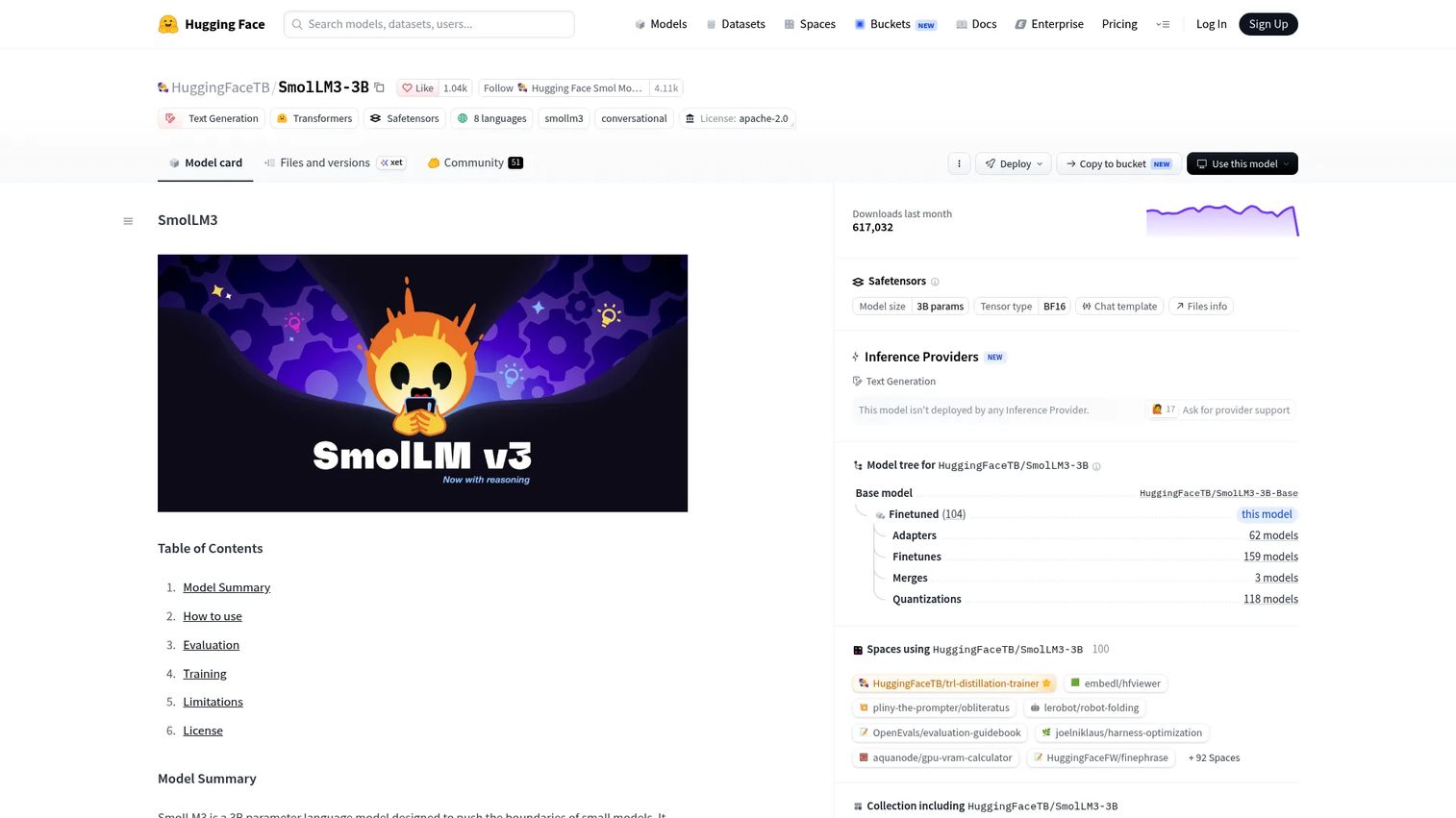
SmolLM3-3B is a fully open 3B-parameter decoder-only language model from Hugging Face designed for hybrid reasoning, multilingual use, and long-context processing. The official model card confirms extended-thinking and no-thinking modes, context support up to 128K tokens via YaRN extrapolation, native support for English, French, Spanish, German, Italian, and Portuguese, tool calling via XML or Python tools, and fully open weights with published training details.
Best for: Early product experiments, constrained local prototypes, and teams building an internal model-comparison harness where full transparency into training is a requirement.
Key features
- Hybrid reasoning with extended-thinking and no-thinking modes
- Up to 128K-token context via YaRN extrapolation
- Native support for six European languages
- Tool calling via XML or Python tool schemas
- Open weights with public training details
Why choose SmolLM3-3B: It's useful when your team needs to understand what a compact model can do before widening the scope of the feature. The published training details and fully open weights make it a strong choice for teams that want to fine-tune on proprietary data or run internal red-teaming without opaque model behavior.
SmolLM3-3B pricing: Open weights are available on Hugging Face. Verify the current license variant on the model card before commercial deployment. Budget for compute, storage, and model monitoring separately.
PM evaluation prompts: Use a small, labeled benchmark set built from your actual user data. Include edge cases, vague instructions, and known harmful or irrelevant requests. The hybrid reasoning mode adds an evaluation dimension: Test whether the extended-thinking path improves task accuracy on the cases that matter most.
6. Qwen2.5-3B
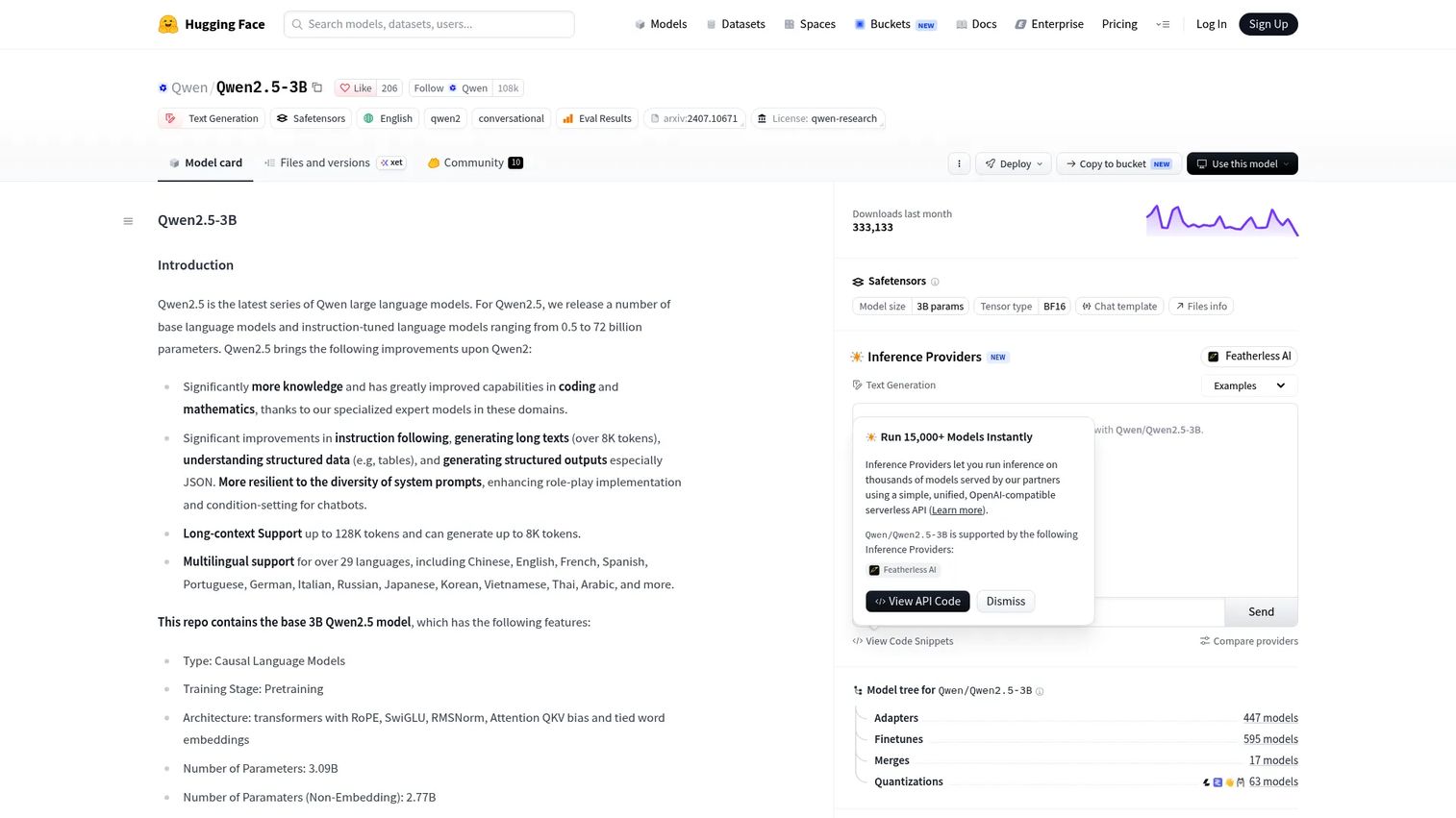
Qwen2.5-3B is a 3.09B-parameter base causal language model in the Qwen2.5 family. The official model card confirms a 32,768-token context length, multilingual support across more than 29 languages, improved coding and mathematics capabilities, structured JSON output generation, and a Transformers architecture with RoPE, SwiGLU, RMSNorm, GQA, and tied word embeddings.
Best for: Multilingual support workflows, regional product experiences, localized content assistance, and language-aware classification where broad language coverage at a compact size is the primary requirement.
Key features
- 3.09B parameters with 32,768-token context length
- Multilingual support for more than 29 languages
- Structured JSON output generation
- Improved coding and mathematics performance
- Apache 2.0 license
Why choose Qwen2.5-3B: Use it when language coverage shapes the product requirement. Do not rely on aggregate benchmark scores across all supported languages. Test the exact languages, terminology, and mixed-language patterns found in your user data, because quality varies across the language set.
Qwen2.5-3B pricing: Open weights are available under Apache 2.0. Infrastructure and deployment path costs are the primary budget line, not the model itself.
G2 rating: N/A. The G2 rating available for Hugging Face as a platform (4.4/5) reflects the hosting service, not this specific model.
PM evaluation prompts: Test English plus each priority customer language. Include product-specific terminology, abbreviations, misspellings, and locale-specific formats such as date styles and currency symbols. Measure quality degradation across languages relative to your primary market before committing to rollout.
7. Ministral 3B
Ministral 3B is Mistral's compact, efficient open model for edge deployments. Official Mistral documentation confirms text-to-text capability, agentic capabilities, and a lightweight edge design. The model is available via Mistral's API at verified usage-based pricing.
Best for: Teams seeking a compact instruction-tuned option within an existing Mistral evaluation or deployment workflow, particularly where cost-per-token predictability matters.
Key features
- Text-to-text with agentic capabilities
- Lightweight edge model design
- Usage-based API access with transparent per-token pricing
- Mistral-family ecosystem and tooling compatibility
- Local and hosted deployment paths
Why choose Ministral 3B: It belongs on the shortlist when ecosystem alignment reduces implementation risk. If your organization already has Mistral tooling, governance patterns, or hosting preferences in place, evaluating a compact family member shortens the path from prototype to production.
Ministral 3B pricing: Mistral's API prices Ministral 3B at $0.10 per million input tokens and $0.10 per million output tokens, verified on the official Mistral pricing page as of October 2026. Batch API pricing is also available; check the current page for discount terms on batch workloads.
PM evaluation prompts: Measure whether ecosystem consistency delivers a practical advantage: Faster deployment cycles, cleaner monitoring integration, or simpler governance compared to evaluating a model from a different family. Track cost per completed task against your latency budget to validate the per-token pricing at your expected request volume.
Considerations when choosing small language models
Define the task before comparing models
Build a representative evaluation set before selecting a model. Include common cases, edge cases, ambiguous inputs, and requests that should be declined or escalated. A product team should measure task success rate on this set, not leaderboard position. An onboarding assistant should be judged by correct next-step guidance, completion rate, and support-ticket deflection, not by a general reasoning benchmark.
Model the full deployment budget
Parameter count is only one input. Include model precision, quantization level, context length, concurrent sessions, batch size, and vision or audio encoder overhead in the sizing discussion. Ask engineering for p50 and p95 latency on the target environment. A prototype that works once on a developer laptop does not prove a production experience at scale.
Treat licensing as a product requirement
Open weights do not mean identical commercial rights. Apache 2.0 (Qwen3.5-4B, Qwen2.5-3B) is permissive for most commercial uses. Gemma's terms, Meta's community license, and Mistral's API terms each carry different obligations around redistribution, fine-tuning, and attribution. Legal review before production deployment is not optional.
Plan for failure and routing
SLMs produce wrong, incomplete, or fabricated outputs on tasks outside their capability. Define ahead of time when the product should ask for clarification, retrieve more context, route to a larger model, or escalate to a human. A fallback rate above your threshold is an architecture signal, not just a model quality signal.
Instrument from day one
Track latency, cost per completion, task success, fallback rate, and user correction rate from the first production session. Tie the model's behavior to product metrics like activation rate, time to first value, and support-ticket deflection. Without this instrumentation, you can't prove ROI or identify which segment the model serves poorly.
Conclusion
These seven models represent the clearest starting points for teams evaluating compact AI for narrow product features in 2026. Each fits a different deployment reality:
Qwen3.5-4B is the strongest compact multimodal option under Apache 2.0. Gemma 3n E4B is purpose-built for resource-aware mobile and laptop contexts. Phi-4-mini-instruct serves long-context text workflows for teams already on Azure infrastructure. Llama 3.2 3B offers a familiar, well-tooled baseline for focused local text features. SmolLM3-3B is the most transparent option for experimentation and fine-tuning. Qwen2.5-3B covers multilingual workflows with strong language breadth. Ministral 3B gives Mistral-ecosystem teams a predictable per-token cost at the compact end.
Don't choose a model from a parameter count alone. Pick two candidates, define a task-specific evaluation set, run them on your target hardware, and compare product outcomes before committing to an architecture. The model that passes your evaluation set on your data, at your latency budget, is the right one regardless of where it sits on any public leaderboard.
For related reading on deploying AI in product contexts, see our guides on AI model deployment software, agentic AI platforms, and AI customer service software.
FAQs
A small language model is a compact language model designed for lower-cost, lower-latency, or local deployment relative to larger models. "Small" has no fixed parameter cutoff and typically refers to models in the range of a few hundred million to around 7 billion parameters, depending on the deployment target. The defining characteristic is fit for a constrained environment, not a specific number.
The difference is primarily scale, deployment profile, and capability ceiling. SLMs fit bounded, repeatable tasks where latency and cost are product requirements. Larger models tend to perform better on complex reasoning, broad generalization, and tasks that require synthesizing diverse knowledge. The two are often used together in hybrid routing architectures rather than as direct substitutes.
Yes, depending on model size, quantization, context length, and available memory. A 3B model at 4-bit quantization fits within the memory budget of many modern developer laptops. Teams should test the target model under realistic concurrent usage rather than a single-request demo, because memory pressure and latency behave differently at scale.
They can when the model weights and inference runtime are deployed locally. Offline operation removes external API dependency but doesn't resolve security, licensing, update-management, or model-versioning obligations. Those requirements need separate planning regardless of whether inference is local or hosted.
Start with models designed for resource-aware deployment, specifically Gemma 3n E4B, which is built for mobile and laptop contexts with conditional parameter loading. The final choice depends on input type (text only, image, audio), target device memory, acceptable battery impact, app binary size constraints, and response-time requirements on the specific device class you're shipping to.
For narrow, measured tasks with a clear evaluation set, yes. Customer-facing deployment requires task-specific accuracy validation, defined refusal or escalation behavior, retrieval or routing controls, and a fallback path for low-confidence responses. "Accurate enough" is a product threshold you define from your evaluation set, not a benchmark score the model vendor publishes.
Most do. LoRA and other parameter-efficient fine-tuning methods let teams adapt a model to a specific task without retraining from scratch. Fine-tuning should follow a baseline evaluation and a clear hypothesis about what behavior the model needs to learn. Skipping the baseline makes it hard to measure whether fine-tuning helped or whether a better prompt would have achieved the same result.
Track task success rate, p95 latency, cost per successful completion, fallback rate, and user correction rate from day one. Connect those operational metrics to downstream product outcomes: Activation rate, time to first value, retained usage after 7 days, and support-ticket deflection. If the model improves the operational metrics but doesn't move the product metrics, the task definition or integration point probably needs revisiting.
Quantization stores model weights at lower numerical precision, typically reducing memory use and improving inference speed at the cost of some output fidelity. A 4-bit quantized 3B model uses roughly a quarter of the memory of the same model at full 32-bit precision. Teams should evaluate quantized variants specifically, because accuracy degradation varies by task and the quantization settings that work for one workflow may not hold for another.
Model routing sends requests to different models based on task characteristics. Predictable, well-scoped requests go to the SLM. Requests that exceed confidence thresholds, involve complex reasoning, or match known failure patterns route to a larger model or a human queue. Effective routing requires instrumented confidence signals, a clear taxonomy of request types, and fallback logic defined before launch, not patched in after the first production incident. For more on agentic AI tools and AI copilot software that can sit alongside SLM-powered features, see those dedicated guides.