Security teams are no longer reviewing only human-written code. They are reviewing AI-generated code, dependency changes, pipeline artifacts, agent behavior, and runtime signals, often with the same headcount they had three years ago.
The math is breaking down. According to Stack Overflow's 2025 developer survey, 84% of developers use or plan to use AI tools in their development process, based on 33,662 responses to that question. Confidence in the resulting code is a different story. In the ACM SAC '25 paper My Code Is Less Secure with Gen AI, Kudriavtseva, Hotak, and Gadyatskaya surveyed 105 developers and found that 25% felt somewhat or very confident in the security of AI-generated code. That is a small sample, so treat it as a directional signal rather than an industry measurement. More code, less confidence, same team size.
Traditional scanning tools surface findings faster than anyone can triage them. Developers stop trusting noisy queues. Security reviews slow down deals. Enterprise buyers ask harder questions during POCs. The problem is no longer detection. The problem is making detected findings actionable.
AI AppSec assistants exist to close that gap. The best ones coordinate triage, prioritization, remediation routing, and governance in a way that static scanners never could. This guide maps the seven tools worth evaluating in 2026, including both dedicated AppSec assistants and the AI coding tools that shape the workload they have to handle.
What's inside
This guide covers 7 AI AppSec assistants and AI-enhanced AppSec platforms for 2026. It is written for AppSec teams, DevSecOps leaders, security-minded engineering teams, and presales teams supporting security diligence during enterprise evaluations.
Items were chosen based on:
- Triage depth: does the tool do more than summarize findings?
- Remediation support: does it generate fixes, route tickets, or validate patches?
- Developer workflow fit: does it connect to GitHub, GitLab, Jira, Slack, and CI/CD pipelines?
- Governance and auditability: can it produce logs, permissions, and scoped access evidence?
Pricing and G2 figures in this guide reflect published vendor pages and G2 listings as read in late October 2026. Vendors change both frequently, and several of the prices below are promotional or quote-only, so confirm current figures on the vendor page before you build a business case.
TL;DR
- Best overall for AppSec workflow automation: ZeroPath AI AppSec Assistant, with AI-native SAST, SCA reachability, auto-fix, and triage workflows built for daily security operations
- Best for enterprise AI supply-chain security: OX Security, covering code, cloud, pipelines, agents, and runtime context in one platform
- Best for runtime application defense: Digital.ai Application Security, focused on post-deployment protection through obfuscation, RASP, and anti-tamper controls
- Best for application security posture management: Cycode, unifying code, secrets, CI/CD, SBOM, and developer workflow signals into a single posture view
- Best for broad enterprise security coverage: Trend Micro, with workload, cloud, network, and endpoint coverage for organizations that need AppSec signals inside a larger security program
- Best AI coding assistants with security relevance: GitHub Copilot and Cursor both accelerate development velocity, but neither replaces dedicated AppSec platforms. Pair them with scanning and governance tooling.
What is AI AppSec assistant software?
AI AppSec assistant software helps security and engineering teams detect, triage, prioritize, remediate, and govern application security risks using AI-driven analysis and workflow automation.
This category sits above the scanner. Traditional SAST and SCA tools identify findings. AI AppSec assistants go further by analyzing exploitability, grouping related findings, generating remediation guidance, creating tickets, routing ownership, and documenting what happened. The best tools also handle AI-generated code, software supply chain security, pipeline artifacts, and runtime signals, not just source-code vulnerabilities.
Core capabilities to look for:
- AI vulnerability triage: grouping, deduplication, and exploitability scoring across findings
- Secure code review support: automated PR analysis and inline remediation suggestions
- SAST and SCA enrichment: context beyond raw scanner output, including reachability
- SBOM and PBOM visibility: dependency and model artifact tracking for software supply chain security
- Remediation guidance or patch creation: from explanation to automated fix generation
- Prompt injection and agent security controls: for teams building or evaluating AI-powered products
- Runtime or attack-path context: connecting code-level findings to live infrastructure risk
- Ticketing and collaboration integrations: Jira, Linear, Slack, and similar tools
- Audit logs, permissions, and governance: scoped access, role controls, and evidence for security review
What this category is not:
AI AppSec assistants are not generic chatbots layered over a CVE database. They are not traditional scanners with an AI marketing update. They also do not replace security ownership, because a human still needs to approve production changes, validate fixes, and maintain accountability for the organization's security posture.
For teams evaluating application security testing software or AI security posture management tools, this category fills the gap between raw detection and operational response.
When to use AI AppSec assistants
Triage findings before they hit engineering
Scanner queues grow faster than anyone can review them. When developers see hundreds of unranked findings in a backlog, they stop engaging. AI AppSec assistants help by grouping related issues, adding exploitability and reachability context, and generating clear ticket descriptions that engineering can act on. This matters for presales teams supporting security diligence, because a buyer who asks how your team handles false positives deserves a workflow answer, not a scanner screenshot.
Review AI-generated code before it ships
According to Google's 2025 DORA research, as reported by TechTarget, around 90% of technology professionals now use AI tools in their work, and roughly 65% say they rely on AI for software development to at least a moderate degree. The DORA sample is close to 5,000 respondents. That volume of generated code increases review burden sharply. AI AppSec assistants can flag insecure patterns, unsafe dependency choices, and missing validation controls earlier in the pipeline, before a review becomes a crisis. The key caveat is that AI-generated code still needs human review, policy enforcement, and testing. The assistant accelerates that process; it does not remove it.
Prove governance during enterprise security review
Enterprise buyers now ask for more than a SOC 2 report. They ask about permissions, audit logs, repository boundaries, and integration controls during POC. AI AppSec assistants that expose scoped execution modes, traceable workflows, role-based access, and detailed logs give security-conscious buying committees the evidence they need to move forward. Faster security review depends on evidence, not assurance.
AI AppSec assistant comparison
The table below is a shortlist for initial evaluation. Pricing and G2 figures reflect published vendor pages and G2 listings as read in late October 2026. Complete this comparison with hands-on testing against representative repositories before making a purchase decision.
| # | Product | Best for | Key differentiator | Pricing | G2 rating |
|---|---|---|---|---|---|
| 1 | ZeroPath AI AppSec Assistant | AppSec workflow automation | AI-native SAST, SCA reachability, auto-fix, and triage in one assistant | From $1,000/mo plus $60 per active developer | 4.5/5 (11 reviews) |
| 2 | OX Security | Enterprise AI supply-chain security | Code-to-runtime coverage with agentic pentesting and PBOM/SBOM | Custom pricing | 4.8/5 (51 reviews) |
| 3 | Digital.ai Application Security | Runtime application defense | Obfuscation, RASP, anti-tamper, and threat monitoring post-deployment | Custom pricing | Not listed on G2 |
| 4 | Cycode | Application security posture management | 120+ connectors unifying code, pipeline, secrets, SBOM, and cloud signals | Custom pricing | 4.0/5 (3 reviews) |
| 5 | Trend Micro | Broad enterprise security coverage | Endpoint, cloud, workload, and network security across one platform | Consumer tiers from $29.95/year promotional; business pricing on request | 4.1/5 (26 reviews) for TippingPoint network security, not the cloud and workload products described here |
| 6 | GitHub Copilot | AI-assisted secure development in GitHub | Repository-aware code suggestions with PR review assistance | Free tier; paid from $10/user/mo | 4.4/5 (400 reviews) |
| 7 | Cursor | Fast AI coding in the IDE | Codebase-aware agents with multi-file editing and PR workflow support | Free tier; paid from $8/mo | 4.6/5 (329 reviews) |
The 7 tools, reviewed
1. ZeroPath AI AppSec Assistant
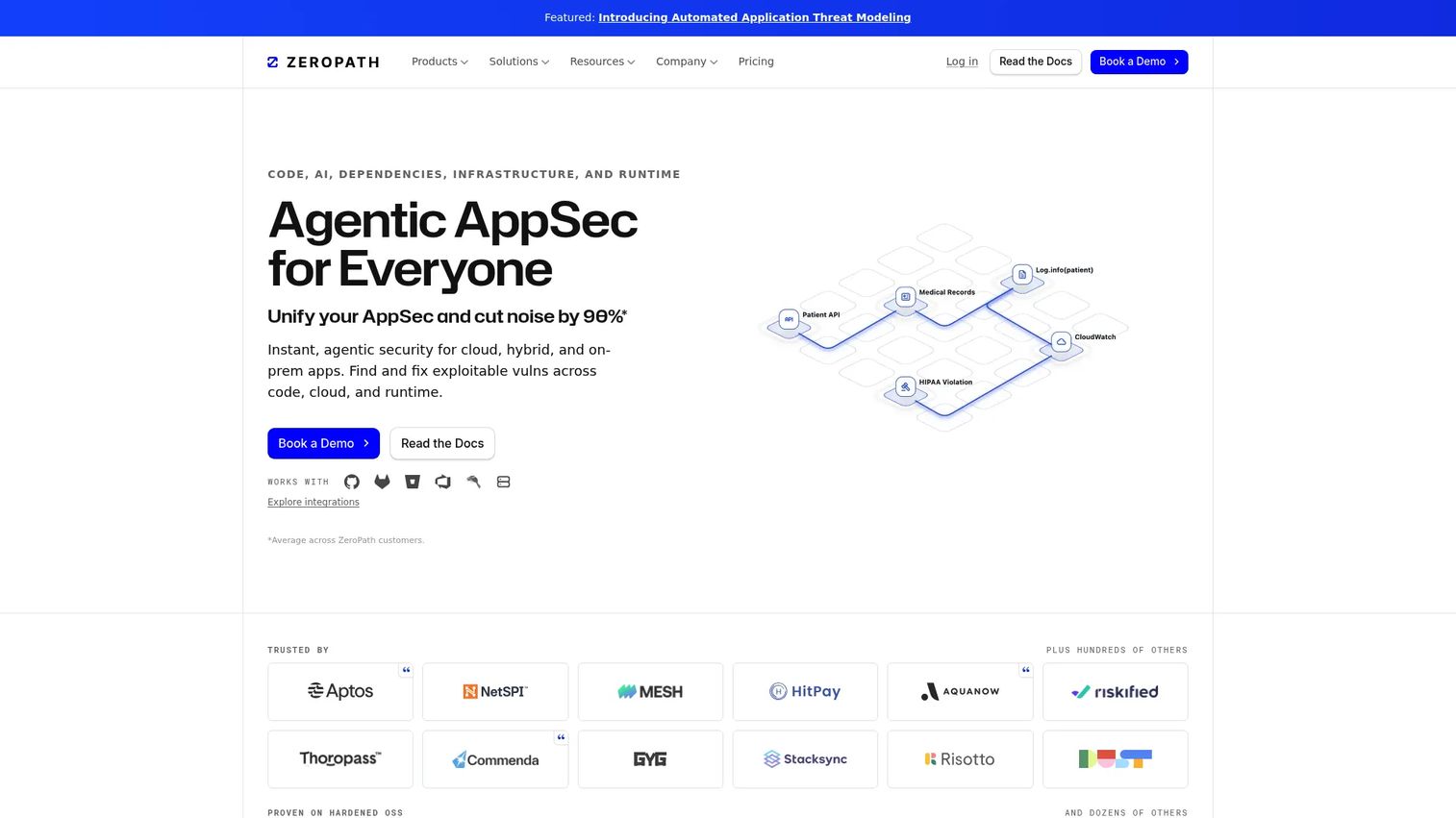
ZeroPath is an AI-native application security platform built around a security assistant that coordinates detection, triage, remediation, ownership, and escalation workflows. It covers SAST with business-logic flaw detection, SCA with reachability analysis, secrets detection, and IaC scanning. Its assistant works across dashboard workflows, quick chat, inbound webhooks, and scheduled tasks, with persistent context and both trusted and untrusted execution modes for scoped action.
Best for: AppSec and engineering teams that need context-aware vulnerability detection and automated remediation across repositories and developer tools.
Key features
- AI-native SAST covering business-logic flaws, broken authentication, and authorization bypasses
- SCA reachability analysis plus secrets and IaC scanning
- Automated PR reviews with one-click AI-generated fixes
- Scheduled AppSec tasks and inbound webhook automation
- Integrations with GitHub, GitLab, Bitbucket, Azure DevOps, Jira, Linear, and Slack
Why choose ZeroPath: If your team already has scanners but no triage capacity, ZeroPath's assistant does the operational work, not just the detection. It fits teams where security engineers spend too much time routing findings rather than fixing them.
ZeroPath pricing: The Team plan starts at $1,000/month plus $60 per active developer per month, and ZeroPath counts only developers who use the tool day to day. All plans include unlimited repositories and scans, plus AI-native SAST, SCA, auto-fix, SSO/SAML, and Jira, Linear, and Slack integrations. Enterprise pricing is custom and adds on-premises or self-hosted deployment, bring-your-own-key LLM access, SCIM, a policy engine, and custom compliance reports. A usage-based credits plan is listed as coming soon with no published price.
G2 rating: 4.5/5
2. OX Security
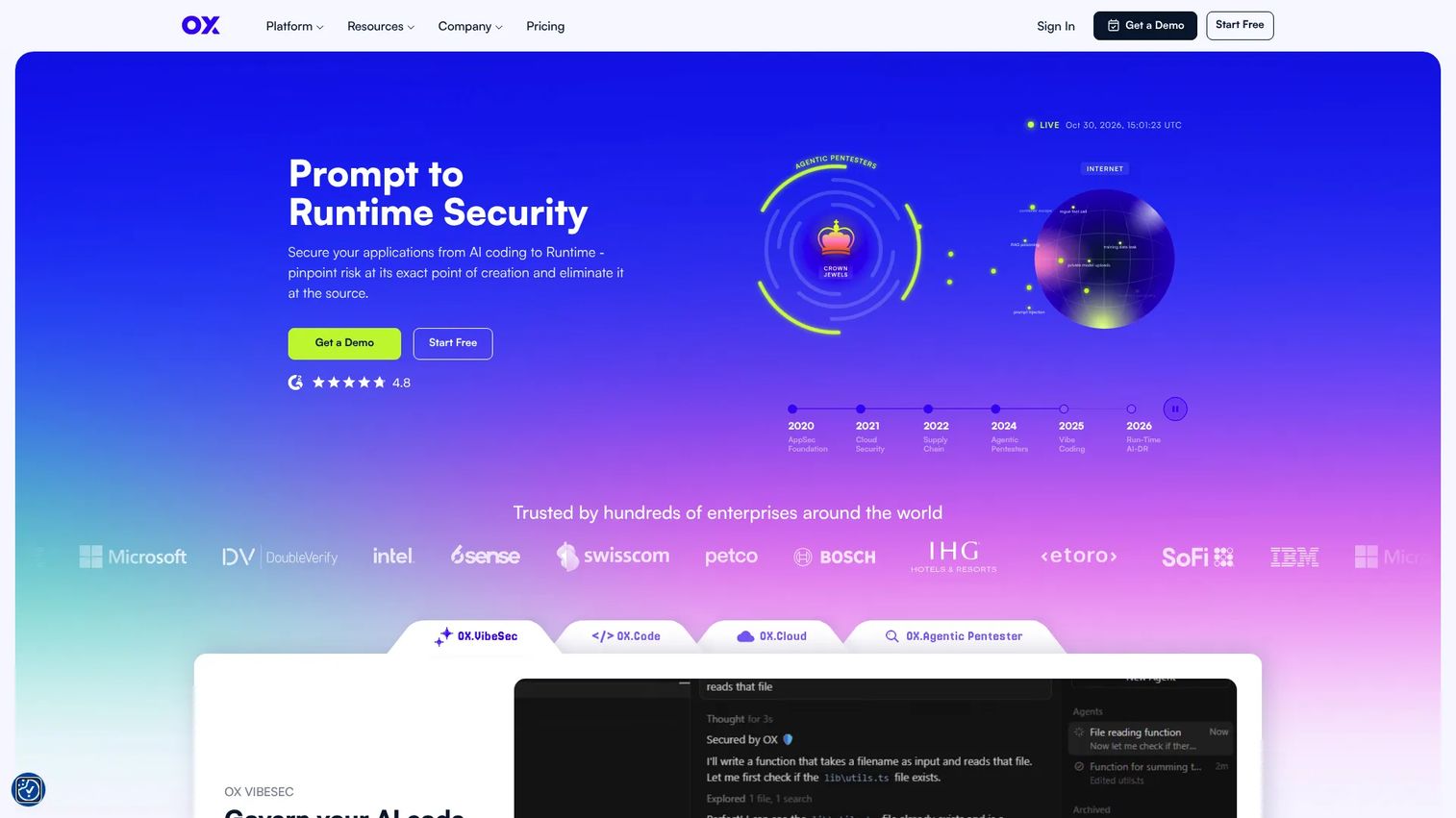
OX Security is an AI-native application security platform that covers the full software lifecycle from prompt to production runtime. Its product suite spans AI governance for users, agents, and generated code (OX VibeSec); code and pipeline security including SAST, SCA, secrets, IaC, SBOM, and CI/CD posture (OX Code); cloud security with CSPM, KSPM, DSPM, and attack-path mapping (OX Cloud); and continuous agentic penetration testing with proof-of-concept exploits (OX Agentic Pentester). PBOM and code-to-runtime correlation connect findings across environments.
Best for: Enterprise AppSec teams securing AI-assisted software development, pipelines, and cloud environments where code and runtime signals need to connect.
Key features
- AI governance for users, agents, MCPs, models, and generated code
- Code-to-runtime attack-path correlation and PBOM/SBOM context
- Agentic penetration testing with proof-of-concept exploits
- SAST, SCA, secrets, IaC, container, and CI/CD pipeline coverage
- Risk prioritization, remediation orchestration, and audit logs
Why choose OX Security: Choose OX when the hardest problem is context across repositories, pipelines, dependencies, model artifacts, and cloud signals simultaneously. Its coverage of agentic AI platforms and software supply chain security makes it relevant for teams whose buyers ask about AI-generated code governance.
OX Security pricing: OX prices each product separately. OX VibeSec is billed by AI user, OX Code by contributing developer, OX Cloud by cloud asset, and OX Agentic Pentester by agent hour. Contact OX sales for a packaged quote.
G2 rating: 4.8/5
3. Digital.ai Application Security
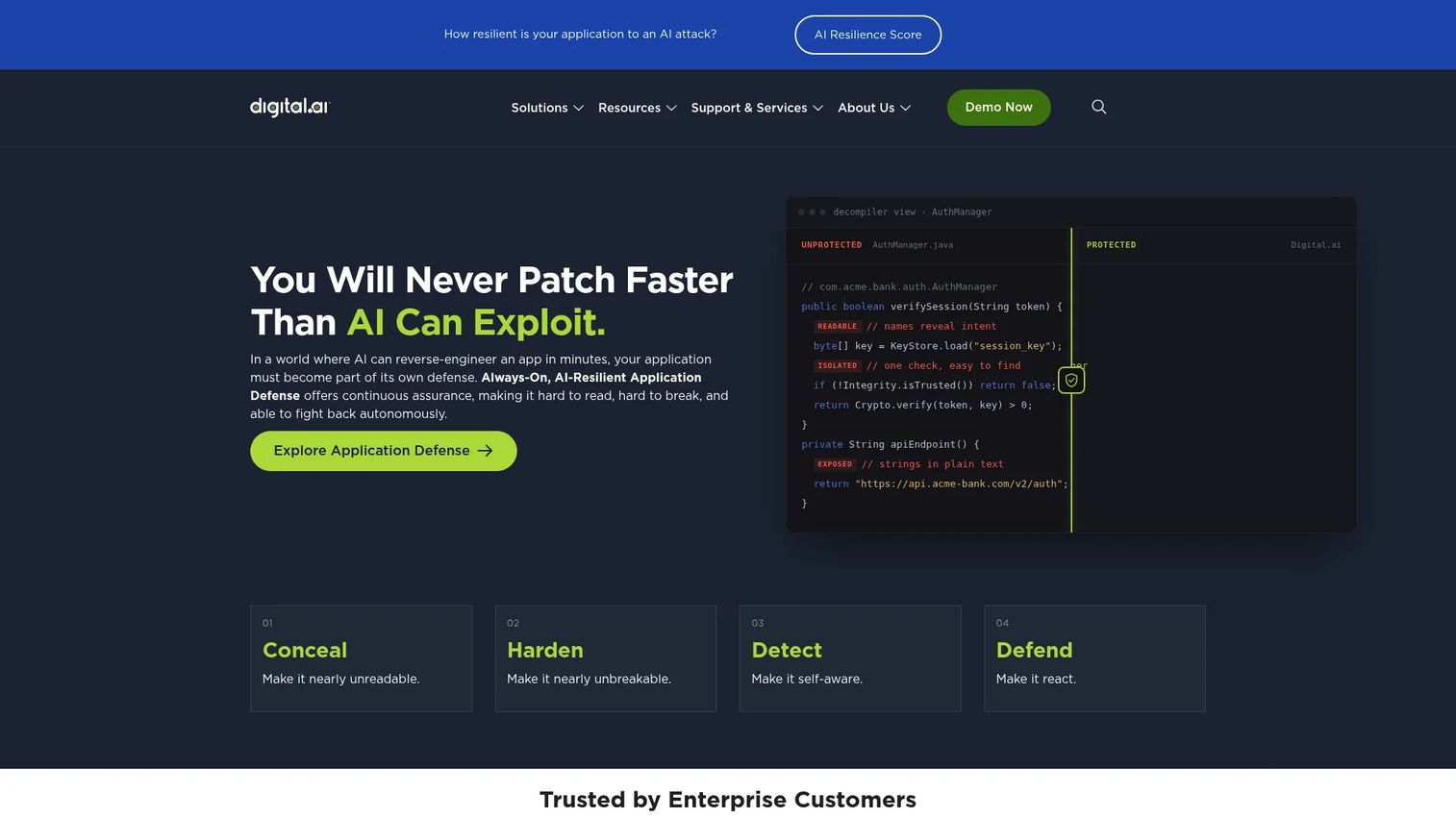
Digital.ai Application Security protects mobile, web, desktop, and server applications against reverse engineering, tampering, and runtime attacks. Its focus is post-deployment. Once your application ships, Digital.ai applies code obfuscation, anti-tamper controls, white-box cryptography, and runtime application self-protection (RASP) to defend against active threats. Threat monitoring and automated response extend coverage to production environments where source code is no longer in scope.
Best for: Enterprise organizations that need runtime application defense for shipped software, particularly mobile and embedded applications where live environments cannot be patched quickly.
Key features
- Runtime application self-protection (RASP)
- Code obfuscation and anti-reverse-engineering controls
- Anti-tampering and threat monitoring
- White-box cryptography for key and data protection
- Coverage across mobile, web, desktop, and server applications
Why choose Digital.ai Application Security: It fits teams whose AppSec problem continues after deployment. If your evaluation includes protecting shipped applications, not only reviewing code before release, Digital.ai covers that distinct layer of application security testing software. Note that this product line is the former Arxan Technologies business, which Digital.ai absorbed in 2020, so much of the independent review and analyst coverage still carries the Arxan name.
Digital.ai Application Security pricing: Digital.ai does not display pricing on its site. Contact the Digital.ai sales team for packaging and pricing details specific to your application types and deployment model.
4. Cycode
Cycode is an agentic development security platform that unifies ASPM, SAST, SCA, secrets detection, container security, IaC scanning, CI/CD security, and SBOM visibility through more than 120 connectors. Its Maestro orchestration layer and Cycode AI teammates help teams automate security workflows across the software delivery lifecycle. The platform prices by active developer count and AI usage, with modules for code security, software supply chain security, and full application security posture management.
Best for: Enterprise security teams that need a single AppSec posture view across code, pipelines, dependencies, and developer workflows, especially those managing large contributor counts or complex delivery chains.
Key features
- ASPM with 120+ connectors across code, pipeline, and cloud tools
- SAST, SCA, container, and IaC security
- Secrets detection and non-human identity (NHI) protection
- CI/CD pipeline security and code leak detection
- SBOM visibility and software supply chain security
Why choose Cycode: Use Cycode when fragmented security data across your software delivery lifecycle is the root problem. For presales teams supporting enterprise deals, Cycode's posture view gives buyers the cross-environment control evidence they ask for during security review. Its SAST and API discovery capability came in through its 2024 acquisition of Bearer. See also the broader AI governance tools landscape for adjacent context.
Cycode pricing: All Cycode plans require contacting sales. Pricing is based on active developer count and AI usage. Modules available include ADLC Security, Code Security, Software Supply Chain Security, Posture Management, Cycode Complete, and Cycode AI (usage-based tiers).
G2 rating: 4.0/5
5. Trend Micro
Trend Micro is a broad cybersecurity platform covering endpoint, cloud, workload, network, email, identity, and security operations for consumers, small businesses, and enterprises. Its relevance in an AppSec context comes from cloud and workload security signals, container protection, and integration with security operations workflows. For organizations that cannot isolate AppSec from broader threat detection, Trend Micro provides a connected view across environments.
Best for: Enterprise organizations that want AppSec-adjacent signals, particularly cloud and workload risk context, connected to a larger security operations program rather than as a standalone AppSec investment.
Key features
- Endpoint and device protection against malware, phishing, and ransomware
- Cloud, workload, and container security
- Network, email, and identity protection
- Security operations integration
- Consumer and business tiers covering individual devices to enterprise deployments
Why choose Trend Micro: Choose it when AppSec cannot sit apart from endpoint, cloud, and SOC workflows. It fits larger security teams that need AppSec signals aggregated into a program they already operate, rather than a dedicated AppSec assistant. For teams comparing attack surface management software alongside AppSec tooling, Trend Micro's breadth often fits that evaluation.
Trend Micro pricing: Trend Micro publishes prices only for its consumer range, and those prices are promotional rather than fixed. The structure is four annual tiers separated by device count, starting at $29.95 for the first year on a single-device antivirus plan and rising to a ten-device suite, with each tier renewing at a higher list price in later years. Trend Micro's own storefront and independent price trackers disagree on the list figures, so check the storefront for current tier prices rather than quoting a number from a comparison article. Contact Trend Micro sales for a quote.
6. GitHub Copilot
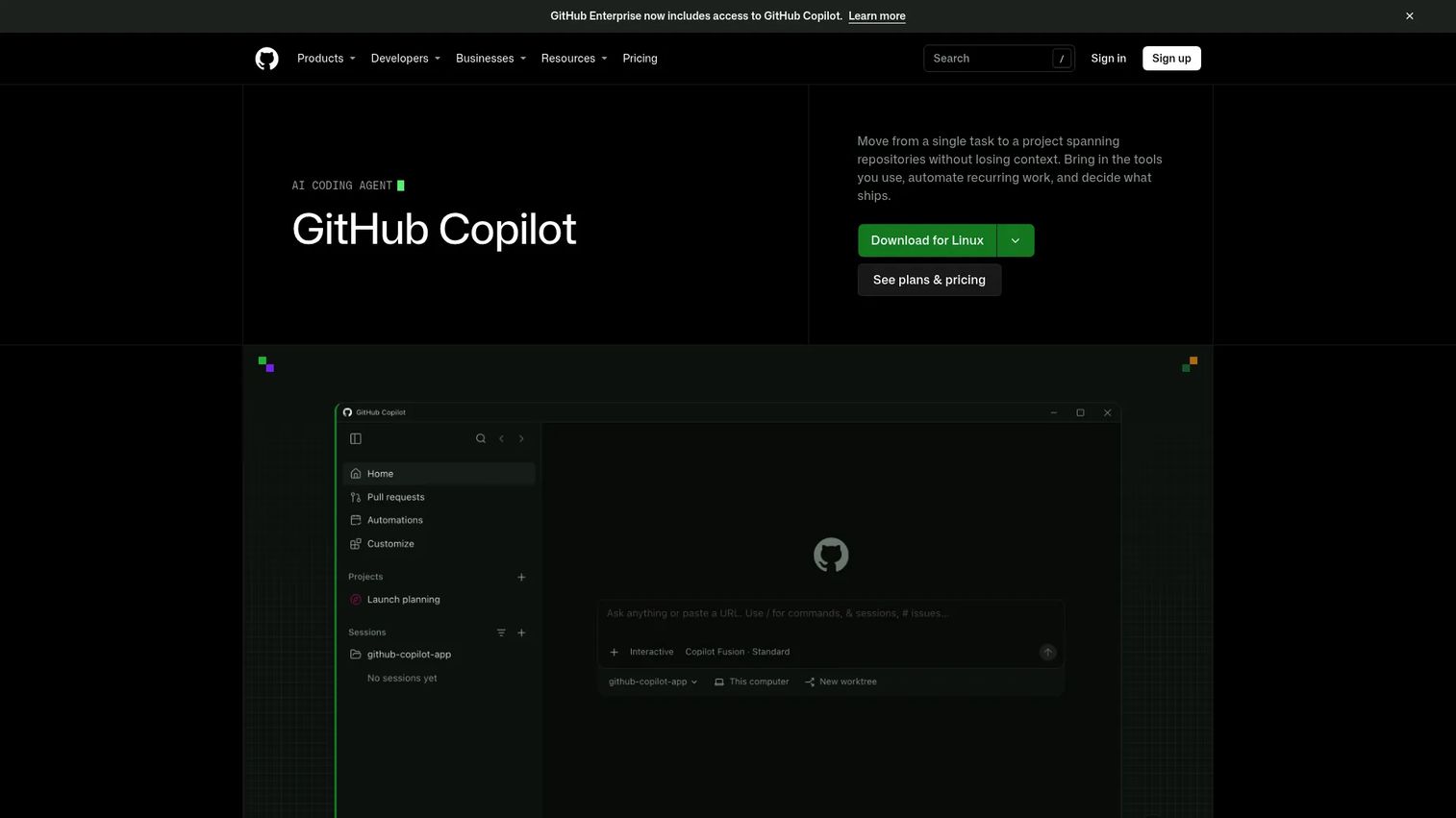
GitHub Copilot is an AI coding assistant integrated with VS Code, Visual Studio, JetBrains IDEs, GitHub, and GitHub Mobile. It provides real-time code completions, next-edit suggestions, pull request assistance, and agentic coding workflows through agent mode and cloud agents. Its security relevance is indirect, because it increases the volume and speed of AI-generated code that AppSec teams then need to review, while its PR assistance can flag some issues before merge.
Best for: Engineering teams that want AI-assisted coding with repository-aware context in GitHub-native workflows, and are prepared to pair it with dedicated security testing and governance tooling.
Key features
- Real-time code completions and next-edit suggestions
- Agent mode and cloud-based coding agent workflows
- Code review and pull request assistance
- GitHub-native workflow integration
- Copilot CLI for terminal-based development
Why choose GitHub Copilot: It belongs on this list because AI coding assistants directly shape AppSec workload. Copilot is strongest for teams already committed to GitHub as their development platform. The free tier makes it accessible, but AppSec teams should validate that generated code goes through dedicated AI software testing tools before reaching production.
GitHub Copilot pricing: A free plan is available, along with a free Student plan. Individual tiers are Pro at $10/user/month, Pro+ at $39/user/month, and Max at $100/user/month. Organization tiers are Business at $19/user/month and Enterprise at $39/user/month. Billing is monthly.
G2 rating: 4.4/5
7. Cursor
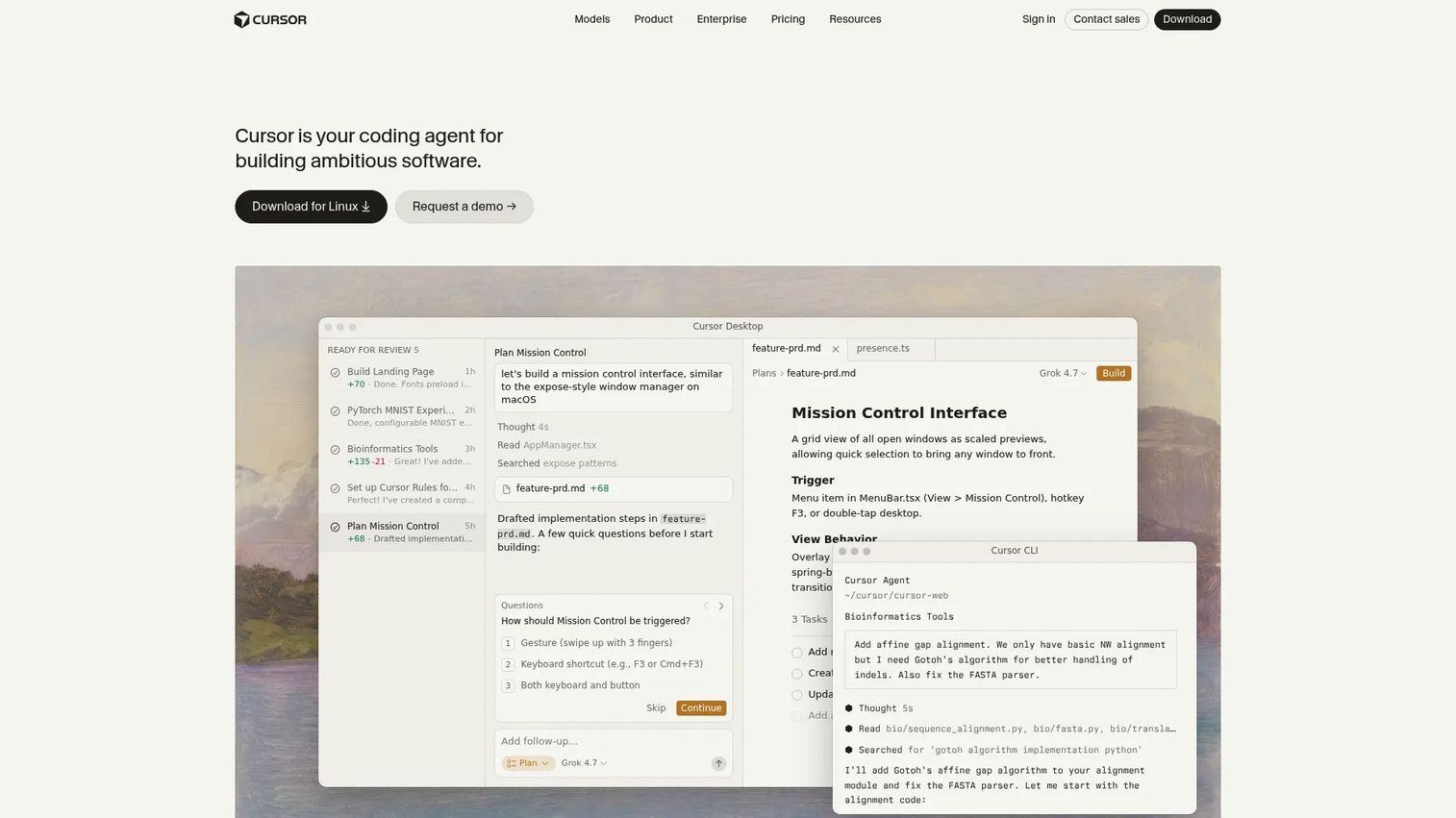
Cursor is an AI coding agent built for software development teams. It provides codebase-aware chat, autonomous coding agents, multi-file editing, terminal-based CLI agents, and pull request workflow support. Like GitHub Copilot, its security relevance is indirect, because Cursor accelerates code generation and editing velocity, which increases the volume of code that needs AppSec review. Developer trust has not kept pace: in the ACM SAC '25 survey of 105 developers cited earlier, 25% felt somewhat or very confident in the security of AI-generated code.
Ownership disclosure: Cursor's parent company Anysphere became a wholly owned subsidiary of SpaceX in August 2026. Cursor's current paid tiers also bundle Grok and X Premium entitlements from affiliated companies in the same group, so some of the headline value in each tier sits outside the coding product. Factor that into procurement and vendor-risk review, particularly if your security questionnaire covers sub-processors and data handling.
Best for: Software developers and engineering teams that need fast AI-assisted coding and codebase-aware editing inside their IDE, paired with separate AppSec validation for production workflows.
Key features
- Autonomous coding agents with codebase awareness
- Cloud agents accessible from browser or phone
- Inline editing and multi-file changes
- Terminal-based CLI agents
- Code review and pull request workflow support
Why choose Cursor: It fits when developer speed inside the editor is the primary need. Teams that have evaluated best AI code generation tools will find Cursor's codebase-aware approach distinctive. Pair it with dedicated AppSec scanning and governance, because Cursor itself does not provide the security validation layer.
Cursor pricing: Cursor restructured its plans in October 2026. A free tier is available, and paid individual tiers are Plus at $8/month, Premium at $30/month, Super at $100/month, and Ultra at $200/month. Teams pricing starts at $30 per user per month, and Enterprise pricing is custom.
G2 rating: 4.6/5
Considerations when choosing AI AppSec assistants
Workflow fit
Not every tool in this list covers the same job. ZeroPath and OX Security focus on AppSec triage and pipeline security. Digital.ai focuses on post-deployment runtime defense. Cycode targets posture management across the full delivery lifecycle. GitHub Copilot and Cursor are coding tools that affect the workload, not the defense layer. Buying the wrong category for your actual problem is the most common mistake in this market.
Signal quality
Scanners that produce noisy findings erode developer trust fast. Evaluate reachability and exploitability scoring by asking whether the tool can tell you if a vulnerable function is actually called in production. False-positive reduction and attack-path context are the signal-quality dimensions that separate tools worth deploying from ones that will sit unused after the first week.
Integration depth
Confirm integrations before signing. The tools in this list support combinations of GitHub, GitLab, Bitbucket, Azure DevOps, Jira, Linear, Slack, and CI/CD pipelines, but not always at the same depth or tier. For presales teams validating these tools during POCs, integration evidence should be tested against your buyer's actual stack, not assumed from a feature page.
Governance and auditability
Enterprise buyers ask for permissions, scoped access, audit logs, repository boundaries, and policy controls. This evidence accelerates security review during deals. Check whether the tool exposes these controls at the tier your buyer would purchase, not only at the enterprise tier. For relevant context, audit management software and AI governance tools both intersect with what buyers expect here.
Remediation support
There is a meaningful gap between a tool that explains a finding and a tool that generates a patch, creates a Jira ticket, assigns an owner, and tracks remediation. Evaluate how far each tool takes the remediation workflow. Critical fixes still require human review and approval, but the tools that reduce the manual steps in between are the ones that actually change team capacity.
Review volume
Several products in this category carry very few public reviews. ZeroPath has 11 G2 reviews, Cycode has 3, and Digital.ai Application Security has no G2 listing at all. A high average drawn from a handful of reviews is not a reliable quality signal. Weight reference calls, peer review platforms, and your own POC results above star ratings when the review count is in single or low double digits.
Conclusion
The right AI AppSec assistant depends on where your security workflow actually breaks down.
If the problem is triage capacity, start with ZeroPath. Its AI-native SAST, SCA reachability, and auto-fix workflows are built for daily security operations at the team level.
For enterprise teams managing AI-assisted development pipelines and software supply chain risk, OX Security's code-to-runtime coverage and agentic pentesting make it the stronger platform.
If runtime protection matters most, Digital.ai Application Security covers the post-deployment layer that most AppSec tools leave unaddressed.
Cycode fits teams where fragmented posture data across code, pipelines, secrets, and cloud is the core problem. Trend Micro fits when AppSec signals need to live inside a broader enterprise security program.
GitHub Copilot and Cursor both belong in the evaluation because they shape AppSec workload. Either should be paired with dedicated scanning and governance tools, not treated as a replacement for them.
For presales teams supporting security-heavy evaluations, the practical takeaway is that buyers are asking better questions about AI-generated code security, pipeline governance, and audit evidence. The tools above give you the vocabulary and workflow context to support those conversations.
Every tool on this list has to earn its place in a POC, and security reviewers judge what they can actually see. The same test applies if you sell complex security or developer tools. Buying committees want to watch detection, triage, remediation routing, and audit evidence work before they commit, and provisioning a sandbox for each evaluator slows that down. An interactive demo lets presales and product marketing teams show the real workflow on demand, reuse it across security-heavy deals, and answer governance questions with something concrete. Guideflow is an interactive demo platform built for that job. Start your journey with Guideflow today!
FAQs
An AI AppSec assistant uses artificial intelligence to help security and engineering teams detect, triage, prioritize, remediate, and document application security risks. It goes beyond scanning by adding exploitability context, generating remediation guidance, routing findings to the right owners, and maintaining audit trails. Unlike a generic chatbot, it operates within developer workflows and connects to code repositories, CI/CD pipelines, and ticketing systems.
SAST tools scan source code and produce findings. AI AppSec assistants take those findings further by enriching them with reachability and exploitability data, deduplicating related issues, suggesting or generating fixes, routing tickets, and tracking remediation. Many modern platforms combine both capabilities, but the assistant layer is what turns scanner output into an actionable workflow rather than a long unranked list.
Some tools generate patches or remediation suggestions automatically, and a few can create and assign tickets without human input. However, critical production fixes still require human review, testing, and approval before deployment. Automated fix generation is a productivity accelerator, not a replacement for the engineering judgment and testing that validated code changes require.
Coding assistants like GitHub Copilot and Cursor can support secure development by catching some issues during code generation and PR review, but they do not replace AppSec platforms. They lack the triage depth, remediation orchestration, SBOM visibility, audit logging, and governance controls that dedicated AppSec tools provide. Coding assistants should be paired with AppSec testing and policy workflows, not treated as equivalent to them.
Presales teams encounter AI AppSec assistants most often during enterprise security reviews, where buyers ask about integrations, audit logs, scoped access, and evidence of control. Understanding the distinction between assistant-first tools, AI-enhanced AppSec platforms, and AI coding tools helps you answer those questions accurately. During POCs, verify that the tool connects to the buyer's actual stack, exposes governance evidence at the purchased tier, and produces the audit artifacts their security team requires.
No single answer fits every organization, but the most relevant evaluation criteria are role-based access controls, repository scoping, audit log completeness, ticketing integration depth, and compliance evidence. ZeroPath includes SSO/SAML, SCIM, and a policy engine at its enterprise tier. OX Security provides audit logs and on-premises support. Cycode's 120+ connectors give broad posture visibility. Evaluate which tier each tool requires to surface the governance controls your buyer needs.
Key risks include prompt injection attacks against the assistant itself, over-trust in automated fix suggestions without adequate testing, sensitive code or credentials exposure through AI model inputs, and weak access boundaries that allow the assistant to act outside its intended scope. Poor auditability makes it difficult to trace what the assistant changed and why. Strong permissions, scoped execution modes, and detailed logs are the controls that mitigate these risks.
Run the POC against repositories that represent your actual codebase complexity, including known vulnerabilities, dependency issues, and secrets exposure. Test the full workflow from detection through triage, ticket creation, remediation suggestion, and audit log generation. Validate that integrations connect to your actual tools (Jira, Slack, GitHub) at the tier you plan to purchase. Check execution boundaries to confirm the tool cannot act outside scoped repositories without explicit permission. For related context on running structured technical evaluations, see the automation testing tools guide.