A voice bot passes QA on Friday afternoon. By Monday morning, it routes customers into a dead end. Average handle time climbs, escalations spike, and the overnight dashboard shows nothing unusual because it was only measuring uptime.
That gap is where contact center AI observability earns its place. Traditional monitoring tells you whether systems are running. It misses the subtler failures: A routing rule that breaks under load, a chatbot intent that misclassifies after a model update, an agent's audio degrading because of a remote network change. According to ICMI and NICE research published in 2025, 54% of contact centers now report some degree of AI functionality. When AI fails quietly, the cost lands on customers before it lands on dashboards.
For presales and solutions engineers evaluating platforms, the stakes are practical. Deals stall when the buyer can't prove uptime, routing behavior, or model reliability. A shortlist built around AI contact center monitoring, synthetic testing, and real call center software observability gives you a sharper answer at every technical review.
What's inside
This guide compares 20 contact center AI observability software products for 2026, chosen for category fit, monitoring depth, AI support, testing capability, and cloud contact center relevance.
- Who it's for: Presales, sales engineering, CX operations, and IT teams evaluating technical fit
- Selection criteria: Category coverage, AI monitoring depth, integration breadth, and verifiable pricing
- What you'll get: A comparison table, per-tool breakdowns, buyer considerations, and FAQs
- Pricing and ratings: Verified against live vendor pages and G2 at time of writing
TL;DR
- Best for enterprise contact center observability: Genesys, because its platform connects routing, AI, workforce, and journey analytics in one environment
- Best for proactive testing: Cyara and Bespoken.ai both cover synthetic testing, IVR validation, and conversational AI scenarios before customers hit them
- Best for AWS-native environments: Amazon Connect, with Contact Lens, contact trace records, and CloudWatch integration built in
- Best for purpose-built cloud contact center observability: Operata, which monitors across CCaaS, carrier, network, and agent-experience layers
- Best for infrastructure and application observability around contact centers: Datadog, Dynatrace, and New Relic cover the surrounding stack that CCaaS-native tools miss
- Best for interaction intelligence and QA: Observe.AI and Verint dig into conversation quality, compliance, and agent performance at scale
What is contact center AI observability software?
Contact center AI observability software monitors, tests, and analyzes the systems, conversations, agents, AI models, and customer journeys that determine contact center performance.
The category goes further than traditional monitoring. Traditional monitoring asks whether systems are up. Observability asks why a customer, agent, bot, queue, or interaction failed, and where the root cause actually sits.
Modern contact centers run across multiple signal layers:
- Technical telemetry: Network, voice quality, latency, application health, and endpoint conditions
- Operational signals: Queue depth, routing logic, transfers, hold time, abandonment rates, and service levels
- Agent signals: Desktop performance, behavior patterns, QA scores, and coaching outcomes
- AI signals: Bot containment, model drift, intent accuracy, hallucination handling, and agent assist quality
- Customer experience signals: Sentiment, effort scores, repeat contact rates, escalation patterns, and conversation outcomes
- Testing signals: Synthetic calls, IVR path validation, chatbot scenario coverage, and regression testing
CX observability software in this category differs meaningfully from adjacent tools. General application performance monitoring tools track infrastructure and app health but lack contact center context. Conversation analytics platforms analyze transcripts but don't watch infrastructure. Workforce engagement management tools measure agent performance without monitoring routing or network layers. CCaaS-native dashboards report on what happened inside a platform, not across it. IVR testing tools validate specific flows but don't monitor production behavior continuously.
Some products in this list are broad suites covering most of these layers. Others specialize in testing, QA, interaction analytics, or infrastructure observability. Mapping the signal you need to the tool that delivers it is the real evaluation task.
When to use contact center AI observability software
Monitor AI-supported contact centers around the clock
AI introduces failure modes that don't wait for business hours. Voice bots, chatbots, agent assist, routing rules, and model updates can all degrade without triggering a traditional availability alert. Teams running 24/7 operations need threshold design, alert correlation, and escalation rules that catch these failures before customers report them.
Validate routing, IVR, and bot flows before customers hit them
Synthetic testing for contact centers lets you verify critical paths ahead of a migration, product launch, or seasonal volume spike. A broken IVR tree or chatbot intent can affect thousands of interactions before anyone notices. Presales teams can use test results to demonstrate operational readiness during technical evaluations, not just after go-live.
Find root cause across systems, agents, and experience signals
Contact center problems rarely sit in one dashboard. A call quality issue might trace back to a remote agent's network, a WebRTC configuration, a CCaaS platform issue, or a carrier problem. A containment drop might reflect a model change, a training data gap, or a new product scenario the bot wasn't built for. Root cause analysis contact center tools correlate across those layers so teams spend less time guessing.
Contact center AI observability software comparison
Below is a shortlist of the 20 tools covered in this guide. Pricing and ratings reflect verified values at time of writing. Both change, so check each vendor's current pricing page and live G2 listing before finalizing a shortlist.
| # | Product | Best for | Key differentiator | Pricing | G2 rating |
|---|---|---|---|---|---|
| 1 | Genesys | Enterprise omnichannel contact centers | Native CX platform data with AI, routing, and journey analytics | From $75/user/mo | 4.4/5 |
| 2 | Cyara | Proactive testing and CX assurance | Synthetic testing across voice, IVR, chatbot, and routing flows | Custom pricing | 4.8/5 |
| 3 | Five9 | AI-powered CCaaS monitoring | Contact center analytics inside a cloud platform | From $119/seat/mo | 4.1/5 |
| 4 | NICE | Enterprise CX and workforce analytics | Broad CX suite with interaction, workforce, and AI analytics | From $110/agent/mo | 4.3/5 |
| 5 | Operata | Cloud contact center observability | Purpose-built monitoring across CCaaS, network, and agent layers | From $0.006/agent min | N/A |
| 6 | Amazon Connect | AWS-native contact center | Contact Lens analytics with AWS monitoring integrations | From $0.010/message | 4.4/5 |
| 7 | Datadog | Infrastructure observability around contact center apps | General observability across apps, infrastructure, and logs | From $0 (Free tier) | 4.4/5 |
| 8 | Dynatrace | Enterprise AIOps and application observability | AI-driven dependency mapping and root cause analysis | From $1.40/pod/mo | 4.5/5 |
| 9 | New Relic | Full-stack monitoring for contact center apps | Unified telemetry across application and infrastructure layers | From $0 (Free tier) | 4.4/5 |
| 10 | Observe.AI | Conversation intelligence and QA | AI-powered QA, coaching, and interaction analysis | Custom pricing | 4.6/5 |
| 11 | Verint | Workforce and interaction analytics | Enterprise WEM with speech, text, and quality analytics | Custom pricing | 4.4/5 |
| 12 | Talkdesk | Cloud contact center AI analytics | AI-native CCaaS analytics and automation | From $85/user/mo | N/A |
| 13 | Sprinklr | Omnichannel CX observability | Unified social, messaging, service, and customer signal analysis | Custom pricing | 4.2/5 |
| 14 | Dialpad | AI-powered voice analytics | Real-time AI transcription, sentiment, and coaching | From $15/user/mo | 4.4/5 |
| 15 | 8x8 | Unified communications and contact center analytics | Voice, contact center, and communications analytics together | Custom pricing | 4.2/5 |
| 16 | Nextiva | CX and communications monitoring | Contact center and business communications analytics | From $15/user/mo | 4.5/5 |
| 17 | Aircall | SMB and mid-market call monitoring | Lightweight call analytics with 250+ integrations | From $30/license/mo | 4.4/5 |
| 18 | InMoment | Experience intelligence | Customer feedback and experience analytics tied to interactions | Custom pricing | 4.9/5 |
| 19 | Bespoken.ai | Voice bot and IVR testing | Automated testing for voice experiences and conversational AI | From $2,000/mo | N/A |
| 20 | Evalgent | AI evaluation and contact center testing | Scenario-driven evaluation for voice AI agents | Custom pricing | N/A |
Best 20 contact center AI observability software tools for 2026
Tools appear in order of relevance for enterprise and technical buyers. Broad platform suites come first, followed by specialized observability, infrastructure, analytics, communications, experience, and testing tools.
1. Genesys

Genesys is an enterprise contact center platform covering voice, digital channels, AI agents, workforce management, and customer journey analytics. Its observability value comes from having routing, interaction, agent, and CX data in the same environment where operations actually run. For presales teams, that means fewer integration gaps to explain during technical reviews.
Best for: Enterprise teams running complex omnichannel contact centers who want observability inside their core CCaaS platform.
Key features
- AI-powered routing analytics and intelligent routing
- Customer journey management and interaction analytics
- Workforce engagement management with quality insights
- Omnichannel performance dashboards across voice and digital
- Agent Copilot with real-time assistance
Why choose Genesys: When routing, workforce, and AI data live in the same platform, the root cause path is shorter. Presales teams benefit because performance claims are easier to support with native platform evidence.
Genesys pricing: Four published plans, starting at $75 per user per month (billed annually) for Genesys Cloud CX 1, rising to $240 per user per month for CX 4. Final pricing accounts for channels, AI capabilities, and workforce modules.
G2 rating: 4.4/5
2. Cyara
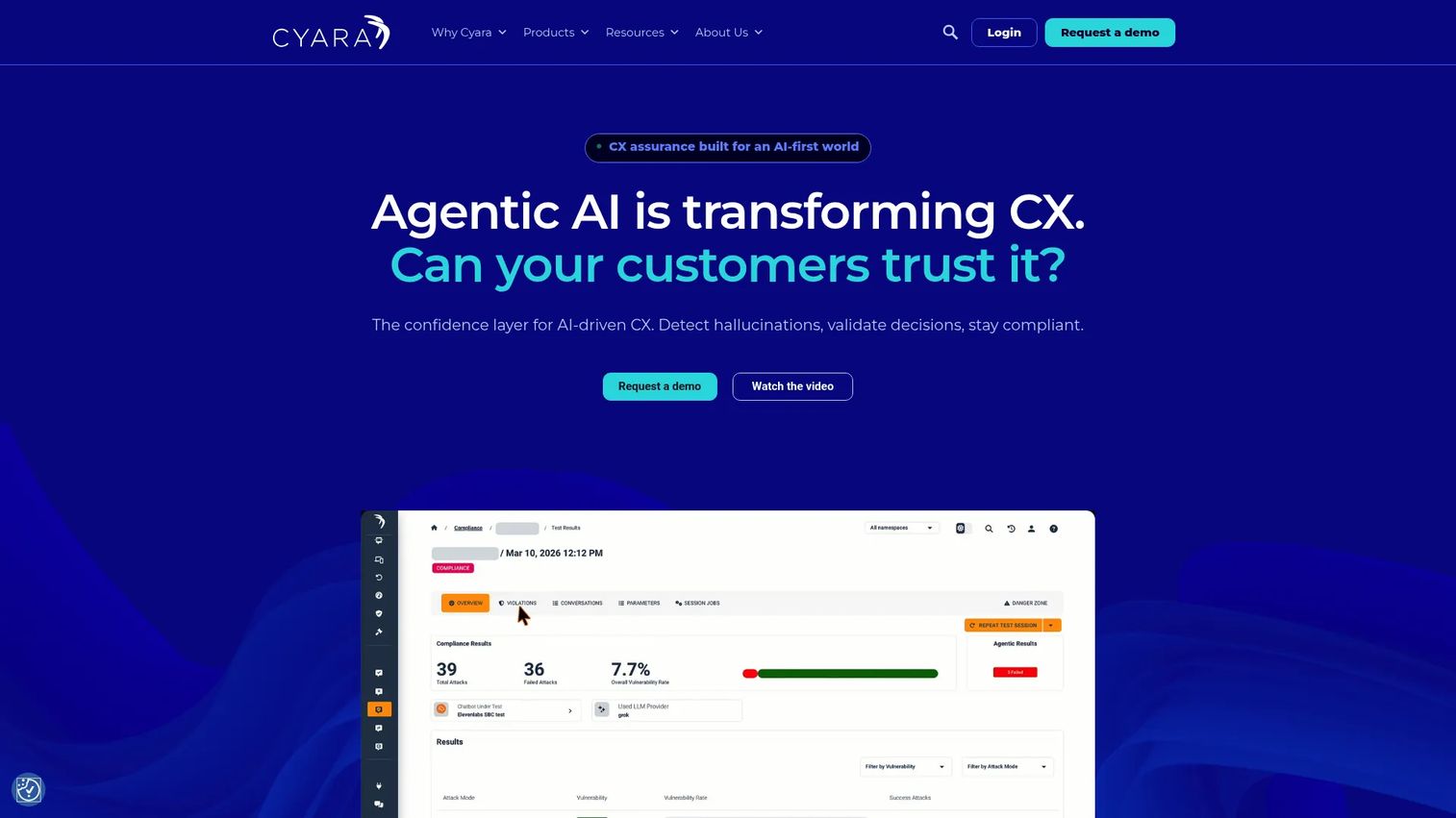
Cyara is a customer experience assurance platform built around testing and monitoring contact center journeys. It covers voice, IVR, chatbot, SMS, email, and web chat, giving QA and operations teams a way to validate flows before customers hit them. Cyara is one of the strongest options for IVR testing software and synthetic testing for contact centers in production environments.
Best for: Large enterprises that need continuous assurance across complex omnichannel contact center and conversational AI journeys.
Key features
- Synthetic interaction testing across voice, IVR, and chat
- No-code customer journey modeling and scenario coverage
- Automated functional, regression, performance, and load testing
- Real-time voice quality, carrier, and agent-environment monitoring
- REST API and DevOps integrations for release pipelines
Why choose Cyara: Migrations, major releases, and seasonal spikes all carry risk. Cyara is the strongest option for teams that need to validate every critical path before customers experience it, not after.
Cyara pricing: Cyara directs all platform pricing conversations through its sales team. Ask about testing volume, channels, concurrency limits, integrations, and enterprise support tiers when requesting a quote.
G2 rating: 4.8/5
3. Five9
Five9 is a cloud contact center platform with AI, workforce engagement, analytics, and automation built in. Five9 analytics run natively inside the platform, so contact center performance monitoring and CCaaS operations happen in the same environment. The observability story is strongest for teams whose contact center already runs on Five9.
Best for: Organizations consolidating contact center operations, AI, and analytics into one cloud CCaaS platform.
Key features
- AI interaction analytics and real-time dashboards
- Omnichannel reporting across voice, chat, SMS, email, and social
- Workforce engagement insights and quality management
- Agent assist visibility and AI-powered routing
- CRM integrations with major platforms
Why choose Five9: If your contact center runs on Five9, the analytics layer requires no additional integration work. Buyers evaluating a full CCaaS migration often find Five9 analytics sufficient for most reporting needs.
Five9 pricing: Digital plan starts at $119 per concurrent seat per month; Core at $159 per concurrent seat per month. The Plus bundle requires contacting sales. A minimum of 50 seats applies.
G2 rating: 4.1/5
4. NICE
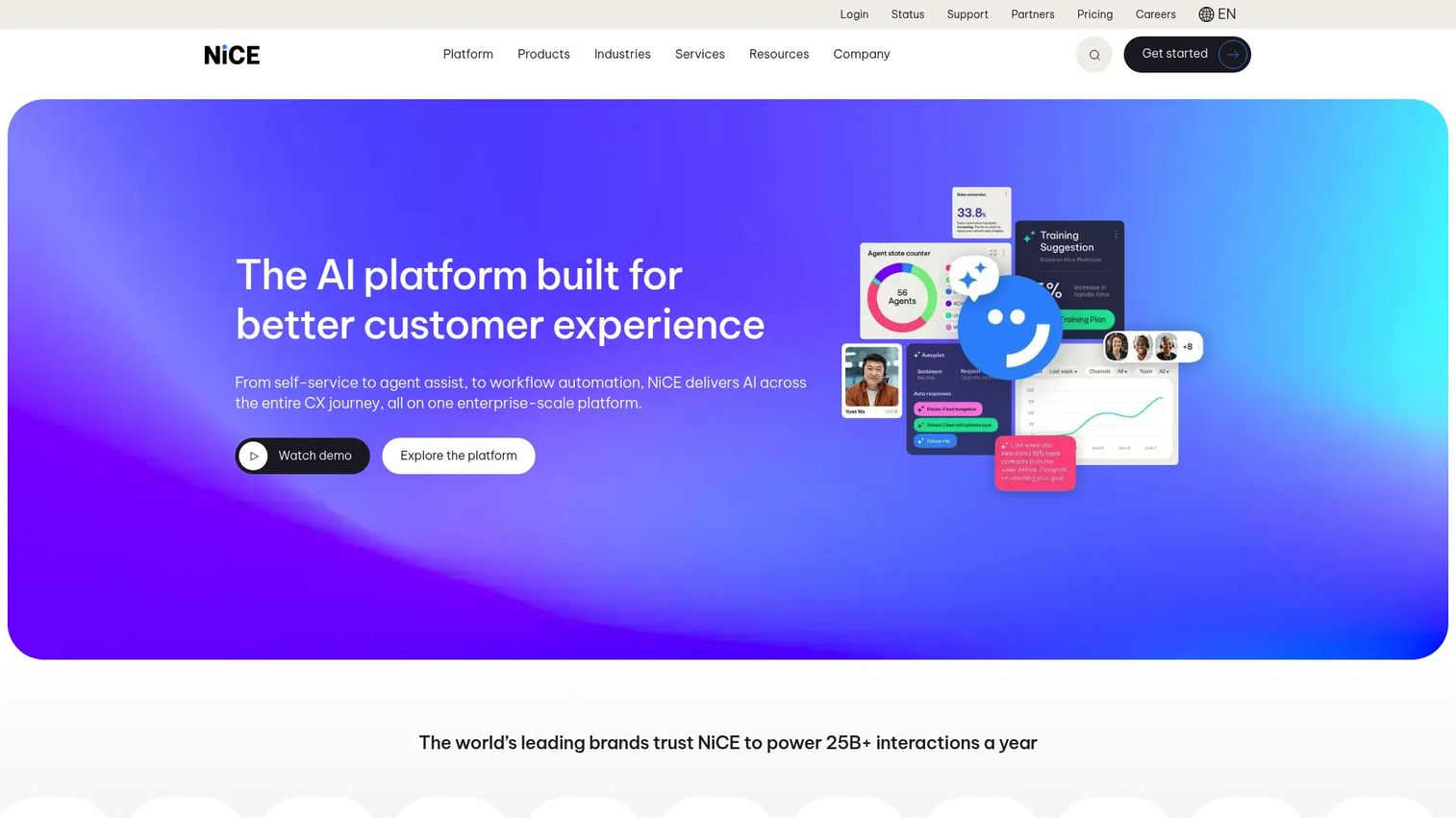
NICE offers the CXone cloud platform, covering AI-powered customer experience, analytics, workforce engagement, routing, and automation. For large contact centers managing multiple channels, agent populations, and compliance requirements, NICE delivers depth across the operational and workforce layers. Think of it as contact center analytics software plus workforce engagement in one enterprise package.
Best for: Large contact centers that need operational analytics, workforce signals, interaction data, and AI insights across complex environments.
Key features
- Interaction analytics with sentiment and topic analysis
- Workforce engagement: Quality management, screen recording, and scheduling
- AI-driven automation and agent assistance
- CX performance dashboards across voice and digital channels
- Omnichannel routing with skills-based and predictive options
Why choose NICE: NICE fits evaluations where stakeholders span operations, workforce, IT, and compliance. The depth across those teams reduces the number of separate tools a buyer needs to justify.
NICE pricing: Five published suite tiers from $110 to $249 per agent per month (Omnichannel Suite through Ultimate Suite). The Ultimate Suite adds per-session charges at $0.25 each.
G2 rating: 4.3/5
5. Operata
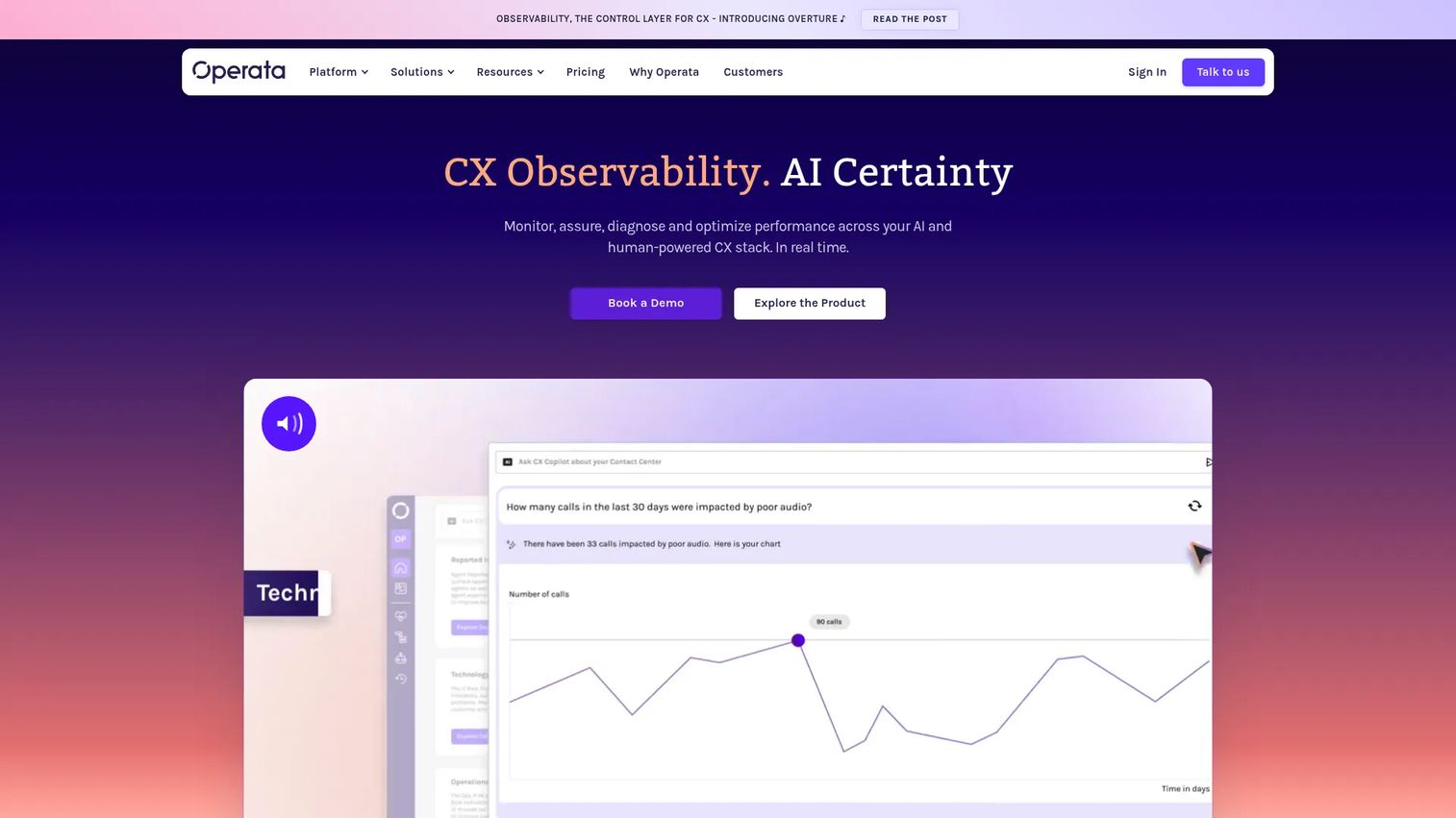
Operata is a purpose-built CX observability platform for cloud contact centers. It monitors across CCaaS platforms, carrier infrastructure, network conditions, WebRTC, AI agents, and human-agent environments in one view. This is the tool for operations teams who know their CCaaS dashboard shows platform health but can't explain why agent or customer experience degrades.
Best for: Operations teams that need contact center-specific observability across cloud platforms, agents, devices, networks, and customer experience layers.
Key features
- Customer Journey Trace for end-to-end interaction visibility
- Real call assurance and carrier monitoring
- AI agent and human-agent environment monitoring
- Real-time CCaaS performance dashboards
- Tenor AI and CX Copilot for diagnostics
Why choose Operata: General application performance monitoring tools show infrastructure health. Operata adds the contact center context those tools miss: Agent desktop state, WebRTC quality, carrier performance, and CX outcome correlation.
Operata pricing: Three published plans: Core at $0.006 per agent minute (minimum $3,000/month), Enterprise at $0.007 per agent minute (minimum $3,500/month), and Enterprise+ at $0.0085 per agent minute (minimum $4,250/month). All plans include unlimited users and data. Plans are billed annually by default.
6. Amazon Connect
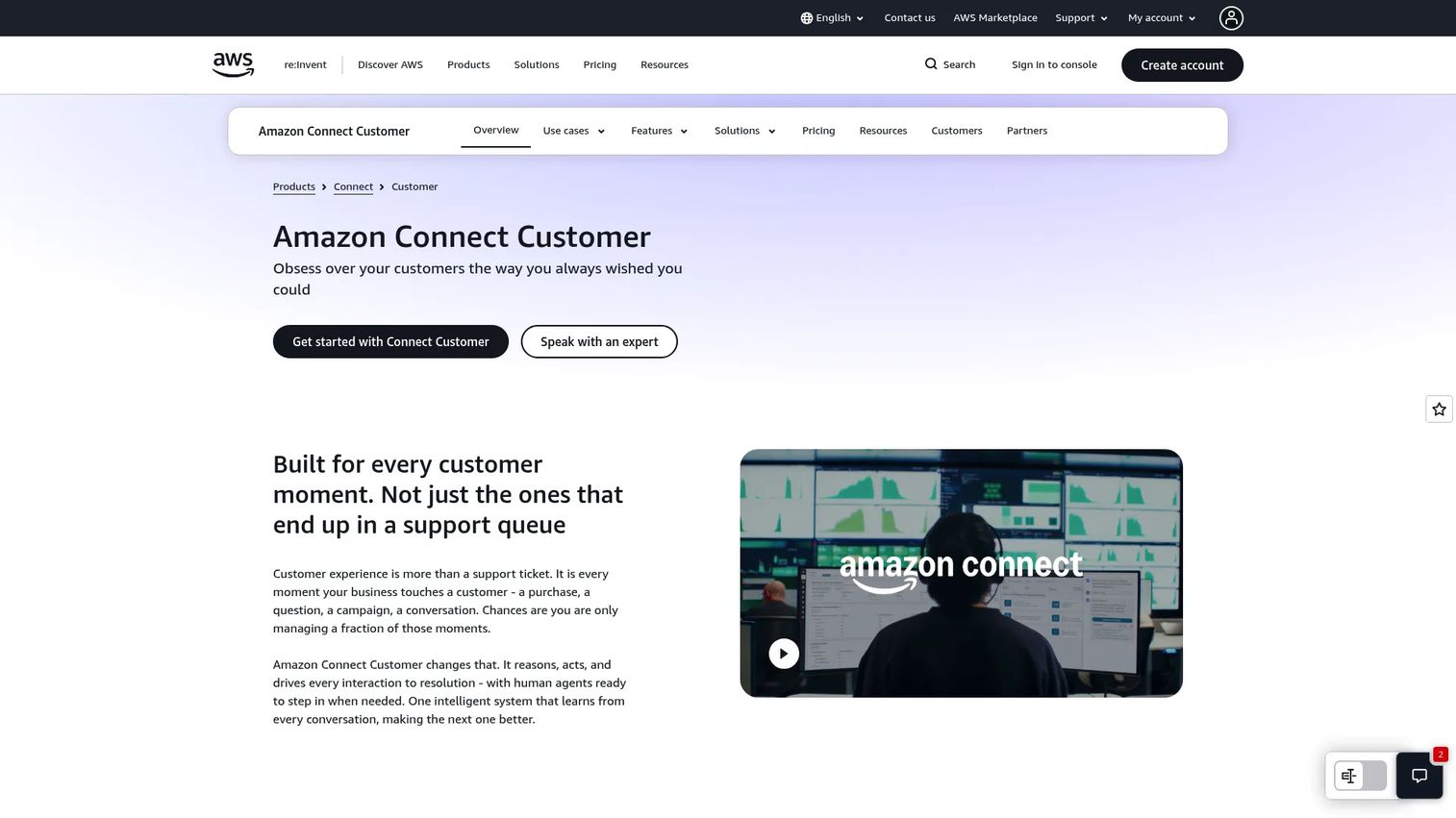
Amazon Connect is AWS's cloud contact center service, built for teams that want to run omnichannel customer interactions inside the AWS stack. Contact Lens provides conversation analytics, contact trace records track interaction detail, and CloudWatch integration brings infrastructure monitoring into the same operational picture. Amazon Connect monitoring is strongest when the surrounding architecture already runs on AWS.
Best for: Teams building contact center operations on AWS who want native monitoring and analytics without adding a separate observability vendor.
Key features
- Contact Lens analytics for conversation intelligence and post-contact summaries
- Contact trace records with full interaction detail
- CloudWatch integration for infrastructure metrics
- Real-time metrics and agent performance dashboards
- AWS Lambda integration and drag-and-drop workflow designer
Why choose Amazon Connect: Technical teams with AWS expertise can build highly configurable contact center architectures. Presales evaluations should include a conversation about reporting design and implementation requirements, since custom analytics often require Lambda and Glue work.
Amazon Connect pricing: Usage-based with no minimums. Chat starts at $0.010 per message; voice at $0.038 per minute; email at $0.080 per email. Contact Lens and additional AWS services carry separate usage charges.
G2 rating: 4.4/5
7. Datadog
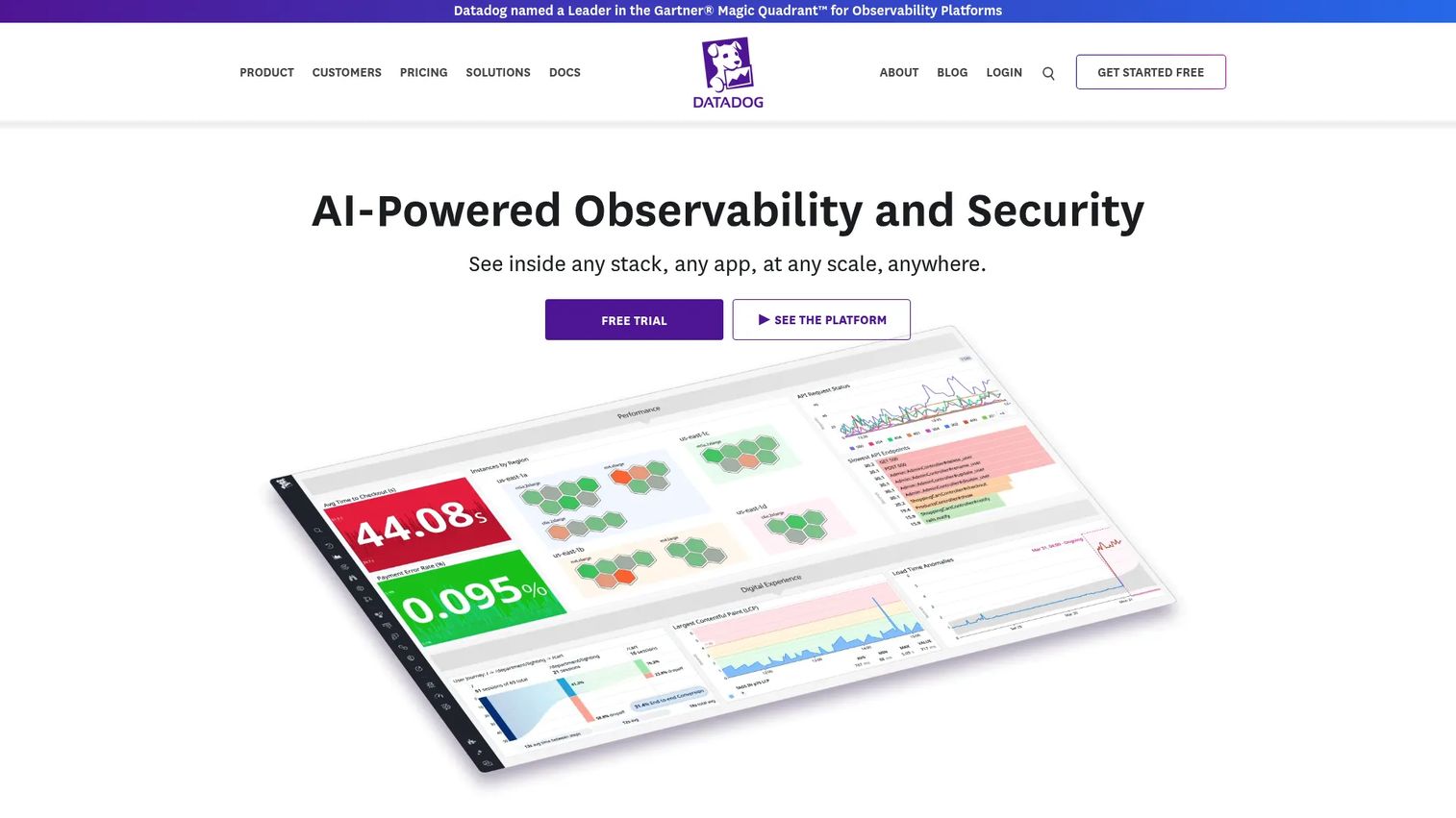
Datadog is a general observability platform covering infrastructure, APM, log management, synthetics, and security. It doesn't focus on contact centers specifically, but it monitors the surrounding architecture: Custom apps, APIs, CRM integrations, middleware, and any service the contact center depends on. Engineering and IT teams reach for Datadog when contact center performance connects to code they own.
Best for: Engineering and IT teams monitoring the applications, APIs, and infrastructure that support the contact center, rather than the CCaaS platform itself.
Key features
- Infrastructure monitoring across hosts, containers, and cloud
- APM with distributed tracing and code-level visibility
- Log management with pattern detection and alerting
- Synthetic tests for API and browser validation
- Alert routing with correlation and suppression
Why choose Datadog: Datadog fits when contact center failures trace back to custom integrations or self-built services. CX-specific signals, like routing behavior or agent experience, still need a contact center analytics layer alongside it.
Datadog pricing: Infrastructure Monitoring starts with a free tier, then Pro at $15 per host per month (billed annually) and Enterprise at $23 per host per month. APM, logs, synthetics, and other products carry separate pricing.
G2 rating: 4.4/5
8. Dynatrace
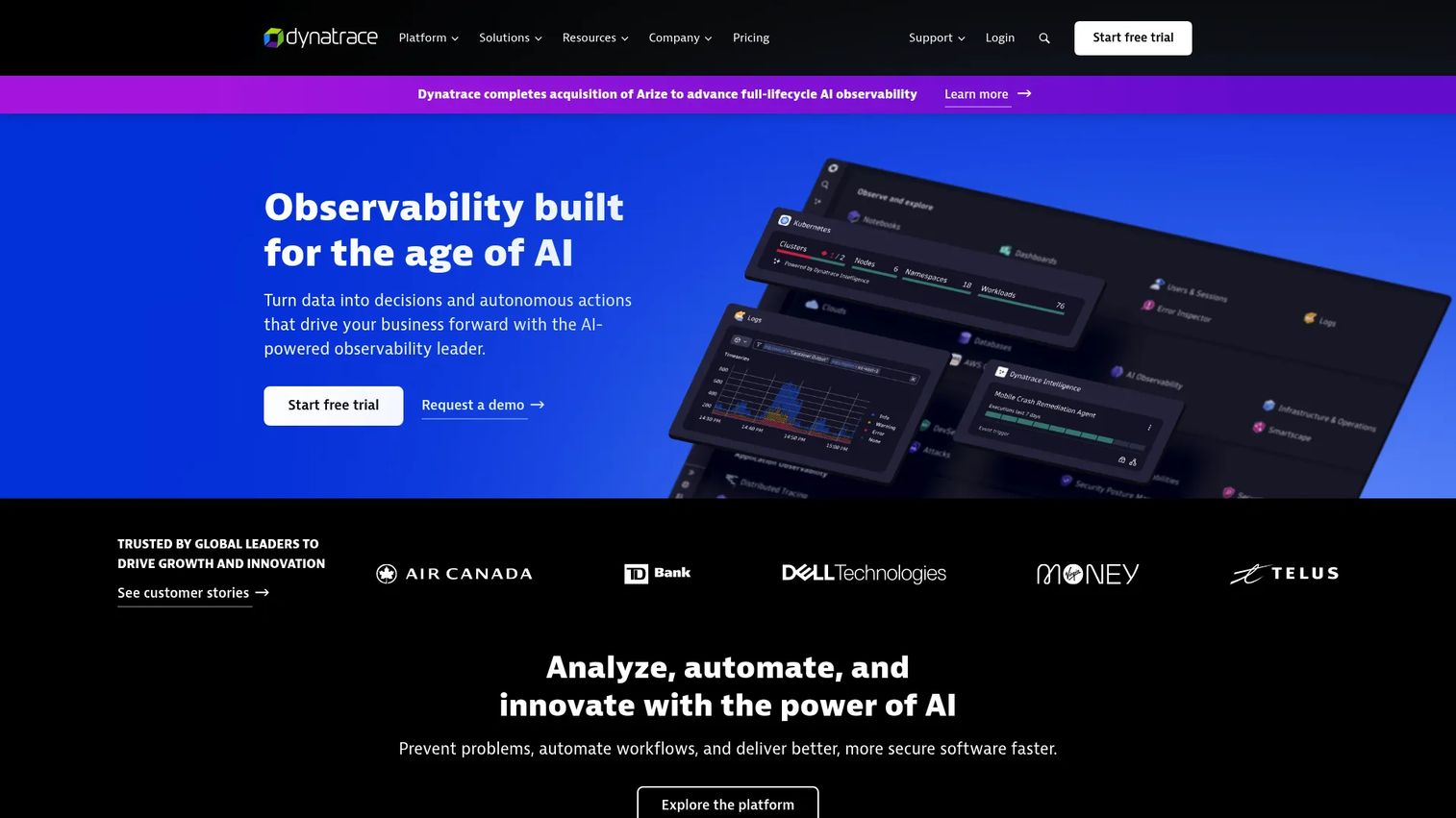
Dynatrace is an enterprise observability and AIOps platform for complex application environments. Its Davis AI engine performs automated dependency mapping and root cause analysis across distributed services. For contact centers running on layered enterprise architectures with many backend dependencies, Dynatrace surfaces which service caused the failure without requiring manual correlation.
Best for: Large IT teams that need AI-assisted dependency mapping and root cause analysis across enterprise systems supporting the contact center.
Key features
- AIOps root cause analysis with Davis AI
- Distributed tracing and service dependency mapping
- Infrastructure monitoring across hosts and Kubernetes
- Digital experience monitoring for web and mobile
- Log analytics with Grail data lakehouse
Why choose Dynatrace: When contact center failures come from backend services, database latency, or integration timeouts rather than the CCaaS platform, Dynatrace isolates the exact cause faster than manual log analysis.
Dynatrace pricing: Usage-based with annual platform commitment. Foundation and Discovery starts at $7 per host per month; Infrastructure Monitoring at $29 per host per month; Full-Stack Monitoring at $58 per 8 GiB host per month. Kubernetes and container monitoring priced separately.
G2 rating: 4.5/5
9. New Relic
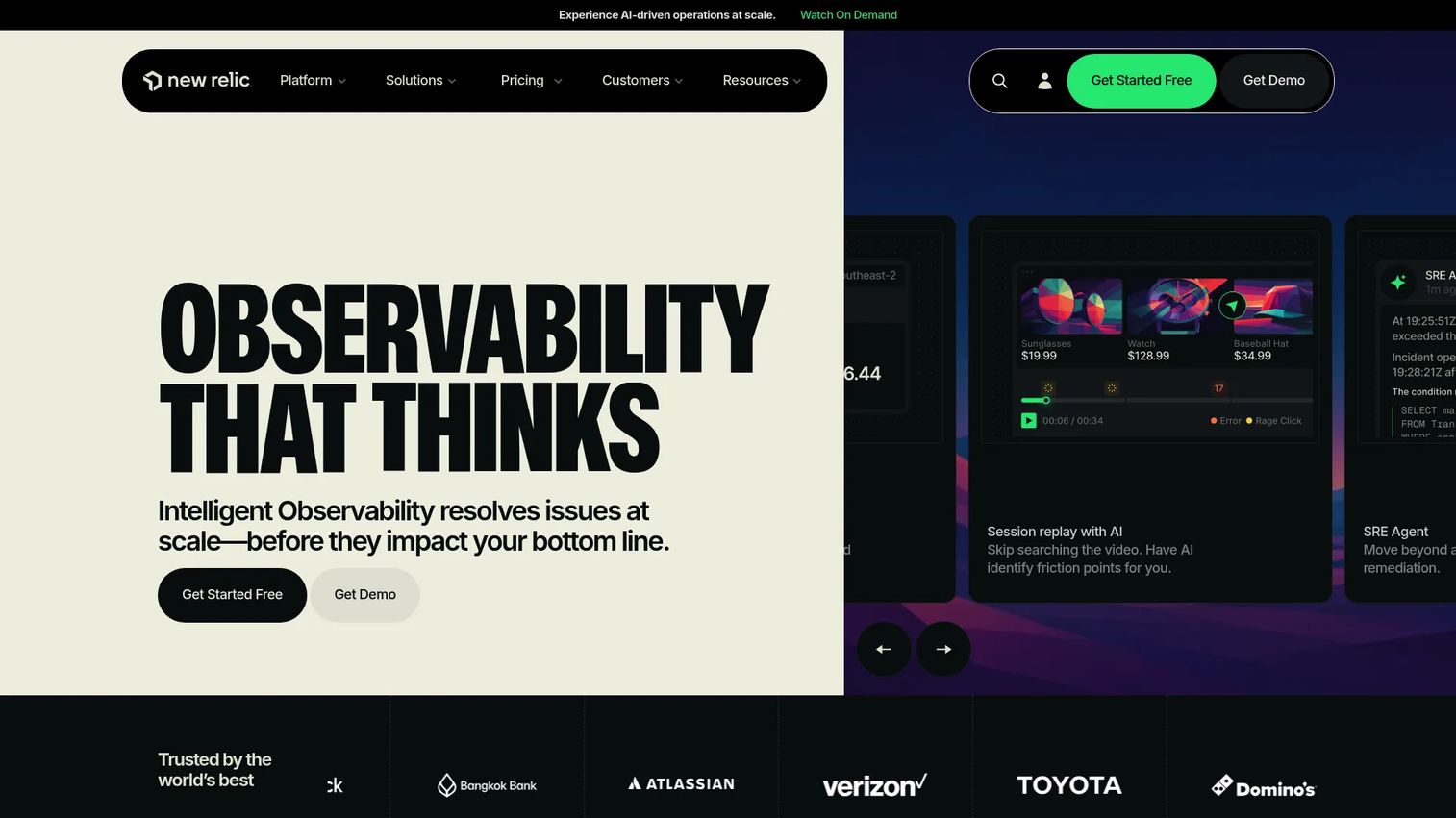
New Relic is a full-stack observability platform covering APM, infrastructure monitoring, log management, browser monitoring, synthetic checks, and session replay. For contact center teams that have built custom applications, CRM integrations, self-service portals, or middleware, New Relic provides the telemetry layer across software stacks. It's particularly useful when technical teams need visibility into specific code paths, not just platform availability.
Best for: Developer and SRE teams that need a full observability layer across the applications and integrations supporting the contact center.
Key features
- Full-stack observability across APM, infrastructure, and logs
- Distributed tracing with code-level metric detail
- Synthetic monitoring for API and browser scenarios
- Log management and service health dashboards
- AI monitoring and browser session replay
Why choose New Relic: New Relic suits teams that write and own the code adjacent to the contact center. Its free tier with 100 GB monthly data ingest makes it approachable for teams testing coverage before committing to paid tiers.
New Relic pricing: Free tier includes one full platform user and 100 GB monthly data ingest. Standard starts at $10 for the first user, $99 for additional users. Pro is $349 per user per year (annual commitment). Enterprise pricing requires contacting sales.
G2 rating: 4.4/5
10. Observe.AI
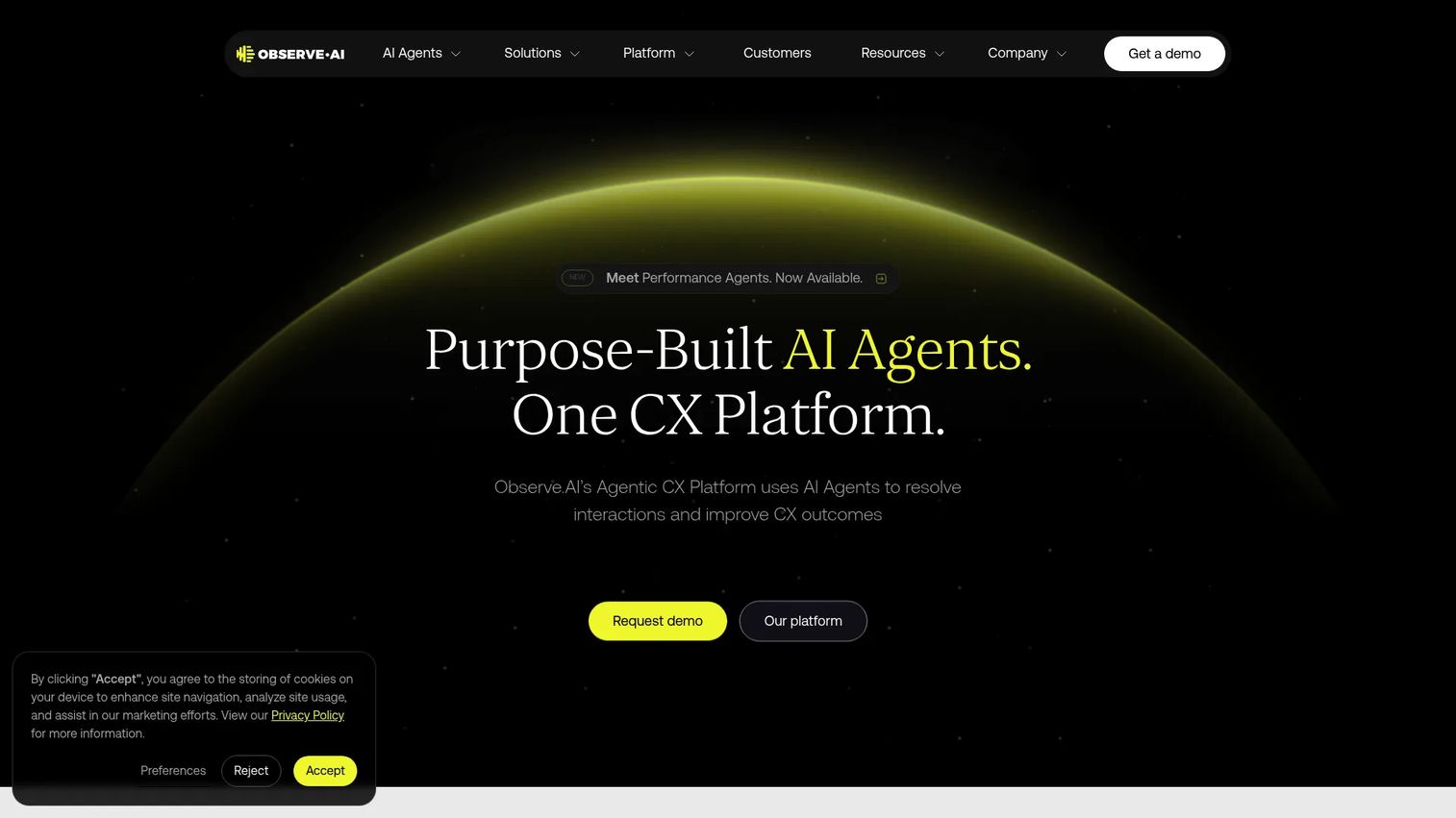
Observe.AI is an agentic AI customer experience platform focused on conversation intelligence, frontline assistance, QA automation, and agent performance. It observes what happens inside interactions rather than the infrastructure around them. Teams that need automated QA scoring, AI-powered coaching, and compliance monitoring reach for Observe.AI when the CCaaS platform's native reporting doesn't go deep enough into conversation quality.
Best for: Enterprise contact centers that need automated QA, agent coaching, compliance monitoring, and conversation insights at scale.
Key features
- Automated QA scoring with AI-driven evaluation
- Real-time frontline guidance and next-best-action recommendations
- Conversation intelligence with sentiment and topic analysis
- Compliance monitoring and interaction flagging
- Agent coaching insights with performance tracking
Why choose Observe.AI: Observe.AI answers the question of what happened inside the conversation, not just whether the call connected. Presales teams can use it to support QA and compliance requirements in regulated industry evaluations.
Observe.AI pricing: Custom enterprise pricing based on deployment scope, AI agents, conversation volume, and channels. Contact their sales team for a quote.
G2 rating: 4.6/5
11. Verint
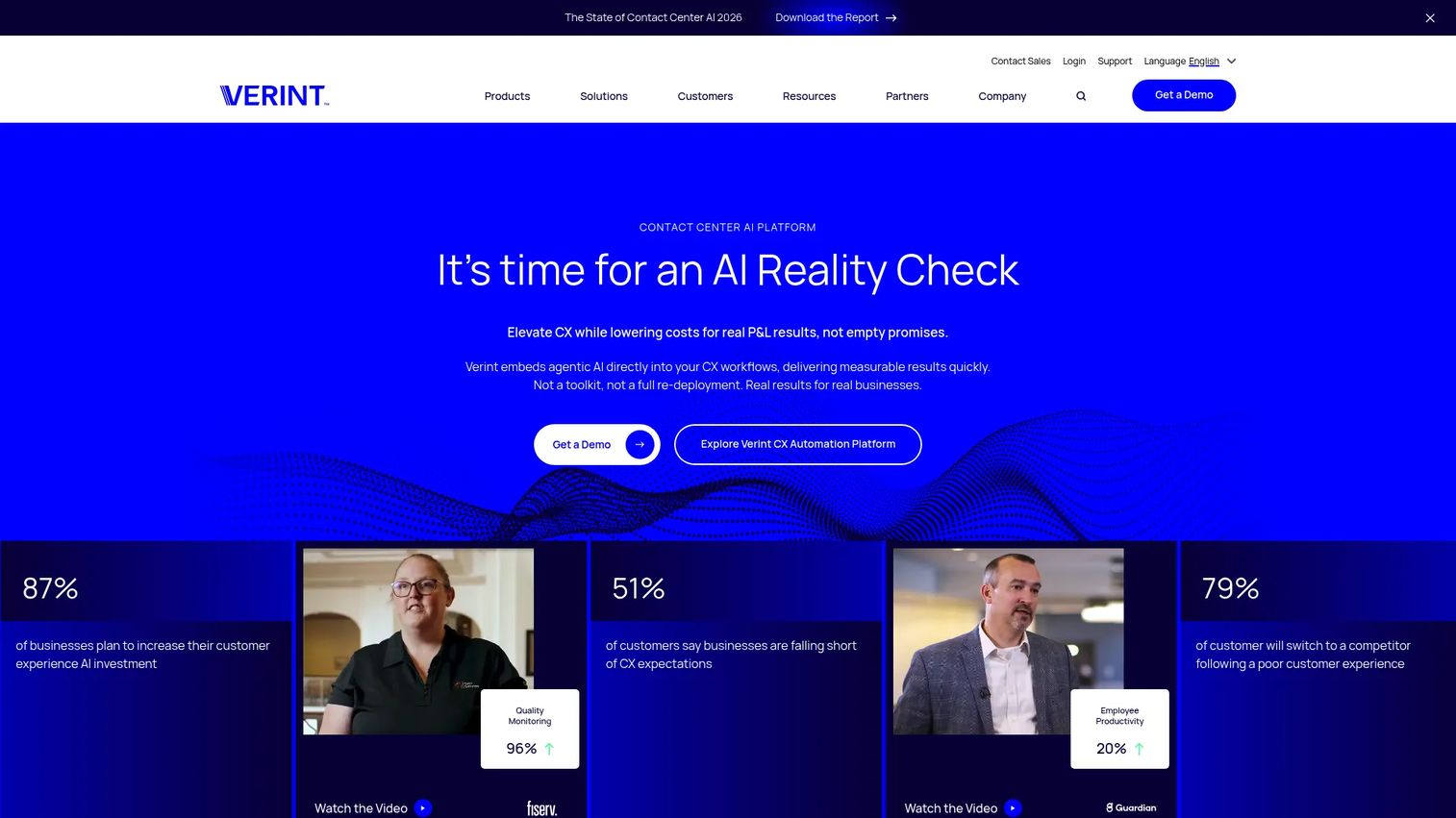
Verint provides a CX Automation Platform covering customer engagement, workforce engagement, analytics, and AI agents. Its strength sits in speech and text analytics, quality intelligence, and workforce optimization for large contact centers. Regulated industries and mature QA operations rely on Verint for compliance monitoring, interaction search, and performance analysis at enterprise scale.
Best for: Enterprise contact centers in regulated industries that need workforce engagement management, speech analytics, and QA at scale.
Key features
- Speech and text analytics with sentiment, topic, and conversation analysis
- Workforce engagement management: Scheduling, forecasting, and quality intelligence
- Compliance monitoring with interaction recording and search
- AI agents and agent assist across voice, chat, email, and messaging
- Omnichannel customer engagement across multiple channels
Why choose Verint: Verint fits evaluations where QA, compliance, and workforce management are non-negotiable alongside AI observability. It handles the depth of interaction analysis that point solutions often can't reach.
Verint pricing: Verint directs all platform pricing through its sales team. Key pricing drivers include workforce modules, analytics scope, interaction volume, user count, and deployment model.
G2 rating: 4.4/5
12. Talkdesk
Talkdesk is a cloud contact center platform with AI, automation, analytics, quality management, and industry-specific capabilities built in. Its analytics run natively within the platform, covering real-time dashboards, agent assist visibility, and omnichannel reporting. Teams that want CCaaS and AI contact center monitoring in the same product evaluate Talkdesk alongside Genesys and Five9.
Best for: Teams that want AI-assisted contact center analytics inside a modern cloud CCaaS platform.
Key features
- AI-powered analytics and real-time operational dashboards
- Quality management with automated scoring
- Agent assist and AI-native automation
- Omnichannel reporting across voice, digital, and messaging
- Industry-specific contact center capabilities
Why choose Talkdesk: Talkdesk works best when the contact center already runs on its platform. Evaluate how deeply it covers your specific channels and integrations before assuming reporting will meet enterprise requirements.
Talkdesk pricing: Four published CX Cloud plans. Digital Essentials starts at $85 per user per month; Voice Essentials at $105; Elite at $165; Industry Experience Clouds at $225. Additional add-ons and usage fees may apply.
13. Sprinklr
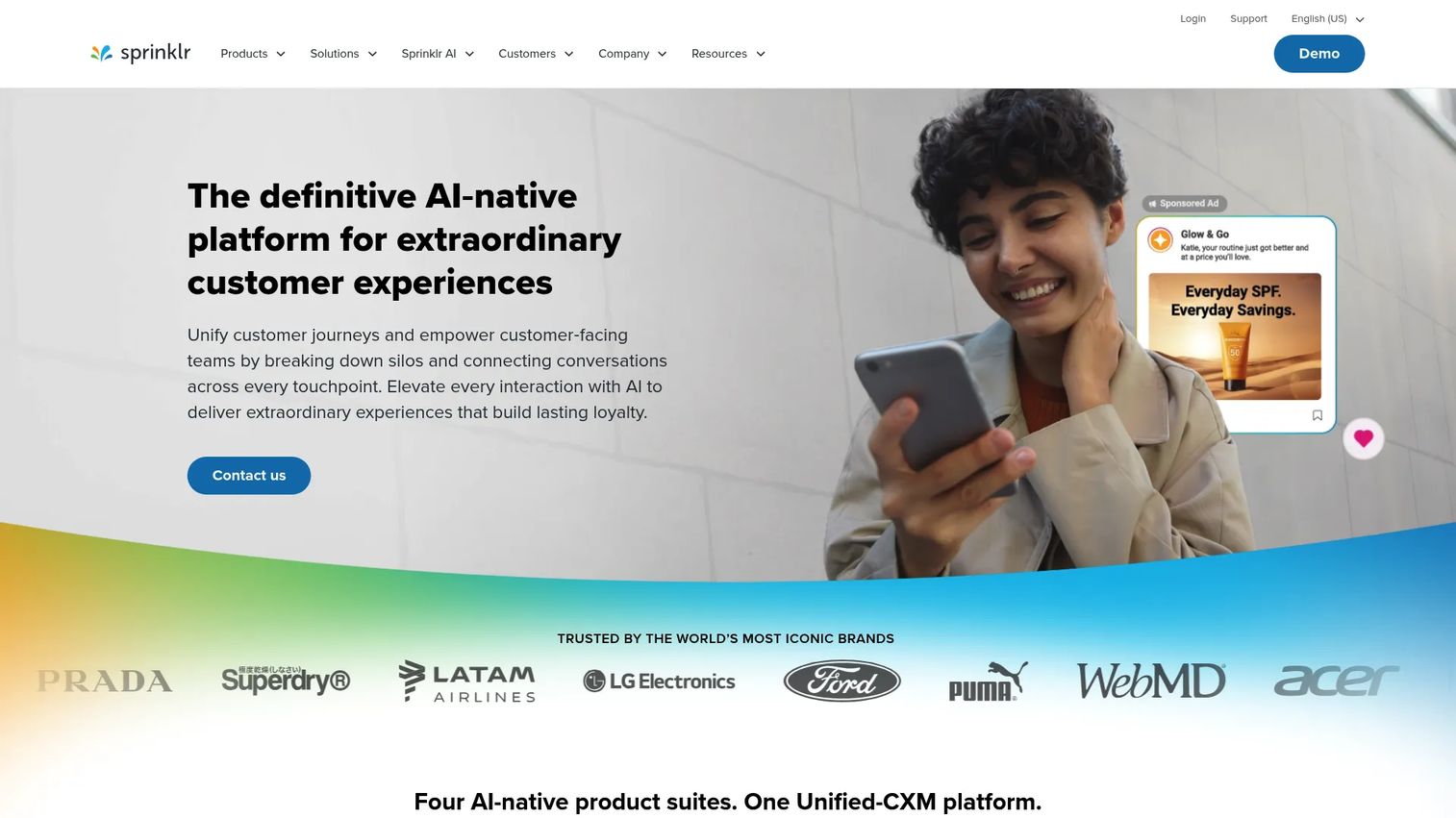
Sprinklr is an AI-native Unified Customer Experience Management platform covering service, social, marketing, and consumer insights. Its observability value comes from connecting customer signals across channels that traditional contact center tools don't see: Social media, review platforms, messaging apps, and digital communities. Teams that need omnichannel CX analytics beyond the call queue look to Sprinklr.
Best for: Large brands that need customer signal visibility across social, messaging, service, and digital channels alongside their contact center data.
Key features
- Omnichannel CX analytics across voice, chat, email, and social
- Social listening and customer sentiment analysis
- AI service insights and case visibility
- Customer signal correlation across digital channels
- Unified platform for marketing, service, and insights
Why choose Sprinklr: If your contact center observability needs to extend past calls into social mentions, app store reviews, and messaging platforms, Sprinklr covers the signal space that CCaaS tools miss entirely.
Sprinklr pricing: Custom enterprise pricing. Self-serve products have been discontinued. Contact Sprinklr's sales team for a quote based on product modules, channels, and user scope.
G2 rating: 4.2/5
14. Dialpad

Dialpad is an AI-native communications and contact center platform with real-time transcription, sentiment analysis, call summaries, and coaching built into every call. It delivers AI contact center monitoring at the conversation layer, making it practical for sales and support teams that want visibility into what's actually being said, not just whether calls connected.
Best for: Sales and support teams that want AI voice analytics, real-time coaching, and conversation intelligence inside their communications platform.
Key features
- Real-time transcription and AI-generated call summaries
- Sentiment analysis with live coaching prompts
- Call routing, analytics, and live monitoring
- CRM and business-tool integrations
- AI-powered support workflows
Why choose Dialpad: Dialpad suits teams where conversation visibility matters as much as call volume reporting. The real-time coaching layer is useful in customer-facing roles where what agents say in the moment determines outcomes.
Dialpad pricing: Dialpad Connect plans start at $15 per user per month (Standard, billed annually), $25 per user per month (Pro). Enterprise pricing requires contacting sales. A 14-day free trial is available.
G2 rating: 4.4/5
15. 8x8
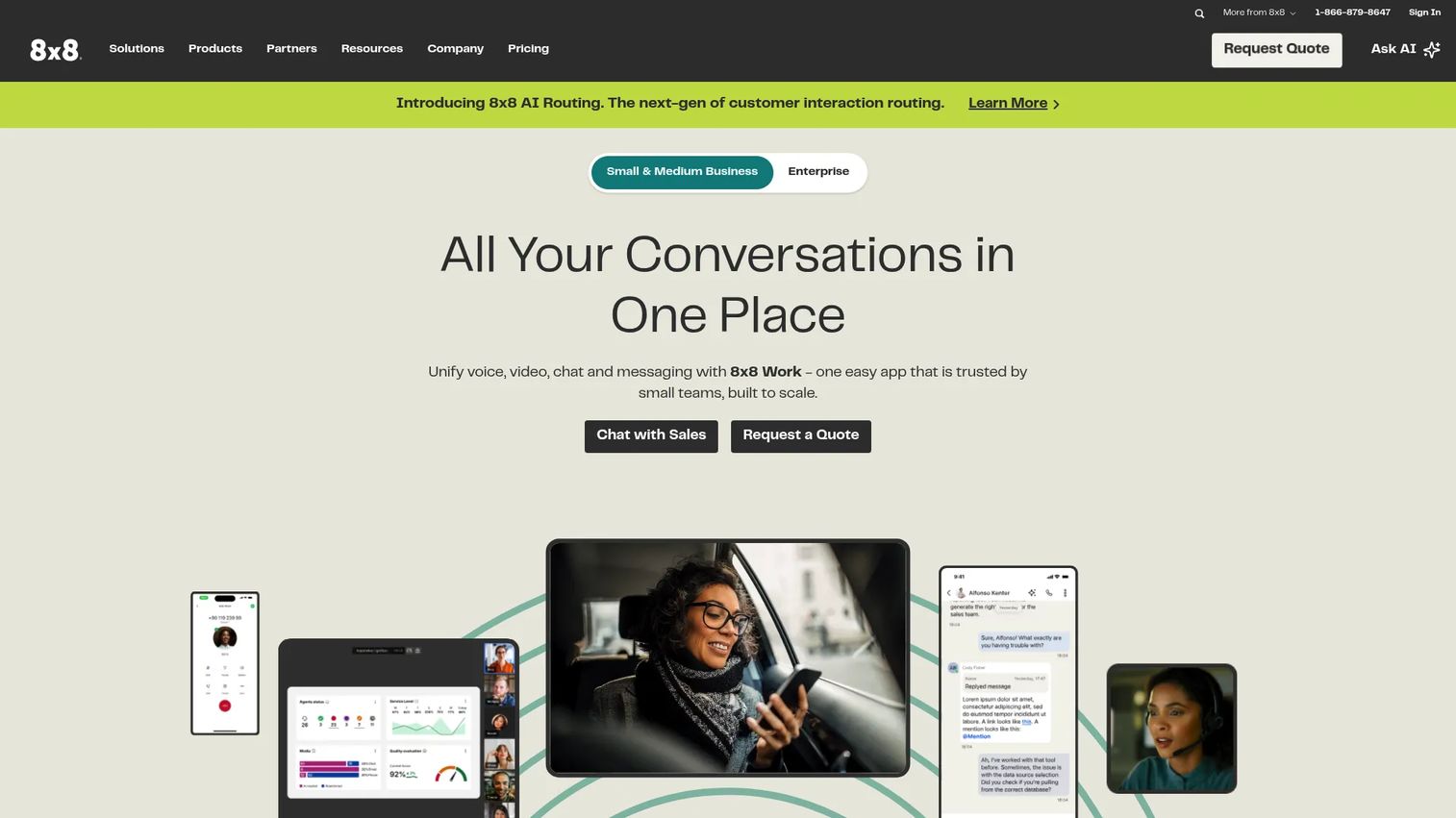
8x8 is a unified communications and contact center platform combining voice, video, chat, and contact center analytics in one architecture. Its contact center analytics cover omnichannel routing, quality management, and workforce engagement alongside broader business communications data. Teams consolidating UCaaS and CCaaS into a single vendor relationship reach for 8x8 when unified communication data helps investigate issues across customer and internal interactions.
Best for: Teams consolidating UCaaS and CCaaS who want contact center analytics alongside business communications visibility.
Key features
- Contact center analytics with omnichannel routing data
- Voice performance reporting across internal and customer interactions
- Unified communications with video and team messaging
- Quality management and workforce engagement tools
- AI-enabled agent assist and self-service capabilities
Why choose 8x8: Unified communication data helps when contact center problems touch internal coordination, not just customer interactions. One vendor covering both layers simplifies procurement and incident investigation.
8x8 pricing: X2 and X4 plans are listed on the 8x8 website but require contacting sales for pricing. Ask about seat counts, contact center add-ons, and international calling requirements.
G2 rating: 4.2/5
16. Nextiva
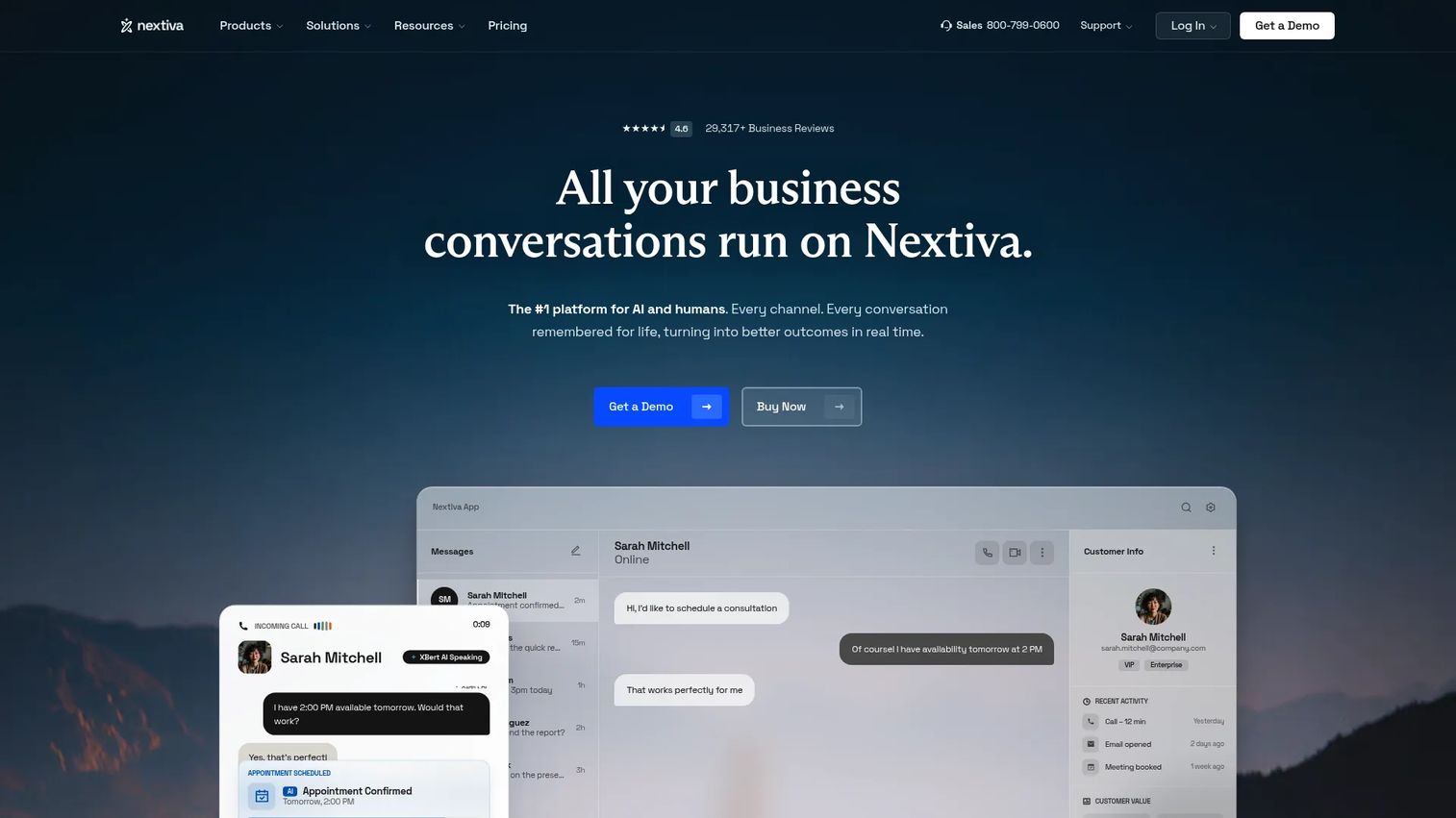
Nextiva is a unified customer experience and business communications platform covering voice, video, messaging, and contact center operations. Its contact center reporting covers call analytics, team performance, omnichannel communication, and customer experience insights. Mid-market teams that want an approachable contact center performance monitoring layer without a complex enterprise deployment consider Nextiva alongside larger suites.
Best for: Mid-market teams that need communications, contact center reporting, and customer experience analytics in a single vendor relationship.
Key features
- Call analytics and contact center reporting dashboards
- Customer experience insights and interaction visibility
- Voice, video, and business SMS communication
- Omnichannel contact center with AI transcription and summaries
- Team collaboration with shared inboxes
Why choose Nextiva: Nextiva fits teams that want predictable contact center analytics without the complexity of a large enterprise platform. Verify that its specific channel and integration coverage matches your requirements before committing.
Nextiva pricing: Core starts at $15 per user per month; Engage at $25 per user per month. Contact center plans (Scale, Essential, Professional, Premium) start from $75 per agent per month, with Professional and Premium requiring contacting sales.
G2 rating: 4.5/5
17. Aircall
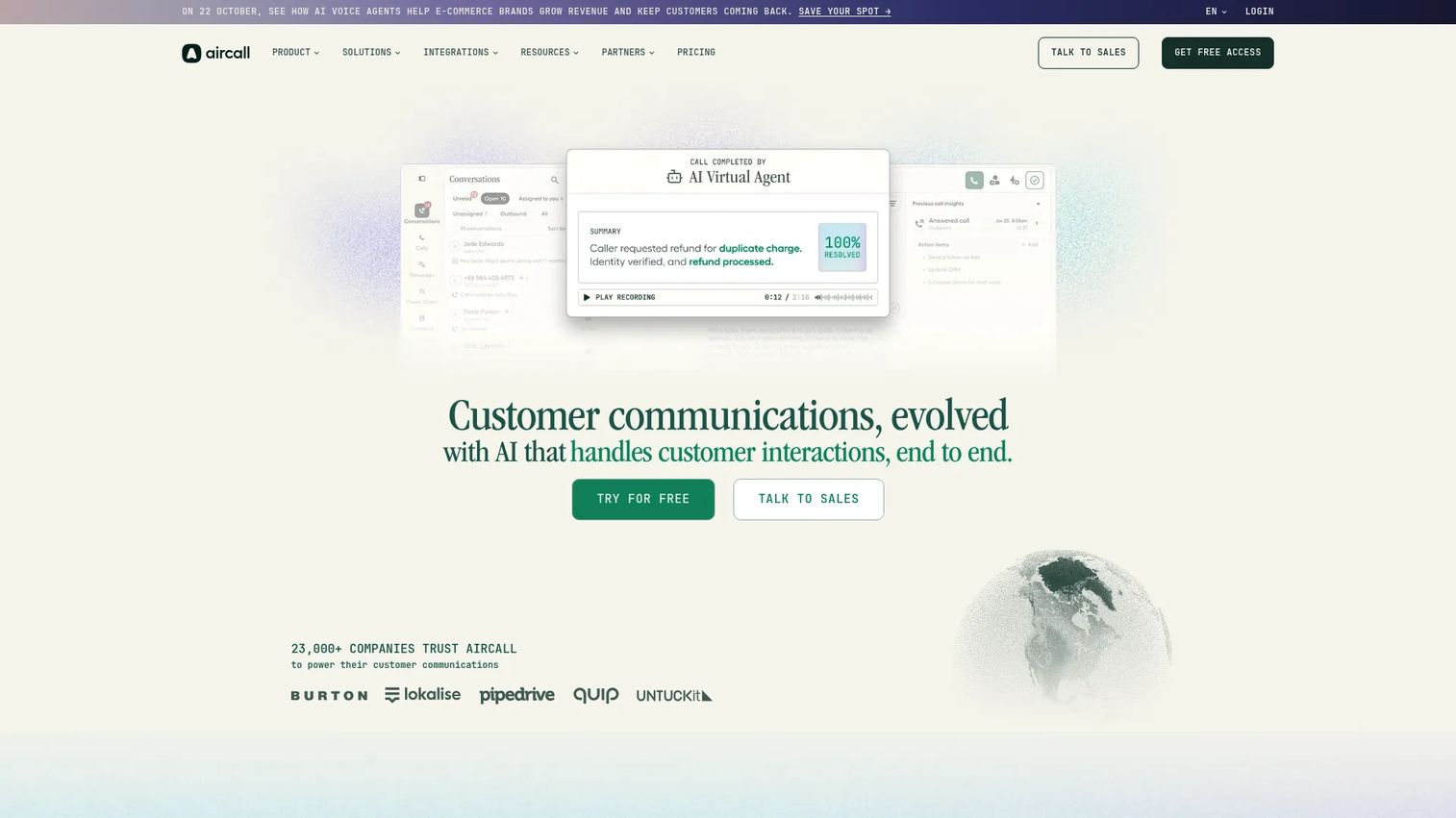
Aircall is a cloud-based customer communications platform for sales and support teams, with call analytics, live monitoring, CRM integrations, and coaching workflows. It's a practical fit for SMB and mid-market teams that need call quality monitoring software without enterprise CCaaS complexity. Over 250 integrations connect Aircall to CRM, helpdesk, and productivity tools.
Best for: SMB and mid-market sales and support teams that need lightweight call analytics and CRM-connected call monitoring.
Key features
- Call analytics with live monitoring and queue visibility
- Power Dialer and outbound campaign capabilities
- Queue callback and coaching workflows
- 250+ integrations including CRM and helpdesk platforms
- Call recording with AI transcripts
Why choose Aircall: Aircall works well for teams that need call visibility without a full contact center infrastructure build. Teams with advanced AI agent monitoring or synthetic testing requirements will need additional tools alongside it.
Aircall pricing: Essentials starts at $30 per license per month (billed annually); Professional at $50 per license per month. Enterprise requires custom pricing (minimum 25 licenses). A minimum of 3 licenses applies to Essentials and Professional. AI Voice Agents are available from $100 per month as an add-on.
G2 rating: 4.4/5
18. InMoment
InMoment is an AI-powered Experience Improvement platform that collects, analyzes, and routes action on customer and employee experience data. Its observability value sits at the customer signal layer: Voice of customer analytics, journey insights, sentiment, and conversational intelligence across calls, chats, and emails. Complement your CCaaS telemetry with InMoment when the question is customer experience quality, not infrastructure health.
Best for: CX teams that want customer feedback and experience signals connected to contact center performance, not just operational metrics.
Key features
- Voice of customer analytics and omnichannel feedback collection
- Conversational intelligence for calls, chats, and emails
- AI-powered text analytics and interaction summaries
- Journey insights with reputation monitoring
- Closed-loop workflow management and reporting dashboards
Why choose InMoment: InMoment answers the experience question that technical dashboards miss. When the evaluation requires proof that contact center performance connects to customer satisfaction, InMoment provides direct customer signal alongside operational data.
InMoment pricing: Custom pricing based on feedback channels, analytics modules, survey volume, and integration requirements. Contact InMoment's sales team for a quote.
G2 rating: 4.9/5
19. Bespoken.ai
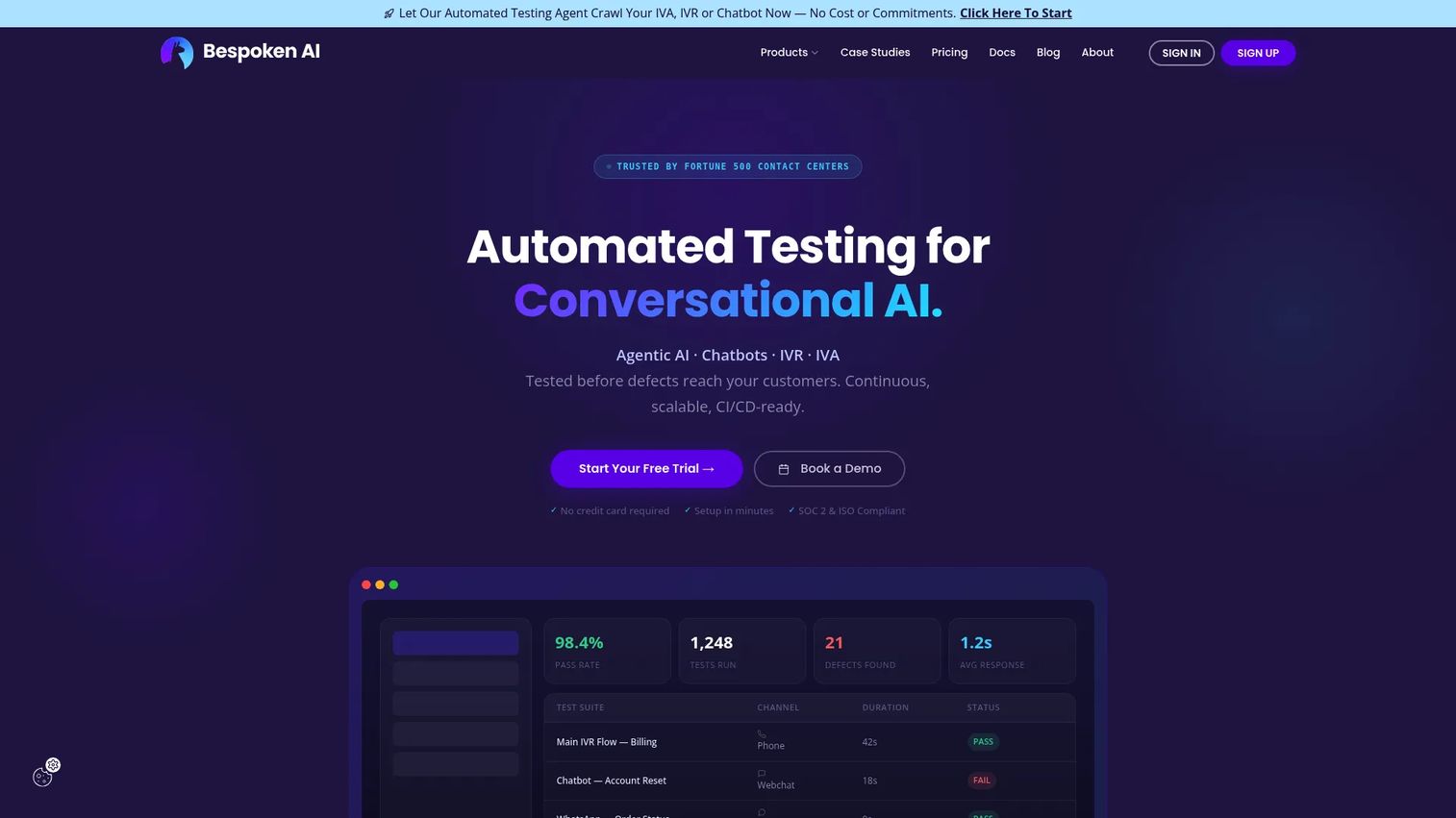
Bespoken.ai is an automated testing and monitoring platform for IVR, chatbots, conversational AI, and agentic AI systems. It runs scenario-based functional tests, load tests, regression tests, and continuous monitoring across voice and chat channels. Teams building or maintaining voice experiences where small changes can break customer paths rely on Bespoken.ai to catch failures before they reach production.
Best for: Enterprise QA, DevOps, and CX teams testing and monitoring conversational AI and IVR systems before and after deployment.
Key features
- Agentic AI testing with scenario-driven coverage
- Voice bot testing and IVR test automation
- Regression testing and load testing
- Continuous monitoring for conversational AI
- Model and LLM testing across channels
Why choose Bespoken.ai: Presales teams evaluating voice AI projects can use Bespoken.ai test results to demonstrate production readiness during technical validation. It's one of the few tools purpose-built for ai software testing tools in voice and conversational AI contexts.
Bespoken.ai pricing: Self-Serve Professional starts at $2,000 per month (billed annually, includes 5,000 monthly interactions). Guided Professional is $3,000 per month (10,000 interactions). Custom Enterprise includes unlimited interactions and requires contacting their team. A 2-week free trial is available.
20. Evalgent
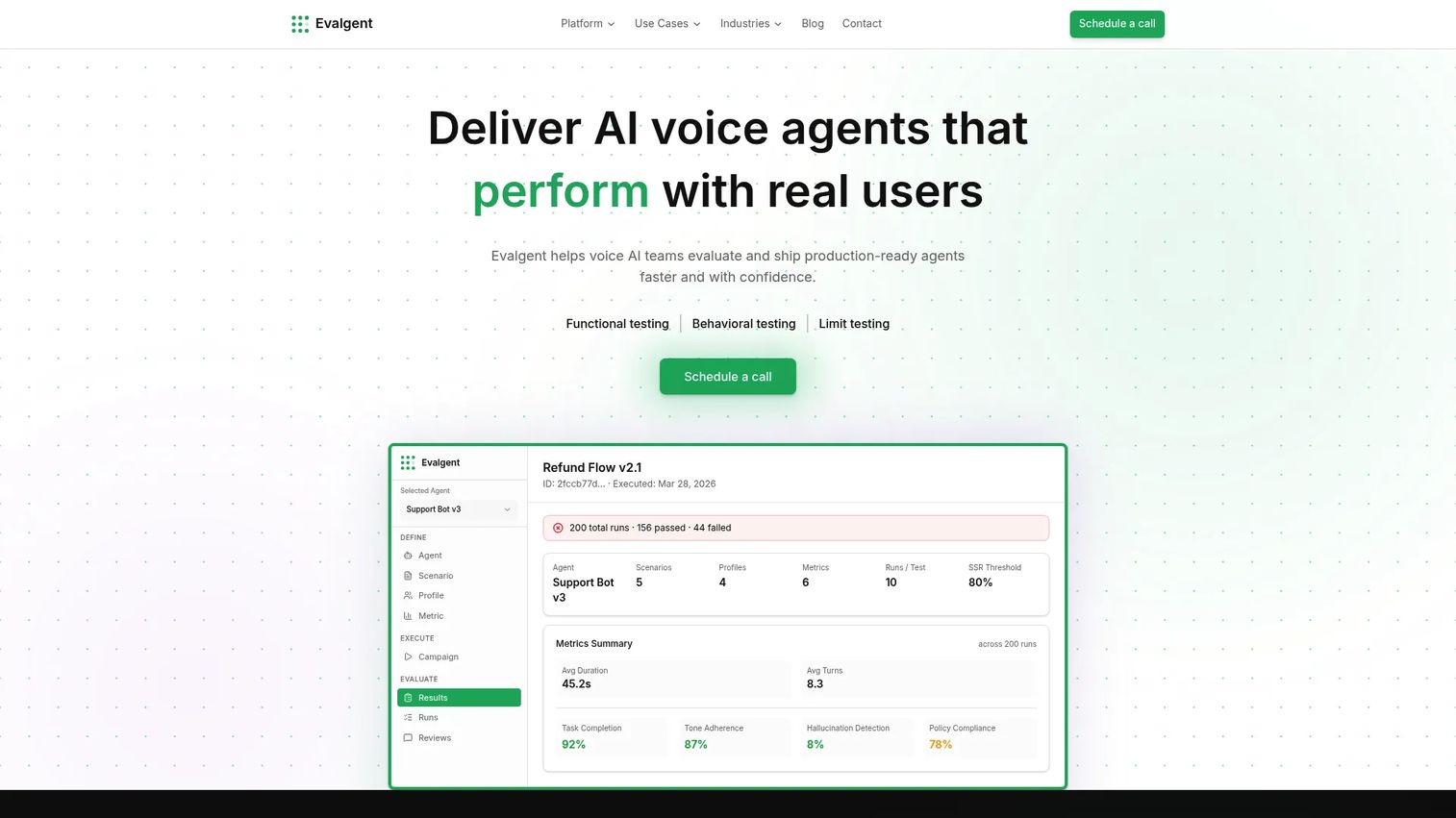
Evalgent is an AI voice agent testing and evaluation platform built for validating production readiness. It uses scenario-driven functional evaluation, behavioral testing with caller profiles, limit testing, and statistical reliability measurement to assess whether an AI agent performs consistently before and after deployment. Teams bringing AI agents or assistants into customer-facing contact center workflows use Evalgent to structure evaluation, not just QA test cases.
Best for: Teams deploying AI voice agents or assistants into customer-facing workflows that need structured evaluation before go-live.
Key features
- Scenario-driven functional evaluation with behavioral caller profiles
- Limit testing to identify edge cases and failure thresholds
- Statistical reliability measurement across test runs
- Evidence-backed results with review workflows
- Model performance checks for AI voice systems
Why choose Evalgent: When an AI agent goes live in a contact center, the failure modes are harder to predict than in a traditional IVR. Evalgent provides the structured evaluation process that closes that gap, useful for presales teams helping buyers prove AI readiness to internal stakeholders.
Evalgent pricing: Pricing is not publicly listed. Contact Evalgent directly to discuss evaluation volume, AI use cases, seat requirements, and support scope.
Considerations when choosing contact center AI observability software
Match the tool to the signal you need
Infrastructure telemetry, CCaaS-native analytics, conversation intelligence, customer feedback, and synthetic testing are different categories. No single product covers all of them equally well. Map your priority failure modes first, then match the tool category to that list.
Check your CCaaS and CRM integrations
Ask whether data sync with platforms like Genesys, NICE, Five9, Amazon Connect, Salesforce, ServiceNow, and Zendesk is native, API-based, or requires services work. Native integrations reduce implementation risk and ongoing maintenance. API-based or services-led integrations should factor into your TCO calculation.
Separate monitoring from testing
Monitoring shows you what's happening in production. Synthetic testing tells you whether a specific flow breaks before customers reach it. Mature operations need both. A tool that only monitors won't catch the broken IVR path until customers hit it.
Evaluate alert quality, not alert volume
A tool that fires on every threshold movement will exhaust overnight teams. Ask specifically about correlation, routing, suppression rules, severity scoring, and escalation logic. The goal is the right alert reaching the right person with enough context to act.
Confirm AI observability depth
For voice bots, chatbots, and agent assist, evaluate how the tool handles intent accuracy, bot containment, hallucination handling, model drift detection, scenario coverage, and interaction auditability. AI model deployment software considerations apply here: The model that worked at launch may not behave the same way after updates.
Conclusion
The 20 tools in this guide cover the full range of contact center AI observability, from enterprise platform suites to specialized testing and infrastructure monitoring.
For platform-native observability, Genesys, NICE, Five9, Talkdesk, and Amazon Connect embed monitoring inside the CCaaS environment itself. Operata adds purpose-built cloud contact center observability when the CCaaS dashboard isn't enough. Cyara, Bespoken.ai, and Evalgent cover proactive testing and AI evaluation before and after deployment. Datadog, Dynatrace, and New Relic handle the infrastructure and application layers surrounding the contact center. Observe.AI, Verint, InMoment, and Sprinklr go deep on conversation quality, QA, and customer experience signals. Dialpad, 8x8, Nextiva, and Aircall bring communications and call analytics for teams that haven't yet committed to a full enterprise CCaaS stack.
Before booking vendor demos, map your current failure modes. Where do deals stall during technical validation? Routing defects, bot misclassification, poor audio, QA blind spots, overnight alert fatigue, or low visibility into customer sentiment each point to a different tool category. Start with the failure you can't currently explain.
For presales teams building a sharper technical story around complex contact center evaluations, the best presales software tools guide covers the broader stack.
Start your journey with Guideflow today!
FAQs
Contact center AI observability software monitors, tests, and analyzes the systems, conversations, AI models, agents, and customer journeys that determine contact center performance. It goes beyond uptime monitoring to explain why interactions fail, including routing defects, bot misclassification, voice quality issues, model drift, and agent experience problems.
Analytics reports what happened: Call volume, handle time, CSAT, abandonment rate. Observability helps explain why a specific failure occurred and where it originated. A queue spike reported in analytics might trace back to a routing misconfiguration, a carrier problem, or a bot containment drop. Observability connects those layers; analytics doesn't.
Mature environments benefit from both. Synthetic testing validates known journeys, such as IVR paths, chatbot flows, and routing logic, before customers reach them. Live observability monitors production behavior and surfaces unexpected failures. Testing catches the predictable; observability catches the rest.
Evaluate on intent accuracy measurement, bot containment tracking, hallucination handling, model drift detection, scenario coverage, escalation behavior, and audit logs. No single product leads universally. Cyara, Bespoken.ai, and Evalgent specialize in testing AI agents pre-deployment. Observe.AI and Verint cover conversation quality and compliance post-interaction. The right choice depends on whether you need pre-production validation or ongoing interaction analysis.
Check integration support for the buyer's CCaaS platform, CRM, and data warehouse. Confirm the deployment model, whether cloud-native, on-premises, or hybrid, and whether it matches the buyer's IT posture. Understand the alerting workflow, including severity scoring, routing, and escalation. Review security requirements, especially for regulated industries. Define the POC success criteria upfront so the evaluation has clear exit conditions.
Yes, with important caveats. Datadog, Dynatrace, and New Relic cover infrastructure health, application performance, and log analysis effectively. They typically miss contact center context: Routing behavior, voice quality at the agent or carrier layer, bot containment, interaction outcomes, and QA signals. General tools and contact center-specific tools often work best together rather than as substitutes.
AI accelerates anomaly detection, conversation classification, interaction scoring, call summarization, and root cause correlation. In observability platforms, AI identifies patterns across thousands of interactions that manual review would miss. The caution: AI outputs still need governance, human review, and ongoing tuning. Model drift in the observability layer itself can produce false alerts or missed failures if not monitored.
Test against known failure modes, not just steady-state operation. Include at least one broken IVR path, a bot misclassification scenario, a degraded audio condition, a CRM sync delay, and a queue overflow situation. Verify that the tool detects each failure, routes the right alert, and provides enough context for an operator to act. Compare how long root cause investigation takes with the tool versus without it.