One surprise OCR audit can unravel months of work. A surveyor asks for your last risk assessment, and you are digging through a shared drive, three binders, and a spreadsheet that nobody updated since the last hire left. Meanwhile, your newest medical assistant still has not acknowledged the bloodborne pathogens policy, and you have no record either way.
This is the daily reality for compliance officers and practice administrators across clinics, hospitals, and multi-site health systems. The stakes keep climbing. According to IBM's Cost of a Data Breach research, healthcare has remained the highest-cost industry for breaches for over a decade, with average breach costs sitting far above the cross-industry figure. The HHS Office for Civil Rights publishes running totals of HIPAA settlements and civil monetary penalties, and the numbers grow every year.
Healthcare compliance software exists to close that gap. The right healthcare compliance software pulls policies, training, incident logs, risk assessments, and audit evidence into one system that proves continuous compliance instead of last-minute scrambling. Get it wrong, and you risk citations, breach penalties, and the staff turnover that breaks your training records. Get it right, and a surveyor request becomes a few clicks instead of a fire drill.
The category is also growing fast. Research and Markets valued the global healthcare compliance software market at roughly USD 3 billion in 2025, projected to reach about USD 6 billion by 2032 at a 10.6% CAGR. More tools means more noise. This guide cuts through it.
What's inside
This guide is for healthcare compliance officers, chief compliance officers, practice managers, HR and operations leads, and risk and quality directors. It covers buyers across clinics, hospitals, home health, dental groups, behavioral health, and large multi-site health systems, from solo-practice administrators to enterprise GRC owners.
We evaluated each healthcare compliance platform against four criteria that actually matter when you are accountable for an audit:
- Multi-framework coverage: HIPAA, OSHA, CMS, OIG, HITRUST, and beyond.
- Audit readiness: can it produce surveyor-ready evidence on demand?
- Ease of use and adoption: will frontline staff complete training and acknowledgments?
- Integrations and pricing transparency: HRIS, EHR, LMS, SSO, and clear cost.
TL;DR
Short on time? Here are the decision shortcuts by buyer segment.
- Best all-in-one for multi-site outpatient groups: MedTrainer, which pairs compliance operations with a deep healthcare LMS.
- Best for spreadsheet replacement and guided HIPAA: Compliancy Group, with transparent pricing and a public trust signal.
- Best for training-heavy hospitals and health systems: HealthStream, built around clinical training and credentialing.
- Best for coding and audit-focused teams: Healthicity, with strong auditing tools and public tiered pricing.
- Best for configurable continuous compliance: VComply, a GRC platform with modular pricing.
- Best for enterprise GRC: ServiceNow GRC, MetricStream, or NAVEX One for large, multi-framework programs.
What is healthcare compliance software?
Healthcare compliance software is a platform that helps healthcare organizations track, document, and prove adherence to regulations like HIPAA, OSHA, and CMS rules by centralizing policies, training, incident reporting, risk assessments, and audit evidence in one system.
Instead of scattered binders and spreadsheets, a healthcare compliance management software system gives you a single source of truth. When a regulator or surveyor asks for proof, you produce it from one place with a timestamped trail of who did what, and when.
Most medical compliance software covers a consistent set of core capabilities:
- Policy and document management: version control, distribution, and staff acknowledgments.
- Training and onboarding tracking: assign courses, track completion, and log attestations.
- Incident reporting: capture, route, and resolve events and complaints.
- Risk assessments: run HIPAA Security Risk Assessments and corrective action plans.
- Audit readiness: maintain immutable evidence trails and surveyor-ready documentation.
- Reporting, dashboards, and monitoring: continuous visibility into compliance status.
- Multi-framework support: HIPAA, OSHA, CMS, OIG, HITECH, HITRUST, NIST, and PCI.
- Integrations: HRIS and HRMS, EHR, LMS, and SSO.
A modern compliance management system for healthcare emphasizes immutable audit trails that capture not just the action, but the person, the timestamp, and often the location. That detail is what satisfies investigators and survives diligence. The strongest healthcare regulatory compliance software treats audit readiness as a continuous state, not a quarterly project.
The category splits into two broad camps. Healthcare-purpose-built tools ship with ready-made HIPAA and OSHA templates, courseware, and surveyor-friendly reports. Enterprise GRC platforms offer broad, configurable risk and compliance workflows that span many industries, healthcare included.
When to use healthcare compliance software
Replace spreadsheets and binders with one system
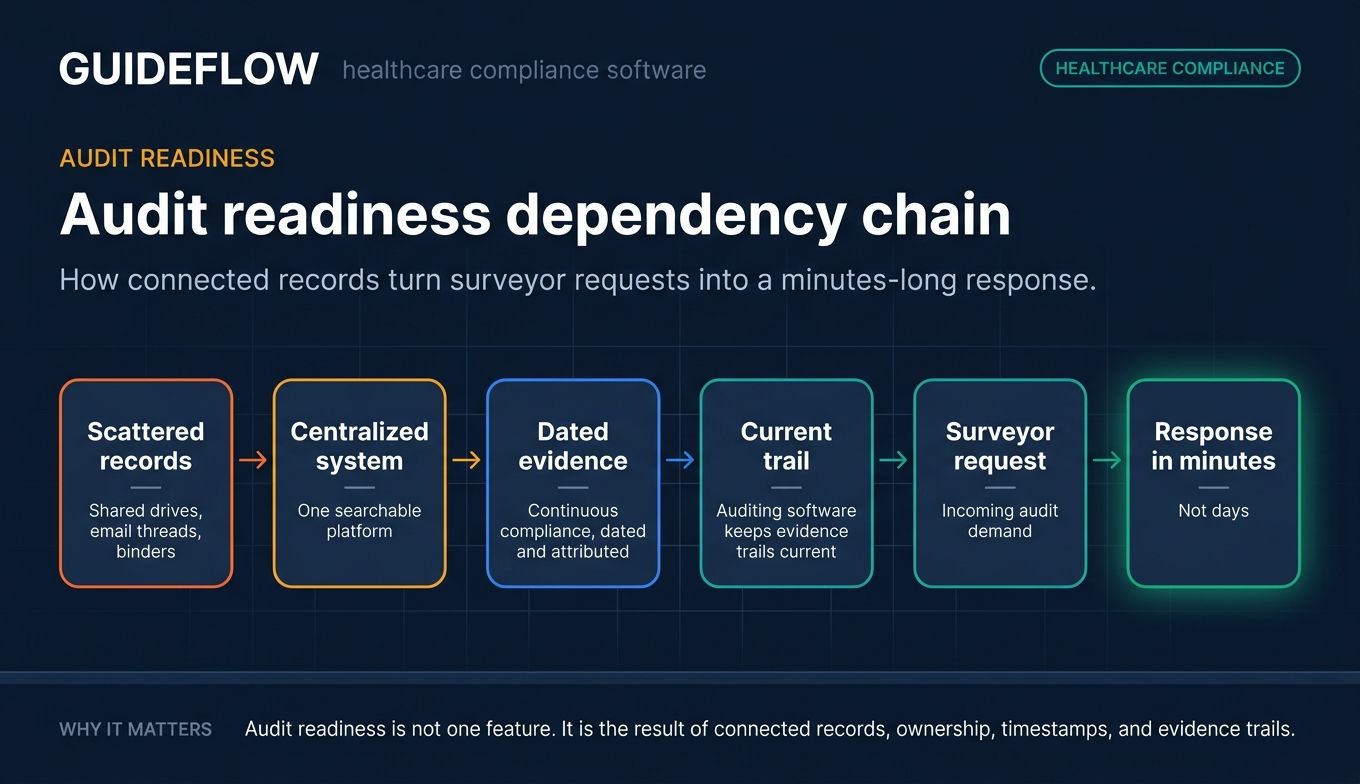
If your compliance program lives in shared drives, email threads, and a binder nobody can find, you are one staff departure away from a gap. A healthcare compliance platform consolidates everything into one searchable system. You stop re-creating the same risk assessment every year and start building on a living record. This is the most common trigger for buyers leaving manual tracking behind.
Stay audit-ready for HIPAA, OSHA, and CMS year-round
Audits do not announce themselves with comfortable notice. Continuous compliance means the documentation a surveyor wants already exists, dated and attributed. Healthcare compliance auditing software keeps evidence trails current so you respond in minutes, not days. For home health agencies and multi-site groups facing CMS conditions of participation, that readiness is the difference between a clean survey and a corrective action plan.
Track training and policy acknowledgments across multi-site staff
Turnover breaks training records. New hires need onboarding paths, and existing staff need recurring HIPAA and OSHA refreshers. Healthcare compliance training software assigns the right courses, tracks completion, and logs attestations automatically. Many teams pair this with a dedicated onboarding flow software to standardize how new clinicians ramp. For home health compliance software needs, where staff work across locations, centralized tracking proves every clinician completed required training without manual chasing.
How we chose these tools
We selected platforms based on framework coverage, audit and reporting depth, training and onboarding capabilities, integrations, ease of use, and pricing transparency. We prioritized tools that serve real healthcare compliance jobs, from HIPAA risk assessments to OSHA tracking and CMS audit readiness. Pricing and ratings were verified against live vendor pricing pages and current G2 or Capterra listings at the time of writing. Where a vendor publishes no public price, we say so plainly rather than guess.
11 best healthcare compliance software tools for 2026: comparison table
The table below ranks the 11 best healthcare compliance software tools by relevance to the typical compliance and operations buyer, from healthcare-purpose-built platforms to enterprise GRC suites. Pricing and ratings reflect verified values at the time of writing. Many enterprise tools publish no public price and quote based on organization size, so plan to request a custom quote for those.
| # | Product | Intent | Key use case | Pricing | G2 rating |
|---|---|---|---|---|---|
| 1 | MedTrainer | All-in-one for outpatient groups | Compliance plus training and credentialing in one platform | Custom (Select, Premier, Signature) | 4.3/5 (Capterra) |
| 2 | Compliancy Group | Guided HIPAA all-in-one | Spreadsheet replacement with public trust badge | From $99/month, billed annually | 4.7/5 |
| 3 | VComply | Configurable GRC | Continuous compliance with leadership dashboards | From $1,000/month | 4.6/5 |
| 4 | HealthStream | Training-led for health systems | Clinical training and credentialing at scale | Custom | 4.4/5 |
| 5 | Healthicity | Coding and audit focused | Compliance program management and auditing | From $500/month, billed annually | 4.3/5 |
| 6 | ComplyAssistant | Cloud GRC for health systems | Broad multi-framework coverage and mobile audits | Custom | 5.0/5 (Capterra) |
| 7 | NAVEX One | Enterprise GRC and ethics | Whistleblowing, policy, and risk at enterprise scale | Custom | 3.7/5 |
| 8 | ServiceNow GRC | Enterprise GRC platform | Workflow-driven risk and compliance | Custom | 4.2/5 |
| 9 | LogicGate Risk Cloud | Configurable GRC | No-code risk and compliance automation | Custom | 4.6/5 |
| 10 | MetricStream | Enterprise GRC for regulated industries | Integrated risk, compliance, and audit | Custom | 3.8/5 |
| 11 | Diligent | Enterprise GRC and governance | Board-level governance plus GRC | Custom | 4.3/5 |
The 11 best healthcare compliance software tools
1. MedTrainer
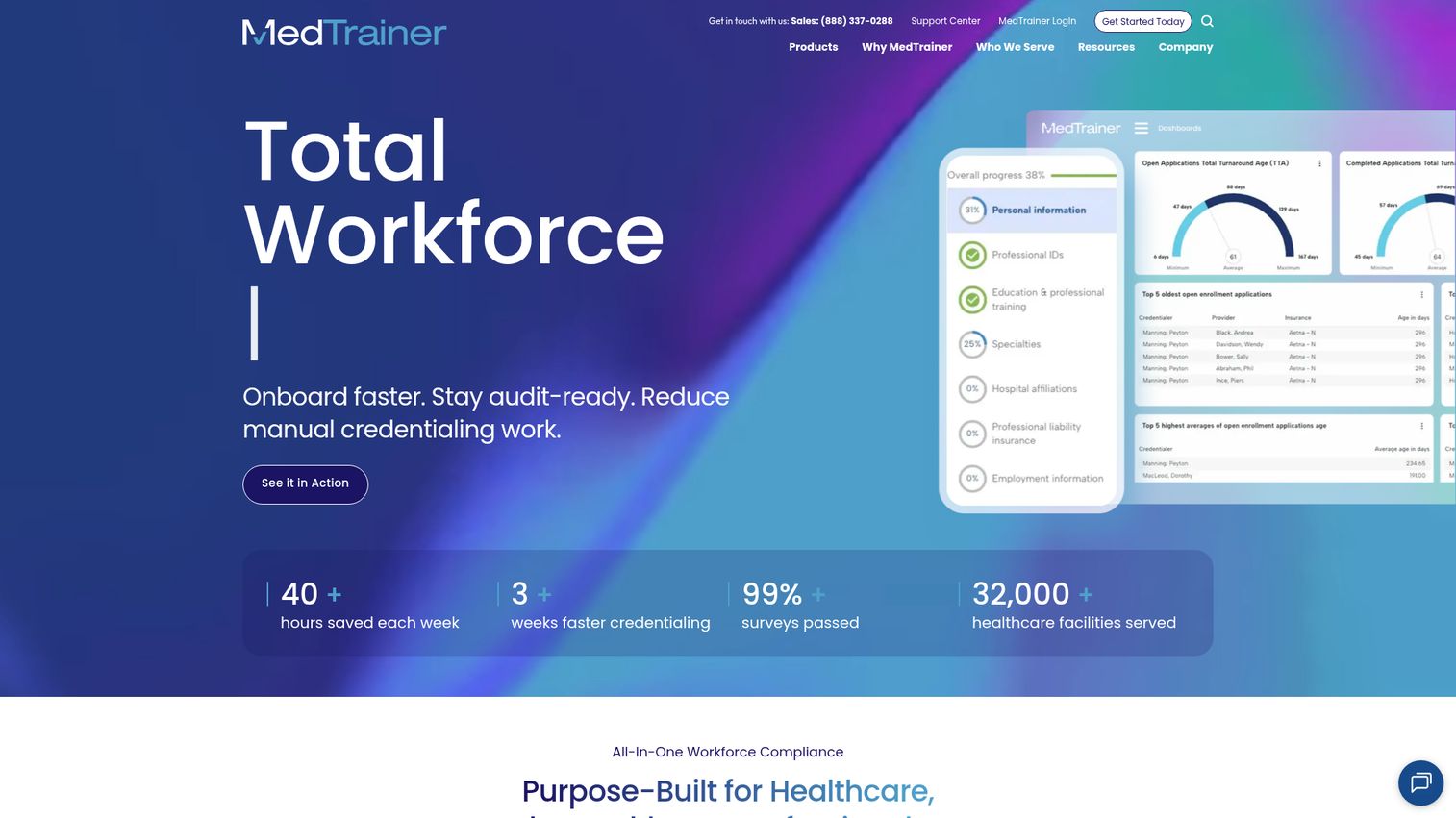
MedTrainer is a healthcare workforce compliance platform that combines learning management, credentialing, and compliance operations in one place. It is built specifically for healthcare, which shows in the depth of its course library and its handling of provider credentialing. For outpatient groups that want training and compliance under one login, it consolidates what would otherwise be three or four separate tools.
Best for: Multi-site outpatient groups that need compliance operations and a healthcare LMS in a single platform.
Key strengths
- Healthcare learning management: Nearly 1,000 healthcare-specific courses, 300+ CEU courses, real-time reporting, and premium content including CPR and BLS.
- Credentialing tools: Provider profile management, primary source verification, exclusions monitoring, provider enrollment, and managed credentialing services.
- Compliance operations: Document and policy management, online incident reporting, SDS management, enterprise-grade reporting, accreditation, safety plans, and onboarding paths.
Why choose MedTrainer: If your compliance burden is split across training, credentialing, and policy management, MedTrainer pulls those jobs together so a single administrator can run the program. It fits practice managers and HR leads who are tired of reconciling an LMS, a credentialing spreadsheet, and a policy folder. The trade-off is that pricing is quote-based, so expect a sales conversation before you see numbers.
MedTrainer pricing: MedTrainer offers three tiers: Select for an essential compliance foundation, Premier for advanced compliance operations, and Signature for comprehensive compliance excellence. Pricing is customized based on licensed user count, the features and modules you need, and industry-specific content. No public starting price is listed. MedTrainer holds a 4.3 out of 5 rating on Capterra.
2. Compliancy Group
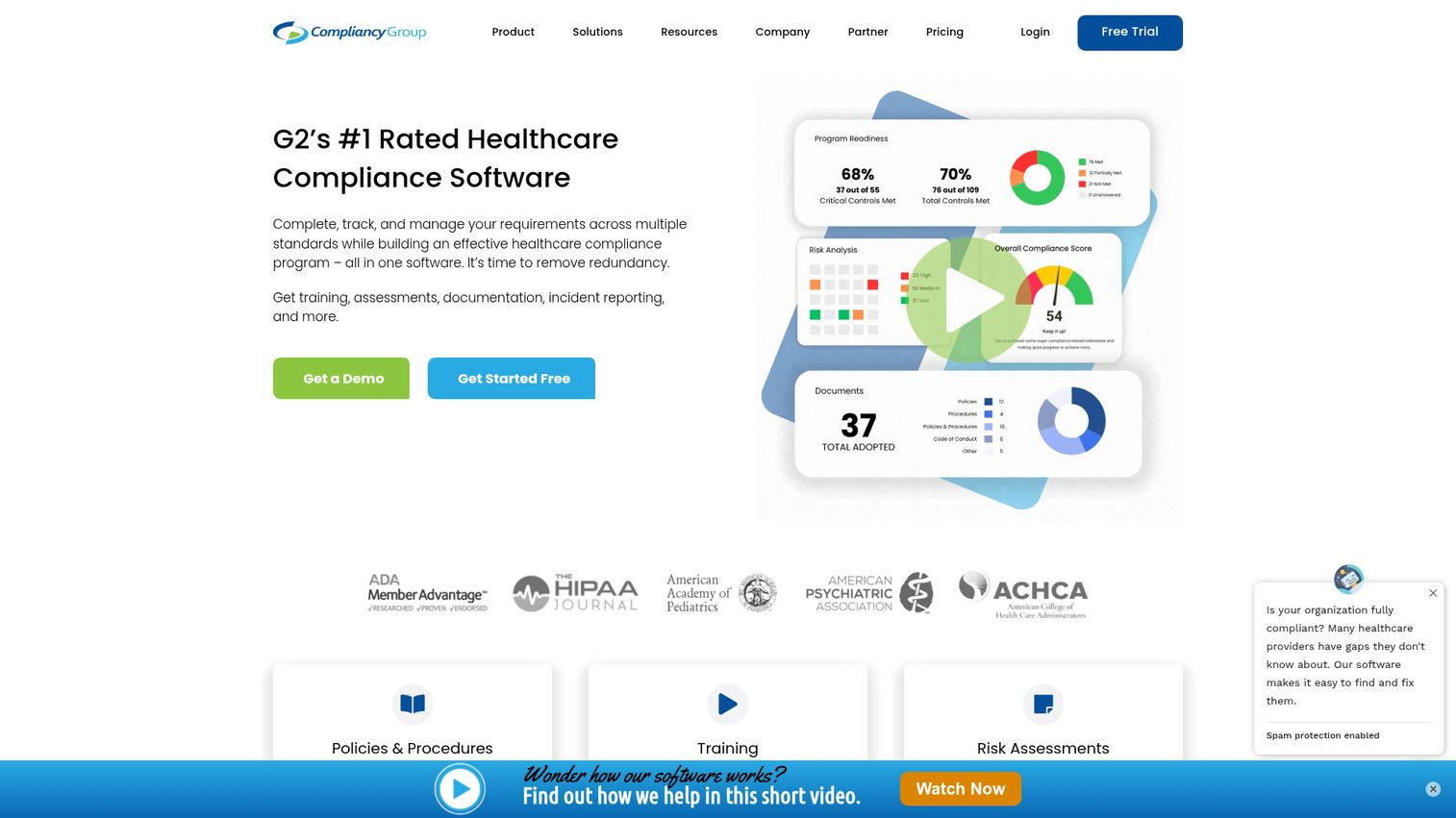
Compliancy Group provides The Guard, a SaaS platform for healthcare compliance tracking and management. It is HIPAA-first and built to guide smaller practices through compliance step by step, then prove it with a public trust signal. For organizations leaving spreadsheets behind, the guided approach lowers the learning curve.
Best for: Practices that want guided HIPAA compliance, transparent pricing, and a public trust signal they can display.
Key strengths
- Policy management: Ready-to-use policy templates plus attestation and acknowledgment management.
- Compliance training: Courses spanning HIPAA, OSHA, fraud waste and abuse, cybersecurity, HR, and ethics.
- Risk and vendor tools: Risk assessments, incident reporting, vendor and BAA management, and exclusion or sanction screening.
Why choose Compliancy Group: This is one of the few vendors on this list with public, tiered pricing, which makes budgeting easier for small and mid-size practices. The guided workflow and template library suit administrators who want structure rather than a blank GRC canvas. Larger organizations can move up to the Elite tier for dedicated account management and tailored terms.
Compliancy Group pricing: Foundation starts at $99/month, billed annually ($139/month billed monthly), with employee pricing starting at $8 per employee per month annually. Growth runs $249/month billed annually, Advanced runs $449/month billed annually, and Elite is enterprise-grade with dedicated support and custom terms. There is no free tier, though free trial links are available. Compliancy Group holds a 4.7 out of 5 rating on G2 across 114 reviews.
3. VComply
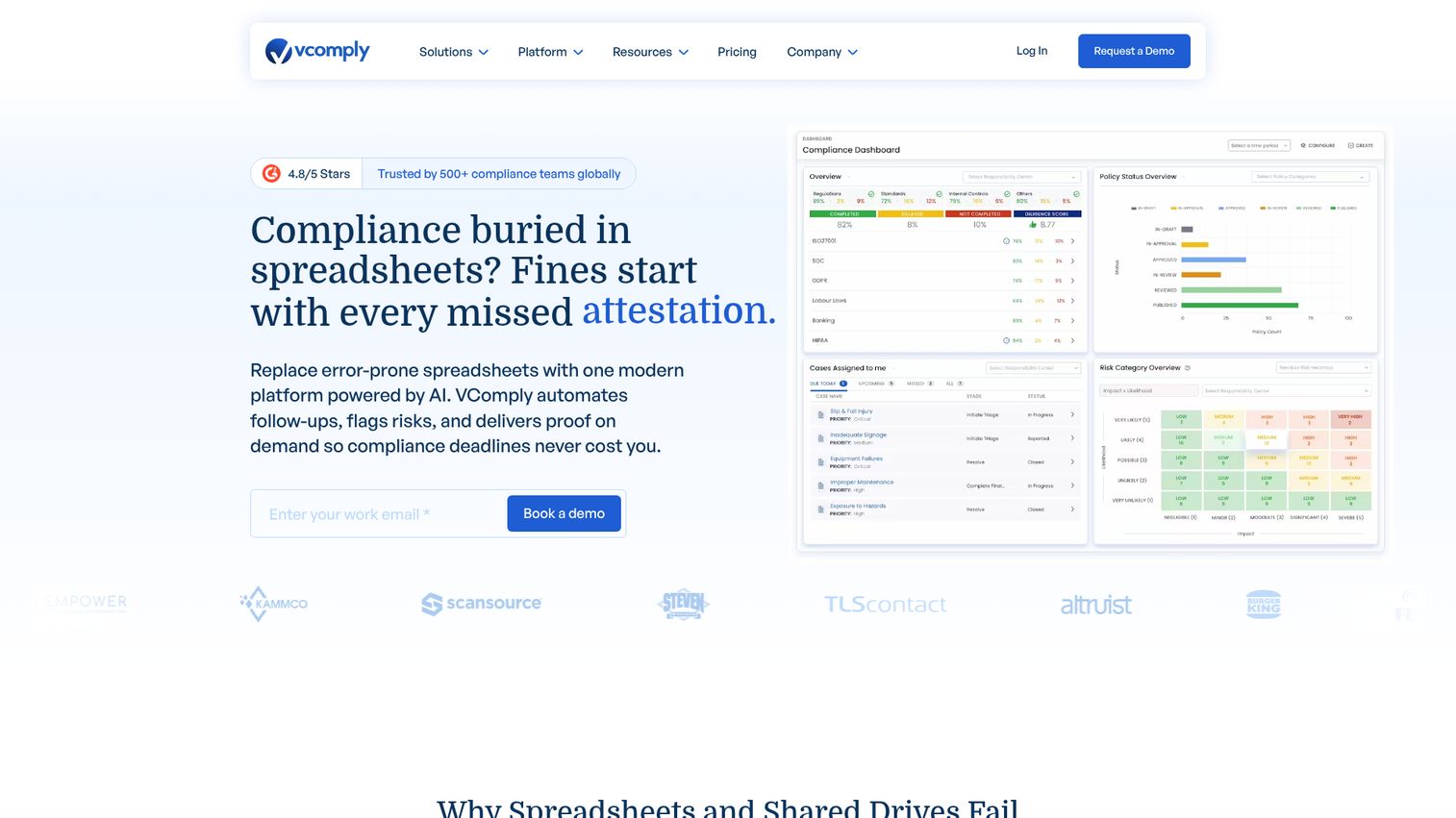
VComply is a governance, risk, and compliance platform for managing compliance tasks, policies, risks, cases, evidence, dashboards, and audit readiness. It takes a configurable, GRC-style approach that supports continuous compliance, with healthcare as one of its vertical use cases. Teams that want workflows they can shape, plus leadership-ready dashboards, tend to gravitate here.
Best for: Mid-market and enterprise compliance teams that want configurable workflows and unified dashboards across obligations, policies, and risks.
Key strengths
- ComplianceOps: Track obligations, assign tasks, and stay audit-ready with evidence trails.
- PolicyOps: Create, approve, distribute, and track policies with version history.
- RiskOps: Identify, assess, and control risks with real-time oversight and reporting.
Why choose VComply: VComply suits teams that have outgrown rigid, template-only tools and want to configure compliance to their own processes. It publishes a clear modular price, which is rare in the GRC space. The trade-off is that it is a broader GRC platform rather than a healthcare-specific product, so you build more of the healthcare context yourself.
VComply pricing: The PRO GRC Suite starts at $1,000/month, invoiced annually with a 12-month minimum contract. A Start-Ups and Non-Profits plan and an Enterprise GRC Suite are both custom priced. VComply is modular, so you can start with a single module or adopt the full suite. VComply holds a 4.6 out of 5 rating on G2 across 51 reviews.
4. HealthStream
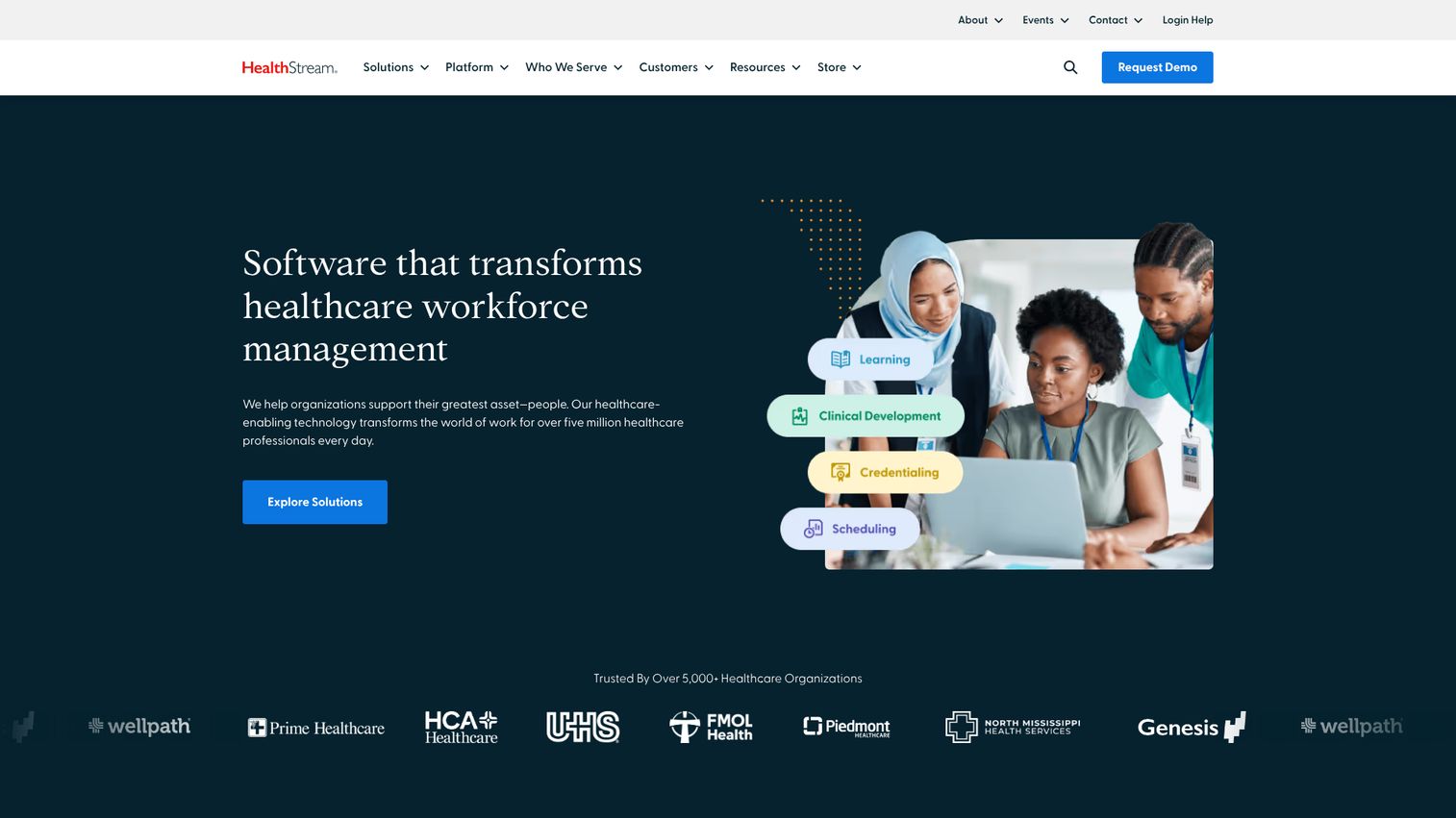
HealthStream provides healthcare workforce solutions including learning, compliance, clinical development, credentialing, and performance tools. It is widely used by hospitals and large health systems where training and credentialing volume is high. If your compliance program is anchored in workforce readiness, HealthStream is built for that scale.
Best for: Large provider organizations and health systems with heavy clinical training and credentialing needs.
Key strengths
- Healthcare-focused LMS: Purpose-built learning management for workforce readiness and compliance training.
- Flexible delivery: Manage, track, and deliver virtual, in-person, and hybrid education.
- Reporting and analytics: Monitor training progress, performance, and skill gaps across the workforce.
Why choose HealthStream: HealthStream earns its place when training and credentialing are the center of gravity for your compliance program, not an afterthought. Hospitals with thousands of clinical staff lean on it to keep competencies and credentials current. Smaller practices may find it more than they need, and pricing is geared toward enterprise contracts.
HealthStream pricing: HealthStream does not publish public pricing. Product pages direct buyers to request a demo and discuss pricing and implementation, which reflects its enterprise contract model. HealthStream's Learning Management System holds a 4.4 out of 5 rating on G2.
5. Healthicity
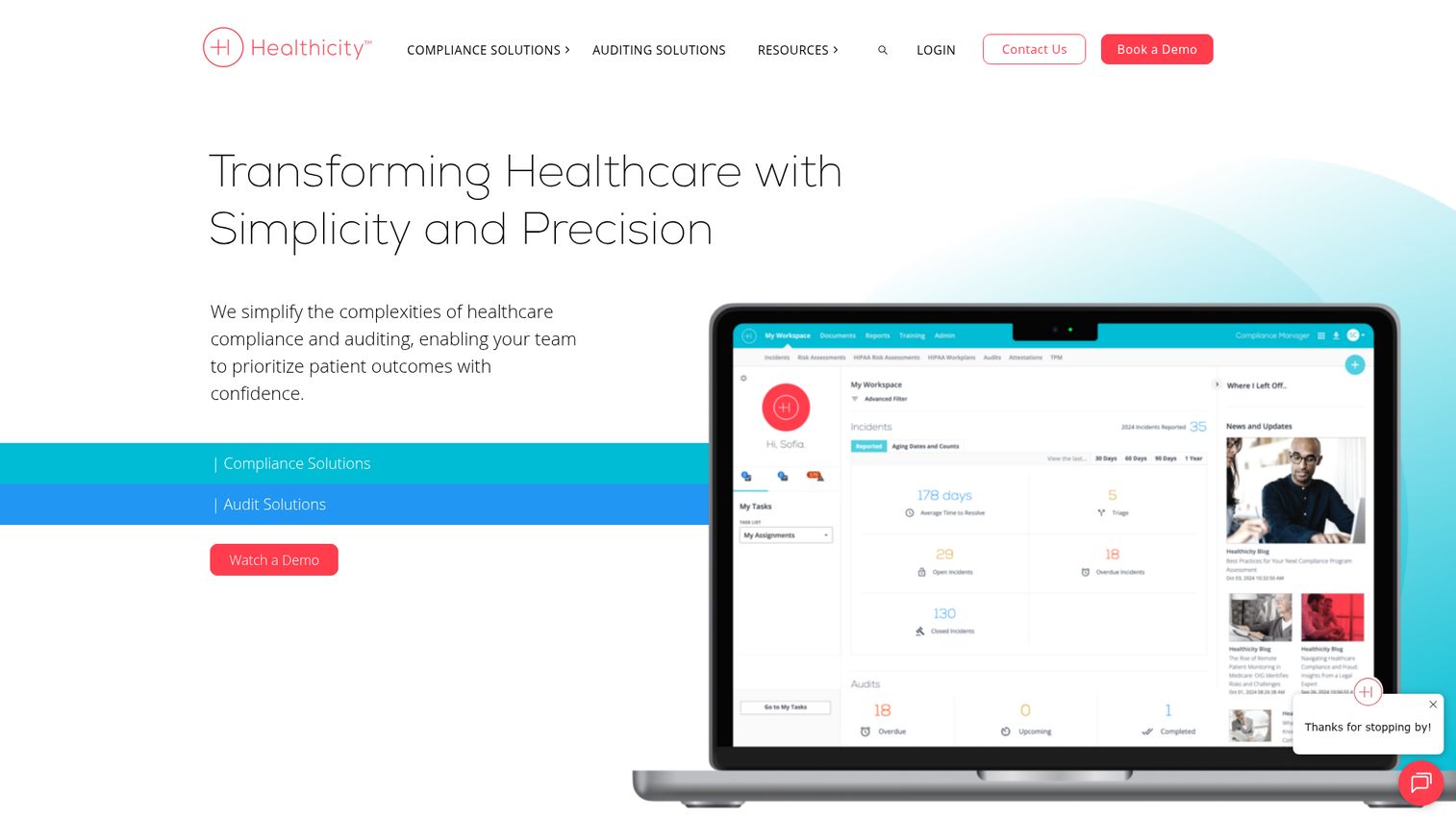
Healthicity provides healthcare-focused compliance management and auditing software for managing audits, workflows, education, and reporting in one place. It leans into coding and auditing alongside core compliance, which makes it a strong fit for organizations where billing and coding compliance carry real risk. The tiered, partly public pricing also helps with planning.
Best for: Healthcare organizations focused on coding and billing compliance, audits, and program management.
Key strengths
- Audit and incident management: Audit management plus incident tracking and resolution in one workflow.
- Training and policies: Training Center courses, attestations, and policy and document management.
- Risk and oversight: Risk assessments, exclusion monitoring, and executive reporting.
Why choose Healthicity: Healthicity stands out for teams where coding and auditing compliance is a core concern, not a side function. The Foundation and Professional tiers give smaller organizations a clear entry point with public pricing. Enterprises can move to the contact-based tier for API integration, larger admin counts, and compliance officer consulting.
Healthicity pricing: Foundation starts at $500/month for up to 25 employees, billed annually, and includes Training Center courses and the HIPAA Security Risk Assessment Manager. Professional runs $1,450/month for up to 50 employees, billed annually, adding premium training, work plans, policies, incident management, audits, exclusion monitoring, and executive reporting. Enterprise is contact-based with API integration, HR systems and SSO, and platinum implementation. Healthicity Compliance Manager holds a 4.3 out of 5 rating on G2.
6. ComplyAssistant
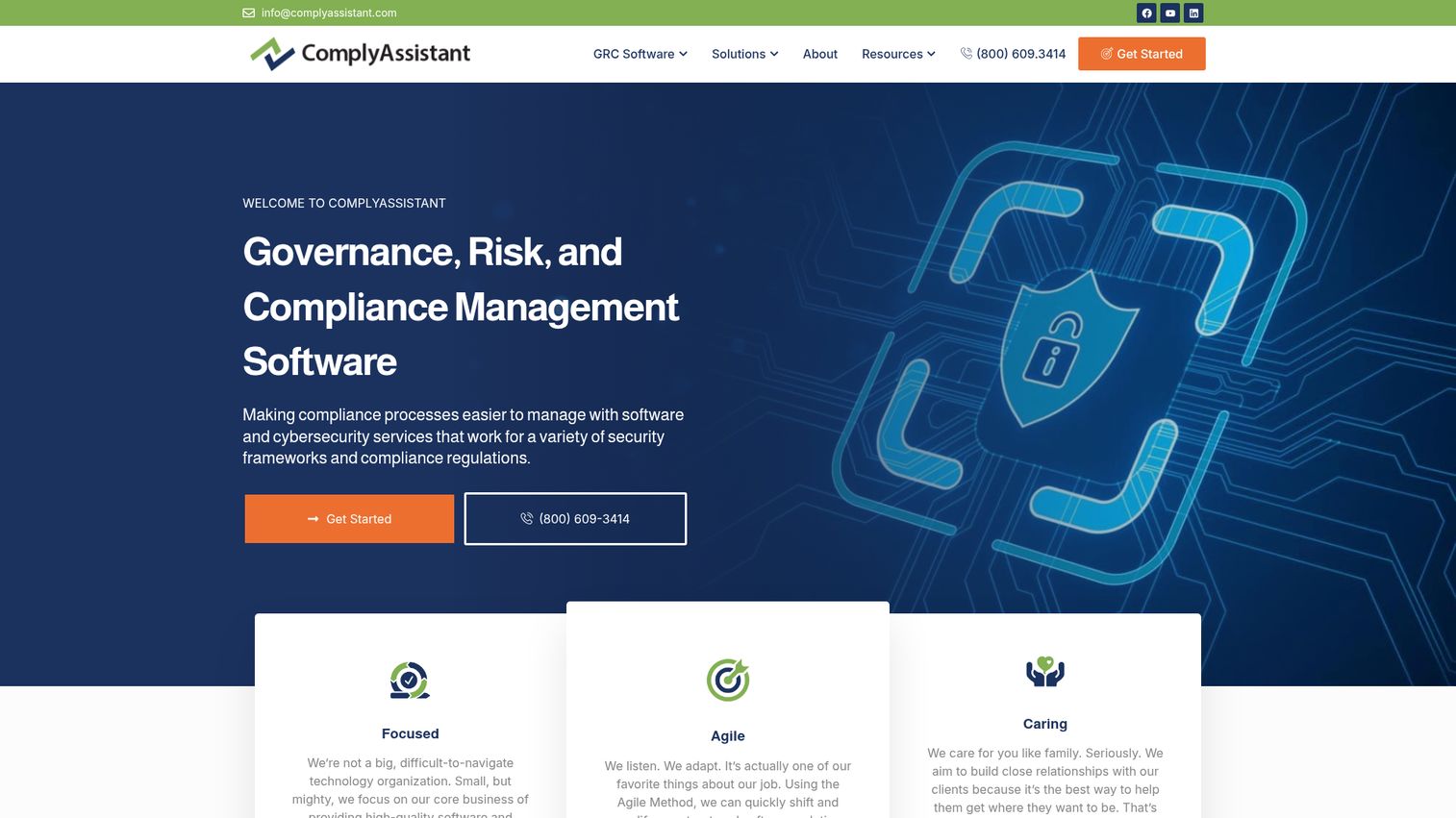
ComplyAssistant provides healthcare-focused governance, risk, and compliance software plus healthcare cybersecurity services. It is built for hospitals and health systems that need broad framework coverage in one platform. The breadth of supported security frameworks is its calling card, alongside mobile audit capability.
Best for: Health systems and managed service providers that need wide multi-framework coverage and on-the-go audits.
Key strengths
- Multi-framework management: Manage HIPAA, HICP, HITRUST, and NIST in one platform.
- Vendor risk and exception handling: Third-party vendor risk programs plus filtering, alerts, and notifications to manage by exception.
- Mobile audits and risk register: Run audits from phones or tablets and assess threats and controls across the organization.
Why choose ComplyAssistant: ComplyAssistant suits health systems that must satisfy multiple frameworks at once and want a single platform plus optional cybersecurity services. The mobile audit feature helps teams capture evidence on the floor rather than back at a desk. Pricing is custom, so budgeting requires a conversation with their team.
ComplyAssistant pricing: ComplyAssistant does not publish public pricing; it operates on a quote-based, enterprise model. ComplyAssistant holds a 5.0 out of 5 rating on Capterra across its current reviews.
7. NAVEX One
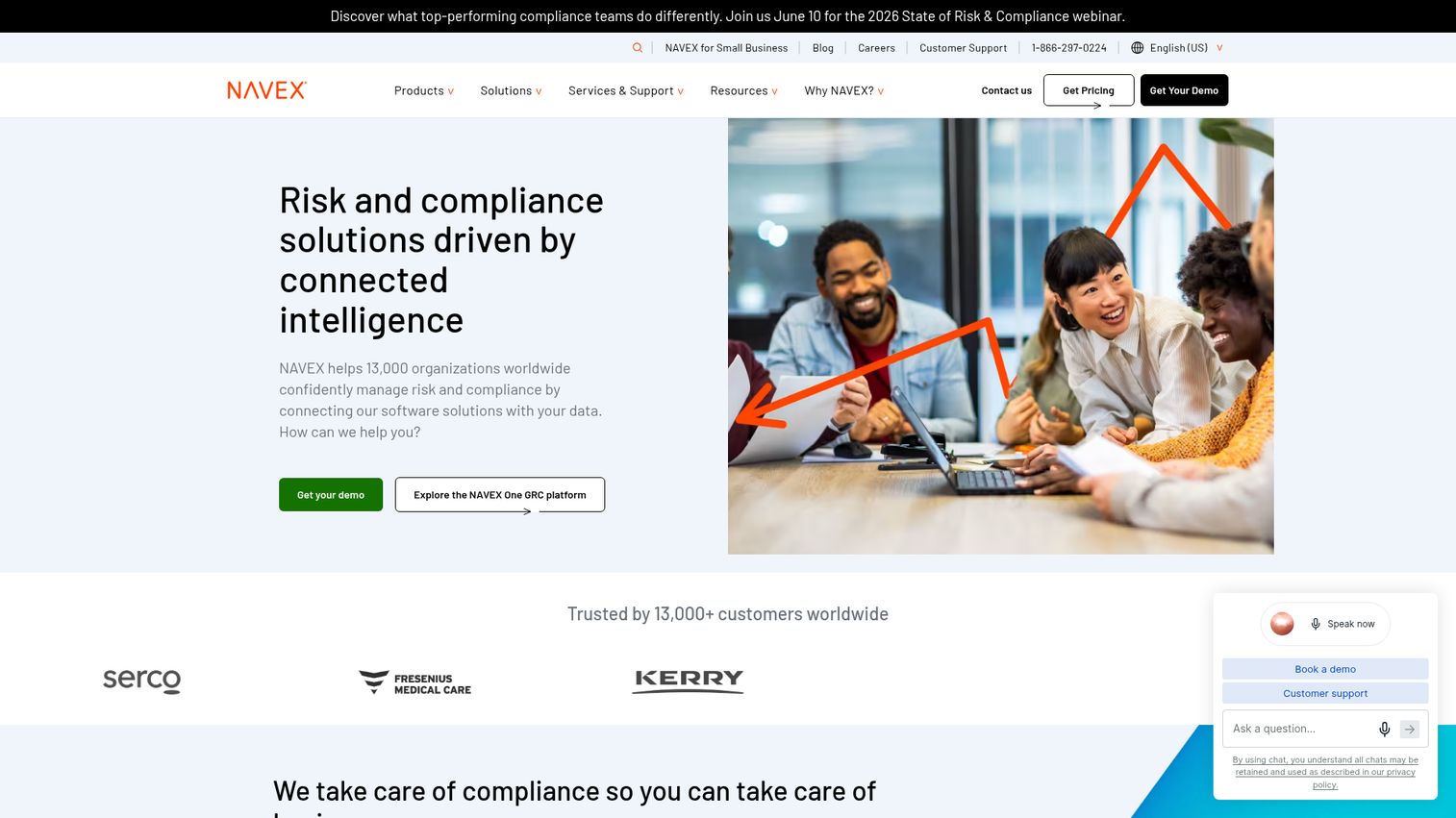
NAVEX One is an AI-powered GRC software platform for managing regulations, risk, training, whistleblowing, policies, disclosures, and cross-program reporting. It is an enterprise ethics and compliance suite that spans many industries, healthcare included. Larger healthcare organizations that need hotline and disclosure management alongside policy and risk often shortlist it.
Best for: Larger healthcare organizations that need enterprise GRC breadth with strong whistleblowing and ethics capabilities.
Key strengths
- Unified GRC platform: Shared data across speak-up, policy, training, disclosures, risk management, and third-party risk.
- Investigations workflow: Multi-channel intake, standardized AI workflows, and board-ready dashboards.
- Broad reporting: Risk, policy, regulatory change, incident, disclosure, third-party risk, analytics, and API-supported reporting.
Why choose NAVEX One: NAVEX One fits enterprises that treat ethics, whistleblowing, and compliance as one connected program rather than separate tools. Its hotline and disclosure capabilities are mature and board-friendly. It is a broad GRC suite rather than a healthcare-specific product, so weigh that against more specialized options if HIPAA and OSHA are your only frameworks.
NAVEX One pricing: NAVEX One pricing is tailored based on organization size, program needs, selected solutions, and scope. There is no public price; buyers request a quote. NAVEX One holds a 3.7 out of 5 rating on G2 across 81 reviews.
8. ServiceNow GRC
ServiceNow GRC, formally ServiceNow Governance, Risk, and Compliance, helps organizations unify enterprise risk, compliance, resilience, privacy, and third-party risk workflows on the ServiceNow platform. For health systems already running ServiceNow for IT and operations, extending into GRC keeps everything on one workflow engine. The strength is integrated, automated workflow at enterprise scale.
Best for: Enterprise health systems already on ServiceNow that want a unified, workflow-driven GRC program.
Key strengths
- Integrated risk management: Enterprise-wide risk and compliance programs on one platform.
- Business continuity management: Crisis management, plan testing, and recovery workflows.
- Third-party risk management: Automated workflows for consistent, auditable vendor risk.
Why choose ServiceNow GRC: ServiceNow GRC makes the most sense when your organization already lives on the ServiceNow platform and wants compliance to ride the same workflows. The automation and integration depth are hard to match for large enterprises. For a small practice, it is more platform than the job requires.
ServiceNow GRC pricing: ServiceNow provides GRC pricing through custom quotes based on company needs, with scalable packages tailored to requirements. No public price, tiers, or free-tier details are shown. ServiceNow GRC holds a 4.2 out of 5 rating on G2 across 98 reviews.
9. LogicGate Risk Cloud
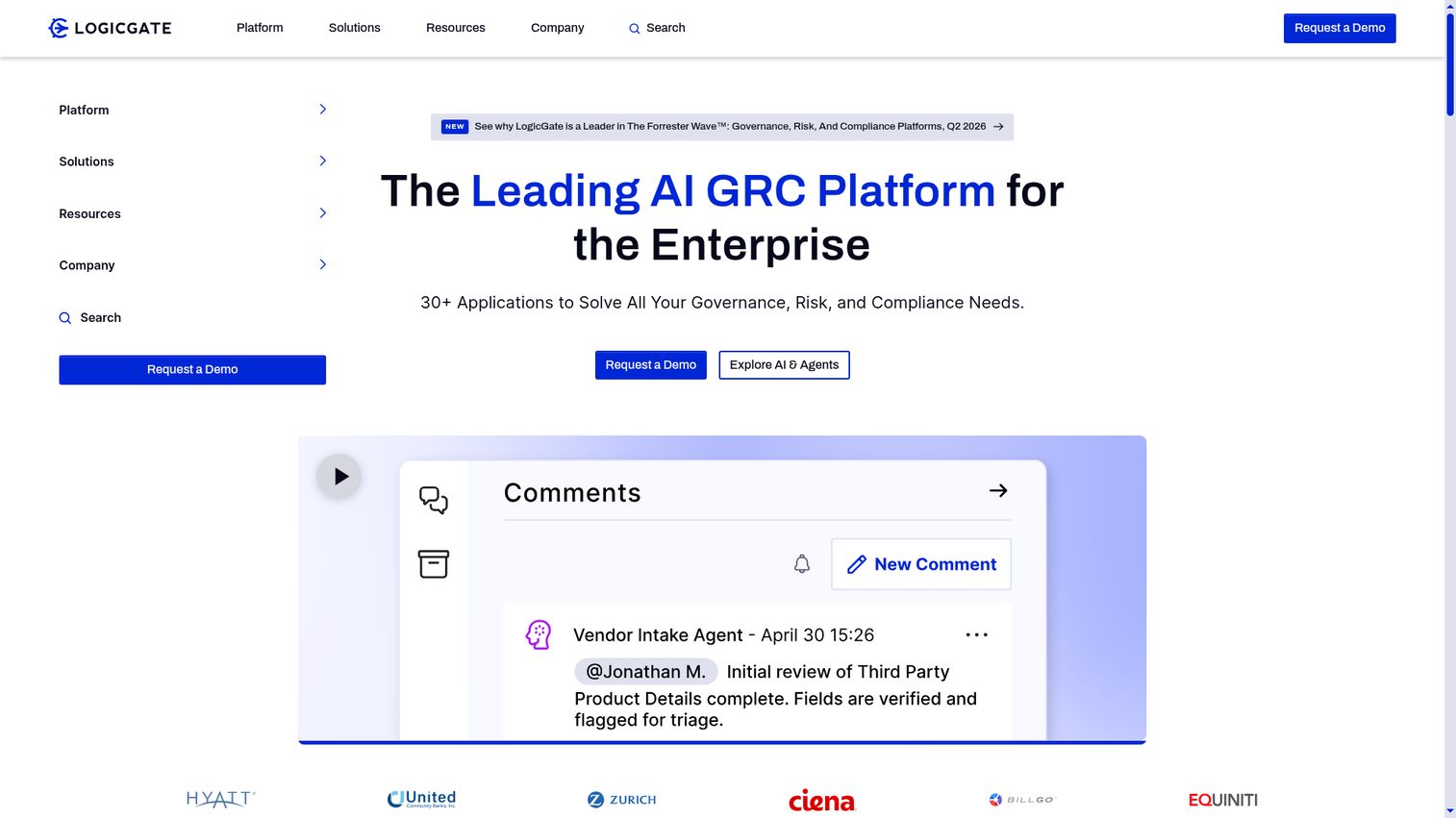
LogicGate Risk Cloud is a no-code GRC platform for flexible automation, real-time risk insights, and streamlined compliance. Its configurability is the headline: risk teams build the workflows they need without engineering. For healthcare risk and compliance teams that want to shape the system around their processes, that flexibility is the draw.
Best for: Risk and compliance teams that want a flexible, no-code platform to configure their own GRC workflows.
Key strengths
- Automated evidence collection: Pull and organize audit evidence with less manual effort.
- No-code graph database: Build and connect workflows without writing code.
- Reporting and analytics: Real-time risk insights and reporting across teams.
Why choose LogicGate Risk Cloud: LogicGate suits teams that find rigid tools constraining and want to model compliance to their exact processes. The no-code builder lowers reliance on technical staff. As with most enterprise GRC tools, pricing is tailored, so plan for a scoping conversation around the applications and licenses you need.
LogicGate Risk Cloud pricing: LogicGate prices around purchased Risk Cloud Applications, Power User licenses, and optional additional features or services. No public numeric price or named tiers are shown on its pricing page. LogicGate Risk Cloud holds a 4.6 out of 5 rating on G2.
10. MetricStream
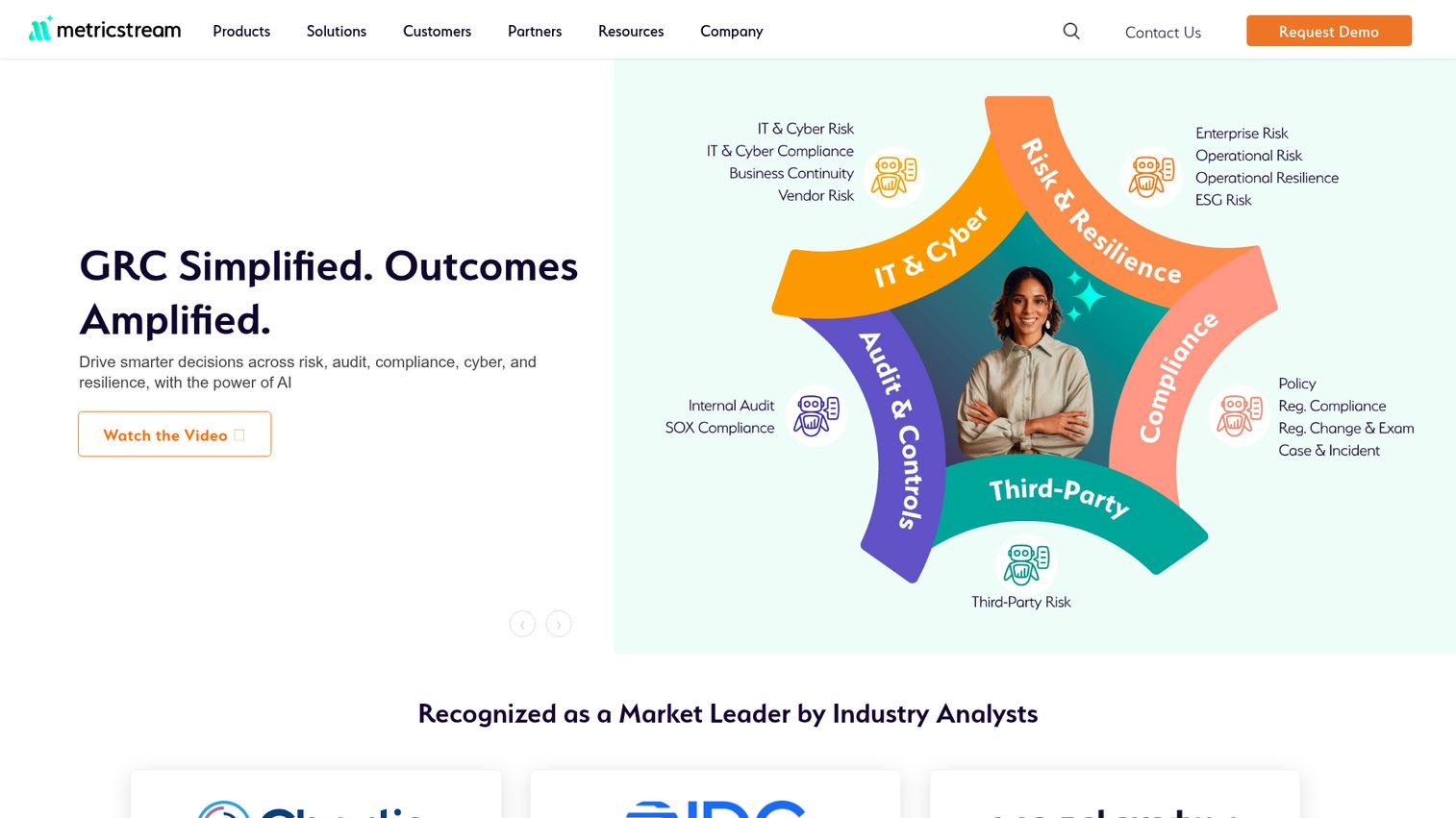
MetricStream provides AI-first governance, risk, compliance, audit, cyber GRC, third-party risk, and resilience software for enterprises. It is built for large, regulated organizations with complex, multi-framework programs. Health systems with mature, enterprise-wide GRC needs use it to connect risk, compliance, and audit in one place.
Best for: Large enterprises with complex multi-framework needs spanning risk, compliance, audit, and cybersecurity.
Key strengths
- Enterprise and operational risk: AI-driven risk insights, assessments, control effectiveness, and issue management.
- Compliance management: Ingest regulatory updates, map compliance profiles, manage policies, and test controls.
- Cyber GRC: IT and cyber risk identification, control validation, and security framework alignment.
Why choose MetricStream: MetricStream fits enterprises that need to manage many risk and compliance domains at once and want AI assistance across them. Its regulatory change management is valuable for organizations facing constant rule shifts. It is enterprise-grade, so smaller healthcare providers will likely find lighter, healthcare-specific tools a better match.
MetricStream pricing: MetricStream uses a request-pricing model; its pricing page is a contact form with no public numbers, tiers, or free-tier details. MetricStream holds a 3.8 out of 5 rating on G2.
11. Diligent
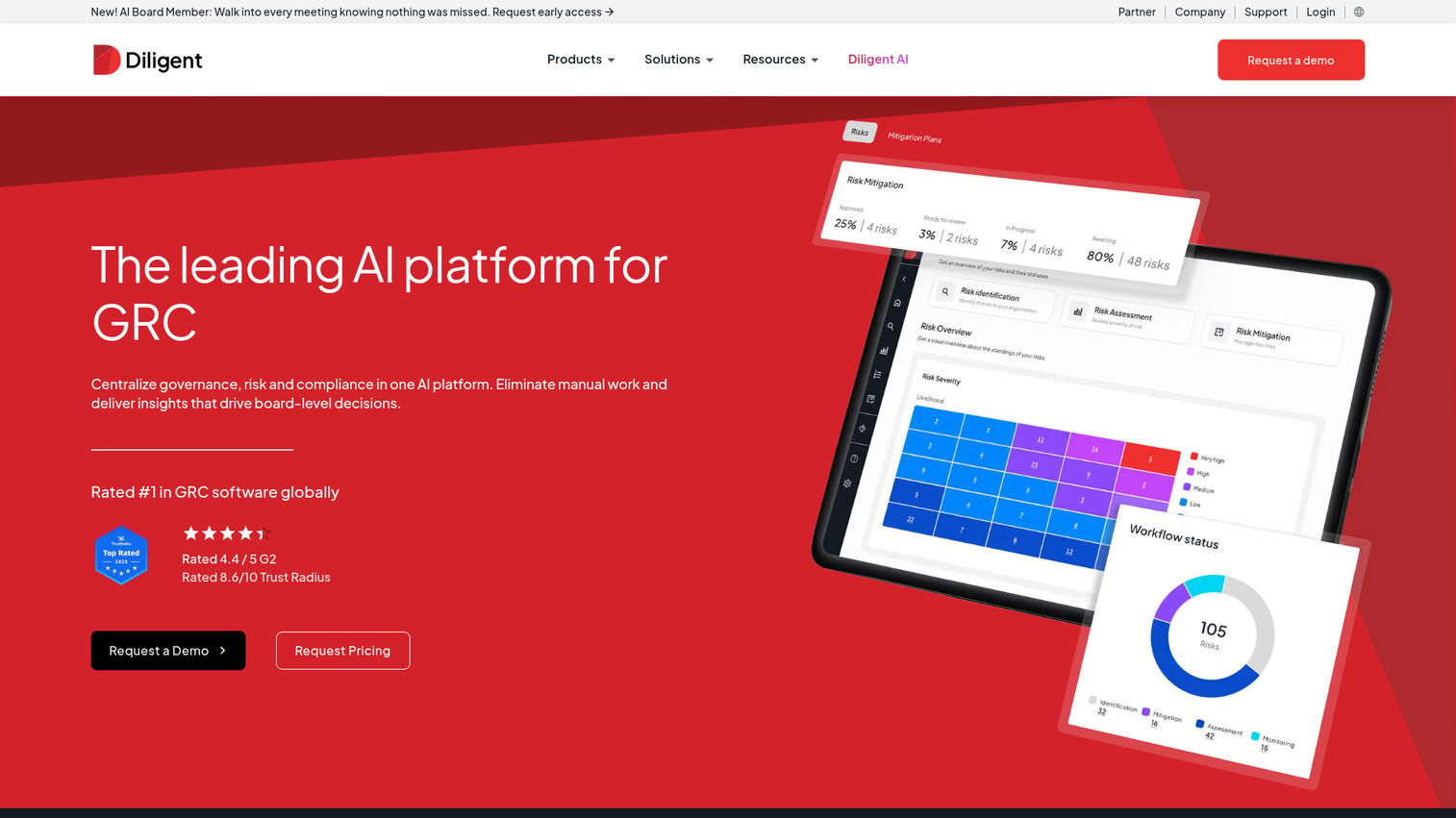
Diligent is an AI-powered governance, risk, and compliance platform for boards, executives, risk, compliance, and audit teams. It is often positioned as a modern alternative to legacy GRC tools, and it pairs GRC with board governance. Healthcare organizations that need to report risk and compliance up to leadership and the board find that combination useful.
Best for: Enterprises that want board-level governance combined with GRC, risk, compliance, and audit workflows.
Key strengths
- Unified GRC platform: Centralizes governance, risk, and compliance activities in one AI platform.
- Board portal: Agendas, board books, archives, and offline access for directors.
- Enterprise modules: Risk management, IT compliance, cyber risk, third-party risk, compliance, and audit management.
Why choose Diligent: Diligent stands out when board reporting and executive governance matter as much as day-to-day compliance work. The board portal plus GRC modules give leadership a single view of risk and compliance posture. Like other enterprise platforms, pricing is built around your organization's size and growth stage, so expect a custom quote.
Diligent pricing: Diligent's pricing is a request-based model, with packages tailored to organization size and growth stage. No public numeric prices or named tiers are shown. Diligent's platform, formerly HighBond, holds a 4.3 out of 5 rating on G2.
How to choose healthcare compliance software
Shortlisting is easier when you score each tool against the criteria that actually drive audit outcomes. Use this checklist before you book demos.
Multi-framework coverage
Start with the frameworks you are accountable for. HIPAA is table stakes, but most organizations also face OSHA, CMS conditions of participation, OIG exclusion screening, and sometimes HITRUST, NIST, or PCI. A healthcare quality and compliance software tool should cover your full regulatory map, not just one acronym. Confirm the frameworks are built in, not bolted on.
Audit readiness and evidence trails
The real test is a surveyor request. Can the tool produce dated, attributed documentation on demand? Look for immutable audit trails that capture who acted, when, and from where. Healthcare compliance monitoring software with strong dashboards lets you see gaps before an auditor does.
Ease of use and staff adoption
A platform only works if frontline staff complete their training and acknowledgments. Evaluate the end-user experience, not just the admin console. Low friction means higher completion rates and fewer gaps in your records during turnover. Vendors that pair onboarding with strong user onboarding software tend to see the highest adoption among non-technical staff.
Integrations
Compliance does not live in isolation. Check for HRIS and HRMS connections for staff data, EHR links where relevant, LMS integration, and SSO for clean access. Guideflow's own integrations approach is a useful reference for how connected tooling reduces double entry. Tight integrations reduce double entry and keep records in sync.
Pricing model and scalability
Decide whether per-seat or flat pricing fits your size. A small practice needs a clear entry price, while a multi-site group needs a model that scales without surprises. For enterprise tools that quote custom, ask about minimum contracts and employee-based add-ons up front.
Conclusion
The right compliance software for healthcare depends on your size, your frameworks, and where your biggest risk sits. For multi-site outpatient groups that want compliance and training together, MedTrainer is the natural fit. Practices replacing spreadsheets with guided HIPAA support and transparent pricing should look hard at Compliancy Group. Training-heavy hospitals and health systems lean toward HealthStream, while coding and audit-focused teams get strong value from Healthicity.
If you need configurable continuous compliance with clear pricing, VComply delivers. And for enterprise GRC at scale, ServiceNow GRC, MetricStream, NAVEX One, LogicGate, and Diligent each bring deep, multi-framework programs to large organizations.
Match your top frameworks and audit cadence to two or three tools above, then request demos to see the dashboards and reporting in action. Compliance-software vendors increasingly use interactive demos to let you explore those dashboards before a sales call, which speeds up evaluation. The best teams build these with a demo center so prospects can self-serve through framework-specific walkthroughs. Walk in knowing exactly which frameworks you must satisfy, and let the surveyor-ready reporting prove itself.
FAQs
Healthcare compliance software is a platform that helps healthcare organizations track and prove adherence to regulations like HIPAA, OSHA, and CMS rules. It centralizes policy management, training, incident reporting, risk assessments, audits, and monitoring in one system. The goal is continuous, documented compliance you can produce on demand instead of scrambling before an audit.
At minimum, look for policy and document management with version control and acknowledgments, training assignment and tracking, incident reporting, and HIPAA risk assessments. For audit readiness, prioritize immutable evidence trails and surveyor-ready reporting. Multi-framework support across HIPAA, OSHA, CMS, and OIG, plus integrations with HRIS, EHR, LMS, and SSO, separates the strong tools from the basic ones.
Start by mapping the frameworks you must satisfy, then match them to tools that cover that full map. Factor in your organization size, audit cadence, required integrations, and budget. Small practices often favor public, tiered pricing and ease of use, while large health systems weigh configurability and enterprise GRC depth. Shortlist two or three and request demos before committing. Many buyers also lean on digital adoption platforms to drive in-app guidance once the tool is live.
Pricing varies widely. Small-practice tools can start around $99 to $500 per month, often billed annually with per-employee add-ons. Mid-market GRC platforms like VComply start around $1,000 per month. Many enterprise tools, including HealthStream, NAVEX One, ServiceNow GRC, MetricStream, and Diligent, do not publish public prices and quote custom based on organization size and scope.
Software supports HIPAA compliance, but it does not replace a compliance program. It helps you document policies, run security risk assessments, track training, manage business associate agreements, and maintain evidence trails. Compliance still depends on your organization actually following those processes. The tool makes the work visible and provable; your team makes it real.
Compliancy Group is a strong pick for small practices thanks to guided HIPAA workflows and public pricing starting at $99 per month. Healthicity's Foundation tier, at $500 per month for up to 25 employees, suits practices focused on training and risk assessments. MedTrainer also works well when a small group needs compliance and a healthcare LMS combined. Prioritize ease of use and clear pricing.
Yes. That is one of the most common reasons organizations buy it. The software consolidates scattered binders and spreadsheets into one system with version control, automated training and acknowledgment reminders, and timestamped audit trails. When a surveyor asks for documentation, you produce it in minutes instead of digging through drives. It also survives staff turnover, since the record lives in the platform rather than in one person's files.
Healthcare-purpose-built tools like MedTrainer, Compliancy Group, Healthicity, and HealthStream ship with ready-made HIPAA and OSHA templates, healthcare courseware, and surveyor-friendly reports. Enterprise GRC platforms like ServiceNow GRC, MetricStream, NAVEX One, LogicGate, and Diligent offer broad, configurable risk and compliance workflows across many industries. Healthcare-specific tools get you to value faster on healthcare frameworks; enterprise GRC offers more breadth and configurability for large, complex organizations.