You ran a clean compliance program last year. Then your engineering team spun up three new cloud buckets, marketing connected a fresh SaaS app, and a contractor exported a customer list to a shared drive. None of it showed up in your data inventory. That gap is the whole problem.
Sensitive data does not sit still. It copies, moves, and hides in places nobody documented: old database tables, email attachments, file shares, screenshots, and dozens of cloud apps. By the time an auditor asks "where is your regulated data," most teams cannot answer with confidence. The market reflects the pressure. The sensitive data discovery market is projected to grow from USD 8.10 billion in 2023 to USD 35.58 billion by 2032, a CAGR of about 17.7%, according to SNS Insider (2024). In the same research, 55% of organizations rank identifying and classifying sensitive data across cloud environments as a top security priority.
The job is not abstract. You need to find PII, PHI, and payment data wherever it lives, keep that picture current as new data arrives, and produce evidence when GDPR, HIPAA, PCI DSS, or CPRA obligations come due. The right tool does that without turning your team into a manual scanning operation.
This guide is a buyer's shortlist for that exact problem. If you also evaluate adjacent categories, you may find our roundups of the best customer data platform and best data visualization tools useful for connecting discovery output to the rest of your stack, and our list of application performance monitoring tools if observability is part of the same review cycle.
What's inside
This guide covers seven sensitive data discovery tools that help teams locate, classify, monitor, and report on regulated information. It is written for product managers, security leaders, compliance teams, and platform owners who care about accuracy and maintainability, not just feature counts.
We evaluated each tool on five criteria:
- Discovery breadth: how much of your estate it can reach (cloud, databases, endpoints, email, file shares).
- Automation and monitoring: scheduled scans versus continuous monitoring and real-time alerting.
- Classification depth: how precisely it tags and labels what it finds.
- Reporting and remediation: support for audit evidence and fixing exposed data.
- Fit for regulated environments: alignment to GDPR, HIPAA, PCI DSS, and CPRA workflows.
TL;DR
- Best for broad enterprise discovery: Spirion, with high-accuracy classification across complex estates.
- Best for scheduled scanning and quick implementation: ManageEngine DataSecurity Plus, with public module pricing and a free trial.
- Best for governance-heavy environments: IBM Guardium Data Protection, for teams already in the IBM ecosystem.
- Best for continuous monitoring: Varonis Data Security Platform, which ties discovery to access and behavior.
- Best for privacy operations: Securiti and OneTrust Privacy Automation, for teams blending discovery with privacy program work.
- Best for dispersed, regulated estates: Ground Labs Enterprise Recon, with precise scanning across mixed environments.
What sensitive data discovery software does
Sensitive data discovery software is a tool that scans your systems to locate, classify, and track regulated or sensitive information so you can secure it and prove compliance. It answers the question "what sensitive data do we hold, and where," then keeps that answer current.
In practice, these tools work in three layers. First, they scan a target set of repositories. Second, they classify what they find against patterns, dictionaries, and machine learning models. Third, they alert, report, or trigger remediation based on policy.
What types of data it finds:
- PII: names, addresses, national IDs, dates of birth.
- PHI: medical records, diagnoses, insurance identifiers.
- PCI data: card numbers, CVVs, cardholder details.
- Biometric data: fingerprints, facial templates, voiceprints.
- Sensitive business data: contracts, source code, financials, secrets.
Where it scans:
- Cloud object storage and SaaS apps.
- Structured databases and data warehouses.
- Endpoints and laptops.
- Email systems and attachments.
- File shares and collaboration tools.
- Public-facing websites and web apps.
Structured data is the easier half. A column labeled ssn in a database is straightforward to catch. Unstructured data is where most teams lose visibility. A scanned PDF, a spreadsheet buried in a shared folder, or a chat export does not announce what it contains, so discovery tools lean on content inspection, optical character recognition, and context-aware classification to find regulated values inside free-form files.
Classification turns raw matches into something you can act on. A good tool does not just flag "this looks like a card number." It assigns sensitivity levels, applies labels, and feeds policy: encrypt, quarantine, restrict access, or delete. Alerting connects that to your workflow, routing high-risk findings to the right owner.
Continuous monitoring is what separates a one-time audit from an actual program. Data changes daily. A point-in-time scan is accurate the day it runs and stale a week later. Continuous monitoring re-evaluates new and changed data so your inventory and your risk picture stay current between formal reviews.
When to use sensitive data discovery software
Find regulated data before an audit
When an audit or assessment is coming, you need to show where regulated data lives and prove you control it. Discovery tools build that evidence by scanning in scope systems, mapping where PII, PHI, and PCI data sit, and producing reports auditors accept. That same map lets you prioritize remediation, fixing the highest-risk exposures first instead of guessing.
Reduce breach and leakage risk
You cannot protect what you cannot see. Teams use discovery to shrink their sensitive-data footprint: finding forgotten copies of regulated data, locating files exposed to broad access, and deleting or relocating data that should not exist. Less sensitive data in fewer places means a smaller blast radius if something goes wrong. This is data minimization in practice, not theory.
Build a data inventory that stays current
A one-time scan is fine for a snapshot. A living inventory needs continuous monitoring. Use scheduled scans when your environment is stable and changes are rare. Use continuous monitoring when data flows constantly, when new cloud resources appear weekly, or when compliance requires you to track regulated data on an ongoing basis. Most regulated teams end up needing both.
Comparison table
The table below summarizes intent, differentiation, pricing, and G2 ratings for each tool. Pricing for most enterprise vendors in this category is quote-based, so we note public pricing where it exists and "contact sales" where it does not. Ratings reflect each tool's current G2 listing.
| # | Product | Intent | Key differentiation | Pricing | G2 rating |
|---|---|---|---|---|---|
| 1 | Spirion | Broad enterprise discovery and governance | High-accuracy classification across complex estates | Contact sales | 4.4/5 |
| 2 | ManageEngine DataSecurity Plus | Scheduled scanning, file auditing, DLP | Module-based with public, accessible pricing | From $145/yr per module | 3.9/5 |
| 3 | IBM Guardium Data Protection | Governance-heavy enterprise data protection | Discovery plus real-time activity monitoring | Contact sales | 4.3/5 |
| 4 | Varonis Data Security Platform | Continuous monitoring tied to access | Discovery linked to permissions and behavior | Contact sales | 4.7/5 |
| 5 | Securiti | Privacy, governance, and AI data controls | Unified data command across security and privacy | Contact sales | 4.7/5 |
| 6 | Ground Labs Enterprise Recon | Regulated discovery in dispersed estates | Precise scanning across mixed environments | Contact sales | 4.6/5 |
| 7 | OneTrust Privacy Automation | Privacy operations and DSR workflows | Discovery connected to privacy program management | Contact sales | 4.3/5 |
1. Spirion
Spirion is sensitive data governance software built for discovering, classifying, and remediating sensitive information across complex environments. Its Sensitive Data Platform pairs discovery with what the vendor calls purposeful classification, aiming to reduce false positives that bury teams in noise. For organizations with sprawling estates, the pitch is accuracy at scale: find the right data, label it correctly, and act on it.
Best for: Enterprises that need sensitive data discovery and governance across many systems and data types.
Key strengths
- Sensitive data discovery: Scans across structured and unstructured sources to locate regulated data wherever it lives.
- Classification and labeling: Assigns sensitivity context so findings map to policy, not just a flag.
- Automated remediation and workflow playbooks: Triggers actions like quarantine or relocation without manual follow-up on every hit.
Why choose Spirion: If your core problem is accuracy across a large, messy estate, Spirion's classification focus is the draw. Teams drowning in false positives from broad scanners tend to value a tool that aims to label precisely the first time. It fits security and compliance teams who treat classification as the foundation of their program rather than an afterthought.
Spirion pricing: Spirion does not publish public pricing. The site uses demo and contact-sales paths instead of posted prices, so plan to scope a quote against your environment size and data sources. Spirion holds a 4.4/5 rating on G2.
2. ManageEngine DataSecurity Plus
ManageEngine DataSecurity Plus is a data visibility and security tool specializing in data leak prevention, file server auditing, and sensitive data discovery. It is built around an operational workflow: scan file servers and endpoints, audit access, and act on leaks through USB, email, cloud apps, and endpoint channels. For teams that want a straightforward implementation and visible pricing, it stands out in a category dominated by quote-only vendors.
Best for: Organizations that need file auditing, DataSecurity Plus, and DLP for Windows file servers and endpoints.
Key strengths
- File access auditing and integrity monitoring: Tracks who touched what, when, and flags unauthorized changes.
- Sensitive data discovery and classification: Locates regulated data across files and applies custom sensitivity rules.
- Data leak prevention: Controls data movement across USB, email, cloud apps, and endpoints.
Why choose ManageEngine DataSecurity Plus: This is the practical pick for teams that want recurring scans, custom sensitivity rules, and clear reporting without a long enterprise sales cycle. The module-based model means you buy the capabilities you need rather than a monolithic platform. It fits IT and security teams that prioritize operational simplicity and a fast path to first value.
ManageEngine DataSecurity Plus pricing: Pricing is module-based and publicly listed. File Analysis starts at $145/yr, Data Risk Assessment at $395/yr, Data Leak Prevention at $345/yr, and File Server Auditing at $745/yr, all billed annually. A free trial is offered, and Cloud Protection is a free add-on for licensed DLP users. ManageEngine DataSecurity Plus holds a 3.9/5 rating on G2.
3. IBM Guardium Data Protection
IBM Guardium Data Protection is IBM's data security platform for discovering, monitoring, and protecting sensitive data while simplifying compliance. It pairs discovery and classification with real-time activity monitoring, so you do not just learn where regulated data sits, you see how it is being accessed and used. For governance-heavy environments, that combination is the appeal.
Best for: Enterprises needing continuous data protection and compliance across hybrid environments.
Key strengths
- Discover and classify sensitive data: Locates and labels regulated data across databases and structured environments.
- Real-time activity monitoring: Tracks data access as it happens, not just at scan time.
- Threat detection and response: Surfaces anomalous access patterns and supports response workflows.
Why choose IBM Guardium Data Protection: Guardium is attractive to security teams that already run IBM tooling and want discovery to live inside a broader data protection and governance program. The depth here is in monitoring and compliance reporting across hybrid estates, which suits regulated organizations with mature security operations. It rewards teams that want discovery and activity monitoring under one roof.
IBM Guardium Data Protection pricing: IBM does not publish public pricing for Guardium Data Protection. Plan to scope a quote with IBM based on your deployment and data sources. IBM Guardium Data Protection holds a 4.3/5 rating on G2.
4. Varonis Data Security Platform
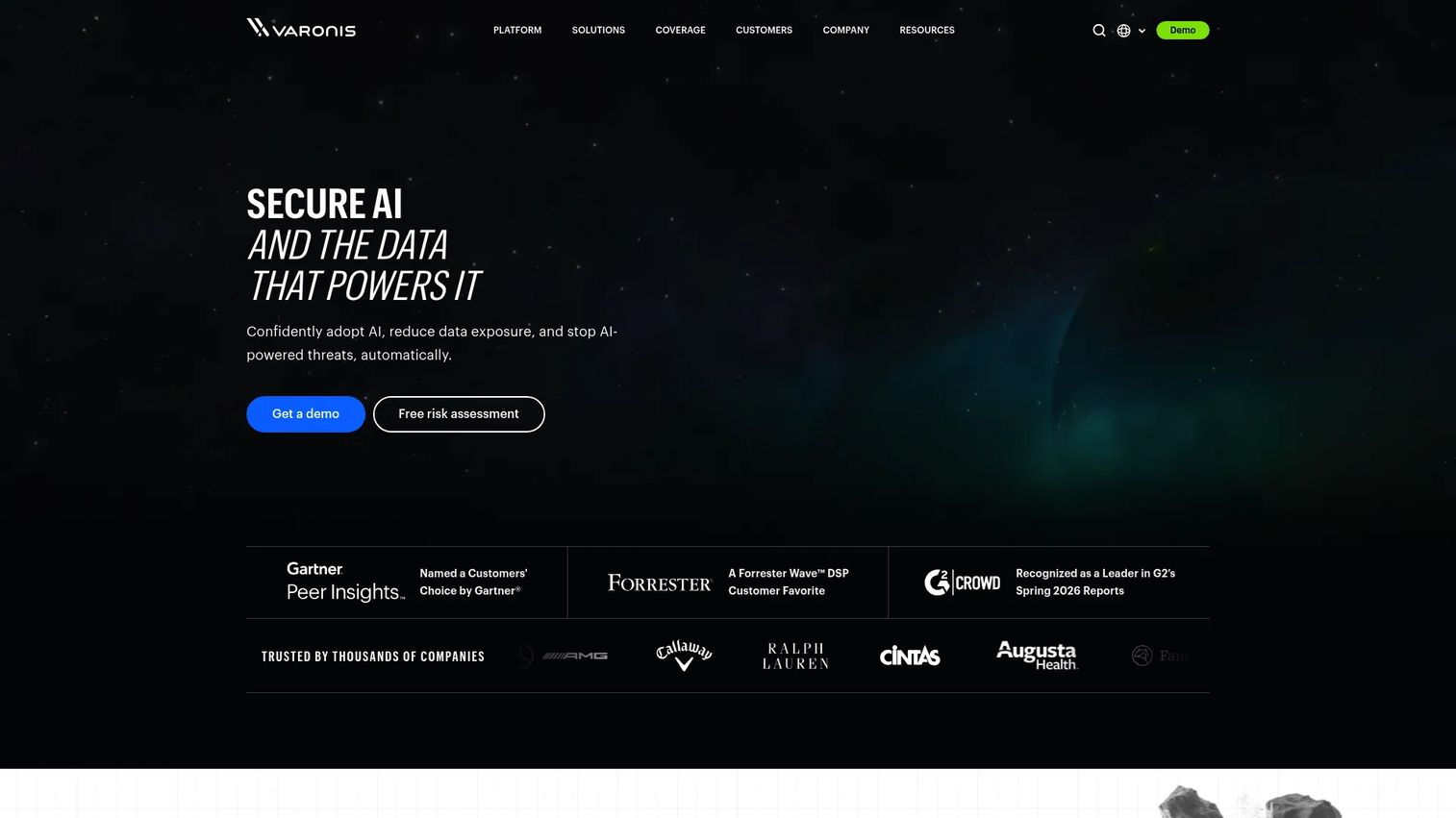
Varonis Data Security Platform is a cloud, SaaS, and on-prem data security platform that discovers sensitive data, reduces exposure, and detects threats. Its distinctive angle is context: Varonis continuously discovers and classifies data, then ties that to who can access it, who is accessing it, and whether those permissions make sense. Discovery is not the endpoint, it is the start of an exposure picture.
Best for: Enterprise teams needing automated data security posture management across cloud, SaaS, and on-prem data stores.
Key strengths
- Discover and classify sensitive data: Continuously identifies regulated data across cloud and file systems.
- Automated remediation of risky permissions: Right-sizes access and fixes misconfigurations that expose data.
- Real-time monitoring and threat detection: Watches data activity continuously and flags abnormal behavior.
Why choose Varonis Data Security Platform: Choose Varonis when you want discovery wired directly to access intelligence and continuous monitoring. The value is not just knowing where regulated data lives, but knowing who can reach it and catching risky behavior in real time. It fits security teams whose biggest worry is over-permissioned data and insider or compromised-account risk.
Varonis Data Security Platform pricing: Varonis does not display public numeric pricing and directs buyers to request a quote or demo. Scope pricing against your data stores and environment scope. Varonis holds a 4.7/5 rating on G2.
5. Securiti
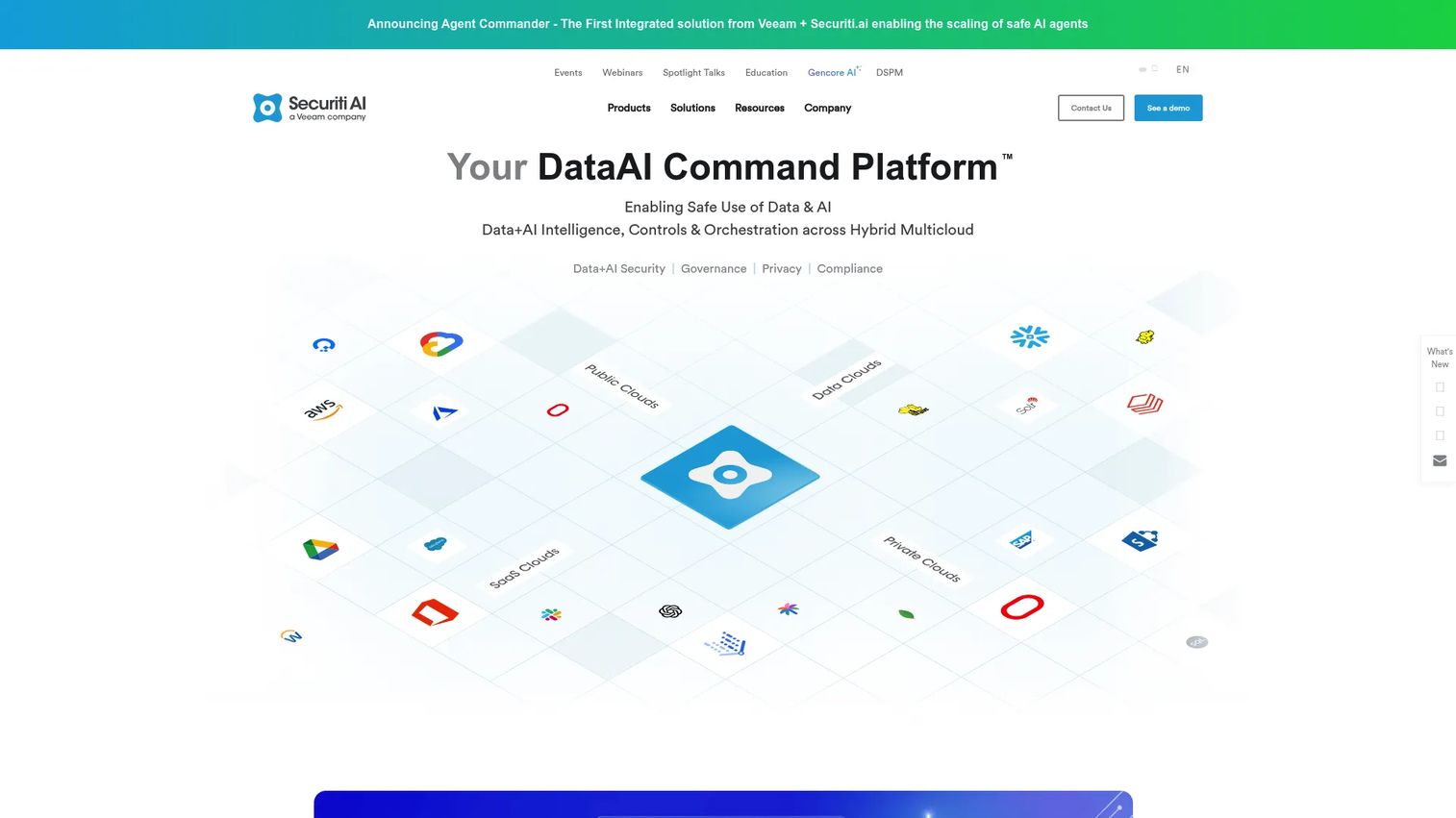
Securiti is a Data and AI command platform spanning data security, privacy, governance, compliance, and AI security. Discovery sits inside a broader fabric: the platform maps sensitive data, then connects that map to privacy operations, data subject workflows, and governance controls. For teams that want discovery and privacy program management in one place, it consolidates what would otherwise be several tools.
Best for: Enterprises needing a unified platform for data security, privacy, governance, and AI controls.
Key strengths
- Data security posture management: Maps and monitors sensitive data across the estate to reduce exposure.
- AI security and governance: Extends data controls to AI systems and the data feeding them.
- PrivacyOps automation: Automates privacy workflows including data subject requests and consent.
Why choose Securiti: Securiti fits teams blending discovery with privacy program management rather than running them as separate functions. If your roadmap includes AI governance alongside traditional data security and privacy, the unified platform reduces tool sprawl. It suits compliance and security teams that want sensitive data mapping feeding directly into privacy operations.
Securiti pricing: Securiti uses personalized pricing and does not display public prices, asking buyers to request a quote. Scope it against your data sources and the modules you need. Securiti holds a 4.7/5 rating on G2.
6. Ground Labs Enterprise Recon
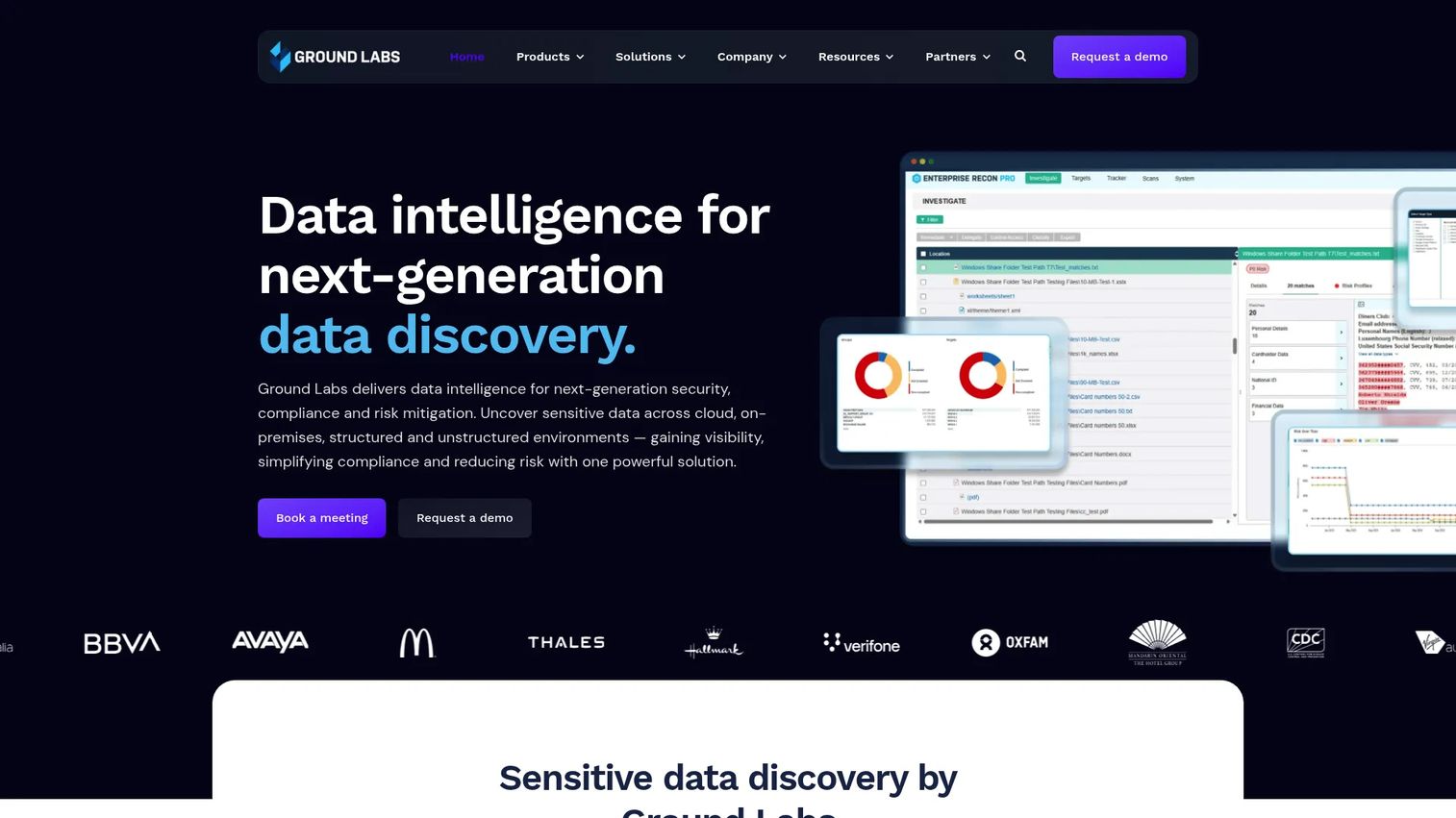
Ground Labs Enterprise Recon is sensitive data discovery and remediation software for cloud, on-premises, and hybrid environments. Its strength is reach and precision across dispersed, mixed estates: the kind of environment where regulated data hides in obscure systems nobody scans. With a large library of preconfigured personal data types, it is built to find sensitive data wherever it scatters.
Best for: Organizations needing regulated sensitive-data discovery across mixed and dispersed environments.
Key strengths
- On-premises and cloud data discovery: Scans across hybrid estates including systems other tools overlook.
- Remediation workflows: Supports redaction, quarantine, encryption, and secure delete on findings.
- Classification, risk scoring, and access governance: Prioritizes findings by risk and ties them to access context.
Why choose Ground Labs Enterprise Recon: This is the pick for compliance-heavy use cases with large attack surfaces, where data is spread across many systems and platforms. The product ships in PCI, PII, and PRO editions, letting you match scope to your regulatory drivers. It fits teams whose primary challenge is breadth: finding regulated data in places that resist easy scanning.
Ground Labs Enterprise Recon pricing: Ground Labs does not display public pricing. The product page shows three editions, PCI, PII, and PRO, with a book-a-demo path and AWS Marketplace availability. Scope a quote against your edition and environment. Ground Labs Enterprise Recon holds a 4.6/5 rating on G2.
7. OneTrust Privacy Automation
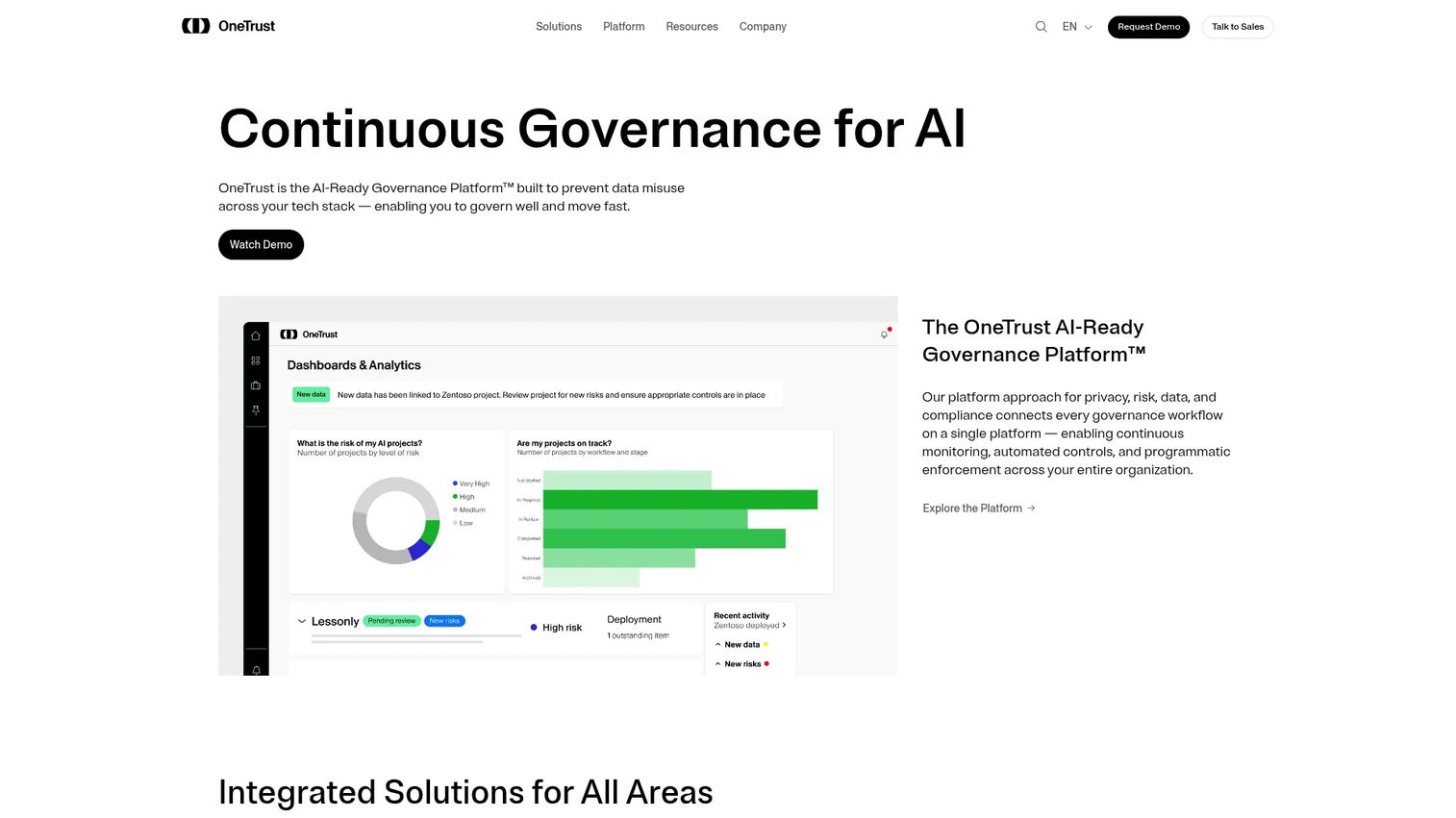
OneTrust Privacy Automation is privacy automation software for scaling compliance, privacy operations, and data subject request workflows. Discovery here serves a privacy program: the platform maps data and activities, then connects that inventory to privacy impact assessments, mitigation workflows, and DSR fulfillment. For privacy-led teams, discovery is one input into a larger compliance machine.
Best for: Enterprises needing Privacy Automation operations and DSR handling at scale.
Key strengths
- Automated data and activity mapping: Builds and maintains a privacy-focused inventory of data and processing.
- Privacy impact assessment and mitigation workflows: Structures PIAs and routes mitigation tasks.
- DSR fulfillment automation: Automates data subject request intake and response.
Why choose OneTrust Privacy Automation: OneTrust fits teams that want discovery connected to privacy management and compliance programs rather than standing alone. If your center of gravity is privacy operations, GDPR and CPRA obligations, and DSR volume, the platform orchestrates discovery into that workflow. It suits privacy and legal teams that own the compliance program end to end.
OneTrust Privacy Automation pricing: OneTrust lists Privacy Automation in Base and Suite tiers, priced based on users and privacy asset inventory, but does not display public numeric prices. Scope a quote against your user count and inventory size. OneTrust Privacy Automation holds a 4.3/5 rating on G2.
Considerations
Use this checklist to pressure-test any tool before you commit. The differences that matter are operational, not just feature lists on a page.
Coverage across cloud, endpoints, databases, and email
Map your actual data estate first, then check coverage against it. A tool that scans databases beautifully but ignores endpoints or email leaves your largest unstructured exposure untouched. Confirm support for your specific cloud providers, SaaS apps, and on-prem systems, not just the categories in general.
Structured vs unstructured discovery capability
Most tools handle structured data well. The real test is unstructured discovery: scanned documents, images, free-text fields, and files in collaboration tools. Ask how the tool inspects content, whether it uses OCR, and how it handles context to keep false positives manageable.
Continuous monitoring and alerting
Decide whether you need point-in-time scans or continuous monitoring. If new data arrives constantly, scheduled scans alone will leave gaps. Check how alerting works: can you route high-risk findings to the right owner, and does real-time alerting integrate with the tools your team already lives in?
Classification, remediation, and reporting
Discovery without action is just a longer to-do list. Evaluate how the tool classifies findings, what remediation it can trigger (quarantine, encrypt, delete, restrict), and whether its reports satisfy auditors for GDPR, HIPAA, PCI DSS, and CPRA. Reporting depth often decides how much manual work your compliance team inherits.
Fit with privacy, security, and governance systems
Discovery rarely lives alone. Confirm the tool integrates with your existing security, privacy, and governance stack so findings flow into the right workflows. The less manual stitching required, the lower the ongoing operational overhead, which is what keeps a program alive past the first audit.
Conclusion
There is no single best sensitive data discovery tool, only the best fit for your environment and compliance pressure. The choice comes down to what you prioritize. Pick Spirion or Ground Labs Enterprise Recon when broad, accurate discovery across complex or dispersed estates is the core need. Pick Varonis or IBM Guardium Data Protection when continuous monitoring and governance depth matter most. Pick Securiti or OneTrust Privacy Automation when discovery should feed a larger privacy operations program. Pick ManageEngine DataSecurity Plus when you want operational simplicity, public pricing, and a fast implementation.
Shortlist by environment complexity and regulatory load. A team with a stable, mostly structured estate and a clear PCI mandate will choose differently from a privacy-led team juggling GDPR and CPRA across dozens of cloud apps. Map your data sources, list your regulatory drivers, then run a focused proof of concept against your own data. The tool that finds your real exposures accurately, keeps the picture current, and reports in a form your auditors accept is the one that earns its place.
FAQs
Sensitive data discovery software is a tool that scans your systems to locate, classify, and track sensitive or regulated information such as PII, PHI, and payment data. It tells you what sensitive data you hold and where it lives, then helps you secure it and prove compliance. The best PII discovery tools keep that inventory current as data changes.
Discovery finds and classifies sensitive data at rest so you know what you have and where. Data loss prevention (DLP) focuses on stopping that data from leaving your environment improperly, such as through email, USB, or cloud uploads. They are complementary: discovery tells you what to protect, DLP enforces controls on it, and many platforms combine both.
At minimum, a discovery tool should find PII (names, IDs, addresses), PHI (medical and insurance data), and PCI data (card numbers and cardholder details). Many also detect biometric data and sensitive business data like contracts, financials, and source code. Coverage should map to the regulations you answer to, including GDPR, HIPAA, PCI DSS, and CPRA.
Yes. Strong tools scan unstructured data such as documents, spreadsheets, scanned PDFs, images, and chat exports, not just structured database columns. They use content inspection, optical character recognition, and context-aware classification to find regulated values inside free-form files. Unstructured discovery is usually where the hardest-to-find exposures sit.
It depends on how fast your data changes. Stable environments can run scheduled scans on a regular cadence. Environments where new cloud resources, files, and apps appear constantly need continuous monitoring so the inventory stays current. Most regulated teams use both: periodic deep scans plus ongoing monitoring of new and changed data.
Continuous monitoring re-evaluates new and changed data on an ongoing basis instead of relying on a single point-in-time scan. It keeps your data inventory and risk picture current between formal audits, flags newly created sensitive data, and supports real-time alerting. This is what turns discovery from a one-off project into a living program.
Ownership varies. Security teams often own it when the driver is breach and exposure risk, while compliance and privacy teams own it when the driver is GDPR, HIPAA, PCI DSS, or CPRA obligations. In many organizations the two share it, with platform owners and product managers involved when discovery touches engineering systems and operational workflows.