You are running a commercial portfolio across five systems. Leases live in one spreadsheet, rent schedules in another, work orders in an email thread, and reporting in a deck someone rebuilds every month. A renewal date slips. A CAM reconciliation gets flagged three weeks late. A tenant emails twice about the same broken HVAC unit before anyone logs it.
None of that is a people problem. It is a systems problem.
The global commercial real estate software market sits at USD 3.11 billion in 2026 and is projected to reach USD 5.35 billion by 2035, growing at a 6.21% CAGR, according to Global Market Statistics (2026). Cloud-based systems now hold a 69% share, and 56% of platforms have adopted AI-based valuation tools. Translation: the category is consolidating around unified platforms that pull leasing, accounting, tenant communication, and portfolio insights into one operating layer.
The wrong stack costs you in slow ways. Missed dates. Manual follow-up. Weak visibility when your board or your lender asks a question you cannot answer in under an hour. We picked these eight platforms by looking at how each one handles the workflows that actually break: lease administration, accounting, tenant self-service, maintenance, and reporting.
What's inside
This guide is for operators, asset managers, and founders evaluating commercial real estate management software for portfolios that span office, retail, industrial, or mixed-use assets. It is not a residential-only roundup.
We chose these eight platforms against four criteria:
- Integrated workflows across leasing, accounting, and operations, not point tools bolted together
- Commercial lease management software depth: escalations, renewals, CAM, abstraction
- Tenant portal and communication quality for self-service and faster resolution
- Reporting and analytics that produce investor-ready and board-ready output
Each entry covers where the platform fits, its key strengths, pricing where it is public, and its G2 rating where verified.
TL;DR
- Best for end-to-end commercial operations: Yardi. Broadest lifecycle coverage from lease to procurement to energy.
- Best for connected finance and analytics: MRI Software. Open architecture, lease abstraction, and investment management in one platform.
- Best for leasing-led teams: VTS. Deal pipeline, asset intelligence, and leasing execution built for landlords and brokers.
- Best for budget-conscious teams: Innago and Azibo. Both start free and handle lease, invoice, and payment workflows without a monthly fee.
- Best for enterprise multifamily and mixed operations: RealPage. Scale, financial operations, and AI-driven revenue tools.
- Best for operational simplicity: AppFolio and Buildium. All-in-one accounting, maintenance, and tenant communication for lean teams.
What commercial real estate software is
Commercial real estate software is a category of platforms that manage the leasing, accounting, tenant experience, maintenance, and reporting workflows for office, retail, industrial, and mixed-use property portfolios.
The core jobs it supports:
- Lease administration: track terms, rent schedules, escalations, options, and renewal dates across every property
- Accounting: invoicing, rent collection, CAM reconciliation, GL, and financial reporting
- Tenant experience: portals, request handling, and self-service that cut email back-and-forth
- Maintenance and facilities management: work order routing, vendor coordination, and service tracking
- Reporting and portfolio insights: dashboards and configurable reports for operators, lenders, and investors
The difference between commercial and residential tooling comes down to lease complexity. Commercial leases carry percentage rent, escalations, CAM pass-throughs, and custom clauses that residential software rarely models. That is why commercial real estate portfolio management software leans hard on lease abstraction and analytics.
When to use commercial real estate software
Centralize lease and rent workflows
Spreadsheets break the moment a lease has a rent bump tied to CPI, a renewal option with a 90-day notice window, and a CAM true-up due in Q1. Miss the notice window and you lose leverage. Miss the true-up and you eat the variance.
Commercial lease management software tracks these dates and calculations automatically. It flags renewals before they lapse and generates rent schedules that update when terms change. That removes the manual follow-up that eats your team's week.
Improve tenant communication and self-service
A tenant portal turns "email the property manager and wait" into "log the request and track it." Tenants submit maintenance tickets, view statements, and pay rent without a phone call. Your team stops re-keying requests from inbox to system.
Faster issue resolution ties directly to retention. A tenant who gets a work order acknowledged in minutes renews more often than one who chases you for a week.
Improve portfolio visibility and decision making
Leadership needs clean reporting across properties, tenants, and cash flow, without waiting for someone to rebuild a deck. When a lender asks for occupancy trends or a board asks about NOI by asset, the answer should take minutes.
Reporting and analytics turn scattered data into board-level visibility. That is operational control: knowing where the portfolio stands without a fire drill.
Comparison table
We ranked these platforms by breadth of commercial coverage first, then by fit for specific operating models. Pricing reflects publicly available figures where vendors publish them; several use quote-based pricing for their core commercial suites.
| # | Product | Best for | Key differentiator | Pricing | G2 rating |
|---|---|---|---|---|---|
| 1 | Yardi | End-to-end commercial operations | Full lifecycle from lease to procurement to energy | Quote-based | 4.0/5 |
| 2 | MRI Software | Connected finance and analytics | Open architecture and lease abstraction | From $60/month (OnLocation) | 4.2/5 |
| 3 | Azibo | Budget-conscious teams | Free core platform, no monthly fee | Free core; add-ons from $29.99 | Not listed |
| 4 | Innago | Small and lean teams | No monthly fee, no contract | Free | 4.8/5 |
| 5 | RealPage | Enterprise multifamily and commercial | AI-driven revenue and financial operations | Quote-based; some services from $4.99/mo | 4.1/5 |
| 6 | VTS | Leasing-led CRE teams | Leasing pipeline and asset intelligence | Quote-based | 4.6/5 |
| 7 | AppFolio | All-in-one operational simplicity | Accounting, leasing, and maintenance in one | Quote-based (Core, Plus, Max) | 4.6/5 |
| 8 | Buildium | Smaller and mixed portfolios | Centralized accounting and communications | From $62/month | 4.4/5 |
Best commercial real estate software for 2026
1. Yardi
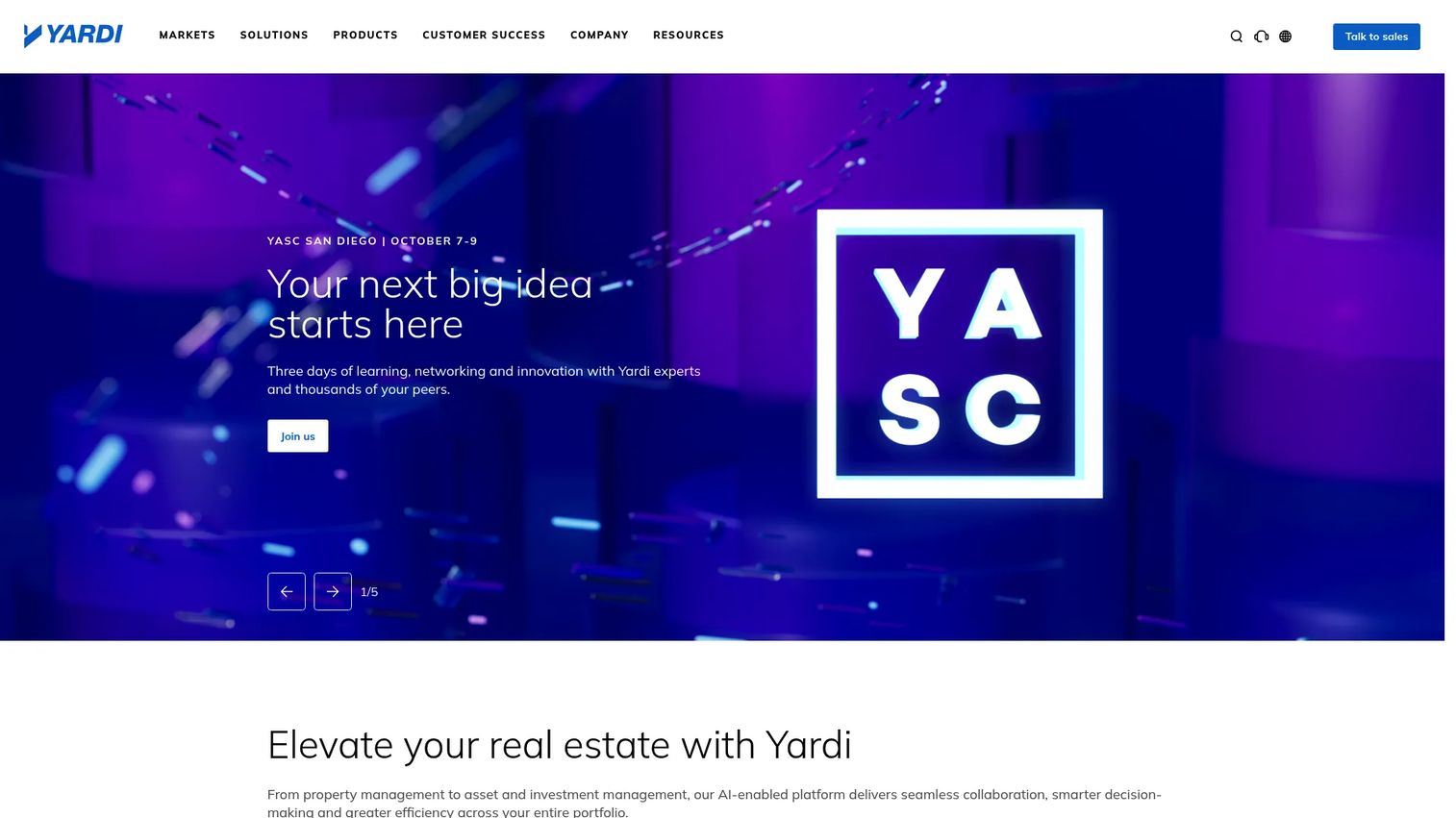
Yardi is a real estate software company offering property management, investment, energy, procurement, and related platforms. For commercial operators, Voyager Commercial anchors the lifecycle, paired with the CommercialCafe suite for tenant services, Smart Lease for lease administration, and Procure to Pay for spend management. Data Connect and energy workflows extend it into analytics and ESG reporting.
Best for: Real estate operators needing an integrated property management and operations platform.
Key strengths
- Property management across Voyager and Breeze
- AI platform (Yardi Virtuoso) for automation and insight
- Investment, energy, and procure-to-pay suites in one stack
Where Yardi earns its place is breadth. A single platform covers commercial lease management software, accounting, tenant portals, procurement, and energy in one operating layer. The tenant portal app gives occupants self-service access to statements, payments, and requests, while reporting rolls up across the full portfolio. That matters when your goal is one system of record instead of five.
Why choose Yardi: If you run a large or growing commercial portfolio and want lease, accounting, tenant experience, and procurement under one roof, Yardi covers the most ground. It fits operators ready to standardize on a full platform rather than stitch point tools together.
Yardi pricing: Yardi uses quote-based pricing for its commercial platforms. Public numeric pricing was not available on the Yardi domain, so plan on a scoping conversation tied to portfolio size and modules.
2. MRI Software
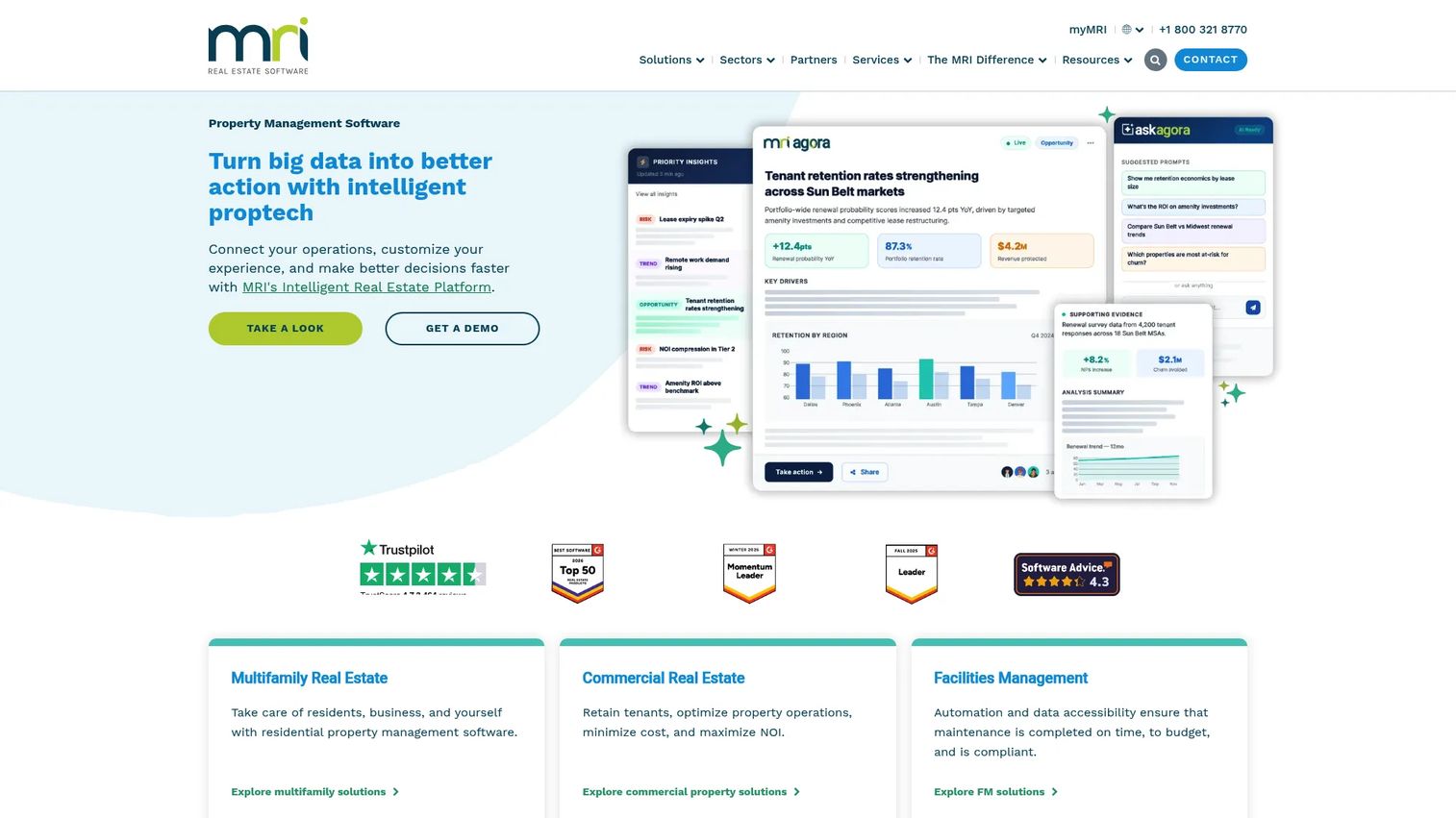
MRI Software is a real estate software provider offering open and connected products across property, investment, facilities, energy, and related operations. Its unified commercial platform pairs property management and accounting with lease management and analytics, and its open architecture lets you connect the finance, BI, and data tools you already run.
Best for: Mid-market to enterprise real estate organizations needing integrated property and facilities workflows.
Key strengths
- Open and connected technology platform
- Property management and accounting in one system
- Lease management and analytics with portfolio insights
MRI leans into connected finance. If your priority is clean cash flow, NOI visibility, and investment management alongside day-to-day operations, the platform is built for that. AI lease abstraction speeds up the work of pulling terms, escalations, and options out of executed leases and into structured data. For retail operators, foot traffic analytics tie occupancy performance to leasing decisions. Sector tailoring and a broad partner ecosystem let you shape the platform to office, retail, or industrial workflows.
Why choose MRI Software: Choose MRI when you want commercial real estate accounting software and analytics that stay connected rather than siloed, and when open architecture matters more than a closed all-in-one. It fits operators who treat portfolio data as a decision engine.
MRI Software pricing: MRI's OnLocation product publishes tiers starting at $60/month (Small), $170/month (Medium), and $304/month (Large), with custom pricing available. Monthly and annual billing options exist, plus paid add-ons. Core commercial platform pricing is scoped by portfolio.
3. Azibo
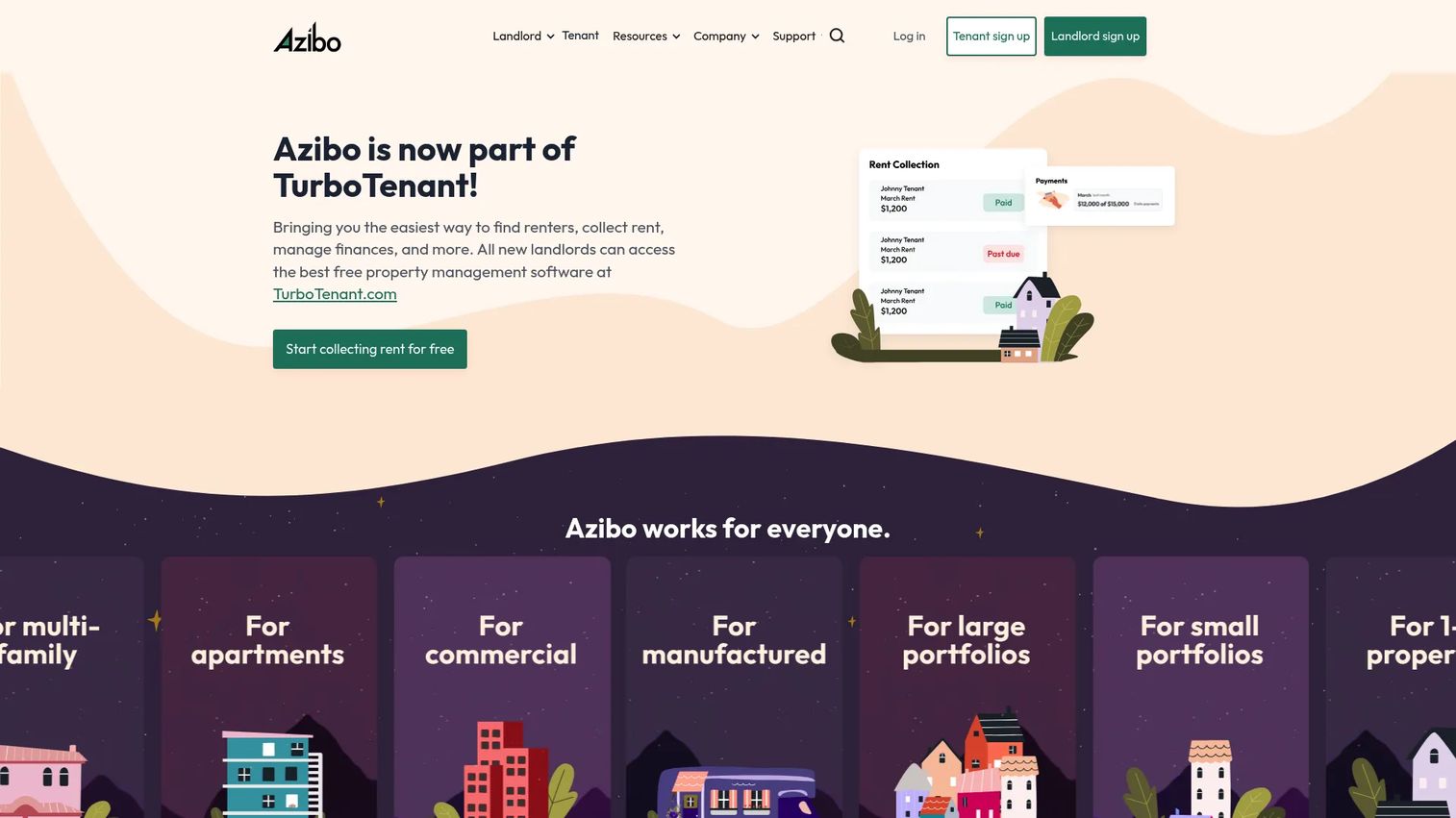
Azibo is rental property management software for landlords and property managers. It handles rent collection, accounting, tenant screening, and lease workflows, and it advertises no monthly fee and no ACH transaction fees on its core platform. For a smaller commercial portfolio or a team that wants straightforward operations without an enterprise contract, that pricing model is the draw.
Best for: Landlords wanting a low-cost all-in-one rental management platform.
Key strengths
- Free online rent collection with multiple payment options
- Tenant screening with credit, criminal, and eviction reports
- Lease creation, e-signature, and document storage
Azibo fits better than a large enterprise suite when your workflows are more about collecting rent cleanly and keeping documents organized than modeling complex CAM pass-throughs. The tenant self-service side covers payments and applications, and lease management handles terms and e-signature without a heavy setup.
Why choose Azibo: Pick Azibo when cost sensitivity is real and your commercial use cases stay relatively simple. It gives you accounting, payments, and lease storage without a monthly platform fee, which is hard to beat for lean operations.
Azibo pricing: The core platform is free, with no monthly fee and no ACH transaction fees. Paid add-ons include Leases, Forms, and Document Storage at $29.99 per lease, digital renter applications at $39.99 charged to the applicant, a Collaborate seat at $99 per seat per year, and premium onboarding at $300 for up to 100 units.
4. Innago
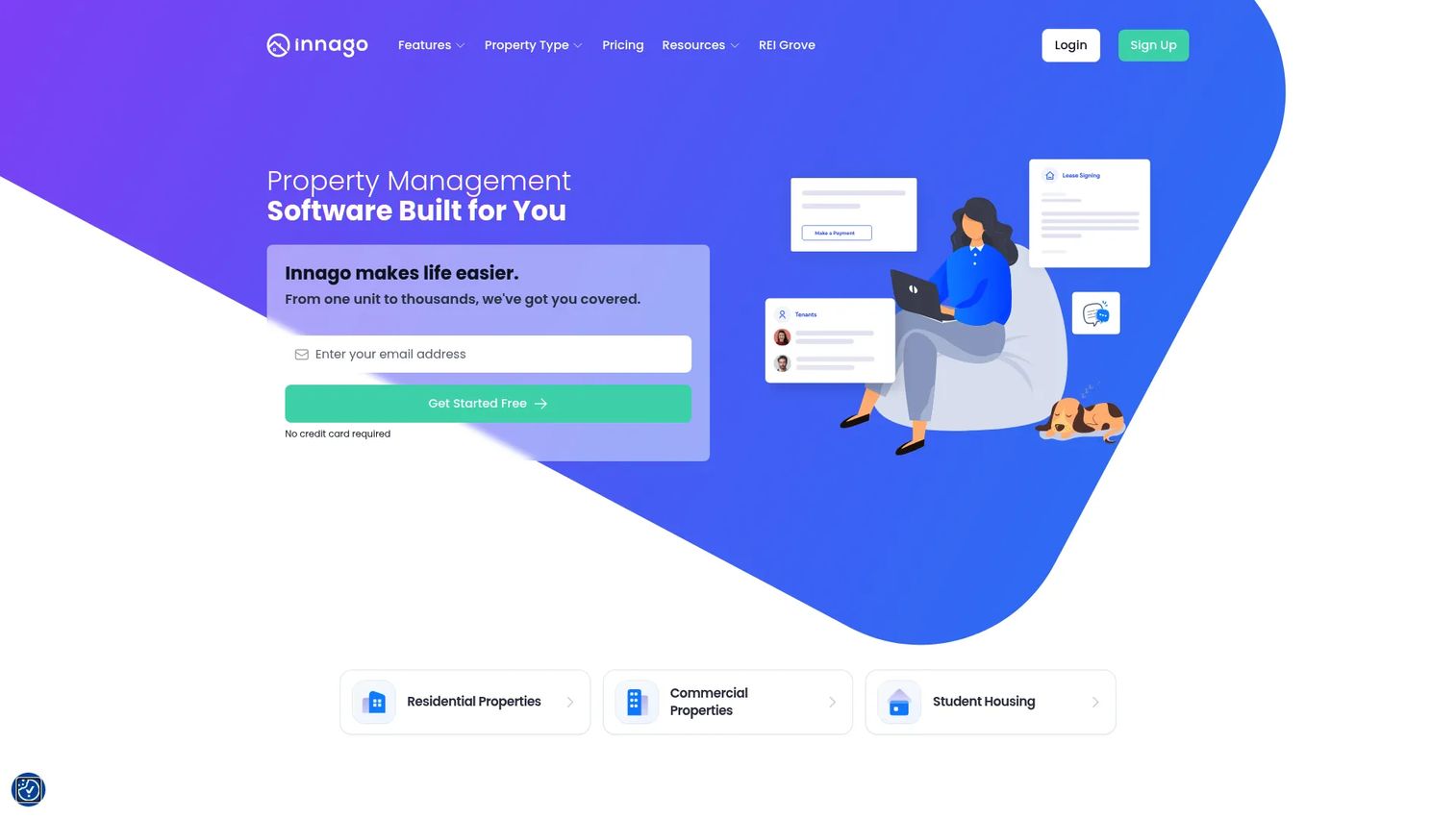
Innago is property management software for landlords and property managers, built around a free-to-start model with no monthly fee, no setup fee, and no contract. It handles online rent collection, tenant screening, lease management, invoices, and payment schedules, which covers the operational basics for a smaller commercial or mixed portfolio.
Best for: Independent landlords and property managers seeking free property management software.
Key strengths
- Online rent collection with flexible payment schedules
- Tenant screening built into the workflow
- Maintenance management for work orders and requests
Innago is budget-friendly by design. For a team managing a handful of commercial units, invoice and lease workflows run without the overhead of an enterprise platform. The tenant experience covers payments and requests, and maintenance management routes work orders. For complex portfolios with heavy CAM reconciliation, escalations, and investment reporting, a deeper platform like MRI or Yardi handles more of that load.
Why choose Innago: Choose Innago when you want to run lease, invoice, and payment workflows at zero platform cost and your commercial needs are straightforward. It is a practical starting point for lean teams.
Innago pricing: Innago is free. There is no monthly fee, no setup fee, and no contract. Certain payment and screening services carry standard per-transaction fees, but the platform itself carries no subscription cost.
5. RealPage
RealPage provides multifamily and commercial real estate software with automation and data tools for property management and operations. It covers property management and financial operations, resident and tenant experience tools spanning leasing, payments, and maintenance, and demand operations with AI-driven revenue management.
Best for: Multifamily operators seeking an enterprise real estate operations suite.
Key strengths
- Property management and financial operations platform
- Resident experience tools for leasing, payments, and maintenance
- Demand operations and AI-driven revenue management
RealPage is built for scale. Large operators evaluate it when they need unified financial workflows, reporting, and operations across a big portfolio, with AI layered onto revenue decisions. The breadth covers leasing, accounting, and maintenance in one enterprise context, which fits organizations that already operate at volume and want consolidation rather than a lean point tool.
Why choose RealPage: Choose RealPage when portfolio scale and financial operations depth outweigh the simplicity a smaller platform offers. It fits enterprise operators standardizing on one system across many properties.
RealPage pricing: Core RealPage platforms are quote-based and require a demo or sales conversation. Some standalone services publish transactional pricing, such as RealPage Rent Reporting at $4.99/month and Propertyware Screening Services at $8.75 per screen. Expect the full platform to be scoped by portfolio.
6. VTS
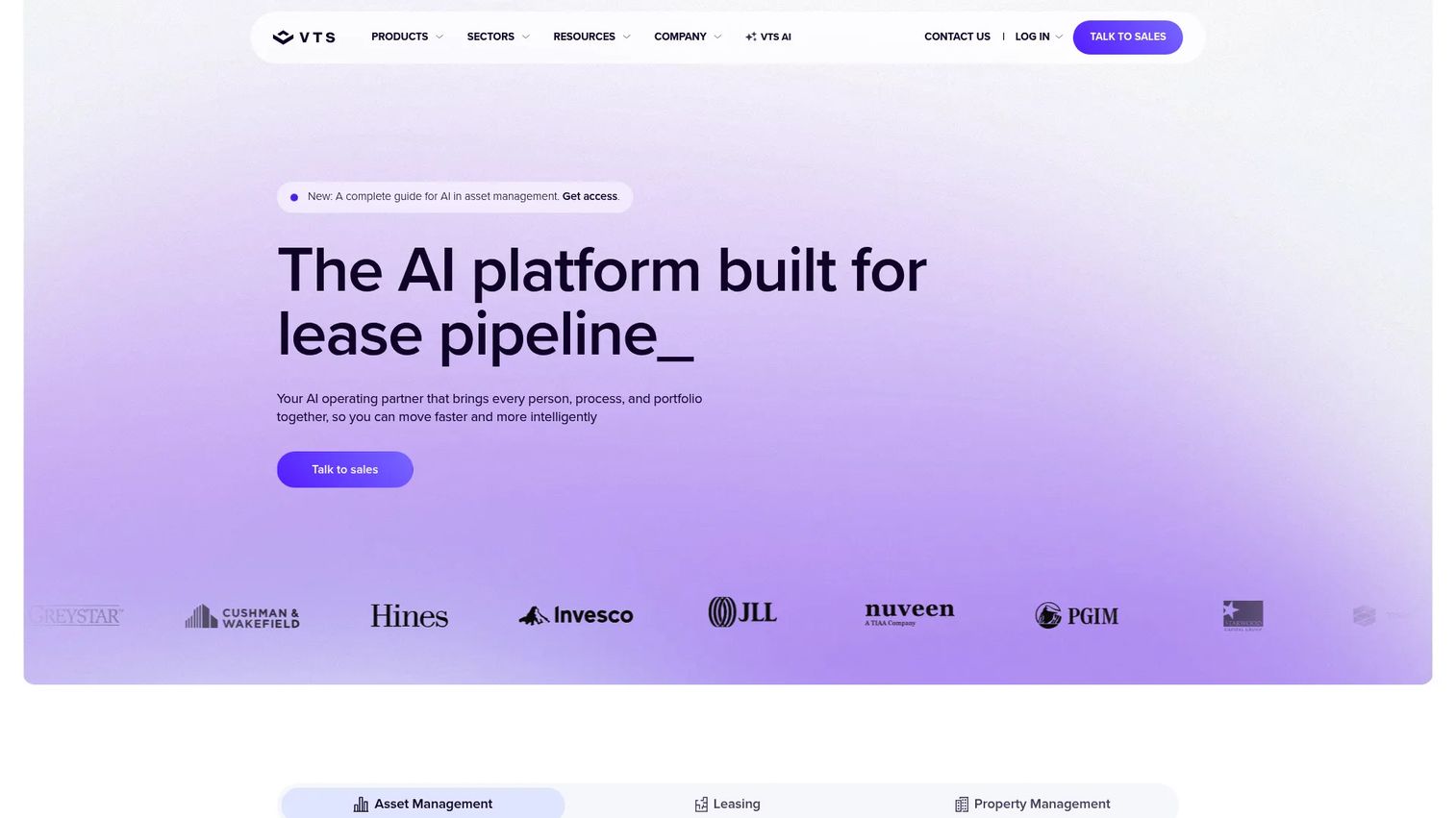
VTS is a commercial real estate software platform for leasing, asset management, tenant experience, and market data. Its strength is the leasing workflow: deal tracking, pipeline management, and asset intelligence that give leasing teams a live view of where every deal stands. Lease abstraction pulls terms into structured data, and portfolio dashboards roll it up for asset managers.
Best for: Institutional landlords and CRE teams needing leasing and asset management software.
Key strengths
- Lease abstraction and deal tracking
- Portfolio dashboards and asset intelligence
- Work orders, visitor and access management, and market data
VTS is the strong choice for leasing-led teams. If your commercial motion is tenant and broker facing, the deal pipeline and market data keep leasing execution tight. It stays distinct from accounting-heavy suites by focusing on the front end of the leasing lifecycle, where speed and visibility win or lose deals.
Why choose VTS: Choose VTS when leasing execution and asset intelligence drive your business more than back-office accounting. It fits institutional landlords who live in the deal pipeline.
VTS pricing: VTS uses sales-led pricing and does not publish public figures on its site. Plan on a conversation with their team to scope a solution to your portfolio and workflows.
7. AppFolio
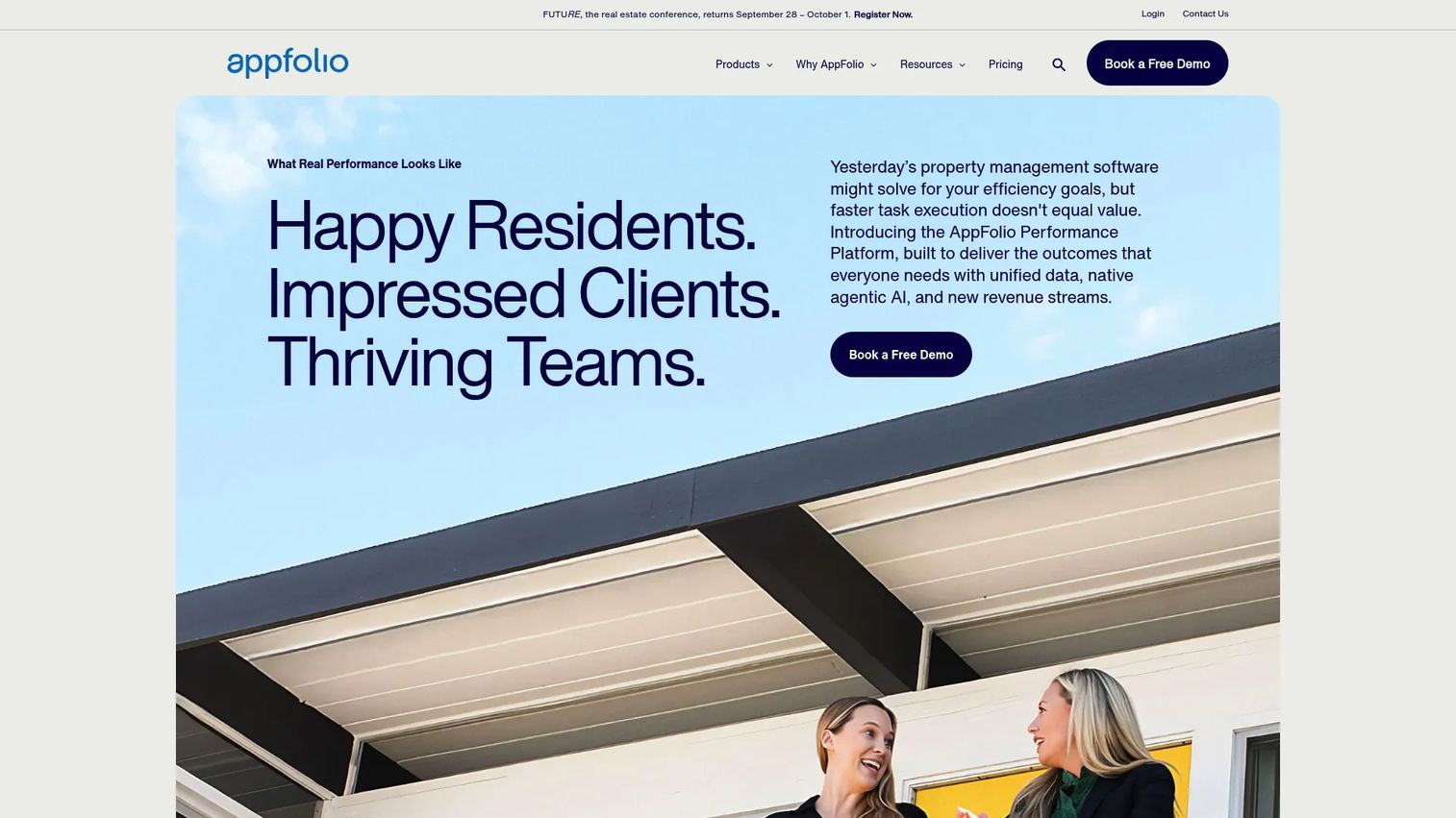
AppFolio is cloud-based property management software for residential, community association, and commercial operators. It bundles property accounting and reporting, marketing and leasing, and work order and maintenance management into one operating platform, with tenant communication built in.
Best for: Residential and association property managers that want an all-in-one operating platform.
Key strengths
- Property accounting and reporting
- Marketing and leasing tools
- Work order and maintenance management
AppFolio's commercial fit is strongest for teams that value usability and operational simplicity over deep enterprise configuration. If your portfolio mixes commercial with residential or association properties, the single platform keeps accounting, tenant communication, and maintenance in one place. Teams that want to onboard fast and run day-to-day operations without heavy setup tend to prefer it.
Why choose AppFolio: Choose AppFolio when operational simplicity and a clean tenant experience matter more than deep commercial lease modeling. It fits mixed portfolios and lean teams that want one usable platform.
AppFolio pricing: AppFolio offers Core, Plus, and Max plans, all quote-based with minimum spend and unit requirements. Public numeric pricing is not displayed, so pricing is scoped to your portfolio size on a quote.
8. Buildium
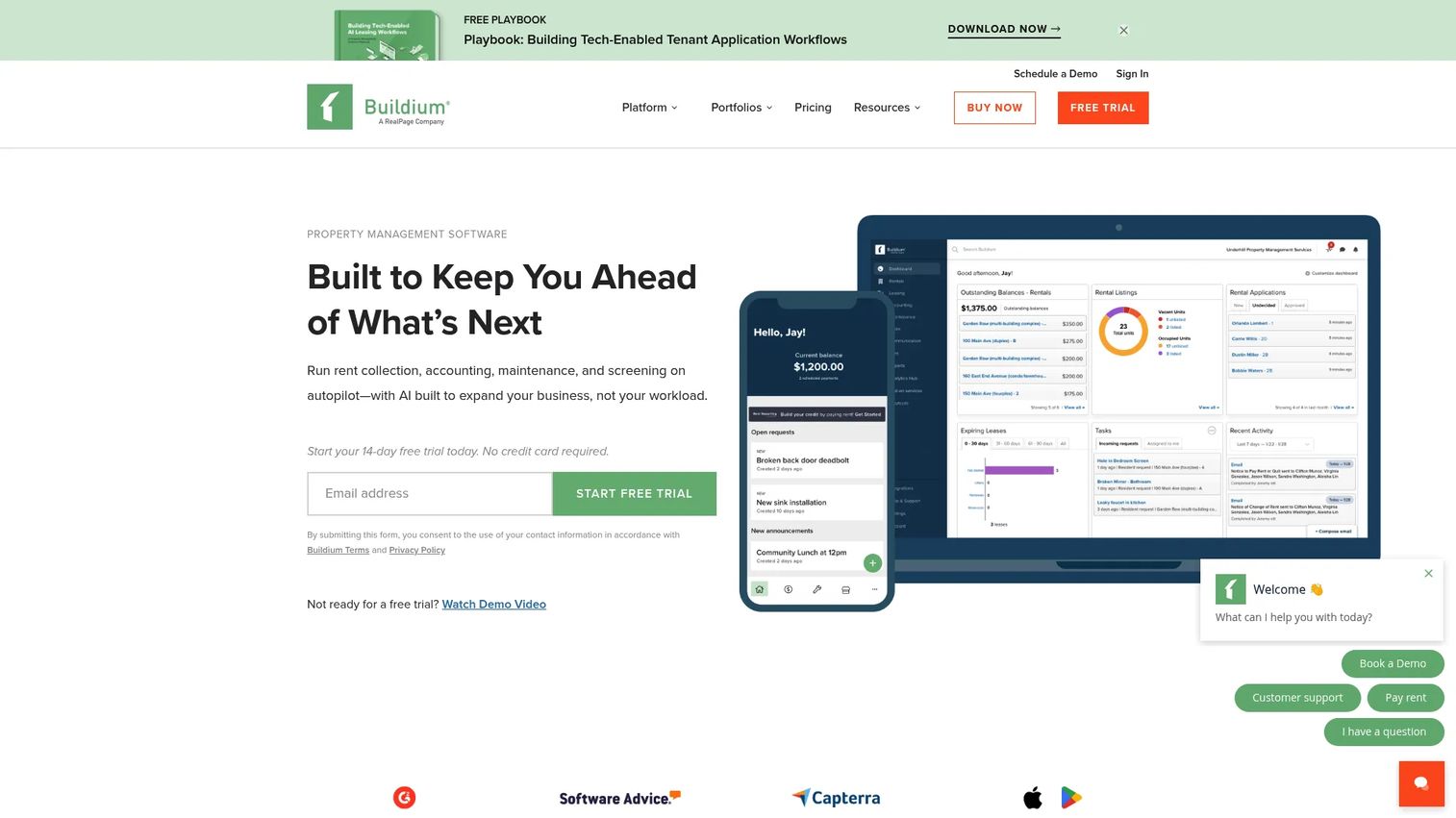
Buildium is all-in-one property management software for residential, community association, and mixed portfolios. It centralizes property accounting, online rent collection, maintenance requests and work orders, and resident communications, with owner reporting built for portfolios that mix asset types.
Best for: Property managers needing a centralized platform for accounting, leasing, maintenance, and resident communications.
Key strengths
- Property accounting and financial reporting
- Online rent collection
- Maintenance requests and work order management
Buildium suits smaller teams and mixed portfolios that want practical operations software without enterprise complexity. Owner reporting gives you clean output for stakeholders, and maintenance workflows keep requests and vendors organized. For simpler commercial use cases blended with residential or association management, it consolidates the essentials into one platform.
Why choose Buildium: Choose Buildium when you manage a mixed or smaller portfolio and want accounting, maintenance, and communications in one place at a predictable monthly price. It fits teams that value clarity over configuration depth.
Buildium pricing: Buildium offers three paid plans: Essential at $62/month, Growth at $192/month, and Premium at $400/month. A 14-day free trial is available; there is no permanent free tier.
What to look for before you buy
Lease complexity handling
Check whether the platform models custom terms, renewal options, escalations, and CAM pass-throughs, and whether it abstracts executed leases into structured data. This is where spreadsheet habits break first. If the software cannot handle a CPI-tied escalation or a notice window, you will still be tracking those by hand.
Accounting and payment workflows
Evaluate invoicing, rent collection, CAM reconciliation, and GL. The real question is finance team adoption, not just property team convenience. If your accountant has to export everything to reconcile, the platform is not doing the job. Look for commercial real estate accounting software that your finance team will actually live in.
Tenant communication and self-service
Assess portal quality, request handling, and alerts. A strong tenant portal reduces internal admin because tenants submit and track their own requests instead of routing everything through your inbox. Faster acknowledgment ties directly to retention.
Reporting and portfolio visibility
Look for dashboards, configurable reports, and investor-ready output. The test: can leadership answer a lender or board question in minutes without rebuilding a deck? Reporting and portfolio insights are what turn scattered data into decisions.
Maintenance and facilities management
Check work order routing, vendor coordination, and service visibility. Maintenance management ties to tenant retention and operational control. A tenant whose request is acknowledged fast and closed cleanly renews. One who chases you does not.
Integration fit and scalability
Ask how the platform connects to your accounting, BI, CRM, and data tools. The best platform fits the rest of your stack rather than forcing you to rip and replace everything overnight. Open architecture matters here: a system that plays with what you already run scales with you.
Conclusion
The winners split by operating model. For end-to-end commercial operations, Yardi covers the most ground from lease to procurement to energy. For connected finance, analytics, and lease abstraction, MRI Software leads with open architecture. Leasing-led teams should look at VTS for deal pipeline and asset intelligence. Budget-conscious teams get real value from Innago and Azibo, both free to start. Enterprise multifamily and mixed operators lean toward RealPage for scale, while AppFolio and Buildium deliver operational simplicity for lean and mixed portfolios.
The right commercial real estate software solutions are the ones that handle your highest-friction workflow first. If lease dates keep slipping, prioritize lease management depth. If your finance team is drowning in reconciliation, prioritize accounting. If tenants are chasing you, prioritize the portal.
Start with the workflow that costs you the most time today. Scope a demo against that specific problem, and you will know within a week whether the platform earns its place in your stack.
FAQs
For small portfolios, Innago and Azibo stand out because both start free with no monthly platform fee, and setup is fast. Buildium is a strong paid option at $62/month for teams that want more structured accounting and reporting. Prioritize simplicity and setup speed over enterprise breadth when your portfolio is small.
The core five are lease management, accounting, tenant portals, maintenance management, and reporting. Commercial leases add complexity through escalations, CAM pass-throughs, and renewal options, so lease depth matters more than in residential tools. Reporting and portfolio insights round it out by giving leadership visibility across properties and cash flow.
Yes. Commercial leases carry percentage rent, escalations, CAM reconciliation, and custom clauses that residential software rarely models. That is why commercial platforms lean on lease abstraction and analytics, while residential tools focus more on straightforward rent collection and tenant screening. Many platforms handle both, but the commercial workflows demand more configuration.
MRI Software and VTS both excel at lease management, with AI lease abstraction that pulls terms, escalations, and options out of executed leases into structured data. Yardi's Smart Lease also handles commercial lease administration across the full lifecycle. For renewals, escalations, and custom terms, prioritize platforms built for lease abstraction rather than general rent tracking.
Yardi's CommercialCafe and tenant portal app, AppFolio, and Buildium all provide tenant portals for payments, requests, and statements. The goal is to move requests out of your inbox and into a system where tenants submit and track their own tickets. Faster request handling reduces internal admin and supports retention.
MRI Software leads on connected analytics and portfolio insights through its open architecture, and it adds foot traffic analytics for retail operators. Yardi's Data Connect and RealPage's financial operations tools also produce strong portfolio-level reporting. Prioritize platforms that generate investor-ready and board-ready output without manual rebuilding.
Choose an all-in-one suite like Yardi, MRI, or RealPage when portfolio scale and workflow complexity justify consolidation, and when finance, leasing, and operations need to stay connected. Choose a focused platform like VTS for leasing-led teams or Innago and Azibo for lean operations. The rule: match the tool to your highest-friction workflow and your team's maturity.
Yes. Most platforms on this list, including Yardi, RealPage, AppFolio, Buildium, and Innago, include maintenance management with work order routing and vendor coordination. Tenants submit requests through the portal, work orders route to vendors, and service progress stays visible. That workflow ties directly to tenant retention and operational control.