A bundled payment program looks clean on a slide. Define an episode, set a target price, coordinate care, reconcile the outcome. Then the claims feed arrives - and the spreadsheet breaks.
The operational reality involves claims runout windows, outlier exclusions, provider attribution rules, post-acute spending, and multi-party settlement logic. Managing that across payer contracts, EHR data, and financial reporting without purpose-built software means your team is rebuilding the same analysis every quarter.
The market is moving fast. The bundled payment solutions market was valued at $1.84 billion in 2025 and is projected to reach $4.32 billion by 2030, according to The Business Research Company (2026). A separate Sage Growth Partners survey found that 61% of hospital and health system organizations used bundled payment models in 2025, up from 46% in 2023.
For a healthcare operator or founder evaluating this space, the question is not whether bundled payments matter. It is which software layer handles the specific operating problem you are trying to solve.
This guide maps seven tools to the operating problem each one actually addresses.
What's inside
This guide is for payer leaders, provider network operators, specialty-care groups, value-based care teams, and healthcare SaaS founders researching the bundled payment software category. Tools were selected based on four criteria:
- Functional coverage: Episode configuration, claims logic, payment administration, analytics, or settlement
- Buyer fit: Which organization type and operating model the tool serves
- Data availability: Verified features from first-party sources
- Category differentiation: Each tool covers a meaningfully different layer of the episode lifecycle
TL;DR
- Best for bundle administration: Cedar Gate Technologies for organizations running prospective episode-based payments with claims adjudication and distribution
- Best for payer claims workflows: Cognizant TriZetto NetworX Payment Bundling Administration for health plans embedding bundle logic into core claims operations
- Best for reconciliation reporting: Milliman Bundled Payment Reporting Interface for claims-based episode visibility before committing to a full platform change
- Best for provider-side analytics: StrataJazz Episode Analytics for hospitals and health systems modeling bundle profitability and care variation
- Best for specialty-care episodes: Health Here Qūb for independent specialty practices automating episodic payments and provider distribution
- Best for episode classification: Solventum Patient-focused Episodes for risk-adjusted episode grouping tied to payment reform and utilization analysis
- Emerging settlement option: BundlFlow for organizations focused on multi-party gainsharing automation and immutable settlement records
What is bundled payment software?
Bundled payment software helps healthcare organizations define episodes of care, group related services and claims, administer episode-based payment rules, track costs against target prices, and reconcile financial outcomes across participating providers.
This category differs from standard claims adjudication software, which processes individual claims in isolation. Bundled payment software applies episode-level logic across multiple services, dates of service, providers, and care settings.
Bundled payments vs fee-for-service
Under fee-for-service, a payer pays separately for each service a patient receives. Bundled payment arrangements set financial accountability across a defined episode, covering all related services from trigger event through a post-care window. Software must track the episode-level view: Included services, exclusions, price targets, and financial performance per participating provider.
Episode of care: What software must handle
An episode typically includes a trigger event, a start date, included claims and services, a follow-up window, exclusions and outlier rules, and attributed providers. A hip replacement episode, for example, covers the anchor hospitalization and defined post-acute services over a set timeframe. The software must assemble that picture reliably from claims data, often weeks or months after the episode closes.
Prospective vs retrospective payment models
| Model | How payment works | What software needs to do |
|---|---|---|
| Prospective | Bundle price set before care delivery | Price episodes, apply bundle logic, adjudicate claims, distribute payment |
| Retrospective | Fee-for-service payments first, reconcile against a target afterward | Identify episodes, aggregate spending, apply exclusions, calculate gains or losses |
Core bundled payment software capabilities
- Episode configuration and trigger rules
- Claims ingestion and episode grouping
- Prospective pricing and claims adjudication
- Retrospective reconciliation and settlement
- Risk adjustment and outlier handling
- Provider attribution and payment distribution
- Care variation and cost analytics
- EHR, payer, and core-administration integrations
- Audit trails and financial reporting
When to use bundled payment software
Administer prospective episode-based payments
When your payer or network has negotiated prospective bundle contracts, you need a platform that converts fee-for-service claims into episode logic, prices each bundle, validates incoming claims, and routes payment to participating providers. Configurable episode definitions, contract logic, and tight claims-system integration are the priority. Look at claims management software evaluations for context on what integration depth means in practice.
Reconcile retrospective bundled payment performance
Many organizations still receive individual claims payments but must compare total episode spending against a target price after the episode closes. This requires claims runout tracking, exclusion logic, risk adjustment, target-price calculations, and provider-level reconciliation visibility. The gap here is usually reporting, not claims administration.
Model program economics before scaling risk
Before signing a bundled payment contract, provider organizations and founders need to know whether the episode is financially viable. Episode analytics tools let teams test bundle definitions, model utilization patterns, identify controllable cost variance, and see whether the program holds up as more specialties or payer contracts come online. This is a decision-support problem, not an adjudication problem.
Bundled payment software comparison
Not every tool in this category does the same job. Payer administration platforms process and price claims. Provider-side analytics products model episode economics and care variation. Reconciliation tools track performance against payment targets. Settlement platforms manage multi-party distribution and gainsharing. Match the tool to the operating layer you are missing, not to the most feature-rich option on the market.
| # | Product | Best for | Key differentiator | Pricing | G2 rating |
|---|---|---|---|---|---|
| 1 | Cedar Gate Technologies | Providers and payers running prospective bundles | Unified data, analytics, adjudication, and distribution | Contact sales | N/A |
| 2 | Cognizant TriZetto NetworX | Payers administering value-based reimbursement | Episode identification and repricing inside claims workflows | Contact sales | N/A |
| 3 | Milliman Bundled Payment Reporting Interface | CMS participants needing reconciliation insight | Claims-based episode reporting and cost drilldowns | Contact sales | N/A |
| 4 | StrataJazz Episode Analytics | Provider organizations modeling bundle performance | Longitudinal episode construction and variation analysis | Contact sales | 4.4/5 |
| 5 | Health Here Qūb | Specialty-care groups managing episodic payments | Automated episodic claims, distribution, and real-time analytics | Contact sales | N/A |
| 6 | Solventum Patient-focused Episodes | Payers and IDNs designing payment models | Risk-adjusted episode classification with 240+ episode types | Contact sales | N/A |
| 7 | BundlFlow | Teams automating multi-party gainsharing settlement | Smart-contract settlement with immutable audit trails | Per-episode fee | N/A |
Best 7 bundled payment software tools for 2026
1. Cedar Gate Technologies
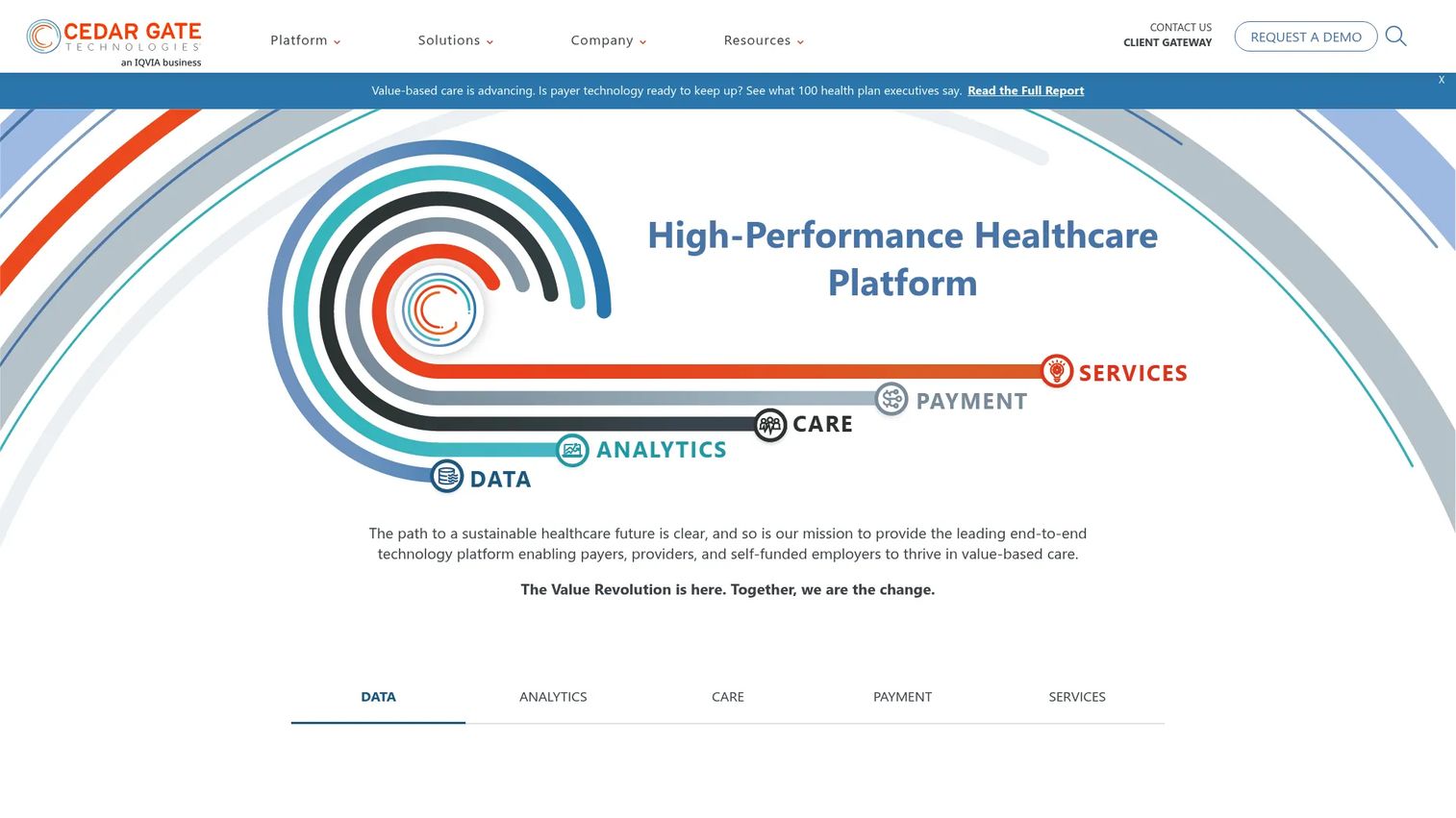
Cedar Gate Technologies provides an end-to-end healthcare technology platform for payers, providers, and self-funded employers pursuing value-based care. Its capabilities span a unified data lake, care management, clinical decision support, and bundles and capitation adjudication, making it one of the more complete operational systems in the category.
Best for: Provider networks, payers, and bundle administrators that need to operate prospective payment arrangements with shared data infrastructure and managed-service support.
Key features
- Enterprise data lake unifying claims, EHR, and clinical data
- Bundles and capitation adjudication for prospective programs
- Healthcare analytics and value-based care performance reporting
- Care management and utilization management modules
- Actuarial consulting and bundle program management services
Why choose Cedar Gate: Cedar Gate fits organizations that need more than software. Its combination of analytics, adjudication, and consulting support makes it a strong choice when the team is building a value-based care program from the ground up and cannot afford a long implementation failure.
Cedar Gate pricing: Cedar Gate does not post pricing. Contact the sales team directly. Ask about platform fees versus managed-service fees, and clarify what claims volume and integration scope drive contract size.
2. Cognizant TriZetto NetworX Payment Bundling Administration

Cognizant TriZetto NetworX Payment Bundling Administration is a payer-oriented module that automates bundled payment processing by identifying and repricing claims according to their role in an episode of care. It integrates with NetworX Pricer and the TriZetto Facets or QNXT core administration systems, which means it runs inside existing payer claims workflows rather than replacing them.
Best for: Health plans and payer organizations that need value-based reimbursement administration connected to a core claims system without building a separate data environment.
Key features
- Automated processing of bundled and episodic payments
- Rules-based identification and pricing across providers and dates of service
- Prospective and retrospective bundle arrangement support
- Preconfigured episode definitions from IHA, CMS, and PROMETHEUS
- Integration with NetworX Pricer, Facets, and QNXT
Why choose Cognizant TriZetto: The integration point is the differentiator. If your claims adjudication already runs on TriZetto infrastructure, adding episode-based repricing through NetworX avoids a parallel platform and a separate data feed. For payers on other core systems, evaluate integration feasibility first.
Cognizant TriZetto pricing: Pricing requires a sales conversation. Ask about licensing structure, implementation scope for episode definition configuration, and whether analytics modules are packaged separately from the adjudication layer.
3. Milliman Bundled Payment Reporting Interface
Milliman offers a Bundled Payment Reporting Interface that functions as a self-service analytics and reporting layer for bundled payment program participants. It processes claims data and surfaces episode-level visibility, including anchor hospitalization costs, post-acute spending, and beneficiary demographics, through dashboards and filterable reports.
Best for: Finance, actuarial, and value-based care teams participating in CMS or commercial bundled payment programs that need clearer episode economics without replacing their claims administration platform.
Key features
- Self-service claims data visualization with guided analytics
- Episode cost drilldowns by provider, time period, and beneficiary
- Anchor hospitalization and related expenditure reporting
- Post-acute care cost analysis
- Filterable dashboards covering program-level and episode-level detail
Why choose Milliman: This is the practical first step when the immediate problem is reconciliation visibility and board-ready episode economics. It does not adjudicate claims or distribute payments, but it gives finance and operations teams a reliable view of where spending is going inside each episode window.
Milliman pricing: Milliman does not publish a price list. Request a scoped quote. Ask whether pricing varies by program type, claims volume, number of CMS models tracked, or consulting support level.
4. StrataJazz Episode Analytics

StrataJazz Episode Analytics links hospital and physician encounters across the care continuum to build a longitudinal view of patient cohorts. Teams can define episodes using trigger events, inclusion criteria, and timeframes, then visualize utilization patterns, total costs, and controllable care variation across providers and settings.
Best for: Hospitals and health systems that need to model bundle profitability, assess contract exposure, and identify controllable cost variance before taking on more financial risk.
Key features
- Longitudinal episode construction linking hospital and physician encounters
- Trigger-based episode definition with configurable timeframes and inclusion criteria
- Cohort utilization and cost visualization across the care continuum
- Controllable versus non-controllable variation analysis
- Bundled and capitated payment agreement performance monitoring
Why choose StrataJazz: It answers the question "Should we take this contract?" rather than "How do we adjudicate this claim?" For provider organizations negotiating bundle agreements or evaluating whether a program scales to additional specialties, the analytics depth here is a material advantage over general financial reporting tools. G2 reviewers rate it 4.4 out of 5 based on 59 reviews (verified October 2026).
StrataJazz pricing: StrataJazz Episode Analytics does not carry a posted price. It may be sold as part of a broader Strata Decision Technology or Axiom package. Confirm during the sales process whether Episode Analytics is licensed separately or bundled with other modules.
5. Health Here Qūb

Health Here Qūb is an episodic payment engine built specifically for specialty-care practices. It handles unified contracting for bundled and episodic payment models, automates claims workflows, and manages provider payment distribution and reconciliation. The platform also supports employer, commercial, self-pay, and marketplace referral arrangements, which makes it relevant for specialty groups pursuing direct-to-employer or value-based referral contracts outside traditional payer channels.
Best for: Independent specialty practices, musculoskeletal groups, and procedural-care organizations that want to run bundled payment models without building a payer-administration operation.
Key features
- Unified contracting for bundled and episodic payment models
- Automated episodic claims processing and provider payments
- Real-time episode analytics across episodes and referral sources
- Support for employer, commercial, self-pay, and marketplace contracts
- Episode cost, payment, and quality metric visibility
Why choose Health Here Qūb: Qūb fits the specialty-care group that knows its episode economics but lacks the infrastructure to automate contracting, claims, and provider settlement. If the team is managing specialty referrals, patient pricing estimates, and gainsharing calculations in spreadsheets, this platform replaces that manual layer with purpose-built workflows.
Health Here Qūb pricing: Pricing requires a demo and sales conversation. Ask whether the fee is per episode, per location, or platform-based, and confirm what implementation support is included at each tier.
6. Solventum Patient-focused Episodes

Solventum Patient-focused Episodes is a clinical classification methodology and analytics system that identifies episodes of care while accounting for total illness burden, comorbidities, and resource use. It offers more than 240 event-based and 120 cohort episode types, risk-adjusted using APR DRGs, EAPGs, and CRGs, and supports payment reform design, utilization analysis, and provider profiling.
Best for: Payers, integrated delivery systems, accountable care organizations, and researchers that need clinically credible, risk-adjusted episode definitions for payment design or performance measurement.
Key features
- Patient-centric, disease-independent episode classification
- Risk adjustment using APR DRGs, EAPGs, and CRGs
- 240+ event-based and 120+ cohort episode types
- Flexible episode windows with configurable inclusions and exclusions
- Provider profiling, utilization analysis, and payment reform model support
Why choose Solventum: When comorbidities and patient complexity make simple procedure grouping too blunt for credible performance measurement, Solventum's risk-adjustment methodology creates defensible episode definitions. It is the right tool when the strategic question is how to define and price episodes accurately before contracting, not how to adjudicate claims after contracting.
Solventum pricing: Solventum directs customers to contact the company directly; pricing is not posted. Confirm whether the product is licensed as a software platform, a methodology, or a consulting engagement, since the contract structure can differ significantly.
7. BundlFlow
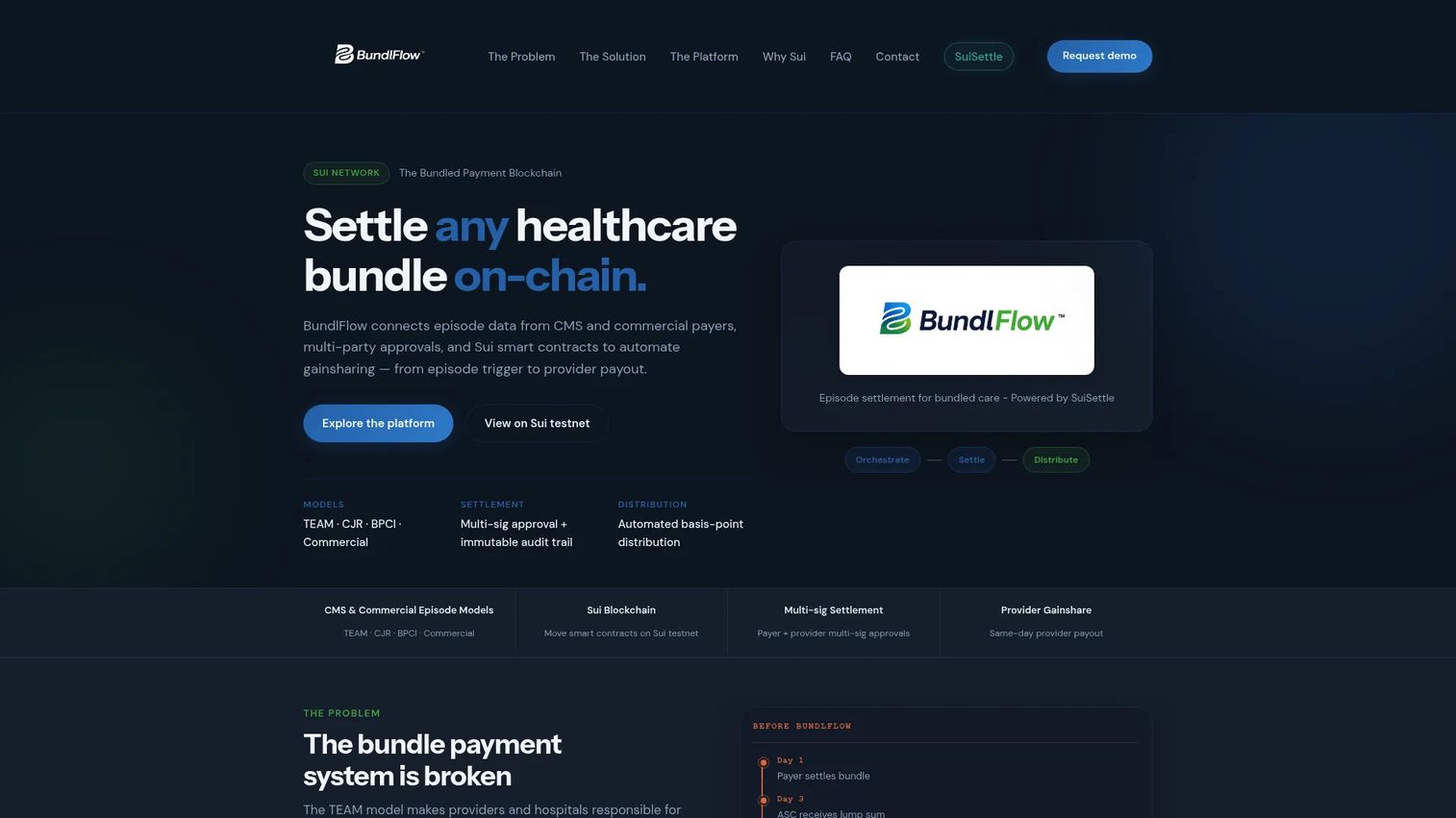
BundlFlow is a healthcare bundle payment settlement platform that connects payer episode data with multi-party approvals and Sui smart contracts to automate provider gainsharing payouts. It supports CMS and commercial episode models including TEAM, CJR, BPCI, and commercial bundles, and uses USDC-based automated payouts with basis-point share logic. Multi-signature approval workflows and immutable audit trails are core to the architecture.
Best for: Hospitals, ambulatory surgical centers, payers, and provider networks focused on automating multi-party settlement and gainsharing distribution with full transaction traceability.
Key features
- CMS and commercial episode model support: TEAM, CJR, BPCI, and commercial bundles
- Multi-signature settlement approvals with immutable audit trails
- Automated USDC provider payouts using basis-point share logic
- Episode-level payment records and claims data capture
- Smart-contract infrastructure for gainsharing distribution
Why choose BundlFlow: BundlFlow addresses the settlement and distribution layer that most episode analytics or adjudication platforms leave to manual reconciliation. For organizations where the primary friction is distributing gainsharing payments transparently across multiple providers, the smart-contract audit trail answers a governance problem that spreadsheets cannot.
BundlFlow pricing: BundlFlow charges a per-episode fee described on its website as a fraction of manual reconciliation costs. Request a scoped estimate covering transaction fees, implementation scope, and settlement model support during the sales process.
Considerations when choosing bundled payment software
Claims data and episode logic
The software must handle the actual data your program runs on. Verify support for claims feeds, EHR context, attribution rules, trigger events, inclusion logic, exclusions, and episode timeframes before any demo. Ask for a working example using a program type that resembles your own. A generic platform walkthrough tells you nothing when financial accountability depends on the exact episode definition.
Administration versus analytics versus settlement
Do not buy an analytics platform when the operating problem is claims adjudication. Write a one-page operating map before evaluating vendors. Define whether the team needs to price claims in real time, reconcile spending after runout, distribute payments across providers, or model risk before contracting. Each of those is a distinct problem that maps to a different product category.
Provider payment distribution and audit trails
Programs involving hospitals, physicians, post-acute facilities, and other participants need clear allocation rules and reliable audit records. Evaluate how the platform tracks payment responsibility, approval workflows, settlement timing, and exceptions. The hard part is rarely calculating one payment. It is keeping the logic reliable across every participant and every episode, quarter after quarter.
Integration and data ownership
Bundled payment software depends on source data it does not create. Ask which team owns claims ingestion, contract configuration, refresh schedules, reconciliation reviews, and exception management after go-live. A platform can work technically and still fail operationally if the data and financial workflow have no named owner inside your organization.
Implementation timeline and first-win speed
For a Series B operator, a platform that takes twelve months to produce a usable view of episode economics is a board problem, not a tech problem. Ask each vendor what a realistic timeline looks like for your episode type and data environment. The first useful output matters more than the feature ceiling.
Conclusion
Bundled payment software is not one category with one buying decision. Some platforms administer claims and episode pricing. Others analyze episode economics, support reconciliation, classify patient complexity, or distribute payment across participating providers.
Start with the operating constraint that is costing the team time or creating financial risk. Refer back to the claims adjudication software and claims management software evaluations if the upstream claims processing question is also open.
Choose Cedar Gate Technologies when you need bundle adjudication and payment distribution in one platform. Choose Cognizant TriZetto when bundled reimbursement must run inside existing payer claims administration. Choose Milliman when reporting and reconciliation visibility are the immediate priority. Choose StrataJazz when provider-side episode economics and variation analysis drive the decision. Choose Health Here Qūb for specialty-care episodic payment workflows. Choose Solventum when risk-adjusted episode classification is central to payment design. Evaluate BundlFlow when multi-party settlement and gainsharing automation are the primary gap.
The next step is to map your episode lifecycle from trigger to reconciliation, then shortlist only the platforms that solve the layer you are missing.
Start your journey with Guideflow today!
FAQs
Bundled payment software helps healthcare organizations define episodes of care, group related claims and services, apply episode-based payment rules, track spending against target prices, and reconcile financial outcomes across providers. It differs from standard claims processing tools by operating at the episode level rather than the individual claim level. Feature depth varies significantly, from reconciliation reporting to full prospective adjudication and provider distribution.
Standard claims processing adjudicates individual claims against fee schedules and coverage rules. Bundled payment software applies episode-level logic across multiple claims, providers, dates of service, and care settings. Some platforms combine both functions; others focus on the analytics or settlement layer and rely on a separate claims system for adjudication.
Prospective bundled payment sets a defined price before care is delivered. The claims system prices each episode at the start, and providers are paid according to bundle rules. Retrospective models typically allow fee-for-service payments during the episode, then reconcile total eligible spending against a target price after the episode closes. Software requirements differ: Prospective models need pricing and adjudication logic; retrospective models need claims aggregation, exclusion handling, and reconciliation reporting.
Some platforms support claims-based episode reporting, reconciliation, and program operations relevant to CMS models such as BPCI Advanced, CJR, and TEAM. Verify model-specific data format requirements, reconciliation timelines, and program rules directly with the vendor. Software capabilities are one input; program compliance and reporting obligations depend on your organization's specific participation agreement and should be reviewed with your internal compliance and legal teams.
Payer operations teams use it to administer bundle contracts and reprice claims. Provider finance and value-based care teams use it to track episode economics and model contract risk. Revenue cycle teams use it for reconciliation and settlement. Actuarial and contracting teams use episode classification tools to design payment models. Clinical operations leaders use variation analytics to identify care pathway opportunities. In a specialty-care group, a smaller team may own all of these functions together.
Core capabilities to evaluate include episode configuration, claims ingestion, prospective pricing or retrospective target-price calculation, risk adjustment, outlier handling, provider attribution, payment distribution, analytics, and integrations with claims systems and EHRs. Most programs do not need every feature on day one. Prioritize the capabilities that close your current operating gap, then confirm the platform can scale to the next phase.
Software improves visibility into episode cost, utilization patterns, care variation, and reconciliation exposure, which gives providers the data to make better contracting and care delivery decisions. Financial outcomes still depend on contract design, patient mix, care delivery, and data quality. The platforms in this guide do not eliminate risk; they create the visibility needed to manage it.
Every vendor in this category prices through a sales-led process. Contract size depends on claims volume, number of episode types, integration complexity, data refresh frequency, and whether managed-service or consulting support is included. Request a scoped estimate that separates software licensing, implementation, data services, and ongoing support so you can compare total cost of ownership across vendors.