A claim comes in. Someone reads the email, opens a spreadsheet, assigns an adjuster by hand, sets a reserve based on gut feel, and hopes nothing slips. Multiply that by thousands of claims a month, and you get slow cycle times, reserve leakage, thin audit trails, and claimants who call because nobody told them what happened to their file.
That manual model is what buyers are now trying to replace. Claims teams no longer judge software on whether it can store a case. They judge it on how fast it routes work, how tightly it controls reserves and payments, whether every action is auditable, and how well it keeps policyholders informed without a phone call. The stakes are real: the global claims management software market sits around USD 5.8 to 6.8 billion in 2025 to 2026 and is forecast to roughly double to USD 12.4 billion by 2033 to 2034, a CAGR near 9 to 12 percent, according to MarketIntelo and Persistence Market Research (2025 to 2026). Software now accounts for roughly 67 percent of total claims solution revenue, per MarketIntelo (2025), which tells you where operational leaders are placing their bets.
Cloud is where the movement is. By 2026, cloud-based deployments represent about 42 percent of new claims management software implementations, up from 28 percent in 2022, and are projected to exceed 65 percent by 2030 (MarketIntelo, 2026). If you are evaluating a platform this year, you are effectively choosing how your claims operation will run for the next decade.
What's inside
This guide compares eight claims management platforms built for insurers, third-party administrators, and claims-heavy operations. We chose and ranked them on the criteria that actually move operational metrics: workflow depth, automation and straight-through processing, reporting and claims analytics, integration fit with policy and billing systems, and compliance controls like FROI/SROI support and audit logging. We also weighted buyer fit, because an enterprise P&C carrier and a small adjusting firm need very different things.
This is a commercial evaluation list, not a software directory. Every entry is framed around who it fits, where it excels, and what it costs, so you can shortlist fast.
TL;DR
- Best for enterprise P&C carriers: Guidewire ClaimCenter, for deep lifecycle execution and large-carrier scale.
- Best for cloud-native claims operations: Duck Creek Claims, for straight-through processing at high volume.
- Best for AI-assisted claims routing: Majesco Claims, for GenAI agents and embedded analytics.
- Best for smaller or focused teams: ClaimFlow, for adjusters who want a lighter, faster claims system.
- Best for automation-heavy workflows: Snapsheet Claims, for no-code automation and digital servicing.
- Best overall shortlist pick: Riskonnect Claims Management Software, for teams tying claims into broader risk workflows.
What is claims management software?
Claims management software is a system that manages an insurance claim across its full lifecycle, from first notice of loss (FNOL) through investigation, reserving, payment, recovery, and closure, with automation, reporting, and compliance controls built in.
A modern claims management system is judged on more than case tracking. The core capabilities buyers evaluate today include:
- FNOL intake and claim assignment: structured intake from web, phone, mobile, or API, with automatic file creation and adjuster assignment.
- Routing and business rules: rules-driven triage that sends the right claim to the right handler based on severity, line of business, geography, or workload.
- Reserves, payments, subrogation, and recovery: reserve management, payment issuance, subrogation management, and salvage recovery tracked in one place.
- Analytics and dashboards: claims analytics on cycle time, loss ratios, leakage, and handler performance, surfaced in real time.
- Claimant communication and portals: self-service portals, automated status updates, and SMS/email notifications that cut inbound call volume.
- APIs, integrations, and compliance controls: connections to policy administration, billing, and document systems, plus audit trails, role-based permissions, and regulatory filing like FROI/SROI.
Those six pillars separate a true claim lifecycle management platform from a glorified case log. Any insurance claims management software worth shortlisting should cover most of them out of the box.
When to use claims management software
Streamline FNOL and routing
If intake still runs through inboxes and manual handoffs, you are losing hours per claim before an adjuster even opens the file. FNOL software with rules-based routing creates the file, validates data, and assigns the right handler automatically. High-volume P&C operations feel this most, but any team with unpredictable intake spikes benefits from removing the manual triage step.
Reduce manual handling and leakage
Reserve leakage and duplicate payments quietly erode combined ratios. A claims processing software platform with straight-through processing, automated reserve logic, and payment controls closes those gaps. When adjusters stop rekeying data across systems, they spend time on judgment calls instead of clerical work, and leakage tightens.
Improve audit trails and stakeholder communication
Regulators, reinsurers, and auditors all want to see who did what and when. A claims management system with immutable audit logs, role-based access, and configurable compliance rules gives you that record without manual reconstruction. Pair it with claimant portals and automated updates, and stakeholder communication improves on both sides of the file.
Comparison table
The table below summarizes each platform by intent, primary use case, pricing, and G2 rating. Most enterprise claims vendors quote custom pricing tied to project scope, so verify current figures and ratings with each vendor before you commit budget.
| # | Product | Intent | Key use case | Pricing | G2 rating |
|---|---|---|---|---|---|
| 1 | Riskonnect Claims Management Software | Risk-integrated claims | Claims tied into RMIS and ERM workflows | Custom quote | 4.1/5 |
| 2 | Duck Creek Claims | Cloud P&C claims | High-volume straight-through processing | Custom quote | 4.4/5 |
| 3 | Guidewire ClaimCenter | Enterprise P&C | Full lifecycle for large carriers | Custom quote | 4.5/5 |
| 4 | ClaimFlow | Lightweight claims | Public adjusters and small firms | From $97/month | Not listed |
| 5 | BriteCore Claims | Cloud core suite | Claims inside a broader platform | Custom quote | Not listed |
| 6 | Snapsheet Claims | Automation-first | No-code workflow automation | Custom quote | 4.1/5 |
| 7 | Majesco Claims | AI-assisted claims | GenAI agents and analytics | Custom quote | 1.5/5 |
| 8 | Insurity Claims | Configurable admin | Multi-line claims administration | Custom quote | 3.7/5 |
1. Riskonnect Claims Management Software

Riskonnect Claims Management Software tracks, automates, and analyzes claims workflows for insurance carriers, third-party administrators, and self-insured organizations managing complex claims at scale. Its differentiator is context: claims do not live in isolation, they connect into risk management information systems (RMIS) and enterprise risk management (ERM) workflows, so loss data flows into the broader risk picture instead of sitting in a silo.
Best for: Insurance carriers, TPAs, and self-insured organizations that want claims tied into wider risk operations.
Key strengths
- Claim intake and data validation: structured FNOL capture with validation that catches bad data before it reaches an adjuster.
- Electronic FROI/SROI filing: built-in workers compensation claims software support for regulatory first and subsequent report filing.
- Reserve, subrogation, and settlement workflows: reserve management, subrogation management, and settlement handled inside one connected system.
Why choose Riskonnect: If your organization already thinks in terms of total cost of risk, Riskonnect keeps claims data in the same environment as your risk and safety programs. That integration matters for self-insured employers and TPAs that report to risk committees, not just claims managers. It fits teams that value auditability and cross-functional reporting over a bare-bones adjusting tool.
Riskonnect pricing: Riskonnect does not publish list pricing. The company states that cost depends on project size, complexity, and customization, with implementation options at different price points. Expect a quote-based engagement scoped to your claim volume and configuration needs. On G2, it holds a 4.1/5 rating.
2. Duck Creek Claims
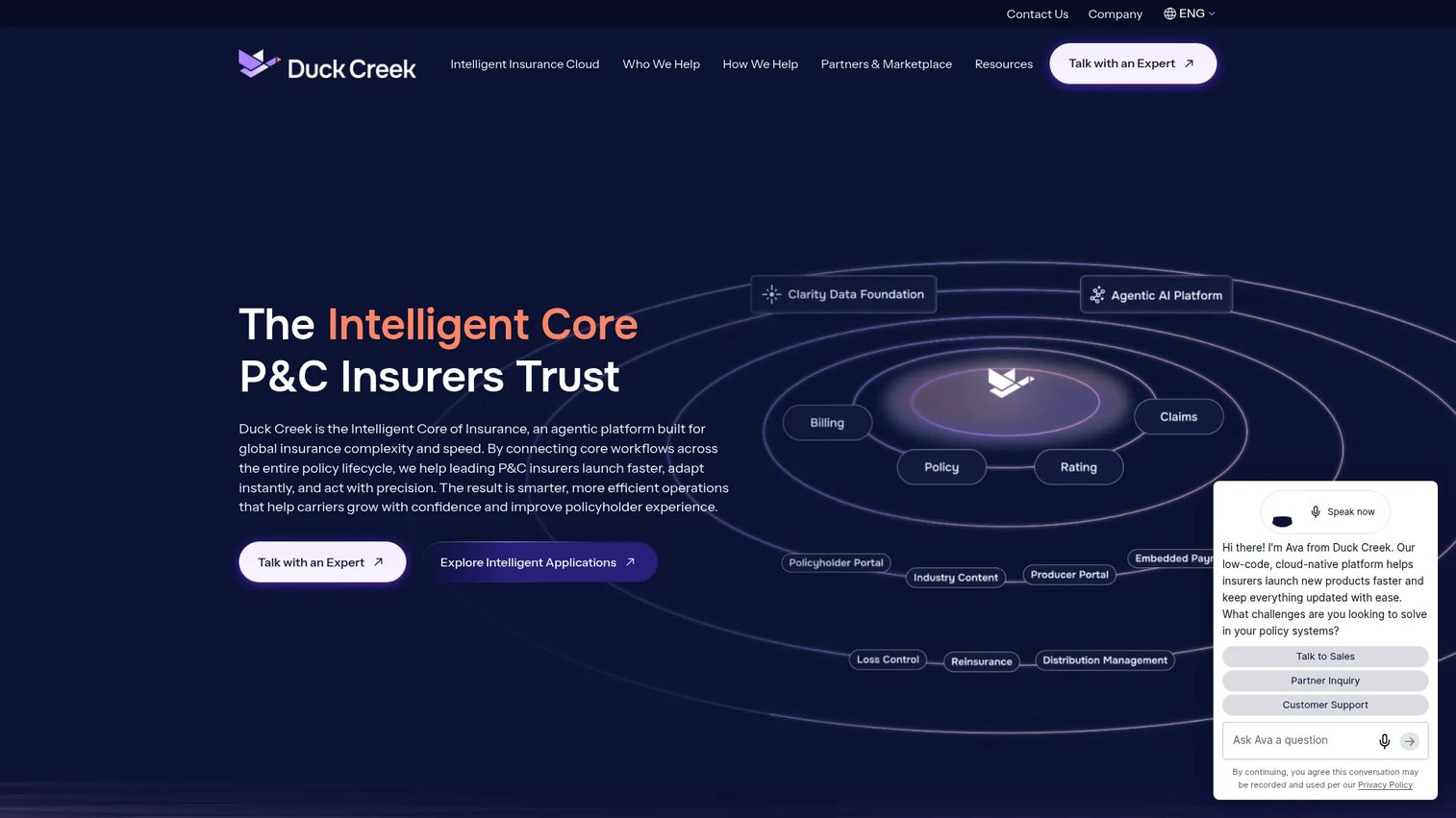
Duck Creek Claims is a cloud claims management solution for property and casualty insurers that automates and streamlines the entire claims lifecycle. It is built for carriers that need to process high volumes without adding headcount, using assignment logic and coverage checks that keep files moving from FNOL to settlement.
Best for: P&C insurers that need an enterprise claims management platform built for cloud scale.
Key strengths
- Assignment and routing: automated triage that matches each claim to the right adjuster based on rules you define.
- Coverage verification: built-in checks that confirm coverage against the policy before work begins, reducing rework and disputes.
- Investigation management: structured investigation workflows that keep documentation, tasks, and findings on the claim file.
Why choose Duck Creek: Duck Creek fits carriers that have outgrown legacy on-premise systems and want cloud elasticity plus modern automation. Its strength is throughput. If your claims volume swings seasonally or is growing fast, the platform scales without the infrastructure headaches of self-hosted software. It is a strong fit for insurers standardizing claims across multiple lines.
Duck Creek pricing: Duck Creek does not display public pricing for its claims product and directs prospects to sales. Pricing is scoped to carrier size, line count, and configuration. On G2, Duck Creek Claims holds a 4.4/5 rating, one of the stronger scores in the enterprise segment.
3. Guidewire ClaimCenter

Guidewire ClaimCenter is claims management software for P&C insurers, covering the full lifecycle from intake to closure. It is one of the most recognized names in enterprise insurance software, frequently shortlisted by mid-to-large carriers that need depth, auditability, and a mature partner ecosystem.
Best for: Mid-to-large P&C insurers that need an enterprise-grade claims management system.
Key strengths
- Claims lifecycle management: end-to-end handling from FNOL through closure, with reserves, payments, and recovery in one system.
- Wizard-based digital intake: guided digital FNOL that captures clean data and speeds up file creation.
- Embedded insurance-grade AI: real-time guidance and AI support built for insurance workflows, not bolted on.
Why choose Guidewire: ClaimCenter is the default shortlist candidate when the operation is complex and the carrier is large. Policy search, deep configurability, and a broad ecosystem of integration partners make it a safe choice for multi-line insurers with strict compliance needs. It rewards carriers willing to invest in configuration to match their exact processes.
Guidewire pricing: Guidewire does not publish pricing for ClaimCenter and directs prospects to request a demo. Engagements are enterprise-scale and scoped to the carrier. On G2, ClaimCenter holds a 4.5/5 rating, the highest in this comparison.
4. ClaimFlow
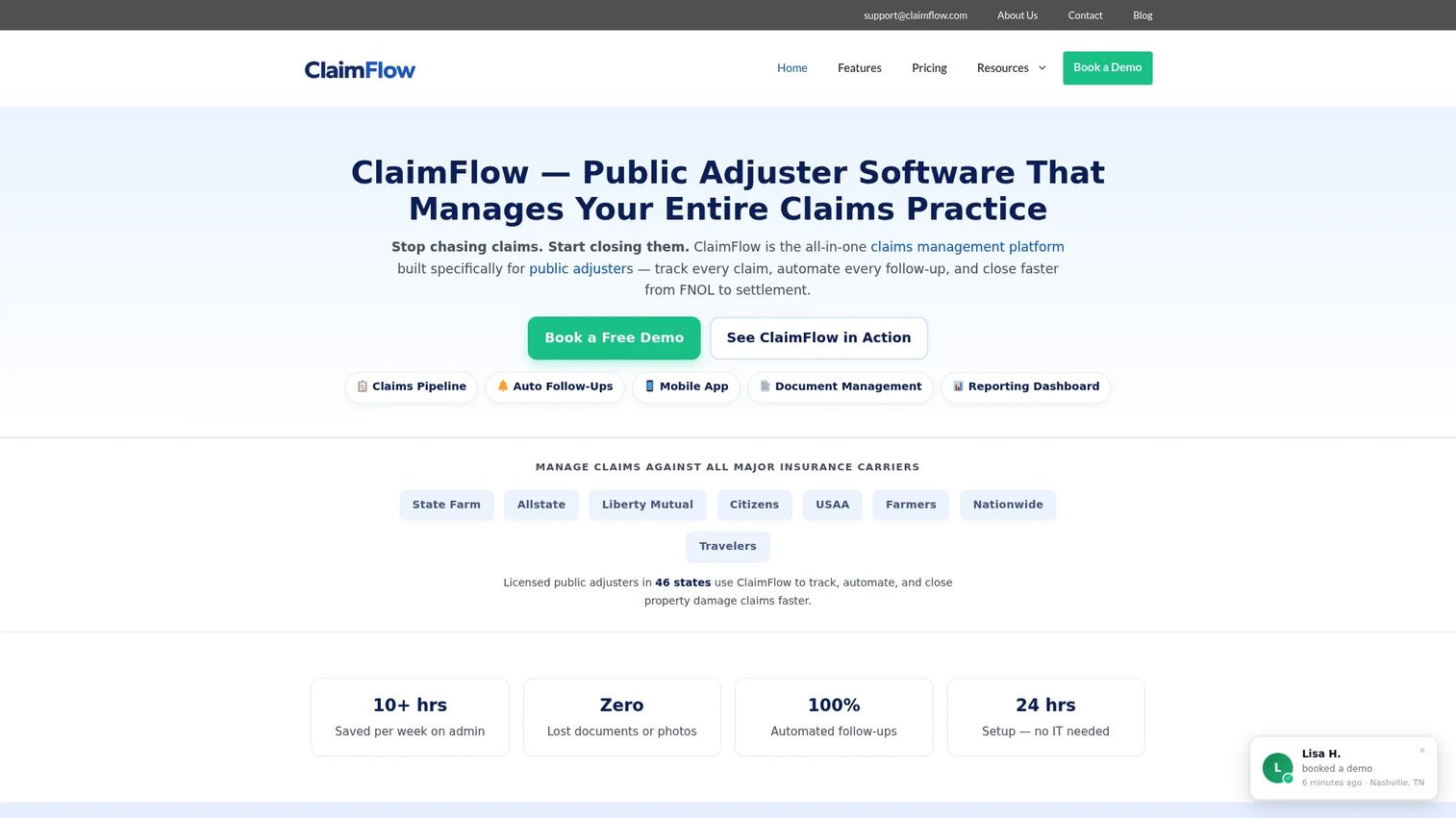
ClaimFlow is claims management software built specifically for public adjusters, giving smaller firms a fast, focused way to track claims without enterprise overhead. Where the large platforms target carriers, ClaimFlow targets the adjuster running dozens of active files who needs visibility, follow-ups, and documents in one place.
Best for: Public adjusters and small multi-adjuster firms that need claims workflow automation without a heavy implementation.
Key strengths
- Visual claims pipeline: a clear pipeline view so adjusters always know which claims need attention and where each one stands.
- Automated SMS and email follow-ups: scheduled outreach that keeps claimants informed and files moving without manual reminders.
- Policyholder self-service portal: a portal where claimants upload documents and check status, cutting back-and-forth.
Why choose ClaimFlow: ClaimFlow is the pragmatic pick for a focused operation. It trades the deep configurability of carrier platforms for speed, a short learning curve, and month-to-month billing. For a public adjusting firm that wants a working claims system this week rather than a six-month rollout, it fits neatly.
ClaimFlow pricing: ClaimFlow publishes transparent pricing. The Starter plan is $97/month, Professional is $197/month, and Agency is $497/month, all billed month-to-month. Every plan includes a 14-day free trial. That transparency and low entry point make it accessible to firms that enterprise vendors rarely quote.
5. BriteCore Claims

BriteCore Claims is the claims management module inside BriteCore's cloud-native core platform for P&C insurers. Its appeal is integration: claims sit alongside policy and billing in one modern system, so carriers avoid stitching together separate vendors for each part of the core suite.
Best for: P&C insurers that want a cloud-native claims module inside a broader core platform.
Key strengths
- FNOL intake: structured first notice of loss capture that starts the claim with clean, complete data.
- End-to-end claims processing: reserves, payments, and full claims handling managed within the core platform.
- Claim bifurcation and role-based permissions: split-claim handling and granular access controls for compliance and workflow separation.
Why choose BriteCore: BriteCore fits insurers modernizing their entire core stack, not just claims. If you are already evaluating a new policy administration or billing system, running claims inside the same cloud-native platform reduces integration work and gives you a single data model across the business. It is a strong option for carriers that value consolidation.
BriteCore pricing: BriteCore does not display public pricing and routes prospects to a demo request. Pricing is scoped to the modules you deploy and your book size. Because it is sold as part of a broader core suite, cost typically reflects a platform commitment rather than a standalone claims tool.
6. Snapsheet Claims
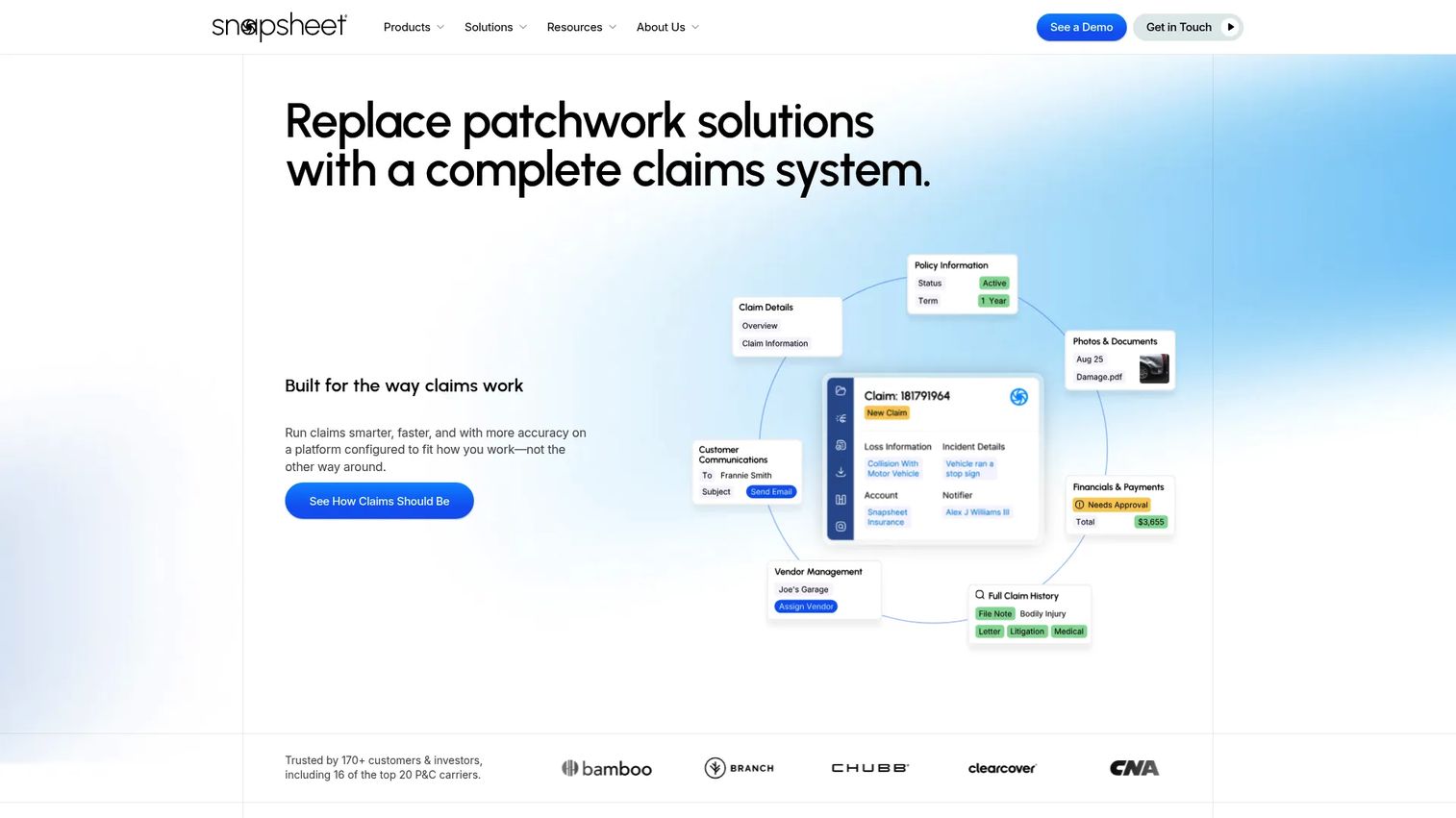
Snapsheet Claims is cloud-based claims management software for insurance carriers, MGAs, and TPAs that centers on automation and digital servicing. Snapsheet built its reputation on virtual appraisals and fast, digital-first claims handling, and its platform reflects that focus on speed and customer experience.
Best for: P&C insurers, MGAs, and TPAs that need configurable claims automation and modern digital servicing.
Key strengths
- Unified claim view: a single searchable view of claim history so handlers see the full context instantly.
- No-code workflow automation: smart assignment and automation configurable without engineering, so ops teams own their own rules.
- Integrations, payments, and AI: open APIs, embedded payments, and AI capabilities that streamline the servicing loop.
Why choose Snapsheet: Snapsheet is the pick when speed of resolution and customer experience are the priority. Its no-code automation lets claims operations adjust workflows without waiting on IT, and its digital servicing tools shorten the cycle from FNOL to payment. It fits organizations that want to modernize the claimant experience without replacing their entire core system.
Snapsheet pricing: Snapsheet offers tailored pricing and does not publish numeric plans on its site. Cost is scoped to your volume and configuration. On G2, Snapsheet holds a 4.1/5 rating.
7. Majesco Claims

Majesco Claims is part of Majesco's cloud insurance suite, delivering P&C claims management with a strong emphasis on AI-assisted processing and embedded analytics. It handles the claim from FNOL through closure while layering GenAI and task-specific AI agents on top of the workflow.
Best for: P&C insurers looking for enterprise claims management with AI-assisted workflows and analytics.
Key strengths
- FNOL through closure workflow: complete claims handling across the full lifecycle in one platform.
- GenAI and task-specific AI agents: AI agents that assist adjusters with routing, summarization, and repetitive tasks.
- Embedded analytics and automation: built-in claims analytics and automation that surface trends and drive straight-through processing.
Why choose Majesco: Majesco fits carriers that want AI as a core part of the claims workflow rather than an add-on, and that already run, or plan to run, other Majesco suite modules. The value compounds when claims share a platform with policy and billing. It is aimed at insurers modernizing operations with automation and analytics at the center.
Majesco pricing: Majesco does not publish public pricing; details are request-based and scoped to the carrier. On G2, the Majesco Claims for P&C product page shows a 1.5/5 rating based on a small number of reviews, so weight it alongside your own reference calls and a hands-on evaluation rather than the score alone.
8. Insurity Claims
Insurity Claims is cloud-based claims administration software for insurance carriers, brokers, and MGAs, built for configurable claim lifecycle management across multiple lines. Its strength is breadth and configurability: rules, dashboards, and document handling can be tailored to fit varied lines of business under one system.
Best for: P&C insurers and MGAs that need configurable claims administration across multi-line environments.
Key strengths
- FNOL intake and automated workflows: structured intake feeding automated claims workflows from the first touch.
- Claims payments and financial positioning: payment handling and reserve/financial tracking built into the platform.
- Configurable dashboards, rules, and document management: tailorable dashboards, business rules, and document controls for compliance and reporting.
Why choose Insurity: Insurity fits carriers and MGAs that operate several lines of business and want one configurable claims administration software layer rather than separate tools per line. Its cloud delivery and rules engine give ops teams room to adapt workflows as products change. It suits organizations that prioritize flexibility and multi-line consolidation.
Insurity pricing: Insurity does not publish public pricing on its site; engagements are quote-based. On G2, the overall Insurity seller rating is 3.7/5, though that reflects the company across products rather than the claims module specifically. Confirm claims-specific references during evaluation.
Considerations before you buy
A demo looks clean. Production is where a claims system earns its keep. Use this checklist to pressure-test any shortlist.
Workflow depth and configurability
Map your actual claim types against the platform's rules engine. Can it route by severity, line, and geography without custom code? Can ops teams change rules themselves, or does every tweak route through IT? Deep configurability is worth more than a long feature list you never use.
Automation and leakage control
Ask exactly where straight-through processing kicks in and where a human still touches the file. Confirm how reserve logic and payment controls prevent duplicate or over-payment. Leakage is where most of the ROI hides, so treat this as a core criterion, not a nice-to-have.
Integration fit
Your claims system does not stand alone. Verify native or API connections to your policy administration, billing, and document systems, plus any downstream analytics warehouse. Weak integration turns a modern platform into another silo you have to reconcile by hand.
Compliance and auditability
Confirm immutable audit logs, role-based permissions, and support for regulatory filing like FROI/SROI if you handle workers compensation. Regulators and reinsurers will ask for this record, and reconstructing it manually is expensive.
Total cost and time to value
Most vendors here quote custom pricing tied to scope, so model total cost of ownership, including implementation, over three years, not just year one. Ask for a realistic go-live timeline and a first-value milestone. A platform that takes 18 months to deliver value costs more than its license suggests.
Conclusion
The right claims management software depends on your claim volume, regulatory burden, and how much integration complexity you can absorb.
For enterprise P&C carriers with complex, multi-line operations, Guidewire ClaimCenter and Duck Creek Claims lead on lifecycle depth and cloud scale. Cloud-first operators modernizing their whole core stack should look hard at BriteCore Claims and Insurity Claims, which put claims inside a broader configurable platform. Smaller and more focused teams, especially public adjusters, get the fastest path to value from ClaimFlow. Automation-heavy buyers who want speed and a modern claimant experience should weigh Snapsheet Claims and Majesco Claims for their AI and no-code strengths. Riskonnect Claims Management Software is the standout when claims need to live inside a broader risk and RMIS picture.
Start with the platform that matches your operational reality, not the longest feature list. Shortlist two or three, run your real claim types through a scoped evaluation, and pressure-test integration and leakage control before signing. The system you pick this year will shape your claims operation for a decade.
FAQs
Claims management software is a system that manages an insurance claim across its full lifecycle, from first notice of loss through investigation, reserving, payment, recovery, and closure. It replaces manual spreadsheets and email-based handling with automated routing, reporting, and compliance controls that shorten cycle time and reduce leakage.
At minimum, look for FNOL intake, rules-based routing, reserve and payment management, subrogation and recovery tracking, claims analytics dashboards, claimant portals, and integrations with policy and billing systems. Compliance features like audit logging, role-based permissions, and regulatory filing round out a platform ready for regulated claims operations.
It removes the manual steps that stall files: automatic file creation at intake, rules-based assignment to the right adjuster, and straight-through processing for simple claims. When adjusters stop rekeying data and chasing status updates, they resolve files faster, and automated claimant communication cuts inbound calls that otherwise interrupt the work.
In practice, the terms are used interchangeably. A claims management system usually refers to the deployed platform running inside an insurer, while claims management software refers to the product you buy. Both describe the same category: technology that runs the claim lifecycle from FNOL to closure.
Yes, and integration should be a core evaluation criterion. Most modern platforms offer APIs or native connectors to policy administration and billing systems so coverage, premium, and payment data flow automatically. Some vendors, like those built as full core suites, include claims alongside policy and billing in one platform, which reduces integration work entirely.
Yes. Workers compensation claims software adds specific requirements like electronic FROI/SROI filing, medical bill review integration, and jurisdiction-specific compliance rules. Platforms with built-in regulatory filing and reserve management handle these workflows without the manual reporting that comp claims otherwise demand.
Prioritize real-time visibility into cycle time, loss ratios, reserve accuracy, leakage, and handler performance, with the ability to slice by line, geography, and claim type. Good claims analytics also surface trends early enough to act, and export cleanly into your broader data warehouse for board-level and reinsurer reporting.
Match the platform to your claim volume, line complexity, and regulatory burden. Enterprise systems like Guidewire ClaimCenter and Duck Creek Claims reward large, multi-line carriers that need deep configurability and can invest in implementation. Mid-market and focused teams often get faster value from lighter, transparently priced options like ClaimFlow that go live in weeks rather than months.