You added a third service zone last quarter. Now your dispatcher is juggling a spreadsheet, two group chats, and a phone that never stops ringing. Drivers double back across the city. Customers call support asking where their order is. And every Friday at peak, something breaks.
That is the moment most operators start shopping for on demand delivery software. Not because the spreadsheet stopped working, but because it stopped scaling. The global on-demand delivery software market hit $10.4B in 2025 and is projected to reach $25.4B by 2035, growing at a 9.3% CAGR, according to WiseGuy Reports (2025). That growth is not abstract. It reflects thousands of teams hitting the same wall you are: manual dispatch breaks down the moment volume, zones, and same-day commitments stack up.
The real problem is not driver chaos or slow customer updates. Those are symptoms. The underlying issue is that delivery operations route through one or two people who hold all the context in their heads. The right platform pulls that context into a system that assigns, routes, tracks, and reports without a human translating every order into action. If you are evaluating tools to run fulfillment more predictably, the same operational lens applies to adjacent stacks like marketing automation, customer data platforms, and event management software: you are buying repeatability, not features.
This guide ranks seven platforms built to do exactly that.
What's inside
This guide is for founders, operators, and delivery teams who have outgrown manual coordination and need a system that scales. We focused on tools that cover the full operational loop: order intake, dispatch automation, real-time tracking, customer notifications, driver coordination, and reporting.
We selected and ranked each platform on four criteria:
- Workflow coverage: how much of the order-to-delivery loop the tool handles end to end
- Operational fit: whether it matches real delivery models like courier, quick commerce, and last mile
- Integrations and extensibility: API access, maps, payments, and notification support
- Scalability: multi-region, multi-vertical, and high-volume handling
Pricing and G2 ratings reflect verified values at time of writing.
TL;DR
- Best for white-label courier operations: Onro covers end-to-end dispatch with branded customer and driver apps.
- Best for quick commerce and hyperlocal: Hyperzod runs white-label marketplaces with module-based pricing.
- Best for complex enterprise networks: Locus brings AI dispatch and routing intelligence at scale.
- Best for configurable last mile: Elite EXTRA handles routing, dispatch, and returns automation.
- Best for SMB and local delivery: Shipday offers a free tier and fast setup for restaurants and local teams.
- Best for flexible field operations: Tookan covers routing, dispatch, and fleet tracking across verticals.
- Best for polished last-mile orchestration: Onfleet pairs route optimization with strong proof of delivery.
What is on demand delivery software?
On demand delivery software is a platform that automates the full delivery workflow, from order intake and driver assignment through dispatch, routing, real-time tracking, customer notifications, and proof of delivery.
Instead of a dispatcher manually matching orders to drivers, the system applies assignment logic, optimizes routes, and pushes status updates to customers and internal teams automatically. It replaces the spreadsheets, group chats, and phone calls that hold most early delivery operations together.
The core capabilities you should expect from any on demand delivery platform:
- Order intake and management: capture orders from your website, app, or integrations into one queue
- Dispatch automation: auto-assign deliveries to drivers based on location, capacity, and zone
- Route optimization: sequence stops to cut drive time and fuel cost
- Real-time tracking: live driver location and accurate ETAs for customers and ops
- Customer notifications: automated status updates by SMS, email, or branded tracking pages
- Driver app: navigation, proof of delivery, cash on delivery, and earnings tracking
- Proof of delivery: photo, signature, or barcode capture at the drop
- Reporting and analytics: delivery performance, driver metrics, and exception tracking
The strongest on demand delivery management software treats these as one connected system, not separate modules you stitch together. That connection is what lets a small ops team handle more volume without adding headcount for every new zone.
When to use on demand delivery software
Not every delivery operation needs a platform on day one. Here is when the switch pays for itself.
Reduce dispatch chaos
Manual assignment works until it doesn't. The break point is usually a combination of peak volume, same-day commitments, and multiple service zones hitting at once. When your dispatcher is making assignment decisions faster than they can think clearly, errors compound: wrong driver, wrong zone, missed window.
Dispatch automation changes the math. The system assigns based on driver location, current load, and zone rules, then reassigns automatically when something falls through. Your dispatcher moves from making every call to managing exceptions, which is the only version of the job that scales.
Improve real-time visibility
When a customer cannot see where their order is, they call you. When your ops team cannot see where a driver is, they guess. Both create work that real-time tracking eliminates.
Live tracking and automated status updates cut inbound support volume and surface problems before they become complaints. A delayed delivery becomes a proactive notification instead of an angry call. For internal teams, visibility means exception management: you catch the stuck delivery while you can still fix it.
Scale without adding headcount
The founder's version of this problem is specific: delivery operations route through one or two people, and the business cannot grow past their capacity. Every new region, every volume spike, every new vertical means more manual coordination.
Automation breaks that dependency. The system handles assignment, routing, and notifications at any volume, so adding orders does not mean adding coordinators. Clean reporting and repeatable handoffs mean a new ops hire ramps in days, not months. That is the difference between a delivery operation that scales and one that caps out at whatever its busiest person can hold in their head.
Comparison table
Use this table to shortlist two or three platforms before reading the full sections. Match the intent column to your delivery model, then check pricing against your stage and volume. Ratings reflect current G2 listings where available.
| # | Product | Intent | Key use case | Pricing | G2 rating |
|---|---|---|---|---|---|
| 1 | Onro | White-label courier ops | End-to-end dispatch with branded apps | From $239/mo | 5/5 |
| 2 | Hyperzod | Quick commerce | White-label delivery marketplaces | From $29/mo | 5.0/5 |
| 3 | Locus | Enterprise networks | AI dispatch and routing at scale | Custom | 4.4/5 |
| 4 | Elite EXTRA | Configurable last mile | Routing, dispatch, returns automation | Custom | Not listed |
| 5 | Shipday | SMB and local | Local delivery with branded updates | Free, then $19/mo | Unrated |
| 6 | Tookan | Flexible field ops | Routing, dispatch, fleet tracking | From 19€/user/mo | 4.2/5 |
| 7 | Onfleet | Last-mile orchestration | Route optimization and proof of delivery | From $619/mo | 4.6/5 |
1. Onro
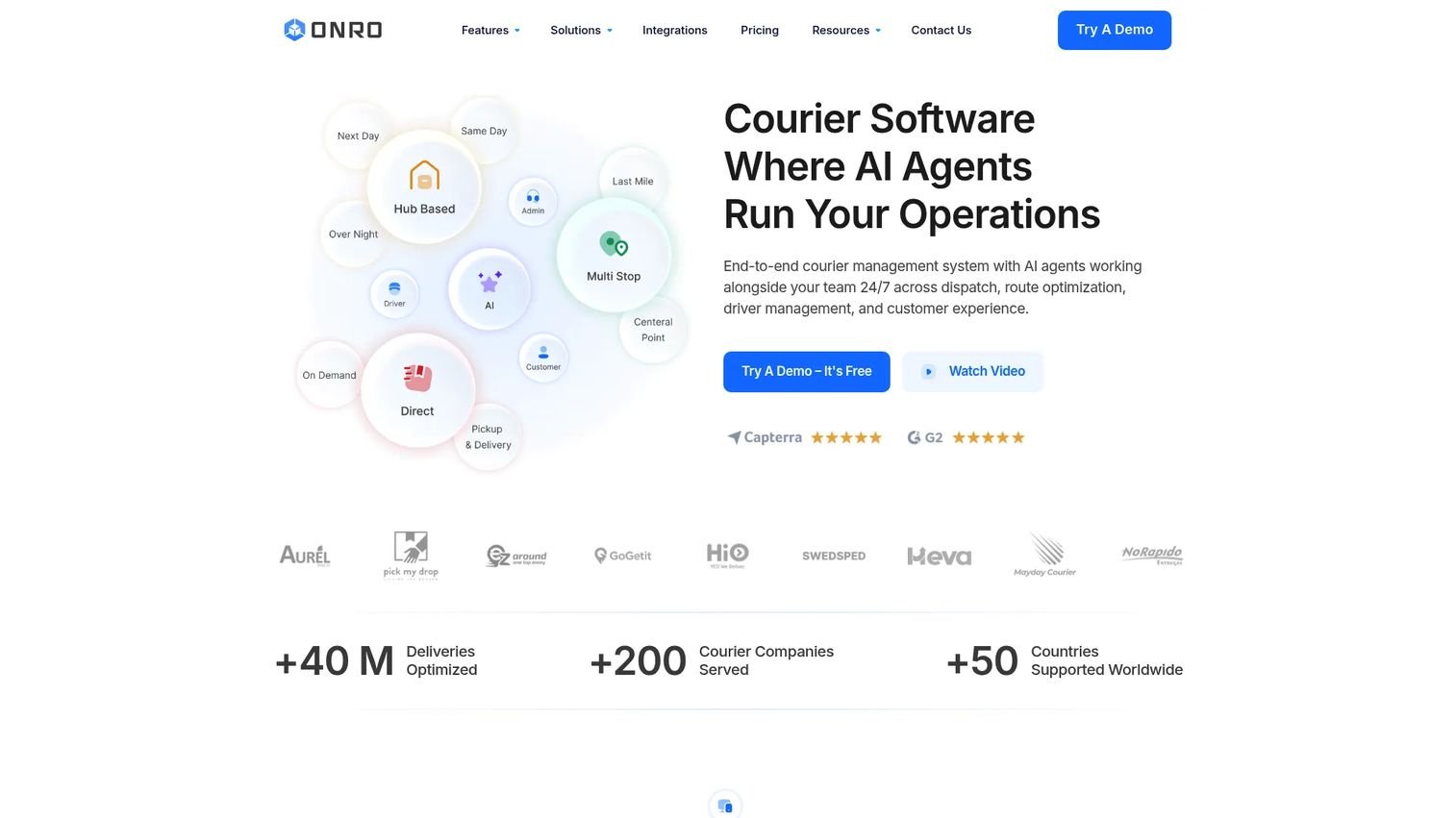
Onro is AI-powered courier software built to run end-to-end delivery operations under your own brand. It covers route planning, auto-dispatching, tracking, scheduling, and invoicing, then layers a driver app and a customer portal on top so the entire flow lives in one system. For operators who want a branded delivery experience without building infrastructure from scratch, it hits the core jobs cleanly.
Best for: Courier and last-mile delivery businesses that need end-to-end dispatch, tracking, and white-label customer and driver apps.
Key strengths
- End-to-end dispatch: Route planning, auto-dispatching, tracking, scheduling, and invoicing in one platform.
- Driver app with proof of delivery: Navigation, cash on delivery, earnings tracking, and POD capture built for the field.
- White-label customer portal: Booking, notifications, chat, payments, and branded tracking under your domain.
Why choose Onro: If you are building a customer-facing delivery brand, Onro's white-label depth is the draw. The customer app, driver app, admin panel, and dispatcher panel all carry your branding, so customers experience your operation, not a third-party logo. It fits courier teams that want operational control and a polished front end without a development project.
Onro pricing: G2 lists Onro's Business plan starting at $239.00 per month, with Enterprise quoted as Contact Us. Onro's own site notes that pricing depends on business size, order volume, and white-label requirements, and offers a demo rather than fully public plan pricing. Onro holds a 5 out of 5 rating on G2.
2. Hyperzod
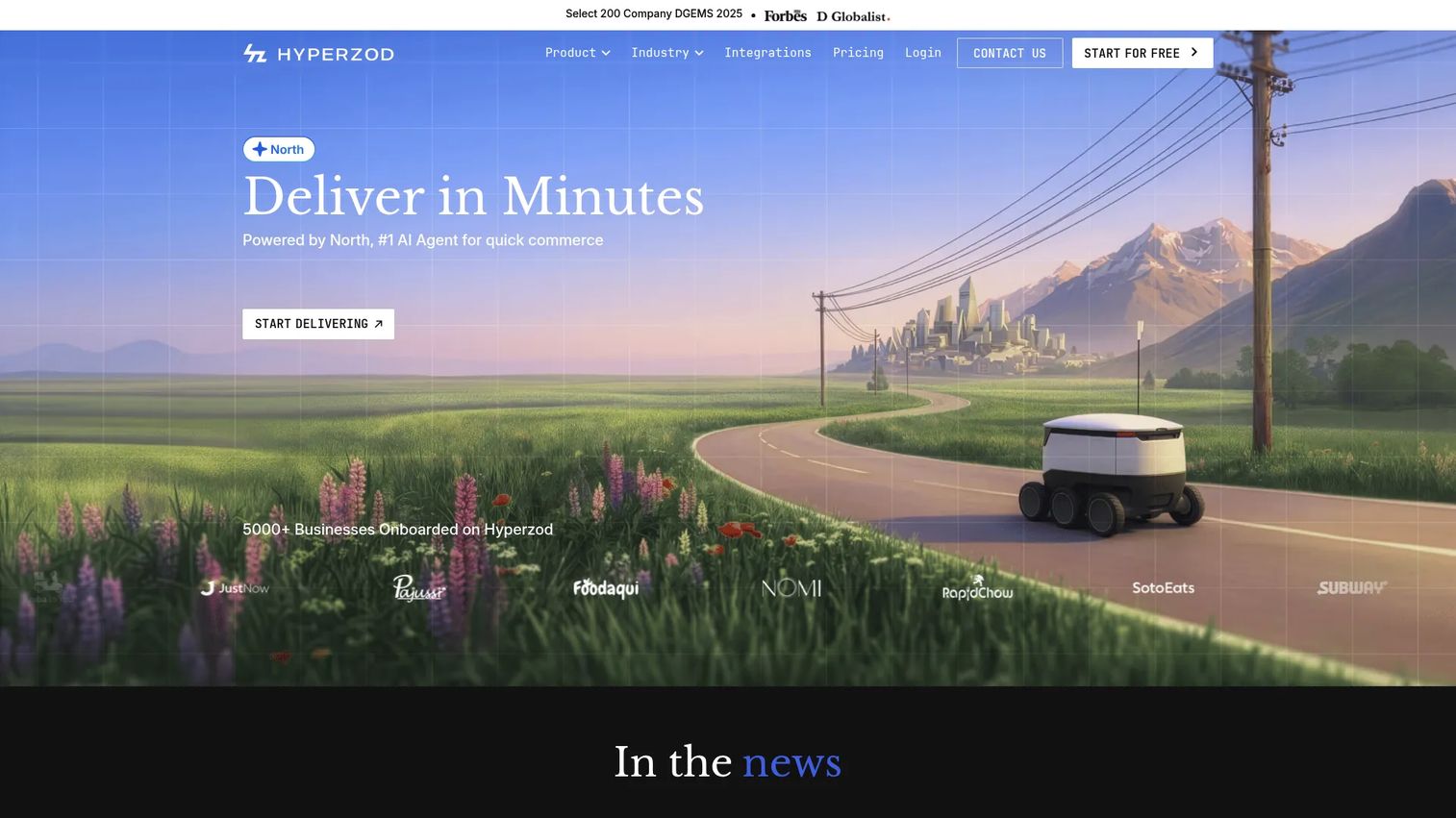
Hyperzod is an AI-first, white-label quick-commerce platform built for delivery-first businesses. It is designed for teams launching hyperlocal and instant-delivery marketplaces, with a white-label ordering website and apps, a merchant app for order management, and support for multi-vendor, single-store, and multi-branch models. If your operation lives or dies on speed and local fulfillment, Hyperzod is built around that reality.
Best for: Businesses launching white-label delivery or quick-commerce marketplaces.
Key strengths
- White-label storefront and apps: Branded ordering website and apps your customers experience as your own.
- Merchant app with integrations: Order management and merchant tooling for vendors on your platform.
- Flexible operating models: Multi-vendor, single-store, and multi-branch support from one platform.
Why choose Hyperzod: Quick commerce and hyperlocal delivery run on automated order handling and fast vendor onboarding, and Hyperzod is structured for both. The module-based approach lets you start with what you need and add capabilities as you grow. It fits operators building a delivery-first marketplace rather than bolting delivery onto an existing storefront.
Hyperzod pricing: Hyperzod uses public, per-module pricing in USD. The Ordering Website module starts at $29 per month, the Merchant App at $79 per month, and the Ordering App at $99 per month, with yearly billing showing a 20% discount. The page also lists a 0.99% per-order success fee and a one-time $300 setup fee per module, with a custom Enterprise plan. Hyperzod holds a 5.0 out of 5 rating on G2.
3. Locus
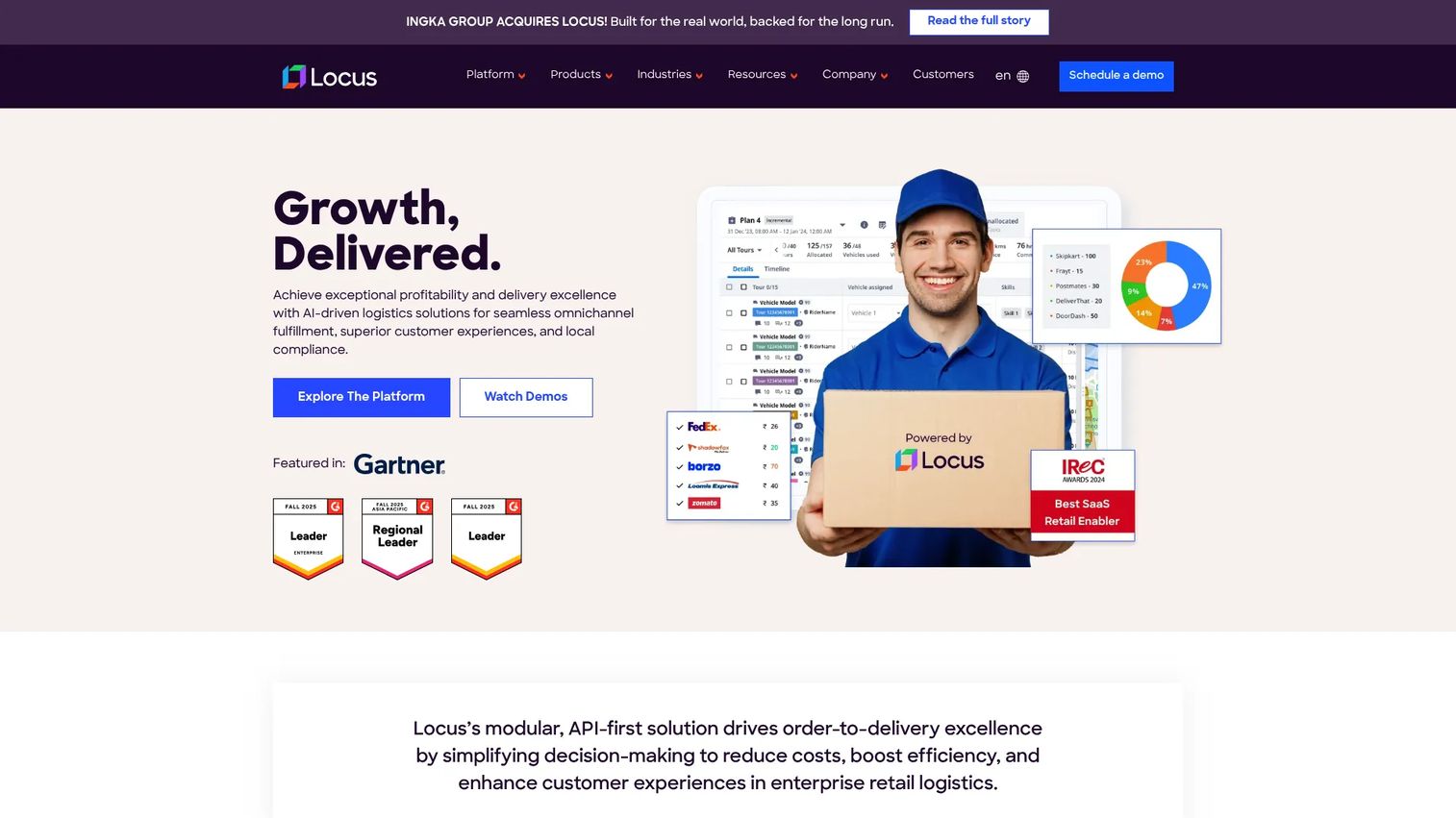
Locus is an AI-driven enterprise logistics platform built for order-to-delivery and last-mile operations at scale. Where lighter tools focus on a single delivery model, Locus is engineered for complexity: dispatch planning, delivery orchestration, and track-and-trace across large, multi-mile networks. It is the platform you reach for when delivery is not a feature of your business but a core operational engine.
Best for: Enterprise retailers and logistics teams managing complex, multi-mile delivery networks.
Key strengths
- AI dispatch planning: Intelligent assignment and capacity planning across high-volume operations.
- Delivery orchestration: Coordinates multi-leg and multi-mile delivery flows end to end.
- Track and trace: Visibility across the full journey for ops teams and customers.
Why choose Locus: If your delivery network spans regions, modes, and high order volume, Locus is built for that operational weight. The routing intelligence and capacity planning matter most when complexity is the constraint, not just volume. It fits larger teams that need control and visibility across a network rather than a single zone.
Locus pricing: Locus does not publish fixed subscription pricing. The company customizes pricing to each client based on shipment volume, so you request a quote scoped to your operation. Locus holds a 4.4 out of 5 rating on G2.
4. Elite EXTRA
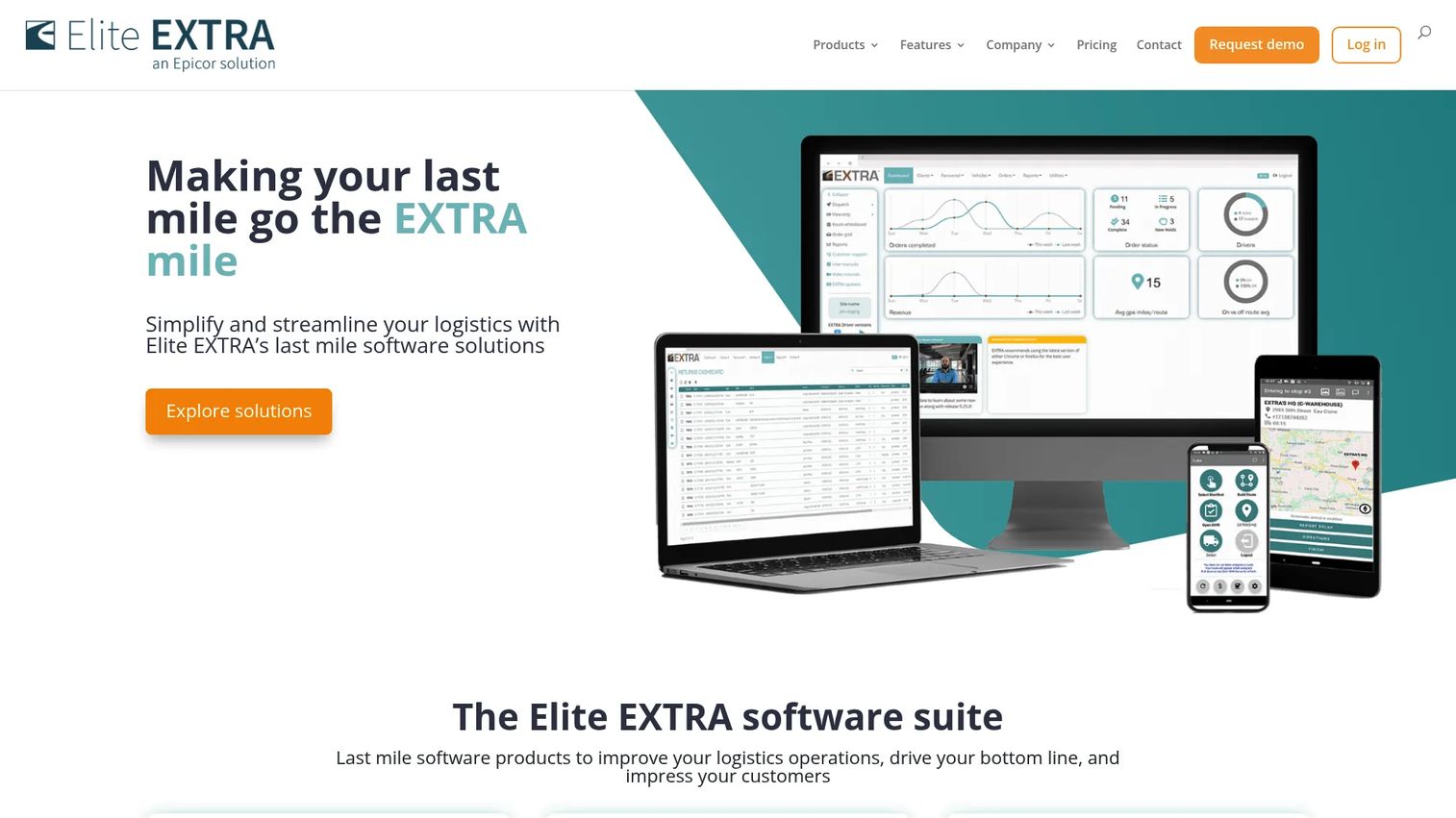
Elite EXTRA is last-mile logistics software covering routing, dispatch, delivery network management, and returns automation. It is built for teams that want a configurable operational system rather than a fixed template, with optimized route planning, automated routing and dispatching, and real-time GPS tracking at its core. The returns automation in particular sets it apart for operations where reverse logistics matter.
Best for: Businesses that need configurable last-mile delivery operations software.
Key strengths
- Optimized route planning: Sequences stops to cut drive time and operating cost.
- Automated routing and dispatching: Assigns and routes deliveries without manual matching.
- Real-time GPS tracking: Live driver location and status for ops and customers.
Why choose Elite EXTRA: Elite EXTRA fits teams that want an operational system with strong route and dispatch logic plus returns handling under one roof. The configurability means you shape the workflow to your operation instead of forcing your operation into a rigid product. It suits businesses where last-mile control and reverse logistics both matter.
Elite EXTRA pricing: Elite EXTRA does not list public prices. Pricing is quote-based, so you fill out a form to receive a custom quote scoped to your needs. A current third-party rating was not available at time of writing.
5. Shipday
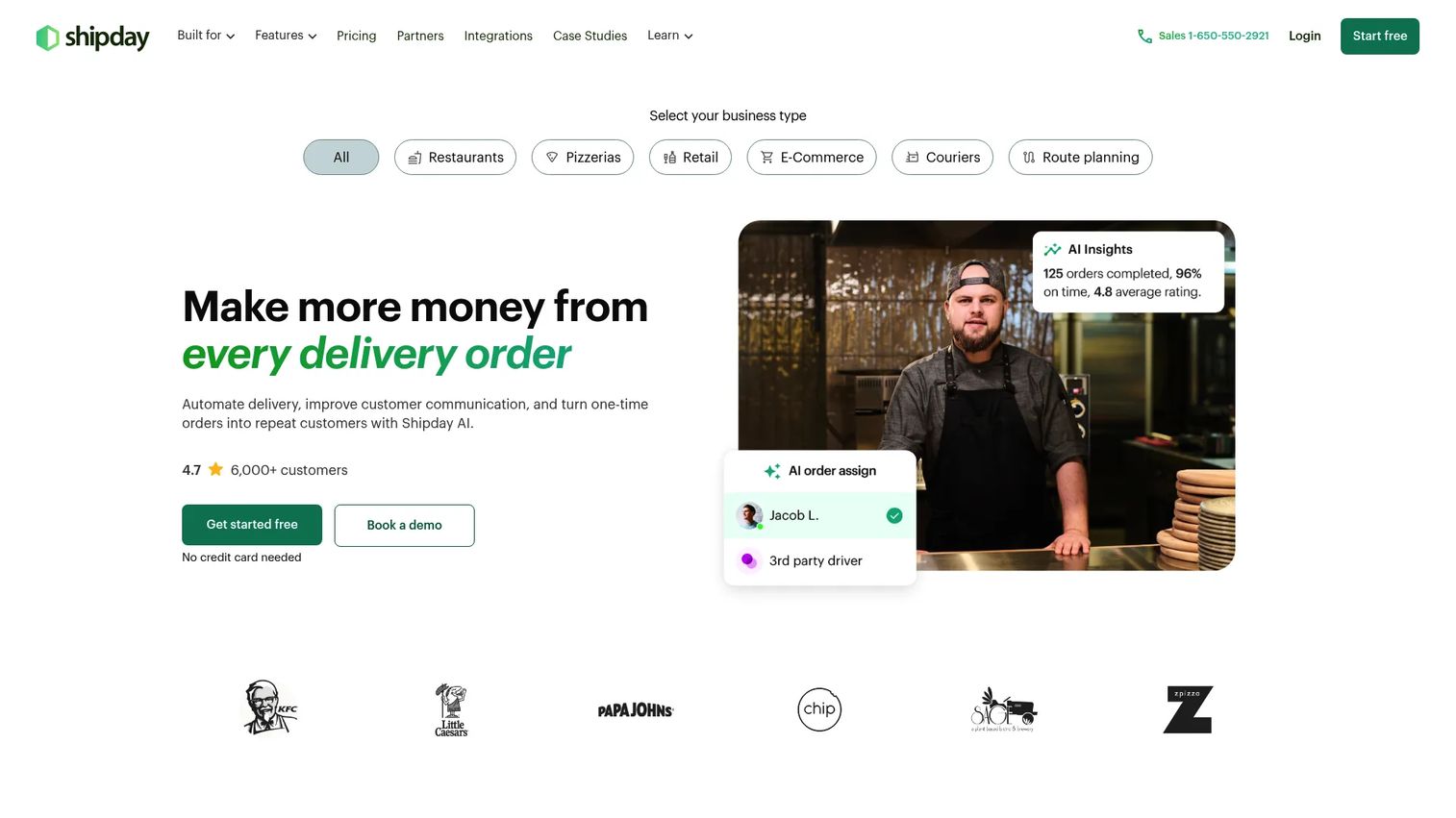
Shipday is AI-powered delivery management software built for local delivery operations. It covers real-time delivery tracking, route optimization with auto-dispatch, and branded customer communication with a driver app, all packaged to get small and fast-moving teams running quickly. The free tier and low entry price make it one of the easiest ways to move off manual coordination.
Best for: Restaurants and local delivery businesses that need delivery tracking, dispatch, and branded customer updates.
Key strengths
- Real-time delivery tracking: Live order status for customers and dispatchers.
- Route optimization and auto-dispatch: Assigns and sequences deliveries automatically.
- Branded customer communication: Status updates and a driver app under your brand.
Why choose Shipday: For SMB and local delivery teams, Shipday's appeal is speed to value and a low floor. A free Basic plan means you can start without a budget conversation, then move up as volume grows. It fits restaurants and local operators who want a working dispatch and tracking system without enterprise overhead.
Shipday pricing: Shipday publishes a free Basic plan, with paid plans at $19, $39, $79, $99, and $349 per month. Each tier includes a set order volume with per-order overages, and higher tiers add branded customer experiences and AI features. Shipday's G2 listing currently shows no reviews, so it is effectively unrated rather than scored.
6. Tookan

Tookan is delivery and fleet management software covering routing, dispatch, tracking, and customer visibility in one platform. It is built to flex across delivery models, with route optimization and dispatching, driver and vehicle tracking, and a customer portal with live status updates. That flexibility makes it a fit for teams running mixed field operations rather than a single fulfillment type.
Best for: Businesses that need delivery routing, dispatch, and fleet tracking in one platform.
Key strengths
- Route optimization and dispatching: Sequences and assigns deliveries across your fleet.
- Driver and vehicle tracking: Live location for drivers and vehicles in one view.
- Customer portal with live updates: Real-time status visibility for end customers.
Why choose Tookan: Tookan suits operations spanning courier, food, grocery, and service delivery that need one configurable system. The fleet tracking layer matters when you manage vehicles, not just independent drivers. It fits teams that want routing, dispatch, and tracking without committing to a single vertical's workflow.
Tookan pricing: Tookan publishes per-user monthly pricing in EUR with no commitment. The Basic plan starts at 19€ per user per month, Advanced at 39€, and Premium at 59€, each including a 15-day trial. Tookan holds a 4.2 out of 5 rating on G2 across more than 160 reviews.
7. Onfleet
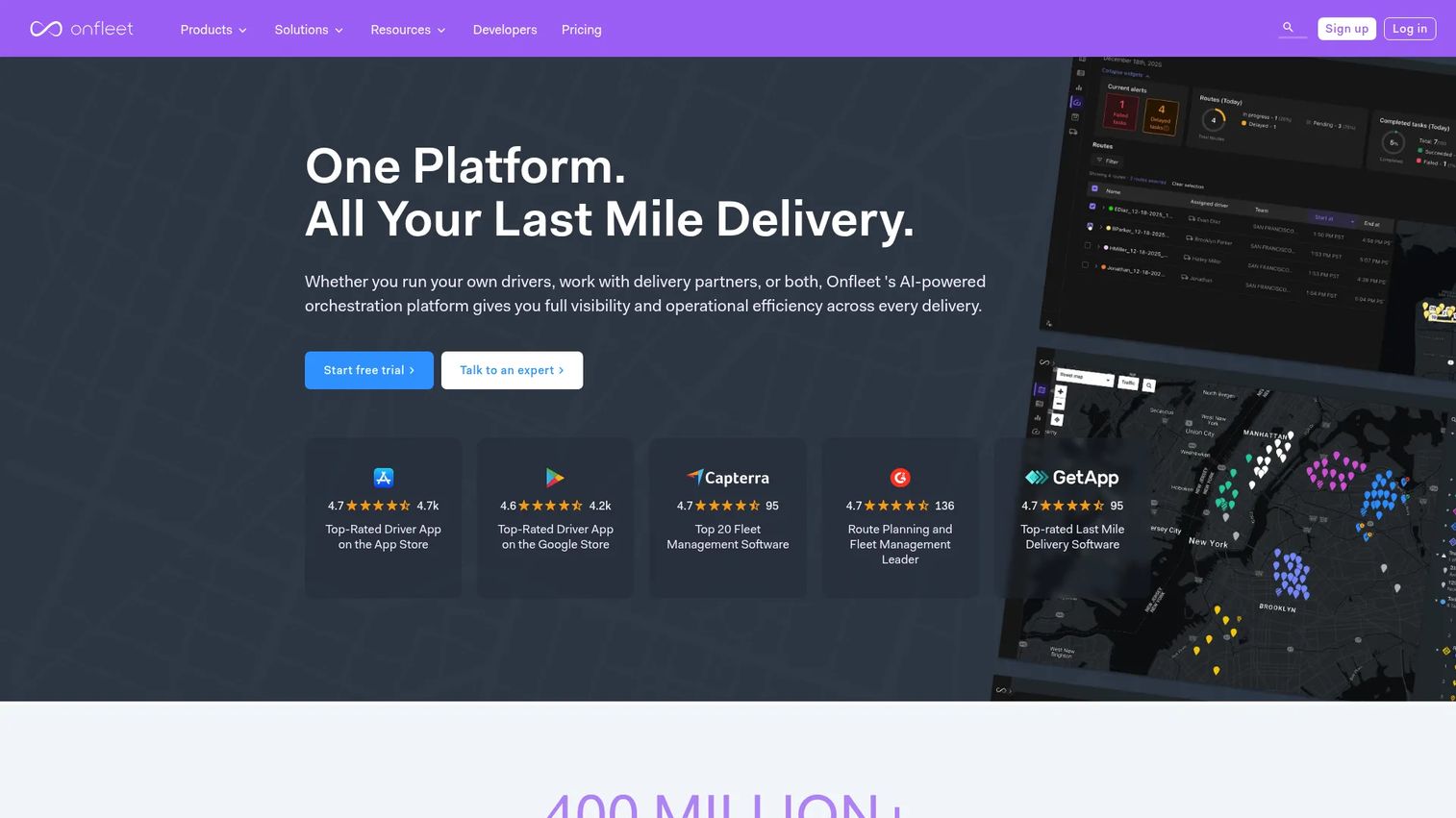
Onfleet is last-mile delivery management software focused on dispatch, routing, tracking, and proof of delivery. It is the polished end of this list, pairing AI route optimization with real-time tracking and ETAs, proof of delivery via photo and signature, driver-dispatcher chat, and full API and webhook access. For teams that want a refined delivery management stack with strong visibility, it delivers.
Best for: Teams that need last-mile delivery orchestration and customer visibility.
Key strengths
- AI route optimization: Sequences deliveries to cut drive time and improve density.
- Real-time tracking and ETAs: Accurate customer-facing arrival windows and live status.
- Proof of delivery and API access: Photo and signature capture plus webhooks for deep integration.
Why choose Onfleet: Onfleet fits teams that want a polished, well-integrated last-mile stack with strong customer visibility and developer-friendly extensibility. The API and webhook access make it a fit for operations that need delivery data flowing into the rest of their stack. It suits teams ready to invest in a refined system rather than a starter tool.
Onfleet pricing: Onfleet publishes tiered pricing. Launch starts at $619 per month with 2,500 tasks, Scale at $1,349 per month with 5,000 tasks, and Enterprise at $3,099 per month with 10,000-plus tasks. A Courier Suite add-on starts at $299 per month, and a 14-day free trial is available. Onfleet holds a 4.6 out of 5 rating on G2.
Considerations
Before you commit, pressure-test each shortlisted tool against the criteria that determine whether it scales with you or caps out.
Dispatch automation
Verify how automatic assignment actually works: what logic drives it, how it handles exceptions, and how much manual oversight remains at peak. The point of dispatch automation is repeatability, so a system that still needs a human in the loop for every reassignment has not solved your real problem.
Real-time tracking
Check customer-facing visibility, ETA accuracy, and how status updates fire. Real-time tracking is what cuts inbound support volume and lets your ops team manage exceptions instead of guessing. Weak tracking means you are still fielding "where is my order" calls.
Integrations and extensibility
Confirm support for your CRM, payments, maps, notification channels, and whether an API is available. Stack fit matters more as you grow: a tool that does not connect to the rest of your operation becomes another silo. API access is what lets delivery data flow into your reporting and other systems.
Scalability
Verify multi-region support, multi-vertical configuration, and how the system handles volume spikes. The right platform scales with the business rather than solving only today's problem. Ask specifically how it behaves at two or three times your current order volume.
Reporting and analytics
Check whether the platform reports on delivery performance, driver metrics, customer behavior, and exceptions. For founders, this is board-level visibility: clean delivery metrics survive scrutiny and inform operational decisions. Reporting is also what tells you whether your automation is actually working.
White-label and branding
If you are building a customer-facing delivery brand, verify custom domain support, app branding, and how much of the customer-facing UX you control. White-label delivery software lets customers experience your operation, not a vendor's. This matters most for operators whose delivery experience is part of the product.
Conclusion
The right on demand delivery software depends on your operating model, not on a feature checklist. For white-label courier operations, Onro and Hyperzod give you a branded experience end to end. For enterprise networks where complexity is the constraint, Locus brings the routing intelligence to match. Elite EXTRA fits configurable last-mile operations with returns, Tookan flexes across mixed field operations, and Shipday gets SMB and local teams running fast on a free tier. Onfleet sits at the polished end for teams ready to invest in a refined last-mile stack.
The move now is simple: shortlist two or three tools that match your delivery model, then evaluate dispatch automation, real-time tracking, and integrations first. Those three determine whether the system actually removes manual coordination or just relocates it. Run a real order volume through a trial or demo before you commit, and judge it on whether your busiest person spends peak managing exceptions instead of making every call.
FAQs
On demand delivery software is a platform that automates order intake, driver assignment, dispatch, routing, real-time tracking, customer notifications, and proof of delivery. It replaces the spreadsheets, group chats, and phone calls most early delivery operations rely on with one connected system that scales as volume grows.
The core features are dispatch automation, real-time tracking, customer notifications, route optimization, and reporting. Dispatch automation removes manual assignment, tracking cuts support volume, route optimization lowers cost, and reporting gives you the metrics to manage and improve operations. The strongest platforms connect all of these rather than treating them as separate modules.
For operators building a customer-facing delivery brand, yes. White-label delivery software puts your branding on the customer app, tracking pages, and driver experience, so customers interact with your operation rather than a third-party vendor. If delivery is part of your product experience, branding control is worth the premium. If you are purely back-office, it matters less.
It replaces manual assignment with logic that matches orders to drivers based on location, capacity, and zone, then reassigns automatically when something falls through. This removes the bottleneck of a dispatcher making every call by hand. Your team shifts from making every assignment to managing exceptions, which is the only version of dispatch that scales with volume.
Courier and last-mile businesses, grocery and quick commerce, restaurants and food delivery, retail, pharma, and B2B distribution all use on demand delivery software. Any operation that fulfills orders with its own or contracted drivers benefits from automated dispatch, tracking, and customer updates. The best fit depends on whether you run hyperlocal instant delivery, scheduled courier routes, or complex multi-region networks.
Start with workflow fit: match the tool to your delivery model rather than a generic feature list. Then check integrations with your existing stack, scalability across regions and volume, reporting depth, and the quality of the customer-facing experience. Shortlist two or three options, run real order volume through a trial, and judge each on dispatch automation, tracking, and integrations.
Ask about implementation time, the support model, pricing structure as you scale, and how the system behaves at two or three times your current volume. The deeper question is whether the platform removes founder or dispatcher dependency, so delivery operations no longer route through one person's head. A tool that scales cleanly earns its place in your stack within the first quarter.