

Your sales team lost three deals last quarter. Ask five people why, and you get five answers. The AE blames pricing. Product blames a missing feature. Marketing swears it was positioning. Nobody actually asked the buyer.
That gap is the whole problem. Internal theories about why deals close or stall are usually confident, fast, and wrong. The buyer knows the real reason. You just never captured it.
Win-loss analysis software exists to close that gap. It captures post-deal feedback from buyers, analyzes patterns across won, lost, and no-decision deals, and turns that evidence into decisions you can defend in a roadmap review or a board meeting. The market backs this up: the win-loss analysis AI segment was worth USD 1.2B in 2025 and is projected to reach USD 5.8B by 2034 at an 18.5% CAGR, according to Market Intelo (2026). Software accounts for 62.3% of that revenue.
For product marketing managers, this is not a nice-to-have. It is the evidence layer under your positioning, your battlecards, and your win rate improvement targets. This guide breaks down the four tools worth evaluating in 2026.
What's inside
This guide is for PMMs, competitive intelligence leads, sales enablement managers, and revenue leaders who need to know why deals are won, lost, or stall at no-decision, and want a shortlist rather than another definition.
We chose these four based on four criteria:
- Software depth: how well the tool captures and structures buyer feedback
- Automation: how much AI and workflow removes manual synthesis
- Integrations: how cleanly it fits your CRM and GTM stack
- PMM relevance: how directly it feeds positioning, messaging, enablement, and roadmap decisions
TL;DR
- Best complete win-loss platform: Clozd. The most mature option for a dedicated, research-grade program with strong buyer insight workflows.
- Best for win-loss plus competitive intelligence: Klue Win-Loss. The right pick when buyer feedback needs to feed battlecards and rep enablement in one platform.
- Best for teams already using revenue intelligence: Avoma. Automates why-we-won and why-we-lost themes from calls and CRM context you already collect.
- Best for evaluation and vendor discovery: Gartner Peer Insights. The review-based directory for shortlisting win-loss analysis providers, not a program execution tool.
What is win-loss analysis software
Win-loss analysis software is a category of tools that collect buyer feedback after deals close, analyze why buyers chose you or a competitor, and turn those findings into go-to-market decisions.
The core workflow has three stages. First, capture post-deal feedback through interviews, surveys, or automated analysis of sales conversations. Second, analyze the decision drivers across won, lost, and no-decision deals to surface patterns. Third, activate the insights into positioning, messaging, enablement, and roadmap priorities.
Common inputs, outputs, and users look like this:
- Inputs: buyer interviews, post-deal surveys, call transcripts, CRM deal data, email threads
- Outputs: decision-driver reports, competitive intelligence, theme analysis, dashboards, alerts
- Users: product marketing, competitive intelligence, sales enablement, RevOps, and revenue leadership
One distinction matters before you buy. Win-loss analysis software is a platform your team operates. A win-loss service is an outsourced program where a provider runs the interviews and delivers findings. Some vendors offer both. The global win-loss analysis service market alone was USD 855M in 2025 and is forecast to reach USD 2.25B by 2032 at a 14.8% CAGR, per PMarketResearch (2025), which tells you how much demand sits on the human-led side of this category too.
When to use win-loss analysis software
Not every team needs a dedicated platform yet. These four scenarios are the clearest signals that you do.
When win rates are flattening
Your competitive win rate stalls or dips, and nobody can explain it with evidence. Internal guesses fill the vacuum. A structured program tells you whether you are losing on price, product, or a champion who could not sell you internally.
When messaging keeps drifting
Your website, sales deck, and battlecards say slightly different things. Win-loss feedback shows you which message actually lands with buyers who bought, so you can align every touchpoint on proof, not opinion.
When PMM needs better buyer evidence
Leadership wants a category point of view. Sales wants sharper battlecards. Both require objective buyer feedback, not anecdotes from the last lost deal. Win-loss software gives you defensible decision drivers.
When manual analysis is too slow
You are running interviews in a doc and synthesizing themes by hand. It works until deal volume grows. AI win-loss analysis compresses that synthesis so insights land while they still matter to an open pipeline.
Win-loss analysis software comparison
Sorted by commercial relevance for a PMM building or scaling a win-loss program, not alphabetically. Clozd leads as the most complete dedicated platform.
| # | Product | Best for | Key differentiator | Pricing | G2 rating |
|---|---|---|---|---|---|
| 1 | Clozd | Dedicated, research-grade win-loss programs | Human and AI interviews plus deep analytics | Custom | 4.8/5 |
| 2 | Klue Win-Loss | Win-loss tied to competitive intelligence | Five capture methods and battlecard activation | Custom | 4.7/5 |
| 3 | Avoma | Teams already on revenue intelligence | Automated win-loss themes from call data | From $19/user/mo | 4.6/5 |
| 4 | Gartner Peer Insights | Comparing and shortlisting providers | Peer-reviewed vendor directory | Not applicable | N/A |
Best 4 tools for win-loss analysis
Each entry follows the same pattern: what it does, who it fits, key strengths, an honest read on fit, and pricing.
1. Clozd
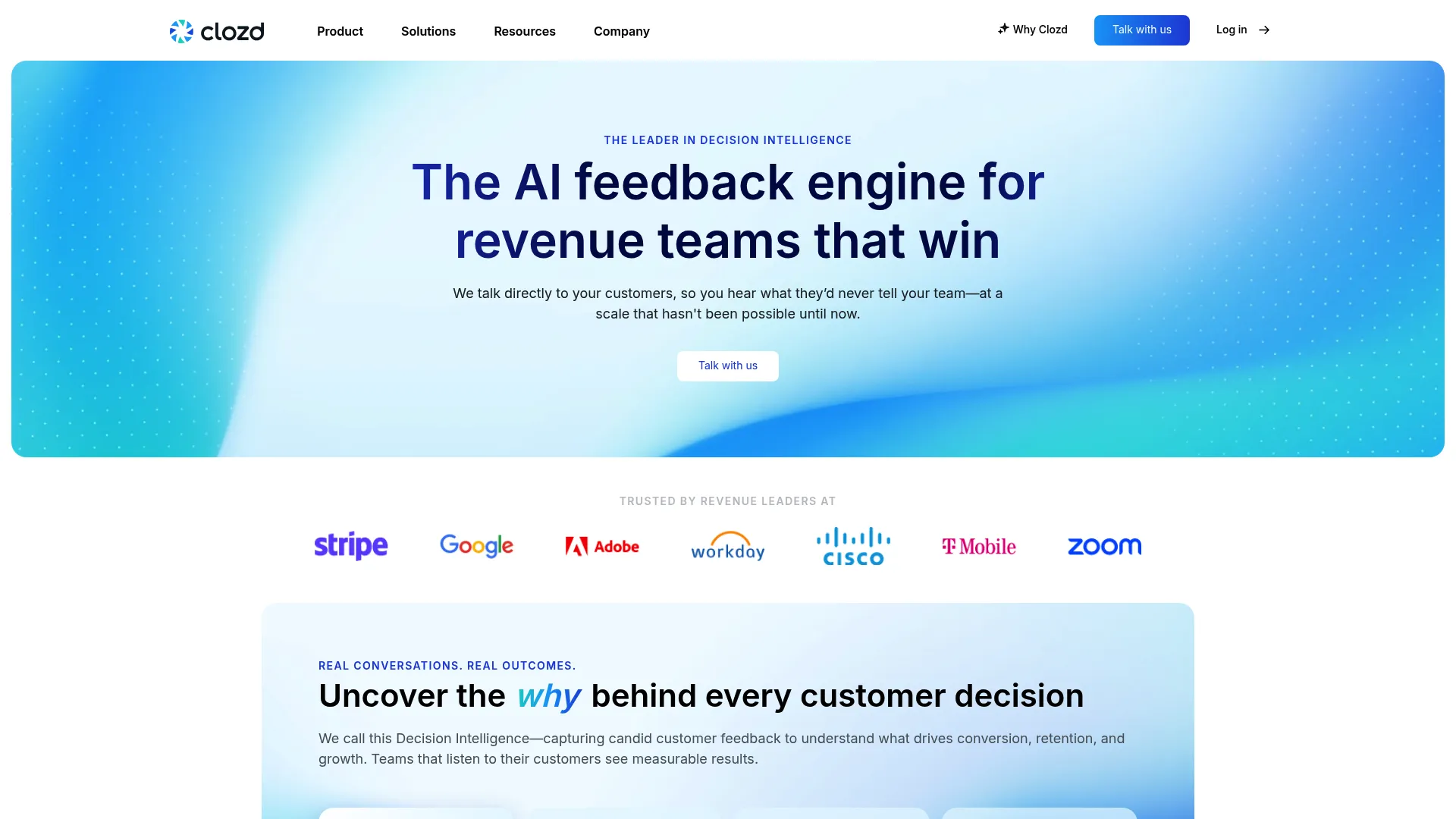
Clozd is a decision intelligence platform built specifically for win-loss and customer feedback analysis. It is the most complete option on this list for PMMs and revenue teams that want a mature, research-grade program rather than a side feature bolted onto another tool. Clozd combines human-led interviews, AI-assisted interviews, and structured analytics so you understand not just that you lost, but why, in the buyer's own words.
Best for: teams building or scaling a dedicated win-loss program with strong buyer insight workflows.
Key strengths
- Human-led and AI-assisted buyer interviews
- Analytics and data analysis across won, lost, and no-decision deals
- Workflow automation for program operations
- Decision-driver reporting for positioning and messaging
- Software integrations to connect insights into your stack
Clozd's value is depth. The interview program produces objective buyer feedback that survives internal debate, and the analytics turn dozens of conversations into decision drivers you can act on. That makes it a strong fit when leadership wants a defensible category point of view and sales wants battlecards grounded in real objections, not internal theory.
Be honest about fit. If your deal volume is low and you mostly need quick why-we-lost notes on a handful of accounts, a lighter automated tool may cover you until a full program earns its place. Clozd pays off when win-loss is a standing function, not a one-off project.
Clozd pricing: Clozd does not publish public pricing. Packaging is quoted per program through their team, with a demo available on request. On G2, Clozd holds a 4.8/5 rating.
2. Klue Win-Loss
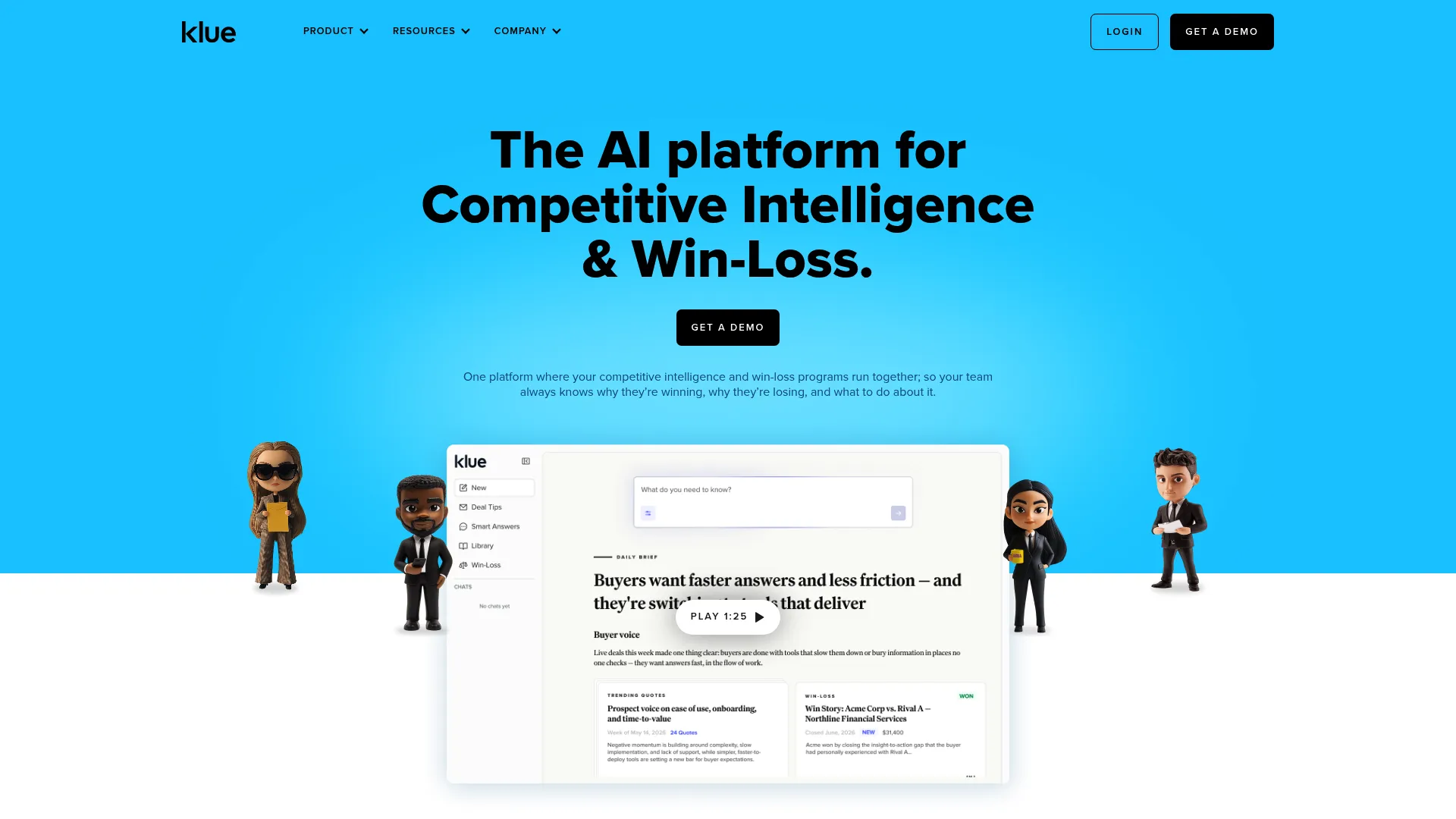
Klue Win-Loss is an AI platform that pairs win-loss analysis with competitive intelligence in one system. That combination is the point. If your buyer feedback needs to end up inside battlecards and rep workflows rather than sitting in a standalone report, Klue is built for that path. It captures feedback, analyzes it, and activates the insight where reps already work.
Best for: enterprise and mid-market teams running win-loss and competitive intelligence together.
Key strengths
- Five capture methods: AI Interviewer, Blindspot Interviews, Win & Loss Stories, Human Expert Interviews, and Bring Your Own Interview
- Automatic AI analysis and activation inside the Klue platform
- Insight delivery into Ask Klue, Slack, Teams, and MCP
- Competitive intelligence and battlecards in the same workspace
Klue leans toward GTM activation more than pure analysis. The five capture methods let you scale from fully automated AI interviews to human expert conversations depending on deal size, and the insights flow straight into the tools reps and PMMs use daily. For a PMM who owns both competitive intel and win-loss, that consolidation removes the seam between "what buyers said" and "what reps hear next."
Where does it fit best? Teams that treat win-loss as one input into a broader competitive program get the most leverage here. If you only want win-loss and nothing else, you are buying a wider platform than the single job requires, which is worth weighing against the value of one connected system.
Klue Win-Loss pricing: Klue does not list public pricing on its site; plans are quoted through their sales team. On G2, Klue holds a 4.7/5 rating.
3. Avoma

Avoma is an AI meeting lifecycle platform covering note-taking, scheduling, conversation intelligence, and revenue intelligence. Win-loss is one use case inside that broader story, but it is a relevant one because Avoma already captures the raw material: calls, transcripts, and CRM context. If your team lives in sales conversations, Avoma turns those into why-we-won and why-we-lost themes without a separate interview program.
Best for: PMMs and revenue teams that want automated analysis from calls, transcripts, and CRM data they already collect.
Key strengths
- AI meeting assistant with transcription, notes, follow-up emails, and a CRM-writing copilot
- Scheduler and lead router with 1:1, group, and round-robin scheduling
- Conversation intelligence with call scoring and talk-pattern insights
- Automated themes across deals for win-loss and forecast accuracy
Avoma's angle is automation from existing conversations. It surfaces patterns from the calls you are already recording, which supports coaching, pipeline review, and forecast accuracy alongside win-loss. That makes it a practical starting point for teams that want automated analysis without standing up a dedicated interview program first.
Keep the scope clear. Avoma is broader than win-loss, so if you need deep, buyer-voiced interview research on lost deals, a dedicated platform goes further. As an AI-first analysis layer over conversations you already own, though, it is a strong and affordable entry point.
Avoma pricing: Startup is $19/user/month, Organization is $29/user/month, and Enterprise is $39/user/month, all billed annually. Viewers and collaborators are free, and Avoma offers a 14-day trial of the Organization plan with add-ons enabled. On G2, Avoma holds a 4.6/5 rating.
4. Gartner Peer Insights
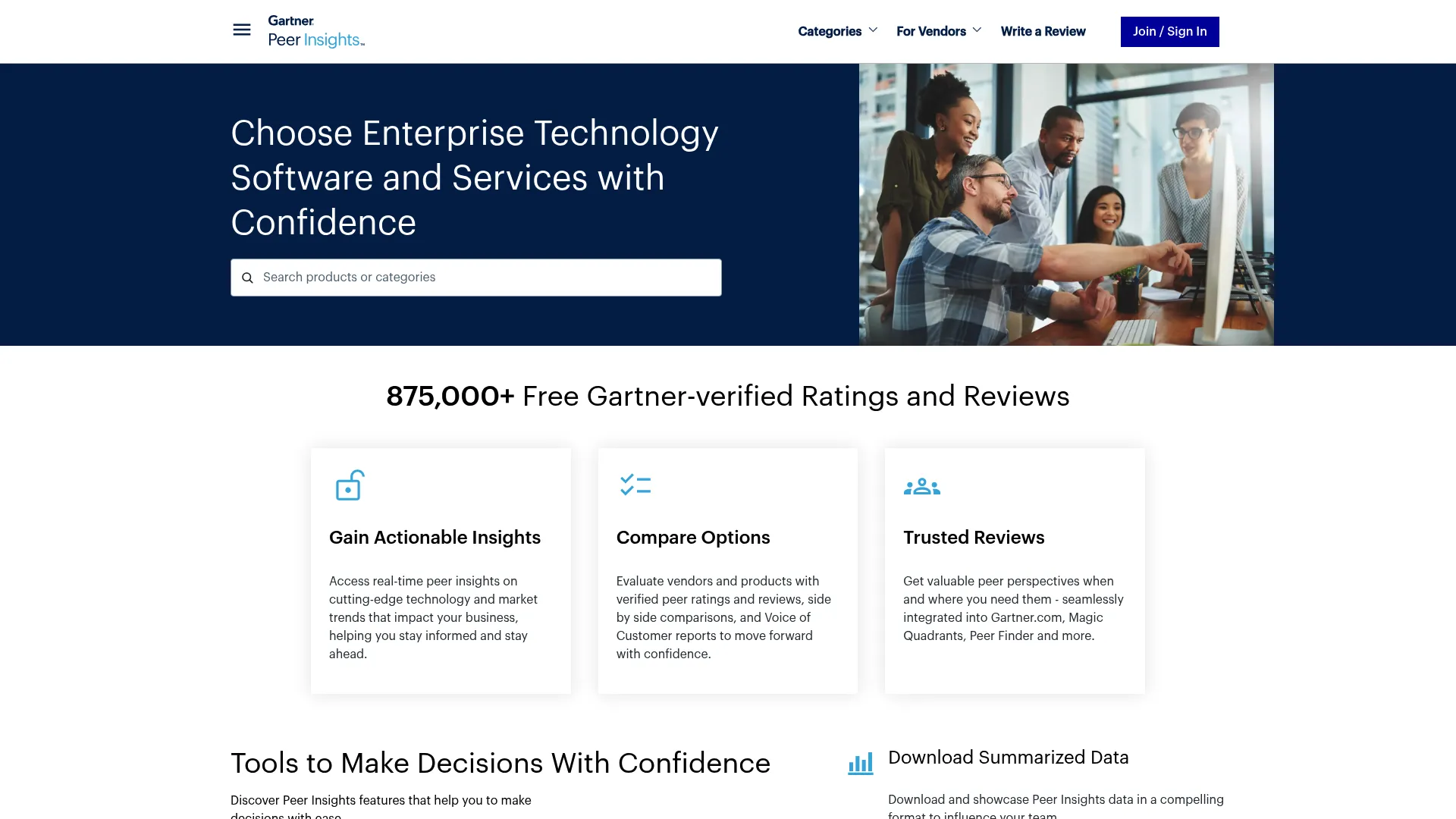
Gartner Peer Insights is not a win-loss tool. It is Gartner's platform for end-user reviews and ratings of enterprise technology, and it belongs on this list for a different job: evaluation and discovery. When you are comparing win-loss analysis providers, shortlisting vendors, and reading review-based comparisons before you commit budget, this is where you start.
Best for: buyers comparing providers, shortlisting vendors, and reading peer reviews before a purchase decision.
Key strengths
- Gartner-verified ratings and reviews from real users
- Customer Choice distinctions to spot category leaders
- Market and category browsing to compare adjacent tools
Use Gartner Peer Insights to pressure-test your shortlist. Peer reviews surface the operational realities, integration gaps, support quality, adoption friction, that vendor landing pages leave out. It helps you decide which two providers to trial, then hands off to the actual platforms above for program execution.
The honest framing: this is a directory, not software you run a program in. It answers "which vendor should I evaluate," not "why did I lose this deal." Pair it with one of the platforms above and it earns its place in the buying process.
Gartner Peer Insights pricing: Gartner Peer Insights is a free review marketplace for buyers, not a paid software product, so standard pricing tiers do not apply.
What to evaluate before buying
Before you commit, run each shortlisted tool against these five criteria. They map to what PMMs actually need to trust and operationalize the data.
Feedback quality and bias control
The whole value of win-loss is objective buyer feedback. Ask how interviews are conducted, whether a neutral third party or AI removes the internal spin, and how the tool separates what buyers say from what your reps assume. Biased input produces confident, wrong conclusions.
Automation and scale
Manual synthesis breaks as deal volume grows. Evaluate how much AI compresses the path from raw feedback to themed decision drivers, and whether that automation holds up across dozens or hundreds of deals without losing nuance.
Workflow fit with CRM and GTM stack
Insight that lives in a silo dies there. Check CRM integrations, whether findings push into Slack, Teams, or your enablement tools, and how deal data flows in automatically. The tighter the fit, the more the program runs itself.
Reporting, shareability, and actionability
You need to move from a dashboard to a decision. Look at how reports are structured, whether decision drivers are clear enough to defend in a roadmap review, and how easily you can share findings with product, sales, and leadership.
Cross-functional adoption
Win-loss only works if teams beyond PMM use it. The best programs feed positioning, battlecards, and roadmap priorities that sales and product actually reference. Evaluate whether the output format fits how each team already works.
Conclusion
Four tools, four distinct jobs.
Start with Clozd if your goal is a dedicated, research-grade win-loss program with the deepest buyer insight workflows. It is the most complete platform here and the safest default for a standing win-loss function.
Choose Klue Win-Loss if win-loss must feed competitive enablement, and you want buyer feedback, battlecards, and rep workflows in one connected system.
Pick Avoma if your team already runs on revenue intelligence and you want automated why-we-won and why-we-lost themes from calls and CRM data you already collect, with forecast accuracy and coaching as a bonus.
Use Gartner Peer Insights to compare providers and shortlist before you buy.
The practical next step: narrow to the two tools that best match your current workflow and data sources. If you already capture sales conversations, trial Avoma alongside a dedicated program like Clozd. If competitive intel is your center of gravity, put Klue on the list. Then let buyer intelligence, not internal theory, drive your next positioning, messaging, and roadmap planning decisions.
FAQs
It is a category of tools that collect buyer feedback after deals close, analyze why buyers chose you or a competitor, and turn those findings into go-to-market decisions. The output feeds positioning, messaging, sales enablement, and roadmap priorities. Unlike a static report, good software makes the analysis repeatable across every deal.
Software is a platform your team operates to capture and analyze buyer feedback in-house. A win-loss service is an outsourced program where a provider runs the interviews and delivers findings to you. Some vendors, like Clozd, offer both, so you can run interviews yourself or have experts conduct them.
Product marketing, competitive intelligence, sales enablement, RevOps, and revenue leadership. PMMs use it for positioning and battlecard evidence, enablement teams use it to sharpen talk tracks, and product teams use decision drivers to prioritize the roadmap. It works best when several teams act on the same buyer intelligence.
Yes. Most platforms connect to CRMs to pull deal data automatically and push insights back into the tools reps use. Klue, for example, delivers insights into Slack, Teams, and its own workspace, while Avoma writes call data into your CRM. Check the specific CRM integrations before you buy.
AI compresses the slowest part of the process: synthesizing raw feedback into themes. It can run AI-led buyer interviews, transcribe and analyze sales calls, and surface decision drivers across dozens of deals in a fraction of the manual time. This lets insights land while the pipeline they affect is still open.
Objective buyer feedback with real bias control, automation that scales with deal volume, clean CRM integrations, and reporting that produces decision drivers you can defend in a roadmap review. Cross-functional adoption matters too: if sales and product will not use the output, the program stalls.
Track competitive win rate improvement, sales cycle length, and forecast accuracy over time, then tie changes back to actions the program drove. Softer signals count too: whether battlecards get updated, whether messaging aligns across channels, and whether roadmap decisions cite buyer evidence rather than internal opinion.
No. No-decision analysis is often the most valuable input, because stalled deals reveal friction that closed-lost deals miss. Studying why buyers chose to do nothing surfaces gaps in urgency, value, or the buying process that you can fix across your entire funnel, not just individual deals.