Your service had three replicas at 9 a.m. By noon, autoscaling spun up nine more, killed two, and rescheduled the rest onto different nodes with different IPs. The config file that hardcoded those endpoints is now pointing at addresses that no longer exist. Requests start failing. Nobody changed the code.
This is the core problem service discovery solves. In a static world, you write down where a service lives and move on. In a containerized, autoscaled, multi-cluster world, "where a service lives" is a moving target that changes by the second. Hardcoded IPs, manual load balancer configs, and stale DNS entries all break the same way: they assume the network holds still.
The demand curve tells the story. The global service discovery software market is projected to grow from about USD 2.5 billion in 2024 to USD 7.8 billion by 2033, a compound annual growth rate of 15.5%, according to Verified Market Reports (2025). The same research cites a NIST-referenced figure that 80% of businesses are expected to use some form of service discovery by 2025. Microservices, containerization, and cloud-native architecture are the drivers.
This guide compares the main service discovery tools and patterns for 2026: registry-based systems, DNS-based discovery, Kubernetes-native discovery, and service mesh orchestration. You will learn how each approach resolves dynamic endpoints, when to reach for a service registry versus built-in DNS, and how to match a tool to your architecture instead of the loudest name in a Slack thread. If your team also fields buyer questions about how discovery fits a broader technical evaluation, the same framing that helps you pick a tool helps you explain the tradeoffs to a prospect.
What's inside
This guide is written for DevOps engineers, platform engineers, SREs, and the architecture-minded presales people who have to explain distributed systems to buyers. It covers seven options across four patterns: dedicated service registries, DNS-based discovery, Kubernetes-native discovery, and service mesh layers for multi-network environments.
We chose each entry on four criteria:
- Relevance to microservices and cloud-native operations, not legacy monoliths
- Real adoption in production Kubernetes and container environments
- Clarity of the discovery pattern it represents, so you can reason by architecture
- Fit across scale, from a single cluster to multi-cluster and multi-network setups
No single tool wins every scenario. The right pick depends on your discovery pattern, not on a feature checklist.
TL;DR
- Best for full-featured service networking: Consul, with health checks, DNS, HTTP APIs, and a key/value store in one package.
- Best as a cloud-native building block: Etcd, the strongly consistent key-value store that already backs much of your Kubernetes control plane.
- Best for coordination-heavy distributed systems: Apache ZooKeeper, for leader election, locking, and configuration at scale.
- Best for JVM and application-level discovery: Eureka, a service registry born in the Netflix microservices stack.
- Best for language-agnostic simplicity: DNS, when you want discovery that every runtime already understands.
- Best for containerized workloads out of the box: Kubernetes, whose built-in service abstraction handles discovery with zero extra tooling.
- Best for multi-cluster and multi-network: Gloo Mesh, when discovery has to cross network boundaries and you need a service mesh control plane.
What is service discovery software?
Service discovery software automatically tracks where every instance of a service is running and gives clients a reliable way to reach a healthy one, even as instances scale, move, restart, or fail. It replaces static configuration with a live source of truth.
The mechanics come down to three moves. A service registers itself when it starts, publishing its address and metadata. A service registry stores that record and prunes it when the instance dies or fails a health check. A client then resolves the service by name and gets back a current, healthy endpoint instead of a hardcoded IP.
There are a handful of core concepts worth naming before you evaluate anything:
- Service registry: the authoritative store of which instances exist and how to reach them.
- Service registration: how an instance announces itself, either by self-registration or through a third-party registrar.
- Health checks: active or passive probes that keep dead instances out of the pool.
- DNS service discovery: resolving services by name through DNS, often via DNS-SD records, so any language-agnostic client can participate.
- Client-side discovery: the client queries the registry directly and picks an instance.
- Server-side discovery: the client hits a load balancer or router that consults the registry on its behalf.
- Service mesh discovery: discovery handled by sidecar proxies inside a mesh, usually bundled with routing and policy.
These patterns are not mutually exclusive. Most real systems blend registry-based discovery, DNS resolution, and orchestration-layer abstractions. Understanding which pattern a tool implements is the fastest way to predict how it behaves in your stack.
When to use service discovery software
You do not need a dedicated discovery layer for a monolith with a fixed set of hosts. You need one the moment endpoints stop being predictable. Here are the situations where the category earns its place.
Migrating from a monolith to microservices
When one deployable unit becomes twenty services calling each other, hardcoded endpoints turn into a maintenance nightmare. Service discovery in microservices lets each service find its dependencies by name, so you can deploy, scale, and relocate services independently without rewriting config across the fleet.
Adopting Kubernetes and containers
Containers get ephemeral IPs, and pods are rescheduled constantly. Kubernetes service discovery handles this natively, but teams adopting Kubernetes still need to understand how internal DNS and service abstractions map to their older discovery patterns, especially during a phased migration where legacy and containerized services coexist.
Running autoscaling-heavy systems
If your replica count swings with traffic, static routing is a liability. A registry with health checks keeps the pool of reachable instances accurate in real time, so requests never land on an instance that scaled down thirty seconds ago.
Operating across multiple clusters or networks
Once services span clusters, regions, or separate networks, single-cluster discovery is not enough. Multi-network discovery and multi-cluster routing require a control plane that can federate registries and resolve services across boundaries, which is where service mesh layers come in.
Comparison table
The table below sorts the seven options by how directly they map to the service discovery job. Pricing for most of these is open-source or usage-based on the platform you run them on, so treat the pricing column as a signal about packaging, not a quote.
| # | Product | Intent | Key differentiation | Pricing | G2 rating |
|---|---|---|---|---|---|
| 1 | Consul | Full service networking | Registry, health checks, DNS, and service mesh in one | Open-source core; paid managed tiers | Not available |
| 2 | Etcd | Cloud-native building block | Strongly consistent key-value store using Raft | Open-source | Not listed |
| 3 | Apache ZooKeeper | Distributed coordination | Coordination primitives via the Zab protocol | Open-source | 4.3/5 |
| 4 | Eureka | Application-level registry | JVM-native registry from the Netflix stack | Open-source | Not listed |
| 5 | DNS | Language-agnostic resolution | Universal name resolution every runtime understands | Free tier; Cloudflare Pro from $20/mo | 4.5/5 |
| 6 | Kubernetes | Container-native discovery | Built-in service and internal DNS abstraction | Open-source | 4.6/5 |
| 7 | Gloo Mesh | Multi-cluster orchestration | Service mesh control plane across networks | Contact sales | Not available |
1. Consul
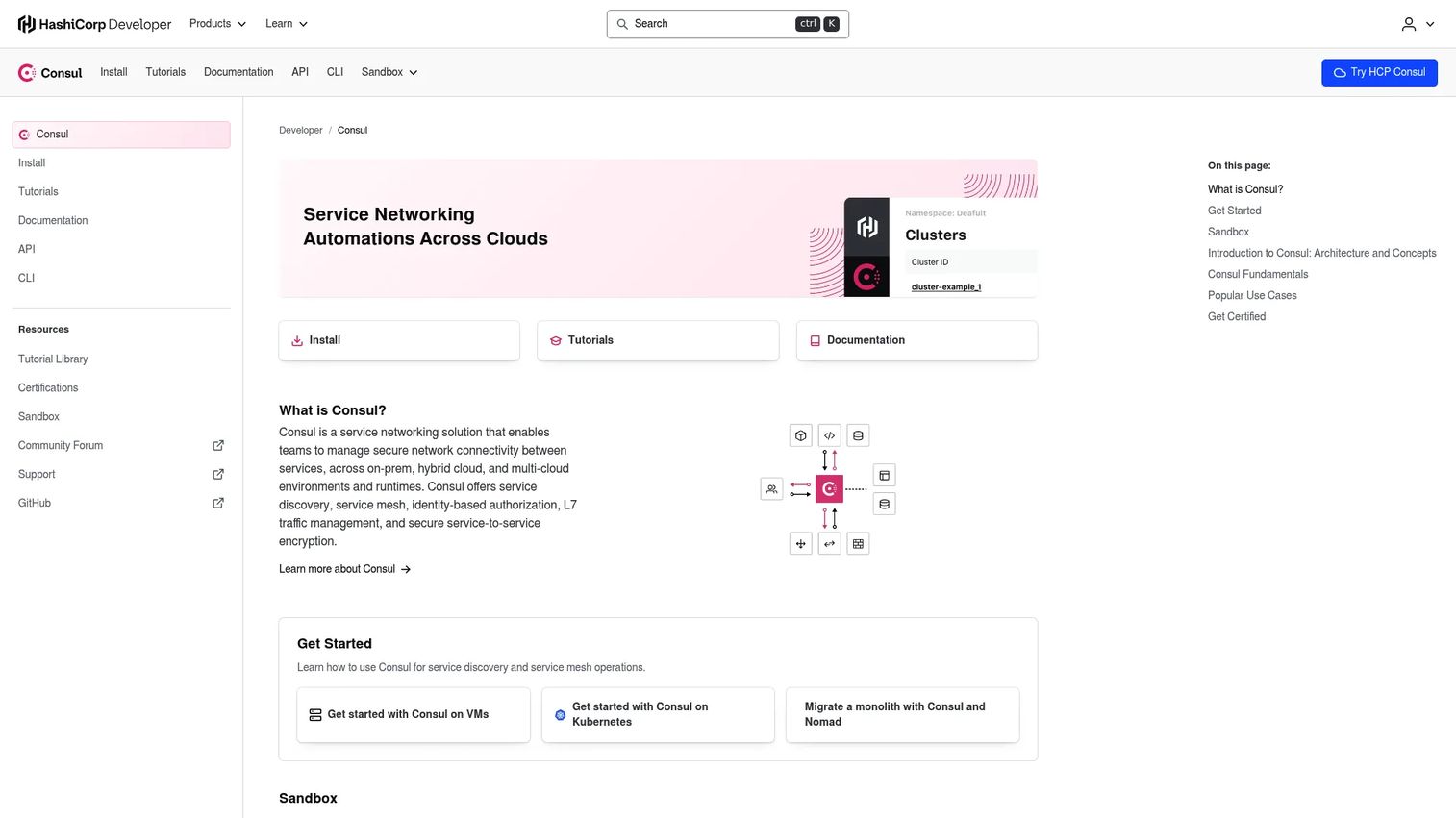
Consul is a service networking platform built for secure service discovery, service mesh, and traffic management. It runs a distributed service registry backed by Raft consensus, exposes discovery over both DNS and an HTTP API, and layers in health checks and a key/value store. That combination makes it a common default for teams that want one system to handle registration, discovery, and secure service-to-service communication across hybrid and multi-cloud environments.
Where Consul stands out is breadth without forcing you into a specific runtime. A VM-based service and a containerized service can register in the same catalog. You can start with plain registry-based discovery, then add its service mesh for mTLS and Layer 7 traffic management as your needs grow. Health checks keep the catalog honest, so clients querying by DNS or API only get healthy endpoints back.
Best for: Teams managing secure service-to-service networking across hybrid and multi-cloud environments.
Key strengths
- Unified service networking: Service discovery, service mesh, and L7 traffic management under one control plane.
- Dual discovery interfaces: Query services by DNS for language-agnostic clients or by HTTP API for richer metadata.
- Health-aware catalog: Built-in health checks prune failing instances so clients only reach live services.
Why choose Consul: If you run a mixed environment of VMs and containers, or you want discovery and mesh from the same vendor rather than stitching two systems together, Consul covers the whole path. It scales from a single datacenter to federated multi-datacenter deployments, which makes it a practical fit for teams standardizing on service registration across a heterogeneous estate.
Consul pricing: The Consul core is open-source and free to self-host. HashiCorp offers managed and enterprise tiers with additional governance and support, but public per-seat pricing is not listed on the product site. Evaluate the open-source version first, then contact HashiCorp for managed pricing if you need a hosted control plane or enterprise features.
2. Etcd
Etcd is a strongly consistent, distributed key-value store designed to hold the critical data of a distributed system. It is not a packaged, UI-first discovery product. It is the infrastructure building block that many service discovery patterns are built on, including the one already running under your Kubernetes control plane, where etcd stores cluster state.
The consistency guarantee is the point. Etcd uses the Raft consensus algorithm to keep every node in agreement, so a client reading a key gets an authoritative answer, not a stale replica. For service discovery, teams write service records as keys and use etcd's watch mechanism to get notified the instant an endpoint changes. Pairing etcd with a tool like confd lets you regenerate configuration files automatically whenever the underlying keys move.
Best for: Teams needing a reliable coordination and configuration store for distributed systems, especially Kubernetes-related infrastructure.
Key strengths
- Strong consistency: Raft consensus ensures every read reflects the latest committed write across the cluster.
- Simple HTTP-based interface: Straightforward key-value operations that any client can call without a specialized SDK.
- Watch for changes: Clients subscribe to keys and react in real time when service records update.
Why choose Etcd: Choose etcd when you want a rock-solid primitive to build discovery on, not a turnkey product. It rewards teams comfortable assembling their own registration and resolution logic around a trustworthy store. If you already run Kubernetes, you are already running etcd, which makes it a natural foundation for custom cloud native service discovery.
Etcd pricing: Etcd is open-source and free to self-host, with no public commercial tiers listed on the official site. Your real cost is the compute and operational effort to run a healthy quorum. Managed etcd is also available bundled inside most managed Kubernetes offerings.
3. Apache ZooKeeper
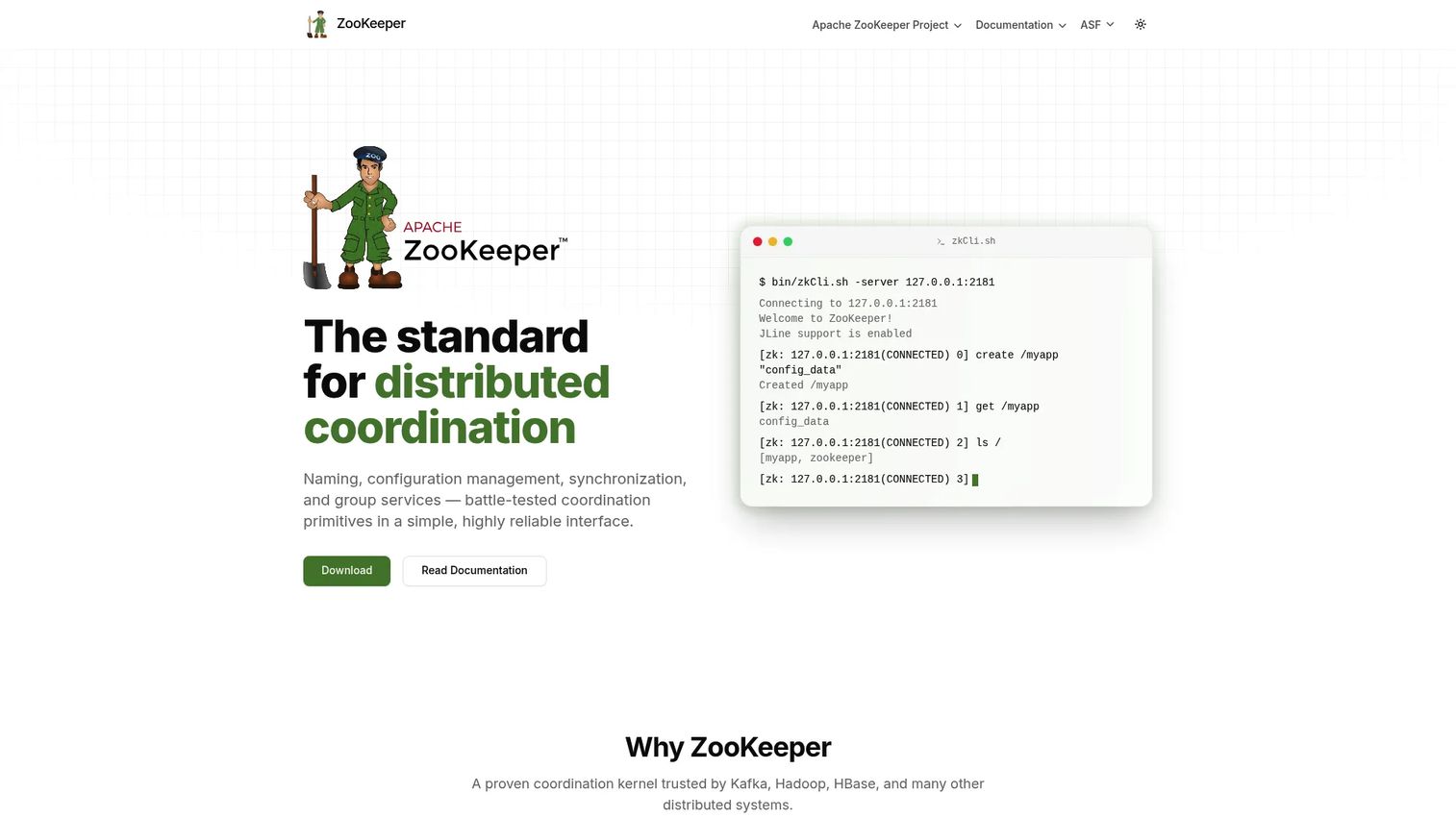
Apache ZooKeeper is an open-source coordination service for naming, synchronization, configuration management, and group services. It predates much of the current cloud-native tooling and remains the coordination backbone in several large distributed systems. Where a registry answers "where is this service," ZooKeeper also answers "who is the leader" and "who holds this lock."
ZooKeeper keeps its data in a hierarchical namespace of nodes, similar to a filesystem, and uses the Zab protocol (ZooKeeper Atomic Broadcast) to keep replicas consistent and elect a leader. Services register as znodes, and clients watch those znodes to detect changes. The same primitives that power service discovery also power distributed locking and leader election, which is why coordination-heavy workloads still reach for it.
Best for: Teams needing an open-source coordination layer for distributed systems.
Key strengths
- Distributed coordination primitives: Leader election, distributed locking, and group membership out of the box.
- Consistent hierarchical namespace: A tree of znodes with watches for change notification.
- Battle-tested at scale: Proven in high-throughput systems where coordination is as important as discovery.
Why choose Apache ZooKeeper: Reach for ZooKeeper when your problem is broader than discovery, when you need leader election, locking, and configuration in one dependable coordination layer. It assumes operational maturity: running a healthy ensemble takes care. But for coordination-heavy or legacy distributed systems, it remains a dependable choice with a long production track record.
Apache ZooKeeper pricing: ZooKeeper is a free, open-source Apache project with no public pricing tiers. It carries a 4.3/5 rating on G2. Budget for the operational overhead of running and monitoring an ensemble rather than any license fee.
4. Eureka
Eureka is an open-source service registry created at Netflix for resilient mid-tier load balancing and failover. It sits firmly in the application-level discovery pattern: services register with a Eureka server through a REST interface, and clients fetch the registry to pick a healthy instance, often paired with client-side load balancing. If you have worked in the Spring Cloud or broader JVM microservices world, you have likely seen it.
Eureka's design assumes instances come and go and prioritizes availability during network partitions. It caches registry data on the client side, so discovery keeps working even if the Eureka server is briefly unreachable. That resilience-first posture reflects its origin in a large, failure-prone AWS microservices environment.
Best for: Teams needing an open-source service registry for microservice discovery in AWS and Java environments.
Key strengths
- RESTful service registry: Simple REST endpoints for registration and lookup that fit cleanly into JVM apps.
- Client-side caching: Clients keep working through short registry outages using cached instance data.
- Load balancing and failover: Built to route around failed instances in mid-tier service calls.
Why choose Eureka: Eureka makes sense when your stack is JVM-heavy and you want application-level, client-side discovery rather than a platform or DNS-based approach. Evaluate its current maintenance status and community activity against your longevity needs before committing, since ecosystems shift. For teams already invested in Spring Cloud patterns, it remains a familiar, well-understood option.
Eureka pricing: Eureka is open-source and free on GitHub, with no product pricing tied to the project itself. Costs are the infrastructure you run it on plus operational effort. There is no commercial tier or managed offering from the project.
5. DNS
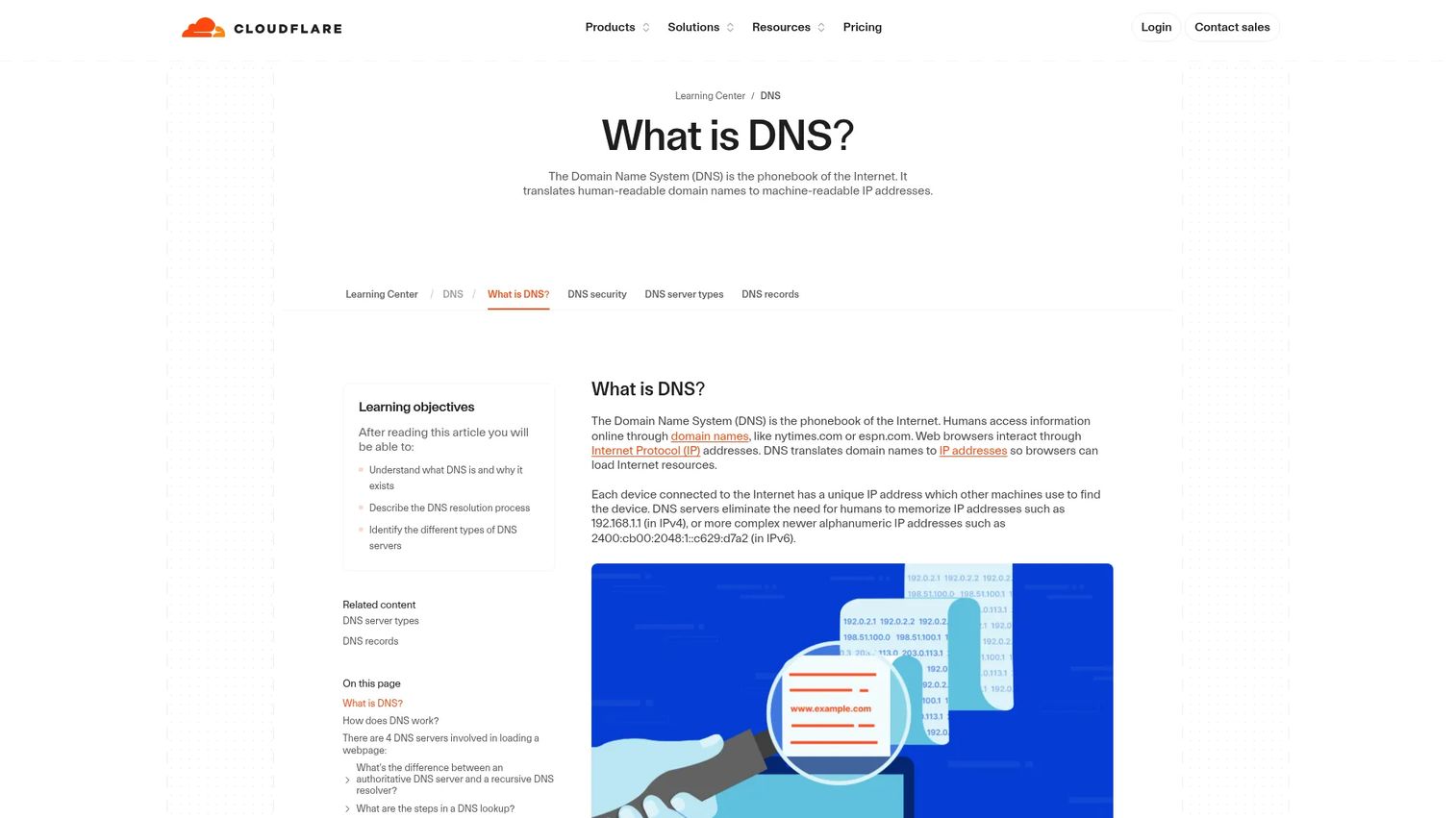
DNS is worth treating as a service discovery approach, not just a naming protocol. Every runtime on earth already knows how to resolve a hostname, which makes DNS the most language-agnostic discovery mechanism available. DNS service discovery, formalized as DNS-SD and closely tied to zero-configuration networking, lets clients look up services by name and receive current address records without any special client library.
The tradeoff worth understanding is expressiveness versus universality. DNS resolution is simple and ubiquitous, but plain DNS carries limited metadata and its caching behavior, governed by TTLs, can lag fast-changing endpoints. Registry-based discovery is more expressive when you need rich health data, weighting, or instant updates. Many teams get the best of both by putting a registry behind a DNS interface, which is exactly what Consul and Kubernetes both do.
Best for: Teams that want simple, language-agnostic discovery where built-in name resolution is enough.
Key strengths
- Universal client support: Every language and runtime resolves DNS with no extra dependency.
- Simple operational model: No SDK to embed, just standard resolution that ops teams already understand.
- Standardized service records: DNS-SD and SRV records express service instances in a portable way.
Why choose DNS: Choose DNS-based discovery when simplicity and broad compatibility matter more than rich, real-time metadata, or when you want a resolution layer in front of a registry. It shines in heterogeneous environments where you cannot mandate a common client library. For managed DNS, Cloudflare offers a free tier, with a Pro plan at $20 per month and a Business plan at $200 per month, both billed yearly, and custom Enterprise pricing. Cloudflare holds a 4.5/5 rating on G2 across its products.
6. Kubernetes
Kubernetes is the platform layer that gives containerized workloads service discovery for free. You do not bolt discovery on; it comes with the abstraction. Define a Service object, and Kubernetes assigns it a stable name and virtual IP, then routes traffic to the healthy pods behind it, regardless of how often those pods are rescheduled or how their IPs change.
The mechanism is elegant. A Service gets an internal DNS name, so any pod can reach another service by name through the cluster's built-in DNS. Kubernetes continuously updates the set of endpoints behind each Service as pods start, pass readiness checks, or die. For most teams running on Kubernetes, this native Kubernetes service discovery handles the entire single-cluster case with no additional software.
Best for: Teams needing open-source container orchestration where discovery, load balancing, and self-healing come built in.
Key strengths
- Built-in service discovery: Stable service names and internal DNS with zero extra tooling.
- Automated load balancing: Traffic spreads across healthy pods behind each service abstraction.
- Self-healing endpoints: The endpoint set updates automatically as pods scale, fail, or reschedule.
Why choose Kubernetes: If your workloads already run on Kubernetes, its native discovery is usually enough for everything inside a single cluster, and it removes an entire class of tooling. You start reaching for a registry like Consul or a service mesh when discovery must cross cluster or network boundaries, or when you need richer traffic policy than Services provide. Kubernetes carries a 4.6/5 rating on G2.
Kubernetes pricing: Kubernetes itself is open-source and free. Your cost is the underlying compute and the operational effort to run a cluster, or the management fee of a hosted Kubernetes service from a cloud provider. There is no license fee for the core project.
7. Gloo Mesh
Gloo Mesh is Solo.io's service mesh management product for securing, observing, and controlling service-to-service traffic across clusters and environments. When discovery has to work across network boundaries, a single-cluster approach runs out of road. Gloo Mesh adds a control plane over Istio that federates service registries and resolves services across multiple clusters and networks.
This is the multi-network discovery scenario. In a mesh, sidecar proxies handle discovery and routing, and Gloo Mesh coordinates that across a fleet of clusters. It brings mTLS-based security between services, traffic management with routing, shifting, and timeouts, and OpenTelemetry-based observability into one place. For platform teams already running Istio, it centralizes control instead of managing each mesh separately.
Best for: Platform teams running Istio or a service mesh across multiple clusters that need enterprise support and centralized control.
Key strengths
- Multi-cluster operations: Federate service discovery and routing across clusters and networks from one control plane.
- mTLS security: Encrypted, authenticated service-to-service and pod-to-pod communication by default.
- Traffic management and observability: Routing, traffic shifting, timeouts, and OpenTelemetry metrics with UI dashboards.
Why choose Gloo Mesh: Reach for Gloo Mesh when your discovery problem is fundamentally a cross-network problem and you want enterprise-grade mesh management rather than assembling it yourself. It fits teams that have outgrown single-cluster discovery and need consistent policy, security, and observability across environments. Solo.io offers Gloo Mesh Core and Gloo Mesh Enterprise tiers.
Gloo Mesh pricing: Gloo Mesh is packaged as Gloo Mesh Core and Gloo Mesh Enterprise, both with contact-sales pricing rather than public per-seat rates. A free trial is referenced on its listing. Reach out to Solo.io for a quote scoped to your cluster count and support needs.
How to choose the right service discovery software
Picking a tool before you pick a pattern is how teams end up with the wrong fit. Work through these criteria first.
Match the tool to your discovery pattern
Decide whether you need client-side discovery, server-side discovery, DNS-based resolution, or mesh-based discovery before you shortlist products. The pattern narrows the field faster than any feature comparison. A registry like Consul or Eureka fits client-side needs; Kubernetes and DNS fit server-side and language-agnostic needs; Gloo Mesh fits multi-network mesh needs.
Check consistency versus availability tradeoffs
Some tools favor strong consistency using Raft, like etcd and Consul, so every read is authoritative. Others, like Eureka, favor availability during partitions and accept brief staleness. Neither is universally correct. Decide which failure mode your system can tolerate and choose accordingly.
Weigh the operational burden honestly
Running a healthy ZooKeeper ensemble or an etcd quorum is real work. Kubernetes-native discovery and managed DNS shift most of that burden elsewhere. Be honest about how much of your team's time you want spent operating discovery infrastructure versus building product.
Plan for multi-cluster before you need it
If there is any chance your services will span clusters, regions, or networks, factor that in now. Retrofitting multi-network discovery onto a single-cluster setup is more painful than choosing a control plane that supports federation from the start.
Conclusion
There is no single best service discovery software, only the best fit for your architecture. Match the pattern to the scenario and the shortlist writes itself.
For full-featured service networking across hybrid environments, Consul brings registry, health checks, DNS, and mesh together. For a cloud-native building block you can trust, etcd gives you a strongly consistent store you likely already run. For coordination-heavy systems, Apache ZooKeeper handles leader election and locking alongside discovery. For JVM and application-level discovery, Eureka fits the Netflix-style microservices pattern. For language-agnostic simplicity, DNS works everywhere. For containerized workloads, Kubernetes gives you discovery built in. And for multi-cluster and multi-network scale, Gloo Mesh federates it all.
The practical next step is not to download a tool. It is to define your discovery pattern first: client-side, server-side, DNS-based, or mesh-based. Once the pattern is clear, the software choice becomes obvious, and your service-to-service communication stays stable no matter how much the network moves underneath it.
FAQs
Service discovery software automatically helps services find each other as instances scale, move, restart, or fail. Instead of hardcoding IP addresses, services register themselves and clients resolve them by name. The three main approaches are registry-based discovery (Consul, Eureka), DNS-based resolution, and orchestration-native discovery in platforms like Kubernetes.
Kubernetes gives each Service object a stable name and virtual IP, plus an internal DNS entry. Pods reach a service by name, and the cluster's DNS resolves it to a healthy endpoint. Kubernetes continuously updates the set of endpoints behind each Service as pods start, pass readiness checks, or terminate, so traffic only routes to live pods.
Consul is a full service discovery and health-check platform with DNS, an HTTP API, and an optional service mesh. Etcd is a strongly consistent distributed key-value store, a building block you assemble discovery logic around rather than a turnkey product. Both use Raft for consistency, but Consul ships discovery features out of the box while etcd gives you a primitive.
Use DNS service discovery when you want language-agnostic resolution that every runtime already understands, when your discovery needs are relatively simple, or when built-in DNS is enough. DNS-SD and SRV records express service instances portably. It is ideal in heterogeneous environments where you cannot mandate a shared client library, though registry-based discovery is more expressive for rich, real-time metadata.
A service registry is the authoritative store of which service instances currently exist, their health status, and how clients can reach them. Instances register on startup and are removed when they die or fail a health check. Clients query the registry to get a current, healthy endpoint instead of relying on stale static configuration.
No. A service mesh can include discovery, but it is broader. A mesh typically adds traffic management, mTLS security, observability, and policy enforcement through sidecar proxies. Discovery is one function inside that larger set. You can run service discovery without a mesh, but most meshes handle discovery as part of what they do.
For discovery that crosses cluster or network boundaries, teams usually evaluate a service mesh control plane like Gloo Mesh, which federates registries and routing across clusters. Consul also supports multi-datacenter federation. Single-cluster tools and plain Kubernetes-native discovery work well inside one cluster but need a federation layer once services span multiple networks.