Your Sunday attendance is up. Your giving records live in one spreadsheet, your volunteer schedule in another, and your first-time visitor list in someone's inbox. When a new family shows up, nobody follows up because nobody owns the handoff. Sound familiar?
That fragmentation is the real problem church management software solves. The category is growing fast because of it. The global church management software market is projected to grow from USD 302.36 million in 2026 to USD 460.53 million by 2034, at a 5.4% CAGR, according to Straits Research (2024). Cloud deployment and mobile access are the biggest drivers of that growth, which tells you where churches are actually spending: on systems that connect people, giving, attendance, and communication in one place instead of five disconnected tools.
If you run operations for a church, you are effectively running an operating system for your congregation. The same discipline that keeps a growing business from routing everything through the founder keeps a growing church from routing everything through one overworked administrator. The goal is the same: reduce manual work, consolidate visibility, and pick software your team can actually sustain.
This guide compares seven platforms on the criteria that matter when you are past the spreadsheet stage: feature breadth, pricing clarity, ease of use, support quality, and fit across church sizes. If you also manage recurring gatherings and registrations, our roundup of the best event management software covers adjacent tools, and if you run any kind of small-group or membership program, the best community management software list is worth a look. For teams juggling asset and content sprawl, the best marketing resource management software breakdown pairs well with this one.
What's inside
This is a comparison of seven church management platforms, chosen for breadth of features, pricing clarity, ease of use, support quality, and fit across church sizes. We favored tools that cover the full operational picture: people and member records, giving and contribution tracking, attendance and check-in, communication and follow-up, events, and volunteer scheduling. Every pricing figure and rating comes from each vendor's own pages or verified sources at publishing time. Where a figure was not public, we say so rather than guess. The list runs from the most flexible modular option to more established, operations-heavy systems.
TL;DR
- Best overall for modular flexibility: Planning Center gives you free core tools and priced modules you turn on as you grow, with a strong member app.
- Best for simplicity and flat-rate value: Breeze from Tithely bundles the essentials into one predictable price with no contract.
- Best church management software for small churches on a budget: ChMeetings and ChurchTrac both start low, with ChMeetings offering a free forever tier and ChurchTrac starting at $9/month.
- Best for worship planning coverage: Elvanto pairs service planning with all-in-one administration on active-adult pricing.
- Best for deeper operational infrastructure: ACS Technologies and Fellowship One suit churches needing integrated member, giving, and accounting tools at scale.
- Bottom line: match the tool to your church size, admin capacity, and support expectations. The right system reduces manual work and gives you clearer visibility into engagement and spiritual growth.
What is church management software?
Church management software is a church management system that centralizes member records, giving, attendance, events, volunteer coordination, and communication so a church can run its operations from one platform instead of scattered spreadsheets and disconnected church software programs.
Most platforms in this category share a common set of core modules:
- People and member records: a central directory of individuals and families, often with a searchable church directory and profile history.
- Giving and contribution tracking: online giving for churches, recurring gifts, pledges, and church donation management with statements and reporting.
- Attendance and check-in: church attendance tracking and church check in software for services, kids' ministry, and events.
- Communication and follow-up: church communication software for email, text, and segmented messaging tied to member actions.
- Events and volunteer scheduling: church event management software plus church volunteer scheduling software for rosters and sign-ups.
- App or web member portal: a church app or member portal where the congregation can give, register, and update their own information.
The appeal of an all-in-one, cloud based church software platform is simple: churches usually run with limited admin bandwidth. One connected system means less duplicate data entry, fewer dropped handoffs, and a single source of truth. That is why church member management software has moved from a nice-to-have to the backbone of how many churches operate.
When to use church management software
When your church has outgrown spreadsheets
There is a clear tipping point. When you track people in one file, giving in another, and attendance on paper, context leaks out at every seam. A volunteer coordinator does not know who visited last week. The finance team re-enters donor info that already exists elsewhere. Someone spends Monday morning reconciling numbers by hand. That admin bottleneck is the signal. Once manual tracking starts costing hours and creating errors, a connected system pays for itself quickly.
When you need cleaner communication and follow-up
Good follow-up is not about sending more messages. It is about sending the right message to the right people at the right moment. Segmentation lets you reach first-time visitors, small-group leaders, or lapsed attendees without blasting everyone. The strongest church automation ties follow-up to real actions: a signup, a first gift, an attendance streak, or joining a group. When follow-up triggers on behavior instead of a manual reminder, staff and volunteers stay aligned without anyone chasing a checklist.
When you want better visibility into engagement
Attendance, group participation, giving patterns, and app activity together tell you something a single metric never will: who is actually connected. This is a ministry visibility problem, not just an admin one. When those signals live in one system, you can see the family that stopped attending, the volunteer quietly carrying too much, or the new member who has not yet joined a group. That visibility is what turns raw data into care, and care into spiritual growth and connectedness.
Comparison table
Pricing below can vary by church size, active member count, modules, and add-ons like accounting or messaging. Treat the starting prices as a floor, not a full quote. The table lists the seven tools in ranking order with verified starting prices and current ratings at publishing time.
| # | Product | Intent | Key use case | Pricing | G2 rating |
|---|---|---|---|---|---|
| 1 | Planning Center | Modular all-in-one | Free core tools plus priced modules and a member app | Free; add-ons from $5/month | 4.7/5 |
| 2 | Breeze from Tithely | Simple all-in-one | Flat-rate people, giving, events, and check-in | $72/month | Not listed |
| 3 | ChMeetings | Budget all-in-one | Membership, giving, and events by church size | Free forever; paid from $12 | 4.8/5 |
| 4 | ChurchTrac | Affordable all-in-one | People, giving, check-in, and messaging | $9/month | 4.8/5 |
| 5 | Elvanto | Worship-planning all-in-one | Service planning plus administration | From $15.20/month | 3.5/5 |
| 6 | ACS Technologies | Operations infrastructure | Integrated member, giving, and accounting | From $32/month | 3.5/5 |
| 7 | Fellowship One | Established platform | 360-degree member view and ministry oversight | Not public | Not listed |
1. Planning center
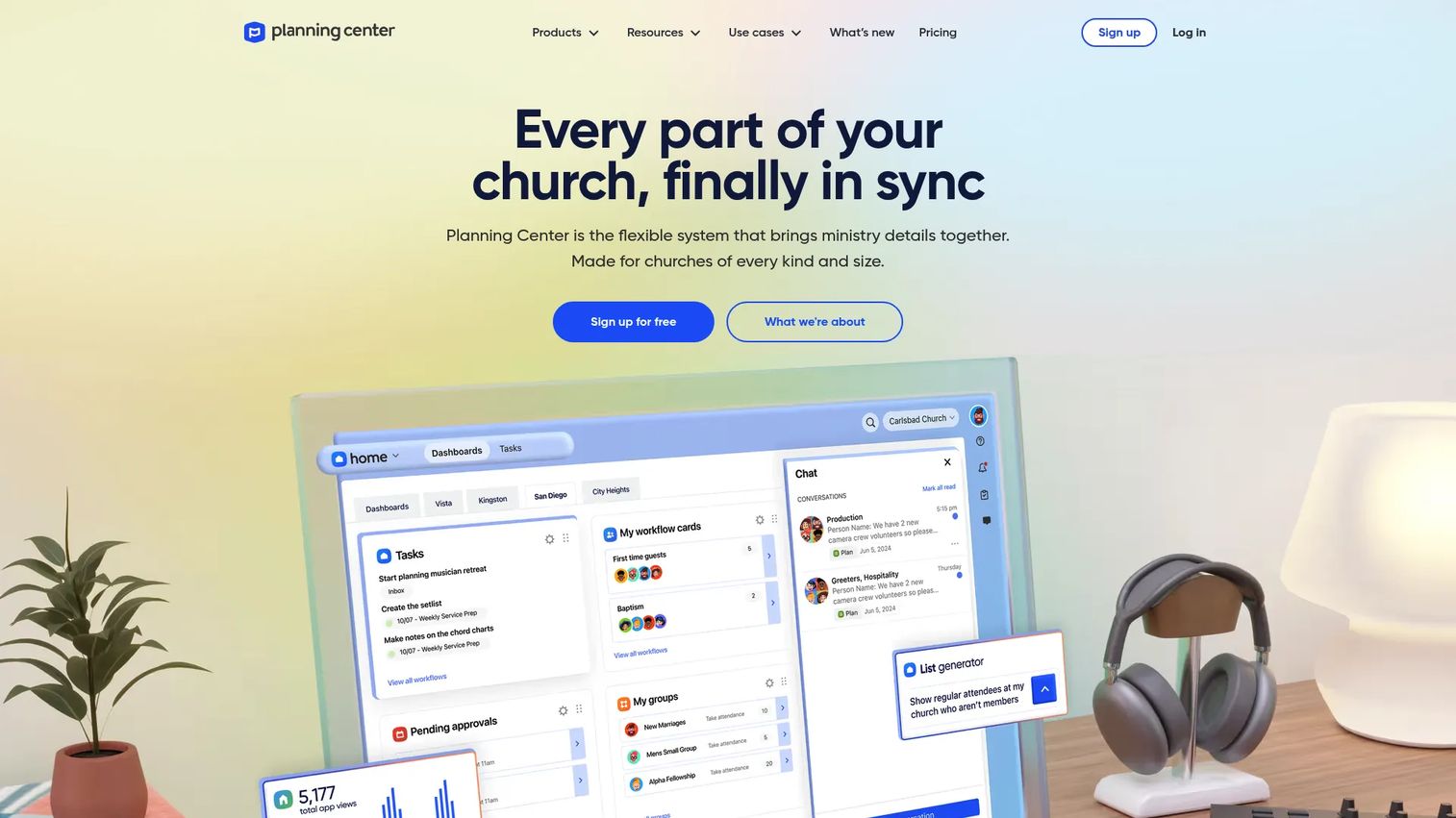
Planning Center is all-in-one church management software built as a set of modules you turn on as you need them. Instead of buying one big bundle, you start with a free, unlimited People database and add Services, Giving, Check-Ins, Groups, Calendar, Registrations, and Publishing over time. The Church Center member app and web platform ties it together for your congregation. That modular design is why it lands first: it scales cleanly from a small plant to a multi-site church without forcing you to pay for what you do not use yet.
Best for: churches that want flexible modules and a strong member experience without a big upfront commitment.
Key strengths
- Free unlimited People database: a central member directory and reporting at no cost, so your records live in one place from day one.
- Full module suite: volunteer scheduling, check-ins, registrations, groups, calendar, giving, and publishing, activated as you grow.
- Church Center app and web platform: a member portal where people give, register, and manage their own profiles.
Why choose Planning Center: the transparency is the draw. Free plans, no contracts, and cancel anytime mean you can adopt one module, prove it works, and expand without a sales negotiation. For a church that wants to control admin load and turn on capabilities as its team matures, that pay-as-you-grow ecosystem depth is hard to beat.
Planning Center pricing: the entry point is $0. People, Services, Registrations, Giving, Check-Ins, Groups, Calendar, Church Center, and Publishing all offer free product plans with usage caps, such as 5 team members on Services, 10 monthly donations on Giving, and 10 daily check-ins. Paid tiers scale per product as your usage grows, and a Music Stand add-on runs $5/month. A 30-day free trial is available. Pricing was verified from Planning Center's own pricing page.
2. Breeze from Tithely
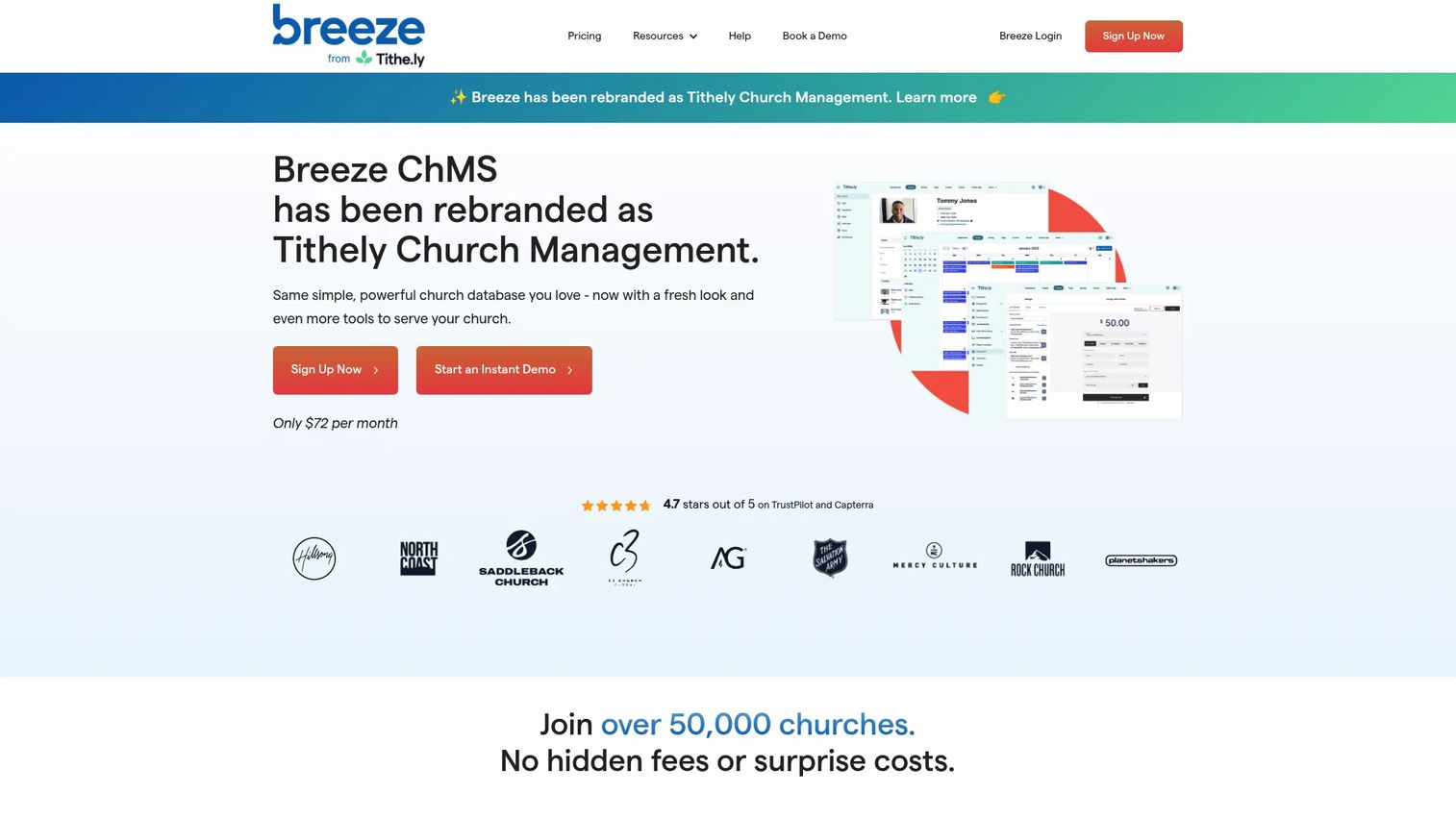
Breeze from Tithely is church management software built around organizing people, giving, events, communications, and service planning without a learning curve. It supports unlimited people and users, so you never pay more for growing your directory. Online and text giving, event management, check-in, and name tags come in the base plan. If simplicity is your priority, Breeze is designed so a volunteer can learn it in an afternoon.
Best for: small and mid-sized churches that want a simple, affordable all-in-one system with predictable pricing.
Key strengths
- Unlimited people and users: your directory and your team both scale without per-seat or per-record fees.
- Built-in giving: online and text giving with reporting included in the base plan, not sold as a separate module.
- Event and check-in tools: event management, check-in, and name tag printing for services and kids' ministry.
Why choose Breeze from Tithely: the pricing story is the easiest to understand on this list. One flat monthly rate covers the core system, so you know your cost before you sign up. Breeze positions itself on no contracts and cancel anytime, which lowers the risk of trying it. For a church that wants everything in one place without decoding a module matrix, that clarity matters.
Breeze from Tithely pricing: public pricing shows Breeze ChMS at $72/month and a Breeze Bundle at $119/month, both billed monthly. Pricing is flat-rate and includes giving in the base plan. There is no free tier, but the flat structure means your bill does not jump as your congregation grows. Pricing was verified from Breeze's own pricing page.
3. ChMeetings
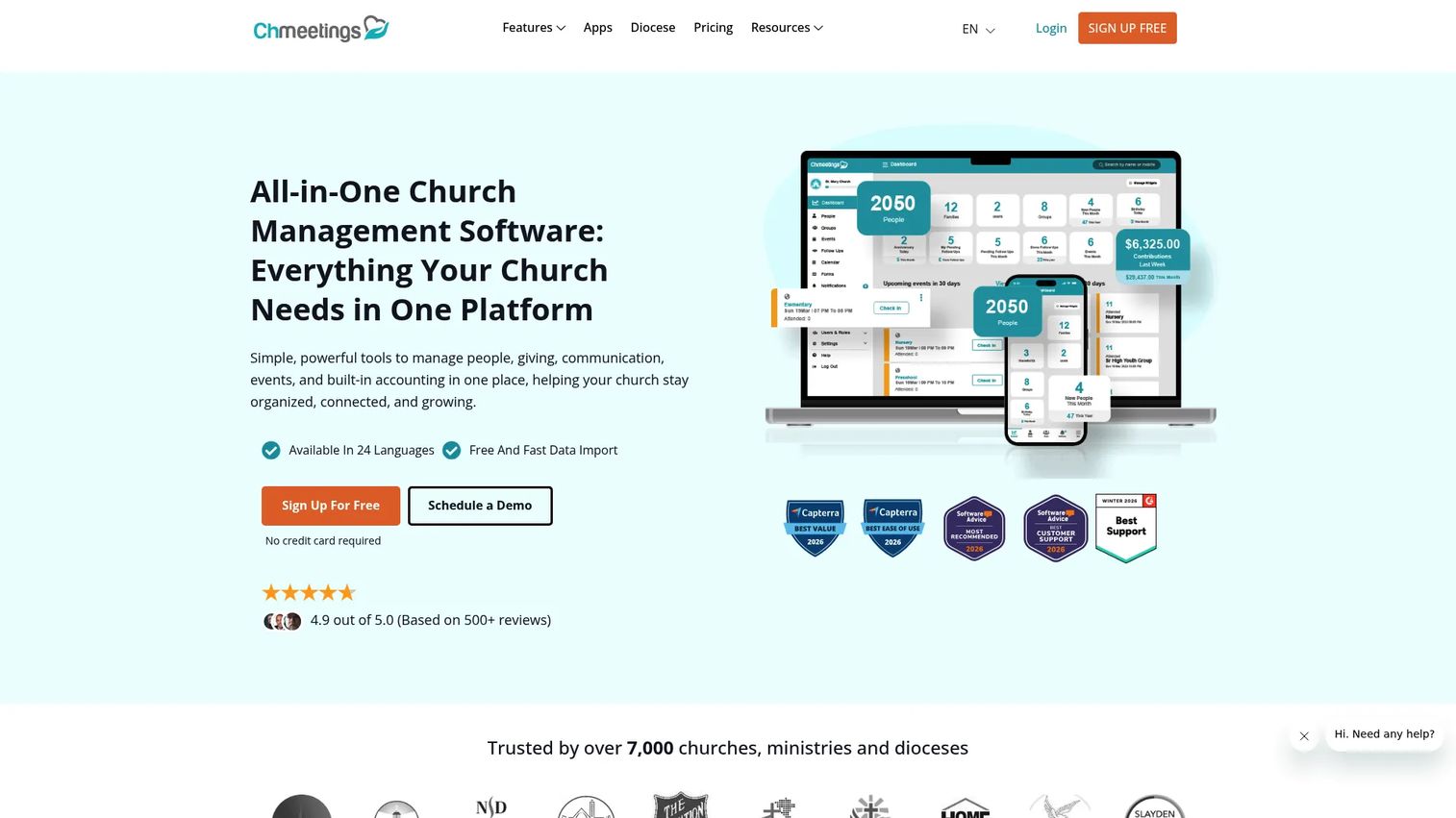
ChMeetings is cloud-based church management software for churches, ministries, and dioceses that need broad coverage on a tight budget. It handles member and group management, online giving and pledges, event registration, volunteer scheduling, and worship planning in one platform. Pricing scales by church size, which makes it one of the most accessible entries here for church management software for small churches that still want a full feature set.
Best for: small to mid-sized churches that want a lower-cost, all-in-one membership and operations platform.
Key strengths
- Member and group management: a central people system with groups, profiles, and history for church member management software needs.
- Online giving and pledges: built-in online giving for churches with pledge tracking and reporting.
- Events and volunteer scheduling: event registration, church volunteer scheduling software, and worship planning together.
Why choose ChMeetings: the price-to-feature ratio is the story. A free forever tier lets very small churches run real operations at no cost, and paid plans stay affordable as you grow. Text and voice messaging and a branded church app are available as add-ons when you need them, so you only pay for extras once they earn their place.
ChMeetings pricing: the public pricing page scales by church size. There is a free forever tier at $0, then V. Small at $12, Small at $25, Medium at $40, Large at $50, and Unlimited at $60, with a monthly and annual toggle. As your church grows, you move up a tier rather than renegotiate a contract. Add-ons like text/voice messaging and the branded app sit outside the base price. Pricing was verified from the ChMeetings pricing page.
4. ChurchTrac
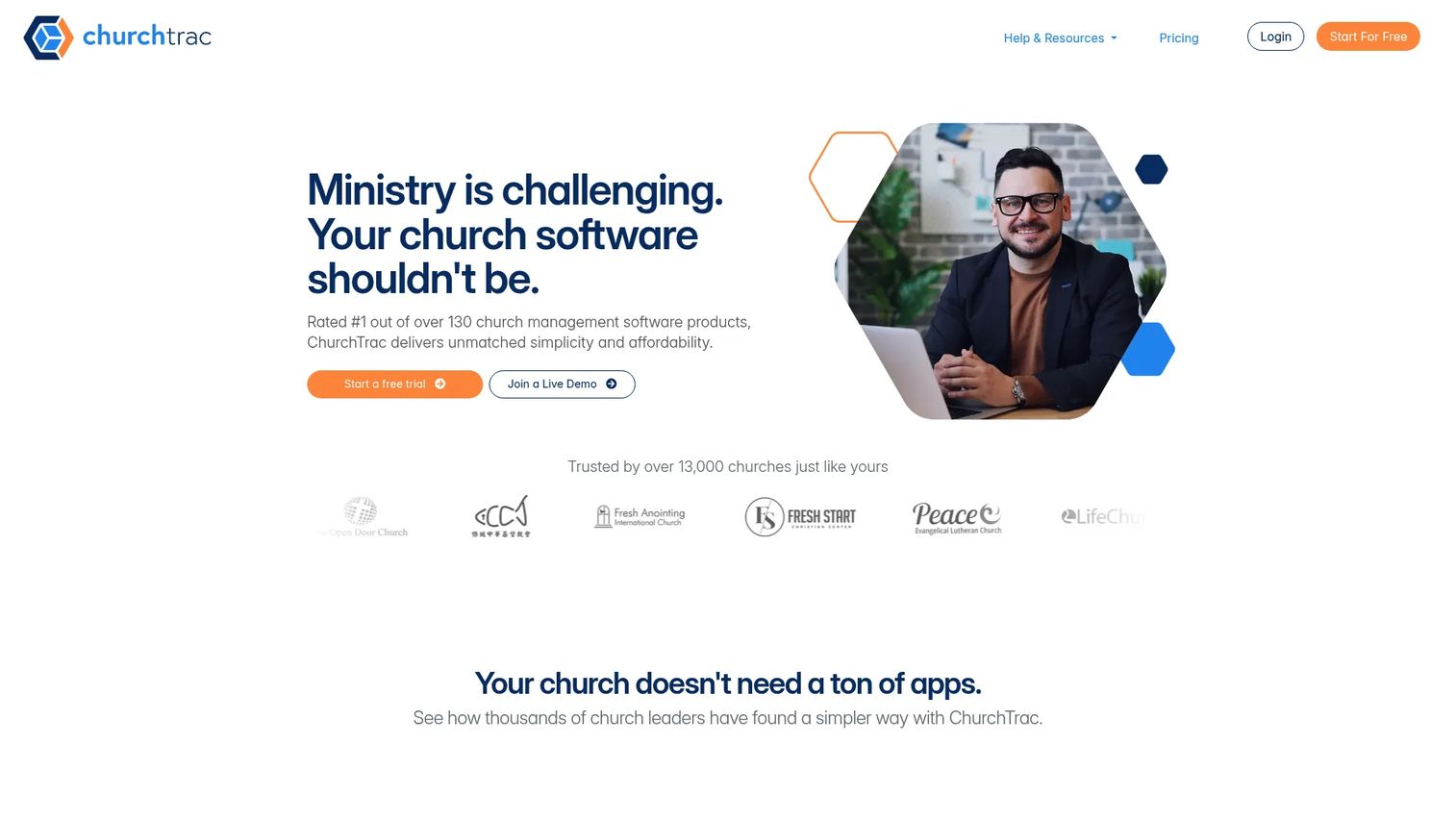
ChurchTrac is all-in-one church management software for handling people, giving, communications, scheduling, worship planning, and more. It covers people management, online giving, check-in and attendance, messaging, and a church app and website. What sets it apart at this price is the depth of support and training, which lowers the adoption risk for churches without a dedicated tech person on staff.
Best for: churches wanting an affordable all-in-one system with built-in giving, messaging, and strong onboarding support.
Key strengths
- People and giving: member management with online giving built in, not bolted on.
- Check-in and attendance: church check in software and church attendance tracking for services and ministries.
- Messaging and church app: communication tools plus a church app and website to reach your congregation.
Why choose ChurchTrac: it pairs a low starting price with hands-on support, which is exactly what a small team needs when switching systems. The workshop-style onboarding means you are not left decoding the software alone. For churches that want affordability without sacrificing help getting set up, ChurchTrac is a strong fit.
ChurchTrac pricing: pricing uses a people-based scale. The Standard plan starts at $9/month and the Plus plan at $24/month, both billed monthly. Optional add-ons include Accounting Features at +$15/month and Enhanced Messaging at +$7/month. A free 30-day trial is offered so you can test it before committing. Pricing was verified from ChurchTrac's own pricing page.
5. Elvanto
Elvanto is cloud-based church management software for administration, worship planning, pastoral care, children's check-in, and giving. It stands out for churches that treat service planning as a first-class need alongside general administration. Member and group management, service planning and volunteer scheduling, and child check-in and attendance tracking all live in one cloud based church software platform.
Best for: churches that want an all-in-one cloud system with serious worship-planning coverage.
Key strengths
- Service planning and volunteer scheduling: build service plans and schedule volunteers in the same place your people records live.
- Member and group management: a central directory with groups for pastoral care and follow-up.
- Child check-in and attendance: secure check-in and church attendance tracking for kids' ministry.
Why choose Elvanto: if worship planning is a weekly headache, Elvanto puts it next to your administration instead of in a separate tool. The pricing model is based on active adults, which many growing churches find fairer than counting every record. Documentation and support round out the package for teams that want to self-serve.
Elvanto pricing: pricing is based on active adults, with annual billing discounted 20% and monthly billing available. The 50 Plan starts at US$15.20/month billed annually, the 100 Plan at US$31.20/month, and larger tiers scale from there. A one-time US$149 setup cost applies. In plain terms, active-adult pricing means you pay for the adults who actually participate, not your entire historical database. Pricing was verified from Elvanto's own pricing page.
6. ACS Technologies
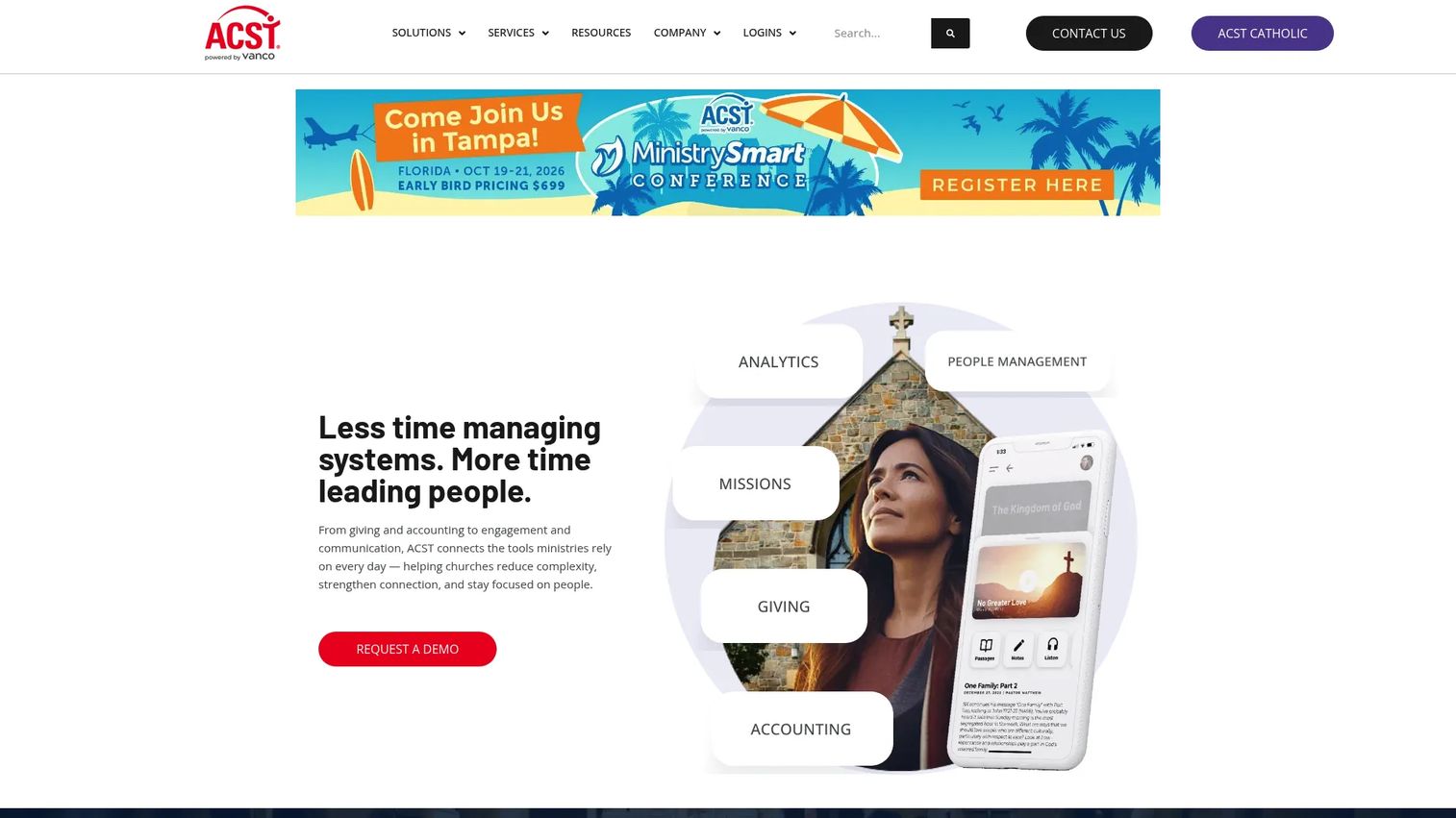
ACS Technologies is church management, giving, and accounting software for faith-based organizations. It leans toward deeper operational infrastructure, combining church management, church giving solutions, and church accounting software in one ecosystem. For churches that need integrated finance and member data rather than just the basics, ACS covers more of the back office than most lighter platforms.
Best for: churches and faith-based organizations needing integrated member, giving, and accounting tools.
Key strengths
- Church management (ACS): web-based member management, volunteer opportunities, and event signups.
- Giving solutions: online giving for churches with donation tracking and reporting.
- Accounting software: built-in church accounting to keep finance and member data connected.
Why choose ACS Technologies: it fits churches already in the ACS ecosystem or those that need accounting and member records under one roof. The record-based pricing scales with your database, and the OnDemand bundle includes Access ACS at no additional monthly cost. For process-heavy churches, that integrated infrastructure reduces the number of systems to maintain.
ACS Technologies pricing: Access ACS pricing is based on uploaded record count, starting at $32/month for 1 to 599 records, $48.50/month for 600 to 1,599, $83/month for 1,600 to 2,999, and rising from there; 30,000+ records is quoted directly. OnDemand bundles Access ACS at no additional monthly cost. A one-time $300 setup fee applies for new Access ACS subscriptions. Pricing was verified from the Access ACS page.
7. Fellowship One
Fellowship One is church management software for churches and ministries that want a more established, operations-heavy platform. It offers web-based access with a family and individual 360-degree view, member care and people management, event registration and check-in, and online giving and donations. The strength here is depth of ministry oversight, which suits larger or more process-driven churches that need a full picture of every household.
Best for: larger or more process-heavy churches that want an established, enterprise-style system.
Key strengths
- 360-degree member view: family and individual profiles that give staff a complete picture for member care.
- Event registration and check-in: church event management software with check-in for services and programs.
- Online giving and donations: integrated church donation management and reporting.
Why choose Fellowship One: it is built for churches that have outgrown lighter tools and need structured processes across ministries. The family-and-individual view helps large staff teams coordinate care without losing context. If your church runs many programs and needs oversight across all of them, this is the more established option.
Fellowship One pricing: the vendor does not publicly display a standard pricing table. Its own materials indicate access fees depend on typical worship attendance and are defined in a pricing schedule or separate agreement, so you will need to contact them for a quote tied to your church size.
Considerations before you choose
Picking a church management system is less about the longest feature list and more about the system your team will actually sustain. Use this checklist to pressure-test each option.
Church size and pricing model
Pricing structures differ in ways that matter. Some tools charge a flat rate, some by active adults, and some by total records. A flat rate like Breeze is predictable; record-based pricing like ACS can climb as your database grows. Map your realistic church management software pricing against 12 to 24 months of growth, not just today.
Admin capacity and ease of use
Be honest about who runs this day to day. A volunteer-run church needs software learnable in an afternoon. A staffed church can absorb a more complex system with more configuration. The best fit matches the tool's complexity to the bandwidth of the people who own it.
Support and onboarding
Migration is where switching costs hide. Look for onboarding help, data import support, and responsive service. ChurchTrac's workshop-style training and Planning Center's documentation are examples of support that lowers adoption risk.
Data ownership and security
Ask where your data lives, how it is backed up, and whether you can export it. Cloud based church software should offer better access and backups than scattered spreadsheets, but the specifics vary by vendor.
Member-facing experience
A church app or member portal shifts work off staff by letting people give, register, and update their own info. If self-service matters to your congregation, weigh the app experience as heavily as the admin tools, especially since mobile access drives much of the category's growth.
Conclusion
The strongest picks come down to fit. Planning Center is the standout for modular flexibility, letting you turn on free core tools and add priced modules as your team grows. Breeze from Tithely wins on simplicity and flat-rate value for churches that want one predictable price. For budget-conscious churches, ChMeetings and ChurchTrac both deliver full-featured, affordable all-in-one platforms, with ChMeetings offering a free forever tier and ChurchTrac starting at $9/month. Elvanto suits churches that need real worship planning, while ACS Technologies and Fellowship One fit those needing deeper operational and church donation management infrastructure.
The practical move is to start with the tool that matches your church size, admin capacity, and support expectations, then adopt one module or run a trial before committing. The right system reduces manual work, connects your people and giving data, and gives you the visibility to support real connectedness and spiritual growth, not just cleaner records.
FAQs
It organizes the core parts of running a church in one place: people and member records, giving and contributions, attendance and check-in, events, volunteer scheduling, and communication. Instead of stitching together spreadsheets and disconnected church software programs, staff work from a single source of truth. That reduces duplicate data entry and keeps follow-up from falling through the cracks.
Prices range from free tiers up to roughly $120/month for base plans, with larger or more complex churches paying more. The main drivers of church management software pricing are church size, the modules you enable, whether you add a branded app, and extras like accounting and messaging. Some vendors charge a flat rate, others by active adults or total records, so compare pricing against your expected growth.
Small churches usually get the most value from simple, affordable tools they can adopt fast. ChMeetings offers a free forever tier, ChurchTrac starts at $9/month, and Planning Center lets you begin with free core modules. Prioritize ease of adoption and predictable pricing over feature bloat you will not use.
Focus on people and member management, giving and contribution tracking, attendance and check-in, communication and follow-up, church volunteer scheduling software, and event management. A member portal or church app is a strong bonus because it moves self-service work off your staff. Everything else is secondary to these core jobs.
Security depends on the vendor, but a well-run cloud based church software platform typically offers better access control, automatic backups, and support than spreadsheets scattered across staff computers. Ask each vendor where data is stored, how often it is backed up, and whether you can export your records. Data ownership and export options are the questions that matter most.
A church app or member portal is not required, but it shifts real work off staff. Congregants can check in, give, register for events, message groups, and see schedules from their phones. Since mobile access drives much of the category's growth, an app is increasingly a practical expectation rather than a luxury.
Connected church management software links attendance records and giving history to the same member profiles. When check-in data and church donation management live together, engagement reporting becomes far more useful, and you avoid re-entering the same person's information in two tools. That single record is what makes cross-metric visibility possible.
Yes. Groups, segmented messaging, check-ins, and follow-up workflows together reveal who is connected and who is drifting. When those signals live in one system, staff can act on real behavior, such as reaching out to a family that stopped attending or a member who has not joined a group. That is how the software supports connectedness and spiritual growth, not just administration.