You inherited a pipeline. It worked last quarter. This morning a source API changed a column type, the sync silently dropped 40,000 rows, and the activation dashboard your CEO screenshots every Monday now shows a cliff that never happened.
That is the real problem with data pipeline software. It is not moving data once. It is moving data reliably, forever, while sources drift, schemas evolve, and volume grows faster than anyone forecasted. The global data pipeline tools market is projected to grow from roughly USD 12.1 billion in 2024 to USD 48.3 billion by 2030, a compound annual growth rate near 26%, according to Grand View Research (2024). That growth is not hype. It reflects how many product decisions now depend on a number that came out the other end of a pipe.
Product managers feel this acutely. Your activation rate, your D7 retention curve, your trial-to-paid conversion, all of it flows through data movement infrastructure you rarely control and almost never chose. When the pipeline breaks, your instrumentation lies, and you defend a roadmap on numbers you cannot trust. If your evaluation stack is broad, this fits alongside how you already assess a customer data platform, your marketing analytics layer, and the data visualization tools sitting downstream.
This guide compares the tools that carry that weight.
What's inside
This is a buyer's comparison of 11 data pipeline tools, written for product managers, data leaders, and analytics owners who need dependable data movement into warehouses, lakes, and downstream apps. We selected platforms on four criteria: architecture and operating model (ingestion, orchestration, transformation, warehouse-native loading), reliability signals (CDC, schema evolution, observability, failure handling), governance depth (access controls, lineage tracking, auditability), and total cost of ownership including maintenance burden. Every tool below earns its place in at least one clear scenario. None is the universal answer.
TL;DR
- Best managed ingestion with minimal upkeep: Fivetran, for teams that want 700+ connectors and low-maintenance syncs.
- Best open and flexible connector coverage: Airbyte, for teams that want cloud, hybrid, on-prem, or open-source deployment.
- Best orchestration-first platform: Dagster, when workflow dependencies and observability matter more than raw ingestion.
- Best warehouse-first ELT: Matillion, for teams doing heavy in-warehouse transformation.
- Best AWS-native serverless ETL: AWS Glue, if your stack already lives in AWS.
- Best for enterprise governance: Informatica and Qlik Talend Cloud, for regulated data management at scale.
What is data pipeline software?
Data pipeline software is a category of tools that automate the movement, transformation, and delivery of data from source systems into destinations like warehouses, lakes, and operational apps, so downstream teams can use it for BI, analytics, ML, and product decisions. It covers ingestion, transformation, orchestration, and loading as distinct but connected jobs.
The category overlaps with ETL tools and ELT tools but is broader than either. ETL transforms data before loading it; ELT loads raw data first and transforms it inside the warehouse. Modern data integration software often blends both, adds workflow orchestration, and layers in reliability features that older batch jobs never had.
Core capabilities to expect from a modern data pipeline platform:
- Connectors and data ingestion: pre-built and custom connectors that pull from SaaS APIs, databases, files, and event streams.
- CDC (change data capture): detecting and syncing only changed records for efficient, near real-time data pipeline delivery.
- Schema evolution: automatically handling upstream column additions, type changes, and drift without breaking downstream tables.
- Transformation: SQL, Python, or no-code logic to clean, join, and model data.
- Data orchestration: scheduling, dependency management, retries, and SLAs across multi-step workflows.
- Warehouse-native loading: loading directly into a warehouse with minimal intermediate infrastructure.
- Observability: monitoring, alerting, lineage tracking, and pipeline health metrics.
- Governance: access controls, auditability, and enterprise governance features.
The operating model matters more than the feature checklist. Some tools are fully managed and hands-off. Some hand you an orchestrator and expect you to own the logic. Some load directly into one warehouse and do it very well. Matching that model to your team's skill and release cadence is the real decision, and it echoes how you'd evaluate an AI orchestration platform or an agentic analytics layer.
When to use data pipeline software
Centralize scattered data for analytics
When source data lives in a dozen SaaS tools and three databases, analysts spend more time collecting than analyzing. A pipeline platform consolidates data ingestion into one warehouse so BI and reporting run on a single source. This is the most common trigger and where managed ingestion tools shine.
Power real-time and operational use cases
When decisions depend on fresh data, batch nightly loads fall behind. A real-time data pipeline built on CDC keeps warehouses and operational apps close to live. Fraud scoring, inventory, and in-product personalization all need this. Latency, not connector count, becomes the deciding factor.
Orchestrate complex, dependent workflows
When pipelines have dozens of steps with cross-dependencies and SLAs, ad-hoc schedulers break down. Data orchestration platforms manage dependencies, retries, and lineage across the whole graph. This matters most for data teams running ML feature pipelines and multi-stage transformations.
Comparison table
Below is a fast scan of all 11 data pipeline tools. Pricing reflects publicly listed figures at publication; several vendors use usage-based or consumption pricing and quote per environment. Ratings are pulled from each tool's current G2 listing.
| # | Product | Intent | Key use case | Pricing | G2 rating |
|---|---|---|---|---|---|
| 1 | Matillion | Warehouse-first ELT | Cloud transformation and orchestration | Usage-based credits; free trial | 4.5/5 |
| 2 | Fivetran | Managed ingestion | Low-maintenance ELT with 700+ connectors | Free plan; usage-based paid tiers | 4.3/5 |
| 3 | Airbyte | Flexible replication | Cloud, hybrid, on-prem, and OSS coverage | Free; Individual $29/mo; Team $299/mo | 4.4/5 |
| 4 | Dagster | Orchestration-first | Asset-aware workflows and observability | Solo $10/mo; Starter $100/mo; Pro custom | 4.5/5 |
| 5 | AWS Glue | Serverless ETL | AWS-native integration and cataloging | $0.44 per DPU-hour; pay-as-you-go | 4.3/5 |
| 6 | Azure Data Factory | Cloud orchestration | ETL/ELT across hybrid and multicloud | Pay-as-you-go, usage-based | 4.6/5 |
| 7 | Hevo Data | No-code ELT | Fast, low-maintenance pipeline setup | Free plan; usage-based paid tiers | 4.4/5 |
| 8 | Rivery | ELT plus orchestration | Consolidated workflow and activation layer | Base $0.9 per BDU credit; free trial | 4.7/5 |
| 9 | Informatica | Enterprise data management | Governed, AI-ready integration at scale | Consumption-based; quote | 4.3/5 |
| 10 | Qlik Talend Cloud | Enterprise integration + quality | Governed data across cloud and hybrid | Contact sales; free trial | 4.6/5 |
| 11 | Snowflake Snowpipe | Warehouse-native loading | Serverless ingestion into Snowflake | 0.0037 credits per GB ingested | 4.5/5 |
1. Matillion
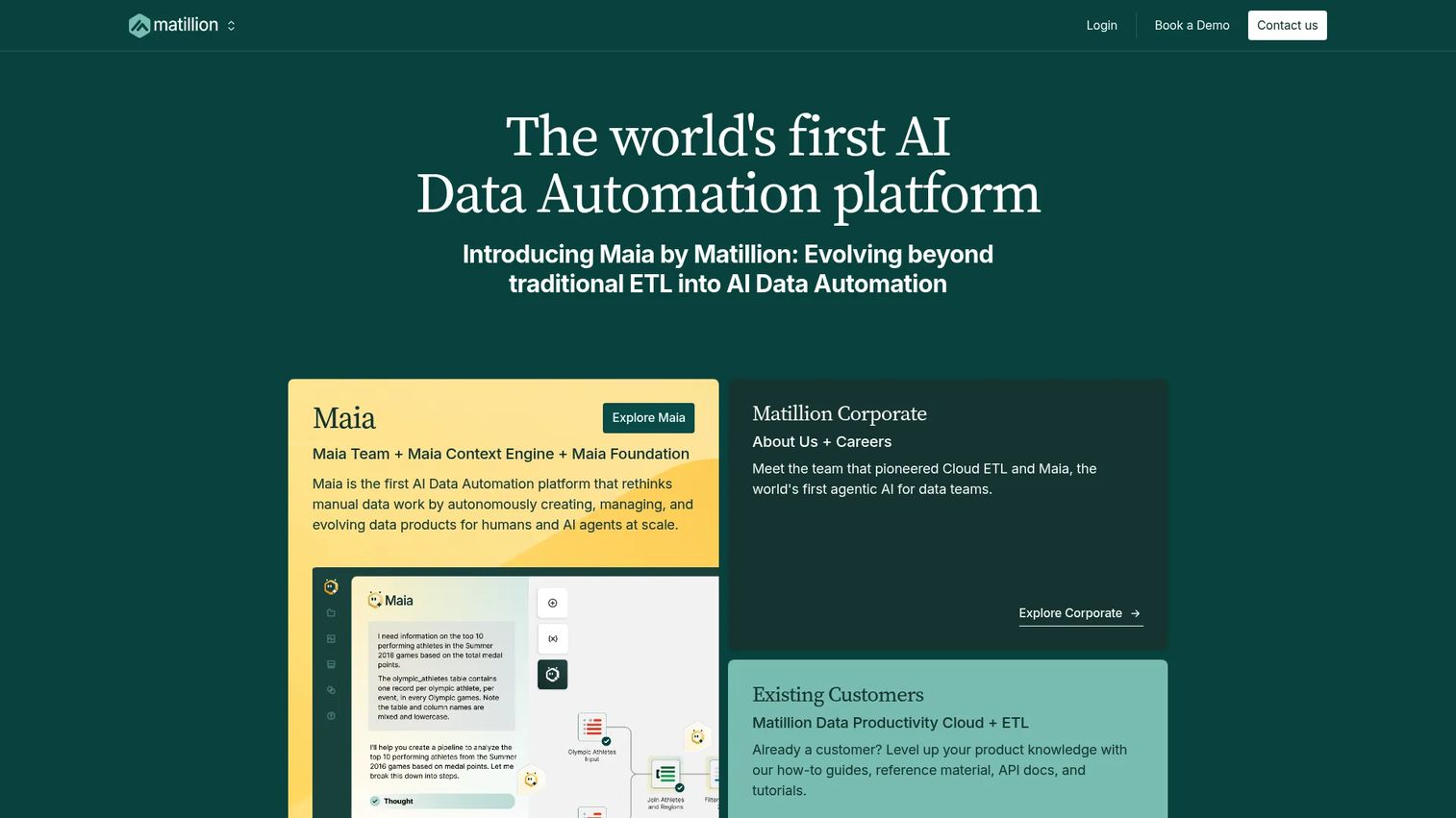
Matillion is a cloud-native data integration and transformation platform built to run push-down transformations directly inside your warehouse. It is warehouse-first by design, so the compute you already pay for does the heavy lifting. That makes it a strong fit for modern analytics teams that want speed without standing up separate transformation infrastructure or a large DevOps function.
The platform blends pre-built and custom connectors with a mix of no-code, low-code, and SQL or Python transformations. Pipeline orchestration, lineage, and CDC come as part of the picture, which is what separates it from a pure loading tool. For a product team, that means fewer moving parts between raw source data and the models feeding your activation dashboards.
Best for: analytics and data teams that want scalable ELT with in-warehouse transformation and light operational overhead.
Key strengths
- Push-down transformation: runs logic inside the warehouse so you use existing compute instead of a separate engine.
- Flexible authoring: no-code, low-code, and SQL or Python paths so both analysts and engineers can build.
- Orchestration and CDC: pipeline orchestration, lineage, and change data capture in one platform.
Why choose Matillion: Choose Matillion when your center of gravity is the warehouse and you want transformation, orchestration, and CDC managed together. It fits teams that value implementation speed and want to avoid maintaining bespoke transformation infrastructure. If your workflows are ingestion-only, a dedicated connector tool may be simpler.
Matillion pricing: Matillion publicly describes three editions, Developer, Teams, and Scale, on a credit-based usage model. The pricing page does not list numeric plan prices and directs you to a free trial or sales. A free trial is available to test before committing.
2. Fivetran
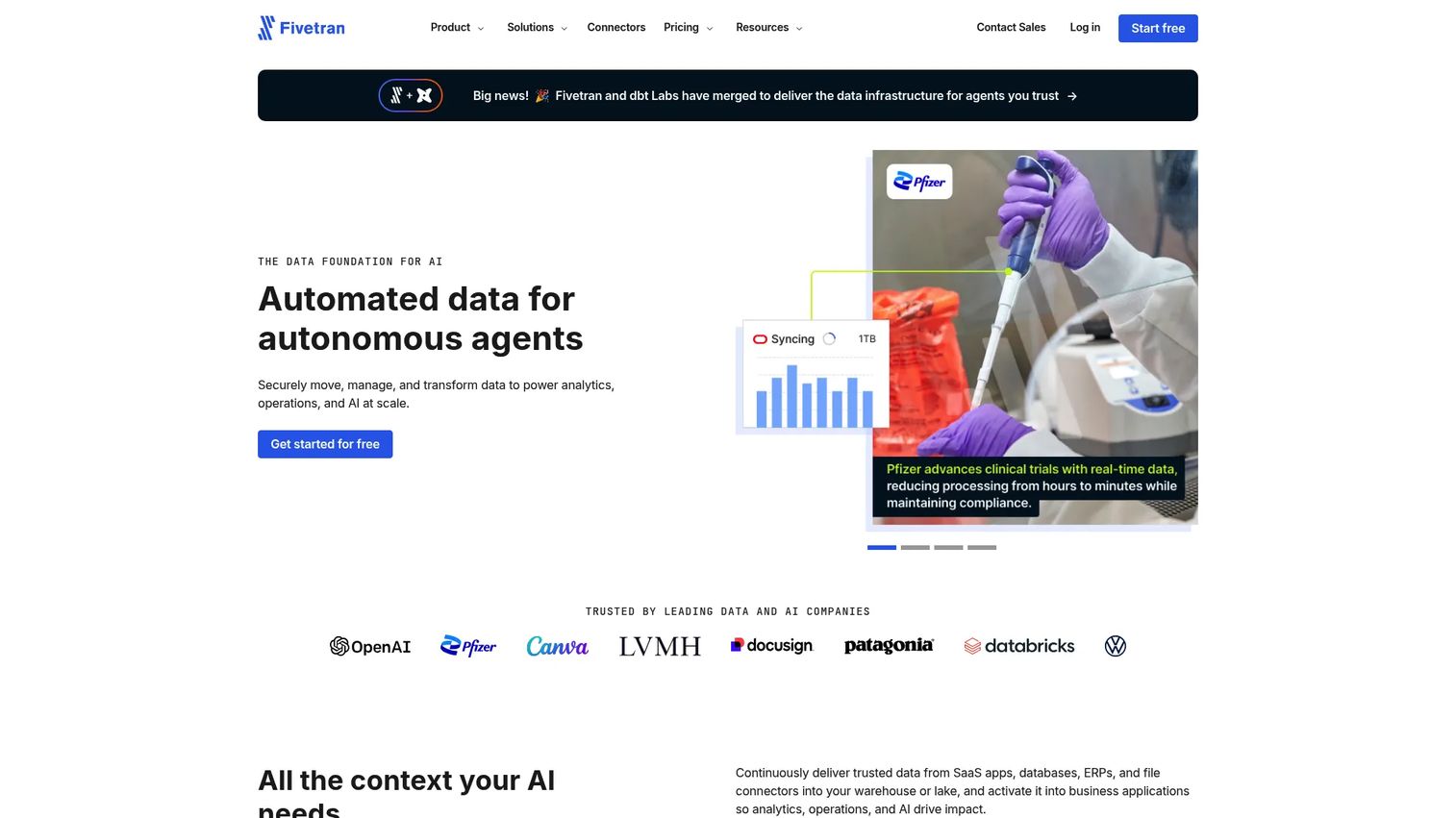
Fivetran is an automated data movement platform focused on getting data into warehouses and lakehouse targets with minimal upkeep. Its pitch is fully managed pipelines: you connect a source, pick a destination, and Fivetran handles schema drift, retries, and normalization behind the scenes. For teams tired of babysitting brittle ingestion jobs, that reliability is the whole point.
The platform offers 700+ fully managed connectors and syncs as frequent as 15 minutes on its Standard plan. Schema handling and normalization are automated, which reduces the maintenance debt that quietly eats data engineering time. This is managed ingestion for teams that would rather spend their hours on modeling and analysis than on connector plumbing.
Best for: teams that want dependable, low-maintenance ELT with broad connector coverage and automated schema handling.
Key strengths
- 700+ managed connectors: broad source coverage without building or maintaining integrations yourself.
- 15-minute syncs: frequent refreshes on Standard for near-current warehouse data.
- Free plan: a usage-capped free tier to start before scaling into paid usage.
Why choose Fivetran: Choose Fivetran when reliability and low maintenance outweigh deep customization. It suits data teams that want ingestion to be invisible infrastructure. Teams that need heavy custom transformation logic or full control over the sync mechanics may prefer a more configurable platform paired alongside it.
Fivetran pricing: Fivetran offers a Free plan at $0 with usage caps, plus Standard, Enterprise, and Business Critical tiers. Paid pricing is usage-based on monthly active rows, and specific plan prices are not publicly listed. Usage examples and per-unit transformation rates are shown on the pricing page.
3. Airbyte
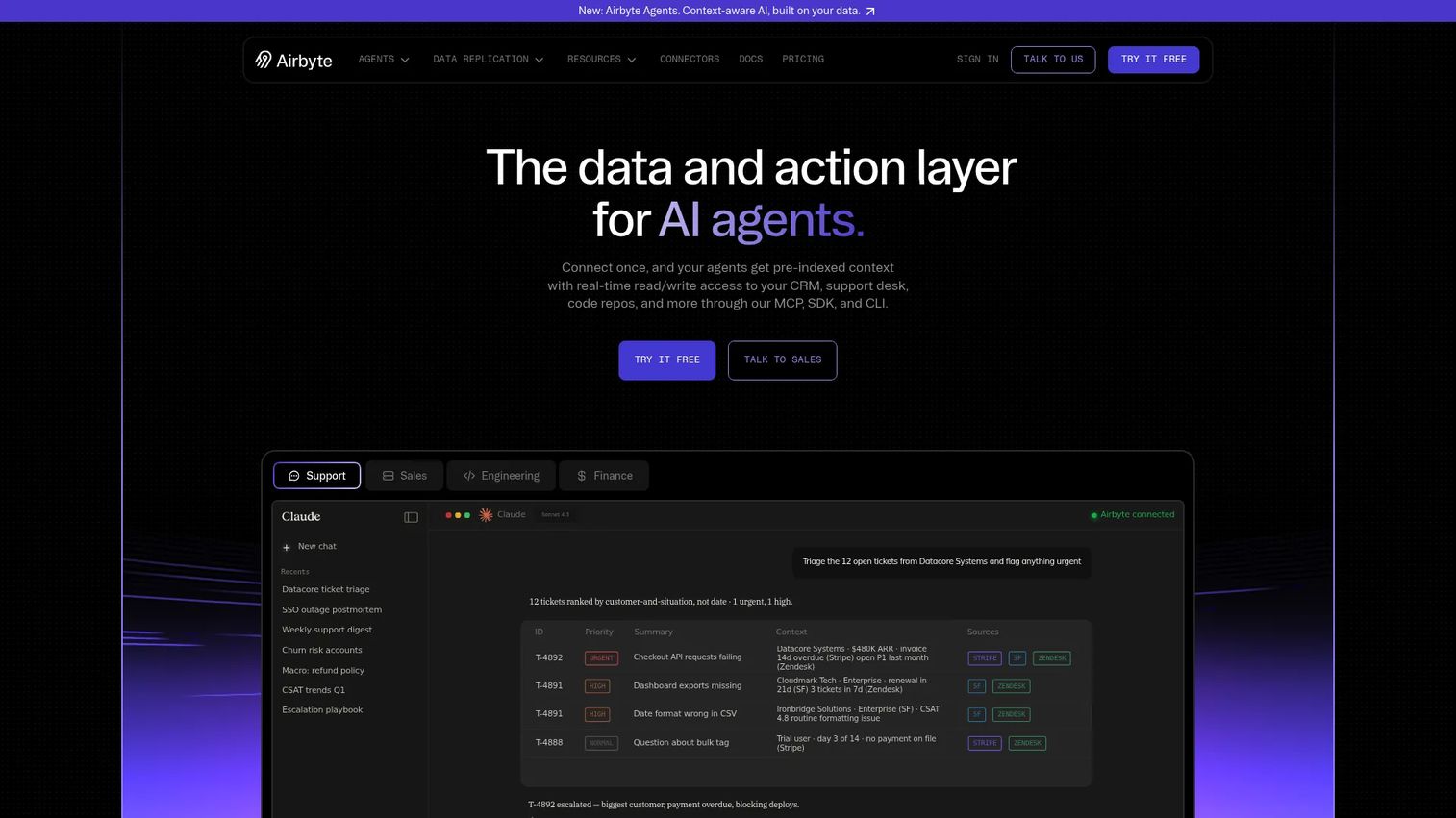
Airbyte is a data movement platform for syncing and activating data across systems, with an open-source core and multiple deployment options. You can run it as managed cloud, hybrid, on-prem, or fully open source, which is rare in this category. For teams with data residency requirements or a strong preference for self-hosting, that flexibility is the headline.
Airbyte offers 600+ connectors and, more recently, Context Store, API, and MCP access aimed at AI context and agents. The open-source foundation means you can extend or build connectors when a source is not covered, which matters for long-tail or internal systems. Schema handling and incremental sync support round out the core.
Best for: teams that want flexible deployment, broad connector coverage, and the option to self-host or extend connectors.
Key strengths
- 600+ connectors: wide coverage across SaaS, databases, and files, with an extensible connector framework.
- Deployment flexibility: cloud, hybrid, on-prem, and open-source options for residency and control needs.
- AI-ready access: Context Store, API, and MCP access for feeding data to agents.
Why choose Airbyte: Choose Airbyte when deployment control and connector extensibility matter more than a fully hands-off experience. It fits engineering-comfortable teams and those with compliance-driven hosting needs. Teams wanting zero infrastructure involvement may lean toward a fully managed option.
Airbyte pricing: Airbyte's public pricing shows Free at $0 per month, Individual at $29 per month, Team at $299 per month, and Custom via sales. A separate Airbyte Cloud section notes usage-based pricing starting at $10 per month. Pricing is currently split across product tabs.
4. Dagster
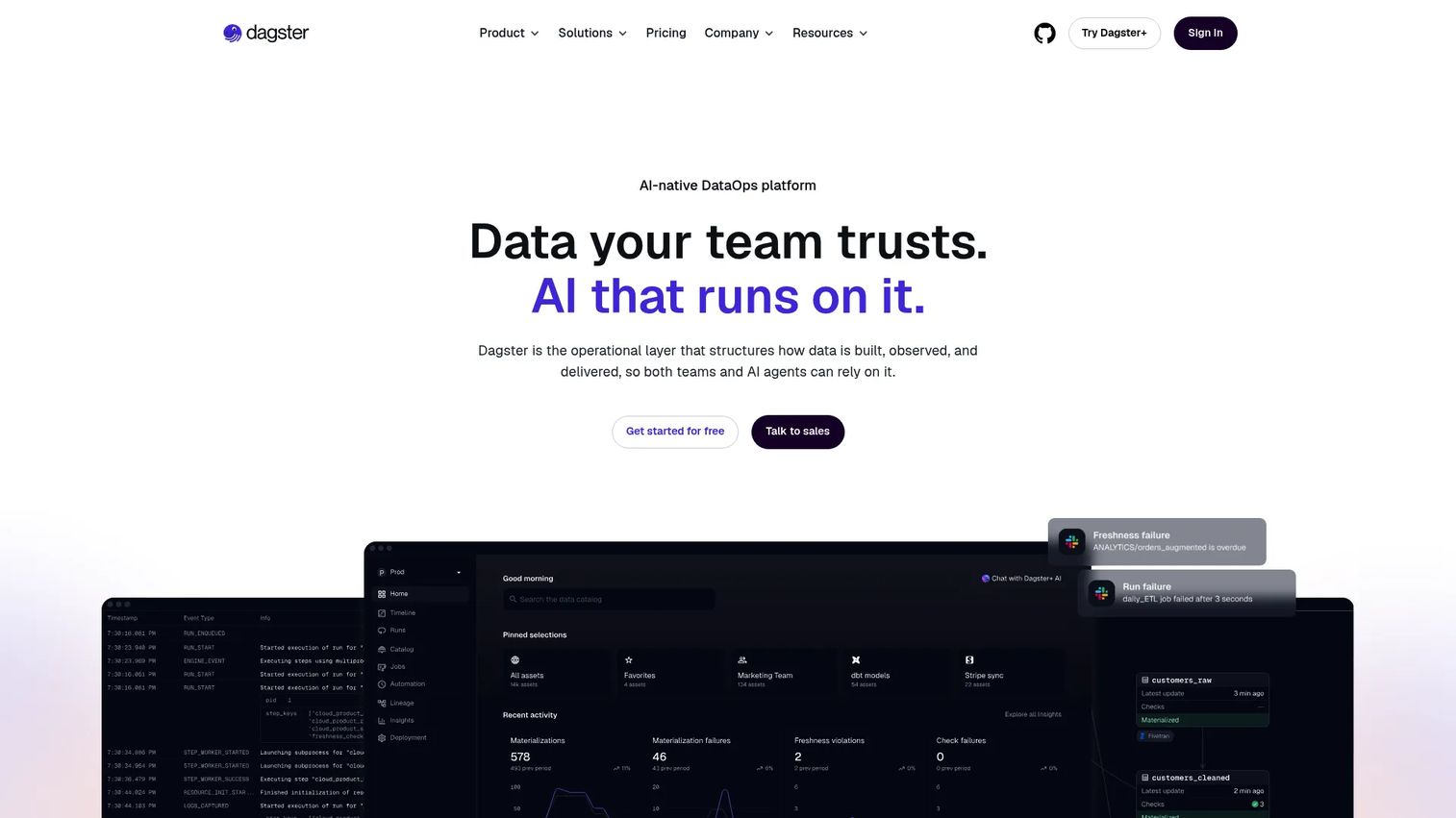
Dagster is a data and AI orchestration platform built around asset-aware pipelines, observability, and a managed cloud offering called Dagster+. Instead of scheduling tasks in isolation, Dagster models the data assets those tasks produce, so you reason about your warehouse tables and datasets directly. That asset-centric design is why orchestration-first teams gravitate to it.
The platform pairs lineage and observability with hybrid deployment and enterprise features. When your pipelines have dozens of interdependent steps and real SLAs, this is where orchestration matters more than pure ingestion. Dagster gives you the dependency graph, retries, and health visibility to keep complex workflows honest.
Best for: data teams that need asset-aware orchestration and observability across modern, multi-step pipelines.
Key strengths
- Asset-based orchestration: model and reason about the data assets your pipelines produce, not just tasks.
- Lineage and observability: built-in visibility into dependencies, freshness, and pipeline health.
- Hybrid deployment: run across environments with enterprise features when you need them.
Why choose Dagster: Choose Dagster when workflow orchestration, dependencies, and observability are the core problem rather than moving data from A to B. It fits teams running ML feature pipelines and complex transformation graphs. Pair it with an ingestion tool for source connectivity.
Dagster pricing: Dagster+ lists Solo at $10 per month, Starter at $100 per month, and Pro as contact sales. A 30-day free trial is available. Solo and Starter show public monthly list prices, while Pro is quoted based on scale.
5. AWS Glue
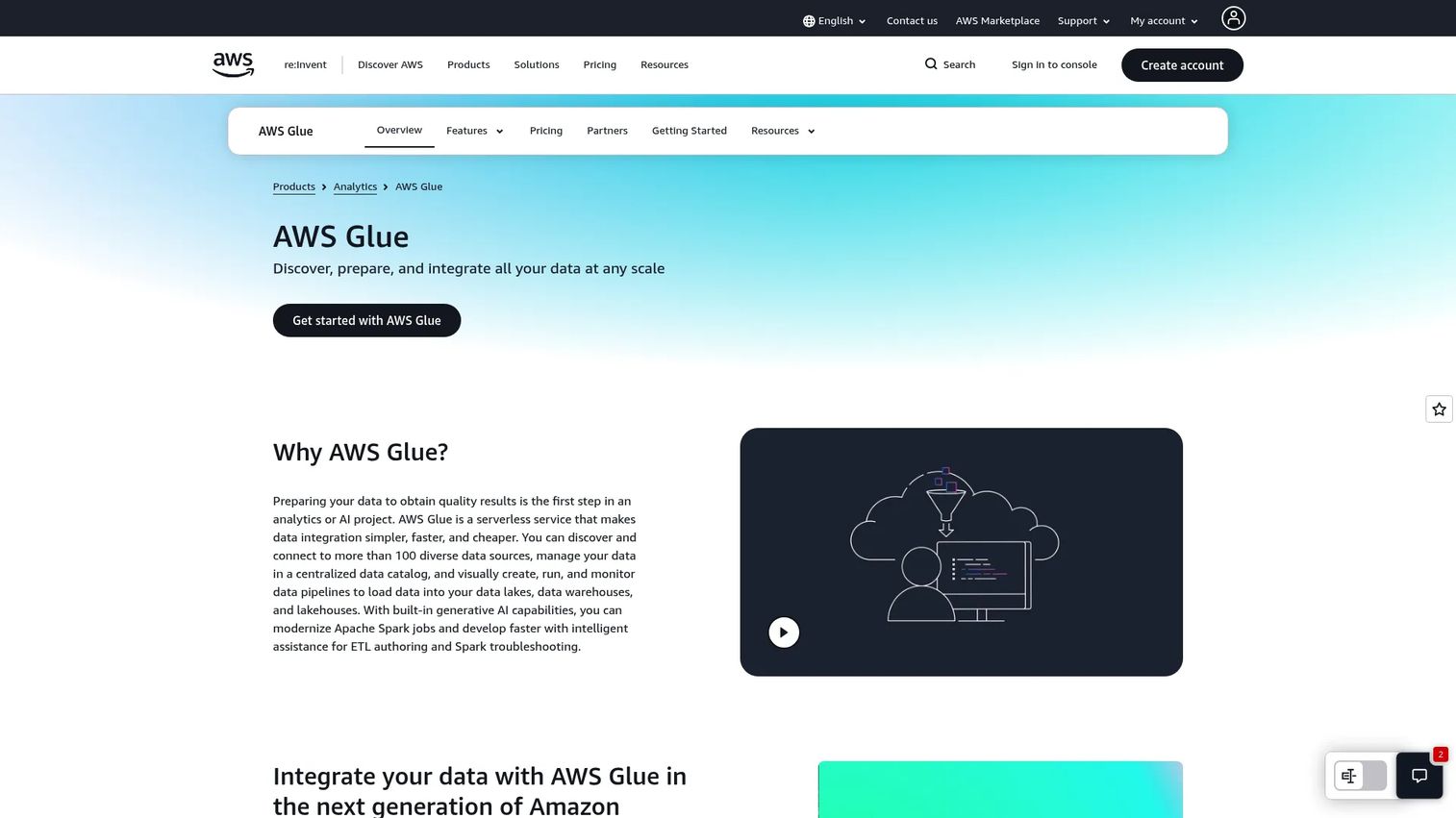
AWS Glue is a serverless data integration service for discovering, preparing, moving, and integrating data inside the AWS ecosystem. Because it is serverless, you do not provision clusters; you run jobs and pay for what you use. For teams already standardized on AWS, Glue slots into IAM, S3, and the broader stack with minimal friction.
Glue centers on a Data Catalog for schema discovery, interactive sessions and job notebooks for authoring, and crawlers plus ETL job orchestration for the actual movement. Its zero-ETL adjacency with other AWS services reduces glue code between systems. The catalog also doubles as a metadata layer other AWS tools can read.
Best for: teams already on AWS that want serverless ETL, metadata management, and native ecosystem integration.
Key strengths
- Data Catalog: centralized schema discovery and metadata usable across AWS analytics services.
- Serverless jobs: interactive sessions and notebooks with no cluster management.
- Crawlers and orchestration: automated schema detection plus ETL job scheduling.
Why choose AWS Glue: Choose Glue when your data gravity is in AWS and you want consumption pricing without managing infrastructure. It fits teams comfortable with a code-forward, AWS-native workflow. Teams on multicloud or wanting a heavily no-code experience may weigh other options.
AWS Glue pricing: AWS Glue is priced per component. ETL jobs and interactive sessions run at $0.44 per DPU-hour, billed per second. The Data Catalog includes the first million metadata objects free, then $1.00 per 100,000 objects per month. Crawlers bill at an hourly rate by the second.
6. Azure Data Factory

Azure Data Factory is Microsoft's fully managed, serverless data integration service for ETL, ELT, and pipeline orchestration. It gives you copy activities, data flows, and a managed runtime to move and transform data across hybrid and multicloud sources. For teams anchored in Azure, it is the natural orchestration and movement layer.
The service ships with more than 90 built-in connectors and code-free pipeline authoring, alongside a pay-as-you-go model with no upfront cost. Data flows let you build transformations visually while the managed runtime handles execution. This is enterprise cloud ETL and ELT with orchestration built in, tuned for the Microsoft ecosystem.
Best for: enterprise teams needing cloud ETL/ELT orchestration across hybrid and multicloud sources within Azure.
Key strengths
- 90+ connectors: broad source coverage across cloud, on-prem, and SaaS systems.
- Code-free authoring: visual ETL and ELT pipelines plus data flows for transformation.
- Managed serverless runtime: pay-as-you-go execution with no infrastructure to provision.
Why choose Azure Data Factory: Choose ADF when your stack lives in Azure and you need orchestration plus movement in one managed service. It fits enterprise teams with hybrid sources and governance needs. Plan for usage-based costs, since consumption can scale with pipeline complexity.
Azure Data Factory pricing: Azure Data Factory is priced on a usage-based, pay-as-you-go model with no upfront cost. Rates vary by activity type, data flow compute, and integration runtime usage. Microsoft publishes detailed component rates on its pricing page, so model your expected pipeline runs and data volume before committing.
7. Hevo Data
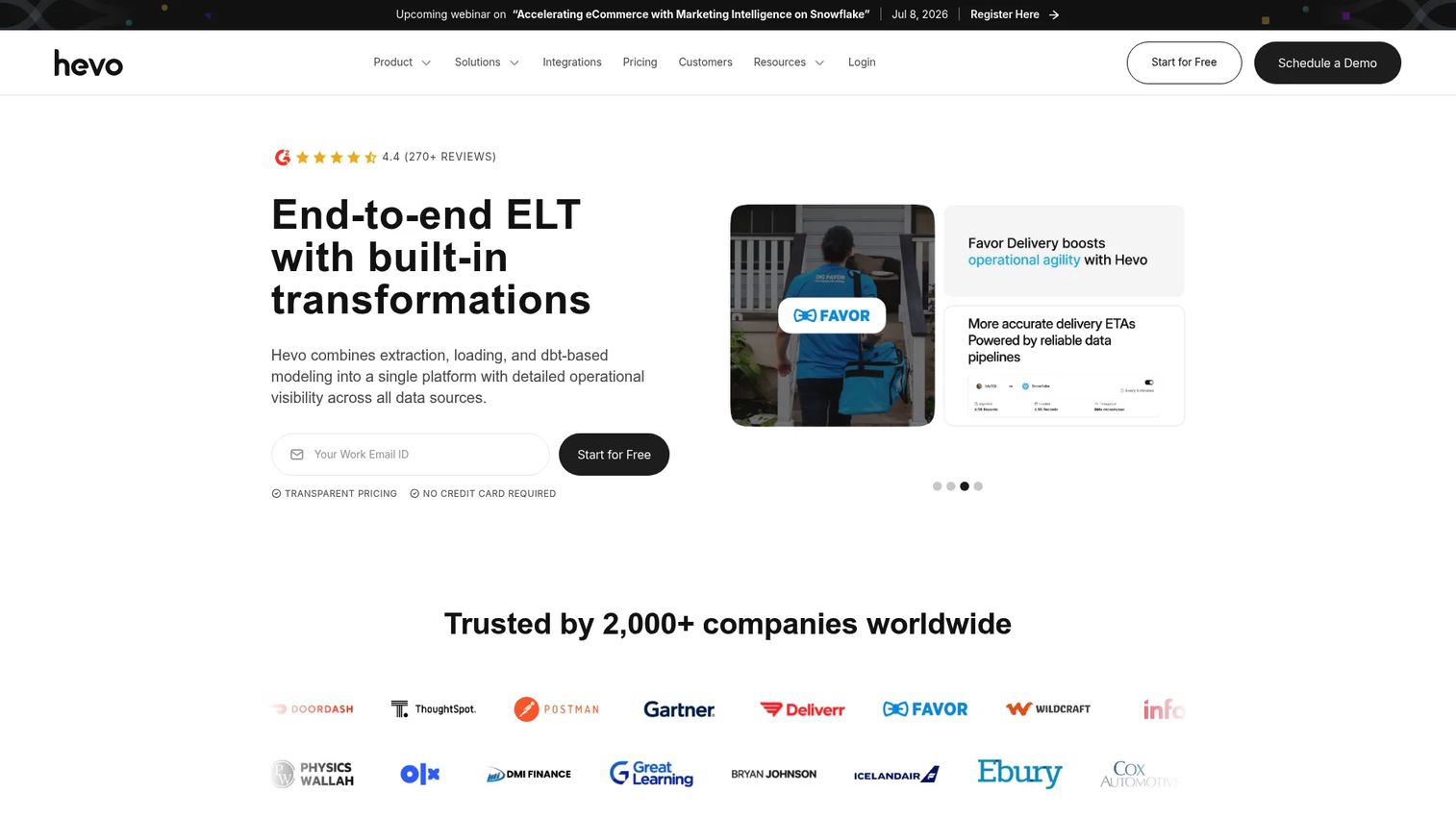
Hevo Data is a no-code ELT and data integration platform for moving data into warehouses and databases quickly. Its appeal is speed to launch: connect sources, pick a destination, and pipelines run without heavy engineering. For teams that want low-maintenance pipeline setup and fast time to value, Hevo lowers the barrier.
The platform offers 150+ integrations, both Python code-based and drag-and-drop transformations, and monitoring with alerts tied to usage-based event tracking. That combination lets a small team stand up dependable data movement without a dedicated data engineering hire. Event-based pricing keeps the entry point accessible for growing workloads.
Best for: small and growing teams that want fast, no-code pipeline setup with minimal maintenance.
Key strengths
- 150+ integrations: solid connector coverage for common SaaS, database, and warehouse targets.
- No-code plus code: drag-and-drop transformations with a Python option for custom logic.
- Monitoring and alerts: built-in pipeline health tracking with event-based usage visibility.
Why choose Hevo Data: Choose Hevo when implementation speed and low maintenance are the priority and you want a no-code entry point. It fits lean teams and early-stage data functions. Teams needing deep custom orchestration or very high connector breadth may layer in additional tooling later.
Hevo Data pricing: Hevo offers a Free plan at $0 that includes 1 million events per month. Paid tiers include Starter, Professional, and Business, scaling by event volume, with Business as custom. Hevo's consumption pricing page lists Free at $0 and higher tiers by event usage, so size your monthly event volume to estimate cost.
8. Rivery
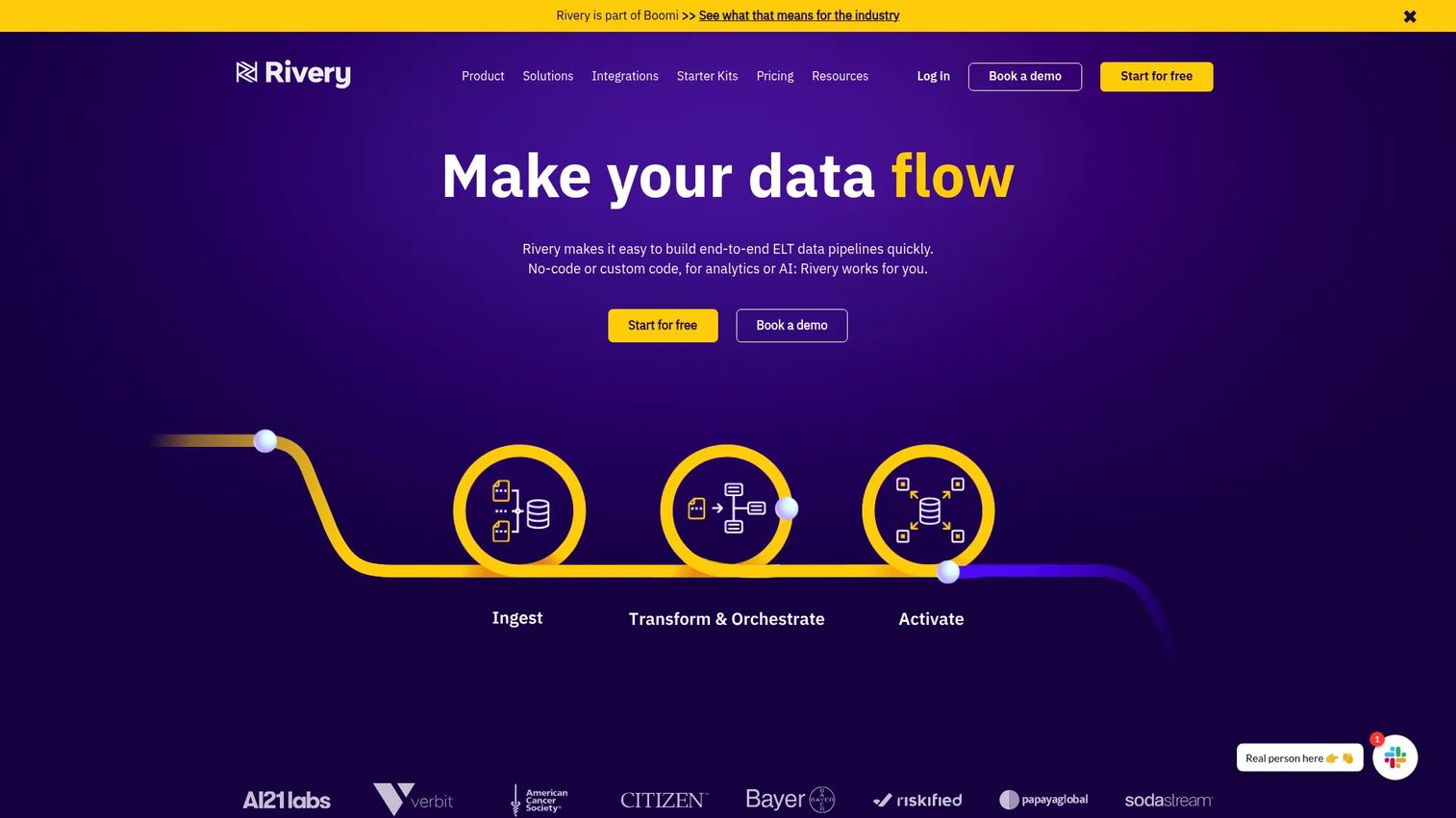
Rivery is a cloud ELT and data integration platform that combines ingestion, transformation, orchestration, and activation, including reverse ETL. It aims to consolidate the layers many teams stitch together separately. If you are running one tool for ingestion, another for orchestration, and a third for reverse ETL, Rivery's appeal is folding those into a single platform.
The platform offers 200+ connectors, end-to-end ELT pipelines, CDC, and multi-environment management for dev, staging, and production. Usage-based pricing on BDU credits ties cost to actual work. For teams tired of workflow-layer sprawl, this consolidation is the draw.
Best for: teams consolidating ingestion, orchestration, CDC, and reverse ETL into one usage-based platform.
Key strengths
- End-to-end ELT: ingestion, transformation, orchestration, and activation in a single platform.
- 200+ connectors and CDC: broad source coverage with change data capture support.
- Multi-environment management: dev, staging, and production separation for safer releases.
Why choose Rivery: Choose Rivery when you want to collapse multiple workflow layers into one usage-based tool with reverse ETL included. It fits teams reducing tool sprawl and standardizing pipeline operations. The Rivery site now references Boomi Data Integration, though the product remains on rivery.io.
Rivery pricing: Rivery's Base plan is introductory pay-as-you-go at $0.9 per BDU credit. Professional starts for free, while Pro Plus and Enterprise are contact-sales plans. A free trial includes 14 days or 1,000 free credits, whichever comes first.
9. Informatica
Informatica is an enterprise data management platform spanning data integration, governance, quality, MDM, catalog, and AI-ready data operations. Its Intelligent Data Management Cloud, IDMC, is the umbrella for these capabilities. For large organizations where governance and control are non-negotiable, Informatica is built for that reality rather than for quick pipeline stand-up.
The platform covers Data Catalog, Data Integration, API and app integration, Data Quality and Observability, MDM and 360 applications, Governance, Access and Privacy, and a Data Marketplace. Multi-cloud and hybrid deployment plus CLAIRE AI and agents round out the breadth. This is enterprise governance, lineage tracking, and access controls at platform scale.
Best for: large enterprises needing governed, AI-ready data management across hybrid and multi-cloud environments.
Key strengths
- IDMC platform: unified data integration, quality, governance, and catalog under one cloud.
- Enterprise governance: access controls, lineage tracking, and auditability built for regulated data.
- CLAIRE AI: AI-assisted optimization and agents across data operations.
Why choose Informatica: Choose Informatica when enterprise governance, data quality, and broad platform breadth matter more than lightweight setup. It fits regulated industries and large data functions. Smaller teams may find the platform's scope more than they need for straightforward data movement.
Informatica pricing: Informatica does not publish a public dollar amount, tiers, or free tier. The pricing page describes flexible, consumption-based pricing and directs you to request a quote. Expect enterprise packaging aligned to processing volume and modules used.
10. Qlik
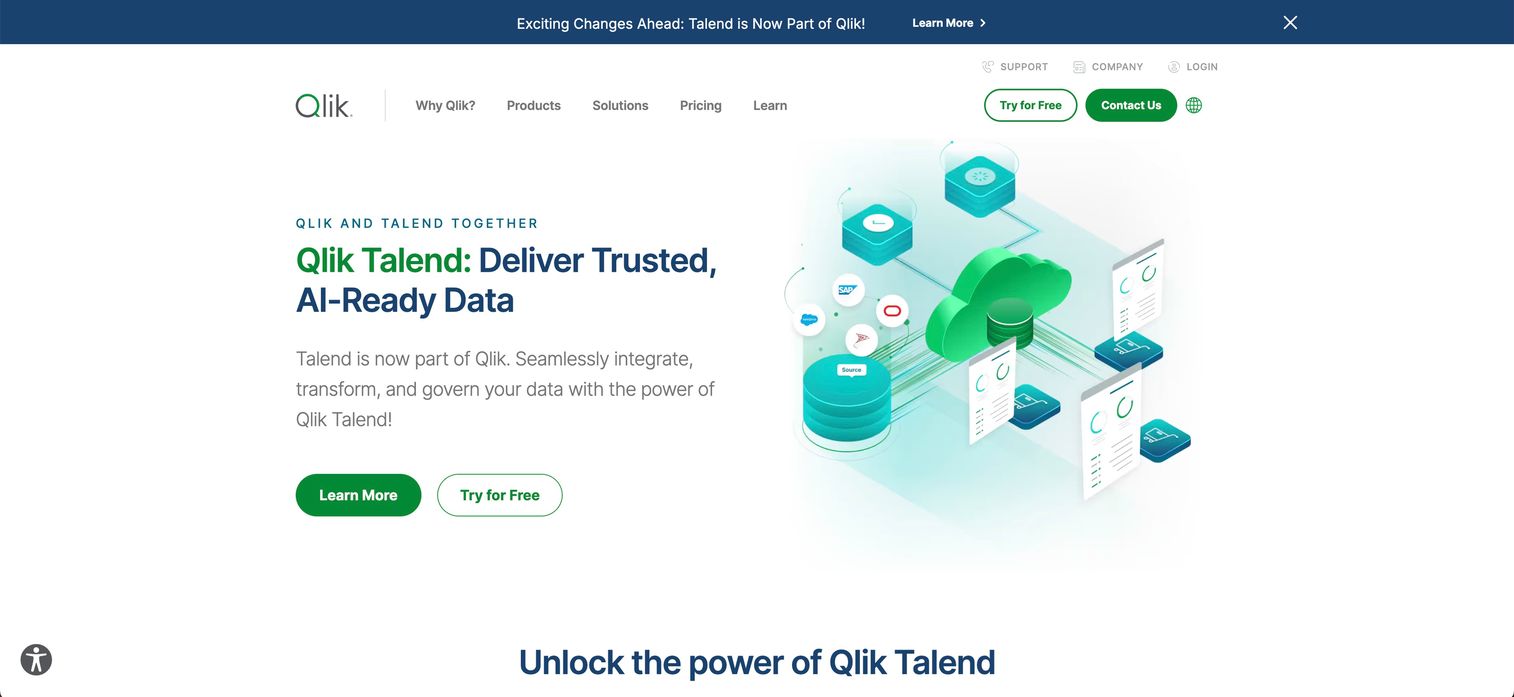
Qlik is a cloud-based data integration, quality, and governance platform, now part of Qlik. It targets enterprises that need governed data movement paired with quality controls across cloud and hybrid environments. The combination of integration plus quality and governance in one platform is its position in the modern data integration stack.
The platform covers data integration, data quality and governance, and cloud, on-premises, and hybrid deployment. Subscription tiers and packaging suit organizations that want managed integration with strong quality guarantees. For hybrid enterprise needs where trust in the data matters as much as moving it, this pairing is the point.
Best for: enterprises needing governed data integration and quality across cloud and hybrid environments.
Key strengths
- Integration plus quality: data movement paired with built-in data quality and governance.
- Hybrid deployment: cloud, on-premises, and hybrid support for complex environments.
- Enterprise governance: controls and quality guardrails for regulated, distributed data.
Why choose Qlik: Choose Qlik Talend Cloud when data quality and governance are as important as integration, and you operate across hybrid environments. It fits enterprises consolidating movement and quality. Teams wanting a purely lightweight ingestion tool may find the governance depth beyond their current needs.
Qlik pricing: Qlik Talend Cloud does not display a public first-party numeric price; packaging typically requires contacting sales. A free trial is offered to evaluate the platform. Expect subscription tiers scaled to data volume, users, and governance requirements.
11. Snowflake
Snowflake is serverless data ingestion service for loading files and streaming data into Snowflake. It loads files as soon as they land in a stage, using pipe objects with COPY statements for automated ingestion. For teams whose warehouse is Snowflake, this is the native, low-latency loading path.
Snowpipe is serverless with near real-time availability and exactly-once semantics, which matters when zero data loss and correctness are requirements. It is best understood as warehouse-native loading rather than a full general-purpose pipeline platform. You still need upstream tooling for broad connectors and transformation, but for getting data into Snowflake fast, Snowpipe is purpose-built.
Best for: teams that need automated, low-latency ingestion into Snowflake without managing infrastructure.
Key strengths
- Land-and-load: ingests files as soon as they arrive in a stage for near real-time availability.
- Serverless pipes: pipe objects with COPY statements automate ingestion with no infrastructure.
- Exactly-once semantics: correctness guarantees that support zero data loss requirements.
Why choose Snowflake Snowpipe: Choose Snowpipe when Snowflake is your warehouse and you want native, fast ingestion. It fits teams that already run Snowflake and want to minimize loading complexity. Pair it with connector and transformation tooling for a complete pipeline, since it is a loading path rather than an all-in-one platform.
Snowflake Snowpipe pricing: Snowpipe billing is usage-based at 0.0037 credits per uncompressed GB ingested, applied across editions. There is no traditional tiered plan list; cost scales directly with ingestion volume. Model your expected GB per month against your Snowflake credit rate to estimate spend.
Considerations before you buy
Feature lists converge fast in this category. What actually separates these tools is how they behave when things go wrong and how they fit your team. Use this checklist.
Latency and CDC support
Decide whether you truly need a real-time data pipeline or whether hourly and daily batches are fine. Real-time requirements push you toward CDC-native tools and warehouse-native loading. Over-buying latency you do not need adds cost and complexity for no return.
Schema evolution and reliability
Sources change. The question is whether the tool absorbs schema evolution automatically or breaks and pages someone at 2 a.m. Evaluate how each platform handles column additions, type changes, and drift, plus retries, failure handling, and zero data loss guarantees. This is the difference between infrastructure you trust and infrastructure you babysit.
Observability and lineage
You cannot fix what you cannot see. Look for observability, alerting, and lineage tracking so you know when a pipeline is late, wrong, or dropping records before your dashboards lie. For a product manager defending activation and retention numbers, this is not optional.
Governance and access controls
For regulated data, evaluate access controls, auditability, and admin controls. Enterprise governance depth varies widely across these tools, and retrofitting it later is painful. Confirm the platform meets your security and compliance bar upfront.
Total cost of ownership
Sticker price is the smallest line item. Weigh usage-based costs against maintenance burden, incident risk, and engineering opportunity cost. A cheaper tool that consumes a data engineer's week every month is not cheaper. Factor cost optimization and implementation speed into the real number.
Conclusion
There is no universal winner in data pipeline software, only the right fit for your latency needs, governance requirements, team skill, and how much orchestration you actually run.
If you want managed ingestion with minimal upkeep, Fivetran and Hevo Data lead. If deployment flexibility and connector extensibility matter, Airbyte fits. When workflow orchestration is the real problem, Dagster earns the pick. For warehouse-first ELT, Matillion and Rivery consolidate the layers well. If you live in a cloud ecosystem, AWS Glue and Azure Data Factory are the native choices, and Snowflake Snowpipe is the fast loading path into Snowflake. For enterprise governance at scale, Informatica and Qlik Talend Cloud are built for it.
The practical next step: shortlist two or three tools that match your architecture, then test each against one real pipeline you already understand. Measure implementation speed, reliability under a schema change, and total cost before you standardize. As you weigh the analytics layer sitting downstream, it helps to review how analytics platforms drive ROI and how an enterprise search layer makes that data findable.
Start your journey with Guideflow today!
FAQs
Data pipeline software is the broad category for moving, transforming, orchestrating, and loading data from sources into destinations. ETL is one pattern within it that transforms data before loading, while ELT loads first and transforms in the warehouse. Modern data pipeline platforms often combine ETL tools, ELT tools, orchestration, and warehouse-native loading in one place.
For small teams, low-maintenance and fast-to-launch options like Hevo Data and Fivetran tend to fit best, since they minimize engineering overhead. The tradeoff is less deep customization than an orchestration-heavy platform like Dagster. Start with a managed tool, then add orchestration or custom transformation only when your workflows demand it.
Prioritize latency, CDC support, and schema evolution handling, since those determine how fresh and reliable your data stays. Also weigh observability and failure handling, because near real-time systems fail in more visible ways. Tools with warehouse-native loading and exactly-once semantics help meet zero data loss requirements.
Ingestion tools move data, but as workflows grow more steps, dependencies, and SLAs, data orchestration becomes important. Orchestration platforms manage retries, scheduling, lineage, and dependency graphs across the whole pipeline. If your pipelines are simple and independent, you may not need a dedicated orchestrator yet.
Evaluate them together as total cost of ownership. A cheaper tool that fails often or requires constant maintenance costs more in incident risk and engineering time than a pricier, dependable one. For product teams relying on data for activation and retention decisions, reliability usually wins, but model both against your real workload.
Informatica and Qlik Talend Cloud are built for enterprise governance, with strong access controls, lineage tracking, data quality, and auditability. Azure Data Factory and AWS Glue also offer solid governance within their respective cloud ecosystems. Match the depth of governance to your compliance requirements rather than over-buying.
Warehouse-native loading like Snowflake Snowpipe is excellent for fast ingestion into a single warehouse, but it is a loading path, not a full platform. If you need broad connectors, transformation, and orchestration across many sources, pair it with a fuller data pipeline platform. For Snowflake-centric teams with narrow needs, native loading may be enough on its own.