A denied claim is not a paperwork problem. It is cash that already left the building and has not come back yet. As of 2024, over 40% of healthcare providers lose more than USD 500K annually from claim denials, and 18% lose more than USD 1M, according to Kodiak RCA data cited by MarkNtel Advisors. That is real money sitting in a queue while your team rebuilds the same appeal letter for the fifth time this week.
The math gets worse when you look at how the work still gets done. Nearly 50% of providers still review denials manually as of 2024, according to Experian Health data cited by MarkNtel Advisors. Manual handling works at low volume. It breaks the moment you scale, because every denial becomes a fresh investigation, every appeal a fresh draft, and every status check a fresh trip through a payer portal.
That is the operational reality a good denial management solution is built to fix. The best tools do two jobs at once. They prevent denials before a claim goes out the door, and they recover revenue after a denial lands. Prevention keeps clean claims moving. Recovery gets paid on the ones that slip. The market is responding fast: the denials management software segment is projected to grow from USD 1.49B in 2026 to USD 4.46B by 2034 at a 14.69% CAGR, per Fortune Business Insights.
This guide compares seven platforms on how much automation, analytics, and workflow coordination they bring to those two jobs, so you can shortlist by fit rather than by feature checklist.
What's inside
This guide is for revenue cycle leaders, billing managers, hospital administrators, and finance operators comparing healthcare denial management software. We evaluated each tool on four criteria that actually move the needle: appeal automation depth, root cause analytics, integration fit with your EHR, HIS, and practice management systems, and suitability for your organization type, whether that is a hospital, a multi-site provider group, or a single practice.
The list covers denial prevention, denial appeal management, analytics, workflow automation, and integration. Tools are ordered by practical relevance to denial management work, not alphabetically. Pricing and ratings reflect verified public sources where available.
TL;DR
- Best overall for AI prioritization and broad denial workflow coverage: Waystar, which pairs claim management with denial and appeal automation across large revenue cycle teams.
- Best for appeal workflow efficiency and revenue diagnostics: Rivet, built around worklists and payer performance analytics.
- Best for claim accuracy and scrubbing before submission: Aptarro, with an AI-driven revenue cycle engine focused on claim editing.
- Best for hospitals needing clinical workflow alignment: EvidenceCare, which embeds prevention into admission and documentation decisions.
- Best for enterprise breadth across the full revenue cycle: FinThrive, for teams consolidating multiple revenue cycle functions.
- Best for ambulatory practices in the NextGen ecosystem: NextGen Healthcare, with denial workflows inside an integrated EHR and practice management platform.
- Best for smaller practices wanting an all-in-one billing platform: AdvancedMD, with transparent specialty-based pricing.
What is denial management software?
Denial management software is a category of healthcare technology that helps provider organizations prevent, track, appeal, and recover revenue from denied insurance claims. It sits inside the broader revenue cycle management software stack and connects to EHR, hospital information systems, and practice management platforms to catch problems early and resolve them fast.
It does two jobs. The first is claim denial prevention: catching coding errors, eligibility gaps, and documentation issues before a claim is submitted, so fewer claims come back rejected. The second is denial recovery software work: routing denied claims to the right staff, drafting appeals, batching submissions, and tracking status until the payer pays. Prevention shrinks the inbound denial volume. Recovery gets paid on what still slips through.
Modern tools typically bring:
- Automated denial routing and prioritization so high-value or time-sensitive claims surface first
- Appeal creation and templating to stop staff from rebuilding the same letters
- Batch appeal submission and tracking across multiple payers at once
- Timely filing alerts so recoverable claims do not age out
- Root cause analysis that groups denials by reason, payer, provider, and service line
- Denial analytics and benchmarking on recovery rate, backlog, and turnaround time
- EHR integration and connections to HIS, PM, and billing systems
The strongest platforms also surface trends over time, so leadership can see whether a spike came from a specific payer, a new coder, or a policy change, and act before it compounds.
When to use denial management software
Not every billing operation needs a dedicated platform on day one. Here is how to tell when the manual approach has stopped scaling.
Reduce manual appeal work
Use denial management tools when your staff are rebuilding the same appeal letters, chasing status updates by phone, and losing hours to payer portal workflows. When the same denial reasons cycle through your queue every month, templating and appeal automation turn a multi-hour rebuild into a review-and-send. That time goes back into working the claims that need a human.
Prevent recurring denial patterns
Use it when the same coding, eligibility, or documentation issues keep showing up. If your team keeps appealing the same rejection reason across the same payer, the fix is upstream. Prevention-focused tooling flags those issues before submission, so you stop generating denials you already know how to avoid.
Improve cash flow visibility
Use it when leadership needs a clearer view of recovery rates, backlog, and turnaround time. When a strong month is followed by a weak one and nobody can say why, denial analytics turn the cash flow impact into something you can read on a dashboard and defend in a meeting.
Comparison table
The table below ranks the seven platforms by relevance to denial management software searches. Intent describes what job the tool is built around. Key use case names the specific work it does best. Pricing and G2 ratings reflect verified public sources; where a vendor keeps pricing behind a sales conversation, that is noted.
| # | Product | Intent | Key use case | Pricing | G2 rating |
|---|---|---|---|---|---|
| 1 | Waystar | Broad RCM with denial and appeal automation | AI prioritization across large revenue cycle teams | Request pricing | 4.4/5 |
| 2 | Rivet | Revenue diagnostics and appeal workflows | Payer performance and worklist-driven recovery | Contact sales | Not rated |
| 3 | Aptarro | Claim accuracy and scrubbing | Pre-submission claim editing and denial reduction | Custom quote | 4.6/5 |
| 4 | EvidenceCare | Clinical decision support for prevention | Hospital admission and documentation alignment | Contact sales | Not rated |
| 5 | FinThrive | End-to-end RCM | Enterprise revenue cycle consolidation | Contact sales | Not rated |
| 6 | NextGen Healthcare | Integrated EHR and PM | Ambulatory practice denial workflows | Contact sales | 3.8/5 |
| 7 | AdvancedMD | All-in-one practice management and billing | Small to mid-market practice billing | From $130/month per provider | 3.6/5 |
1. Waystar

Waystar is healthcare revenue cycle management software built around claims, payments, eligibility, and patient financial care. For denial management specifically, it combines claim management and clearinghouse workflows with denial and appeal handling, so large provider organizations can prioritize which denials to work first and automate the repetitive parts of the appeal process. It is the broadest platform on this list, which is why it leads it.
The pitch for a scaling revenue cycle team is coordination. Instead of denial work living in one silo and payment posting in another, Waystar keeps claim management, price transparency, and financial clearance in the same system. That matters when your denial backlog is a symptom of upstream problems in eligibility or estimation, because you can trace a denial back to where it started without switching tools.
Best for: Large healthcare providers and billing organizations that need automated claim, payment, and denial workflows in one revenue cycle platform.
Key strengths
- Claim management and clearinghouse workflows: Submit, scrub, and track claims across payers from a single queue.
- Denial and appeal handling with prioritization: Surface high-value and time-sensitive denials first so staff work the right claims.
- Patient payment and financial clearance: Connect eligibility, estimation, and price transparency to reduce denials that start upstream.
Why choose Waystar: Choose it if you run a complex revenue cycle and want denial management as part of a larger connected system rather than a standalone appeals tool. The breadth is the point. Smaller practices with simple billing may find that reach more than they need.
Waystar pricing: Waystar lists packaged offerings, including Starter, Core, Performance, and Premium tiers for claim management, but publishes no numeric prices. The pricing page shows "Request pricing," so plan to scope a quote against your claim volume and module needs. Waystar holds a 4.4/5 rating on G2.
2. Rivet
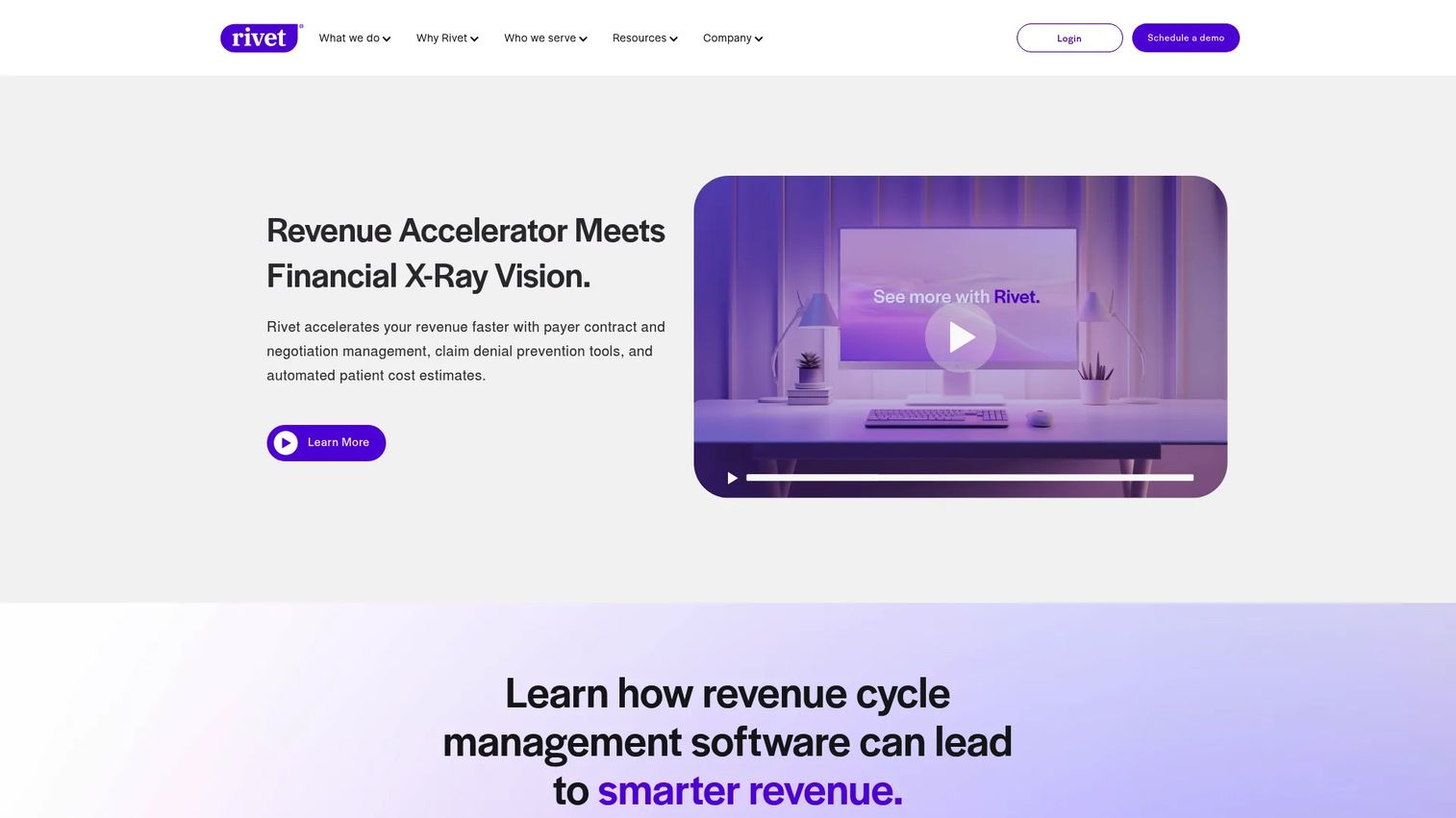
Rivet is healthcare revenue cycle management software focused on revenue diagnostics, payer contract management, and patient pricing. Its denial work centers on worklists and reporting, so teams can move through denied claims in a structured, repeatable order rather than triaging by hand. For denial appeal management, that worklist model is the draw: it standardizes how staff pick up, work, and close denials.
Rivet leans into diagnostics. Its revenue diagnostics module uses AI-based forecasting and reporting to show where revenue is leaking, and its payer performance tools benchmark contracts and fee schedules against actual payment behavior. That combination helps a team see not just which claims were denied, but which payers deny most and why, which is the input every prevention effort needs.
Best for: Provider groups that want appeal workflow efficiency paired with contract and revenue analytics.
Key strengths
- Revenue diagnostics with AI forecasting: Surface where revenue is leaking before it shows up as a denial backlog.
- Payer performance and contract management: Benchmark payer behavior against fee schedules to spot systematic denial sources.
- Worklist-driven denial resolution: Standardize how staff pick up and close denied claims for repeatable throughput.
Why choose Rivet: Choose it when your team needs a consistent, standardized way to work denials and you also want visibility into payer and contract performance. The analytics layer is the differentiator here.
Rivet pricing: Rivet does not publish pricing on its site, which is oriented toward demos and sales conversations. Plan to contact the vendor for a quote scoped to your organization. A current public G2 rating for Rivet was not available at the time of writing.
3. Aptarro
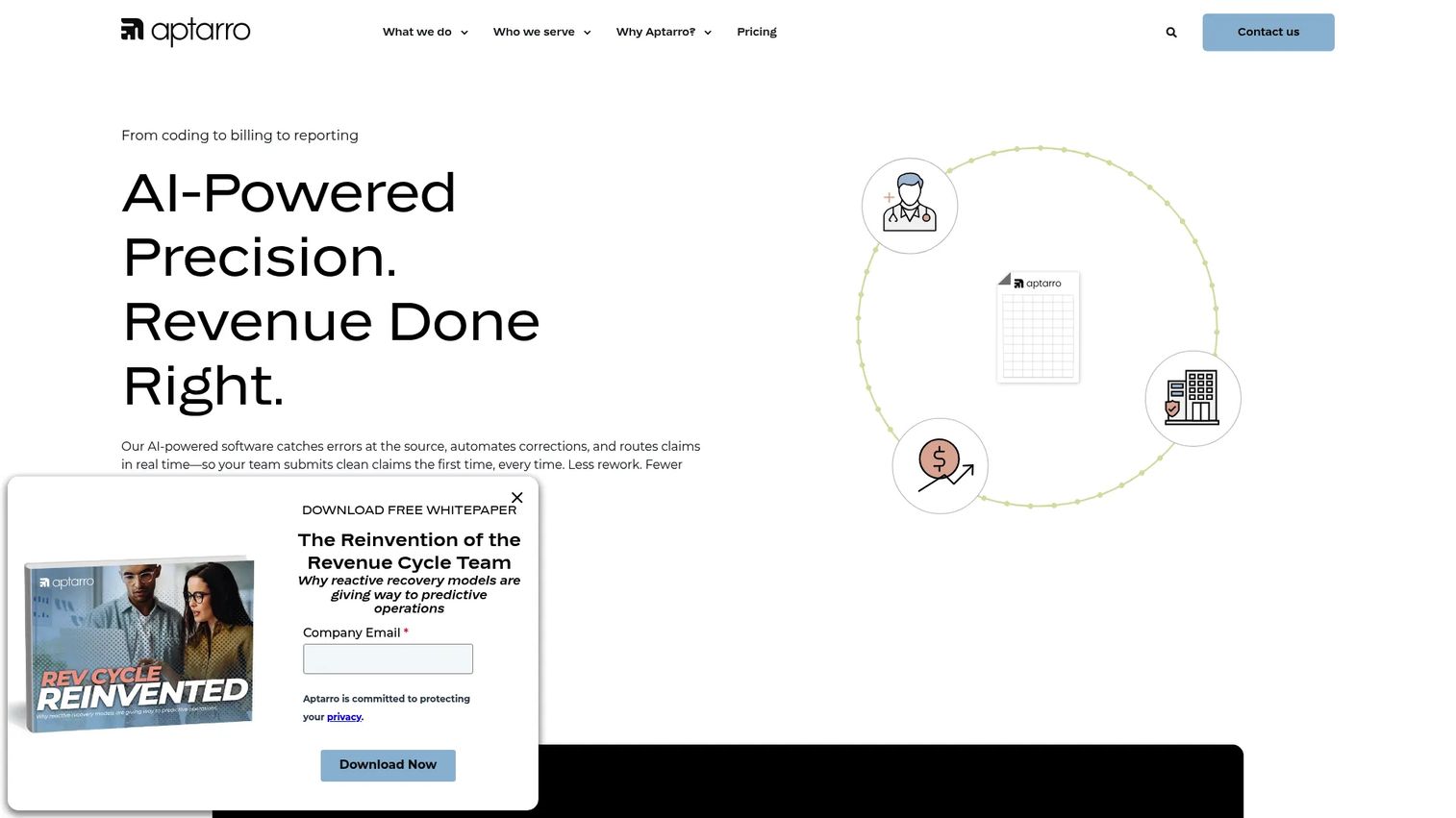
Aptarro is healthcare revenue cycle management software focused on reducing denials and improving claim accuracy. Its center of gravity is prevention: an AI-powered revenue cycle engine and claim editing workflows that catch problems before a claim reaches the payer. For teams whose denial volume traces back to clean-claim issues, that pre-submission focus is the most direct lever.
The platform pairs claim scrubbing with denial management, so it works both jobs. Claims get edited and validated on the way out, and denials that still land get routed and worked on the way back. Aptarro also supports HCC coding, which matters for organizations managing risk-adjusted populations where coding accuracy directly affects reimbursement and denial exposure.
Best for: Healthcare organizations that want to reduce denials at the source through claim scrubbing and coding accuracy.
Key strengths
- AI-powered revenue cycle engine: Automate claim validation and flag denial risks before submission.
- Claim editing and scrubber workflows: Catch coding and formatting errors that drive avoidable denials.
- HCC coding support: Improve coding accuracy for risk-adjusted populations and reduce related denial exposure.
Why choose Aptarro: Choose it when your denials trace back to claim accuracy and you want to fix the problem upstream rather than appeal it downstream. It works as a broader revenue cycle platform with denial management built into a larger claim accuracy system.
Aptarro pricing: Aptarro uses custom, volume-based pricing and does not display a numeric starting price. Its pricing page points to a custom quote. Aptarro holds a 4.6/5 rating on G2, the highest verified rating on this list.
4. EvidenceCare
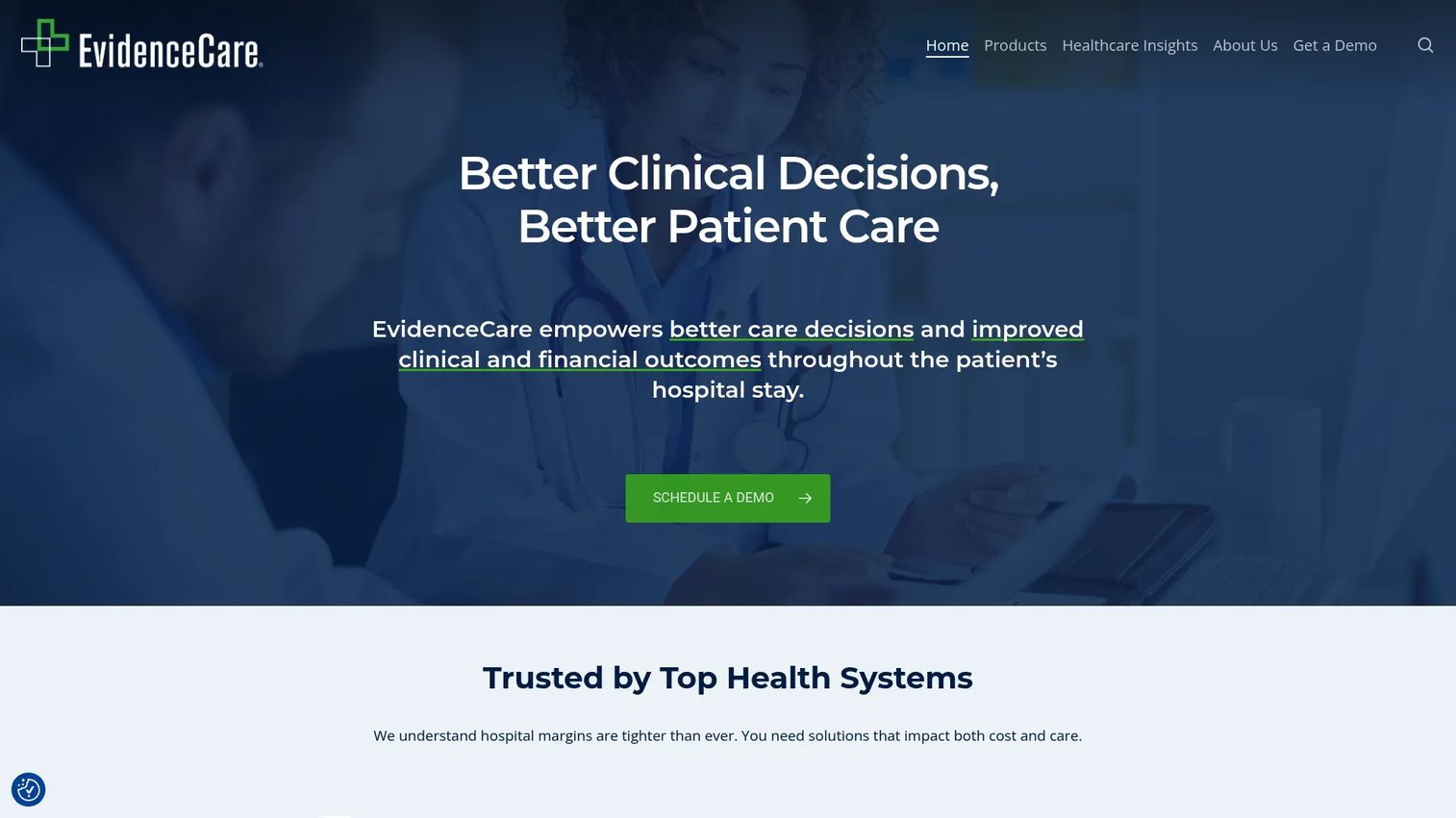
EvidenceCare is an EHR-integrated clinical decision support platform for hospitals and health systems. It approaches denial management from an angle most tools skip: the clinical decision itself. By embedding guidance into admission and documentation workflows, it aims to prevent the denials that start with the wrong bed status or missing medical necessity documentation, before billing ever sees them.
This is a hospital denial management software play, and it fits a specific use case. Its AdmissionCare module gives bed status guidance and documentation support at the point of admission, while CareGauge surfaces real-time care utilization and cost transparency. The idea is that a denial avoided at the clinical decision point never becomes an appeal, which is the cheapest denial to handle: the one that never happens.
Best for: Hospitals and health systems that want to prevent denials inside clinical decision and documentation workflows.
Key strengths
- EHR-agnostic clinical decision support: Embed guidance directly in provider workflows regardless of underlying EHR.
- AdmissionCare for bed status guidance: Get admission status and documentation right at the point of decision.
- CareGauge for utilization transparency: Surface real-time care cost and utilization data to support medical necessity.
Why choose EvidenceCare: Choose it when a meaningful share of your denials are clinical in origin, tied to admission status or medical necessity documentation, and you want prevention embedded in the provider workflow rather than caught by billing after the fact.
EvidenceCare pricing: EvidenceCare does not publish pricing; the site directs visitors to schedule a demo or contact the company. A current public G2 rating could not be verified at the time of writing.
5. FinThrive
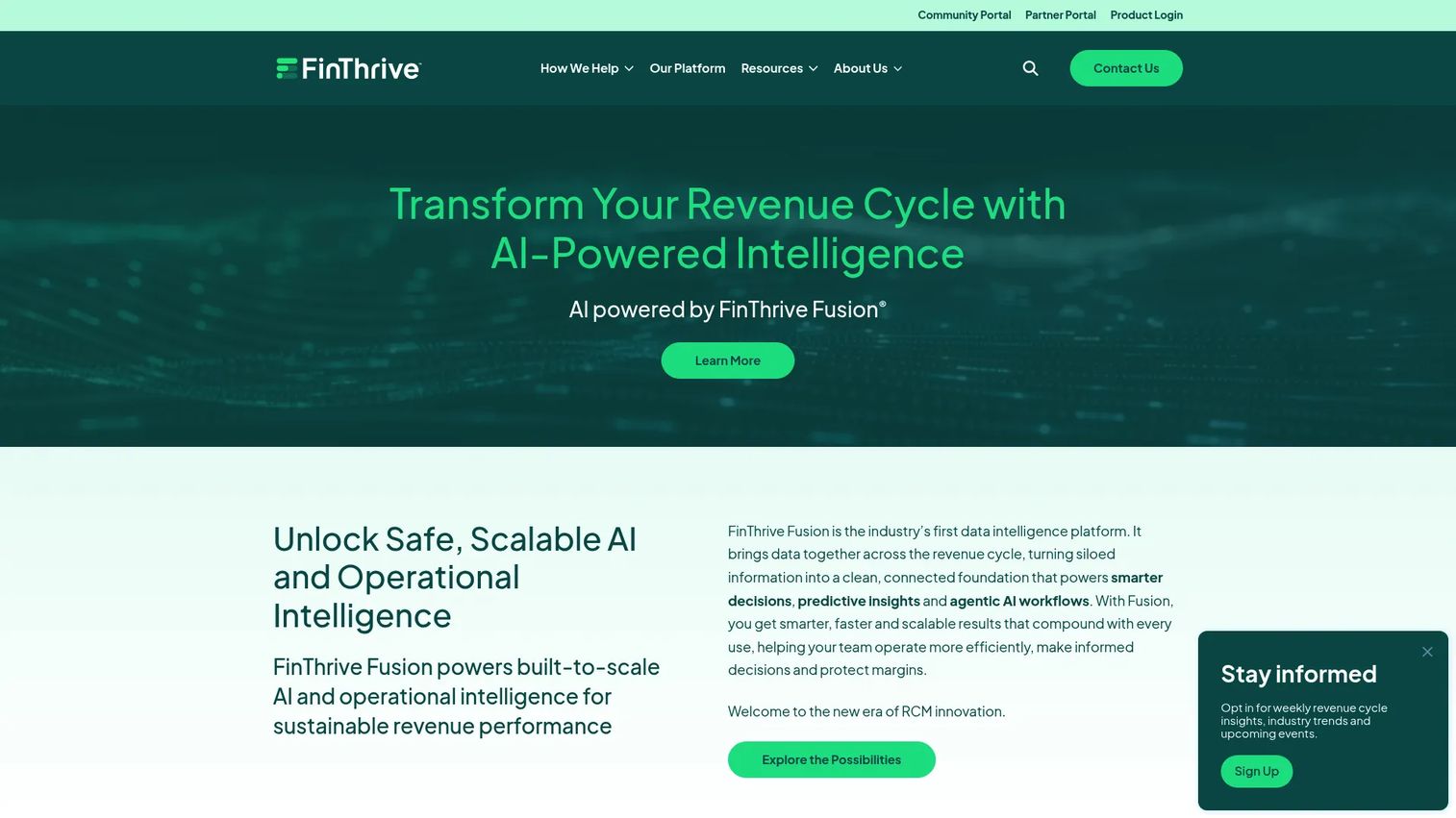
FinThrive is healthcare revenue cycle management technology for hospitals and health systems, built to cover the full cycle rather than one slice of it. Denial management lives inside a broader platform that spans patient access, revenue optimization, and revenue integrity. For organizations trying to consolidate multiple revenue cycle functions, that breadth is the reason to look.
The appeal for a scaling health system is fewer disconnected tools. Patient access solutions handle price transparency and digital intake, revenue optimization tools cover claims, contract management, and insurance discovery, and revenue integrity plus analytics run through FinThrive Fusion. When denial work connects to intake, contracts, and integrity checks in the same platform, root cause analysis gets easier because the data is already together.
Best for: Hospitals and health systems seeking end-to-end revenue cycle management with denial handling as one connected function.
Key strengths
- Patient access with price transparency: Reduce front-end denials through digital intake and eligibility checks.
- Revenue optimization tools: Manage claims, contracts, and insurance discovery in one connected layer.
- Revenue integrity and analytics via Fusion: Run root cause analysis on denials with data already unified across the cycle.
Why choose FinThrive: Choose it when consolidation is the goal and you want denial management as part of an end-to-end revenue cycle platform rather than a point solution. The value is in reducing tool sprawl across a large operation.
FinThrive pricing: FinThrive does not publish public pricing on its site, which uses demo and contact-sales flows. Plan to scope a quote with the vendor. A current public G2 rating could not be verified at the time of writing.
6. NextGen Healthcare
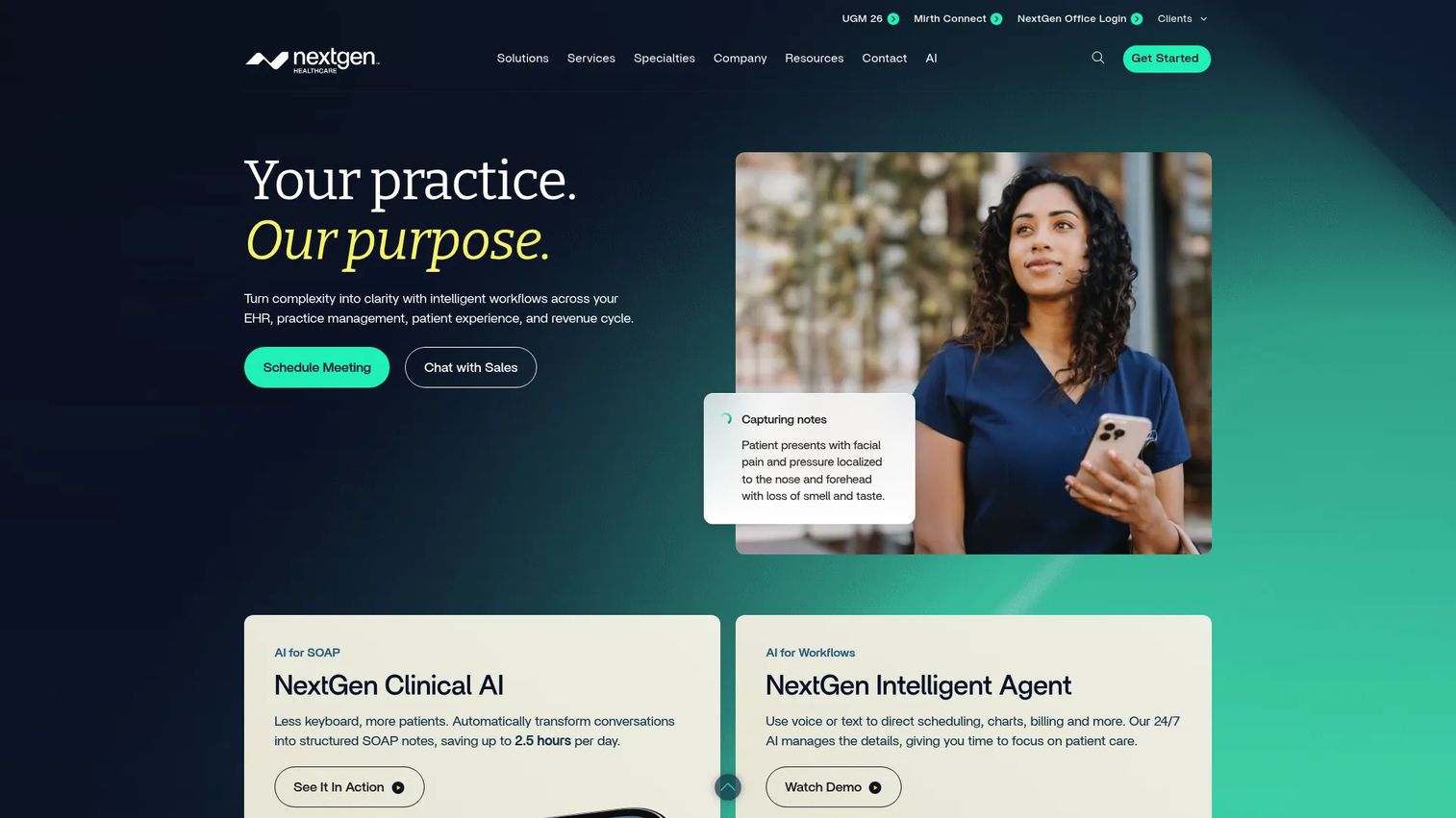
NextGen Healthcare is a healthcare software company offering cloud-based EHR, practice management, patient experience, interoperability, and revenue cycle solutions for ambulatory practices. Denial workflows live inside that integrated platform, so practices already running NextGen for clinical and scheduling work can handle denials without adding a separate tool.
The fit here is ecosystem-driven. If your outpatient or specialty clinic already runs on NextGen for EHR and practice management, keeping denial workflows in the same system means EHR integration is a given rather than a project. Its clinical AI documentation and ambient listening features also target the documentation gaps that drive clinical denials, which ties prevention back to the point of care.
Best for: Ambulatory practices already using the NextGen ecosystem for EHR and practice management.
Key strengths
- Cloud-based EHR and practice management: Run clinical, scheduling, and denial workflows in one integrated platform.
- Patient experience workflows: Handle scheduling, reminders, portal, and virtual visits alongside billing.
- Clinical AI documentation: Use ambient listening to close documentation gaps that drive clinical denials.
Why choose NextGen Healthcare: Choose it when you are already invested in NextGen and want denial workflows native to a platform your staff already knows. Practices on a different EHR will weigh the switching cost against standalone denial tools.
NextGen Healthcare pricing: NextGen does not publish public pricing and uses demo and contact-sales flows. NextGen Healthcare holds a 3.8/5 seller rating on G2, though product-specific pages vary.
7. AdvancedMD
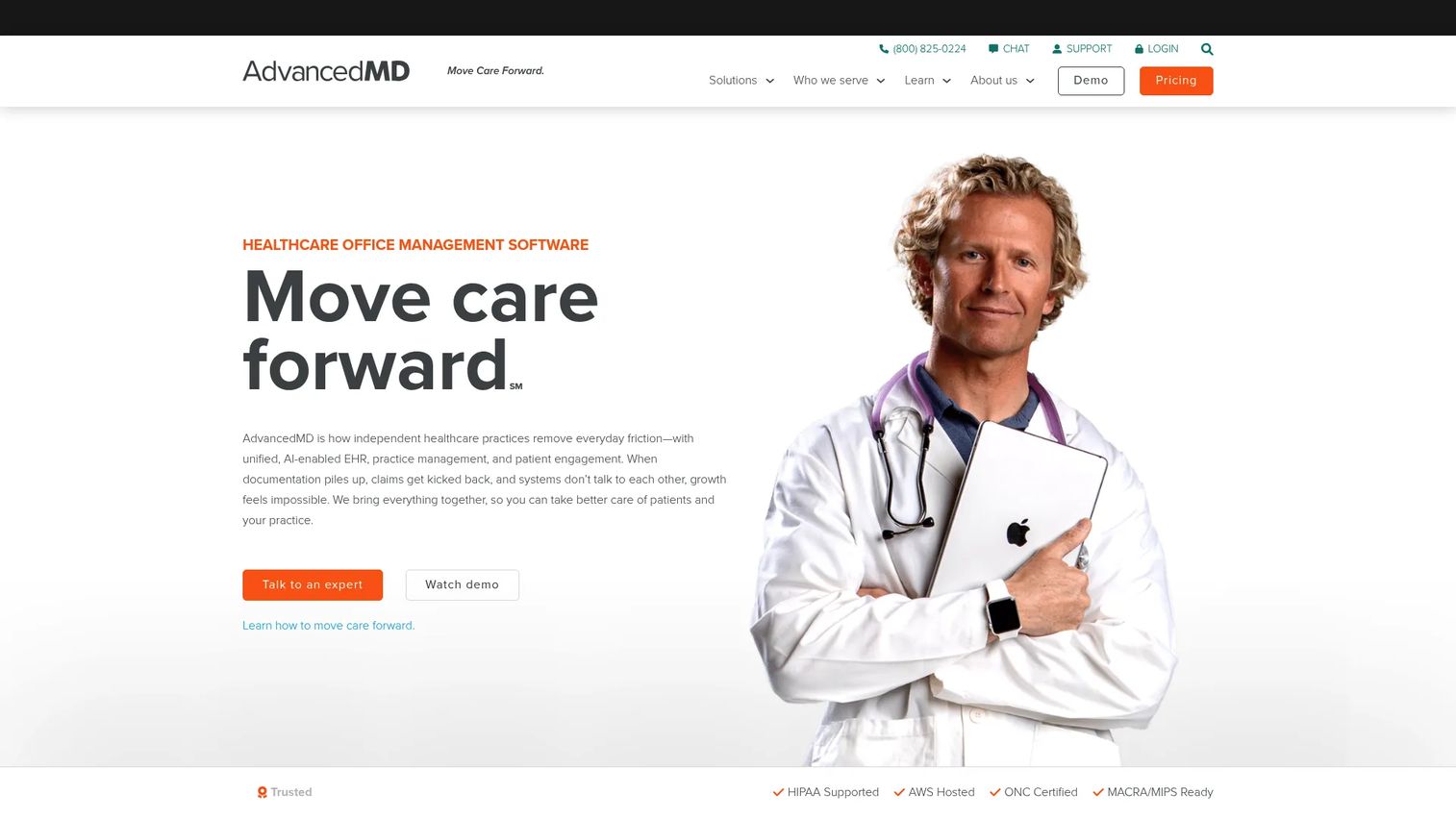
AdvancedMD is cloud-based practice management, EHR, billing, and patient engagement software for independent healthcare practices. Denial handling sits inside the billing and practice management workflows, which suits smaller and mid-market practices that want one platform rather than a stack of specialized tools. It is the most price-transparent option on this list.
The consolidation case is straightforward for a small practice: one system for scheduling, records, billing, and denial follow-up means fewer integrations to maintain and fewer places for a claim to fall through. That reduces medical billing denial management software sprawl without asking a two-person billing team to learn a new specialized product on top of everything else.
Best for: Independent medical, behavioral health, and billing practices that want an all-in-one cloud workflow platform.
Key strengths
- Practice management and scheduling: Run the front office and billing from one connected system.
- Electronic health records: Keep clinical and billing data together to reduce documentation-driven denials.
- Patient engagement workflows: Handle intake and communication alongside claim and denial follow-up.
Why choose AdvancedMD: Choose it when you run a smaller or mid-market practice and want billing plus denial workflows inside a familiar all-in-one platform. Large hospitals and complex health systems will likely need the deeper, dedicated denial tooling higher on this list.
AdvancedMD pricing: AdvancedMD publishes specialty-based pricing. Mental health plans start at $130 per provider per month for small practices, with a complete bundle at $399 per provider per month. Medical specialties run $429 to $1,070 per provider per month, and RCM services run 4% to 8% of collections. A free 30-day trial is available for solo and small mental health practices. AdvancedMD holds a 3.6/5 rating on G2.
Considerations before you buy
Before you commit, run every shortlisted tool through the same checklist. The differences that matter show up here, not in a feature grid.
Prevention versus recovery balance
Decide which job is your bottleneck. If most denials trace to coding, eligibility, or documentation, weight prevention-heavy tools like Aptarro or EvidenceCare. If you have a large recoverable backlog, weight recovery and appeal automation. The best platforms do both, but your current pain should set the priority.
Automation depth
Look past "automated" as a label. Ask what specifically automates: routing, prioritization, appeal drafting, batch submission, or status tracking. A tool that batches appeals across payers and tracks filing deadlines saves materially more staff time than one that only routes work to a queue.
Analytics and root cause analysis
Denial analytics are only useful if they group denials by reason, payer, provider, and service line, and trend those over time. Confirm the reporting answers "why did this spike" and not just "how many denials do we have." That is the difference between reacting and preventing.
Integration fit
Verify the tool connects cleanly to your EHR, HIS, and practice management systems. An integrated platform like NextGen or AdvancedMD makes this a given for existing users, while a standalone tool needs confirmed connectors. Broken integration turns automation into manual re-entry.
Conclusion
The right pick depends less on which vendor has the longest feature list and more on your organization type and where your denials come from. Large revenue cycle teams that want AI prioritization and broad workflow coverage should start with Waystar. Groups that want appeal efficiency plus payer analytics should look at Rivet. Teams fixing denials at the source belong with Aptarro for claim accuracy or EvidenceCare for clinical prevention.
Hospitals and health systems consolidating the full revenue cycle should evaluate FinThrive. Ambulatory practices already on NextGen get native denial workflows without adding a tool, and smaller practices get transparent pricing and all-in-one simplicity with AdvancedMD.
Whatever you shortlist, judge it on the same four factors: prevention versus recovery fit, automation depth, denial analytics quality, and integration with your existing systems. Reimbursement recovery and cash flow impact are the outcomes that matter, so pick the denial recovery software that moves those numbers for your specific operation, not the one with the most impressive demo.
FAQs
Denial management software is healthcare technology that helps provider organizations prevent, track, appeal, and recover revenue from denied insurance claims. It typically connects to EHR, HIS, and practice management systems, and combines claim denial prevention with appeal automation and denial analytics. The goal is fewer denials on the front end and faster recovery on the back end.
It catches problems before a claim is submitted. That means flagging coding errors, checking eligibility, validating documentation, and scrubbing claims against payer rules on the way out. Prevention-focused tools like Aptarro and EvidenceCare push these checks upstream, so avoidable denials never reach the payer in the first place.
The features that move the needle are automated routing and prioritization, appeal creation and templating, batch appeal submission and tracking, timely filing alerts, root cause analysis, and denial analytics. Integration with your EHR, HIS, and PM systems matters just as much, because automation only works if the data flows without manual re-entry.
Denial management is a function within revenue cycle management software. RCM covers the entire cycle from patient access and eligibility through claims, payments, and collections. Denial management focuses specifically on preventing and recovering denied claims. Broad platforms like Waystar and FinThrive include denial management as one connected part of a larger RCM system.
Hospitals with high claim volume, complex payer mixes, and a meaningful share of clinical denials benefit most. When denials trace to admission status or medical necessity documentation, a hospital denial management software approach that embeds prevention in clinical workflows, like EvidenceCare, addresses the problem at its source rather than after billing.
Denial analytics group denials by reason, payer, provider, and service line, then trend them over time. That turns a pile of rejected claims into a diagnosis. Instead of appealing the same denial repeatedly, you can see that one payer or one service line drives the spike, fix the upstream cause, and recover more revenue with less rework.
Look for appeal drafting from templates, batch submission across multiple payers, and status tracking through to payment. Strong appeal automation also includes timely filing alerts so recoverable claims do not age out. The best denial appeal management setups turn a multi-hour rebuild into a review-and-send, freeing staff to work the claims that need real judgment.
It depends on the tool and your integration needs. An all-in-one platform you already run, like NextGen or AdvancedMD, adds denial workflows quickly because the integration is built in. A standalone tool connecting to an existing EHR, HIS, and PM stack takes longer, since connectors and data mapping have to be configured and tested before go-live.