You reconciled the day's charges last night and found three exam-room procedures that never made it onto an invoice. Again. The front desk is toggling between a scheduler, a paper chart, and a separate reminder tool. Your techs re-type the same patient history twice. Nobody can tell you, without exporting a spreadsheet, which services actually drove revenue last month.
That is the operational tax of running a clinic on disconnected tools. And it compounds. Every missed charge, every re-typed record, every reminder that never sent is margin walking out the door while your team works harder to stand still.
The market has caught up to that problem. The global veterinary software market is projected to grow from $1.07 billion in 2026 to $1.51 billion in 2030 at a 9.1% CAGR, according to The Business Research Company (2026). Cloud delivery already dominates, representing about 80.8% of revenue in 2024 per MarketsandMarkets (2025), and independent clinics are the leading adopters at roughly 52.5% of end-user share. Translation: modern veterinary practice management software is no longer a nice-to-have. It is the operating layer clinics run on.
The catch is that switching systems touches everything at once, scheduling, charting, billing, client communication, inventory, reporting. Choosing wrong means months of disruption. Choosing well means charge capture stops leaking and your team stops doing manual work the software should handle. This is a practical shortlist to help you get to the right two options faster.
If you evaluate software for a living, the same discipline that applies here shows up in adjacent categories too, from contract lifecycle management software to event management software. The pattern is identical: consolidate tools, prioritize workflow fit, and demand measurable return.
What's inside
This guide covers the seven strongest veterinary software programs for modern clinics in 2026. It is written for practice owners, practice managers, and operators comparing real alternatives, not readers still asking what the category is.
We selected platforms based on four criteria that matter most in daily operations: cloud deployment and accessibility, workflow coverage across charting, scheduling, and billing, integration depth with labs, pharmacy, and payments, and onboarding plus migration support. Where a vendor does not publish pricing, we say so plainly rather than guess. Every entry explains what the platform replaces and what it changes about your day.
TL;DR
- Best all-in-one cloud PIMS with AI: Digitail, for clinics replacing multiple disconnected tools with one system.
- Best connected ecosystem: Covetrus Pulse, for practices that want pharmacy, payments, and communications in one workflow.
- Best for usability and fast adoption: Shepherd, for teams that want charge capture automation without a steep learning curve.
- Best for customizable, multi-site operations: EzyVet, for growing or operationally complex practices.
- Best for clinical workflow depth: Instinct, for specialty, emergency, and treatment-heavy teams.
- Quick shortcut: Independent single-location clinic? Start with Digitail, Shepherd, or IDEXX Neo. Multi-location or specialty? Look at EzyVet and Instinct first.
What is veterinary software?
Veterinary software, often called a practice information management system (PIMS) or veterinary practice management software, is the platform a clinic uses to run daily operations, from booking appointments to charting to billing, in one place. It replaces the patchwork of paper charts, standalone schedulers, and manual billing that slows clinics down.
Modern vet practice management software typically covers these core functions:
- Scheduling: appointment booking, online self-scheduling, and calendar management across providers and rooms.
- Medical records: SOAP notes, patient history, treatment sheets, and increasingly AI-assisted charting and dictation.
- Billing and invoicing: charge capture, veterinary billing software workflows, estimates, and integrated payments.
- Reminders and communications: automated recalls, appointment reminders, and two-way client messaging.
- Reporting: revenue, production, and clinic performance analytics for operational decisions.
- Inventory and pharmacy: stock tracking, controlled-substance logging, and pharmacy integrations.
- Integrations: connections to lab diagnostics, payment processors, and client-communication tools.
Two terms come up constantly. Cloud-based veterinary software runs in the browser, meaning your team accesses records from any device without maintaining a local server, and updates ship automatically. All-in-one describes a platform that handles most or all of the functions above natively, rather than forcing you to bolt on separate tools. Both matter because they reduce the number of systems your team logs into and the number of places data can go stale.
When to use modern veterinary clinic software
Replace legacy systems that slow daily work
Older on-premise systems tie your records to one machine, delay updates, and make remote access painful. Clinic teams move to cloud-based platforms for three reasons: any-device access to records, faster feature updates without IT overhead, and real-time visibility into the schedule and the books. If your current system requires a specific computer in a specific room to pull a chart, that is the trigger.
Standardize workflows across roles
Reception, technicians, veterinarians, and managers each touch the same patient record differently. A unified system reduces handoff friction: the front desk books, the tech preps and charts, the vet signs off, and billing captures the charges, all against one record. Fewer handoffs means fewer data gaps and fewer charges that quietly disappear between the exam room and the invoice.
Improve billing, reporting, and inventory control
Software choice ties directly to cash flow. Automated charge capture catches procedures before they leave the room. Clinic reporting software turns raw activity into production and revenue analytics your leadership can act on weekly. And inventory tracking prevents both stockouts and the slow bleed of untracked controlled substances. For owners trying to scale without adding chaos, this is where the return shows up.
Comparison table
Read this table top to bottom by relevance to a typical clinic buyer. "Intent" describes the buyer motion each platform fits, and "Key use case" is the job it does best. Pricing reflects publicly available figures as of mid-2026; several vendors route to a demo instead of listing prices, which we note as such.
| # | Product | Intent | Key use case | Pricing | G2 rating |
|---|---|---|---|---|---|
| 1 | Digitail | All-in-one cloud PIMS | AI-native charting, booking, and billing in one system | From $289.00/month (per G2) | 5.0/5 |
| 2 | Covetrus Pulse | Connected ecosystem | Pharmacy, payments, and communications workflow | Demo-led, not public | 4.0/5 |
| 3 | Shepherd | Usability-first cloud PIMS | Charge capture automation and fast adoption | Demo-led, not public | 5.0/5 |
| 4 | Vetport | Established workflow coverage | Scheduling, records, and billing for varied practice types | Demo-led | Not listed |
| 5 | EzyVet | Configurable, multi-site | Customizable workflows for complex practices | From $260.50/month | 3.9/5 |
| 6 | Instinct | Clinical workflow depth | EMR and decision support for specialty and ER | Demo-led, not public | Not listed |
| 7 | IDEXX Neo | Straightforward cloud PIMS | Everyday workflow for smaller practices | Get started for free offer | Not listed |
The 7 best veterinary software platforms for 2026
1. Digitail
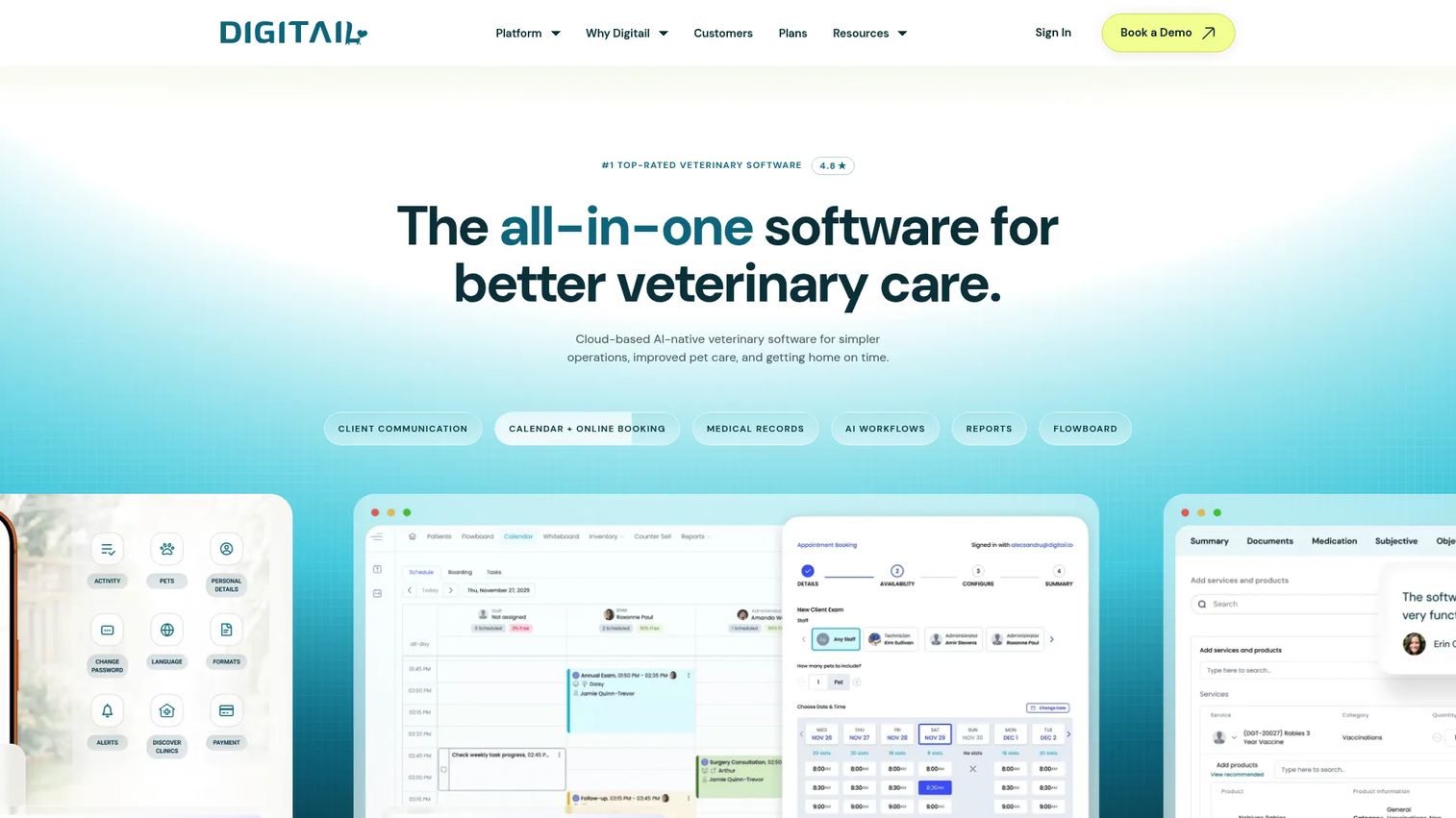
Digitail is an AI-native cloud PIMS built to consolidate the tools most clinics run in parallel. It combines online booking, a pet parent app, medical records with AI dictation, and payments into one system. The pitch is straightforward: stop paying for and switching between four tools when one covers the workflow. For clinics tired of reconciling data across a scheduler, a chart, and a separate billing app, that consolidation is the whole point.
Best for: Veterinary clinics that want an all-in-one cloud PIMS with AI workflows baked in rather than bolted on.
Key strengths
- Online booking and pet parent app: clients self-schedule and stay in the loop, cutting phone volume at the front desk.
- Medical records with AI dictation and SOAP notes: charting happens faster, so vets spend less time typing and more time on patients.
- Payments, invoicing, reporting, and 40+ integrations: charge capture, cash flow, and lab connections live in one place.
Why choose Digitail: The appeal is breadth without a heavy stack. If your clinic is currently stitching together booking, charting, reminders, and billing from separate vendors, Digitail collapses that into a single cloud system with AI doing the repetitive charting work. It fits owners who would rather manage one platform than integrate five.
Digitail pricing: Digitail's public plans page lists three named tiers, Mobile, Growth, and Growth AI, plus an Enterprise option, but does not display dollar amounts on the brand site. G2 shows a starting price of $289.00 per month and notes a free trial is available. Because the figure is not first-party verified, confirm current pricing directly with Digitail before budgeting.
2. Covetrus Pulse
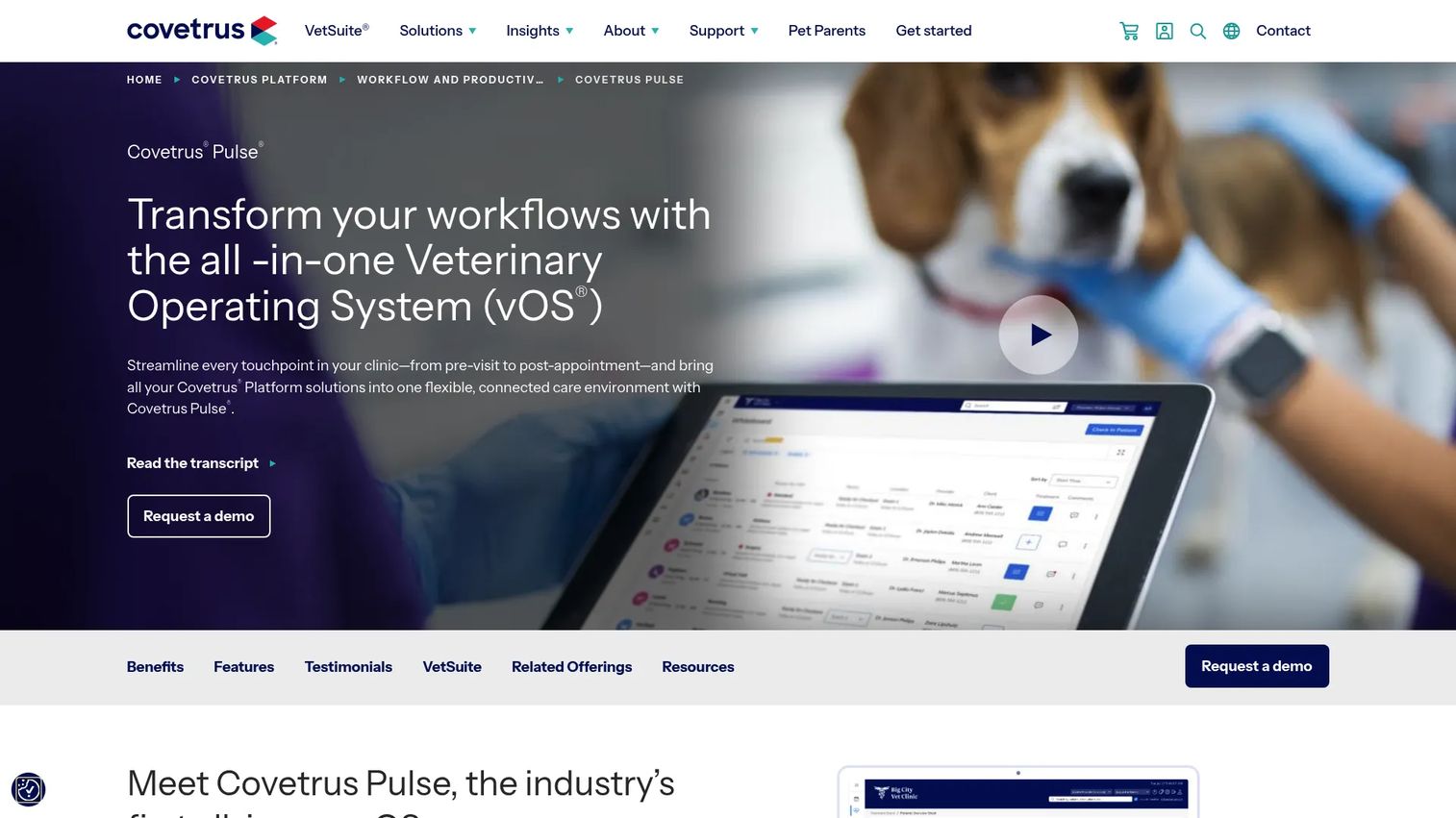
Covetrus Pulse positions itself as a cloud-based veterinary operating platform rather than a standalone PIMS. Its differentiator is ecosystem connectivity: electronic medical records sit alongside online pharmacy integration and client communications, so prescribing, refilling, and reminding all flow through the same system. For clinics that already lean on Covetrus for pharmacy and supplies, Pulse pulls those threads into daily workflow.
Best for: Veterinary clinics that want an all-in-one cloud practice management system with tight pharmacy and communications connectivity.
Key strengths
- Electronic medical records: core charting and patient history in a cloud environment accessible from any device.
- Online pharmacy integration: prescriptions and refills connect directly to the pharmacy workflow, reducing manual steps.
- Client communications and scheduling: reminders, messaging, and booking sit inside the same platform as records.
Why choose Covetrus Pulse: The strength here is the connected ecosystem. Clinics that want pharmacy, payments, and communications working together, rather than as separate integrations, get a platform designed around that flow. It suits practices that value one vendor relationship across software and supply.
Covetrus Pulse pricing: Covetrus does not publish pricing on its Pulse pages; the product routes to a demo request instead. Expect to go through a sales conversation to get a quote scoped to your clinic size and needs. On G2, Pulse holds a 4.0/5 rating.
3. Shepherd
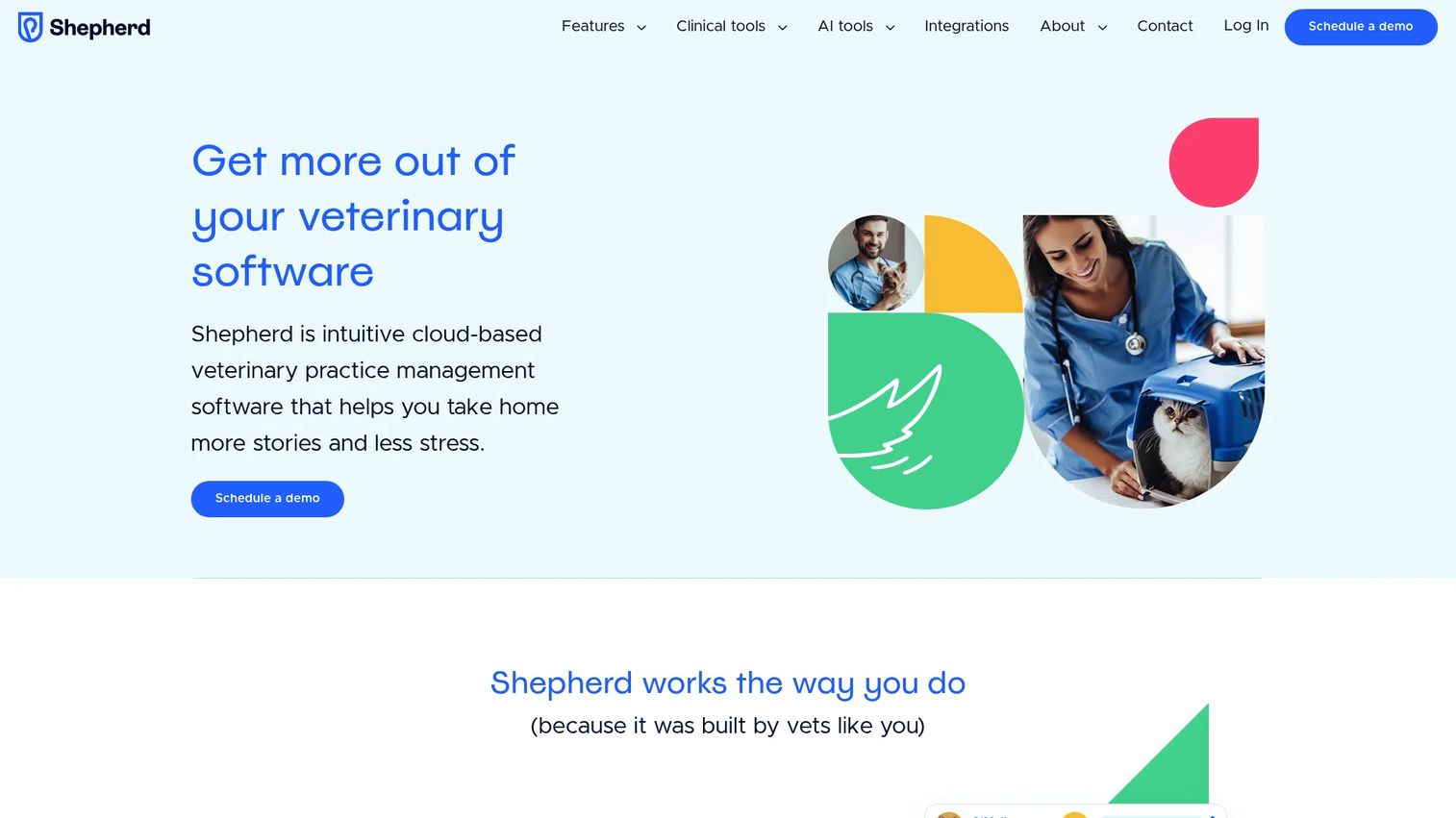
Shepherd is cloud-based veterinary practice management software built around workflow and ease of adoption. Its selling point is usability: SOAP-based medical records paired with charge capture automation so procedures do not slip through unbilled. Shepherd leans into the daily reality that software only helps if the team actually uses it, and designs the interface to lower resistance on day one.
Best for: Veterinary practices that want cloud-based workflow, automation, and AI-assisted records without a steep learning curve.
Key strengths
- SOAP-based medical records: charting follows the clinical structure vets already think in, speeding documentation.
- AI tools including TranscribeAI and DiagnoseAI: dictation and clinical support reduce manual note-taking.
- Inventory tracking and charge capture automation: missed charges get caught automatically, protecting margin.
Why choose Shepherd: The appeal is speed to value. Clinics that have been burned by hard-to-adopt systems tend to respond to Shepherd's workflow-first design, where charge capture and charting feel intuitive rather than imposed. It fits teams that prioritize getting productive fast over configuring every edge case.
Shepherd pricing: Shepherd does not publish pricing on its site; the buying motion is demo-led. You will need to book a demo to get a quote. On G2, Shepherd shows a 5.0/5 rating, though from a small review sample, so treat it as directional and verify fit yourself.
4. Vetport
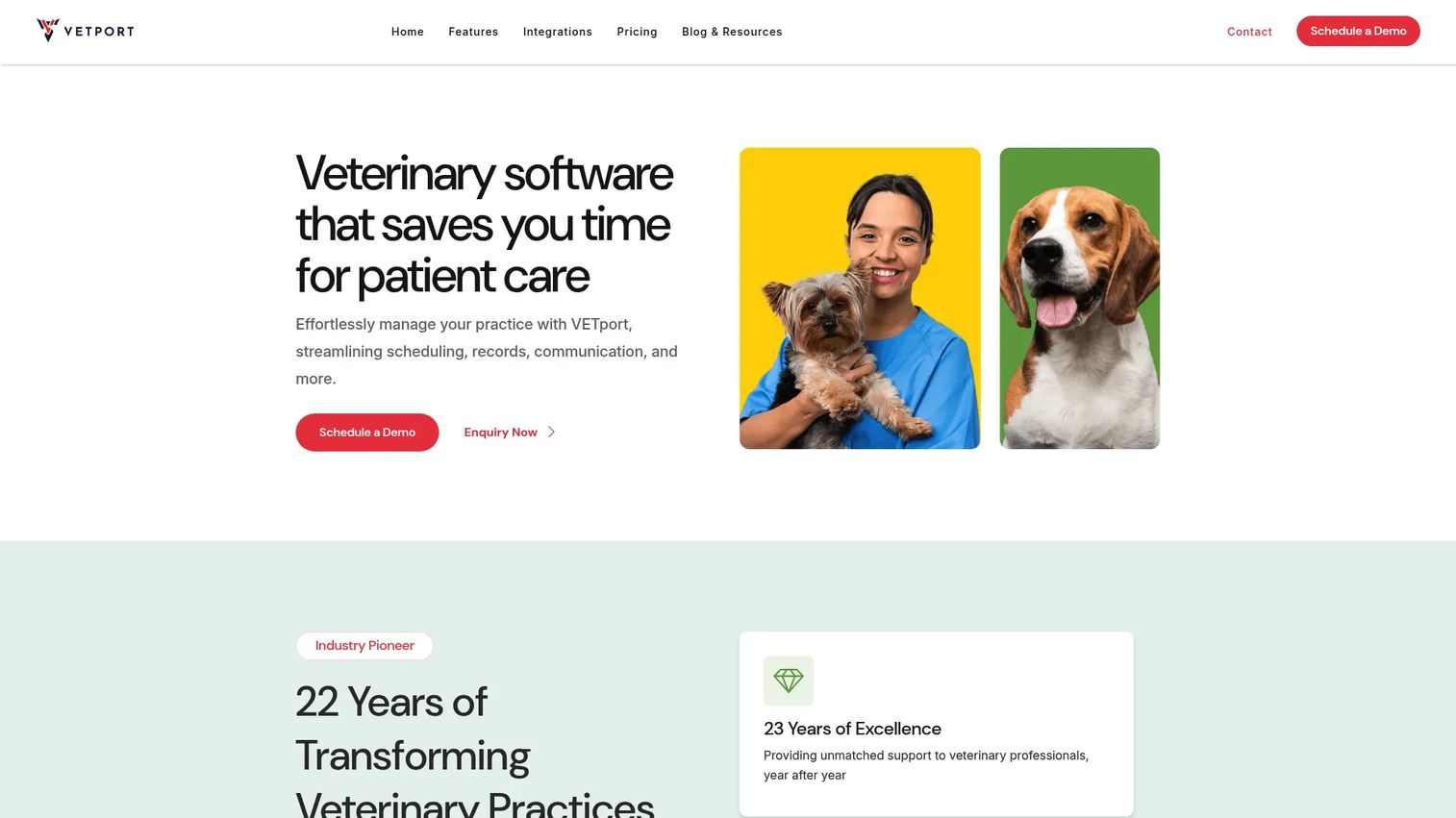
Vetport is a veterinary practice management platform with established, broad workflow coverage. It handles the operational core, scheduling, records, and billing, for clinics that want a proven system spanning general, specialty, and multi-practice settings. Vetport has been around long enough to have refined the everyday workflows most clinics run, which is its main draw for buyers who value maturity over novelty.
Best for: Clinics wanting a veterinary practice management platform with established, wide-ranging workflow coverage.
Key strengths
- Scheduling and appointment management: provider and room calendars keep the day organized across roles.
- Medical records and clinical documentation: patient history and charting in a cloud-accessible system.
- Billing and invoicing: charge workflows and estimates tied to the patient record.
Why choose Vetport: The case for Vetport is dependable coverage. It fits practices that would rather adopt a system with a long operational track record than one built primarily around a single headline feature. For owners who want the fundamentals covered reliably, it earns a place on the shortlist.
Vetport pricing: Vetport's buying motion is demo-led, and public pricing is not prominently displayed. Contact the vendor for a quote scoped to your practice type and size, and ask specifically about implementation and migration support during that conversation.
5. EzyVet
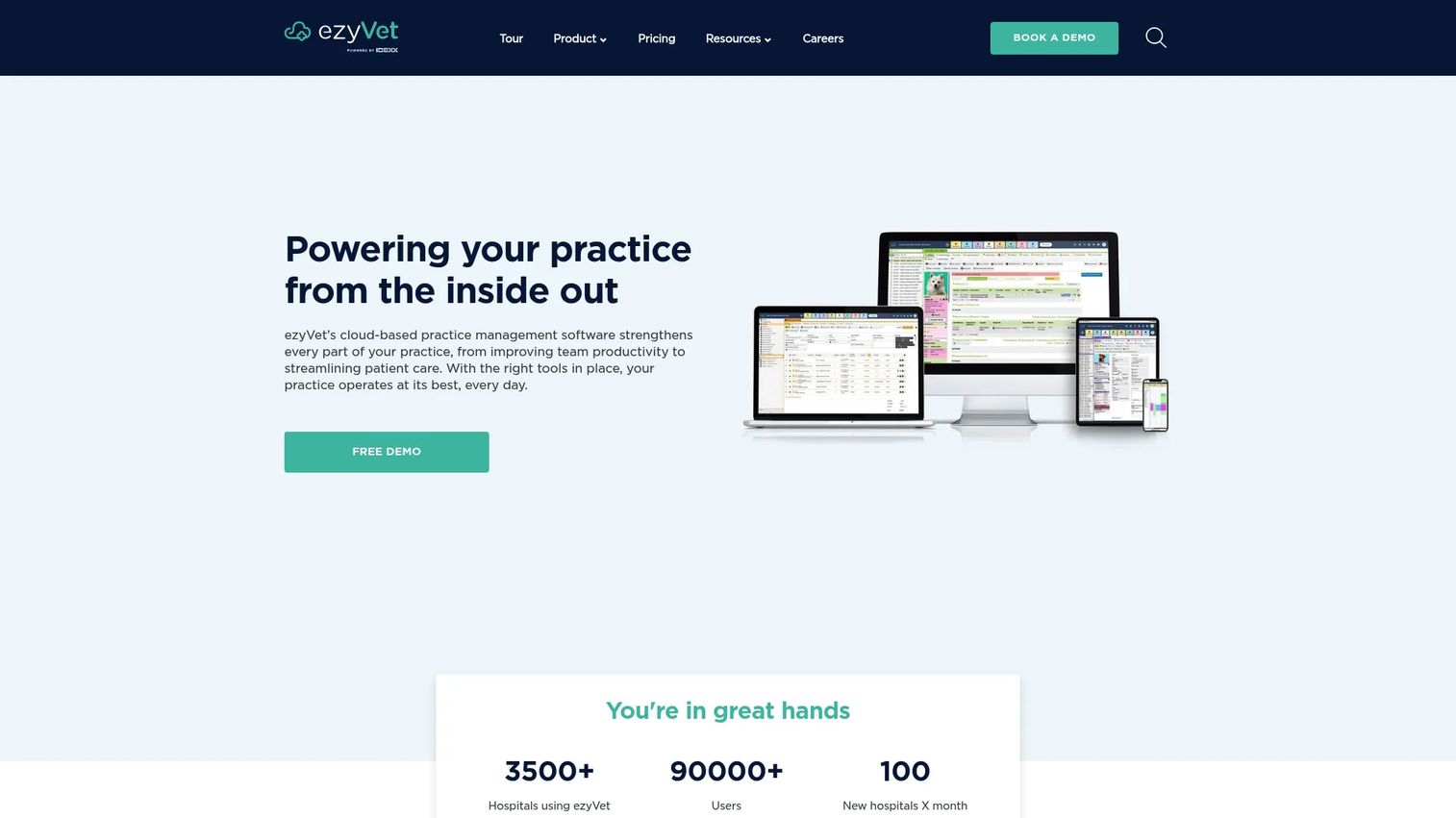
EzyVet is cloud-based veterinary practice management software built for clinics that need configurability and depth. It targets multi-site and operationally complex practices with customizable workflows, clinical records, invoicing, reporting, inventory, and more than 100 integrations, including IDEXX diagnostics. If your operation has outgrown a simpler system and needs the software to bend to your processes, EzyVet is designed for that.
Best for: Veterinary practices needing a customizable cloud practice management system that scales with operational complexity.
Key strengths
- Cloud-based access: records and workflows available from any location, useful for multi-site teams.
- Clinical records, invoicing, reporting, and inventory management: the full operational stack in one configurable platform.
- 100+ software integrations including IDEXX diagnostics: labs, payments, and tools connect into the workflow.
Why choose EzyVet: The strength is configurability at scale. Growing clinics and multi-location groups that need standardized-yet-adaptable workflows, plus deep reporting for leadership, tend to evaluate EzyVet for exactly that flexibility. It fits operations complex enough that a one-size system would slow them down.
EzyVet pricing: EzyVet publishes a starting price of $260.50 per month, and its pricing page states all customers get access to all features and the latest updates. Note that the monthly figure excludes implementation, and additional pricing details are available on request. Confirm implementation cost during your evaluation. On G2, EzyVet holds a 3.9/5 rating.
6. Instinct
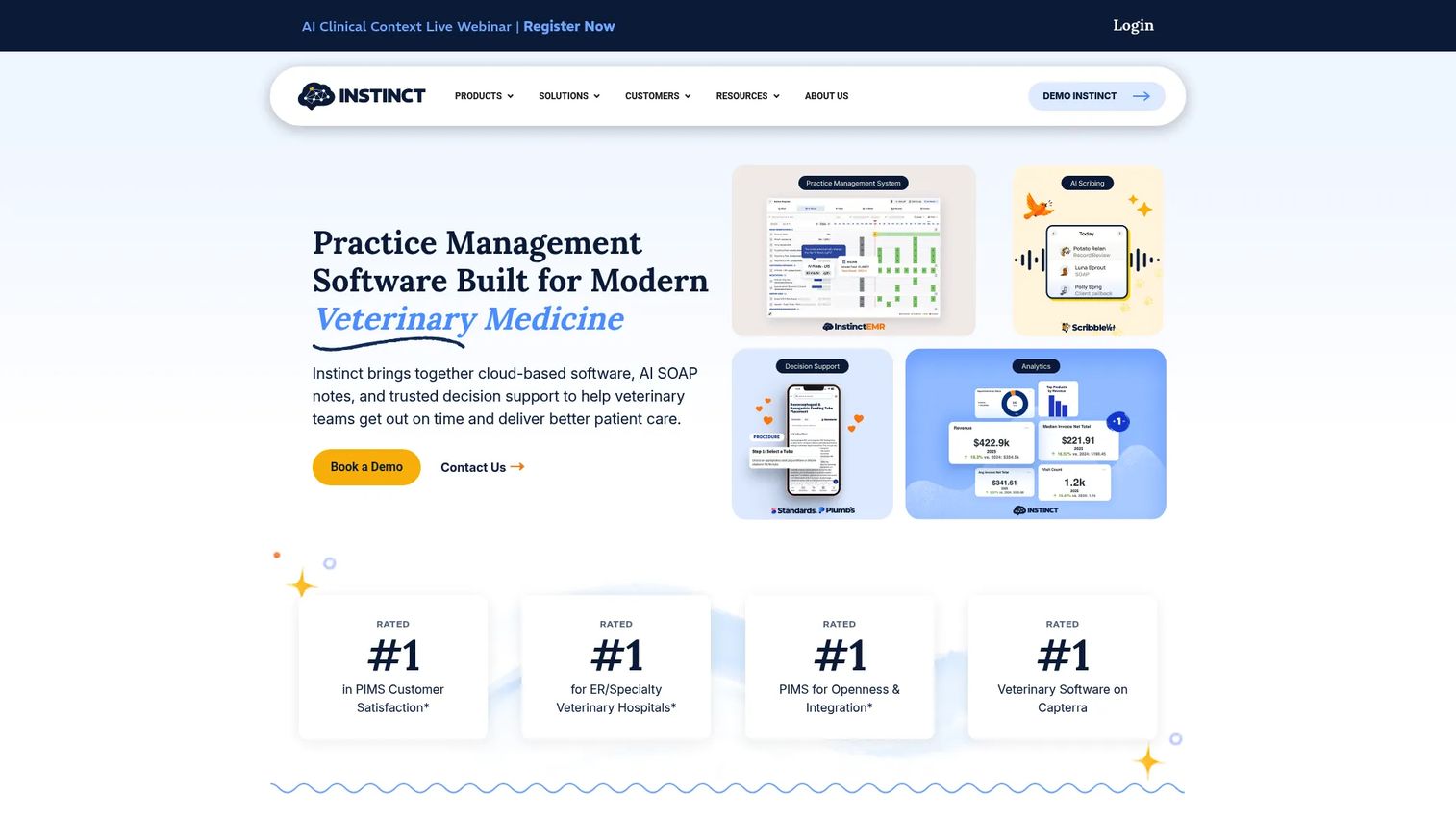
Instinct focuses on clinical workflow depth, combining a cloud-based EMR with clinical decision-support tools. It offers Instinct EMR for practice management and a Primary Care edition, ScribbleVet AI scribing, Standards clinical decision support, Plumb's veterinary drug reference, and digital treatment sheets. This is a platform built for teams where the clinical workflow, not just the front desk, carries the operational weight.
Best for: Veterinary practices needing cloud-based PIMS and workflow tools with genuine clinical depth.
Key strengths
- Instinct EMR and Primary Care editions: practice management tailored to both specialty and primary-care workflows.
- ScribbleVet AI scribing and Treatment Plan sheets: AI-assisted documentation plus digital treatment sheets for complex cases.
- Standards and Plumb's reference: clinical decision support and drug reference built into the workflow.
Why choose Instinct: The differentiator is clinical fidelity. Specialty, emergency, and treatment-heavy teams that live in treatment sheets and decision support evaluate Instinct because it is built around that clinical intensity, not adapted to it. It fits practices where charting and treatment workflows are the operational heart of the day.
Instinct pricing: Instinct does not display public pricing; its pages route to Book a Demo or Contact Us. You will need a sales conversation to get a quote. When you talk to the team, ask about implementation timelines and support, given the clinical depth of the platform.
7. IDEXX Neo
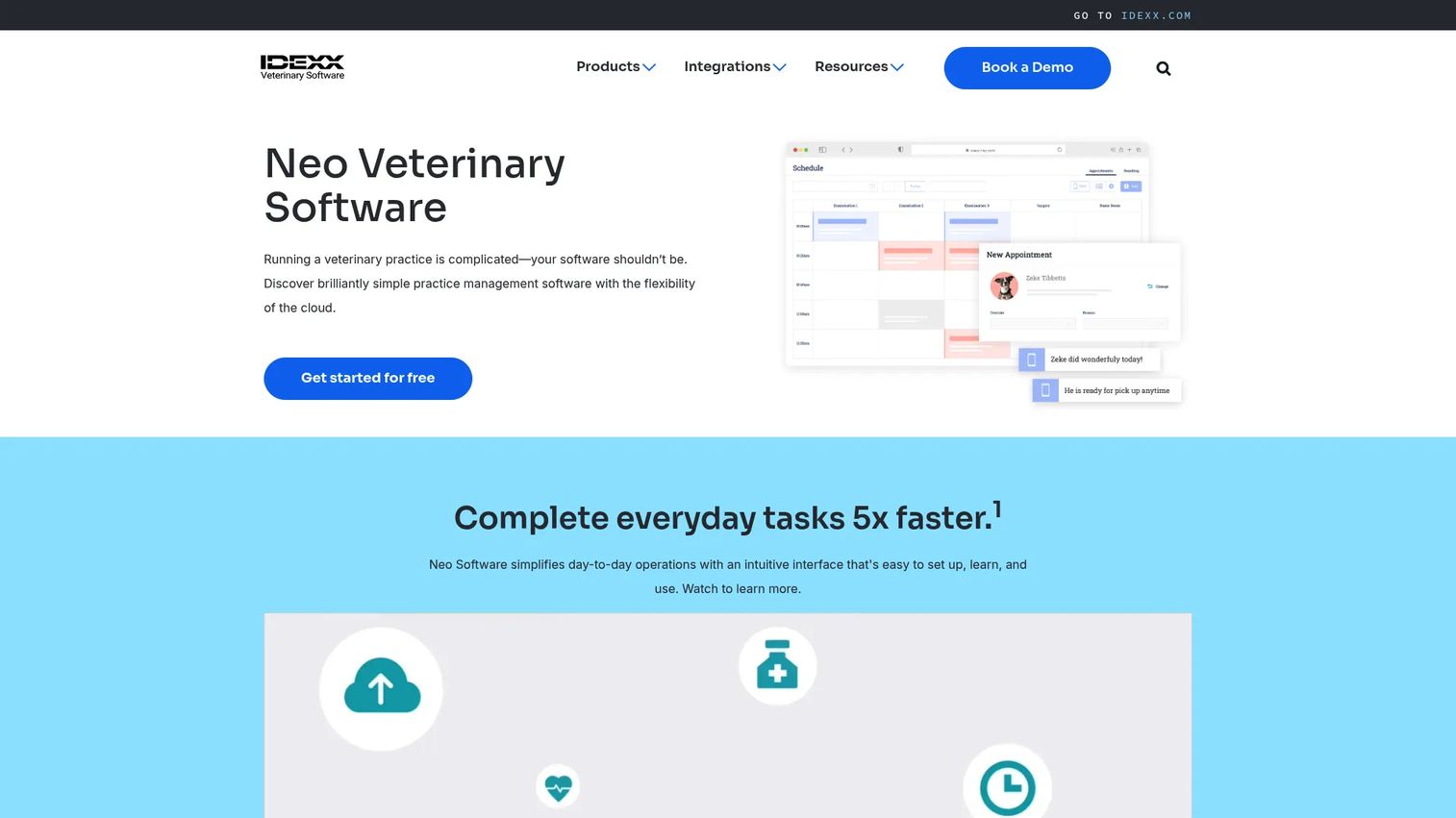
IDEXX Neo is cloud-based veterinary practice management software built for straightforward daily operations. It covers a practice dashboard, patient workflow, simplified scheduling, digital payments, client communications, and flexible reporting. Neo aims for accessibility: an easy-to-run system for smaller or simpler practices that want the essentials handled without complexity, plus alignment with the broader IDEXX diagnostics ecosystem.
Best for: Veterinary practices wanting cloud-based practice management with integrated workflows and a low barrier to entry.
Key strengths
- Practice dashboard and patient workflow: the day's activity and patient status visible at a glance.
- Simplified scheduling and digital payments: booking and payment handled inside the same system.
- Client communications and flexible reporting: reminders and clinic analytics without heavy configuration.
Why choose IDEXX Neo: The appeal is simplicity plus ecosystem fit. Smaller practices that want cloud accessibility and the essentials, without configuring a complex system, tend to land on Neo, especially if they already use IDEXX diagnostics. It fits clinics that value ease over extensive customization.
IDEXX Neo pricing: The IDEXX Neo product page promotes a "Get started for free" offer and references add-on subscriptions for integrated payments and Vello, but does not display a public base price. Contact IDEXX to confirm what the free start includes and what the paid add-ons cost for your clinic.
Considerations before you buy
Software evaluations go sideways when buyers weigh features and ignore fit. Use this checklist to pressure-test any shortlist. The same rigor applies whether you are choosing a PIMS or, say, contract management software for the business side of the practice.
Workflow fit across every role
Map the system against a real day: front desk booking, tech prep and charting, vet sign-off, and billing. A platform that impresses one role and frustrates three will not stick. Watch a demo run through your actual workflow, not the vendor's polished script.
Migration and data ownership
Moving from your current system is the riskiest part of switching. Ask exactly how patient records, history, and financials transfer, how long it takes, and who owns the data after. Get the migration plan in writing before you commit.
Integration depth
Your PIMS does not live alone. Confirm it connects to your lab diagnostics, payment processor, and communication tools, and that those integrations are maintained, not one-time bolt-ons. Weak integrations recreate the tool sprawl you are trying to escape.
Onboarding and support
Adoption lives or dies on support quality in the first 90 days. Ask what onboarding includes, how support is reached, and what response times look like. A great platform with thin onboarding still stalls.
Total cost, including implementation
Monthly pricing is rarely the whole number. Several vendors here quote a monthly figure that excludes implementation. Pin down the full first-year cost so the budget survives board scrutiny.
Conclusion
The right veterinary software depends less on feature counts and more on how the platform fits your clinic's daily reality. For independent single-location clinics wanting an all-in-one cloud PIMS, Digitail, Shepherd, and IDEXX Neo are the natural starting points. For connected pharmacy and communications workflows, Covetrus Pulse fits. For growing, multi-site, or operationally complex practices, EzyVet and Instinct earn a closer look, with Vetport as a dependable, established option across practice types.
Run every candidate through the same framework: cloud deployment, workflow coverage across all roles, billing and reporting depth, integration health, and onboarding support. Then take one practical next step. Shortlist two tools that best match your practice type, and compare them head to head on implementation support, data migration, and total workflow fit before you sign anything. The clinic that switches deliberately stops leaking charges and stops doing manual work the software should own.
FAQs
Veterinary software is the platform a clinic uses to manage daily operations in one place, including appointment scheduling, medical records, billing, reminders, inventory, and reporting. It is often called a practice information management system, or PIMS. The goal is to replace paper charts and disconnected tools with a single system that keeps patient, clinical, and financial data connected.
At minimum, it should cover scheduling, medical records and SOAP notes, billing and invoicing, automated client reminders, inventory tracking, and reporting. Stronger platforms add integrated payments, pharmacy connectivity, AI-assisted charting, and lab integrations. The right mix depends on your practice type, so map the features against your actual daily workflow before deciding.
For most clinics, cloud-based veterinary software offers clear operational advantages: any-device access to records, automatic updates without IT overhead, and no local server to maintain. Cloud delivery already represents about 80.8% of the market per MarketsandMarkets (2025). Before switching, verify data ownership, offline behavior during internet outages, and the vendor's security and backup practices.
The terms overlap heavily and are often used interchangeably. "Veterinary software" is the broad umbrella for any software a clinic uses, while PIMS (practice information management system) specifically refers to the core platform managing scheduling, records, billing, and reporting. When buyers say veterinary practice management software, they almost always mean a PIMS.
Start with workflow fit: watch a demo run through your real day across every role, from front desk to billing. Then weigh integration depth with your labs and payment tools, migration effort from your current system, and onboarding support quality in the first 90 days. Shortlist two platforms and compare them directly rather than trying to evaluate seven at once.
Multi-location practices should prioritize workflow standardization across sites, centralized reporting for leadership oversight, and granular user permissions so each role sees the right data. Configurable workflows matter too, since sites often differ operationally. Platforms built for complexity, like EzyVet, tend to handle centralized oversight better than systems designed for a single location.
Integrations are central, because your PIMS does not operate in isolation. Connectivity to lab diagnostics, payment processors, pharmacy, and client-communication tools determines whether data flows automatically or gets re-entered by hand. Weak integrations recreate the exact tool sprawl clinics adopt software to escape, so confirm which integrations exist and how well they are maintained before you buy.