Your search bar, your category pages, and your recommendation carousels all sell the same catalog. So why do they behave like three separate stores?
This is the quiet tax on most ecommerce teams. A merchandiser pins a high-margin product on a collection page, then watches onsite search bury it three rows down. Autocomplete surfaces an out-of-stock SKU. The "you may also like" widget recommends something the shopper already returned. Each surface runs on its own logic, and every promotion becomes a manual, copy-paste chore across tools that do not talk to each other.
The category exists to fix that fragmentation. E-merchandising software pulls search, browse, and recommendations under one set of rules and one analytics view, so a single merchandising decision propagates everywhere a shopper looks. The payoff is measurable: revenue per visitor, conversion rate, fewer zero-result searches, and far less time spent hand-editing collection pages.
The money behind this shift is real. The e-merchandising software market is projected to grow from about $1.67 billion in 2026 to $2.37 billion by 2030, a 9.1% CAGR, according to ResearchAndMarkets (2026). Mobile is the forcing function: smartphones drove nearly 80% of all retail website visits worldwide in 2024, per Statista, which means your merchandising logic has to hold up on a small screen for most of your traffic.
If you are evaluating adjacent tooling at the same time, our guides to the best enterprise search software and the best customer data platform pair naturally with this shortlist, since search infrastructure and customer data both feed merchandising decisions.
What's inside
This guide is for ecommerce, growth, and digital merchandising teams comparing platforms that control product discovery across onsite search, category pages, and recommendations. It is written for the buyer forming a shortlist, not browsing definitions.
We selected tools on five criteria: depth of AI-driven and rule-based merchandising, coverage across search and browse, analytics that tie back to revenue, omnichannel consistency, and fit across catalog sizes from Shopify brands to enterprise retailers. Every pricing figure and G2 rating below was pulled from first-party pages and live G2 listings. Where a vendor only publishes custom pricing, we say so plainly rather than guess.
TL;DR
- Best for enterprise commerce suites: Bloomreach, if you want search, content, and lifecycle personalization under one roof.
- Best for search and browse depth: Constructor, built around AI-driven discovery and granular ranking control.
- Best for Shopify-first teams: Tagalys, with transparent starting prices and merchandising plus search in one app.
- Best for fast, scalable search: Algolia, with a genuine free tier and a Merchandising Studio layered on top.
- Best for usage-based product discovery: Luigi's Box, covering search, recommendations, and analytics on a flexible model.
- Best for visual retail: Syte, purpose-built for fashion and image-based discovery.
What is e-merchandising software?
E-merchandising software is a category of ecommerce tools that controls how products appear and rank across onsite search, category pages, and recommendations, using a mix of merchandising rules and AI to maximize conversion and revenue per visitor.
The core feature set across the category looks like this:
- Searchandising: combining onsite search with merchandising rules, so ranking, synonyms, redirects, and autocomplete all respond to merchant intent and inventory.
- Product recommendations: algorithmic and rule-based widgets that surface related, complementary, or personalized products across the journey.
- Category page optimization: stock-aware sorting, pinning, boosting, and burying products on collection and listing pages.
- Personalization: adapting search results, browse order, and recommendations to segment, behavior, or individual shopper signals.
- Merchandising analytics: dashboards that surface zero-result searches, conversion by query, attach rates, and the revenue impact of each merchandising rule.
The category has shifted hard over the past few years. It used to mean manual rule-building: a merchandiser sets a boost, watches a report, adjusts by hand. AI-driven merchandising now layers decision support and automation on top, where the platform re-ranks results based on live conversion signals and flags where manual rules are leaving revenue on the table. The best tools keep both modes available, so teams keep control where it matters and automate the repetitive work.
That blend matters because catalog complexity keeps rising. The broader ecommerce software market is forecast to expand from $13.10 billion in 2026 to $44.32 billion by 2034, a 16.46% CAGR, per Fortune Business Insights (2026). More products, more channels, more surfaces to keep consistent.
When to use e-merchandising software
Improve category page performance
Reach for these tools when your collection pages run on default sort order and a merchandiser is editing them by hand. You want control over ranking, stock-aware sorting that pushes low-inventory items down, and the ability to pin high-converting or high-margin products to the top. The goal is fewer dead-end browse sessions and more shoppers reaching a product they actually buy.
Increase search conversion
Search users are usually your highest-intent traffic: they typed exactly what they want. That makes ranking quality, autocomplete, and synonym handling disproportionately valuable. Better searchandising lifts revenue per visitor and cuts zero-result searches, the queries that quietly send buyers to a competitor. If a meaningful share of revenue already touches your search bar, this is where the fastest wins live.
Coordinate merchandising across channels
Use a platform with omnichannel reach when web, mobile app, and email all need to reflect the same merchandising logic. A product you boost on the site should not vanish from app browse or contradict what a lifecycle email promotes. Omnichannel merchandising keeps the rules consistent across surfaces, which protects both conversion and brand coherence as you scale.
Comparison table
The table below compares all seven tools at a glance, sorted by relevance to ecommerce merchandising and product discovery. Use it to narrow your shortlist fast, then read the detailed sections for fit. Pricing and G2 ratings are verified from first-party and G2 sources as of mid-2026.
| # | Product | Intent | Key differentiation | Pricing | G2 rating |
|---|---|---|---|---|---|
| 1 | Bloomreach | Enterprise commerce experience | Unified search, content, and lifecycle personalization | Custom | 4.6/5 |
| 2 | Constructor | AI search and product discovery | Deep ranking control and merchant intelligence | Custom | 4.8/5 |
| 3 | Tagalys | Shopify-first merchandising | Collections, search, and recommendations in one app | From $259/mo | 4.8/5 |
| 4 | Algolia | Search-led discovery | Free tier plus Merchandising Studio | Free, then usage-based | 4.5/5 |
| 5 | Luigi's Box | Search and discovery | Usage-based search, recommendations, and analytics | Custom | 4.8/5 |
| 6 | Hawksearch | B2B and B2C search | Transparent starting prices, AI search and answers | From $500/mo | 4.2/5 |
| 7 | Syte | Visual product discovery | Image search and visual AI for fashion retail | From $2,000/mo | 4.6/5 |
1. Bloomreach
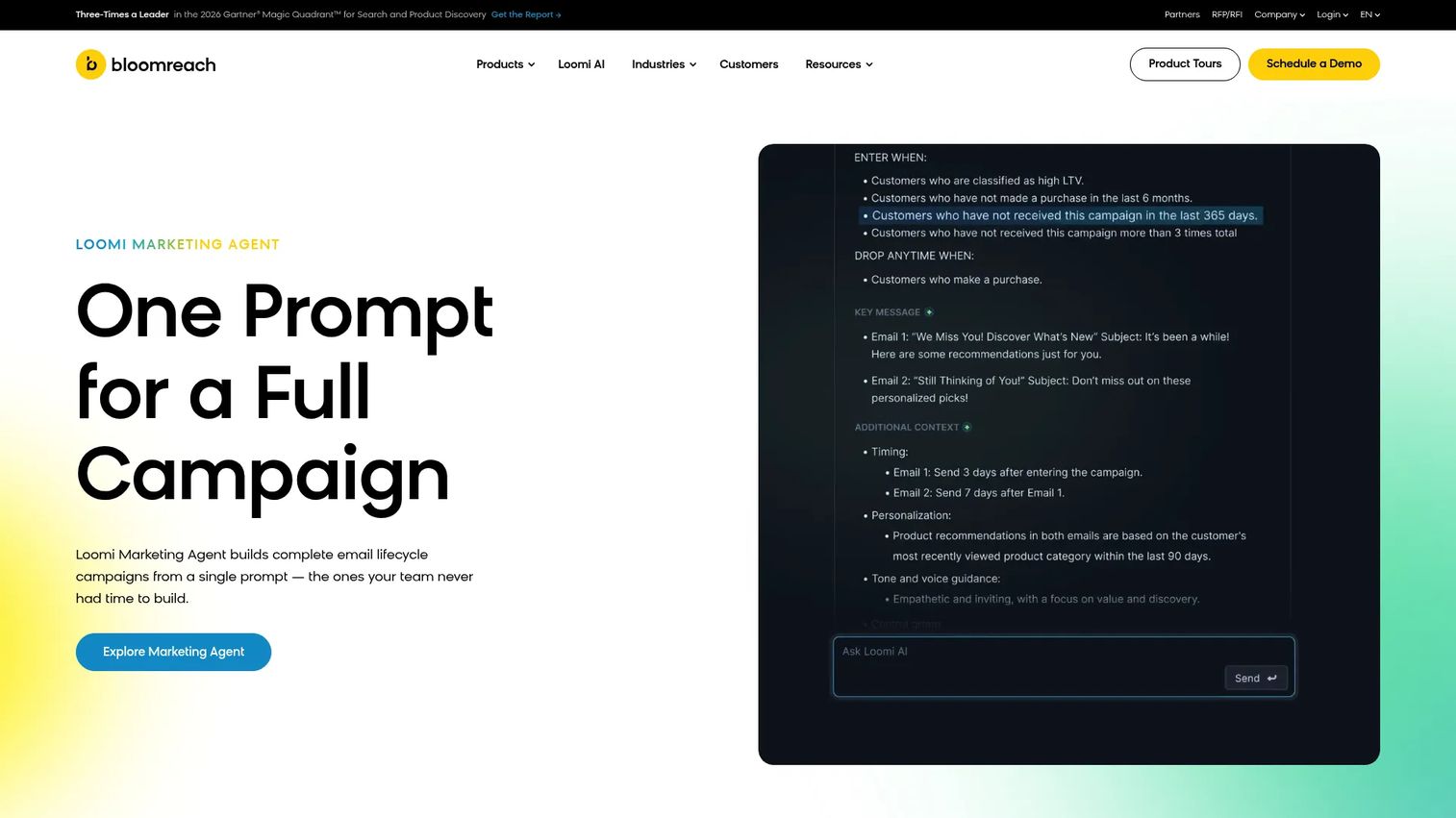
Bloomreach is an AI-powered commerce experience platform that brings search, merchandising, content, and lifecycle marketing into one system. For teams that want product discovery and personalization to share the same engine, it is one of the broadest options on this list. It pairs ecommerce search and merchandising with marketing automation across email, SMS, and web, plus a headless enterprise CMS.
Best for: Enterprises that need unified commerce personalization across search, content, and lifecycle marketing.
Key strengths
- Autonomous search and merchandising: AI re-ranks results and surfaces high-converting products with less manual rule maintenance.
- Marketing automation built in: email, SMS, and web personalization run on the same customer and product data as discovery.
- Headless enterprise CMS: content and commerce share one backend, useful for large catalogs and complex content needs.
Why choose Bloomreach: Choose Bloomreach when you are consolidating tools and want search, merchandising, and lifecycle marketing under one contract rather than stitched together across vendors. It rewards teams with the scale and complexity to use the full suite. Smaller catalogs may find the breadth more than they need, which is worth weighing against a focused search tool.
Bloomreach pricing: Bloomreach uses customized pricing tailored to company needs and asks prospects to request a quote. No public starting price is listed on its first-party pricing page, so plan on a sales conversation to scope cost against your catalog size and module mix. On G2, Bloomreach holds a 4.6 out of 5 rating.
2. Constructor
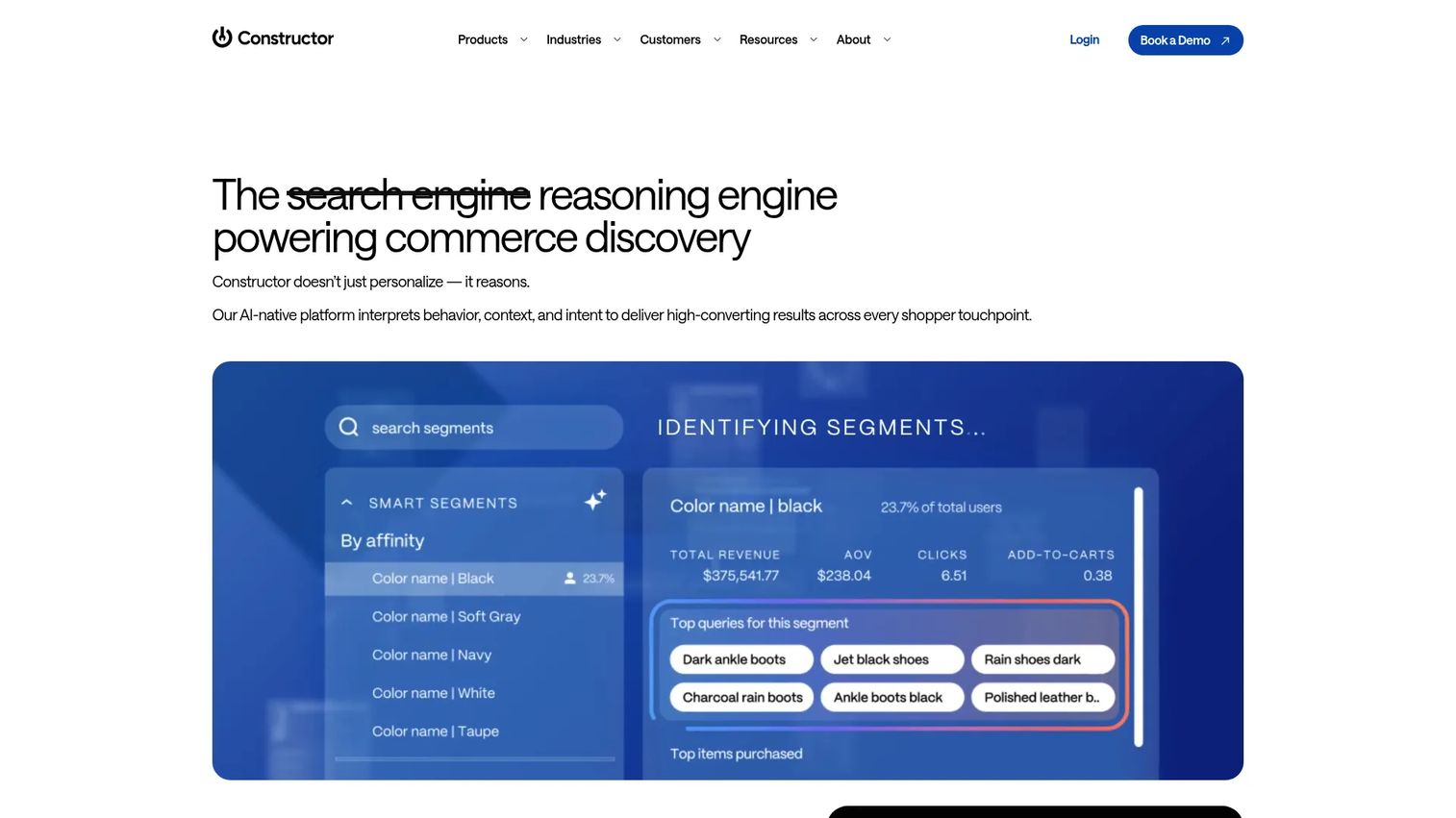
Constructor is an AI-powered ecommerce search and product discovery platform built for teams that treat discovery as a revenue lever, not a utility. It optimizes search, browse, and recommendations against conversion and revenue signals, and gives merchandisers granular control over how products rank on every surface.
Best for: Enterprise ecommerce teams that need search, browse, and personalization with deep ranking control.
Key strengths
- Search and browse optimization: ranking tunes to conversion and revenue rather than relevance alone, across both query and category surfaces.
- Recommendations: personalized product suggestions that draw on the same discovery model as search and browse.
- Merchant intelligence: analytics that show how ranking changes move revenue, so merchandisers can defend their decisions with data.
Why choose Constructor: Choose Constructor when category page control and searchandising depth are the priority and you want a platform engineered around revenue outcomes. It fits teams ready to invest in tuning discovery rather than accepting defaults. The trade-off is that it is purpose-built for discovery, so you will still run lifecycle marketing elsewhere.
Constructor pricing: Constructor does not publish public pricing on its site, and packaging is scoped to catalog size, traffic, and the surfaces you cover. Expect a custom quote through sales. On G2, Constructor holds a strong 4.8 out of 5 rating, among the highest in this category.
3. Tagalys
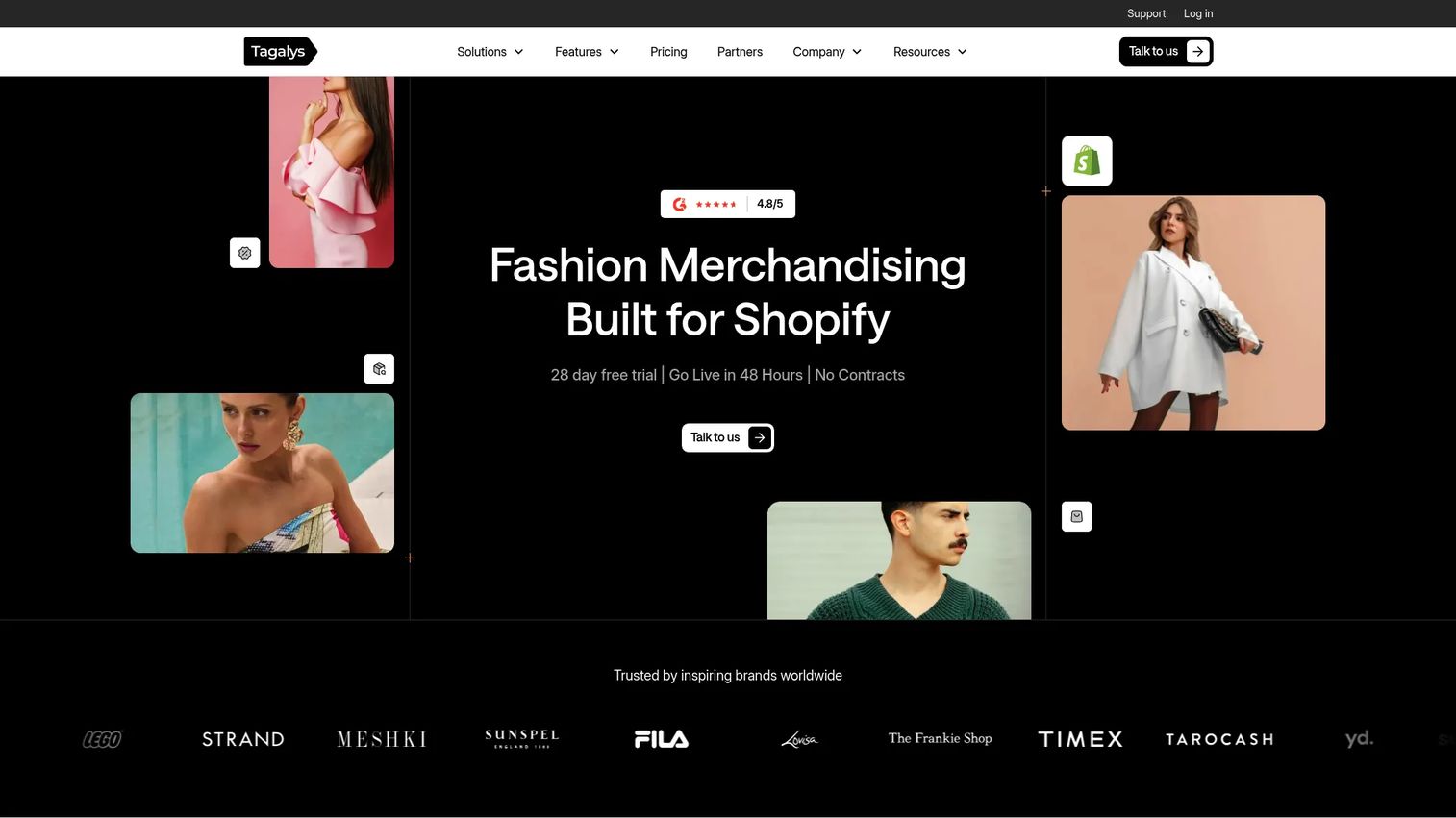
Tagalys is a Shopify-first merchandising, search, and recommendations platform built for ecommerce brands that want control without enterprise complexity. It combines intelligent collections, smart ranking, and onsite search in one app, with merchandising controls that fashion and retail stores actually use day to day.
Best for: Fashion and retail Shopify stores that need merchandising alongside onsite search and recommendations.
Key strengths
- Intelligent collections and smart ranking: automated category page sorting that merchandisers can override with pinning and boosting.
- Search with full control: autosuggest, synonyms, redirects, and merchandising rules in one search configuration.
- Recommendations and reporting: product recommendations with pinning, boosting, and reporting tied to merchandising actions.
Why choose Tagalys: Choose Tagalys when you run a Shopify store and want transparent pricing plus merchandising and search in a single app, without a procurement cycle. Its pricing clarity is a genuine differentiator in a category full of "contact sales" pages. Larger enterprises with non-Shopify stacks may need a broader platform.
Tagalys pricing: Tagalys publishes starting prices by product area: Search from $259 per month, Recommendations from $279 per month, and Collections from $299 per month, all billed monthly with custom pricing scaled to monthly visitors and features. A 28-day free trial is available. On G2, Tagalys holds a 4.8 out of 5 rating.
4. Algolia
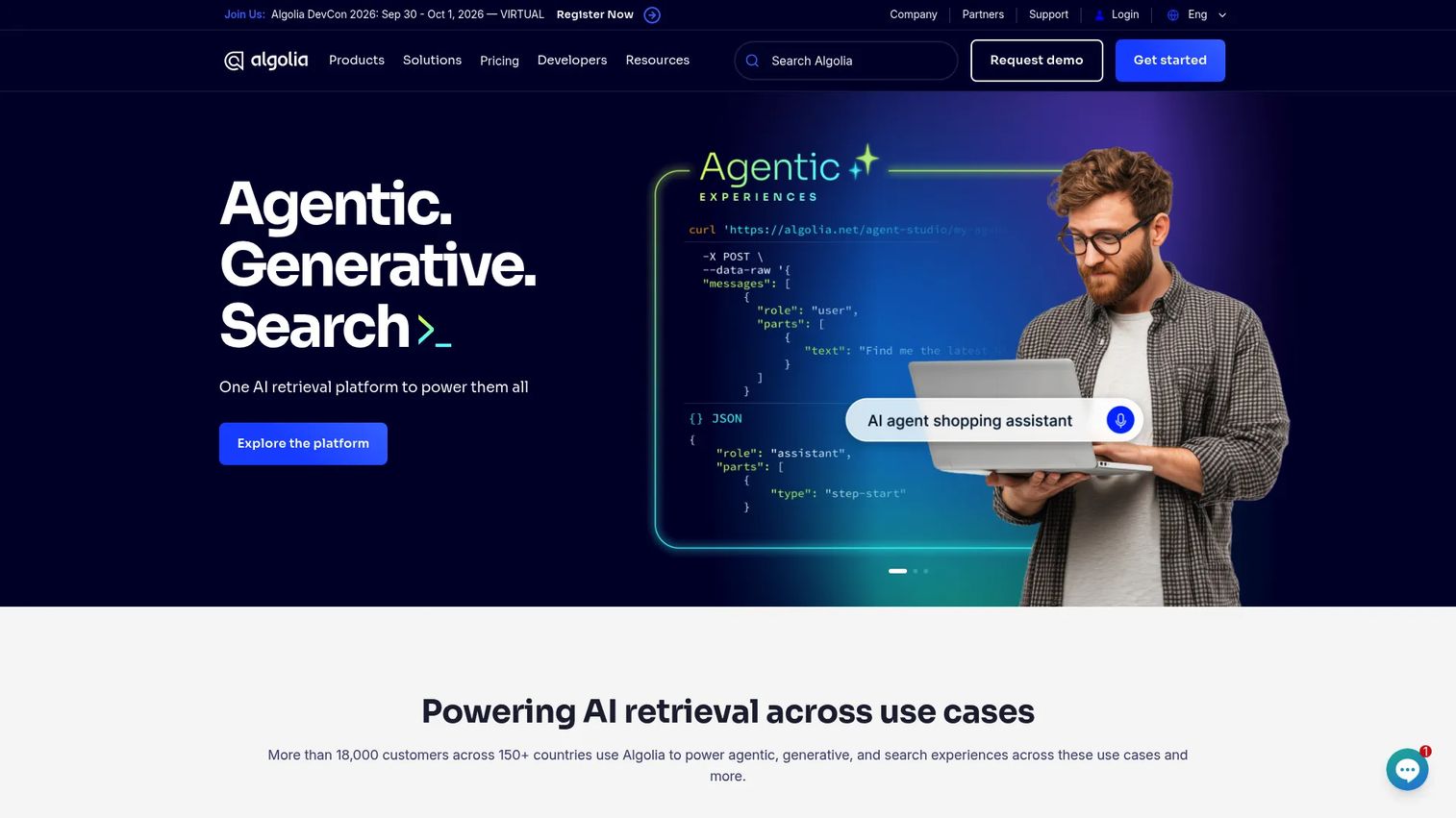
Algolia is an AI-powered search and discovery platform for apps and websites, with a Merchandising Studio that layers merchant controls on top of fast, scalable search. It fits teams that want search performance first and merchandising as part of the same stack, including AI search features like NeuralSearch and generative guides.
Best for: Teams that need fast, scalable site or app search with AI features and merchandising controls.
Key strengths
- Keyword and AI search: classic keyword search plus NeuralSearch for semantic, intent-aware results.
- Merchandising Studio: dynamic re-ranking, pinning, and merchandising rules layered over search.
- Generative experiences and guides: AI-driven guides and recommendations to support product discovery.
Why choose Algolia: Choose Algolia when search speed and scale matter and you want to start without a sales call. Its free tier makes it one of the easiest platforms here to pilot. The usage-based model rewards efficient implementation, so model your search volume before committing to a paid tier.
Algolia pricing: Algolia's Build plan is free, with 10,000 search requests per month and 1 million records included. Grow and Grow Plus add usage-based pricing after the included tier, at $0.50 and $1.75 per additional 1,000 search requests respectively, plus $0.40 per additional 1,000 records. Elevate is enterprise-scale on an annual contract, priced on request. On G2, Algolia holds a 4.5 out of 5 rating.
5. Luigi's Box
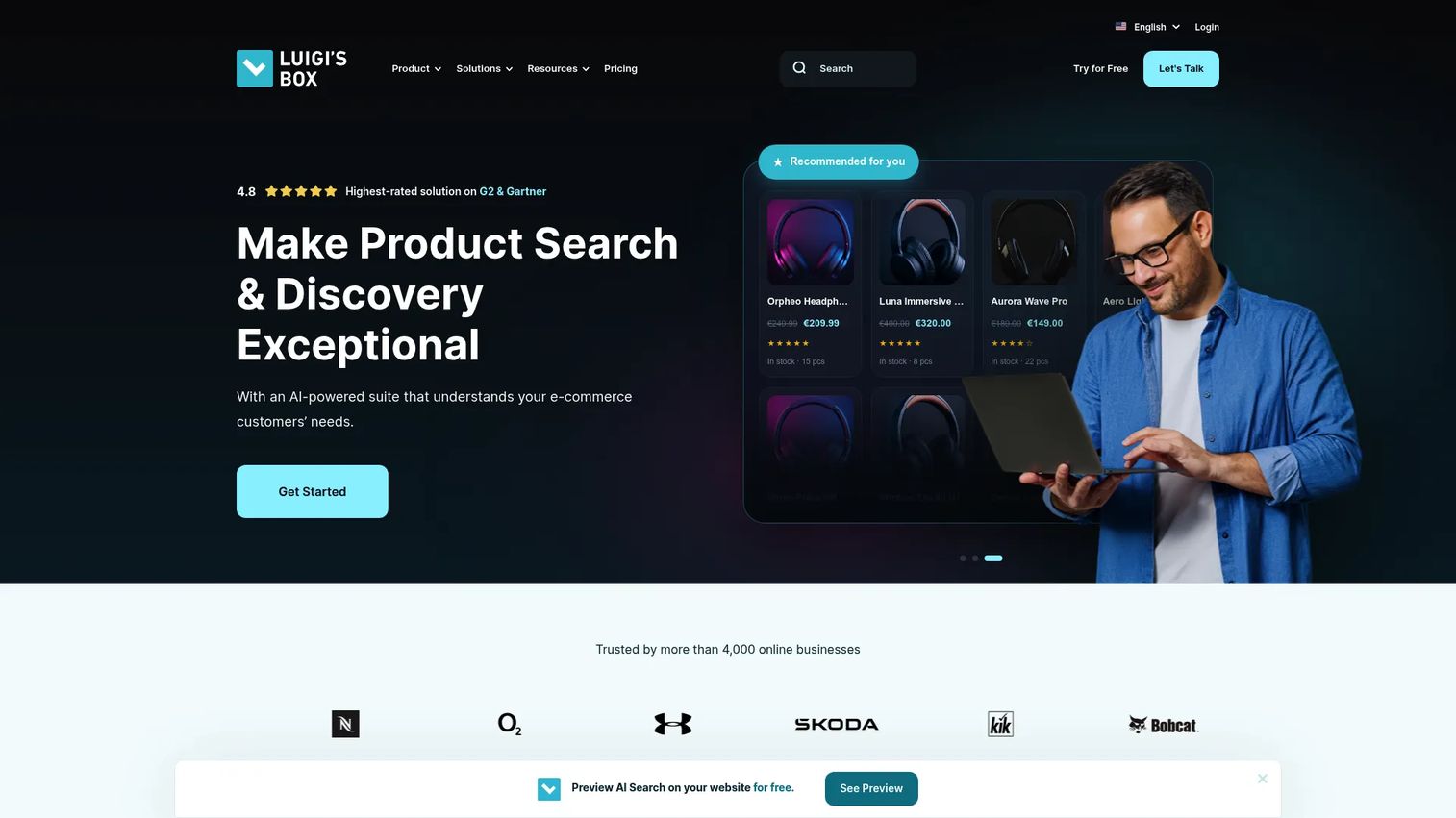
Luigi's Box is an AI-powered ecommerce search and product discovery platform built around search, recommendations, and analytics. It suits teams that want strong onsite search and browse optimization on a flexible, usage-based model rather than a fixed seat count.
Best for: Ecommerce teams that need AI search, recommendations, and merchandising on a usage-based model.
Key strengths
- Autocomplete and search: fast, typo-tolerant autocomplete and search tuned for conversion.
- Recommender: product recommendations across the journey, drawing on shopper behavior signals.
- Analytics: merchandising analytics that surface zero-result searches and discovery gaps to act on.
Why choose Luigi's Box: Choose Luigi's Box when you want search and discovery with usage-based pricing that scales with your catalog and traffic rather than a flat subscription. The 30-day free trial lets you validate fit before committing. Teams that prefer fully published pricing should note that paid plans are quoted through sales.
Luigi's Box pricing: Luigi's Box prices on usage and catalog size, with no public numeric figure on its pricing page. It offers a self-integration option with a 30-day free trial, plus custom integration and enterprise plans available through sales. On G2, Luigi's Box holds a 4.8 out of 5 rating.
6. Hawksearch
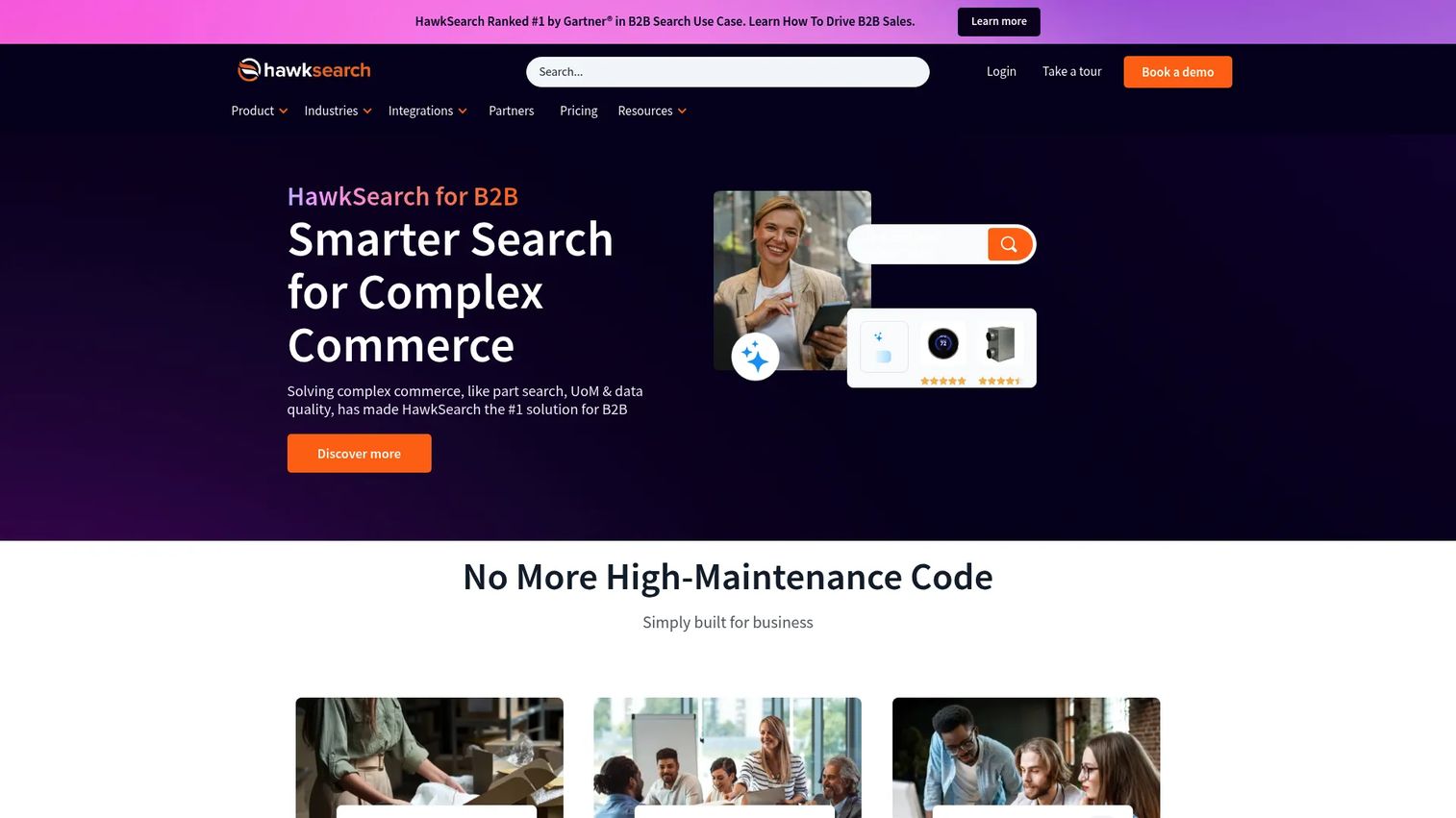
Hawksearch is an AI-powered search, answers, and product discovery platform for commerce teams, with strong B2B and B2C orientation. It pairs smart search and recommendations with merchandising controls, and it is one of the few platforms here with transparent published starting prices.
Best for: B2B and ecommerce teams that need AI search, merchandising, and recommendations.
Key strengths
- Smart Search: AI-driven search tuned for complex catalogs, including B2B part numbers and attributes.
- Smart Response: generative answers that handle natural-language queries beyond keyword matching.
- Recommendations: personalized product recommendations with merchandising rule controls.
Why choose Hawksearch: Choose Hawksearch when you sell into B2B or mixed B2B/B2C audiences and want published pricing you can budget against before talking to sales. Its transparent tiers make planning straightforward. Consumer-only brands focused on visual discovery may find more specialized fits elsewhere.
Hawksearch pricing: Hawksearch publishes clear tiers. Core starts at $500 per month and Premium starts at $850 per month, both billed monthly, with an Enterprise tier available on a contact-for-pricing basis. No free tier is listed. On G2, Hawksearch holds a 4.2 out of 5 rating.
7. Syte
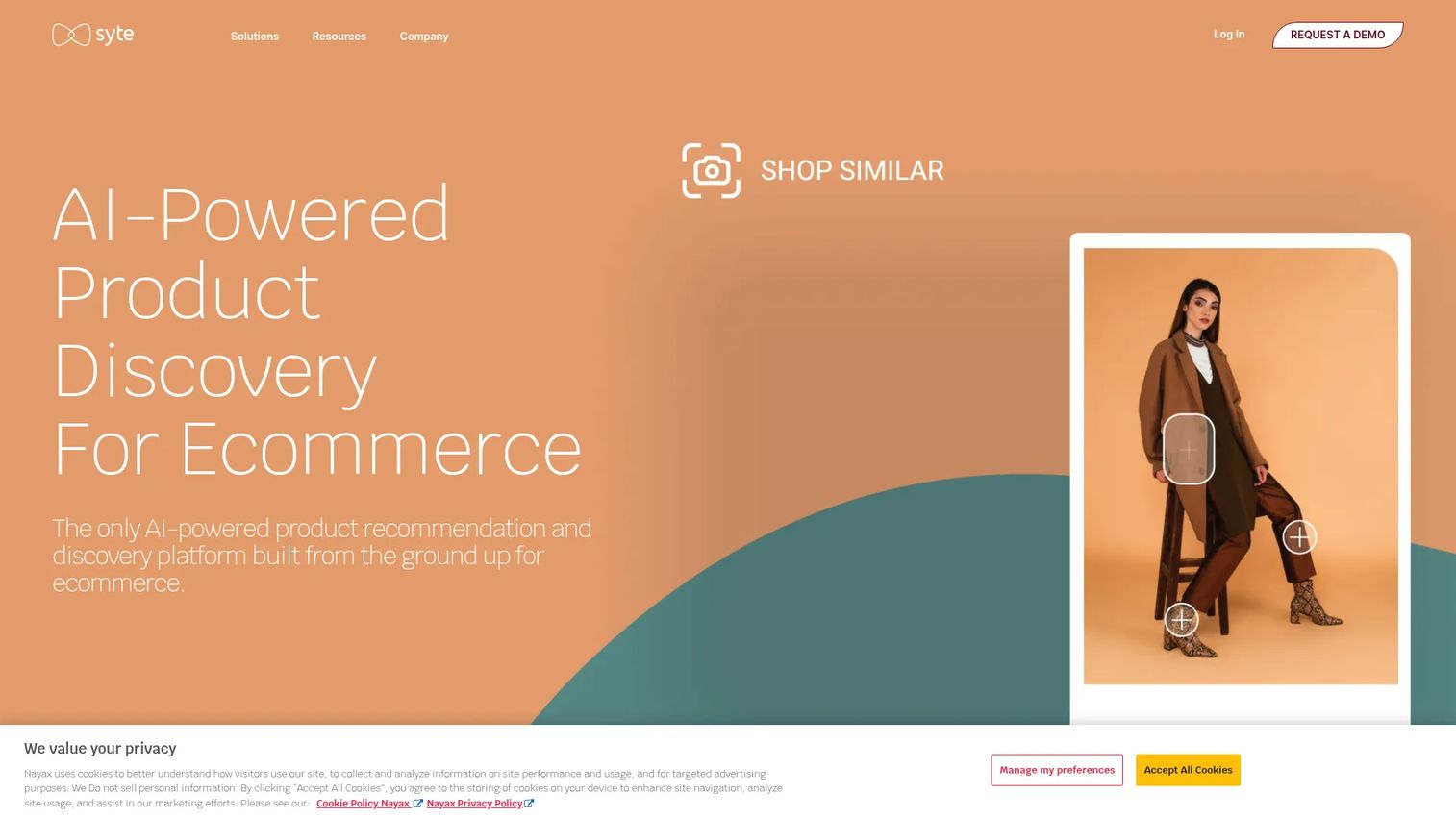
Syte is an AI-powered product discovery platform built around visual AI, making it the specialist pick for fashion and visually driven retail. Where most tools on this list lead with text search, Syte leads with the image, letting shoppers discover products by photo, by visual similarity, and through automated tagging.
Best for: Retailers that want visual search and product discovery for ecommerce, especially in apparel.
Key strengths
- Image search: shoppers find products by uploading or selecting an image, ideal for visual categories.
- Discovery button: an entry point on product images that surfaces visually similar items and shop-the-look options.
- Recommendation carousels: visually driven recommendation widgets to extend discovery across the catalog.
Why choose Syte: Choose Syte when your catalog is visual-first and shoppers buy on look rather than spec, as in fashion, home, and lifestyle retail. It is the most specialized tool here, which is its strength for the right catalog. Brands needing broad B2B search or lifecycle marketing will pair it with another platform.
Syte pricing: Syte publishes bundle pricing for 50,000 to 500,000 monthly sessions. Essential starts at $2,000 per month, Pro at $2,400 per month, and Powerhouse at $2,700 per month. No free tier is listed. On G2, Syte holds a 4.6 out of 5 rating.
Considerations before you buy
Surface coverage: search, browse, and recommendations
Decide which surfaces matter most before you compare features. Some tools lead with search, others with category page control, and a few cover all three plus recommendations. Map your highest-revenue surface first, then check that the platform's merchandising rules propagate everywhere rather than only where it specializes.
Rule control versus automation
The best fit depends on how much manual control your merchandisers want. AI-driven re-ranking saves time at scale, but you still want pinning, boosting, and burying when a buyer, a promotion, or a stock situation demands it. Confirm the platform keeps both modes available rather than forcing one.
Analytics depth
Merchandising analytics are where you prove ROI. Look for visibility into zero-result searches, conversion by query, attach rates, and the revenue impact of individual rules. If you cannot tie a merchandising change to a number, you cannot defend the spend to a CFO.
Platform and catalog fit
Match the tool to your stack and scale. Shopify brands get fast value from a Shopify-native app, while enterprise retailers with custom or headless stacks need deeper integration and larger catalog support. Check integration quality early, since a weak connector becomes an engineering dependency you did not budget for.
Conclusion
The right e-merchandising software depends less on the longest feature list and more on where your revenue actually lives. If you are consolidating search, content, and lifecycle marketing at enterprise scale, Bloomreach is the broadest fit. For teams that treat search and browse depth as a revenue lever, Constructor leads on ranking control, while Algolia wins on fast, scalable search with a free tier to start. Shopify-first brands get the cleanest path with Tagalys and its transparent pricing. Luigi's Box suits teams that prefer usage-based discovery, Hawksearch fits B2B and mixed audiences with published tiers, and Syte is the specialist for visual, fashion-led retail.
Start by mapping your highest-converting surface and your catalog size. A small Shopify store and an enterprise retailer with a headless stack should not shortlist the same way. Pilot with the free trials and free tiers where they exist, measure the lift in revenue per visitor and zero-result rate, and let the numbers pick your platform. While you scope your discovery stack, our roundups of the best digital adoption platforms and the best interactive demo tools for product marketing cover adjacent layers worth evaluating in the same cycle.
FAQs
E-merchandising software controls how products appear and rank across onsite search, category pages, and recommendations, using merchandising rules and AI to lift conversion and revenue per visitor. It replaces manual, per-surface editing with one coordinated set of merchandising decisions. The goal is a consistent product discovery experience wherever a shopper looks.
The highest-impact features are searchandising, category page optimization, product recommendations, personalization, and merchandising analytics. Searchandising and analytics tend to drive the fastest ROI because search users are high-intent and analytics let you prove the lift. Prioritize the feature set that maps to your highest-revenue surface rather than chasing the longest list.
They overlap heavily and the terms are often used interchangeably. A product discovery platform usually emphasizes search and browse experiences, while e-merchandising software adds explicit merchant controls like pinning, boosting, and stock-aware sorting. Most modern tools, including the ones on this list, combine both, so the distinction matters more in marketing language than in practice.
It improves conversion by surfacing the right products faster and reducing dead ends. Better search ranking and autocomplete cut zero-result searches, stock-aware category sorting keeps buyable products visible, and personalized recommendations raise attach rate. Each surface reinforces the others, so a single merchandising decision compounds across the journey rather than living on one page.
Searchandising is the practice of applying merchandising rules to onsite search, so ranking, synonyms, redirects, and autocomplete reflect merchant intent and inventory, not just text relevance. It treats the search bar as a revenue surface, letting you boost high-margin products, fix zero-result queries, and align search with promotions. It is one of the highest-leverage parts of any merchandising platform.
Teams accountable for revenue per visitor and conversion rate need merchandising analytics most: growth marketers, ecommerce managers, and digital merchandisers. Analytics that expose zero-result searches, conversion by query, and the revenue impact of each rule turn merchandising from guesswork into a defensible, repeatable practice. Without them, you cannot tie a merchandising change to a financial outcome.
Yes, and that coordination is the core value of the category. The strongest platforms apply one set of merchandising rules and one analytics view across search, browse, and recommendations, so a product you boost shows up consistently everywhere. When evaluating, confirm that rules propagate across all three surfaces rather than only the one the vendor specializes in.
Shopify brands should prioritize native integration, transparent pricing, and merchandising plus search in a single app to avoid stitching tools together. Smart ranking, intelligent collections, and a free trial to validate fit before committing all help smaller teams move fast without engineering dependency. Tagalys is a common starting point for exactly this profile.