Your buyer just asked how you secure container images, runtime workloads, Kubernetes admission, and the artifact registry. One scanner cannot answer that question. According to the Red Hat State of Kubernetes Security Report (2024), 67% of organizations delayed or slowed deployments because of Kubernetes security concerns. The gap between "we have a scanner" and "we have a defensible container security posture" is exactly what enterprise security reviews expose.
Container security spans the full path from Dockerfile to running workload. A misconfigured base image, an unpatched dependency, an overprivileged pod, a secret committed to a registry, a container doing something unexpected at runtime: Each of those is a different failure mode requiring a different tool. Presales teams supporting cloud, platform, and security diligence need to understand this map, because buyers increasingly ask about all of it in a single vendor questionnaire.
This guide covers the best container security tools for 2026 across every layer of that lifecycle.
What's inside
This guide is for security engineers, DevOps and platform teams, and presales and solutions engineers who support cloud architecture and security validation questions during B2B software evaluations.
Tools were selected based on:
- Lifecycle coverage: Build-time scanning, SBOM generation, registry governance, policy enforcement, runtime detection, and network security
- Adoption and maintenance: Active open source projects and established commercial platforms
- Buyer usefulness: Each tool maps to a specific question a security reviewer will ask
- Mix of open source and commercial: Both categories are represented so you can build the right stack for your context
Container security platforms, general CI/CD tools without meaningful container security depth, and infrastructure monitoring tools unrelated to container workloads were excluded.
TL;DR
- Best overall open source scanner: Trivy covers images, filesystems, Kubernetes configs, IaC, and SBOMs from a single CLI
- Best for runtime threat detection: Falco detects suspicious container and Kubernetes behavior at the syscall level
- Best for SBOM inventory: Syft generates software bills of materials in SPDX and CycloneDX formats
- Best for registry security: Harbor combines a private registry with scanning hooks, signing, and role-based access
- Best commercial CNAPP-style coverage: Wiz connects container findings to cloud attack paths; OX Security maps risk from code through runtime
- Best Kubernetes policy enforcement: Kyverno writes policies as YAML; Open Policy Agent applies Rego across Kubernetes and CI/CD
Most teams run at least four or five tools across these categories. A single platform rarely closes every gap.
What are container security tools?
Container security tools are software products or open source projects that help teams secure container images, registries, Kubernetes configurations, runtime workloads, and the software supply chain.
Traditional application security focuses on code. Container security adds a set of problems that appear between code commit and production: What is in the base image, whether the Dockerfile is written safely, whether the registry enforces access controls, whether the Kubernetes cluster is hardened, whether workloads behave as expected after deployment, and whether secrets are handled correctly throughout.
Buyers in enterprise security reviews often ask about all of these simultaneously. Understanding the categories helps you prepare the right evidence.
Core capabilities covered by container security tools:
- Image and dependency scanning: Detect known CVEs in container image layers and language dependencies
- SBOM generation: Inventory all software components inside an image for vulnerability response and procurement evidence
- Dockerfile and manifest checks: Catch configuration mistakes before a build runs
- Kubernetes benchmark checks: Validate cluster configuration against CIS Benchmark controls
- Policy as code: Enforce what can run, what images are allowed, and what resources can be created
- Registry access and signing: Control image storage, enforce trust, and replicate with governance
- Runtime detection: Alert on anomalous syscall behavior, unexpected process execution, or suspicious network activity
- Network policy and workload segmentation: Control which workloads can communicate and how
- Secrets management: Store, rotate, and deliver credentials without embedding them in images
How container security maps to security review questions:
| Container security capability | What it helps prove in a security review |
|---|---|
| Image scanning | "Do you scan images before release?" |
| SBOM generation | "Can you show what's inside the image?" |
| Kubernetes benchmark | "How do you harden cluster configuration?" |
| Policy as code | "How do you prevent untrusted images from running?" |
| Runtime detection | "What happens if a container behaves suspiciously?" |
| Registry governance | "How do you control access to your artifact registry?" |
| Secrets management | "How are credentials handled in containerized workloads?" |
When to use container security tools
Scan images before they reach production
Image scanning belongs in the CI/CD pipeline, ideally at pull request time and again at build time. Scanning catches CVEs in base images, vulnerable language dependencies, and secrets accidentally committed to the image. Policy gates can block a build if critical vulnerabilities exceed a threshold. For presales teams, this answers the most common security questionnaire question: "Do you scan images before release, and what is your patching SLA for critical CVEs?"
Protect Kubernetes workloads at runtime
An image can pass every scan and still behave badly once it is running. Runtime security tools watch for unexpected process execution, file system writes to protected paths, outbound connections to unknown addresses, and privilege escalation attempts. This layer answers the buyer question that scanners cannot: "What happens if a compromised or misconfigured container is already running in production?"
Prove control across registries and supply chains
Enterprise RFPs and vendor risk reviews ask about provenance. Who signed the image? What registry is it stored in? What policy controls prevent an untrusted image from being deployed? SBOM generation, image signing, registry access controls, and admission policies all contribute to the evidence package. This is where tools like Harbor, JFrog Artifactory, Syft, and Kyverno carry their weight during procurement conversations.
Container security tools comparison
The table below covers all 21 tools in this guide. Pricing reflects vendor pricing pages current at time of writing. G2 ratings are from current G2 listings; N/A means no distinct G2 product listing was found. Most open source tools do not carry a G2 listing.
| # | Product | Best for | Key differentiator | Pricing | G2 rating |
|---|---|---|---|---|---|
| 1 | Trivy | Broad open source scanning | Scans images, filesystems, IaC, Kubernetes, and SBOMs | Free, open source | N/A |
| 2 | Clair | Registry-based vulnerability scanning | API-driven layer analysis for container images | Free, open source | N/A |
| 3 | Falco | Runtime threat detection | Syscall and Kubernetes audit event rules | Free, open source | 4.0/5 |
| 4 | Harbor | Registry security | Registry, scanning integration, signing, and replication | Free, open source | 5.0/5 |
| 5 | Grype | Container vulnerability matching | Pairs with Syft SBOMs; CLI-first scanning | Free, open source | N/A |
| 6 | Syft | SBOM generation | SPDX and CycloneDX output for images and filesystems | Free, open source | N/A |
| 7 | Anchore Engine | Policy-based image analysis | Image analysis and policy evaluation (archived March 2026) | Free, open source | 4.0/5 |
| 8 | Dagda | Malware and vulnerability analysis | Combines dependency checks with malware scanning | Free, open source | N/A |
| 9 | Wiz | Cloud-native risk prioritization | Security Graph connecting containers to cloud attack paths | Custom pricing | 4.7/5 |
| 10 | OX Security | Application security posture | Maps container risk across code, pipeline, and runtime | Custom pricing | 4.8/5 |
| 11 | Kube-bench | Kubernetes CIS checks | Tests clusters against CIS Kubernetes Benchmark controls | Free, open source | N/A |
| 12 | Hadolint | Dockerfile linting | Catches Dockerfile issues before image build | Free, open source | N/A |
| 13 | Kyverno | Kubernetes policy enforcement | YAML-based admission policies, image verification | Free, open source | N/A |
| 14 | Open Policy Agent (OPA) | Policy as code | Rego-based policy engine for Kubernetes and CI/CD | Free, open source | N/A |
| 15 | HashiCorp Vault | Secrets management | Centralizes secrets, tokens, and dynamic credentials | Pay-as-you-go, Flex, or Enterprise | 4.3/5 |
| 16 | Project Calico | Container network security | Network policy and workload segmentation | Free (open source); Cloud from $0.025/vCPU hour | 4.5/5 |
| 17 | Cilium | eBPF-based networking and security | Deep network visibility and enforcement through eBPF | Free, open source | 4.5/5 |
| 18 | KubeArmor | Runtime policy enforcement | Workload hardening via Linux security modules and eBPF | Free, open source | N/A |
| 19 | Docker Scout | Docker image insights | Vulnerability context and remediation for Docker workflows | Free tier; Pro from $9/user/month | 4.6/5 |
| 20 | JFrog Artifactory | Enterprise artifact security | Universal registry with security integrations and governance | Pro from $50/month | 4.3/5 |
| 21 | Red Hat Quay | Enterprise container registry | Registry security for Red Hat and Kubernetes environments | Custom pricing | 4.5/5 |
Best 21 container security tools for 2026
1. Trivy
Trivy is an open source security scanner from Aqua Security that covers more ground than most point tools. It scans container images, filesystems, Git repositories, Kubernetes configurations, infrastructure as code, and SBOMs from a single CLI. This breadth is the reason it often becomes the first scanner teams adopt in a CI/CD pipeline.
Best for: DevSecOps and platform teams that want one open source scanner across images, code, dependencies, and Kubernetes assets.
Key features
- Container image and filesystem vulnerability scanning
- Infrastructure-as-Code misconfiguration scanning
- Secret and sensitive-data detection
- SBOM generation output
- Kubernetes cluster configuration checks
Why choose Trivy: The low barrier to adoption and broad scope make it a strong starting point. When a buyer asks "How do you scan images before release?", Trivy gives presales teams a concrete, defensible answer backed by an active open source project.
Trivy pricing: Trivy is free and open source under the Apache 2.0 license. No paid tiers exist for the CLI project itself.
G2 rating: No distinct Trivy G2 listing was found at time of writing.
2. Clair
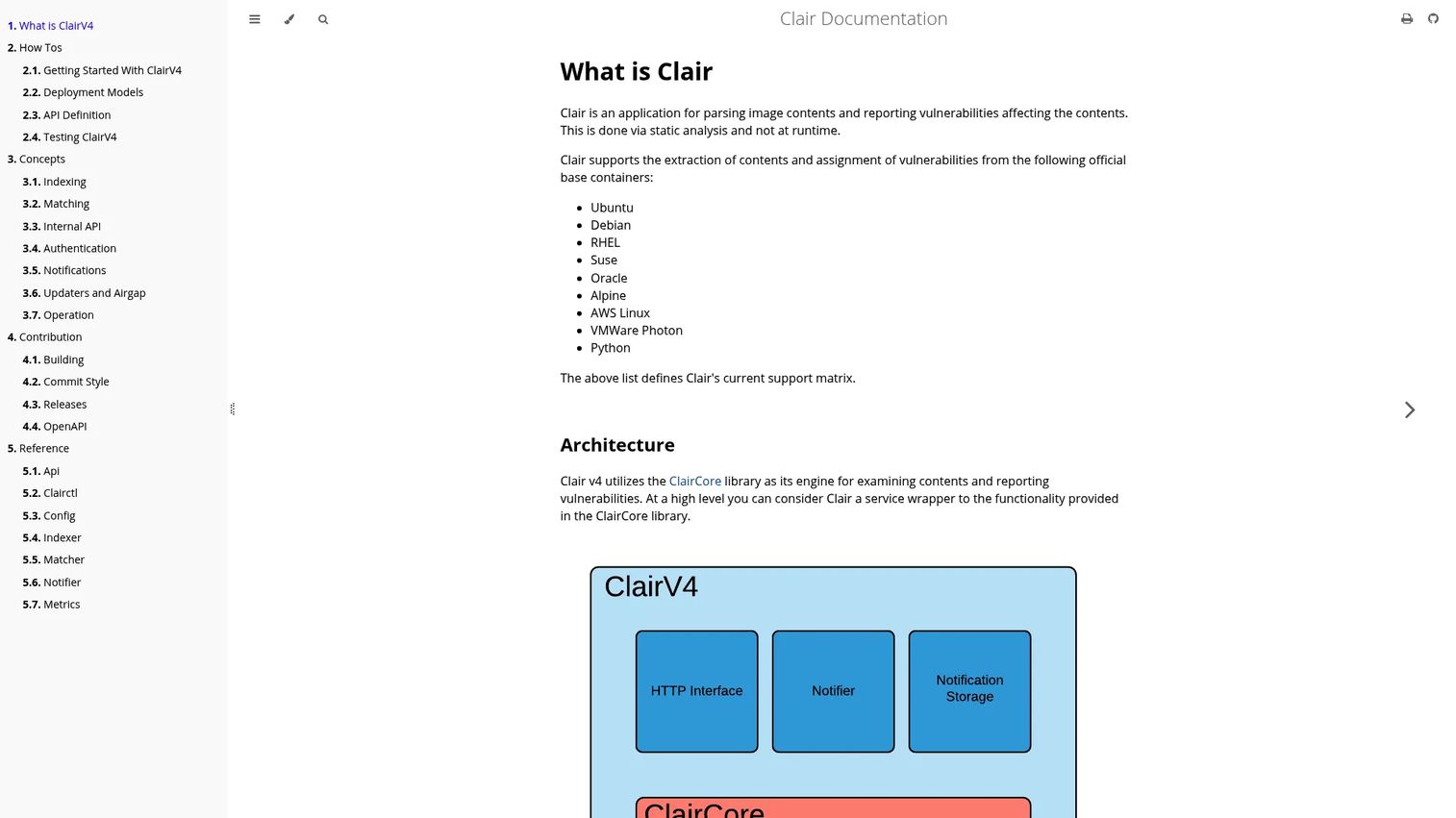
Clair is an open source static vulnerability analyzer for container images. It indexes image layers and matches them against continuously updated vulnerability databases covering Ubuntu, Debian, RHEL, Alpine, Oracle, and several other distributions. Its API-driven architecture makes it a fit for teams embedding a scanner service into registry or platform workflows.
Best for: Teams that need scanner infrastructure integrated into registry or platform tooling rather than a local CLI-first workflow.
Key features
- Layer-based container image vulnerability analysis
- Continuous vulnerability database ingestion
- OCI manifest and layer indexing
- Notification service for newly discovered CVEs
- API-driven architecture for registry integration
Why choose Clair: Clair suits teams that want to run scanning as a service inside their own infrastructure, particularly those building registry integrations or internal security platforms. Setup and operating model matter here more than a polished UI.
Clair pricing: Clair is free and open source. The project is hosted on GitHub under the Red Hat and Quay organization.
3. Falco
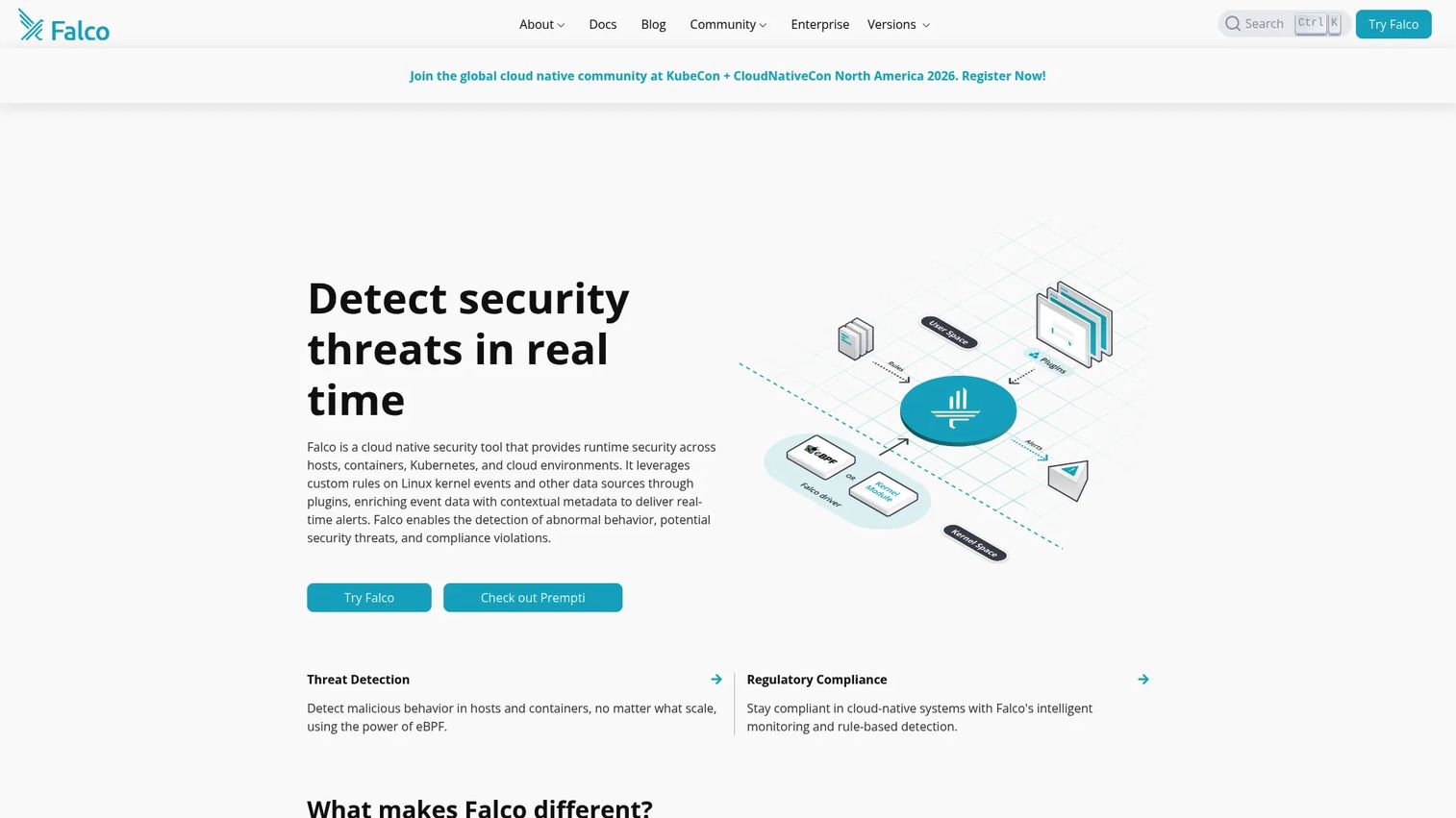
Falco is a CNCF graduated runtime security project that watches Linux syscalls, Kubernetes audit events, and cloud-native behavior patterns. Where image scanners check what is inside a container before deployment, Falco watches what containers actually do once they are running. It uses eBPF and kernel-module monitoring and ships with a plugin architecture that routes alerts to more than 50 downstream systems through Falcosidekick.
Best for: Security and platform teams that need detection after containers are deployed, not just before.
Key features
- Syscall-based runtime threat detection
- Kubernetes audit event monitoring
- Customizable rule engine for hosts, containers, and cloud
- eBPF and kernel-module event sources
- Alert forwarding through Falcosidekick integrations
Why choose Falco: This is the tool to reach for when buyers ask what happens after deployment. Strong fit for discovery calls about incident detection, SOC integration, and cloud-native monitoring. It addresses the runtime gap that image scanning leaves open.
Falco pricing: Falco is free and open source, maintained as a CNCF graduated project.
G2 rating: 4.0/5 (based on 3 reviews, per G2 alternatives listing).
4. Harbor
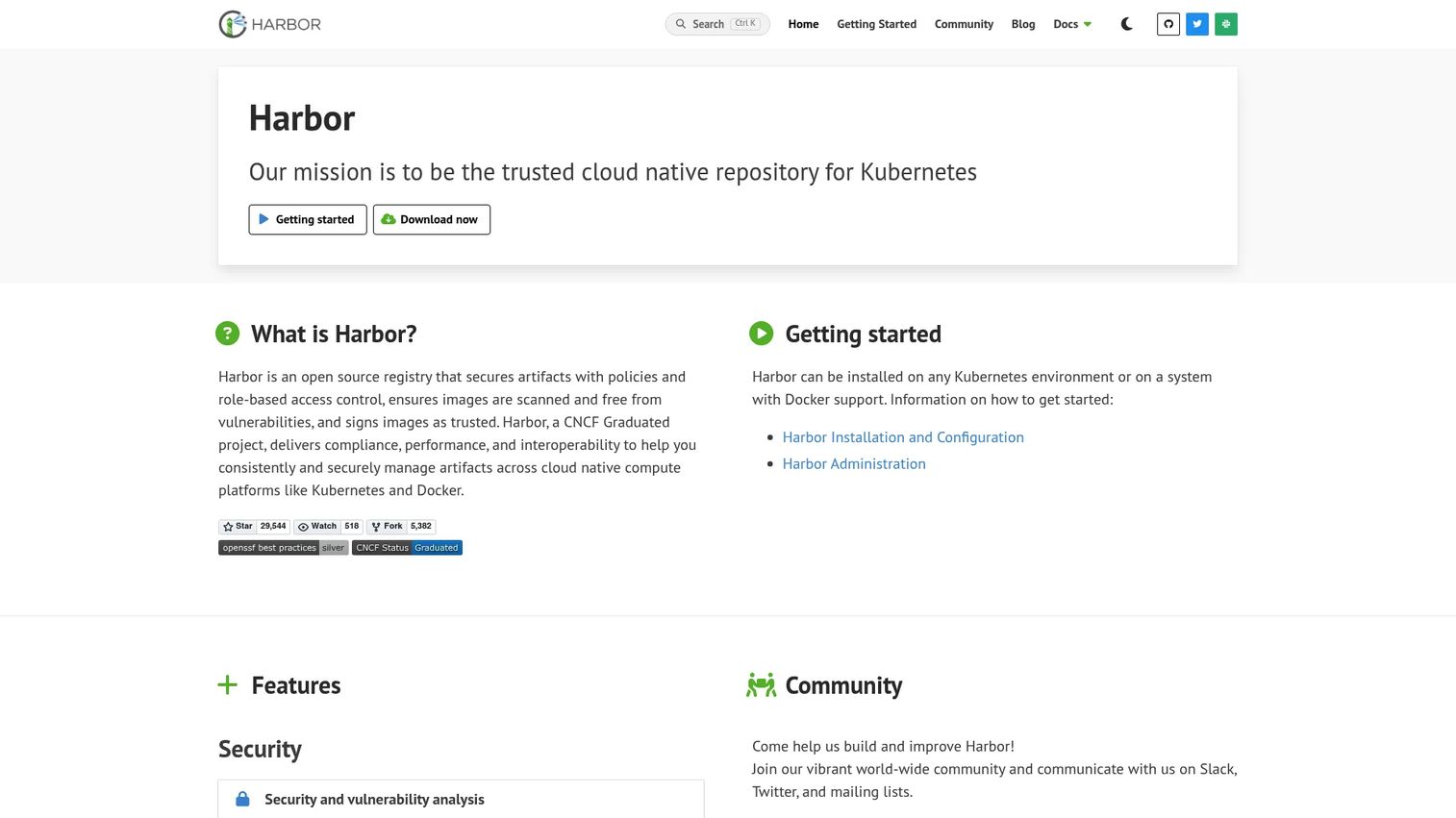
Harbor is an open source cloud-native registry that adds security governance on top of image storage. It combines a private artifact registry with built-in vulnerability scanning integrations, content trust and signing, role-based access control, image replication across registries, and multi-tenancy. The combination makes it a registry security layer, not just a place to store images.
Best for: Teams that want a self-hosted, secure private registry with governance controls and vulnerability scanning hooks in one place.
Key features
- Private image registry with multi-tenancy
- Vulnerability scanning integrations (pluggable)
- Content trust and image signing
- Role-based access control and identity integration
- Image replication across registries
Why choose Harbor: Harbor answers the registry governance questions that come up in vendor risk reviews. It helps prove that trusted images are managed, signed, and accessible only to authorized users. Pair it with a scanner like Trivy or Clair for full image lifecycle coverage.
Harbor pricing: Harbor is free and open source under the Apache 2.0 license. No paid tiers are offered by the project itself.
G2 rating: 5.0/5 per G2's container registry category listing.
5. Grype
Grype is an open source vulnerability scanner from Anchore that scans container images, filesystems, and SBOMs. It supports Docker, OCI, and Singularity image formats and can consume Syft-generated SBOMs directly, making the two tools a natural pair. Grype also uses EPSS and Known Exploited Vulnerabilities (KEV) data for risk prioritization, which helps cut through raw CVE volume.
Best for: DevSecOps and security teams that want CLI-based vulnerability scanning with SBOM input support and risk prioritization.
Key features
- Container image and filesystem vulnerability scanning
- SBOM input from Syft or compatible sources
- EPSS and KEV scoring for risk prioritization
- Multiple output formats (JSON, table, CycloneDX)
- OpenVEX support for filtering scan results
Why choose Grype: Recommend Grype when the team already uses SBOM workflows or wants a focused CLI scanner that pairs with Syft. The EPSS and KEV support is worth calling out when buyers push back on raw vulnerability counts.
Grype pricing: Grype is free and open source, available on GitHub under the Apache 2.0 license.
6. Syft
Syft is an open source SBOM generator from Anchore. It creates software bills of materials from container images, filesystems, archives, and directories. Outputs include SPDX, CycloneDX, and Syft JSON formats, and it supports signed SBOM attestations using the in-toto specification. The SBOM it generates feeds directly into Grype for vulnerability matching.
Best for: Security and engineering teams that need software component inventory for containers and want evidence for procurement, RFPs, or vulnerability response workflows.
Key features
- SBOM generation from container images and filesystems
- SPDX and CycloneDX output formats
- Signed SBOM attestations via in-toto
- Support for OCI, Docker, and Singularity image formats
- SBOM format conversion
Why choose Syft: When a buyer asks "Can you show us what is inside the container image?", a Syft-generated SBOM is the concrete answer. SBOMs also shorten the response cycle when a new CVE drops and procurement wants to know if you are affected. Check out related guidance on application security testing software for additional context on building a complete security stack.
Syft pricing: Syft is free and open source under the Apache 2.0 license.
7. Anchore Engine
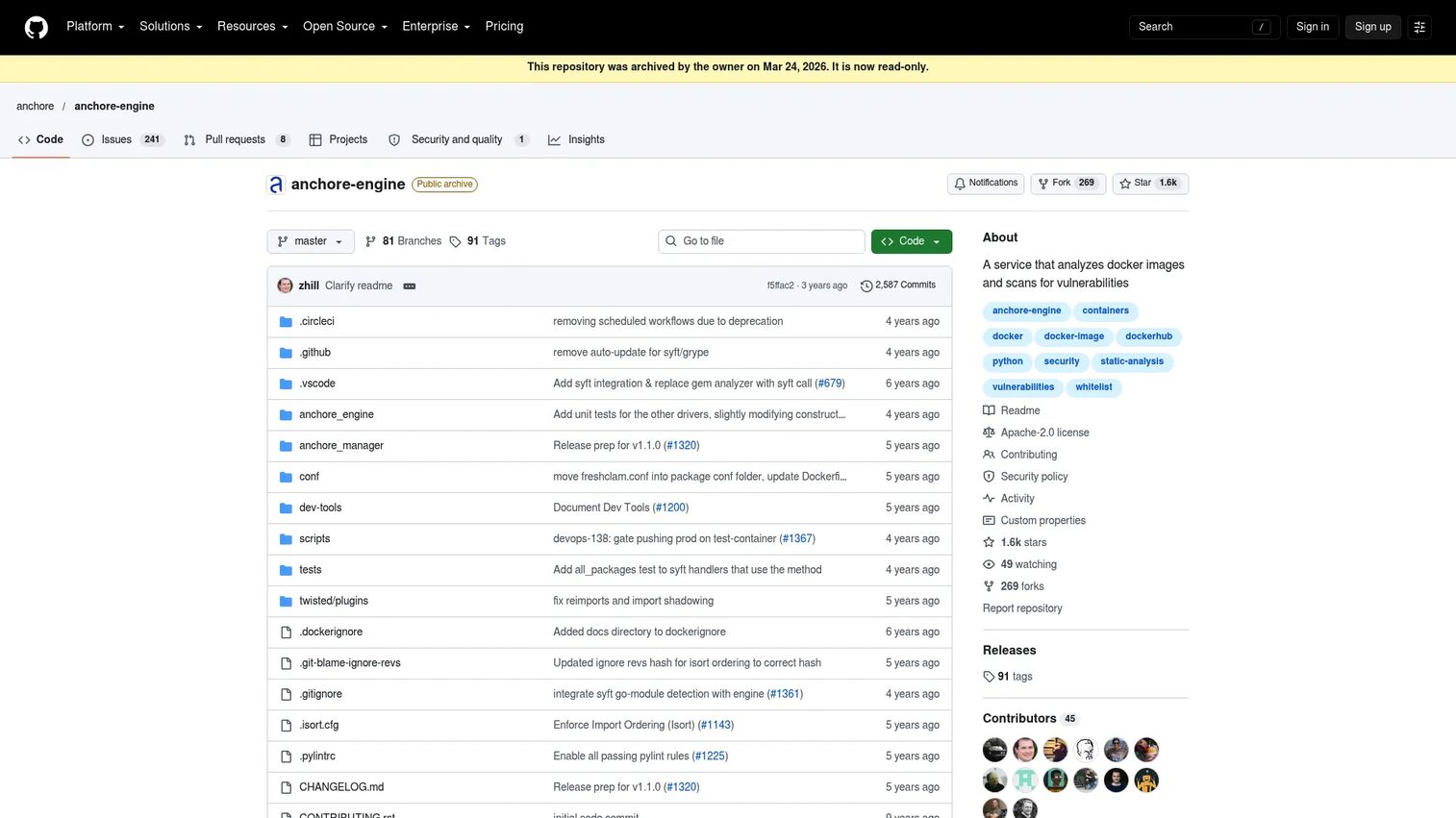
Anchore Engine was an open source service for container image analysis, policy evaluation, and vulnerability scanning. It provided a REST API, Docker image inspection, policy-based evaluation, and package analysis for multiple language ecosystems. However, the official GitHub repository confirms the project was archived on March 24, 2026, and has not been actively maintained since 2023.
Best for: Teams researching historical open source policy-based scanning patterns or understanding the Anchore product family's open source origins.
Key features
- Container image analysis and vulnerability scanning
- Policy-based image evaluation
- RESTful API and CLI access
- Package analysis across multiple language ecosystems
- Support for Docker-compatible registries
Why choose Anchore Engine: If you are evaluating Anchore's approach to policy-driven scanning, the commercial Anchore product line is the active path forward. The open source engine is archived; verify project activity and look at the commercial offerings before standardizing on anything in this family.
Anchore Engine pricing: The engine was free and open source. The repository is now archived, so no active installation is recommended without evaluating current alternatives.
G2 rating: 4.0/5 per G2's Anchore product listing
8. Dagda
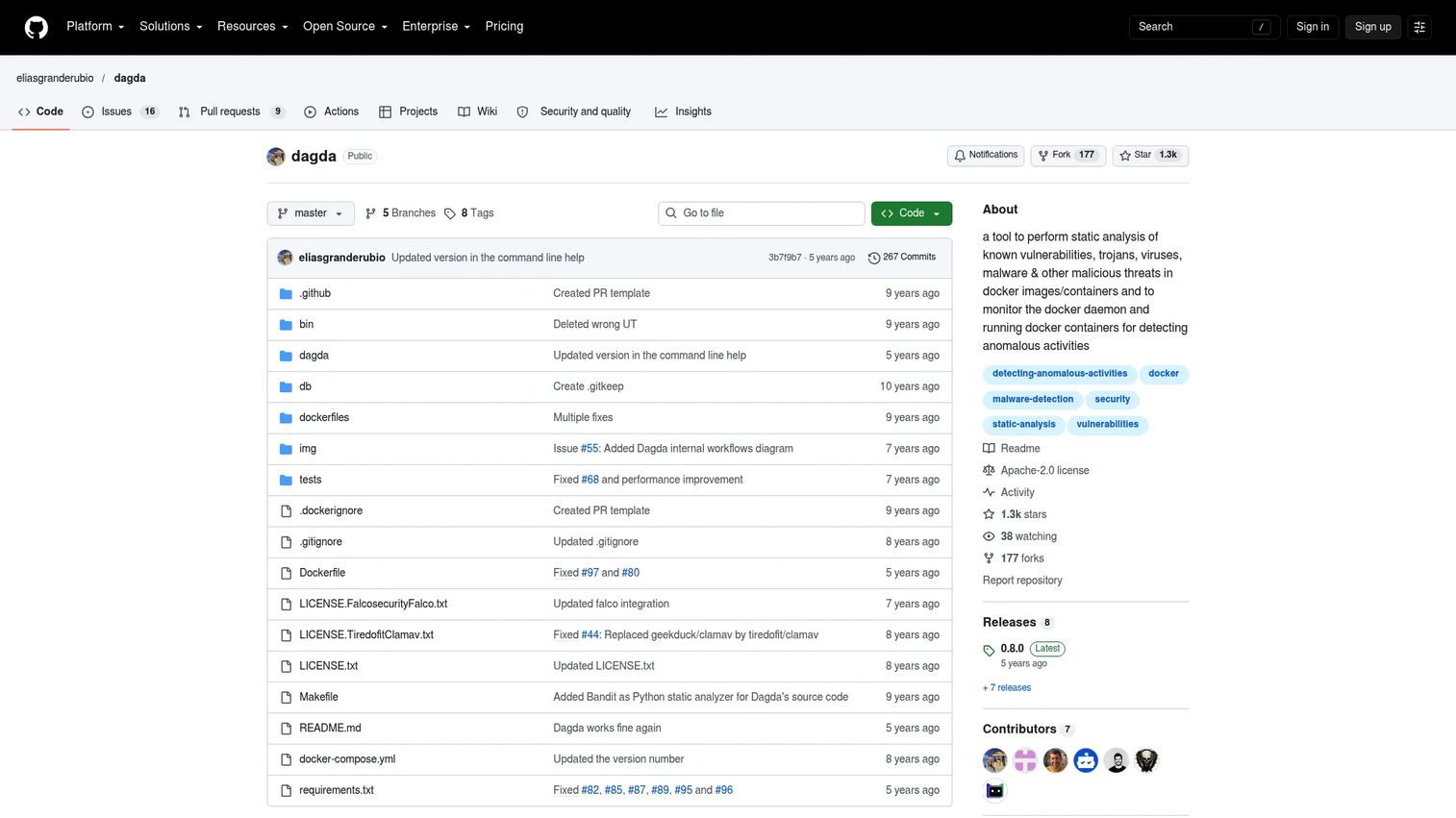
Dagda is an open source tool that combines static vulnerability analysis with malware detection for Docker images and containers. It analyzes dependencies for Java, Python, Node.js, JavaScript, Ruby, and PHP, stores results in MongoDB, and integrates with Falco for runtime anomaly monitoring. Before adopting it in production, verify current repository activity and compatibility with your environment.
Best for: Security teams researching open source malware detection and vulnerability analysis tooling for Docker environments.
Key features
- Static vulnerability analysis for Docker images and containers
- Malware, trojan, and virus detection
- Dependency analysis for multiple language ecosystems
- Runtime monitoring integration with Falco
- REST API and CLI interface
Why choose Dagda: Include Dagda as a specialist option when the team specifically needs malware scanning alongside CVE detection. It fills a gap most scanners leave open. That said, check the GitHub repository for recent commits before committing to it.
Dagda pricing: Dagda is free and open source, available on GitHub.
9. Wiz
Wiz is a commercial cloud and AI security platform that gives cloud and security teams visibility across containers, Kubernetes, cloud infrastructure, identities, and data in one agentless view. Its Security Graph connects individual findings to cloud attack paths, so teams can prioritize the vulnerabilities that represent real exposure rather than working through an undifferentiated CVE list.
Best for: Enterprise cloud and security teams that need risk prioritization across containers, Kubernetes, and cloud infrastructure from a single platform.
Key features
- Agentless cloud and AI environment visibility
- Security Graph and attack-path analysis
- Cloud Security Posture Management
- Container and Kubernetes vulnerability context
- Runtime protection with Wiz Sensor
Why choose Wiz: Choose Wiz when buyers are drowning in isolated scanner findings and need context about which vulnerabilities are actually exploitable given real cloud exposure. Presales teams can reference this category when enterprise buyers ask how vulnerability noise gets triaged.
Wiz pricing: Custom pricing based on cloud workload count and features selected. Contact Wiz for a quote.
G2 rating: 4.7/5
10. OX Security
OX Security is an enterprise application security posture platform that covers code, CI/CD pipelines, containers, and runtime in one view. It includes SAST, SCA, secrets detection, SBOM generation, IaC checks, container security, and supply-chain controls. Contextual risk prioritization uses exploitability, reachability, runtime exposure, and business impact to surface what matters most.
Best for: Security and engineering teams that want container findings connected to application ownership, development workflows, and remediation accountability.
Key features
- Code-to-runtime security mapping
- CI/CD pipeline risk visibility
- Container and supply-chain security checks
- Contextual risk prioritization using exploitability and reachability
- Automated remediation workflows and integrations
Why choose OX Security: Strong fit for teams trying to connect a container vulnerability to the developer who owns the fix. It operates more like a platform than a point scanner, which affects the buying scope and evaluation process. For AI-specific security posture context, see best AI security posture management tools.
OX Security pricing: Custom pricing calculated per active developer. Four packages available: OX VibeSec, OX Code, OX Cloud, and OX Agentic Pentester. Contact OX Security for a quote.
G2 rating: 4.8/5
11. Kube-bench
Kube-bench is an open source tool from Aqua Security that runs checks against the CIS Kubernetes Benchmark. It tests control plane components, etcd, worker nodes, and kubelet configurations, and outputs results in JSON or JUnit format. Kube-bench can also send findings to AWS Security Hub for centralized reporting.
Best for: Platform and security teams that need Kubernetes cluster benchmark checks before a security review or audit.
Key features
- CIS Kubernetes Benchmark security checks
- Control plane and node configuration tests
- JSON and JUnit output formats
- Runs inside a Kubernetes pod or as a standalone container
- AWS Security Hub integration
Why choose Kube-bench: Use it to prepare concrete evidence for security reviews that ask how clusters are hardened. A Kube-bench report gives reviewers specific benchmark pass/fail data rather than a verbal claim about cluster configuration.
Kube-bench pricing: Free and open source under the Apache 2.0 license.
12. Hadolint
Hadolint is an open source Dockerfile linter written in Haskell. It parses Dockerfiles against a set of best-practice rules and validates inline shell scripts through ShellCheck. Catching problems at this stage, before an image is built at all, is the cheapest place in the pipeline to enforce quality.
Best for: Developers and DevOps teams that want lightweight Dockerfile checks before image builds run.
Key features
- Dockerfile parsing and best-practice linting
- Inline Bash validation through ShellCheck
- Configurable rules, severity overrides, and failure thresholds
- CI integration support
- Ignored rules and custom rule configuration
Why choose Hadolint: Choose Hadolint when teams want to prevent common Dockerfile mistakes upstream. It is not a vulnerability scanner; it is early-pipeline hygiene that complements image scanning downstream.
Hadolint pricing: Free and open source, distributed through binaries, package managers, and container images.
13. Kyverno
Kyverno is a CNCF Kubernetes-native policy engine. It handles validation, mutation, generation, and cleanup of Kubernetes resources, plus container image verification, all through YAML and CEL-based policies. Admission control happens before workloads enter the cluster, with policy reports available for audit and compliance evidence.
Best for: Kubernetes platform and security teams that want policy enforcement without learning a separate policy language.
Key features
- Validation, mutation, and generation policies in YAML
- Container image and metadata verification
- Kubernetes admission control and CLI scanning
- OpenReports policy reporting
- Policy exceptions and testing tooling
Why choose Kyverno: The YAML-based approach means Kubernetes teams can write and maintain policies without learning Rego. This matters in organizations where Kubernetes is owned by platform engineers who are not policy language specialists.
Kyverno pricing: Free and open source, maintained as a CNCF project.
14. Open Policy Agent (OPA)
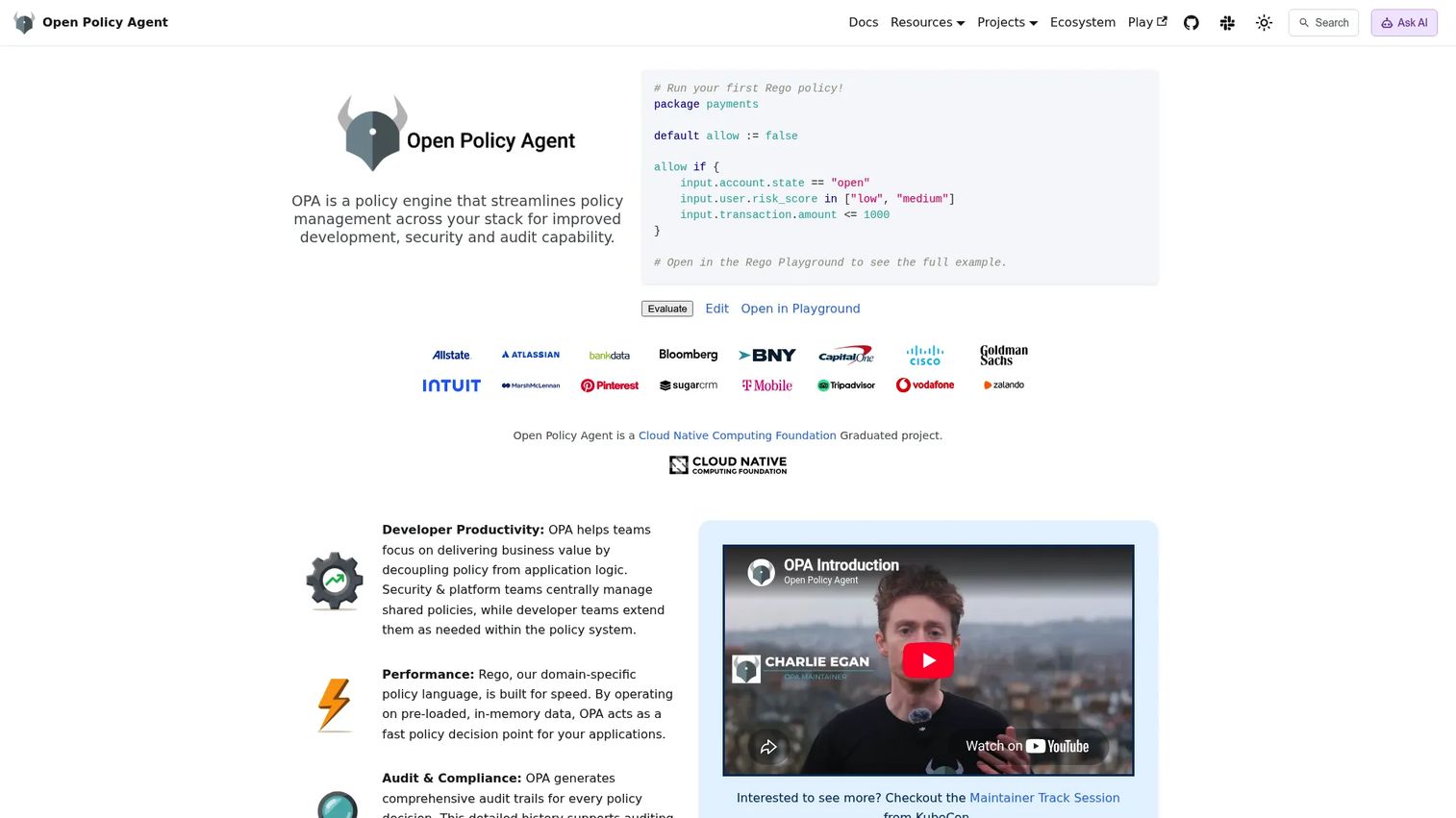
Open Policy Agent (OPA) is a CNCF graduated general-purpose policy-as-code engine. It uses the Rego declarative language and can enforce policies across Kubernetes admission, CI/CD pipelines, microservices, APIs, and infrastructure. Deployable as a sidecar, daemon, library, or centralized service, it gives teams one policy engine across multiple systems.
Best for: Engineering and platform teams that want policy consistency across Kubernetes, CI/CD, and other platform controls through a single engine.
Key features
- Rego policy language for structured data
- REST APIs for policy management and evaluation
- Kubernetes admission control
- CI/CD policy integration
- Decision logs and status telemetry
Why choose OPA: OPA fits when policy consistency matters across multiple systems, not just Kubernetes. The Rego learning curve is real, but the payoff is uniform policy enforcement across the stack. Teams with simpler Kubernetes-only needs may prefer Kyverno's YAML approach.
OPA pricing: Free and open source under the Apache 2.0 license. Commercial support comes from third-party providers listed by the project.
15. HashiCorp Vault
HashiCorp Vault is a secrets management platform that centralizes storage and delivery of tokens, keys, certificates, and dynamic credentials. In containerized environments, Vault handles Kubernetes authentication, issues short-lived credentials to workloads, and removes the need to embed secrets in images or environment variables.
Best for: Platform and security teams managing credentials and dynamic secrets across Kubernetes and hybrid cloud workloads.
Key features
- Centralized static and dynamic secrets management
- Certificate and PKI lifecycle management
- Encryption as a service
- Kubernetes authentication integration
- High availability and replication
Why choose Vault: Choose Vault when secret sprawl across containers and clusters is a bigger operational risk than image scanning gaps. Presales teams should frame it as one layer of container security, covering secrets handling specifically, rather than a complete scanning or detection tool.
HashiCorp Vault pricing: Vault is available through Pay-As-You-Go, Flex (single- or multi-year), and Enterprise Self Managed offerings. No public price is displayed on the pricing page; contact HashiCorp for a quote.
G2 rating: 4.3/5
16. Project Calico
Project Calico is an open source Kubernetes networking and network security project maintained by Tigera. It enforces network policy, provides workload segmentation, and delivers observability through its Whisker component. Calico supports eBPF, iptables, nftables, and Windows data planes, and works across container, VM, and bare-metal workloads.
Best for: Kubernetes teams that need network policy enforcement and workload segmentation as part of their container security posture.
Key features
- Kubernetes network policy enforcement
- Workload segmentation and identity-aware controls
- Traffic observability with Whisker
- Support for multiple data planes including eBPF
- Multi-cluster and multi-environment networking
Why choose Project Calico: Use Calico when buyers ask how east-west traffic is controlled between workloads. It answers a specific question scanners and runtime detection tools do not cover. Pair with Cilium for teams that need eBPF-depth observability alongside Calico's networking.
Project Calico pricing: Calico Open Source is free. Calico Cloud is usage-based, starting at $0.025 per vCPU hour. Calico Enterprise uses custom pricing.
G2 rating: 4.5/5
17. Cilium
Cilium is an open source, eBPF-based cloud-native networking, observability, and security project for Kubernetes. It enforces identity-aware network policy at L3 through L7, replaces kube-proxy, provides a Hubble observability layer, and integrates with service mesh and Gateway API patterns.
Best for: Cloud-native platform teams that want deep network visibility, policy enforcement, and service observability through eBPF.
Key features
- eBPF-based Kubernetes networking and kube-proxy replacement
- Identity-aware network policy enforcement at L3-L7
- Hubble service and network observability
- Service mesh integration with encryption
- Gateway API support
Why choose Cilium: Cilium is not a vulnerability scanner. It addresses the network security and observability layer, answering questions about service communication, workload identity, and east-west traffic control. CI/CD pipeline security context is available in the CI/CD tools guide.
Cilium pricing: Free and open source under the Apache 2.0 license. Enterprise support is available from Isovalent and other providers.
G2 rating: 4.5/5
18. KubeArmor
KubeArmor is a CNCF Sandbox open source runtime security enforcement engine. It uses eBPF and Linux security modules to restrict what container workloads can do at runtime: Which processes can execute, which files can be accessed, which network operations are permitted, and which resources can be consumed. Policy violations are logged through eBPF.
Best for: Kubernetes, container, VM, and bare-metal teams that want preventive runtime controls rather than detection-only monitoring.
Key features
- Behavior restriction for process execution and file access
- Network operation controls between containers
- Kubernetes-native policy development and enforcement
- Real-time runtime policy enforcement based on workload identity
- Policy violation logging via eBPF
Why choose KubeArmor: KubeArmor adds preventive enforcement where Falco adds detection. The two complement each other well. Use KubeArmor when buyers want to prevent a compromised container from taking harmful actions, not just alert when it does.
KubeArmor pricing: Free and open source, available on GitHub and kubearmor.io.
19. Docker Scout
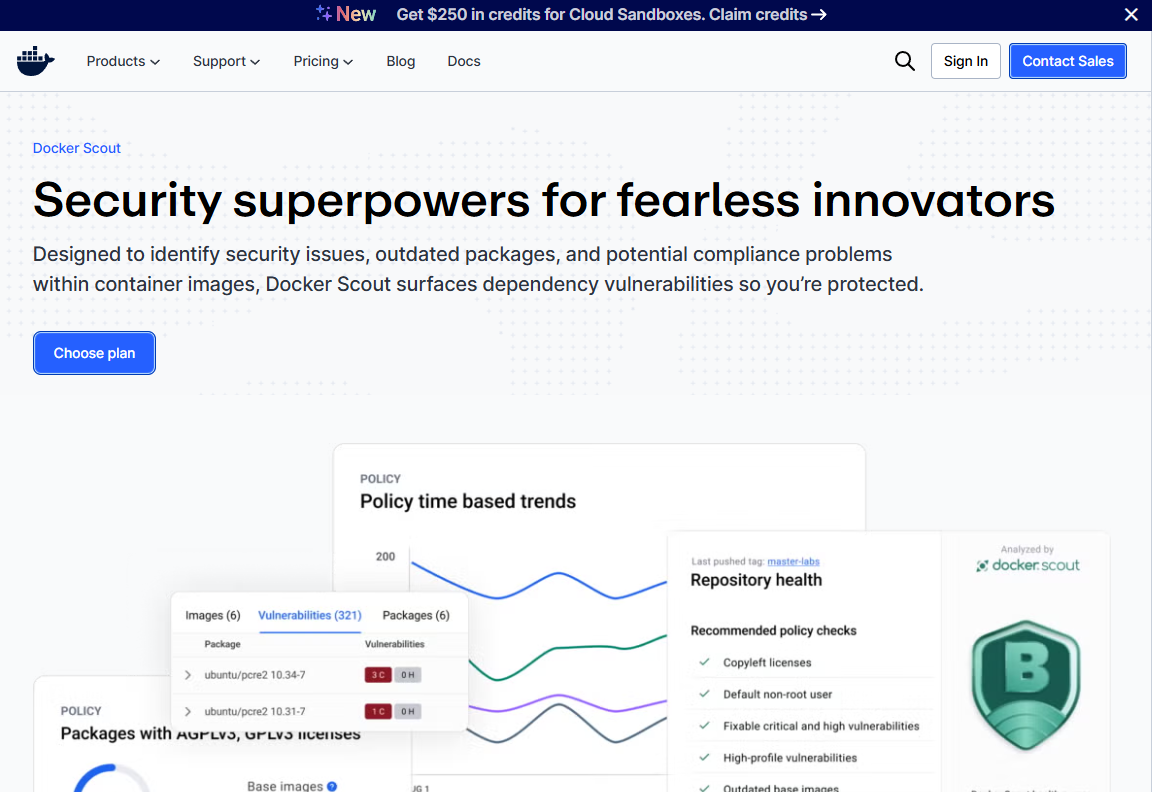
Docker Scout is Docker's image analysis and vulnerability insight product. It continuously recalculates vulnerability exposure as new CVE data arrives, provides layer-level remediation recommendations, evaluates policy compliance, and integrates with Docker Desktop, Docker Hub, and Docker CLI. The SBOM generation and base image recommendations help developers act on findings without switching tools.
Best for: Development and security teams already using Docker Desktop or Docker Hub that want vulnerability context and remediation guidance inside their existing workflow.
Key features
- Continuous vulnerability recalculation with updated CVE data
- Layer-level remediation recommendations
- Base image improvement suggestions
- Policy evaluation and compliance checks
- Local SBOM generation
Why choose Docker Scout: Scout fits when developer adoption is the priority and the team already works in Docker tooling. It may not replace a broader runtime or CNAPP platform, but it closes the vulnerability awareness gap for Docker-native development workflows.
Docker Scout pricing: Docker Personal (free) includes 1 Scout-enabled repository. Docker Pro is $9 per user per month; Docker Team is $15 per user per month; Docker Business is $24 per user per month. Pro and Team include 2 and unlimited Scout-enabled repositories respectively.
G2 rating: 4.6/5 (Docker overall G2 listing).
20. JFrog Artifactory
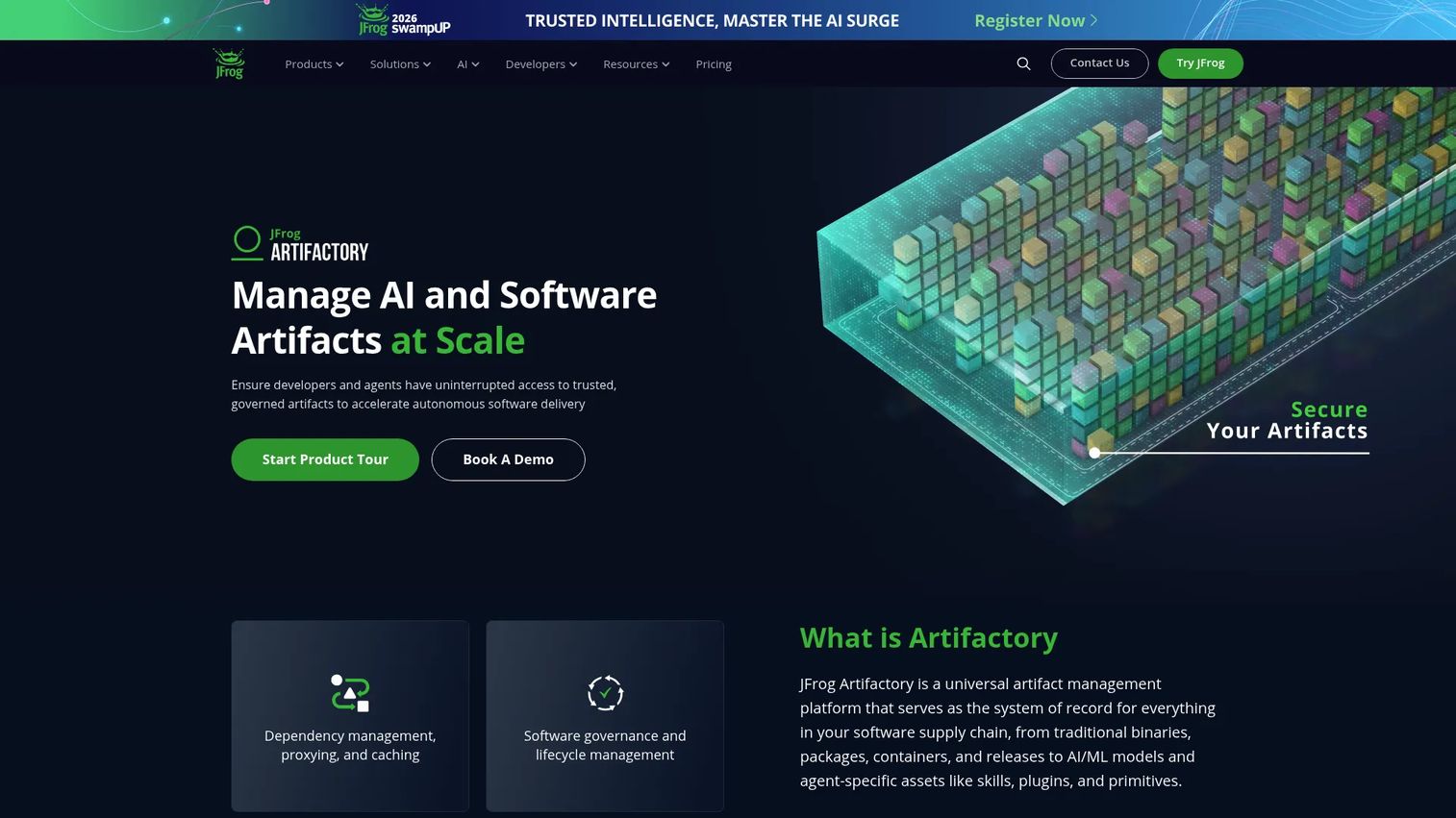
JFrog Artifactory is a universal artifact management platform that supports over 60 package and artifact types, including container registries. It handles repository proxying, replication, federation, and global distribution. For container security, Artifactory provides access controls, governance, audit trails, and integration with JFrog's security tooling for artifact scanning and attestation.
Best for: Enterprise development and DevOps teams managing container images alongside many other artifact types under unified governance.
Key features
- Universal support for 60+ artifact and package types
- Repository proxying, replication, and federation
- Role-based access control, governance, and auditing
- CI/CD integrations and dependency caching
- Security integrations and artifact attestation
Why choose JFrog Artifactory: Artifactory earns its place in enterprises with mature build pipelines, compliance requirements, and multiple artifact types to manage. Container registry security is part of a larger artifact governance picture here, not the primary focus.
JFrog Artifactory pricing: Pro plan starts at $50 per month with 25 GB base consumption. Usage-based charges apply for additional storage and data transfer. A 14-day free trial is available.
G2 rating: 4.3/5
21. Red Hat Quay
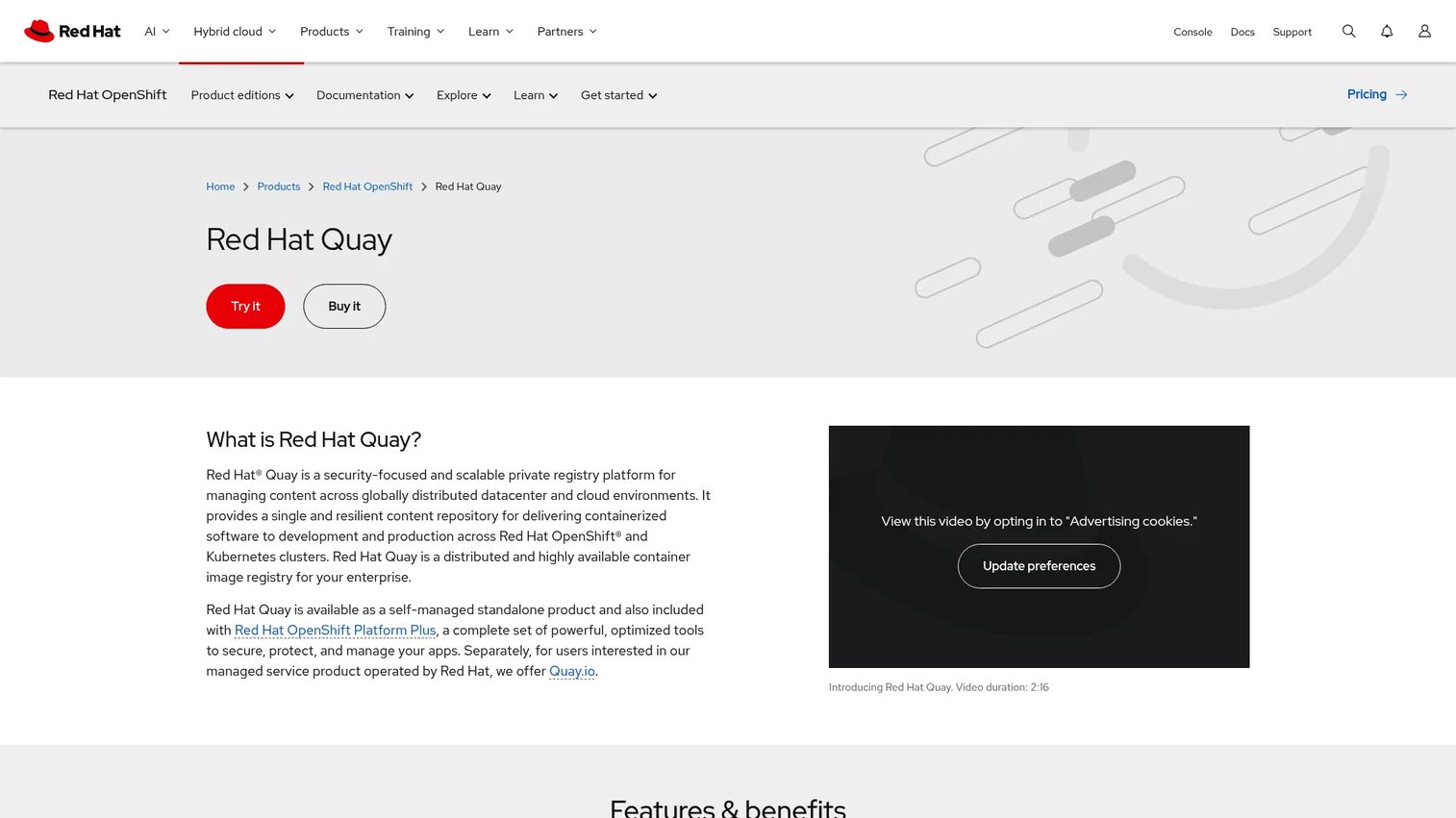
Red Hat Quay is an enterprise container registry with continuous vulnerability scanning, granular team-based access control, geographic replication, and tight OpenShift integration. It supports CI/CD automation with GitHub, Bitbucket, and GitLab, and provides repository mirroring and image caching for organizations that need high availability across environments.
Best for: Red Hat and Kubernetes teams that need enterprise registry governance aligned with OpenShift infrastructure.
Key features
- Enterprise image registry with high availability
- Granular team-based access control
- Continuous vulnerability scanning integrations
- Geographic replication and repository mirroring
- Red Hat OpenShift integration
Why choose Red Hat Quay: Quay is the registry governance choice when the rest of the infrastructure runs on Red Hat. It is registry security and distribution, not runtime detection. Frame it accordingly when buyers ask about the full container security stack.
Red Hat Quay pricing: Priced per deployment, available with OpenShift or separately. Contact Red Hat for a quote.
G2 rating: 4.5/5
Considerations when choosing container security tools
Match the tool to the lifecycle stage
Build-time scanning, registry governance, policy enforcement, and runtime detection each solve a different problem. Buying a scanner and treating the container security question as answered will leave gaps that come up in security reviews. Map your coverage to each stage before evaluating vendors.
Check how findings get prioritized
Most image scanners return hundreds of CVEs. Without exploitability scores, runtime exposure context, and asset ownership, teams burn cycles on vulnerabilities that pose no real risk. Commercial platforms like Wiz and OX Security add this context. Open source tools like Grype include EPSS and KEV data to help with the same problem.
Validate CI/CD and registry integrations
Test how each tool fits your actual pipeline before committing. Relevant integration points include GitHub Actions, GitLab CI, Docker, Kubernetes, your artifact registry, and your ticketing or alerting workflow. A tool that does not fit the pipeline will not get used. More on building CI/CD pipeline security is available in the CI/CD tools guide.
Look at maintenance and project activity
For open source tools, check the GitHub repository for release cadence, open issues, documentation quality, and Kubernetes version support. Anchore Engine is a concrete example of what happens when a project goes quiet; the tool was archived in March 2026. Verify activity before adopting any open source project in a production security workflow.
Prepare evidence for audits and security reviews
Presales teams supporting enterprise deals need more than a scanner running somewhere. Prepare SBOMs, Kube-bench reports, policy outputs, vulnerability exception records, and patching timelines. These artifacts are what survive a vendor security questionnaire. For related guidance on building a complete security evidence package, see application security testing software.
Conclusion
No single container security tool covers the full lifecycle. The best teams build a stack that maps to the questions buyers and auditors actually ask.
For image scanning, Trivy, Grype, Clair, and Docker Scout each serve different workflow needs. Syft provides the SBOM evidence that procurement and vulnerability response teams increasingly require. Falco and KubeArmor address the runtime layer where scanners have no visibility. Harbor, JFrog Artifactory, and Red Hat Quay each handle registry governance at different scales and with different ecosystem dependencies. Kyverno, OPA, Kube-bench, Project Calico, and Cilium collectively cover Kubernetes configuration, policy enforcement, and network security. Wiz and OX Security help teams connect raw findings to business risk and remediation ownership.
Start by mapping the lifecycle stages you currently have no coverage for. That gap, whether it is runtime detection, SBOM generation, or Kubernetes policy, is usually where the next security review question lands.
If your team also explains complex technical workflows to buyers, interactive demos can help make container security architecture easier to communicate during presales discovery and technical validation calls.
Start your journey with Guideflow today!
FAQs
Container security tools protect the full lifecycle from build through runtime. Typical uses include scanning images for CVEs, generating SBOMs, enforcing Kubernetes admission policies, detecting anomalous container behavior at runtime, controlling registry access, and managing secrets. Most teams combine four or more tools to close coverage across these areas.
Container scanning tools detect vulnerabilities and misconfigurations in images or filesystems. Container security tools is the broader category and includes scanners plus runtime detection, policy enforcement, registry governance, secrets management, and network security controls. Scanning is one layer; container security spans the complete path from Dockerfile to running workload.
Trivy, Grype, Clair, and Docker Scout are the most commonly evaluated image scanners. Trivy offers the broadest scope across images, IaC, Kubernetes, and secrets. Grype pairs well with Syft-generated SBOMs. Clair suits service-oriented registry integrations. Docker Scout fits teams already embedded in Docker tooling. The right pick depends on CI/CD workflow, output format requirements, and whether SBOM generation is part of the same workflow.
Falco detects suspicious behavior through syscall and Kubernetes audit event monitoring, operating as a detection tool. KubeArmor enforces preventive policy at the workload level using Linux security modules and eBPF. Cilium adds runtime network visibility and enforcement through eBPF. The detection-versus-enforcement distinction matters: Falco tells you something happened, while KubeArmor can prevent it.
Scanning typically runs on pull requests, at build time, and again at registry push. SBOM generation happens at build time and feeds downstream vulnerability matching. Policy checks run as admission gates before workloads deploy to Kubernetes. Tools like Trivy, Grype, and Hadolint integrate directly with GitHub Actions, GitLab CI, and Jenkins through plugins and CLI commands.
No. Image scanners do not address Kubernetes cluster configuration, admission control, network policy, or runtime enforcement. Those require separate tools. Kube-bench validates cluster hardening against CIS benchmarks. Kyverno and OPA enforce admission policies. Project Calico and Cilium control network traffic between workloads. KubeArmor enforces workload behavior at runtime. Container scanning and Kubernetes security are complementary, not overlapping.
Open source tools can cover image scanning, SBOM generation, policy enforcement, and runtime detection. The gaps that push enterprise teams toward commercial platforms include centralized reporting across teams, risk prioritization with business context, RBAC for large engineering organizations, audit trail requirements, SLA-backed support, and correlation between findings across cloud infrastructure layers. Wiz and OX Security address those gaps; Trivy, Falco, Kyverno, and their peers handle the technical controls.
Presales teams benefit from understanding the lifecycle map rather than individual tool details. The key is connecting each buyer question to the tool category that answers it. "How do you scan images?" points to Trivy or Grype. "What happens after deployment?" points to Falco or KubeArmor. "How do you harden the cluster?" points to Kube-bench and Kyverno. "Can you prove what is inside the image?" points to Syft. Preparing evidence across these layers, not just mentioning that scanning exists, is what builds buyer confidence during technical validation. See also the best presales software tools guide for broader presales workflow context.