An employee reports the app is slow. IT opens a ticket. By the time anyone investigates, three more tickets land, and the root cause, whether a degraded endpoint, a misconfigured update, or a SaaS performance issue, is already buried under noise.
That reactive loop is expensive. According to Gartner (2024), just 23% of digital workers are completely satisfied with their work applications, down from 30% in 2022. Digital workers who are satisfied with their apps are nearly three times more likely to report being much more productive, per Gartner (2025). The gap between what employees experience and what IT can see in real time is the core problem digital employee experience (DEX) software solves.
This guide gives IT leaders, digital workplace teams, and technical GTM readers a practical shortlist of 20 DEX software tools for 2026, with verified pricing, current G2 ratings, and buying criteria drawn from real enterprise evaluation scenarios.
What's inside
This guide is built for IT operations, digital workplace, and presales teams evaluating DEX platforms. Selection criteria include:
- Endpoint and network telemetry depth: Real-time data across devices, apps, and workspaces
- Automated remediation and proactive support: Self-healing workflows and issue prevention before tickets spike
- Employee sentiment and experience scoring: Combining technical data with employee feedback signals
- ITSM and endpoint management integrations: Connecting DEX insights to existing operational workflows
- Fit for hybrid and remote environments: Visibility across on-premise, VDI, cloud, and home-office endpoints
TL;DR
- Best overall enterprise DEX platform: Nexthink Infinity for broad endpoint telemetry, sentiment campaigns, and automated remediation at scale
- Best for real-time IT operations: ControlUp ONE for endpoint, VDI, and unified communications monitoring with fast remediation
- Best for application and device performance: Riverbed Aternity Employee Experience for connecting app performance data to employee experience scores
- Best for deep endpoint intelligence: SysTrack for device telemetry, persona modeling, and workplace analytics
- Best for ITSM-centered enterprises: ServiceNow Digital End-User Experience for teams already running ServiceNow workflows
- Best for mobile and frontline device fleets: SOTI ONE Platform for organizations managing large, diverse mobile and rugged device estates
What is digital employee experience software?
Digital employee experience (DEX) software helps organizations monitor, measure, and improve how employees experience workplace technology, including devices, applications, networks, collaboration tools, and support workflows.
Where traditional IT monitoring focuses on infrastructure health, DEX software focuses on the human layer: What does the technology feel like to the people using it, and where does it fail them?
Modern DEX platforms collect telemetry from endpoints, virtual desktops, SaaS applications, browsers, and network paths. They combine that technical data with employee sentiment surveys and experience scores to give IT teams a complete picture of friction, not just failure. When an issue surfaces, DEX software helps teams identify root causes before a ticket avalanche arrives, and increasingly, it can trigger automated remediation or self-service workflows to fix known issues without human intervention.
The category is distinct from broader HR employee experience software, which focuses on engagement, culture, benefits, and surveys. DEX software is specifically about technology experience: Whether devices boot fast, whether apps perform, whether collaboration tools hold up under distributed workloads.
Key capabilities to look for
- Endpoint and device monitoring (health, performance, boot time, crash rates)
- Application performance visibility (response times, errors, usage patterns)
- Network and workspace telemetry (latency, VPN performance, home-network signals)
- Employee sentiment collection (in-context surveys, feedback campaigns)
- Experience scoring and persona analysis
- Root-cause analysis and anomaly detection
- Automated remediation and self-healing workflows
- ITSM and endpoint management integrations
- Self-service support portals and virtual agents
- Reporting for IT leaders and business stakeholders
When to use digital employee experience software
Detect employee technology issues before tickets spike
DEX platforms give IT visibility into slow logins, application crashes, failed patch deployments, and device health degradation before employees reach the help desk. For presales teams evaluating DEX software, proof of proactive detection, demonstrated in a POC with real endpoint data, is often the decisive validation moment.
Support hybrid and remote work with better visibility
Distributed employees create blind spots in traditional monitoring. DEX platforms extend visibility to home-network conditions, VPN performance, SaaS application latency, and remote endpoint health. When your IT team cannot physically touch an endpoint, telemetry-driven diagnosis is the only path to fast resolution.
Turn employee sentiment into IT prioritization
Telemetry tells you what broke. Sentiment tells you what hurt. Teams that combine both can prioritize fixes based on employee impact rather than ticket volume alone, which means the right issues get fixed first, not the loudest ones.
Digital employee experience software comparison
Use the table below as a quick reference. Pricing reflects vendor-published figures where available; where vendors price by quote, "Custom pricing" is noted. G2 ratings are verified from each tool's current G2 listing.
| # | Product | Best for | Key differentiator | Pricing | G2 rating |
|---|---|---|---|---|---|
| 1 | Nexthink Infinity | Enterprise DEX at scale | Telemetry, sentiment, and remediation in one platform | Custom pricing | 4.6/5 |
| 2 | ControlUp ONE | Real-time endpoint and VDI monitoring | Unified monitoring with synthetic testing and automated remediation | Custom pricing | 4.7/5 |
| 3 | Riverbed Aternity Employee Experience | App and device performance analytics | Digital Experience Index correlated with application telemetry | Custom pricing | 4.0/5 |
| 4 | SysTrack | Deep endpoint intelligence | Persona modeling and workplace analytics from endpoint data | Custom pricing | 4.5/5 |
| 5 | FlexxClient | Hybrid workspace operations | Real-time diagnostics with remote support and self-service workflows | Custom pricing | 4.6/5 |
| 6 | HP Workforce Experience Platform | Workforce and device analytics | AI-driven anomaly detection across PC fleets with printer management | Custom pricing | 4.2/5 |
| 7 | TeamViewer DEX | IT support with DEX visibility | Endpoint monitoring connected to remediation and support actions | Custom pricing | 4.4/5 |
| 8 | Tanium Autonomous IT Platform | Enterprise endpoint control at scale | Real-time endpoint intelligence with autonomous patch and security management | Custom pricing | 4.5/5 |
| 9 | Ivanti Autonomous Endpoint Management | Endpoint management and DEX combined | Risk-based patching with self-healing bots and DEX scoring | Custom pricing | 4.2/5 |
| 10 | Omnissa Workspace ONE Experience Management | Existing Workspace ONE environments | Experience scoring across device, app, OS, and sentiment data | From $1.67/device/month | N/A |
| 11 | ServiceNow Digital End-User Experience | ITSM-embedded DEX | Desktop Assistant, DEX Score, and bulk remediation in ServiceNow | Custom pricing | 4.4/5 |
| 12 | Nanoheal | Self-healing endpoint remediation | Zero-touch autonomous remediation with ITSM integrations | Custom pricing | N/A |
| 13 | Workelevate | AI-driven employee IT support | Conversational AI self-service with DEX monitoring and endpoint management | Custom pricing | 4.8/5 |
| 14 | Stratusphere UX | Virtual and physical workspace diagnostics | End-to-end UX scoring with session-level analytics and VDI diagnostics | Custom pricing | N/A |
| 15 | ManageEngine Endpoint Central | Endpoint management with DEX visibility | Unified patching, remote control, and asset management with published pricing | From $104/month (50 endpoints, cloud) | N/A |
| 16 | Collective IQ | AI workforce automation | Digital Direct Reports that act inside business systems | Custom pricing | 4.5/5 |
| 17 | Bumblebot Tasky | Employee task automation | AI-guided support and task routing for digital workplaces | Custom pricing | N/A |
| 18 | BigFix Workspace+ | Large-scale endpoint automation | Centralized management across 120+ operating systems with DEX monitoring | Custom pricing | 4.4/5 |
| 19 | eG Enterprise | Cross-stack IT performance monitoring | Automatic root-cause diagnosis across applications, infrastructure, and VDI | From $100/month | 4.5/5 |
| 20 | SOTI ONE Platform | Mobile and frontline device management | Integrated MDM, diagnostics, app development, and printer lifecycle management | Custom pricing | N/A |
Best 20 digital employee experience software for 2026
1. Nexthink Infinity
Nexthink Infinity is a purpose-built enterprise DEX platform for detecting, diagnosing, and fixing employee technology issues across distributed device estates. It captures real-time telemetry from endpoints, applications, operating systems, and networks, and layers in employee sentiment campaigns to surface friction that technical data alone misses. AI-powered root-cause analysis helps IT teams move from signal to resolution faster, while automated remote actions and workflow integrations keep remediation out of the manual queue.
Best for: Large enterprises that need a complete DEX platform covering telemetry, sentiment, diagnostics, and automated remediation in one place.
Key features
- Real-time endpoint and application telemetry
- AI-powered root-cause analysis and benchmarking
- Employee sentiment campaigns and experience scoring
- Automated remote actions and remediation workflows
- ITSM integrations with major service management platforms
Why choose Nexthink Infinity: Nexthink's breadth makes it the right starting point for enterprises that need both technical visibility and employee-facing experience signals in a single operational layer. If your team is managing tens of thousands of endpoints and needs to prove DEX impact to leadership, this is the platform most evaluators shortlist first.
Nexthink Infinity pricing: Nexthink prices by quote and directs buyers to contact sales. No standard tier pricing is shown publicly.
G2 rating: 4.6/5
2. ControlUp ONE
ControlUp ONE is a unified digital employee experience platform built for operations teams that need to catch and fix issues while they are happening. It monitors physical endpoints, virtual desktops, DaaS environments, SaaS applications, and unified communications in real time. Synthetic proactive testing checks for problems before employees report them, and built-in remediation actions let IT respond without context-switching between tools.
Best for: Enterprise IT operations teams running VDI or DaaS environments alongside physical endpoints, where speed of diagnosis directly affects employee productivity.
Key features
- Real-time monitoring across endpoints, applications, and VDI/DaaS
- Synthetic proactive testing for early issue detection
- Automated optimization and remediation workflows
- Patch management and vulnerability remediation
- Employee sentiment, unified communications monitoring, and AI-powered anomaly detection
Why choose ControlUp ONE: The combination of real-time monitoring and in-platform remediation collapses the gap between detection and fix. It fits IT operations teams that have outgrown dashboard-only tools and need action capabilities alongside visibility.
ControlUp ONE pricing: ControlUp ONE is sold as a platform license. Pricing requires a quote from sales.
G2 rating: 4.7/5
3. Riverbed Aternity Employee Experience
Riverbed Aternity Employee Experience connects application performance data directly to employee experience scores, giving IT teams a clear line between "this app degraded at 9am" and "these 200 employees had a bad Monday." It monitors device health, application usage and performance, browser experience through DOM-based replay, and network conditions, then correlates all of that into a Digital Experience Index. Automated remediation and service-desk integrations round out the operational picture.
Best for: Enterprises where employee issues frequently trace back to application performance, and where IT needs to report business impact alongside technical metrics.
Key features
- Application performance monitoring with usage and error tracking
- Device health and inventory analytics
- Digital Experience Index and employee sentiment scoring
- DOM-based browser replay correlated with endpoint and network telemetry
- Automated remediation and ITSM integrations
Why choose Riverbed Aternity Employee Experience: If your team spends too many cycles arguing about whether a slow app is a device problem, a network problem, or a backend problem, Aternity's correlated data model cuts through that noise. The business impact reporting also helps IT teams justify DEX investment to leadership.
Riverbed Aternity Employee Experience pricing: Riverbed offers Essentials and Enterprise editions. Both are subscription-based and priced by quote through sales.
G2 rating: 4.0/5
4. SysTrack
SysTrack by Lakeside Software is a digital employee experience platform built around deep endpoint telemetry. It collects granular data from devices and uses that data to build persona models, forecast capacity needs, and power AI-assisted remediation. The platform is widely used for workplace planning decisions, including hardware refresh cycles and application rationalization, as well as for real-time IT diagnostics. It also covers VDI and multi-platform environments.
Best for: Enterprise IT teams that want to connect endpoint data to workforce analytics, technology planning, and persona-based experience management.
Key features
- Endpoint telemetry across hardware, OS, and applications
- Persona modeling and employee experience segmentation
- Proactive IT and predictive analytics
- AI-assisted remediation and automations
- Multi-platform and VDI support
Why choose SysTrack: SysTrack earns its place when IT wants to go beyond incident resolution and use endpoint data to make better decisions about device procurement, application deployment, and support staffing. It is a strong fit for teams that present quarterly technology health reports to IT leadership.
SysTrack pricing: Pricing is quote-based through Lakeside sales; no standard tier pricing is available.
G2 rating: 4.5/5
5. FlexxClient
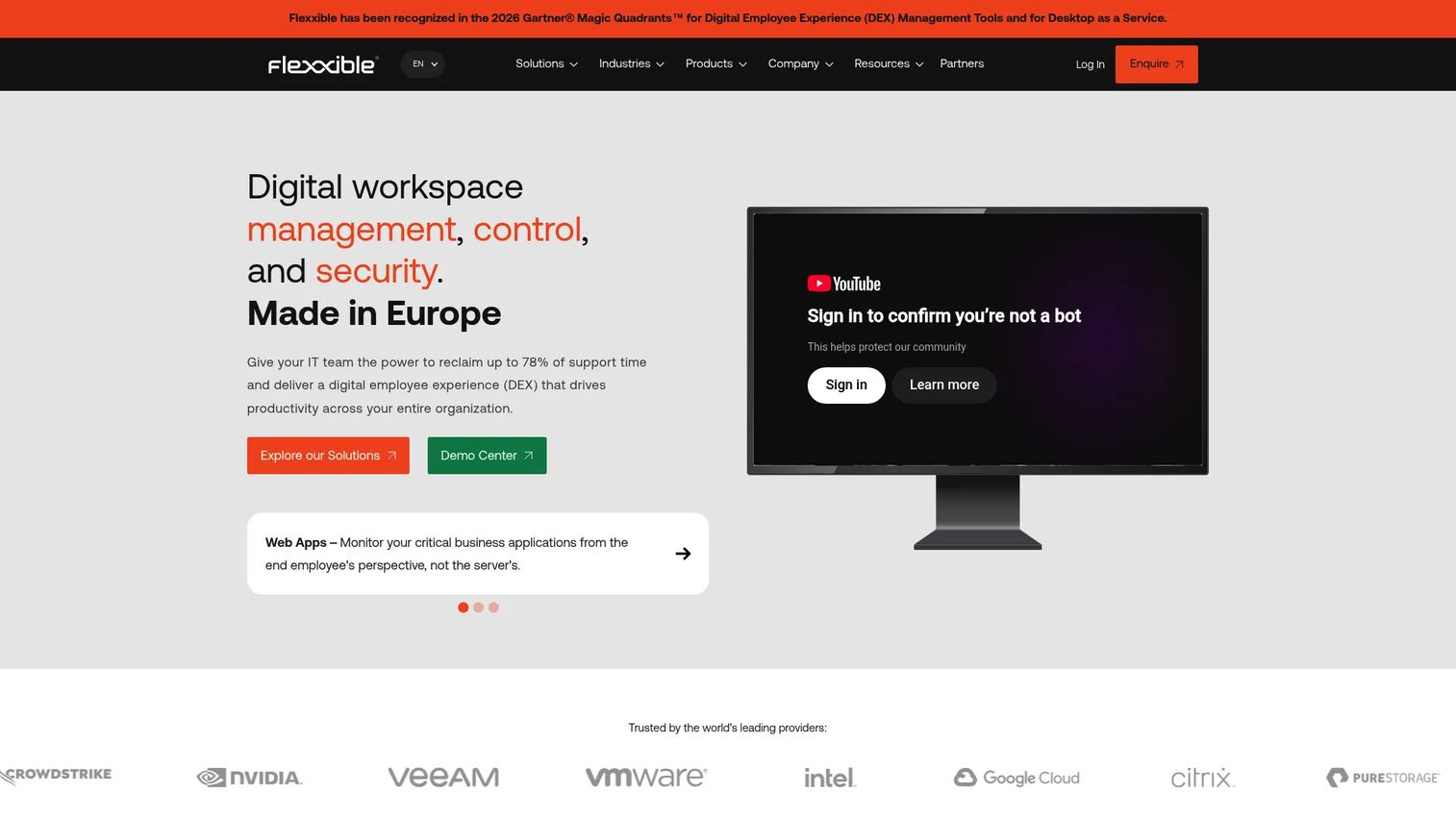
FlexxClient by Flexxible is a SaaS-delivered DEX platform covering physical endpoints, virtual desktops, and user sessions. It provides real-time visibility into device and application health, employee sentiment, and session performance, then connects that data to remote support tools and automated remediation workflows. Software asset management, patch management, compliance reporting, and security alerting are also included, which helps teams consolidate point tools.
Best for: Enterprise IT teams managing distributed hybrid workspaces who want DEX monitoring, endpoint operations, and support workflows in one platform.
Key features
- Real-time diagnostics across devices, applications, and sessions
- Employee sentiment integration with technical monitoring
- Remote support and self-service remediation
- Patch management, software inventory, and compliance reporting
- Security alerting and endpoint controls
Why choose FlexxClient: FlexxClient is worth evaluating when your team is tired of switching between a monitoring tool, a patch tool, and a remote support tool to solve a single employee issue. The consolidated workflow reduces context-switching and speeds up resolution.
FlexxClient pricing: Pricing is quote-based. Contact Flexxible for current tier information.
G2 rating: 4.6/5
6. HP Workforce Experience Platform
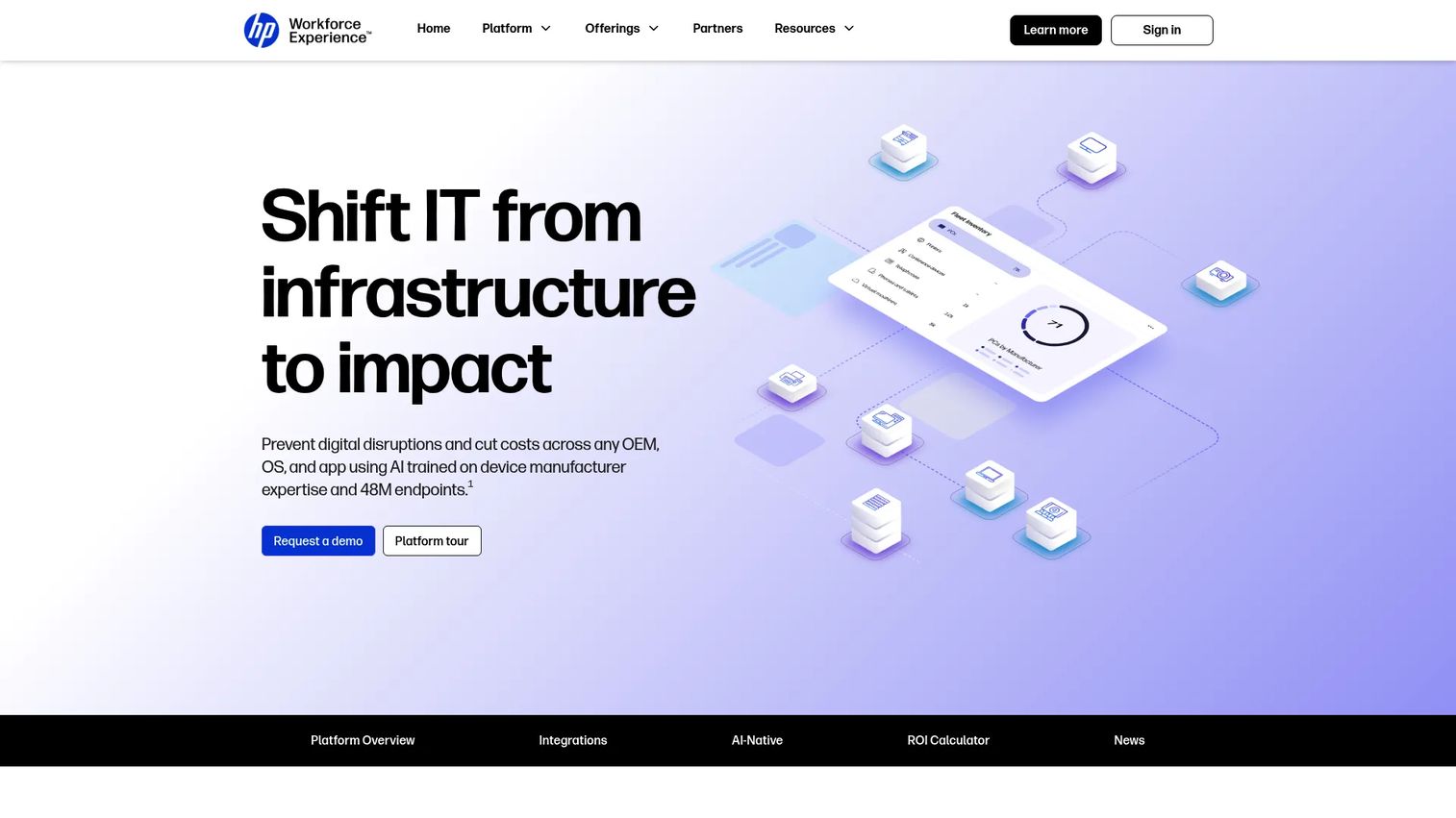
HP Workforce Experience Platform is an AI-powered DEX platform for monitoring PC fleet health, detecting anomalies, and improving IT support efficiency. It combines hardware and software inventory, AI-driven recommendations, employee sentiment surveys, and a Workforce Experience Score into a single dashboard. Integration with ServiceNow, Microsoft Intune, Power BI, and Microsoft Entra ID fits organizations already standardized on Microsoft and HP toolchains. Printer fleet management is included, which sets it apart from endpoint-only competitors.
Best for: Enterprise IT teams managing large HP device estates who want DEX analytics, proactive remediation, and printer management from one vendor.
Key features
- PC fleet visibility and hardware/software inventory
- AI-driven anomaly detection and automated recommendations
- Employee sentiment surveys and Workforce Experience scoring
- Integrations with ServiceNow, Intune, Power BI, and Microsoft Entra ID
- Printer fleet management with policy-based configuration and firmware updates
Why choose HP Workforce Experience Platform: If your organization already standardizes on HP hardware and Microsoft management tools, WXP reduces integration overhead significantly. The printer management module is a practical differentiator for IT teams that manage large print fleets alongside endpoint estates.
HP Workforce Experience Platform pricing: HP lists Standard, Pro, and Elite tiers plus printer-specific plans. All pricing requires contacting HP; HP notes WXP is available at no additional cost to new and renewing HP Proactive Insights customers in the United States.
G2 rating: 4.2/5
7. TeamViewer DEX
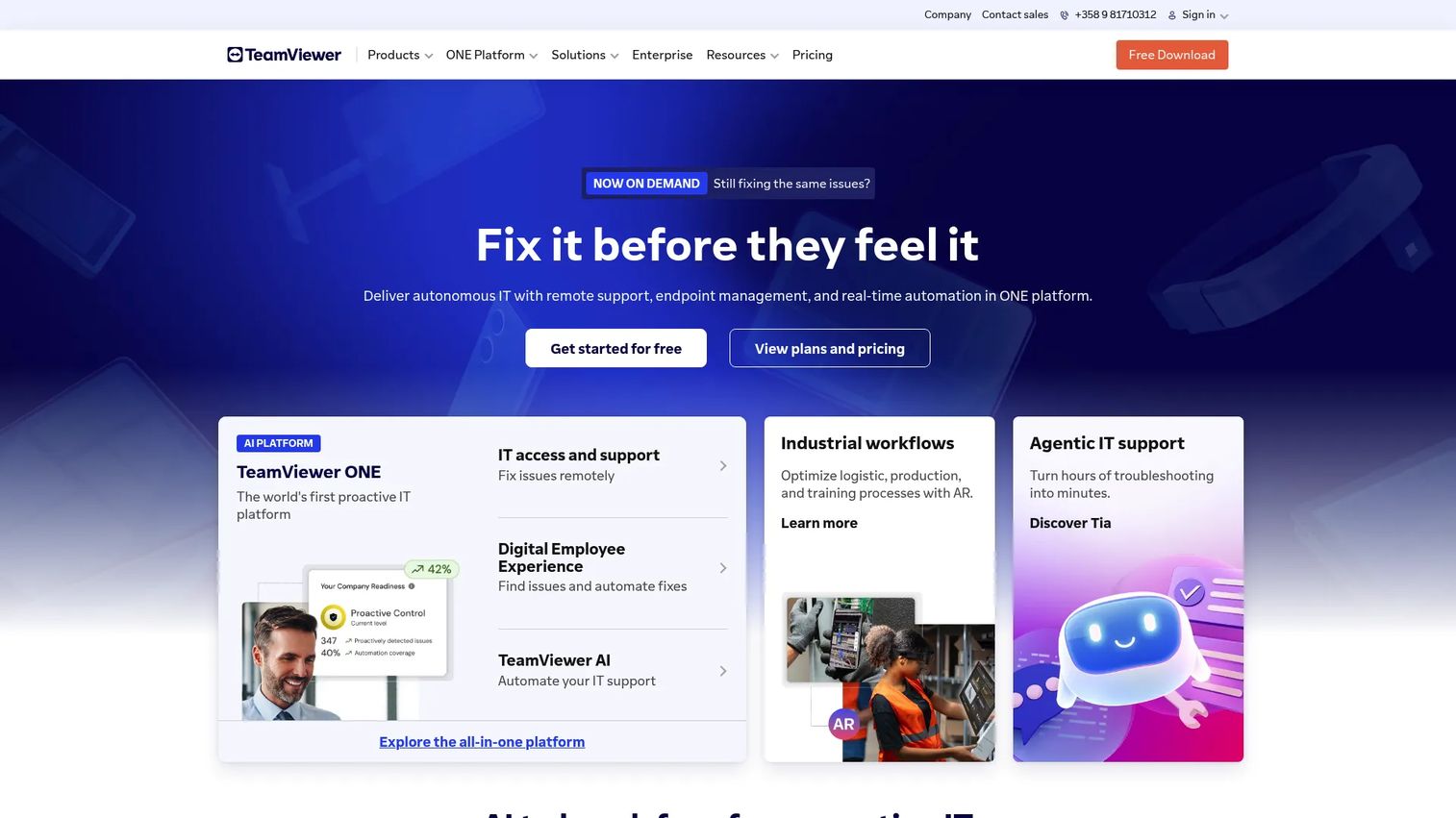
TeamViewer DEX connects proactive endpoint monitoring to support action in a single platform. It monitors endpoint health, Microsoft 365 performance, network and ISP conditions, and unified communications, while Application Experience Management tracks software performance at the user level. DEX Intelligence surfaces AI-generated insights and root-cause context, so when an IT team sees a flag on the monitoring dashboard, they can act from the same interface rather than opening a separate tool.
Best for: Enterprise IT and service desk teams that want proactive endpoint monitoring and remediation connected to existing support workflows.
Key features
- Endpoint troubleshooting, automation, and inventory
- Application Experience Management and DEX Intelligence
- Microsoft 365, network, ISP, and unified communications monitoring
- Employee sentiment and experience analytics
- Patch insights and remediation workflows
Why choose TeamViewer DEX: TeamViewer DEX is a natural fit for teams already using TeamViewer for remote support. The DEX layer adds proactive monitoring and experience analytics without requiring a separate platform, which reduces tool sprawl for mid-size and enterprise IT teams.
TeamViewer DEX pricing: TeamViewer DEX is sold in Standard, Enterprise, and Enterprise Plus device-based tiers. Pricing requires contacting TeamViewer sales.
G2 rating: 4.4/5
8. Tanium Autonomous IT Platform
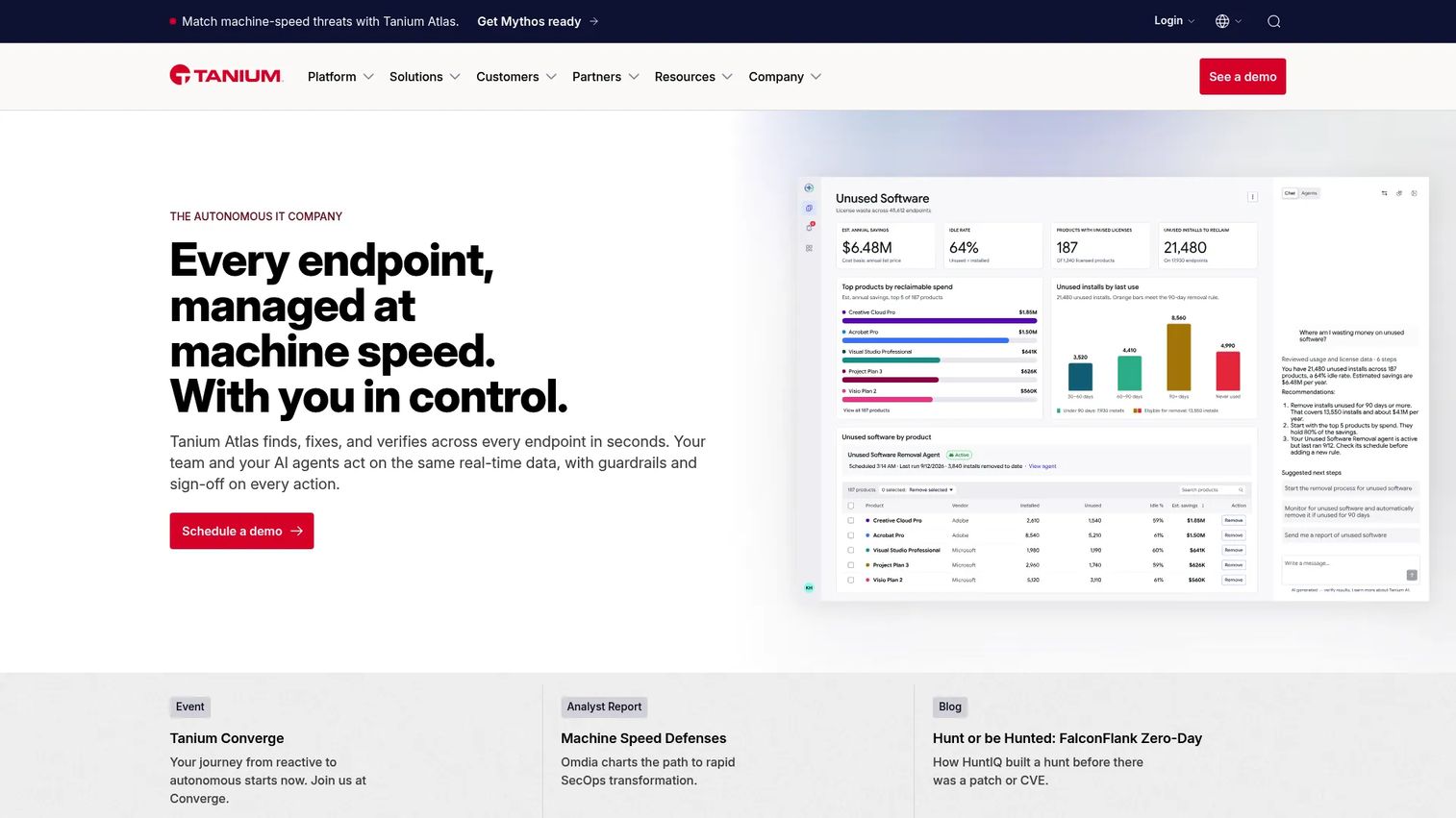
Tanium Autonomous IT Platform delivers real-time endpoint intelligence at enterprise scale, combining asset discovery, patch management, threat detection, compliance, and autonomous remediation in one architecture. AI-powered natural-language investigation lets IT analysts query the endpoint estate without scripting. Tanium also covers IT, mobile, operational technology, cloud, and remote endpoints from a single management layer, which is relevant for enterprises with complex, heterogeneous environments.
Best for: Large enterprises that need unified endpoint visibility, security, and autonomous remediation across complex multi-environment device estates.
Key features
- Real-time endpoint asset discovery and visibility
- Autonomous patch management and configuration management
- Threat hunting, endpoint detection and response, and deep forensics
- AI-powered natural-language investigation and governed remediation
- Support for IT, mobile, OT, cloud, and remote endpoints
Why choose Tanium Autonomous IT Platform: Tanium is the right call when DEX improvements need to happen alongside security hardening and compliance enforcement. It sits at the intersection of endpoint management and security operations, which makes it a strong platform for teams that cannot separate those functions.
Tanium Autonomous IT Platform pricing: Pricing is by quote. Contact Tanium sales for package details.
G2 rating: 4.5/5
9. Ivanti Autonomous Endpoint Management
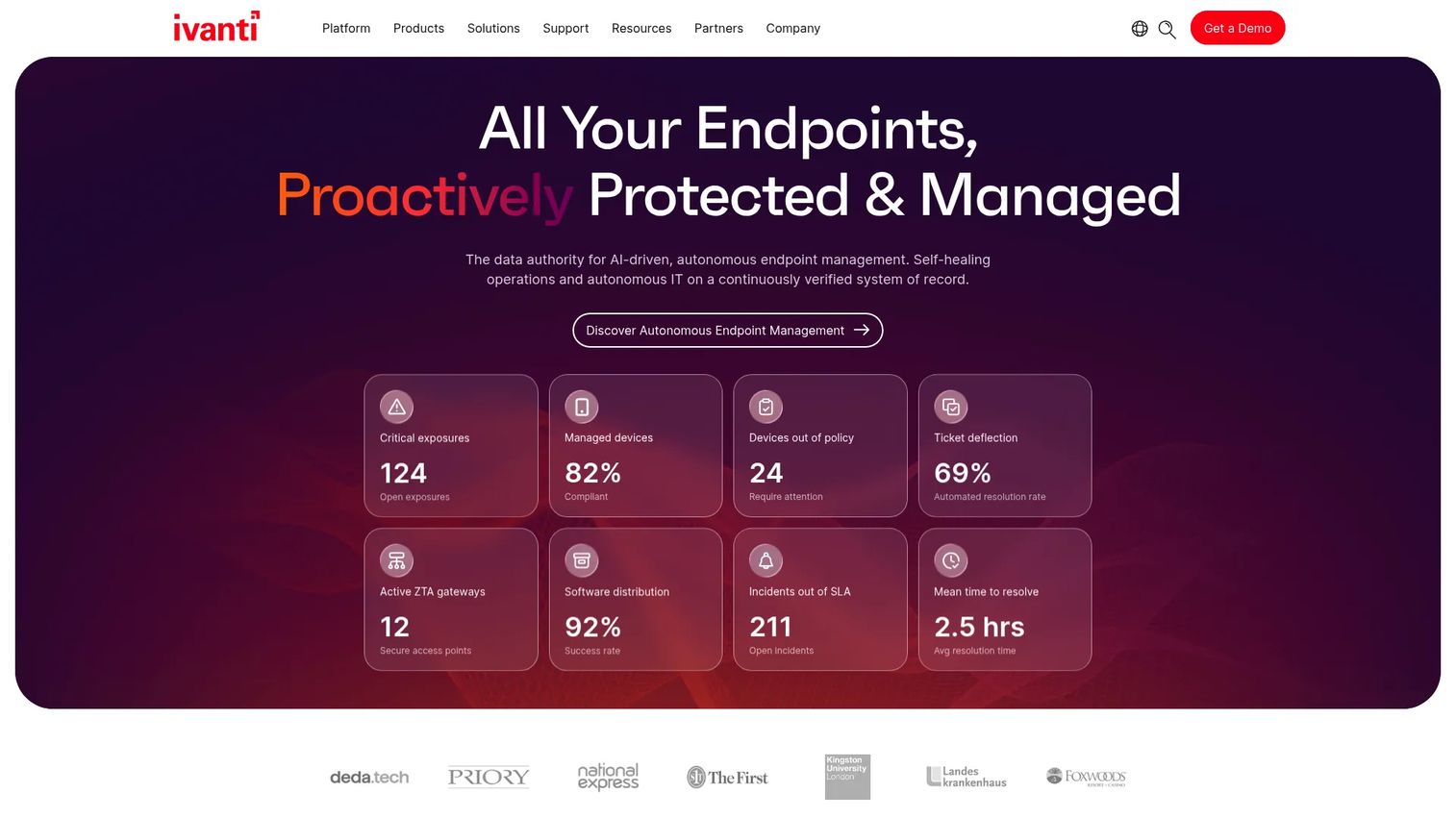
Ivanti Autonomous Endpoint Management combines trusted endpoint data, multi-OS device management, risk-based patching, self-healing automation bots, and DEX analytics in a unified approach. The self-healing bots automatically remediate known issues before employees notice them, which directly reduces ticket volume for recurring problems. Ivanti's packages also cover autonomous patch management, endpoint management, and exposure management as separate or bundled options.
Best for: Mid-market and enterprise IT teams that want endpoint lifecycle management and DEX improvement from a single operational motion.
Key features
- Trusted asset, device, software, and exposure visibility
- Multi-OS enrollment, provisioning, and application deployment
- Risk-based autonomous patch management and continuous compliance
- Self-healing and autonomous remediation bots
- Digital employee experience analytics and DEX scoring
Why choose Ivanti Autonomous Endpoint Management: The self-healing bot model is particularly useful for teams dealing with the same recurring endpoint issues across a large workforce. Instead of agents fixing the same broken VPN client for the fifteenth time, bots handle it automatically.
Ivanti Autonomous Endpoint Management pricing: Ivanti presents solution packages but does not show prices; pricing requires contacting sales. Package names include Autonomous Endpoint Management, Endpoint Management, and Autonomous Patch Management.
G2 rating: 4.2/5
10. Omnissa Workspace ONE Experience Management
Omnissa Workspace ONE Experience Management integrates DEX scoring directly into the Workspace ONE unified endpoint management platform. It aggregates device performance, application behavior, OS health, session data, and employee sentiment into an experience score, then uses AI-driven anomaly detection to identify when and where employee experience degrades. Automated remediation runs through Freestyle workflows and Workspace ONE Assist without requiring a separate tool.
Best for: Organizations already managing endpoints and applications through Workspace ONE that want built-in DEX analytics without adding another vendor.
Key features
- Experience scoring using device, app, OS, session, and sentiment data
- AI-driven anomaly detection and root-cause analysis
- Automated remediation through Freestyle workflows and Workspace ONE Assist
- Mobile, desktop, and virtual endpoint coverage
- Integrated with the broader Workspace ONE management platform
Why choose Omnissa Workspace ONE Experience Management: If your environment is already standardized on Workspace ONE, adding Experience Management is the lowest-friction path to DEX visibility. The cost and integration overhead of a standalone DEX platform may not be justified when this capability is already available inside your existing management layer.
Omnissa Workspace ONE Experience Management pricing: Experience Management is included in Enterprise Edition ($10/device/month or $15/user/month) and Platinum Edition ($15.63/device/month or $24.71/user/month). Lower tiers start from $1.67/device/month for Employee Essentials.
G2 rating: N/A
11. ServiceNow Digital End-User Experience
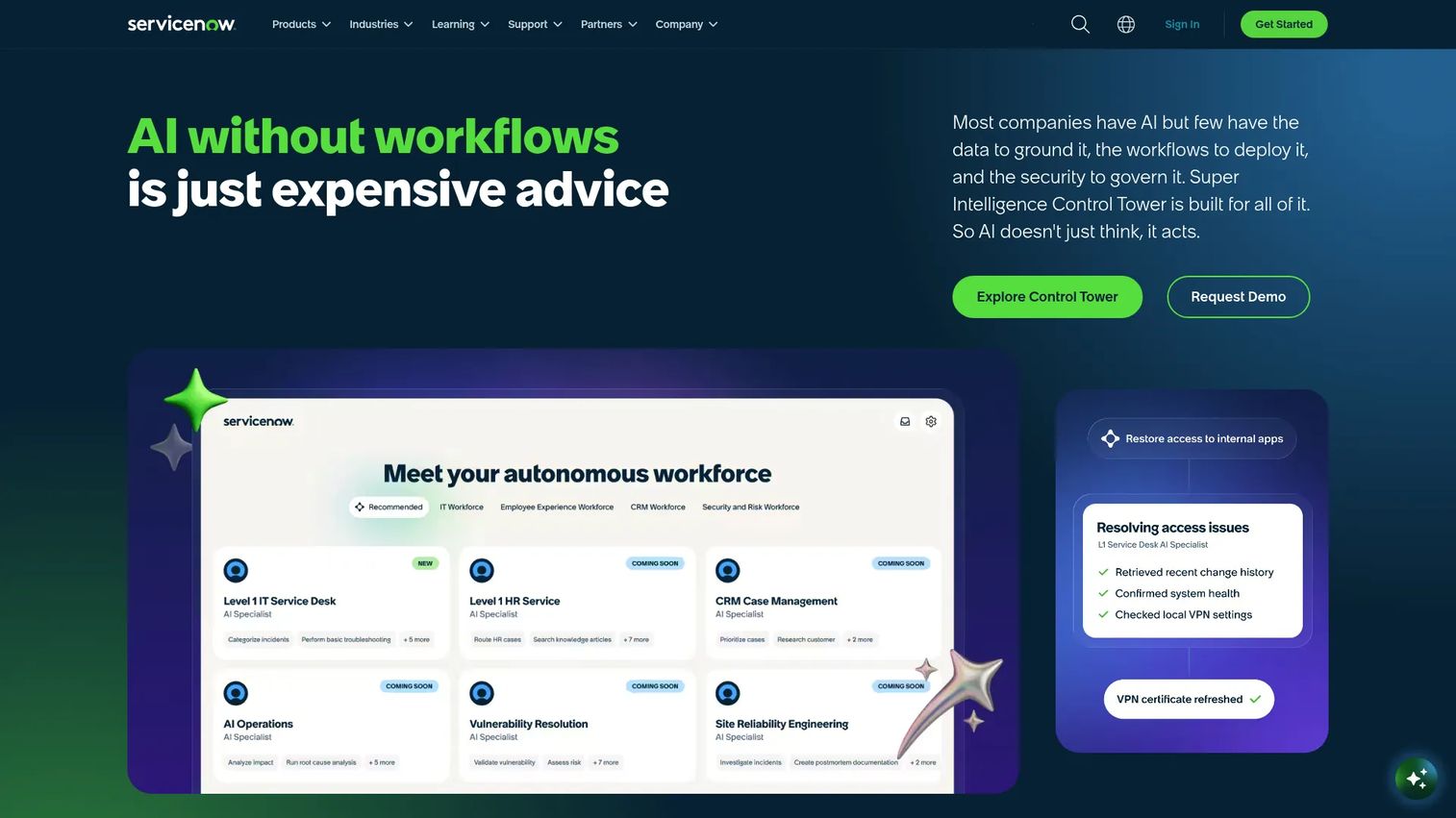
ServiceNow Digital End-User Experience embeds DEX capabilities directly into the ServiceNow platform. A Desktop Assistant gives employees self-service diagnostics and IT communication without opening a ticket. Application and device health monitoring feeds a DEX Score that appears alongside incident data. Proactive Engagement, Bulk Remedial Action, Microsoft Teams monitoring, and ESG integration complete the feature set for teams already operating inside the ServiceNow environment.
Best for: Enterprises already using ServiceNow for ITSM that want DEX monitoring and self-service capabilities without introducing a separate platform.
Key features
- Desktop Assistant for self-service diagnostics and IT communication
- Application and device health monitoring with DEX Score
- Proactive Engagement and Bulk Remedial Action
- Microsoft Teams monitoring and network experience visibility
- ESG integration for performance context
Why choose ServiceNow Digital End-User Experience: The strongest argument for this tool is workflow consolidation. If your IT team lives in ServiceNow, adding DEX data to that same environment removes the friction of context-switching and lets incident managers see experience signals alongside operational data.
ServiceNow Digital End-User Experience pricing: ServiceNow lists a Standard package for Digital End-User Experience. Pricing requires contacting ServiceNow; no public figures are shown.
G2 rating: 4.4/5 (ServiceNow overall rating)
12. Nanoheal
Nanoheal is an AI-driven digital experience automation platform built around proactive and autonomous endpoint remediation. It detects anomalies, predicts issue recurrence, and applies zero-touch fixes through a zero-code automation framework, without requiring scripting knowledge from the IT team. Pre-built templates cover common endpoint issues, and ITSM integrations, including ServiceNow, route incidents that cannot be auto-resolved into existing workflows.
Best for: Service desk teams with high volumes of recurring endpoint issues who want autonomous remediation to reduce ticket load before employees notice problems.
Key features
- AI-powered anomaly detection and predictive issue resolution
- Zero-touch, user-assisted, and remote-action remediation
- Zero-code automation framework with pre-built templates
- Real-time endpoint monitoring and DEX analytics
- ITSM integrations including ServiceNow
Why choose Nanoheal: Nanoheal fits teams where the service desk is handling the same ten problems every day. The autonomous remediation model converts repetitive ticket work into background automation, which frees agents for escalations that actually require human judgment.
Nanoheal pricing: Nanoheal prices by quote. Contact Nanoheal to discuss pricing for your environment.
13. Workelevate
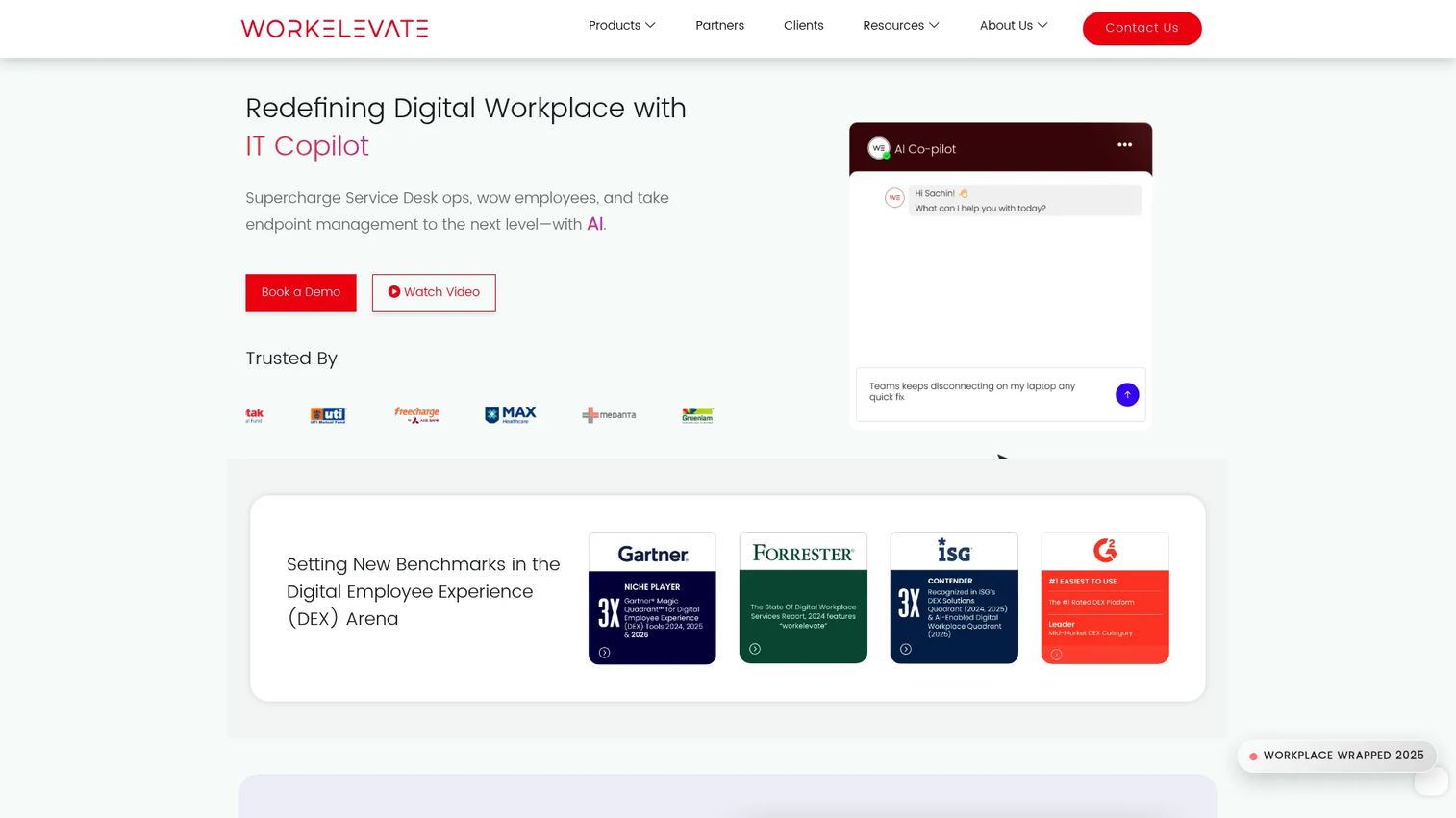
Workelevate combines conversational AI employee self-service, DEX monitoring, and unified endpoint management in one platform. The IT Copilot gives employees a chat-based way to resolve common issues without filing a ticket. Under the hood, DEX monitoring and root-cause analysis identify what is causing friction, while self-healing capabilities address known issues automatically. Endpoint management features, including remote access, software distribution, and patch management, round out the operational coverage.
Best for: Enterprises that want to reduce service desk load through AI-driven self-service while maintaining endpoint visibility and management from the same platform.
Key features
- Conversational AI IT Copilot for employee self-service
- DEX monitoring, root-cause analysis, and self-healing
- Unified endpoint management with remote access and patch management
- Employee engagement tracking
- IT workflow integration
Why choose Workelevate: The conversational self-service layer distinguishes Workelevate from pure monitoring or endpoint management tools. For teams where employee adoption of self-service is the bottleneck, a chat-based interface typically sees better uptake than a traditional service portal.
Workelevate pricing: Pricing is custom and requires booking a call with Workelevate's team.
G2 rating: 4.8/5
14. Stratusphere UX
Stratusphere UX by Liquidware monitors endpoint and user session performance end-to-end, covering physical workstations, virtual desktops, and cloud workspaces. It produces UX scores, login and logoff breakdown analysis, process optimization insights, and threshold alerts, while employee sentiment surveys add a qualitative layer to technical metrics. The platform is commonly used during VDI migration planning, workspace optimization, and ongoing performance baselining.
Best for: IT teams managing complex virtual desktop or physical workspace environments who need session-level diagnostics and performance baselining.
Key features
- End-to-end monitoring of endpoints, sessions, users, and applications
- UX scoring, threshold alerts, and proactive issue detection
- Login and logoff breakdown analysis
- Employee sentiment surveys correlated with technical metrics
- Process optimization and API-based reporting
Why choose Stratusphere UX: Stratusphere is a strong choice when VDI performance or workspace migration is on the roadmap. The session-level granularity and UX baselining capabilities help IT teams establish pre-migration benchmarks and validate post-migration outcomes.
Stratusphere UX pricing: Stratusphere UX uses named-user and concurrent-user licensing. Pricing requires contacting Liquidware.
15. ManageEngine Endpoint Central
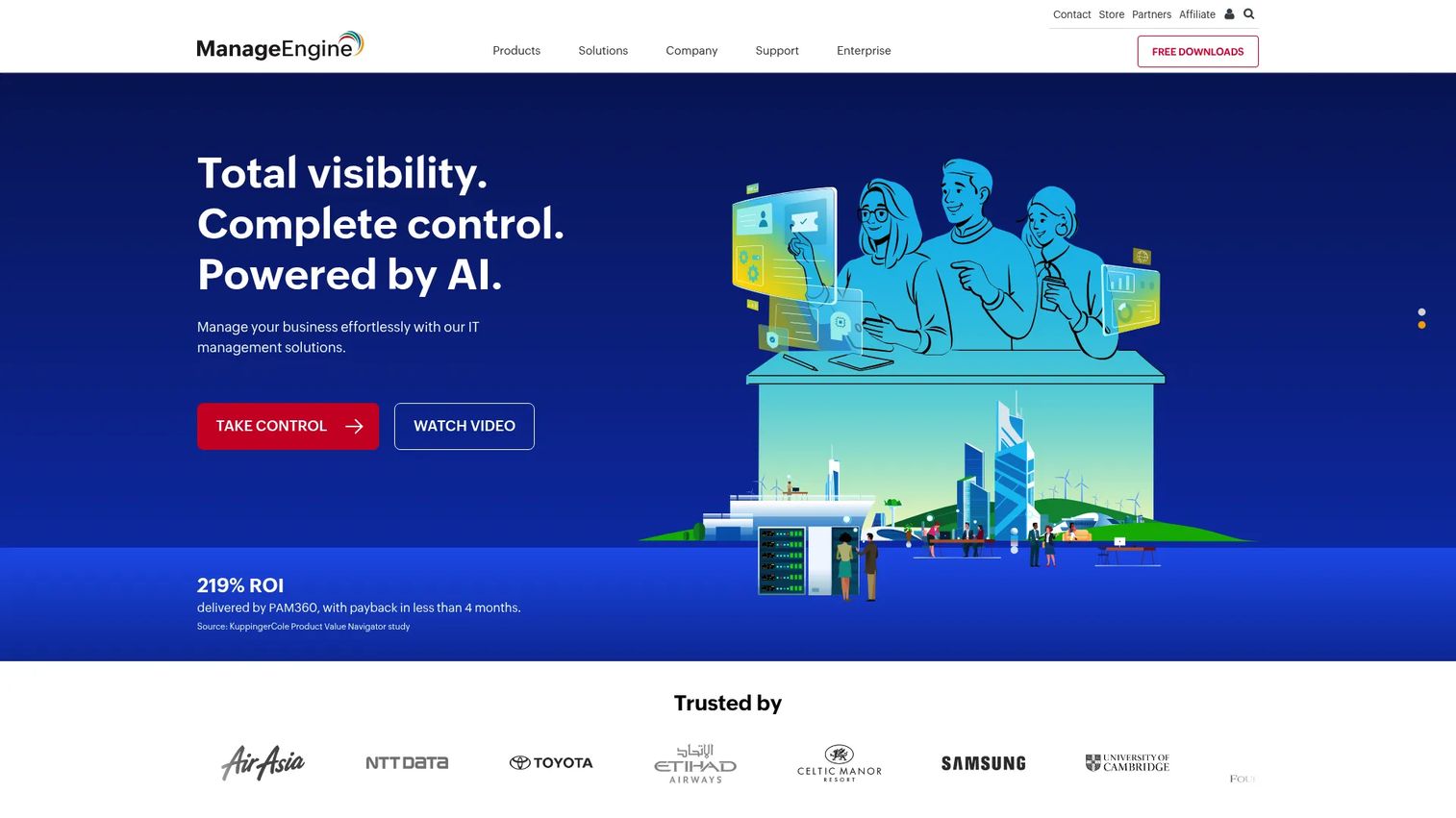
ManageEngine Endpoint Central is a unified endpoint management and security platform covering patching, remote control, software deployment, OS imaging, asset management, mobile device management, and endpoint detection and response. A digital employee experience module is included alongside core management capabilities. It is one of the few tools in this category with published pricing, which makes initial budget planning more straightforward for teams that prefer not to enter a sales cycle before shortlisting.
Best for: Organizations that need endpoint management basics, including patching, remote control, and asset management, at a defined price point before investing in specialized DEX analytics.
Key features
- Patch and update management with vulnerability remediation
- Remote troubleshooting and OS imaging
- Software deployment and application management
- Asset management and auditing
- Mobile device management and Endpoint Detection and Response
Why choose ManageEngine Endpoint Central: For teams at an earlier stage of DEX maturity, Endpoint Central provides core endpoint management capabilities alongside basic DEX visibility without requiring a custom quote. The transparent pricing model simplifies budget approval.
ManageEngine Endpoint Central pricing: Professional edition starts at $104/month for 50 endpoints (cloud, monthly billing) or $1,045/year for 50 endpoints (cloud, annual billing). On-premises annual pricing starts at $795/year for 50 endpoints.
16. Collective IQ
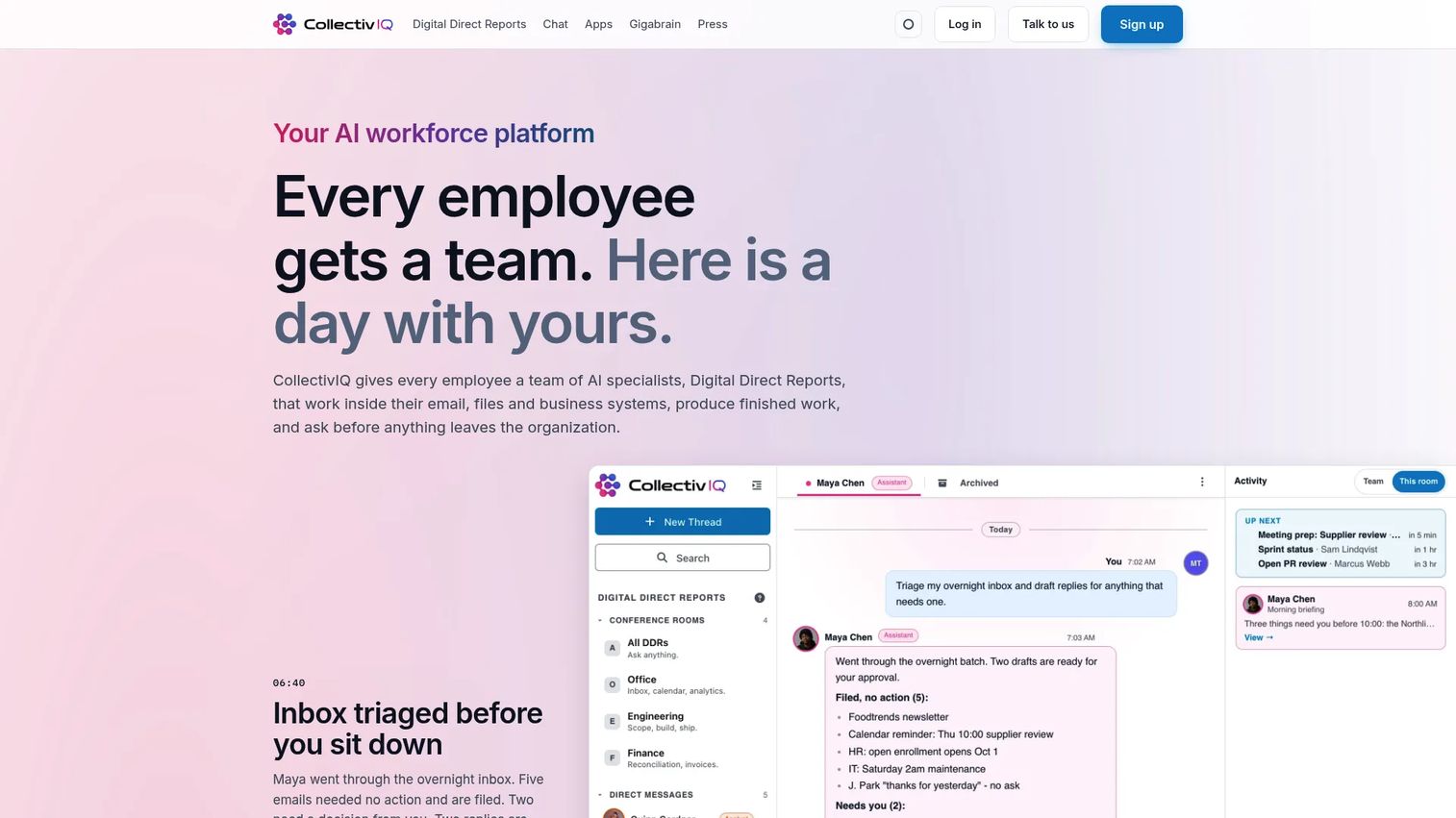
CollectivIQ is an AI workforce platform that gives employees specialized AI assistants, called Digital Direct Reports, that operate inside email, files, and connected business systems. Multi-model chat compares responses across leading AI providers, while the Gigabrain shared knowledge base aggregates team knowledge with source attribution. Permission-based actions, approval workflows, and action logging keep governance intact. Integrations span Microsoft 365, Google Workspace, Salesforce, Atlassian, and GitHub.
Best for: Teams evaluating AI-driven workforce automation and employee assistance beyond traditional endpoint-focused DEX tools.
Key features
- Digital Direct Reports operating inside business systems
- Multi-model AI chat comparing GPT, Claude, Gemini, Grok, and others
- Gigabrain shared knowledge base with source attribution
- Permission-based actions and approval workflows with action logging
- Integrations with Microsoft 365, Google Workspace, Salesforce, Atlassian, and GitHub
Why choose Collective IQ: Collective IQ addresses a different dimension of digital employee experience than endpoint monitoring tools do. It fits teams where employee friction is less about device performance and more about finding information, completing operational tasks, and navigating fragmented business systems.
Collective IQ pricing: Pricing is quote-based. Contact CollectivIQ for current packages.
G2 rating: 4.5/5 (based on 1 review)
17. Bumblebot Tasky
Bumblebot Tasky is positioned in the digital workplace automation space, focusing on employee task routing, AI-guided support, and workflow deflection. The product is designed to reduce manual IT support overhead by helping employees resolve common requests through guided digital workflows. Note: Limited first-party product detail was available at generation time, so evaluate Bumblebot Tasky directly with the vendor before adding it to a formal shortlist.
Best for: Teams exploring conversational or task-based employee support automation to complement monitoring-focused DEX tools.
Key features
- Employee task automation and guided support workflows
- Workflow routing and support deflection
- AI-assisted employee assistance
- Usage analytics
- Integration capabilities for digital workplace environments
Why choose Bumblebot Tasky: This tool is most relevant when your team's primary friction point is employee support task volume rather than endpoint telemetry gaps. Evaluate it alongside a dedicated monitoring platform rather than as a standalone DEX solution.
Bumblebot Tasky pricing: Pricing is not displayed on the vendor site. Contact Bumblebot directly for current pricing.
18. BigFix Workspace+
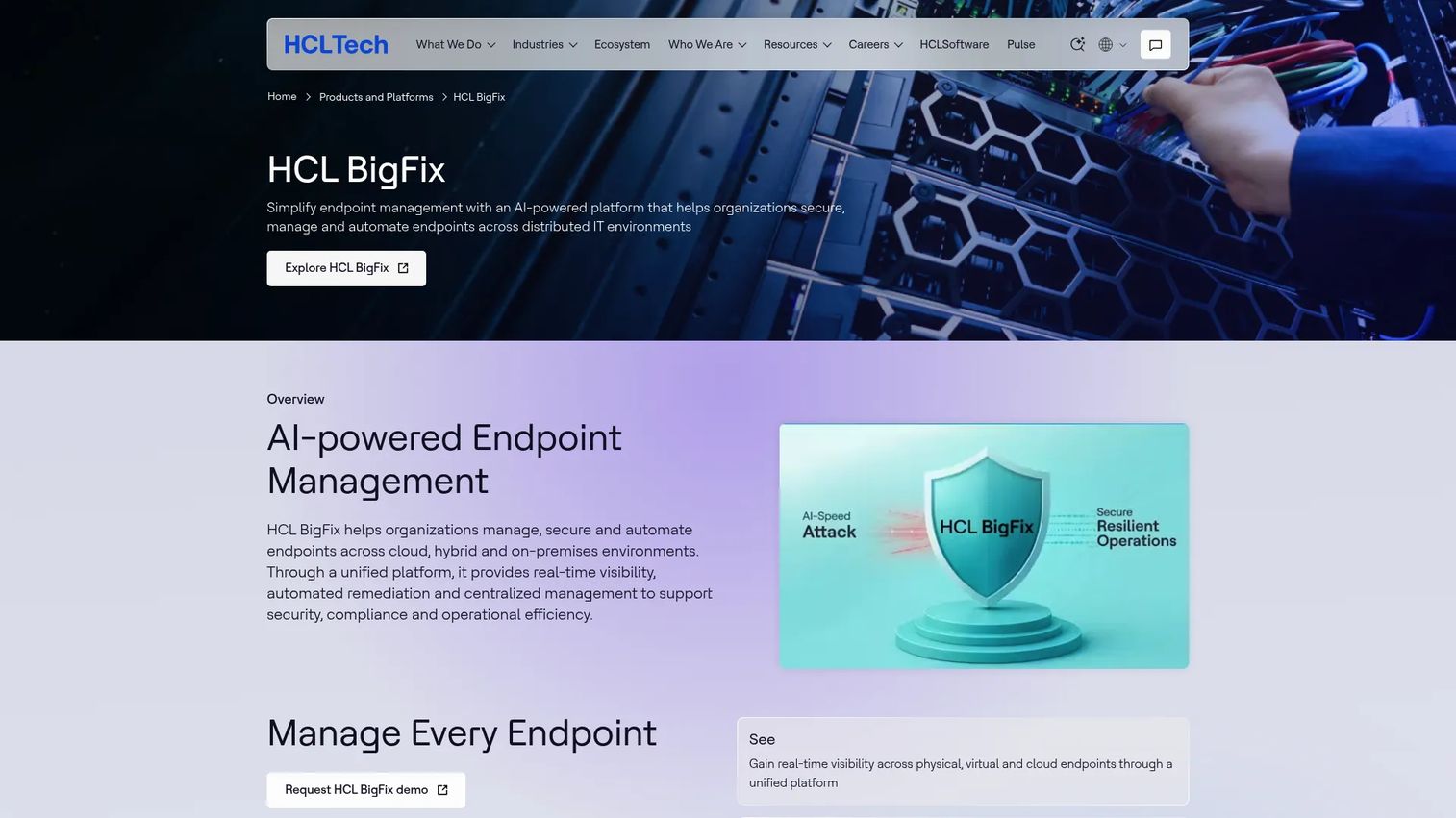
BigFix Workspace+ by HCLTech is an AI-driven workspace management and DEX platform built for enterprises managing large, heterogeneous endpoint estates. It supports centralized management across 120+ operating systems, continuous patching and policy enforcement, real-time asset intelligence, and DEX monitoring. The HCL BigFix AEX module adds AI-assisted self-service for employees, connecting endpoint health data to employee-facing resolution options.
Best for: Large enterprises needing unified endpoint automation, continuous compliance, and DEX visibility across complex hybrid environments.
Key features
- Automation-first endpoint management and remediation
- Centralized management across 120+ operating systems
- Continuous patching, policy enforcement, and compliance monitoring
- Real-time hardware and software asset intelligence
- DEX monitoring with AI-assisted self-service through HCL BigFix AEX
Why choose BigFix Workspace+: BigFix has a long track record in large enterprise endpoint management. Workspace+ adds the DEX and self-service layer on top of that foundation, which makes it a practical choice for organizations that already have BigFix deployed and want to extend its value rather than introduce a new platform.
BigFix Workspace+ pricing: Pricing requires contacting HCLTech. No standard tier pricing is displayed on the vendor site.
G2 rating: 4.4/5 (HCL BigFix overall G2 rating)
19. eG Enterprise
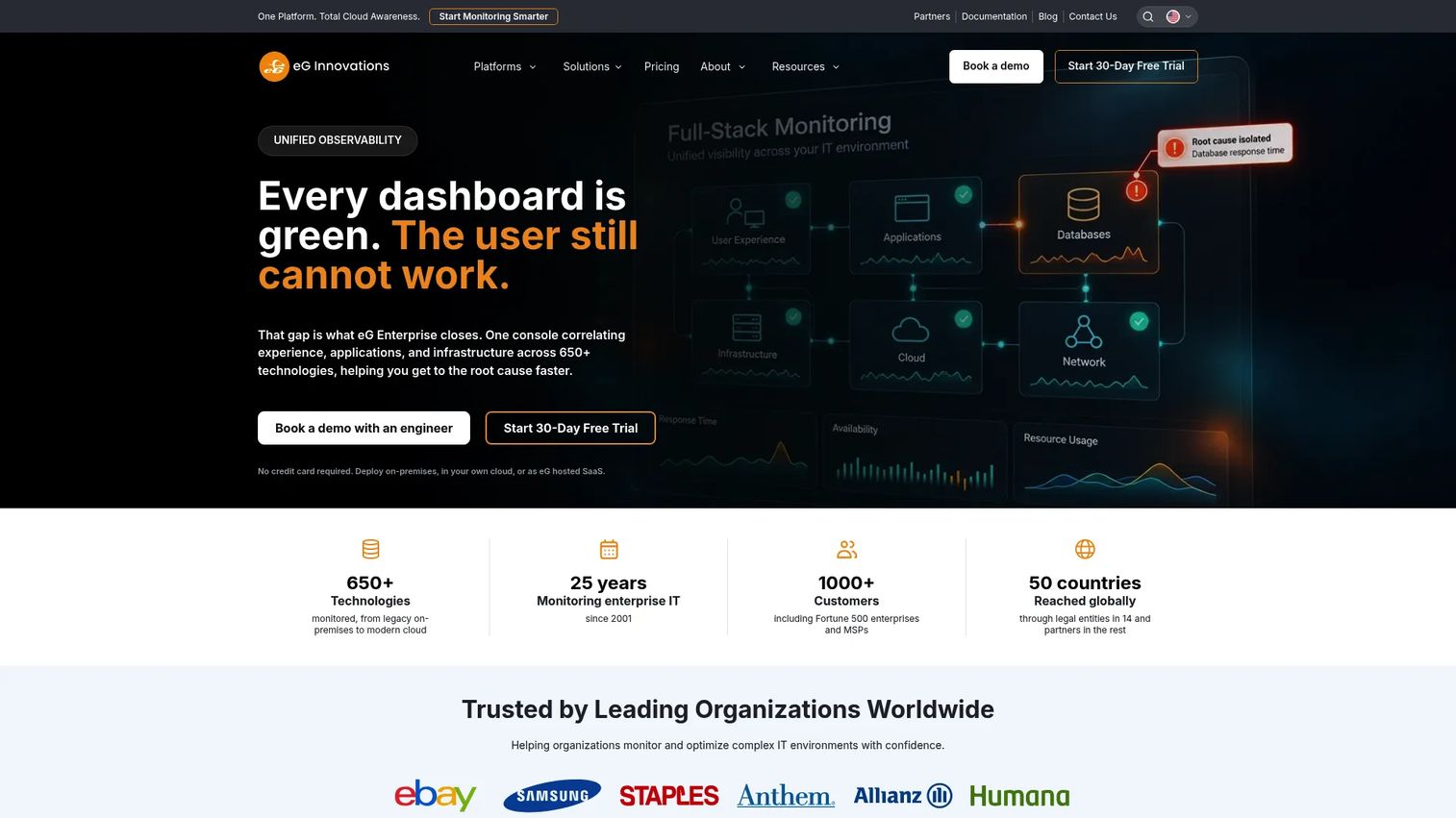
eG Enterprise is an end-to-end IT performance monitoring and observability platform covering applications, infrastructure, cloud, VDI, containers, networks, and digital workspaces. What sets it apart is automatic infrastructure-wide root-cause diagnosis: Rather than surfacing alerts, it tells IT teams what caused the problem and where to look first. Monitoring spans 650+ enterprise technologies, including real-user experience and synthetic monitoring.
Best for: Enterprise IT teams and managed service providers needing cross-stack monitoring and automatic root-cause diagnosis across applications, infrastructure, and virtual desktop environments.
Key features
- End-to-end application and infrastructure performance monitoring
- Automatic root-cause diagnosis across the full infrastructure stack
- Real user and synthetic experience monitoring
- VDI monitoring with session and application visibility
- Monitoring for 650+ enterprise applications and technologies
Why choose eG Enterprise: eG Enterprise's automatic root-cause diagnosis removes the investigation step that consumes the most time during a major incident. For teams managing complex hybrid environments where an employee-facing issue could originate anywhere in the stack, this accelerates mean time to resolution materially.
eG Enterprise pricing: SaaS/Cloud deployment starts at $125/month. Subscription deployment starts at $100/month. Pricing scales with monitored systems, operating systems, hypervisors, and digital-workspace users.
G2 rating: 4.5/5
20. SOTI ONE Platform
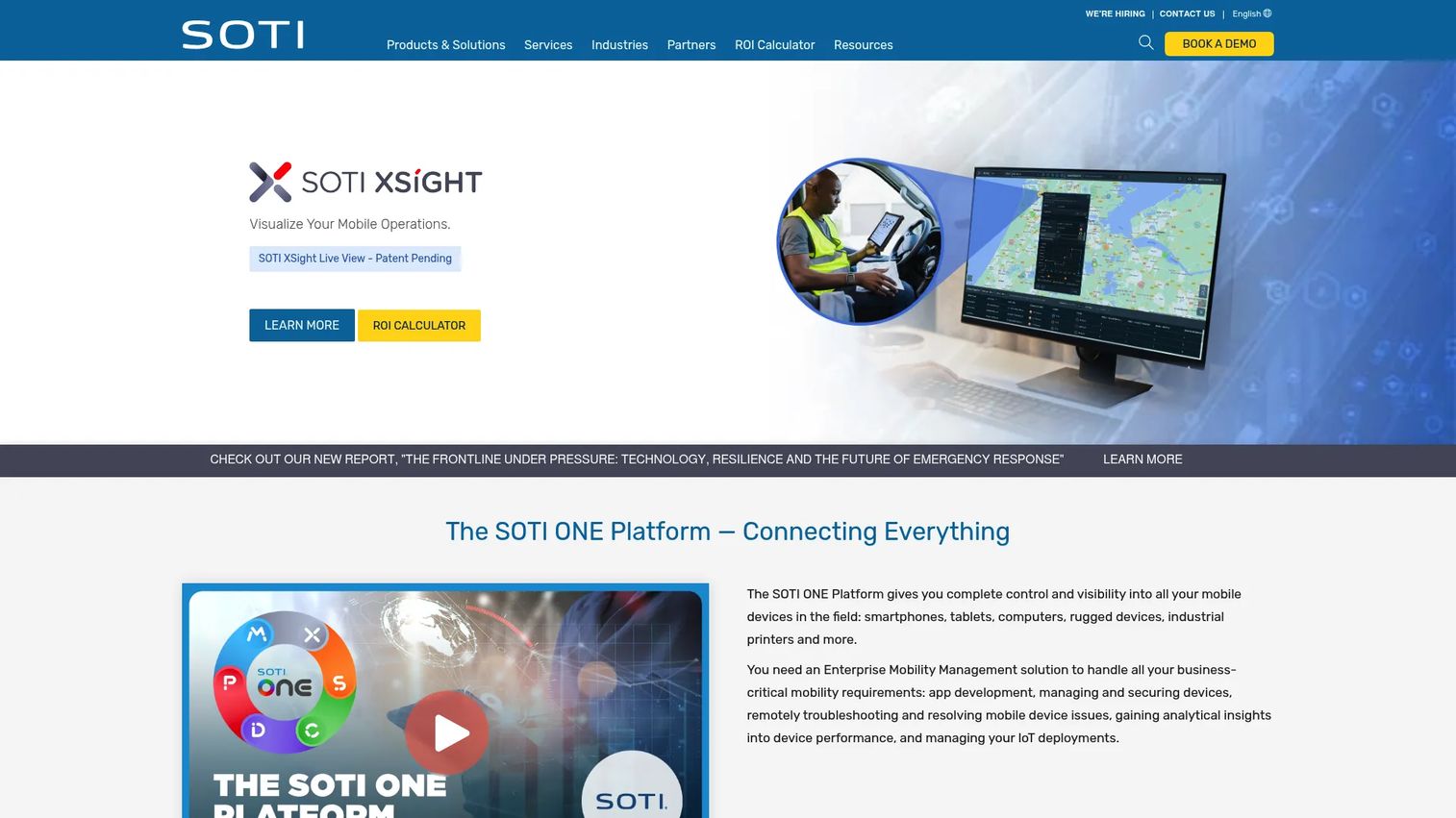
SOTI ONE Platform is an integrated suite built for organizations managing business-critical mobile devices, printers, and frontline workflows at scale. It covers enterprise mobility management across Android, Windows, Apple iOS/macOS, and Linux, alongside diagnostic intelligence with analytics and remote support. The platform includes rapid mobile app development tools, printer lifecycle management, and centralized authentication with single sign-on.
Best for: Organizations managing large, diverse fleets of mobile, rugged, or frontline devices where employee digital experience depends on device reliability and field-ready applications.
Key features
- Enterprise mobility management across Android, Windows, iOS, macOS, and Linux
- Diagnostic intelligence with analytics, remote support, and issue resolution
- Rapid mobile app development and business-process digitization
- Lifecycle management for industrial and mobile printers
- Centralized authentication, single sign-on, and role management
Why choose SOTI ONE Platform: SOTI ONE is the right choice when the majority of your employee workforce is mobile or frontline rather than desk-based. Desktop-first DEX platforms often underserve field device fleets; SOTI's architecture is built around that operational reality.
SOTI ONE Platform pricing: SOTI offers several bundles including MobiControl, MobiControl XS, SOTI Snap, and the full ONE Platform. Pricing requires contacting SOTI; a free trial of ONE Platform is available.
Considerations when choosing digital employee experience software
Match the platform to your operating model
A VDI-heavy financial services firm, a mobile-first logistics company, and a SaaS-heavy distributed startup need fundamentally different DEX capabilities. Before issuing an RFP, map your top three employee friction scenarios to the telemetry sources each platform covers. A platform with strong desktop monitoring but limited VDI support will miss the issues that matter most in Citrix or VMware environments.
Check telemetry depth before dashboards
A polished dashboard only helps if the underlying data captures the right signals. Ask each vendor what data is collected, at what frequency, and how it can be exported to your SIEM, data warehouse, or ITSM. Shallow telemetry that looks comprehensive in a demo often surfaces gaps during a POC with production workloads.
Verify remediation workflows in practice
Automated remediation is only valuable when it fixes real, recurring issues with appropriate controls. During evaluation, ask specifically for examples of remediation playbooks, approval workflows, rollback options, and ITSM handoff behavior when automation fails. A tool that remediates without guardrails is a support ticket waiting to happen.
Evaluate employee sentiment in context
Sentiment surveys and experience scores should complement telemetry, not replace it. A platform that collects frustration data without helping IT diagnose the underlying technical cause creates awareness without action. Look for vendors that correlate sentiment signals directly with device, application, or network telemetry.
Test integrations with your IT stack
For presales and technical evaluators, integration depth is often the deciding factor. Validate connections to your ITSM platform, endpoint management tooling, identity provider, security tooling, and analytics stack during the POC, not after contract signature. Ask for documentation on API coverage, webhook behavior, and data mapping before committing.
Conclusion
The 20 tools above cover a wide range of entry points into digital employee experience management, from purpose-built DEX platforms to endpoint management tools with built-in experience analytics.
For most enterprise IT teams starting a DEX evaluation, Nexthink Infinity is the broadest starting point for telemetry, sentiment, and remediation. ControlUp ONE is the stronger pick when real-time operational visibility and VDI monitoring are the primary drivers. Riverbed Aternity earns its place where application performance is the main source of employee friction. SysTrack suits teams that want to connect endpoint data to workplace planning decisions. ServiceNow Digital End-User Experience fits organizations where the ITSM workflow is already the operational center of gravity.
For mobile and frontline fleets, SOTI ONE Platform addresses needs that most desktop-first DEX tools do not cover well. For teams at an earlier stage of DEX maturity, ManageEngine Endpoint Central and eG Enterprise offer published pricing and strong foundational capabilities without a full enterprise procurement cycle.
The practical next step: Shortlist two or three platforms based on your operating model, then run a focused POC against your two most painful employee technology scenarios. Validate telemetry coverage, remediation controls, and integration depth before expanding the evaluation.
Start your journey with Guideflow today!
FAQs
Digital employee experience software monitors, measures, and improves how employees interact with workplace technology, including devices, applications, networks, collaboration tools, and support workflows. It combines endpoint telemetry with employee sentiment data to help IT teams detect issues proactively, prioritize fixes by business impact, and automate remediation for common problems.
DEX software focuses specifically on technology experience: Device performance, application behavior, network conditions, and IT support workflows. Broader employee experience software typically covers engagement, HR workflows, benefits, culture, and organizational feedback. The two categories overlap in sentiment measurement, but DEX platforms are built for IT operations teams, not HR teams.
Large enterprises most commonly shortlist Nexthink Infinity, ControlUp ONE, Riverbed Aternity Employee Experience, SysTrack, and ServiceNow Digital End-User Experience. The right choice depends on your primary pain: Nexthink for broad DEX coverage, ControlUp ONE for real-time VDI and endpoint monitoring, Aternity for application performance correlation, SysTrack for workplace analytics, and ServiceNow for ITSM-embedded DEX.
DEX platforms reduce tickets through several mechanisms: Proactive detection of issues before employees notice them, automated remediation of recurring problems, self-service portals that let employees resolve common requests without agent involvement, and better root-cause analysis that speeds resolution of tickets that do arrive. The most direct ticket reduction comes from self-healing automation applied to the issues that generate the highest volume of repetitive tickets.
Prioritize endpoint and application monitoring depth, automated remediation with appropriate governance controls, employee sentiment collection, experience scoring, ITSM and endpoint management integrations, and reporting for both IT and business stakeholders. For hybrid environments, also check remote endpoint visibility, VPN performance monitoring, and SaaS application latency tracking.
Yes. Hybrid and remote workforces are exactly where DEX software shows the most immediate value. Traditional IT monitoring often has no visibility into home-network conditions, personal device health, or SaaS application performance across varied internet connections. DEX platforms extend that visibility to distributed endpoints and give IT teams the data to diagnose and fix issues regardless of where employees are working.
Presales teams supporting IT buyers should validate telemetry sources (which endpoints, apps, and networks are actually monitored), integration depth with existing ITSM and endpoint management tools, the security model for data collection and storage, remediation controls and approval workflows, and proof-of-value metrics that map to IT KPIs like time-to-resolution and ticket reduction. A POC run against two real, painful employee technology scenarios is more revealing than a standard demo environment.
Pricing in this category is almost universally quote-based for enterprise platforms, with cost driven by device count, user count, module selection, telemetry depth, and automation scope. Omnissa Workspace ONE Experience Management publishes per-device pricing starting from $1.67/device/month at lower tiers. eG Enterprise starts from $100/month for subscription deployments. ManageEngine Endpoint Central starts from $104/month for 50 cloud-managed endpoints. For all other platforms in this list, contact vendors directly to get quote-based pricing tied to your specific environment and requirements.