

You post a load. Then you start dialing. Twelve calls, four voicemails, a couple of email threads that go nowhere, and maybe a covered truck two hours later than you needed one.
That is still how a lot of freight moves. As of 2026, an estimated 35 to 40% of freight matching in North America happens through digital platforms, with the rest still riding on phone-based brokers and manual methods, according to MarketIntelo (2024). Which means the majority of loads are still matched the slow way.
Freight matching software changes the math. It matches available capacity to loads using truck type, location, lane history, and live market data, then handles posting, quoting, booking, and tracking in one place. In 2023, over 3.1 million freight shipments moved through digital freight matching platforms globally, improving load efficiency by 23% and cutting empty miles by 17%, per Market Growth Reports (2024).
The problem is not whether to use freight load matching software. It is which platform actually fits how your team works. This guide compares seven of them.
What's inside
This guide is for freight brokers, 3PL operators, shippers, and transportation teams comparing freight matching platforms in 2026. We picked seven tools based on four things that matter to operators:
- Real-time matching and load posting speed
- Booking and quoting workflow depth
- Automation and capacity intelligence
- Visibility and TMS integration fit
Each entry includes verified pricing where public, G2 ratings, core capabilities, and a plain read on who the tool serves best. No vendor spin, just what each platform does well.
TL;DR
- Best overall for broad matching workflows: DAT, for its load board reach and rate intelligence.
- Best for hybrid tech plus human brokerage: RXO, when you want platform speed with service support.
- Best for capacity intelligence and automated booking: Trucker Tools, for predictive matching and a free driver app.
- Best for visibility and transportation management: Descartes, when freight matching sits inside a broader logistics stack.
- Best for broker workflow depth: Truckstop, for load board coverage and posting tools.
- Best for digital-first, enterprise-scale freight: Uber Freight, for shippers wanting marketplace scale and a free shipping platform.
- Best for shipper-side procurement: Loadsmart, for automated booking and TMS-driven execution.
What is freight matching software
Freight matching software is a digital platform that connects available loads with carrier capacity in real time, using data and automation to replace manual phone-and-email coordination.
Under the hood, it handles a repeatable set of jobs. Understanding these helps you evaluate any freight matching platform on the same terms.
- Real-time load posting: shippers and brokers post loads that carriers see instantly across the network.
- Carrier search: filter available trucks by lane, equipment type, location, and availability.
- Automated matching: the platform pairs loads with capacity using historical lanes, truck type, and market signals.
- Quoting and pricing: market rate data and lane insights inform rate decisions instead of guesswork.
- Automated booking: covered loads get booked and confirmed without a phone call.
- Shipment visibility: live tracking from pickup to delivery.
- TMS integration: matched loads and status sync back into your transportation management system.
It helps to separate three things people often blur together. A load board is a channel, a marketplace where loads and trucks get listed. Freight matching software usually wraps the load board with matching logic, quoting, booking, tracking, and integrations. And human-first brokerage is the traditional model where a broker works the phones. Most freight matching services now blend all three, digital marketplaces on top of load boards, with human support when a lane gets complicated.
When to use freight matching software
Speed up capacity discovery
When a load needs a truck in the next few hours, working the phones does not scale. Freight matching software surfaces available carriers on a lane in seconds, ranked by fit. For repeated lanes, it remembers which carriers cover them reliably and resurfaces them automatically. That turns a two-hour cover into a two-minute one.
Reduce phone and email coordination
Manual booking is a series of back-and-forth confirmations, each one a chance for a detail to drop. Freight load matching software standardizes the flow: post, match, quote, book, confirm, all in one system, with automated booking for the loads that do not need a human touch. Your team stops rekeying the same load details into five different tools.
Improve pricing and service outcomes
Rate decisions made on gut feel cost margin. Platforms with market data and lane insights show you what a lane is actually paying right now, so you quote with evidence instead of hoping. Over hundreds of loads, pricing optimization and consistent carrier selection add up to real margin and fewer service failures.
Freight matching software comparison
Here is a side-by-side look at the seven platforms. Pricing reflects public first-party figures where available; some vendors price by product or quote, which we note in each entry.
| # | Product | Best for | Key differentiation | Pricing | G2 rating |
|---|---|---|---|---|---|
| 1 | DAT | Brokers, carriers, shippers needing matching plus rate intelligence | Large load board network with RateView rate data | From $54/month | 4.6/5 |
| 2 | RXO | Shippers and carriers wanting tech plus brokerage service | Hybrid digital matching with human brokerage support | Quote-based | Not listed |
| 3 | Trucker Tools | Brokers and carriers focused on capacity sourcing | Predictive matching plus a free driver app | Free app; quote for paid | 4.6/5 |
| 4 | Descartes | Teams aligning matching with visibility and TMS | Freight matching inside a broader logistics suite | From $499/month | 4.6/5 |
| 5 | Truckstop | Brokers needing load board depth and workflow tools | Load board plus rate and workflow tooling | From $35/month | 4.0/5 |
| 6 | Uber Freight | Shippers wanting digital-first, enterprise scale | Marketplace scale with a free shipping platform | Free shipping platform | 4.1/5 |
| 7 | Loadsmart | Shippers wanting automated procurement and booking | Instantly bookable rates inside ShipperGuide TMS | Quote-based | 4.5/5 |
Best 7 freight matching platforms for 2026
1. DAT

DAT is the reference point most operators use when they talk about freight matching. Its network and load board reach are the reason: brokers, carriers, and shippers all live on the same marketplace, which means the loads and the trucks are actually there. The DAT One load board pairs with a mobile app so drivers and dispatchers see matches on the road, and RateView Analytics layers market rate data on top so you are not quoting blind.
Best for: brokers, carriers, and shippers who want both marketplace reach and rate intelligence in one place.
Key strengths
- DAT One load board with a mobile app for on-the-road access.
- RateView Analytics for truckload pricing and market insights.
- CarrierWatch and related freight intelligence for vetting and compliance.
Why choose DAT: if your team needs the widest pool of loads and trucks plus data to price lanes with confidence, DAT covers both without stitching two vendors together. It fits high-volume broker and carrier operations where matching speed and rate accuracy directly move margin.
DAT pricing: DAT One load board plans start at $54/month for the Standard tier, with Enhanced at $119/month, Pro at $169/month, and broker-focused plans running from $319/month up to $469/month. The DAT One mobile app is included in all subscriptions. RateView Analytics is priced by contacting sales.
2. RXO
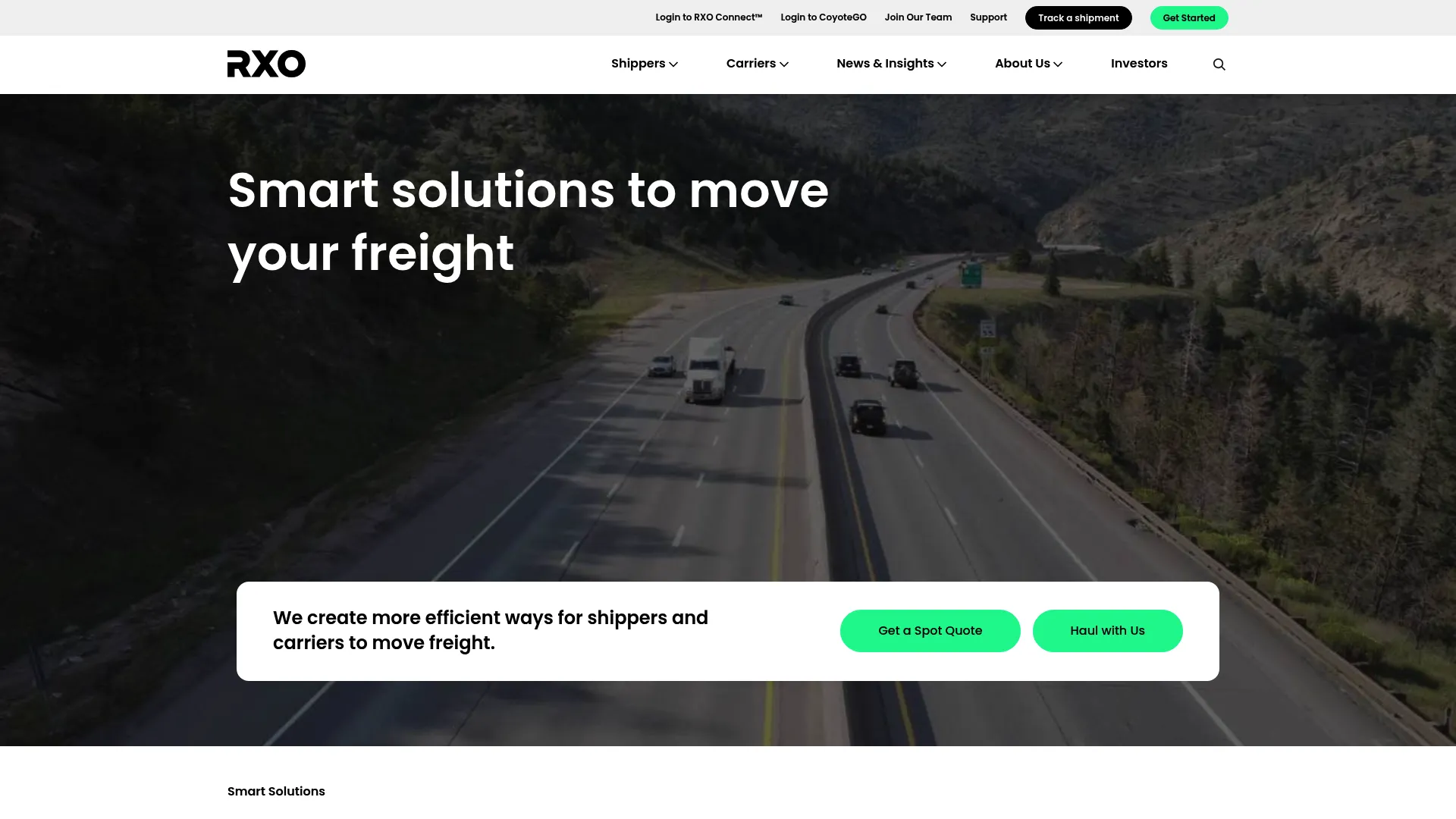
RXO sits at the point where digital matching meets human brokerage. The platform matches loads to its carrier network with technology, but a service team stands behind it for the lanes and exceptions that need a person. That "best of both worlds" model appeals to teams that want the speed of automated matching without giving up someone to call when a load goes sideways.
Best for: shippers and carriers who want enterprise freight brokerage and logistics service alongside platform matching.
Key strengths
- RXO Connect for load management and shipment visibility.
- Truckload, LTL, last mile, expedite, and freight forwarding coverage.
- Carrier mobile app and API integrations for connected workflows.
Why choose RXO: if you would rather not run matching entirely self-serve, RXO gives you a technology layer with brokerage support attached. It works well for shippers moving mixed freight types who want one provider across truckload, LTL, and last mile.
RXO pricing: RXO uses a quote-based model. Shipping services run through a request-a-quote flow rather than fixed public plans, so pricing depends on lane, volume, and service mix.
3. Trucker Tools
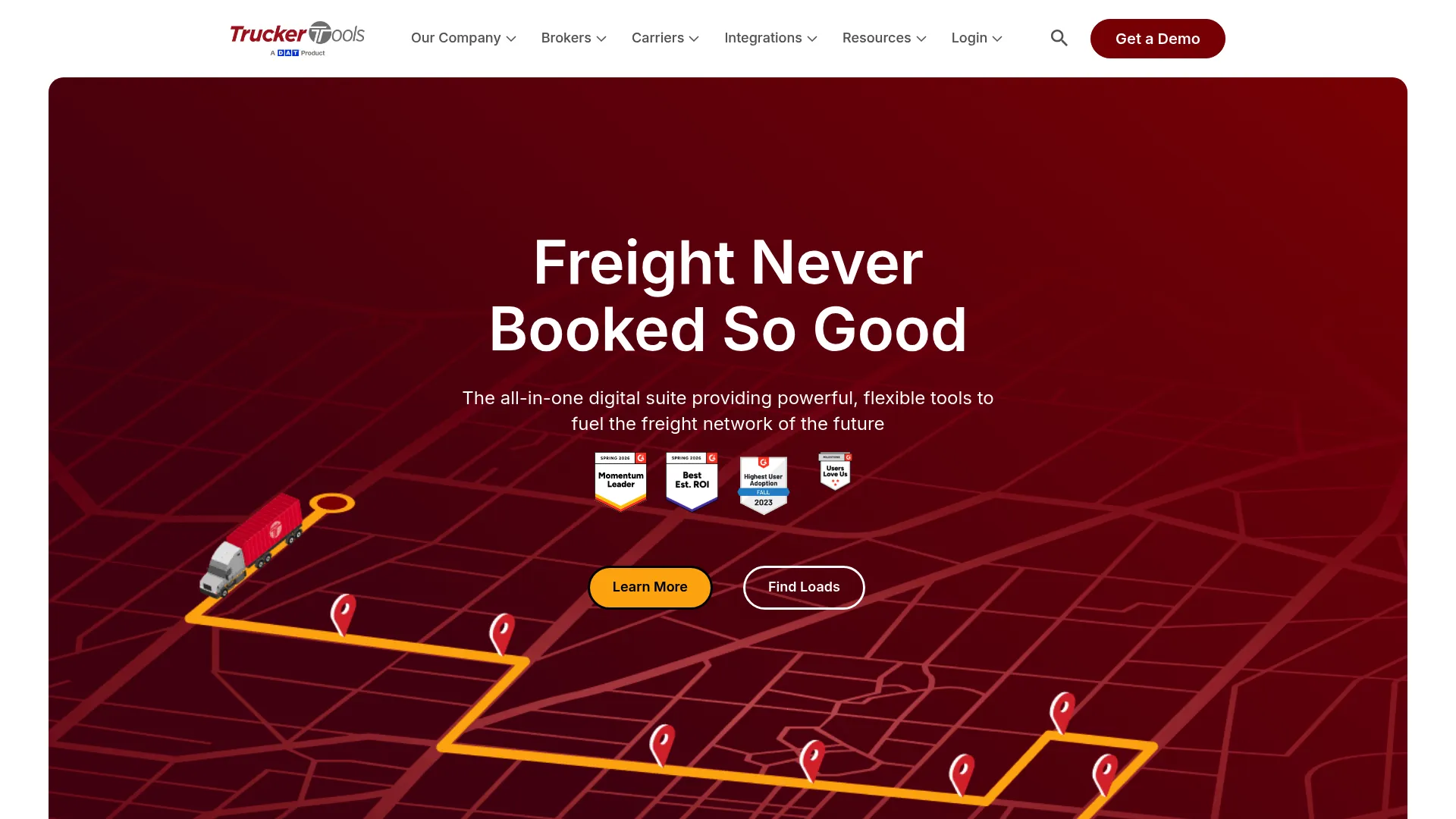
Trucker Tools approaches freight matching from the capacity side. Its Smart Capacity engine predicts which carriers are likely to want a load before you post it, so matching starts from intent rather than a cold broadcast. Load Tracking gives real-time visibility, and the free driver app keeps carriers engaged, which is what feeds the matching data in the first place.
Best for: freight brokers and carriers who care about proactive capacity sourcing and load tracking.
Key strengths
- Load Tracking with real-time shipment visibility.
- Smart Capacity for predictive, digital freight matching.
- Free carrier and driver app plus a carrier load board.
Why choose Trucker Tools: if sourcing capacity before it goes to the open market matters to you, the predictive matching model finds trucks proactively instead of waiting for responses. The free driver app also lowers the barrier to building a carrier network that stays active.
Trucker Tools pricing: the driver app is free for carriers. Load Tracking is priced by volume, and Smart Capacity is quoted through a demo, so paid pricing depends on your usage.
4. Descartes
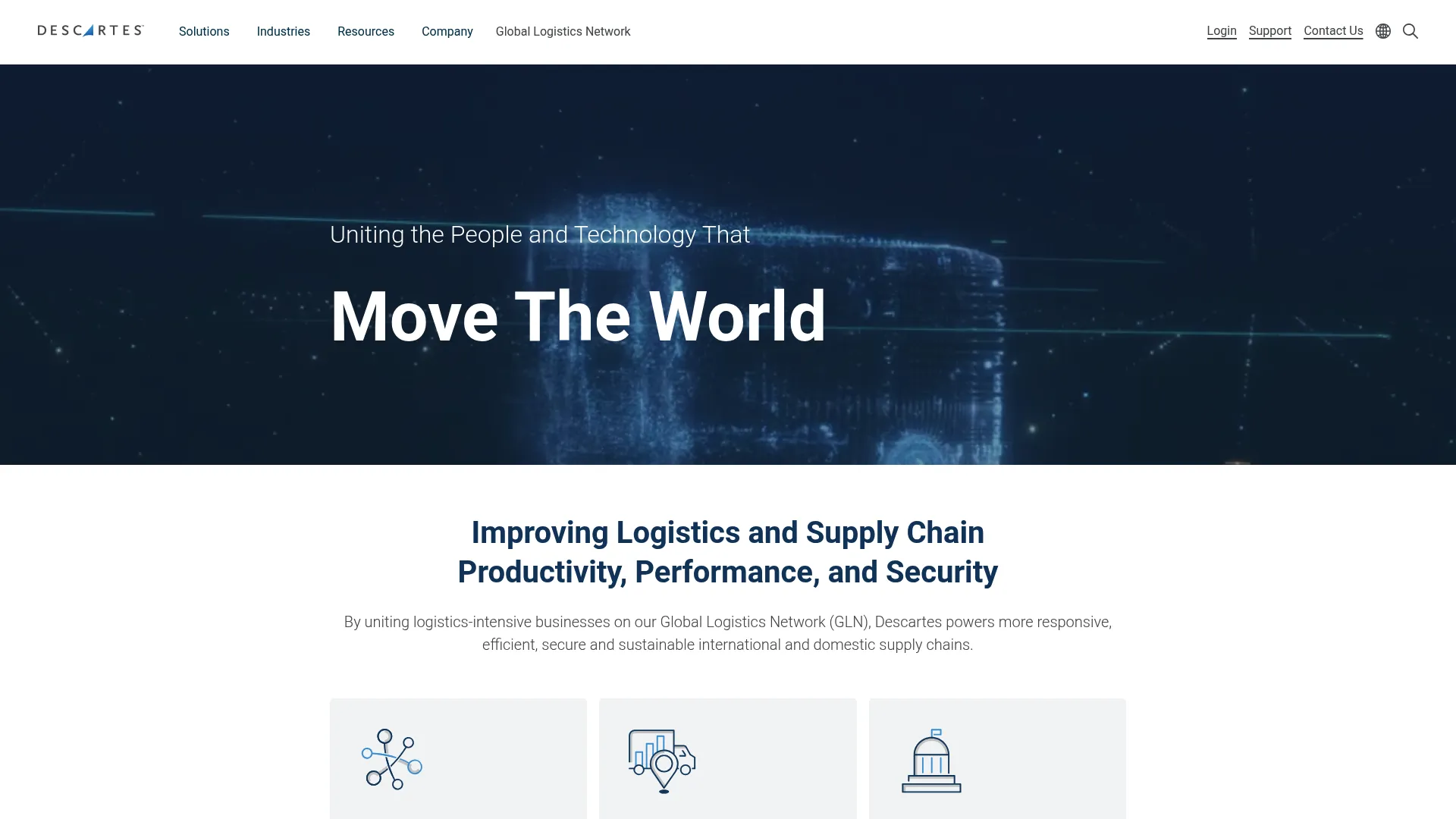
Descartes fits teams that already think in terms of transportation management and visibility, not just matching. Its capacity matching sits inside a broader logistics suite covering ecommerce operations, warehouse management, and trade compliance, with MacroPoint for shipment visibility. The value is in the connection: matched capacity flows into the same system that handles tracking, execution, and compliance.
Best for: organizations that want freight matching paired with shipment visibility and transportation management.
Key strengths
- Capacity matching connected to transportation management workflows.
- MacroPoint for real-time shipment visibility.
- Trade compliance, warehouse, and ecommerce operations modules.
Why choose Descartes: if matching is one piece of a larger logistics operation, Descartes keeps it inside a single stack rather than a standalone marketplace. It suits shippers and 3PLs that value execution and visibility alignment as much as raw matching speed.
Descartes pricing: public first-party pricing is visible for specific products, with Finale from $499/month, Sellercloud from $1,349/month, and Peoplevox from $2,050/month. Other Descartes solutions, including capacity matching modules, are quote-based.
5. Truckstop
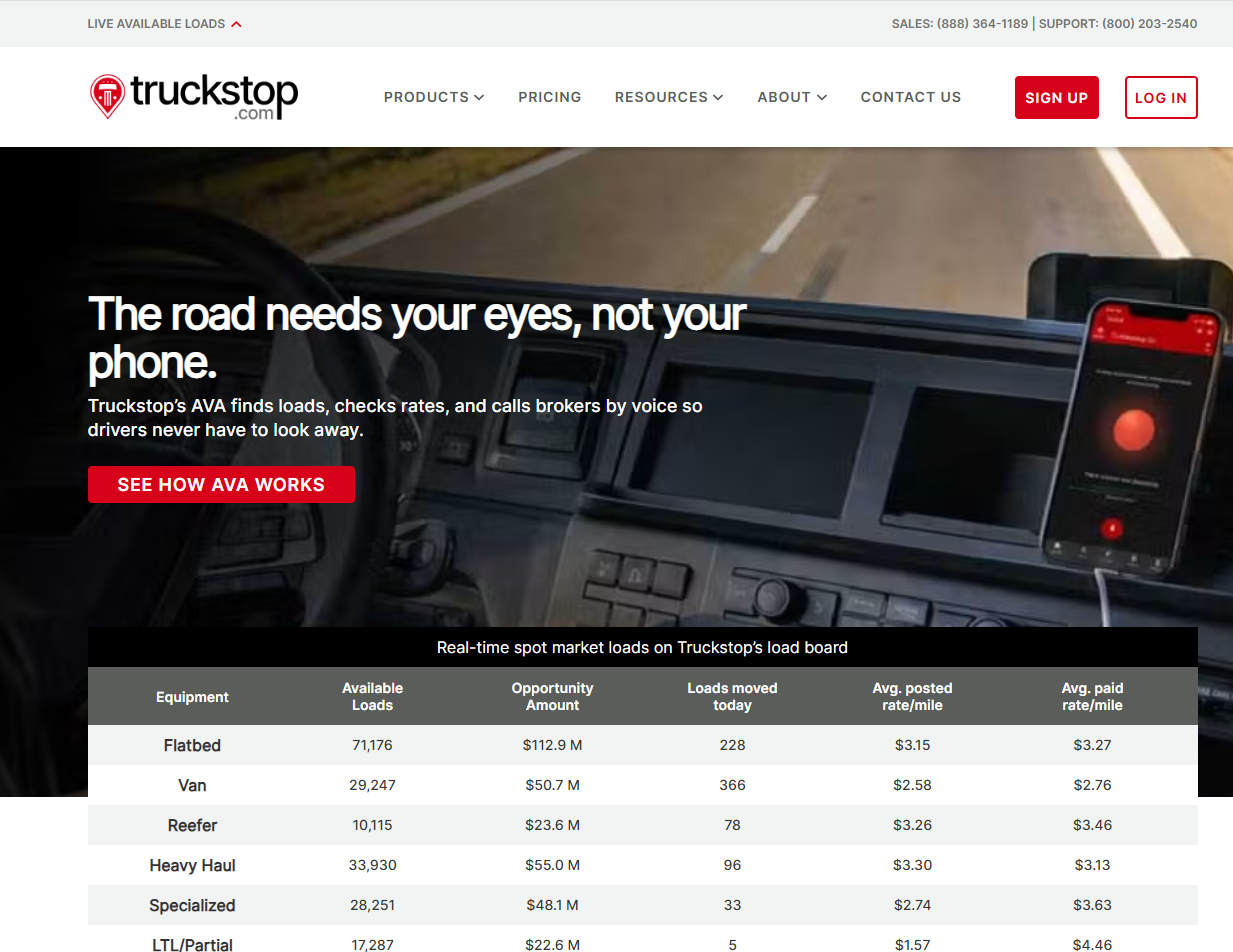
Truckstop is a familiar name in broker workflows. Its load board is the core, but the platform wraps it with rate insights, load comparison, posting, booking, and performance tools built for how brokers and carriers actually transact. For teams that want a recognizable marketplace with operational tooling attached, it is a practical default.
Best for: carriers and brokers who need load matching plus rate and workflow tools in a familiar marketplace.
Key strengths
- Load board for carriers, brokers, and shippers.
- Rate insights and load comparison tools.
- Posting, booking, and performance workflow tools.
Why choose Truckstop: if your team wants broker workflow depth and a well-known load board without a heavy implementation, Truckstop delivers matching efficiency out of the box. Its tiered plans let smaller operations start light and scale into fuller feature sets.
Truckstop pricing: load board plans start at $35/month for Dry Van Basic (per 3 users), with Dry Van Pro at $129/month. Standalone Load Board plans run from $109/month per user up to $239/month for Pro, and carrier Premium reaches $369/month. Prices exclude applicable fees and taxes.
6. Uber Freight
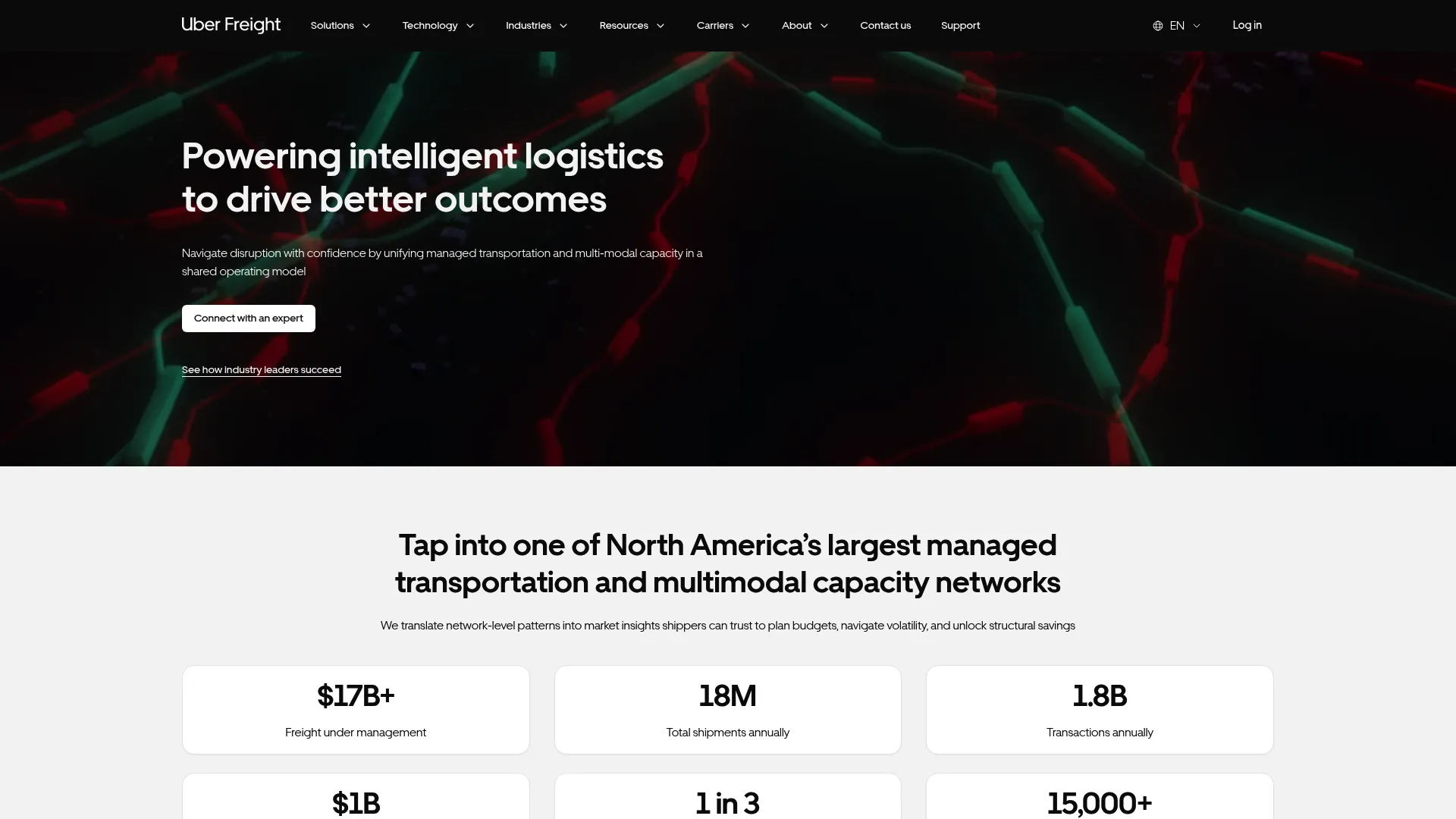
Uber Freight brings a digital-first marketplace model to shipper-side freight. Uber Freight Shipping handles quoting, booking, and tracking in one platform, while Uber Freight TMS and managed transportation support larger, more complex operations. The scale of the network is the draw for shippers who want instant matching without building carrier relationships from scratch.
Best for: shippers wanting marketplace scale, streamlined execution, and shipment visibility.
Key strengths
- Uber Freight Shipping for quoting, booking, and tracking.
- Uber Freight TMS for planning and managing logistics operations.
- Managed transportation and network intelligence at scale.
Why choose Uber Freight: if you are a shipper who wants digital-first matching with enterprise reach, the marketplace scale means capacity is rarely the bottleneck. The free shipping platform also lowers the entry cost for teams testing digital freight marketplaces.
Uber Freight pricing: Uber Freight Shipping is offered as a free platform for quoting, booking, and tracking shipments. Uber Freight TMS and managed transportation are not publicly priced and depend on scope.
7. Loadsmart
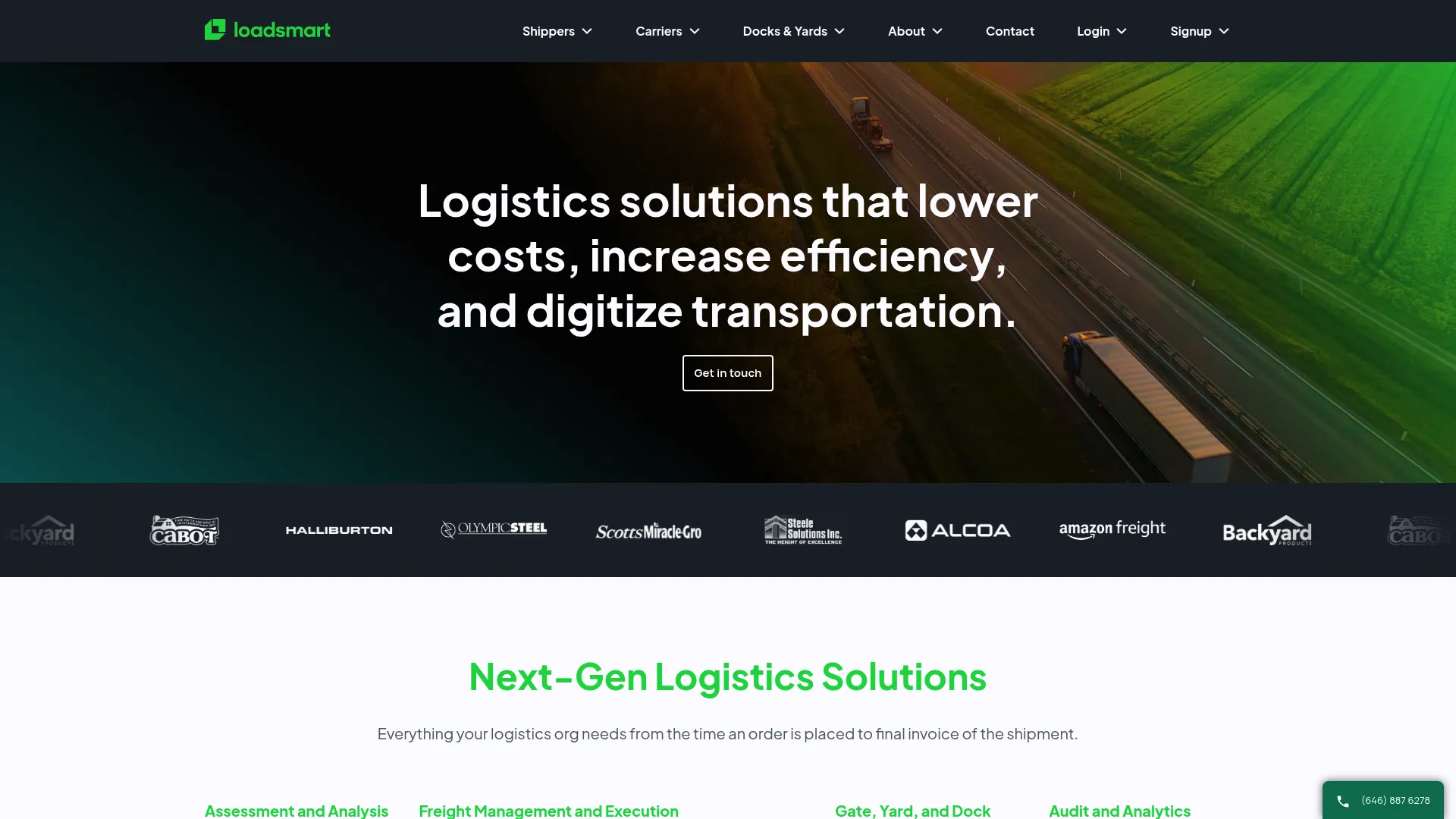
Loadsmart is built for the shipper side, with automation at the center. Its ShipperGuide TMS covers procurement, planning, execution, visibility, settlement, and analytics, and instantly bookable rates with dynamic pricing let shippers book capacity directly inside the workflow. For teams that want more control over booking and capacity decisions, the automated execution model reduces the manual steps between quote and covered load.
Best for: shippers wanting automated execution and control over booking and procurement.
Key strengths
- ShipperGuide TMS for procurement, planning, execution, and settlement.
- Instantly bookable rates with dynamic pricing.
- Carrier tools including load board, QuickPay, factoring, and CarrierGuide.
Why choose Loadsmart: if procurement and automated booking are your priority, Loadsmart puts matching and execution in one shipper-facing system. It fits teams that want to move from manual rate shopping to instant, data-driven booking.
Loadsmart pricing: Loadsmart's shipper pricing is quote-based, with the platform emphasizing demos and contact-sales flows. Carrier tools are offered free, but ShipperGuide TMS pricing depends on volume and scope.
Considerations
Before you commit to a freight matching platform, run it against your actual operating model.
Network depth on your lanes
A platform is only as good as the loads and trucks on the lanes you run. A huge national network means little if your regional lanes are thin. Ask vendors for coverage data on your specific lanes, not just headline network numbers.
TMS and integration fit
If matched loads have to be rekeyed into your TMS, you have added work, not removed it. Confirm the platform syncs load, status, and rate data into the systems you already run. Check which integrations are native versus which need custom work.
Pricing model versus your volume
Per-user monthly plans suit small broker teams; quote-based enterprise pricing fits high-volume shippers. Match the model to your volume so you are not paying for seats or scale you do not use. Watch for fees and taxes layered on top of headline prices.
Automation versus service support
Decide how much you want the platform to handle automatically and how much human backup you need. Fully digital marketplaces move fast; hybrid models add a service team for the exceptions. Neither is better, they fit different operating styles.
Data and rate intelligence
Rate data is where margin lives. Evaluate whether the platform's lane insights and market data are current and specific enough to guide real pricing decisions, or whether they are generic averages that will not help you quote a tight lane.
Conclusion
The right freight matching software depends on how your team operates, not on which platform has the biggest logo.
If you run a broker-led operation, start with DAT for its network reach and rate data, or Truckstop for load board depth and workflow tools. If you want technology with brokerage support behind it, review RXO. For capacity-first sourcing, Trucker Tools and its predictive matching are worth a close look. And if you are a shipper focused on visibility, procurement, and execution, compare Descartes, Uber Freight, and Loadsmart against your TMS and integration needs.
The practical next step: pick two platforms that fit your operating model, pull coverage data for your specific lanes, and run a short trial on live loads. The tool that covers your lanes fastest, with the least rekeying, is the one that earns a place in your stack.
FAQs
Freight matching software is a digital platform that matches available loads with carrier capacity using data, automation, and marketplace workflows. It replaces manual phone-and-email coordination with real-time load posting, carrier search, automated matching, quoting, booking, and tracking in one system.
A load board is a channel: a marketplace where loads and trucks get listed. Freight matching software usually adds a layer on top, including automated matching logic, quoting, booking, shipment visibility, and TMS integration. Many platforms include a load board as one component of a broader matching system.
Both use it, but their workflows differ. Brokers focus on covering loads and matching capacity fast. Shippers lean more toward procurement, pricing control, and service consistency, which is why shipper-side platforms emphasize TMS integration and automated booking over pure marketplace speed.
Look for real-time load posting, carrier search, automated matching, quoting, and tracking. Strong platforms also add saved rates, digital paperwork, mobile access for drivers and dispatchers, and TMS sync so matched loads flow into your existing systems without rekeying.
Yes, especially platforms with market rate data and lane insights. Tools that draw on historical transactions and live market signals let you quote lanes with evidence instead of gut feel. Over hundreds of loads, that pricing optimization protects margin and improves rate consistency.
Digital freight matching is the automated, data-driven version of connecting loads with carrier capacity. Instead of phone calls and manual coordination, digital freight marketplaces use algorithms, historical lane data, and real-time signals to pair the right truck with the right load, often with instant booking.
Marketplaces excel at capacity discovery, giving you the widest pool of loads and trucks fast. TMS-connected tools excel at execution and visibility, keeping matched loads inside the system that manages the rest of your operation. Many teams need both, using a marketplace for coverage and a TMS-connected platform for execution.