


You built the battlecard. You put a competitor's pricing gaps next to your differentiators, added the objection responses, wrote the trap questions. Then a deal came in against that exact competitor, and the rep opened a slide deck from eight months ago instead.
That gap is the real problem battlecard software solves. Not creating cards. Keeping them current, findable, and trusted enough that a rep reaches for them mid-call instead of guessing.
The competitive intelligence software market that powers dynamic battlecards is growing fast, with enterprise CI platforms averaging 12 to 20 percent annual growth per a Luminix synthesis of Mordor and Zion data (2024 to 2025). More budget is flowing in. But spend does not fix adoption. A battlecard nobody opens is a document, not enablement.
So the question is not "which tool makes the prettiest cards." It is "which tool keeps competitive intelligence fresh and gets it into live sales conversations." This guide ranks eight options against exactly that.
What's inside
This guide is for product marketing managers, sales enablement leaders, and competitive intel owners evaluating battlecard software in 2026. We picked tools that solve at least one of the three jobs that actually matter.
We evaluated each on:
- Freshness: how easily competitive updates reach the card without manual rework
- Adoption: whether reps can find and trust the card in a live deal
- Workflow fit: how well it embeds in CRM, Slack, and enablement hubs
- Depth: win-loss analysis, competitor monitoring, and objection handling built in
TL;DR
- Best for vendor-neutral comparison research: Software BattleCard, for downloadable analyst-vetted reports before you build cards.
- Best for full CI plus win-loss: Klue, a mature platform pairing intelligence collection with battlecards.
- Best for always-current competitive intel: Kompyte, with real-time competitor monitoring and AI-filtered alerts.
- Best for building a CI program from scratch: Crayon, strong on web tracking and market change detection.
- Best for living, rep-sourced battlecards: Playwise HQ, with AI-generated cards and Slack-native field intel.
- Best for distribution and adoption at scale: Showpad and Highspot, if your bigger problem is getting content used.
What is battlecard software?
Battlecard software is a category of competitive enablement tools that create, maintain, and distribute sales battlecards, the concise reference documents reps use to position against competitors in live deals. Modern platforms pair competitive intelligence software with content management, so battlecards stay current as competitors change pricing, packaging, and messaging.
A sales battlecard typically compiles competitor strengths and weaknesses, your differentiators, objection handling scripts, talk tracks, trap questions, and proof points into a single scannable view. Battlecard software turns that from a static file into a maintained, findable, measurable asset.
Core capabilities to expect:
- Competitor monitoring: automated tracking of competitor websites, pricing, reviews, and messaging changes
- Battlecard templates: structured formats for competitive battlecards by competitor, segment, or deal stage
- Win-loss analysis: insights from closed deals that feed back into card content
- CRM and Slack delivery: battlecards in the tools reps already work in
- AI assistance: summarized competitor moves, AI battlecards, and draft content
- Analytics: usage data showing which cards reps open and which drive competitive wins
The line between battlecard software and broader sales enablement software blurs here. Some tools lead with competitive intelligence and add distribution. Others lead with enablement content and treat battlecards as one asset type. Both approaches show up on this list.
When to use battlecard software
Standardize competitive positioning across the team
When your top reps win competitive deals and everyone else struggles, the gap is usually knowledge, not talent. Battlecard software captures how your best sellers position against each competitor and makes it repeatable. Every rep gets the same trap questions and objection responses, not a version they half-remember from a training session.
Keep intelligence current without a full-time analyst
Competitors ship new pricing, rebrand, and launch features constantly. Manual battlecard maintenance falls behind fast. Tools with competitor monitoring and AI summaries surface changes automatically, so your cards reflect what the competitor is doing this quarter, not last year.
Deliver intel inside live sales conversations
A battlecard buried in a shared drive does not help a rep on a call. The point of modern battlecard software is delivery: cards in the CRM, in Slack, in Microsoft Teams, surfaced at the moment a competitor gets named. That is where freshness and findability turn into competitive win rate.
Battlecard software comparison
Here is a side-by-side view of the eight tools. Pricing and G2 ratings reflect verified values where publicly available; where a vendor gates pricing behind sales, we note that plainly.
| # | Product | Best for | Key use case | Pricing | G2 rating |
|---|---|---|---|---|---|
| 1 | Software BattleCard | Vendor-neutral research | Downloadable comparison reports | Free reports | Not listed |
| 2 | Klue | CI plus win-loss | Competitive intel and battlecards in one | Custom | 4.7/5 |
| 3 | Kompyte | Always-current intel | Real-time competitor monitoring | Custom | 4.3/5 |
| 4 | Crayon | Building a CI program | Web tracking and market change detection | Custom | 4.6/5 |
| 5 | Playwise HQ | Living battlecards | AI cards plus Slack field intel | Free; Pro $250/mo | 5.0/5 |
| 6 | Playbook | Playbook distribution | SOP, training, and process content | Free trial; metered | 4.7/5 |
| 7 | Showpad | Content distribution | Governed enablement and buyer engagement | Custom | 4.6/5 |
| 8 | Highspot | Enablement at scale | AI content search and GTM analytics | Custom | 4.7/5 |
Best 8 battlecard software tools for 2026
1. Software BattleCard

Software BattleCard is less a live battlecard builder and more a research layer that sits before card creation. It provides analyst-vetted software comparison reports and selection tools for teams evaluating enterprise software. If you need vendor-neutral requirement scoring to inform your own competitive positioning, this is where you start.
For PMMs, the value is in the structured comparison charts and requirement-prioritized ratings. You get an outside view of how a category is scored, which is useful raw material when you build competitive battlecards for your own reps. It answers "how does an analyst frame this market" rather than "how do I arm my sellers in a live deal."
Best for: teams comparing enterprise software options with vendor-neutral research reports before building internal battlecards.
Key strengths
- Analyst-vetted requirements and vendor ratings
- Comparison charts of features and capabilities
- Free downloadable battlecards and selection reports
Why choose Software BattleCard: Choose it when your immediate need is research and category framing, not a maintained system reps use in deals. It is a complement to a battlecard platform, not a replacement for one.
Software BattleCard pricing: Reports are publicly listed as free at $0.00, with several showing a crossed-out $49.95 reference. No broader subscription plan was publicly verified.
2. Klue
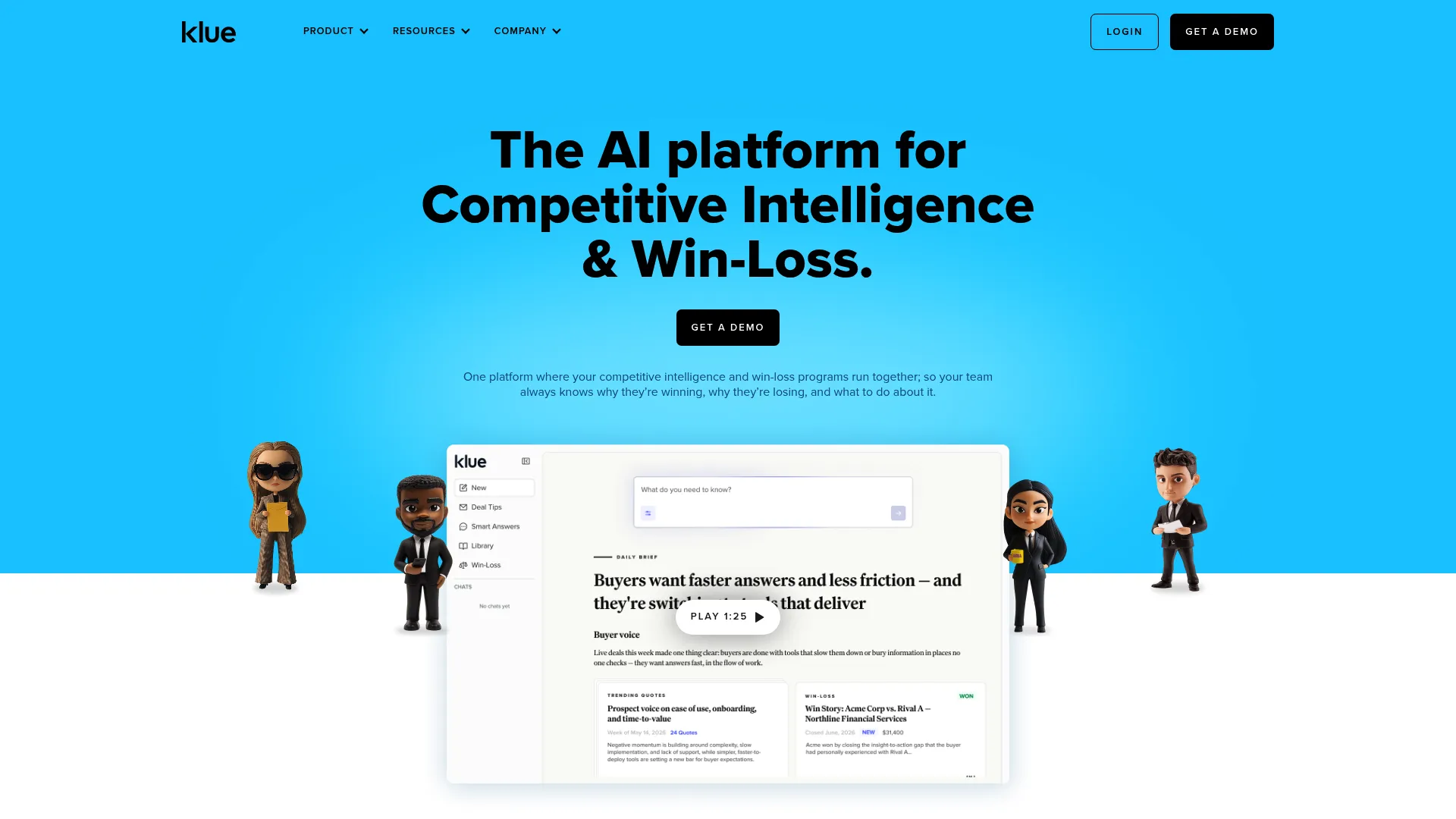
Klue is one of the more mature platforms in the competitive intelligence software category. It pairs intelligence collection and monitoring with battlecard creation and win-loss analysis, so the same system that spots a competitor's move also updates the card reps see. That closed loop is what PMMs building process maturity tend to want.
Klue's education-first content set is deep on battlecard frameworks and battlecard types, which helps teams new to structured competitive enablement. But the product itself is built for scale: intel curation, deal-level seller enablement, and win-loss insights feeding back into content. For a PMM whose bigger problem is a fragmented CI process rather than a single stale card, Klue is a strong fit.
Best for: B2B revenue teams that need competitive intel and win-loss insights in one platform.
Key strengths
- Competitive intelligence collection and monitoring
- Battlecards and competitive content creation
- Win-loss analysis and deal-level seller enablement
Why choose Klue: Choose Klue when you want one platform to own the full loop from intel capture to card to win-loss learning, and you have the team to run it.
Klue pricing: Klue does not publish pricing tiers or numbers on its site. Plans are quoted based on your needs, so expect a sales conversation.
3. Kompyte

Kompyte is built around one job: keeping competitive intelligence current with low manual lift. It tracks competitor websites, reviews, content, social, ads, and even job postings in real time, then uses AI to filter the noise into daily summaries. When a competitor changes pricing, you know, and the battlecard can reflect it fast.
For PMMs who need monitoring plus distribution, Kompyte connects competitor tracking to battlecards, win-loss reporting, and CRM and sales-tool integrations. The always-current angle is the differentiator. Instead of a quarterly scramble to refresh cards, updates flow in continuously, which is exactly what keeps battlecards trusted in live deals.
Best for: B2B teams that need automated competitive intelligence and battlecards without a dedicated analyst.
Key strengths
- Real-time competitor tracking across websites, reviews, content, social, ads, and job postings
- AI-filtered alerts and daily summaries
- Battlecards, win/loss reporting, and CRM/sales-tool integrations
Why choose Kompyte: Choose Kompyte when freshness is your primary problem and you want competitive updates surfaced automatically rather than chased manually.
Kompyte pricing: Public plan names are Essentials, Professional, and Unlimited. Pricing is based on competitors tracked, user licenses, SSO, and permission management, with no public numeric price shown.
4. Crayon

Crayon is a centralized competitive intelligence platform strong on web tracking, monitoring competitor website changes, product details, and customer feedback over time. If you are standing up a CI program and want a system of record for everything competitors do, Crayon is built for that breadth.
Crayon's public content leans into battlecard best practices, adoption, and modern templates, which reflects how the product thinks about the field. The value for PMMs is building enablement reps actually consume: competitive content organized so a seller can find the right card fast. It fits teams that want a full CI foundation, not just a card generator.
Best for: B2B teams building a competitive intelligence program from the ground up.
Key strengths
- Centralized competitive intelligence platform
- Web tracking for competitor website changes
- Product details and customer feedback monitoring
Why choose Crayon: Choose Crayon when you want a broad CI foundation with strong monitoring, and you are investing in competitive intelligence as an ongoing program rather than a one-off asset.
Crayon pricing: Crayon uses custom pricing and requires requesting an estimate. No public numeric price is shown on the site.
5. Playwise HQ

Playwise HQ is a lighter-weight competitive intelligence and battlecard tool built for B2B sales teams that want living cards without a heavy CI suite. It generates AI competitor battlecards and, importantly, pulls competitive insights sourced directly from reps in the field. That rep-sourced intel is what keeps cards grounded in what is actually happening in deals.
The Slack integration matters here. Reps drop competitive updates where they already work, and version control plus governance keep cards trustworthy. For PMMs who want a fast path to always-updated battlecards and value field intel over exhaustive market monitoring, Playwise HQ hits a practical middle ground. Its win-loss analysis rounds out the loop.
Best for: B2B sales teams needing living competitor battlecards and rep-sourced competitive intel.
Key strengths
- AI-generated competitor battlecards
- Sales-sourced competitive insights
- Slack integration, win-loss analysis, and version control
Why choose Playwise HQ: Choose Playwise HQ when you want rep adoption baked in through Slack and field-sourced intel, without committing to a large enterprise CI platform.
Playwise HQ pricing: A free plan covers up to 5 users. Pro is $250/month for up to 10 users, and Enterprise is $450/month for up to 20 users.
6. Playbook

Playbook is knowledge management and playbook software for training, onboarding, and process documentation. It is not a dedicated competitive intelligence suite, but it organizes and distributes structured content, which makes it a viable home for battlecards inside a broader enablement library. If your competitive content lives alongside SOPs and training, Playbook keeps it in one place.
For PMMs, the draw is distribution and usability. Templates, SMS and email communications with automations, and reporting help push content to reps and track engagement. It fits teams that want organized, accessible playbooks more than deep competitor monitoring, and that prefer a lighter footprint than a full CI platform.
Best for: teams that need to document and distribute SOPs, training, and playbooks, including battlecards.
Key strengths
- Templates for structured content
- SMS/email communications and automations
- Reports and analytics
Why choose Playbook: Choose Playbook when battlecards are one part of a wider enablement and training content need, and organized distribution matters more than automated competitor tracking.
Playbook pricing: Playbook offers a free 14-day trial and metered pricing. No public numeric price is shown on the pricing page.
7. Showpad
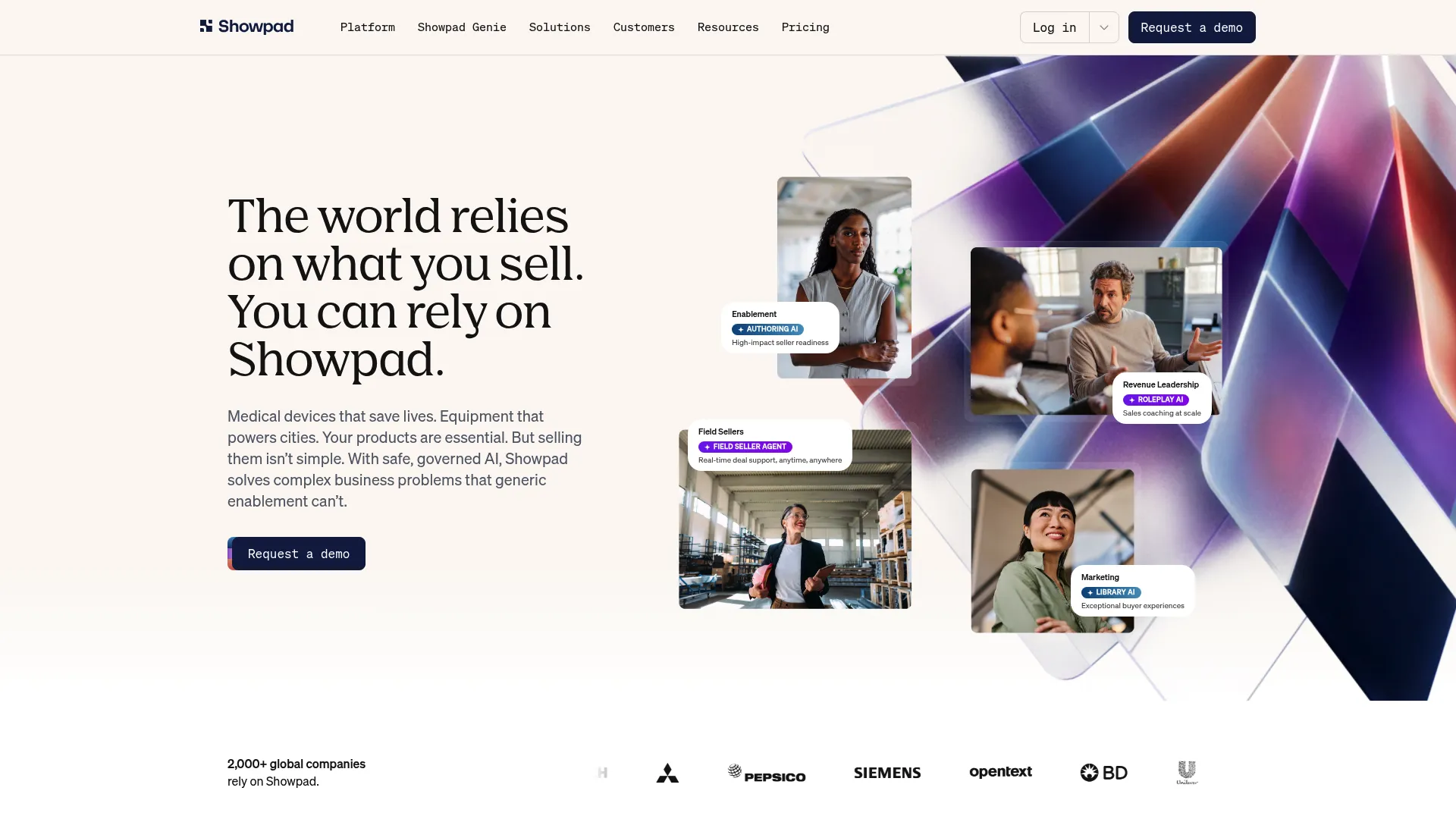
Showpad is a revenue effectiveness and sales enablement platform, broader than battlecards alone. It covers sales readiness, content management, and buyer engagement, which makes it a strong delivery layer for competitive content across a large org. PMMs often use it as the place battlecards live and get surfaced, tied to training and buyer-facing workflows.
The value here is governance and reach. When you need battlecards discoverable across many reps, with version control and readiness programs around them, Showpad's enablement depth pays off. It is the right pick when your bigger problem is distribution and adoption, not sourcing the intel itself. Pair it with a dedicated CI tool for the freshest competitor tracking.
Best for: enterprise teams needing governed sales enablement, content management, and buyer engagement.
Key strengths
- Sales readiness and certification
- Content management and governance
- Buyer engagement
Why choose Showpad: Choose Showpad when adoption and content governance across a large team are your priority, and battlecards are part of a wider enablement motion.
Showpad pricing: Showpad prices per user across Professional, Advanced, and Expert plans. Pricing is customizable and quoted on request, with no public numbers shown.
8. Highspot

Highspot is an AI-powered go-to-market and sales enablement platform built for scale. Its content governance and AI-driven search keep battlecards discoverable and tied to workflows, so a rep facing a competitor can surface the right card without hunting. For larger enablement programs, that discoverability is the whole game.
In a sales environment where 72 percent of sellers do not expect to make quota, Highspot positions its platform around measurable outcomes, reporting that its customers increase seller quota attainment by 24 percent. For PMMs, the GTM analytics and digital sales rooms mean battlecard usage becomes measurable, not a guess. The tradeoff is complexity: this is a full enablement platform, best suited to teams ready to run it.
Best for: mid-market and enterprise GTM teams needing a unified sales enablement platform.
Key strengths
- AI-driven content search and recommendations
- GTM analytics and intelligence
- Digital sales rooms and buyer engagement
Why choose Highspot: Choose Highspot when you are running enablement at scale and want battlecards inside a governed, analytics-rich platform reps already live in.
Highspot pricing: Highspot does not publish plan prices. Pricing is tailored based on capabilities, use cases, services, team size, and complexity.
Considerations before you buy
Battlecard software only earns its keep when sales trusts it, finds it fast, and sees it stay current. Weigh these before committing.
Freshness mechanics
Ask exactly how a competitor's pricing change reaches the card. Is it automated monitoring, an analyst's manual edit, or rep-sourced field intel? Always up to date battlecards depend on the maintenance model, not the template. Tools with competitor monitoring and AI summaries reduce the manual burden that lets cards go stale.
Rep adoption and findability
A card nobody opens changed nothing. Check whether battlecards surface inside the CRM, Slack, and Microsoft Teams where reps already work, and whether they appear when a competitor gets named. Sales readiness and easy access matter more than the depth of the content if reps never see it.
Workflow and integration fit
Confirm the tool connects to your CRM, marketing automation, and enablement hub. Battlecards in CRM and Slack are worth more than a polished standalone portal reps forget exists. Integration depth decides whether the tool becomes part of the workflow or another silo.
Measurement and win-loss
Look for analytics that tie card usage to competitive win rate, plus win-loss analysis that feeds learnings back into content. If you cannot show which battlecards drive wins, you cannot defend the spend or improve the cards.
Conclusion
The right battlecard software depends on which problem is biggest for you. If you need vendor-neutral research before building, start with Software BattleCard. If you want competitive intelligence and win-loss in one mature platform, Klue is the pick. For always-current intel with minimal manual lift, Kompyte leads. To stand up a broad CI program, Crayon fits. For living, rep-sourced cards with Slack adoption baked in, Playwise HQ is the practical middle ground. And when distribution and adoption at scale are the real challenge, Showpad and Highspot deliver the enablement depth.
Next step: name your bigger problem. Is it creation, freshness, or adoption? Shortlist two or three tools that solve that specific job, then test them against a real competitive deal, not a demo scenario. The tool your reps actually open in a live deal is the one worth paying for.
FAQs
Battlecard software creates, maintains, and distributes sales battlecards, the reference documents reps use to position against competitors in live deals. Modern tools combine competitive intelligence, content management, and delivery into CRM and Slack, so battlecards stay current and reps can find them fast. It sits at the intersection of competitive intelligence software and sales enablement software.
A strong battlecard includes competitor strengths and weaknesses, your key differentiators, objection handling scripts, talk tracks, trap questions, and proof points like customer wins. The best battlecard examples stay concise and scannable, since reps use them mid-conversation. Anything that cannot be absorbed in a few seconds during a call adds noise, not value.
PMMs keep battlecards current through a mix of automated competitor monitoring, rep-sourced field intel, and a regular review cadence. Tools that track competitor pricing, messaging, and product changes surface updates automatically, cutting the manual work that lets cards go stale. Pairing that with feedback from live sales conversations keeps cards grounded in reality.
Battlecard software focuses on competitive intelligence: monitoring competitors, building competitive battlecards, and running win-loss analysis. Sales enablement software is broader, covering all sales content, training, and buyer engagement. The categories overlap because battlecards are an enablement asset, and several tools do both. Choose based on whether your bigger gap is competitive intel or content distribution.
Reps pull up a battlecard the moment a competitor gets named on a call, using it for objection handling, trap questions, and positioning talk tracks. The best setups surface the right card automatically inside the CRM or Slack, so the rep is not searching mid-conversation. Speed and trust decide whether the card gets used or ignored.
Track competitive win rate, battlecard usage or open rates, and rep adoption across the team. Win-loss analysis shows whether cards move deals in your favor, while usage analytics reveal which competitive battlecards reps actually open. If usage is low, the problem is findability or trust, not the content itself.
Yes. Smaller teams benefit because a few strong battlecards can lift the whole team to the win rate of the best rep. Lighter tools with free or low tiers, like Playwise HQ, make it accessible without an enterprise budget. The key is picking a tool that fits your team size rather than one built for a much larger org.
Update battlecards whenever a competitor makes a material change to pricing, packaging, positioning, or product, and review them on at least a quarterly cadence regardless. Tools with real-time competitor monitoring shorten the lag between a competitor's move and your card reflecting it. Stale cards erode rep trust fast, so freshness is the metric that matters most.