Your security team isn't short on findings. Scanners surface CVEs daily. Cloud tools flag misconfigurations. Identity systems report privilege drift. Endpoint agents track configuration gaps. The problem is that none of those streams talk to each other, so the backlog grows while the real question goes unanswered: Which of these findings can actually become a breach?
That's the gap exposure management platforms close. According to a 2025 Brinqa survey, 57% of security decision-makers said identified exposures still went unpatched, not because teams lacked findings, but because they lacked a shared way to prioritize them. A platform that connects asset context, attacker paths, remediation workflows, and executive reporting changes the operating model from "manage the queue" to "reduce material risk."
This guide compares 10 platforms across attack surface management, prioritization logic, remediation depth, and implementation fit. It's written for product managers and security stakeholders who need to assess operational cost alongside security value.
What's inside
This guide covers 10 exposure management platforms evaluated for 2026. Platforms were selected based on four criteria:
- Coverage breadth: What asset types does the platform discover and monitor directly?
- Prioritization logic: How does it weigh exploitability, reachability, and business context?
- Remediation integration: Where does remediation work actually happen?
- Implementation fit: What does adoption require from engineering, IT, and data owners?
Pricing and G2 ratings were verified against each vendor's live pricing page and G2 listing. This guide suits security leaders, vulnerability management teams, and product managers evaluating platforms that affect enterprise-readiness commitments.
TL;DR
- Best overall enterprise exposure management: Tenable One, for unified visibility across IT, cloud, web applications, OT, and identity
- Best for endpoint and cloud-led teams: CrowdStrike Falcon Exposure Management, for teams already standardizing on the Falcon platform
- Best for mature vulnerability programs: Qualys Enterprise TruRisk Platform, for large asset estates with compliance and remediation tracking needs
- Best for Microsoft-heavy environments: Microsoft Security Exposure Management, for organizations running Defender, Entra, and Azure
- Best for risk aggregation and orchestration: Brinqa Unified Exposure Management Platform, for security programs with many fragmented data sources
The right fit depends on where your organization has the largest visibility gaps and where remediation work currently stalls.
What is exposure management software?
Exposure management software continuously identifies, prioritizes, validates, and helps remediate security weaknesses across an organization's attack surface.
Unlike vulnerability scanners that produce a list of CVEs, an exposure management platform connects those findings to asset context, identity privileges, attacker reachability, and business criticality. The goal is not a longer list. It's a shorter, more defensible queue of work that the security and engineering teams can actually act on.
Core capabilities to evaluate:
- Continuous asset discovery software across IT, cloud, applications, identities, OT, and external assets
- Risk prioritization using exploitability, reachability, privilege, business impact, and active threat intelligence
- Attack path analysis showing how individual weaknesses combine into usable attacker routes
- Exposure validation through control testing or breach simulation
- Remediation orchestration through ITSM, ticketing, and engineering workflows
- Executive reporting that tracks exposure reduction over time
How exposure management fits adjacent categories:
| Category | Main question answered | Typical scope |
|---|---|---|
| Vulnerability management | What weaknesses exist? | Assets and CVEs |
| Attack surface management | What is exposed or unknown? | External and internal asset discovery |
| CTEM | How do we continuously reduce exposure? | Program framework and operating model |
| Exposure management platform | Which exposures create meaningful business risk, and what should we fix first? | Unified visibility, prioritization, validation, remediation |
| Breach and attack simulation | Do our controls stop relevant attacker behaviors? | Continuous validation and control testing |
The global exposure management market reached approximately $3.89 billion in 2025, according to Grand View Research. At the same time, 58% of organizations reported adopting a Continuous Threat Exposure Management framework (Axonius, 2025), which reflects how quickly this category has moved from a research concept to an operational buying decision.
When to use exposure management platforms
Unify fragmented security signals
Security teams running separate vulnerability, cloud, endpoint, and identity tools often lack a normalized view of risk. When findings live in four different dashboards with four different scoring systems, prioritization becomes a spreadsheet exercise. An exposure management platform creates a shared inventory and a common risk language that security, product, and IT teams can act on together.
Prioritize attack paths instead of ticket volume
A backlog of 50,000 findings is not a risk program. The real question is which five percent of those findings combine into a path an attacker can walk. Platforms with graph-based attack path analysis help teams identify toxic combinations, privilege escalation routes, and high-blast-radius choke points. That analysis is what turns a vulnerability report into a remediation argument engineering will fund.
Make exposure remediation measurable across teams
Ownership is where most exposure programs break down. A platform that routes work into the systems your engineers already use, tracks SLA adherence, and measures recurrence gives security leadership something concrete to report. For product managers, this is where the engineering opportunity cost calculation gets clearer: Fewer ad-hoc fire drills, more predictable remediation cycles.
Exposure management platform comparison
Pricing and G2 ratings were verified against each vendor's live pricing page and G2 listing in October 2026. Enterprise pricing across this category is largely quote-based. Verify figures directly with each vendor before finalizing a shortlist.
| # | Product | Best for | Key differentiator | Pricing | G2 rating |
|---|---|---|---|---|---|
| 1 | Tenable One | Enterprise-wide exposure management | Unified attack surface and attack path analysis across IT, cloud, OT, web apps, and identity | From $3,500/yr (selected modules); platform packages by quote | 4.5/5 |
| 2 | CrowdStrike Falcon Exposure Management | Falcon platform customers | Cross-domain exposure context with adversary intelligence | Subscription; module requirements vary | Not listed |
| 3 | Qualys Enterprise TruRisk Platform | Mature vulnerability and compliance programs | TruRisk scoring with broad asset and compliance coverage | From $2,195 (VMDR TruRisk); platform by quote | 4.3/5 |
| 4 | Microsoft Security Exposure Management | Microsoft-first security environments | Exposure prioritization across Microsoft security graph | Included with qualifying Microsoft licenses | Not listed |
| 5 | Check Point Exposure Management | Prevention-focused security teams | Exposure prioritization with control effectiveness and threat context | Quote-based | 4.6/5 |
| 6 | Zafran Threat Exposure Management Platform | Teams reducing exploitable risk across existing tools | Contextual risk mitigation using existing security controls | Quote-based | Not listed |
| 7 | Brinqa Unified Exposure Management Platform | Security programs with many data sources | Risk aggregation, quantification, and workflow orchestration | Quote-based | 3.6/5 |
| 8 | XM Cyber Exposure Management Platform | Hybrid attack path analysis | Graph-based attack path management across cloud and on-premises | Quote-based | 3.5/5 |
| 9 | Armis Centrix | OT, IoT, and unmanaged-device environments | Agentless asset intelligence across cyber-physical environments | Quote-based | 4.4/5 |
| 10 | Tanium Autonomous IT Platform | Endpoint-heavy enterprise operations | Real-time endpoint data, patching, and remediation execution | Quote-based | 4.5/5 |
Best 10 exposure management platforms for 2026
1. Tenable One
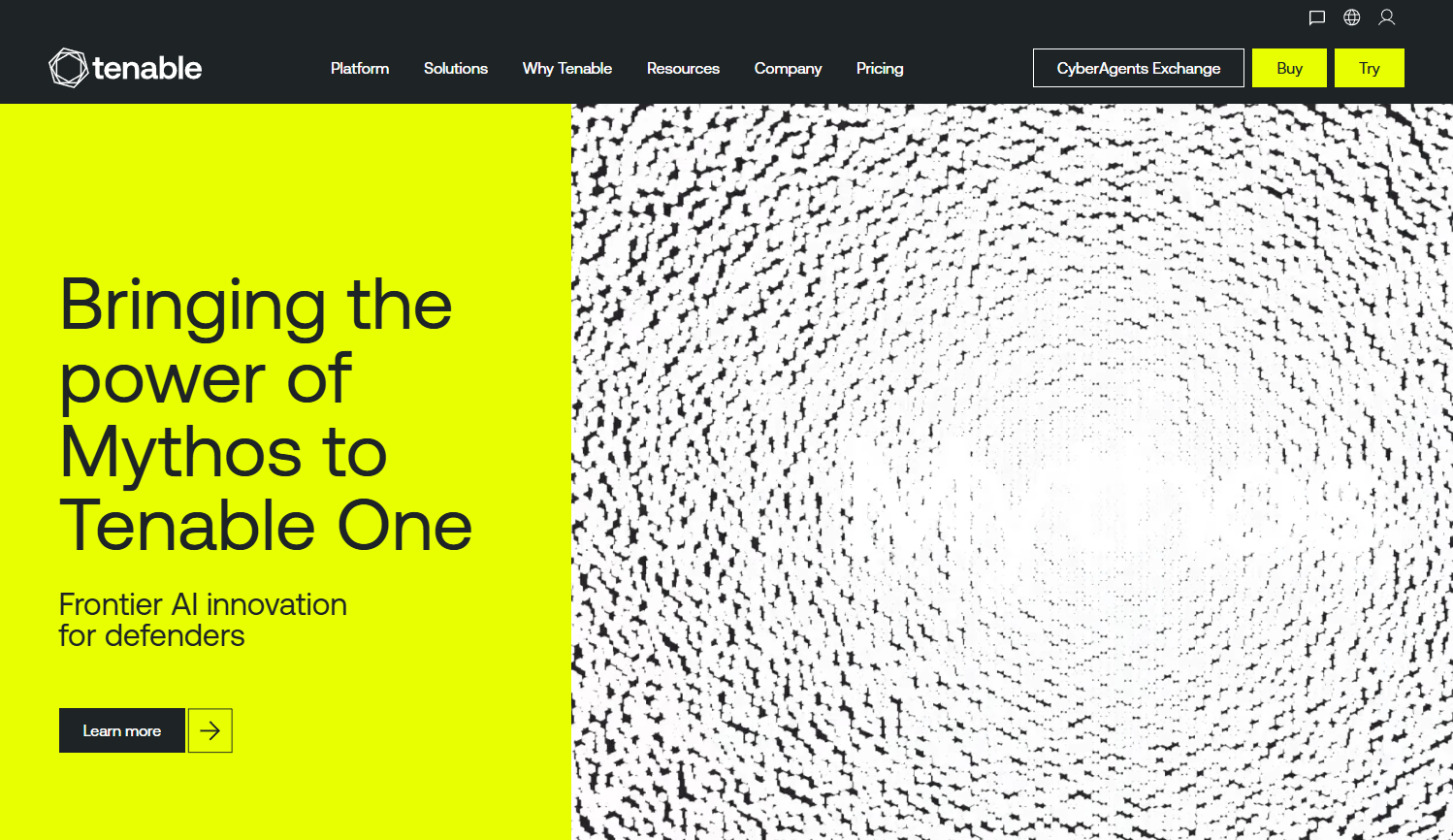
Tenable One is an AI-powered exposure management platform that brings together visibility across IT, cloud, web applications, OT, IoT, identity systems, and external assets into a single operational view. It is built for organizations that need a broad exposure management program rather than a collection of point scanners. The platform connects asset inventory, attack path analysis, and risk prioritization to give security teams a shared picture of what matters most.
Best for: Enterprises consolidating vulnerability, attack surface, cloud, and attack-path context into one security risk program.
Key features
- Unified asset inventory across IT, cloud, OT, web apps, and identity
- Risk-based exposure prioritization with attack path analysis
- AI-powered discovery, analysis, and remediation guidance
- External and web application attack surface visibility
- Executive exposure reporting and industry benchmarks
Why choose Tenable One: It's the strongest shortlist candidate when your team needs to connect existing exposure data from multiple domains into a single operational view, and when leadership needs a reporting layer that tracks risk reduction over time rather than just finding volume.
Tenable One pricing: Selected components carry published annual prices. Tenable One Vulnerability Management starts at $3,500 per year for 100 assets. Web App Scanning starts at $3,578 per year for five FQDNs. Foundation and Advanced platform packages are available by quote. Verify current terms directly with Tenable.
G2 rating: 4.5/5
2. CrowdStrike Falcon Exposure Management

CrowdStrike Falcon Exposure Management is built for organizations already operating on the Falcon platform across endpoint, cloud, and identity security. Rather than adding another disconnected tool, it layers exposure context onto the signals Falcon already collects, then enriches that context with adversary intelligence from CrowdStrike's threat research teams. The result is exposure prioritization grounded in how actual attackers behave, not just CVE scores.
Best for: Security teams that want exposure management connected to endpoint, cloud, identity, and detection workflows without operating a separate platform.
Key features
- Continuous exposure monitoring across endpoints, cloud, network, OT/IoT, and shadow AI
- Adversary intelligence context for exposure prioritization
- Cloud posture and workload exposure insights
- AI-driven exploitability and attack path analysis
- Falcon platform integration for unified workflow
Why choose CrowdStrike Falcon Exposure Management: The strongest fit is for teams already standardizing on Falcon where consolidation matters more than adding a new vendor relationship. Confirm which specific exposure capabilities are included in your current bundle before evaluating.
CrowdStrike Falcon Exposure Management pricing: CrowdStrike publishes bundle pricing for Falcon platform tiers, but dedicated Falcon Exposure Management package pricing requires confirmation with their sales team. The exposure management capabilities may sit inside a specific bundle or as an add-on.
3. Qualys Enterprise TruRisk Platform

Qualys Enterprise TruRisk Platform is a cloud-based platform for measuring, communicating, and eliminating cyber risk across large enterprise asset estates. Its TruRisk scoring model connects technical vulnerability findings to business context, making it a practical fit for organizations that already operate Qualys tools across their vulnerability, compliance, and cloud security programs. The platform spans endpoint, cloud, application, and container environments.
Best for: Enterprises running large vulnerability and compliance programs that need a broader risk model without replacing existing Qualys coverage.
Key features
- TruRisk scoring and risk-based vulnerability prioritization
- Unified asset inventory and cyber risk context
- Automated remediation, patching, and workflow tracking
- Cloud, application, container, and endpoint security coverage
- Compliance and configuration management reporting
Why choose Qualys Enterprise TruRisk Platform: It's a practical choice when your team has broad Qualys adoption across a high-volume asset estate and needs to connect findings into a prioritized, reportable risk program. Teams without existing Qualys tooling should weigh integration work against a net-new platform evaluation.
Qualys Enterprise TruRisk Platform pricing: Qualys publishes package pricing for VMDR TruRisk. The VMDR TruRisk package starts at $2,195, VMDR TruRisk FixIT starts at $2,995, and VMDR TruRisk ProtectIT starts at $4,645. Broader Enterprise TruRisk Platform pricing depends on selected applications, asset counts, and modules, and requires a quote.
G2 rating: 4.3/5
4. Microsoft Security Exposure Management

Microsoft Security Exposure Management is a security solution that provides unified visibility, risk prioritization, and attack path analysis across devices, identities, applications, data, and hybrid or multicloud environments. Its core advantage is the enterprise exposure graph: A connected view of Microsoft security signals that reduces integration overhead for organizations already running Defender, Entra, and Azure.
Best for: Security and SecOps teams in Microsoft-first environments that want exposure prioritization connected to existing Microsoft security signal without adding a new vendor.
Key features
- Enterprise exposure graph across endpoints, cloud, identities, SaaS, and external attack surfaces
- Critical-asset classification and exposure prioritization
- Security initiatives, metrics, and unified remediation recommendations
- Integration with Microsoft Defender for Cloud and Defender Vulnerability Management
- External data connectors for sources including ServiceNow CMDB, Tenable, and Qualys
Why choose Microsoft Security Exposure Management: It's the natural choice for organizations deeply invested in the Microsoft security stack, since it reduces the integration lift significantly. Teams running mixed-vendor environments should test third-party connector depth and reporting coverage before committing.
Microsoft Security Exposure Management pricing: Access comes through qualifying Microsoft licenses, including Microsoft 365 E5, Microsoft 365 E3 with eligible add-ons, Microsoft Defender products, and Microsoft Defender for Cloud. Non-Microsoft data connectors use consumption-based pricing. Contact Microsoft to confirm licensing eligibility for your environment.
5. Check Point Exposure Management

Check Point Exposure Management is an AI-driven platform that combines threat intelligence, exposure prioritization, agentic validation, and remediation across existing security controls. It goes beyond identifying exposures to test whether they are actually exploitable, using AI agents that simulate attacker behavior against the organization's deployed controls.
Best for: Enterprise security teams that need risk prioritization linked to prevention control effectiveness and want validation built into the workflow rather than as a separate tool.
Key features
- Attack surface monitoring, dark-web monitoring, and supply-chain intelligence
- Risk-based prioritization using exploitability, reachability, and existing control coverage
- Agentic Exposure Validation to test whether exposures are exploitable
- Safe remediation through virtual patching, IPS enforcement, and ITSM/SOAR workflows
- Unified asset inventory with ownership and control coverage context
Why choose Check Point Exposure Management: It's a strong fit for organizations that want prevention context alongside exposure analysis rather than a detached risk dashboard. Teams already running Check Point controls get additional value from the integrated remediation and validation layer.
Check Point Exposure Management pricing: Quote-based. Contact Check Point to confirm whether the product is bundled with other Check Point services or licensed separately for your environment.
G2 rating: 4.6/5
6. Zafran Threat Exposure Management Platform
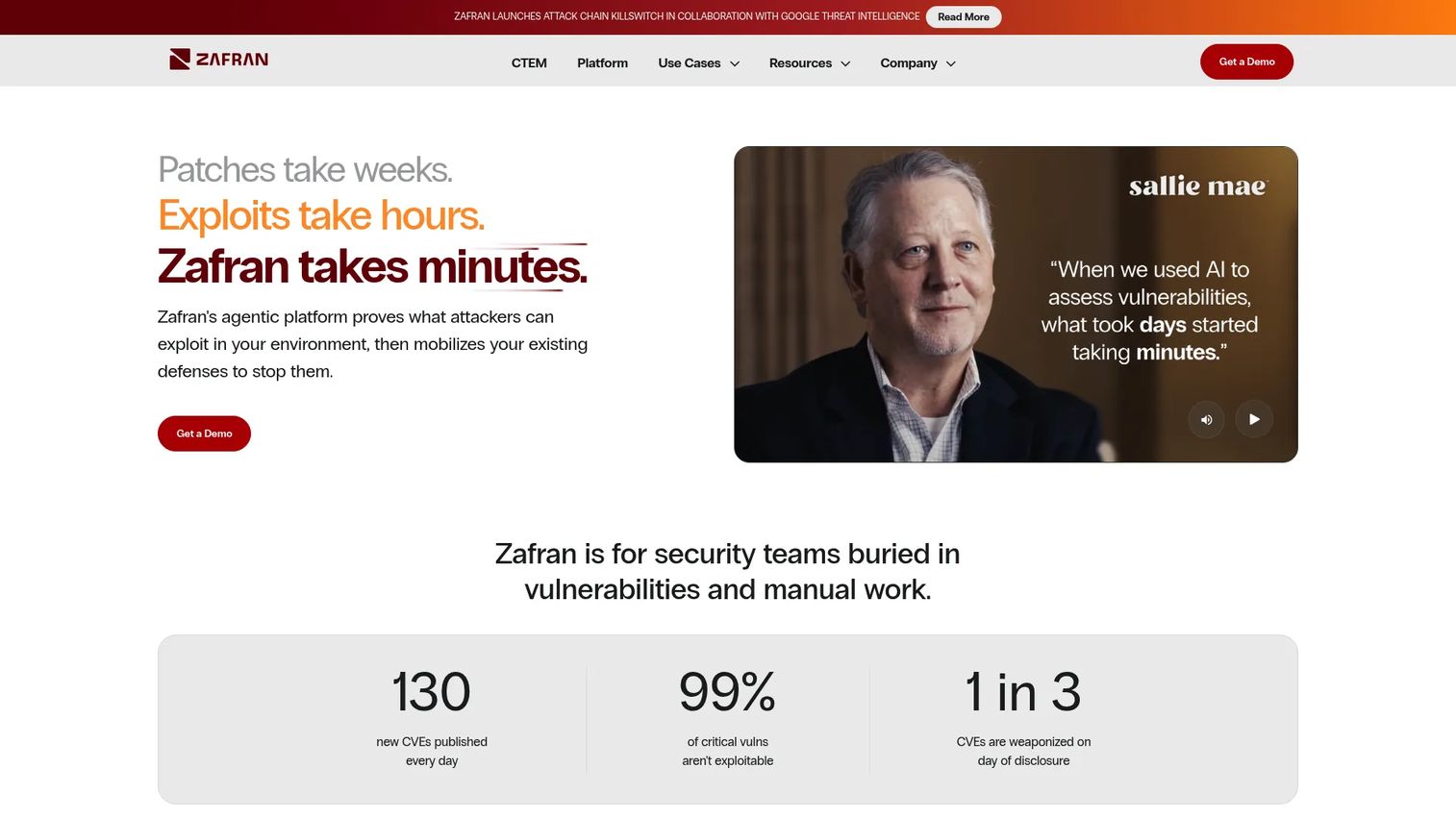
Zafran is an AI-native, agentless platform that unifies vulnerability, asset, cloud, identity, and control findings across existing security tools, then assesses which exposures are exploitable given the organization's actual deployed controls. Its approach is additive: It works with your current detection and vulnerability stack rather than replacing it.
Best for: Security organizations that have invested in multiple security tools and need a focused layer for identifying, mitigating, and remediating the exposures attackers can actually use.
Key features
- Unified findings with normalization and deduplication across existing tools
- Contextual risk assessment using runtime presence, reachability, and compensating controls
- Mitigation guidance that uses existing security controls to reduce risk before patching
- AI-powered remediation workflows through existing ticketing platforms
- Proactive exposure hunting for CVEs, zero-days, and control gaps
Why choose Zafran Threat Exposure Management Platform: It fits organizations where the core problem is making sense of findings already collected across many tools rather than replacing those tools with something new. The mitigation-first approach means teams can reduce exploitable risk before a patch is available or deployed.
Zafran Threat Exposure Management Platform pricing: Quote-based. Commercial terms depend on organizational scope and connector requirements. Contact Zafran to confirm deployment model and pricing for your environment.
7. Brinqa Unified Exposure Management Platform
Brinqa is a unified exposure management platform built around a CyberRisk Graph that normalizes and connects security findings from across the organization's tool stack. It focuses on risk quantification, ownership attribution, and remediation orchestration, making it a practical choice for large programs with fragmented data sources and a need to route work to the right teams.
Best for: Large security programs with many scanning, cloud, identity, and application security tools that need risk aggregation, ownership routing, and executive reporting from a single platform.
Key features
- CyberRisk Graph for normalized, contextualized exposure data across tools
- AI deduplication and ownership attribution of findings
- Contextual risk scoring based on exploitability, asset criticality, and business impact
- Workflow automation, ticketing, validation, and executive reporting
Why choose Brinqa Unified Exposure Management Platform: It's best suited for security teams where the hardest problem is connecting systems of record, normalizing disparate findings, and routing remediation ownership across security, IT, and engineering. Plan for stakeholder alignment across data owners before deployment.
Brinqa Unified Exposure Management Platform pricing: Quote-based. Pricing depends on scope, connected data sources, and organizational requirements. Contact Brinqa for commercial terms.
G2 rating: 3.6/5
8. XM Cyber Exposure Management Platform
XM Cyber uses Attack Graph Analysis to map the routes an attacker could take across hybrid environments, including external surfaces, on-premises infrastructure, cloud environments, and identity systems. Its graph-based approach helps security teams identify choke points where a single remediation step closes multiple attack paths, which is where remediation prioritization becomes most defensible.
Best for: Hybrid enterprises that need to identify attack paths, privilege escalation routes, and high-impact choke points rather than managing findings at the individual vulnerability level.
Key features
- Attack Graph Analysis across external, on-premises, cloud, AI, and identity surfaces
- Business-impact-based prioritization and choke-point remediation guidance
- Cloud exposure, posture, vulnerability, and entitlement management
- Identity and privilege context for attack path discovery
- Exposure intelligence for SOC investigation support
Why choose XM Cyber Exposure Management Platform: It's the right choice when individual findings are less useful than a view of how exposures connect into complete attacker paths. Security teams that need to explain prioritization decisions to engineering and leadership will find the graph model makes the argument concrete.
XM Cyber Exposure Management Platform pricing: Quote-based. XM Cyber uses subscription pricing and directs customers to contact the company or their partners for commercial terms.
G2 rating: 3.5/5
9. Armis Centrix

Armis Centrix is a cloud-based cyber exposure management platform that provides real-time visibility, risk assessment, threat detection, and containment across IT, OT, IoT, medical devices, and cloud assets. Its agentless approach makes it particularly useful in environments where traditional endpoint agents cannot be deployed, including manufacturing floors, healthcare networks, and operational technology infrastructure.
Best for: Organizations with OT, IoT, healthcare, or unmanaged-device exposure challenges where standard endpoint coverage leaves significant blind spots.
Key features
- Agentless asset discovery and unified inventory across managed and unmanaged devices
- Real-time risk prioritization and vulnerability management
- Behavioral anomaly detection and threat detection
- Network segmentation and automated containment capabilities
- Compliance reporting and integration with existing security tools
Why choose Armis Centrix: Asset discovery quality is the prerequisite for any prioritization the platform performs. If unknown or unmanaged devices represent your largest visibility gap, Armis Centrix addresses that gap before vulnerability prioritization becomes meaningful.
Armis Centrix pricing: Quote-based. Contact Armis to confirm commercial terms for your asset type, environment scope, and required modules.
G2 rating: 4.4/5
10. Tanium Autonomous IT Platform
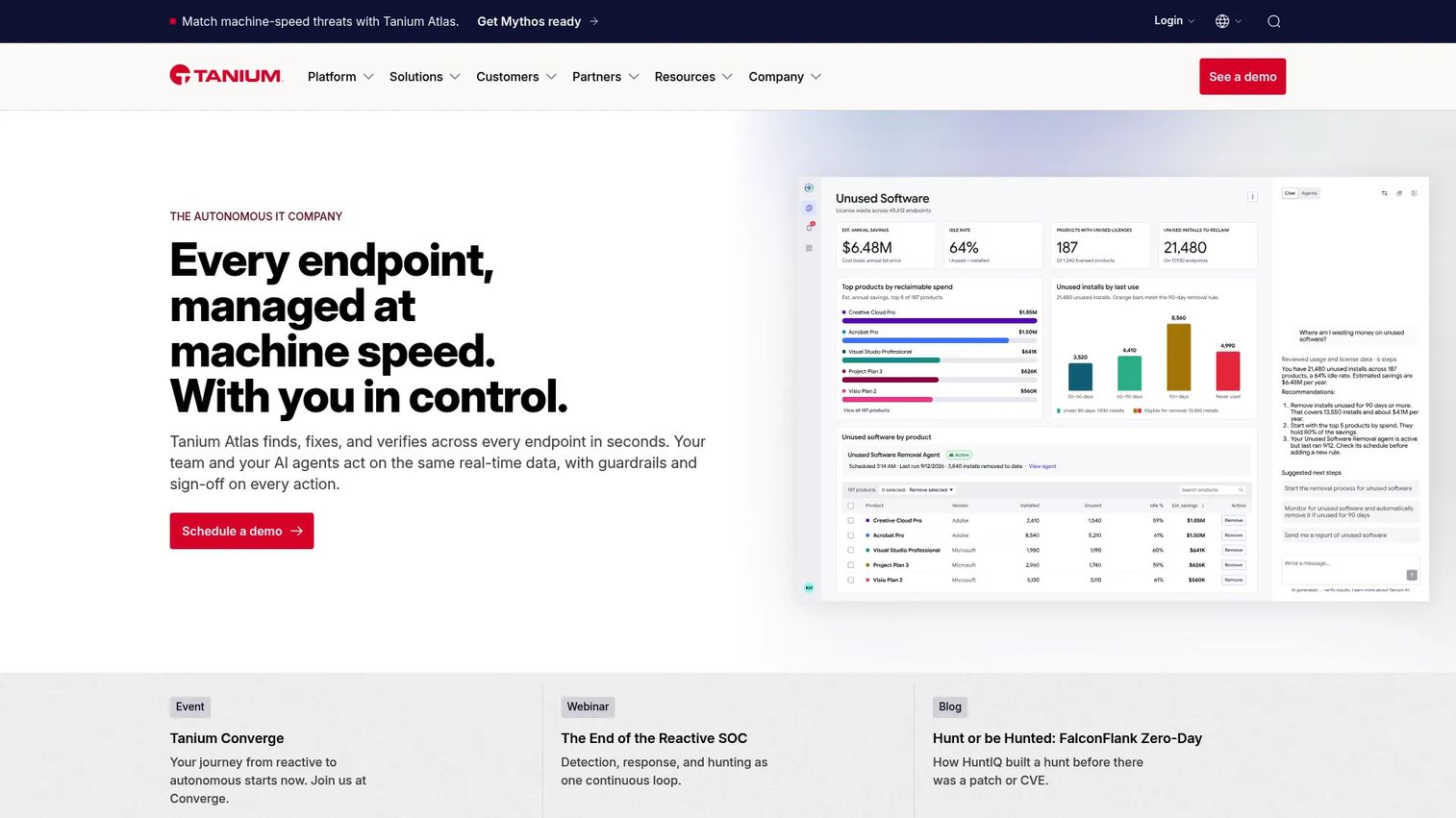
Tanium is a unified enterprise platform that combines real-time endpoint intelligence, IT operations, security, and AI-powered autonomous remediation. Where most exposure management platforms surface findings and route them to other tools for execution, Tanium closes the loop at the endpoint: It discovers, assesses, and remediates on the same platform.
Best for: Endpoint-heavy enterprises that need to connect exposure findings directly to endpoint operations, patching workflows, and remediation execution at scale.
Key features
- Real-time endpoint visibility and querying across managed assets
- AI-powered autonomous remediation and governed automation
- Unified patching, configuration management, and software deployment
- Compliance tracking, threat detection, and forensics capabilities
- IT operations integration for remediation workflow closure
Why choose Tanium Autonomous IT Platform: It's the strongest fit when endpoint data quality and remediation execution capacity are the limiting factors in the exposure program. Security teams whose biggest problem is getting patches deployed, not just finding vulnerabilities, will get the most from the platform's end-to-end model.
Tanium Autonomous IT Platform pricing: Quote-based. Contact Tanium to confirm package structure and commercial terms for your endpoint count and required modules.
G2 rating: 4.5/5
Considerations when choosing exposure management platforms
Coverage across your actual attack surface
Ask each vendor what the platform discovers directly versus what it ingests from other tools. The answer changes the integration footprint significantly. For product managers assessing engineering cost, a platform that covers your customer-facing cloud and application environments natively reduces the connector maintenance burden.
Prioritization logic you can explain
A risk score without explainable inputs will not build stakeholder trust, and it will not survive scrutiny from engineering teams being asked to prioritize patches over features. Before committing, ask vendors to walk through exactly how their score weighs exploitability, exposure, privilege, business criticality, and compensating controls.
Remediation workflow and ownership routing
Confirm whether the platform routes work into the systems your teams already use: ITSM, Jira, cloud-control workflows, or identity management platforms. A finding that lands in a security dashboard but never reaches an engineer with context and assignment does not reduce exposure.
Implementation and data quality requirements
A unified exposure platform will surface inventory and ownership gaps that organizations often discover for the first time during deployment. Plan for data normalization, asset criticality labeling, connector ownership, and cross-functional operating rules before launch. This is the most common source of implementation delays.
Metrics that serve both operators and executives
Require reporting that serves two audiences. Operators need drill-down on SLA adherence, remediation recurrence, and coverage gaps. Executives need trend lines on high-risk path reduction and business-critical asset exposure. A platform that can only serve one audience will create reporting overhead elsewhere.
Conclusion
Exposure management platforms range from broad enterprise programs to focused specialists. Tenable One suits organizations consolidating visibility across many asset types. CrowdStrike Falcon Exposure Management fits teams already standardizing on Falcon. Qualys Enterprise TruRisk Platform serves large vulnerability and compliance programs. Microsoft Security Exposure Management reduces integration work for Microsoft-first environments. Brinqa handles risk aggregation and orchestration across fragmented data sources. Armis Centrix covers cyber-physical and unmanaged-device visibility. XM Cyber focuses on attack path analysis. Tanium closes the loop at the endpoint with remediation execution.
The practical starting point is your blindest attack-surface domain and your slowest remediation workflow. The platform that connects both without creating additional reporting overhead deserves the top of your shortlist.
Pricing and ratings shift. Verify every figure directly with each vendor before finalizing your evaluation.
Start your journey with Guideflow today!
FAQs
An exposure management platform is a security tool that brings together continuous asset discovery, risk context, attack path analysis, validation, remediation workflow integration, and executive reporting. Its purpose is to help security teams identify which exposures create meaningful business risk and prioritize those for remediation rather than working through an undifferentiated findings backlog.
Vulnerability management identifies and tracks weaknesses at the asset and CVE level. Exposure management adds context: Reachability, identity privileges, business criticality, control coverage, and attack path relationships. A vulnerability management program tells you what is broken. An exposure management platform tells you which broken things an attacker can actually use.
CTEM (Continuous Threat Exposure Management) is a continuous operating model for reducing exposure risk, defined by Gartner as a structured program rather than a product. An exposure management platform provides the visibility, prioritization, validation, and workflow capabilities that make running a CTEM program operational. The platform is the tooling; CTEM is the practice.
No. Most platforms in this category ingest data from existing scanners alongside cloud security, identity, and endpoint tools. The platform's role is to normalize those findings, add prioritization context, and connect them to remediation workflows. Scanners remain part of the data collection layer.
Focus on data integrations with your existing security stack, asset ownership and routing capabilities, remediation workflow fit with engineering tools, coverage of customer-facing and external surfaces, and reporting quality for leadership and enterprise buyers. Also assess how much engineering time the platform requires to deploy connectors and maintain asset criticality data as your product surface changes across release cadence.
Platforms combine inputs including exploit availability, asset exposure, identity privileges, attack path reachability, business criticality, active threat intelligence, and compensating control coverage. The weighting differs across vendors. Ask each platform to explain how its risk score is calculated and which inputs the team can inspect or override, since a score your security engineers cannot explain to product and engineering will not build the trust needed for prioritization decisions.
The answer depends on your existing cloud and identity stack. Teams running Microsoft environments get the most from Microsoft Security Exposure Management's native integration. Broader cloud and identity coverage is strong in Tenable One, CrowdStrike Falcon Exposure Management, and Zafran for teams that need cross-tool normalization. For cloud data security contexts specifically, evaluate which platforms have native coverage for your cloud provider versus connector-based ingestion.
Track exposure lifespan (how long a high-risk finding stays open), high-risk path reduction over time, remediation SLA adherence by team, recurrence rates for the same exposure type, coverage gaps across asset categories, and business-critical assets without clear ownership. These metrics connect the exposure program to outcomes that leadership and enterprise buyers can evaluate. For more on asset lifecycle management software and how asset tracking feeds exposure programs, see our related guide.
Implementation timelines vary significantly by platform type and organizational complexity. Platforms that ingest from many existing tools require connector setup, data normalization, and asset criticality labeling before prioritization becomes meaningful. Organizations with clean asset inventories and defined ownership models typically reach operational use faster. Plan for a proof-of-value period that includes at least one full remediation cycle before assessing whether the platform fits your team's workflow.
Exposure management identifies and prioritizes weaknesses across the attack surface. Breach and attack simulation (BAS) tests whether deployed controls would stop specific attacker behaviors. For more on breach and attack simulation software, see our dedicated guide. Some exposure management platforms include validation capabilities that overlap with BAS, but they serve different primary purposes.