You quoted a custom bracket job on Tuesday. The material price shifted, the shop ran two revisions, and by the time it shipped, the margin you promised was gone. Nobody lied. The numbers just lived in five disconnected places: a spreadsheet, a whiteboard, a purchase order, a paper traveler, and someone's memory.
That gap is the real reason fabrication teams buy software. Not because they lack tools. Because the tools they have do not talk to each other, so every quote, schedule change, and material receipt becomes manual reconciliation. The metal fabrication software market was valued at roughly USD 3.5 billion in 2025 and is projected to reach USD 6.2 billion by 2032, a 7.5% CAGR, according to LinkedIn Market Analysis (2025). That growth is not hype. It is shops trying to close the reconciliation gap.
This guide compares 16 platforms across the categories that actually run a shop: metal fabrication ERP software, MRP, MES, and CAD/CAM-heavy systems. Some are broad ERPs. Some are lightweight cloud tools built for a single job shop. A few are steel fabrication management software built for structural work. The point is not to crown one winner. It is to help you match a tool to your workflow complexity, your shop type, and your appetite for implementation effort.
What's inside
This is a buyer's comparison of fabrication software for job shops, steel fabricators, and sheet metal operations. It covers metal fabrication ERP software, MRP tools, and shop management platforms, plus the CAD/CAM angle where design flows into production.
Every tool was assessed against four criteria that map to how a shop actually runs:
- Workflow fit: quoting, scheduling, job tracking, and traceability in one connected flow
- Operational depth: BOM management, inventory, production planning, and job costing
- Integration and CAD/CAM: how cleanly design files move into fabrication instructions
- Deployment model: cloud vs on-prem, implementation effort, and total cost of ownership
TL;DR
- Best overall ERP depth: MIE Trak Pro, for discrete manufacturers needing quoting, scheduling, inventory, and shop-floor control in one configurable system.
- Best for smaller shops: MRPeasy and ERPAG, both cloud-first with faster adoption and lower entry cost.
- Best for cloud-first teams: Acumatica Cloud ERP and Fulcrum, built for growing operations that want scalability without heavy on-prem infrastructure.
- Best for scheduling visibility: Fulcrum and EZIIL, strong on shop-floor reporting and live production dashboards.
- Best for inventory control: Fishbowl and Katana Cloud Inventory, purpose-built around stock accuracy and production coordination.
- Best for quality and traceability: ProShop ERP and SYSPRO, for shops where documentation and compliance drive the workflow.
What is metal fabrication software?
Metal fabrication software is a category of manufacturing systems that connect quoting, planning, inventory, scheduling, job tracking, and traceability so a shop can run production from estimate to shipment without manual reconciliation.
The category splits into a few overlapping layers. Understanding the split saves you from buying the wrong thing:
- ERP handles business operations end to end: quoting, purchasing, financials, inventory, and job costing.
- MRP focuses on materials and production planning: what to buy, when, and in what quantity.
- MES governs shop-floor execution and reporting: work order tracking, labor capture, and real-time production status.
- CAD/CAM handles design and part programming: flat patterns, nesting, and generating fabrication instructions from models.
- Quoting and estimating tools turn drawings and specs into accurate, margin-aware prices.
Most platforms in this guide combine several of these layers. The core capabilities a fabrication buyer should expect are consistent:
- BOM management and inventory management
- Quoting and estimating tied to real cost data
- Scheduling and routing across machines and work centers
- Work order tracking and shop-floor visibility
- Quality control and traceability
- CAD/CAM integration for design-to-production flow
A useful way to read the landscape:
| Layer | Primary job | Typical buyer |
|---|---|---|
| ERP | Run the whole business | Shops needing financial and operational control |
| MRP | Plan materials and production | Shops with material-heavy planning needs |
| MES | Execute and report on the floor | Shops needing live production visibility |
| CAD/CAM | Design to fabrication instructions | Sheet metal and precision shops |
When to use metal fabrication software
Not every shop needs the same system. The trigger is usually a specific workflow breaking under manual load. Here is how metal fabrication manufacturing software earns its place.
Streamline quoting and estimating
Disconnected quoting is where margin quietly leaks. When estimates live in spreadsheets separate from actual production data, every custom job and revision widens the gap between quoted and real cost. Job shops with high-mix, low-volume work feel this most: a new drawing, a material change, a bend added late. Quoting and estimating tools tied to live cost data keep estimates honest, so the price you promise reflects the labor, material, and machine time the job actually consumes.
Improve scheduling and shop-floor visibility
Manual scheduling holds up until workloads and dependencies grow. Add a second shift, a bottleneck machine, or a rush order, and the whiteboard stops reflecting reality. Scheduling and job tracking software gives you WIP visibility, bottleneck detection, and machine capacity planning in one view. This is an operational control problem more than a data problem. You cannot manage what you cannot see, and shop-floor visibility is what turns a reactive shop into a predictable one.
Connect design to production
For sheet metal and precision shops, CAD/CAM integration is the difference between a smooth handoff and a re-keyed mess. Design files carry flat patterns, bend calculations, and nesting layouts that should flow directly into fabrication instructions. When the platform handles that flow, or integrates cleanly with the CAD/CAM tools you already run, revision control stays intact and the floor works from the current version, not last week's print.
Comparison table
Use this table to narrow your shortlist fast. Sort mentally by your primary constraint: shop type, deployment model, or the operational muscle you most need to fix. Every tool below is profiled in detail after the table.
| # | Product | Intent | Key differentiation | Pricing | G2 rating |
|---|---|---|---|---|---|
| 1 | MIE Trak Pro | Job-shop and discrete manufacturing ERP | Configurable ERP with real-time job tracking | Contact vendor | 4.3/5 |
| 2 | Fulcrum | Cloud shop-floor execution | Live labor and material capture, autoscheduling | From $43/user/mo | 4.6/5 |
| 3 | JobBOSS² | Make-to-order job shops | Quote-to-cash for custom manufacturing | Custom | 3.8/5 |
| 4 | NetSuite | Broad enterprise ERP | Integrated ERP, CRM, and ecommerce suite | Custom | 4.1/5 |
| 5 | Odoo | Modular open-source ERP | Configure a stack around fabrication needs | Free tier; $24.90/user/mo | 4.1/5 |
| 6 | MRPeasy | Small-shop MRP/ERP | Production planning and BOM for SMBs | From $49/user/mo | 4.6/5 |
| 7 | Fishbowl | Inventory-led manufacturing | Real-time inventory with accounting sync | From $229/mo | 4.0/5 |
| 8 | Acumatica Cloud ERP | Growing cloud-first teams | Unlimited-user consumption licensing | From $1,495/mo | 4.4/5 |
| 9 | SYSPRO | Manufacturing-depth ERP | Process control and traceability | Subscription | 4.1/5 |
| 10 | ERPAG | Lightweight ERP/MRP | Accessible ERP for small shops | From $199/mo | 4.6/5 |
| 11 | Genius ERP | Custom-manufacturing ERP | CAD2BOM and quote-to-production flow | Custom | 4.3/5 |
| 12 | Statii | Job-shop management | Simple order control and scheduling | Custom | Not listed |
| 13 | Katana Cloud Inventory | SMB inventory and production | Real-time inventory and production control | From $179/mo | 4.4/5 |
| 14 | Global Shop Solutions | End-to-end shop management | 35+ apps from quote to cash | Custom | 3.9/5 |
| 15 | ProShop ERP | Quality-driven manufacturing | Integrated ERP, QMS, and MES | Custom | Not listed |
| 16 | EZIIL | Cloud steel fabrication | Visual scheduling and shop-floor reporting | From €120/mo | Not listed |
1. MIE Trak Pro
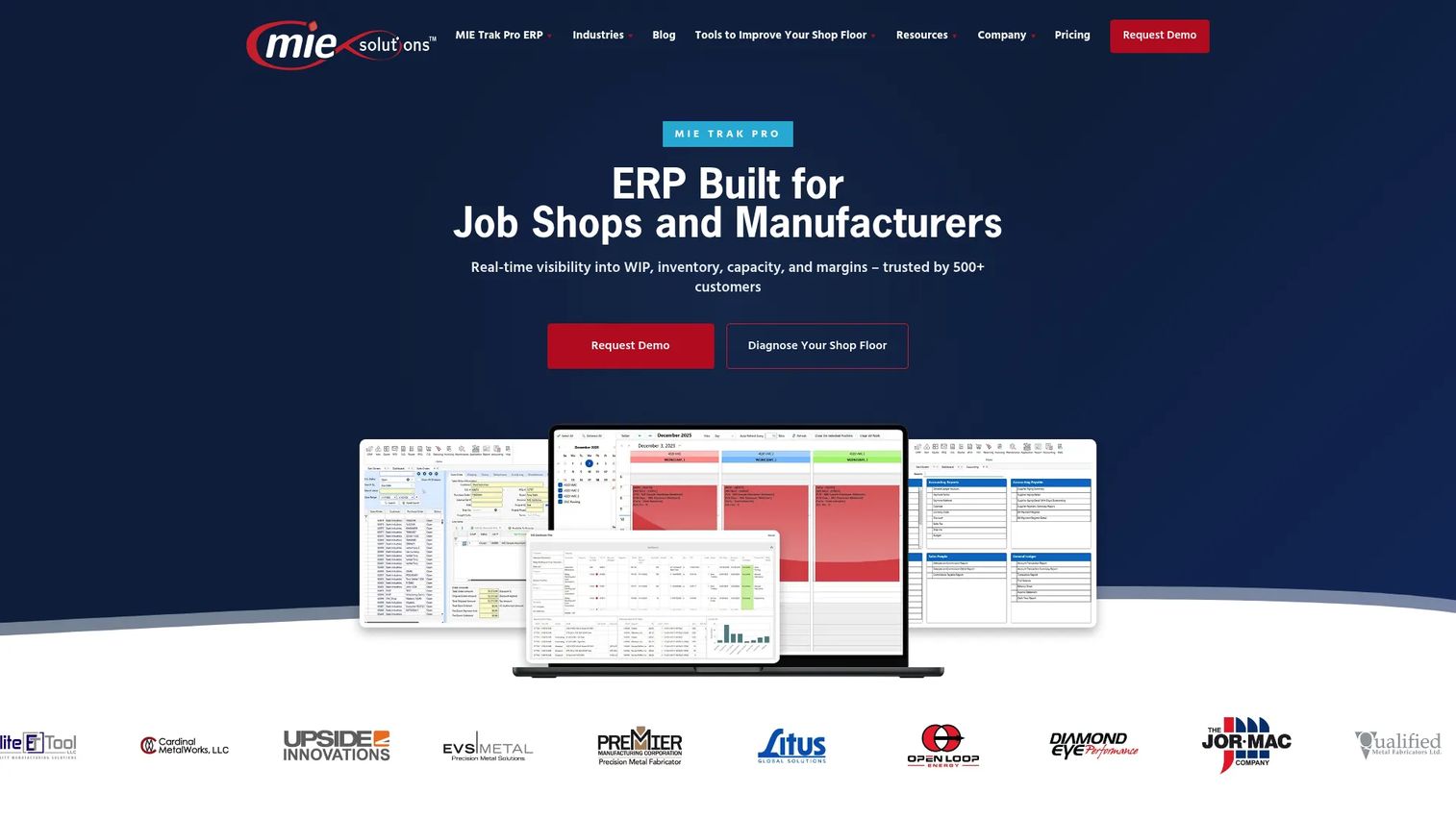
MIE Trak Pro is a manufacturing ERP built for job shops and discrete manufacturers that need broad operational control in one system. It connects quoting, scheduling, inventory, and shop-floor tracking so the numbers stop living in five disconnected places. Its reputation rests on configurability: shops can adapt the system to their routing, work centers, and reporting rather than bending their process to fit the software.
Best for: Discrete manufacturers needing an integrated ERP for quoting, scheduling, inventory, and shop-floor control.
Key strengths
- Real-time job tracking: See labor, material, and status by job as work moves across the floor.
- Quoting and scheduling: Build margin-aware estimates and schedule against real work-center capacity.
- Inventory control: Manage stock, BOMs, and purchasing inside the same system that runs production.
Why choose MIE Trak Pro: If your shop has outgrown spreadsheets and needs one system to run quoting, scheduling, financials, and job costing together, MIE Trak Pro is the depth benchmark. It rewards shops willing to invest in configuration, because that configurability is exactly what lets it fit varied fabrication workflows.
MIE Trak Pro pricing: MIE lists three plans (Essential, Plus, Enterprise), all on flat-rate billing shown as "Contact Vendor for Pricing." No public numeric price is published, so plan on a discovery call to scope your license.
2. Fulcrum
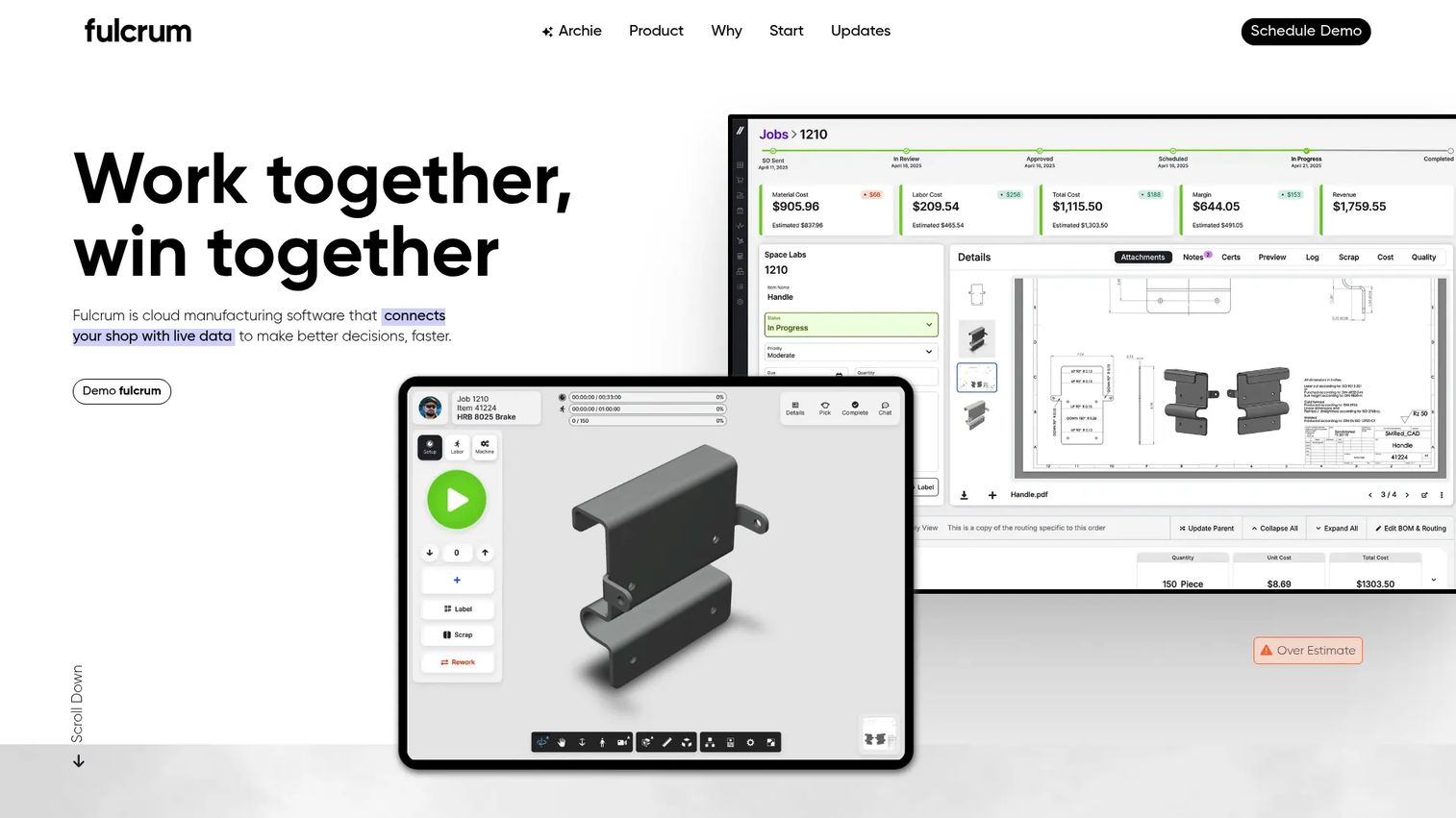
Fulcrum is cloud manufacturing software focused on shop-floor execution and operational control. It captures labor and material live as jobs run, then feeds that data into autoscheduling, job costing, and reporting. For fabrication teams that want tight visibility into what is happening on the floor right now, Fulcrum leans into execution rather than back-office breadth alone.
Best for: Manufacturers needing an integrated cloud system for shop-floor execution and control.
Key strengths
- Live labor and material capture: Track actuals as work happens, not after the fact.
- Autoscheduling and job costing: Schedule automatically and see true cost per job.
- Quality, BOM, routing, and inventory: Run production control and live reports in one place.
Why choose Fulcrum: Fulcrum fits shops that treat shop-floor visibility as the core problem. Where broader ERPs spread across finance and CRM, Fulcrum concentrates on production planning, scheduling, and live reporting, which suits teams that want operational control first and are comfortable in a cloud-native tool.
Fulcrum pricing: As listed on G2, Fulcrum offers Professional at $43/user/month and Elite at $55/user/month, with Enterprise on a contact-us basis. No free tier is listed.
3. JobBOSS²
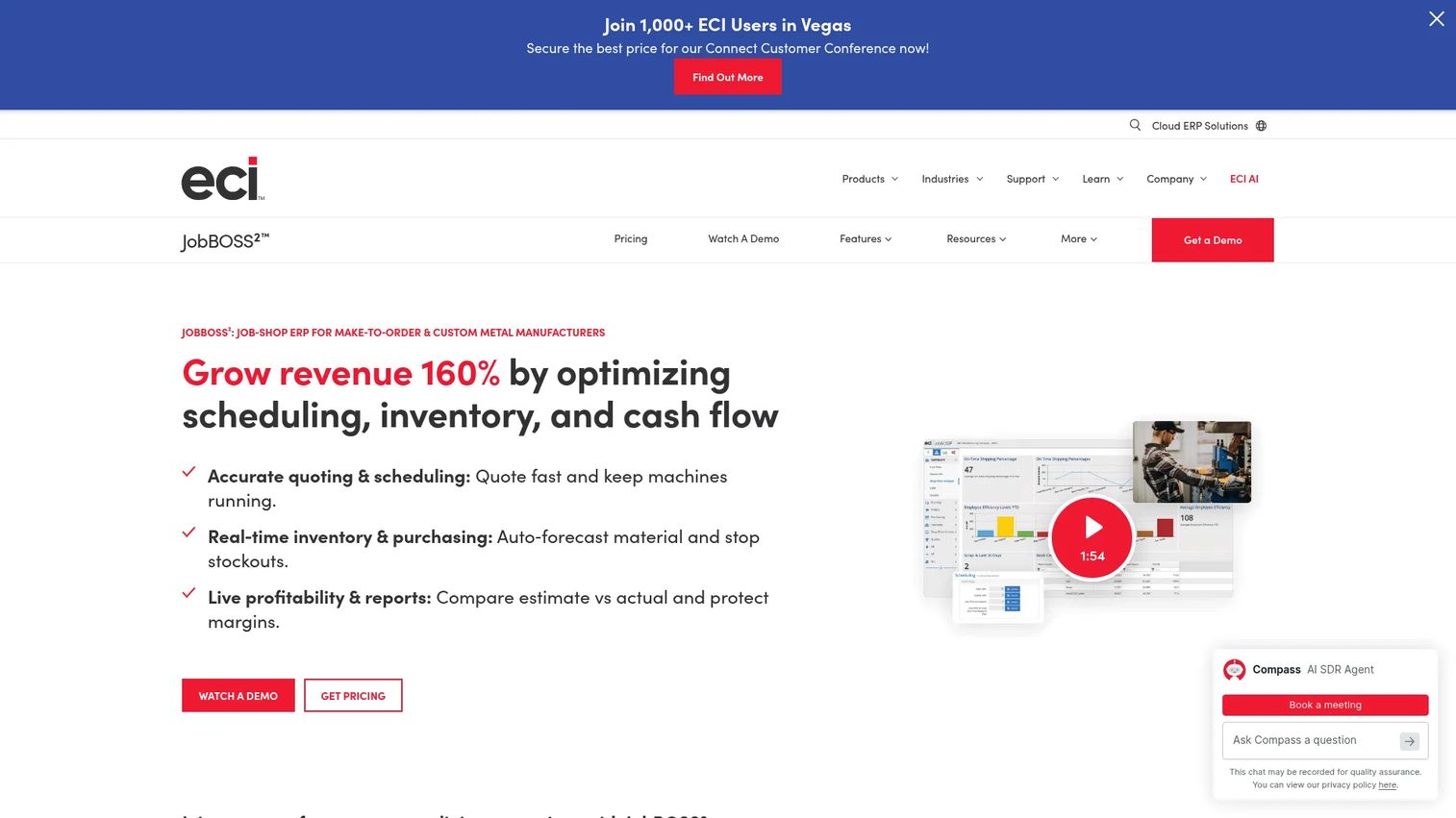
JobBOSS² is a job-shop ERP built for make-to-order and custom manufacturing. It covers the full quote-to-cash flow: estimating, job costing, purchasing, inventory, and scheduling. For small to mid-sized shops running repeatable custom work, it structures the operational backbone without demanding enterprise-scale overhead.
Best for: Job shops and make-to-order manufacturers needing ERP for quoting, scheduling, and inventory control.
Key strengths
- Quoting and estimating: Turn custom specs into consistent, costed quotes.
- Job costing and accounting: Track cost against estimate and keep financials aligned.
- Inventory, purchasing, and scheduling: Manage materials and shop capacity in one flow.
Why choose JobBOSS²: JobBOSS² fits shops whose bread and butter is custom, made-to-order work with frequent quoting. If your workflow revolves around turning drawings into jobs and tracking them to shipment, the quote-to-cash orientation maps directly to how you operate.
JobBOSS² pricing: Pricing is tailored to the scale and functionality you need. The vendor directs buyers to request a quote rather than publishing plan prices, so scope your requirements before the call.
4. NetSuite
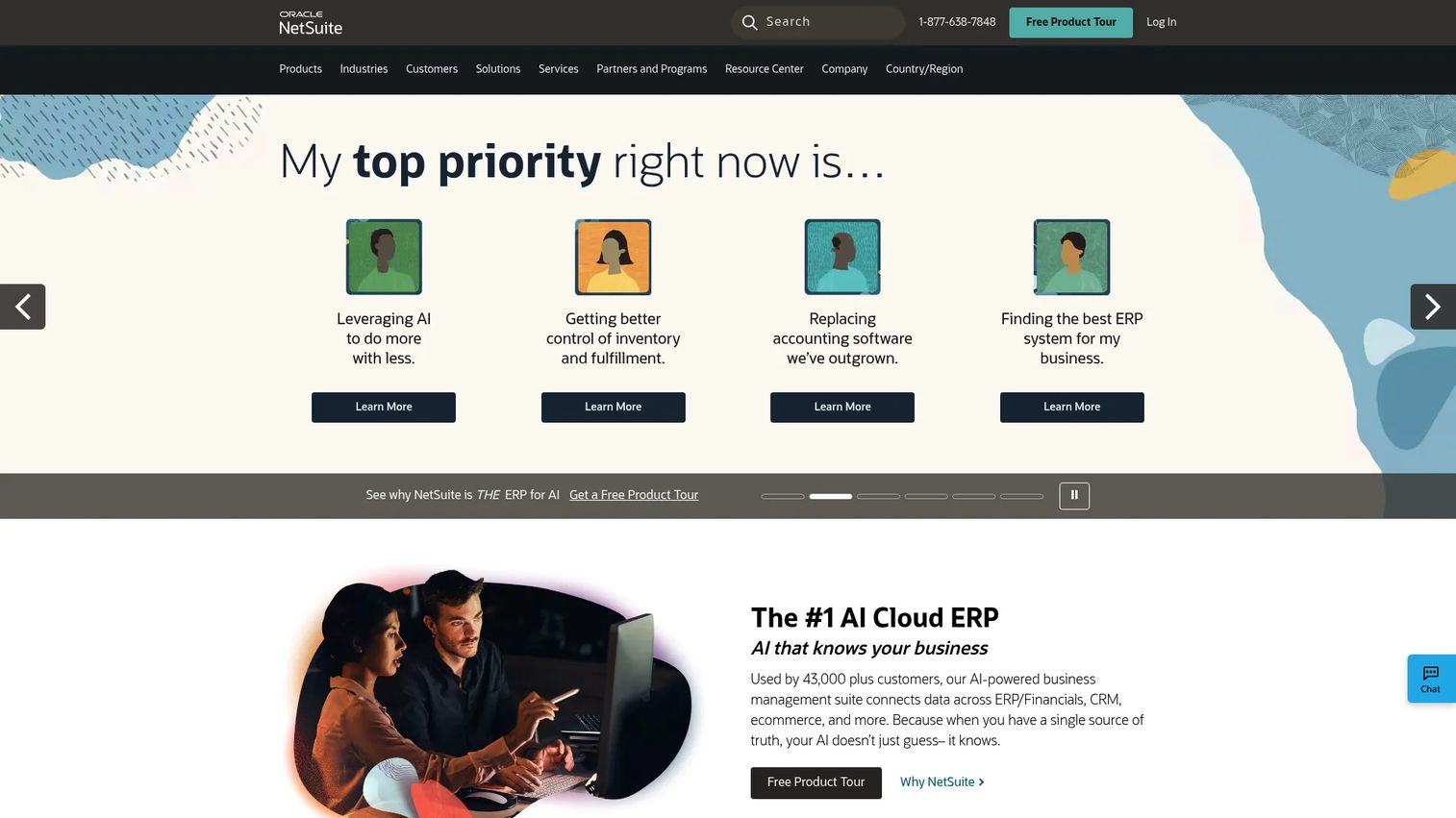
NetSuite is Oracle's cloud ERP and business management suite spanning finance, operations, CRM, and ecommerce. For fabrication teams, its value is breadth: a single system of record when the business complexity extends well beyond the shop floor into multi-entity finance, distribution, or online sales.
Best for: Mid-market to enterprise companies needing an integrated ERP, CRM, and ecommerce suite.
Key strengths
- Cloud ERP and financial management: Run finance and operations on one platform.
- CRM and ecommerce integration: Connect sales, service, and online channels.
- Subscription billing and revenue management: Handle complex revenue models cleanly.
Why choose NetSuite: NetSuite works best when a fabrication team is part of a larger, more complex business. If you need deep financial control and extensibility more than shop-specific fabrication features out of the box, NetSuite gives you a platform to build on, typically with implementation partners handling the manufacturing configuration.
NetSuite pricing: No public numeric pricing is published. NetSuite uses a request-a-quote model, with cost driven by modules, users, and implementation scope.
5. Odoo
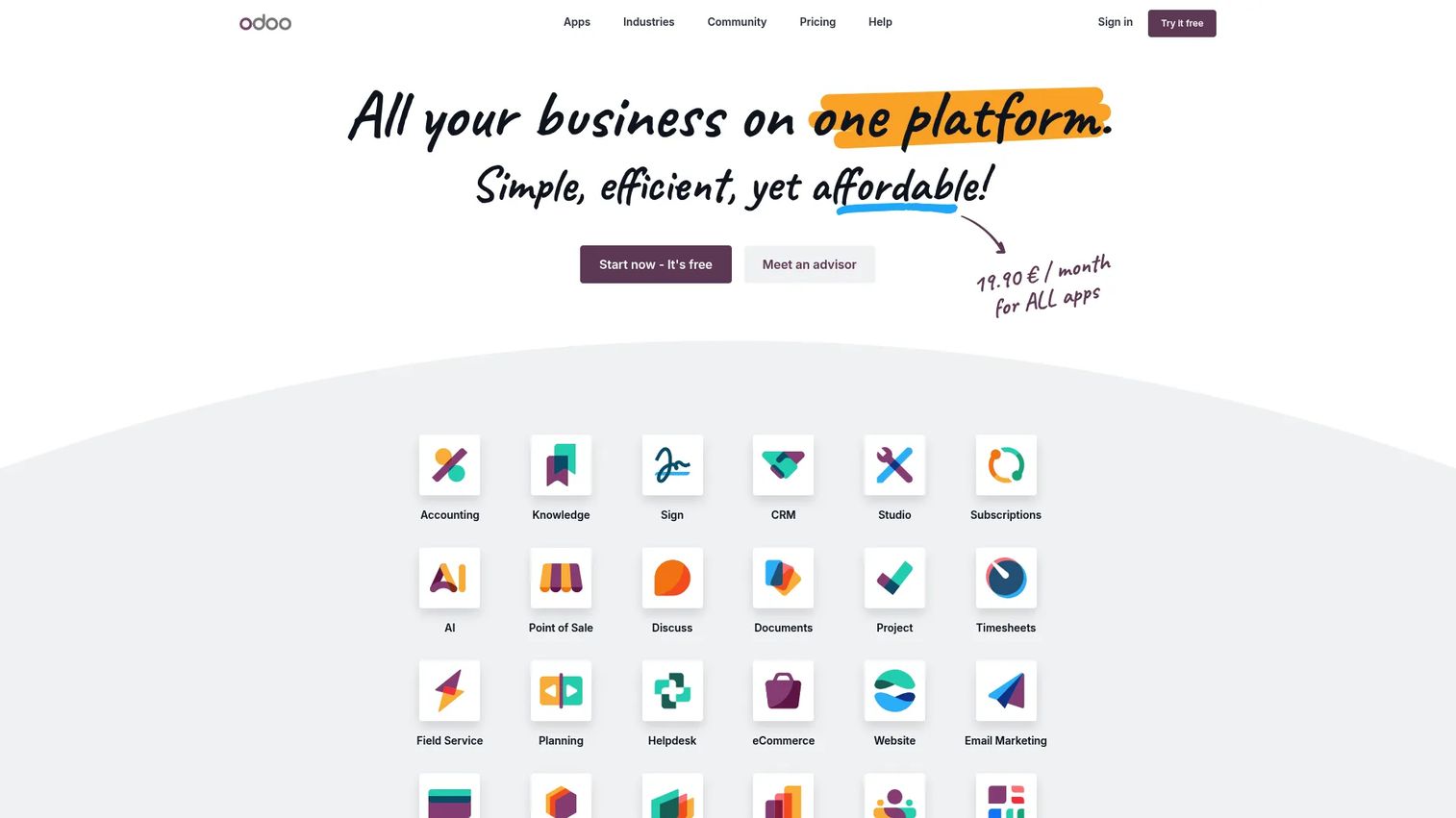
Odoo is an all-in-one suite of open-source business apps covering CRM, ecommerce, inventory, manufacturing, and more. Its appeal for fabrication is modularity: you assemble a stack around your workflow rather than buying a monolith. That flexibility is powerful for teams with the discipline to configure it well.
Best for: Businesses that want a single integrated ERP/CRM platform with modular apps.
Key strengths
- Modular apps: Add manufacturing, inventory, and CRM as your needs grow.
- Inventory management: Track stock and BOMs alongside the rest of operations.
- Configurable platform: Shape the system around fabrication-specific workflows.
Why choose Odoo: Odoo suits teams that want to configure their own stack and have the internal systems expertise to do it. The tradeoff between flexibility and implementation discipline is real: the more you customize, the more you own the maintenance. Done well, it becomes a tailored fit at a lower license cost than many closed ERPs.
Odoo pricing: One App Free covers a single app with unlimited users. Standard is $24.90/user/month and Custom is $49.00/user/month, the latter adding Odoo Studio, multi-company, and API access. A free tier is available.
6. MRPeasy
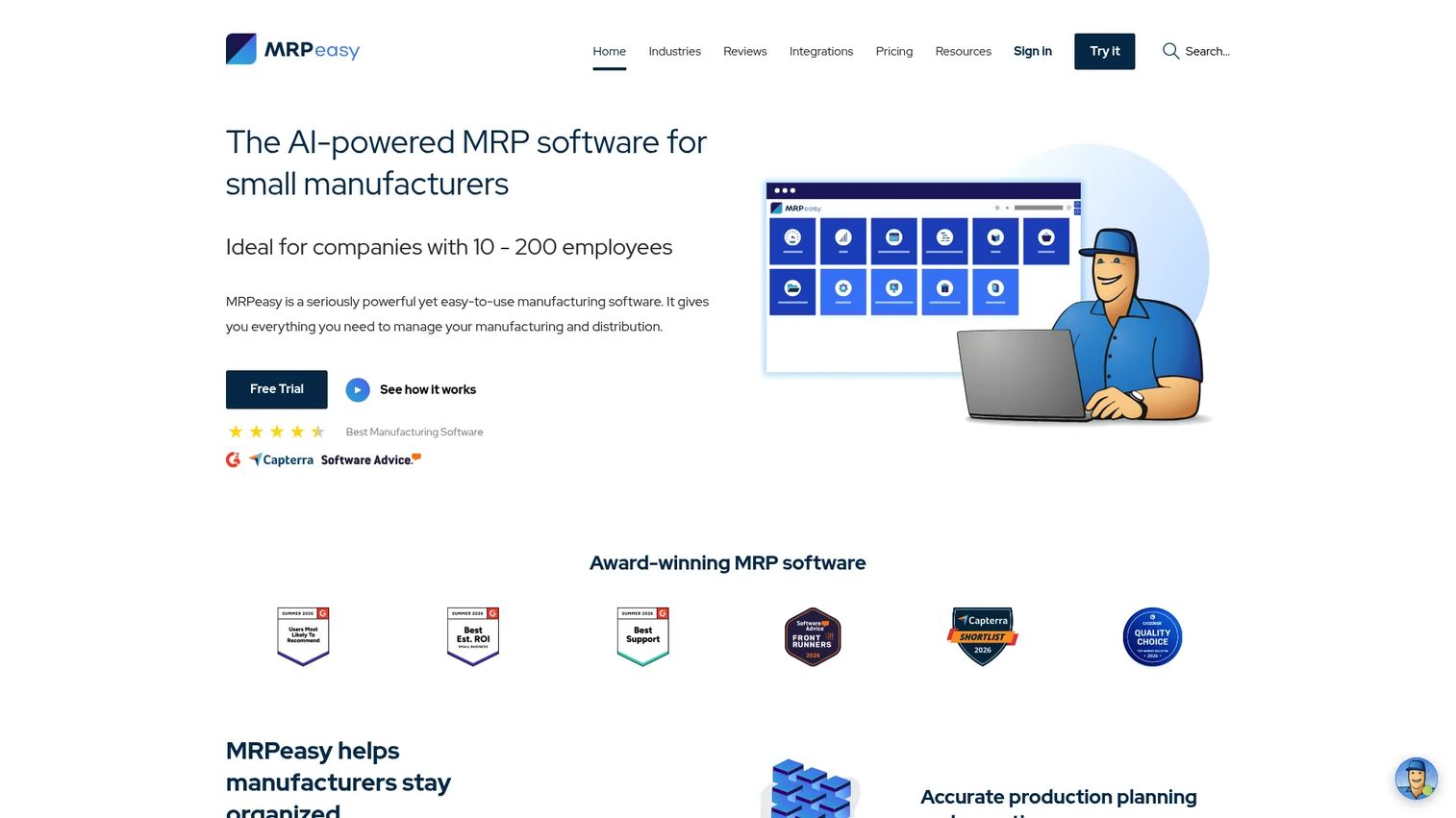
MRPeasy is cloud-based manufacturing ERP/MRP software built for small and medium manufacturers and distributors. It focuses on approachable planning: production scheduling, BOM management, and inventory in a system that a small shop can adopt without a long implementation runway.
Best for: Small to mid-sized manufacturers needing an all-in-one MRP/ERP system.
Key strengths
- Production planning and reporting: Schedule production and report on progress clearly.
- BOM management: Build and maintain multi-level bills of materials.
- Inventory and warehouse management: Track stock across locations in real time.
Why choose MRPeasy: MRPeasy is a strong cloud-first pick for smaller shops that want structured MRP without enterprise complexity. If you are moving off spreadsheets and want planning, inventory, and production tracking in one accessible tool, it lowers the barrier to getting organized.
MRPeasy pricing: Per-user monthly plans run Starter at $49, Professional at $69, Enterprise at $99, and Unlimited at $149. A free trial is available and annual billing is offered.
7. Fishbowl
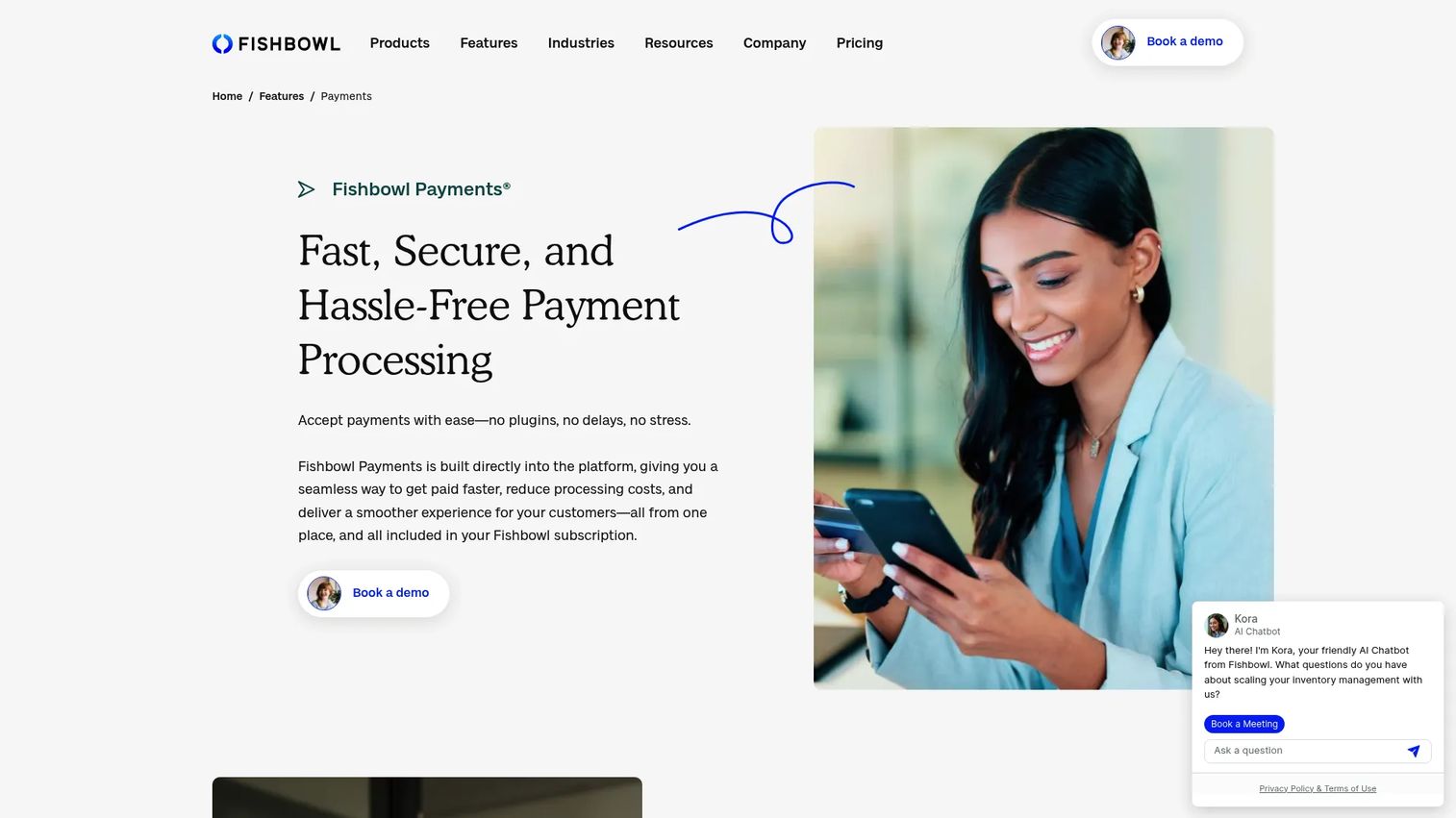
Fishbowl is inventory, warehouse, and manufacturing software for small to midsize businesses. Its center of gravity is stock accuracy: real-time inventory, multi-location tracking, and barcode scanning, with tight sync to accounting tools. For shops where purchasing and stock control drive the operation, that focus pays off.
Best for: Manufacturers and distributors needing inventory, warehouse, and accounting sync in one system.
Key strengths
- Real-time inventory tracking: Keep stock counts accurate across the operation.
- Barcode scanning and multi-location: Manage warehouses and locations precisely.
- Accounting integration: Sync with QuickBooks and Xero to keep books current.
Why choose Fishbowl: Fishbowl fits fabrication shops where inventory accuracy and purchasing discipline matter most. If material tracking and stock control are your pain, and you already run QuickBooks or Xero, Fishbowl slots into that stack rather than replacing your financials.
Fishbowl pricing: Cloud plans start at Essentials $229/month, Growth $429/month, and Scale $729/month, all billed annually. Fishbowl Advanced adds Advanced Warehouse ($595/month) and Advanced Manufacturing ($675/month), priced by users and deployment.
8. Acumatica Cloud ERP
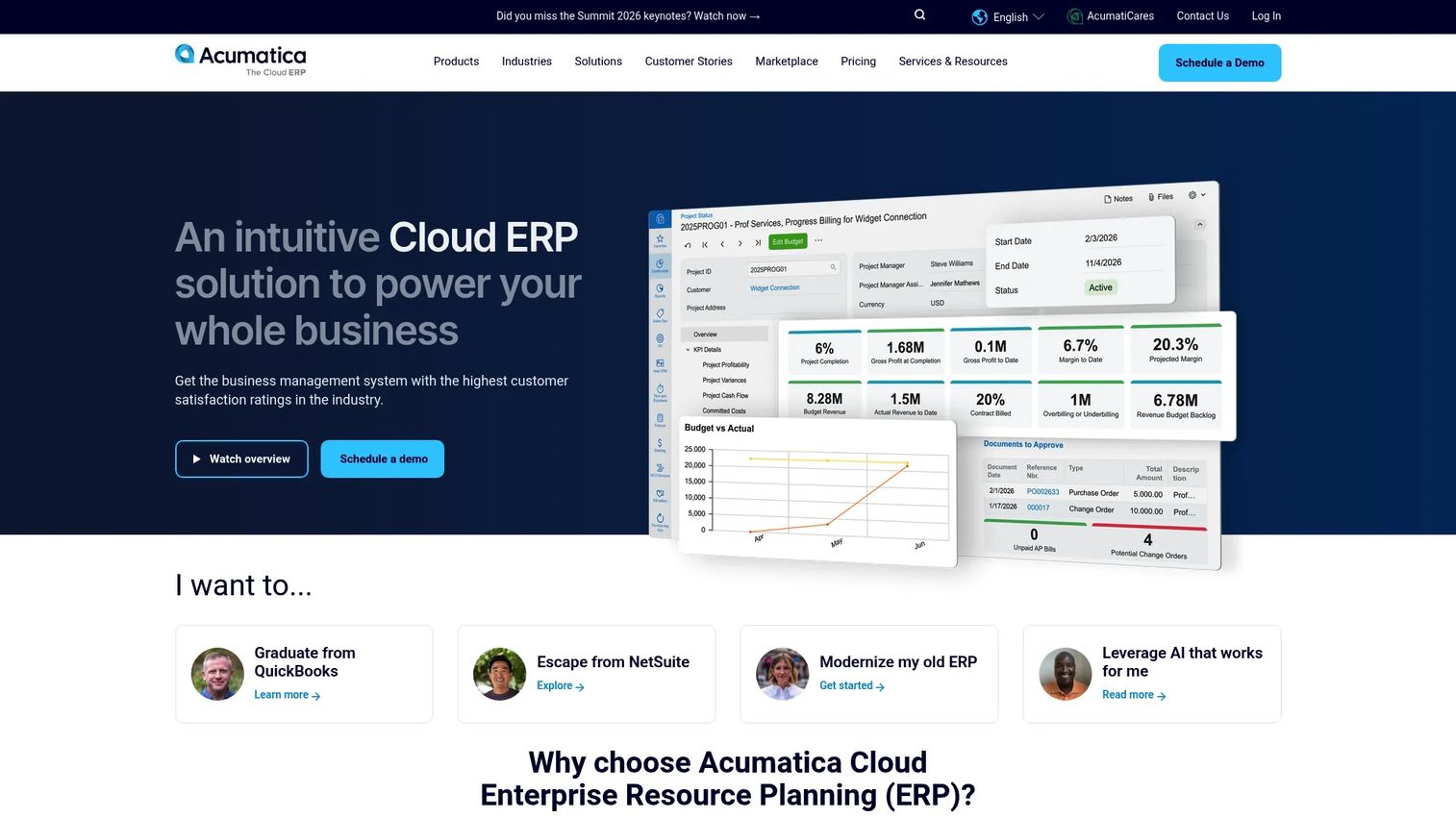
Acumatica Cloud ERP is a cloud ERP for mid-sized companies, notable for consumption-based licensing with unlimited users. For growing fabrication teams, that model matters: you scale seats without per-user fees, and the low-code platform lets you extend the system as operations mature.
Best for: Mid-market businesses needing a customizable cloud ERP with unlimited users.
Key strengths
- Unlimited-user licensing: Pay by consumption, not per seat.
- Low-code/no-code customization: Extend the platform without heavy development.
- Industry-specific editions: Use manufacturing and distribution modules tuned to the work.
Why choose Acumatica Cloud ERP: Acumatica suits cloud-first teams that expect to grow headcount and want finance, operations, and visibility in one scalable platform. The unlimited-user model removes a common cost ceiling for expanding shops, which is why growth-stage fabricators shortlist it.
Acumatica pricing: General pricing is tailored by applications, usage, and deployment. Publicly listed packaged offers include APEX for distribution at USD 1,495/month and APEX for manufacturing at USD 2,185/month.
9. SYSPRO
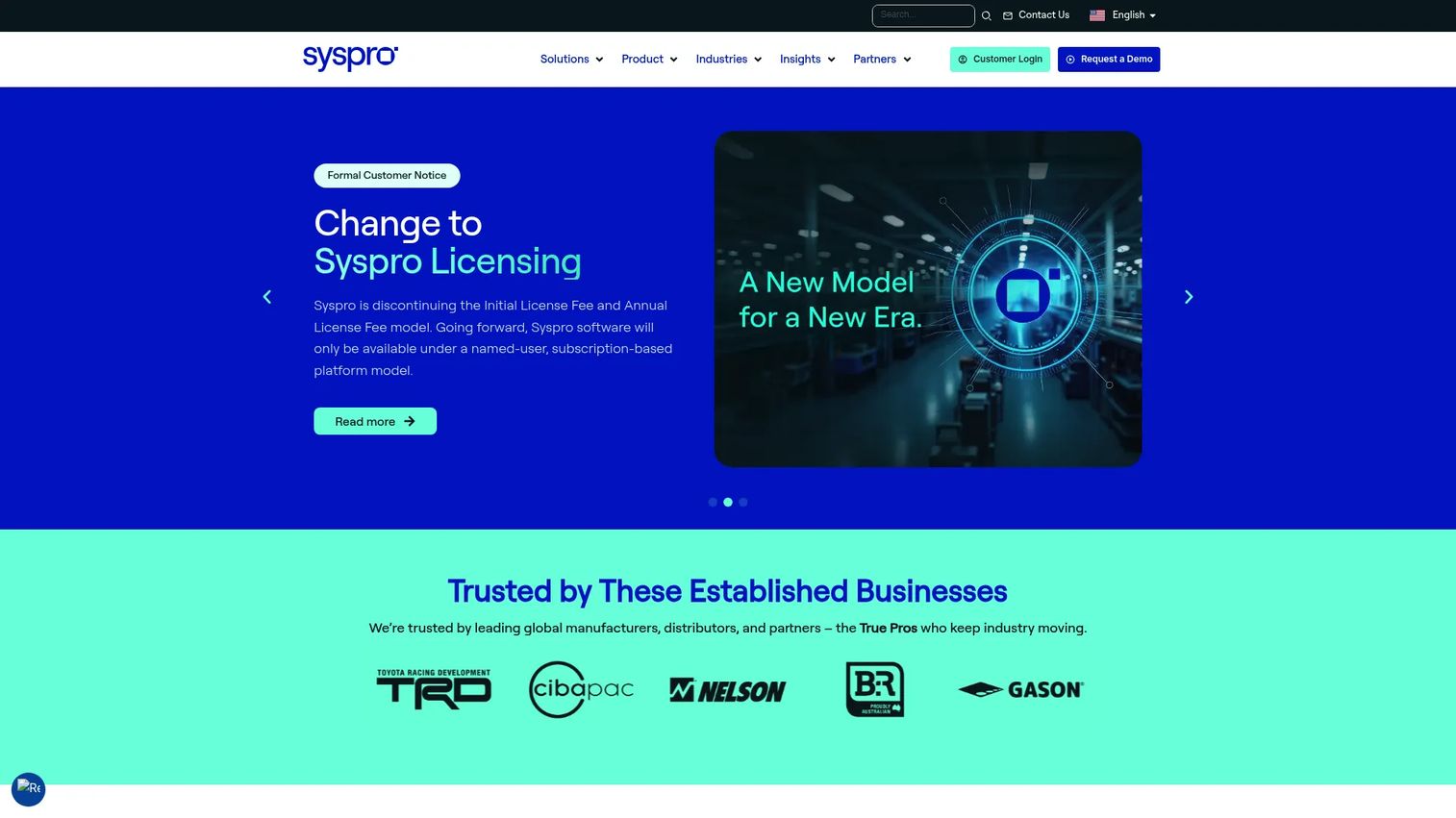
SYSPRO is industry-specific ERP software for manufacturers and distributors, with real depth in production planning and process control. For established fabrication operations that need structured traceability and quality control alongside strong reporting, SYSPRO brings manufacturing maturity.
Best for: Mid-sized manufacturers and distributors needing an industry-focused ERP.
Key strengths
- Manufacturing and distribution ERP: Purpose-built for production-heavy businesses.
- Business intelligence and dashboards: Get real-time operational insight.
- Product configurator and CRM: Handle configurable products and customer data in one system.
Why choose SYSPRO: SYSPRO fits shops that have moved past basic job tracking and need production planning, traceability, and operational structure at scale. If your customers or industry demand documented process control, SYSPRO's manufacturing depth carries that weight.
SYSPRO pricing: SYSPRO has moved to a named-user, subscription-based model and discontinued its prior license-fee structure. No public numeric price is shown, so pricing comes through sales.
10. ERPAG
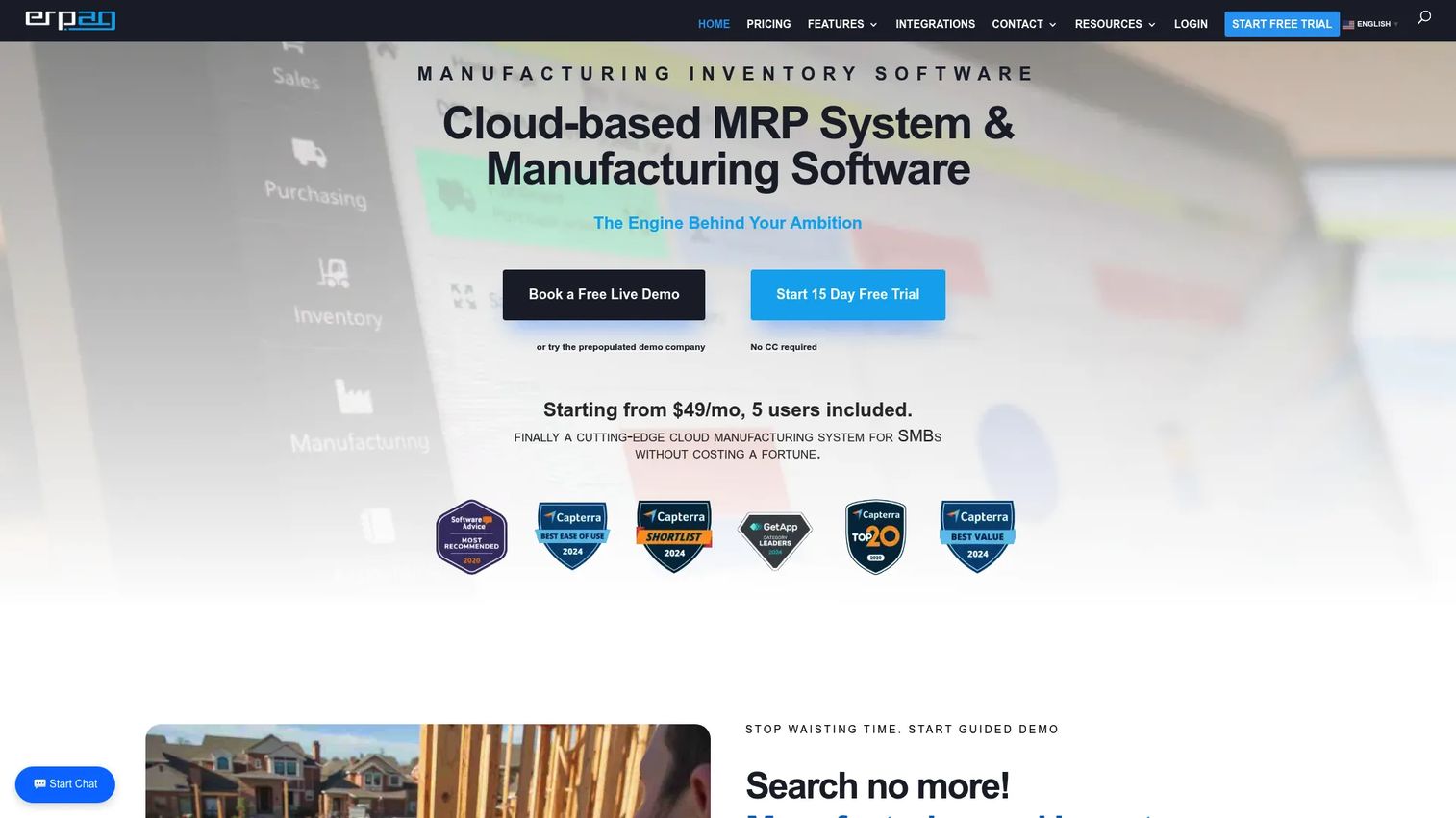
ERPAG is cloud-based ERP software for small and midsize businesses, covering inventory, manufacturing, and sales in an accessible package. For cost-sensitive shops that still want work-order tracking and core shop control, ERPAG offers ERP structure without the weight of enterprise systems.
Best for: Small or midsize businesses needing ERP with inventory and manufacturing workflows.
Key strengths
- Inventory management: Track stock and movement across the business.
- Manufacturing management: Run work orders and production tracking.
- Sales and CRM: Connect orders and customer data to production.
Why choose ERPAG: ERPAG is a practical choice for smaller or budget-conscious teams that need real ERP structure fast. If you want inventory, work orders, and core shop tracking without a long rollout, its accessibility is the draw.
ERPAG pricing: The public pricing page lists an Advanced plan at $199/month, with a promotional $49 for the first three months and a 15-day free trial.
11. Genius ERP
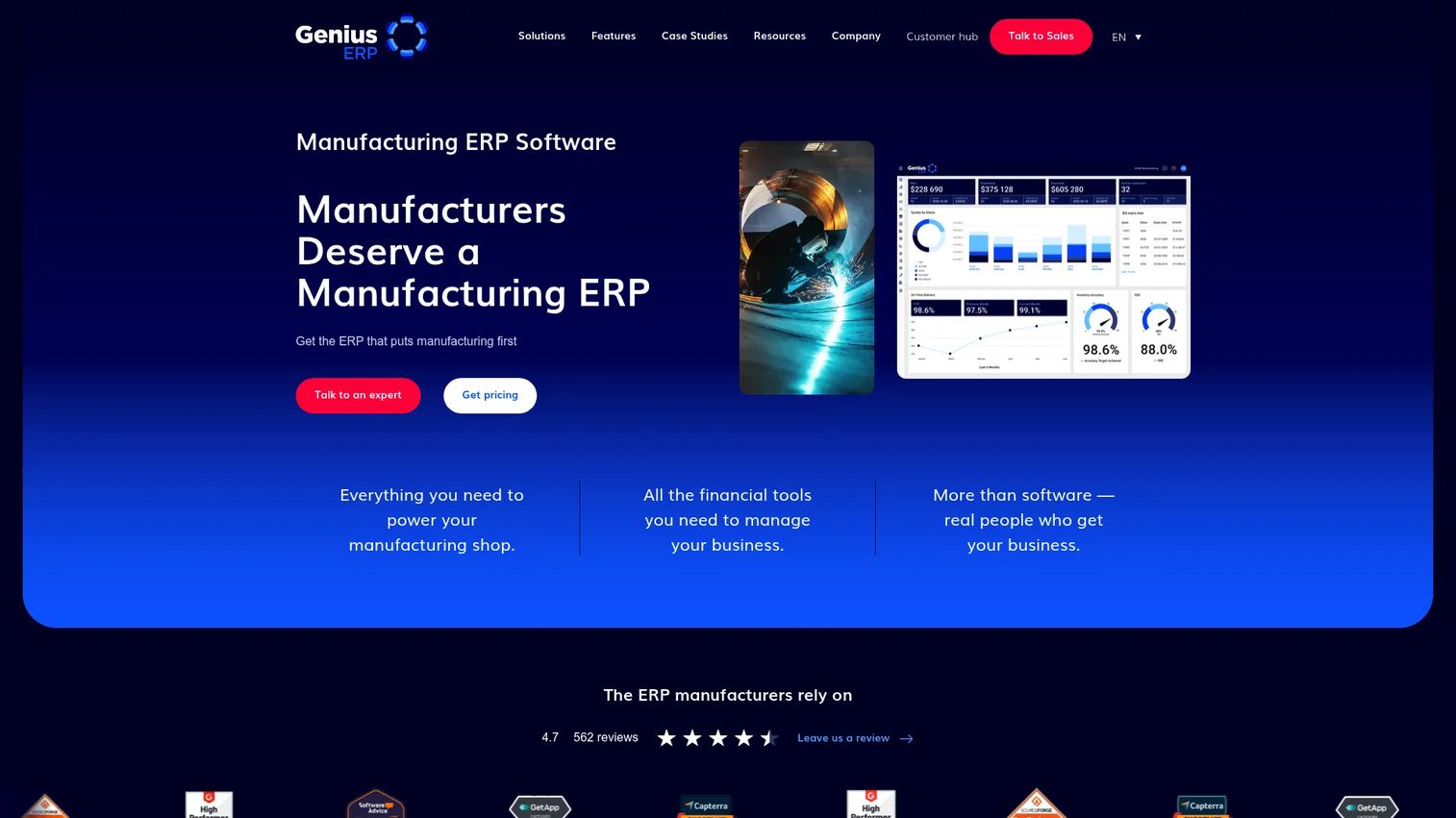
Genius ERP is manufacturing ERP software built specifically for custom manufacturers. It centers on the design-to-production flow with CAD2BOM, plus quoting, estimating, and inventory in one integrated system. For fabrication teams whose work starts with engineering, that CAD-connected workflow is the differentiator.
Best for: Custom manufacturers needing an ERP built around quoting, production, and inventory.
Key strengths
- CAD2BOM: Turn design data into bills of materials directly.
- Quoting and estimating: Build accurate quotes for custom, engineered work.
- Inventory management: Track materials against production requirements.
Why choose Genius ERP: Genius ERP fits custom and engineer-to-order manufacturers where CAD/CAM integration and BOM accuracy drive everything downstream. If your jobs begin as models and drawings, its CAD2BOM approach reduces the re-keying that erodes accuracy between engineering and the floor.
Genius ERP pricing: Pricing is customized and requires a discovery call. No public numeric price or tier table is displayed.
12. Statii
Statii is a practical shop management system for job shops and custom manufacturing, built around simplicity. It supports quoting, order control, and scheduling in a straightforward interface that small shops can actually adopt and use daily, rather than fighting an overbuilt system.
Best for: Small job shops and custom manufacturers wanting simple, usable order and production control.
Key strengths
- Quoting and order control: Move from estimate to order without friction.
- Scheduling: Plan work across the shop with a clear view of what is due.
- Operational simplicity: Keep the system usable for teams without dedicated IT.
Why choose Statii: Statii fits shops that value simplicity and daily usability over exhaustive feature depth. If your team will only adopt a system that stays out of the way, its focused, operational design is a strong match for smaller custom manufacturers.
Statii pricing: Public numeric pricing is not published on a standard plan table; contact the vendor to scope pricing for your team size and needs.
13. Katana Cloud Inventory
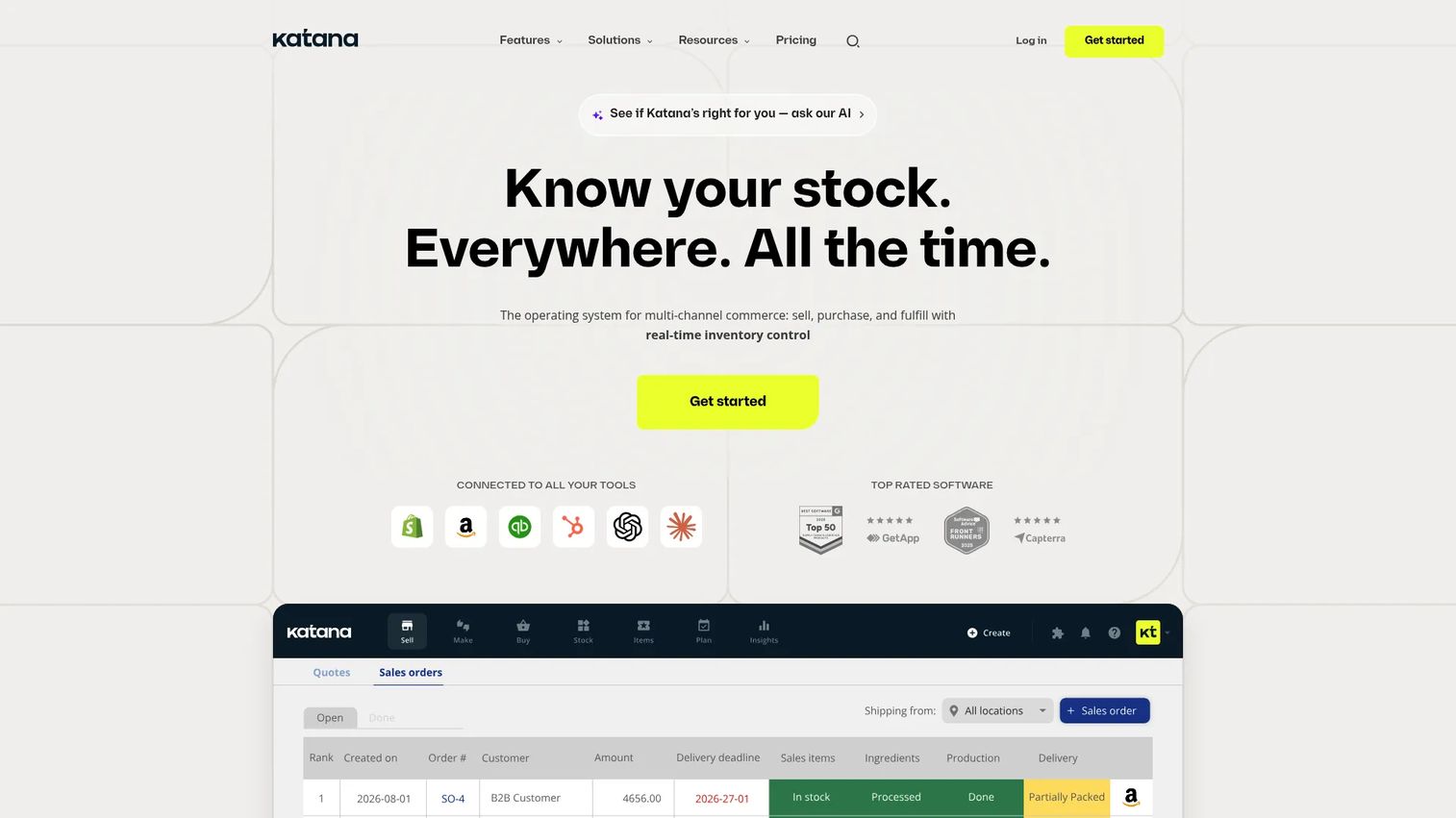
Katana Cloud Inventory is cloud inventory and manufacturing software for SMBs, strong on real-time inventory and production coordination. It fits smaller fabricators who want live visibility into stock and production without standing up a heavy ERP, and it connects to the ecommerce and accounting tools many small manufacturers already run.
Best for: Small to mid-sized manufacturers and multichannel businesses needing inventory and production control.
Key strengths
- Real-time inventory visibility: See stock and availability as it changes.
- Batch/lot and serial tracking: Support traceability for regulated or serialized work.
- Ecommerce and accounting integrations: Connect Katana to the tools you already use.
Why choose Katana Cloud Inventory: Katana works best for smaller fabricators and mixed manufacturing operations that prioritize inventory and production coordination over deep fabrication-specific complexity. If your operation blends manufacturing with multichannel sales, its integration-friendly design fits that reality.
Katana pricing: Plans start at Starter $179/month, Standard $359/month, Professional $799/month, and Professional Plus $1,799/month, all billed annually. Each plan includes unlimited users, SKUs, and integrations.
14. Global Shop Solutions
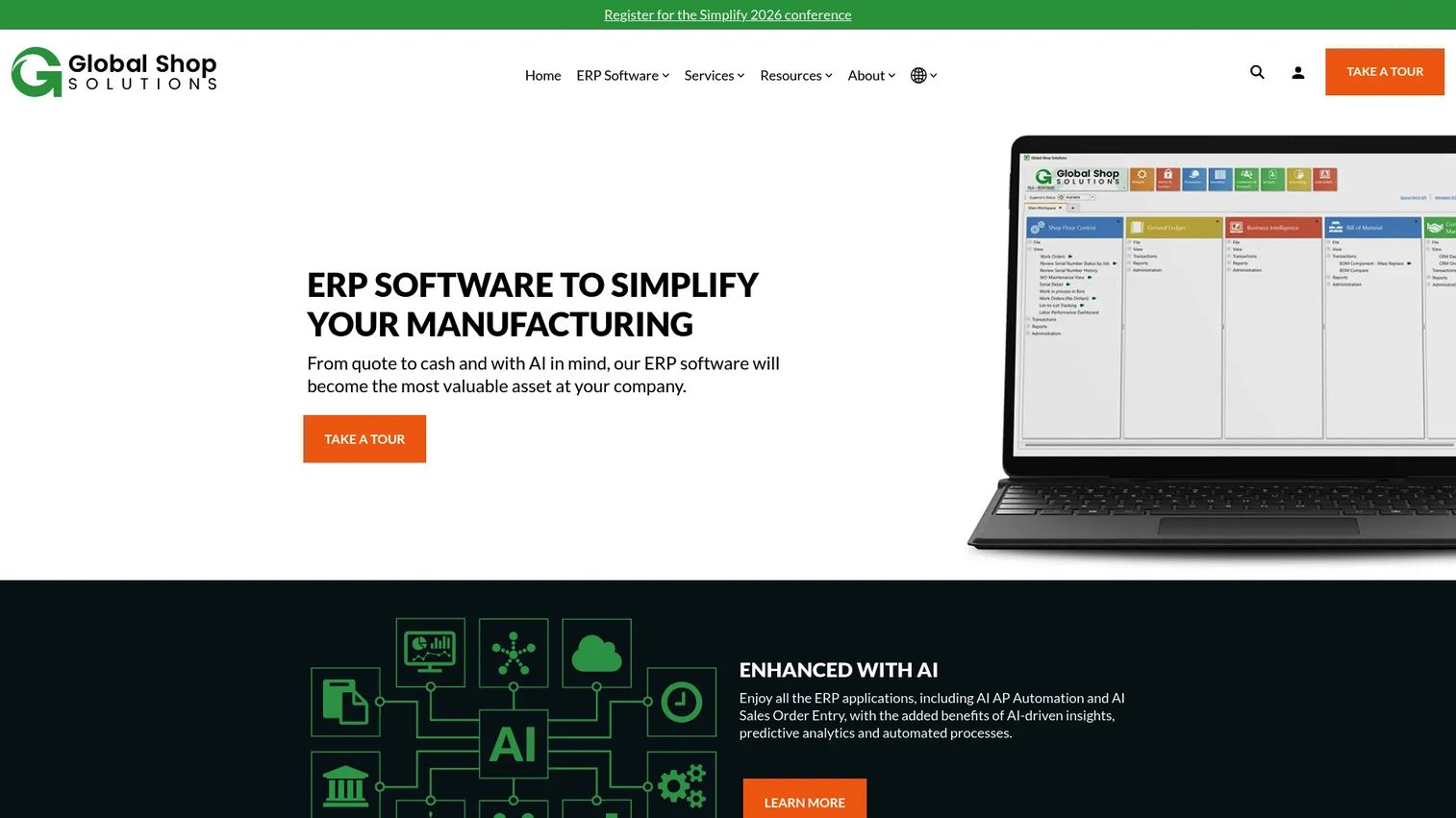
Global Shop Solutions is a comprehensive manufacturing ERP covering the full quote-to-cash workflow across 35+ applications. For shops that want end-to-end control over production, finance, and shop-floor operations in one system, it delivers breadth, now with AI-assisted modules for AP automation and sales order entry.
Best for: Manufacturers that need an all-in-one ERP for production, finance, and shop-floor operations.
Key strengths
- 35+ applications, quote to cash: Cover the whole operation in one platform.
- AI-enhanced automation: Use AI AP automation and AI sales order entry.
- Shop-floor and scheduling modules: Run scheduling, data collection, and job tracking together.
Why choose Global Shop Solutions: Global Shop Solutions fits shops that want a single vendor for the entire operation, from scheduling and shop-floor data collection to accounting and purchasing. If consolidating many disconnected tools into one platform is the goal, its application breadth addresses that directly.
Global Shop Solutions pricing: Public pricing is not published. The vendor tailors plans per company, using a concurrent-user model with an upfront cost plus ongoing quarterly cost.
15. ProShop ERP
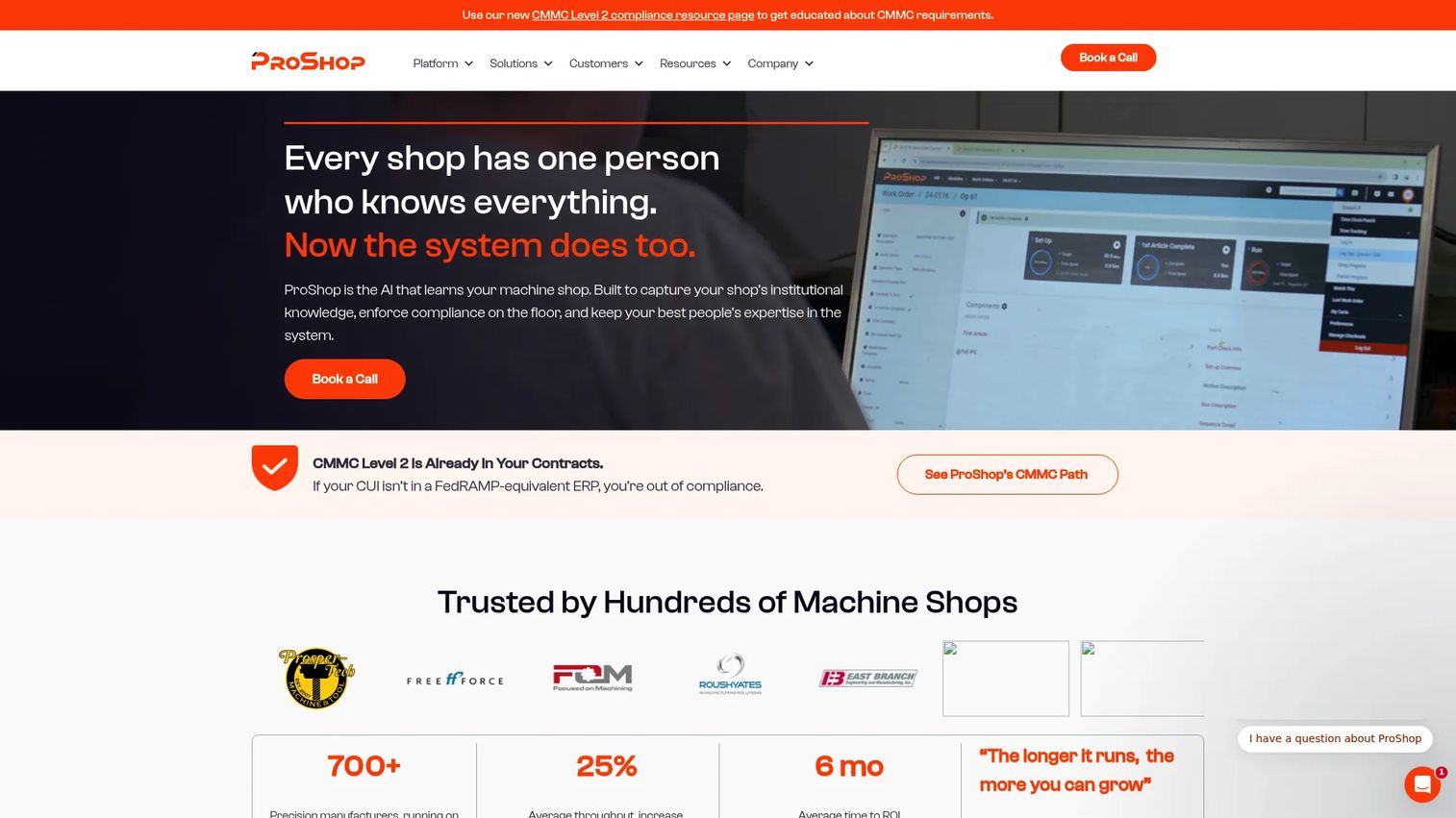
ProShop ERP is a manufacturing-first ERP for precision manufacturers and machine shops, built around quality and process discipline. It integrates ERP, QMS, and MES with a paperless workflow, which makes traceability and documentation core to how the system runs rather than bolt-on modules.
Best for: Precision manufacturers and machine shops needing integrated ERP/QMS/MES workflows.
Key strengths
- Estimating and quoting: Cost jobs accurately for precision work.
- Shop floor management and scheduling: Run and schedule production with paperless travelers.
- Quality systems and inspection: Manage QMS, inspection, and traceability in the workflow.
Why choose ProShop ERP: ProShop ERP fits shops where quality, standardization, and traceability drive the operation, especially those pursuing or holding certifications. If documented process control and audit readiness are non-negotiable, its integrated QMS and MES approach is purpose-built for that discipline.
ProShop ERP pricing: Pricing is based on total users and is not publicly disclosed. Contact the vendor to scope a plan for your shop.
16. EZIIL
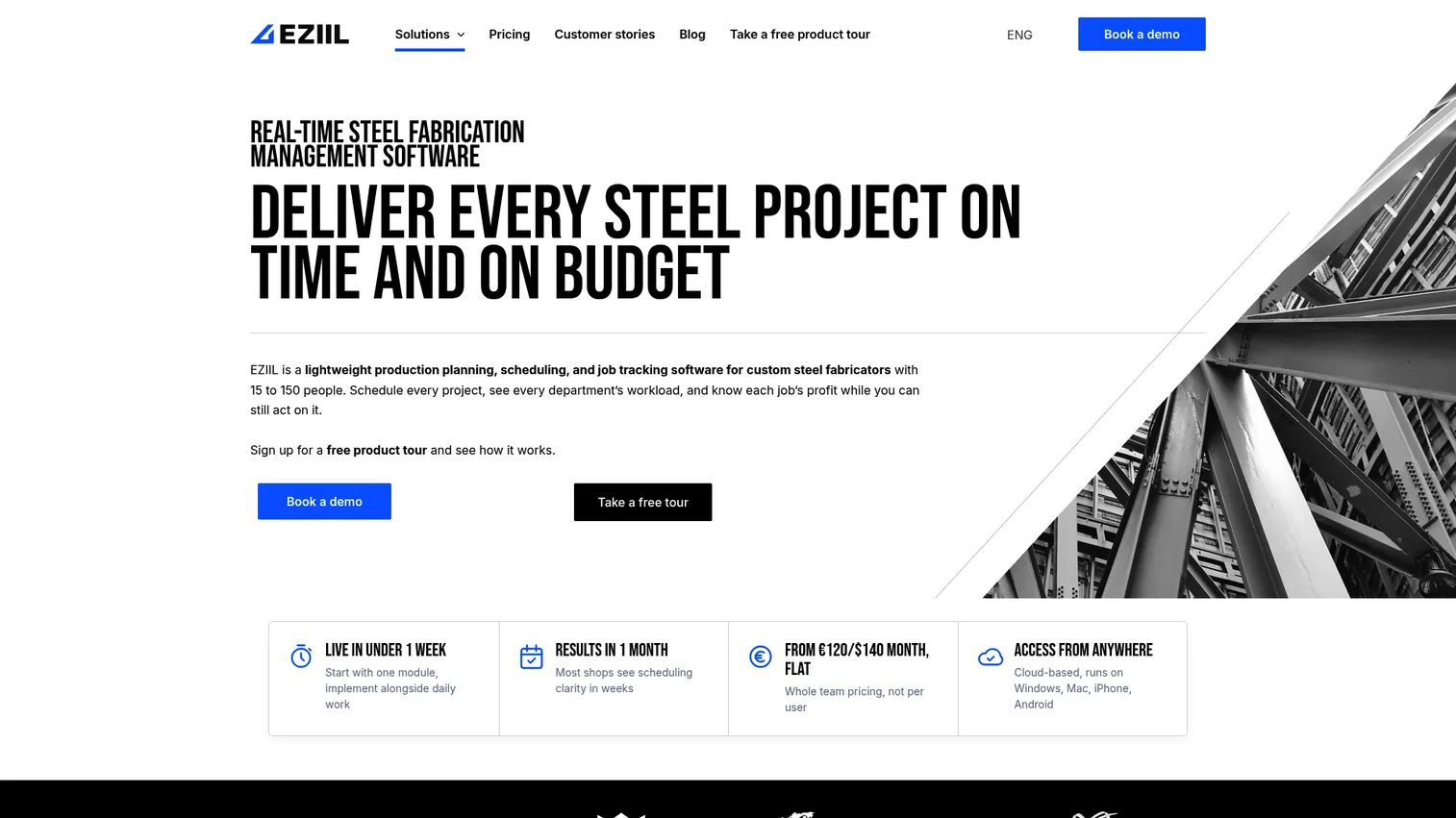
EZIIL is cloud-first steel fabrication production management software built for custom steel shops. It emphasizes workflow clarity and deployment simplicity: a real-time production dashboard, visual scheduling, and mobile shop-floor reporting, with traceability geared to steel fabrication compliance.
Best for: Small to mid-sized custom steel fabricators needing production planning, shop-floor reporting, and profitability tracking.
Key strengths
- Visual scheduling and capacity planning: Plan the shop with a clear, drag-friendly view.
- Mobile shop-floor reporting: Capture progress from the floor in real time.
- Profitability and compliance tracking: Track plan-vs-actual and EN 1090 EX2/3 traceability.
Why choose EZIIL: EZIIL is a strong steel fabrication management software pick for shops that want fast deployment and clear shop-floor visibility without heavy on-prem infrastructure. If structural steel work, capacity planning, and job profitability are your focus, its cloud-first design and steel-specific traceability fit directly.
EZIIL pricing: Starter plans scale by team size: €120/month for 1–15 users, €180/month for 16–50 users, and €290/month for 51–150 users. All plans include every Starter feature; add-on modules are priced separately.
Considerations before you buy
Feature lists rarely tell you whether a system will actually run your shop. Work through these criteria against your real workflow before committing.
Deployment model
Cloud vs on-prem is the first fork. Cloud tools reduce maintenance, offer access from anywhere, and push updates automatically, which suits shops without dedicated IT. On-prem makes sense when data control or infrastructure policy drives the decision. Whichever way you lean, verify uptime commitments, support responsiveness, backup practices, and who owns your data.
CAD/CAM integration
If design flows into production, confirm exactly how. Some platforms handle native CAD/CAM or CAD2BOM; others rely on integrations with the tools you already run. Ask whether flat patterns, nesting, and revision control survive the handoff, because a broken handoff means re-keying and version errors on the floor.
Quoting, scheduling, and traceability
These are the three operational muscles most buyers care about. Validate that the software handles your actual job mix: custom, high-revision work stresses systems differently than standard repeat runs. Traceability and quality control should map to your certification or customer requirements, not just exist as a checkbox.
Implementation and adoption
The best system fails if the shop will not use it. Weigh change management, training, and data migration honestly. Ask how long a comparable shop took to go live, and whether your team can run a real job from quote to shipment in the system without workarounds.
Total cost of ownership
Compare subscription, implementation, training, and customization over 12 to 24 months, not just the sticker price. Cheap software can be expensive to run if it needs heavy configuration or ongoing consulting. Modular vs monolithic matters here too: modular stacks add flexibility but shift maintenance ownership to you.
Conclusion
The right choice depends on your workflow complexity, not the feature count. Large, discrete manufacturers that need deep operational control gravitate to MIE Trak Pro, SYSPRO, or Global Shop Solutions. Smaller shops moving off spreadsheets do well with MRPeasy, ERPAG, or Statii. Cloud-first growing teams look at Acumatica Cloud ERP and Fulcrum. Steel fabricators find a natural fit in EZIIL, while inventory-led operations lean toward Fishbowl or Katana Cloud Inventory, and quality-driven precision shops toward ProShop ERP.
Do not shortlist on brand recognition. Pick two or three tools that match your shop type, then map each one against your four operational muscles: quoting, scheduling, inventory, and traceability. Run a real job through a trial or a scoped demo before you sign. The system that handles your messiest custom order from quote to shipment, without workarounds, is the one worth buying.
FAQs
Metal fabrication software is a category of shop management and manufacturing systems that connect quoting, planning, inventory, scheduling, job tracking, and traceability. It replaces disconnected spreadsheets and paper with one system so a shop can run production from estimate to shipment without manual reconciliation.
ERP runs business operations end to end: quoting, purchasing, financials, and job costing. MRP focuses on materials and production planning, deciding what to buy and when. MES governs shop-floor execution and reporting, tracking work orders, labor, and real-time production status. Many platforms combine two or all three layers.
It depends on complexity more than headcount. Even a small shop benefits once quoting, inventory, and scheduling become hard to manage by hand, especially with high-mix custom work and frequent revisions. Lightweight cloud tools like MRPeasy, ERPAG, or Statii let small shops get organized without an enterprise rollout.
Prioritize quoting, scheduling, job tracking, inventory, traceability, and CAD/CAM integration, in the order that maps to your biggest pain. Deployment model and integrations are second-order filters. If custom work drives your business, weight quoting accuracy and revision handling heavily.
Fabrication-specific systems usually reduce configuration work because the shop workflows are built in. Generic ERPs like NetSuite or Odoo can work well if you have internal systems expertise or implementation support to configure the manufacturing side. Match the choice to how much configuration your team can realistically own.
Cloud software wins on accessibility and maintenance: automatic updates, anywhere access, and no server upkeep, which suits shops without dedicated IT. On-prem makes sense mainly when data control policy or infrastructure requirements drive the decision. For most growing shops, cloud is the default starting point.
Look beyond the subscription. Add implementation, support, training, and customization, then compare total cost over 12 to 24 months. A low monthly price can hide high setup and consulting costs, while a higher subscription may include implementation that keeps total ownership predictable.
Ask to see the quoting flow, how the system handles change orders, work order visibility, and barcode or shop-floor tracking. Then push further: ask how quickly the system moves a real job from quote to shipment, and request to run one of your own typical orders through it before you commit.