You added three new tags last quarter. A retargeting pixel, a heatmap script, a chatbot. Each one drops cookies. None of them asked the visitor first.
That gap is where compliance risk and broken attribution both live. Marketers feel it from two sides at once: legal wants every non-essential tracker blocked until consent, and the analytics team wants clean data flowing into dashboards the CFO trusts. The wrong cookie banner tanks opt-in rates. The wrong configuration tanks your measurement.
The pressure is not hypothetical. The cookie and website tracker scanning software market is projected to grow from $1.73B in 2025 to $2.02B in 2026, on track to reach $3.54B by 2030 at a 15.1% CAGR, according to The Business Research Company (2026). Consent and preference management, driven largely by cookie-consent mandates, accounted for 33.1% of total privacy management software spending in 2025, per Market Research Future (2026). And with third-party cookies fully deprecated across all major browsers by early 2024, per Digital Applied (2026), the entire tracking stack has shifted toward consent-first, first-party data.
A good cookie consent management platform sits at the center of that shift. It scans your site, classifies every tracker, blocks non-essential scripts until consent, logs the decision, and keeps your measurement intact through tools like Google Consent Mode. If you also own attribution and reporting, the right consent layer protects the signal instead of starving it. This guide ranks 11 tools so you can shortlist without sitting through 11 sales calls.
What's inside
This guide is for digital and growth marketers, web ops, and privacy-adjacent teams who need to manage cookies and trackers without breaking conversion or compliance. We compared 11 cookie tracking software tools against four criteria that actually matter when you operationalize consent: scanning and tracker discovery depth, auto-blocking accuracy, banner UX and consent optimization, and integration fit with Google Consent Mode, tag managers, and your CMS. Each entry includes verified pricing, a G2 rating, and a clear read on which team it fits. Pricing and ratings reflect current public sources as of mid-2026.
TL;DR
- Best for enterprise governance: OneTrust, for unified privacy, consent, risk, and AI governance in one platform.
- Best for fast deployment: Cookiebot by Usercentrics, a Google-certified CMP with automated scanning and a free tier.
- Best for small to mid-market teams: CookieYes, with a clean setup, a free plan, and strong WordPress support.
- Best for global multi-channel consent: Usercentrics, covering web, app, and CTV with localized experiences.
- Best budget-conscious pick: CookieScript, with a free plan and Lite plans starting at €6 per month.
- Best for privacy governance plus consent: Secure Privacy, blending consent management with regional compliance and audit logs.
What is cookie tracking software?
Cookie tracking software is a cookie management platform that scans a website for cookies and trackers, classifies them by purpose, blocks non-essential scripts until a visitor consents, and records each consent decision in an auditable log. In practice, most of these tools are full consent management platforms, often labeled a cookie consent manager, that wrap detection, blocking, banner display, and record-keeping into one workflow.
Here is how the core mechanics work. A cookie scanner crawls your pages and inventories every cookie, pixel, and third-party tag. The platform then categorizes each tracker as strictly necessary, analytics, marketing, or preferences. A cookie banner asks the visitor for granular consent across those categories. Until they choose, auto-blocking holds non-essential scripts so nothing fires without permission. Once they decide, the platform writes timestamped consent logs and, where supported, signals tools like Google Consent Mode to adjust behavior.
Core capabilities to expect:
- Website scanning: Automated, scheduled crawls that detect cookies and trackers across every page.
- Categorization: Classification of each tracker by purpose so banners present accurate choices.
- Auto-blocking: Prevention of non-essential scripts from firing before consent is captured.
- Consent banner and granular consent: A customizable prompt that supports category-level opt-in and geo-targeting.
- Consent logs: Timestamped, exportable consent records for audit and proof of compliance.
- Integrations: Native support for Google Consent Mode, tag managers, CMS plugins, and frameworks like IAB TCF 2.2.
This is the line between a basic banner plugin and a real consent management platform. A plugin shows a notice and stores a yes or no. A CMP scans, classifies, blocks, logs, localizes, and feeds consent signals downstream so your tracking stays both legal and measurable.
When to use cookie tracking software
Launch or update a compliant cookie banner
A static notice that says "we use cookies" no longer meets most consent requirements. The moment your marketing site runs analytics, retargeting pixels, or ad tech, you need a cookie consent management platform that blocks those trackers until the visitor opts in. If you operate across the EU, UK, California, or Brazil, geo-targeting lets you show the right banner and the right legal basis per region without maintaining separate sites.
Audit trackers after adding new tags or pages
Every new campaign landing page, A/B test, or marketing tag can introduce cookies you did not plan for. Scheduled cookie scans catch these drifts before they become a compliance gap. If your site changes weekly, a tool that re-scans automatically and flags new trackers does the audit management work you would otherwise do by hand. Continuous discovery keeps your cookie policy honest as the site evolves.
Preserve measurement while staying compliant
Consent and analytics are not enemies, but they fight when implemented poorly. Marketers who depend on clean reporting need a tool that integrates with Google Consent Mode and their tag manager, so consent state flows into how tags fire. Done right, you keep modeled conversions and attribution your team can defend, even as opt-in rates fluctuate. This matters most for teams tying consent to outbound call tracking and downstream pipeline reporting.
Comparison table
Read this table as a shortlist filter, not a final verdict. The Intent column tells you the buyer it fits, the Key use case column tells you the job it does best, and pricing reflects the entry point. G2 ratings give you a quick credibility check before you read the full section.
| # | Product | Intent | Key use case | Pricing | G2 rating |
|---|---|---|---|---|---|
| 1 | OneTrust | Enterprise governance | Unified privacy, consent, and AI compliance | Custom, usage-based | 4.4/5 |
| 2 | Cookiebot by Usercentrics | Fast deployment | Automated scanning and certified consent | Free; from $8/mo per domain | 4.2/5 |
| 3 | TrustArc | Enterprise privacy ops | Centralized privacy and consent workflows | Custom | 4.2/5 |
| 4 | Usercentrics | Multi-channel consent | Web, app, and CTV consent management | Free; Pro from €30/mo | 4.3/5 |
| 5 | CookieYes | SMB and WordPress | Simple banner setup and consent logs | Free; Basic from $10/mo per domain | 4.8/5 |
| 6 | Osano | All-in-one privacy | Consent plus DSAR and data mapping | Free trial; self-service plans | 4.5/5 |
| 7 | Didomi | Enterprise orchestration | Consent and preference management at scale | Custom, annual contract | 4.5/5 |
| 8 | CookieScript | Budget-conscious | Lightweight scanning and banners | Free; Lite from €6/mo | 4.8/5 |
| 9 | CookieFirst | International sites | Scanning, blocking, multilingual consent | Free; Basic from €9/mo | 4.0/5 |
| 10 | Secure Privacy | Compliance plus governance | Consent automation with audit logs | Free; Small from $15/mo per domain | 4.9/5 |
| 11 | Cookie Information | GDPR-first compliance | Cookie banner with Consent Mode v2 | From €19/mo per domain | 4.4/5 |
1. OneTrust
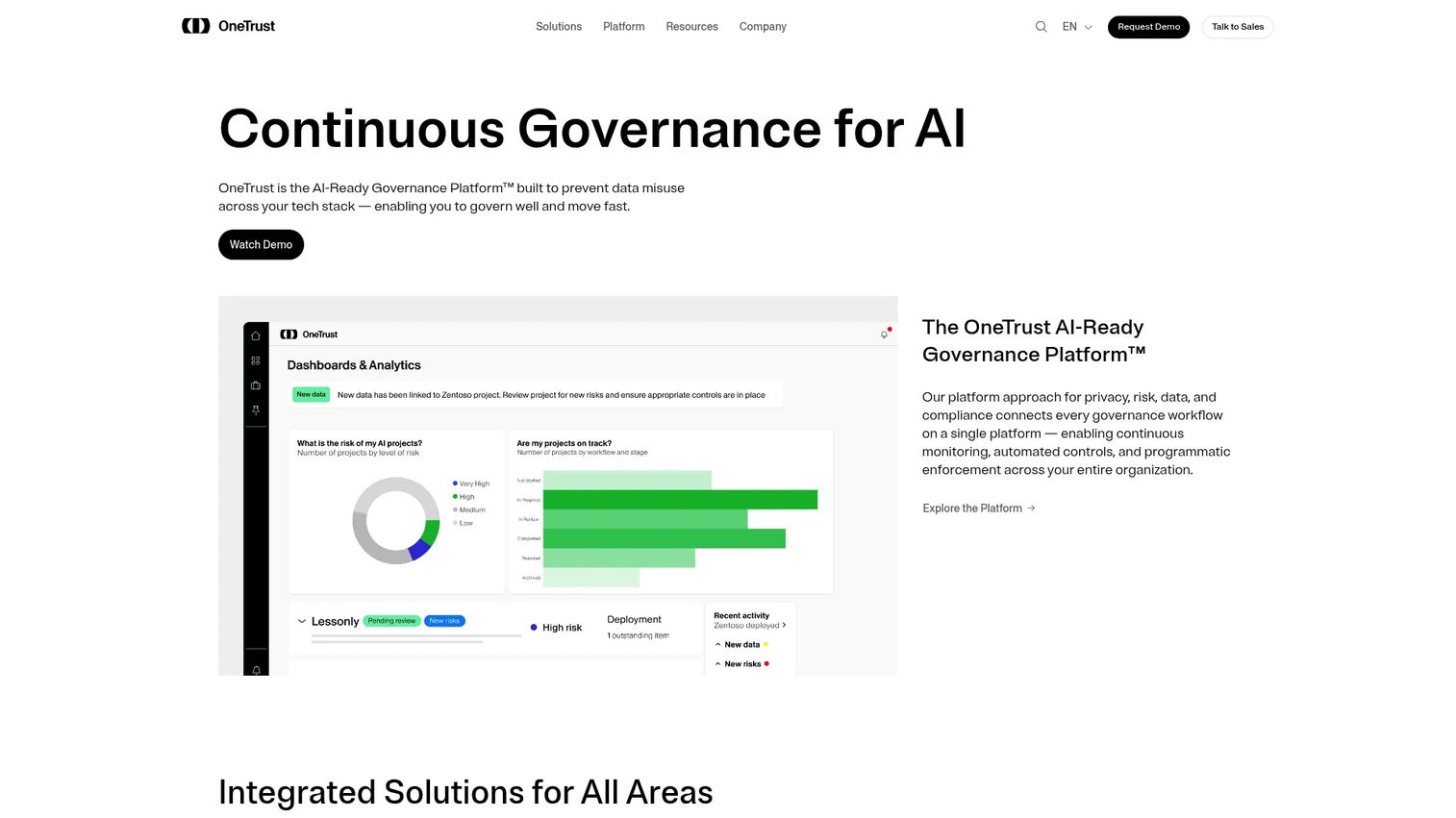
OneTrust is an AI-ready governance platform that covers privacy, consent, risk, third-party, and AI compliance workflows in one system. Its consent management runs alongside data mapping, DSR automation, and vendor risk, so large organizations manage cookies as one part of a wider privacy program rather than a standalone banner. For enterprises with legal, security, and procurement all in the room, that breadth is the draw.
Best for: Enterprises that need a unified privacy, consent, risk, and AI governance platform under one roof.
Key strengths
- AI governance and compliance: Manage AI risk and privacy obligations alongside cookie consent in a single platform.
- Privacy automation and DSR workflows: Automate data subject requests and privacy operations beyond consent alone.
- Consent and preference management: Capture, store, and govern consent across web properties and channels.
Why choose OneTrust: Choose it when cookie consent is one line item in a much larger privacy and governance mandate. If your buying committee includes a CISO, a DPO, and procurement, OneTrust gives them a shared platform instead of a point tool. Smaller teams may find the breadth more than they need, but enterprises rarely outgrow it.
OneTrust pricing: OneTrust does not publish numeric pricing. It uses customized, usage-based pricing tied to meters such as admin users, inventory size, visitors, profiles, or data volume. Modules include a Consent Management Platform base and suite, Universal Consent and Preference Management, Privacy Automation, and AI Governance, each quoted on request. Expect a sales-led process and an annual contract.
2. Cookiebot by Usercentrics
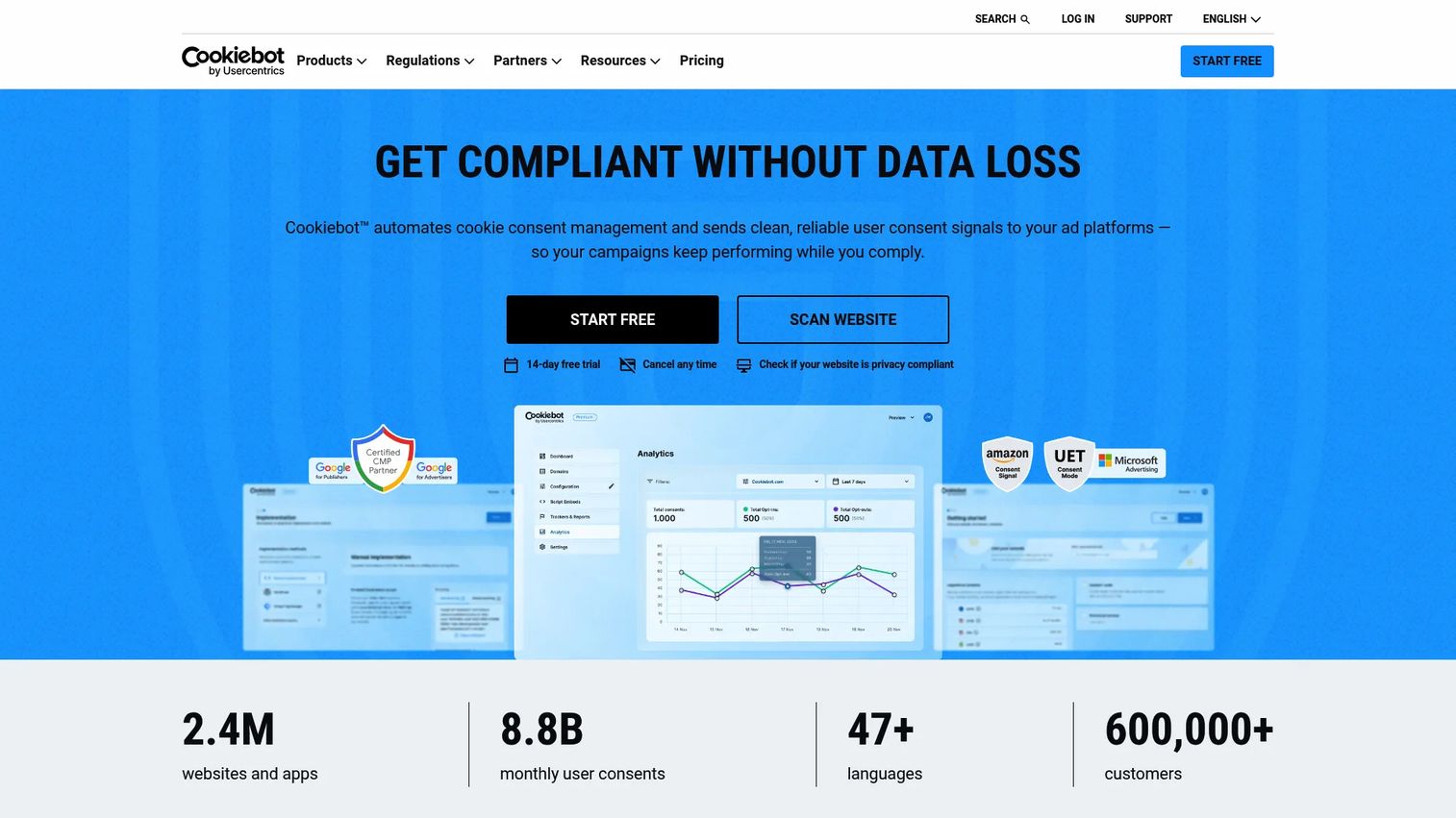
Cookiebot by Usercentrics is a cookie consent management platform built around automated scanning and consent automation. It crawls your site, detects cookies and trackers, and serves a customizable consent banner with geo-targeting and multilingual support. As a Google-certified CMP, it is a common choice for teams that want compliance live quickly without heavy configuration.
Best for: Businesses that need automated cookie consent compliance and continuous site scanning with fast time to live.
Key strengths
- Automated cookie and tracker scanning: Recurring crawls keep your cookie inventory current as the site changes.
- Customizable consent banners with branding: Match the banner to your brand while supporting granular consent.
- Geotargeting and multilingual banner support: Show the right consent experience by region and language.
Why choose Cookiebot: Choose it when you want a credible, certified CMP you can deploy fast and trust to keep scanning on a schedule. The Google-certified status reassures legal, and the automation reduces the manual cookie audit work that piles up after every site change. It scales from a single domain to large multi-domain estates.
Cookiebot pricing: Cookiebot offers a free plan covering up to 50 subpages on one domain. Premium plans are priced per domain: Premium Lite at $8 per month, Small at $16, Medium at $34, Large at $56, and XLarge at $96. A 14-day free trial is available with no credit card required at sign-up. Pricing is shown publicly in USD on the US pricing page.
3. TrustArc
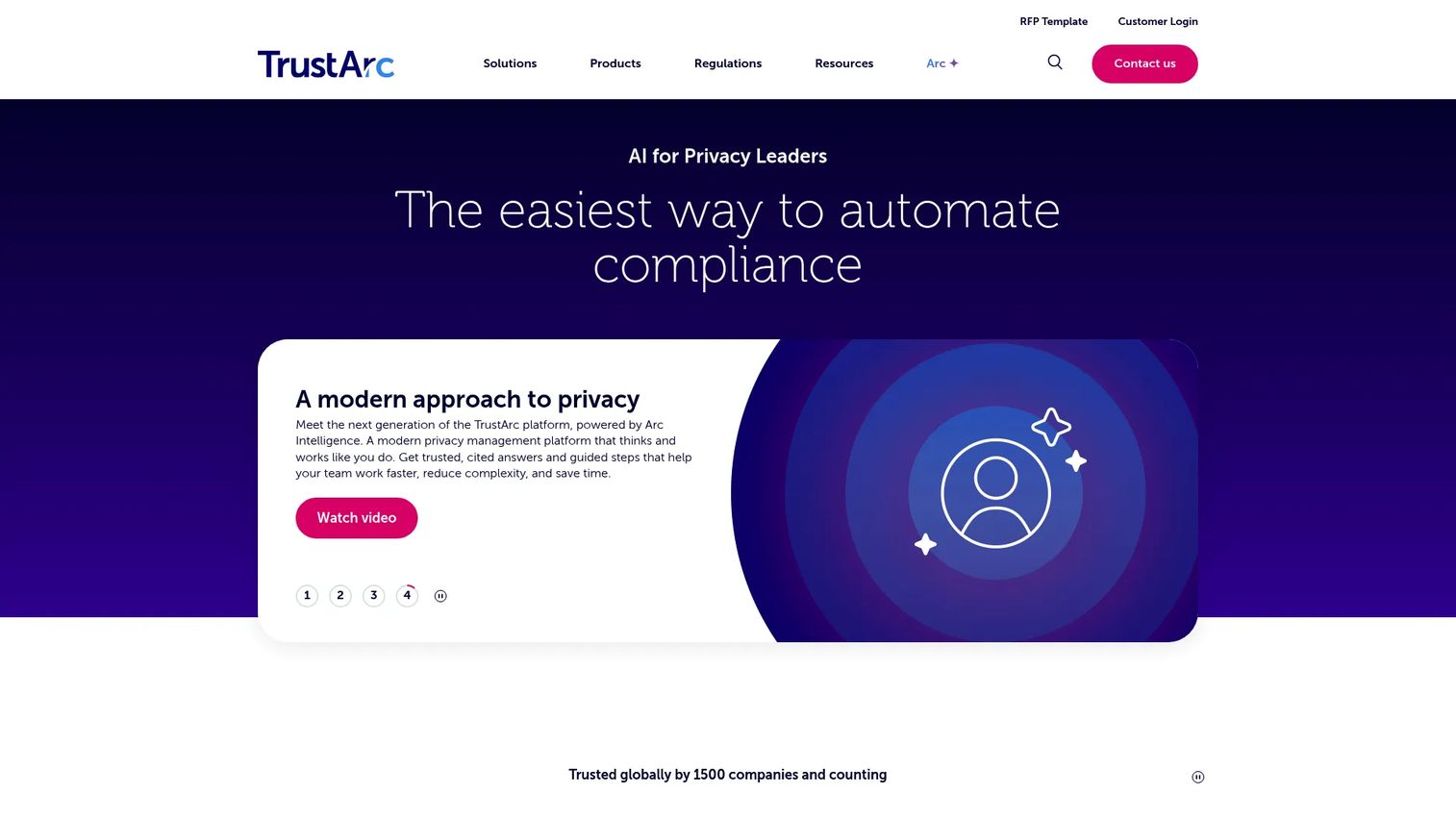
TrustArc is an AI-powered privacy management platform spanning compliance, consent, data governance, and trust operations. Its Arc Intelligence layer adds contextual guidance and automation across workflows, while cookie and tracker management sits inside a broader suite that includes data mapping, DSRs, and privacy impact assessments. It fits organizations building a centralized privacy function.
Best for: Enterprises needing a centralized privacy compliance platform with AI-assisted workflows and broad jurisdiction support.
Key strengths
- Arc Intelligence AI layer: Contextual guidance and automation across privacy and consent workflows.
- Consent and cookie management: Tracker discovery and consent collection inside a wider privacy suite.
- Data mapping, DSR, and PIAs: Connect cookie consent to the full lifecycle of privacy operations.
Why choose TrustArc: Choose it when consent is one piece of a governance program that also covers data mapping, assessments, and jurisdictional compliance. Teams standardizing privacy operations across regions get a single platform with AI-assisted workflows. If you only need a banner, this is more platform than the job requires, but privacy teams value the depth.
TrustArc pricing: TrustArc does not display public pricing. The site directs prospects to contact sales for a quote tailored to scope and modules. Expect an enterprise, sales-led process with an annual agreement. Because numeric tiers are not published, confirm scope and cost directly during evaluation.
4. Usercentrics
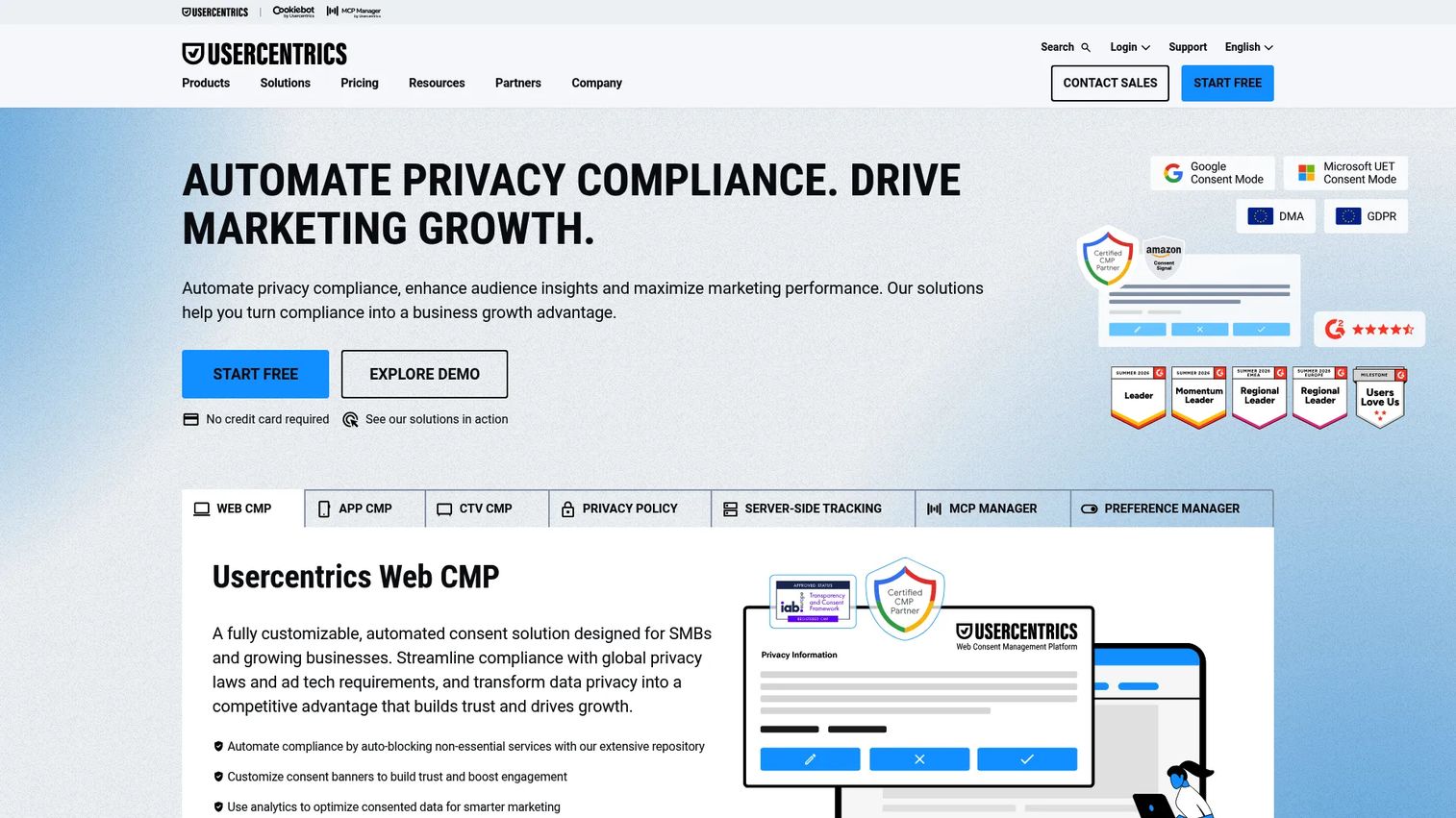
Usercentrics is consent management and privacy compliance software for websites, apps, and connected TV. It collects consent across surfaces with a Web CMP, App CMP, and CTV CMP, and adds a privacy policy generator plus server-side tagging. For teams that operate across multiple channels and regions, its localized consent experiences are the standout.
Best for: Teams needing a consent management platform with flexible, multi-channel privacy compliance across web, app, and CTV.
Key strengths
- Multi-channel CMP coverage: Collect consent on web, mobile apps, and connected TV from one provider.
- Server-side tagging: Move tag firing server-side while honoring consent state.
- Privacy policy generator: Keep policy documentation aligned with detected trackers and regions.
Why choose Usercentrics: Choose it when your consent footprint spans more than a website. Brands running apps and CTV alongside their site avoid stitching together separate tools. The localization and granular consent controls make it a fit for teams operating across many markets with different legal bases.
Usercentrics pricing: Usercentrics publishes a free plan at €0 per month and paid self-serve tiers, including Pro at €30 per month and Business at €50 per month, with Essential and Plus tiers between them. A Corporate tier is quote-based via contact sales. Some higher-tier prices are not fully exposed on the public page, so confirm specifics during evaluation.
5. CookieYes
CookieYes is a cookie consent and privacy compliance platform for websites and apps, known for a clean setup and strong WordPress support. It runs automated cookie scanning, serves a customizable cookie banner, and supports Google Consent Mode v2 and IAB TCF v2.3. With a free tier and accessible paid plans, it is a frequent pick for small and mid-market teams.
Best for: Teams that need a straightforward website cookie consent tool with a free tier and quick implementation.
Key strengths
- Automated cookie scanning: Detect and categorize cookies without manual inventory work.
- Customizable cookie banner: Brand the banner and offer granular, category-level consent.
- Google Consent Mode v2 and IAB TCF v2.3 support: Keep measurement and framework compliance aligned.
Why choose CookieYes: Choose it when simple implementation wins and you do not want to wrestle with a heavy platform. It earns a 4.8/5 on G2, reflecting how quickly teams get a compliant banner live. WordPress sites especially benefit from the plugin-friendly setup and the free starting plan.
CookieYes pricing: CookieYes lists a Free plan at $0 per month per domain, Basic at $10, Pro at $25, and Ultimate at $55, each billed per domain. A 14-day free trial is available on paid plans. Pricing is published publicly on the CookieYes site, which makes budgeting straightforward for smaller teams.
6. Osano
Osano is data privacy management software covering consent, subject rights, data mapping, vendor risk, and broader privacy compliance. Cookie consent sits alongside DSAR automation and vendor risk management, giving growing teams an all-in-one privacy layer rather than a single-purpose banner. Its emphasis on transparency and ease of deployment makes it approachable.
Best for: Teams needing an all-in-one privacy compliance platform with consent and DSAR tooling in one place.
Key strengths
- Cookie consent management: Scan, categorize, and block trackers with consent capture across web and mobile.
- Subject rights and DSAR automation: Handle data subject requests without manual routing.
- Data mapping and vendor risk management: Connect consent to a fuller picture of where data flows.
Why choose Osano: Choose it when you want consent plus the adjacent privacy workflows growing teams eventually need. Rather than buying a banner today and a DSAR tool later, you start on a platform that scales with your obligations. The transparency-first positioning and quick deployment appeal to teams without a dedicated privacy engineer.
Osano pricing: Osano offers self-service plans and a free 30-day trial, but does not display a public numeric price on its plans page. Because exact figures are not published, confirm tier scope and cost directly with Osano during evaluation. The free trial gives you a no-risk way to test fit before committing.
7. Didomi
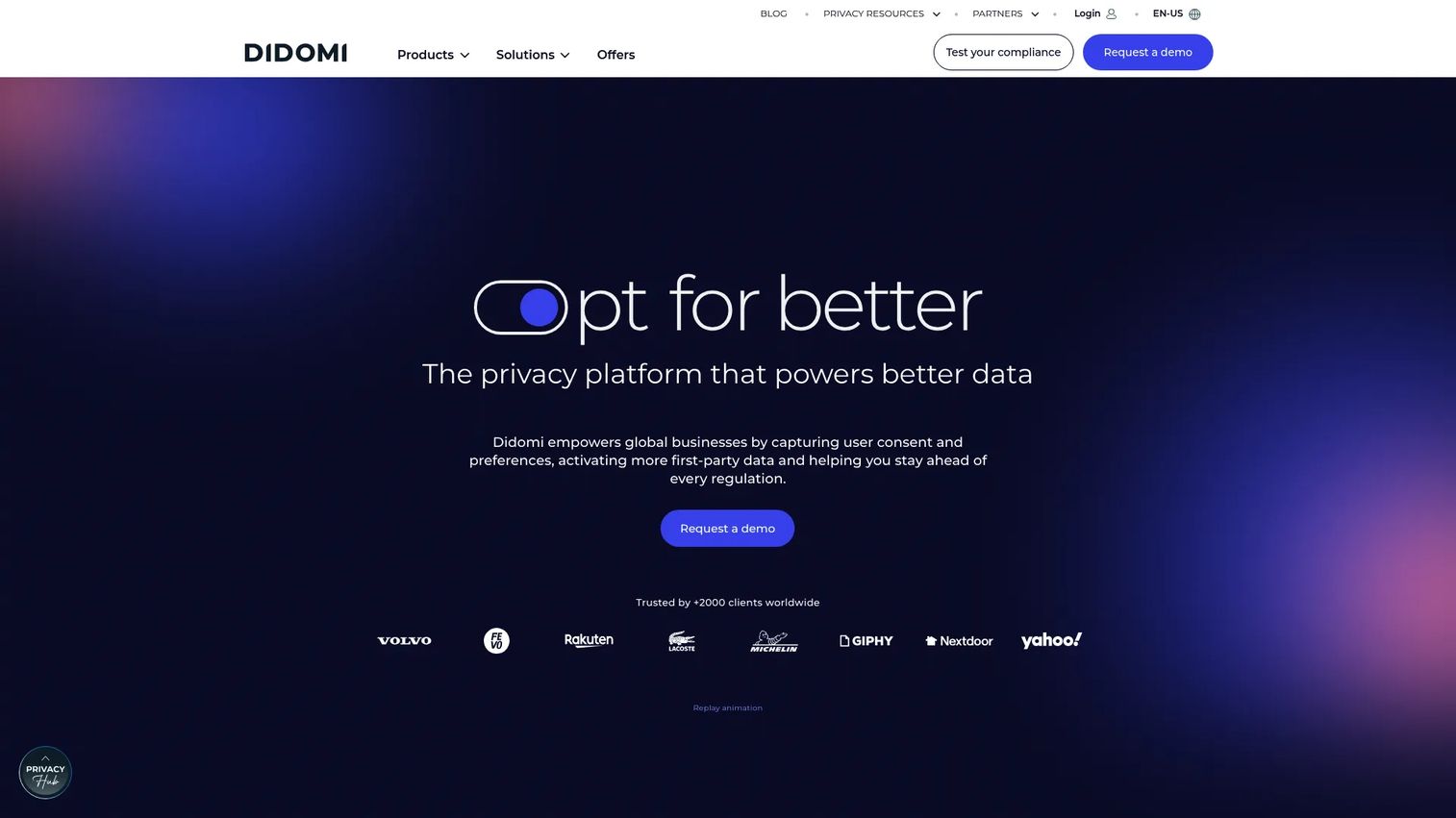
Didomi is a privacy platform built around consent and preference management at scale. It pairs a Consent Management Platform with a Preference Management Platform and privacy request workflows, making it a fit for larger, data-heavy organizations that govern consent across web, app, and connected devices. Consent orchestration is its core strength.
Best for: Enterprises needing consent and preference management across web, app, and connected devices at scale.
Key strengths
- Consent Management Platform: Collect and govern consent across multiple channels and regions.
- Preference Management Platform: Let users manage detailed preferences beyond a simple cookie choice.
- Privacy requests and DSAR: Tie consent to data subject request handling in one platform.
Why choose Didomi: Choose it when consent volume is high and you need orchestration across many touchpoints. Larger marketing and data teams use the preference layer to build richer, durable relationships with users instead of a one-time opt-in. Didomi holds a 4.5/5 on G2, reflecting its standing among data-heavy teams.
Didomi pricing: Didomi lists Essential, Advanced, and Premium plans as contact-us offerings on annual contracts. A separate Addingwell by Didomi free plan covers up to 100,000 requests, though that applies to the Addingwell product rather than the core platform. Because core platform pricing is quote-based, confirm scope and cost with sales.
8. CookieScript
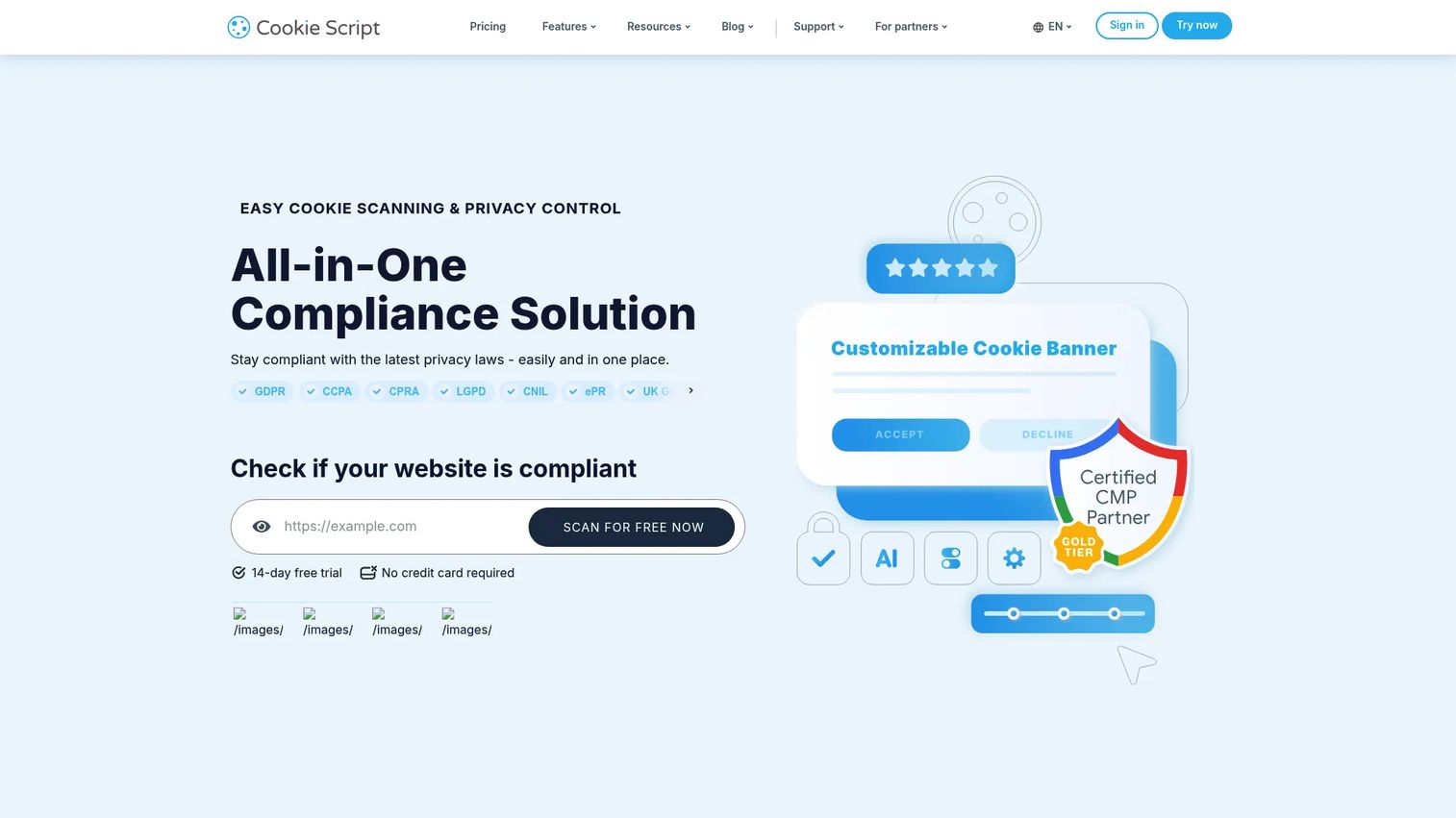
CookieScript is a consent management platform focused on website cookie compliance with a lightweight footprint and budget-friendly pricing. It provides a cookie banner, cookie blocking, and a cookie scanner in a setup that smaller businesses can deploy without heavy ops. When simplicity and cost both matter, it punches above its price.
Best for: Websites needing a cookie consent banner and GDPR-oriented consent management without a big budget.
Key strengths
- Cookie scanner: Detect cookies and trackers across your pages automatically.
- Cookie blocking: Hold non-essential scripts until consent is captured.
- Customizable cookie banner: Present granular consent in a branded, lightweight prompt.
Why choose CookieScript: Choose it when you want solid compliance without enterprise overhead or cost. It earns a 4.8/5 on G2 and keeps the workflow simple, which suits lean teams and agencies managing many smaller sites. The free plan and low entry price make it easy to start and scale per domain.
CookieScript pricing: CookieScript offers a Free plan per domain, then Lite at €6 per month, Standard at €7, and Plus at €9, with prices shown in EUR and billed annually in the plan details. A 14-day free trial is available. The low starting price makes it one of the most budget-friendly options on this list.
9. CookieFirst
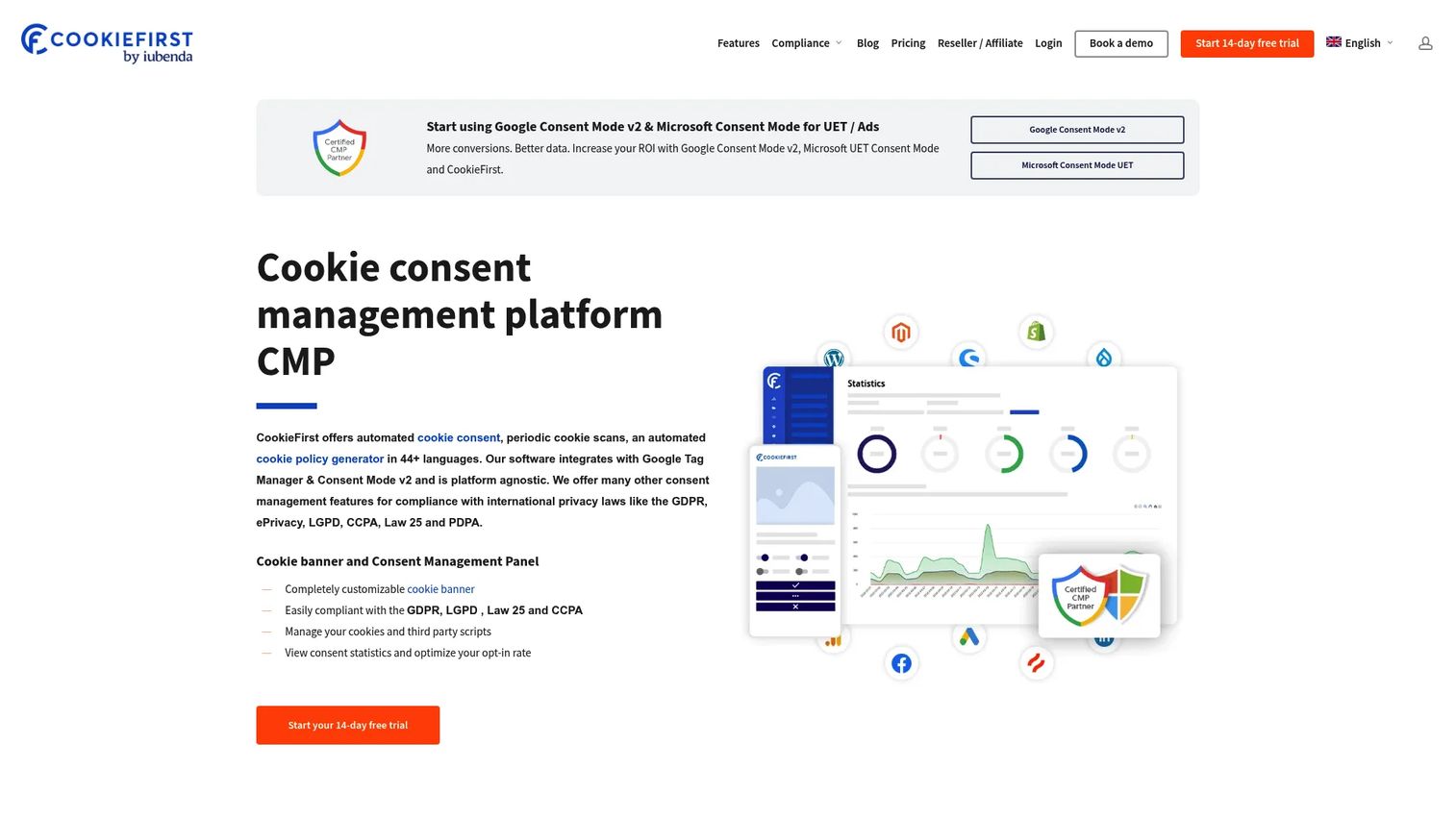
CookieFirst is a cookie consent management platform with cookie scanning, consent logging, and compliance tooling aimed at international websites. It serves a cookie banner and consent panel, runs periodic scans, handles cross-domain consent and re-consent, and integrates with Google Tag Manager and Google Consent Mode v2. Multilingual support makes it a fit for sites serving multiple markets.
Best for: Teams needing a CMP with cookie scanning and consent logging across international, multilingual sites.
Key strengths
- Cookie banner and consent panel: Collect granular consent with a clear, configurable interface.
- Periodic cookie scanning and policy updates: Keep your cookie inventory and policy current automatically.
- Cross-domain consent and Consent Mode v2: Sync consent across domains and signal Google tags correctly.
Why choose CookieFirst: Choose it when your sites span languages and regions and you need consistent consent records across them. The multilingual support and cross-domain handling reduce the manual work of maintaining separate setups per market. Note that CookieFirst's G2 rating sits at 4.0/5 on a small number of reviews, so weigh it alongside a trial.
CookieFirst pricing: CookieFirst publishes a Free plan, Basic at €9 per month or €99 per year, and Plus at €19 per month or €209 per year. An Enterprise tier is custom-priced via sales. Annual billing offers a discount on the Basic and Plus plans, which helps for sites committing for the year.
10. Secure Privacy
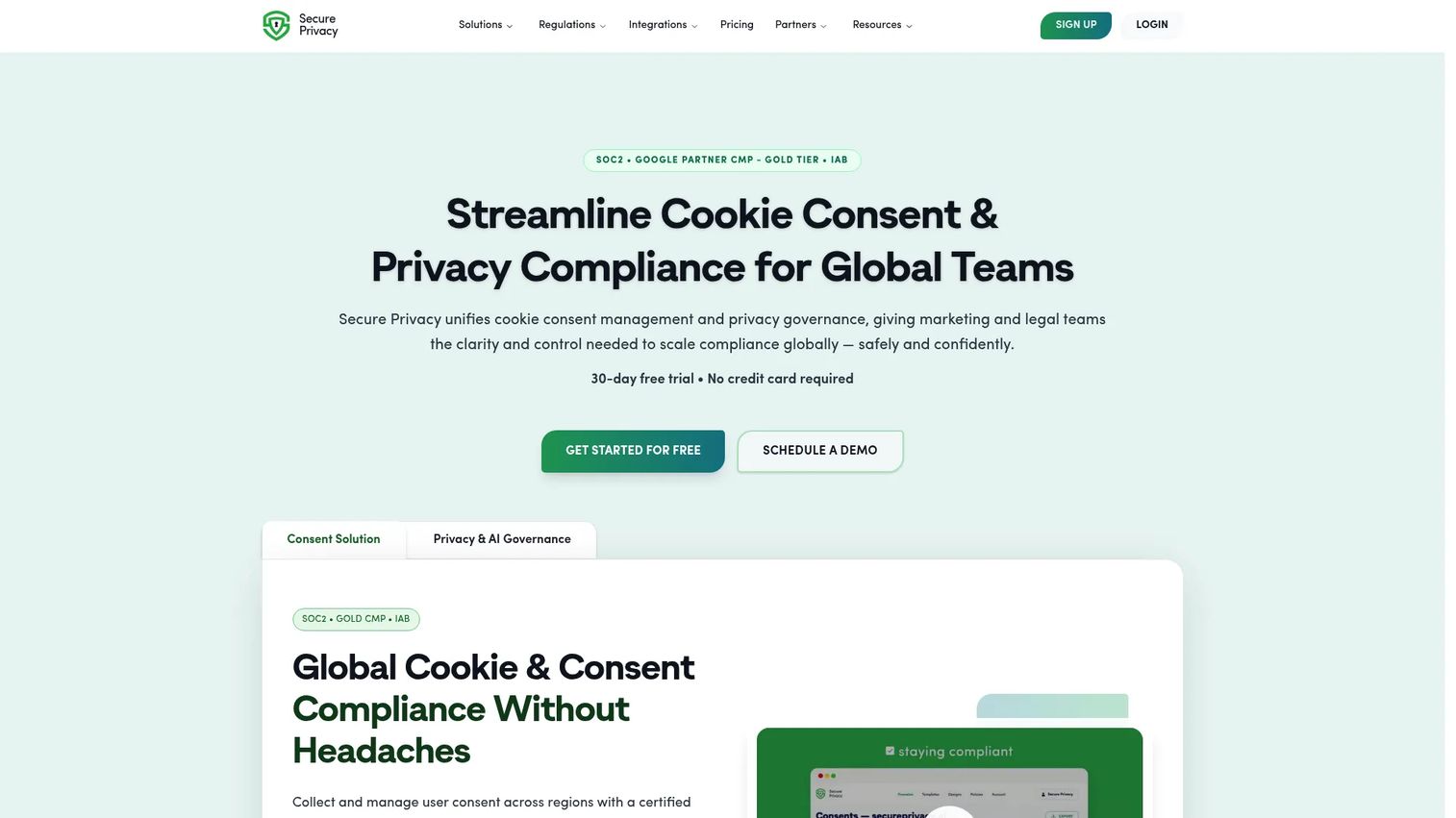
Secure Privacy is a cookie consent and privacy governance platform for global compliance teams. It automates cookie detection and policy updates for GDPR, CCPA/CPRA, and LGPD, supports IAB TCF 2.3 and Google Consent Mode v2, and adds a cookie scanner, consent logging, DSAR, and audit logs. It fits marketers who want compliance without standing up heavy internal ops.
Best for: Teams needing consent management plus privacy governance across multiple regions in one tool.
Key strengths
- Automatic detection and policy updates: Continuously detect trackers and keep policies current for GDPR, CCPA/CPRA, and LGPD.
- IAB TCF 2.3 and Google Consent Mode v2: As an official Google Consent Mode partner, it aligns consent with measurement.
- Consent logging and audit logs: Maintain audit-ready consent records and DSAR handling.
Why choose Secure Privacy: Choose it when you operate in several regions and want consent plus governance without a large privacy team. The 30-day free trial with no credit card lets you validate fit first. Secure Privacy holds a 4.9/5 on G2, the highest rating in this list, which signals strong user satisfaction.
Secure Privacy pricing: Secure Privacy offers a Free plan at $0 per month per domain, Small at $15, Business at $59, and Advanced at $249, each per domain, plus a quote-based Enterprise tier. Annual billing includes two months free. A 30-day free trial with no credit card required lets you test before buying.
11. Cookie Information
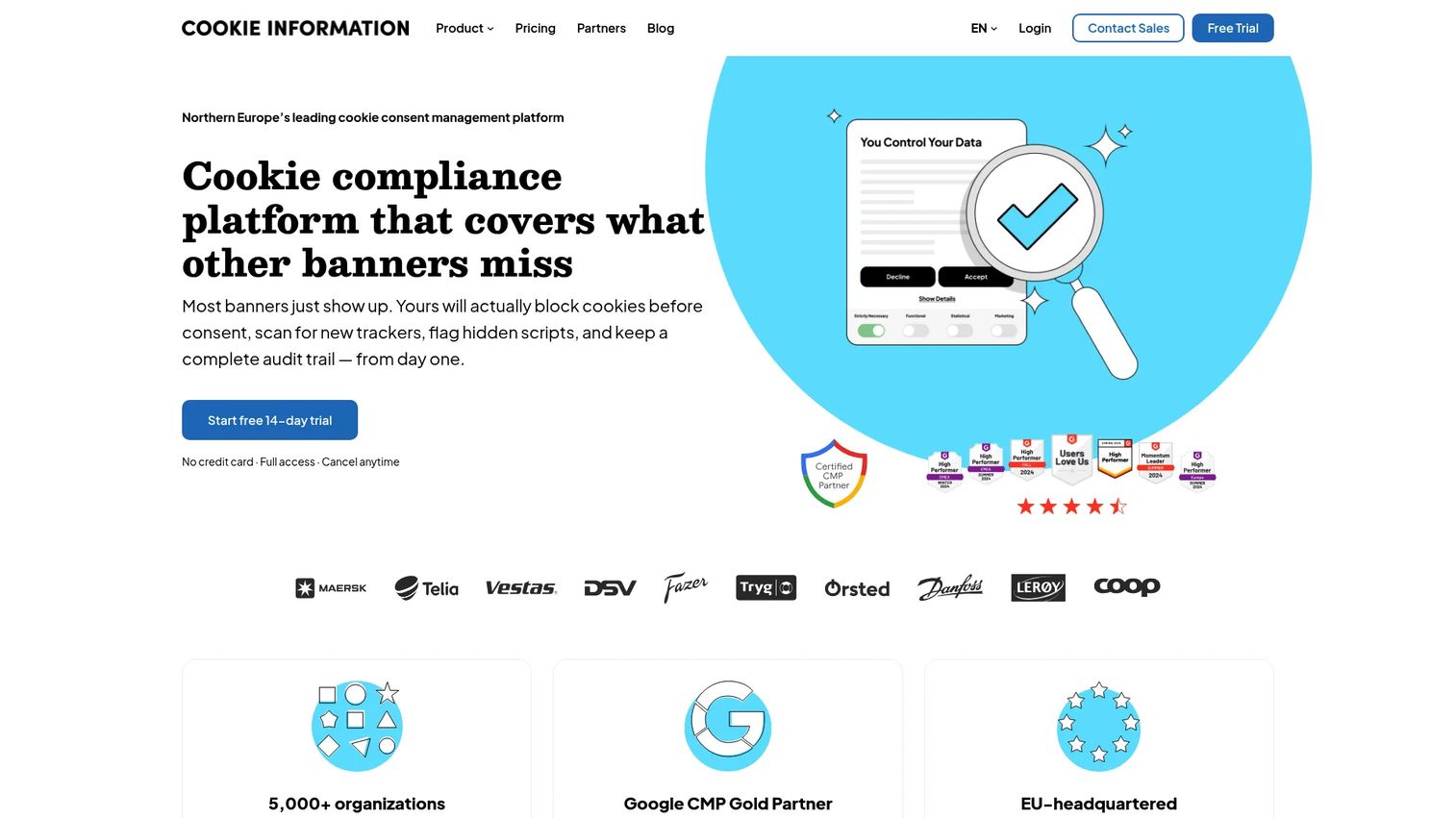
Cookie Information is a cookie consent and compliance platform for websites and apps with a GDPR-first posture. It runs automatic cookie scanning and classification, blocks cookies before consent with audit-ready records, and supports Google Consent Mode v2. For teams that prioritize defensible compliance and clear consent records, it is a practical, compliance-led option.
Best for: Teams needing a GDPR-oriented cookie banner and CMP with Consent Mode v2 support and audit-ready records.
Key strengths
- Automatic cookie scanning and classification: Detect and sort trackers without manual cataloging.
- Cookie blocking before consent: Hold non-essential cookies and keep audit-ready records of every decision.
- Google Consent Mode v2 support: Preserve measurement while honoring consent state.
Why choose Cookie Information: Choose it when GDPR compliance and clean consent records are the priority. The audit-ready logging and pre-consent blocking give legal teams the proof they need. It holds a 4.4/5 on G2, and the focus on classification accuracy suits teams that want trustworthy tracker discovery.
Cookie Information pricing: Cookie Information's Essential plan starts at €19 per month per domain, and Business starts at €35 per month per domain. A 14-day free trial is offered, though no public free tier is listed. Pricing is shown per domain, so multi-site estates should budget accordingly.
Considerations before you buy
Before you commit, run each shortlisted tool through this checklist against your real stack.
Scanner accuracy and coverage
Test how thoroughly the cookie scanner crawls your site, including dynamic pages and subdomains. A scanner that misses trackers leaves you exposed, so check scan frequency and whether it catches cookies set by third-party scripts you do not control.
Auto-blocking reliability
Verify that auto-blocking actually holds non-essential scripts until consent, not just visually. Test a known marketing pixel and confirm it does not fire pre-consent. Weak blocking is the most common gap between looking compliant and being compliant.
Banner UX and consent optimization
Your cookie banner is a conversion surface, not just a legal box. Evaluate granular consent, geo-targeting, localization, and how much you can A/B test the design. Small wording and layout changes move opt-in rates, which directly affects your downstream data volume.
Integration fit and consent logs
Confirm native support for Google Consent Mode, your tag manager, and your CMS before you sign. Check that consent records and consent logs export cleanly for audits. If you run frameworks like IAB TCF 2.2, verify support explicitly rather than assuming it.
Conclusion
The right cookie tracking software depends on how much privacy program you are running, not just the banner. Enterprises managing privacy, risk, and AI governance together gravitate to OneTrust, TrustArc, or Didomi. Mid-market teams that want fast, certified deployment lean toward Cookiebot by Usercentrics or Usercentrics for multi-channel coverage. Smaller teams and budget-conscious sites do well with CookieYes, CookieScript, or CookieFirst, while Secure Privacy and Cookie Information serve teams that want governance and GDPR-first records without heavy ops.
Your next step is simple. Shortlist two tools from this list that match your team size and region, then test the banner UX and auto-blocking on a live page before you decide. Confirm Google Consent Mode and tag manager integration during the trial, and check that consent logs export the way your auditors expect. The privacy compliance software you pick should protect both your compliance posture and your measurement, so test both before you sign.
FAQs
Cookie tracking software is a tool, usually a consent management platform or cookie consent manager, that scans a website for cookies and trackers, blocks non-essential scripts until consent, and logs each consent decision. It sits between your visitors and your tags, ensuring trackers only fire with permission while keeping auditable consent records.
It depends on your jurisdiction and how you collect data, but a proper CMP is the common way to meet consent requirements. GDPR generally requires prior consent for non-essential cookies, while CCPA/CPRA focuses on opt-out and do-not-sell rights. A consent management platform operationalizes both, so most teams use one rather than building consent flows by hand.
The features that matter most are scanner quality, auto-blocking reliability, banner UX, consent logs, and integrations. A strong cookie scanner finds every tracker, dependable auto-blocking holds scripts until consent, and a flexible banner protects opt-in rates. Clean consent records and native Google Consent Mode and tag manager integration keep you both auditable and measurable.
The category itself is not the issue; script behavior and implementation determine performance. A well-built CMP loads asynchronously and adds negligible weight, while poor implementation, like loading multiple consent scripts or blocking rendering, can add latency. Test page load before and after deployment and follow the vendor's recommended install method to keep speed intact.
A cookie banner is the visual prompt visitors see, while a CMP is the underlying system that scans, blocks, logs, and manages consent. The banner is the front end; the consent management platform handles tracker discovery, auto-blocking, granular consent storage, and the consent records you need for audits. A banner alone rarely satisfies modern consent requirements.
Many tools integrate with Google Consent Mode, but setup needs verification per tool. Platforms like CookieYes, CookieFirst, Secure Privacy, and Cookie Information explicitly support Consent Mode v2, which adjusts how Google tags behave based on consent state. Always confirm the integration during a trial and validate it in your tag manager before going live.
Compare governance depth, customization, integrations, and ease of setup against your team size and regions. Enterprise tools like OneTrust and TrustArc offer governance, jurisdiction breadth, and usage-based pricing for complex programs. SMB tools like CookieYes and CookieScript prioritize fast setup, public pricing, and a free tier. Match the platform to the privacy program you actually run, not the one you imagine.