Your month-end close is late again. Someone is still matching transactions in a spreadsheet at 9pm, three days after the deadline. An unexplained variance sits in a suspense account, and nobody can trace where it came from. When the auditors ask for the supporting evidence, half of it lives in an inbox.
This is the reality for most finance teams still doing reconciliation by hand. And the cost is not just late nights. It is risk. Manual matching hides errors, weakens the audit trail, and slows every downstream decision that depends on clean numbers.
That is why the category is growing so fast. The global reconciliation software market is projected to grow from USD 2.53 billion in 2024 to USD 7.54 billion by 2033, a 13.1% CAGR, according to Grand View Research (2024). More than 60 to 75% of financial institutions now use automated reconciliation systems instead of manual processes, per SNS Insider (2024). The shift is not theoretical. It is already happening.
Good financial reconciliation software handles transaction matching, exception management, workflow, and reporting in one place. It replaces the spreadsheet sprawl with a controlled process that closes books faster and keeps an audit-ready record of every match, every adjustment, and every sign-off. The right account reconciliation software turns a reactive scramble into a repeatable system.
This guide compares the tools that do that well.
What's inside
This is a buyer's comparison for finance leaders, controllers, and accounting managers evaluating reconciliation tools for a mature finance operation. It covers platforms that handle account, bank, GL, intercompany, and close workflows, not generic bookkeeping apps.
We selected each tool on four criteria that matter most for real workflows:
- Automation depth: how much matching and journal entry work the tool removes
- ERP integration: how cleanly it connects to your systems of record
- Audit trail and controls: whether it produces defensible, audit-ready evidence
- Scalability and exception management: how it handles high volume, multiple entities, and unresolved items
Pricing for this category is largely quote-based, so we note verified public figures where they exist and describe the model where they do not.
TL;DR
- Best for enterprise close teams: BlackLine, for broad close management and reconciliation at scale.
- Best for AI-led automation: HighRadius, for pattern recognition and closed-loop journal posting.
- Best for AI-driven close and reconciliation: Trintech, for transaction matching and enterprise governance.
- Best for mid-market finance teams: FloQast, for fast, structured, collaborative close workflows. Adra by Trintech is the strong alternative for growing teams.
- Best for ERP-heavy environments: Oracle Fusion Cloud EPM, for finance operations consolidating on a broader suite.
- Best for configurable, high-volume matching: ReconArt, for bank, account, and payment reconciliation with deep configuration.
What is financial reconciliation software?
Financial reconciliation software is a category of financial close software that automates the process of matching transactions across data sources, flagging discrepancies, and producing an audit-ready record of every reconciliation and adjustment. It replaces manual spreadsheet matching with controlled, repeatable workflows.
The core workflows these tools support:
- Transaction matching: automatically pairing transactions across ledgers, banks, and subledgers using configurable rules, so matched items clear without manual review.
- Exception management: surfacing unmatched or out-of-tolerance items, routing them for resolution, and supporting root-cause analysis so the same break does not recur.
- Audit trail and controls: capturing every match, adjustment, and approval with timestamps and user attribution, giving you a defensible record for audit readiness and compliance.
- ERP and data-source integration: connecting to systems of record and banks to pull balances and transactions automatically, with support for multi-ERP environments.
- Reporting and analytics: giving finance leaders real-time visibility into close status, open items, and reconciliation completeness.
- Types of reconciliation supported: account, bank, general ledger, intercompany, and payment reconciliation, often within a single platform.
The strongest platforms tie these together into close management, so reconciliation is not a separate island but part of a governed, end-to-end close process. Some now push toward continuous reconciliation, running matches throughout the period instead of only at month-end.
When to use financial reconciliation software
Reconciling high-volume transaction data
If your team matches thousands of transactions each period across banks, subledgers, and the GL, manual matching stops scaling. Automated reconciliation software applies matching rules to clear the bulk of items instantly, so analysts spend time on genuine exceptions rather than tie-outs. This is where transaction matching pays for itself.
Closing books faster with fewer manual steps
When close stretches past your target and the bottleneck is reconciliation, close management software removes the manual handoffs. Journal entry automation posts adjustments back to the ERP, task workflows track who owns what, and dashboards show real-time status. The result is a shorter, more predictable close.
Standardizing audit-ready workflows across entities
If audit prep means chasing evidence across inboxes and folders, a reconciliation platform enforces a consistent process with a built-in audit trail. Every reconciliation follows the same template, every sign-off is logged, and evidence is attached at the source. That strengthens both audit readiness and internal compliance.
Managing multi-ERP or multi-bank environments
Growth through acquisition or global expansion often leaves finance teams stitching together several ERPs and dozens of bank accounts. Software with strong multi-ERP support and broad bank connectivity consolidates reconciliation into one governed workspace, including intercompany reconciliation between entities.
Comparison table
We selected these seven tools based on automation depth, ERP integration, audit trail quality, and how well each handles exception management at scale. The list spans enterprise close suites, AI-led automation platforms, and configurable reconciliation tools. Pricing in this category is mostly quote-based, so ratings and public figures are noted where verified.
| # | Product | Intent | Key differentiation | Pricing | G2 rating |
|---|---|---|---|---|---|
| 1 | Trintech | AI-driven close and reconciliation | Transaction matching plus enterprise governance | Quote-based | 4.5/5 |
| 2 | HighRadius | AI-led automation at enterprise scale | Pattern recognition and closed-loop journal posting | Quote-based | 4.3/5 |
| 3 | BlackLine | Enterprise close management | Broad close and reconciliation platform | Quote-based | 4.5/5 |
| 4 | FloQast | Accounting-team close automation | Ease of use and collaborative checklists | Quote-based | 4.6/5 |
| 5 | Oracle Fusion Cloud EPM | Unified enterprise finance suite | EPM plus account reconciliation | From $250/month | 4.1/5 |
| 6 | ReconArt | Configurable high-volume matching | Bank, account, and payment reconciliation | Quote-based | Not listed |
| 7 | Adra by Trintech | Mid-market close and reconciliation | Practical automation for growing teams | Quote-based | 4.5/5 |
1. Trintech
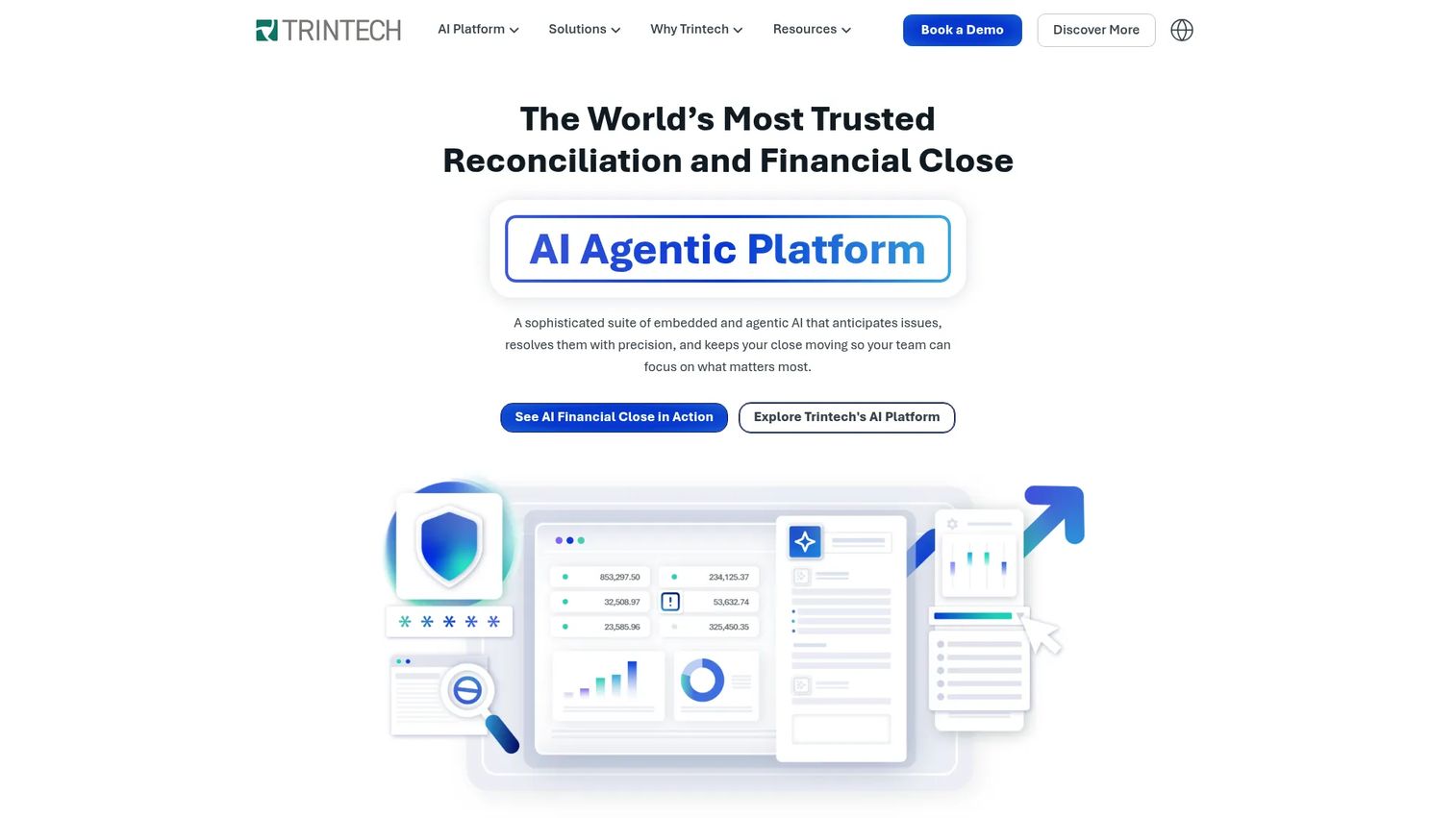
Trintech is AI-powered financial close and reconciliation software built for finance teams that need to standardize matching, close tasks, and controls across the organization. Its platform spans account reconciliation, transaction matching, and journal entry management, aimed at mid-sized to enterprise operations that treat reconciliation as part of a governed close, not a side task.
Where Trintech stands out is the combination of automated matching and enterprise governance. It pulls balances and transactions from your systems of record, applies matching rules to clear routine items, and routes exceptions with a full audit trail behind every action. Journal entry management ties adjustments back to the ERP, so the close moves without manual re-keying.
Best for: Mid-sized to enterprise finance teams automating reconciliation and financial close under strong governance.
Key strengths
- Account reconciliation: Standardized, template-driven reconciliations with built-in controls and sign-off.
- Transaction matching: Rule-based matching across banks, subledgers, and the GL to clear high volumes automatically.
- Journal entry management: Structured journal entry automation that posts adjustments back into the ERP.
Why choose Trintech: Trintech fits teams that want reconciliation and close in a single governed platform with the depth to handle complex, multi-entity operations. It suits controllers who care as much about the audit trail and control framework as they do about raw automation speed.
Trintech pricing: Trintech does not publish list pricing. The company routes prospects to a demo or sales conversation, so pricing is quote-based and scoped to your entity count, volume, and modules. Its current G2 rating is 4.5/5.
2. HighRadius
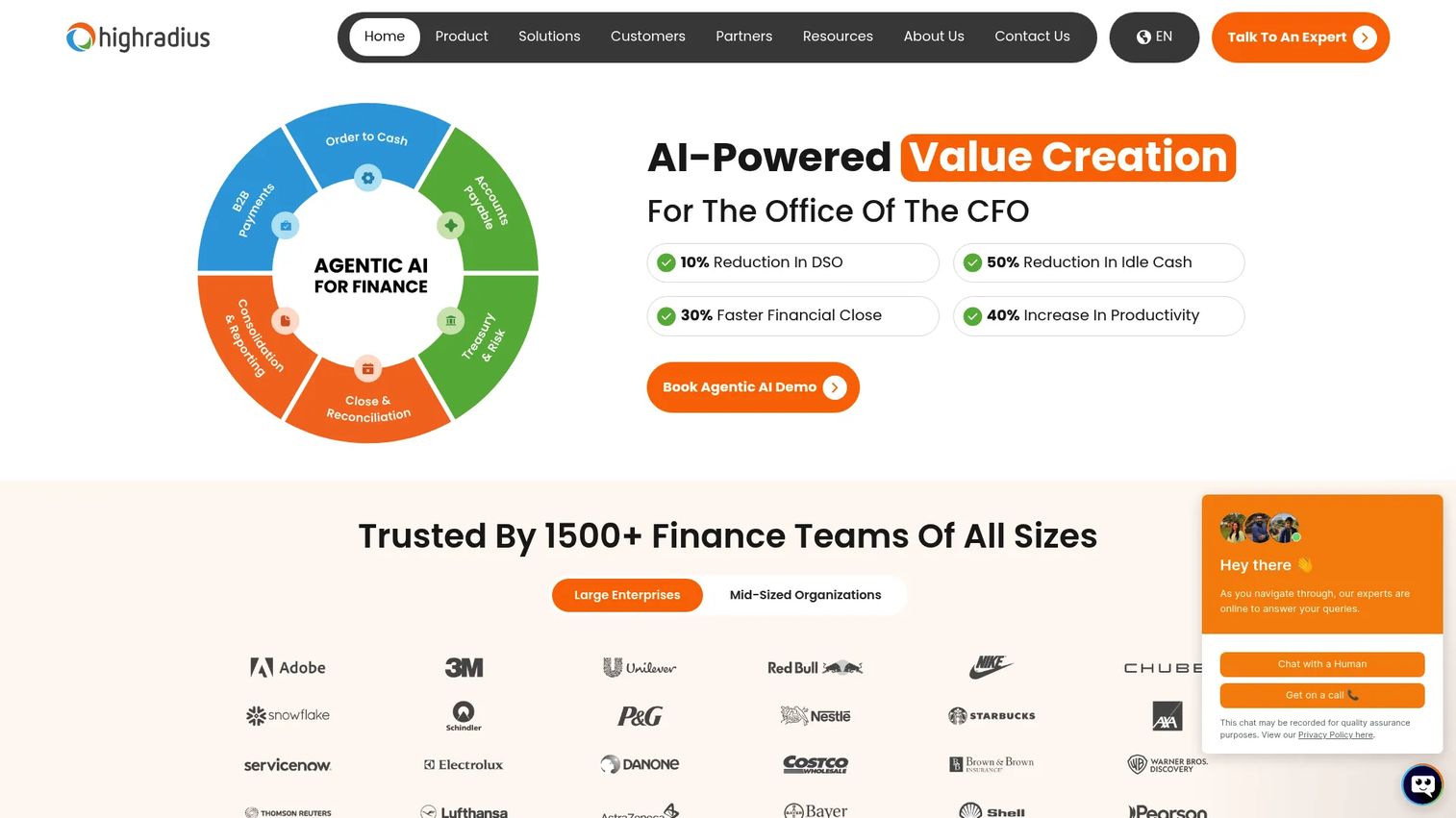
HighRadius is enterprise finance automation software covering accounts receivable, accounts payable, reconciliation, and treasury workflows. For reconciliation specifically, the draw is its AI-led approach: the platform learns matching patterns, clears items automatically, and pushes toward closed-loop posting that writes adjustments straight back to the ERP.
That AI-powered reconciliation is the headline capability. Rather than relying only on static rules, HighRadius uses pattern recognition to match transactions that would otherwise land in an exception queue. Unmatched items still route through exception management, but the volume reaching a human shrinks as the system learns.
Best for: Large finance teams needing AI-based AR, AP, and reconciliation automation at enterprise scale.
Key strengths
- AI-driven matching: Pattern recognition clears complex matches beyond simple rule sets.
- Closed-loop journal posting: Adjustments post back to the ERP without manual re-entry.
- Pre-built ERP integrations: Ready connectors reduce the lift of connecting systems of record.
Why choose HighRadius: Enterprise finance teams evaluate HighRadius when reconciliation is one piece of a broader push to automate the order-to-cash and record-to-report cycle. It rewards teams with high transaction volumes where AI-based matching meaningfully reduces manual exception handling and strengthens audit readiness.
HighRadius pricing: HighRadius states publicly that pricing is available through its sales team; no public numeric price is listed. Pricing is scoped to your workflows and scale. Its current G2 rating is 4.3/5.
3. BlackLine
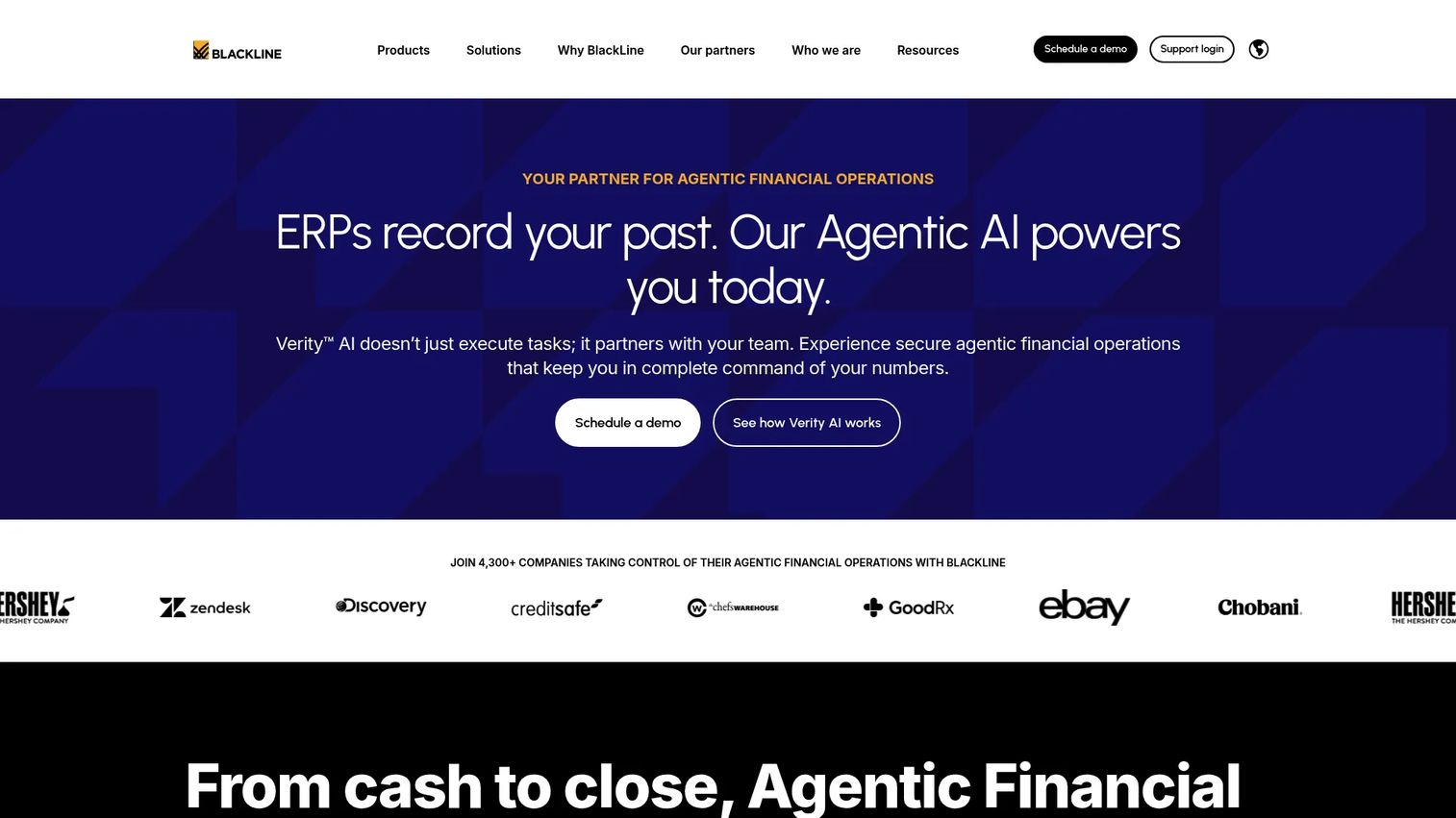
BlackLine is a cloud financial close and accounting automation platform built for the office of the CFO. It is one of the most widely adopted names in enterprise close, covering account reconciliations, close and consolidation automation, intercompany accounting, and invoice-to-cash in one platform.
The reconciliation story sits inside a broader close management framework. BlackLine standardizes reconciliations with templates and certification, automates workflow so tasks route and escalate on their own, and maintains a detailed audit trail across the close. For teams that want reconciliation, task management, and controls under one roof, that breadth is the differentiator.
Best for: Enterprise finance teams automating close, reconciliations, and related accounting workflows at scale.
Key strengths
- Close and consolidation automation: Manages the full close, not reconciliation alone.
- Intercompany accounting: Automates intercompany reconciliation across entities.
- Workflow automation and controls: Routes tasks, enforces sign-offs, and logs a complete audit trail.
Why choose BlackLine: BlackLine suits large, complex finance organizations that want a single platform for reconciliation and the wider close. Its enterprise adoption and depth of controls make it a common shortlist name when governance and audit trail quality drive the decision.
BlackLine pricing: BlackLine does not publish list pricing; its site directs buyers to a demo or sales conversation. Pricing is quote-based and scoped to modules, entities, and volume. Its current G2 rating is 4.5/5.
4. FloQast
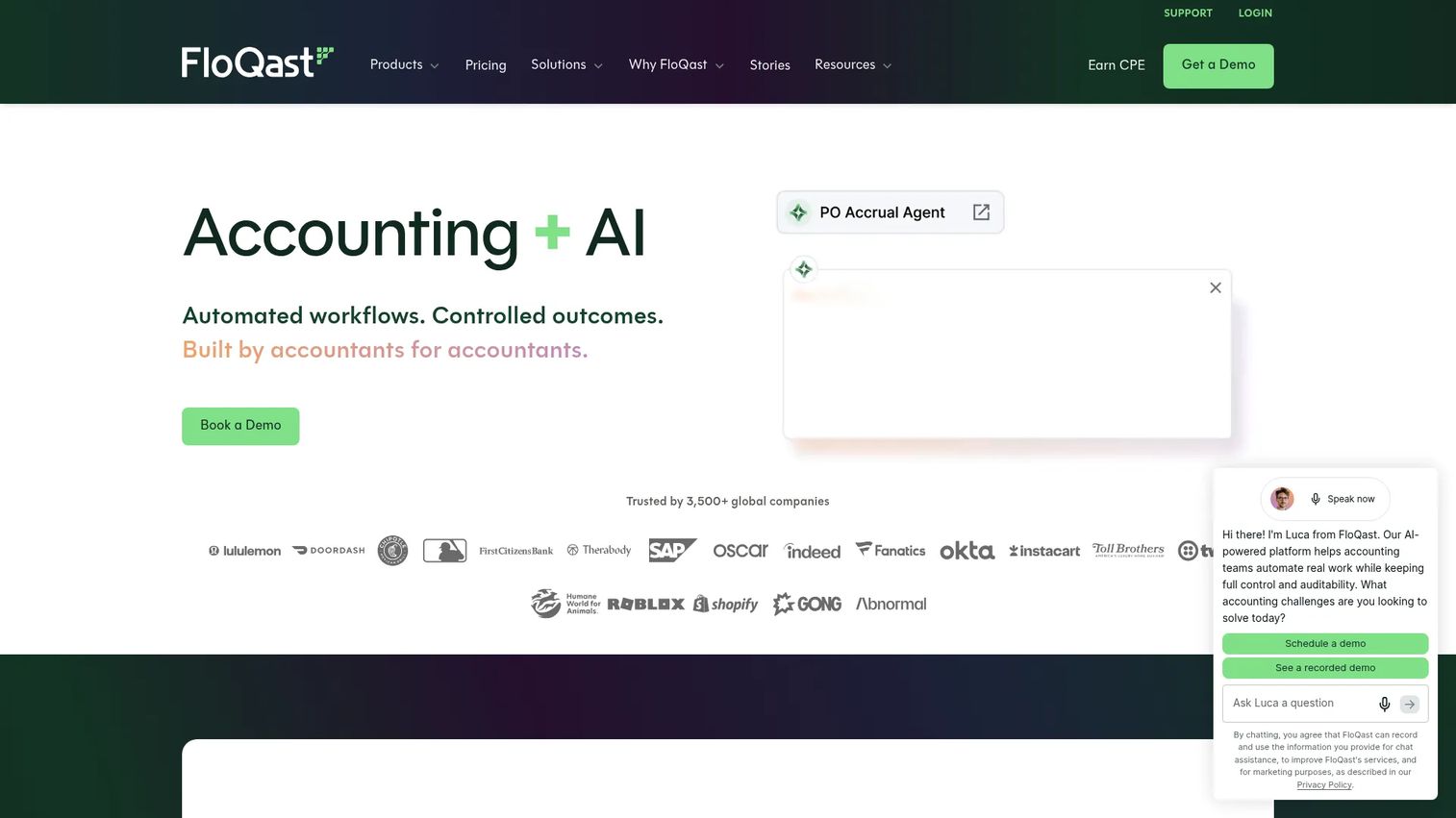
FloQast is an accounting automation platform focused on financial close, compliance, reporting, and AI-driven workflows. It was built by accountants, and it shows in the design: the tool prioritizes ease of use and structured, collaborative close over heavy configuration, which makes it a favorite for teams that want speed without a long implementation.
For reconciliation, FloQast pairs automated reconciliations and journal entries with close checklists that keep the whole team aligned. Rather than treating reconciliation as an isolated engine, it wraps matching inside a clear close process, so everyone can see what is done, what is open, and who owns each item. Connected compliance features collect audit evidence as work happens.
Best for: Mid-market to enterprise accounting teams needing close, compliance, and reporting automation without heavy complexity.
Key strengths
- Financial close automation: Checklists and task tracking keep the close on schedule.
- Automated reconciliations and journal entries: Matches items and supports journal entry automation inside the close flow.
- Connected compliance: Collects audit evidence automatically for audit readiness.
Why choose FloQast: FloQast fits teams that want structure and collaboration without a lengthy setup. It performs best when the priority is a faster, cleaner close that the whole accounting team can run day to day, rather than deep, bespoke reconciliation configuration.
FloQast pricing: FloQast states that pricing is customized and not per-user. Its public pricing page lists packages such as Close Optimization, Close Automation, Connected Compliance, Compliance Pro, FloQast Reporting, and FloQast Transform, each shown as Contact Sales. Its current G2 rating is 4.6/5.
5. Oracle Fusion Cloud Enterprise Performance Management
Oracle Fusion Cloud Enterprise Performance Management is Oracle's cloud suite for enterprise performance management, spanning planning, close, reporting, analysis, and account reconciliation. It fits large, multi-system finance operations that want reconciliation to live inside a broader EPM stack rather than as a standalone tool.
The account reconciliation module sits alongside planning, financial consolidation, and close, with AI and machine learning capabilities layered across the workflows. For organizations already invested in Oracle, or those consolidating many systems, the value is integration and governance: reconciliation, close, and reporting share one environment, which simplifies the record-to-report process and supports multi-ERP consolidation.
Best for: Mid-to-large finance teams that want a unified cloud EPM suite with reconciliation built in.
Key strengths
- Account reconciliation inside EPM: Reconciliation runs within the broader close and consolidation suite.
- Financial consolidation, close, and reporting: One environment for the full record-to-report process.
- AI and machine learning across workflows: Applied across EPM processes, including reconciliation.
Why choose Oracle Fusion Cloud EPM: Oracle fits enterprises that value a single, integrated finance suite over a best-of-breed reconciliation point tool. It performs best in ERP-heavy and multi-system environments where consolidation, governance, and one unified process outweigh the appeal of a specialized standalone.
Oracle Fusion Cloud EPM pricing: Oracle publishes pricing in its global price list. The Enterprise Performance Management Standard Cloud Service is listed at $250/month and the Enterprise Cloud Service at $500/month, with related services priced separately. Its current G2 rating is 4.1/5.
6. ReconArt
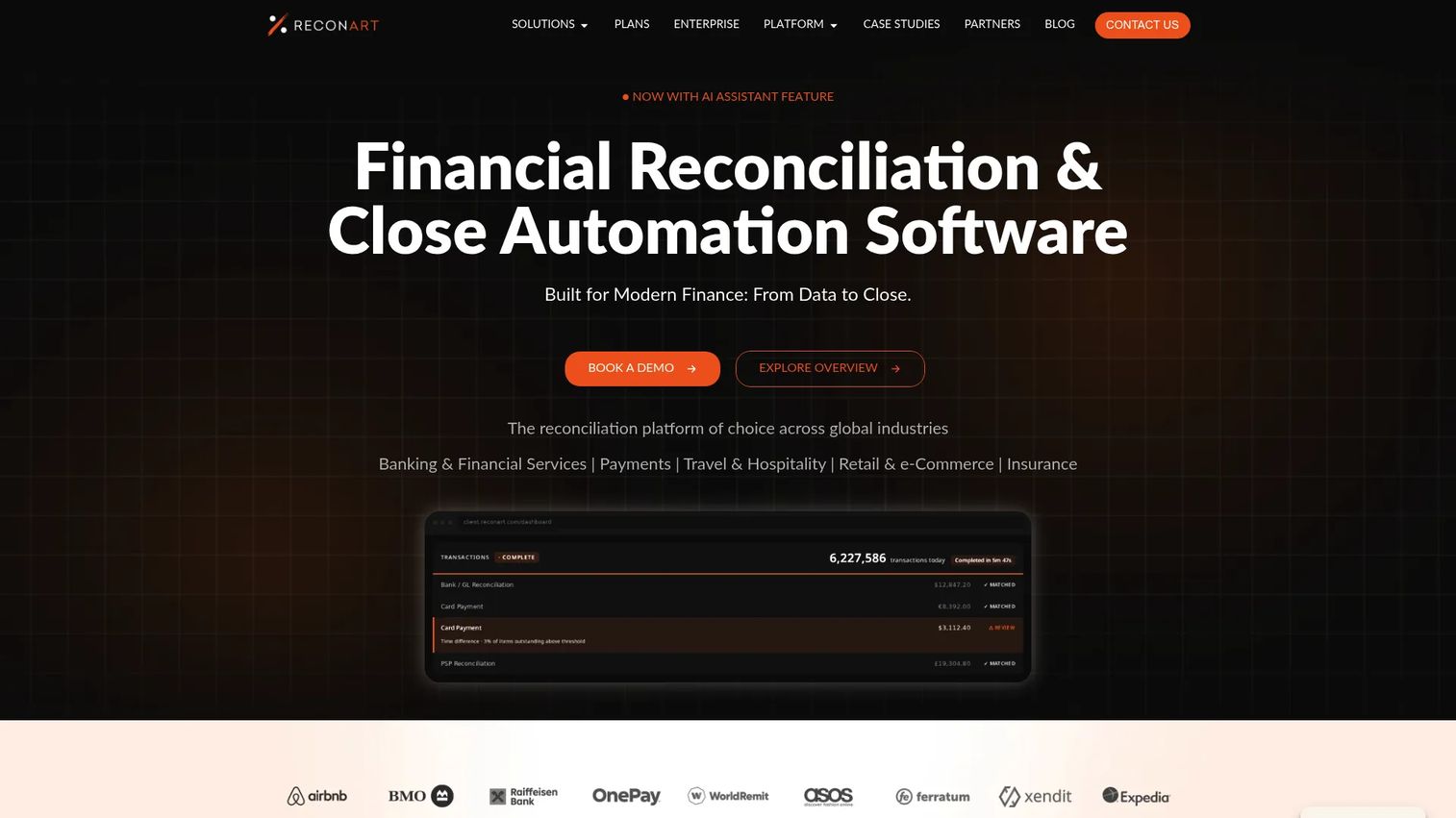
ReconArt is financial reconciliation and close automation software built for organizations that need configurable, high-volume reconciliation. It leans into flexibility, letting teams tailor matching rules and workflows to their own data rather than forcing a fixed template, which suits complex or unusual reconciliation needs.
The platform covers bank reconciliation strongly, along with account and payment reconciliation, and layers on API integrations and AI-powered document processing. Exception management is a core part of the workflow: unmatched items route for resolution with the configuration to support root-cause analysis. For teams reconciling large volumes across many accounts, that configurability is the reason to look.
Best for: Organizations needing configurable, high-volume reconciliation and financial close automation.
Key strengths
- Bank reconciliation: Deep support for high-volume bank matching across accounts.
- API and integrations: Connects to systems of record and data sources for automated data import.
- AI-powered document processing: Extracts and matches data from documents to reduce manual handling.
Why choose ReconArt: ReconArt fits teams whose reconciliation needs do not fit a rigid template and who want to shape matching rules, workflows, and exception handling around their own process. It rewards operations that reconcile high volumes across bank, account, and payment types and value configuration over a fixed structure.
ReconArt pricing: ReconArt uses edition-based annual subscriptions across tiers such as Essentials, Plus, Certify, and Close, with implementation described as a one-time 60 or 80-hour package. No public price figures are shown on its pricing page, so pricing is quote-based.
7. Adra by Trintech
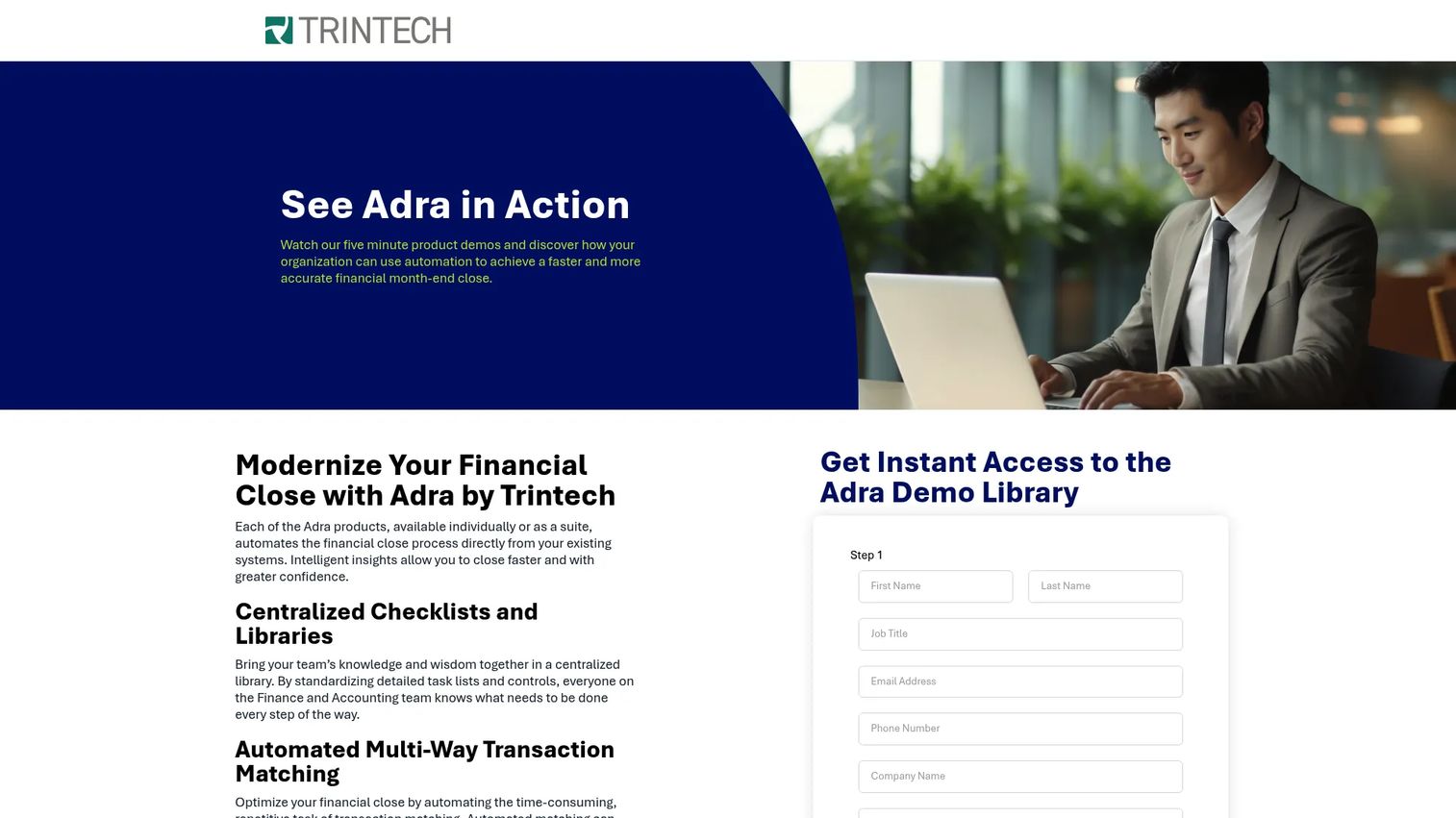
Adra by Trintech is cloud-based financial close automation software built for mid-market finance teams. It takes the reconciliation and close capabilities that enterprises expect and packages them for growing teams that need structure without enterprise-scale complexity or cost.
Adra covers account reconciliations, transaction matching, close task management, journal entry, and reporting and analytics. The design centers on giving a mid-market team a clear, controlled close: reconciliations follow a standard template, tasks route through a defined workflow, and reporting gives leaders real-time visibility into close status. It is a practical step up from spreadsheets for teams outgrowing manual processes.
Best for: Mid-market finance teams automating reconciliation and close processes.
Key strengths
- Account reconciliations and matching: Template-driven reconciliations with transaction matching built in.
- Close task management: Defined workflows track ownership and progress across the close.
- Reporting and analytics: Real-time visibility into close status and open items.
Why choose Adra by Trintech: Adra fits growing finance teams that want reliable automation and a governed close without the scope of a full enterprise deployment. It suits controllers moving off spreadsheets who need account reconciliations, matching, task workflows, and reporting in one accessible platform.
Adra by Trintech pricing: Adra does not publish list pricing; Trintech uses a book-a-demo flow for its Adra product. Pricing is quote-based and scoped to your team size and needs. Its current G2 rating is 4.5/5.
Considerations before you buy
Before you shortlist, pressure-test each tool against the operational realities of your finance team.
Automation and matching depth
Look past the marketing and ask how matching actually works. Does the tool support the rule complexity your data needs? How much of your volume clears automatically versus falling into an exception queue? For high-volume operations, AI-powered reconciliation and continuous reconciliation can materially cut manual work.
ERP integration and data import
Your reconciliation tool is only as good as the data feeding it. Confirm native connectors for your ERP and banks, and how the tool handles data import when a native connector does not exist. If you run multiple systems, verify genuine multi-ERP support, not just a single integration.
Audit trail and controls
For audit readiness, the tool must log every match, adjustment, and approval with clear attribution. Ask whether evidence is attached at the source, how sign-offs are enforced, and whether the audit trail satisfies your auditors and compliance requirements without extra manual work.
Exception management and root-cause analysis
Automation clears the easy items; the exceptions are where teams lose time. Evaluate how the tool surfaces breaks, routes them, and supports root-cause analysis so recurring issues get fixed at the source rather than re-worked every period.
Scalability and governance
Finally, confirm the tool scales with entity count, transaction volume, and users, and that governance features (permissions, ownership, workflow automation) hold up as you grow. A tool that fits today but breaks at double the volume is a short-term choice.
Conclusion
The right financial reconciliation software depends on where your finance operation sits today. For enterprise close teams that want reconciliation inside a broad close management platform, BlackLine and Trintech lead. For AI-led automation at scale, HighRadius is built for high-volume matching and closed-loop posting. Mid-market teams get a faster, more collaborative close from FloQast, with Adra by Trintech as a strong, practical alternative for growing operations.
If your environment is ERP-heavy or multi-system, Oracle Fusion Cloud EPM keeps reconciliation, close, and reporting in one suite. And for configurable, high-volume matching across bank, account, and payment reconciliation, ReconArt earns its place.
Whichever way you lean, hold the evaluation to the same criteria: automation depth, ERP integration, audit trail quality, exception management, and scalability. Build a shortlist of two or three tools, run your own transaction data through a proof of concept, and confirm ERP fit, governance, and pricing before you commit. The tool that clears the most volume with the cleanest audit trail is the one that will actually shorten your close.
FAQs
Financial reconciliation software automates the matching of transactions across data sources, flags discrepancies, and records an audit-ready trail of every match and adjustment. It replaces manual spreadsheet reconciliation with controlled, repeatable workflows, and typically covers account, bank, GL, intercompany, and payment reconciliation within one platform.
Account reconciliation software validates general ledger balances against supporting detail across many account types, including balance sheet reconciliation, intercompany, and subledger accounts. Bank reconciliation is a narrower subset focused on matching your GL cash balances to bank statements. Most enterprise reconciliation tools handle both, plus payment and intercompany reconciliation, in a single workflow.
For large, complex organizations, BlackLine and Trintech are common shortlist names because they combine reconciliation with broad close management, deep controls, and enterprise governance. HighRadius is a strong option when AI-led automation across high transaction volumes is the priority. The best fit depends on your ERP landscape, entity count, and how much of the close you want in one platform.
For the reconciliation process itself, yes. These tools replace manual spreadsheet matching with automated transaction matching, structured exception management, and a built-in audit trail that Excel cannot maintain. Many teams still use spreadsheets for ad hoc analysis, but the core reconciliation workflow moves into governed software that scales and stays audit-ready.
ERP integration is the priority, since your systems of record supply the balances and transactions being reconciled. Bank connectivity matters for bank reconciliation, and multi-ERP support is essential if you run several systems after growth or acquisition. Also check how the tool handles data import when a native connector is unavailable.
AI-powered reconciliation uses pattern recognition to match transactions that static rules would miss, clearing more items automatically and shrinking the exception queue. It can also support root-cause analysis on recurring breaks and, in some platforms, drive closed-loop posting that writes adjustments back to the ERP. The net effect is less manual matching and faster close.
Audit readiness comes from a complete, tamper-evident audit trail: every match, adjustment, and approval logged with user attribution and timestamps. Look for evidence attached at the source, enforced sign-offs, standardized reconciliation templates, and reporting that lets you demonstrate completeness and controls to auditors without manual reconstruction.
Run your own data through a proof of concept and watch what falls into the exception queue and how the tool handles it. Strong exception management surfaces unmatched or out-of-tolerance items clearly, routes them to the right owner, tracks resolution, and supports root-cause analysis so the same break does not recur every period.