You raised the budget on display. The CPMs climbed. The click-through rate didn't move. And the dashboard still can't tell your CFO whether any of it generated pipeline.
That gap is exactly why native advertising keeps pulling spend away from banner inventory. In 2024, native display made up 63.1% of all U.S. display ad spending, according to eMarketer. The global native advertising market is projected to reach USD 125.6 billion in 2026, growing at a 21.7% CAGR through 2036, per Future Market Insights. Mordor Intelligence puts the 2026 figure even higher at USD 165.7 billion. The reason is simple: native ads match the form and feel of the content around them, so people actually read them instead of training their eyes to skip them.
But "native" covers a wide range of buying motions. Some platforms are content discovery engines built on publisher widgets. Others are full programmatic stacks where native is one channel among CTV, display, and audio. A few specialize in sponsored storytelling inside premium editorial. Picking the wrong one means paying for reach that never converts, or buying placements your brand-safety team will flag later.
This guide ranks the platforms that matter, then gives you the decision criteria to choose. If you also manage adjacent parts of your stack, our roundups of the best content marketing tools and best customer data platform options pair well with native buying, and our ai content creation tools list helps you feed those campaigns with creative.
What's inside
This is a buyer's guide for growth marketers, demand gen leads, and media buyers who already understand paid media and now want a shortlist with decision logic attached. We evaluated each native ads platform on four criteria: reach and audience quality, contextual and cookieless targeting depth, brand safety and transparency, and measurement that ties spend to outcomes beyond raw clicks. We pulled pricing models and ratings from first-party sources and G2 where available, and we wrote around any figure we couldn't confirm rather than guessing.
TL;DR
- Best for open-web performance and scale: Taboola, the largest content discovery platform by recommendation volume.
- Best for premium editorial adjacency: Outbrain (now Outbrain Direct Response by Teads) for cleaner publisher placements.
- Best for omnichannel programmatic teams: StackAdapt, where native sits alongside CTV, display, audio, and video in one DSP.
- Best for international reach: MGID for contextual matching across a wide global publisher network.
- Best for content-led storytelling: Nativo and Pressboard for sponsored content inside premium environments.
What is native advertising software?
Native advertising software is a platform that lets advertisers buy, target, and measure ads that match the look, feel, and function of the editorial environment they appear in, rather than interrupting it like a banner. Instead of a boxed display unit, a native ad shows up as a recommended article, an in-feed promotion, or a sponsored story that blends into the page.
These native advertising platforms sit on top of two sides of the market: advertisers who want distribution and publishers who want to monetize content. The software handles bidding (usually CPC or CPM), audience and contextual targeting, creative formatting, brand safety controls, and performance reporting.
Core capabilities you'll find across most native ad platform options:
- Content discovery and recommendation widgets: the "you may also like" and "around the web" units that surface promoted content inside publisher pages.
- Contextual targeting: matching ads to page content and intent signals rather than relying on third-party cookies, which makes native a strong fit for cookieless targeting.
- Programmatic native buying: activating native inventory through a DSP or curated marketplace alongside other channels.
- Brand safety and inventory controls: publisher allowlists, blocklists, and verification to keep your brand out of low-quality placements.
- Performance measurement: CTR, CPA, ROAS, dwell time, and conversion tracking, often with pixel or server-side integration.
A native advertising network connects your campaign to thousands of publisher sites at once, while a single-publisher or premium native advertising company focuses on deeper editorial integration. Understanding which model you're buying into is the first real decision. For teams building the surrounding stack, our best content creation software tools and best brand intelligence software guides cover the adjacent pieces.
When to use native advertising software
Distribute content beyond your owned channels
You published a strong piece of content and it's converting the traffic it gets, but it's not getting enough traffic. Native discovery platforms put that article in front of readers who are already in a reading mindset on premium publisher sites. This is where native materially outperforms a cold display retargeting push for content-led campaigns.
Replace opaque display spend with measurable native
Display CPMs keep rising and your team can't explain where the money went. Native ad platforms with CPC billing and dwell-time reporting give you a clearer line from spend to engaged sessions to conversion. You pay for clicks, not impressions nobody saw.
Reach audiences without third-party cookies
As cookie deprecation reshapes targeting, contextual native buying matches ads to page content and reader intent instead of cross-site tracking. That makes native one of the more durable channels for cookieless targeting heading into 2026.
Comparison table: native ads platforms at a glance
Here's how the eight native advertising platforms compare on intent, differentiation, pricing model, and rating. Pricing across this category is overwhelmingly CPC or CPM based, so most vendors quote a billing model rather than a published seat price.
| # | Product | Intent | Key differentiation | Pricing | G2 rating |
|---|---|---|---|---|---|
| 1 | Taboola | Open-web performance and content discovery | Largest recommendation volume across publisher network | CPC or CPM, no public price | 3.0/5 |
| 2 | Outbrain | Premium editorial native distribution | Cleaner publisher adjacency, AdBlock exclusion | CPC model, no public price | 3.4/5 |
| 3 | StackAdapt | Omnichannel programmatic incl. native | Native plus CTV, DOOH, display, audio, video | Flexible, no public price | 4.7/5 |
| 4 | MGID | International native reach | Contextual matching across global publishers | CPC prepaid, $100 minimum deposit | 4.1/5 |
| 5 | TripleLift | Programmatic native and creative formats | Native across web and CTV via supply curation | Not publicly listed | 4.5/5 |
| 6 | Nativo | Premium sponsored storytelling | Native article and display formats at scale | Not publicly listed | 4.4/5 |
| 7 | Pressboard | Branded content measurement | Sponsored content analytics and reporting | Free account available | Not listed |
| 8 | Revcontent | Open-web native and traffic acquisition | Granular targeting, no minimum spend | $100 minimum funding | 3.4/5 |
1. Taboola
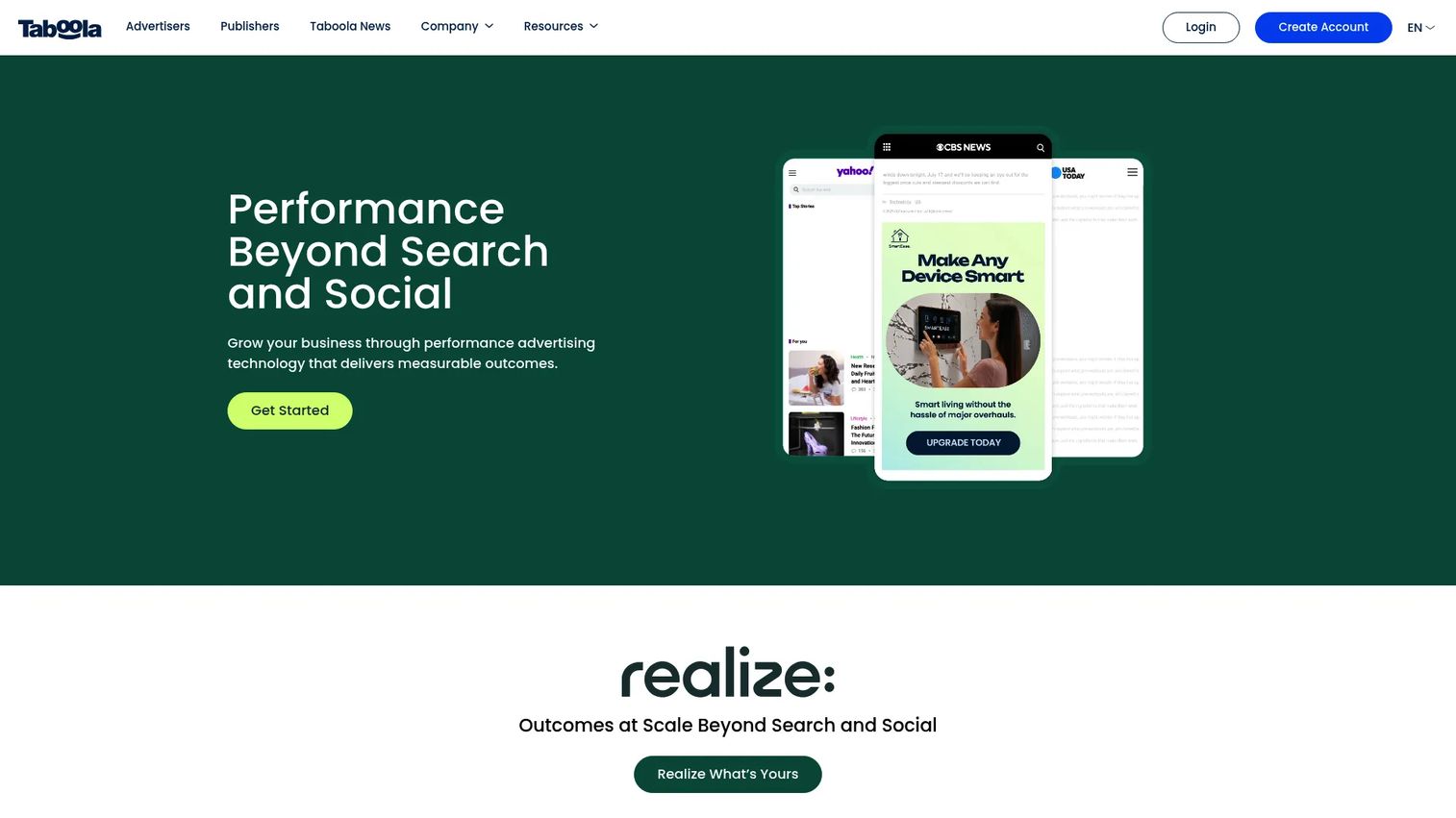
Taboola is the benchmark name in content discovery and native advertising. Its recommendation widgets, the "around the web" and "you may also like" units, appear across a massive publisher network, and the platform serves recommendations to over a billion users every month. For advertisers, that translates into open-web reach at a scale few competitors match. The platform runs on webpages, digital devices, and mobile apps to monetize content and drive engagement.
Best for: Advertisers and publishers needing native ads and content recommendation distribution at open-web scale.
Key strengths
- CPC and CPM campaign pricing: Choose the billing model that matches your performance or awareness goal.
- Publisher monetization and content recommendations: Tap into one of the deepest content discovery networks available.
- Audience targeting and performance reporting: Combine audience signals with reporting that tracks engagement past the click.
Why choose Taboola: If your priority is raw reach and you're running content-led performance campaigns on the open web, Taboola's scale is hard to beat. It's the default first test for many teams precisely because the publisher network is so large. Be deliberate with your allowlists and creative quality so the engagement you buy actually converts.
Taboola pricing: Taboola bills campaigns on a CPC or CPM basis with defined payment schedules, according to its help center. No public starting price or tier table is published on its first-party pricing pages, so budget is set by your bids and spend rather than a fixed plan. Taboola holds a 3.0/5 rating on G2.
2. Outbrain
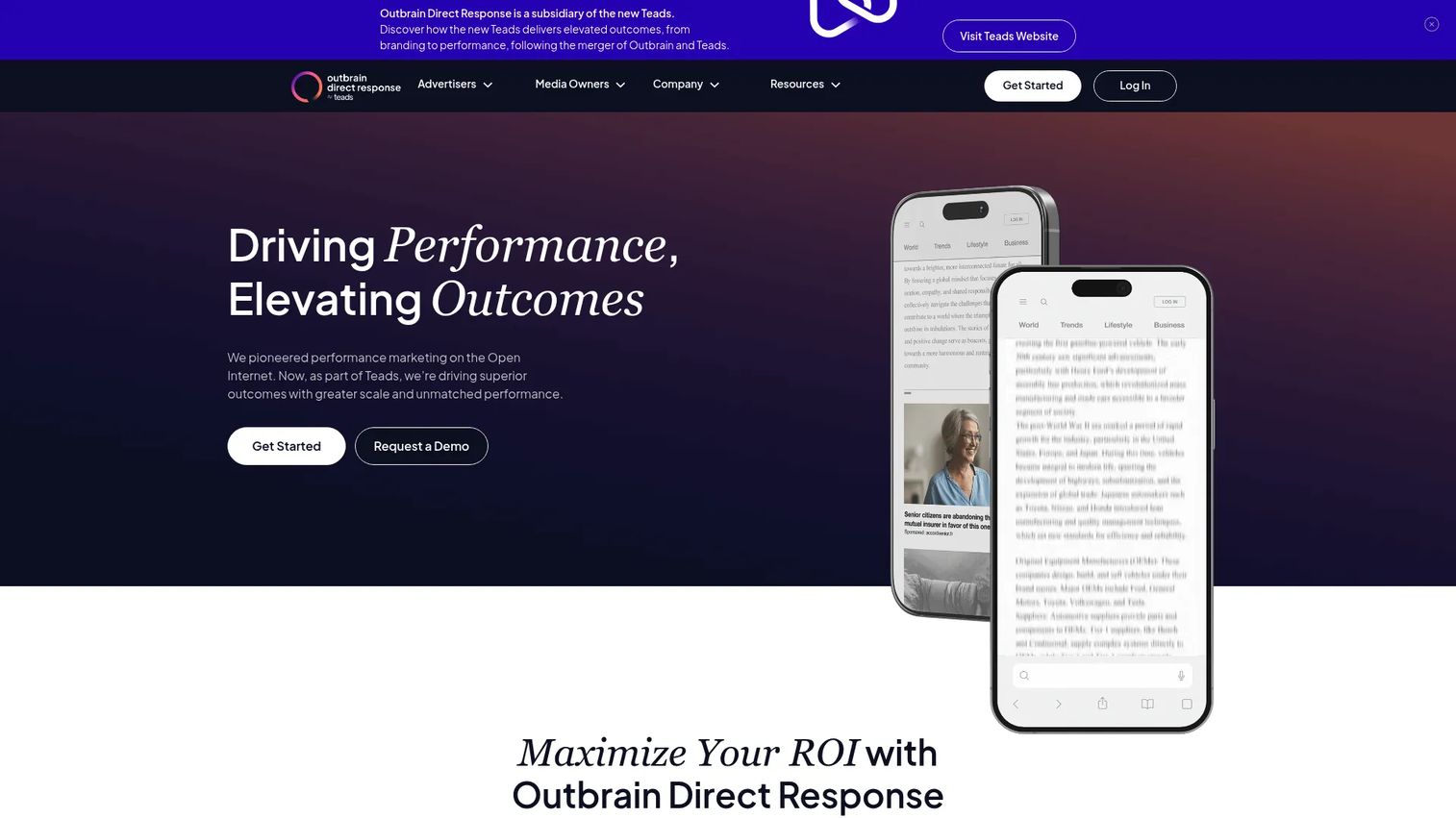
Outbrain, now operating as Outbrain Direct Response by Teads, is the other heavyweight in content discovery, and the one most often praised for cleaner editorial adjacency. Sponsored content is delivered based on a reader's interests and interactions across sites that use Outbrain's technology, which keeps placements feeling native to premium publisher environments. For advertisers who care about where their content shows up, that adjacency matters.
Best for: Advertisers seeking native and performance traffic on the open internet with strong publisher quality.
Key strengths
- Cost-per-click pricing model: Pay for engaged clicks rather than impressions, with automatic or prepayment billing.
- Deep targeting controls: Location, platform, OS, interest, contextual, retargeting, and placement targeting in one place.
- High Impact placements and AdBlock exclusion: Premium units and inventory that surfaces past ad blockers.
Why choose Outbrain: Pick Outbrain when premium publisher adjacency and brand-safe placements matter as much as reach. Its targeting depth and AdBlock exclusion make it a strong fit for performance marketers who want native discovery without sacrificing editorial context. Note the brand is mid-transition under the Teads name, so expect some positioning shifts.
Outbrain pricing: Outbrain uses a CPC model with automatic, threshold, or prepayment billing. No single public starting price is shown on its first-party pages, and credit-card accounts incur a 3% processing fee. Outbrain holds a 3.4/5 rating on G2.
3. StackAdapt
StackAdapt approaches native differently. Rather than a standalone content discovery network, it's an AI-powered programmatic platform where native is one channel inside a broader media mix that spans CTV, DOOH, display, audio, video, and email. For demand gen teams that want native buying unified with the rest of their programmatic media and measurement, that consolidation is the draw.
Best for: Brands and agencies buying programmatic media across multiple channels who want native inside one DSP.
Key strengths
- Cross-channel advertising: Run native alongside CTV, DOOH, display, audio, video, and email from one platform.
- AI-powered orchestration, targeting, and optimization: Automated bidding and audience optimization across channels.
- Real-time forecasting and reporting with first-party data activation: Plan and measure with first-party signals built in.
Why choose StackAdapt: If you're tired of running native in a silo, StackAdapt folds it into a single programmatic workflow with cross-channel reporting. That makes attribution cleaner and reduces the tool sprawl most growth teams are fighting. It's the strongest fit on this list for marketers who think in full-funnel, multi-channel terms rather than native alone.
StackAdapt pricing: StackAdapt uses flexible pricing with self-serve, managed, or hybrid support models, and public dollar figures aren't displayed on its plans page. Pricing scales with media spend and the support model you choose. StackAdapt holds a 4.7/5 rating on G2, the highest in this roundup.
4. MGID
MGID is a native advertising platform built around global reach and contextual targeting. Its AI-based matching pairs ads with relevant page content across a wide publisher network, and the company has documented results like a 143% traffic increase for a publisher using its internal recirculation and contextual targeting technology. For marketers who need international scale, MGID's footprint is a genuine differentiator.
Best for: Advertisers and publishers seeking native ad traffic and monetization with strong international reach.
Key strengths
- CPC-based prepaid campaign billing: Fund campaigns upfront and pay per click for predictable cost control.
- Campaign management and reporting in MGID Ads: Plan, launch, and measure native campaigns in one console.
- Publisher monetization with native, display, and video widgets: Multiple ad formats across the publisher network.
Why choose MGID: MGID suits marketers prioritizing reach and international expansion, especially in markets where the larger discovery networks are thinner. Its contextual targeting makes it a solid cookieless-era pick, and the prepaid model keeps spend disciplined. Pair it with tight brand-safety controls to keep placement quality high.
MGID pricing: MGID uses a CPC prepaid model with a minimum deposit of $100, according to its help center. No subscription plan price is published; budget is governed by your deposit and bids. MGID holds a 4.1/5 rating on G2.
5. TripleLift
TripleLift is a programmatic advertising platform that connects data, creative, and supply to drive measurable outcomes. Its strength is creative-led native that fits the page, delivered through supply curation across web and CTV. For teams running native inside a broader programmatic stack, TripleLift handles the creative formatting and inventory access that make native scale without looking like an afterthought.
Best for: Advertisers and publishers seeking an omnichannel programmatic native platform with strong creative formats.
Key strengths
- Data and audiences: Activate first-party and curated audience data for targeting.
- Creative formats across web and CTV: Native units that adapt to premium inventory and connected TV.
- Supply and curation plus measurement: Curated inventory access paired with outcome measurement and optimization.
Why choose TripleLift: Choose TripleLift when premium inventory and flexible, creative-led native formats matter for your campaigns. It fits teams that already buy programmatically and want native handled with the same rigor as their other channels. The creative formatting is a particular advantage for brand-conscious advertisers.
TripleLift pricing: TripleLift does not publish pricing on its site, and G2 notes pricing details are not currently available, so cost is set through direct negotiation tied to your media plan. TripleLift holds a 4.5/5 rating on G2.
6. Nativo
Nativo, now operating under Life360 Ads branding, is a premium native advertising platform built for sponsored storytelling and branded content at enterprise scale. It specializes in Native Article and Native Display formats that live inside premium editorial environments, giving advertisers deeper alignment with the content readers came to consume. For brands that want their message to feel like part of the story, Nativo is purpose-built for it.
Best for: Advertisers and publishers buying or selling native ad inventory at enterprise scale with editorial alignment.
Key strengths
- Native Article and Native Display ad formats: Sponsored storytelling that reads like editorial, plus standard native display.
- Campaign management with pacing, budgeting, and reporting: Full campaign controls for enterprise media teams.
- Creative optimization and shareable previews: Refine creative and share previews with stakeholders before launch.
Why choose Nativo: Pick Nativo when deeper editorial alignment is the goal and your campaigns lean on storytelling rather than direct-response clicks. It fits enterprise advertisers running branded content programs that need premium placement and polished execution. The Life360 Ads transition is worth tracking as the brand evolves.
Nativo pricing: Nativo does not publish public pricing on its first-party domain, so cost is arranged directly through sales and tied to your campaign scope. Nativo holds a 4.4/5 rating on G2.
7. Pressboard
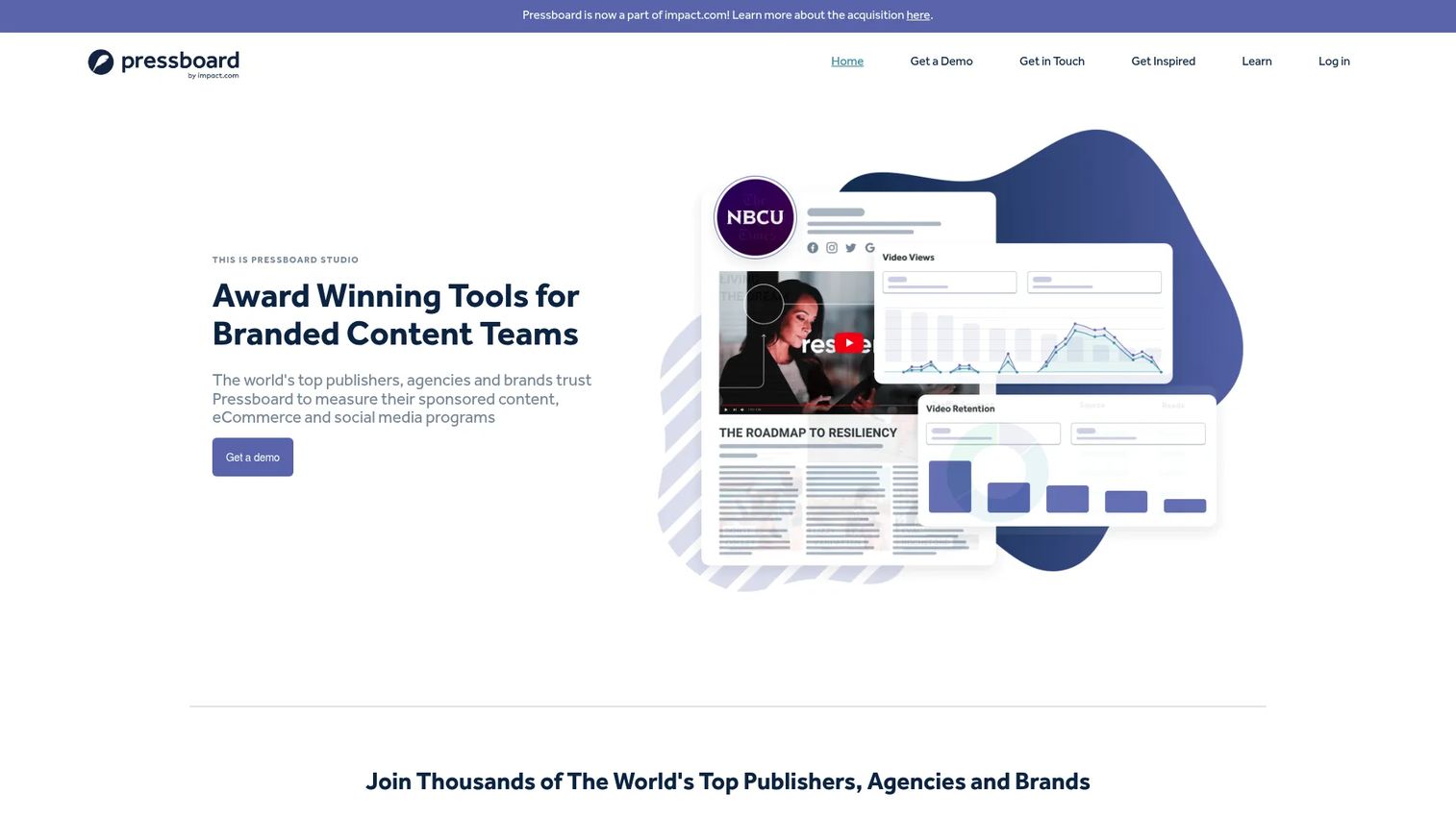
Pressboard, now part of impact.com, is a branded content analytics and reporting platform for publishers, influencers, and brands. Co-founded in 2014, it focuses on measuring and managing sponsored content rather than serving ads itself. Publishers using Pressboard tools include Gannett, The New York Times, Hearst, and NBCUniversal. For content-led advertisers who run sponsored storytelling with publishers directly, Pressboard is the measurement layer that proves it worked.
Best for: Publishers and brands managing branded content measurement, reporting, and publisher partnerships.
Key strengths
- Centralized campaign communications hub: Coordinate branded content campaigns and stakeholders in one place.
- Real-time reporting and shareable client dashboards: Give clients live performance views without manual reports.
- Third-party tracking and integrations: Verify audiences and connect to your existing measurement stack.
Why choose Pressboard: Choose Pressboard when your native motion is sponsored content with publishers and you need transparent, verified reporting to defend the spend. It continuously verifies every publisher's audience and offers transparent pricing, which growth marketers under attribution pressure will appreciate. It complements an ad-serving native platform rather than replacing one.
Pressboard pricing: Pressboard offers a free account for influencers and publishers, with enterprise accounts handled through a free trial and sales contact. No public numeric price is shown on its site.
8. Revcontent
Revcontent is an open-web native advertising and content recommendation platform for advertisers and publishers. Its recommendation widgets distribute content across publisher sites, and the platform emphasizes granular targeting and real-time reporting. For direct-response and reach-driven native campaigns, Revcontent offers a low barrier to entry and quick setup.
Best for: Publishers and advertisers seeking native ad monetization and traffic acquisition with flexible spend.
Key strengths
- Native advertising for advertisers: Distribute content through recommendation widgets across the open web.
- Publisher monetization: Help publishers earn from native, recommendation-style placements.
- Granular targeting and real-time reporting: Refine campaigns with detailed targeting and live performance data.
Why choose Revcontent: Revcontent fits direct-response or reach-driven native campaigns where you want to test quickly without a heavy commitment. The site indicates no minimum spending requirements, though account funding requires a $100 minimum. As with any open-web network, lean on targeting and creative discipline to keep quality high.
Revcontent pricing: Revcontent does not publish a plan price. The site indicates no minimum spend, while account registration requires a $100 minimum initial funding amount, and campaign setup shows a $50 minimum daily budget. Revcontent holds a 3.4/5 rating on G2.
Considerations before you buy native advertising software
The right native advertising company depends on your channel mix, budget, and how seriously you measure. Run every shortlist candidate through these criteria before committing spend.
Reach and audience quality
Raw scale is meaningless if the audience doesn't convert. Look past total reach to placement quality and publisher tier. A smaller premium network often outperforms a massive low-quality one on conversion and brand perception.
Contextual and cookieless targeting
With third-party cookies fading, contextual targeting is the durable signal. Evaluate how well each platform matches ads to page content and intent, and whether its first-party data activation gives you a path that survives cookie deprecation.
Brand safety and transparency
Demand publisher-level visibility, allowlists and blocklists, and third-party verification. Opaque placement is how brands end up next to content they'd never sponsor. Transparent pricing and verified audiences should be table stakes.
Measurement depth beyond clicks
CTR alone won't satisfy a CFO. Prioritize platforms that report dwell time, CPA, ROAS, and post-click conversion, and that integrate cleanly with your analytics and attribution stack. Your goal is a defensible line from native spend to pipeline. Our best brand advocacy software and ai content detectors roundups cover adjacent tools worth auditing as you tighten measurement.
Conclusion
There's no single best native advertising software, only the best fit for your motion. For open-web performance at scale, Taboola and Revcontent lead on reach. For premium editorial adjacency and cleaner brand safety, Outbrain and Nativo are the stronger picks. For teams that want native unified with CTV, display, and audio in one programmatic stack, StackAdapt is the most complete option, and its 4.7/5 G2 rating reflects that. MGID wins on international reach and contextual targeting, TripleLift on creative-led programmatic native, and Pressboard on transparent branded-content measurement.
Start by naming your primary job: distribution, measurable performance, or sponsored storytelling. Then test two platforms against the same content and the same KPIs, tracking dwell time and conversion, not just CTR. The data from a controlled head-to-head will tell you more than any vendor pitch. While you're refining the rest of your stack, our best content marketing tools guide and best component content management systems roundup are worth a look.
FAQs
Native advertising software is a platform that lets you buy, target, and measure ads that match the form and feel of the content around them, like recommended articles or in-feed promotions, rather than interrupting the page with a banner. These native ads platforms handle bidding, contextual targeting, brand safety, and performance reporting across publisher networks.
For pure open-web performance and reach, Taboola and Revcontent lead on volume. For performance marketers who want native unified with other programmatic channels and cleaner attribution, StackAdapt is the strongest fit. The best choice depends on whether you optimize for scale, editorial quality, or cross-channel measurement.
Track past the click. CTR shows interest, but dwell time, CPA, ROAS, and post-click conversion show value. Connect your native platform to your analytics and attribution stack so you can tie spend to engaged sessions and eventually pipeline, the line your CFO actually cares about.
Native delivers a fundamentally different engagement model: because the ad matches the surrounding content, people read it instead of ignoring it. Native display made up 63.1% of U.S. display ad spend in 2024 per eMarketer, which reflects that shift. Display still works for retargeting and broad awareness, so most teams run both and let the data decide the mix.
In-feed recommendation widgets, native article (sponsored storytelling) units, and contextual native placements perform strongly heading into 2026. Formats that respect the reading experience and rely on contextual rather than cookie-based targeting are best positioned as third-party cookies fade.
Choose Taboola for the largest open-web discovery reach. Choose Outbrain when premium publisher adjacency and brand safety matter most. Choose StackAdapt when you want native folded into a full programmatic stack with CTV, display, and audio plus cross-channel reporting. All three bill on a media-spend model rather than a fixed seat price.
Prioritize four things: audience quality over raw reach, contextual and cookieless targeting depth, brand-safety and transparency controls, and measurement that goes beyond CTR to CPA, ROAS, and conversion. The right platform reduces tool sprawl and gives you attribution you can defend in a budget review.
Yes, and arguably more so. Native leans heavily on contextual targeting, matching ads to page content and reader intent rather than cross-site tracking. That makes it one of the more durable performance channels as third-party cookies disappear, which is a big part of why native spend keeps growing into 2026.