

You ran a clean cycle. Discovery was tight, the demo landed, the champion said yes. Then the contract left your hands and vanished into legal, procurement, and finance. Two weeks passed. Then three. Redlines bounced between inboxes with no version anyone trusted.
Deals do not stall because the product loses. They stall because the paperwork does.
The global CLM software market reached USD 2.6 billion in 2025 and is forecast to hit USD 5.7 billion by 2034, a 9.2% CAGR, according to Research and Markets (2025). That growth is not academic. It reflects how many revenue teams have watched a signed-in-principle deal die in an approval loop and decided to fix the machinery around the contract.
Contract lifecycle management software is the machinery. It moves a contract from draft to signature to renewal without the manual chasing that eats late-stage momentum. For an account executive, that is not a legal nicety. It is cycle time, forecast accuracy, and quota. This guide breaks down eight contract management software platforms worth shortlisting in 2026, what each one is built for, and how to pick based on the friction you actually feel.
What's inside
This guide is written for revenue and deal teams evaluating contract lifecycle management software, not just legal ops. We looked past feature checklists and focused on what moves deals.
We chose the eight platforms below on four criteria:
- Workflow depth: how well the tool automates approvals, redlining, and negotiation
- Repository and search: how fast you find what is signed, what is stuck, and what is renewing
- Integration fit: how cleanly it connects to CRM, e-signature, and procurement systems
- Enterprise governance: audit trail, permissions, compliance, and reporting
Every pricing note and G2 rating below reflects verified vendor and third-party sources at the time of writing.
TL;DR
Short on time? Here is the fast read.
- Best for enterprise governance: Icertis, for large organizations with serious compliance and reporting requirements
- Best for legal ops workflow automation: Ironclad, for legal and revenue teams that want end-to-end contract automation
- Best for post-signature and value protection: Sirion, when contract value leakage and obligation tracking are the concern
- Best for e-signature adjacency: Docusign CLM, if you already live inside the Docusign environment
- Best for CRM-connected sales teams: Conga CLM, for Salesforce-heavy revenue orgs
- Best for tailored workflows: Agiloft, when out-of-the-box paths do not fit your process
- Best for AI-assisted contract intelligence: LinkSquares CLM and Workday CLM, for fast visibility into signed contracts
What is contract lifecycle management software?
Contract lifecycle management software is a platform that manages a contract across its entire life, from creation and negotiation to execution, storage, analysis, and renewal, in one system instead of scattered documents and email threads.
The lifecycle it manages breaks into clear stages:
- Creation: drafting from templates and clause libraries
- Negotiation: redlining, version control, and collaborative markup
- Execution: approval routing and e-signature
- Storage: a centralized, searchable contract repository
- Analysis: reporting on terms, risk, and performance
- Renewal: alerts and renewal management before deadlines slip
Core capabilities most CLM platforms share include:
- Clause management: reusable, pre-approved clause libraries
- Contract approval workflow: automated routing to the right approvers
- Contract repository: a single source of truth for signed agreements
- Audit trail: a complete record of who changed what and when
- Obligation tracking: monitoring deliverables and commitments after signing
- Renewal management: proactive alerts on upcoming expirations
Why does this matter for an AE? Because contracts are where late-stage deals go quiet. A tool that shortens the approval loop and kills redline chaos protects the cycle time you already fought for. CLM is not a legal tool that happens to touch sales. In a governed enterprise deal, it is deal infrastructure.
When to use CLM software
Not every team needs enterprise contract lifecycle management. Here is when it earns its cost.
Speed up late-stage deals
The deal is verbally won and now sitting in approvals. If your last three deals each lost a week to routing and signature chasing, that is recoverable cycle time. CLM software automates the contract approval workflow so the document moves to the right approver the moment it is ready, not when someone remembers to forward it.
Reduce redline chaos
Redlines fly between legal, procurement, and the buyer's counsel, and nobody knows which version is current. Contract redlining software inside a CLM keeps every markup in one place with version control. Your legal team negotiates from a single source, and you stop reconstructing what was agreed from a chain of attachments.
Standardize approvals across teams
When every deal follows a different approval path, forecasting breaks. CLM software enforces consistent rules: which discount triggers which sign-off, which clause requires legal review, which contract skips straight to signature. Standardized approvals make your contract negotiation workflow predictable, which makes your forecast defensible.
CLM software comparison
The table below sorts the eight platforms by fit. Use it as a shortlist starter, then read the sections for the workflow detail that matters to your deals. Pricing across enterprise contract lifecycle management software is almost universally quote-based, so treat the pricing column as a guide to model rather than a live number.
| # | Product | Best for | Key use case | Pricing | G2 rating |
|---|---|---|---|---|---|
| 1 | Ironclad | Legal and revenue teams | End-to-end contract automation with AI drafting | Custom quote | 4.4/5 |
| 2 | Icertis | Large enterprises | Contract intelligence and governance at scale | Custom quote | 4.2/5 |
| 3 | Sirion | Enterprises with services contracts | Post-signature obligation tracking | Custom quote | 4.5/5 |
| 4 | Docusign CLM | Docusign ecosystem teams | Agreement workflow adjacent to e-signature | Custom quote | 4.3/5 |
| 5 | Conga CLM | Salesforce-centric sales orgs | CRM-connected contract generation | Custom quote | Not published |
| 6 | Agiloft CLM Platform | Teams needing custom workflows | No-code configurable process design | Custom quote | 4.5/5 |
| 7 | Workday CLM | Enterprise teams needing AI workflows | AI-powered creation and redlining | Custom quote | 4.6/5 |
| 8 | LinkSquares CLM | Legal and ops teams | AI contract analysis and repository search | Custom quote | 4.7/5 |
Best CLM software tools for 2026
1. Ironclad

Ironclad is AI-powered contract lifecycle management software for creating, reviewing, signing, storing, and analyzing contracts. It pairs workflow automation with an AI assistant, Jurist, that helps teams draft, review, and research faster. For revenue teams, the appeal is a system where the contract approval workflow runs on rules rather than reminders.
Ironclad is a common shortlist candidate for larger legal and revenue teams because it treats the whole lifecycle as one connected flow. Drafts pull from a controlled clause library, approvals route automatically, and everything lands in a centralized contract repository you can actually search.
Best for: legal and business teams that need enterprise contract automation tied closely to how sales moves deals.
Key strengths
- Contract lifecycle management workflows with automated routing
- AI assistant (Jurist) for drafting, reviewing, and research
- Centralized contract repository with analytics
Why choose Ironclad: if your deals stall in redlines and approval loops, Ironclad's workflow engine is built to compress that stage. It fits AEs who need contracts to move without babysitting.
Ironclad pricing: pricing is custom and demo-based. No public numeric starting price is listed on the Ironclad pricing page, so expect a scoped quote based on volume and teams.
2. Icertis
Icertis is an AI-native contract intelligence and CLM platform built for enterprise contracting. Where lighter tools stop at storage and signing, Icertis leans hard into what your contracts mean: obligations, performance, and risk across legal, procurement, sales, and operations.
For enterprise AEs, this matters because large deals carry governance weight. Icertis gives legal and compliance the reporting depth they need, which removes a common source of late-stage friction: the security and compliance review that stalls a deal nobody wants to lose.
Best for: large enterprises that need contract intelligence and governance across multiple departments.
Key strengths
- AI-native contract intelligence
- Contract lifecycle management workflows
- Analytics, obligations, and performance management
Why choose Icertis: choose it when the buying committee spans legal, procurement, and operations, and reporting rigor is a gate you cannot skip. It is built for scale, not for a two-person deal desk.
Icertis pricing: Icertis does not publish public pricing. The contact flow routes to a sales conversation and demo, so pricing is scoped per enterprise deployment.
3. Sirion

Sirion is an AI-native contract lifecycle management platform focused on the full lifecycle, with real strength after the ink dries. Its standout is post-signature execution: obligation tracking, compliance monitoring, and invoice reconciliation that catch value leakage before it compounds.
This angle matters when a signed contract is only the start of the relationship. For services and SLA-heavy agreements, the money leaks in the months after signing when nobody is tracking what was promised. Sirion's contract intelligence surfaces those obligations and holds both sides accountable.
Best for: large enterprises that need AI-driven CLM with serious post-signature and value-protection capability.
Key strengths
- AI-powered contract extraction and structured data capture
- Conversational contract intelligence and natural-language querying
- Obligations, compliance, and invoice reconciliation monitoring
Why choose Sirion: pick Sirion when contract value leakage is a board-level concern and your agreements carry ongoing SLAs. It is less about signing faster and more about protecting the value of what you sign.
Sirion pricing: Sirion does not display public pricing. The site directs you to request a demo, and quotes are scoped to enterprise deployment.
4. Docusign CLM
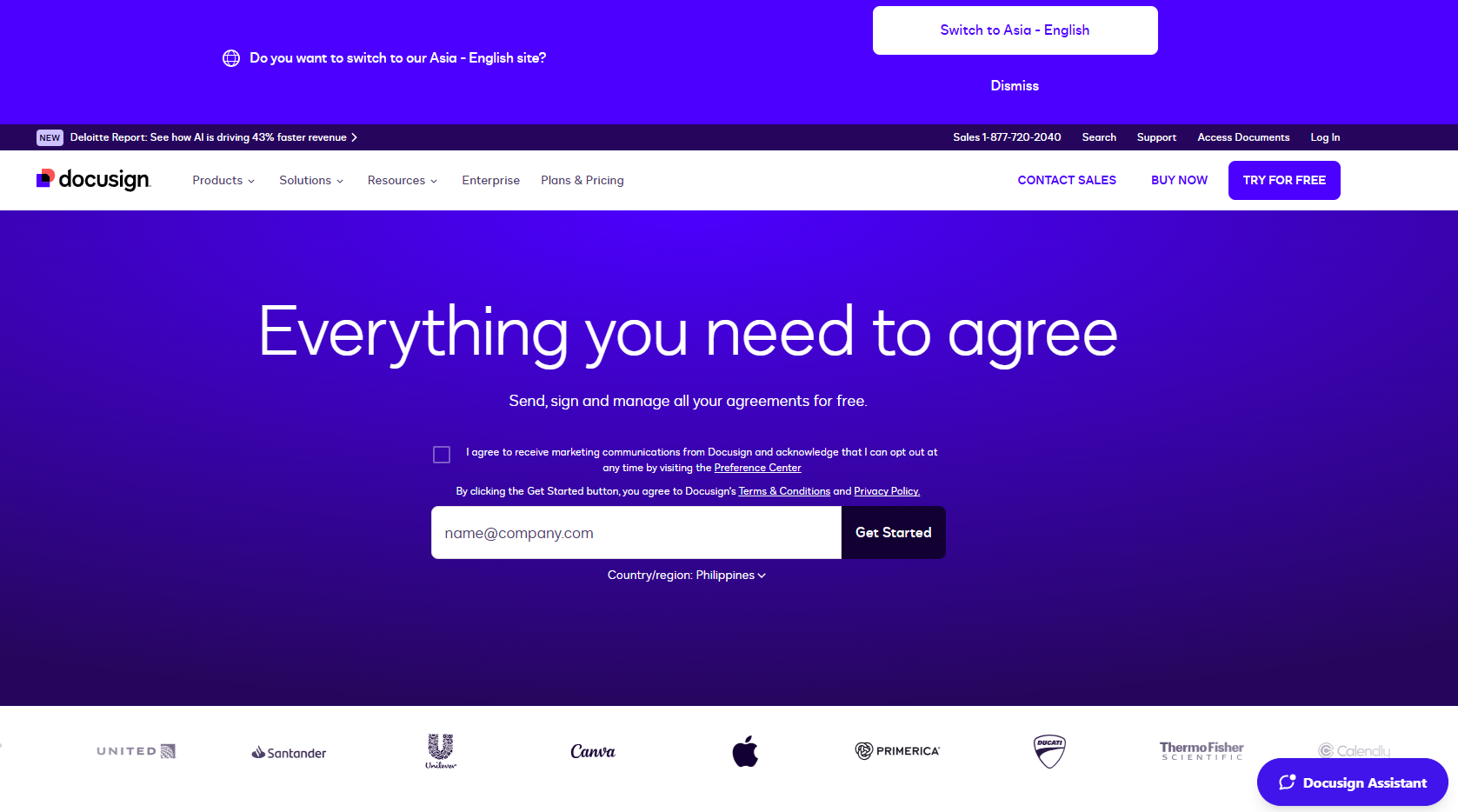
Docusign CLM is enterprise contract lifecycle management software for drafting, negotiating, routing, storing, and analyzing agreements. Its natural advantage is adjacency: if your organization already runs e-signature through Docusign, the CLM layer extends that into full workflow automation without introducing a new vendor.
According to Business Research Insights (2025), 71% of enterprises integrate CLM with e-signature and document authentication platforms. That integration reality is exactly where Docusign CLM lives, connecting the signature step you already trust to the drafting, approval, and repository steps before it.
Best for: large teams that want enterprise-grade contract workflow automation connected to an e-signature workflow they already use.
Key strengths
- Automated contract generation and clause libraries
- Workflow routing, approval, and negotiation
- Central searchable repository with analytics and AI-assisted review
Why choose Docusign CLM: if adoption is your risk, the familiar Docusign environment lowers the change-management cost. Teams already inside that ecosystem shortlist it to avoid rebuilding a signature workflow that works.
Docusign CLM pricing: the Docusign CLM product page routes to Contact Sales. No public CLM price is displayed, so expect a scoped enterprise quote billed per user.
5. Conga CLM

Conga CLM is a contract lifecycle management platform for creating, negotiating, signing, storing, and reporting on contracts. Its differentiator for sales orgs is CRM alignment: Conga has deep roots in the Salesforce world, so the contract can live close to the opportunity instead of in a separate silo.
That connection matters for AEs who want the contract negotiation workflow to reflect what is already in the CRM. Template management, redlining, approvals, and renewal management all run against records your team already maintains, which cuts the double entry that slows deal desks.
Best for: enterprise legal, sales, and procurement teams that want tight CRM-connected contract workflows.
Key strengths
- Centralized contract repository with version control and audit trail
- Contract creation, redlining, approval workflows, and renewal management
- AI-powered search, reporting, and third-party paper risk assessment
Why choose Conga CLM: if your revenue org runs on Salesforce, Conga keeps contracts in the same gravity well as your pipeline. That proximity reduces handoff friction between sales and the deal desk.
Conga CLM pricing: Conga does not list public pricing. The site directs you to contact sales for a scoped quote based on your workflow and volume.
6. Agiloft CLM Platform
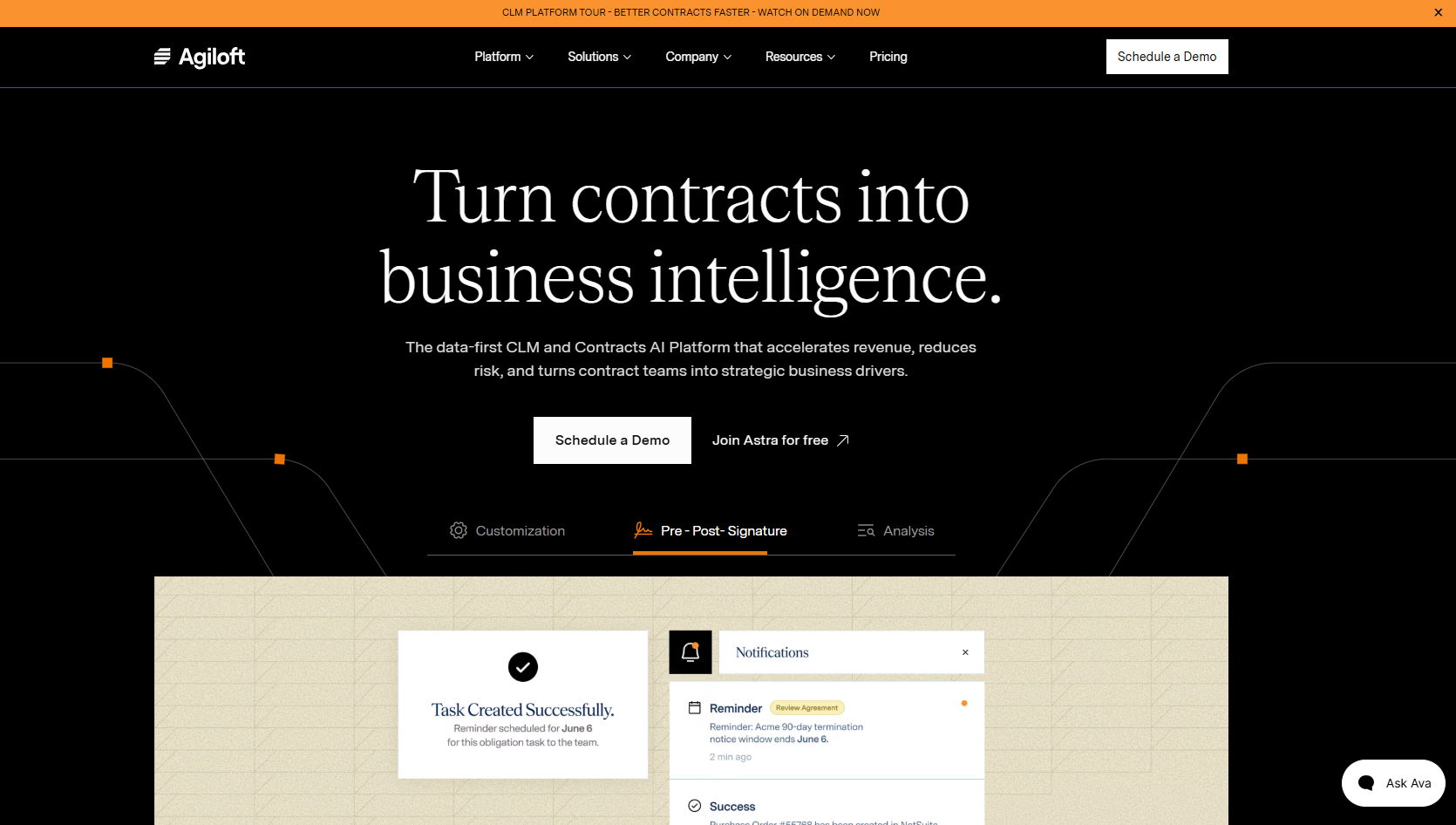
Agiloft is an enterprise contract lifecycle management platform for managing the full contract process from intake through renewal. Its calling card is configurability: a no-code engine that lets teams design workflows around their actual process instead of forcing the process into a rigid template.
For organizations with unusual approval logic or industry-specific requirements, that flexibility is the reason to shortlist it. If your contract approval workflow does not fit a standard mold, Agiloft is built to bend to it rather than the reverse.
Best for: large organizations that need highly configurable CLM with strong workflow and post-signature management.
Key strengths
- End-to-end lifecycle control from intake to renewal
- No-code workflow and automation configuration
- Searchable repository with reporting, dashboards, alerts, and obligation tracking
Why choose Agiloft: choose it when your process is the constraint, not the software. Teams that have outgrown out-of-the-box tools use Agiloft to model exactly the paths they need.
Agiloft pricing: Agiloft does not display public pricing. The pricing page shows a get-pricing prompt, so quotes are scoped to your configuration and scale.
7. Workday Contract Lifecycle Management

Workday Contract Lifecycle Management, powered by Evisort AI, is AI-powered CLM software focused on unified workflows, visibility, and process clarity. The framing is accountability and collaboration: one workspace where contract creation, negotiation, approvals, and search sit together and everyone can see where a document stands.
For teams already inside the Workday environment, that visibility is the draw. When a stakeholder asks where a contract is, the answer is one screen away rather than a round of Slack messages and forwarded emails.
Best for: enterprise teams that need AI-assisted contract creation, negotiation, approvals, and search in a unified workspace.
Key strengths
- End-to-end, AI-powered workflows
- Automated redlining
- Clause library and contract templates
Why choose Workday CLM: if your organization already runs Workday and wants contract visibility inside a familiar system, this keeps the process and the people in one place. The Evisort AI layer adds analysis on top of workflow.
Workday CLM pricing: Workday does not publish public pricing on its CLM product page. Pricing is contact-sales only, scoped to your deployment.
8. LinkSquares CLM
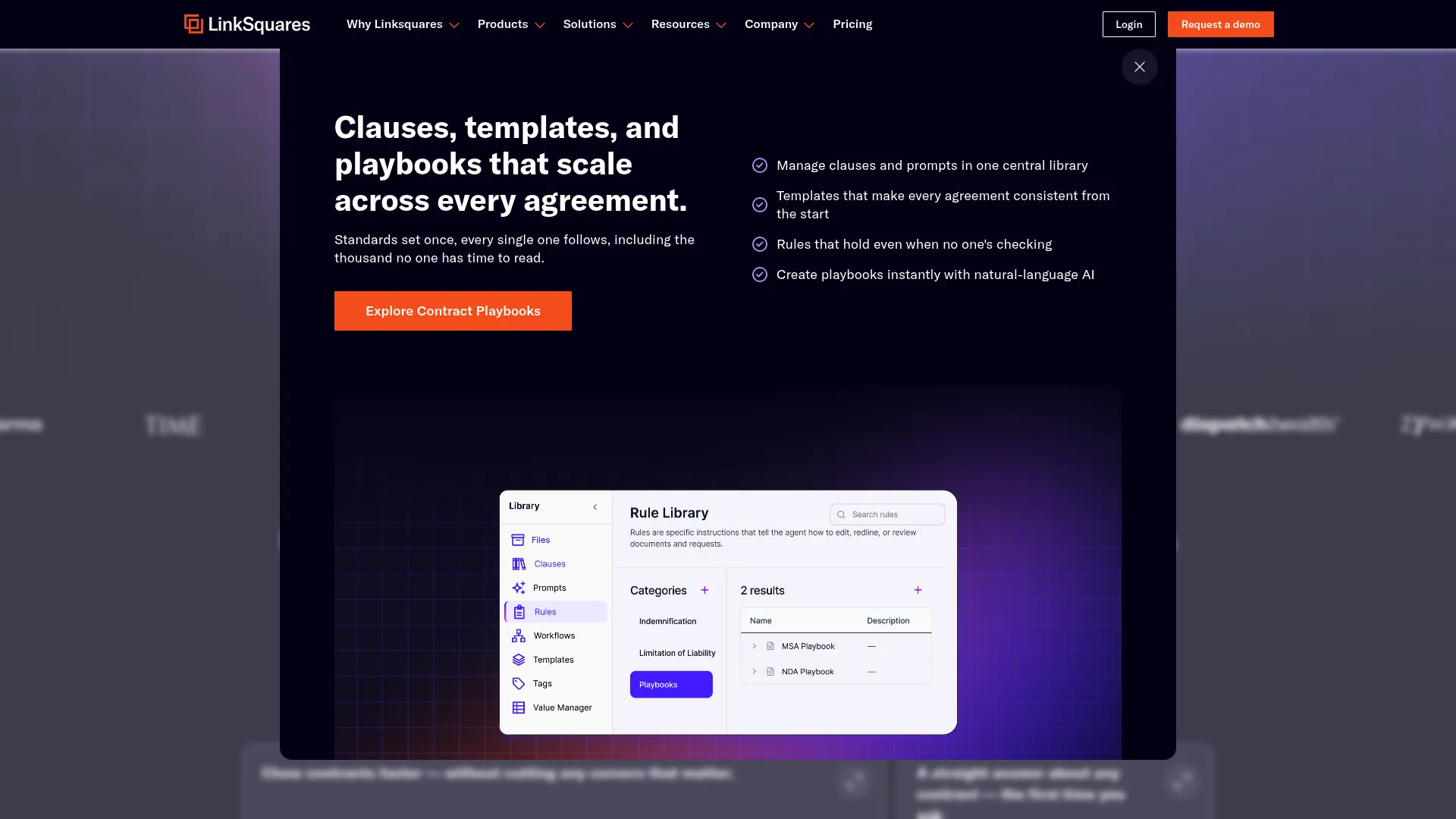
LinkSquares CLM is AI-powered contract lifecycle management software built for legal and operations teams that need fast visibility into what is signed and what is stuck. Its practical strength is the repository and analytics layer: AI-assisted contract analysis that surfaces terms, obligations, and status without a manual read of every document.
That speed-to-visibility is useful when the question is not "how do we sign faster" but "what did we already agree to." For a revenue team, knowing renewal dates and buried terms across a large book of signed contracts is the difference between a proactive renewal and a surprise churn.
Best for: legal and operations teams that need AI-driven contract lifecycle management with strong repository search.
Key strengths
- Contract management across the full lifecycle
- Reporting and analytics
- Collaboration and workflows
Why choose LinkSquares CLM: pick it when your immediate pain is visibility into existing agreements, not just new-deal velocity. The AI analysis makes a large contract repository searchable and actionable.
LinkSquares CLM pricing: LinkSquares does not list public pricing. The company scopes quotes to organization size and needs, so expect a tailored figure after a sales conversation.
Considerations before you buy
A CLM demo will always look clean. Your job is to pressure-test it against the reality of your deal cycles. Here is the checklist.
Implementation reality
Ask how long a comparable customer took to go live, not the vendor's best case. Enterprise CLM rollouts commonly run one to six months depending on template migration and workflow complexity. Model that timeline against your quota, because a tool that takes two quarters to deploy does not help this year's number.
Integration fit
Verify native connections to your CRM, e-signature, and procurement workflow before you sign. A CLM that does not talk to Salesforce or your document system creates the double entry it was supposed to kill. Confirm the depth of the integration, not just that a logo appears on a partner page.
Security and auditability
Enterprise buyers gate on SOC 2, ISO 27001, and GDPR. Confirm the platform's certifications and its audit trail: who changed what, when, and whether that record survives export. This is the same review that stalls your own deals, so make sure the tool clears it fast.
Approval logic and reporting
Map your actual contract approval workflow and ask the vendor to build it in the demo. If your discount tiers, legal-review triggers, and signature rules do not translate cleanly, you will fight the tool. Then check that reporting surfaces cycle time and bottlenecks, because that data is how you defend the investment internally.
Conclusion
The right CLM depends on the friction you are solving, not the longest feature list. For enterprise governance and contract intelligence across departments, Icertis and Workday CLM carry the depth. For legal ops workflow automation that compresses late-stage deals, Ironclad is the strong pick. When value leakage and post-signature obligation tracking are the concern, Sirion leads. Sales-led teams living in Salesforce lean toward Conga CLM, while Docusign CLM fits organizations already standardized on that e-signature workflow. Agiloft wins when your process needs bending, and LinkSquares CLM earns its place when visibility into signed contracts is the immediate gap.
Choose by matching the tool to your bottleneck. If deals die in approvals, prioritize workflow automation. If they die in review, prioritize governance and audit trail. If revenue leaks after signing, prioritize obligation tracking. Run a scoped demo against your own contract approval workflow, and make the vendor prove it on your process, not their slides.
FAQs
CLM software manages a contract across its full lifecycle: creation, negotiation, execution, storage, analysis, and renewal. It replaces scattered documents and email threads with one system that automates approvals, keeps a searchable contract repository, and tracks obligations after signing. The result is less manual chasing and faster, more consistent contracting.
Contract management often refers to the narrower task of storing and tracking signed contracts. Contract lifecycle management is broader, covering the entire journey from drafting and redlining through execution, analysis, and renewal. Most modern contract management software now spans the full lifecycle, so the terms are frequently used interchangeably.
Prioritize a strong contract approval workflow, contract redlining software with version control, a centralized contract repository, and a complete audit trail. For post-signature value, look at obligation tracking and renewal management. Then confirm integrations with your CRM, e-signature, and procurement systems, because integration fit determines whether the tool actually reduces work.
Legal, procurement, finance, sales, and operations all touch CLM. Legal owns clause management and risk, procurement runs the procurement workflow, and finance tracks obligations. Sales and revenue teams increasingly care because contracts are where late-stage deals stall, and a faster contract negotiation workflow protects cycle time.
It compresses the stage where verbally-won deals go quiet. Automated approval routing sends contracts to the right approver instantly, redlining stays in one version-controlled place, and standardized rules make the path predictable. That combination shortens the gap between "yes" and signature, which is often the longest unmanaged part of an enterprise cycle.
No. While legal contract management software started as a legal ops tool, CLM now serves the whole revenue motion. Sales uses it to move deals, procurement uses it for vendor contracts, and finance uses it for obligation and renewal tracking. In a governed enterprise deal, it functions as shared deal infrastructure.
Ask the vendor to build your actual contract approval workflow in the demo, not a generic one. Confirm SOC 2, ISO 27001, and GDPR compliance, the depth of your CRM and e-signature integrations, and a realistic implementation timeline from a comparable customer. Then check that reporting surfaces cycle time so you can prove impact.
Timelines vary with complexity, but enterprise CLM deployments commonly run one to six months. Template migration, clause library setup, integration work, and approval-logic configuration drive the range. Ask each vendor for a timeline based on a customer with a similar contract volume and workflow, and factor that into your legal ops software rollout plan.