A missed shipment window in automotive is not a rounding error. When a tier supplier ships a sequenced part late, an OEM line can stop, and the penalties escalate by the hour. Yet most of the plants living with that risk are running production, purchasing, quality, and compliance in systems that barely talk to each other.
That disconnect is the real reason ERP selection stalls. Every vendor claims "real-time visibility." Few of them mean the same thing by it. A generic ERP gives you visibility into ledgers and stock counts. An automotive-fit ERP gives you visibility into EDI releases, sequenced builds, PPAP status, and supplier performance across multiple tiers, all tied to the same production schedule.
The stakes are only climbing. The automotive ERP market is projected to grow from USD 6.2 billion in 2026 to USD 8.72 billion by 2031, a 7.07% CAGR, according to Mordor Intelligence (2026). ERP adoption in the automotive industry already sits around 72%, among the highest of any ERP-using sector, per ERPSoftware.com (2024). The question for most buyers is no longer whether to run ERP. It is which system actually understands how cars get built.
That is where automotive ERP software diverges from generic ERP. Automotive runs on just-in-time and just-in-sequence delivery, multi-tier supplier coordination, mandated quality gates, and traceability that has to survive an audit years after a part left the dock. A finance-first ERP treats those as add-ons. An industry-fit system treats them as the core.
What's inside
This guide covers eight ERP software for automotive operations, spanning large OEMs, tier suppliers, and specialty vehicle manufacturers. Some are broad cloud ERP platforms with strong manufacturing modules. Others are automotive-specific suites built around sequenced production and supplier compliance.
We compared each option on the criteria that actually separate an auto ERP from a generic one:
- Automotive fit: support for EDI, JIT/JIS, sequencing, and supplier compliance
- Supply chain depth: multi-tier coordination, inventory visibility, procurement
- Manufacturing planning: discrete, repetitive, and mixed-mode production
- Quality and traceability: IATF 16949, APQP, PPAP, FMEA, audit-ready records
- Cloud flexibility: deployment options, scale, and roadmap
- Implementation practicality: partner ecosystem, timeline, change management
The goal is to help you shortlist, not just define the category. Read the fit notes, not only the feature lists.
TL;DR
- Best for large, global OEMs: SAP S/4HANA, for enterprise-scale process depth and embedded analytics.
- Best automotive-specific cloud suite: Infor CloudSuite Automotive, built around multi-mode manufacturing and sequence control.
- Best manufacturing-first agility: QAD Adaptive ERP, tuned for global manufacturers that need to reconfigure fast.
- Best cloud-first mid-market backbone: Acumatica or NetSuite, depending on whether you want manufacturing depth or financial breadth.
- Best modular or open-source flexibility: Odoo, for smaller operations building ERP from apps.
- Best shop-floor and quoting depth: Epicor Kinetic or SYSPRO, for suppliers that live in production detail.
What is automotive ERP software?
Automotive ERP software is an enterprise resource planning system tailored to the manufacturing, supply chain, and quality workflows of automotive OEMs, tier suppliers, and specialty vehicle manufacturers. It connects production, procurement, inventory, quality, and finance on one data model so a change in one area updates the others in real time.
An automotive manufacturing ERP typically includes:
- Supply chain integration: EDI, multi-tier supplier coordination, and demand-to-delivery visibility
- Production planning: JIT, JIS, sequencing, and mixed-mode scheduling
- Quality management: APQP, PPAP, FMEA, and non-conformance tracking
- Inventory visibility: real-time stock, WIP, and consignment tracking
- Compliance and traceability: IATF 16949 support and audit-ready genealogy
- Analytics and reporting: real-time dashboards on OEE, on-time delivery, and cost
- Optional AI and IoT: predictive planning, machine data capture, and automation
Here is why the distinction matters. A generic ERP can invoice a customer and count parts. An ERP for the automotive industry has to schedule a sequenced build tied to an OEM release, prove the genealogy of every component in that build, and pass an IATF 16949 audit without a manual scramble. Automotive-specific complexity is not a reporting layer bolted onto finance. It is the operating logic of the plant.
When to use automotive ERP software
Not every manufacturer needs an automotive-specific suite on day one. These are the situations where the industry fit starts paying for itself.
Use it when you need end-to-end supplier visibility
Automotive supply chains run several tiers deep, and timing is everything. When an OEM issues a release, purchasing, inventory, and EDI have to move together, or the shortage surfaces on the line instead of in a report. An automotive ERP connects these into one flow, so a demand signal updates supplier schedules and inventory positions at once.
A generic ERP can track purchase orders. It rarely models the release-to-shipment cadence of a tiered supply base, which means the buyer ends up reconciling EDI in spreadsheets. That is where delays and expedite costs come from.
Use it when production planning is tied to traceability
Just-in-time and just-in-sequence production only work when the schedule, the shop floor, and the quality record stay locked together. Picture the flow:
- Demand release lands from the OEM
- Scheduling sequences the build to the delivery slot
- Shop floor execution reports actuals back to the plan
- Quality gates capture inspection and non-conformance data
- Traceability records tie every part to its genealogy
If manufacturing execution and ERP data drift apart, you lose the ability to answer the one question an OEM will ask after a defect: which vehicles have this part? Tight alignment is what makes that answer instant instead of a two-week investigation.
Use it when compliance pressure is part of the buying decision
For most suppliers, compliance is not paperwork. It is the price of staying on the platform. If your buying committee is weighing certifications, the ERP has to carry them natively:
- IATF 16949 quality management
- APQP for new product planning
- PPAP for part approval submissions
- FMEA for failure mode analysis
- MMOG/LE for materials management assessment
- Emissions, safety, and audit-ready reporting
Frame compliance as operational risk reduction. Embedded quality workflows mean an audit is a report you run, not a project you staff.
Comparison table
We ranked these by relevance to automotive buyers and buyer intent, weighting industry fit and manufacturing depth over generic breadth. Pricing in automotive ERP is mostly quote-based because scope, module count, and deployment drive the number. G2 ratings reflect current listings at the time of writing; where a clean rating was not available, we noted it.
| # | Product | Intent | Key differentiation | Pricing | G2 rating |
|---|---|---|---|---|---|
| 1 | Odoo | Modular ERP for smaller or lean automotive operations | Open-source app model, free single-app entry | From $0; Standard $24.90/user/mo | 4.1/5 |
| 2 | Acumatica | Cloud ERP for mid-market manufacturers | Unlimited-user pricing, manufacturing edition | APEX for manufacturing under $2,185/mo | 4.4/5 |
| 3 | NetSuite | Cloud ERP backbone for multi-site operations | Broad financial and operational suite | Quote-based | Not listed |
| 4 | SAP S/4HANA | Enterprise ERP for large, global OEMs | Embedded AI, industry best-practice processes | Quote-based | 4.4/5 |
| 5 | Infor CloudSuite Automotive | Automotive-specific cloud ERP | Multi-mode manufacturing, sequence control | Quote-based | 3.9/5 |
| 6 | QAD Adaptive ERP | Manufacturing-first ERP for global plants | Configurable, agile reconfiguration | Quote-based | 3.5/5 |
| 7 | Epicor Kinetic | Manufacturing ERP with shop-floor depth | Discrete, make-to-order, quoting strength | Quote-based | 3.9/5 |
| 8 | SYSPRO | ERP for mid-market manufacturers and distributors | Configurable pricing engines, cost control | Quote-based | 4.1/5 |
The pattern to notice: the two automotive-specific and enterprise options sit alongside broad cloud platforms with strong manufacturing modules. Which one fits depends less on the feature checklist and more on your manufacturing model, supplier complexity, and compliance burden.
1. Odoo
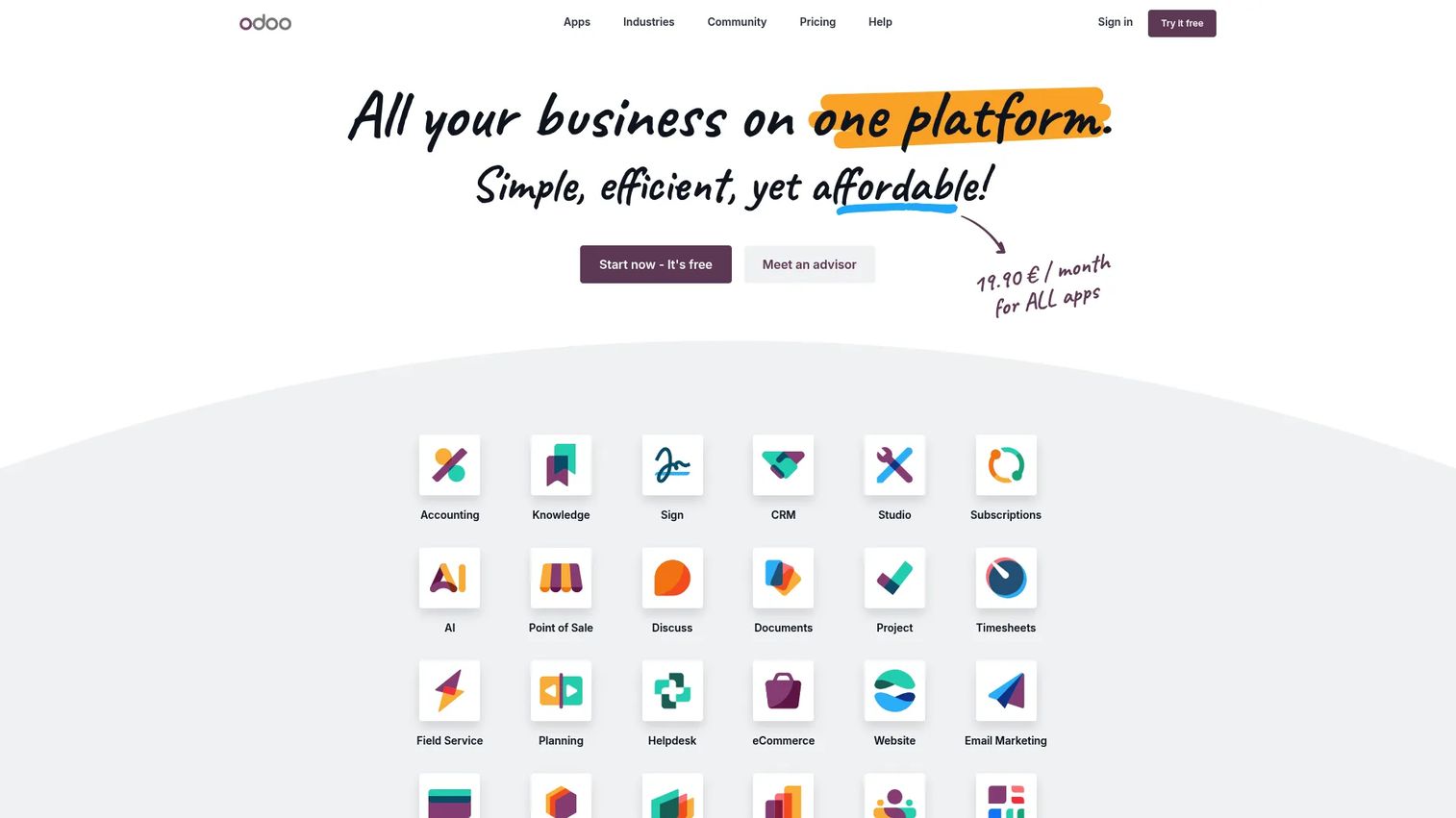
Odoo is an all-in-one open-source business apps platform covering ERP, CRM, accounting, inventory, and manufacturing. Instead of buying a monolithic suite, you assemble the modules you need, which appeals to smaller automotive shops and lean suppliers that want to start focused and expand as operations grow. The free single-app tier makes it one of the lowest-friction ways to test an ERP workflow before committing budget.
Best for: Smaller or modular automotive operations that want flexible ERP building blocks rather than a full industry suite.
Key strengths
- Modular app suite: Add manufacturing, inventory, and purchasing as separate apps and grow the footprint over time.
- All apps on paid plans: Paid tiers unlock the full catalog, so expansion does not mean re-buying.
- Free entry point: One App Free with unlimited users lets you validate a single workflow at zero cost.
Why choose Odoo: Odoo fits teams that value configurability and cost control over prebuilt automotive workflows. If your supplier compliance and sequencing needs are light or handled elsewhere, the modular model keeps you from paying for capability you will not use. Operations with deep IATF 16949, PPAP, and JIS requirements will likely need to build or extend those workflows, so weigh internal or partner capacity before committing.
Odoo pricing: Odoo publishes three public tiers. One App Free is $0 for a single app with unlimited users. Standard is $24.90 per user per month, and Custom is $49.00 per user per month, both billed monthly. Paid plans include the full app catalog.
2. Acumatica
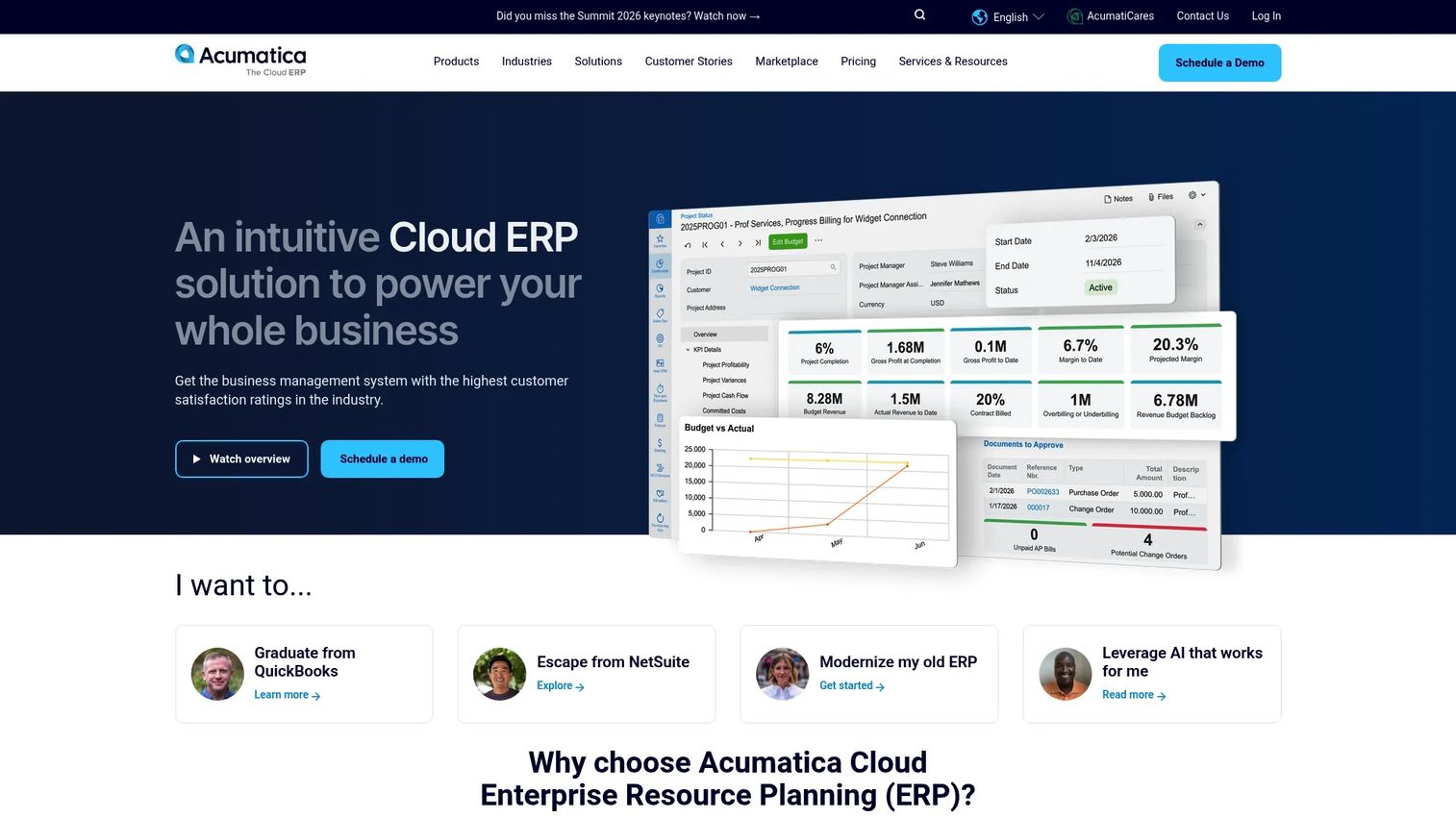
Acumatica is a cloud ERP built for mid-market businesses, with a manufacturing edition that brings production planning, distribution, and project accounting into one platform. Its unlimited-user pricing model stands out for growing automotive suppliers, since you scale headcount without scaling license cost. That structure appeals to teams that want bundled software, implementation, and support without per-seat math slowing adoption.
Best for: Mid-market automotive manufacturers that want modular cloud ERP with predictable, resource-based pricing.
Key strengths
- Financial management: Core accounting and reporting integrated with operations for real-time control.
- Project accounting: Track cost and margin across complex builds and programs.
- Distribution and manufacturing modules: Production, inventory, and purchasing configured for discrete operations.
Why choose Acumatica: Acumatica works well for suppliers that expect to add users quickly and want cloud deployment without seat-based friction. The manufacturing edition covers discrete production and inventory needs common to tier suppliers. Teams requiring the deepest automotive-specific sequencing and EDI may need to validate those flows against a specialized suite during evaluation.
Acumatica pricing: Acumatica prices by applications, usage and resources, and deployment preference rather than a flat public rate. Its offers page lists bundled APEX packages, with APEX for manufacturing starting under $2,185 monthly and APEX for distribution under $1,495 monthly. There is no free tier.
3. NetSuite
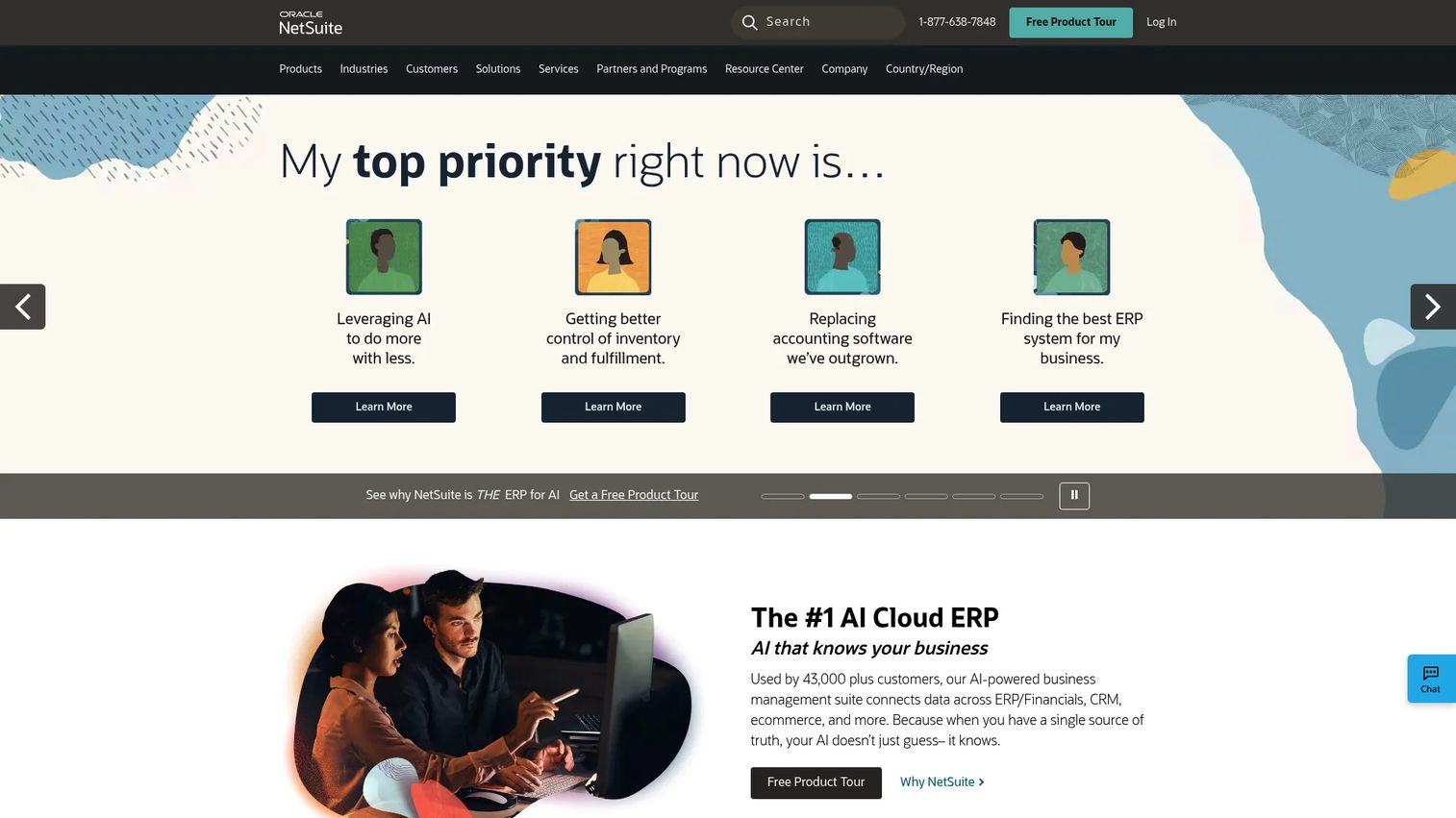
NetSuite is a cloud ERP and business management platform spanning finance, operations, commerce, and services. Its strength is breadth: financials, CRM, ecommerce, HCM, and PSA on one data model, with real-time analytics and strong multi-subsidiary support. For automotive businesses with multiple sites, entities, or a services arm alongside manufacturing, that unified backbone is the draw.
Best for: Mid-market to enterprise automotive companies needing an extensible ERP backbone with strong reporting across multiple sites.
Key strengths
- Cloud financial management: Real-time consolidation across subsidiaries and currencies.
- Multi-module suite: CRM, ecommerce, HCM, and PSA extend the platform beyond core ERP.
- Global operations support: Multi-subsidiary structures and real-time analytics at scale.
Why choose NetSuite: NetSuite fits automotive businesses that need financial depth and multi-entity reporting as much as production control. If your organization spans manufacturing plus distribution or services across regions, the unified suite reduces integration overhead. Buyers whose primary need is deep sequenced production should confirm manufacturing coverage against their specific workflows during scoping.
NetSuite pricing: NetSuite does not publish a public starting price. Pricing is quote-based and typically scales with modules, user count, and deployment scope. Expect a tailored quote after a scoping conversation with the vendor.
4. SAP S/4HANA
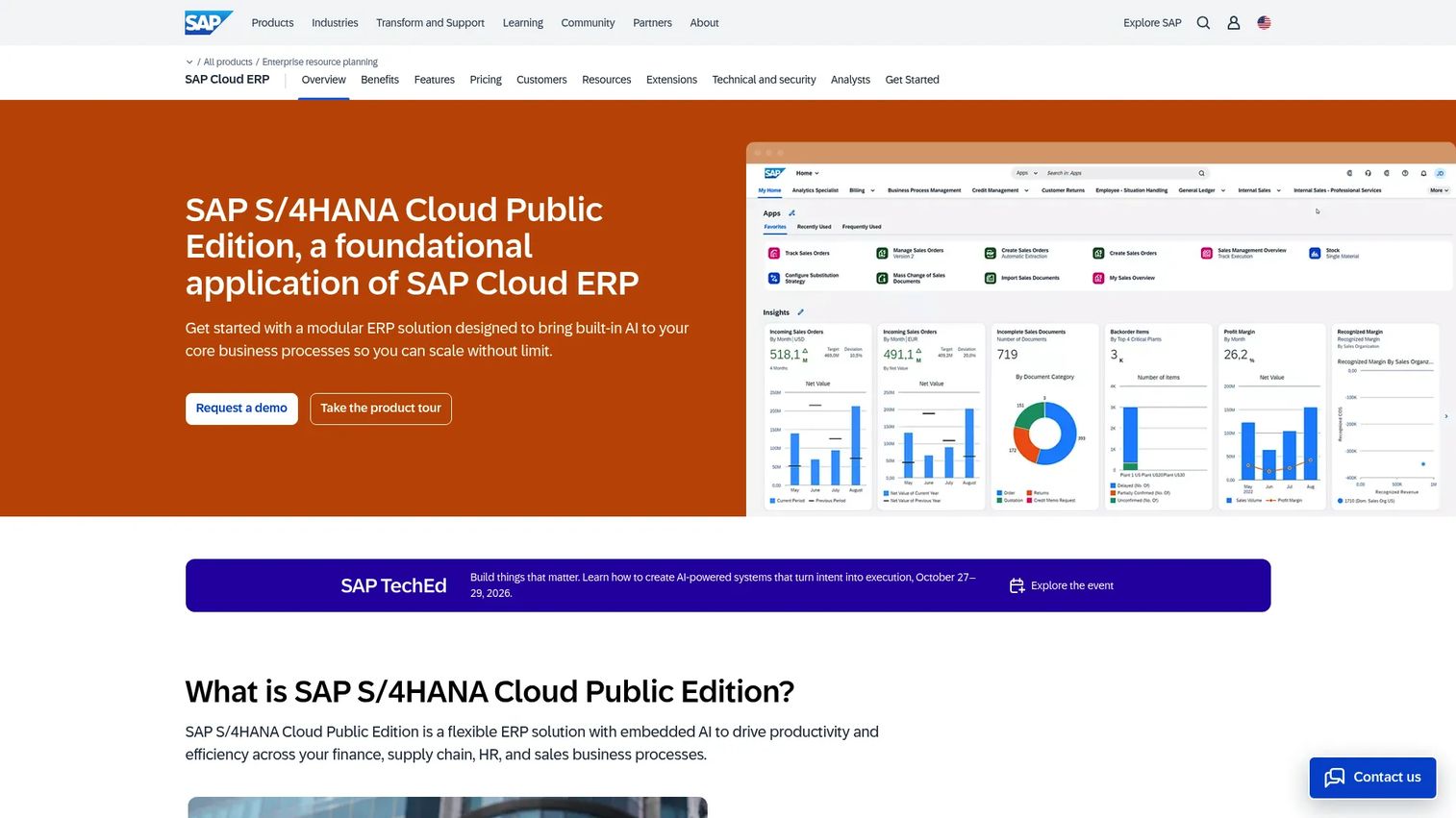
SAP S/4HANA is SAP's cloud ERP suite covering finance, supply chain, HR, and sales, with embedded AI and real-time processing. It is engineered for scale and process depth, which is why large OEMs and highly regulated manufacturers gravitate to it. Preconfigured industry best-practice processes shorten the distance between deployment and standardized operations across global sites.
Best for: Large, global automotive OEMs and highly regulated manufacturers that need enterprise-scale process depth and analytics.
Key strengths
- Embedded AI automation: In-context insights and automation across core processes.
- Best-practice processes: Preconfigured industry flows accelerate standardization.
- Broad functional coverage: Finance, supply chain, HR, and sales on one real-time platform.
Why choose SAP S/4HANA: SAP S/4HANA is built for organizations managing global operational complexity, advanced planning, and heavy compliance loads. Its depth suits enterprises that can invest in a structured rollout and want a platform that scales across dozens of sites. Smaller suppliers should weigh implementation scope against team capacity before committing.
SAP S/4HANA pricing: SAP does not publish numeric pricing for S/4HANA. Its pricing page routes to a request-a-quote flow, so the figure depends on modules, users, and deployment. Plan for a scoped quote through SAP or a partner.
5. Infor CloudSuite Automotive
Infor CloudSuite Automotive is a cloud-based ERP built specifically for automotive OEMs, tier suppliers, and specialty vehicle manufacturers. Where broad platforms adapt to automotive, this one starts there, with multi-mode manufacturing, assembly sequence control, and advanced supply chain management as native capabilities. That industry fit is the reason it belongs on any automotive shortlist.
Best for: Automotive manufacturers that want industry-specific cloud ERP with sequencing and supply chain capabilities out of the box.
Key strengths
- Multi-mode manufacturing: Handle discrete, repetitive, and mixed-mode production in one system.
- Assembly sequence control: Native JIS and sequencing built for line-side delivery.
- Advanced supply chain management: Multi-tier coordination and demand-driven planning.
Why choose Infor CloudSuite Automotive: This suite fits teams that want automotive workflows without heavy customization. OEMs and sequenced suppliers benefit from sequence control and supply chain depth designed for the industry's timing pressures. Specialty vehicle manufacturers with lower-volume, high-mix builds should confirm how the mixed-mode capabilities map to their exact production profile.
Infor CloudSuite Automotive pricing: Infor does not publish public pricing for CloudSuite Automotive. Cost is quote-based and depends on deployment, modules, and user scope. Contact Infor or a partner for a scoped estimate.
6. QAD Adaptive ERP
QAD Adaptive ERP is a cloud-based manufacturing ERP built for global manufacturers, with embedded analytics and supply chain capabilities. QAD has deep automotive roots, and the platform is designed around agility: reconfiguring processes as programs, plants, and requirements shift. For manufacturers that expect frequent change, that adaptability is the core pitch.
Best for: Global and regional automotive manufacturers that need a configurable cloud ERP for multi-site operations.
Key strengths
- Manufacturing-first core: ERP built around production operations rather than adapted from finance.
- Embedded analytics: Reporting and insight built into daily workflows.
- Global capabilities: Sales, purchasing, production, and internationalization for multi-site plants.
Why choose QAD Adaptive ERP: QAD suits manufacturers that prioritize agility, production control, and supplier coordination across regions. Its automotive heritage means the workflows reflect how the industry actually operates. Teams evaluating it should map their compliance and sequencing needs against the configuration to confirm fit before rollout.
QAD Adaptive ERP pricing: QAD does not publish public pricing. Its pages route to a demo or contact flow, so cost is quote-based and scoped to your operations. Expect pricing to track module count, sites, and user volume.
7. Epicor Kinetic
Epicor Kinetic is a cloud ERP built for manufacturers, with real-time business intelligence, built-in collaboration, and support for discrete, make-to-order, and hybrid production. Its strength is operational detail: shop-floor execution, quoting, and production control that reward manufacturers who live in the specifics of how parts get made and priced.
Best for: Automotive suppliers that need strong shop-floor control, quoting, and production detail.
Key strengths
- Cloud ERP for manufacturers: Purpose-built for production rather than generic operations.
- Real-time business intelligence: Dashboards and reporting embedded in daily work.
- Flexible production support: Discrete, make-to-order, and hybrid deployment models.
Why choose Epicor Kinetic: Kinetic works well for teams that need granular operational detail and production control, especially suppliers managing complex quoting and mixed production. The shop-floor depth suits manufacturers who want tight execution-to-plan alignment. Confirm automotive-specific EDI and quality flows against your requirements during evaluation.
Epicor Kinetic pricing: Epicor does not publish public pricing for Kinetic. Cost is request-based and scoped to deployment, modules, and users. Reach out to Epicor or a partner for a tailored quote.
8. SYSPRO
SYSPRO is an ERP platform for manufacturers and distributors, with business intelligence, real-time dashboards, and AI-powered assistance. Its manufacturing and distribution depth, paired with configurable pricing engines, makes it a practical fit for mid-market automotive suppliers that need cost control and flexible planning without enterprise overhead.
Best for: Mid-sized automotive suppliers and distributors that need configurable pricing, planning, and cost control.
Key strengths
- Manufacturing and distribution ERP: Combined coverage for suppliers that make and move parts.
- Real-time dashboards: Business intelligence surfaced where teams work.
- AI-powered assistance: Analytics and automation embedded across workflows.
Why choose SYSPRO: SYSPRO fits mid-market suppliers that want practical manufacturing workflows, configurable pricing, and strong cost visibility. Its industry-specific focus keeps the platform grounded in how manufacturers and distributors actually operate. Teams with heavy sequenced-delivery and multi-tier EDI needs should validate those flows during a scoped evaluation.
SYSPRO pricing: SYSPRO does not publish public pricing. Cost is quote-based and scoped to modules, users, and deployment. Contact SYSPRO or a regional partner for pricing tailored to your operations.
Considerations before you buy
Feature lists blur together fast. Use this checklist to pressure-test any automotive ERP solution against how your plant actually runs.
Evaluate automotive-specific workflow depth
Confirm the ERP supports the workflows that carry real risk: supplier coordination, traceability, quality management, and production sequencing. Generic ERP marketing language is not enough. Ask to see a sequenced build tied to a quality record inside the demo, not on a slide.
Confirm manufacturing and planning fit
Check whether the system handles your production model, whether discrete, repetitive, or mixed-mode. Validate JIT and JIS support and how shop-floor execution feeds back into the plan. A mismatch here shows up as manual reconciliation every shift.
Validate compliance and reporting support
Verify APQP, PPAP, FMEA, and MMOG/LE support, plus audit-ready reporting. Compliance needs to be embedded in the data model, not a bolt-on module you maintain separately. Embedded compliance turns an audit into a report you run on demand.
Check integration and data visibility
Make sure the ERP connects cleanly with EDI, supplier systems, analytics, and finance. Reporting and dashboard depth is a purchase criterion, not a nice-to-have. If leadership cannot see on-time delivery and quality trends in real time, the visibility promise is hollow.
Pressure-test implementation reality
Ask about rollout timeline, partner ecosystem, training, and change management. Tie implementation risk directly to your team's capacity and tolerance for operational disruption. The best-fit system on paper can still fail on a rollout your team cannot absorb.
Conclusion
The right automotive ERP depends less on the brand and more on how you build. Large, global OEMs with heavy compliance loads gravitate to SAP S/4HANA for enterprise-scale depth, or to Infor CloudSuite Automotive when they want automotive workflows native rather than adapted. Tier suppliers that prioritize agility and production control lean toward QAD Adaptive ERP or Epicor Kinetic, while SYSPRO fits mid-market suppliers wanting configurable pricing and cost control.
Cloud-first mid-market teams choose between Acumatica for manufacturing depth with unlimited-user pricing and NetSuite for financial and multi-site breadth. Smaller or lean operations building ERP piece by piece start with Odoo's modular model.
The decision rule holds across all of them: match the tool to your manufacturing model, supplier complexity, and compliance burden, in that order. Build a comparison matrix scored against those three factors, then book scoped demos with your top two or three. Ask each vendor to show a sequenced build with a live quality record, not a curated slide. That single request separates the automotive-fit systems from the finance ERPs wearing an automotive badge.
FAQs
Automotive ERP software is an enterprise resource planning system built for the manufacturing, supply chain, and quality workflows of automotive companies. It connects production planning, procurement, inventory, quality management, and finance on a single data model. The industry fit shows up in native support for sequencing, EDI, and audit-ready traceability that generic ERP handles as afterthoughts.
At minimum, an automotive ERP system should cover production planning and scheduling, supplier collaboration and EDI, inventory and WIP visibility, and quality management with traceability. Compliance support for IATF 16949, APQP, and PPAP should be embedded rather than bolted on. Real-time analytics and dashboards round out the core so leadership can see delivery and quality trends as they move.
Yes, and it is now the default. Cloud deployments hold roughly 62% of the automotive ERP market share, per Mordor Intelligence (2025), thanks to faster rollout, easier scaling, and lower infrastructure overhead. That said, some large plants with deep integrations or strict data residency rules run detailed evaluations before migrating, and on-premise deployment is still growing at a 13.4% CAGR through 2031.
For large, global OEMs, SAP S/4HANA and Infor CloudSuite Automotive are the common shortlist. SAP brings enterprise-scale process depth, embedded AI, and best-practice processes across many sites. Infor CloudSuite Automotive brings native automotive workflows like sequence control. The best fit depends on scale, complexity, and how much you value industry-native workflows versus configurable enterprise breadth.
Tier suppliers should weight supply chain visibility, production planning, and quality management heavily. QAD Adaptive ERP and Epicor Kinetic both offer strong manufacturing-first depth, while Acumatica appeals to mid-market suppliers wanting unlimited-user cloud pricing. SYSPRO fits suppliers that need configurable pricing engines and tight cost control. Match the choice to your production model and EDI requirements.
Most automotive ERP pricing is quote-based, because scope, module count, deployment, and user volume drive the figure. Public entry points exist at the lower end, such as Odoo starting at $0 for a single app and $24.90 per user per month for Standard, or Acumatica's manufacturing package starting under $2,185 monthly. Enterprise suites like SAP S/4HANA and Infor CloudSuite Automotive route to scoped quotes.
The core standards are IATF 16949 for quality management, APQP for advanced product quality planning, PPAP for production part approval, and FMEA for failure mode analysis. MMOG/LE covers materials management assessment. An automotive ERP should support these natively so audits become reports you run rather than projects you staff, along with emissions and safety reporting where applicable.
Build a selection matrix scored on five factors: manufacturing model fit, integration depth (EDI, supplier systems, finance), implementation reality, reporting and analytics, and support. Weight automotive-specific workflow depth over generic feature breadth. Then run scoped demos with your top two or three and ask each vendor to show a sequenced build tied to a live quality record, which quickly separates industry-fit systems from repurposed finance ERPs.