A transaction touches a wallet your system has never seen. Your team can inspect the hash in seconds. The board-level question takes longer: Is this routine activity, a compliance exposure, or the start of a reportable incident?
Public ledgers tell you what moved. They don't tell you who sits behind an address, where funds traveled before arriving, or whether the counterparty has sanctions exposure. That gap is where blockchain analysis tools earn their place in a stack. According to Chainalysis (2026), illicit crypto addresses received at least $154 billion in 2025, which means crypto risk is no longer a niche concern for exchanges. It's a due-diligence question for any fintech, payment product, or treasury function touching digital assets.
The right tool depends on one decision you need to make before shortlisting: Do you need screening and compliance monitoring, active fund-tracing investigation, a data API to build features, or public intelligence for early research? Each job maps to a different category, and buying the wrong one wastes both budget and engineering time.
What's inside
This guide helps founders and technical leads choose between seven blockchain analytics tools covering enterprise compliance platforms, investigation tools, data APIs, and public intelligence products. Each tool was evaluated against these criteria:
- Multi-chain coverage: Which networks receive full investigation and screening support, not just lookup
- Risk intelligence depth: Whether risk scores are explainable and defensible, not just a number
- Workflow fit: How alerts translate into cases, reports, and operational decisions
- Cost visibility: Entry price, pricing model, and what drives contract expansion
TL;DR
- Best for large-scale crypto compliance: Chainalysis for institutions that need investigations, transaction monitoring, sanctions screening, and fraud detection in one platform
- Best for cross-chain risk operations: TRM Labs for teams combining financial-crime investigations with transaction monitoring across multiple networks
- Best for compliance connected to investigations: Elliptic for screening, cross-chain tracing across 65+ blockchains, and AI-assisted risk summaries
- Best for developer-led data products: Bitquery for GraphQL APIs, real-time streaming, and Coinpath money-flow analysis, with plans starting at $39/month
- Best for public entity research: Arkham Intelligence for wallet labels, portfolio tracking, and on-chain investigation workflows without a sales conversation
- Best for investigation-first teams: Crystal Intelligence (formerly Crystal Blockchain) for audit-ready blockchain forensics and cross-chain fund tracing
- Best for Web3 fraud and monitoring: Merkle Science for behavioral risk detection and AML compliance in crypto-native products
Pricing models split sharply across this field. Enterprise intelligence platforms sell annual contracts through sales teams, with final cost reflecting transaction volume, supported chains, and module scope. API-first tools publish self-serve plans but shift implementation ownership to your engineering team.
What is blockchain analysis software?
Blockchain analysis software collects, enriches, and interprets public on-chain data to help teams trace transactions, identify wallet and entity relationships, assess risk, investigate suspicious activity, and monitor blockchain exposure.
A block explorer shows you the raw record: A transaction hash, a sender address, an amount, a timestamp. Blockchain analytics software adds the interpretation layer: Which entity likely controls that address, what risk exposure it carries, how funds moved across wallets and chains before arriving, and whether the activity should trigger an alert or a case file.
What blockchain analysis tools do:
- Trace fund flows across wallets and services on single or multiple chains
- Attribute addresses to known entities using labels, clustering, and behavioral signals
- Score wallets and transactions for sanctions exposure, scam connections, ransomware payments, and indirect risk
- Monitor transaction activity continuously and generate alerts against policy thresholds
- Investigate suspicious events with graph tools, case management, and audit-ready reporting
- Provide blockchain data via APIs, indexed datasets, and query interfaces for product or research use
The four categories to separate before shortlisting:
| Category | Primary job | Typical buyer | Example use case |
|---|---|---|---|
| Enterprise intelligence platforms | Investigations, monitoring, screening, fraud at scale | Financial institutions, exchanges, compliance functions | Continuous KYT monitoring for a regulated crypto exchange |
| Transaction monitoring and screening | Pre-transaction risk screening, AML policy enforcement | Fintechs, payment products, wallets | Screening counterparty addresses before approving a transfer |
| Blockchain data APIs | Multi-chain data access for product development or research | Engineering and data teams | Querying token holder data for an analytics dashboard |
| Public investigation tools | Entity labels, wallet research, early incident triage | Founders, analysts, security researchers | Mapping a suspicious wallet before opening a formal case |
The distinction matters for budget planning. An enterprise compliance contract can run to six figures annually. A developer API plan can start under $50 per month. Neither replaces the other.
When to use blockchain analysis tools
Screen crypto transaction risk before funds move
Exchanges, fintechs, and payment products need to evaluate wallet addresses and incoming transactions against sanctions lists, scam databases, ransomware exposure, and indirect counterparty risk. The goal is catching a high-risk transfer before it clears, not after. This use case requires a tool with continuous monitoring, configurable alert thresholds, and a clear path from alert to human review.
Trace funds after a suspicious event
When a scam, exploit, or unclear transaction appears in your product or treasury, investigators need to follow the money across wallets, chains, and services. Graph tools map how funds moved, which entities received them, and what exposure remains. Output from this workflow informs internal escalation and supports external reporting. It does not replace legal or law-enforcement processes.
Build on-chain features without maintaining data infrastructure
A product team building wallet analytics, token holder dashboards, DEX data feeds, or fund-flow features faces a build-vs-buy decision on data access. Running full archive nodes and custom indexers across multiple chains is expensive and slow. A blockchain data API provides indexed, multi-chain data via GraphQL or REST, reducing engineering overhead and letting the team focus on the product layer.
Blockchain analysis tools comparison
The table below covers seven tools across four categories. "Best" is not a single ranking. A compliance team, an investigation unit, and a developer team will rank this field differently based on their specific operating need.
| # | Product | Best for | Key differentiator | Pricing | G2 rating |
|---|---|---|---|---|---|
| 1 | Chainalysis | Enterprise compliance and investigations | Broad intelligence platform: Tracing, monitoring, screening, and fraud | Sales-led enterprise contracts | 4.8/5 |
| 2 | TRM Labs | Cross-chain risk and financial-crime operations | Unified investigation, monitoring, and risk workflows | Sales-led enterprise contracts | 4.8/5 |
| 3 | Elliptic | Screening, monitoring, and cross-chain investigations | Cross-chain tracing across 65+ blockchains with AI-assisted risk summaries | Sales-led enterprise contracts | Not enough reviews |
| 4 | Bitquery | Developer data, APIs, and on-chain analysis | GraphQL and REST APIs, real-time streams, and Coinpath money-flow analysis | From $39/month (billed annually) | 4.6/5 |
| 5 | Crystal Intelligence | Transaction tracing and investigations | Audit-ready forensics across 330+ blockchains with verified entity attribution | Sales-led pricing | 4.5/5 |
| 6 | Merkle Science | Crypto risk monitoring and fraud detection | Behavioral risk intelligence for Web3 compliance and AML | Sales-led pricing | 4.0/5 |
| 7 | Arkham Intelligence | Public wallet intelligence and entity research | Entity labels, portfolio tracking, and Intel Marketplace for on-chain research | Free access available | 4.9/5 |
Pricing and G2 ratings verified October 2026 from each vendor's pricing page and live G2 listing.
Best 7 blockchain analysis tools for 2026
1. Chainalysis
Chainalysis is an enterprise blockchain intelligence platform covering investigation, transaction monitoring, wallet and counterparty screening, fraud detection, and Web3 security workflows. It serves government agencies, financial institutions, exchanges, and mature crypto compliance functions that need a single operational environment rather than point tools stitched together. The platform's products span Reactor for investigation, KYT for transaction monitoring, and a broader data and intelligence layer that feeds into compliance workflows and incident response.
Best for: Financial institutions, high-volume crypto businesses, public-sector teams, and fintech companies with audit, reporting, or sanctions obligations that require investigation trails.
Key features
- Transaction tracing and graph investigation across blockchains
- Wallet and counterparty risk screening
- Continuous transaction monitoring with real-time alerts
- Address attribution and entity intelligence
- Fraud and scam detection workflows
- Custom analytics, dashboards, and automated alert rules
Why choose Chainalysis: Choose it when crypto risk has become a company-level compliance function, not a research task. If your team needs to run investigations, produce audit evidence, and maintain defensible policy-based monitoring at scale, Chainalysis is built for that operating model.
Chainalysis pricing: Chainalysis sells through enterprise contracts negotiated with its sales team. Final price reflects the products selected (investigation, monitoring, screening, or data), monitored transaction volume, supported blockchains, analyst seat count, and support tier. Contact Chainalysis directly for a quote.
G2 rating: 4.8/5 (based on Chainalysis KYT reviews, verified October 2026).
2. TRM Labs
TRM Labs provides blockchain intelligence software for transaction tracing, financial-crime investigation, compliance, and risk management. Its core products include TRM Forensics for cross-chain fund tracing, TRM Wallet Screening for proactive address risk checks, and TRM Transaction Monitoring for detecting suspicious activity across customer wallets and counterparties. Teams that need to run investigations and screening in one workspace, without switching platforms between detection and case-building, find this combination particularly useful.
Best for: Crypto-native businesses and public-sector teams handling investigations, compliance obligations, and transaction risk across multiple digital-asset ecosystems.
Key features
- Cross-chain transaction tracing via TRM Forensics
- Proactive wallet and address risk screening
- Transaction monitoring with customizable alert logic
- Wallet and entity risk intelligence
- Investigation case management and compliance workflows
Why choose TRM Labs: TRM fits when the team needs to hand off from a detected alert to an open investigation without rebuilding context across tools. It works especially well for organizations managing DeFi exposure, stablecoin activity, and multi-chain transaction flows in one operational view.
TRM Labs pricing: TRM Labs prices through enterprise contracts. Cost factors include transaction monitoring volume, number of users, product modules selected (Forensics, Wallet Screening, Transaction Monitoring), chain coverage, and support requirements. Request a quote through TRM's website.
G2 rating: 4.8/5 (verified October 2026 from TRM Labs' G2 page).
3. Elliptic
Elliptic provides blockchain analytics for wallet and transaction screening, cross-chain investigations, ecosystem risk monitoring, and blockchain data access. A notable capability is cross-chain tracing across 65+ blockchains and 250+ bridges, supported by configurable risk logic, AI-assisted risk summaries, and graph analysis tools. The platform also offers API access and data feeds for teams that want to pipe intelligence into existing compliance infrastructure rather than operate a standalone interface.
Best for: Banks, payment providers, exchanges, and compliance teams that need screening and investigation to share the same underlying risk model, reducing inconsistencies between the two workflows.
Key features
- Real-time wallet and transaction screening
- Cross-chain tracing across 65+ blockchains and 250+ bridges
- Configurable risk logic and alert thresholds
- AI-assisted risk summaries and graph analysis
- API access and blockchain data feeds
Why choose Elliptic: Elliptic earns its place when the compliance team wants to connect high-volume alert resolution with deeper fund-tracing investigation, using a shared intelligence layer. It also suits teams that want API or no-code data access alongside the core investigation and monitoring interface.
Elliptic pricing: Elliptic uses quote-based enterprise packaging. Cost varies with screening transaction volume, supported workflows, data access requirements, integrations, and support coverage. Reach out to Elliptic's team for specific pricing.
4. Bitquery
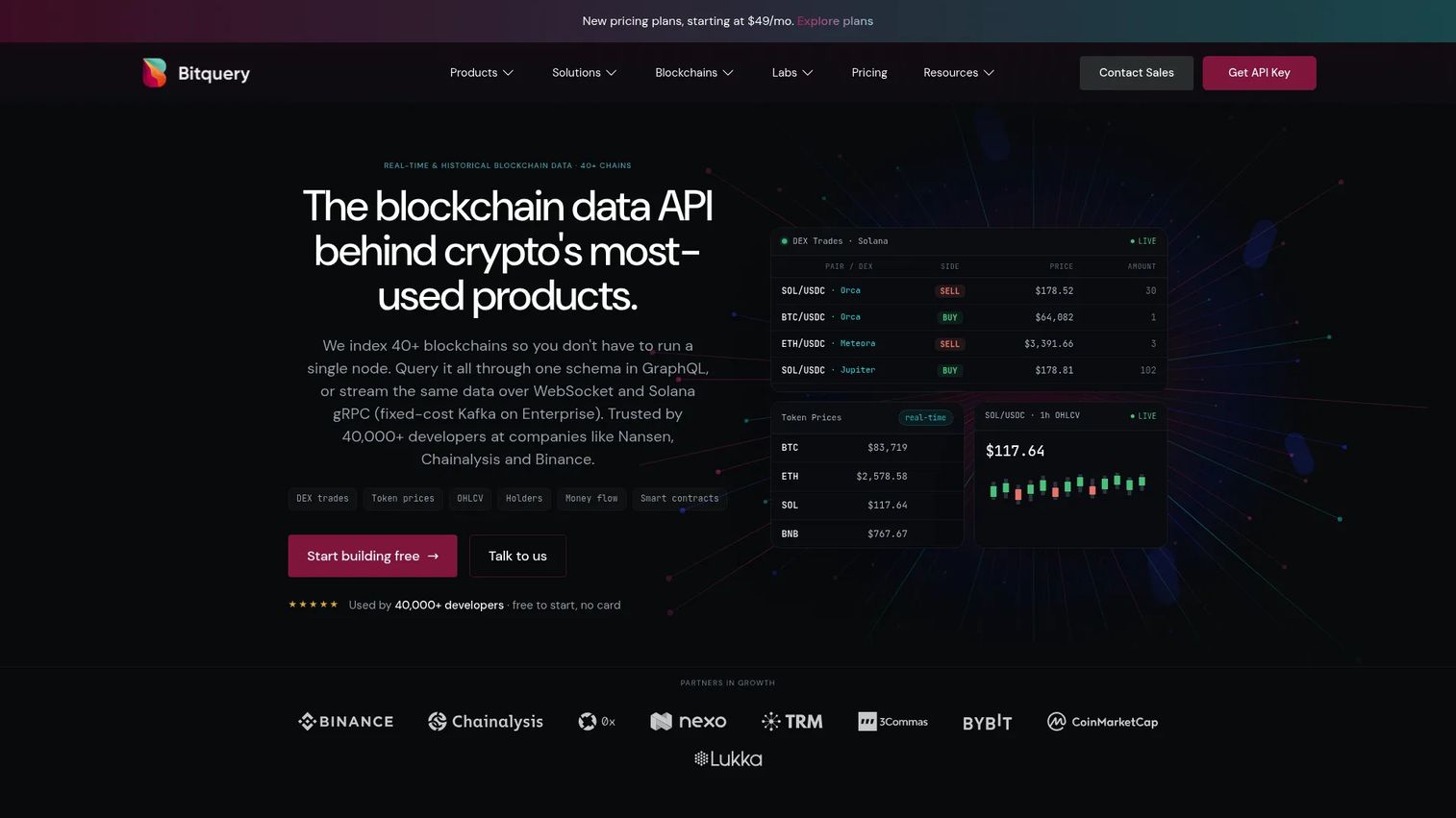
Bitquery is a developer-oriented blockchain data API platform rather than a full AML compliance suite. It provides historical and real-time multi-chain data through GraphQL and REST interfaces, WebSocket streaming, Kafka, and gRPC. Coinpath, Bitquery's money-flow analysis module, maps fund flows across wallets for teams building investigation features or internal risk dashboards. An AI Investigation MCP plan also allows AI-assisted on-chain research for technical teams experimenting with automated workflows.
Best for: Technical founders, data engineers, and product teams who need programmable multi-chain data: Token holders, DEX trades, transfer histories, mempool activity, or fund-flow queries, without building their own node and indexing infrastructure.
Key features
- GraphQL and REST APIs for multi-chain blockchain data
- Real-time WebSocket streaming, Kafka, and gRPC interfaces
- Coinpath money-flow analysis across wallets
- Historical DEX trades, token prices, holders, transfers, and balances
- AI Investigation MCP for AI-accessible on-chain queries
Why choose Bitquery: Bitquery fits when the team wants to build its own analytics feature, internal risk signal, or fund-tracing tool rather than buying a pre-built investigator workspace. Engineers get data access and flexibility; the tradeoff is that alert logic, visualization, case records, and reporting workflows require internal build work.
Bitquery pricing: A 7-day free trial is available. Personal plans start at $39/month (billed annually), Pro at $79/month (billed annually), and Scale at $239/month (billed annually). Enterprise plans are custom. Specialized MCP plans include Trading MCP at $15/month and AI Investigation MCP at $119/month (both billed annually). See the Bitquery pricing page for current plan details.
G2 rating: 4.6/5 (verified October 2026 from Bitquery's G2 page).
5. Crystal Intelligence
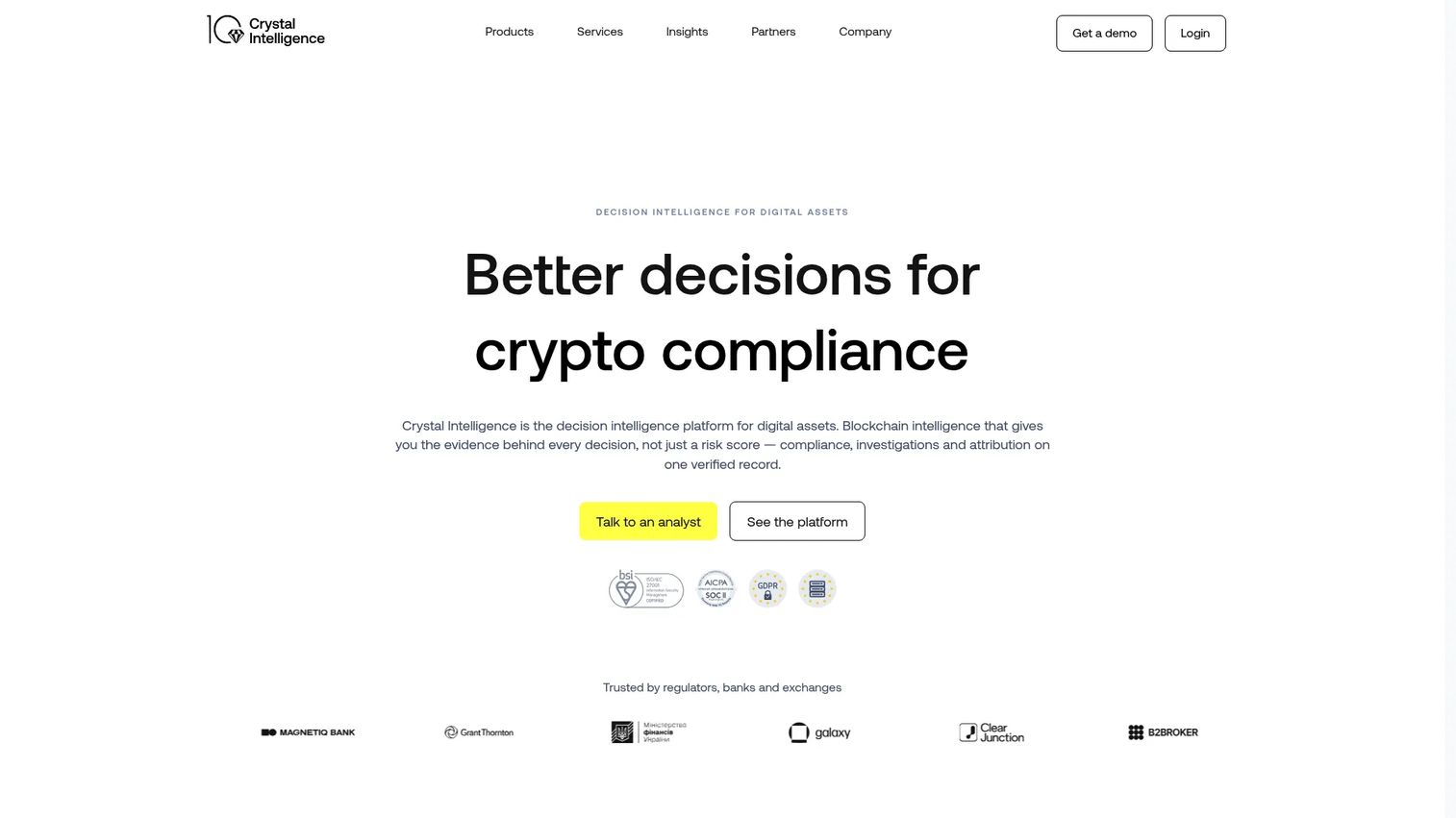
Crystal Intelligence (the platform previously known as Crystal Blockchain) is a decision-intelligence platform for digital assets covering crypto compliance, transaction monitoring, blockchain investigations, and verified entity attribution. It supports real-time know-your-transaction monitoring across 330+ blockchains, cross-chain fund tracing, wallet and counterparty risk scoring, and audit-ready investigation reporting. The platform's AI-assisted analysis layer helps compliance and investigation teams work through complex multi-hop transactions more efficiently.
Best for: Financial institutions, crypto businesses, regulators, and financial-crime investigation teams that prioritize visual fund-tracing, verified entity attribution, and audit-trail quality over broad platform breadth.
Key features
- Real-time KYT across 330+ blockchains
- Cross-chain fund tracing and blockchain forensics
- Wallet and counterparty risk scoring
- Verified off-chain entity attribution
- Audit-ready investigation reports and full audit trails
- AI-assisted compliance and investigation analysis
Why choose Crystal Intelligence: Choose Crystal when the core job is investigation and forensics, with compliance monitoring as a supporting layer. It suits teams that need to turn address activity into a documented investigation narrative that holds up under internal escalation, external reporting, or regulatory review.
Crystal Intelligence pricing: Crystal Intelligence sells through a sales-led process. Pricing reflects product scope, analyst seat count, supported chains, API access requirements, and monitoring volume. Contact the team directly for a quote.
G2 rating: 4.5/5 (based on reviews on G2, verified October 2026).
6. Merkle Science
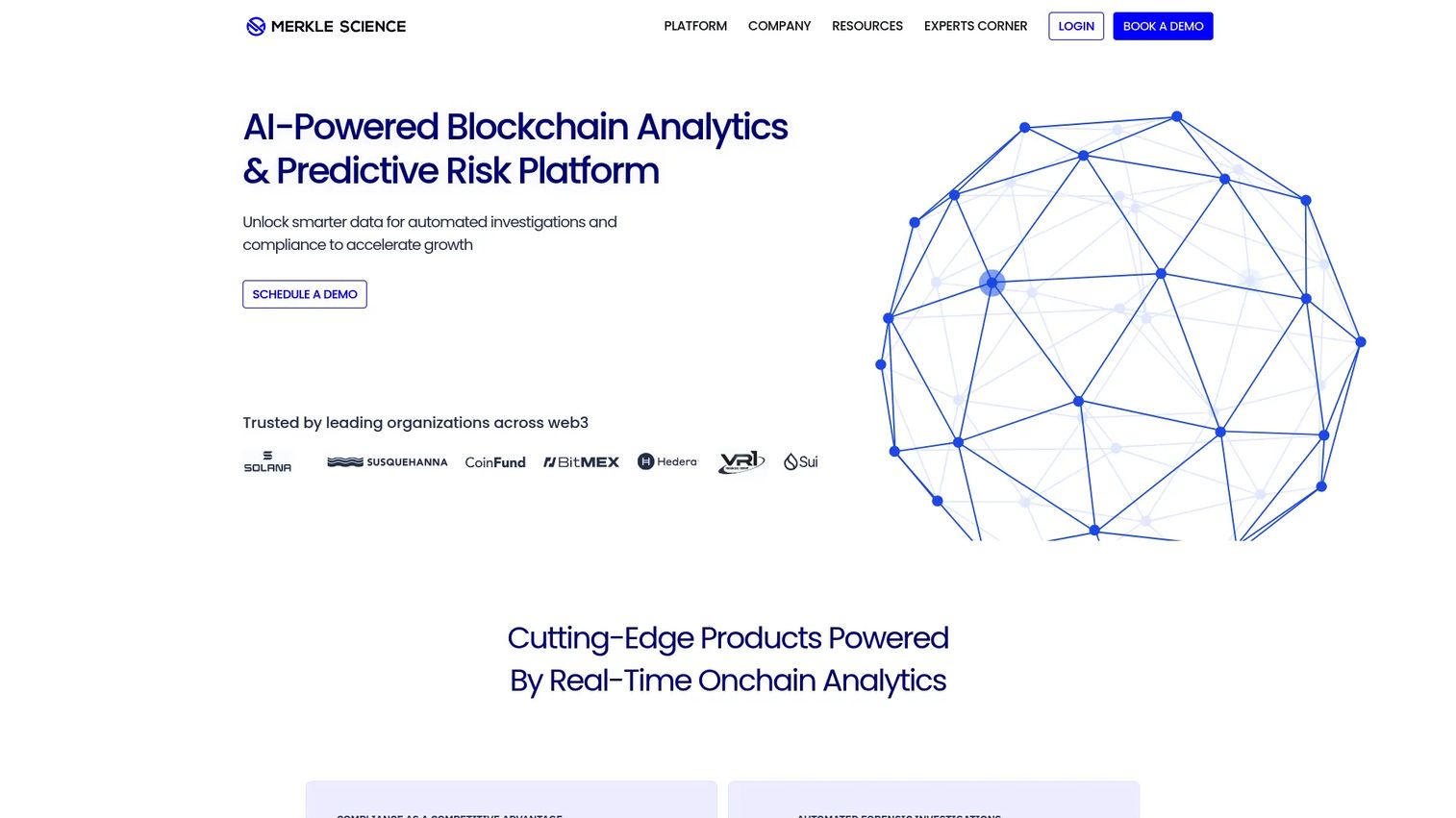
Merkle Science is an AI-powered blockchain analytics platform focused on cryptocurrency compliance, predictive risk monitoring, and on-chain investigation. Its core capabilities cover AML software workflows including transaction and wallet monitoring for AML and KYC compliance, behavioral risk detection, cross-chain forensic investigation, and counterparty due diligence with risk profiles and reporting. The platform is designed for Web3-native businesses that need to scale compliance operations as transaction volume grows, without proportionally growing headcount.
Best for: Crypto exchanges, DeFi products, NFT platforms, and fintech teams that need operational risk monitoring with behavioral fraud intelligence, not just address-level screening.
Key features
- Transaction and wallet monitoring for AML, KYC, and CFT compliance
- Behavioral risk detection for fraud and suspicious patterns
- Crypto forensics and cross-chain investigation of illicit activity
- Counterparty and vendor due diligence with risk profiles
- Compliance workflow support and reporting
Why choose Merkle Science: Merkle Science fits when the immediate pressure is operational crypto risk in a growing product: Fraud patterns, suspicious activity spikes, and AML policy enforcement that needs to scale without constant manual review. It's worth evaluating earlier than most founders expect, before transaction volume outpaces the team's capacity to investigate manually.
Merkle Science pricing: Merkle Science prices through direct sales conversations. Cost varies with transaction monitoring volume, product modules, chain coverage, required integrations, and support level. Request a demo via Merkle Science's website to get pricing context for your use case.
G2 rating: 4.0/5 (based on 2 reviews on G2, verified October 2026).
7. Arkham Intelligence
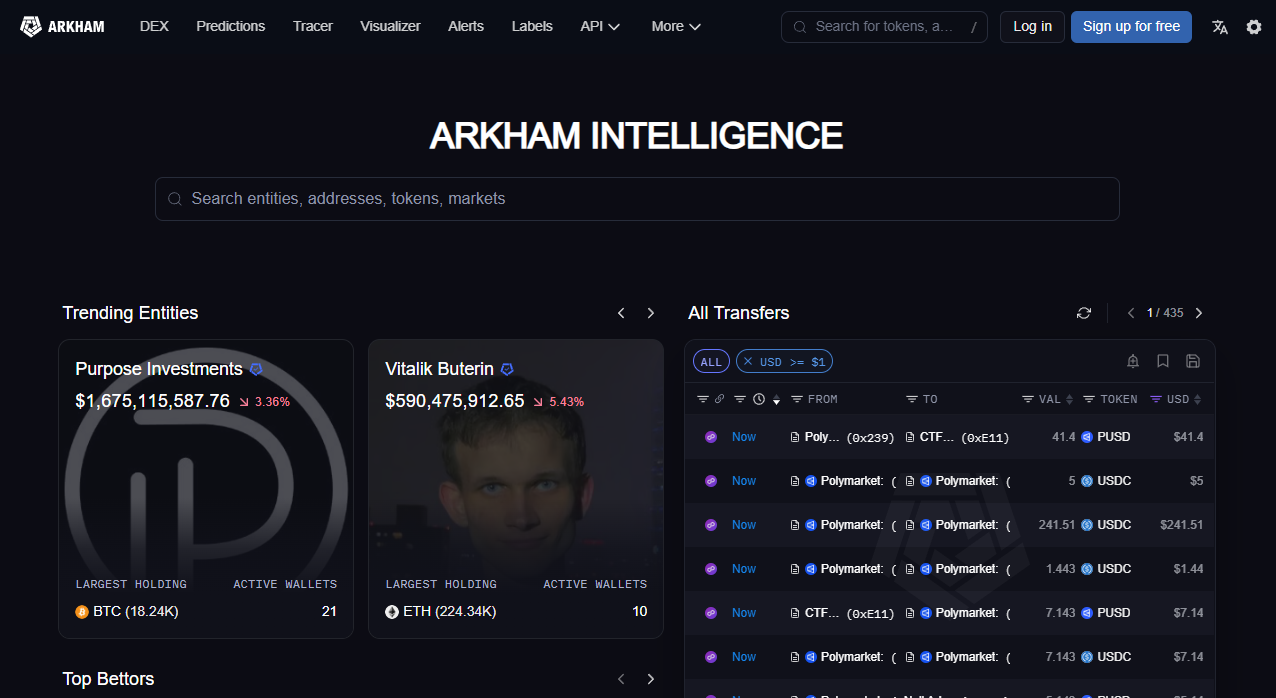
Arkham Intelligence is a public blockchain intelligence platform that maps on-chain activity to real-world entities. It provides entity and address intelligence including transaction histories, portfolios, balance history, profit and loss, exchange usage, and counterparties. The platform also includes a graph Visualizer for network analysis, custom dashboards, transaction alerts, token analytics, API access to its Ultra intelligence engine, and an Intel Marketplace where users can buy and sell blockchain intelligence. The core platform is accessible without a sales conversation, making it the fastest entry point for initial research.
Best for: Founders, investors, analysts, and security researchers doing early-stage wallet research, ecosystem monitoring, or initial incident triage before opening a formal compliance or forensics workflow.
Key features
- Entity and address intelligence: Transaction history, portfolios, PnL, and counterparties
- Visualizer for customizable on-chain network analysis
- Custom dashboards and wallet activity alerts
- Token pages with holder, transaction, and exchange-flow data
- API access to the Ultra intelligence engine
- Intel Marketplace for buying and selling on-chain intelligence
Why choose Arkham Intelligence: Arkham is the right starting point when the team needs to understand what happened on chain before deciding whether a formal compliance or forensics workflow is warranted. It converts "we saw a suspicious wallet" into entity-level context quickly. It should not serve as the primary risk control layer for a regulated transaction flow or sustained compliance program.
Arkham Intelligence pricing: The core Arkham platform is accessible without a paid subscription. Verify any premium plan or API pricing tiers directly on the Arkham website, as these offerings may expand over time.
G2 rating: 4.9/5 (verified October 2026; note that this listing may reflect limited review volume).
Considerations when choosing blockchain analysis tools
Match the tool category to the decision you need to make
A public intelligence tool accelerates research. A data API supports product development. An enterprise platform handles monitoring, investigations, compliance workflows, and audit evidence. Buying an enterprise contract for a developer-data need, or using a research tool as the only control layer in a regulated flow, creates gaps that cost more to fix than the initial tool saved.
Verify chain and bridge coverage specifically
A broad blockchain count in a vendor's marketing does not guarantee investigation-grade coverage on every network. Ask whether each relevant chain receives full screening, entity attribution, cross-chain tracing, and bridge tracking, or only basic transaction lookup. For teams with DeFi exposure, stablecoin activity, or users on newer L2 networks, the answer will narrow the shortlist quickly. This is also relevant when evaluating address verification software that sits upstream of your transaction flow.
Inspect the data behind risk scores
A risk score is only as useful as the explanation supporting it. Ask vendors what labels, typologies, indirect-exposure rules, and refresh cadence influence each score. Your compliance lead needs a path from alert to evidence, not just a number that triggered a review. If a score cannot be explained to an auditor or regulator, it cannot defensibly inform a decision.
Model the full operational cost
Enterprise blockchain intelligence pricing scales with monitored transaction volume, wallets, chains, modules, analyst seats, API call volume, and support tier. API-first tools lower the entry cost but shift indexing, alert logic, graph visualization, and reporting to internal engineering. Compare the contract cost against the cost of manual investigation time, false-positive review burden, and any data infrastructure you would otherwise maintain.
Test the handoff from alert to action
Detection is not the end of the workflow. Evaluate how an alert becomes a case, how investigators document their findings, where audit evidence lives, and how outcomes route back into transaction controls or your internal ticketing and CRM stack. Teams that evaluate analytics platforms and risk tools often underestimate this integration layer until a real incident exposes it.
Conclusion
The blockchain analysis market splits clearly across four jobs: Enterprise compliance and investigations, transaction screening and monitoring, developer data infrastructure, and public entity research. Buying the wrong category wastes budget and delays the operational capability you actually need.
Chainalysis and TRM Labs belong at the top of the shortlist for mature compliance and investigation programs. Elliptic is worth evaluating when screening and investigation need to share a risk model. Crystal Intelligence fits investigation-first teams that need audit-ready forensics. Merkle Science suits Web3 products managing fraud and AML compliance at scale. Bitquery is the clearest choice for technical teams building data features internally. Arkham Intelligence handles early research and triage without a sales conversation.
Start by mapping the specific decision your team must make in the next quarter. That one step cuts the shortlist from seven to two or three, which makes the evaluation faster and the final contract easier to defend to your board.
Start your journey with Guideflow today!
FAQs
The strongest choice depends on transaction volume, regulatory exposure, required blockchain coverage, investigation workflow needs, and audit requirements. Enterprise platforms like Chainalysis and TRM Labs are better suited to continuous monitoring and defensible case management than public research tools. For smaller teams or early-stage programs, Elliptic or Crystal Intelligence may match the scope more closely.
A blockchain explorer shows public records: Transactions, blocks, addresses, and amounts. Blockchain analytics software adds entity attribution, address clustering, risk scoring, fund-flow tracing across wallets and services, and case-management workflows. The explorer tells you what happened. The analytics layer tells you what it likely means and whether it should trigger action.
Some platforms support cross-chain tracing through bridges, swaps, and linked wallet activity. Elliptic covers 65+ blockchains and 250+ bridges. Crystal Intelligence supports KYT across 330+ blockchains. Buyers should verify whether specific chains, bridge paths, and asset types receive full investigation coverage or only basic monitoring, since the distinction matters for DeFi-heavy or multi-chain products.
Yes. They help investigators follow fund movement, identify related addresses, surface exposure to labeled entities such as known scam wallets or ransomware addresses, and document activity in audit-ready formats. The output informs human investigation and internal policy decisions. It supports, rather than replaces, legal or law-enforcement processes.
Not directly. A wallet address does not contain identity information. Tools infer or attach entity context using public records, known service deposit addresses, behavioral clustering, sanctions designations, investigative findings, and other attribution methods. The result is a probability-weighted entity association, not a legal identification of a person.
Enterprise platforms sell annual contracts through sales teams. Final cost reflects workflow scope, monitored transaction volume, number of users, chain coverage, and support requirements. Contracts often run to five or six figures annually. API-first platforms like Bitquery publish self-serve plans starting at $39/month (billed annually), but implementation and engineering ownership add to the real total cost of operation.
Start with the specific job. For early wallet research or incident triage, Arkham Intelligence provides entity-level context without a sales conversation. For product development requiring raw on-chain data, Bitquery's API plans fit. For regulated transaction flows, sanctions exposure, or sustained AML monitoring, evaluating an enterprise platform early prevents the compliance gaps that become expensive to fix at Series B or later.
APIs provide data and flexibility, but the buyer must build the analyst interface, alert logic, graph views, case records, and reporting workflows internally. A full investigation platform packages those operational layers for teams that need to detect, investigate, and document activity repeatedly and at scale. An AI governance tools framework or agentic AI platform can help orchestrate API-based workflows, but it still requires meaningful engineering investment to reach feature parity with a purpose-built compliance environment.