A serious risk issue rarely starts as a board-level event. It starts as an alert nobody owns, a vendor review that slips, or a security question from an enterprise prospect that exposes a reporting gap you didn't know existed.
When the board asks whether risk is under control, most founders reach for spreadsheets and periodic reports. Those tools made sense at Seed. They break at Series B, when risk changes between weekly meetings and the founder is no longer the right person to field every escalation.
The data backs this up: Nearly 60% of ERM professionals still rely on word-processing files and spreadsheets for risk management, according to a 2025 survey by The IIA and Baker Tilly. That's the gap you're trying to close.
The right risk intelligence platform doesn't monitor everything. It connects the risk that matters to a named owner, a decision, and a measurable outcome. This guide helps you choose the platform that fits the risk domain you need to instrument first, whether that's external threat monitoring, third-party cyber exposure, vendor due diligence, or governed enterprise risk operations.
What's inside
This guide is for Series B SaaS founders, heads of security, operations leaders, and risk owners building their first structured risk function. Items were selected based on four criteria:
- Monitoring coverage: Does it watch the right signal for the risk type?
- Actionability: Can alerts reach a named owner inside an existing workflow?
- Integrations: Does it connect to your security, CRM, ticketing, or IT systems?
- Pricing model: Is the buying structure clear enough to evaluate against stage and budget?
The list is ordered by relevance to scaling SaaS companies, starting with external threat intelligence and moving toward broader enterprise risk platforms.
TL;DR
- Best for critical event and protective intelligence: Everbridge 360 AI for enterprises managing employee safety, supply-chain disruption, and operational response at scale
- Best for emerging geopolitical and operational risk: Seerist for analyst-curated intelligence with AI-assisted research and asset-specific context
- Best for MSP cyber-risk assessments: N-able Risk Intelligence for managed service providers turning data exposure scans into client-facing financial reports
- Best for governed enterprise risk programs: Riskonnect, Resolver, and ServiceNow Integrated Risk Management for organizations building cross-functional risk ownership and audit trails
- Best for third-party and cyber-risk monitoring: SecurityScorecard, BitSight, Black Kite, and OneTrust Third-Party Risk Management for vendor visibility and continuous cyber posture tracking
What is risk intelligence software?
Risk intelligence software collects risk signals from internal and external sources, analyzes exposure, prioritizes likely impact, and routes actionable information to the people responsible for response.
It is distinct from a traditional GRC repository, a security information and event management tool, or a questionnaire platform. Each of those is a component. Risk intelligence software connects them, or replaces them with a signal-to-owner workflow.
What risk intelligence software does
- Identifies emerging threats and known exposures before they escalate
- Connects risks to specific assets, vendors, locations, or business processes
- Prioritizes by likelihood, business impact, or financial exposure
- Alerts the right owner when risk conditions change
- Tracks mitigation, evidence, and board-level reporting over time
Core types of risk intelligence software
| Category | Primary signal | Typical owner | Decision supported |
|---|---|---|---|
| Protective and critical-event intelligence | Physical events, travel, supply chain, global disruptions | Security, operations, facilities | Activate response or communications |
| Cybersecurity risk intelligence | External security posture, sensitive data, breach-cost context | CISO, IT, MSP | Prioritize remediation or vendor escalation |
| GRC and operational risk platforms | Risk registers, controls, audits, incidents, resilience | Risk, compliance, audit | Assign ownership and track mitigation |
| Third-party risk intelligence | Supplier assessments, cyber ratings, due diligence | Procurement, legal, security | Approve, monitor, or flag vendors |
What risk intelligence software is not
It is not useful if alerts only create another inbox. A platform that generates reports without routing them into an owner's workflow becomes a reporting layer, not a risk management tool. Evaluate every platform on this question: When a signal fires, who gets it, and what can they do with it inside their existing tools?
When to use risk intelligence software
Detect emerging threats before they affect customers or operations
Organizations managing global assets, executive travel, physical facilities, or supply-chain partners need geographic context and fast alert routing. A regional event in a supplier's country can affect production before anyone on your operations team knows it happened. Protective intelligence platforms ingest open-source, analyst-curated, and automated signals, then map them to your specific assets.
Put cyber and third-party risk into commercial terms
Enterprise sales cycles increasingly include security questionnaires. Cyber insurance renewals demand evidence of vendor oversight. Board members want a score, not a spreadsheet. External cyber-risk ratings and third-party risk monitoring platforms generate repeatable evidence: Continuous scores, trend data, and peer benchmarks that travel well in commercial conversations.
Build accountability across a growing company
When a founder stops handling every risk decision personally, the company needs named owners, review cadences, and audit-ready records. GRC and operational risk platforms create that infrastructure: Risk registers with owners, controls mapped to frameworks, incidents with documented resolution, and dashboards that report progress without requiring a board-prep sprint.
Risk intelligence software comparison
The 10 tools below cover distinct risk domains. Use the table to route by use case, then read the relevant entries for pricing and fit context. Pricing and G2 ratings were verified against each vendor's pricing page and G2 listing.
| # | Product | Best for | Key differentiator | Pricing | G2 rating |
|---|---|---|---|---|---|
| 1 | Everbridge 360 AI | Critical event management and protective intelligence | Real-time, location-aware threat monitoring and operational response | Starting under $9K (Core); contact sales for Professional and Enterprise | 4.5/5 |
| 2 | Seerist | Emerging geopolitical and operational risk | Analyst-curated intelligence with AI-assisted research and asset monitoring | Contact sales | 4.8/5 |
| 3 | N-able Risk Intelligence | MSP cybersecurity assessments | Sensitive-data scanning, financial risk context, and client reports | Contact sales | 4.5/5 |
| 4 | Riskonnect | Enterprise risk and resilience programs | Integrated risk, business continuity, incident, and operational workflows | Contact sales | 4.3/5 |
| 5 | Resolver | Corporate security and enterprise risk operations | Incident, security, risk, and intelligence workflows in one operating model | Custom pricing | 4.3/5 |
| 6 | ServiceNow Integrated Risk Management | Enterprises already using ServiceNow | Native workflow automation across risk, compliance, audit, and IT operations | Contact sales | 4.4/5 |
| 7 | OneTrust Third-Party Risk Management | Vendor governance programs | Third-party assessments, workflows, and compliance-oriented governance | Custom pricing (Base and Suite tiers) | 4.5/5 |
| 8 | SecurityScorecard | Continuous external cyber-risk monitoring | Security ratings, supply-chain cyber posture, and attack-surface intelligence | Free tier available; paid TITAN plans require contacting sales | 4.3/5 |
| 9 | BitSight | Board-ready third-party cyber risk | External security ratings, peer benchmarking, and vendor monitoring | Contact sales | 4.5/5 |
| 10 | Black Kite | Financial context in third-party cyber risk | Vendor cyber intelligence with financial and business-risk context | Contact sales (Standard and Enterprise tiers) | 5.0/5 |
Best 10 risk intelligence software tools for 2026
1. Everbridge 360 AI
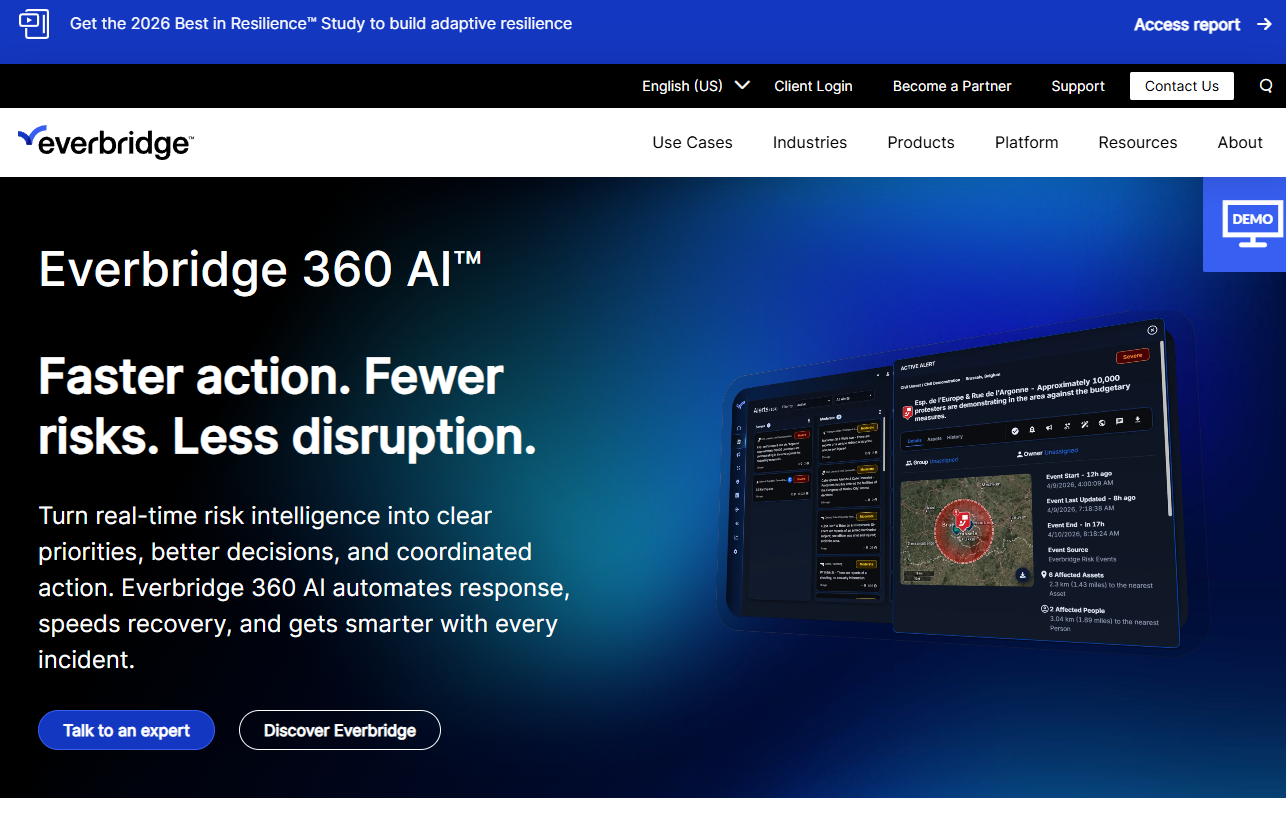
Everbridge 360 AI is an AI-powered critical event management platform that combines risk intelligence, mass communications, automation, and incident response. It is designed for organizations that need to monitor threats in real time, route alerts to the right people, and activate a response across facilities, employees, and supply chains. The platform spans protective intelligence, emergency communications, and operational resilience in a connected workflow.
Best for: Large enterprises and government organizations managing employee safety, physical facilities, supply-chain disruption, and organizational resilience across multiple locations.
Key features
- AI Advisor for conversational risk and response guidance
- Protective intelligence monitoring with hyper-local threat alerts
- Asset and location risk mapping with geofencing
- Supply-chain disruption monitoring and business continuity workflows
- Multichannel messaging and executive reporting dashboards
Why choose Everbridge 360 AI: It fits organizations where physical-world disruptions, travel risk, and workforce safety are material operating concerns. A SaaS company without a global footprint or large field workforce will likely find this overbuilt for its immediate needs.
Everbridge 360 AI pricing: The Core plan starts under $9K. Professional and Enterprise plans require contacting sales, with cost driven by monitored locations, user seats, modules selected, and analyst service levels. Pricing is verified from Everbridge's official pricing page as of October 2026.
G2 rating: 4.5/5
2. Seerist
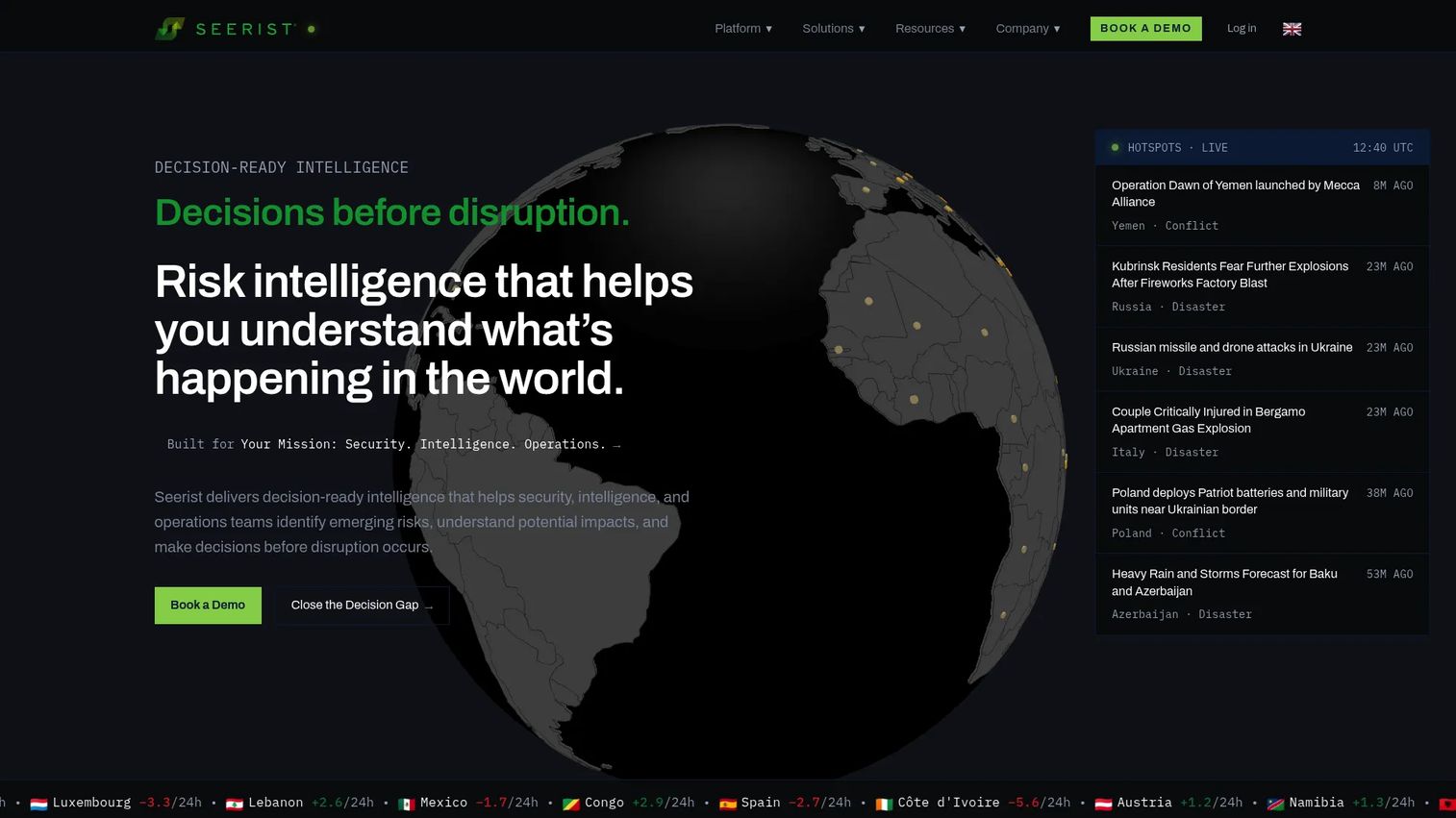
Seerist is an AI-enabled risk and threat intelligence platform that combines human-verified intelligence with automated event detection, real-time monitoring, and forecasting. Its AskAnna conversational analyst delivers cited, timestamped answers rather than generic alerts, which makes it useful for teams that need context alongside signal. Security, intelligence, travel-risk, and supply-chain teams use it to anticipate disruptions before they affect operations.
Best for: Security, intelligence, and operations teams that need early warning, horizon scanning, and asset-specific risk context across global assets or executive travel programs.
Key features
- AskAnna conversational analyst with cited, timestamped answers
- Human-verified events combined with AI-powered event detection
- Real-time monitoring and PulseAI risk scores
- Asset tracking and proximity-based risk assessment
- API and Esri-compatible integrations for GIS workflows
Why choose Seerist: It suits companies making decisions across locations, supply routes, or high-risk markets where analyst context matters as much as raw alert volume. Teams primarily building internal risk registers or vendor assessment workflows will find it too specialized for those jobs.
Seerist pricing: Seerist directs prospective customers to request a demo or contact sales. Pricing drivers include monitored assets, geography coverage, user seats, and data packages. No public entry-level price was available as of October 2026.
G2 rating: 4.8/5
3. N-able Risk Intelligence
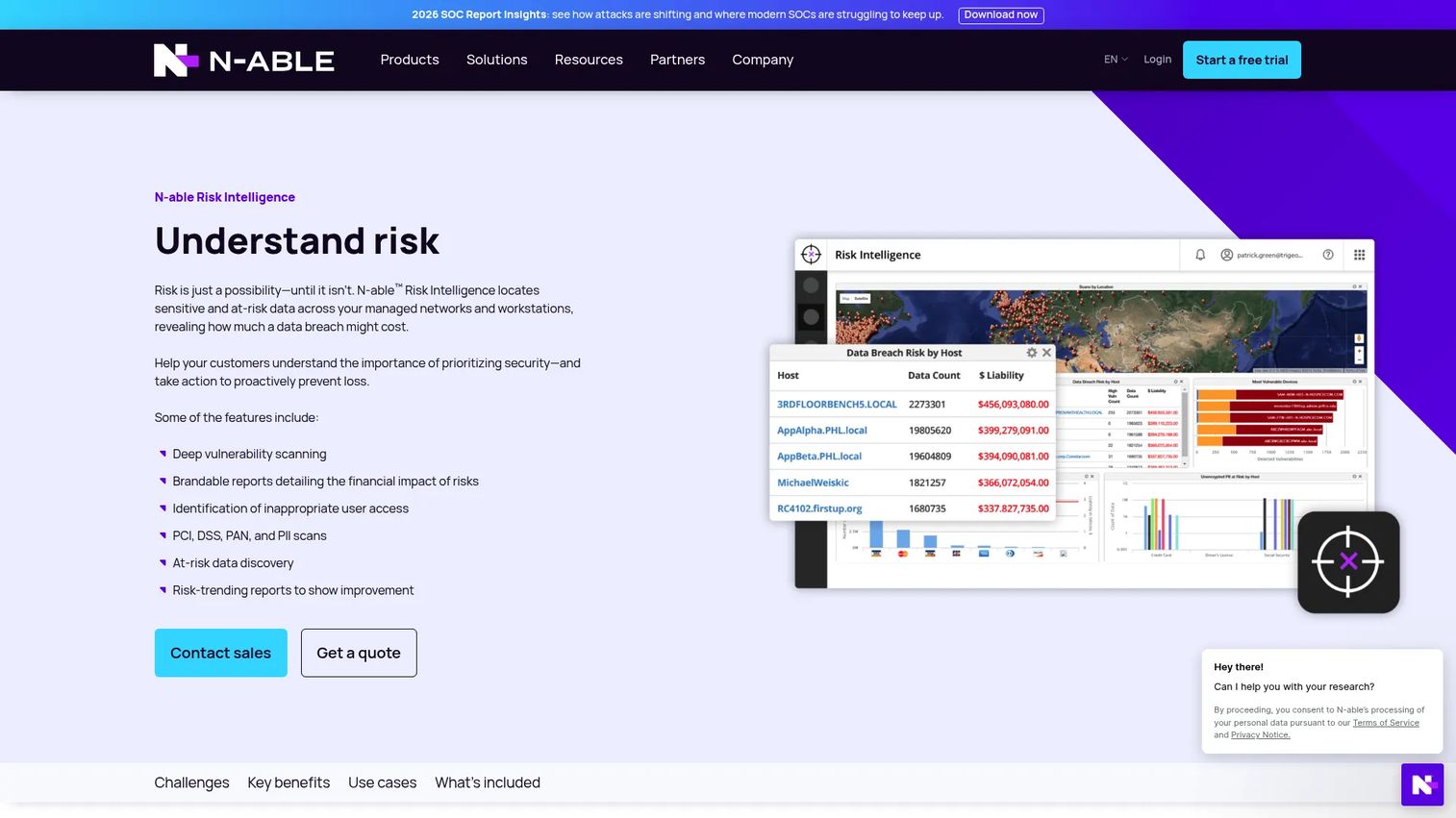
N-able Risk Intelligence is a cloud-based cybersecurity risk intelligence tool built for managed service providers. It scans client environments to discover sensitive and at-risk data across managed networks and workstations, estimates potential breach costs, and packages findings into brandable financial-impact reports. The goal is to give MSPs a repeatable way to turn cyber risk assessments into client conversations and expand their security service offerings.
Best for: MSPs and IT service providers that want to run recurring cyber-risk assessments, surface PII and payment-data exposure, and deliver client-facing reports that quantify financial risk.
Key features
- Deep vulnerability scanning across managed endpoints
- At-risk data discovery covering PII, PAN, and payment information
- Identification of inappropriate user access
- Brandable financial-impact reports for client delivery
- Historical risk-trending and baseline report generation
Why choose N-able Risk Intelligence: It is purpose-built for the MSP assessment and upsell motion. If your job is recurring client reporting on cyber risk, this fits well. It is not the right pick for enterprises needing geopolitical monitoring, vendor due diligence workflows, or internal GRC processes. For a broader view of business continuity software that complements cyber risk tools, that resource covers adjacent platforms.
N-able Risk Intelligence pricing: N-able directs buyers to request a quote; the price is not displayed publicly. Cost factors include managed device count and service tier. Verified from N-able's official pricing page as of October 2026.
G2 rating: 4.5/5
4. Riskonnect
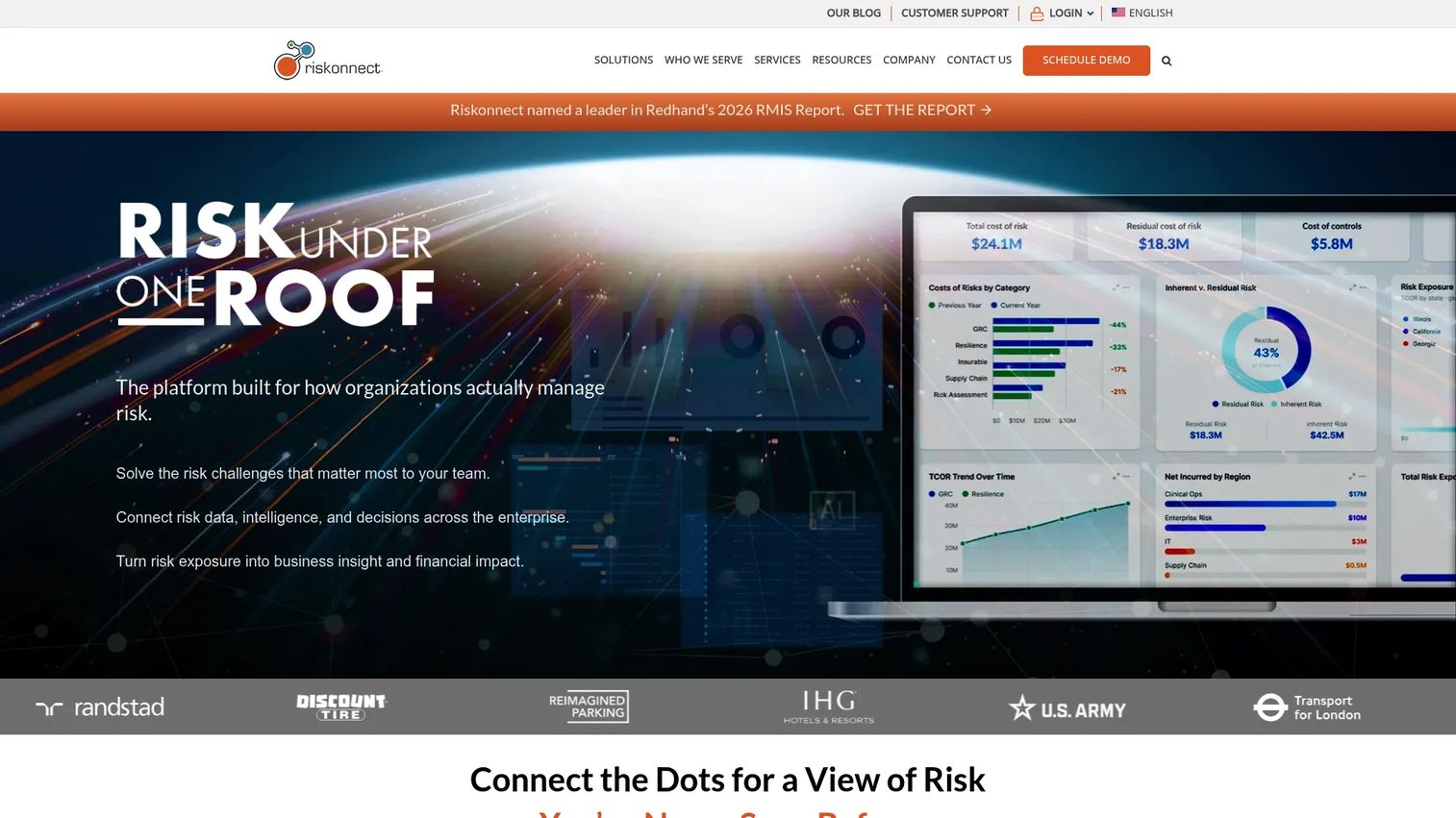
Riskonnect provides integrated risk, compliance, claims, resilience, and analytics software for mid-market and enterprise organizations. It brings operational risk, business continuity, incident reporting, and compliance workflows onto one platform, giving risk owners a connected view rather than a set of disconnected modules. Organizations use it to build formal risk programs with named owners, audit trails, and executive dashboards.
Best for: Organizations building structured, cross-functional risk ownership across operational risk, business continuity, claims, and compliance teams.
Key features
- Governance, risk, and compliance management
- Risk register and claims workflow management
- Business continuity and operational resilience planning
- Incident management with ownership tracking
- Risk analytics dashboards and reporting
Why choose Riskonnect: It suits companies that need governed, cross-functional risk processes rather than a single-domain monitoring tool. A founder evaluating Riskonnect should ask whether the immediate problem needs this breadth or whether a narrower tool for vendor cyber risk or external threat monitoring closes the gap faster.
Riskonnect pricing: Riskonnect does not display numeric pricing on its public site. It sells through direct sales with contract-based pricing. G2 reviewers report mid-market and enterprise annual contracts, with implementation services typically included. Pricing was verified as unavailable publicly as of October 2026.
G2 rating: 4.3/5
5. Resolver
Resolver is an enterprise resilience and risk intelligence platform that combines enterprise risk management, incident case management, corporate security, investigations, audit, and business continuity in one operating model. It is built for organizations where security and risk teams need to share a common operational record, from the initial incident report through to board-level reporting. AI-assisted workflows and no-code configuration make it easier to adapt to specific processes without engineering involvement.
Best for: Mid-market and enterprise organizations that need incident management, corporate security, risk, and intelligence workflows connected in a single system of record.
Key features
- Centralized risk and incident data with AI-assisted workflows
- Enterprise risk management, audit, compliance, and business continuity
- Corporate security and investigations case management
- No-code workflow configuration and drag-and-drop form builder
- Data visualization, dashboards, and audit-ready reporting
Why choose Resolver: It works best when security and risk teams must coordinate from the same operational picture. Implementation depth matters here. A team deploying Resolver without a clear process owner and defined workflows will end up with an expensive incident log rather than a functioning risk program.
Resolver pricing: Custom pricing based on selected modules, customization requirements, and active user count. Buyers request a tailored quote directly from Resolver's pricing page. No public numeric price was verified as of October 2026.
G2 rating: 4.3/5
6. ServiceNow Integrated Risk Management
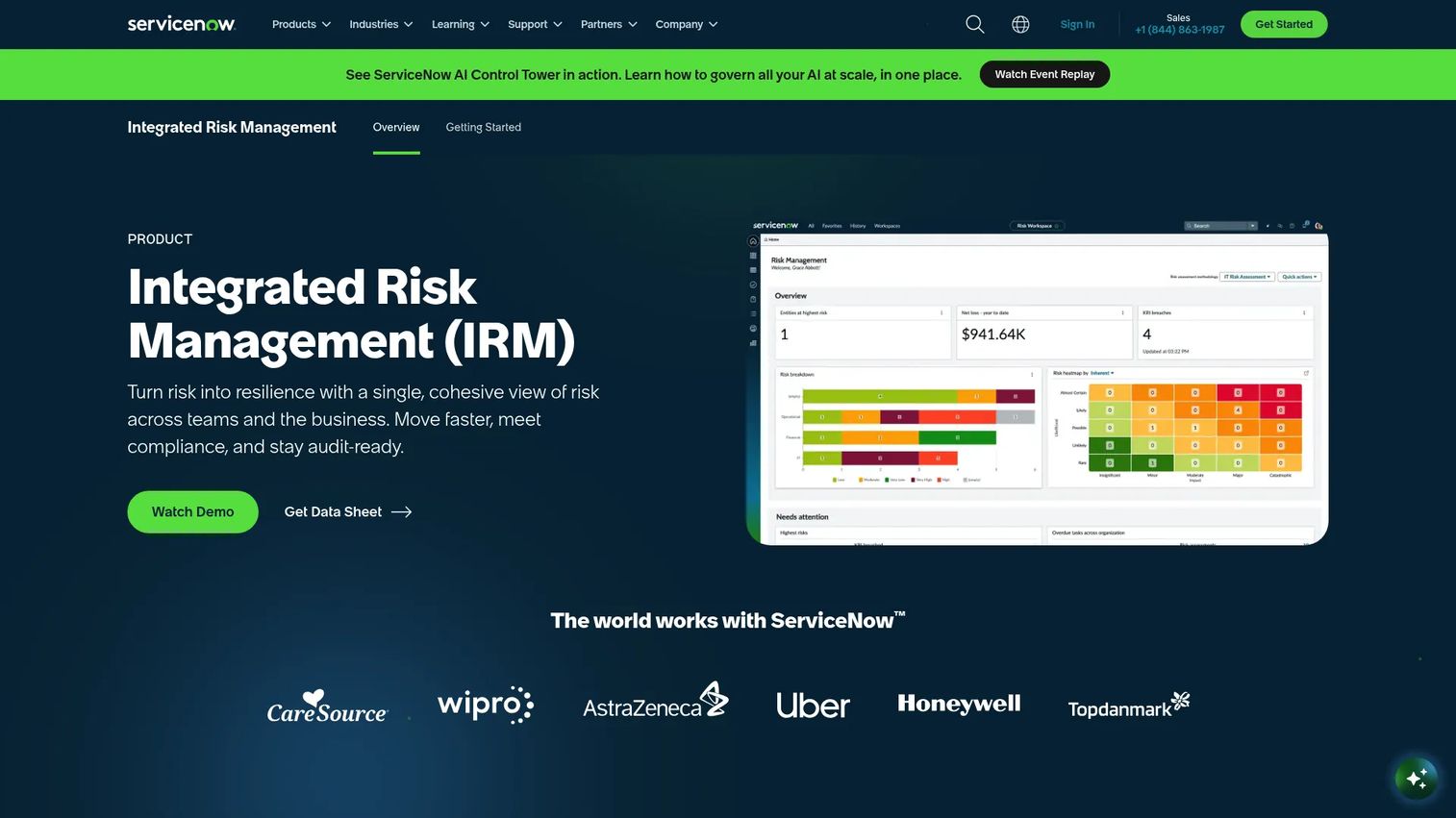
ServiceNow Integrated Risk Management is enterprise risk management software built on the ServiceNow AI Platform. It connects risk, compliance, audit, operational resilience, and IT workflows through the same platform many large organizations already use for ITSM and security operations. The differentiation is workflow connection, not standalone threat intelligence. When risk events trigger remediation tasks in IT, security, or operations, those handoffs happen natively inside existing ServiceNow workflows.
Best for: Large enterprises that already operate core IT, security, and service workflows in ServiceNow and need risk, compliance, audit, and resilience management connected to that existing operating model.
Key features
- Enterprise-wide risk visibility and prioritization
- Automated compliance control testing and centralized audit evidence
- Operational risk management with issue remediation tracking
- Operational resilience management workflows
- AI-assisted risk suggestions and executive reporting
Why choose ServiceNow Integrated Risk Management: It makes sense when ServiceNow already functions as the operational backbone and the risk team can own and configure the module. For a company that does not run ServiceNow for IT or security, buying this product means buying an entire platform primarily to access risk workflows, which is a significant implementation commitment. ServiceNow does not publish numeric pricing publicly; buyers contact sales or request a demo.
ServiceNow Integrated Risk Management pricing: Enterprise pricing, available through direct sales. No public numeric price is displayed. Platform and module license requirements drive total cost. Verified as of October 2026 from ServiceNow's official product pages.
G2 rating: 4.4/5
7. OneTrust Third-Party Risk Management
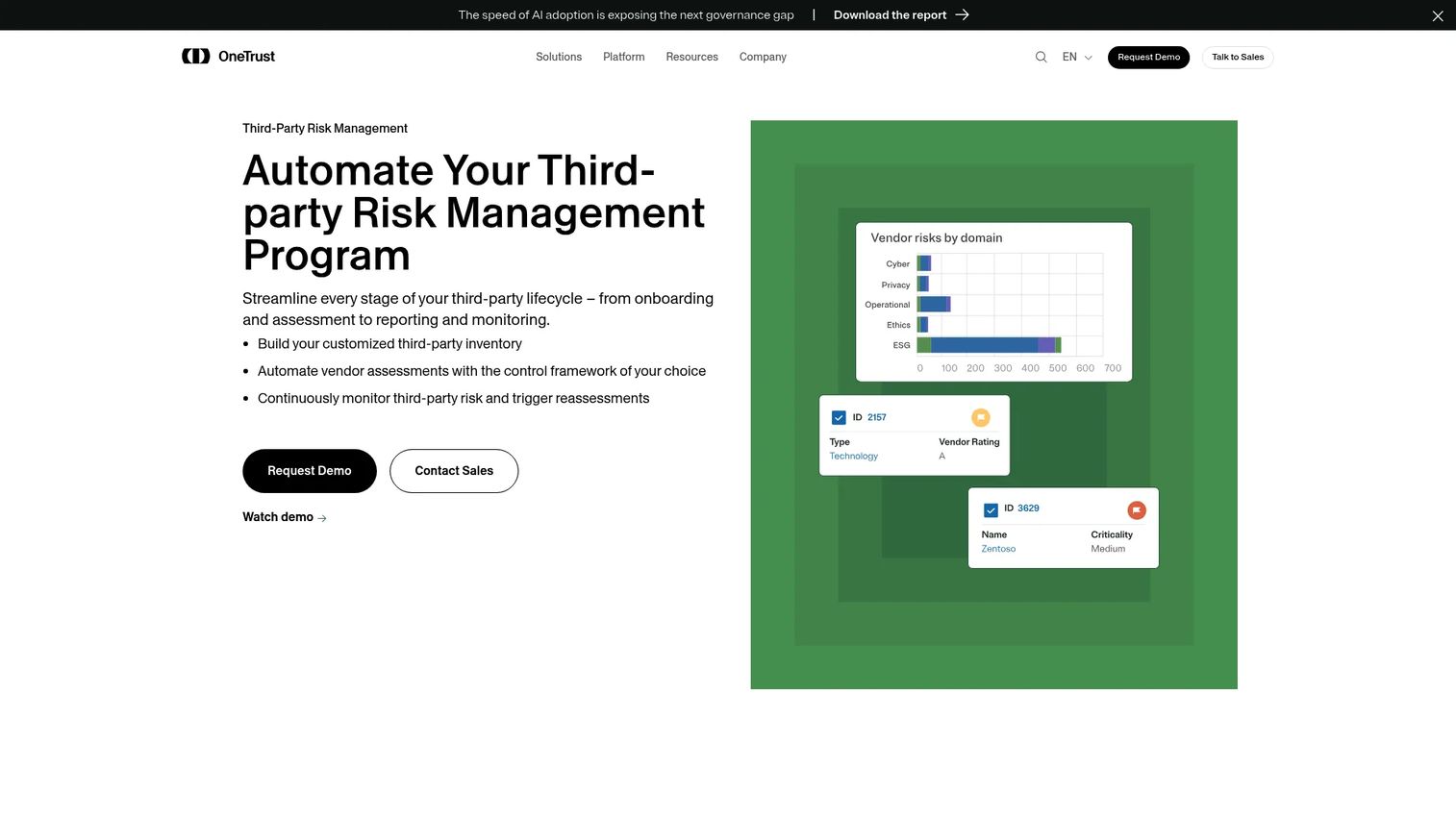
OneTrust Third-Party Risk Management automates the third-party lifecycle from initial onboarding and assessment through risk mitigation, ongoing monitoring, and offboarding. It centralizes vendor inventory, questionnaire management, workflow automation, and evidence retention, giving procurement, legal, security, and compliance teams a shared record of every vendor decision. The Suite tier adds ethics and compliance evaluation, including Dow Jones databases, sanctions screening, and adverse-media monitoring.
Best for: SaaS companies formalizing vendor due diligence programs that span security, privacy, procurement, and compliance requirements at scale.
Key features
- Centralized third-party inventory with risk prioritization
- Automated vendor assessments with customizable templates and workflows
- Continuous third-party monitoring with automated alerts and reassessments
- Evidence and questionnaire management across the vendor lifecycle
- Privacy and compliance alignment, with Suite tier adding sanctions and adverse-media monitoring
Why choose OneTrust Third-Party Risk Management: It works when the buyer needs process control, assessment consistency, and audit-ready evidence across a growing vendor inventory. It does not replace external cyber-risk ratings on its own. Pair it with a tool like SecurityScorecard or BitSight for continuous external posture monitoring. For context on how business intelligence software supports governance decisions alongside risk tools, that resource covers complementary platforms.
OneTrust Third-Party Risk Management pricing: OneTrust offers Base and Suite tiers with customized pricing. No public numeric starting price is displayed. Buyers receive a quote tailored to organization size, vendor count, and modules selected. Verified from OneTrust's pricing page as of October 2026.
G2 rating: 4.5/5
8. SecurityScorecard
SecurityScorecard is a continuous cybersecurity risk management platform providing externally observed security ratings, third-party and supply-chain risk monitoring, attack-surface intelligence, and automated vendor workflows. It scores organizations across ten risk categories using external signals, giving security and procurement teams a shared benchmark for vendor conversations. Its free tier makes it accessible as a starting point before committing to a paid monitoring program.
Best for: Security and procurement teams that need a continuous external signal for their own organization, key suppliers, and the broader vendor portfolio.
Key features
- Security ratings and scorecards across ten risk categories
- Third- and fourth-party risk monitoring
- External attack-surface and threat intelligence
- Security questionnaires and risk scoring workflows
- Automated remediation and response tracking
Why choose SecurityScorecard: It is useful for prioritizing third parties, monitoring external changes, and giving procurement teams a common framework. A rating should start a conversation, not close an assessment. High-risk vendors still need questionnaire review, contract controls, and internal business-impact analysis alongside any external score.
SecurityScorecard pricing: A free-forever plan is available. Paid TITAN plans (Watch, Assess, Secure, and MAX) require contacting sales. No public numeric pricing is displayed for paid tiers. Verified from SecurityScorecard's pricing page as of October 2026.
G2 rating: 4.3/5
9. BitSight
BitSight provides a cyber risk intelligence platform for monitoring, prioritizing, and managing enterprise and supply-chain cybersecurity risk. It generates externally observed security ratings, supports continuous attack-surface and asset discovery, and pulls threat intelligence from clear, deep, and dark web sources. Security leaders use it to benchmark their organization against peers, communicate risk to boards, and monitor critical vendors in the supply chain.
Best for: Security leaders and boards that need an external cyber-risk benchmark for their own company and a portfolio view of critical vendors and suppliers.
Key features
- Continuous attack-surface and asset discovery
- Third-, fourth-, and nth-party risk monitoring
- Threat intelligence from clear, deep, and dark web sources
- Dynamic vulnerability exploitability scoring
- APIs, integrations, data feeds, and MCP server access
Why choose BitSight: It fits a leadership team that needs a defensible external risk signal and a vendor comparison framework for board reporting. Ratings provide a starting point for vendor conversations, not a substitute for questionnaire workflows, contractual controls, or control validation on high-risk suppliers. For a broader view of AI security posture management tools that complement external ratings, that guide covers adjacent internal tooling.
BitSight pricing: Pricing varies by solutions, capabilities, vendor coverage, and workflow requirements. Offerings include Continuous Monitoring, Expanded Risk Coverage, Standard, Advanced, and Threat Intelligence tiers, all requiring a pricing request. No public numeric price was verified as of October 2026.
G2 rating: 4.5/5
10. Black Kite
Black Kite is an AI-native third-party cyber risk management platform that provides continuous vendor monitoring, AI-powered assessments, cyber event response, and cyber risk quantification using Open FAIR methodology. What distinguishes it from other cyber-rating platforms is its financial risk context: It maps vendor exposure to potential business impact, helping risk and procurement teams prioritize which vendors deserve deeper attention rather than treating every score equally.
Best for: Risk, procurement, and security teams that need to prioritize third-party cyber exposure using business impact and financial context, particularly across complex vendor ecosystems.
Key features
- Continuous third-party monitoring with vendor intelligence profiles
- AI-powered vendor assessments and investigations
- Cyber risk quantification using Open FAIR methodology
- Nth-party and supply-chain visibility
- Cyber event response and AI-powered reporting
Why choose Black Kite: It is the right pick for teams that need business-oriented prioritization on top of cyber ratings, not just a score. If your primary need is GRC workflows, incident management, or physical-world threat intelligence, look at a different category. Black Kite's financial context is most valuable when you have enough vendors to need triage logic.
Black Kite pricing: Standard and Enterprise tiers are available, with full-featured packaging, unlimited users, and included onboarding and configuration. Black Kite does not display current numeric prices publicly. Buyers contact sales for a quote. Verified from Black Kite's first-party pages as of October 2026.
G2 rating: 5.0/5 (based on 1 verified G2 review)
Considerations when choosing risk intelligence software
Start with the risk domain, not the feature list
Pick between protective intelligence, external cyber risk, operational GRC, and third-party risk before evaluating vendors. A broad platform that covers all four domains creates significant configuration and ownership overhead when your immediate gap is a single poorly managed risk type. Identify the one risk that most directly affects revenue, enterprise sales, or customer trust, then choose the platform built for that domain.
Check whether signals reach an owner with a workflow
A platform that fires alerts into a dashboard nobody monitors is not a risk management tool. Before committing, trace the full workflow: Signal fires, alert routes to a named person, that person can act inside their existing tools (ticketing, CRM, Slack, ITSM). If any step in that chain is manual, ambiguous, or falls outside your current stack, factor the integration work into your evaluation.
Validate data sources and refresh frequency
Ask every vendor what feeds their intelligence, how events are validated, and how quickly data refreshes. For cyber ratings, understand which external signals drive the score and whether your own organization has a clear path to remediation feedback. For threat intelligence, ask whether human analysts review automated detections or whether the platform is fully algorithmic.
Price the operating model, not only the license
The risk management software market reached $13.05 billion in 2025, according to Mordor Intelligence, and most enterprise-tier platforms price accordingly. Beyond the annual subscription, factor in implementation services, data integration work, internal administrator time, and the review cadence your team needs to sustain. For a founder, the most significant cost is often the security or operations leader's time spent running a platform that was bought without a clear owner in mind.
Confirm integration with your existing GTM and security stack
Verify whether the platform connects to your CRM, ticketing system, identity provider, or security tooling. The best business intelligence software surfaces similar requirements for data routing. Risk intelligence is most useful when findings land in the tools your team already uses to make decisions.
Conclusion
Risk intelligence software for enterprises covers four meaningfully different categories, and the right shortlist starts with the question: Which risk is already blocking growth, costing deals, or keeping you in the room when you should be delegating?
Choose Everbridge 360 AI or Seerist for external, real-time threat and operational intelligence. Choose N-able Risk Intelligence if you run an MSP and need cyber-risk assessment as a client-facing service. Choose Riskonnect, Resolver, or ServiceNow Integrated Risk Management for governed enterprise risk processes with named owners and audit trails. Choose OneTrust Third-Party Risk Management, SecurityScorecard, BitSight, or Black Kite for vendor and cyber-risk visibility.
The goal is not to monitor everything. The goal is to see the risk that changes a decision, assign an owner, and demonstrate that exposure is reducing over time. Build a two-tool shortlist, define the risk event each platform must help you catch, and ask every vendor to walk you through the workflow from signal to owner to board report.
Start your journey with Guideflow today!
FAQs about risk intelligence software
Risk intelligence software collects signals from internal and external sources, analyzes exposure across vendors, locations, business processes, and assets, prioritizes by likely impact, and routes actionable information to the people responsible for response. It can cover operational risk, cyber risk, third-party risk, protective intelligence, or geopolitical risk depending on the platform. The defining characteristic is that it connects a signal to an owner and a workflow, not just a report.
Risk intelligence focuses on gathering, interpreting, and prioritizing changing signals from outside and inside the organization. Risk management software typically handles the downstream processes: Risk registers, control ownership, mitigation tracking, audit evidence, and governance reporting. Many enterprise platforms combine both functions, but not all do. If your immediate need is early detection of external threats or vendor exposure, start with an intelligence-first platform. If you need structured governance and accountability, start with a GRC-oriented tool.
Four categories are worth evaluating: Operational and GRC platforms for building internal risk accountability; third-party risk tools for vendor due diligence and ongoing monitoring; external cyber rating platforms for continuous posture visibility; and protective or critical-event intelligence platforms for physical-world and operational disruption. Start with the risk most likely to affect revenue, customer trust, or enterprise sales. Only 35% of U.S. organizations report comprehensive ERM processes, according to the AICPA and NC State ERM Initiative (2025), which means most companies are addressing one or two domains at a time rather than all four simultaneously.
Yes. Third-party platforms like OneTrust, SecurityScorecard, BitSight, and Black Kite can centralize vendor inventories, questionnaires, cyber posture scores, assessment evidence, and ongoing monitoring in one place. External ratings are useful for initial prioritization and continuous monitoring, but high-risk vendors still require human review, contract-level controls, and internal business-impact analysis. A score starts the conversation; it does not close the assessment.
The platform ingests signals from external data feeds, open-source intelligence, analyst reports, and internal systems. It detects changes, maps them to monitored assets, vendors, or locations, then sends alerts or creates workflow tasks for named owners. Quality depends on data source coverage, relevance configuration, and how well the alert routes into the recipient's existing workflow. Two-thirds of surveyed organizations now use specialized tools to manage all or nearly all of their risk processes, according to the KPMG Enterprise Risk and Resiliency Survey (2025), indicating that real-time monitoring has moved from a capability only large enterprises access to a mainstream expectation.
No. External ratings are a strong starting point for prioritization and continuous monitoring of your vendor portfolio. They do not replace questionnaire-based assessments, contractual controls, evidence review, or internal analysis of what a vendor failure would cost your business. Use ratings to triage which vendors deserve deeper attention, then conduct thorough due diligence on the ones with the highest potential impact.
Start with the risk problem already blocking growth. If enterprise prospects are asking security questions your team can't answer consistently, external cyber monitoring or a vendor risk tool is the first priority. If board members are asking about operational resilience and you have no documented process, a lightweight GRC tool creates the paper trail and ownership model you need. Avoid buying a broad platform before you have a named owner and a defined review cadence. A tool without an owner becomes an expensive dashboard within one quarter.
Enterprise platforms in this category typically price through direct sales. Cost depends on the number of monitored vendors, locations, user seats, modules selected, integration requirements, analyst service tiers, and contract length. Everbridge 360 AI is one of the few platforms with a disclosed starting price: Core begins under $9K. Most others, including Riskonnect, Resolver, ServiceNow, BitSight, and Black Kite, require a direct sales conversation for pricing. Budget for the total cost of ownership: Subscription, implementation, internal administration time, and integration development. For platforms requiring significant configuration, implementation services can equal or exceed the first year's license fee.