Your continuity plan lives in a shared drive nobody has opened since the last audit. The business impact analysis is a spreadsheet three versions behind. When a real disruption hits, response coordination happens in a frantic thread of emails and phone calls, and half the team is guessing who owns what.
That is the gap most teams are trying to close when they start shopping for business continuity software. The plans exist. The problem is they are scattered, stale, and disconnected from the moment they matter most.
Business continuity software fixes that by turning continuity planning, business impact analysis, dependency mapping, testing, and crisis response into one connected operating layer instead of a pile of documents. The category is growing fast because the pressure is real: the global business continuity management planning solution market is projected to rise from USD 720.5 million in 2024 to USD 3.31 billion by 2034, at a 16.5% CAGR, according to Fact.MR (2024).
For a sales enablement or RevOps leader, this reads differently than a pure risk buy. You care about governance, cross-functional process consistency, and whether a platform can hold plans, playbooks, and ownership without adding chaos. The same principles that make a strong contract lifecycle management system, versioning, approvals, and clean audit management trails, apply here. And the same reporting discipline you expect from business intelligence tooling matters when leadership asks whether the organization is actually resilient.
What's inside
This guide covers six business continuity tools built for continuity planning, business impact analysis, recovery sequencing, crisis coordination, testing, and audit-ready governance. It is written for teams evaluating a business continuity solution mid to late in the buying journey, when you are narrowing vendors, not discovering the category.
We selected platforms based on four criteria that matter operationally: lifecycle coverage from plan creation through recovery, depth of dependency mapping, crisis response and communication capabilities, and compliance support with ease of maintenance. Pricing and G2 ratings are noted where public and verifiable, and omitted where a vendor keeps figures behind a sales conversation.
TL;DR
- Best for mobile-first frontline operations: SafetyCulture, for teams that run inspections, incident tracking, and continuity checks from a phone.
- Best for enterprise resilience programs: Fusion Framework System, for a single operating view across risk, continuity, and interconnections.
- Best for large governed programs: Riskonnect, for centralized continuity, crisis response, and ISO 22301 alignment.
- Best for integrated risk stacks: SAI360 and Archer Business Resiliency, when continuity sits inside a broader GRC program.
What is business continuity software?
Business continuity software is a centralized platform that helps organizations plan for, respond to, and recover from disruptions by managing continuity plans, business impact analysis, dependencies, testing, and crisis workflows in one place.
Think of it as the operating layer for resilience, not a document repository. Instead of static plans that decay between audits, a business continuity management software platform keeps ownership, versioning, and dependencies live and connected to real response actions.
Core capabilities to expect from a modern business continuity program platform:
- Plan creation and lifecycle management: build, version, approve, and expire continuity plans with clear ownership.
- Business impact analysis and risk assessment: quantify what a disruption costs, prioritize critical processes, and set recovery objectives.
- Dependency and process mapping: model upstream and downstream connections between processes, systems, vendors, and people.
- Incident and crisis workflows: trigger structured response actions, task assignments, and live coordination when disruption hits.
- Testing and exercises: run drills, tabletop simulations, and scenario tests to surface weaknesses before a real event.
- Compliance and audit trails: document readiness, align to frameworks like ISO 22301, and produce reports auditors and leadership trust.
The strongest business continuity tools connect these pieces so a change in one, a new dependency, a failed test, an updated recovery objective, propagates everywhere it should. That connectivity is what separates a resilience system from a folder of PDFs.
When to use business continuity software
Not every team needs a dedicated platform on day one. Here is how to recognize the moment a business continuity planning software investment pays off.
Standardize continuity planning across teams
When plans live in docs, spreadsheets, and email threads, nobody trusts which version is current. Ownership is fuzzy, updates lag, and the plan you rely on in a crisis reflects last year's org chart. Business continuity software centralizes plans with versioning, assigned owners, and approval workflows, so the plan people execute is the plan that was actually reviewed.
Improve crisis coordination and response
Static plans do not coordinate a response. When disruption hits, you need live incident workflows, emergency notification, task assignment, and structured recovery actions that everyone can see. The right business resilience software gives cross-functional teams a single view of who is doing what, cutting the frantic-thread problem out of the equation.
Prove resilience to auditors and leadership
Leadership and auditors want evidence, not assurances. Audit trails, exercise records, and reporting let you document readiness and show alignment to ISO 22301 or internal governance standards. This is where continuity management software earns its keep during a certification cycle or a board review.
Run tests and exercises that reflect real disruption
A plan that has never been tested is a hypothesis. Drills, tabletop simulations, and scenario testing surface the gaps, an outdated contact, a missing dependency, an unrealistic recovery time, before a real event does. Good software makes exercises repeatable and captures the findings so the next plan version is stronger.
Comparison table
The six platforms below span mobile-first operations, enterprise resilience, and integrated risk management. Pricing and G2 ratings reflect verified public sources where available; where a vendor keeps pricing behind a sales conversation, that is noted directly.
| # | Product | Intent | Key differentiation | Pricing | G2 rating |
|---|---|---|---|---|---|
| 1 | SafetyCulture | Mobile-first operations and continuity checks | Frontline inspections, incident tracking, and tasks on any device | Free; Premium $24/seat/mo | 4.6/5 |
| 2 | Fusion Framework System | Enterprise operational resilience | Single operating view across risk, continuity, and dependencies | Custom | 4.4/5 |
| 3 | Riskonnect | Large governed continuity programs | Centralized continuity, crisis response, ISO 22301 alignment | Custom | Not listed |
| 4 | Archer Business Resiliency | Enterprise resilience and DR | BIA, continuity, disaster recovery, and crisis workflows | Custom | 4.5/5 |
| 5 | SAI360 | Integrated GRC with resilience | Continuity inside a unified risk and compliance platform | Custom | 4.1/5 |
| 6 | Oracle Risk Management Cloud | Oracle ERP-standardized enterprises | Embedded risk, access, and compliance controls | From $180/user/mo | 4.2/5 |
1. SafetyCulture
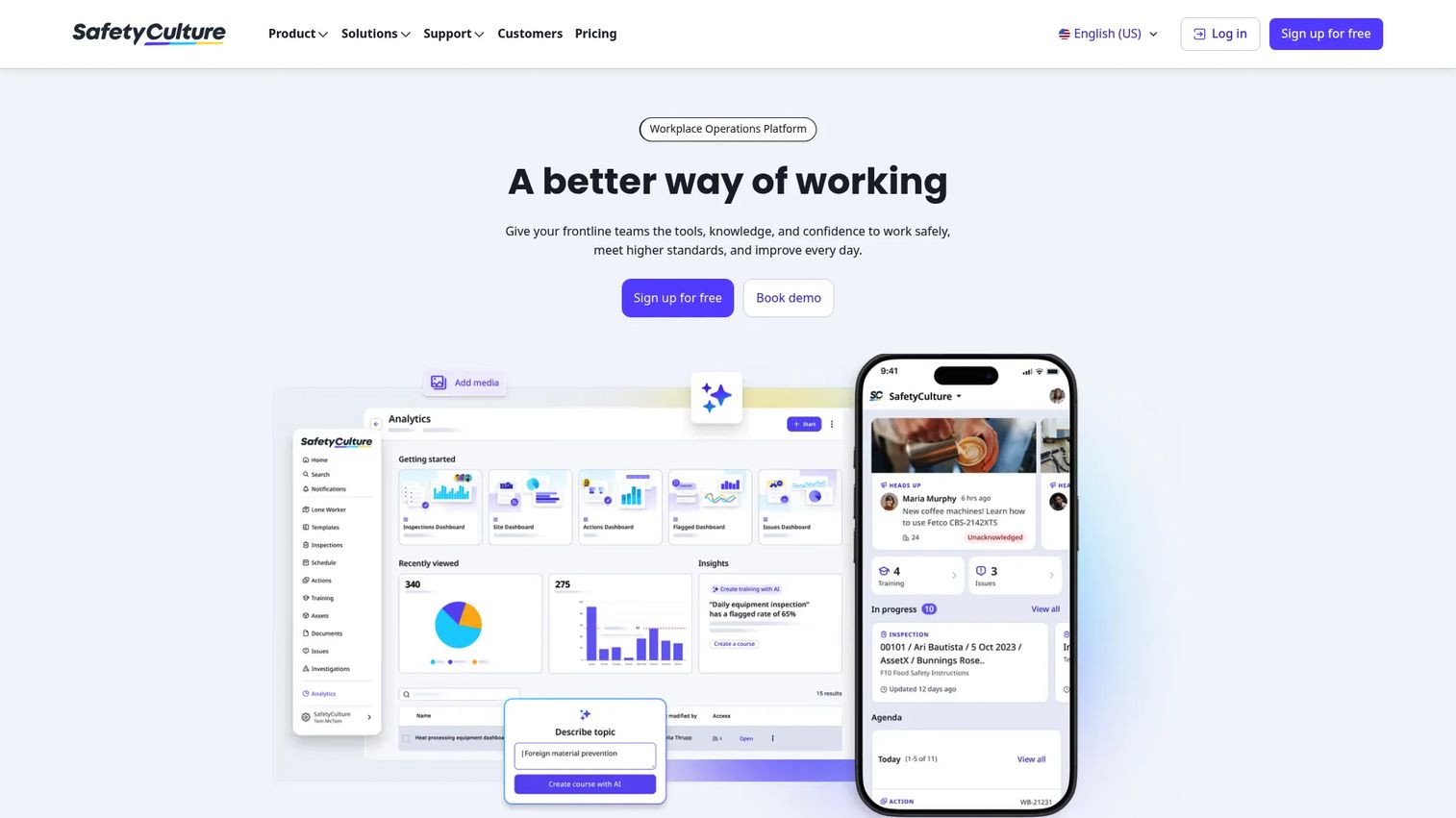
SafetyCulture is a workplace operations platform for inspections, training, asset management, tasks, documents, issues, and analytics. It is the practical option for teams whose continuity work happens on the ground rather than in a governance office. If your resilience depends on people running checks, tracking incidents, and closing tasks from a phone in the field, this is the tool that meets them where they work.
Best for: Teams needing a mobile-first platform for inspections, audits, training, and frontline operations.
Key strengths
- Inspections and checklists: run repeatable continuity and safety checks on any device, with results captured instantly.
- Issues and investigations: log incidents, route them, and track resolution so disruptions do not slip through the cracks.
- Task management and analytics: assign recovery actions and see completion and trends across sites in real time.
Why choose SafetyCulture: It is the strongest fit when continuity is an operational reality, not a paperwork exercise. Frontline teams actually adopt it because it lives on mobile and mirrors how they already work. If your program leans toward inspections, asset checks, and incident tracking rather than formal BIA modeling, SafetyCulture removes friction the governance-heavy platforms introduce for field staff.
SafetyCulture pricing: SafetyCulture offers a Free plan at $0/seat/month. The Premium plan is $24/seat/month, billed monthly or annually. Enterprise pricing is custom and available through sales, and optional Lite seats start from $5/seat/month when billed annually. It carries a 4.6/5 rating on G2.
2. Fusion Framework System
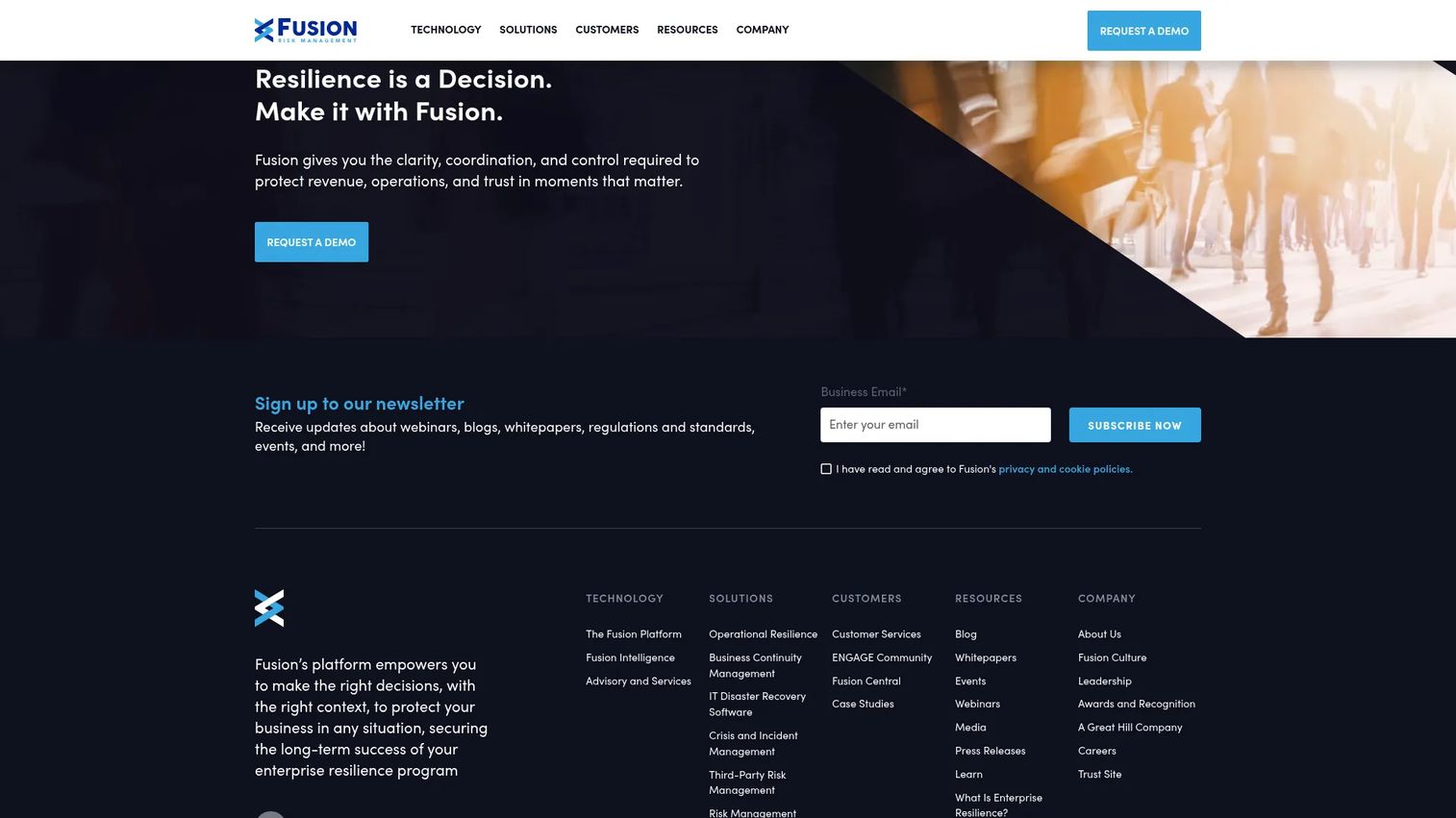
Fusion Framework System is cloud-based operational resilience software for risk, continuity, and incident management. Its defining trait is the single operating view: instead of continuity, risk, and dependencies living in separate systems, Fusion connects them so you can see how a disruption in one process ripples across the organization. That visibility across interconnections is what makes it a serious enterprise contender.
Best for: Enterprises managing operational risk, resilience, and business continuity in one platform.
Key strengths
- Critical process mapping: map how services and products get delivered, then trace the dependencies underneath.
- Impact tolerances and guardrails: set thresholds for how much disruption a service can absorb before it breaches acceptable limits.
- Scenario testing: run exercises that validate tolerances and surface where recovery plans fall behind reality.
Why choose Fusion Framework System: Choose it when your program has outgrown planning and needs to model the planning-to-response lifecycle as one connected system. The dependency visibility is genuinely useful for teams that need to answer, precisely, what breaks when a critical vendor or system goes down. It rewards programs mature enough to invest in modeling their operations, not just documenting plans.
Fusion Framework System pricing: Fusion does not publish public pricing on its site; packages are quote-based and depend on scope and configuration. It holds a 4.4/5 rating on G2.
3. Riskonnect
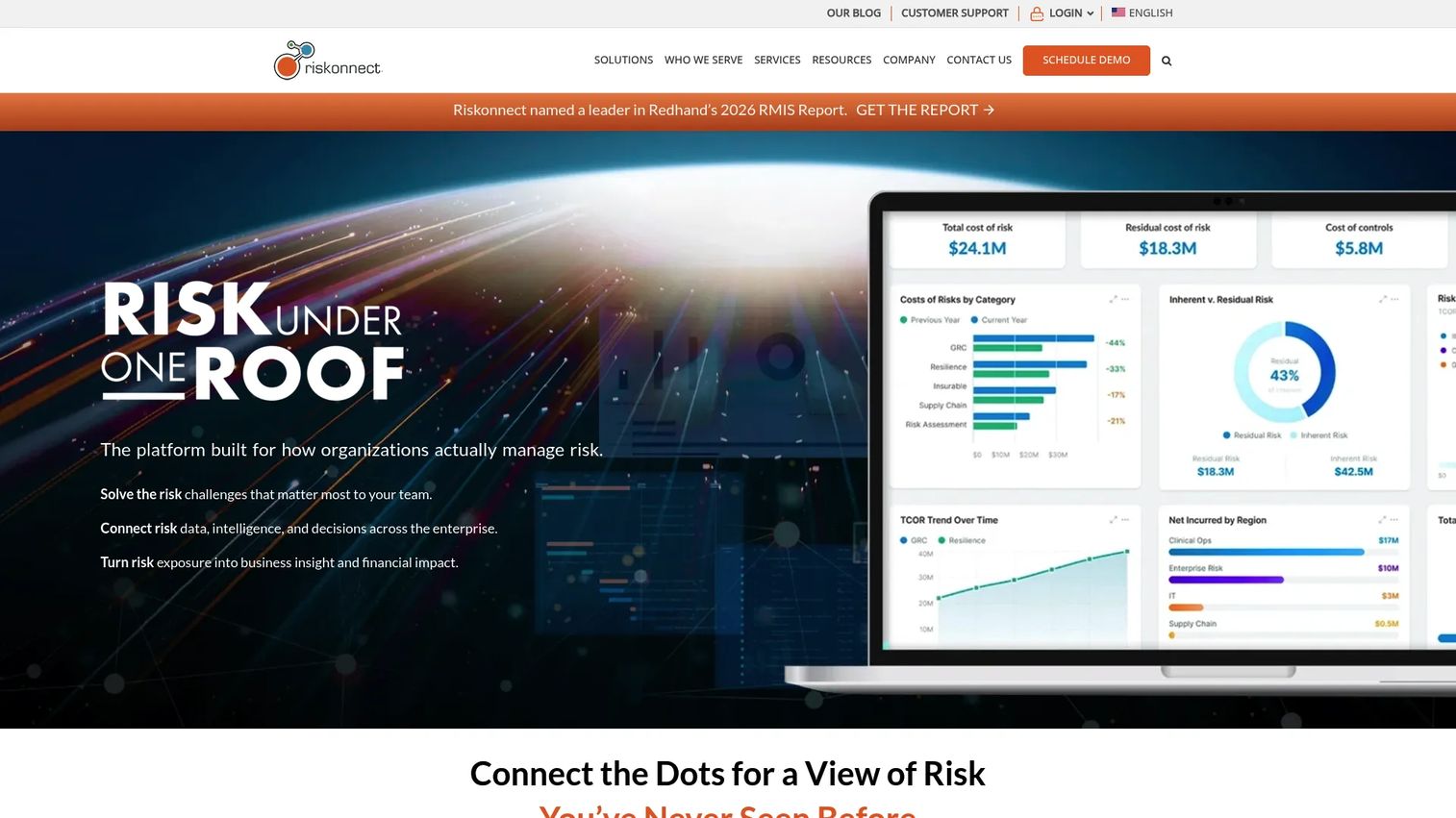
Riskonnect is integrated risk management software spanning enterprise risk, compliance, claims, audit, and resilience. For business continuity specifically, it centralizes continuity and resilience management with dynamic plans, crisis response, emergency notification, and threat intelligence, all aligned to ISO 22301. It suits organizations that want continuity to sit inside a broader, governed risk program rather than as a standalone tool.
Best for: Mid-market to enterprise teams centralizing governance, risk, compliance, claims, audit, and resilience workflows.
Key strengths
- Cloud-based integrated platform: connect continuity to enterprise risk, claims, and audit through shared data and APIs.
- AI-powered risk intelligence: surface emerging threats and prioritize the risks most likely to disrupt operations.
- Dynamic plans and crisis response: keep continuity plans current and trigger structured response with built-in notification.
Why choose Riskonnect: It is the pick for larger programs that need auditability and governance across many risk domains at once. If continuity is one line in a bigger operational resilience mandate, consolidating it with claims, audit, and compliance in one platform reduces the tool sprawl that fragments reporting. The ISO 22301 alignment is a practical advantage during certification.
Riskonnect pricing: Riskonnect uses quote-based pricing that depends on project size, complexity, and customization, with implementation options at different price points. No public numeric price is listed.
4. Archer Business Resiliency
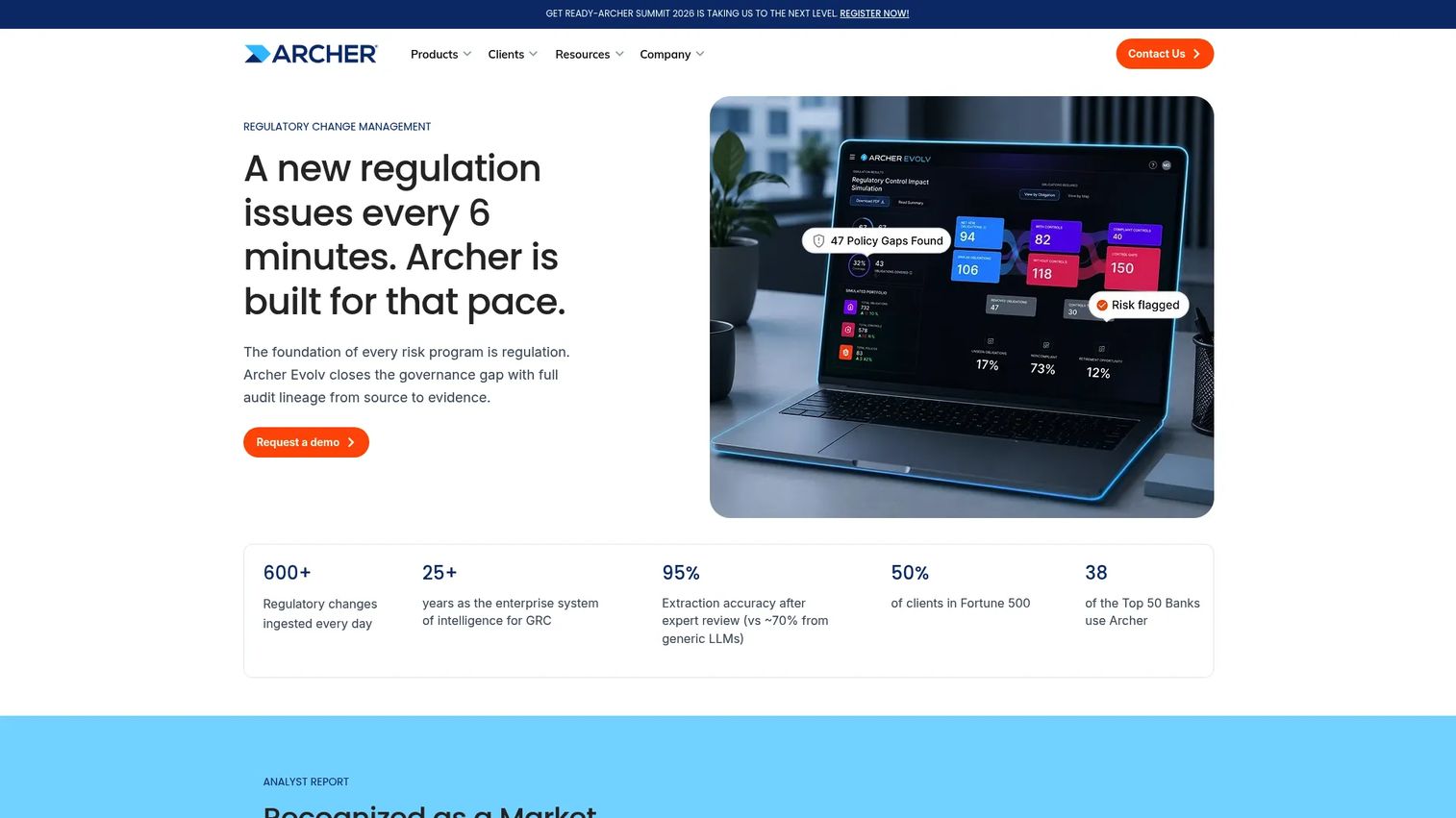
Archer Business Resiliency helps organizations plan for disruptions by managing business impact analysis, continuity, disaster recovery, incident, crisis, and scenario analysis workflows. It sits inside Archer's broader integrated risk management platform, which makes it a natural fit for large, regulated organizations that already run enterprise governance programs.
Best for: Large regulated organizations needing an enterprise business resiliency and risk management platform.
Key strengths
- Business impact analysis: quantify disruption impact and prioritize critical processes for recovery.
- Continuity and IT disaster recovery: manage both business and technical recovery in one integrated view.
- Incident and crisis management: coordinate response with alerts and notifications across the enterprise.
Why choose Archer Business Resiliency: It is the pick when continuity is one component of a mature, enterprise-wide risk and resilience program. The integration of BIA, continuity, and disaster recovery under a single governance layer suits regulated industries with heavy documentation and audit expectations. Teams already standardized on Archer for risk gain continuity without adding a separate platform.
Archer Business Resiliency pricing: Archer uses demo-led, request-based pricing; no public figures are published on the site. It carries a 4.5/5 rating on G2.
5. SAI360
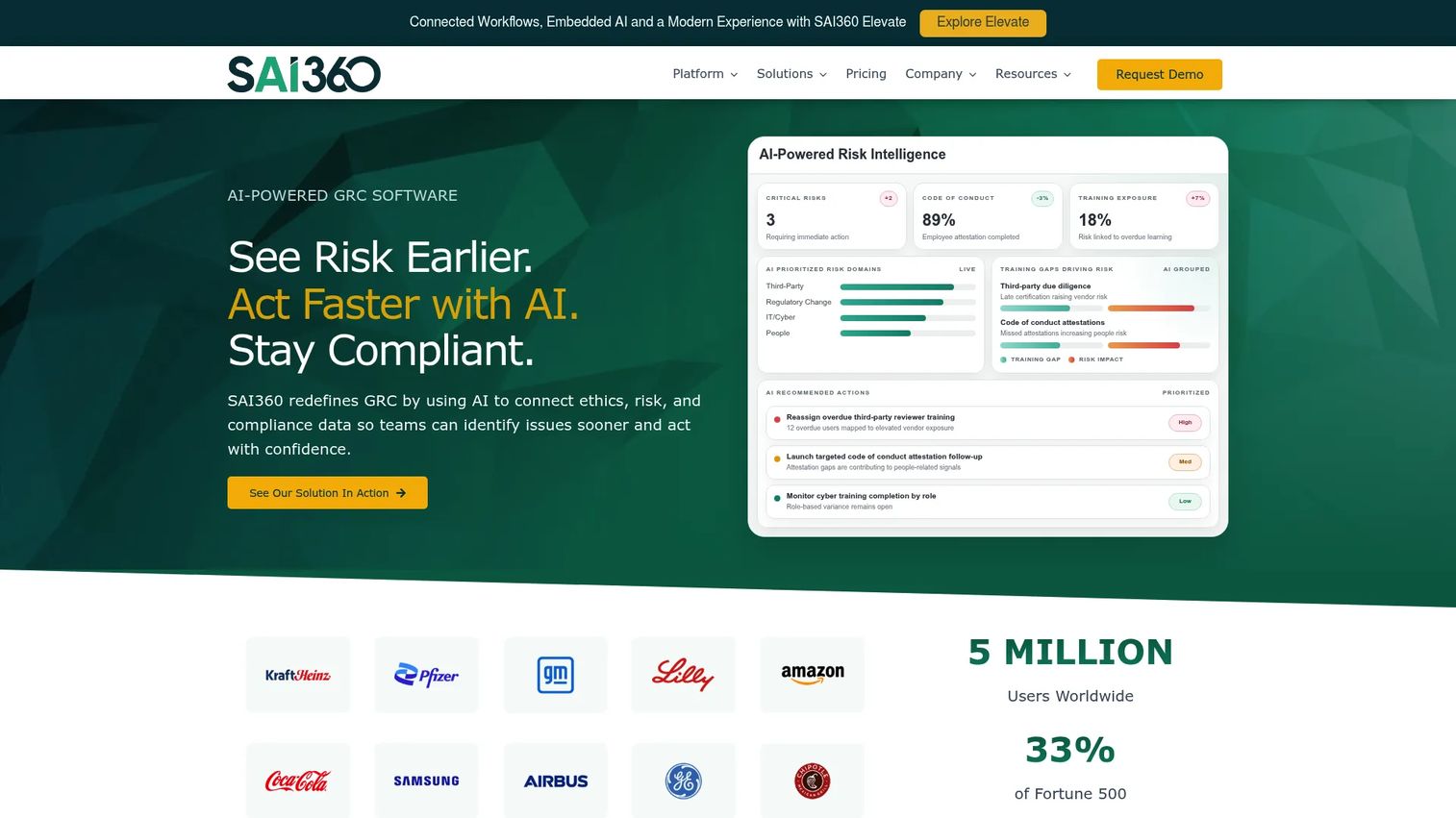
SAI360 is an AI-powered GRC platform for ethics, risk, compliance, and related workflows, with continuity program support as part of its resilience packages. It suits teams that want business continuity and risk management software in a single configurable system rather than a point solution, so continuity, policy, incidents, and compliance share one backbone.
Best for: Mid-market to enterprise teams needing a configurable GRC platform.
Key strengths
- Unified workflows: connect policy, incidents, training, and regulatory compliance in one platform.
- AI-powered risk intelligence: get recommended actions and surface risks that could disrupt operations.
- Configurable modules: assemble compliance, risk, and resilience editions to match program scope.
Why choose SAI360: Choose it when continuity belongs inside a broader integrated risk management stack rather than standing alone. The configurability means you can shape modules to your program's maturity, and the shared workflows reduce the reporting fragmentation that comes from stitching separate tools together. It is a fit for teams thinking in terms of governance across the whole risk landscape.
SAI360 pricing: SAI360 offers Essentials, Professional, and Enterprise editions plus pre-bundled Compliance, Risk, and Resilience packages. Pricing is quote-based and depends on edition, users, and modules; no public numeric price is displayed. It holds a 4.1/5 rating on G2.
6. Oracle Risk Management Cloud
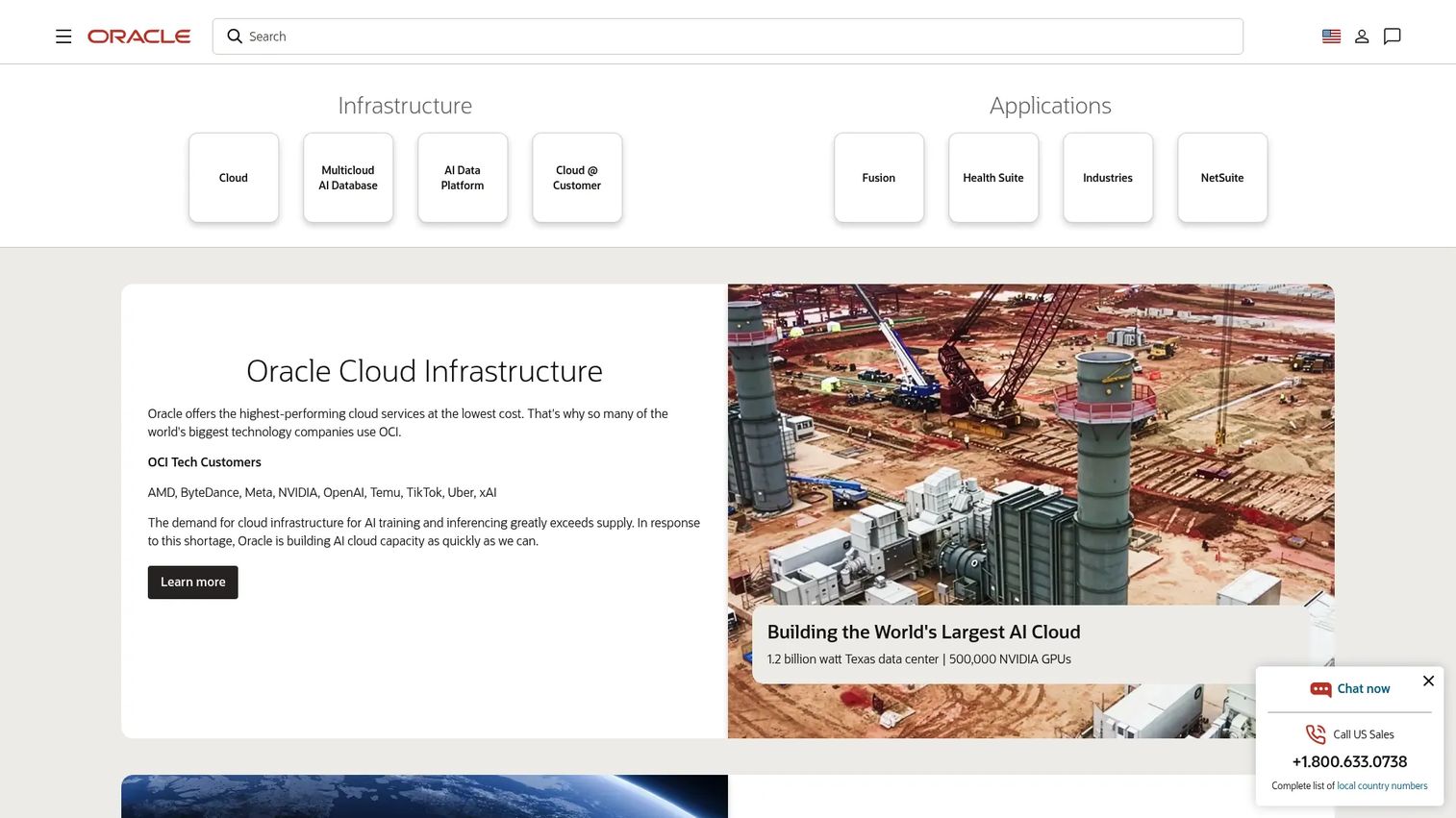
Oracle Risk Management Cloud is Oracle's cloud risk and compliance module for managing segregation of duties, access controls, and continuous monitoring within ERP. It is less a standalone continuity tool and more an AI-enabled risk and controls layer that fits organizations already standardized on Oracle Fusion. If your resilience concerns center on financial controls, access risk, and automated monitoring inside ERP, this belongs on your shortlist.
Best for: Enterprises using Oracle Fusion ERP that need embedded risk, access, and compliance controls.
Key strengths
- Risk and compliance automation: automate control workflows and reduce manual compliance effort.
- Secure role design: run segregation-of-duties analysis and design access controls with less risk.
- Continuous monitoring: watch security, configurations, and transactions on an ongoing basis.
Why choose Oracle Risk Management Cloud: It is the right call when you are already invested in Oracle's ecosystem and want risk, access, and compliance controls embedded rather than bolted on. The AI-enabled monitoring and audit controls fit enterprises whose continuity and resilience priorities are tightly coupled to ERP integrity. For non-Oracle shops, the dedicated continuity platforms above will map more directly to BIA and crisis workflows.
Oracle Risk Management Cloud pricing: Oracle's published global price list shows Oracle Fusion Risk Management Cloud Service at $180.00 per hosted named user per month, with a 10-user minimum and a three-year standard term. It carries a 4.2/5 rating on G2.
Considerations
Once you have a shortlist, judge the tools against how your program actually operates, not just the feature grid. These criteria separate a platform you will use from one that becomes another stale repository.
Governance and version control
Ownership, approvals, expiration dates, and audit trails are what keep plans trustworthy. Ask how the tool assigns plan owners, how it enforces review cadences, and whether it records who changed what and when. This is the same governance discipline you would demand from any contract management or component content management system, and it is non-negotiable for continuity.
BIA and dependency depth
A shallow BIA produces confident but wrong recovery priorities. Evaluate how well the tool models upstream and downstream dependencies across processes, systems, vendors, and people. The best platforms let you trace, in a click, what fails when a specific dependency goes down, and which recovery actions unlock which processes.
Crisis response and communications
Look closely at notification channels, task assignment, and live coordination. When an incident starts, can you trigger the right response, notify the right people across SMS, email, and app, and see status in real time? A plan you cannot activate quickly is a plan you do not really have.
Testing and scenario quality
Good exercises feel like real disruption, not a checkbox. Judge how the tool supports tabletop simulations, scenario variation, and after-action capture. The point of testing is to feed findings back into the next plan version, so look for a clean loop from exercise to update.
Integrations and maintenance
Continuity data does not live in isolation. Consider how the platform connects to your communication tools, HR systems, analytics, and reporting stack. Then weigh how much admin effort keeps it current. Strong reporting, echoing what you expect from marketing resource management or loyalty management platforms, makes leadership reviews and audits far less painful.
Conclusion
Business continuity software earns its place when you treat it as an operating system for resilience, not a filing cabinet for plans. The difference shows up in a crisis: connected platforms coordinate response, while document folders leave you reconstructing who owns what.
The strongest fit depends on your program's shape. SafetyCulture is the practical choice for mobile-first frontline operations. Fusion Framework System and Archer Business Resiliency suit enterprise resilience programs that need deep dependency modeling and governance. Riskonnect and SAI360 fit teams consolidating continuity into a broader integrated risk stack. Oracle Risk Management Cloud leans into ERP-embedded controls for Oracle shops.
Do not buy on the feature list alone. Shortlist two or three platforms that match your maturity and program scope, then run a scenario-based demo, walk each vendor through a real disruption your team has faced and watch how the tool handles plan activation, notification, and recovery. The one that keeps the response clear under pressure is the one to buy.
FAQs
Business continuity software is a centralized platform for planning, responding to, and recovering from disruptions. It manages continuity plans, business impact analysis, dependencies, testing, and crisis workflows in one place, connecting planning to real response so resilience is operational rather than theoretical.
The core set is plan creation and lifecycle management, business impact analysis, dependency and process mapping, incident and crisis workflows, testing and exercises, and compliance audit trails. The strongest business continuity tools connect these so a change in one area propagates everywhere it should.
Business continuity software covers the whole program: how the organization keeps operating and recovers processes, people, and services during any disruption. Disaster recovery software is narrower and more technical, focused on restoring IT systems, data, and infrastructure. Continuity is the operational resilience layer; disaster recovery is one technical component inside it.
Prioritize governance and version control, BIA and dependency depth, crisis response and communications, testing support, and ease of maintenance. A tool that is hard to keep current becomes a stale repository, so weigh admin overhead and reporting quality as heavily as the feature list.
Risk, security, operations, IT, compliance, and leadership all use it. Risk and security own the program, operations and IT execute recovery, compliance documents readiness, and leadership reviews resilience posture. In many organizations, RevOps and enablement leaders also care because continuity touches process consistency and governance.
Yes, if you run or plan to run a structured continuity program. ISO 22301 is the international standard for business continuity management, and alignment gives you a proven framework for plans, BIAs, and exercises. Platforms built around it make certification and audits considerably smoother.
Yes. Emergency notification, incident coordination, task assignment, and structured recovery workflows are core to most business resilience software. When disruption hits, these features replace frantic email threads with a single coordinated view of who is doing what and what happens next.
Match the platform to your program maturity and scope rather than buying the biggest suite. A mobile-first operations team has different needs than an enterprise consolidating continuity into a GRC stack. Shortlist based on your real use cases, then run a scenario-based demo to confirm fit before committing.