You're about to approve a six-figure platform decision. Your VP has a vendor shortlist. Your board wants a market view. Sales says the category is moving fast. Everyone has an opinion, but nobody has evidence that survives due diligence.
That's the exact moment technology research services pay for themselves. They give you independent market intelligence, analyst guidance, vendor evaluations, and forecasts before you lock in a product roadmap, a budget, or a GTM plan. The global insights industry exceeded $150 billion in turnover in 2024, according to ESOMAR's Global Market Research report (2025). That scale reflects how many organizations have concluded that internal assumptions aren't enough.
Technology research matters most when the decision has real consequences. Market entry, a major platform bet, a build versus buy call, or a fundraise narrative that needs to hold up under scrutiny - these are the moments where a research subscription or a custom project earns its keep.
This guide compares seven technology research services worth shortlisting in 2026.
What's inside
This guide is for Series B SaaS founders and strategy leaders who need outside research to make a technology, market, or vendor decision without building a full internal research function.
Providers were selected based on:
- Research breadth and technology coverage
- Decision support depth, including analyst inquiry and advisory access
- Industry or sector specialization
- Fit for high-consequence technology investments
TL;DR
- Best overall for broad executive technology decisions: Gartner, for leadership teams that need analyst guidance, vendor evaluation, and cross-functional market research
- Best for translating research into operating frameworks: Forrester, for founders whose teams need research tied to planning tools and role-specific guidance
- Best for market sizing and technology intelligence: IDC, for data-heavy technology market analysis, buyer demand, and regional forecasts
- Best for engineering and service-provider evaluation: Everest Group, for sourcing, AI services, and technology operations decisions
- Best for specialist markets: Omdia for telecom and infrastructure, ABI Research for connected and industrial technology, and Frost & Sullivan for growth strategy and vertical expansion
What are technology research services?
Technology research services provide independent market intelligence, analyst guidance, vendor evaluations, forecasts, and custom analysis that organizations use to make technology and innovation decisions.
Unlike vendor-produced content, which has a commercial purpose, research services are built around methodology, data breadth, and analyst independence. A good research partner explains uncertainty rather than hiding it.
What technology research services typically include
- Technology market sizing and forecasts
- Emerging technology trend analysis
- Vendor evaluation and shortlisting support
- Competitive intelligence and category mapping
- Industry-specific research by sector or vertical
- Custom surveys, advisory calls, and strategic workshops
- Analyst inquiry for live decision validation
- Technology investment and sourcing guidance
How research services differ from vendor reports
Vendor reports can orient you to a product category. Research services go further: They define the market boundaries, compare providers independently, interview buyers, and build forecasts from primary data. The key questions to ask are who funded the research, how the data was collected, and whether the analyst can challenge your assumptions.
The four delivery models you should understand
| Delivery model | What you get | Best for | Founder caution |
|---|---|---|---|
| Research subscription | Ongoing reports, data, and analyst access | Continuous strategic decisions | Can be excessive for a narrow one-time question |
| Custom research project | A defined study or market analysis | Market entry, category sizing, investor preparation | Scope must define the decision it will support |
| Analyst inquiry and advisory | Direct access to subject-matter experts | Fast decision validation | Valuable only when the right stakeholders use it |
| Specialist research firm | Deep coverage of a sector or technology | Telecom, industrial tech, AI infrastructure, engineering services | Depth may come with narrower breadth |
When to use technology research services
Evaluate a major build versus buy decision
Category maturity, vendor concentration, and implementation risk are hard to assess from inside the company. Research validates what the market looks like before you commit engineering capacity to a build decision that could consume a year of roadmap. A wrong bet here delays repeatable GTM, and external data narrows the uncertainty before you make it.
Enter a new market or product category
Before hiring a new GTM leader or opening a new segment, you need a view on TAM assumptions, buyer maturity, regional demand, and competitive whitespace. Research turns a market instinct into a defensible plan. It also tells you which terminology buyers use in a new vertical, which matters more than most founders expect.
Shortlist strategic technology vendors
Running a full vendor evaluation without research is slow and expensive. A research subscription helps your team narrow the field before committing to demos, security reviews, pilots, and procurement cycles. Analyst inquiry adds a fast calibration layer: A one-hour call with the right analyst can reframe an evaluation that would otherwise take three months.
Prepare for a board meeting, fundraise, or strategic reset
Third-party market evidence stress-tests your category narrative before investors do. If your market-size claim or competitive positioning can't survive an analyst's framework, it won't survive a term sheet negotiation. Research gives your leadership team a shared vocabulary before that conversation starts.
Technology research services comparison
These providers are not interchangeable. Some are broad executive advisory firms. Others are strongest in market data, engineering services, telecom, industrial technology, or innovation research. Choose by the decision you need to support.
| # | Product | Best for | Key differentiator | Pricing | G2 rating |
|---|---|---|---|---|---|
| 1 | Gartner | Broad executive technology strategy and vendor evaluation | Magic Quadrant, analyst guidance, peer communities, and decision tools | Contact for quote | 4.1/5 |
| 2 | Forrester | Technology leaders converting research into action | Role-specific research, Forrester Wave evaluations, planning tools | Contact for quote | 4.3/5 |
| 3 | IDC | Market sizing, technology intelligence, and buyer data | Global technology market forecasts, IDC Quanta AI assistant, IDC TechMatch | Contact for quote | 4.5/5 |
| 4 | Everest Group | Engineering, AI services, sourcing, and service-provider evaluation | PEAK Matrix assessments and services market research | Contact for quote | 3.5/5 |
| 5 | Omdia | Telecom, media, technology, and digital infrastructure markets | Sector-specific market intelligence and forecasting | Contact for quote | N/A |
| 6 | ABI Research | Connected technology, AI, industrial tech, and IoT markets | Specialist analyst coverage and quantitative data products | Contact for quote | N/A |
| 7 | Frost & Sullivan | Growth strategy, innovation, and sector-specific market research | Growth advisory with vertical and regional coverage | From €9,950 for 3-month program | 3.5/5 |
Best 7 technology research services for 2026
1. Gartner
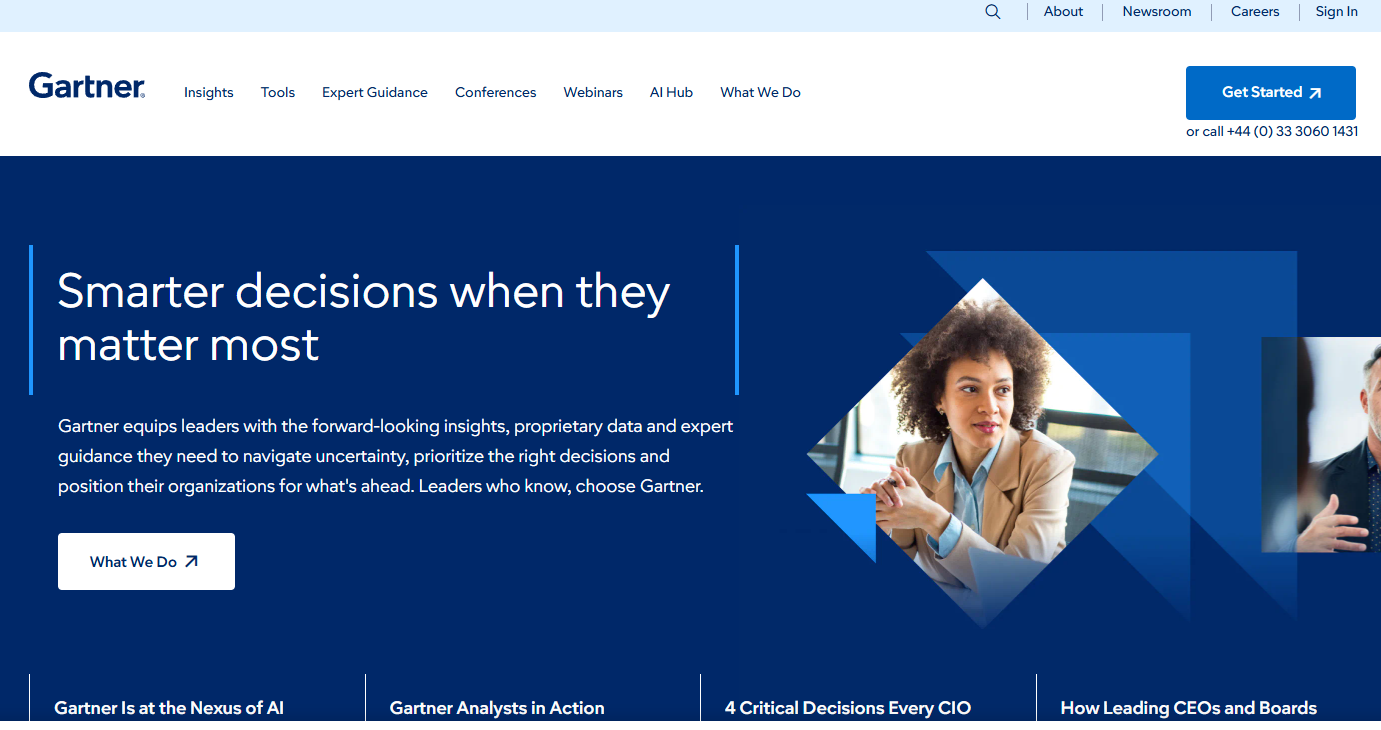
Gartner provides business and technology insights, research, consulting, tools, and conferences for enterprise leaders. Its research covers AI adoption, cloud, cybersecurity, product strategy, and operating model decisions. The firm is best known for its Magic Quadrant vendor evaluations and Critical Capabilities assessments, which give buyers a structured view of provider landscapes across hundreds of technology categories.
Best for: Series B and later SaaS companies facing multi-function technology, category, or vendor decisions with board-level visibility.
Key features
- Proprietary research across technology and business functions
- Magic Quadrant and Critical Capabilities vendor evaluations
- Analyst inquiry access for direct decision validation
- Peer community benchmarks and executive networking
- Custom research and consulting engagements
Why choose Gartner: Choose it when the decision has broad organizational consequences and your leadership team needs a shared framework. Its breadth becomes more valuable once you have multiple strategic questions across product, IT, and GTM running simultaneously.
Gartner pricing: Gartner structures access around research subscriptions, user count, role coverage, and analyst engagement. Pricing is quote-based; contact Gartner directly for package details. Before entering that conversation, write down the next two to four decisions you need research to support - that scope prevents overbuying.
G2 rating: 4.1/5
2. Forrester
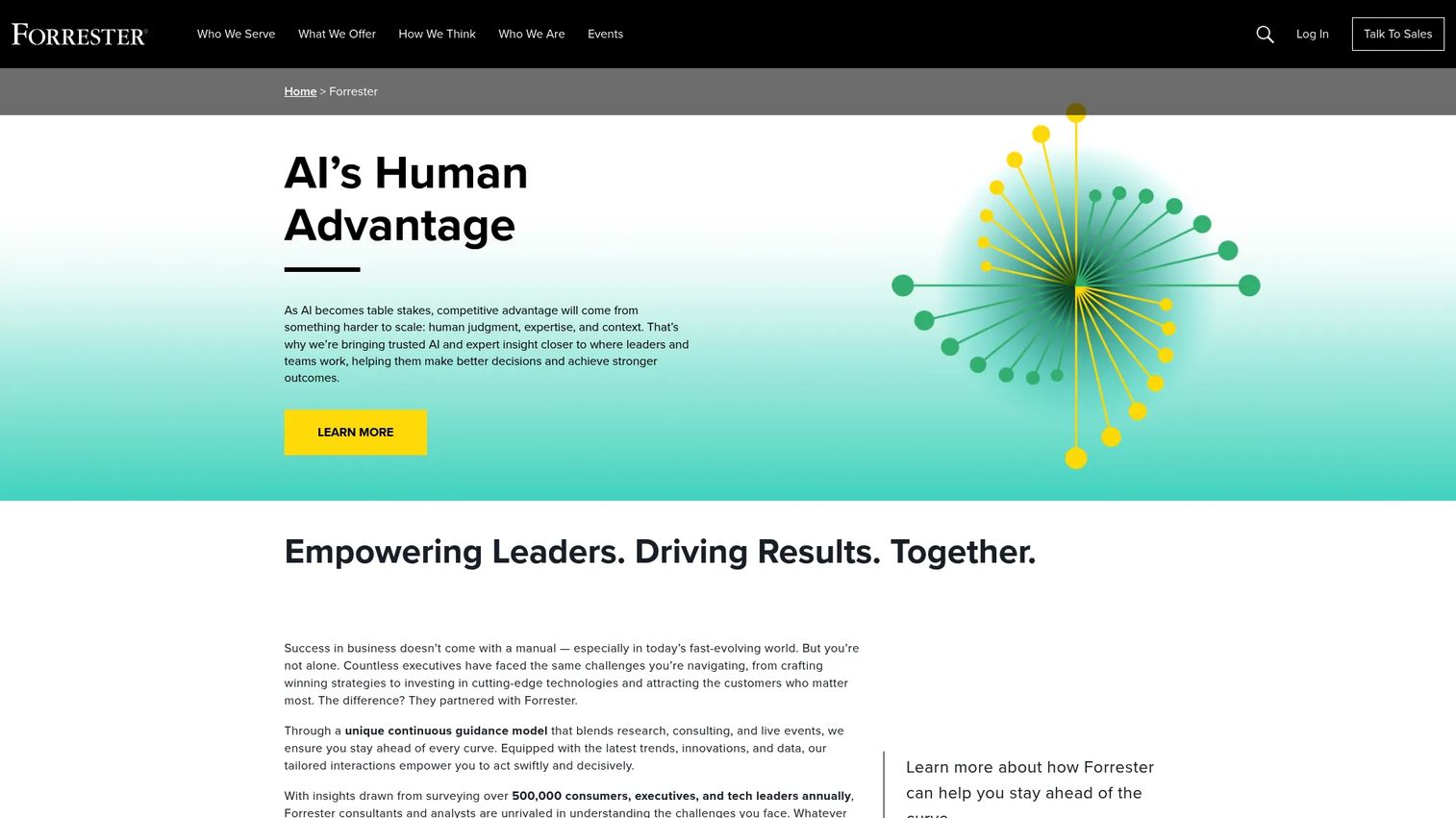
Forrester is a research and advisory firm offering proprietary research, Forrester Wave evaluations, consulting, analyst guidance, and planning tools for business and technology leaders. Its Forrester Decisions platform organizes research by role, giving marketing, sales, and technology leaders research tied to their specific operating priorities rather than generic category reports. Forrester has also introduced AI-assisted research capabilities for faster access to its content.
Best for: Founders and functional leaders who need research translated into planning frameworks, team priorities, and execution tools.
Key features
- Forrester Wave vendor evaluations across technology categories
- Role-based research libraries for marketing, sales, and technology leaders
- Strategic planning frameworks, templates, and assessments
- Analyst guidance and peer benchmark sessions
- Forrester AI research assistant for faster content access
Why choose Forrester: It fits teams that have a clear owner who will turn research into a plan. Reading a report is one thing; using it to realign a VP's quarterly priorities is another. Forrester's planning tools close that gap between insight and execution.
Forrester pricing: Access is quote-based and varies by role coverage, number of users, and advisory requirements. Forrester's public pages describe its Forrester Decisions subscription service but do not show a numeric price; contact the company for current packaging.
G2 rating: 4.3/5
3. IDC
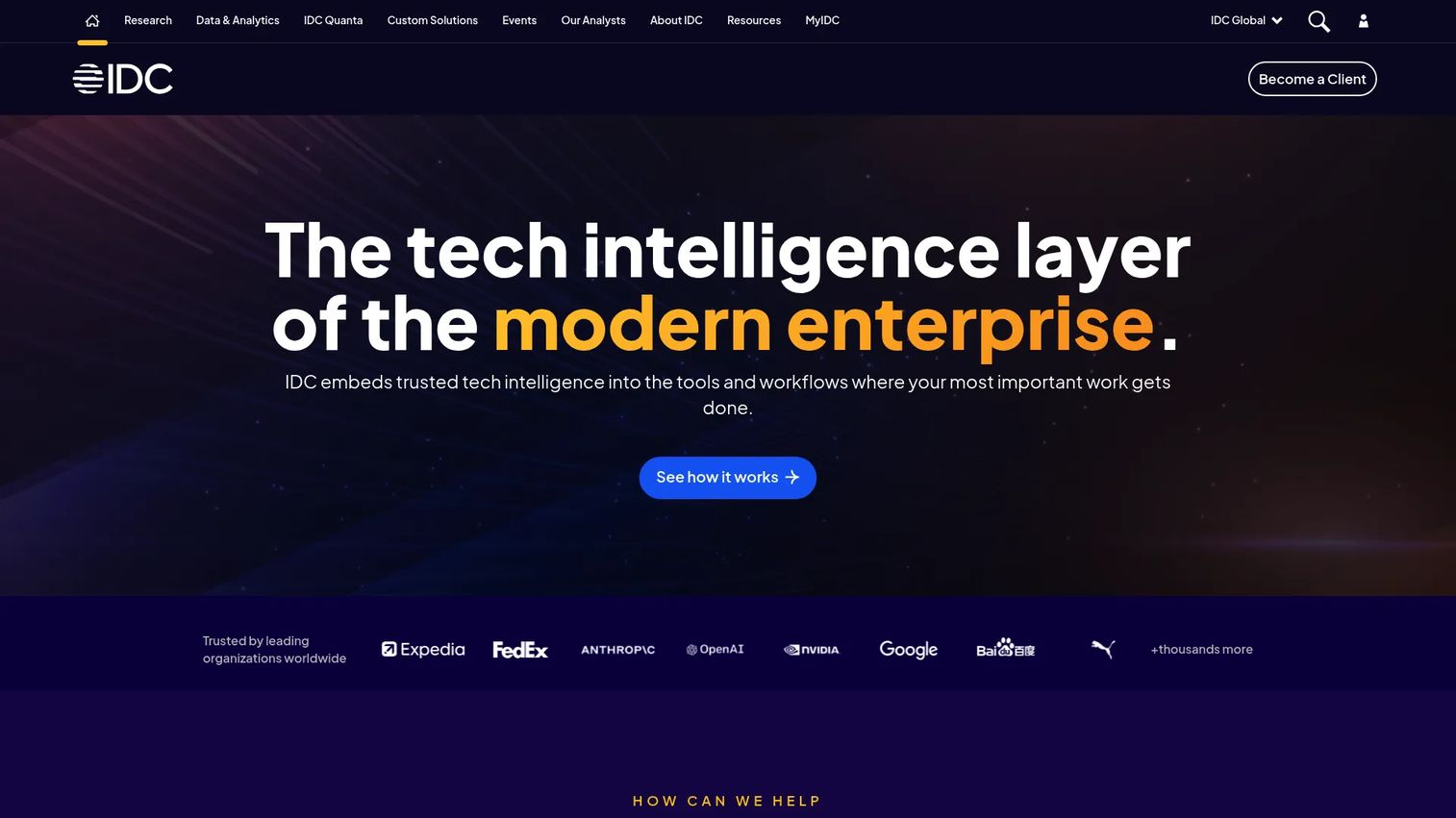
IDC provides technology market intelligence, research subscriptions, advisory services, data products, and technology decision-support tools. It covers IT spending, vendor market share, buyer behavior, and regional technology adoption across major technology categories. IDC Quanta, its AI-powered research assistant, lets subscribers get cited answers from entitled research and datasets. IDC TechMatch supports software sourcing and vendor evaluation with structured comparison tools.
Best for: SaaS founders who need data on market size, technology spending, buyer demand, or regional technology trends to support a fundraise, market entry, or category sizing effort.
Key features
- Technology market forecasts and IT spending analysis
- Buyer intent research and buyer survey data
- IDC Quanta AI assistant for research-cited answers
- IDC TechMatch for vendor evaluation and sourcing
- Analyst inquiry access and custom research engagements
Why choose IDC: Choose IDC when the hard question is "How large is this market, who is buying, and where is demand heading?" Its data is particularly useful for pressure-testing investor-facing market claims or building a regional expansion thesis. Founders working toward a fundraise often find IDC's category-sizing data more defensible than TAM estimates built from internal assumptions.
IDC pricing: IDC's Continuous Intelligence Services require contacting a sales representative. Individual research documents and event access may be purchased separately. Contact IDC directly for subscription pricing details.
G2 rating: 4.5/5
4. Everest Group
Everest Group is a research and advisory firm focused on global technology services, engineering services, AI operations, outsourcing, and business process decisions. Its PEAK Matrix assessments evaluate service providers across capability and market impact, giving buyers a structured shortlist framework for outsourcing, managed services, and AI delivery decisions. Everest Group covers IT services, business process services, engineering services, and market intelligence through both published research and custom engagement.
Best for: Companies evaluating engineering partners, AI service providers, technology operations firms, or outsourcing models rather than pure software vendor decisions.
Key features
- PEAK Matrix assessments for service-provider evaluation
- Engineering services and AI operations research
- Business process and IT sourcing analysis
- Custom benchmarking and market assessments
- Membership and advisory access
Why choose Everest Group: It earns a place on the shortlist when the decision centers on who delivers the service, not just which software to buy. If you're evaluating an outsourced engineering partner, a managed AI operations firm, or a large-scale implementation vendor, Everest Group's research is more relevant than a broad analyst subscription focused on software categories.
Everest Group pricing: Offerings cover memberships, research subscriptions, and custom advisory engagements. Pricing is quote-based and not listed on the website; contact Everest Group for membership and project pricing.
G2 rating: 3.5/5 (based on 1 review on G2)
5. Omdia
Omdia provides technology market intelligence, research reports, data products, forecasts, and strategic advisory services. Its coverage is strongest in telecom, media, cloud, enterprise technology, cybersecurity, AI infrastructure, and digital transformation. Omdia serves technology vendors, infrastructure buyers, and investors who need deep sector-specific intelligence rather than broad cross-functional advisory. Its research and consulting work spans go-to-market advisory, vendor benchmarking, and regional market analysis.
Best for: SaaS founders in telecom, cloud infrastructure, cybersecurity, media technology, data center, or digital infrastructure markets who need sector-specific research that broad advisory firms may cover less deeply.
Key features
- Telecom and media market research and forecasts
- Cloud and infrastructure sector intelligence
- Vendor benchmarking and competitive analysis
- Strategic consulting and go-to-market advisory
- Regional market coverage
Why choose Omdia: Choose it when your company's market has technical buying committees, infrastructure dependencies, or sector-specific dynamics. Sector-specific research helps a founder speak the buyer's language in a technical market - particularly useful before hiring a vertical sales leader or entering a new infrastructure segment.
Omdia pricing: Research access is quote-based and organized around coverage areas, data products, and analyst engagement. Contact Omdia for subscription and custom research details.
6. ABI Research
ABI Research provides technology market intelligence, quantitative forecasts, strategic research, analyst access, and advisory services for connected and emerging technology markets. Coverage spans IoT, industrial technology, AI, edge computing, automotive technology, smart manufacturing, robotics, and connectivity ecosystems. ABI Research offers individual reports, service-specific subscriptions, and an All Access tier. Its Ask ABI generative AI assistant helps subscribers query research content directly. ABI Connect integrations via MCP, API, and FTP allow research data to flow into existing tools.
Best for: Founders building for connected devices, industrial markets, telecom, mobility, AI infrastructure, or machine intelligence, where technology adoption curves and supply chain dynamics drive the business model.
Key features
- Emerging technology forecasts and market data
- IoT, connectivity, and industrial technology research
- Interactive datasets, dashboards, and pivot tools
- Ask ABI AI assistant for research queries
- Analyst inquiry and customer-success support
Why choose ABI Research: It earns a place when your market is shaped by adoption curves, hardware-software ecosystems, network standards, or industrial buying behavior. A broad market report can't answer the ecosystem assumptions behind a connected device business model; ABI Research's specialist coverage can. Individual reports are available to buy without a full subscription, which makes it accessible for a targeted one-off question.
ABI Research pricing: ABI Research lists four access tiers: Individual Reports (priced as marked), Individual Service, Data Access, and All Access (all subscription-based via quote). Contact ABI Research for subscription pricing.
7. Frost & Sullivan
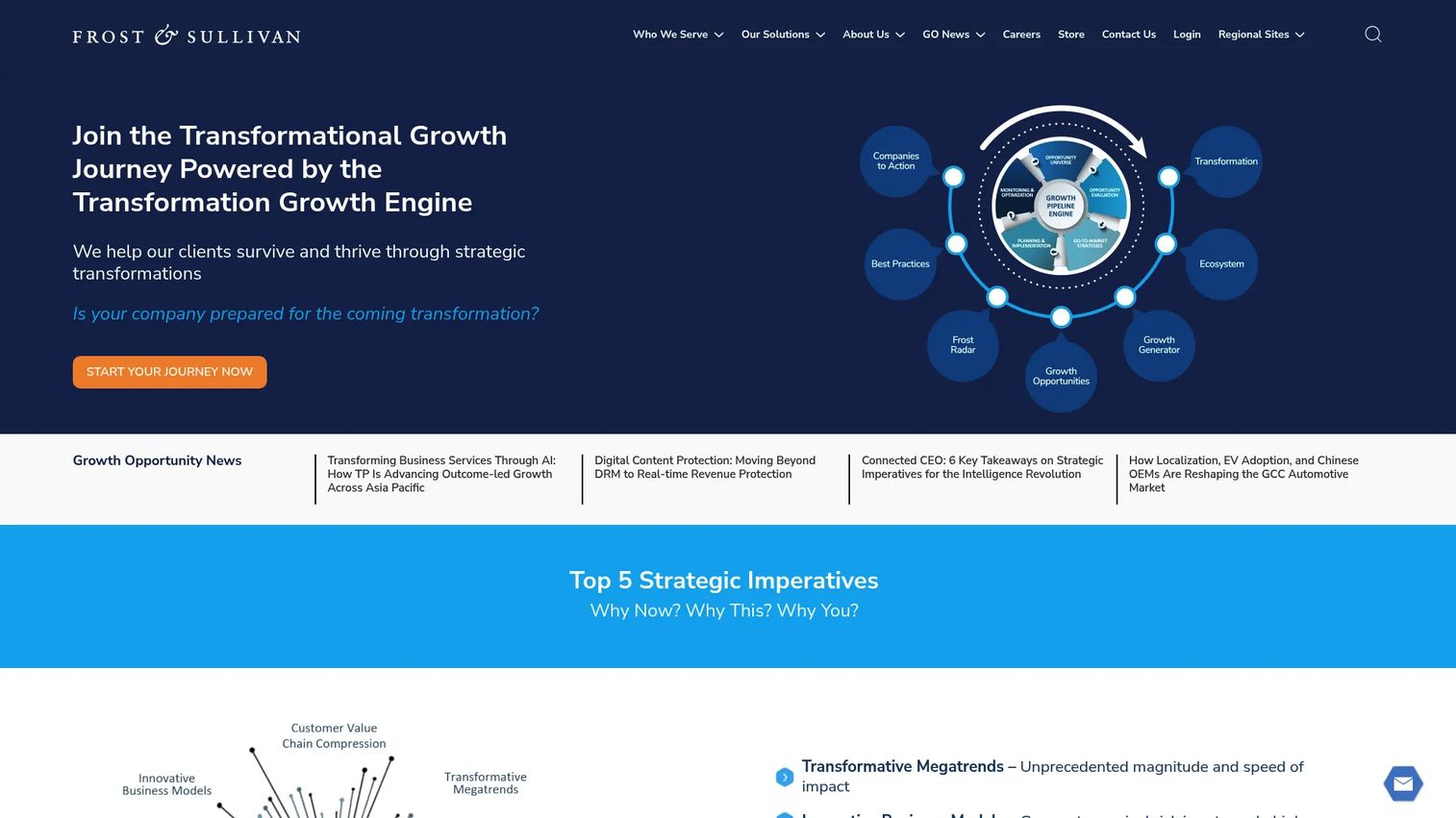
Frost & Sullivan is a global growth strategy, research, analytics, advisory, and coaching company. Its Growth Opportunity Analytics service covers industry market research, regional opportunity assessments, competitive intelligence, and innovation strategy. The Transformation Engine offering adds strategy anchoring, dashboards, forecasting, and AI assistance. Frost & Sullivan is particularly relevant when the question is "Where should we grow next?" rather than only "Which software vendor should we choose?"
Best for: SaaS founders who need market-entry research, growth strategy, industry opportunity analysis, or commercialization support before committing to a new vertical, geography, or product extension.
Key features
- Growth Opportunity Analytics across industry verticals
- Regional market assessment and opportunity sizing
- Innovation strategy and commercialization support
- Growth Advisory and Growth Coaching
- Transformation Engine with forecasting and AI assistance
Why choose Frost & Sullivan: It is a strong fit when the decision precedes a new vertical GTM motion or a regional expansion. Frost & Sullivan's blend of market research and growth advisory gives a founder both the market data and a framework for acting on it, which is useful before hiring a vertical sales leader or opening a new geography.
Frost & Sullivan pricing: A 2026 foresight program lists two options: The Focused Growth Program at €9,950 / $11,530 for 3-month access to one industry vertical, and the Comprehensive Growth Program at €14,950 / $17,324 for 3-month access to all industry verticals (up to three users). Other Frost & Sullivan services are quote-based; contact the company for pricing on custom research and advisory engagements.
G2 rating: 3.5/5
Considerations when choosing technology research services
Define the decision before you buy research
Research is valuable when it changes a specific decision. Write that decision in one sentence before speaking with providers. "Should we enter the enterprise security segment in EMEA in Q3?" is a decision research can serve. "Stay informed about AI trends" is not. A clear decision statement also protects you from overbuying scope.
Choose breadth or depth deliberately
Broad analyst firms work well when several functions need a shared view across product, IT, and GTM. Specialist firms are stronger when the decision depends on telecom, industrial technology, AI infrastructure, or engineering services. Buying a broad subscription for a narrow technical question, or a specialist firm for a cross-functional strategy question, produces the same outcome: Research that goes unread.
Check how research reaches your operating team
A PDF archive isn't enough. Evaluate analyst inquiry access, internal sharing rights, data export formats, research portals, and whether the service integrates with tools your leaders use week-to-week. A subscription that only one person accesses is a subscription that doesn't change decisions.
Separate recurring intelligence from one-time research
A subscription supports a continuing set of decisions across multiple quarters. Custom research fits a defined question with a defined deadline - a market entry study, a fundraising narrative, a vendor shortlist. Don't buy an annual platform when a focused project would resolve the immediate uncertainty faster and cheaper.
Assess the evidence behind the recommendation
Ask how the firm collects data, how often it refreshes forecasts, whether it conducts primary buyer interviews, and where analysis ends and opinion begins. Research that can't explain its methodology can't support a decision that will face scrutiny from a board or an investor.
Conclusion
Technology research is most valuable when it narrows a high-stakes uncertainty before you commit resources. The right provider depends on the decision, not just the brand.
Gartner is the broad pick for multi-function executive technology strategy and vendor evaluation. Forrester is stronger when the team needs research tied to planning tools and execution frameworks. IDC is the data-first choice for market sizing, technology spend, and regional buyer analysis. Everest Group is the right shortlist candidate for engineering services, AI operations, outsourcing, and service-provider decisions. Omdia and ABI Research are strong specialist options for infrastructure, telecom, connected technology, and emerging markets. Frost & Sullivan fits growth strategy and commercialization questions before a new vertical or geography commitment.
Start with the decision you need to resolve. A research subscription should earn its place by helping your team make better calls across multiple quarters. A custom project should earn its place by resolving one high-consequence uncertainty fast.
For founders building out their competitive intelligence capability alongside a research subscription, pairing market data with an ongoing competitor monitoring process gives your strategy team a more complete picture.
Start your journey with Guideflow today!
FAQs
Technology research services provide independent market intelligence, vendor evaluations, analyst guidance, forecasts, and custom analysis that organizations use to make technology and innovation decisions. They differ from vendor-produced reports in that their methodology, data sourcing, and analyst conclusions are independent of any single supplier's commercial interest. Services range from broad subscriptions covering hundreds of technology categories to specialist coverage of a single sector.
Market research typically focuses on customers, demand, and market size. Technology research adds vendor landscapes, IT spending patterns, architecture trends, technology adoption curves, supply chain dynamics, and technology strategy. A founder evaluating a new category often needs both: Customer discovery data and an independent view of the vendor landscape and market maturity.
The answer depends on the decision. A startup validating a narrow market question may need one focused custom research project rather than a broad annual subscription. Gartner and Forrester work well once leadership faces recurring technology and vendor decisions across multiple functions. IDC is particularly useful for investor-facing market-size claims and regional expansion. Specialist firms like ABI Research and Omdia are worth shortlisting when the company operates in a sector-specific market.
Most enterprise analyst firms price through quotes rather than a self-serve checkout. Cost typically reflects research coverage, number of users, analyst inquiry access, data products, advisory services, and custom project scope. Frost & Sullivan's published growth programs start at €9,950 for a 3-month access package. For Gartner, Forrester, IDC, Everest Group, Omdia, and ABI Research, pricing requires a direct conversation with the provider.
They can be worthwhile when they reduce a costly uncertainty around market entry, vendor selection, product strategy, or a major technology investment. They are less useful when the company only needs an answer that customer interviews, product telemetry, or a short focused project can provide. The clearest signal that a subscription is worth it: Your leadership team will face the same category of strategic question repeatedly across multiple quarters.
Yes. Research providers help teams understand vendor category maturity, provider strengths, pricing models, implementation risk, and buyer feedback before a formal evaluation begins. Research narrows the shortlist; demos, security reviews, references, and pilots validate final fit. Using research to skip the shortlisting stage is where evaluation timelines get compressed without losing quality.
Ask about coverage areas and whether they match your current strategic questions. Ask about analyst inquiry access, including how many calls are included and which topics qualify. Ask about data freshness and primary research methods. Check internal sharing rights before assuming your VP and board can access the same materials. Also ask for examples of decisions the provider has helped similar-stage companies make.
No. External research improves the market view by adding independent vendor analysis, category sizing, and technology trend data. It does not replace interviews with target buyers, win and loss analysis, product telemetry, pipeline data, or direct conversations with customers. Research and customer discovery answer different questions: Research tells you what the market looks like, while customer conversations tell you what your buyers actually do.