An SDR sends 250 cold emails on Monday. By Friday, three replies. Pipeline meeting Monday morning, and the explanation is going to be "the copy needs work."
The copy probably isn't the problem.
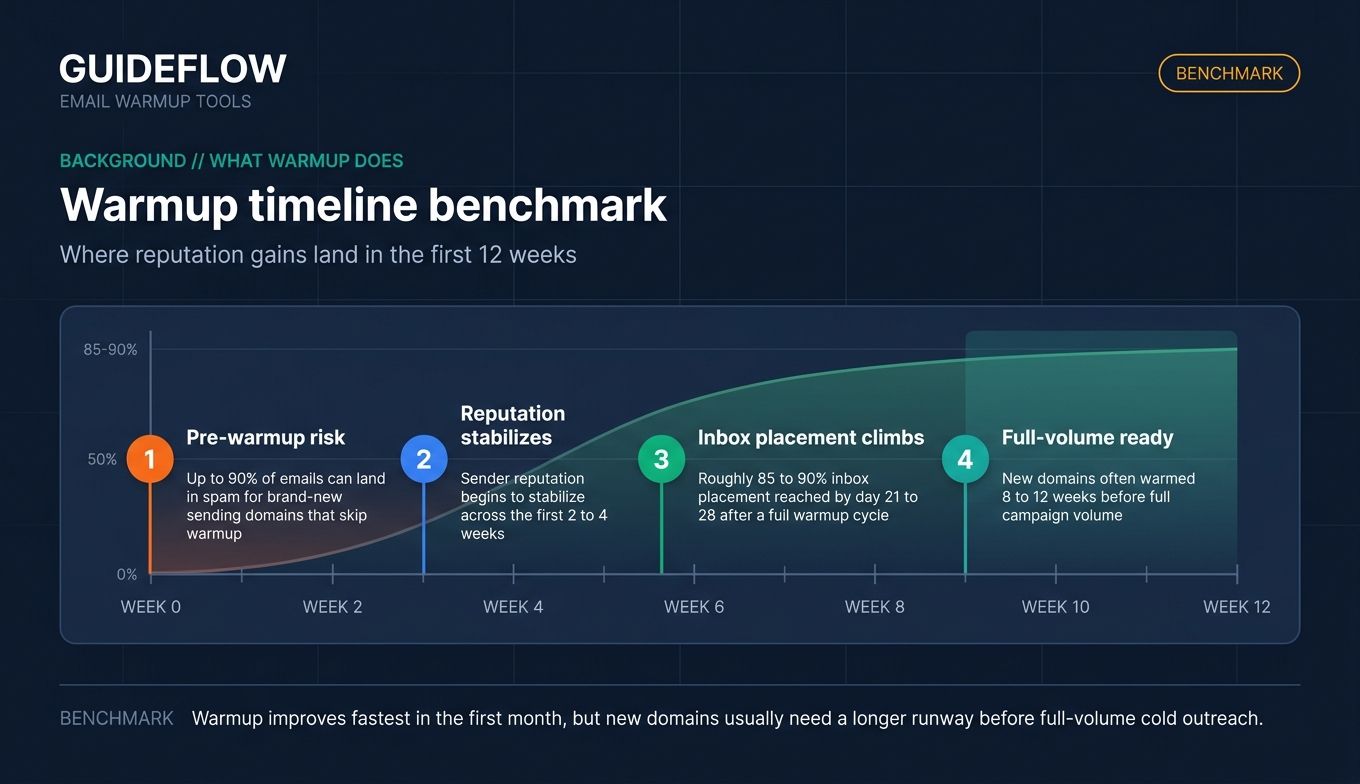
According to Signado's analysis of warmup benchmarks, accounts that skip warmup on brand-new sending domains can see up to 90% of emails land directly in spam, while accounts that complete a full warmup cycle reach roughly 85–90% inbox placement by day 21–28. That is the gap between a quota-hitting quarter and a quarter where every metric below the funnel quietly lies to you.
Email warmup is deliverability infrastructure. It sits underneath every other outbound number you track. When warmup is broken, your reply rates lie, your A/B tests lie, your win-rate-by-message-variant analysis lies, and your forecast is built on top of all of it. The downstream effect is that sales leaders blame copy, blame lists, blame SDRs, and rarely blame the inbox.
This guide compares the 11 best email warmup tools for sales teams running cold outbound at any scale. We compared them on what actually matters: deliverability lift, per-inbox economics, infrastructure compatibility, and reporting your sales ops team can act on. Pick one, run it for three weeks, and watch reply rates correct themselves before you touch a single subject line.
What's inside
This guide is built for sales teams, not deliverability consultants. SDRs running cold outbound, AEs managing personal outbound, sales ops setting up new sending domains, and RevOps owners who treat deliverability as a pipeline lever will all find the picks ranked by their actual workflow fit.
We selected platforms based on four criteria:
- Deliverability performance, measured by inbox placement lift.
- Multi-inbox pricing that scales without becoming punitive.
- Infrastructure compatibility across Gmail, Outlook, Microsoft 365, and custom SMTP.
- Reporting depth that lets you prove placement changed.
TL;DR
- Best overall standalone email warmup service for sales teams: Mailreach, for its reputation analytics and inbox placement reporting.
- Best for multi-inbox teams scaling outbound: Warmup Inbox, with multi-account dashboards built for agencies and outbound shops.
- Best if you already use a sequencing platform: Smartlead or Instantly, both include native warmup at no extra per-inbox cost.
- Best free or low-cost option: TrulyInbox, with a free forever tier for one account.
- Best for enterprise with complex deliverability needs: Folderly, a full deliverability platform with human experts.
- Best for AI-driven warmup behavior: Warmy, with adaptive warmup pacing and template testing.
Background: what email warmup actually does
Email warmup is the process of gradually increasing sending volume from a new or cold inbox while generating positive engagement signals (opens, replies, moves out of spam) so mailbox providers like Gmail and Outlook treat the sender as trustworthy. An email warmer connects to your inbox, sends automated emails to a peer network of other warmup inboxes, and engages with those messages on the other side. Over the first 2 to 4 weeks, sender reputation begins to stabilize. For brand-new domains, many practitioners recommend continuing warmup for 8 to 12 weeks before sending at full campaign volume, per GMass's warmup guidance.
Core capabilities to expect from any email warmup software worth considering:
- Engagement simulation: opens, replies, moves from spam to inbox, marks as important.
- Sender reputation monitoring: daily or weekly scores that flag regressions.
- *SPF, DKIM, and DMARC* checks: authentication is a precondition, not a substitute.
- Inbox placement testing: seed-list tests across Gmail, Outlook, and Yahoo.
- Multi-inbox management: centralized dashboards for teams running multiple senders.
- Sequencing platform integrations: clean handoffs into outbound tools.
Why this matters for sales teams: deliverability is the invisible top of the funnel. If your domain is flagged, every other metric is corrupted. Reply rate, meeting rate, opportunity rate, win rate by message variant: all of them get distorted when half your emails are landing in the promotions tab or spam folder. Sender reputation is the upstream variable, and it compounds. A small reputation drop in week one becomes a much bigger pipeline drop in week six. For sales orgs evaluating the full outbound stack alongside warmup, our roundup of the best sales engagement tools and best outreach software covers the sequencing layer that sits on top of a clean inbox.
Cold email deliverability also depends on authentication hygiene. SPF, DKIM, and DMARC must be set correctly before warmup begins, or warmup just papers over the deeper problem. Mailwarm's deliverability guidance is explicit that warmup complements authentication, never replaces it.
When sales teams need an email warmup tool
Launching a new sending domain
New domains start with zero sending reputation. Cold-starting outbound from a fresh domain at full volume is the fastest way to land on a blacklist and burn the domain before your first campaign closes. A gmail warmup or outlook warmup process gives the domain a credible engagement history before real prospects see anything.
Recovering a domain that's landing in spam
If reply rates dropped suddenly with no copy change, no list change, and no sending volume spike, the inbox is the problem. Warmup paired with list hygiene resets sender reputation over several weeks. Expect a longer recovery window than a fresh-domain warmup, because the algorithm has negative signals to overwrite.
Scaling outbound across multiple inboxes
Teams sending high cold-email volume rarely run a single inbox. They distribute sending across multiple mailboxes, often on alias domains, to spread reputation risk and stay under provider thresholds. Each inbox needs its own warmup. This is where per-inbox pricing economics start to dominate the buying decision. Teams scaling cold outbound at this level often also evaluate AI SDR tools to handle volume without burning rep time on manual sending.
Comparison table
The table below is a scan layer. Full tool sections follow with strengths, fit, and pricing detail. Pricing is shown per the vendor's own pricing page on 2026-06-05. Note that some tools charge per inbox while others bundle unlimited inboxes into a flat plan, which dramatically changes the math at team scale. G2 ratings reflect current listings; tools showing 0.0 have no published reviews on G2 at the time of writing.
| # | Product | Intent | Key differentiation | Pricing | G2 rating |
|---|---|---|---|---|---|
| 1 | Mailreach | Standalone warmup with deep analytics | Reputation scoring plus spam testing in one platform | From $20/mo (All-In-One, billed annually) | 4.7/5 |
| 2 | Warmup Inbox | Multi-inbox warmup for teams | Reputation health score with blacklist detection | See pricing page | 4.6/5 |
| 3 | Smartlead | Sequencing with native warmup | Unlimited warmup inboxes on every plan | From $39/mo (Base) | 4.5/5 |
| 4 | Instantly | Sequencing with native warmup | Unlimited email accounts and warmup | From $47/mo (Outreach Growth) | 4.8/5 |
| 5 | Lemwarm | Warmup inside the lemlist suite | Cluster-based warmup with deliverability scoring | From $31/mo (Email plan, billed yearly) | Not rated on G2 |
| 6 | Warmbox | Budget-friendly standalone warmup | Auto-remove from spam and simple per-inbox pricing | From $15/mo (Solo, billed yearly) | Not rated on G2 |
| 7 | Mailwarm | Established standalone warmup | Live inbox vs spam placement tracking | Custom; $0.02 per added interaction | 4.9/5 (Capterra) |
| 8 | Folderly | Enterprise deliverability platform | Daily monitoring with spam trigger detection | From $56 per mailbox/mo (25-99 mailboxes, yearly) | 4.8/5 (Capterra) |
| 9 | InboxAlly | High-engagement signal warmup | Sender reputation repair plus inbox placement testing | From $149/mo (Starter) | 4.6/5 |
| 10 | TrulyInbox | Free and low-cost warmup | Free forever tier with AI-powered warmup content | Free; paid from $22/mo (Starter, billed annually) | 4.1/5 |
| 11 | Warmy | AI-driven warmup behavior | Volume-based pricing with deliverability monitoring | Volume-based, demo required | 4.8/5 |
The 11 best email warmup tools for sales teams in 2026
1. Mailreach
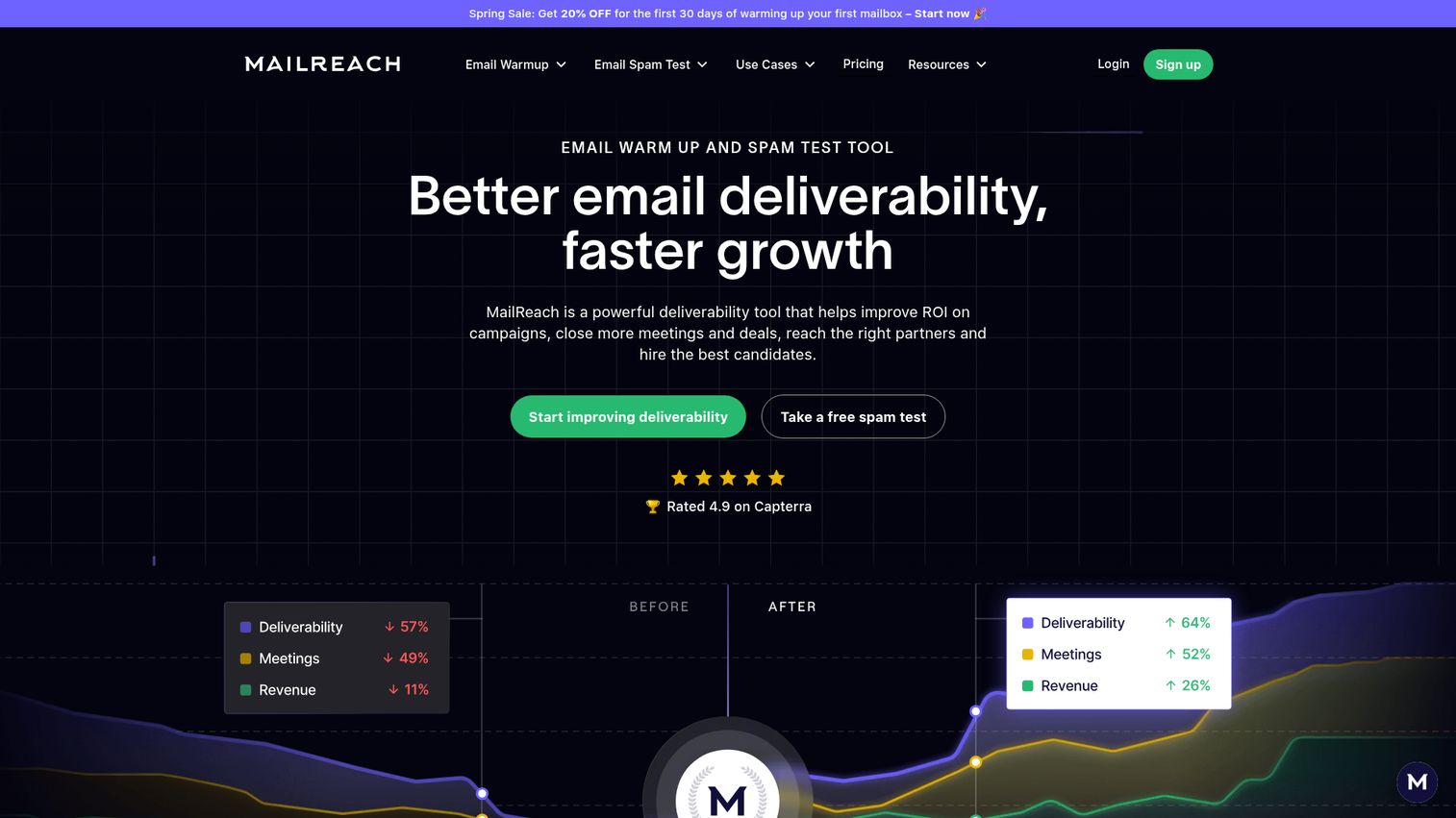
Mailreach is an email deliverability platform built around two things: warmup that simulates realistic engagement, and spam testing that shows you exactly where your emails land across major providers. It pairs warmup with a Co-Pilot AI deliverability assistant that translates raw signals into next steps your sales ops team can actually act on.
Best for: Sales teams that treat deliverability as a tracked metric and want reporting they can defend in a pipeline review.
Key strengths
- Spam test reports: inbox placement breakdowns across Gmail, Outlook, and other major providers.
- Reputation score tracking: a single trend line your team can monitor and flag when it slips.
- Co-Pilot AI deliverability assistant: contextual guidance on what to fix when scores drop.
Why choose Mailreach: It is built for teams who want a deliverability operating system, not just a warmup background process. If your sales ops or RevOps function is going to ask "what changed in week three of the campaign," Mailreach gives you a clean answer. For RevOps teams pairing this with broader reporting, our list of the best sales analytics software covers tools that connect deliverability signals to pipeline outcomes.
Mailreach pricing: Verified on the Mailreach pricing page on 2026-06-05. The All-In-One plan starts at $20/month with annual billing, combining the email warmer and spam tester. A standalone Spam Tester option is listed at $210/month on pay-as-you-go. Monthly, annual, and pay-as-you-go billing modes are available via a calculator on the pricing page.
2. Warmup Inbox
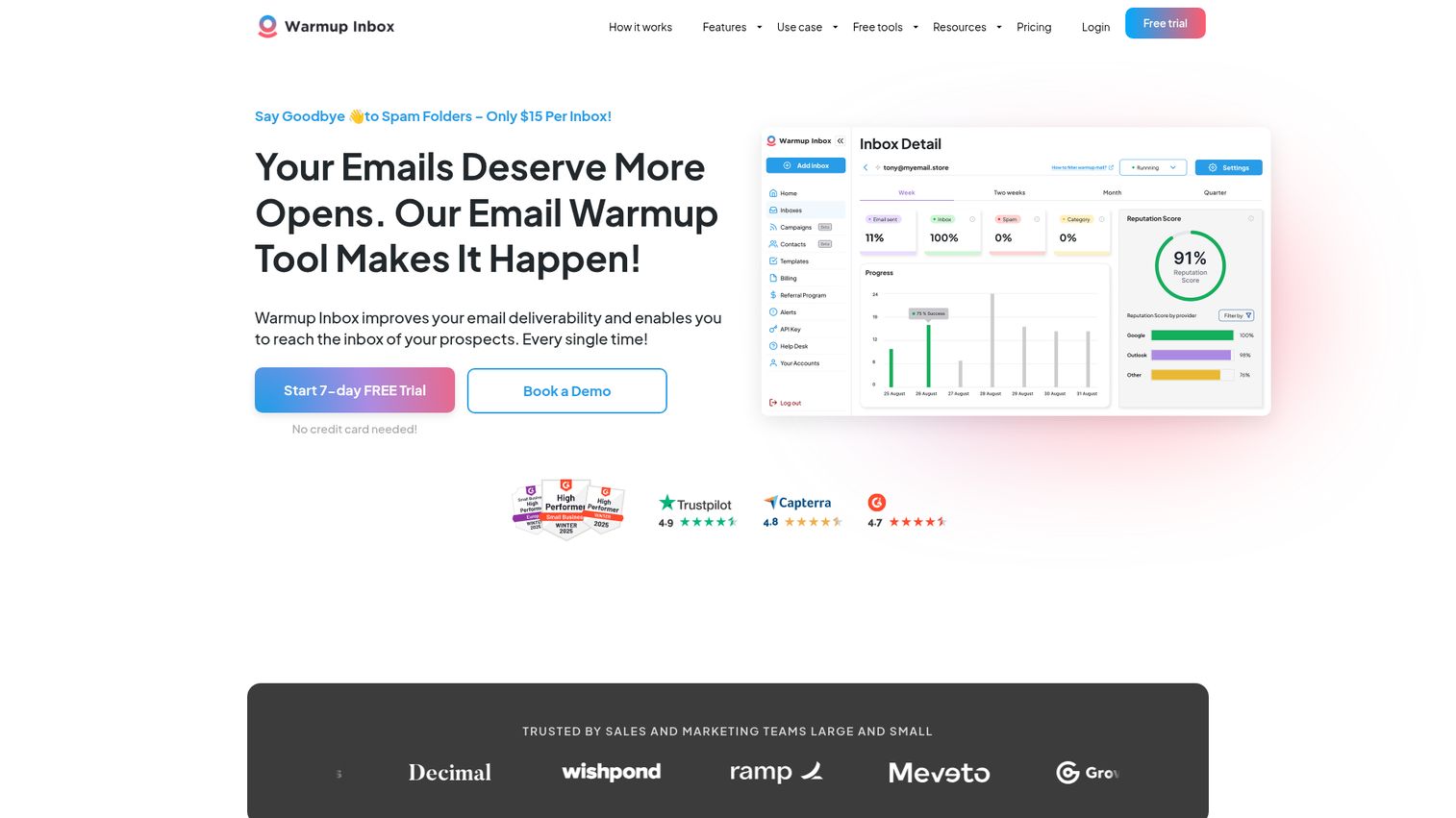
Warmup Inbox is an email warmup platform built for teams that connect multiple sending accounts. It uses real inbox interactions to build sender reputation, monitors a health score per inbox, and flags blacklist hits on synced inboxes and domain IPs before they tank campaign performance.
Best for: Agencies and outbound teams running multiple sending accounts that need central monitoring and provider coverage across Gmail, Outlook, Microsoft 365, and custom SMTP.
Key strengths
- Reputation health score: a per-inbox metric with alerts when the score drops.
- Blacklist detection: monitoring across synced inboxes and IP addresses.
- Multi-provider support: Gmail, Outlook, Microsoft 365, and custom SMTP connections.
Why choose Warmup Inbox: It is purpose-built for the multi-inbox reality of cold outbound at scale. When you are running 10 sending accounts across alias domains, a single warmup inbox dashboard with health scoring is the difference between catching a reputation drop early and explaining a missed quota at the QBR.
Warmup Inbox pricing: Pricing is published on the Warmup Inbox pricing page, but specific plan tiers and prices were not visible in scraped content on 2026-06-05. The site offers a 7-day free trial. Check the pricing page directly for current per-inbox economics before purchase.
3. Smartlead
Smartlead is an AI-native outbound platform with native warmup included on every plan. The native warmup runs inline with sequences, which means your sending inboxes are being warmed in the same system where you build campaigns and manage replies. The Master Inbox consolidates replies across mailboxes, and SmartAgent handles workflow automation around prospecting and follow-ups.
Best for: Sales teams who want sequencing and warmup in one tool and want to stop paying per-inbox warmup fees on top of their outbound platform.
Key strengths
- Unlimited warmup inboxes: native warmup included on every plan regardless of inbox count.
- Unified Master Inbox: reply management across all connected mailboxes in one view.
- SmartAgent AI automation: workflows for prospecting, follow-ups, enrichment, and engagement.
Why choose Smartlead: It addresses the "we already have too many tools" objection directly. One platform replaces both your sequencer and your standalone warmup tool, which usually wins the procurement conversation.
Smartlead pricing: Verified on the Smartlead pricing page on 2026-06-05. Four paid plans: Base at $39/month, Pro at $94/month, Unlimited Smart at $174/month, and Unlimited Prime at $379/month. Annual billing saves 17%. All plans include a free trial with no credit card required.
4. Instantly
Instantly is a sales engagement and lead intelligence platform with unlimited email accounts and unlimited email warmup included. It runs multichannel campaigns across email, LinkedIn, and webhook sequences, and consolidates replies into a Unibox with AI reply labels for triage.
Best for: Sales teams who want unlimited warmup paired with sequencing, lead sourcing, and inbox management in one platform.
Key strengths
- Unlimited email accounts and warmup: no per-inbox tax as you scale outbound across senders.
- Multichannel sequences: email, LinkedIn, and webhook steps in one workflow.
- Unibox with AI reply labels: centralized inbox management with AI-driven triage.
Why choose Instantly: Similar consolidation logic to Smartlead. Pick based on which sequencer your team prefers and how each platform's UI fits your workflow. Both eliminate the per-inbox warmup cost as a separate line item.
Instantly pricing: Verified on the Instantly pricing page on 2026-06-05. Outreach plans include Growth at $47/month, Hypergrowth at $97/month, Light Speed at $358/month, and custom Enterprise pricing. Separate Instantly Credits plans for lead sourcing exist at similar tiers. Confirm current pricing on the pricing page before purchase.
5. Lemwarm
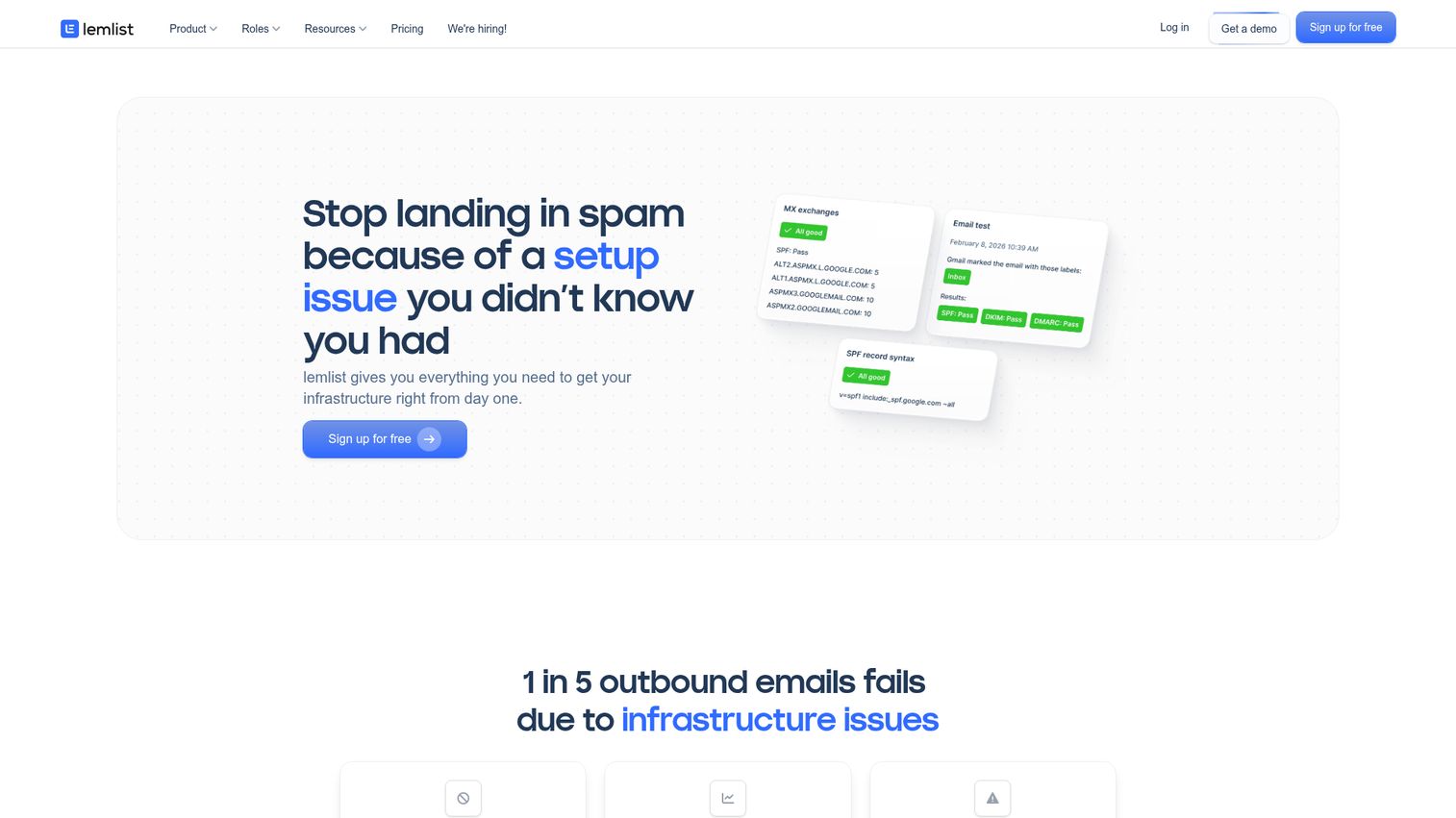
Lemwarm is the warmup and deliverability product from lemlist. It runs automated warm-up against real inboxes, enforces daily sending caps with automatic pauses if you hit unsafe limits, and surfaces deliverability health with alerts and a tech audit so your sales ops team can fix issues before they cost meetings.
Best for: Teams already on lemlist or evaluating lemlist for outbound, who want warmup and deliverability protection bundled with their sequencer.
Key strengths
- Automated warm-up with real inboxes: engagement diversity across a peer network.
- Daily sending caps with auto-pause: protects sender reputation when limits are hit.
- Deliverability health monitoring: alerts plus a tech audit of authentication and configuration.
Why choose Lemwarm: It is a well-established email warming service with a long track record in the cold email category. If your team is already on lemlist, Lemwarm is included rather than an additional purchase.
Lemwarm pricing: Verified on the lemlist pricing page on 2026-06-05. Lemwarm is included in all lemlist plans. Email starts at $31/month billed yearly, Multichannel at $87/month billed yearly, and Enterprise is custom pricing. A 14-day free trial is available.
6. Warmbox
Warmbox is a standalone warmup tool focused on simplicity and reasonable per-inbox pricing. It runs automated interactions across a peer network, automatically removes warmup emails from the spam folder, and reports on warmup activity and reputation through a dashboard you can scan in 30 seconds.
Best for: Small sales teams, founders running personal outbound, and budget-conscious teams that want a clean warmup tool without enterprise reporting overhead.
Key strengths
- Automated interactions: opens, replies, and engagement signals across a peer network.
- Auto-remove from spam: rescues warmup emails from spam to reinforce inbox placement.
- Reporting dashboard: visibility into warmup activity and reputation trends.
Why choose Warmbox: Low-friction setup, transparent per-inbox pricing, and a small enough surface area that you can onboard a new SDR's inbox in minutes. Good fit when you want a working warmup tool without negotiating an annual contract.
Warmbox pricing: Verified on the Warmbox pricing page on 2026-06-05. Yearly billing: Solo at $15/month, Start-up at $69/month, Growth at $139/month. Monthly billing: Solo at $19/month, Start-up at $79/month, Growth at $159/month. A custom Team plan is available for larger needs.
7. Mailwarm
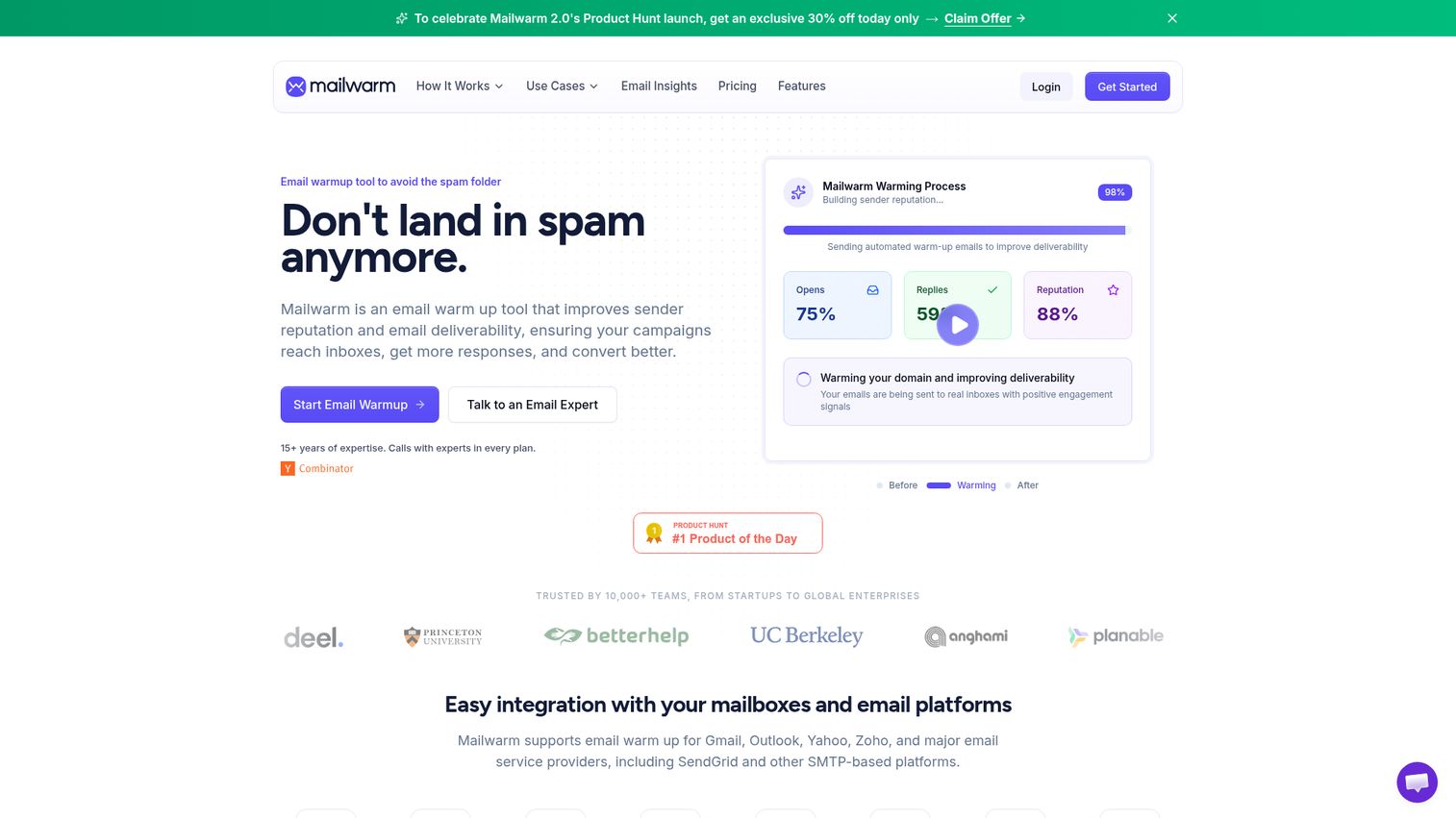
Mailwarm is one of the longer-running standalone warmup tools in the category. It supports Gmail, Outlook, Microsoft 365, Yahoo, and SMTP, runs continuous live inbox vs spam placement testing, and lets you use your own email templates during warmup so the simulated activity aligns with how you actually send.
Best for: Established outbound teams that want a mature platform with broad ESP coverage and continuous inbox placement reporting.
Key strengths
- Wide ESP support: Gmail, Outlook, Microsoft 365, Yahoo, and SMTP connections.
- Live placement tracking: continuous tests showing inbox vs spam in real time.
- Custom warmup templates: use your own templates during warmup for realistic activity patterns.
Why choose Mailwarm: A long track record and a feature set built around proving placement, not just simulating activity. The mailwarm platform is a reasonable choice when you want a standalone email warm up tool that is not tied to a specific sequencer.
Mailwarm pricing: Verified on the Mailwarm pricing page on 2026-06-05. Subscription tier prices were not visible in scraped page content, but the page confirms additional interactions cost $0.02 each and custom enterprise plans are available. Check the pricing page for current plan details. Capterra shows a 4.9/5 rating at the time of writing.
8. Folderly
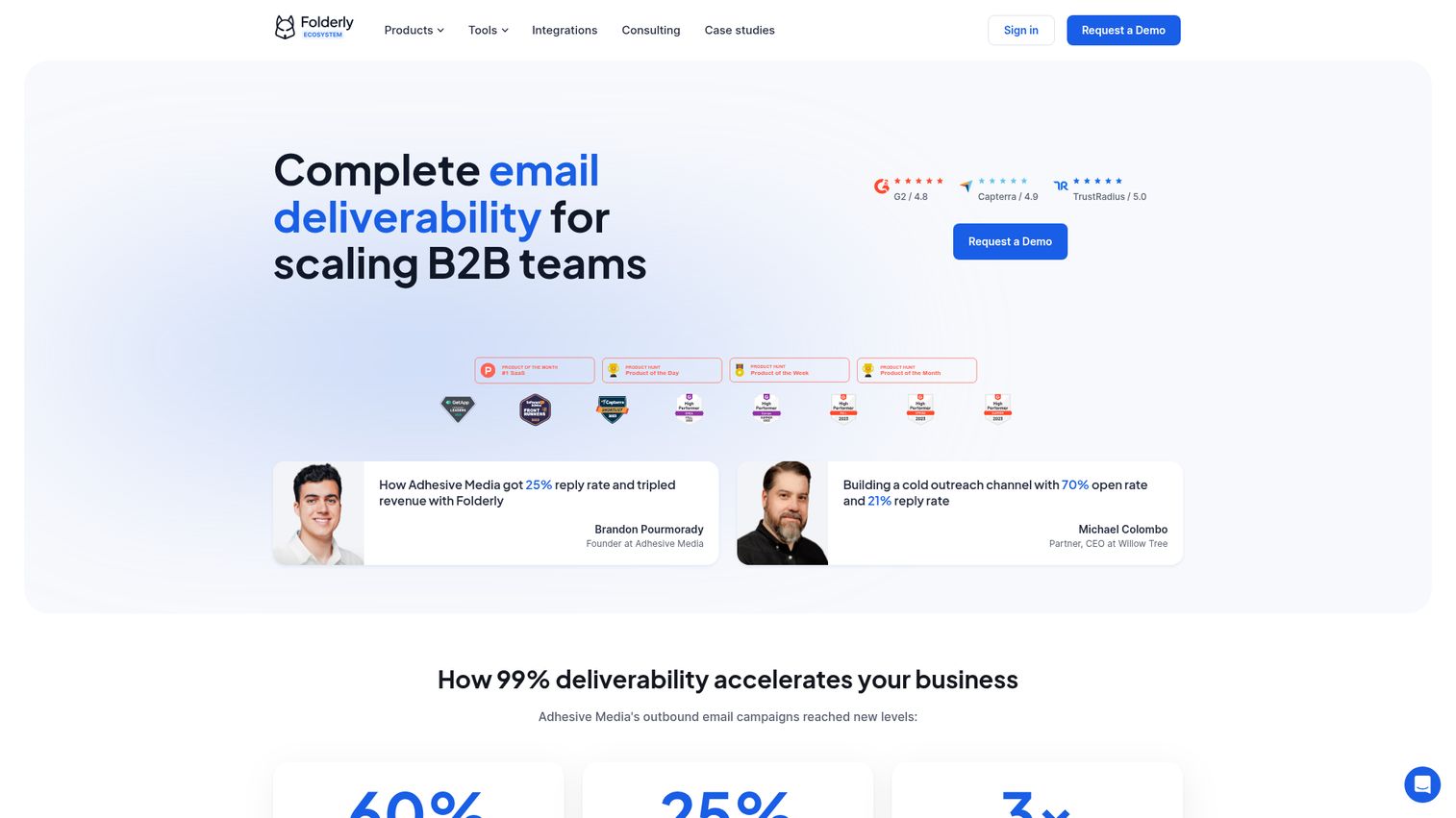
Folderly is an email deliverability platform built for scaling B2B teams. It goes beyond warmup into daily inbox monitoring, spam trigger detection for Gmail and Outlook, and domain health insights paired with step-by-step resolution guides. The product is positioned for teams where deliverability is a tracked program, not a side project.
Best for: Mid-market and enterprise sales orgs with multiple sending domains and a deliverability problem big enough to warrant a platform plus human expertise.
Key strengths
- Daily inbox monitoring: continuous tracking of placement health across mailboxes.
- Spam trigger detection: identifies why specific emails land in spam on Gmail and Outlook.
- Domain health insights: step-by-step resolution guides for authentication and configuration issues.
Why choose Folderly: Built for teams where deliverability is a board-level conversation, not a side project. The platform pairs ongoing monitoring with diagnostic depth that helps when an enterprise sending program has multiple things wrong simultaneously.
Folderly pricing: Verified on the Folderly overview page on 2026-06-05. Yearly mailbox-based bands: 1-9 mailboxes at $96 per mailbox/month, 10-24 mailboxes at $72 per mailbox/month, 25-99 mailboxes at $56 per mailbox/month, and custom pricing for 100+ mailboxes. Minimum commitment applies. Confirm current bands on the pricing page.
9. InboxAlly
InboxAlly is an email deliverability tool that emphasizes high-quality engagement signals to teach providers to put your messages in the inbox. The product combines sender reputation repair, email warmup, and inbox placement testing in one platform, and is built around the principle that strong positive engagement signals are what move reputation fastest.
Best for: Teams recovering a damaged sending domain or running high-volume email programs where reputation repair is the immediate priority.
Key strengths
- Sender reputation repair: focused on rehabilitating domains that have lost provider trust.
- Email warmup: engagement signal generation across a controlled network.
- Inbox placement testing: validates where emails land across major providers.
Why choose InboxAlly: When you need to rehab a hurt domain quickly, the platform's focus on positive engagement signals is built for that specific job. Pricing is higher than entry-level warmup tools, which reflects the positioning toward high-volume senders and reputation recovery cases.
InboxAlly pricing: Verified on the InboxAlly pricing page on 2026-06-05. Starter at $149/month, Plus at $645/month, Premium at $1,190/month, and custom Enterprise pricing. A 10-day free trial is available; no permanent free tier.
10. TrulyInbox
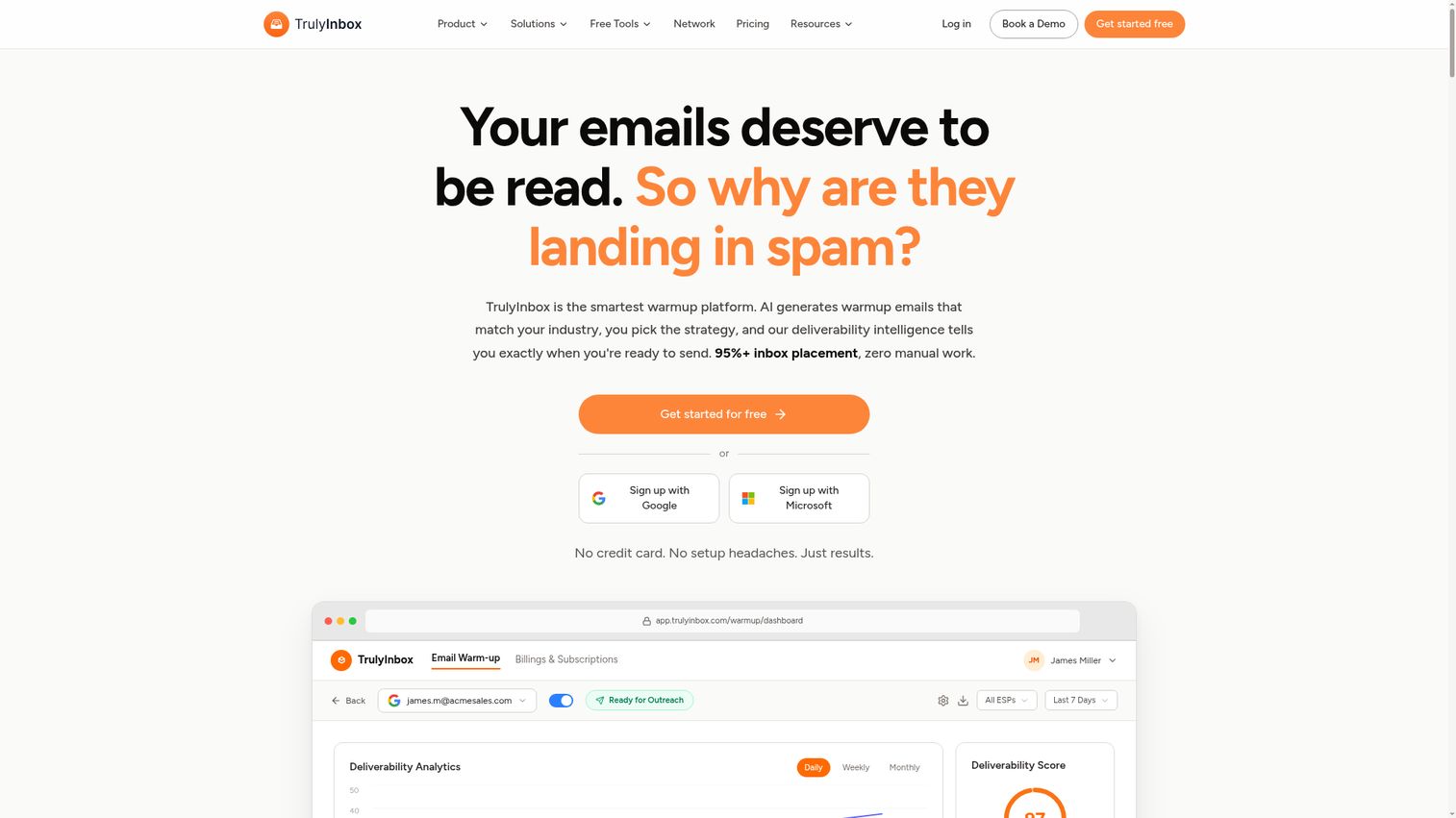
TrulyInbox is an email warm-up tool with a genuine free forever tier. It uses AI-powered warmup content, tracks a Deliverability Score and Outreach Readiness metric per inbox, and monitors account health including SPF, DKIM, and DMARC configuration so you catch authentication issues before they cost campaigns.
Best for: Solo SDRs, founders, and outbound teams that want to test warmup before committing budget, plus teams that prefer pricing scaled by daily warmup volume rather than inbox count.
Key strengths
- AI-powered warmup content: dynamically generated warmup emails for engagement realism.
- Deliverability Score: per-inbox scoring with Outreach Readiness tracking.
- Account health monitoring: SPF, DKIM, and DMARC checks built in.
Why choose TrulyInbox: The free forever tier is the lowest-friction way to start warming an inbox. Paid plans support unlimited email accounts and price by daily warmup volume, which can work out better than per-inbox pricing for teams running many low-volume senders.
TrulyInbox pricing: Verified on the TrulyInbox pricing page on 2026-06-05. Free forever for 1 account with 10 warmup emails per day. Paid plans billed annually: Starter at $22/month, Growth at $84/month, Scale at $169/month, Scale+ 5K at $407/month. Paid plans support unlimited email accounts.
11. Warmy
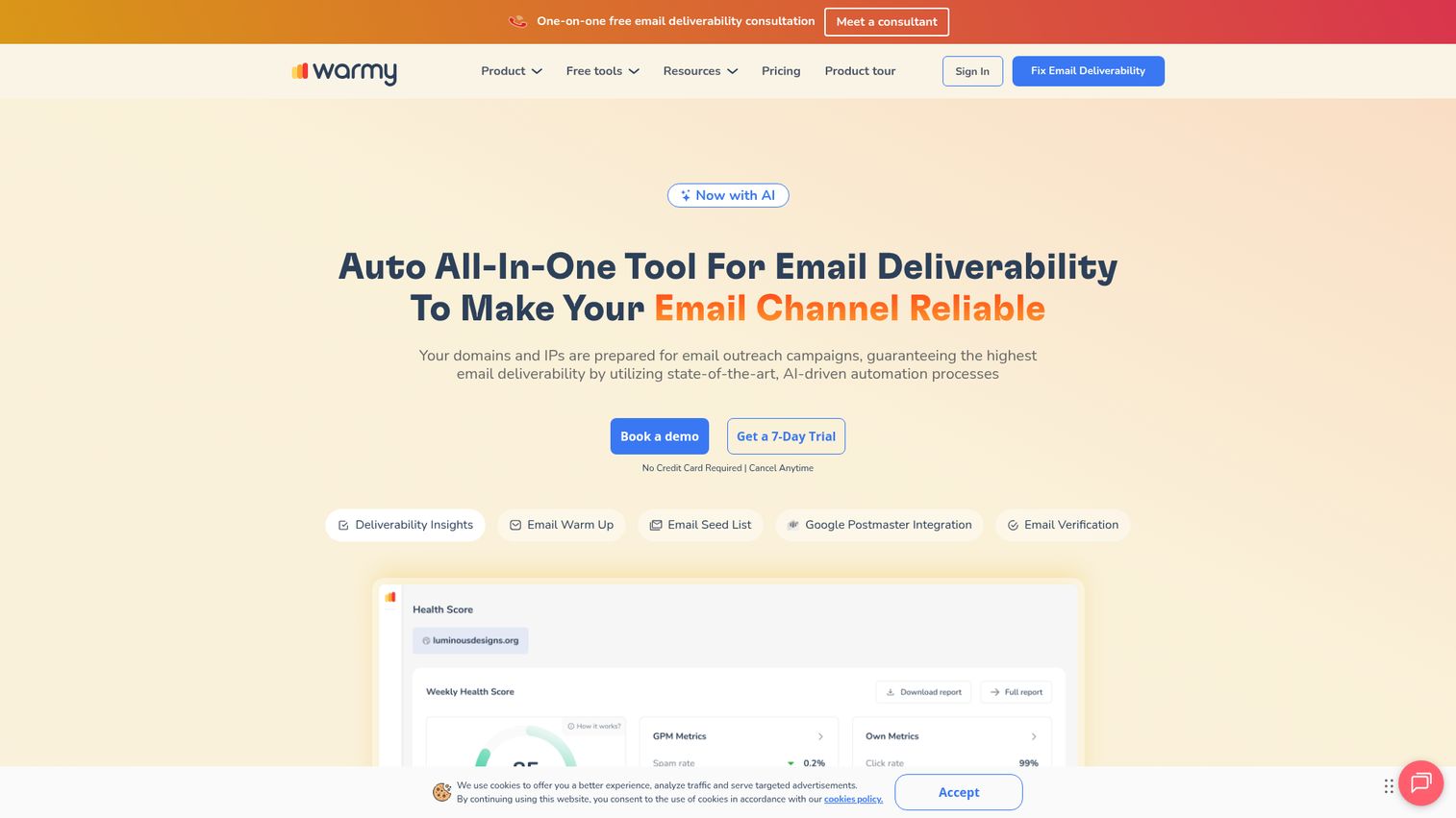
Warmy is an AI-driven email deliverability platform that prepares domains and IPs for outreach. The warmup is volume-aware: the algorithm adjusts pacing based on reputation signals rather than running a fixed ramp. The product also includes seed-list testing for inbox placement and ongoing deliverability monitoring.
Best for: Teams that want warmup volume to dynamically match what they actually plan to send, with adaptive pacing based on inbox health.
Key strengths
- AI-driven warmup optimization: adaptive pacing based on reputation and engagement signals.
- Email seed list testing: placement validation across major providers.
- Deliverability monitoring: inbox vs spam placement insights and reputation tracking.
Why choose Warmy: Useful when warmup volume should match real sending patterns rather than ramp on a fixed schedule. The AI-driven pacing logic is the differentiator for teams who have run static-volume warmup before and watched it overshoot or undershoot real campaign needs.
Warmy pricing: Verified on the Warmy pricing page on 2026-06-05. The page lists B2B sender, B2C sender, and Custom plan options described as volume-based pricing, but no public numeric prices were displayed. A 7-day trial with no credit card is available. Book a demo via the pricing page for specific plan figures.
Considerations for sales teams before buying
Per-inbox pricing math
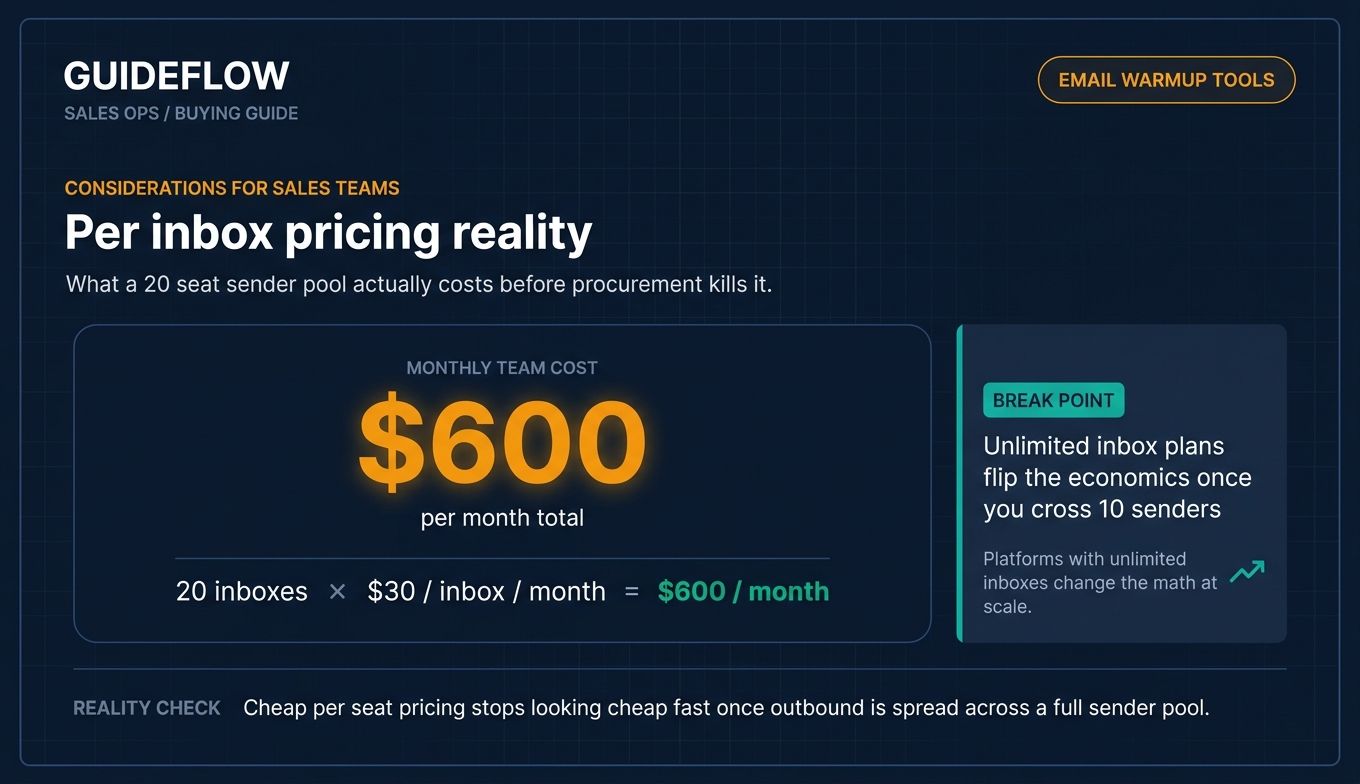
The number that matters is monthly cost multiplied by inbox count. A tool that lists at $30 per inbox per month becomes $600 per month for a 20-inbox team, which is the kind of line item that gets killed in procurement. Always compute team-level cost before list price, and remember that platforms with unlimited inboxes (Smartlead, Instantly, TrulyInbox paid tiers) change the economics completely once you cross 10 senders.
Native warmup vs standalone
If your sequencing platform includes warmup natively, run it before adding a standalone tool. Smartlead, Instantly, and Lemwarm all bundle warmup, which means one less procurement conversation and one less integration to maintain. Standalone tools like Mailreach and Folderly earn their place when you want deliverability reporting depth your sequencer cannot match.
Reporting your sales ops team can act on
Inbox placement scores, reputation trends over time, and per-inbox health views are the reports that drive decisions. "Your inbox is warm" with a green checkmark is not a report. Push for tools that surface the daily score, the trend line, and the specific signal that changed when reputation drops.
Compatibility with your sending infrastructure
Coverage of Gmail, Microsoft 365, and custom SMTP varies. If you send through SendGrid, Mailgun, or AWS SES, verify SMTP support explicitly before purchase. Mailwarm and Warmup Inbox both publish broad ESP support; some entry-level tools cover only Gmail and Outlook.
Security and procurement fit
Will the tool pass SOC 2 review? Does it use OAuth or require an app password? RevOps and IT will ask before approval, especially in mid-market and enterprise. The tools positioned for enterprise (Folderly, InboxAlly) tend to have these answers ready; smaller tools often do not.
How to know warmup isn't actually your problem
Three patterns look like a deliverability problem but are not. Diagnose before you buy.
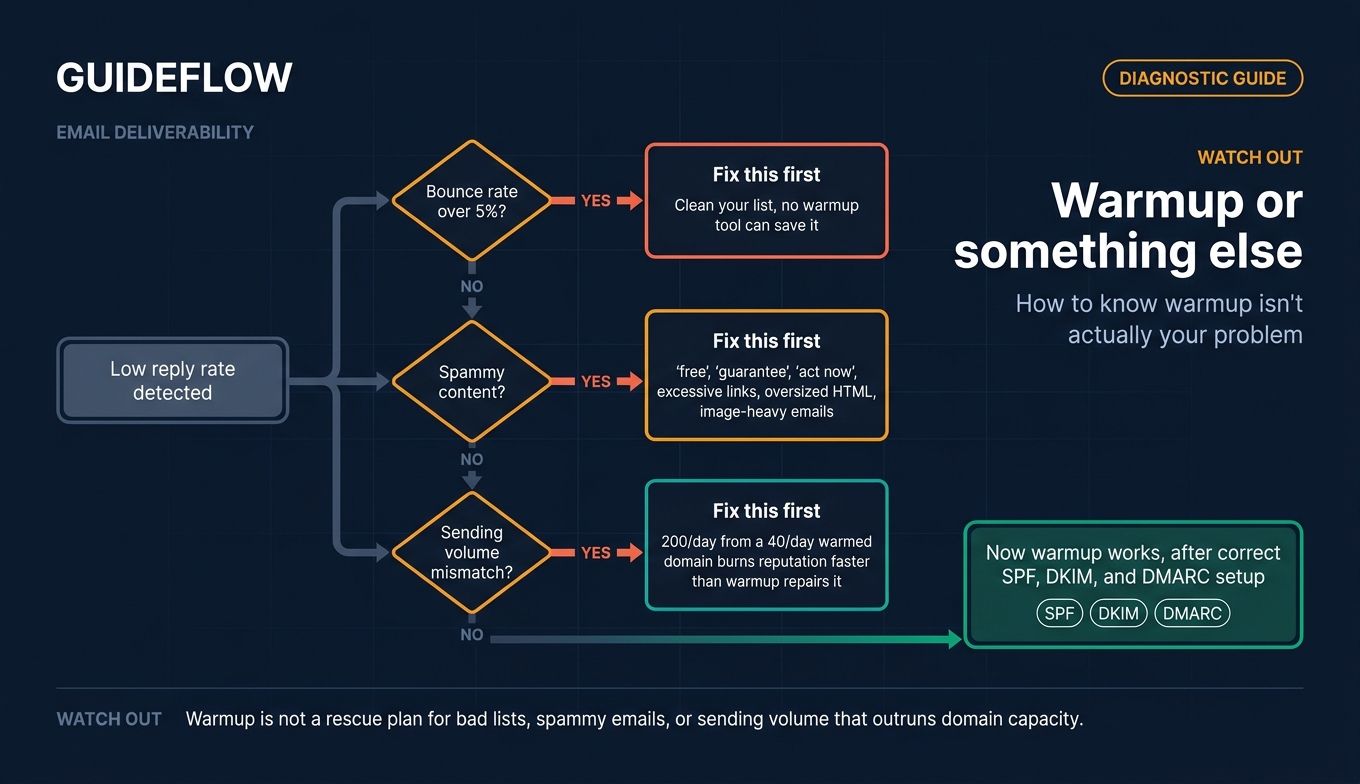
Bad list hygiene. High bounce rates damage sender reputation faster than warmup can rebuild it. If your list has more than 5% bounces, no warmup tool will save you. Verify lists before sending, every time, with a dedicated email verification tool. This is the most common misdiagnosis in cold outbound.
Spammy copy and HTML weight. Subject lines with "free," "guarantee," "act now," excessive links, oversized HTML templates, and image-heavy emails trigger spam filters regardless of how warm your domain is. If your copy fails a content-based spam test, warmup is not the fix.
Sending volume mismatch. Sending 200 emails per day from a domain that warmed up to 40 per day will burn reputation faster than warmup can repair it. Match real sending volume to warmed capacity, or your warmup investment is wasted within a week.
Once deliverability is solved, the question shifts. The email gets to the inbox; now what makes the recipient reply? This is the content question, and it is where most cold outbound stalls. Plain text outreach with a generic value prop competes against every other plain text email in the prospect's inbox. Cold emails that include an interactive demo give the recipient something to engage with on the spot, which materially changes the engagement model compared to text-only outreach. Teams pairing warm inboxes with high-converting assets often build a demo center that reps can link to directly from sequences, and our guide to brand awareness demo strategies covers how to position those assets inside outbound. Fix the inbox first, then upgrade the asset inside the email.
Conclusion
Pick by use case. If you are running standalone warmup and want deep reputation analytics, Mailreach is the strongest pick. If you are managing multiple sending inboxes across alias domains, Warmup Inbox is built for that operational reality. If you already use a sequencing platform, Smartlead or Instantly bundle warmup at no extra per-inbox cost and consolidate your stack. If your deliverability problem is bigger than warmup, Folderly is the enterprise-grade choice. If budget is the constraint, TrulyInbox's free tier or Warmbox's $15/month Solo plan are the lowest-friction starting points.
The next step is simple: pick one tool from this list, run a 3-week test, and measure inbox placement before and after via a seed-list test like Glockapps. Reputation signals start stabilizing in the first 2 to 4 weeks, with brand-new domains often needing 8 to 12 weeks of warmup before full-volume sending.
Warmup is plumbing, not pipeline. Fix the plumbing, then go solve the real problem of what your reps actually send.
FAQs
An email warmup tool is software that gradually builds a sending inbox's reputation by simulating positive engagement (opens, replies, moves out of spam, marks as important) across a network of peer inboxes. The goal is to make mailbox providers like Gmail and Outlook treat outgoing emails as trustworthy, which improves inbox placement and reduces spam-folder placement when you start real campaigns.
For most domains with some existing history, expect meaningful improvement over 2 to 4 weeks. For brand-new domains, GMass and similar deliverability guides recommend 8 to 12 weeks of warmup before full-volume sending. Recovery on a damaged domain typically takes longer than initial warmup, often 4 to 8 weeks of disciplined sending plus continued warmup.
Yes, when paired with proper authentication (SPF, DKIM, DMARC) and reasonable sending volume. Benchmarks from FirstSales.io summarized by Signado show that accounts completing a full warmup cycle reach 85 to 90% inbox placement by day 21 to 28, while accounts that skip warmup can see up to 90% of emails land in spam. Warmup does not fix bad copy, bad lists, or sending volumes that exceed warmed capacity.
Warmup tools send between consenting peer inboxes in the warmup network, so the recipients have opted in. That said, compliance depends on jurisdiction and how each network is structured. Some providers have updated their warmup policies in response to mailbox provider terms, so vet any email warming service for current compliance posture and consult counsel for high-volume programs.
Standalone tools typically range from around $15 to $50 per inbox per month at entry tiers, with higher-volume and agency plans on top. Native warmup inside sequencing platforms like Smartlead, Instantly, and Lemwarm is usually included in the platform price rather than billed per inbox, which changes the economics significantly for multi-inbox teams.
The terms are used interchangeably in most marketing. "Service" sometimes implies a managed offering with human deliverability experts (Folderly is the clearest example), while "tool" implies self-serve software (Warmbox, Mailreach, TrulyInbox). For most sales team buyers, both terms refer to the same category of email warmup software.
Yes. The mailbox provider does not change the fact that sender reputation is tied to your domain and sending IP. New Gmail and Microsoft 365 accounts start with little or no sending reputation, so gmail warmup and outlook warmup are still required before sending cold outbound at volume. The provider just affects which engagement signals matter most.
Yes, and most sales teams do. Tools like Warmup Inbox, Smartlead, Instantly, and TrulyInbox are built for multi-inbox management. Pricing structures differ significantly: some charge per inbox, others bundle unlimited inboxes into a flat plan, and some price by daily warmup volume. Budget by computing team-level cost at your expected inbox count, not list price.