It is day four of the close and half the team is still chasing signoffs in a spreadsheet nobody trusts. One reconciliation is stuck in someone's inbox. A journal entry got booked twice. The controller wants a status update, and the honest answer is "we're not sure." That is the reality of month-end close for a lot of finance teams, and it does not scale.
The market has noticed. The global financial close software market is projected to grow from USD 8.6 billion in 2024 to USD 18.5 billion by 2034, an 8.1% CAGR, according to Custom Market Insights (2024). Cloud-based deployments now dominate adoption over on-premise, driven by flexibility and tighter data security. The pull is not hype. It is the cost of a close that runs on manual trackers, shared drives, and email.
Financial close software fixes the parts of the close that spreadsheets cannot: workflow automation for task ownership and approval routing, reconciliation management that flags exceptions before they compound, and a clean audit trail that documents who did what and when. Some tools lean toward close management for accounting teams. Others lean toward financial close and consolidation software for multi-entity finance orgs. Getting the fit right matters more than the feature count.
This piece breaks the category down by close workflow maturity, from replacing spreadsheet checklists to enterprise consolidation, so you can match a tool to where your team actually is. If your evaluation touches adjacent categories, our roundups of audit management software and contract lifecycle management software cover the neighboring stack.
What's inside
This guide is for finance and accounting teams comparing financial close software, month end close software, and financial close and consolidation software. It is written for people building a shortlist, not learning the definition for the first time.
We evaluated each tool against four criteria that predict fit in real close cycles:
- Workflow automation: task management, approval routing, and status visibility
- ERP integration: how cleanly it connects to your accounting and general ledger systems
- Reconciliation support: transaction matching, exception handling, and journal entry control
- Audit readiness and ease of use: documentation, controls, compliance, and adoption
We sorted the list by relevance to teams evaluating close management first, then broadened to consolidation-heavy platforms.
TL;DR
- Best overall for modern close automation: Numeric, an AI-forward close management platform for accounting teams that want speed without heavy setup.
- Best for enterprise close and reconciliation: BlackLine, the category-defining platform for mature, high-volume finance operations.
- Best for accounting teams leaving spreadsheets: FloQast, built around structured close checklists and reconciliation organization.
- Best for reporting and controls: Workiva, for teams where documentation, governance, and audit trail matter most.
- Best for enterprise consolidation: OneStream, a unified platform for multi-entity close, consolidation, and planning.
- Best for integrated FP&A and close: Planful, for finance teams that want continuous close and planning in one place.
What is financial close software?
Financial close software is a category of tools that automates and controls the month-end and period-end close, from task management and journal entries through reconciliations, consolidation, and reporting. It replaces spreadsheet checklists and email approvals with a system of record for the close.
Most platforms in the category share a common set of capabilities. When you evaluate financial close management software, expect to see:
- Close task management: a shared checklist with owners, due dates, dependencies, and approval routing so nothing stalls in an inbox.
- Reconciliation management: transaction-level matching, exception flagging, and standardized templates for recurring accounts.
- Journal entry automation: rules-based and recurring entries with review and approval controls to cut manual booking errors.
- Consolidation and reporting: roll-ups across entities and currencies, plus reporting that ties back to the general ledger.
- ERP integration: connectors to your accounting and ERP systems so balances and actuals flow without manual export.
- Audit trail and controls: a timestamped record of every action, supporting audit readiness, compliance, and internal controls.
The category splits along a spectrum. Close management software focuses on running the close workflow: checklists, reconciliations, and controls. Financial close and consolidation software adds multi-entity consolidation, intercompany logic, and reporting for complex org structures. Knowing which end of that spectrum you sit on is the first real decision.
When to use financial close software
Not every team needs the same tier. Here is how to pattern-match your situation before you scan the list.
Replace spreadsheet-based close checklists
When your close tracker lives in a shared spreadsheet and status means "ask the person who owns that tab," you have outgrown manual tools. Software gives you a single checklist with clear ownership, dependencies, and approval routing. Everyone sees what is done, what is blocked, and who is accountable, without a status meeting.
Improve reconciliation and journal entry control
Recurring reconciliations and manual journal entries are where errors and rework hide. Close software standardizes these tasks with templates, transaction matching, and journal entry automation. Every action leaves an audit trail, and reviewers approve in-system instead of over email, which keeps collaboration and control in one place.
Shorten the close and improve audit readiness
When leadership wants a faster month-end and cleaner documentation, the fix is process visibility plus controls. Close software surfaces bottlenecks, enforces sign-off, and produces the compliance and reporting records auditors ask for. Security, permissioning, and a complete audit trail turn audit prep from a scramble into an export.
Comparison table
The table below sorts the seven tools by relevance to teams evaluating financial close software today. Read "Intent" as the buyer profile each tool fits best, and "Key differentiation" as the one thing that sets it apart. Pricing reflects publicly available information; several vendors price by quote, which is normal for this category. G2 ratings are included where verified.
| # | Product | Intent | Key differentiation | Pricing | G2 rating |
|---|---|---|---|---|---|
| 1 | Numeric | Modern close automation for accounting teams | AI-assisted close, reconciliations, and flux analysis | From $30/month/user | 4.8/5 |
| 2 | BlackLine | Enterprise close and reconciliation | Deep reconciliation and intercompany at scale | Quote-based | 4.5/5 |
| 3 | FloQast | Accounting teams leaving spreadsheets | Structured close checklists and reconciliation organization | Custom (not per user) | 4.6/5 |
| 4 | Workiva | Reporting and controls-heavy teams | Connected reporting with strong audit trail | Quote-based | 4.5/5 |
| 5 | Trintech | Complex reconciliation at enterprise scale | Transaction matching and certification | Quote-based | 4.5/5 |
| 6 | OneStream | Enterprise consolidation and CPM | Unified close, consolidation, and planning | Quote-based | 4.6/5 |
| 7 | Planful | Integrated FP&A and close | Planning plus close and consolidation in one | Quote-based | 4.3/5 |
1. Numeric
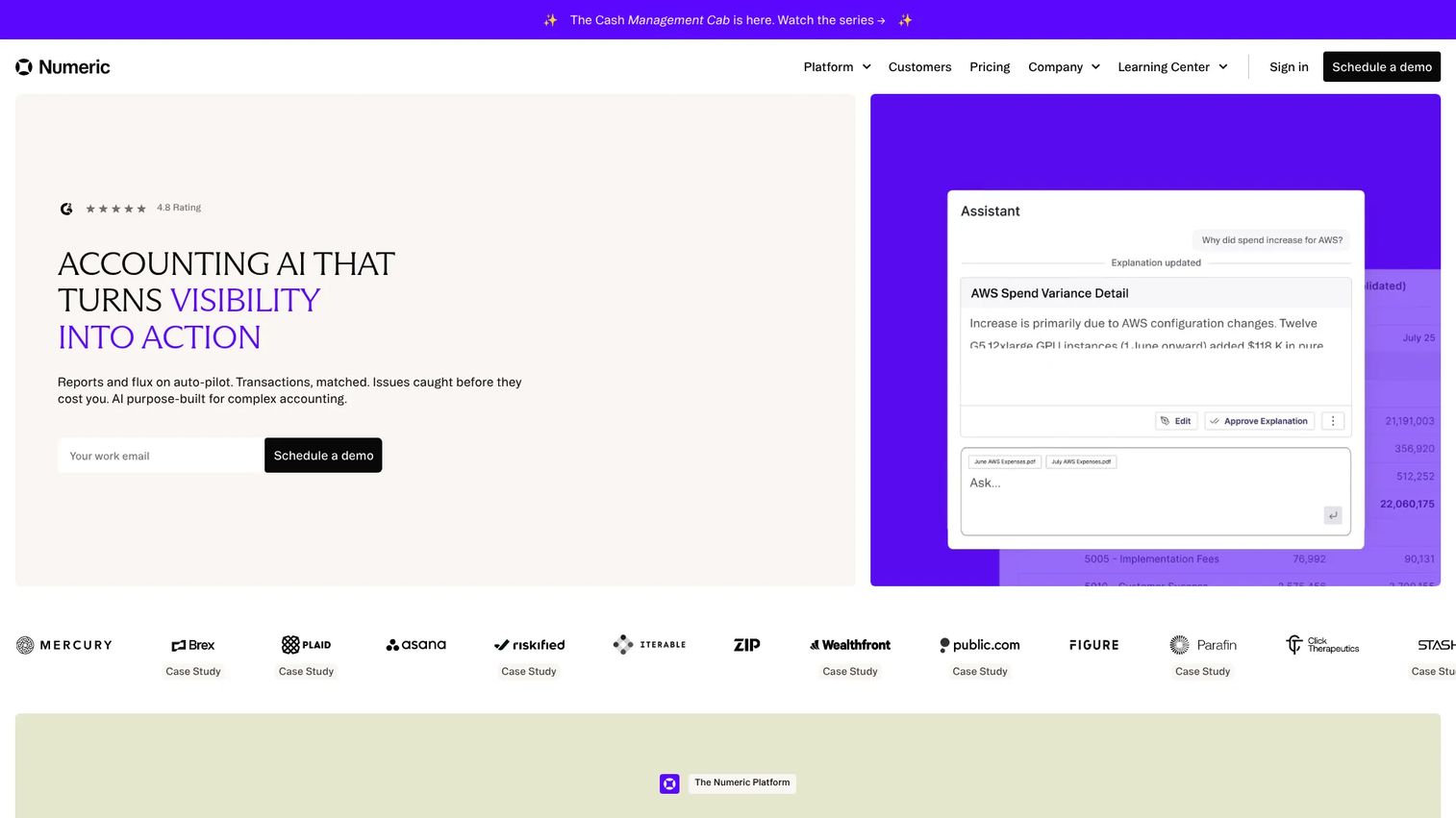
Numeric is an AI-powered close automation platform built for accounting teams that want to run month-end faster without a long implementation. It centers on the close checklist, account reconciliations with transaction-level detail, and flux analysis, then layers AI assistance across those workflows. It reads as the modern, close-management-first option in this list.
Best for: Accounting teams that want to automate month-end close, reconciliations, and flux analysis without heavy setup.
Key strengths
- Close checklist and project management: Ownership, dependencies, and approval routing in one shared view, so status is always visible.
- Account reconciliations with transaction-level detail: Match at the transaction level and surface exceptions before they compound into rework.
- Flux analysis, reporting, and transaction monitors: Explain variances and catch anomalies with monitors that watch the ledger continuously.
Why choose Numeric: If your team wants close management software that feels modern and gets running quickly, Numeric fits. It suits growth-stage and mid-market accounting teams who value AI-assisted close operations and clean reconciliation workflows over the heavier configuration of legacy enterprise suites. The continuous monitoring approach also supports a move toward continuous close rather than a once-a-month scramble.
Numeric pricing: Numeric's Essentials plan starts at $30 per user per month, published on its pricing page. The Growth and Enterprise tiers are custom and quote-based. There is no free tier listed. That published entry price is unusual in a category where most vendors gate all pricing behind sales, and it makes Numeric easy to scope for smaller finance teams.
2. BlackLine

BlackLine is the category-defining platform for enterprise financial close and reconciliation. It is cloud-based financial operations automation built for accounting and finance teams running high-volume, high-complexity close cycles. If a tool set the standard for what close and reconciliation software should do, this is it.
Best for: Midmarket and enterprise finance teams automating close, reconciliations, and intercompany processes.
Key strengths
- Account reconciliations: Standardized, controlled reconciliations at scale, with certification and exception workflows built in.
- Intercompany accounting: Manage intercompany transactions and eliminations across a complex entity structure.
- Financial close management: End-to-end close orchestration with task management, controls, and a full audit trail.
Why choose BlackLine: Choose BlackLine when your close is genuinely complex, high transaction volumes, many entities, strict controls, and audit scrutiny. It is the mature choice for finance orgs that have outgrown lighter tools and need reconciliation depth plus audit readiness that stands up to external auditors. Smaller teams may find it more platform than they need, which is exactly why it fits the enterprise end of the spectrum.
BlackLine pricing: BlackLine does not publish pricing on its site, and packages are quote-based through its sales team. Expect enterprise-oriented, custom pricing scoped to entity count, modules, and users. Request a quote to size it against your close volume and module needs.
3. FloQast
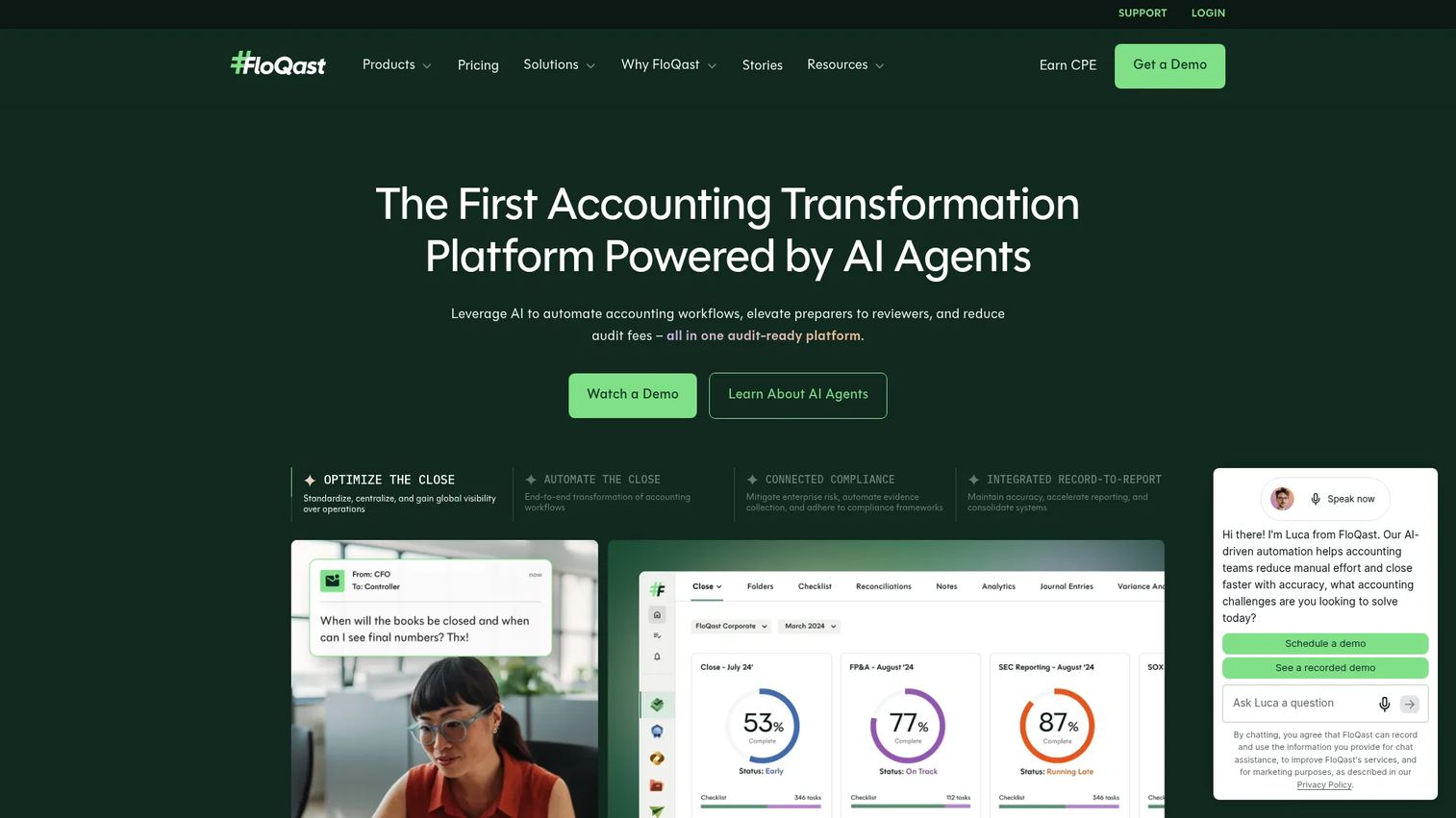
FloQast is an accounting transformation platform built around close, compliance, reporting, and AI-driven accounting workflows. It is a strong pick for accounting teams that want structure, close checklists, reconciliation organization, and connected compliance, without abandoning the spreadsheet-based work they already know.
Best for: Mid-market and enterprise accounting teams needing close automation and compliance workflows.
Key strengths
- Automated reconciliations and journal entry automation: Standardize recurring reconciliations and entries to cut manual effort and errors.
- Connected compliance and internal audit workflows: Tie close activity to controls and audit readiness in one connected system.
- Integrated record-to-report reporting and consolidation: Move from close tasks through reporting and consolidation without leaving the platform.
Why choose FloQast: FloQast lands well with accounting teams making the jump from spreadsheet-based close to a real workflow system. It respects how accountants already work, then adds ownership, automation, and an audit trail on top. That makes adoption smoother for teams who resist a rip-and-replace platform but need the visibility and control that month end close software provides.
FloQast pricing: FloQast does not charge per user and does not publish a numeric price. Its pricing page states packages are customized and directs buyers to contact sales. Because it is not seat-based, scope your quote around your close scale and the modules you need rather than headcount.
4. Workiva

Workiva is a cloud platform for connected reporting, compliance, and data collaboration. It is the option for reporting-heavy finance teams that need transparency and control across documents, spreadsheets, and filings, with a strong audit trail running through everything.
Best for: Enterprise finance, reporting, and compliance teams.
Key strengths
- Document and data collaboration: Multiple stakeholders work in the same connected documents without version chaos.
- Linked spreadsheets, documents, and presentations: Change a number once and it updates everywhere it is referenced, which protects reporting accuracy.
- SEC reporting and filings: Purpose-built support for regulatory reporting and filings, with governance baked in.
Why choose Workiva: Workiva fits finance teams where reporting and governance carry as much weight as the close itself. If your pain is fragmented documentation, manual data reconciliation across reports, and audit-trail gaps, Workiva's linked-data model closes those gaps. It is less a standalone close checklist and more a controls-and-reporting backbone for teams with heavy compliance obligations.
Workiva pricing: Workiva sells through direct sales and does not publish public pricing. Pricing is quote-based and scoped to your reporting, compliance, and user requirements. Contact sales for a package sized to your filing and reporting needs.
5. Trintech

Trintech provides an AI-powered financial close and reconciliation platform for accounting and finance teams. It is enterprise-grade, built for automation, controls, and scale across complex reconciliation and close operations.
Best for: Mid-market and enterprise finance teams automating reconciliation and financial close.
Key strengths
- Transaction matching and daily reconciliation: High-volume matching and daily reconciliation to keep balances current, not just at period end.
- Account reconciliation and certification: Standardized reconciliations with certification workflows for controls and sign-off.
- Journal entry and close task management: Orchestrate entries and close tasks with ownership, routing, and a clear audit trail.
Why choose Trintech: Trintech suits finance operations with heavy reconciliation demands, high transaction volumes, frequent matching, and strict certification requirements. Teams that need daily reconciliation rather than a monthly catch-up will value the continuous approach. Like other enterprise suites here, it is best matched to larger organizations with genuine complexity rather than a small team looking to leave spreadsheets.
Trintech pricing: Trintech does not publish pricing on its site and works through demos and sales conversations. Expect enterprise, quote-based pricing scoped to transaction volume, reconciliation needs, and modules. Book a demo to size it against your reconciliation workload.
6. OneStream
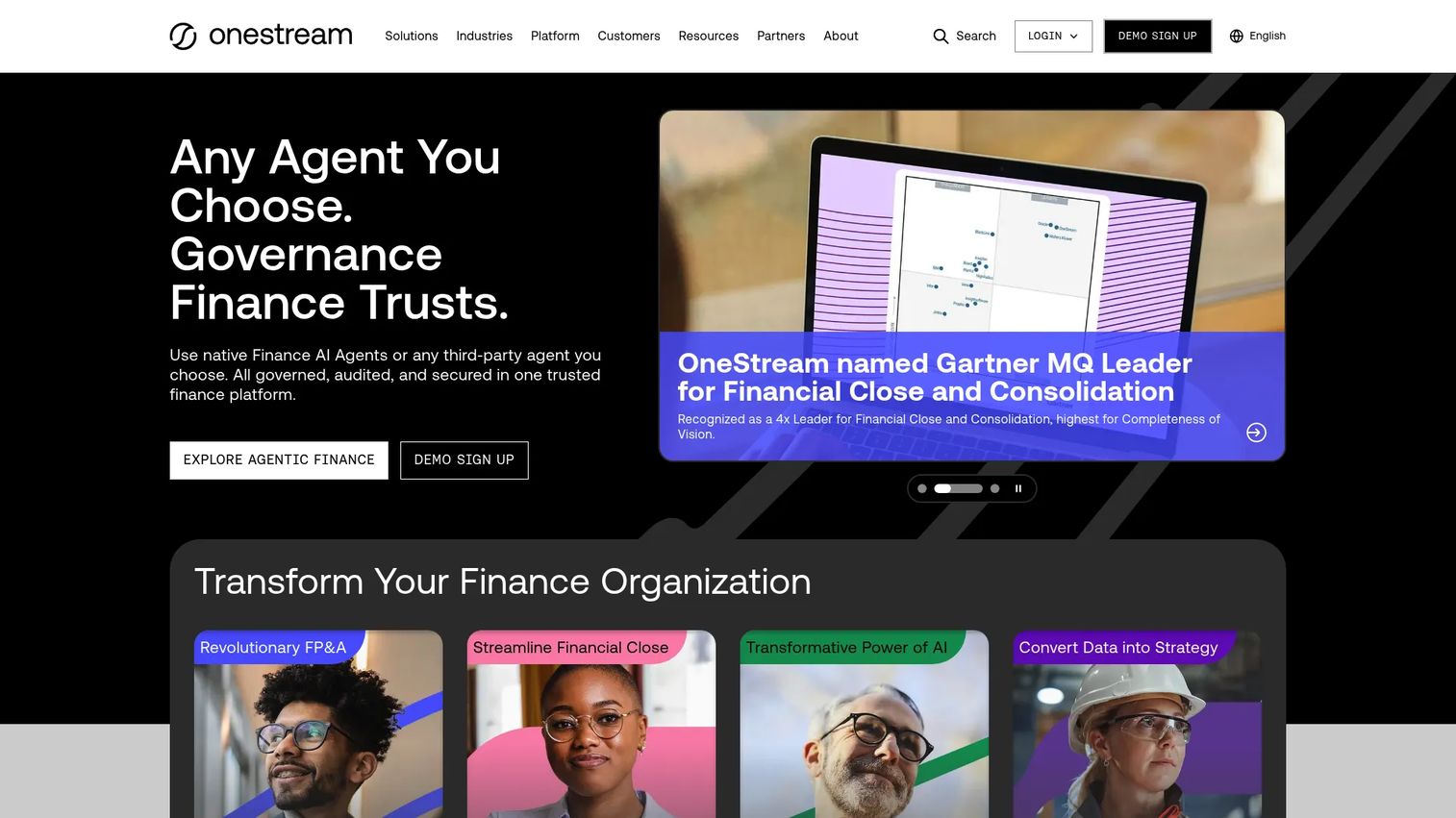
OneStream is an enterprise finance management platform spanning financial close, consolidation, planning, forecasting, reporting, and analytics on a single unified platform. When your requirements go beyond running the close and into multi-entity consolidation, this is the platform-first option.
Best for: Large finance teams needing a unified CPM/EPM platform.
Key strengths
- Unified financial and operational data on a single platform: One source of truth for close, consolidation, and planning instead of stitched-together tools.
- Financial close, consolidation, planning, forecasting, reporting, and analytics: The full corporate performance management scope in one system.
- Built-in AI/ML and extensible Solution Exchange: Add capabilities and automation without bolting on separate products.
Why choose OneStream: Prefer a platform approach like OneStream when your finance org runs multi-entity consolidation, intercompany eliminations, and planning that all need to share the same data. Consolidating close, consolidation, and FP&A onto one platform cuts reconciliation between systems and gives leadership a single reporting layer. It is a bigger commitment than a standalone close tool, which is precisely the point for enterprise finance teams.
OneStream pricing: OneStream does not publish public pricing and sells through demos and direct sales. Pricing is enterprise, quote-based, and scoped to entities, modules, and users. Engage sales for a package matched to your consolidation and planning footprint.
7. Planful

Planful is financial performance management software covering planning, reporting, close, and consolidation. It is the pick for finance teams that want integrated FP&A and close workflows rather than a standalone close checklist tool.
Best for: Mid-market to enterprise finance teams needing FP&A and performance management.
Key strengths
- AI-powered planning and forecasting: Connect close actuals directly into planning and forecasting cycles.
- Financial close and consolidation: Run close and consolidation alongside planning in one performance management system.
- Real-time reporting and analysis: Report on close and plan data together for faster, cleaner decisions.
Why choose Planful: Planful fits teams that see close as one part of a broader financial performance picture. If your close and your planning currently live in separate tools and separate spreadsheets, bringing them together shortens the loop from actuals to forecast. It supports cross-functional planning benefits that a pure close tool cannot, which is why it fits teams wanting more than a checklist.
Planful pricing: Planful does not display public pricing and directs buyers to contact sales. Pricing is quote-based and scoped to your planning, close, and consolidation requirements. Reach out to sales for a package sized to your finance team's scope.
Considerations before you buy
The right tool depends on where your close sits on the maturity curve and how your stack is built. Use this checklist to pressure-test any shortlist.
ERP integration and stack fit
Confirm the tool connects cleanly to your existing ERP and general ledger. Ask how balances, actuals, and journal entries sync, and whether the ERP integration is native or requires a middleware layer. Mixed or legacy ERP environments are where integration friction shows up, so validate it before you commit.
Close management vs consolidation
Decide whether you need close management software to run the workflow or financial close and consolidation software for multi-entity roll-ups. Buying a heavy consolidation platform to fix a checklist problem is overkill. Buying a lightweight checklist tool when you have twelve entities and intercompany eliminations leaves gaps.
Reconciliation and journal entry depth
Match the tool's reconciliation management and journal entry automation to your actual volume. High-transaction teams need transaction matching and certification. Lower-volume teams may only need standardized templates and approval routing. Do not pay for depth you will not use.
Audit readiness and controls
Every serious buyer should verify the audit trail, permissioning, and compliance support. Ask what auditors can self-serve and what your team has to assemble. A complete, timestamped record is the difference between an audit prep scramble and an export.
Implementation effort and adoption
Ask for a realistic implementation timeline and what internal resources it demands. The best financial close automation software still fails if the team does not adopt it. Weigh ease of use and change management support as heavily as the feature list.
Conclusion
The best financial close software for your team is the one that matches your close workflow maturity, not the one with the longest feature list. Numeric is the modern, close-management-first pick for accounting teams that want AI-assisted automation and a published starting price. BlackLine and Trintech serve enterprise finance operations with deep reconciliation and controls. FloQast fits accounting teams graduating from spreadsheets. Workiva anchors reporting-and-governance-heavy teams. OneStream and Planful bring consolidation and FP&A into the same platform as the close.
Your decision criteria stay constant: workflow automation, ERP integration, reconciliation and journal entry depth, audit readiness, and adoption. Before you sign, validate ERP fit and implementation effort against your real close, because that is where most projects stall. Shortlist two tools that map to your maturity level, run a scoped trial or demo against a real close cycle, and pick the one your team will actually use. If your evaluation extends into adjacent finance and operations tooling, our guides to contract management software and event management software can round out the picture.
Start your journey with Guideflow today!
FAQs
Financial close software automates and controls the month-end and period-end close, from task management and journal entries through reconciliations, consolidation, and reporting. It replaces spreadsheet checklists and email approvals with a single system of record. The category ranges from close management tools to full financial consolidation tools for multi-entity organizations.
It gives every close task an owner, a due date, and an approval path, so status is visible without a meeting. It standardizes recurring reconciliations and journal entries, flags exceptions early, and records every action in an audit trail. The result is a faster, more predictable month end close with fewer errors and less last-minute scrambling.
Yes. ERP integration is a core capability, and most platforms connect to common accounting and ERP systems so balances and actuals flow without manual export. The depth varies: some offer native connectors, others rely on a middleware layer. Validate the specific integration to your ERP, especially in mixed or legacy environments, before committing.
Close management software focuses on running the close workflow: checklists, reconciliations, journal entries, and controls. Financial close and consolidation software adds multi-entity consolidation, intercompany eliminations, and reporting across a complex org structure. Smaller teams usually need close management; multi-entity enterprises need consolidation depth on top.
Start with workflow automation and status visibility, since ownership and approval routing solve the most common close pain. Next, prioritize reconciliation management and journal entry automation to reduce errors and rework. Then confirm audit trail, controls, and ERP integration so audit readiness and reporting hold up under scrutiny.
It depends on complexity. A close management tool for a single-entity accounting team can go live in weeks, while an enterprise consolidation platform with multiple entities and ERP connections can take several months. Ask each vendor for a realistic timeline and the internal resources required, because adoption effort often outweighs the software cost.
Often, yes. Mid-market finance teams usually feel spreadsheet sprawl and audit-prep pain acutely but lack the headcount to brute-force it. A right-sized close management platform delivers workflow visibility, reconciliation control, and financial close automation without enterprise complexity, which is why tools with published or scoped pricing fit this segment well.