You shipped the feature. Three customers asked for it in Slack, two logged it in support tickets, one mentioned it on a call, and someone dropped it in a spreadsheet a quarter ago. None of them got told it was live.
That is the real problem with scattered feedback. It is not that you collect too little. It is that requests live in ten places, so nobody can see the pattern, prioritize honestly, or close the loop after shipping.
The customer feedback software market sits at $2.96 billion in 2026 and is projected to reach $8.66 billion by 2035, growing at 12.7% annually, according to Business Research Insights (2026). That growth reflects a shift in how product teams work. Anecdote and the loudest voice no longer cut it. Teams want a visible system for intake, voting, triage, and roadmap communication.
A good feedback board software fixes the mess. It gives you one place to capture requests from every channel, deduplicate them, score them against real signal, and tell customers what happened. The right tool turns feedback from noise into a decision engine.
What's inside
This guide is for Product Managers and product teams evaluating a customer feedback tool that does more than collect. We picked six tools based on the criteria that matter for turning feedback into shipped roadmap.
- Board experience: how clean the public feedback board and voting flow feels
- Multi-source capture: whether it pulls from support, calls, surveys, and Slack
- Prioritization: scoring, segmentation, and signal quality over raw vote counts
- Workflow routing: how well it pushes requests into Jira, Linear, and your stack
- Close the loop: how it notifies customers when a request ships
TL;DR
- Best overall for public feedback boards: Canny for its board, roadmap, and changelog in one tool
- Best for product lifecycle management: Productboard for insights, prioritization, and roadmap depth
- Best for multi-source feedback analysis: Enterpret for AI-driven theme extraction across every channel
- Best for lean teams that want a simple board: Feature Upvote for low-friction voting boards
- Best for strong routing and prioritization: Savio for CRM-aware signal quality
- Best for shared product and ops workflows: Cycle for feedback-to-delivery loops
- Best for a flexible customer feedback portal: Featurebase for boards, changelog, and support in one suite
What is feedback board software?
Feedback board software is a system for collecting, organizing, deduplicating, prioritizing, and communicating customer requests and product ideas in one place. It replaces scattered spreadsheets and Slack threads with a structured workflow: capture a request, group duplicates, score it, decide, then tell the customer what happened.
Most teams start with a public feedback board where customers submit ideas and vote. Behind that board sits an internal layer where you triage, tag, and route the signal into your roadmap. The best product feedback software connects both halves so nothing gets lost between intake and shipping.
Here are the core capabilities to expect from any feedback management tool:
- Public feedback board and voting: let customers submit and upvote feature requests
- Internal triage and deduplication: merge duplicate requests so one idea shows true demand
- Multi-source capture: pull feedback from support tickets, calls, surveys, reviews, and chat
- Prioritization and scoring: rank requests by revenue, segment, and vote weight, not volume alone
- Roadmap and changelog updates: show what is planned, in progress, and shipped
- Workflow routing: push prioritized requests into Jira, Linear, or your PM stack
The category overlaps with feature request software and roadmap software, but the defining job is the board. A customer feedback management tool earns its place when it turns raw requests into decisions your whole team can see.
When to use feedback board software
Centralize requests from many channels
Feedback starts breaking when it lives in too many places. A request in Intercom, a note from a sales call, a spreadsheet row, a Slack reaction. Multi-source feedback tools pull all of it into one board so you see true demand instead of whoever shouted last. If your team cannot answer "how many customers asked for this," you need centralized intake.
Prioritize what to build next
Roadmap decisions built on anecdote age badly. When you are choosing between five features and each has a champion, you need better signal than gut feel. Prioritization software lets you weight requests by revenue, segment, and vote count, so the roadmap reflects value rather than volume. This is where a feedback board stops being a suggestion box and becomes a decision tool.
Close the loop after shipping
You built the thing. Now the customers who asked deserve to hear it. Closing the loop, telling requesters what shipped, builds trust and drives retention. Manual follow-up never scales past a handful of accounts. A customer feedback management tool tracks who asked for what and notifies them automatically when the status changes to shipped.
Comparison table
Here is a side-by-side view of the six tools, sorted by relevance to teams evaluating a public feedback board with prioritization and close-the-loop workflows. Pricing and G2 ratings reflect verified values at the time of writing and can shift, so confirm current figures on each vendor's page before you buy.
| # | Product | Best for | Key differentiator | Pricing | G2 rating |
|---|---|---|---|---|---|
| 1 | Canny | Public feedback board plus roadmap and changelog in one tool | AI feedback capture (Autopilot) with tracked-user pricing | Free, Pro from $79/mo billed yearly | 4.5/5 |
| 2 | Productboard | Product teams needing feedback, prioritization, and roadmaps | Customer-centric prioritization tied to roadmap planning | Free tier; paid pricing on request | 4.3/5 |
| 3 | Enterpret | Consolidating customer feedback at enterprise scale | AI adaptive taxonomy across every feedback source | Usage-based, contact sales | 4.6/5 |
| 4 | Featurebase | An all-in-one support plus product feedback platform | Feedback, changelog, help center, and AI support together | Free, Growth $29/seat billed yearly | 4.7/5 |
| 5 | Feature Upvote | A lightweight feature-request board with voting | Simple per-board pricing, minimal setup | Indie $49/board/mo, 30-day trial | Not yet rated |
| 6 | Savio | B2B teams capturing and prioritizing requests | CRM-aware prioritization by customer segment | Essential $39/mo | 4.8/5 |
6. best feedback board software for 2026
1. Canny
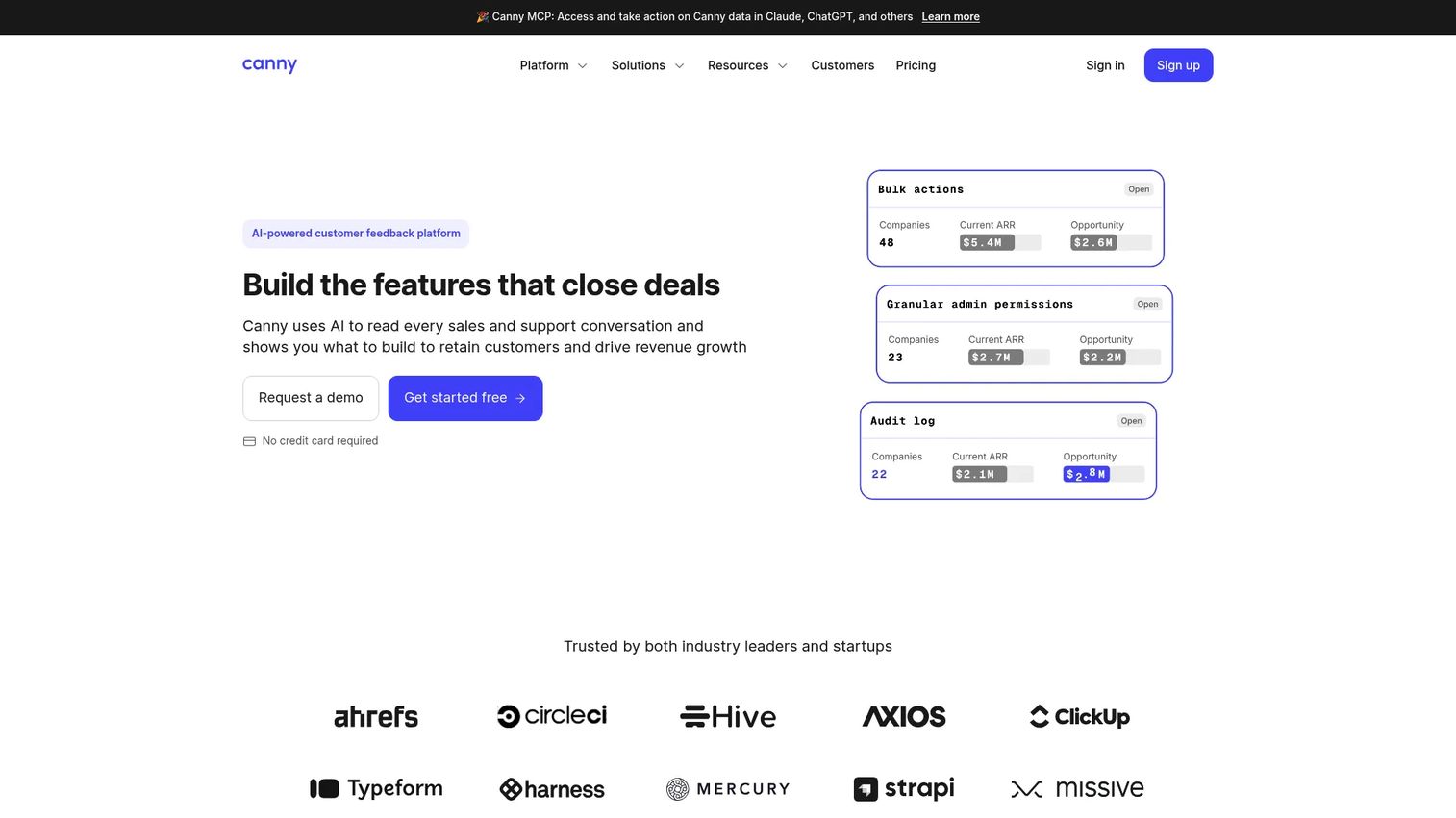
Canny is customer feedback management software for collecting, organizing, and acting on product feedback. It pairs a public feedback board with a roadmap and changelog, so intake, planning, and communication live in one tool. Public boards are visible to anyone on the web, and the public roadmap displays on your company's Canny homepage. Product Managers reach for it when they want to stop losing requests in Slack and give customers a real place to vote.
Canny's Autopilot uses AI to capture feedback from support conversations automatically. In a test across 1,725 support tickets, Typeform found Autopilot identified feature requests with 93% accuracy, catching 30% more than their team did manually. That is the difference between a board that reflects reality and one that only shows the requests customers bothered to log.
Best for: Teams that want a public feedback board plus roadmap and changelog in one place.
Key strengths
- AI-powered feedback capture with Autopilot
- Public roadmap and changelog for close-the-loop updates
- Tracked-user-based pricing with a free plan
Why choose Canny: If you want the cleanest board experience and native roadmap plus changelog without stitching tools together, Canny fits Product Managers who value a customer-facing prioritization workflow. It is the default recommendation for teams new to structured feedback boards.
Canny pricing: Free plan at $0/month. Pro starts at $79/month billed yearly at the 100 tracked-user tier. Business is custom, priced on request.
2. Productboard
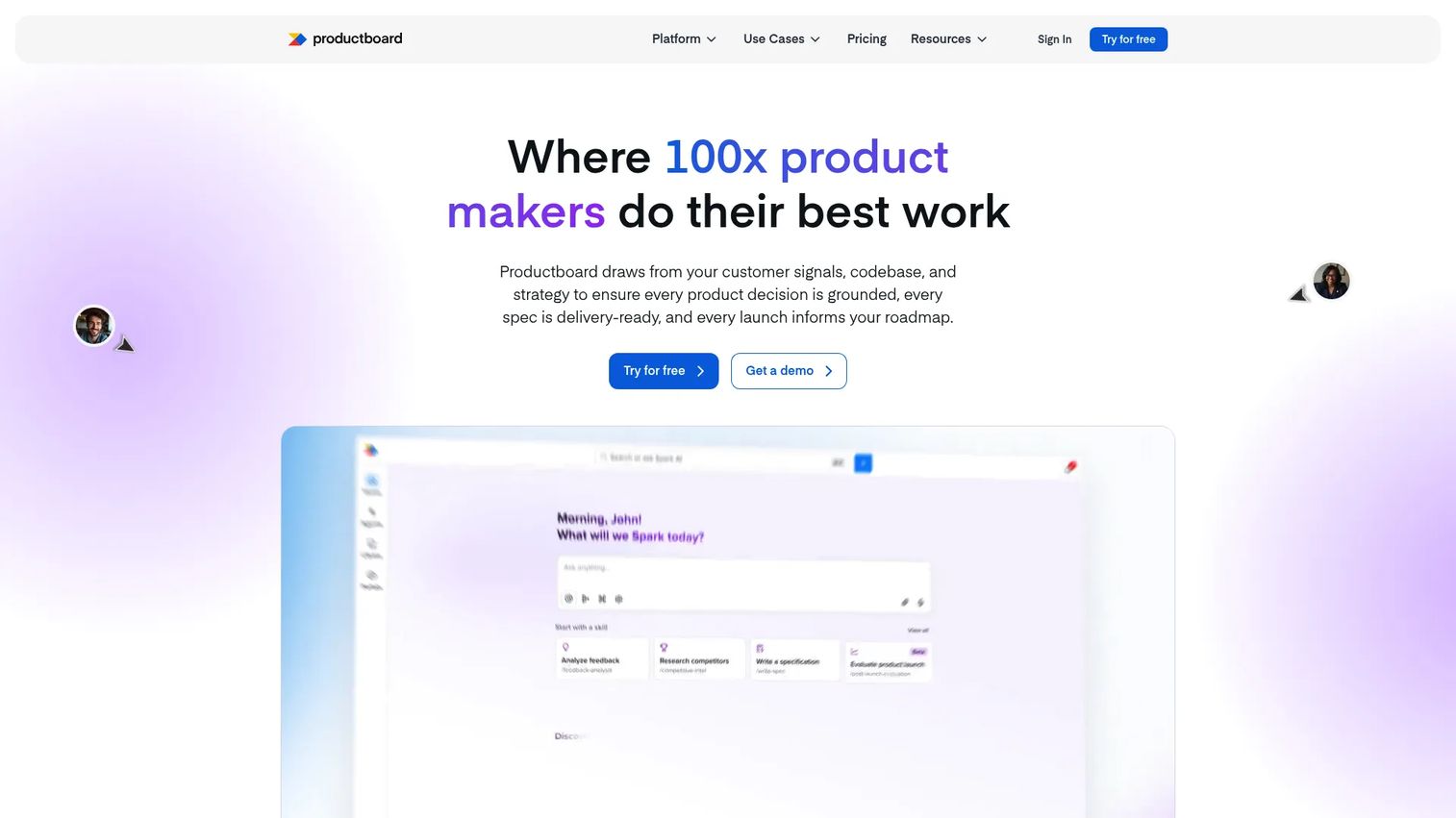
Productboard is a customer-centric product management platform for prioritizing roadmaps and product decisions. It goes deeper than a board, aggregating feedback and insights, then feeding them into prioritization and roadmap planning. AI-assisted opportunity surfacing helps you spot themes across your inputs. For teams that treat feedback as one part of a full product lifecycle, it is a natural fit.
Where a pure board tool stops at voting, Productboard connects customer insights to the discovery and roadmap work that follows. That makes it strong for product organizations balancing many inputs across engineering, design, and go-to-market.
Best for: Product teams that need feedback aggregation, prioritization, and roadmap planning in one platform.
Key strengths
- Product roadmapping tied to customer insight
- Customer feedback and insights management
- AI-assisted product discovery and opportunity surfacing
Why choose Productboard: Choose it when the roadmap matters as much as the board. It suits mid-market and larger product teams who need prioritization frameworks and cross-team alignment, not just a request queue.
Productboard pricing: A free tier is available. Paid plans (Plus, Business, Enterprise) are based on the number of makers and monthly credits, with pricing shared on request rather than listed publicly.
3. Enterpret

Enterpret is a customer intelligence platform that unifies customer feedback and turns it into actionable insights. Instead of asking customers to post on a board, it ingests feedback from support tickets, calls, surveys, and reviews, then applies an adaptive taxonomy to extract themes. Its context graph and AI agents surface what customers actually want across every channel. For teams drowning in unstructured feedback, this is the analysis layer.
Enterpret works best when the challenge is volume and fragmentation rather than a public voting board. It excels at answering "what are customers telling us across all sources" and routing those insights into your PM tools.
Best for: Product, CX, and insights teams consolidating customer feedback at enterprise scale.
Key strengths
- Adaptive taxonomy that categorizes feedback automatically
- Context graph and knowledge graph for connected insight
- AI assistant and agents for analysis and workflows
Why choose Enterpret: Pick it when you need multi-source feedback analysis, not a suggestion box. It fits larger teams where feedback arrives faster than humans can tag it, and where theme accuracy drives roadmap decisions.
Enterpret pricing: Pricing is usage-based and shared through sales. Contact the team for a quote tailored to your feedback volume.
4. Featurebase
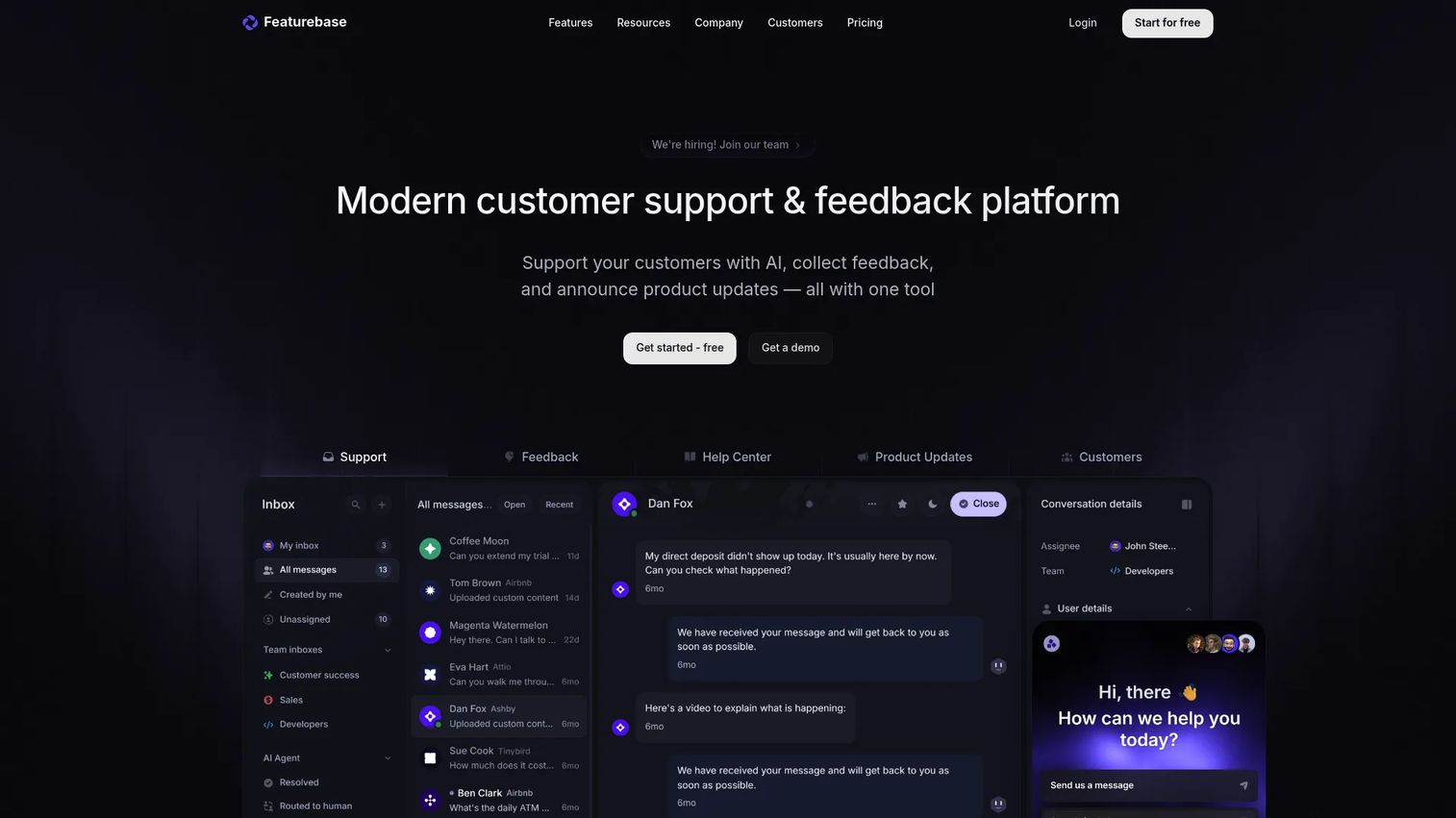
Featurebase is a customer support and product feedback suite with AI support, tickets, help center, roadmaps, and changelogs. It gives you a flexible customer feedback portal where boards, changelog, and support content sit together. The AI support agent, Fibi, deflects tickets while feedback boards and roadmaps handle product communication. Teams that want feedback and support under one roof find it efficient.
The overlap between help center, changelog, and feedback board makes Featurebase useful for lean teams who do not want separate tools for support and product feedback. One suite handles both jobs.
Best for: Teams that want an all-in-one customer support plus product feedback platform.
Key strengths
- AI support agent (Fibi) for ticket deflection
- Feedback boards and roadmaps in one portal
- Help center, changelogs, and a tickets inbox with workflows
Why choose Featurebase: Choose it when you want a single portal for support and feedback rather than a standalone board. It fits growing teams consolidating tools and looking for strong value at the entry tier.
Featurebase pricing: Free plan available. Growth is $29/seat billed yearly, Professional is $59/seat, and Enterprise is $99/seat. Paid plans are seat-based with usage add-ons for Fibi AI, Copilot, and whitelabeling.
5. Feature Upvote
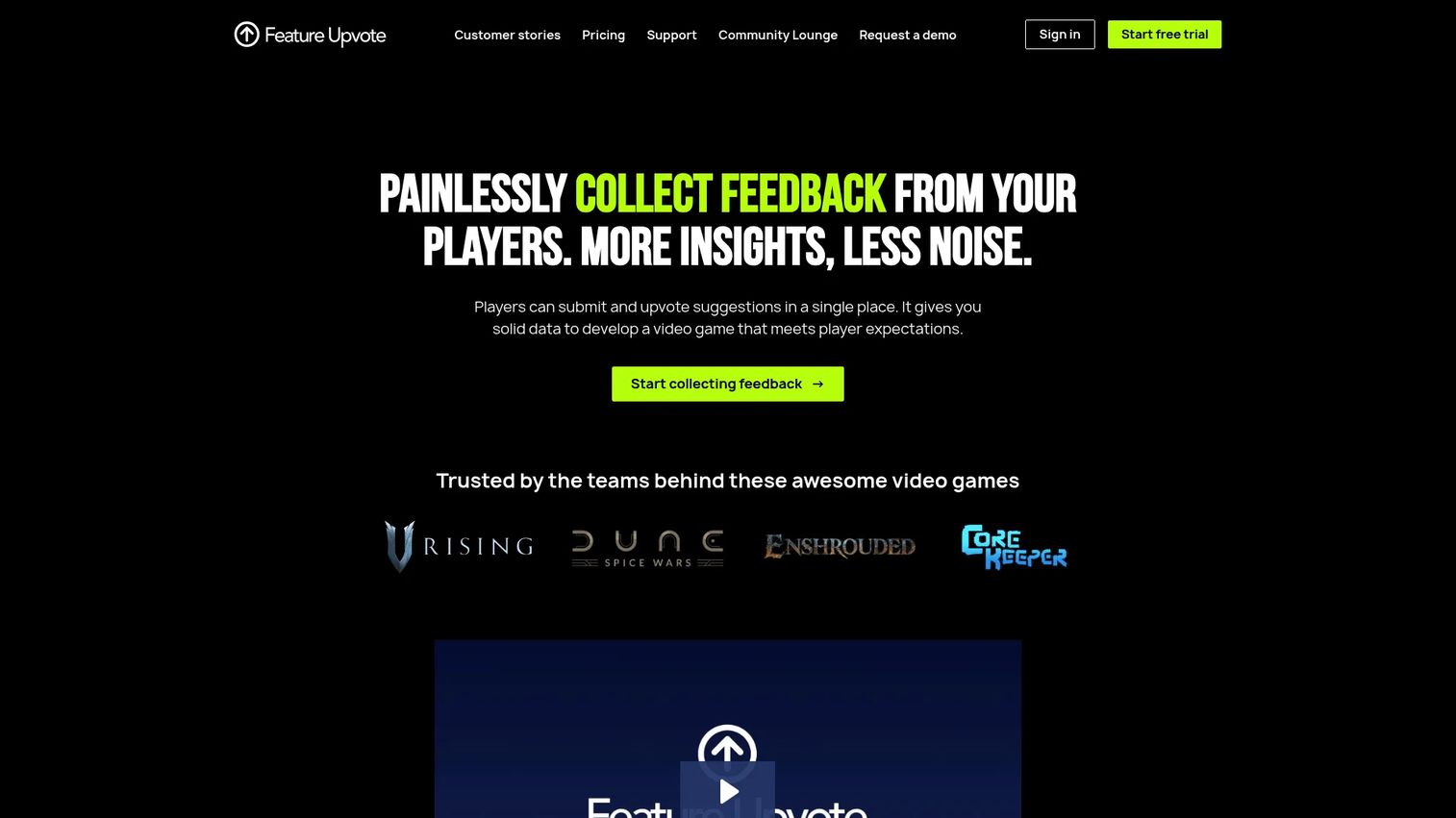
Feature Upvote is customer feedback and feature voting software for collecting, organizing, and prioritizing product ideas. Created in 2017 by the Barbary Software team, it stays deliberately simple: a voting board with comments, custom statuses, and moderation controls. There is no heavy setup, which appeals to lean teams and startups that want a board live in an afternoon. The company is profitable, sustainable, and self-funded.
Feature Upvote fits teams that want the core job done without a product management platform wrapped around it. Voting, comments, and roadmap visibility, with integrations for Slack, Discord, Microsoft Teams, Jira, and Zapier when you need them.
Best for: Teams wanting a lightweight feature-request board with voting and prioritization.
Key strengths
- Feedback boards with voting and comments
- Custom statuses, tags, and moderation controls
- Integrations including Slack, Discord, Microsoft Teams, Jira, and Zapier
Why choose Feature Upvote: Choose it when simplicity beats depth. It suits startups and small teams who want a clean voting board without the operational overhead of a larger platform.
Feature Upvote pricing: Indie is $49/board/month and Standard is $99/board/month, with monthly and yearly billing. Enterprise pricing is on request. A free 30-day trial is available.
6. Savio
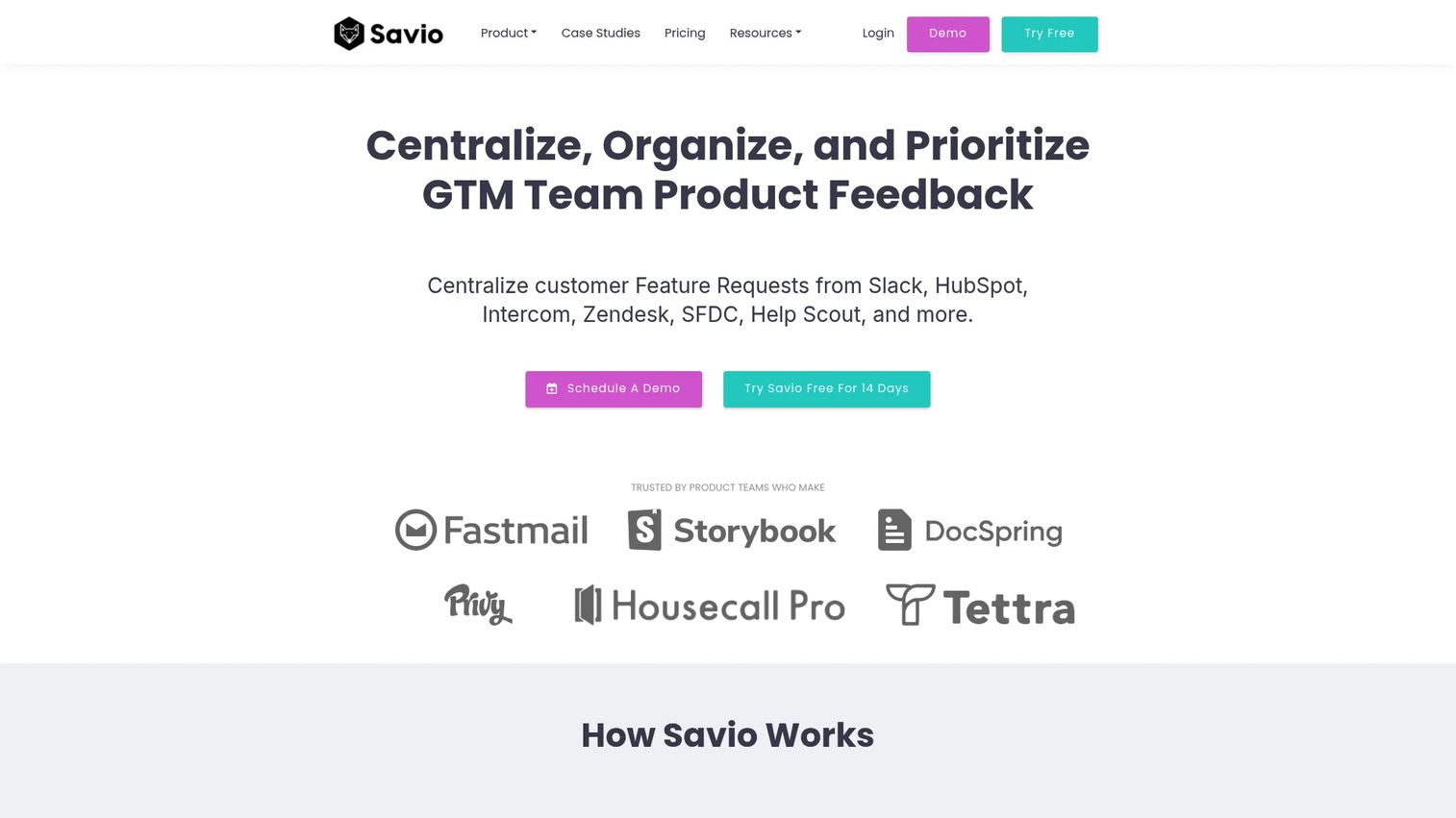
Savio is product feedback and roadmap software for centralizing, prioritizing, and closing the loop on customer requests. It centralizes feedback from tools like Intercom, Help Scout, Slack, and email, then prioritizes with customer segmentation and CRM data. That CRM awareness is the point: Savio ranks requests by who is asking, not just how many. For B2B teams where a request from one enterprise account outweighs fifty from free users, that signal quality matters.
Savio pairs voting boards and roadmaps with close-the-loop notifications, so requesters hear back when their idea ships. It fits PM workflows where signal quality matters more than a cosmetic public board.
Best for: B2B teams that need a lightweight system to capture and prioritize product feedback.
Key strengths
- Centralize feedback from Intercom, Help Scout, Slack, and email
- Prioritize with customer segmentation and CRM data
- Roadmaps, voting boards, and close-the-loop notifications
Why choose Savio: Choose it when prioritization by customer value drives your roadmap. It fits B2B product teams who want CRM-aware scoring and reliable close-the-loop follow-up over board aesthetics.
Savio pricing: Essential is $39/month, Professional is $79/month, and Business is $249/month. A 14-day free trial with no credit card is available, and annual plans get two months free.
Considerations for Product Manager teams
Before you commit to a feedback board software, pressure-test it against how your team actually works. These are the criteria that separate a tool you adopt from one that becomes another abandoned tab.
Segmentation and source coverage
Check which channels the tool ingests natively. Support tickets, sales calls, surveys, reviews, and chat all carry feedback, and a tool that only accepts board posts misses most of it. Confirm you can segment requests by plan, role, and account so you see demand by customer type.
Prioritization model and deduplication
Raw vote counts reward the loudest, not the most valuable. Look for scoring that weights revenue, segment, and effort, plus solid deduplication that merges the same idea into one record. Without merge logic, one request looks like ten and your priorities skew.
Workflow routing into PM tools
Feedback that never reaches your backlog dies. Verify native integrations with Jira, Linear, or whatever you use to plan work. The handoff from prioritized request to engineering ticket should be one click, not a copy-paste ritual.
Public board customization and branding
If customers will see the board, it should look like yours. Check custom domains, branding controls, and how the public roadmap displays. A public feedback board doubles as a trust signal, so cosmetics matter more than they seem.
Close-the-loop communication
The step teams skip most is telling customers what shipped. Confirm the tool tracks who requested what and notifies them on status change. Automated close-the-loop notifications turn a suggestion box into a retention lever.
Analytics and impact measurement
You will need to prove the feedback workflow drove outcomes. Look for reporting on request volume, vote trends, and which shipped features came from customer signal. That data ties product work back to retention and expansion.
Conclusion
The right feedback board software depends on where your team sits today. If you want a clean public board with roadmap and changelog in one tool, Canny is the strongest starting point. If the roadmap and prioritization framework matter as much as intake, Productboard fits product organizations balancing many inputs.
Teams buried in unstructured feedback across support, calls, and reviews should look at Enterpret for multi-source analysis. Lean teams and startups get the core job done fast with Feature Upvote. B2B teams that prioritize by customer value will find Savio's CRM-aware scoring the differentiator, while Cycle suits teams that want feedback flowing straight into delivery. Featurebase fits anyone consolidating support and product feedback into one portal.
Start by naming your primary job: a public board, deeper prioritization, or multi-source intelligence. Pick the tool that nails that job, run it against real requests for a month, and measure whether it shortened the path from feedback to shipped roadmap. That is the only test that matters.
FAQs
Feedback board software focuses on collecting, organizing, and prioritizing customer requests, usually with a public board and voting. Product management software is broader, covering roadmap planning, discovery, and delivery. Tools like Productboard and Cycle blur the line by doing both, but a pure board tool centers on the intake-to-decision workflow rather than full lifecycle management.
Weight requests by more than vote count. Score them against revenue, customer segment, and strategic fit, so a request from one high-value account can outrank fifty low-intent votes. Tools with CRM data, like Savio, let you tie each request to the customer behind it. The goal is signal quality, not volume.
No, and it should not try. Feedback board software captures and prioritizes what to build. Jira and Linear track how the work gets built. The right setup routes prioritized requests from your feedback board into Jira or Linear with native integrations, so the two systems complement each other instead of overlapping.
Any channel where customers tell you what they want. That means support tickets, sales and success calls, surveys, app store reviews, chat, and direct board submissions. Multi-source feedback tools like Enterpret pull from all of these, so your board reflects true demand rather than only the requests customers took time to log manually.
Track who requested each feature, then notify them automatically when the status changes to shipped. Most feedback board software links requesters to requests and sends updates on status change. Closing the loop this way builds trust, shows customers you listen, and often surfaces the next request while goodwill is high.
Neither is strictly better; they serve different needs. A public feedback board invites customers to vote and builds transparency, which suits product-led and community-driven teams. An internal-only workflow keeps triage private, which suits teams handling sensitive requests or noisy input. Many tools support both, letting you collect publicly while triaging internally.
Prioritize multi-source capture, deduplication, prioritization that weights value over volume, and native routing into your PM stack. Confirm it closes the loop with customers automatically and reports on impact. The best customer feedback tool turns scattered requests into decisions your whole team can see, without becoming another operational mess to maintain.