Your front desk is toggling between four systems to book one patient. Scheduling lives in one tool, charting in another, texting reminders in a third, and claims run through a clearinghouse that talks to none of them. Every handoff leaks time, and every leak shows up in no-shows, aging receivables, and staff burnout.
That is the real problem dental software solves. It is not a feature checklist. It is an operational decision about how your practice runs every single day.
The category is growing for a reason. The global dental software market is projected to reach USD 2.07 billion in 2026, on its way to USD 3.94 billion by 2033 at a 9.6% CAGR, according to Coherent Market Insights (2026). Cloud deployment alone is projected to hold 79.3% of that market in 2026, and patient record and communication applications account for 59.8%. The market is telling you where practices are spending: connected, cloud-native systems that keep records and patient communication in one place.
We evaluated seven dental practice management software platforms through an operator's lens, the same way you would evaluate any high-stakes software decision. Not "which has the most features," but "which reduces admin drag, keeps billing and charting in sync, and scales without routing everything through your office manager." The way founders scrutinize a contract lifecycle management software purchase or weigh event management software for stack fit is the same discipline you should bring here.
What's inside
This guide compares seven dental office software platforms built for modern practices, single-location offices through multi-site groups and DSOs. We picked tools that do real operational work, not point solutions.
We evaluated each platform on:
- Workflow breadth: scheduling, charting, imaging, billing, and reporting in one system
- Cloud access and multisite control: remote access and centralized visibility across locations
- Integrations and open API: how well it connects to imaging, clearinghouses, and patient tools
- Patient engagement: portals, texting, forms, and online scheduling
- Security and HIPAA readiness: data protection and compliance posture
The list prioritizes commercial relevance and operational fit, not marketing polish.
TL;DR
Short on time? Here is the shortlist by buyer type for dental management software in 2026:
- Best for interoperability and configurability: Open Dental, for its open ecosystem and deep customization
- Best for cloud-first connected practices: Dentrix Ascend, for role-based cloud access and a broad add-on ecosystem
- Best for AI automation and all-in-one simplicity: Archy, for unlimited users and automation built into daily workflows
- Best for DSOs and scaling groups: CareStack, for centralized operations and revenue cycle management at scale
- Best for usability in modern offices: Curve Dental, for a clean cloud experience across core workflows
- Best for enterprise multi-site control: Denticon, for centralized records and reporting across many locations
What is dental software?
Dental software is a system that runs the clinical and business operations of a dental practice, from scheduling and charting to billing, patient communication, and reporting, in one connected platform.
Modern dental practice management software pulls together the functions that used to live in separate tools. The strongest platforms cover these pillars:
- Patient scheduling and reminders: online booking, automated recall, and dental scheduling software that fills the chair
- Portals, texting, and forms: a patient portal, two-way texting, and digital intake that cuts front-desk data entry
- Billing, payments, and collections: dental billing software, payment processing, and revenue cycle management
- Charting, imaging, and treatment planning: dental charting software plus dental imaging integration for clinical workflows
- Reporting and analytics: production, collections, and performance data across the practice
- Integrations and open APIs: an open API to connect imaging, clearinghouses, and third-party tools
- Security and HIPAA compliance: HIPAA compliant dental software with encryption and access controls
- Cloud access and multisite control: multisite dental software with centralized visibility for groups and DSOs
- AI automation and workflow assist: AI automation for insurance, scheduling, and repetitive admin
Not every dental software program does all of this well. The difference between a good decision and an expensive migration is knowing which pillars matter most for your practice size and growth plan.
When to use dental software
Dental clinic management software earns its place when manual workflows start costing you money or time. Three situations tend to trigger the search.
Standardize a growing practice
When you have outgrown spreadsheets, paper charts, or a legacy system that only one person understands, you need a single source of truth. A three-operatory practice adding a fourth chair and two new hygienists cannot run on tribal knowledge. Practice management software for dentists standardizes how appointments get booked, how treatment gets charted, and how claims get filed, so a new hire can be productive in days, not months.
Improve patient communication and collections
When the pain is missed appointments, slow follow-up, and payment friction, patient engagement tools do the heavy lifting. A practice losing four appointments a week to no-shows is losing real production. Automated reminders, a patient portal for forms and balances, and text-to-pay options reduce the front-desk phone tag and shorten the gap between treatment and payment.
Centralize multi-location operations
When an owner or DSO needs visibility across locations, consistent workflows, and clean reporting, centralized cloud dental software is the answer. A group running five offices cannot compare production or manage insurance aging if each site keeps its own siloed database. Multisite platforms give leadership one dashboard, one set of workflows, and one place to spot the location that is falling behind before it becomes a quarter-end surprise.
Comparison table
Use this table to shortlist quickly. It maps each platform to its primary intent, key differentiation, published pricing, and G2 rating so you can narrow to two or three before reading the full sections.
| # | Product | Intent | Key differentiation | Pricing | G2 rating |
|---|---|---|---|---|---|
| 1 | Open Dental | Highly configurable practice management | Open ecosystem, bridges, and deep customization | Fees vary by locations, providers, and functionality | 4.3/5 |
| 2 | Dentrix Ascend | Cloud practice management for groups | Role-based cloud access and broad add-on ecosystem | Custom packages (Essentials, Pro, Accelerate) | 4.3/5 |
| 3 | Archy | All-in-one cloud PMS with automation | Unlimited users and providers, imaging included | $899/month per location | 4.1/5 |
| 4 | CareStack | Centralized operations for DSOs | Scalable multi-location workflows and RCM | Essentials from $829/month | 4.7/5 |
| 5 | Curve Dental | Usability-first cloud PMS | Clean interface across core workflows | Contact for pricing | 4.6/5 |
| 6 | Denticon | Enterprise multi-site management | Centralized records and reporting across locations | $750/month flat rate | Not published |
| 7 | DentiMax | Practice management plus imaging | Integrated imaging and flexible deployment | From $169/month | 4.5/5 |
The 7 best dental software platforms for 2026
Below, each platform gets a full evaluation: what it does, who it fits, key strengths, why you would choose it, and what pricing looks like. Read the two or three that matched your needs in the table above.
1. Open Dental
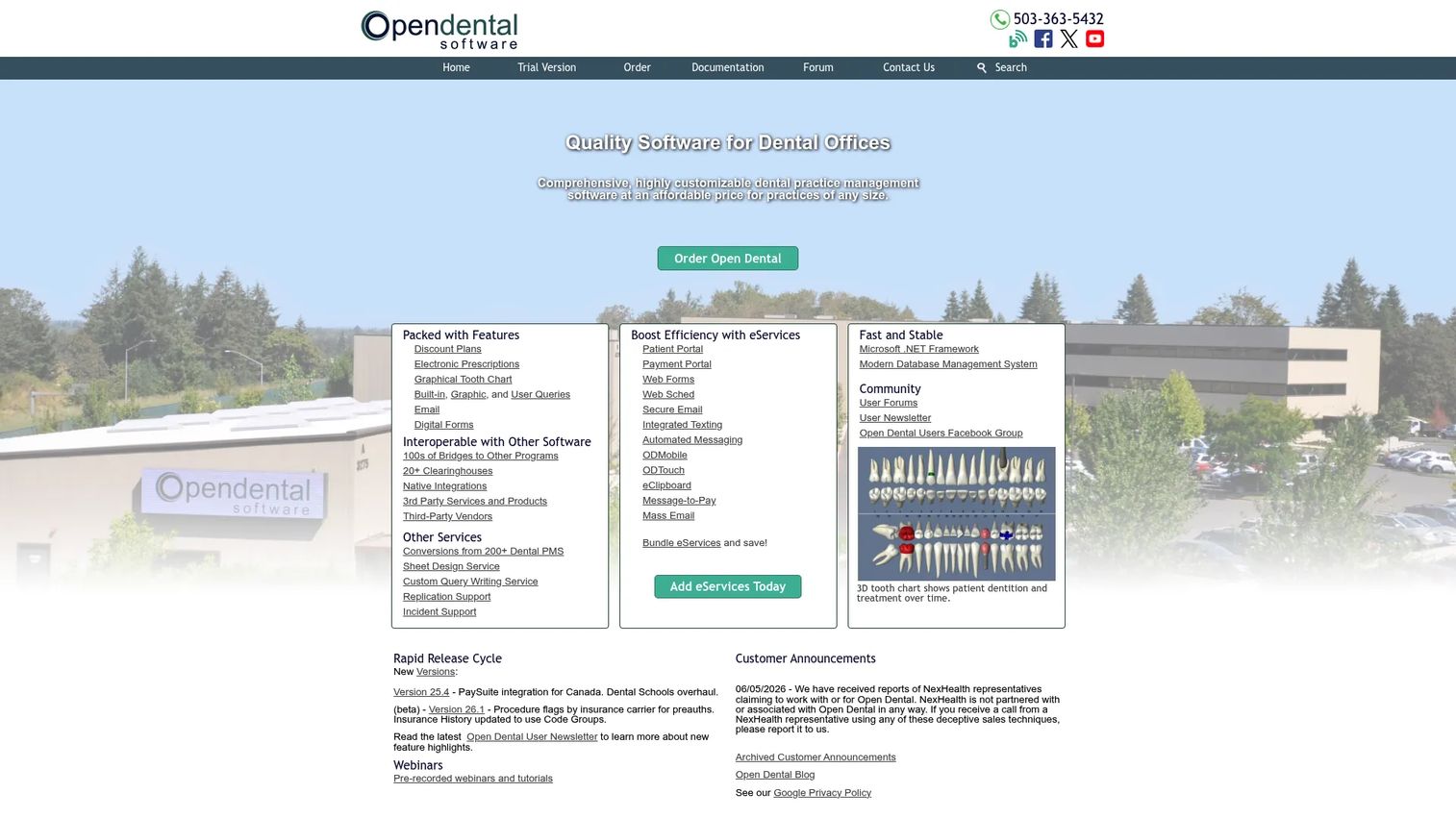
Open Dental is dental practice management software built for offices that want control. It is known for an open ecosystem, an extensive library of bridges and integrations, and a level of customization that most closed platforms cannot match. Practices that want to shape the software around their workflows, rather than the other way around, gravitate here.
Best for: Dental practices and groups that want a highly customizable, interoperability-first system.
Key strengths
- Graphical tooth chart: A clinical charting foundation that clinicians can tailor to how they actually document.
- Full e-services suite: Patient portal, web forms, web scheduling, texting, and messaging in one connected layer.
- Enterprise and multi-location setup: Clinics, replication, and cloud hosting options for practices that plan to grow.
Why choose Open Dental
Choose Open Dental when configurability and integration flexibility rank above out-of-the-box simplicity. The open approach means you can connect a wide range of imaging systems, clearinghouses, and third-party tools, which is a major advantage for practices with an existing stack they do not want to abandon. Migration support and a broad support ecosystem back the transition.
Open Dental pricing: Open Dental indicates that fees vary by number of locations, providers, and the functionality a practice requires. No single public starting price is published, so request a quote scoped to your practice size. It holds a 4.3/5 rating on G2.
2. Dentrix Ascend
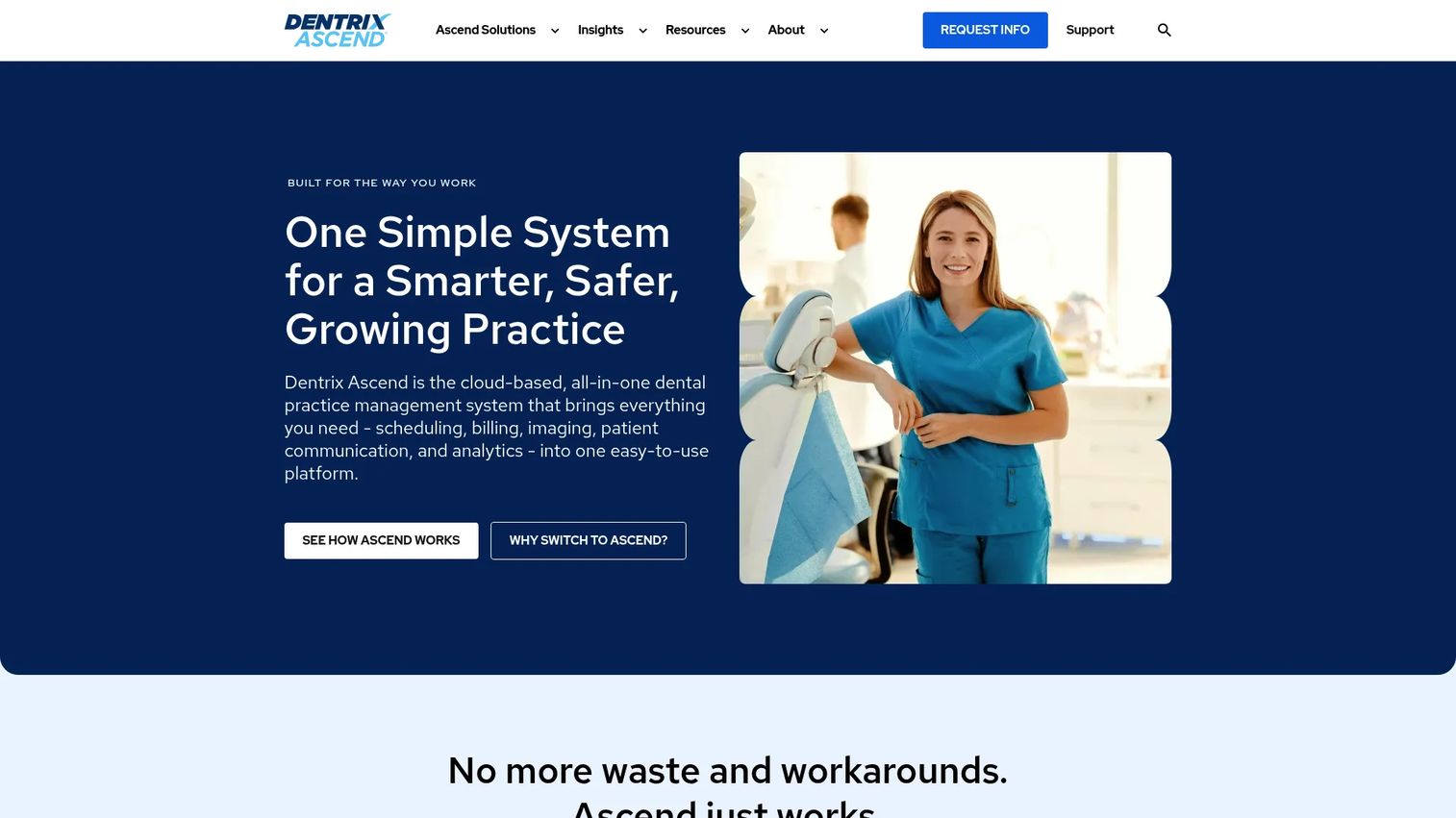
Dentrix Ascend is cloud-based dental practice management software covering scheduling, charting, billing, imaging, and patient communication in one platform. Cloud-native access is the core draw: staff work from any location with a browser, and leadership sees activity across sites without a VPN or on-prem server to maintain.
Best for: Dental practices and DSOs that want an all-in-one cloud platform with role-based access.
Key strengths
- Cloud-based access: Work from any operatory, front desk, or remote location without local servers.
- Integrated clinical AI: Charting and imaging paired with clinical AI to speed documentation.
- Insurance and collections workflows: Built-in billing, insurance, and collections to keep revenue moving.
Why choose Dentrix Ascend
Cloud-native access matters most for groups and centralized teams. Role-based permissions let an office manager, hygienist, and biller each see exactly what they need and nothing more, which keeps HIPAA exposure tight as headcount grows. A broad add-on ecosystem means you can extend the platform as the practice matures rather than replacing it.
Dentrix Ascend pricing: Dentrix Ascend offers customizable packages, sold as Ascend Essentials, Ascend Pro, and Ascend Accelerate suites. Public prices are not displayed; pricing is scoped through a demo and quote. It holds a 4.3/5 rating on G2.
3. Archy
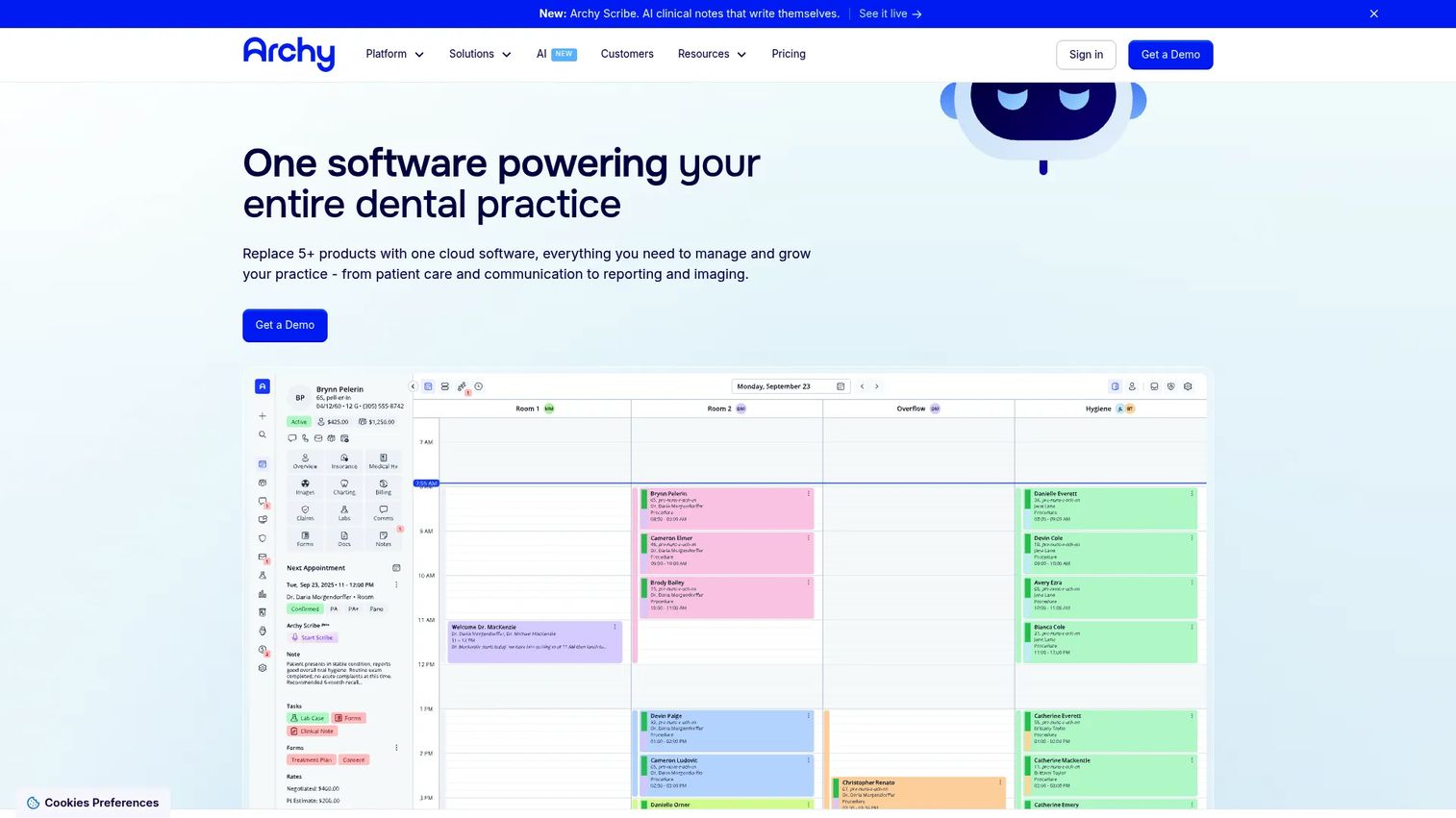
Archy is a cloud dental practice management platform that folds scheduling, clinical, billing, communication, and reporting into one system. Its differentiator is scope with automation: unlimited users and providers on the platform plan, plus automation woven into daily operations rather than bolted on as an upsell.
Best for: Dental practices that want an all-in-one cloud platform without per-seat pricing friction.
Key strengths
- Unlimited users and providers: Included on the platform plan, so growing the team does not grow the bill per seat.
- Integrated imaging: Offline capture and Schick sensor support built into the clinical workflow.
- End-to-end operations: Online scheduling, texting, claims, payments, and reporting in one connected system.
Why choose Archy
Archy fits practices that want automation to handle repetitive admin, insurance follow-up, scheduling, and communication, so staff spend less time on manual tasks. Grounding the value in workflows matters more than hype: the point is fewer hours spent on claims and reminders, not a buzzword. The all-in-one model also means fewer integrations to manage.
Archy pricing: Archy publishes platform pricing at $899/month per location, with unlimited users, unlimited providers, and unlimited claim submissions included. Additional suites and new-practice pricing exist but are not publicly numbered. It holds a 4.1/5 rating on G2.
4. CareStack
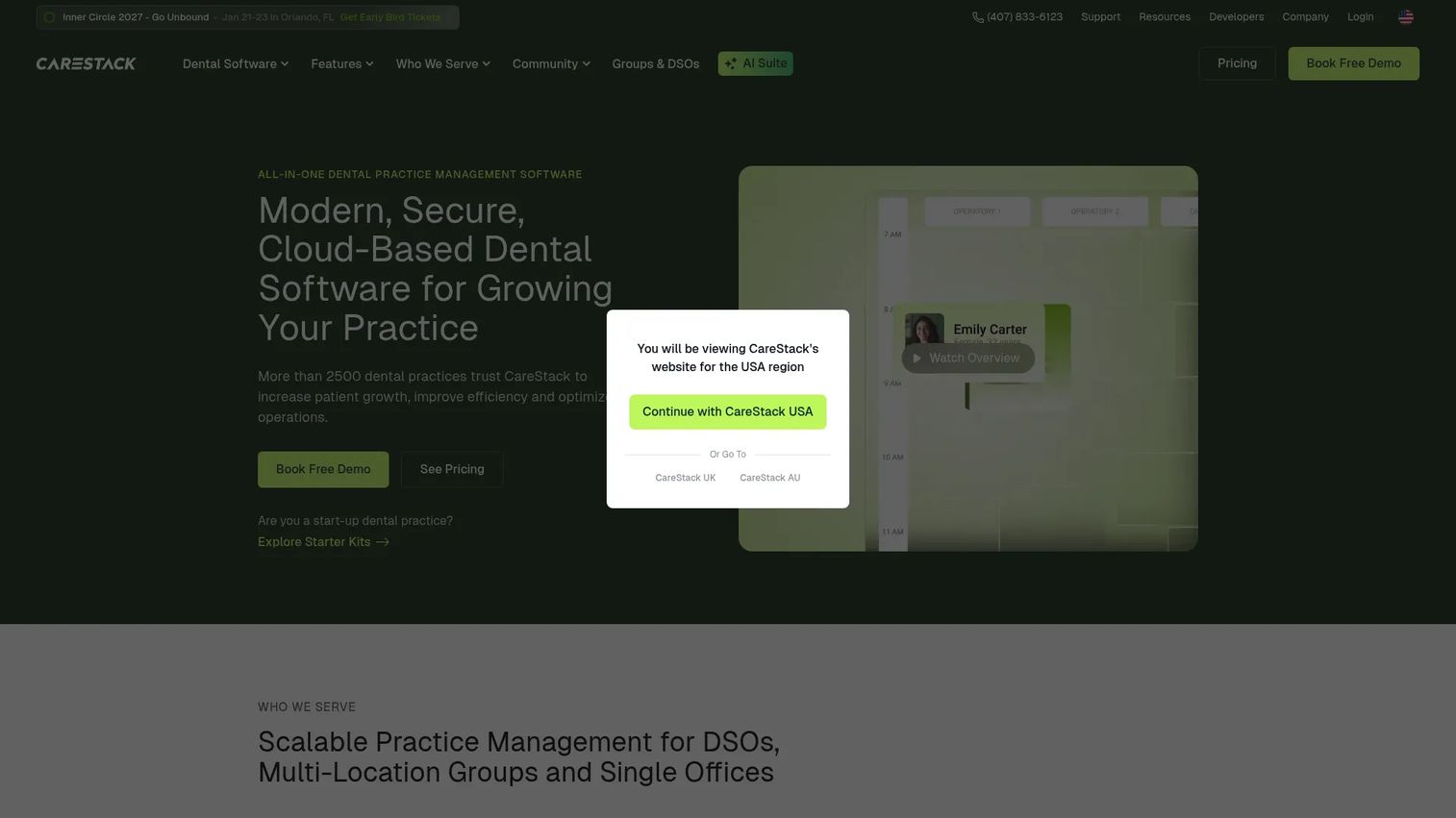
CareStack is cloud-based dental practice management software built around centralized operations, scheduling, clinical workflows, billing, patient engagement, and reporting in one platform. It is engineered for scale, which is why DSOs and larger groups feature heavily in its customer base.
Best for: Dental practices and DSOs that want an all-in-one cloud PMS designed to scale across locations.
Key strengths
- All-in-one dental practice management: One platform covering the full clinical and business workflow.
- Patient engagement suite: Scheduling, forms, reminders, and a patient portal to reduce front-desk load.
- Clinical and RCM depth: Charting, treatment planning, and revenue cycle management in one system.
Why choose CareStack
For DSOs and multi-location groups, centralized operations are the whole game. CareStack gives leadership consistent workflows and reporting across sites, plus workflow automation and revenue cycle management that keep collections tight as the group grows. That combination is what separates a platform that scales from one that fragments under load.
CareStack pricing: CareStack publishes an Essentials plan starting at $829/month and an Intelligence plan starting at $1,299/month. The pricing page notes that final pricing can be customized by locations, chairs, and providers. It holds a 4.7/5 rating on G2, the highest on this list.
5. Curve Dental
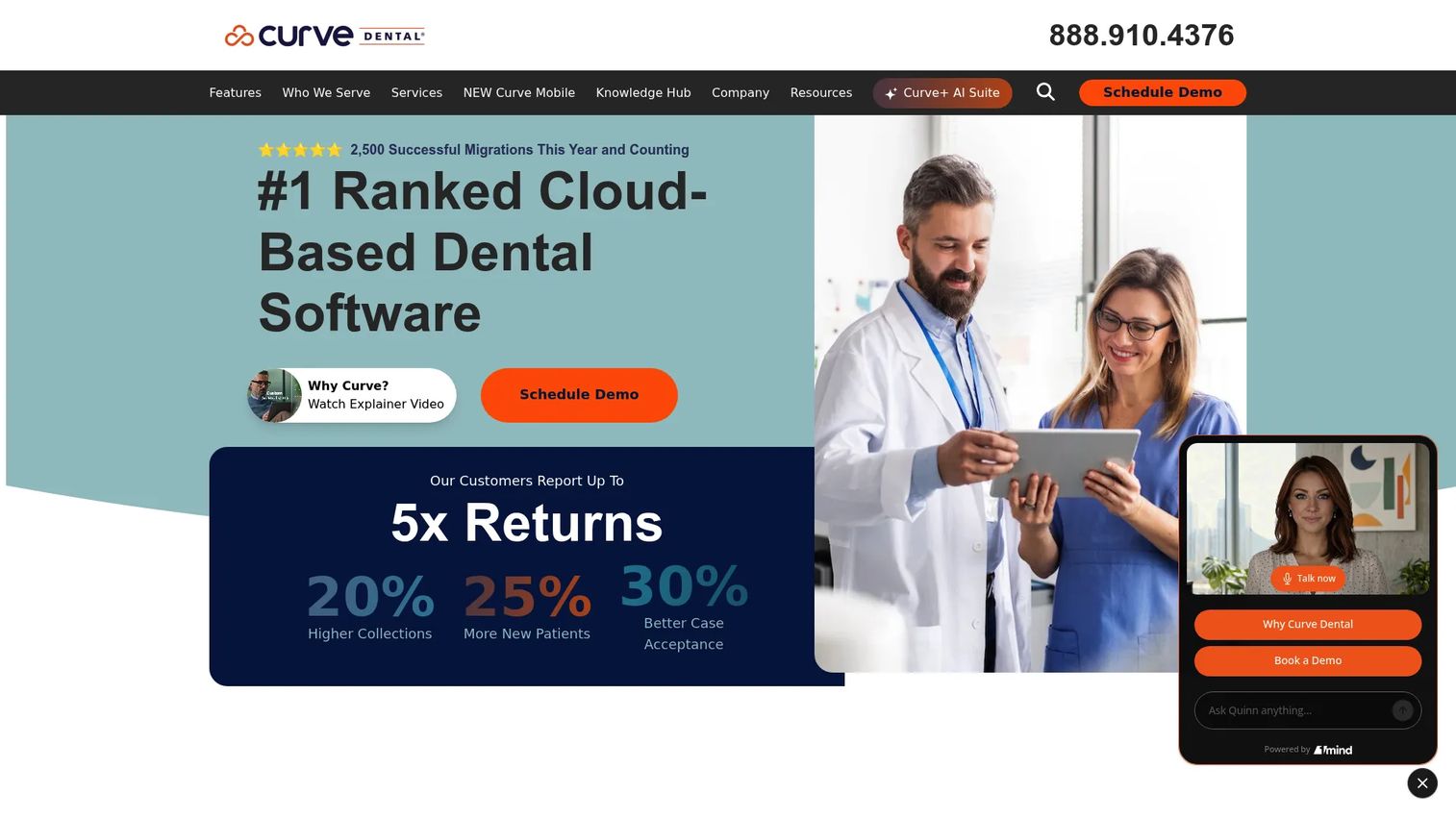
Curve Dental is cloud-based dental practice management software focused on usability. It covers the core workflows a modern office needs, charting, scheduling, insurance verification, patient engagement, imaging, payment processing, and business analytics, in a clean interface that staff pick up quickly.
Best for: Dental practices that want an all-in-one cloud PMS with a low learning curve.
Key strengths
- Broad workflow coverage: Charting, scheduling, imaging, and payments in one cloud platform.
- Patient engagement and e-Prescribe: Communication tools and prescribing built into daily workflows.
- Business analytics: Practice performance data to guide decisions without a separate reporting tool.
Why choose Curve Dental
Curve Dental fits offices that value speed to competence, where a front desk can learn the system without weeks of training. Insurance verification and payment processing are handled in-platform, which reduces tool-switching. Practices with heavy multi-site enterprise requirements or highly specialized integration needs should confirm those specifics fit before committing, since usability-first platforms optimize for the common case.
Curve Dental pricing: Curve Dental does not publish a numeric price; its pricing page emphasizes included tools and startup pricing help. Request a quote scoped to your practice. It holds a 4.6/5 rating on G2.
6. Denticon
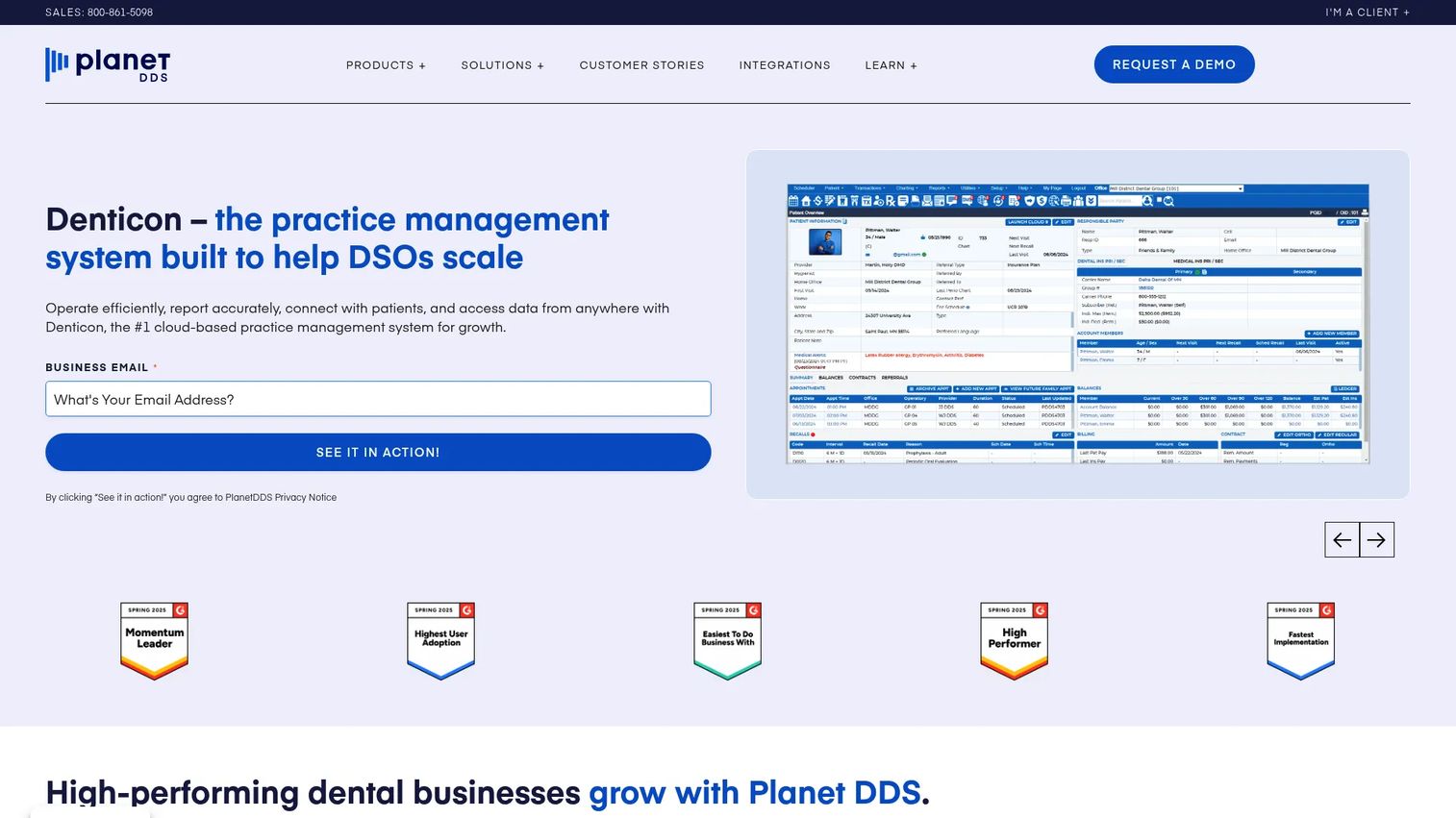
Denticon, from Planet DDS, is cloud-based dental practice management software built for multi-location groups and DSOs. Centralized control is the point: patient records, financials, and performance data live in one system across every location, so leadership manages the whole group from a single view.
Best for: Dental groups and DSOs that need cloud-based multi-location management with centralized reporting.
Key strengths
- Centralized records across locations: Patient records, financials, and performance data in one place.
- Patient communication and engagement: Scheduling and online patient communication built in.
- Enterprise billing and analytics: Billing, payment plans, insurance claims, reporting, and analytics at group scale.
Why choose Denticon
Denticon is built for the operational consistency that larger practices and groups need. When you run many locations, standardized workflows and centralized reporting are the difference between a group you can actually manage and a collection of offices you can only hope are performing. The enterprise focus makes it a fit for organizations prioritizing control and reporting over lightweight simplicity.
Denticon pricing: Third-party listings report a flat rate of $750/month, with no free trial. Confirm current pricing directly with Planet DDS, since the figure comes from a third-party source rather than the brand's own published page. A verified G2 rating was not available at publication.
7. DentiMax
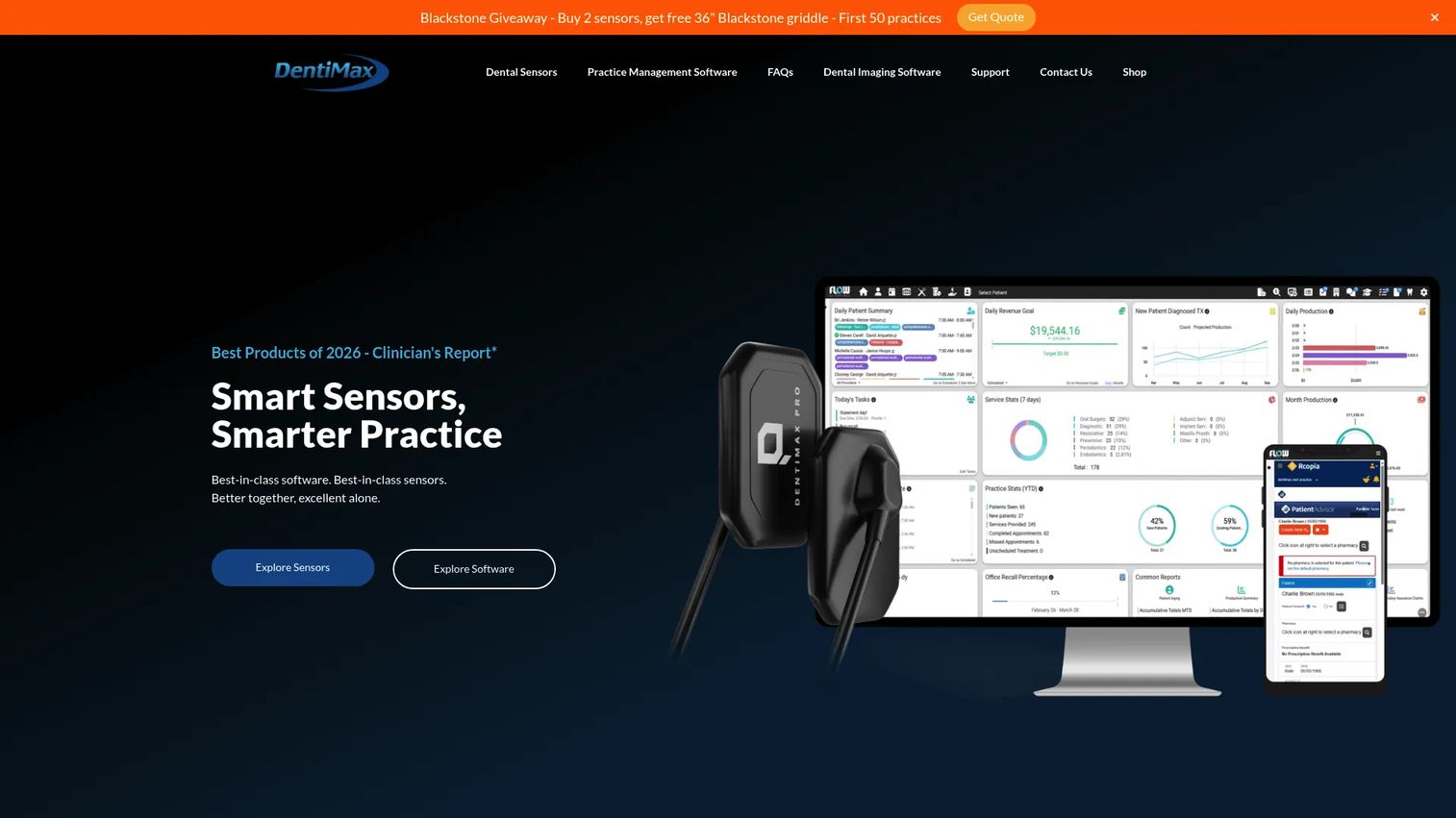
DentiMax is dental practice management software paired with dental imaging and sensor solutions. It covers scheduling, billing, payment processing, and reports, plus patient texting, reminders, and document signing, with both cloud and in-office deployment options.
Best for: Dental practices that want an all-in-one practice management and imaging system with flexible deployment.
Key strengths
- Practice management core: Scheduling, billing, payment processing, and reporting in one system.
- Patient communication tools: Texting, reminders, document signing, and a document center.
- Flexible deployment with imaging: Cloud and in-office options with imaging integration built in.
Why choose DentiMax
DentiMax fits practices that value imaging integration and a choice between cloud and on-premise deployment. The published, transparent pricing is a practical advantage for smaller offices comparing costs. Before committing, verify that reporting depth, integration options, and scalability match your growth plan, since practices planning aggressive multi-site expansion have different needs than a single established office.
DentiMax pricing: DentiMax publishes monthly plans: In-Office at $169/month, Core at $299/month, Ultimate Bundle at $358/month, Executive at $579/month, and Unlimited at $699/month. A 30-day free trial is offered. It holds a 4.5/5 rating on G2.
What to consider before buying dental software
The demo will look great. What matters is whether the platform fits how your practice actually runs. Check these before you sign.
Deployment model
Decide between cloud-native, on-premise, and hybrid before comparing features. Cloud dental software gives remote access and no server maintenance, which is why it dominates new adoption. On-premise gives local control some practices still prefer. Match the model to your IT reality and growth plan.
Integrations and open API
Your imaging, clearinghouse, and patient communication tools have to talk to the platform. Confirm which imaging systems and sensors are supported, whether an open API exists, and how many bridges the vendor maintains. A gap here becomes a daily friction point, not a one-time inconvenience.
Patient engagement depth
A patient portal, two-way texting, online scheduling, and digital forms are now table stakes, but depth varies. Verify that reminders, recall, and text-to-pay work the way your front desk needs, and that the tools are included rather than priced as add-ons.
Billing and revenue cycle management
Look past basic invoicing. Evaluate insurance verification, claims submission, aging reports, payment plans, and revenue cycle management. For groups, confirm you can see collections and aging across locations in one view.
Security and HIPAA compliance
You are handling protected health information. Confirm the platform is HIPAA compliant dental software with encryption, role-based access controls, audit logging, and a signed business associate agreement. This is not optional, and it is not a place to compromise.
Conclusion
The right dental software depends on how your practice runs and where it is headed, not on which vendor has the longest feature list.
If interoperability and configurability matter most, Open Dental gives you an open ecosystem and deep customization. For cloud-first connected practices that want role-based access, Dentrix Ascend delivers. If AI automation and all-in-one simplicity are the goal, Archy folds unlimited users and workflow automation into one platform. For DSOs and scaling groups, CareStack and Denticon both center on the centralized operations that multi-site growth demands. Curve Dental wins on usability for modern offices, and DentiMax pairs practice management with imaging and transparent pricing.
Start with the shortlist criteria, not a single forced winner. Map your must-haves across deployment model, integrations, patient engagement, billing, and security, then book demos with the two or three platforms that fit. The best dental software is the one that reduces admin drag for your team, not the one with the flashiest marketing.
The way you evaluate this is the same discipline behind any high-stakes software choice, whether that is contract management software, loyalty management software, or audit management software: fit and outcomes over feature counts. Teams that want to show complex products through interactive demos apply the same logic, letting buyers experience a workflow rather than read about it. Guideflow helps teams build those experiences when the time comes to evaluate their own stack.
Start your journey with Guideflow today!
FAQs
Dental software runs the clinical and business operations of a practice in one system: scheduling, charting, imaging, billing, patient communication, and reporting. It replaces the fragmented mix of tools most offices start with, cutting admin work and keeping records in sync. Dental management software also supports insurance claims, recall, and analytics so the practice runs on one source of truth.
At minimum, practice management software for dentists should cover scheduling and reminders, charting and treatment planning, imaging integration, billing and claims, a patient portal, and reporting. Stronger platforms add two-way texting, online scheduling, revenue cycle management, and an open API. Match the feature depth to your practice size rather than chasing the longest list.
For most practices, cloud dental software is the better fit because it offers remote access, automatic updates, and no local server to maintain, which is why cloud deployment holds roughly 79% of the market in 2026. On-premise still suits offices that want local data control or have specific IT requirements. The right answer depends on your growth plan and internal IT capacity.
For multi-location practices, DSOs, and groups, CareStack and Denticon are built specifically for centralized operations, with records, financials, and reporting consolidated across every location. Dentrix Ascend also supports multisite work with role-based cloud access. The key is a single dashboard for leadership and consistent workflows across sites.
Very. Your imaging systems, sensors, clearinghouses, and patient communication tools all need to connect to the platform. An open API and a large library of maintained bridges, a strength of platforms like Open Dental, prevent daily friction and let you keep tools your team already relies on. Confirm specific integrations before you commit.
Look for a patient portal that handles forms, balances, and appointment management, plus two-way texting for reminders, recall, and confirmations. Text-to-pay and online scheduling reduce front-desk phone tag and shorten the gap between treatment and payment. Confirm these tools are included rather than priced as separate add-ons.
Go past basic invoicing. Evaluate insurance verification, claims submission, aging reports, payment plans, and revenue cycle management. For groups, confirm you can view collections and aging across every location in one report. Strong dental billing software is often the fastest path to recovering lost production.
Confirm the platform is HIPAA compliant dental software with encryption at rest and in transit, role-based access controls, audit logging, and a signed business associate agreement. Cloud vendors should document their security posture and backup practices. Since you are handling protected health information, treat this as a hard requirement, not a nice-to-have.