Healthcare GTM teams don't lose deals because they lack data. They lose momentum because provider records, claims histories, payer context, and prescriber behavior live in separate systems that don't talk to each other. The result is a sales team making calls against incomplete account lists, a VP of Marketing without a defensible TAM number, and a board deck that relies on assumptions instead of evidence.
According to Grand View Research (2025), the global healthcare business intelligence market was valued at $11.2 billion in 2025 and is projected to reach $31.8 billion by 2033. That growth reflects how urgently healthcare and life sciences organizations are trying to turn fragmented data into commercial decisions. The platforms in this guide sit at the center of that shift.
This is written for founders and GTM leaders who want a shortlist they can hand to a VP on day one. Each entry answers one core question: What decision does this tool actually improve?
What's inside
This guide covers 21 healthcare commercial intelligence software options for 2026, spanning life sciences commercial data, healthcare BI, payer analytics, provider intelligence, and market mapping.
Tools were selected and evaluated on:
- Data coverage: HCP, HCO, claims, payer, patient, and market data depth
- Commercial fit: How well the platform supports GTM decisions (targeting, TAM sizing, account prioritization, payer strategy)
- Governance and integration: Privacy controls, data refresh, and connection to CRM or BI stacks
- Time to useful signal: How quickly a new VP can make the first real decision
Pricing and G2 ratings are verified from vendor pricing pages and live G2 listings.
TL;DR
- Best for life sciences commercial scale: IQVIA and Veeva Systems are the first shortlist for biopharma teams that need prescriber data, market access depth, and field execution
- Best for healthcare market mapping: Definitive Healthcare and H1 fit when the job is finding HCPs, HCOs, affiliations, sites, and key stakeholder relationships
- Best for data infrastructure: Snowflake fits teams where the bottleneck is fragmented data architecture, not a missing point-solution dashboard
- Best for payer and claims intelligence: Inovalon, Cotiviti, Claritev, and HealthEdge serve teams focused on utilization, risk, payment accuracy, and quality analytics
- Best for founder-led evaluation: Start with the commercial decision you need to improve. Market mapping, field execution, payer analytics, and healthcare BI each require a different stack
What is healthcare commercial intelligence software?
Healthcare commercial intelligence software helps organizations combine healthcare data, analytics, and market context to identify opportunities, understand stakeholders, prioritize accounts, and make commercial decisions across providers, payers, life sciences, and health technology markets.
It differs from general healthcare BI in one key way. Healthcare BI typically looks inward at clinical performance, operational efficiency, or financial reporting inside your organization. Commercial intelligence looks outward at markets, accounts, prescribers, payer dynamics, and growth opportunities. The distinction matters when you are evaluating tools for a GTM team rather than a hospital analytics department. For a deeper comparison of analytics platforms and ROI, the mechanics are worth understanding before you commit to a vendor.
Core data sources these platforms use:
- Claims data (medical and pharmacy)
- Provider and healthcare organization data
- Prescriber and procedure data
- Payer and formulary data
- Clinical trial and research data
- Affiliation, ownership, and referral networks
- Public records and government data
- CRM and sales activity data
Core capabilities to look for:
- HCP and HCO intelligence
- Healthcare market mapping and TAM sizing
- Claims and utilization analytics
- Patient journey analytics
- AI and predictive analytics
- Territory and account planning
- RFP and opportunity discovery
- Data governance and privacy controls
The category overlaps with competitive intelligence tools and audience intelligence platforms, but the healthcare-specific version adds regulated data sources, entity resolution complexity, and privacy requirements that general market intelligence tools don't handle well.
When to use healthcare commercial intelligence software
Map a healthcare market before hiring the GTM team
Before committing headcount to a new segment, founders and GTM leaders use commercial intelligence to understand which accounts exist, how they're structured, and what a reachable TAM looks like. Getting a credible market map takes days with the right platform. Without one, territory definitions are guesswork and board slides become impossible to defend.
Prioritize providers, payers, HCPs, and accounts
Not all providers prescribe the same. Not all health systems buy on the same cycle. Commercial intelligence platforms let you rank accounts by prescribing behavior, payer mix, affiliation, utilization, and buying signals so your team works the highest-probability targets first. This is where data coverage differences between vendors show up most clearly.
Turn fragmented healthcare data into decisions
Most healthcare GTM teams have data in multiple places: A CRM, a claims file, a provider database, and a spreadsheet that someone maintains manually. Commercial intelligence platforms consolidate that noise into account plans, market views, and dashboards a VP can actually use for weekly decisions, rather than another one-off analysis.
Healthcare commercial intelligence software comparison
The 21 platforms below span life sciences commercial intelligence, provider and market mapping, payer analytics, healthcare BI, and practice management intelligence. Use the table to narrow your shortlist before going deep on vendor conversations. Pricing reflects verified information from official vendor pages. G2 ratings are from live listings.
| # | Product | Best for | Key differentiator | Pricing | G2 rating |
|---|---|---|---|---|---|
| 1 | IQVIA | Life sciences commercial intelligence | Broad healthcare data, analytics, and commercial services | Custom pricing | 4.3/5 |
| 2 | Veeva Systems | Biopharma commercial execution | Regulated CRM, content, and data for life sciences | Custom pricing | 4.1/5 |
| 3 | Definitive Healthcare | Healthcare market mapping | Provider, HCO, affiliation, and decision-maker intelligence | Custom pricing | 3.9/5 |
| 4 | H1 | HCP and clinical research intelligence | AI-enabled HCP profiles and clinical trial site data | Custom pricing | N/A |
| 5 | Snowflake | Healthcare data infrastructure | Governed, consumption-based data cloud | Trial with $400 credits | 4.6/5 |
| 6 | Inovalon | Claims and revenue cycle analytics | Claims management, eligibility, and RCM analytics | Custom pricing | 4.4/5 |
| 7 | Health Catalyst | Healthcare analytics and BI | Clinical, financial, and operational data platform | Custom pricing | 5.0/5 |
| 8 | Axtria | Life sciences commercial operations | Sales planning, territory alignment, and incentive compensation | Custom pricing | 4.2/5 |
| 9 | Trinity Life Sciences | Life sciences strategy and market access | Commercialization strategy, launch, and forecasting | Custom pricing | N/A |
| 10 | Real Chemistry | Healthcare engagement intelligence | Omnichannel HCP marketing and audience analytics | Custom pricing | N/A |
| 11 | Claritev | Payment integrity and network analytics | Claims cost containment and pricing transparency | Custom pricing | N/A |
| 12 | Cotiviti | Payer payment accuracy and quality | Payment integrity, risk adjustment, and quality analytics | Custom pricing | 4.2/5 |
| 13 | Vizient | Provider performance intelligence | Hospital benchmarking, supply chain, and clinical data | Custom pricing | 4.0/5 |
| 14 | HealthEdge | Health plan operations intelligence | Core claims administration with embedded AI | Custom pricing | 4.3/5 |
| 15 | Veradigm | Provider data and EHR network insights | Clinical network data and ePrescribe workflows | From $59/mo per prescriber | 3.7/5 |
| 16 | WellSky | Post-acute and community care analytics | Care coordination, analytics, and referral intelligence | Custom pricing | 4.2/5 |
| 17 | symplr | Healthcare operations intelligence | Workforce, credentialing, and compliance data | Custom pricing | 4.3/5 |
| 18 | Netsmart | Behavioral health and post-acute EHR | Community care EHR, interoperability, and analytics | Custom pricing | 3.6/5 |
| 19 | ModMed | Specialty practice intelligence | Specialty-specific EHR, RCM, and AI documentation | Custom pricing | 4.5/5 |
| 20 | Greenway Health | Ambulatory practice intelligence | Ambulatory EHR, practice management, and AI documentation | Custom pricing | 3.3/5 |
| 21 | CareCloud | Practice and revenue cycle intelligence | RCM, EHR, and telehealth for physician practices | Custom pricing | 3.6/5 |
Best 21 healthcare commercial intelligence software for 2026
1. IQVIA
IQVIA is one of the most comprehensive commercial intelligence platforms for life sciences, combining healthcare data assets, analytics, AI capabilities, and professional services into a single offering. The platform serves biopharma, medtech, biotech, and payer organizations across every stage of the commercial lifecycle, from market research through field execution. IQVIA's data network covers prescriber activity, real-world evidence, market access dynamics, and clinical trial intelligence at global scale.
Best for: Biopharma and life sciences organizations that need both deep data coverage and hands-on commercial strategy support.
Key features
- HCP and prescriber analytics across therapeutic areas
- Real-world data assets and evidence generation
- Market access and formulary intelligence
- Commercial strategy and field force planning support
- AI and agentic AI applications for life sciences workflows
Why choose IQVIA: Choose IQVIA when data breadth and integrated commercial services matter more than self-serve simplicity. It's the right fit for enterprise life sciences teams where market access, launch, and prescriber strategy all need to pull from the same data foundation.
IQVIA pricing: IQVIA sells through a contract and consultative sales process. Ask sales for module, data coverage, and engagement-scope details before comparing it against point solutions.
G2 rating: 4.3/5 (14 reviews)
2. Veeva Systems
Veeva Systems provides cloud software, data, and applications purpose-built for the life sciences industry. Its Vault platform covers regulatory, quality, clinical, and commercial workflows, while Vault CRM connects field engagement, HCP targeting, and omnichannel execution for commercial teams. Veeva is widely deployed across biopharma companies that need compliance-aware field execution tied directly to data and content.
Best for: Biopharma and medtech commercial teams that need CRM, content governance, and field execution in a single regulated environment.
Key features
- Vault CRM for life sciences field engagement
- HCP targeting and omnichannel engagement workflows
- Content management with regulatory compliance controls
- Integrated data and analytics across commercial operations
- Clinical data collection and regulatory submission support
Why choose Veeva Systems: Use Veeva when commercial intelligence must connect directly to sales execution. It's the platform that ties prescriber data to field rep activity, content to compliance, and engagement to measurable outcomes in a regulated environment.
Veeva Systems pricing: Pricing requires a direct conversation with Veeva's sales team. Confirm module selection, seat count, and data network access before comparing costs.
G2 rating: 4.1/5 (Veeva Vault)
3. Definitive Healthcare
Definitive Healthcare (marketed as Definitive ID in some contexts) is a healthcare market intelligence platform that maps providers, health systems, physician groups, decision-makers, and their affiliations. For healthcare SaaS companies and medtech vendors, it answers the first GTM question: Which accounts exist, how are they connected, and who makes the buying decision? The platform also supports TAM sizing, RFP discovery, and account prioritization. Teams looking to build location intelligence into their account mapping will find Definitive Healthcare's HCO mapping especially useful.
Best for: Healthcare SaaS, medtech, staffing, and services companies that need to map the provider market before building their sales motion.
Key features
- Provider and HCO profiles with detailed organizational data
- Affiliation mapping across health systems and physician groups
- Decision-maker intelligence and contact data
- TAM sizing and market segmentation tools
- RFP discovery and opportunity tracking
Why choose Definitive Healthcare: It excels when the first job is knowing which accounts exist and how they're structured. If your team is still working off a spreadsheet of hospital names, this is where to start.
Definitive Healthcare pricing: Pricing is custom and requires a quote from the sales team. The pricing page confirms a bundled and add-on model. Confirm data access scope, license type, and refresh frequency.
G2 rating: 3.9/5
4. H1
H1 provides AI-enabled healthcare data and analytics connecting life sciences organizations with healthcare professionals, clinical research intelligence, provider data, and scientific insights. Its HCP profiles combine prescribing activity, publication history, clinical trial participation, and organizational affiliations into a single view. Life sciences teams use H1 for HCP research, site selection, congress planning, and understanding which providers are actively engaged in specific therapeutic areas.
Best for: Life sciences and healthcare companies that need deep HCP intelligence tied to clinical research activity, prescriber behavior, and site-level opportunity.
Key features
- AI-powered HCP profiles with prescribing and publication data
- Clinical trial site and investigator intelligence
- Provider data management and directory accuracy
- HCP activity updates and engagement insights
- Healthcare organization and affiliation data
Why choose H1: Choose H1 when prescriber understanding needs to go beyond claims data. The connection between clinical research activity, publications, and commercial engagement makes it a strong fit for medical affairs and commercial teams working in complex therapeutic areas.
H1 pricing: H1 sells through a direct sales process. Contact the team to understand data coverage, seat pricing, and module configuration.
5. Snowflake
Snowflake is a fully managed AI Data Cloud covering data engineering, analytics, AI workloads, and cross-cloud data sharing. In healthcare and life sciences contexts, Snowflake serves as the governed data foundation that commercial intelligence apps are built on top of. It handles big data analytics workloads at scale, supports secure data sharing between organizations, and connects to the BI and AI tools your team already uses.
Best for: Teams where the core problem is fragmented data infrastructure rather than a missing point-solution dashboard.
Key features
- Healthcare and life sciences data cloud with governance controls
- Secure cross-cloud data sharing and collaboration
- AI and ML workload support, including vector search and LLMs
- Interoperability and data standardization at scale
- Integrations with major BI and analytics platforms
Why choose Snowflake: Use Snowflake when your commercial intelligence bottleneck is architecture, not application. If your team is stitching together five data exports to produce one account plan, Snowflake solves the upstream problem that point solutions can't fix.
Snowflake pricing: Snowflake uses consumption-based pricing across Standard, Enterprise, Business Critical, and Virtual Private Snowflake editions. A 30-day free trial includes $400 in credits. Contact sales for enterprise volume pricing.
G2 rating: 4.6/5
6. Inovalon
Inovalon provides cloud-based healthcare software for revenue cycle management, claims processing, eligibility verification, and analytics. Its all-payer claims capabilities, automated claims correction, and revenue-cycle analytics make it a strong fit for provider organizations focused on payer performance and financial intelligence. According to Milliman MedInsight (2025), 72% of payer organizations rank cost and utilization analytics as most linked to their operational success.
Best for: Healthcare providers and payer-adjacent teams that need integrated claims management, eligibility, and revenue-cycle intelligence.
Key features
- All-payer claims management and automated claims correction
- Eligibility verification and insurance discovery
- Revenue-cycle analytics and denial insights
- Quality measurement and reporting
- Healthcare data assets for population analytics
Why choose Inovalon: The platform works well when claims accuracy and RCM intelligence need to operate together in one system. It's a practical fit for provider organizations where payer mix and denial patterns directly drive commercial decisions.
Inovalon pricing: Inovalon uses a contract-based model. Ask sales about module scope, data coverage, and implementation costs before comparing vendors.
G2 rating: 4.4/5
7. Health Catalyst
Health Catalyst provides data and analytics technology, software, and services for healthcare organizations. Its platform unifies clinical, financial, and claims data into a standardized model with self-service population analytics and embedded AI. It's built for provider organizations where healthcare BI and performance improvement are as important as external market intelligence. This makes it a useful reference point when evaluating best business intelligence software for a health system context.
Best for: Provider organizations and healthcare teams focused on clinical, financial, and operational performance analytics.
Key features
- Unified clinical, financial, and claims data model
- Self-service population analytics and visualization
- Embedded AI and healthcare-specific data models
- Financial and operational performance dashboards
- Quality and utilization measurement
Why choose Health Catalyst: Use it when healthcare BI and internal performance analytics matter as much as external market intelligence. It's a stronger fit for provider-side leaders than for life sciences commercial teams.
Health Catalyst pricing: Pricing is not publicly displayed. Contact sales to discuss implementation scope, data integration requirements, and platform configuration.
G2 rating: 5.0/5 (2 reviews)
8. Axtria
Axtria provides AI-powered cloud software, data analytics, and commercial operations support for life sciences organizations. Its platform covers sales planning, territory alignment, incentive compensation management, and omnichannel engagement analytics, connecting commercial data management to field execution. Pharma and medtech companies use Axtria when commercial intelligence must translate directly into sales operations decisions. According to NVIDIA (2026), 65% of healthcare and life sciences organizations now use AI for data analytics and data science, and Axtria's AI-driven commercial stack sits in that category.
Best for: Pharmaceutical and medtech commercial teams that need intelligence tied to sales planning, territory design, and incentive management.
Key features
- Data onboarding, governance, and analytics-ready data products
- Sales planning, territory alignment, and call planning
- Incentive compensation management and field intelligence
- AI-driven omnichannel engagement and next-best-action recommendations
- Customer 360 views for HCP targeting
Why choose Axtria: It fits life sciences teams where commercial intelligence needs to connect directly to how territories are defined and how reps are measured. The combination of data management and sales operations in one platform reduces the gap between insights and field execution.
Axtria pricing: Axtria sells through a consultative process. Confirm data scope, module configuration, and seat count with the sales team.
G2 rating: 4.2/5 (21 reviews)
9. Trinity Life Sciences
Trinity Life Sciences is a technology-enabled commercialization partner for pharmaceutical, biotech, and medtech organizations. It provides strategy, analytics, and AI solutions across market access, launch planning, pricing research, and commercial forecasting. Trinity's ForecastEDGE platform supports demand and revenue forecasting. The company functions as both a software provider and a strategic advisor, which distinguishes it from pure-play data platforms.
Best for: Biopharma and medtech companies making high-stakes launch, pricing, market access, or portfolio decisions where strategic interpretation matters as much as raw data.
Key features
- Pipeline and pre-commercial market strategy
- Launch excellence and commercialization planning
- Pricing, market access, and reimbursement strategy
- Commercial forecasting powered by ForecastEDGE
- AI-powered commercial analytics and insight generation
Why choose Trinity Life Sciences: It's the right choice when the intelligence problem requires expert interpretation, not just a dashboard. For complex launch decisions or payer strategy, having analysts and consultants connected to the platform can accelerate decisions that a self-serve tool would leave unresolved.
Trinity Life Sciences pricing: Trinity operates on a project and contract basis. Reach out directly to discuss scope, timeline, and engagement structure.
10. Real Chemistry

Real Chemistry is a healthcare commercialization partner combining advertising, analytics, communications, media, and AI solutions under one roof. Its ANATOMI platform powers AI-enabled healthcare commercialization, while MaestroHCP handles omnichannel HCP marketing. Real Chemistry works with life sciences and healthcare brands that need audience intelligence, engagement measurement, and brand strategy in addition to commercial data.
Best for: Healthcare and life sciences brands that need integrated engagement intelligence alongside market and audience analytics.
Key features
- Healthcare advertising, brand strategy, and market assessment
- Analytics, audience insights, and integrated measurement
- Omnichannel HCP marketing through MaestroHCP
- AI-enabled commercialization through ANATOMI
- Medical communications and healthcare media strategy
Why choose Real Chemistry: Choose it when the intelligence problem is understanding audience behavior, engagement, and brand perception, not just account lists or claims data. It's a stronger fit for healthcare marketing and brand teams than for data infrastructure or field execution.
Real Chemistry pricing: Engagements are structured as contracts. Contact the team to discuss campaign scope, analytics depth, and service configuration.
11. Claritev
Claritev provides healthcare data, claims intelligence, payment integrity, pricing transparency, and analytics for payers, employers, providers, and government organizations. Its capabilities include reference-based pricing, surprise bill and negotiation services, and PlanOptix and CompleteVue pricing analytics dashboards. Claritev operates at the intersection of claims cost control and network analytics.
Best for: Healthcare payers, employers, and organizations focused on payment accuracy, cost containment, and network pricing intelligence.
Key features
- Claims intelligence and cost containment
- Reference-based and transparency-based pricing
- Surprise bill management and negotiation services
- PlanOptix pricing intelligence dashboard
- Healthcare financial and revenue analytics
Why choose Claritev: Use it when commercial decisions depend on payment economics, network design, and cost data rather than HCP engagement or market mapping. It's a fit for payer and employer analytics teams where payment integrity drives strategic choices.
Claritev pricing: Claritev directs buyers to contact sales. Confirm solution scope, data coverage, and contract terms directly.
12. Cotiviti
Cotiviti provides connected healthcare data, analytics, workflow, and infrastructure for payers, providers, and government programs. Its core capabilities cover payment accuracy, payment integrity, risk adjustment, quality and Stars performance, member engagement, and interoperability through EDI and FHIR data exchange. Payers use Cotiviti to improve claims accuracy, manage risk, and demonstrate quality performance to CMS. For teams evaluating contract analytics software in a payer context, the payment integrity layer is directly relevant.
Best for: Healthcare payers and related organizations that need payment integrity, risk adjustment, and quality analytics in one platform.
Key features
- Payment accuracy and payment integrity across the claims lifecycle
- Risk adjustment and quality and Stars measurement
- Interoperability with EDI and FHIR data exchange
- Member engagement analytics and solutions
- Connected data infrastructure for payer workflows
Why choose Cotiviti: It's the right platform when payer economics, claims accuracy, and quality reporting are central to commercial and operational decisions. The combination of payment integrity and risk adjustment in one system reduces the number of vendors a payer analytics team needs to manage.
Cotiviti pricing: Pricing is contract-based. Ask sales about module configuration, data coverage, and implementation scope.
G2 rating: 4.2/5 (12 reviews)
13. Vizient
Vizient provides data, expertise, technology, and performance improvement for healthcare organizations, with particular depth in provider benchmarking, supply chain analytics, pharmacy, and clinical performance. Its member network of hospitals and health systems gives it a benchmarking advantage that individual health systems can't replicate on their own. Provider-side leaders use Vizient to compare performance against peers, optimize sourcing decisions, and understand cost and quality dynamics.
Best for: Hospitals, health systems, and provider networks seeking benchmark-driven performance intelligence and supply chain optimization.
Key features
- Clinical, operational, and financial benchmarking analytics
- Supply chain and pharmacy analytics
- Healthcare market intelligence and peer comparison data
- Performance improvement consulting and advisory services
- Member peer network and education programs
Why choose Vizient: It's a strong fit for provider-side leaders who need external benchmark data to make sourcing, quality, and strategic decisions. If the commercial question is how your health system performs relative to peers, Vizient provides the reference point.
Vizient pricing: Pricing is custom. Contact Vizient to understand membership structure and product configuration.
G2 rating: 4.0/5 (16 reviews)
14. HealthEdge
HealthEdge provides AI-enabled software and services for health plans, spanning core claims administration, payment integrity, risk adjustment, care management, provider data management, analytics, and member engagement. Its cloud-native HealthRules Edge platform uses configurable HealthRules Language for claims logic, and it embeds AI within health plan workflows with explainability and human oversight built in.
Best for: Health plans that need core operations and commercial intelligence connected in a single platform rather than managed across separate systems.
Key features
- Cloud-native core claims administration with HealthRules Edge
- Payment integrity including claims editing, pricing, and auditing
- Care management with automated care planning and community referrals
- Real-time analytics with dashboards and what-if modeling
- Embedded AI with governance, explainability, and human oversight
Why choose HealthEdge: It works best when payer commercial and operational intelligence need to run from the same data foundation. If the health plan's commercial decisions depend on claims processing accuracy and care management data, connecting those systems reduces friction.
HealthEdge pricing: Pricing is not publicly displayed. Contact sales to discuss platform scope and implementation.
G2 rating: 4.3/5
15. Veradigm
Veradigm is a healthcare technology company providing clinical, financial, data, and connectivity for providers, health plans, and life sciences organizations. Its ambulatory EHR includes customizable workflows, ambient scribe capabilities, and telehealth. The ePrescribe module covers EPCS, PDMP, electronic prior authorizations, and formulary checks. Veradigm also provides data assets that life sciences teams use for provider analytics and clinical network intelligence.
Best for: Healthcare providers and life sciences organizations that need EHR-connected clinical data, provider network intelligence, or electronic prescribing workflows.
Key features
- Ambulatory EHR with ambient scribe and telehealth integration
- Practice management with predictive scheduling and RCM workflows
- Electronic prescribing with PDMP and prior authorization support
- Provider data and clinical network analytics
- EHR-connected data assets for life sciences research
Why choose Veradigm: It's a practical fit when provider data needs to connect to clinical workflows and prescribing intelligence. Life sciences teams use its data assets; provider organizations use its EHR and RCM capabilities.
Veradigm pricing: Veradigm ePrescribe starts at $59 per prescriber per month. Other Veradigm products are sold through a contract process.
G2 rating: 3.7/5 (74 reviews)
16. WellSky
WellSky provides software for health and community care providers, supporting operations, patient outcomes, care coordination, analytics, and compliance. Its platform covers home health, hospice, post-acute care, and community services, with AI-powered documentation and medication-data extraction. For commercial teams targeting post-acute markets, WellSky's referral intelligence and care coordination data answer questions that general provider databases often miss.
Best for: Post-acute and community care providers, and vendors targeting that market segment, who need operational intelligence tied to patient flow and referral networks.
Key features
- Patient management and care coordination workflows
- Analytics and revenue cycle management
- Referral intelligence and network visibility
- AI-powered clinical documentation and medication extraction
- Community care and compliance reporting
Why choose WellSky: Use it when the market or account strategy centers on post-acute care settings, home health, hospice, or community services. General healthcare intelligence platforms treat this segment too broadly.
WellSky pricing: WellSky Learning Center subscriptions start at $205 per person annually, with volume pricing available for larger seat counts. Core healthcare software pricing requires a direct quote.
G2 rating: 4.2/5
17. symplr
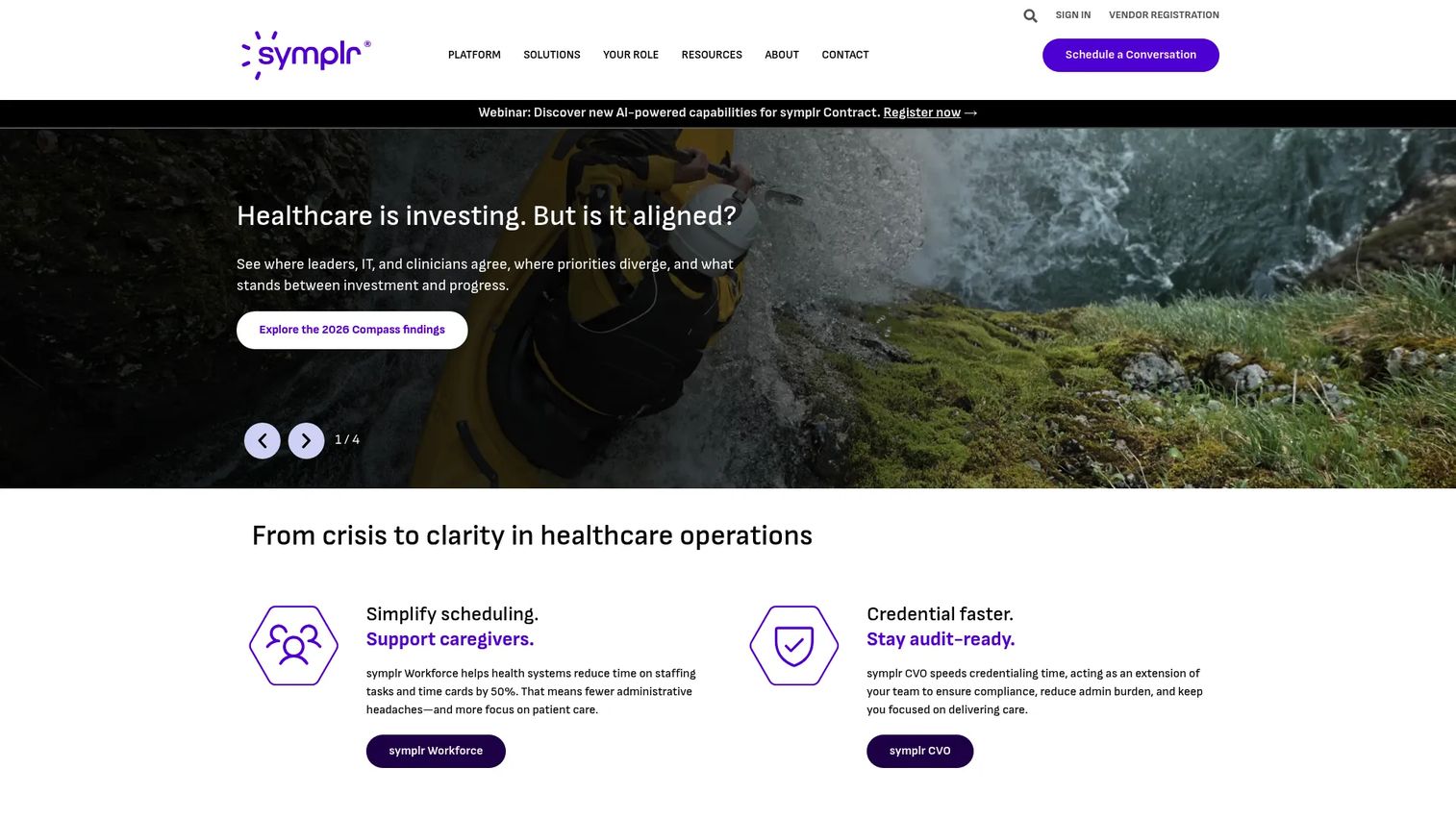
symplr provides cloud-based healthcare operations software spanning workforce scheduling, provider data management, credentialing, vendor access, compliance, contract management, and spend management. Its seller profile on G2 aggregates 359 reviews across multiple products. For commercial teams, symplr's provider credentialing and workforce data create a view of healthcare organization operations that complements market mapping tools. It's also relevant for vendors selling into healthcare HR and operations workflows.
Best for: Healthcare organizations managing provider operations, workforce complexity, and compliance data at scale.
Key features
- Healthcare workforce scheduling, timekeeping, and predictive staffing
- Provider data management, credentialing, and enrollment
- Vendor credentialing and access control with audit-ready reporting
- Contract and spend management
- Compliance and quality operations reporting
Why choose symplr: It fits when the intelligence problem sits inside workforce, credentialing, and compliance operations rather than external market mapping. Vendors selling into healthcare HR or provider management workflows will find symplr's data scope directly relevant.
symplr pricing: Pricing depends on organization size, selected modules, and implementation scope. Contact sales directly to get a quote.
G2 rating: 4.3/5 (359 reviews across products)
18. Netsmart
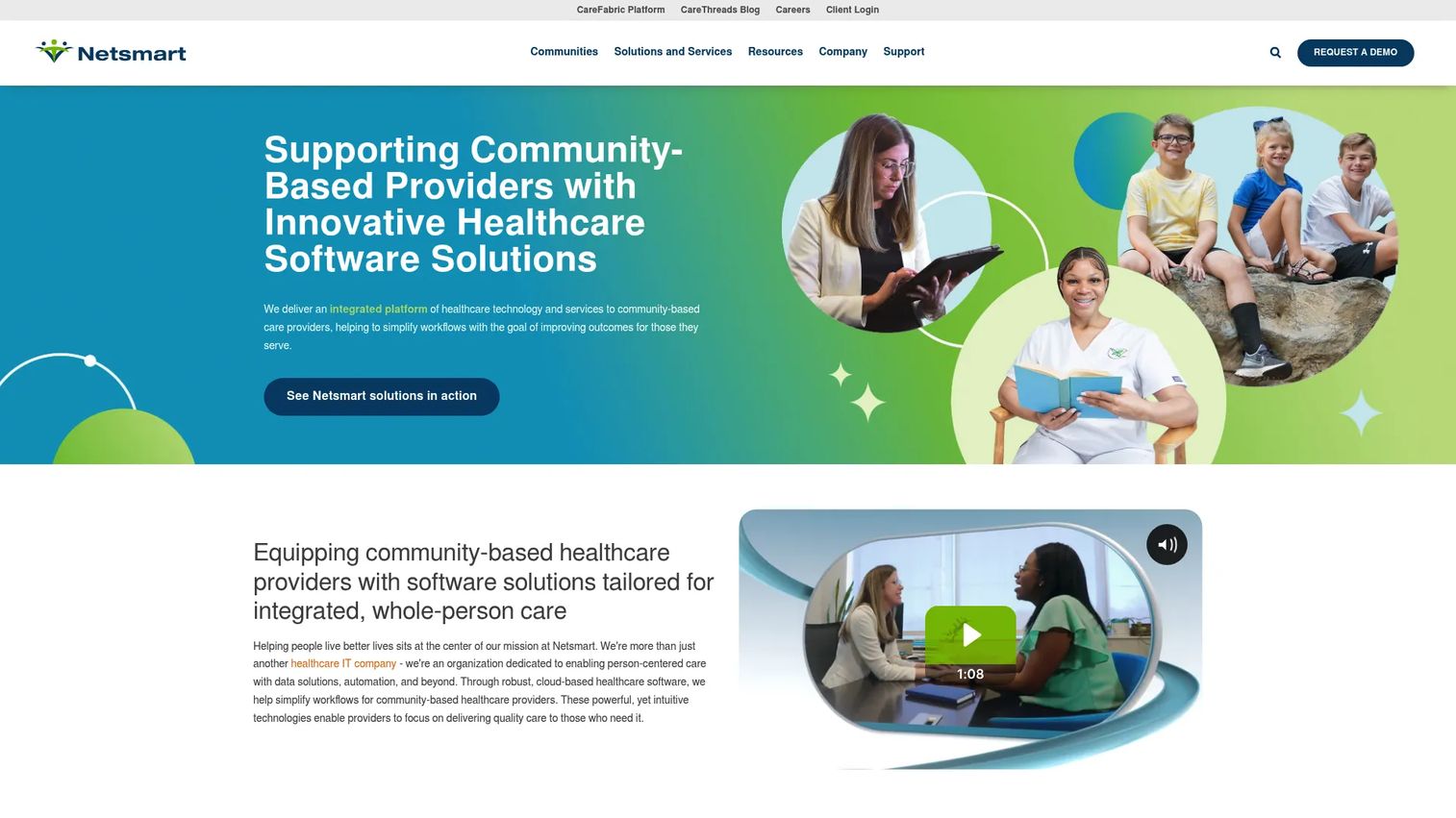
Netsmart provides integrated healthcare technology and services for community-based care organizations, including behavioral health, post-acute care, public health, and social services. Its platform covers EHR, care management, revenue cycle, interoperability, telehealth, and AI-enabled clinical documentation. Netsmart serves care settings that general healthcare BI platforms treat as an afterthought, which matters if your commercial motion targets behavioral health or social services markets.
Best for: Community-based healthcare organizations in behavioral health, post-acute, and social services that need an integrated EHR and analytics platform.
Key features
- EHR and care management for behavioral health and post-acute
- Revenue cycle management, claims, and collection automation
- Interoperability and secure data exchange
- Population health analytics and reporting
- AI-enabled clinical documentation and workflow automation
Why choose Netsmart: It's a strong fit for care settings where general healthcare BI tools miss the workflow detail that matters. If your commercial motion targets behavioral health systems, social services agencies, or community care networks, Netsmart's domain specificity is a meaningful advantage.
Netsmart pricing: Netsmart directs prospects to request a demo. Pricing is contract-based and varies by product and organization type.
G2 rating: 3.6/5 (76 reviews)
19. ModMed
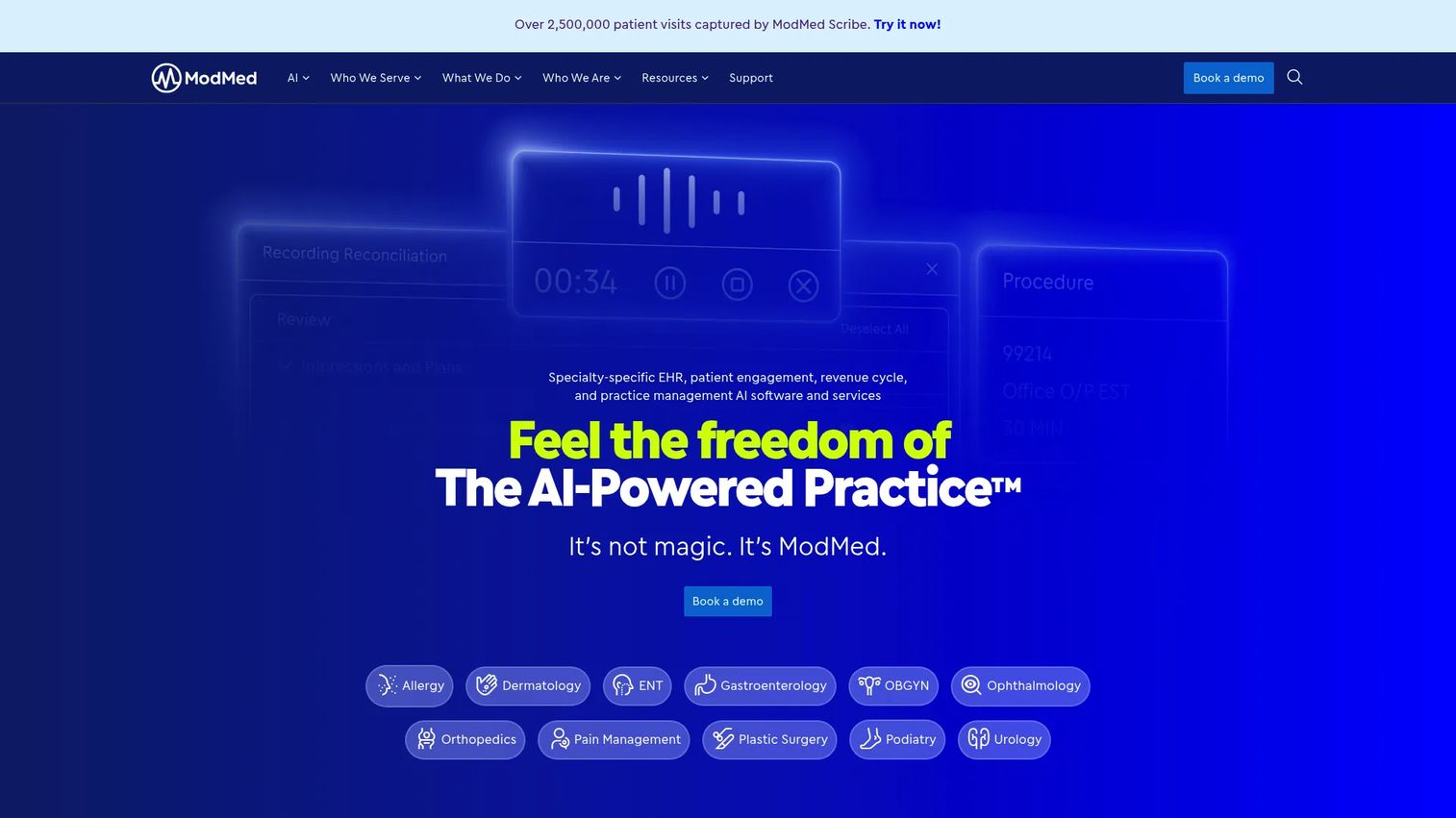
ModMed is a cloud-based, specialty-specific healthcare software platform providing EHR, practice management, revenue cycle management, patient engagement, and AI tools for medical practices. Its specialty focus means the clinical documentation, scheduling, and billing workflows are built for dermatology, ophthalmology, orthopedics, gastroenterology, and other specialties, rather than adapted from a general ambulatory template.
Best for: Specialty medical practices and vendors targeting specialty care markets that need workflows reflecting specialty-specific clinical and billing patterns.
Key features
- Specialty-specific EHR and clinical documentation
- Practice management with scheduling, eligibility, and billing
- Revenue cycle management and payment processing
- Patient engagement with digital intake and telehealth
- AI-assisted documentation, denial assessment, and fax intake
Why choose ModMed: Choose it when the commercial insight problem is specific to specialty practices. Generic provider intelligence misses the workflow differences between a dermatology group and an orthopedic surgery center. ModMed's specialization fills that gap.
ModMed pricing: Pricing is customized by specialty, provider count, and selected modules. Contact ModMed directly for a quote.
G2 rating: 4.5/5
20. Greenway Health
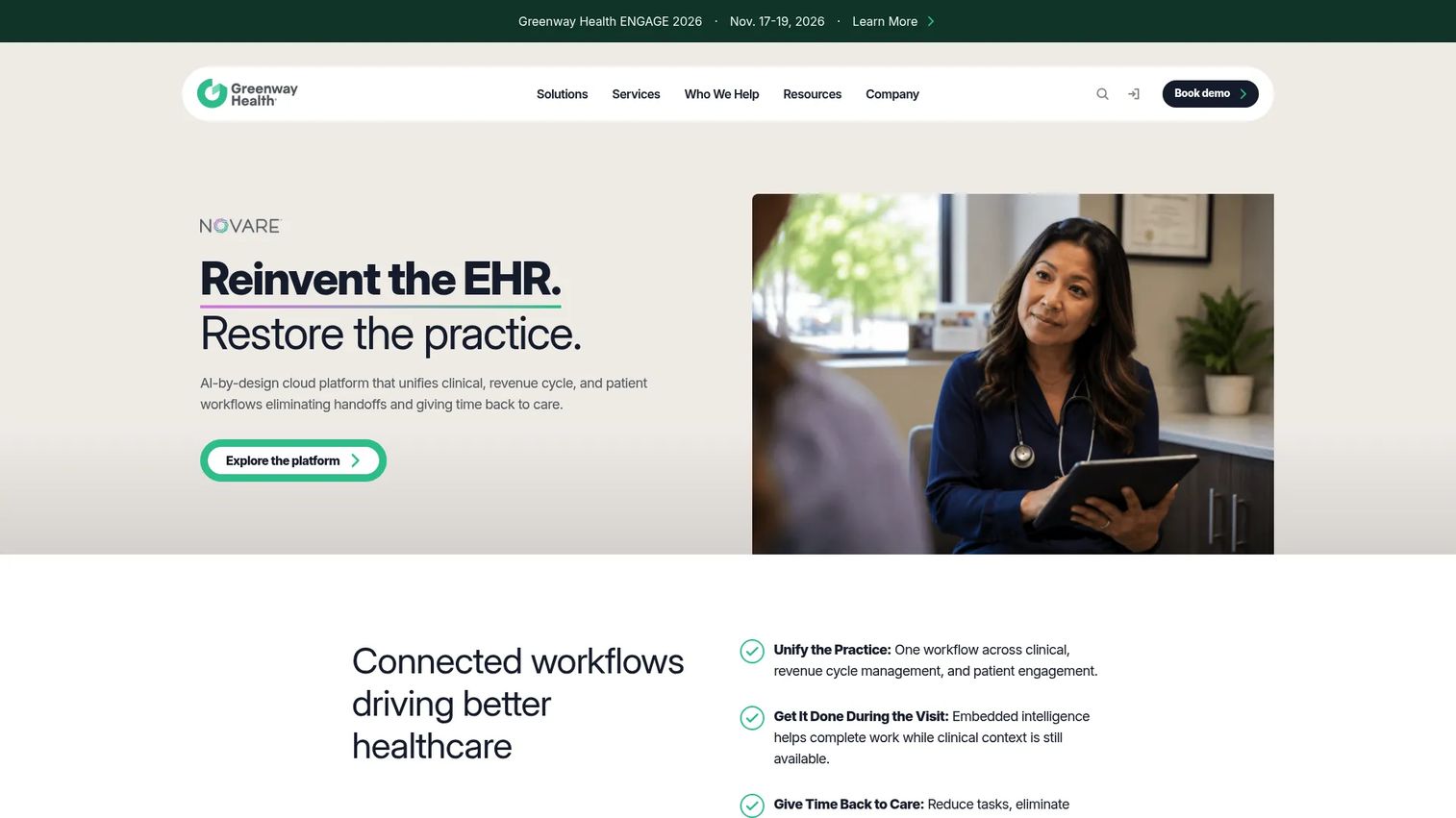
Greenway Health provides AI-enabled EHR, practice management, revenue cycle, patient engagement, interoperability, and analytics for ambulatory practices. Its ambient clinical documentation connects to EHR workflows, and it supports FHIR, HL7, and CommonWell connectivity for interoperability. Ambulatory practices and vendors targeting outpatient settings use Greenway for operational intelligence tied to patient and revenue workflows.
Best for: Ambulatory healthcare organizations and vendors targeting outpatient practice markets that need integrated EHR, practice management, and AI-assisted workflows.
Key features
- Cloud-based EHR with specialty customization
- AI-powered ambient clinical documentation
- Practice and revenue management
- Patient engagement and scheduling tools
- Healthcare interoperability using FHIR and CommonWell
Why choose Greenway Health: Use it when commercial insight depends on ambulatory practice operations and outpatient workflow visibility. It's a practical fit for vendors evaluating the outpatient market from an inside operational perspective.
Greenway Health pricing: Greenway uses a combination of implementation fees and ongoing subscription or maintenance fees. Contact sales for current pricing specific to practice size and configuration.
G2 rating: 3.3/5
21. CareCloud
CareCloud provides cloud-based healthcare software covering revenue cycle management, EHR, practice management, patient experience management, telehealth, business intelligence, and AI-powered clinical documentation. It serves physician practices and medical groups that need operational and revenue visibility in one platform. CareCloud's business intelligence layer connects practice performance data to revenue cycle outcomes.
Best for: Physician practices and medical groups that need revenue cycle intelligence, EHR, and operational analytics without separate systems for each function.
Key features
- Revenue cycle management and claims analytics
- Electronic health records with AI documentation
- Practice management and scheduling
- Patient experience management and telehealth
- Business intelligence and operational reporting
Why choose CareCloud: Choose it when practice-level intelligence needs to connect directly to revenue cycle performance. It's a fit for outpatient groups evaluating whether commercial and financial operations can run from a single platform.
CareCloud pricing: CareCloud directs buyers to request a demo. Pricing is tailored to practice size and selected modules.
G2 rating: 3.6/5 (34 reviews)
Considerations when choosing healthcare commercial intelligence software
Data coverage and source quality
The most important question isn't which platform has the most data. It's which platform has the right data for your specific commercial motion. A payer analytics team needs different coverage than a biopharma HCP strategy team. Map your use case first, then evaluate which platform covers the sources that drive your decisions: Claims, prescriber data, HCO affiliations, payer mix, or clinical research activity.
Healthcare entity resolution
Matching HCPs, HCOs, ownership structures, and payer relationships across fragmented sources is one of the hardest problems in healthcare data. A provider with admitting privileges at three hospitals, ownership in a group practice, and a consulting relationship with a health plan may appear as four different records across four different systems. Platforms that handle entity resolution well build trust into account plans. Platforms that don't can create false confidence in coverage numbers that don't reflect the actual buying landscape.
Governance, privacy, and security
Healthcare data carries privacy obligations that general B2B data platforms don't face. Evaluate access controls, data provenance, auditability, and sensitive data handling before committing to any vendor. Milliman MedInsight (2025) found that 64% of healthcare payer organizations cite legacy-system integration as their biggest barrier to enterprise-wide AI adoption, and governance complexity is often part of why integration stalls. This is also worth evaluating through the lens of AI governance tools if your team plans to build AI workflows on top of the data.
Workflow fit and integrations
Commercial intelligence only creates value if it connects to where decisions get made. Evaluate how each platform connects to your CRM, data warehouse, marketing automation, and sales planning tools. A new VP needs to be able to use the platform without building a shadow ops team to maintain it. Ask vendors specifically about refresh frequency, API access, and the complexity of the initial integration.
Time to useful signal
The first real business decision this platform improves is the right evaluation benchmark, not the full feature list. Examples: The first territory plan, the first TAM cut, the first target account list, or the first board-ready market view. Ask vendors how long that took for customers at a similar stage, and request a reference from a team that started from scratch.
Conclusion
Healthcare commercial intelligence software covers a wide range of decisions. The right platform depends on which decision your team is trying to improve and which data sources drive that decision.
Start with use case clarity before evaluating vendors. For life sciences commercial scale, IQVIA and Veeva Systems are the natural first conversations. For healthcare market mapping and stakeholder discovery, Definitive Healthcare and H1 are where most SaaS and medtech teams begin. When the problem is data infrastructure, Snowflake solves the upstream architecture issue that point solutions can't address. For payer and claims-heavy analytics, Inovalon, Cotiviti, Claritev, and HealthEdge each serve a distinct slice of that market. For provider-side performance intelligence, Health Catalyst and Vizient are the two platforms worth evaluating together.
The best outcome from this guide is a shortlist of two or three platforms you can put in front of your VP with enough context to start a real evaluation conversation.
For teams also evaluating how to present complex healthcare data products to prospects, best marketing analytics software and best data visualization tools are worth reviewing alongside your intelligence stack decisions.
FAQs
Healthcare commercial intelligence software helps organizations combine healthcare data, analytics, and market context to make commercial decisions. It covers market mapping, account prioritization, HCP and HCO intelligence, claims analytics, payer strategy, and growth planning across providers, payers, life sciences, and health technology markets.
Healthcare BI typically looks inward at clinical performance, operational efficiency, or financial reporting inside an organization. Commercial intelligence looks outward at markets, accounts, prescribers, payer dynamics, and growth opportunities. A health system using BI to track readmission rates is doing something fundamentally different from a medtech company using commercial intelligence to map which health systems are acquiring physician practices in a target territory.
The primary users are life sciences commercial teams (biopharma, medtech, biotech), healthcare SaaS vendors mapping their addressable market, payer analytics teams tracking utilization and cost, provider organizations benchmarking performance, healthcare services companies identifying growth opportunities, and GTM leaders building account lists and TAM models for board reporting.
The most consequential sources depend on the use case. For life sciences, prescriber data and market access intelligence usually come first. For healthcare SaaS vendors, provider organization data and affiliation mapping are the foundation. For payers, claims data, risk adjustment data, and quality metrics drive most decisions. Clinical trial and research data matters for medical affairs and HCP targeting in specialized therapeutic areas.
IQVIA, Veeva Systems, H1, Axtria, and Trinity Life Sciences are the strongest options for life sciences commercial teams. The right fit depends on whether the priority is data breadth and real-world evidence (IQVIA), field execution and compliance (Veeva Systems), HCP and clinical research intelligence (H1), commercial operations (Axtria), or launch strategy and market access consulting (Trinity Life Sciences).
Definitive Healthcare and H1 are the most common starting points for healthcare SaaS companies that need to map their addressable market. Snowflake fits teams that need a governed data foundation before adding vertical intelligence apps. For SaaS companies selling into payer markets, Inovalon, Cotiviti, or HealthEdge may be more relevant depending on whether the product sits in claims, quality, or care management workflows.
Start with the specific commercial decision the platform needs to improve, not the feature list. Examples include: Building the first territory plan, sizing the TAM for a board presentation, prioritizing HCP targets by prescribing behavior, or understanding payer segmentation before hiring a market access lead. Then evaluate which data sources drive that decision and which vendor covers them with sufficient depth, governance, and integration capability.
Most platforms in this category use custom enterprise pricing. The price varies by data coverage scope, number of users, modules selected, refresh frequency, and implementation services. Life sciences platforms like IQVIA, Veeva Systems, and Axtria are typically six-figure annual contracts. Provider intelligence platforms like Definitive Healthcare vary by license type and data access. Healthcare BI platforms like Health Catalyst are priced by implementation scope. The best approach is to request pricing with a clear statement of your specific use case, data requirements, and integration needs. Comparing quotes without that context makes the numbers impossible to evaluate.