Your AI tools are multiplying faster than your approval workflows. Analytics tags are firing across properties no one owns. Customer data lives in six systems, and when legal asks who has access to what, the honest answer is "we're not sure."
This is the governance debt that accumulates quietly until a campaign gets blocked, a data request lands from a regulator, or a CFO asks why attribution numbers differ between platforms. According to Precisely and Drexel LeBow (2024), 71% of organizations now report having a data governance program, up from 60% the year before. The gap closing fast between intent and execution means buyers are actively evaluating platforms, not just policies.
The challenge for growth and digital teams is that "digital governance" covers more ground than any single tool. Data quality, AI governance, privacy compliance, model monitoring, and asset lifecycle management all live under the same umbrella. Choosing the wrong layer means buying software that solves the wrong problem.
This guide maps 11 tools to the specific governance problem each one is built to solve.
What's inside
This guide compares 11 digital governance tools for 2026 across data governance, AI governance tools, privacy governance, and policy enforcement. Tools were selected for marketing, data, risk, compliance, and digital teams evaluating platforms for the first time or replacing existing solutions.
Selection criteria:
- Governance scope: Which layer does the tool actually cover?
- Auditability: Does it produce records that survive a real audit?
- Integration depth: Does it connect to your data warehouse, CRM, or AI stack?
- Usability for non-technical teams: Can marketing, legal, and risk use it without IT mediation?
Pricing and G2 ratings reflect verified sources as of November 2026.
TL;DR
- Best for unified data and AI governance: OvalEdge connects data cataloging, lineage, policy workflows, and access controls in one platform
- Best for responsible AI governance: Credo AI formalizes AI risk workflows with policy packs aligned to the EU AI Act and NIST AI RMF
- Best for enterprise AI governance at scale: IBM watsonx.governance covers AI lifecycle governance with continuous monitoring and compliance controls
- Best for privacy-heavy governance: OneTrust AI Governance or Securiti.ai, depending on whether your priority is AI use case intake or sensitive data discovery across hybrid clouds
- Best for model monitoring and observability: Fiddler AI adds runtime evidence to governance programs that already handle policy documentation
- Best for LLM and agent runtime controls: NeuralTrust governs AI behavior at the application layer with a free entry point starting at $0/month
What is digital governance software?
Digital governance software helps organizations set, enforce, monitor, and prove rules for digital systems, data, AI, content, services, and customer-facing technology. It is not one product category. It is a buyer term that covers several distinct governance layers, each with its own tool set.
The five layers most buyers are navigating in 2026:
- Data governance: Data cataloging, lineage tracking, stewardship, quality rules, access controls, and business glossaries. Tools include OvalEdge, Collibra, Informatica, and Microsoft Purview.
- AI governance: Model inventory, risk assessment, explainability, audit evidence, and regulatory mapping against frameworks like the EU AI Act, NIST AI RMF, and ISO 42001. Tools include Credo AI, IBM watsonx.governance, Holistic AI, and Fiddler AI.
- Privacy governance: Consent management, data rights workflows, sensitive data discovery, and privacy impact assessments. Tools include OneTrust and Securiti.ai.
- Digital service governance: Website standards, accessibility controls, content lifecycle, and digital property ownership. This layer is often managed through process and lightweight tooling rather than dedicated platforms.
- Risk and compliance governance: Framework mapping, control evidence, approval workflows, and reporting for regulators or executive teams.
Key capabilities to look for across any governance platform:
- Policy management and enforcement
- Asset, data, model, or AI inventory
- Workflow approvals and accountability trails
- Audit logs and evidence collection
- Risk scoring and compliance mapping
- Reporting for executives, regulators, and operations
For digital marketers, governance software matters when campaign data, analytics tags, AI workflows, and customer consent must stand up to scrutiny. The goal is faster execution with records that leadership and legal can trust, not slower marketing.
When to use digital governance tools
Govern AI usage before it becomes shadow process
When teams adopt generative AI, predictive scoring, content automation, or customer data enrichment without central oversight, the AI inventory gaps compound fast. Governance platforms help you catalog what AI systems exist, document the risk each one carries, and produce evidence that controls are in place. This matters before an audit, not after.
Bring trust back to customer and campaign data
Attribution fights between marketing, finance, and RevOps usually trace back to the same root cause: No agreed source of truth for data definitions, lineage, or access. Data governance tools create cataloged, owned, and quality-controlled data assets. The result is campaign reporting that finance and RevOps accept, not dispute.
Standardize digital experiences across teams
Websites, digital services, and content libraries grow in ways no one planned. Pages with unknown owners, analytics tags no one controls, and consent language that varies by region are governance gaps waiting to become compliance problems. Governance tooling gives teams a structure for ownership, lifecycle management, and change controls across digital properties. For further context on managing digital assets at scale, see our roundup of asset discovery software and asset inventory software.
Digital governance tools comparison
The table below is a shortlist for initial screening, not a final purchasing decision. Run at least one real governance workflow through any tool before committing.
| # | Product | Best for | Key differentiator | Pricing | G2 rating |
|---|---|---|---|---|---|
| 1 | OvalEdge | Unified data and AI governance | Data catalog plus governance workflows with 170+ connectors | Quote-based | 5.0/5 |
| 2 | Credo AI | Responsible AI governance | AI risk workflows with EU AI Act, NIST AI RMF policy packs | Quote-based | 4.6/5 |
| 3 | IBM watsonx.governance | Enterprise AI governance | AI lifecycle governance with continuous monitoring | From $3,500/month | 4.3/5 |
| 4 | Collibra AI Governance | Data governance-led AI oversight | Metadata, catalog, lineage, and AI traceability | Quote-based | 4.2/5 |
| 5 | Holistic AI | AI risk and regulatory readiness | 40+ risk tests plus agent governance and red teaming | Quote-based | N/A |
| 6 | OneTrust AI Governance | Privacy and AI governance | AI use case intake with EU AI Act and NIST alignment | Quote-based | N/A (Capterra 4.3/5) |
| 7 | Fiddler AI | Model monitoring and observability | Runtime explainability, drift detection, and audit evidence | From $0 (Developer: $0.002/trace) | 4.4/5 |
| 8 | Microsoft Purview | Microsoft data estate governance | Data security, compliance, cataloging in Microsoft ecosystem | From $12/user/month | 4.3/5 |
| 9 | Securiti.ai | Privacy, data, and AI governance | Data command platform for sensitive data across hybrid clouds | Quote-based | 4.6/5 |
| 10 | NeuralTrust | LLM and agent runtime governance | AI gateway with guardrails and prompt-injection protection | From $0/month (Standard: $49/month) | N/A |
| 11 | Informatica | Enterprise data governance and intelligence | AI-assisted cataloging, quality, lineage, and master data | Quote-based | 4.2/5 |
Best 11 digital governance tools for 2026
1. OvalEdge
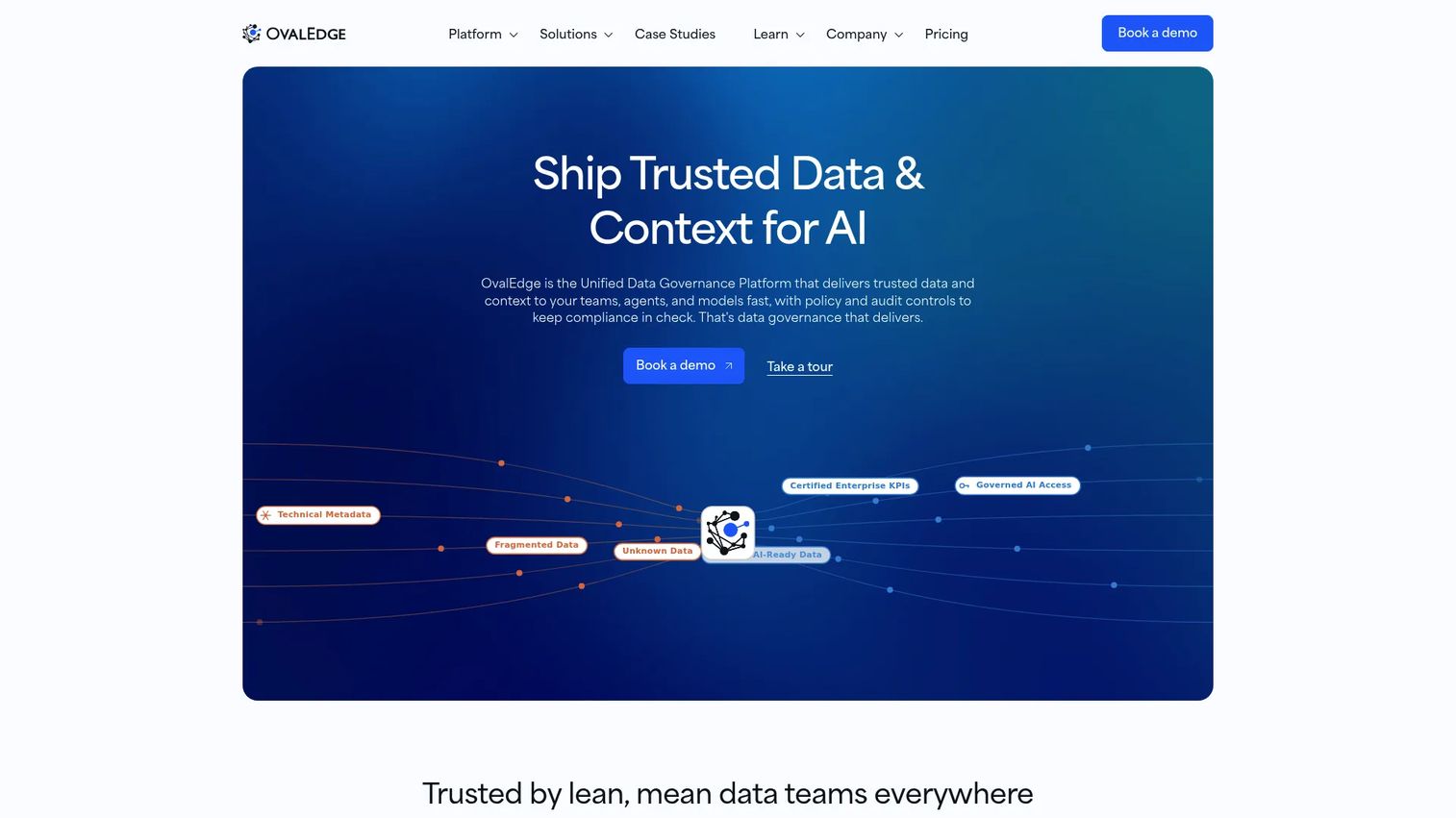
OvalEdge is a unified data governance and data catalog platform built for mid-market and enterprise data teams. It connects metadata across 170+ pre-built connectors, generates automated data lineage, and provides business glossaries and policy workflows that non-technical stakeholders can actually use. For marketing and analytics teams, it closes the gap between "we have data" and "we trust this data for reporting."
Best for: Mid-market and enterprise teams that need a practical bridge between data cataloging and policy enforcement, with strong connector coverage for existing tools.
Key features
- Data catalog with metadata management and discovery
- Automated data lineage generation across 170+ connectors
- PII detection and data classification
- Business glossary and governance workflow automation
- Access governance and role-based permissions
Why choose OvalEdge: If your governance problem starts with "we don't know what data we have or who owns it," OvalEdge addresses both the inventory and the stewardship layer. It is particularly useful for teams that need data definitions marketing, finance, and analytics can agree on.
OvalEdge pricing: OvalEdge prices by quote. The license structure is connector-based and includes 1,000 reader users at no additional cost. Ask sales about connector count, author user volume, and whether AI governance modules are included.
G2 rating: 5.0/5
2. Credo AI
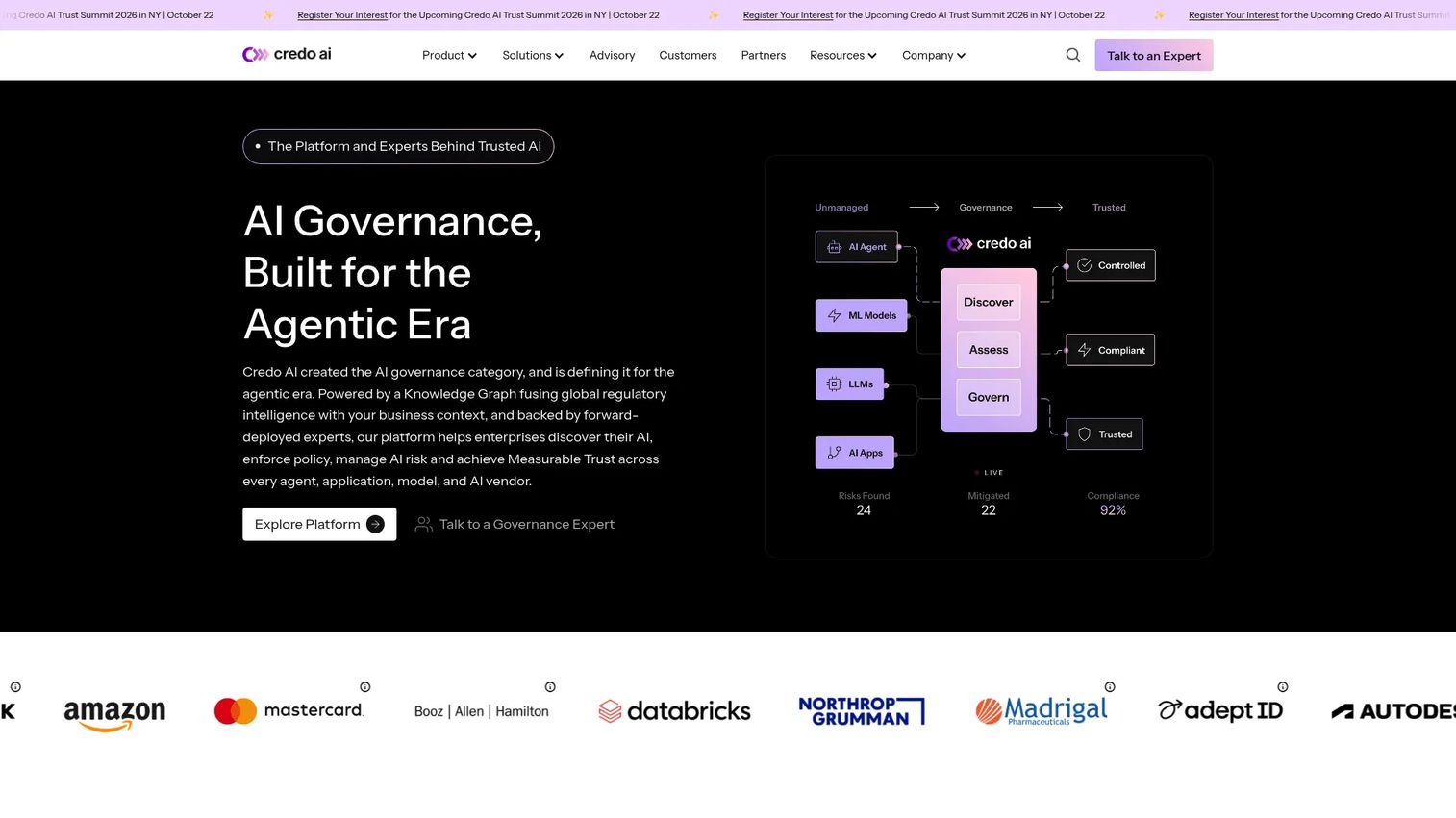
Credo AI is an enterprise AI governance platform for discovering, assessing, and monitoring AI agents, models, applications, and vendors across the AI lifecycle. It includes an AI registry with shadow AI discovery, continuous contextual risk scoring, and policy packs aligned to the EU AI Act, NIST AI RMF, ISO 42001, and SOC 2. Teams use it to document AI use cases before procurement reviews and generate audit evidence throughout the governance workflow.
Best for: Enterprises formalizing responsible AI governance programs, particularly those under regulatory pressure or preparing for EU AI Act compliance.
Key features
- AI registry with shadow AI discovery
- Continuous contextual risk assessment and scoring
- Policy packs for EU AI Act, NIST AI RMF, ISO 42001, and SOC 2
- Governance workflows with approval gates and audit trails
- Agent registry with dependency graphs and agent-specific risk controls
Why choose Credo AI: Credo AI is the clearest fit when responsible AI governance is the primary mandate. It goes beyond policy documentation to continuous monitoring, which matters when AI systems are running in production and risk profiles change over time.
Credo AI pricing: Credo AI prices by quote. Contact sales about AI use case volume, policy packs required, user seats, and implementation support.
G2 rating: 4.6/5
3. IBM watsonx.governance
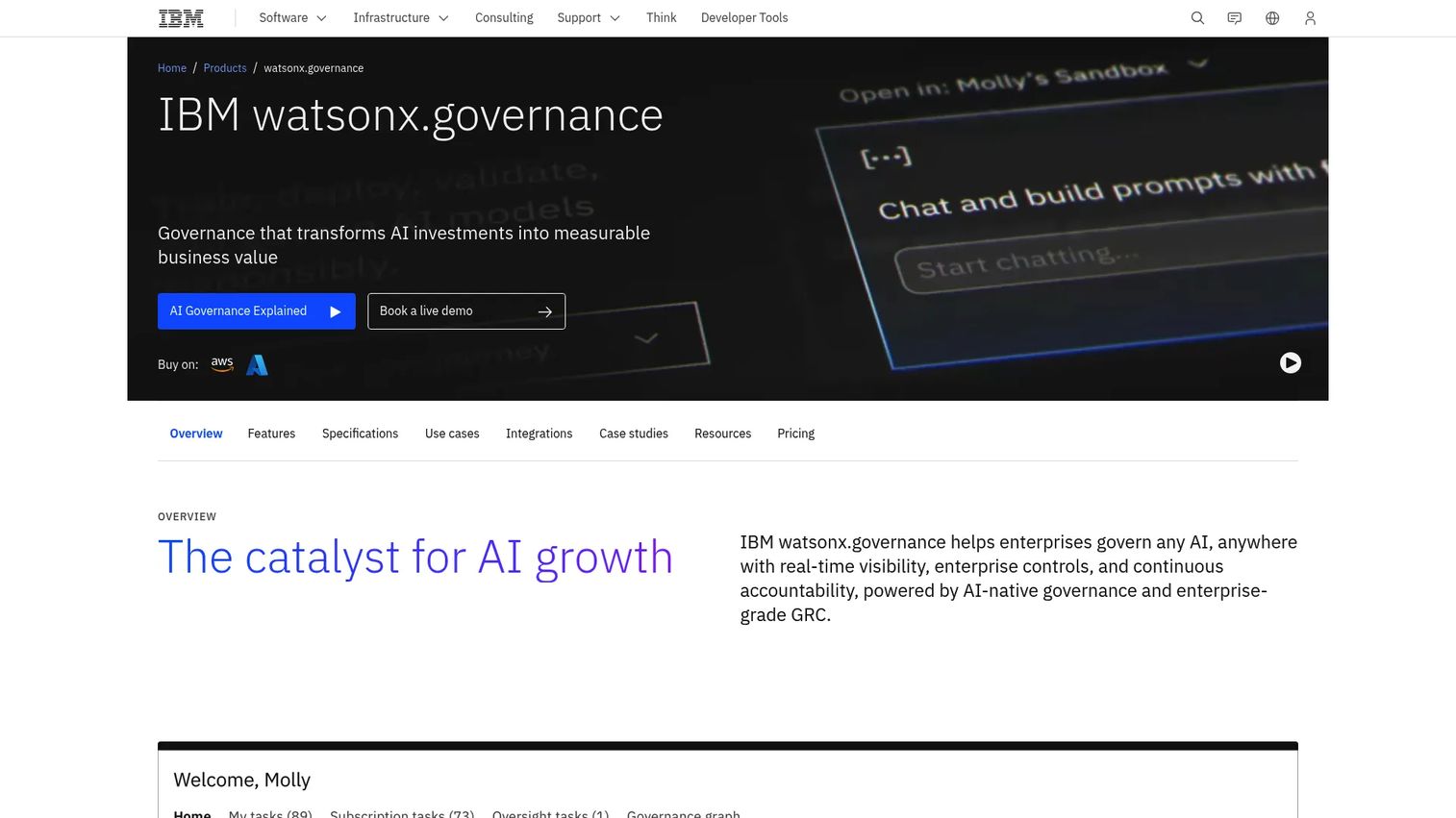
IBM watsonx.governance is an AI governance platform providing visibility, continuous accountability, risk management, compliance, and monitoring across AI systems. It includes a governance graph for AI ecosystem visibility, shadow AI detection, policy enforcement, and end-to-end traceability across foundation models, machine learning models, and AI applications. It is designed for enterprises running large, governed AI programs across IBM or hybrid cloud environments.
Best for: Large enterprises that need centralized AI governance, regulatory compliance, and continuous monitoring with deep integration into IBM infrastructure.
Key features
- Governance graph and AI ecosystem visibility
- Shadow AI detection
- Continuous monitoring and AI risk management
- Policy enforcement and regulatory compliance controls
- AI value tracking and end-to-end traceability
Why choose IBM watsonx.governance: Organizations already running IBM Cloud workloads or committed to the IBM AI stack will find the tightest integration here. For teams that need documented AI governance with continuous monitoring and audit-ready evidence, the Risk and Compliance tiers provide structured coverage.
IBM watsonx.governance pricing: A 14-day free trial is available. The Model Management plan starts at $0.64 (pay-as-you-go, per usage unit). The Risk and Compliance Basic plan starts at $3,500/month; the Advanced plan starts at $6,450/month. The AWS deployment starts at $42,000. Prices are indicative and vary by country.
G2 rating: 4.3/5
4. Collibra AI Governance
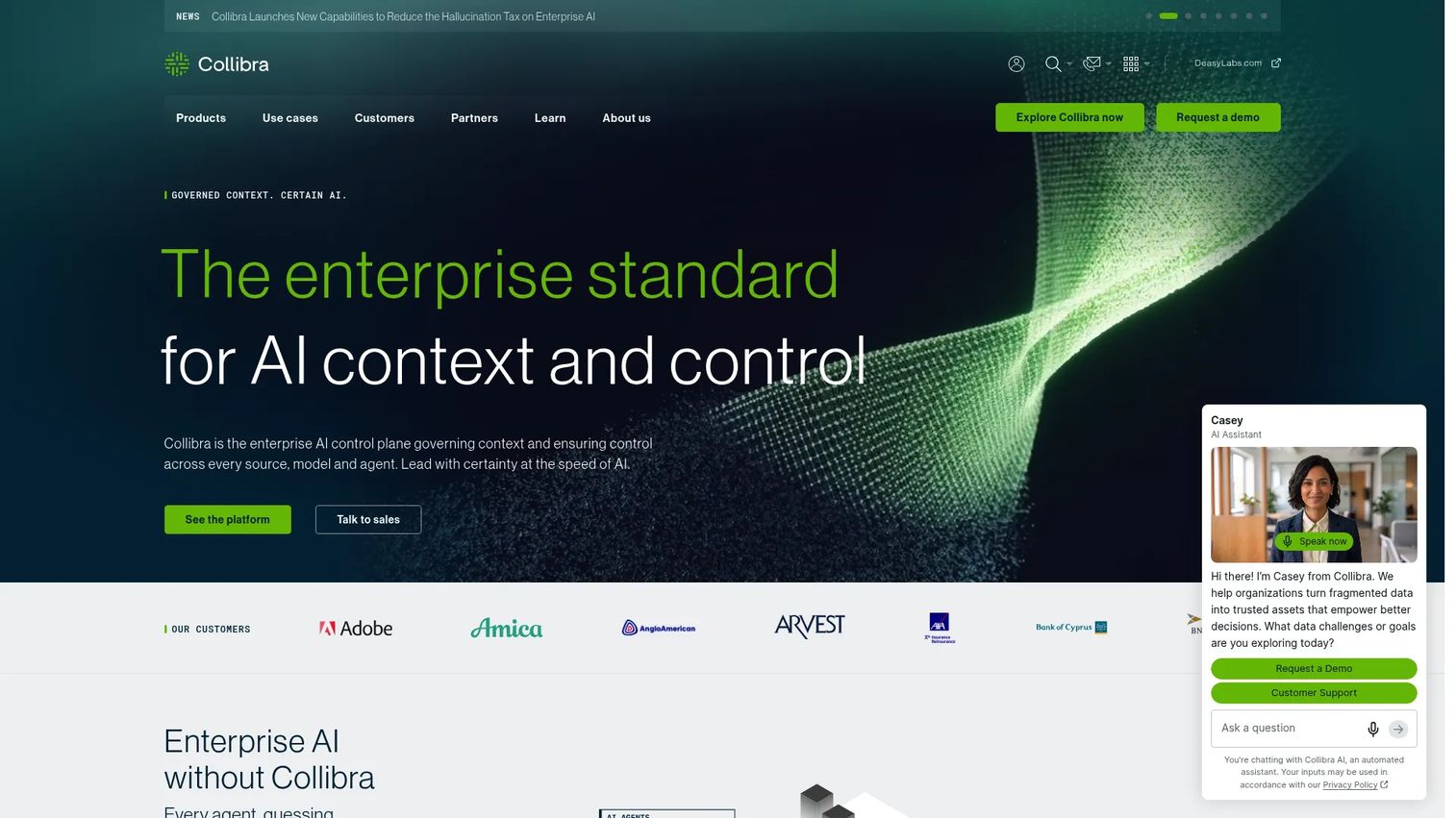
Collibra AI Governance extends Collibra's data governance platform into AI oversight. It provides a centralized registry for AI agents, models, and use cases, with AI model and data lineage, automated traceability, and collaborative assessments covering business context, legal and ethics, risks, the EU AI Act, and NIST AI RMF. For enterprises with existing Collibra data stewardship programs, it connects AI governance to the same metadata and ownership structure already governing enterprise data.
Best for: Large organizations that already use Collibra for data governance and want to extend the same catalog, lineage, and workflow infrastructure into AI oversight.
Key features
- Centralized AI agent, model, and use case registry
- AI model and data lineage with automated traceability
- Collaborative assessments for EU AI Act and NIST AI RMF
- Lifecycle monitoring, risk documentation, and approval workflows
- Metadata management and stewardship controls
Why choose Collibra AI Governance: If your data governance program already runs on Collibra, this is the path of least resistance into AI governance. Teams inherit existing data definitions, ownership structures, and workflow patterns rather than building a parallel system from scratch.
Collibra AI Governance pricing: Pricing is quote-based. Ask Collibra sales about platform tier, AI Governance module inclusion, seat volume, and whether the AI Command Center (the evolved product name) changes packaging.
G2 rating: 4.2/5
5. Holistic AI
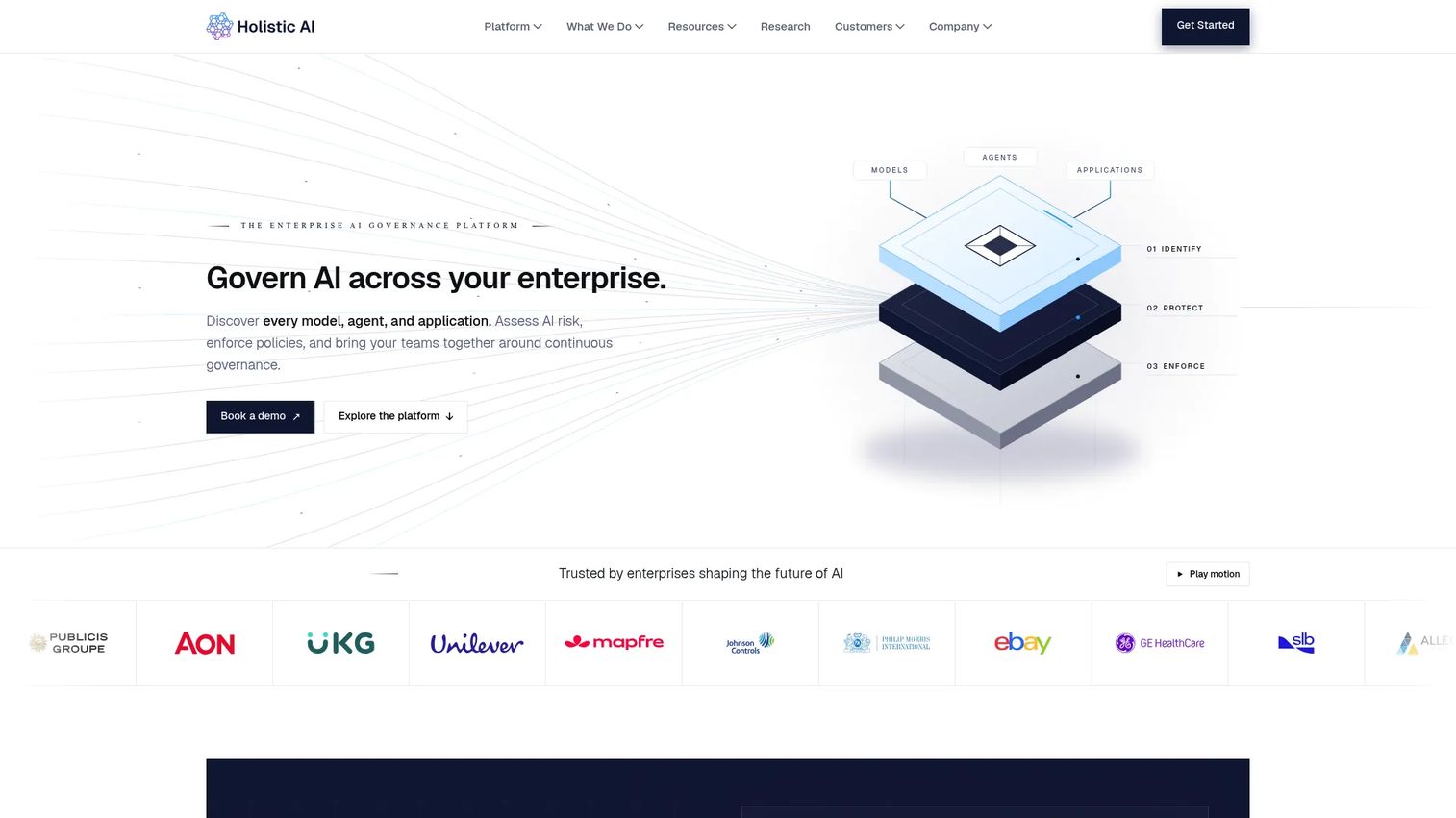
Holistic AI is an enterprise AI governance platform for discovering, assessing, monitoring, and enforcing controls across AI systems, models, agents, and applications. It runs 40+ risk tests, including bias audits and LLM red teaming with jailbreak and prompt-injection testing. Policy enforcement, compliance mapping, and audit-ready reporting are paired with Guardian Agents for real-time monitoring. It is built for organizations that need to assess high-risk AI systems before deployment and maintain continuous oversight after.
Best for: Enterprise compliance, legal, and risk teams evaluating AI systems under regulatory frameworks or sector-specific requirements.
Key features
- AI discovery and inventory including shadow AI detection
- AI risk assessment, bias audits, and 40+ risk tests
- LLM and agent red teaming with jailbreak and prompt-injection testing
- Policy enforcement, compliance mapping, and audit-ready reporting
- Agent governance with real-time monitoring and Guardian Agents
Why choose Holistic AI: The depth of risk testing, including bias audits and adversarial testing for LLMs, makes Holistic AI relevant for teams operating in regulated sectors or evaluating high-risk AI use cases where documented assurance is a requirement.
Holistic AI pricing: Pricing is quote-based. Ask sales about the number of AI systems, assessment depth, regulatory scope, and advisory support requirements.
6. OneTrust AI Governance
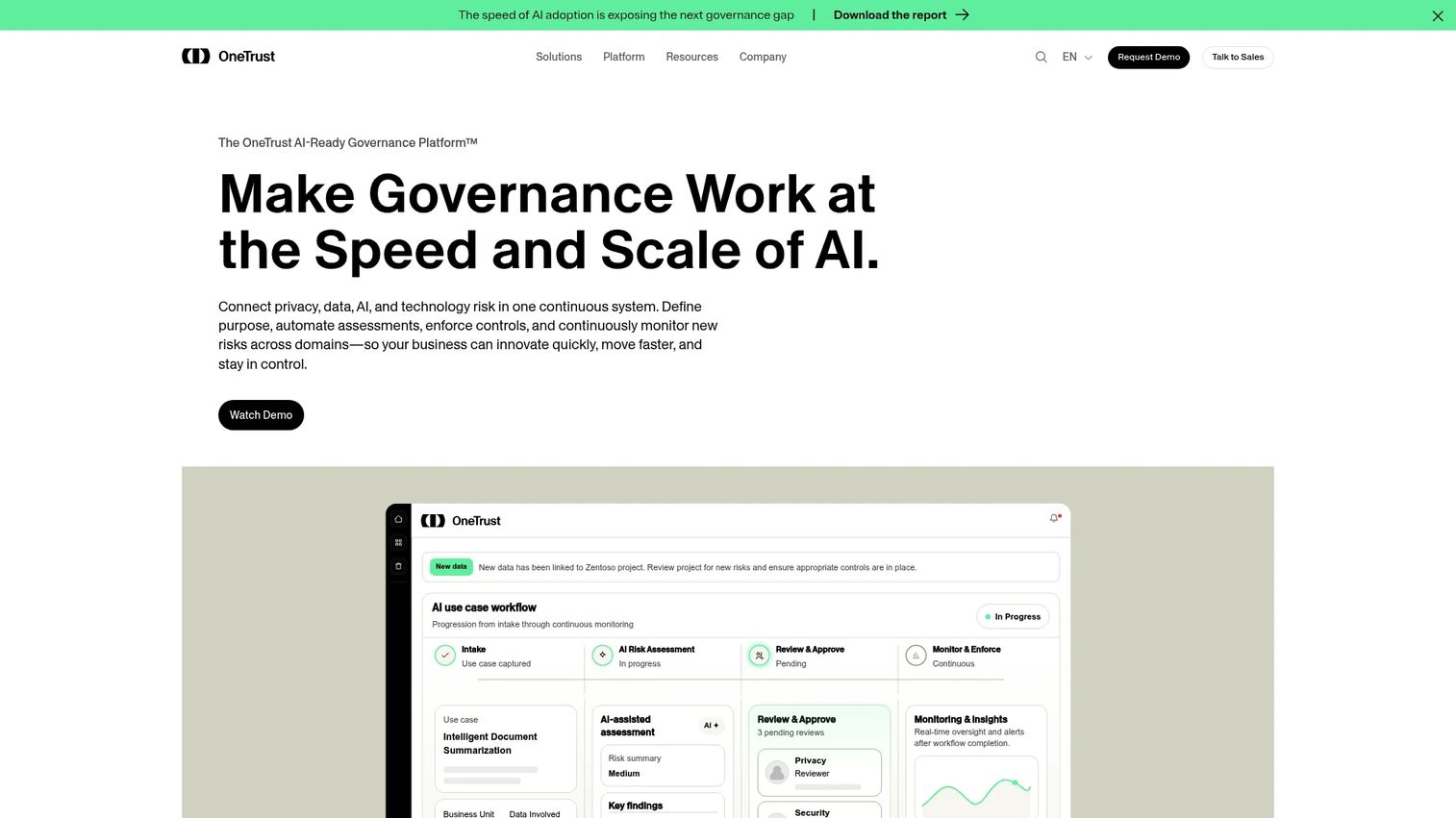
OneTrust AI Governance connects AI use case intake, privacy risk workflows, policy management, third-party AI governance, and compliance reporting in one platform. Risk assessments align with the EU AI Act, NIST AI RMF, and ISO 42001. For marketing and digital teams, it is most useful when AI usage intersects with personal data, vendor tools, automated decisioning, or customer consent workflows. OneTrust's existing strength in privacy governance means AI governance sits alongside data rights, consent, and regulatory compliance controls.
Best for: Organizations where AI governance must connect directly to privacy, third-party risk, and customer data compliance workflows.
Key features
- AI inventory and discovery across systems, models, agents, vendors, and use cases
- Risk assessments aligned to EU AI Act, NIST AI RMF, and ISO 42001
- Policy management, runtime monitoring, and guardrail enforcement
- Third-party AI governance and vendor controls
- Audit-ready evidence generation
Why choose OneTrust AI Governance: The fit is strongest for legal, privacy, and compliance teams that already manage consent and data rights in OneTrust and need to extend that governance into AI. Marketing teams benefit when personalization, targeting, or customer data enrichment involves AI vendors or automated decisioning.
OneTrust AI Governance pricing: Pricing is customized by admin user count and third-party AI inventory. Ask sales about modules, user volume, data sources, and AI governance workflow requirements.
7. Fiddler AI
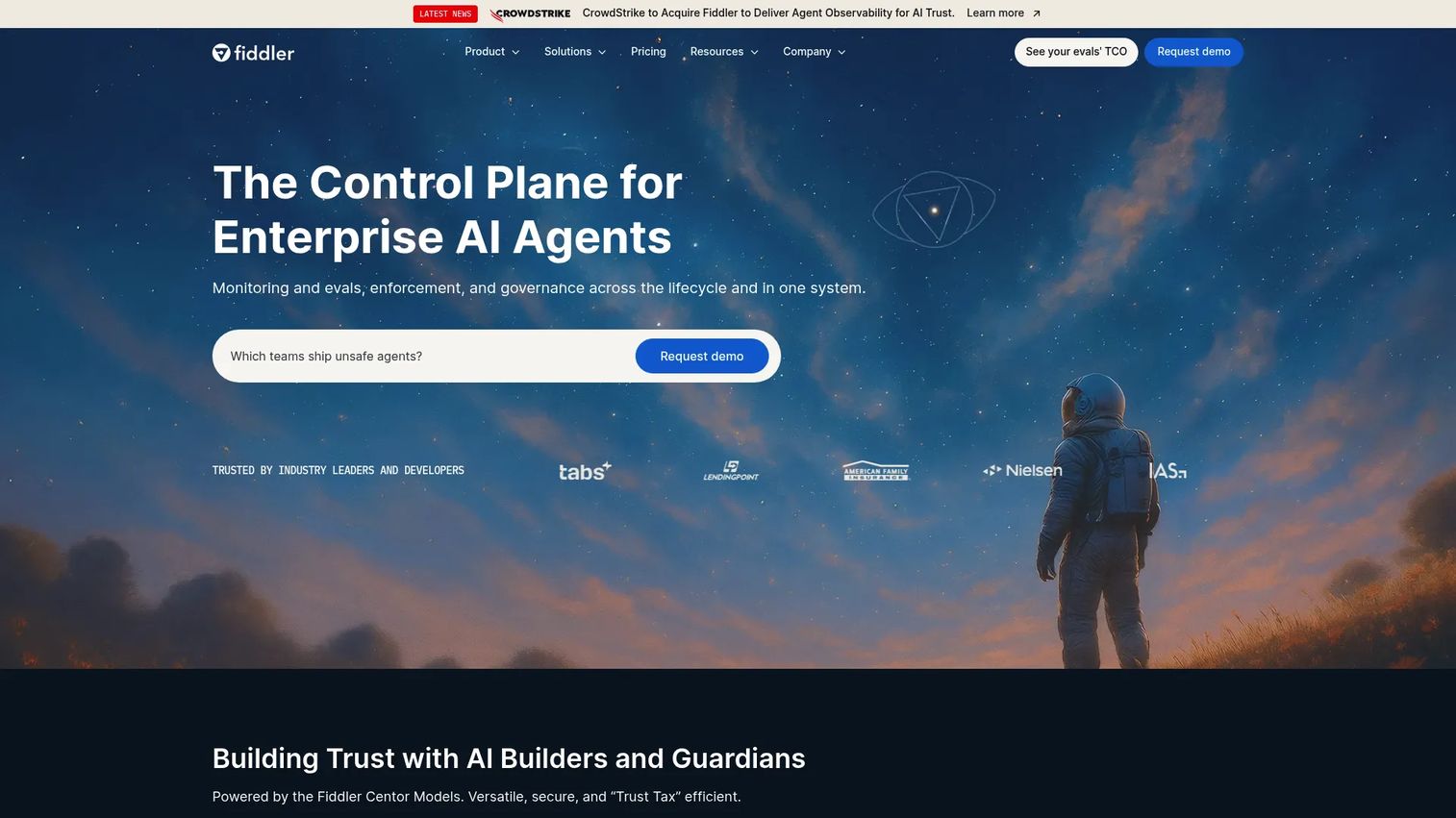
Fiddler AI is an AI control plane for enterprise agents and predictive models, providing monitoring, evaluations, enforcement, and governance across the AI lifecycle. It offers real-time guardrails covering hallucinations, toxicity, PII/PHI, prompt injection, and jailbreaks. Explainable AI features include SHAP, integrated gradients, what-if analysis, and local explanations. Fiddler announced in November 2026 that it signed a definitive agreement to be acquired by CrowdStrike, which may affect future roadmap and packaging, so confirm current status before purchasing.
Best for: ML and AI teams that need runtime observability, explainability, and audit evidence for deployed models and agents, beyond policy documentation alone.
Key features
- AI observability, monitoring, and continuous evaluations
- Real-time guardrails for hallucinations, toxicity, PII/PHI, and prompt injection
- Explainable AI with SHAP and integrated gradients
- Drift detection and performance monitoring
- Governance, audit evidence, and flexible deployment (SaaS, VPC, on-premise)
Why choose Fiddler AI: Fiddler is the right choice when governance needs runtime evidence, not just policy records. Teams that have documented AI use cases but lack visibility into how models behave in production will find the observability and explainability layer directly useful. For teams exploring AI model deployment software alongside governance, Fiddler connects both needs.
Fiddler AI pricing: A free tier is available with real-time guardrails included. The Developer plan is $0.002 per trace (usage-based). Enterprise pricing is by quote. Ask sales about trace volume, deployment model, and support requirements.
G2 rating: 4.4/5
8. Microsoft Purview
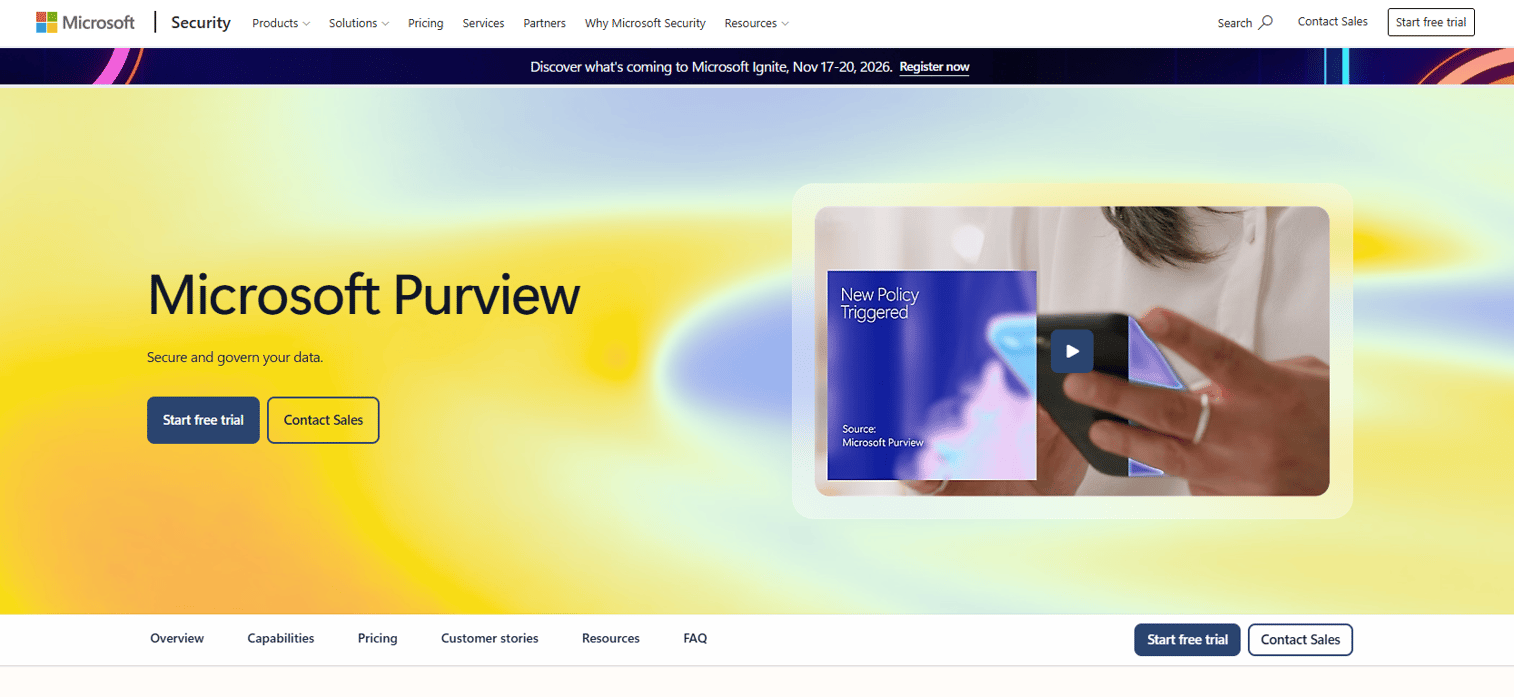
Microsoft Purview is a unified set of data security, governance, risk, and compliance tools for managing data across Microsoft 365, Azure, and connected cloud environments. It covers data loss prevention, information protection and sensitivity labeling, insider risk management, audit and eDiscovery, communication compliance, data lifecycle and records management, Compliance Manager, and data cataloging and discovery. For organizations already operating in the Microsoft ecosystem, it is the lowest-friction path to governed data estates.
Best for: Enterprise IT, data, compliance, and security teams that need integrated governance across Microsoft 365 content, Azure data, and connected cloud workloads.
Key features
- Data loss prevention
- Information protection and sensitivity labeling
- Insider risk management
- Audit and eDiscovery
- Data lifecycle and records management
- Compliance Manager
- Data governance and data discovery
Why choose Microsoft Purview: The fit is strongest for organizations where the data estate lives primarily in Microsoft. Marketing teams benefit when governed customer data and access controls need to extend across Microsoft 365 collaboration tools, SharePoint, and Azure-hosted analytics. For teams building out brand asset management alongside data governance, Purview handles the lifecycle and access control side.
Microsoft Purview pricing: The Microsoft Purview Suite add-on starts at $12.00/user/month (annual subscription). Microsoft 365 E5, which includes Purview capabilities, starts at $60.00/user/month (annual). Pay-as-you-go options are available for Data Governance, Data Security, and Data Compliance separately. Requirements include Microsoft 365 E3, or Office 365 E3 plus Enterprise Mobility + Security E3.
G2 rating: 4.3/5 (Microsoft Purview Audit)
9. Securiti.ai
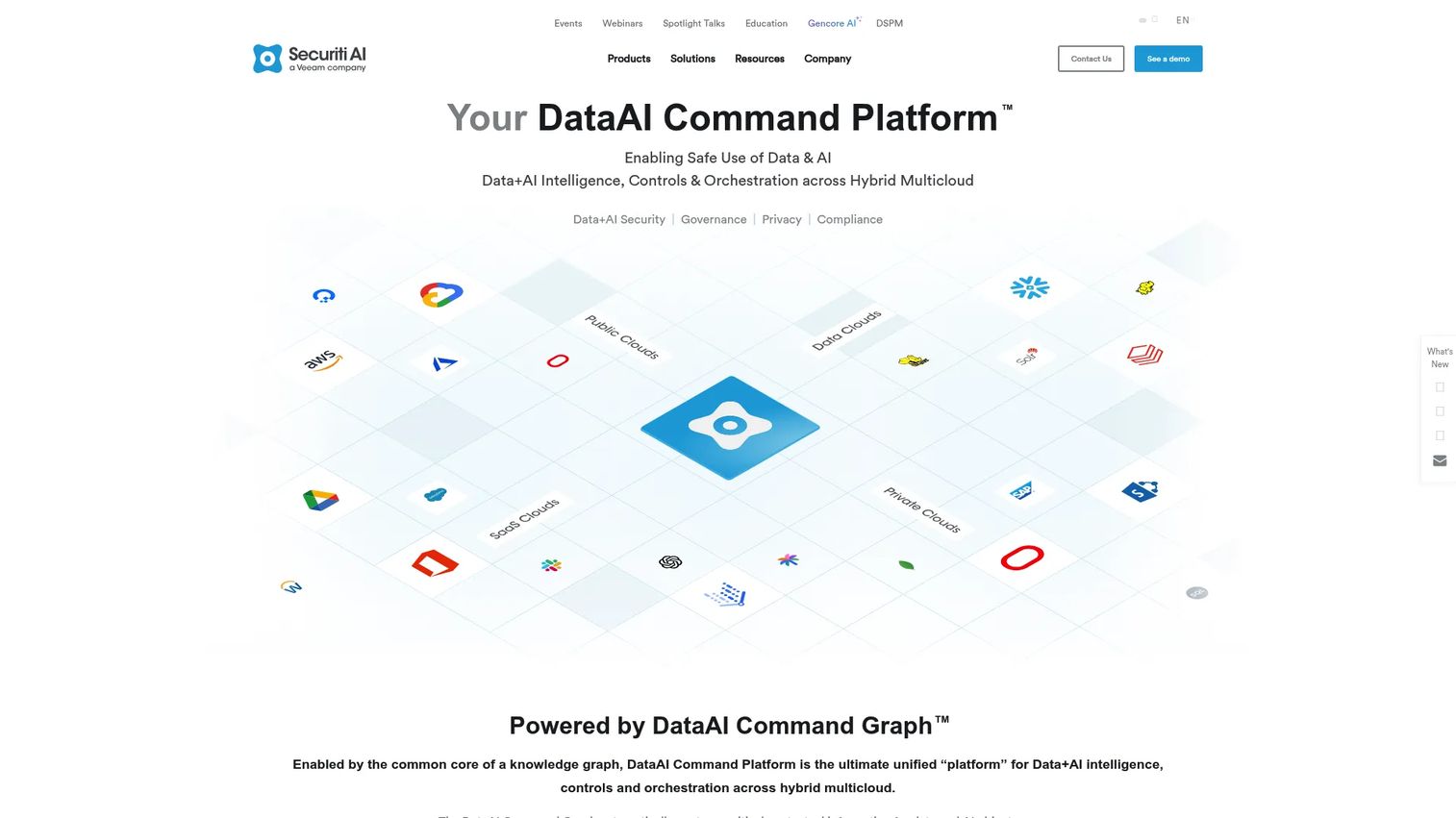
Securiti.ai provides a DataAI Command Platform covering data security, privacy governance, compliance, AI governance, and breach impact analysis across hybrid multicloud environments. Core capabilities include data discovery and classification, data access intelligence, AI security and governance, consent and privacy operations, and compliance management. For digital and marketing teams, the most direct value is in discovering what sensitive data AI systems or marketing workflows are touching, and proving consent and access controls are in place.
Best for: Large enterprises with sensitive customer data spread across multiple clouds, SaaS applications, and data warehouses that need a unified platform for privacy, data, and AI governance.
Key features
- Data discovery and classification across hybrid multicloud environments
- Data access intelligence and governance
- AI security and governance
- Compliance management and breach impact analysis
- Consent and privacy operations
Why choose Securiti.ai: When the governance problem is "we don't know where our sensitive data lives or how it's being used by AI systems," Securiti provides the discovery and classification layer that makes the rest of governance possible. It is particularly relevant for enterprises running data across AWS, Azure, GCP, and SaaS platforms simultaneously.
Securiti.ai pricing: Personalized pricing based on selected modules and use cases. Ask Securiti about data sources, specific modules, cloud environments covered, and automation scope.
G2 rating: 4.6/5
10. NeuralTrust
NeuralTrust is an AI and agent security platform providing runtime protection, gateways, governance, observability, and security controls for generative AI applications. It covers agent runtime security, prompt-injection protection, an AI gateway for model and tool access control, tracing, analytics, audit logs, and security posture monitoring. The free tier supports 100,000 requests per month, which makes it accessible for teams piloting LLM governance before committing to a full platform purchase. For more context on prompt management tools in AI governance workflows, the adjacent tooling landscape is worth reviewing.
Best for: Teams deploying generative AI products, assistants, or agentic workflows that need runtime security and governance at the application layer.
Key features
- Agent runtime security and prompt-injection protection
- AI gateway for model and tool access control
- Tracing, analytics, and audit logs
- Security posture monitoring
- Real-time guardrails and content filtering
Why choose NeuralTrust: The case for NeuralTrust is clearest when the governance gap is at runtime, meaning policies exist but there is no layer enforcing them on live AI behavior. The free tier lets teams run a real proof of concept before scaling up, which matters when governance budgets are still forming.
NeuralTrust pricing: A free plan is available at $0/month, covering 100,000 requests/month, US/EU data residency, 7-day log retention, and 5 team members. The Standard plan is $49/month with usage credits and 30-day log retention. Enterprise pricing uses committed volume and custom rates.
11. Informatica
Informatica provides the Intelligent Data Management Cloud, an AI-assisted platform for connecting, managing, governing, and unifying enterprise data across cloud and hybrid environments. Capabilities include data cataloging and discovery, data integration, data quality and observability, master data management, data governance and access, privacy and protection controls, and CLAIRE AI-powered automation. For digital and marketing teams, Informatica creates the trusted data foundation that makes campaign reporting, customer segmentation, and consent-aware data access reliable. See also our coverage of best business intelligence software for how governed data feeds downstream BI and analytics workflows.
Best for: Large enterprises with complex customer, product, finance, and analytics data estates that need integrated data cataloging, quality, lineage, and master data management.
Key features
- Data cataloging and discovery
- Data quality and observability
- Data lineage across cloud and hybrid environments
- Master data management and 360 applications
- Data governance, access, and privacy controls
- CLAIRE AI-powered automation
Why choose Informatica: Informatica is the right starting point when the data foundation itself is the governance gap. Teams that need authoritative customer records for segmentation, attribution, or personalization, and want that data governed with lineage and quality controls, will find the breadth of Informatica's platform covers more of the problem in one place.
Informatica pricing: Consumption-based, volume-based pricing with customizable subscriptions. The price is driven by data volume, selected modules, deployment model, connectors, and support tier. Request a quote from Informatica with specifics on each variable.
G2 rating: 4.2/5
Considerations when choosing digital governance tools
Governance scope comes first
Before evaluating any vendor, decide which governance layer you are actually buying: Data governance, AI governance, privacy governance, digital service governance, or a combined platform. Tools built for data lineage will not solve AI risk management. Tools built for AI use case intake will not discover sensitive data across cloud environments. The mismatch between buyer intent and tool coverage is the most common reason governance projects stall.
Integration depth determines adoption
A governance platform that cannot connect to your data warehouse, CRM, marketing automation, cloud storage, or AI development environment will create a parallel system that people use until they stop. Prioritize tools with pre-built connectors for the systems your team already works in. For marketing operations specifically, CRM and analytics stack fit is non-negotiable.
Auditability means records, not policies
Governance without logs is a document. The tools worth buying generate audit trails, approval records, risk scores, ownership assignments, and exportable reports. Before committing, run a test workflow and confirm the tool produces evidence you would be comfortable showing to legal, a regulator, or a board. See our guide to audit management software for what good audit trail infrastructure looks like.
Non-technical teams must be able to use it
Governance programs collapse when only IT and data engineering can operate the platform. Marketing, legal, compliance, and risk teams need governance workflows they can execute without filing tickets. Evaluate the user interface and self-service capability as seriously as the feature set. Dresner Advisory Services (2024) found 69% of organizations report difficulty finding data and analytics content, which signals that discoverability and usability are still unsolved at most companies.
Total cost includes more than the subscription
License cost is one line. The others include connector or integration fees, professional services for implementation, training time, number of governed data assets or AI models, cloud consumption (for usage-based tools), and ongoing admin hours. Governance platforms with consumption-based pricing can scale unpredictably if data or AI volumes grow. Get a total cost projection across your expected usage volume before signing.
Conclusion
The right digital governance tool is the one that matches the layer where your governance gap actually lives.
For data governance foundations, OvalEdge and Informatica cover cataloging, lineage, quality, and access. Collibra is the natural extension for enterprises already invested in its platform. For AI governance, Credo AI and IBM watsonx.governance handle lifecycle governance and regulatory compliance at different price points and infrastructure assumptions. Holistic AI adds depth in risk assessment and adversarial testing. Fiddler AI adds the runtime observability layer that policy-only programs typically miss.
For privacy and sensitive data, OneTrust and Securiti.ai approach the problem from different directions. OneTrust connects privacy workflows to AI use case intake. Securiti starts with discovering what sensitive data exists across your environment. For Microsoft-centric environments, Purview is the path of least resistance. For LLM and agent applications that need runtime controls, NeuralTrust provides a free starting point with a path to enterprise scale.
Map your governance problem first. Pick no more than three platforms for a proof of concept. Run one real workflow through each, measure the time to produce usable audit evidence, and check whether non-technical stakeholders can operate the tool without IT support.
Start your journey with Guideflow today!
FAQs
Digital governance tools help organizations define, enforce, monitor, and prove rules for digital systems, data, AI models, content, and services. They typically include capabilities for policy management, asset and data inventory, ownership assignment, audit logs, risk scoring, and compliance reporting. The category spans data governance platforms, AI governance tools, privacy governance software, and digital service governance resources.
Data governance focuses specifically on data assets: Quality, lineage, stewardship, access controls, and usage. Digital governance is broader and can include AI systems, websites, digital services, accessibility standards, content lifecycle, security policies, and operational controls for any customer-facing or internal digital system. Data governance is one layer within digital governance, not a synonym for it.
AI governance tools manage risks specific to artificial intelligence: Model inventory, risk assessments, explainability, monitoring for drift or bias, and audit evidence tied to regulatory frameworks like the EU AI Act and NIST AI RMF. Digital governance tools may include AI governance, but they also cover data, content, privacy, and digital service operations. If your primary concern is governing AI systems specifically, tools like Credo AI, IBM watsonx.governance, or Holistic AI are more targeted than general digital governance platforms.
Marketing teams should prioritize tools that connect to their CRM, analytics stack, consent management, and data cataloging workflows. OvalEdge and Informatica are strong fits for teams whose governance problem is data quality and attribution trust. Microsoft Purview fits when the team runs on Microsoft 365 and Azure. OneTrust and Securiti.ai fit when consent, customer data privacy, and AI vendor oversight are the primary concerns. Start with the governance problem your team actually faces, then match the tool to that layer.
Small teams can often start with documented policies, named owners, and lightweight workflow tools before committing to a dedicated platform. Dedicated software becomes valuable when the team handles regulated data, uses AI tools without central tracking, manages multiple systems with no source of truth, or faces audit requests it cannot answer from spreadsheets. NeuralTrust's free tier and Fiddler AI's free plan are reasonable starting points for small teams that need runtime AI governance without an enterprise procurement cycle.
The core capabilities to evaluate are: Policy management and enforcement, inventory for data assets or AI models, ownership and stewardship workflows, data lineage, access controls, risk scoring, audit logs with exportable evidence, compliance mapping to relevant frameworks, integrations with your existing stack, and usability for non-technical stakeholders. Auditability is the feature most buyers underweight. A tool that produces records leadership and legal can read is more valuable than one with more features but no exportable evidence trail.
Governance platforms help map internal policies to regulatory controls, collect and store evidence of those controls, document approvals, monitor for risk deviations, and generate reports for internal and external review. They do not make a team compliant on their own. Legal and compliance teams still need to interpret specific regulations and validate that the tool's outputs satisfy the requirements of the applicable framework. What governance software does is make collecting and presenting that evidence significantly faster and more consistent.
Pick one real governance workflow your team actually runs today, such as an AI use case intake, a customer data access request, a campaign data lineage review, or a sensitive data discovery scan. Run the same workflow in the tool and measure four things: Time to complete the workflow, effort required from non-technical users, quality of the audit evidence produced, and integration work required to connect the tool to your existing stack. Any governance platform that cannot handle a real workflow in a proof of concept will not handle a real audit either.