Your product analytics tell you a flow dropped off. Session replays show users clicking around. But neither source tells you whether that hesitation at step three was confusion, distrust, or just distraction. Clickstream data captures behavior. It does not capture how users felt while behaving.
That gap is real and it compounds. A conversion drop without emotional context means you iterate on the wrong hypothesis. A support call without voice emotion instrumentation means your QA team scores words, not signal quality. An ad test without attention data means you optimize for reach over resonance.
Emotion AI software, also called affective computing or emotion recognition software, fills that instrumentation gap. IMARC Group puts the global emotion AI market at $3.53 billion in 2025, growing at a 19.99% CAGR to $19.05 billion by 2034. The tools in this category capture observable signals, including facial expressions, voice tone, eye gaze, text sentiment, and physiological data, and map them to emotional states, attention, and engagement.
For product managers, the question is not whether emotion AI is interesting. The question is which signal type fits your decision, which deployment model fits your stack, and whether the consent and bias controls meet your organization's standards.
What's inside
This guide compares 11 emotion AI platforms for 2026. Tools were selected for signal depth, deployment readiness, use-case specificity, and responsible AI controls.
- Who this is for: PMs, UX researchers, CX leaders, market research teams, and AI product teams
- How tools were selected: Emotion recognition depth, integration options, deployment model, and responsible AI documentation
- What you'll compare: Facial, voice, text, behavioral, and physiological signal coverage
- What to verify before buying: Consent controls, bias documentation, export options, and model confidence reporting
TL;DR
- Best for media analytics and consumer research: Affectiva suits teams testing ads, video, and audience emotional response at scale, backed by one of the largest labeled emotion datasets available. Note that its media analytics platform is now delivered through iMotions, its sister brand inside Smart Eye Group
- Best for privacy-first web deployments: MorphCast runs facial emotion recognition entirely in the browser, with plans starting at $199/month
- Best for multimodal research labs: iMotions combines biosensors, eye tracking, facial coding, EEG, and surveys in a single research environment
- Best for contact center instrumentation: Uniphore and Cogito analyze voice, conversation behavior, and customer emotion signals in live service operations
- Best for product teams evaluating the category: Prioritize tools with clear consent flows, segment-level exports, and documented model confidence scores
What is emotion AI software?
Emotion AI software uses artificial intelligence to infer human emotional states, attention, or engagement from observable signals such as facial expressions, voice, text, behavior, and physiological data.
The field draws on affective computing, a discipline rooted in MIT research from the 1990s. Modern platforms have extended those foundations into commercial applications across advertising, customer service, UX research, healthcare, and education.
A critical framing point for PMs: these tools estimate emotional signals. They do not read internal mental states with certainty. Accuracy depends on model training data, signal conditions, demographic representation, and context. Treat emotion AI outputs as high-signal hypotheses, not ground truth.
Key capabilities to look for
- Facial expression analysis
- Voice tone and prosody analysis
- Text emotion classification
- Eye tracking and gaze mapping
- Attention and engagement scoring
- Physiological signal integration (EEG, GSR, ECG)
- Real-time dashboards and reporting
- SDKs and APIs for custom integration
- Consent management and privacy controls
- Bias testing documentation and model confidence reporting
- Data exports and analytics integrations
Emotion AI vs sentiment analysis
Sentiment analysis typically works on text and classifies tone as positive, neutral, or negative. Emotion AI can analyze multiple signal types simultaneously and classify finer-grained states: attention, arousal, valence, stress, hesitation, or engagement. A voice call might have neutral text content but show acoustic indicators of distress. Sentiment analysis would miss that. Neither system should be treated as definitive, and PMs should validate outputs against behavioral data before acting.
When to use emotion AI software
Validate product experiences beyond click data
Product analytics can show where users drop off. Emotion AI adds a signal layer for usability studies, onboarding tests, and prototype validation. If you want to know whether step three of your onboarding creates confusion or just takes longer for a specific segment, facial coding or voice analysis during a moderated session can give you that context before you write a single line of code.
Test ads, video, and messaging before launch
Media analytics teams use emotion AI to measure moment-by-moment audience response to video content, ad creative, and brand narratives. These tools compare attention, emotional engagement, and valence across audience segments. For PMMs and growth teams, that data shapes creative decisions before spend is committed.
Improve customer conversations and service quality
Voice emotion analytics can identify frustration, hesitation, and escalation signals in real-time support conversations. Contact center teams use this instrumentation for agent coaching, QA, and churn-risk flagging. Before deploying, involve legal and security teams: call recording, consent disclosure, and data retention require careful governance.
Emotion AI software comparison
The table below compares all 11 tools by use case, differentiator, ownership, pricing, and G2 rating. Pricing reflects each vendor's published pricing page in October 2026. G2 ratings come from each vendor's G2 listing; where G2 publishes no rating, the table says so.
This market has consolidated heavily, and several entries below are not independent of each other. Affectiva and iMotions are both Smart Eye Group brands. Decode is Entropik's product, so those two entries share one company and one G2 listing. Cogito is now part of Verint and was CompanionMx's former parent. The ownership column flags each relationship.
| # | Product | Best for | Key differentiator | Ownership | Pricing | G2 rating |
|---|---|---|---|---|---|---|
| 1 | Affectiva | Media analytics and ad testing | Large-scale facial emotion and attention analytics | Smart Eye Group; media analytics now delivered through iMotions (row 4) | Quote only | 4.3/5 (2 reviews) |
| 2 | MorphCast | Privacy-first browser experiences | Server-free, browser-based emotion recognition | Independent | From $199/month | Not listed on G2 (4.6/5 on Capterra, 7 reviews) |
| 3 | Decode | Consumer and UX research | Unified human insights with AI creative analysis | Entropik product, same company as row 5 | Free self-recruitment tier; paid plans by quote | 4.5/5 (51 reviews) |
| 4 | iMotions | Multimodal research labs | Combines biosensors, eye tracking, EEG, and surveys | Smart Eye Group, same group as row 1 | Quote only, priced per module | Not listed on G2 |
| 5 | Entropik | Consumer insights and UX research | Emotion AI, eye tracking, and research automation | Parent of Decode (row 3) | Free plan available; Enterprise by quote | 4.5/5 (same G2 listing as Decode) |
| 6 | Uniphore | Enterprise contact centers | Governed AI agents and conversation intelligence | Independent | Quote only | 4.2/5 (81 reviews) |
| 7 | Cogito | Agent coaching and CX monitoring | Real-time behavioral guidance for contact center agents | Part of Verint; former parent of CompanionMx (row 8) | Quote only, through Verint | Not listed on G2 |
| 8 | CompanionMx | Behavioral health research | Voice and mobile biomarkers for mental health monitoring | Spun out of Cogito (row 7); no active product found | No published pricing | Not listed on G2 |
| 9 | Lightbulb | Market research with emotion signals | Facial coding, eye tracking, and text sentiment analysis | Independent | Quote only | Not listed on G2 |
| 10 | TechSee | Visual customer support and field service | Computer vision AI for device recognition and remote assistance | Independent | Quote only | 4.9/5 (10 reviews) |
| 11 | MetaSoul | Emotion-aware digital humans | Dynamic synthetic personalities with real-time emotion processing | Emoshape brand | Not published; check vendor | Not listed on G2 |
Emotion AI tools reviewed in detail
1. Affectiva
Affectiva is an emotion AI and media analytics brand inside the Smart Eye Group, which acquired it in 2021. It specializes in measuring how audiences respond to content, ads, and entertainment using facial expression analysis, attention tracking, and engagement scoring. Affectiva has built one of the largest labeled emotion datasets in the field, which underpins media analytics workflows for advertisers, market researchers, and entertainment companies.
An important structural point for buyers: in January 2025, Smart Eye announced that iMotions would fully integrate Affectiva's Media Analytics into a single behavioral research unit. The Media Analytics platform now runs inside iMotions Online rather than as a separate Affectiva product. The Affectiva SDK continues as a standalone offering, developed within iMotions. So Affectiva and iMotions, entry 4 in this list, are not independent alternatives; they are two brands in one group.
Best for: Market research teams, PMMs, and product teams testing audience reactions to ads, video content, and brand narratives at scale.
Key features
- Facial expression analysis, which Affectiva documents as 30+ classifiers covering a set of discrete emotional states
- Attention and engagement metrics via webcam-based eye tracking
- Media analytics for ad testing and entertainment content evaluation
- Qualitative research analysis of recorded video interviews and focus groups
- Emotion SDK for developer integration into custom applications
Why choose Affectiva: Choose Affectiva when your primary job is measuring audience emotional response to media, creative, or product concepts. It is not a general product analytics tool; it is a research capability optimized for emotion and attention measurement in controlled or panel-based settings. Because the media analytics side now lives in iMotions, confirm with the vendor which platform your contract actually covers.
Affectiva pricing: Affectiva prices by quote. Contact the Smart Eye Group sales team for media analytics or SDK packaging options.
G2 lists Affectiva at 4.3/5
2. MorphCast
MorphCast is a privacy-first emotion AI platform built on a fundamental architectural choice: all processing happens in the browser, without sending video or images to a server. Its JavaScript SDK is under 1 MB, which means it can run on any standard web page without backend infrastructure changes. The platform measures facial expressions, attention, and engagement in real time, making it a practical option for teams building adaptive web experiences, interactive video, or education tools with local processing requirements.
Best for: PMs and developers building privacy-sensitive digital experiences where in-browser processing and low engineering overhead matter.
Key features
- On-device, browser-based processing without server-side video transmission
- Real-time analysis of 100+ affective signals including attention and engagement
- JavaScript SDK under 1 MB with cross-platform browser support
- Interactive experience use cases across education, healthcare, and marketing
- Self-service monthly plans with stream hour allowances
Why choose MorphCast: The server-free architecture removes a significant data governance obstacle for teams handling sensitive users or operating in markets with strict data residency rules. Validate browser compatibility and consent UX before committing to production, since in-browser models can vary across device types and connection conditions.
MorphCast pricing: Self-service plans start at $199/month for the Minimal tier (50 stream hours), $499/month for Plus (150 stream hours), and $999/month for Pro (350 stream hours). All plans include a 60-day free trial, and prices exclude applicable taxes. Enterprise plans with custom usage, SLAs, and account management are available by quote.
3. Decode
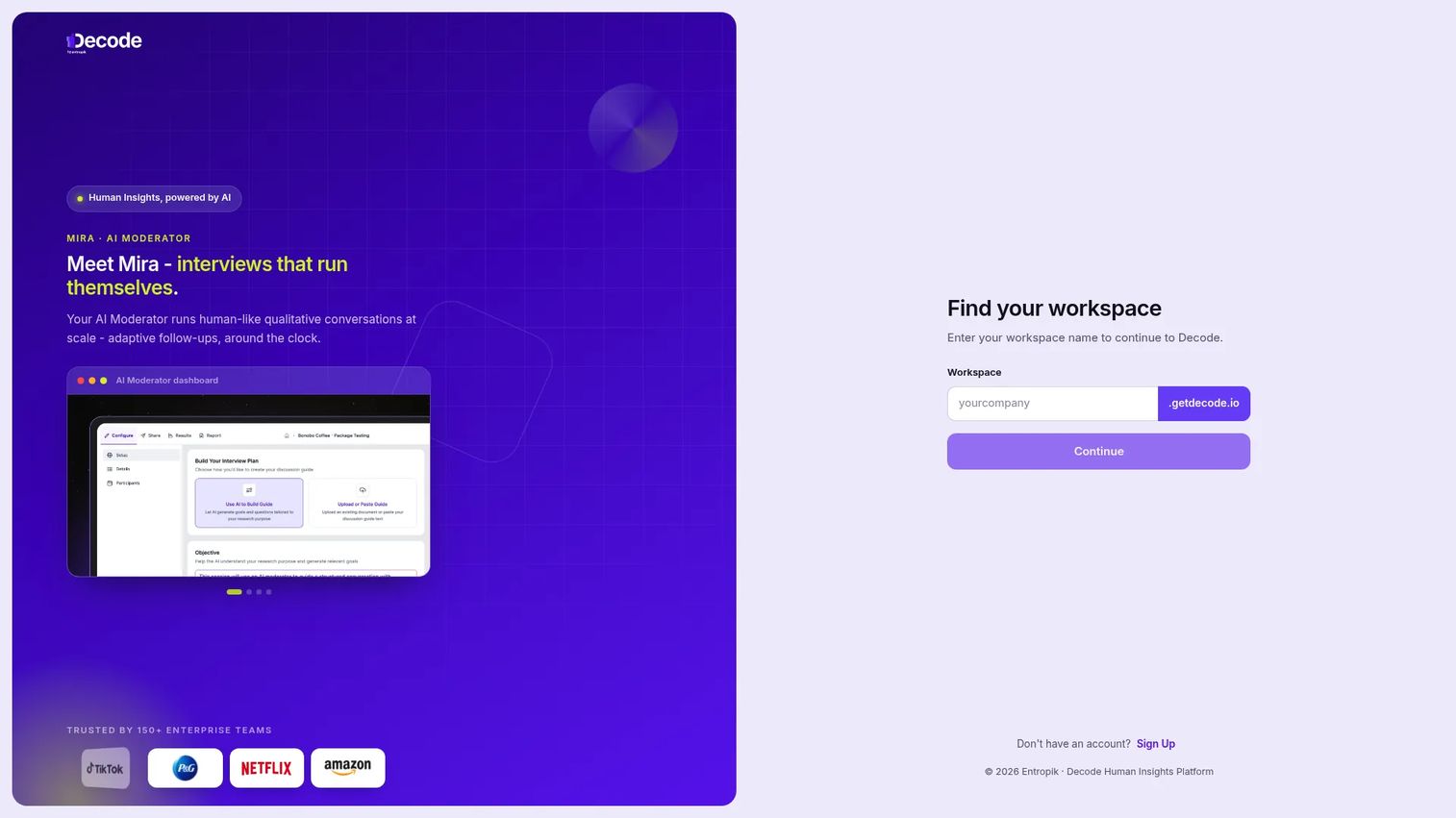
Decode by Entropik is a unified human insights platform for user and consumer research. It is the same company as entry 5 in this list, so treat Decode and Entropik as one vendor with two brand surfaces rather than two shortlist options. Decode combines AI creative analysis, AI-moderated interviews, surveys, media testing, and in-context testing in a single environment. The AI Creative Insights module uses attention analysis, heatmaps, and area-of-interest scoring to evaluate how audiences process visual content. The Decode Audience Cloud handles participant recruitment when teams need external panels.
Best for: Research, insights, and product teams running integrated qualitative and quantitative studies without stitching together multiple point solutions.
Key features
- AI Creative Insights: attention, focus, clarity, heatmaps, and area-of-interest analysis
- AI-moderated structured qualitative interviews
- Media testing, in-context testing, and group discussions
- Insights Hub for storing and organizing research outputs
- Decode Audience Cloud for participant recruitment
Why choose Decode: Decode suits teams that want research output, not raw APIs. The platform handles recruitment, moderation, and analysis in one place, which reduces the coordination overhead PMs often absorb when research tools are fragmented. Verify how raw data exports fit your analytics stack before signing a contract.
Decode pricing: Pricing runs on a free tier plus a credit model. The free tier covers self-recruitment with 100 responses per month, one researcher seat, and up to three studies. Beyond that, paid access is sold as annual Enterprise agreements with bundled credits, and Entropik does not publish per-credit or per-seat rates, so ask sales for a current credit schedule before budgeting. G2 rates Decode at 4.5/5 across 51 reviews.
4. iMotions
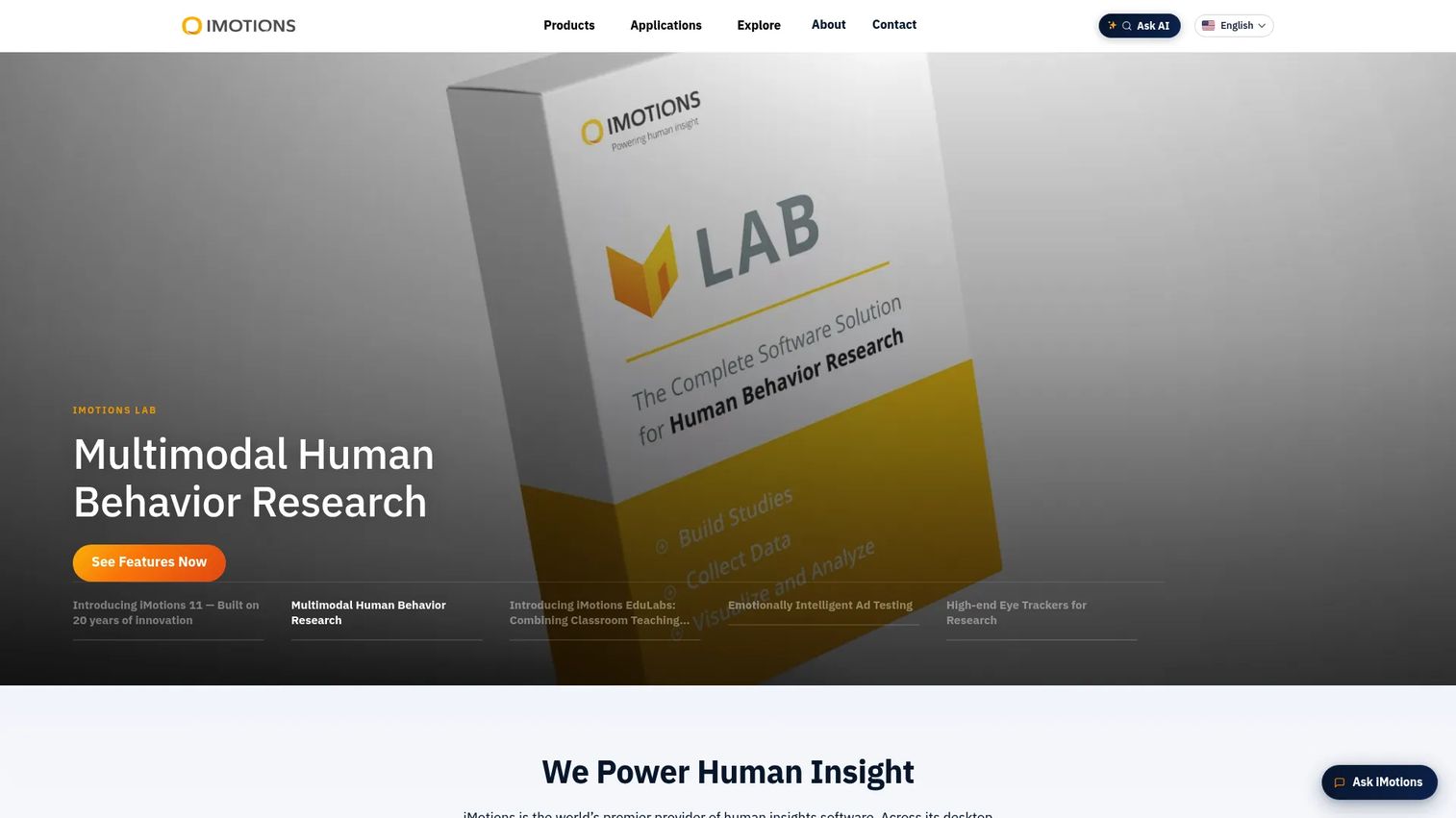
iMotions is a human behavior research platform built for rigorous, multi-signal studies, and a wholly owned Smart Eye Group subsidiary. It is the same group as Affectiva, entry 1 in this list, and since January 2025 it also carries Affectiva's Media Analytics capability. iMotions integrates biosensors, eye tracking, facial expression analysis, EEG, ECG, EMG, fNIRS, motion capture, surveys, and remote webcam-based analysis into a single data collection environment. The platform is designed for academic, clinical, and enterprise research teams running controlled studies where signal synchronization and methodological rigor matter.
Best for: Research labs, UX research teams, and enterprise product teams running lab-grade, multimodal behavioral studies.
Key features
- Multimodal biosensor data collection and synchronization
- Eye tracking, EEG, ECG, EMG, fNIRS, and motion capture modules
- Facial expression analysis and remote webcam study support
- Research study management and structured data export
- Respondent behavior analysis across lab and remote settings
Why choose iMotions: Choose iMotions when you need a lab-grade, multi-modal research environment rather than a lightweight web SDK. The tradeoff is real: hardware, software modules, and study design require operational investment. PMs should factor in setup time, hardware procurement, and researcher expertise when estimating opportunity cost against lighter alternatives.
iMotions pricing: Pricing is configured per module and by license type, with Academic, Commercial, and Student options. Commercial module subscriptions run annually and exclude hardware; academic licenses carry an annual renewal fee tied to the support program. iMotions states it does not offer a free or light plan, and every quote is configured individually.
5. Entropik
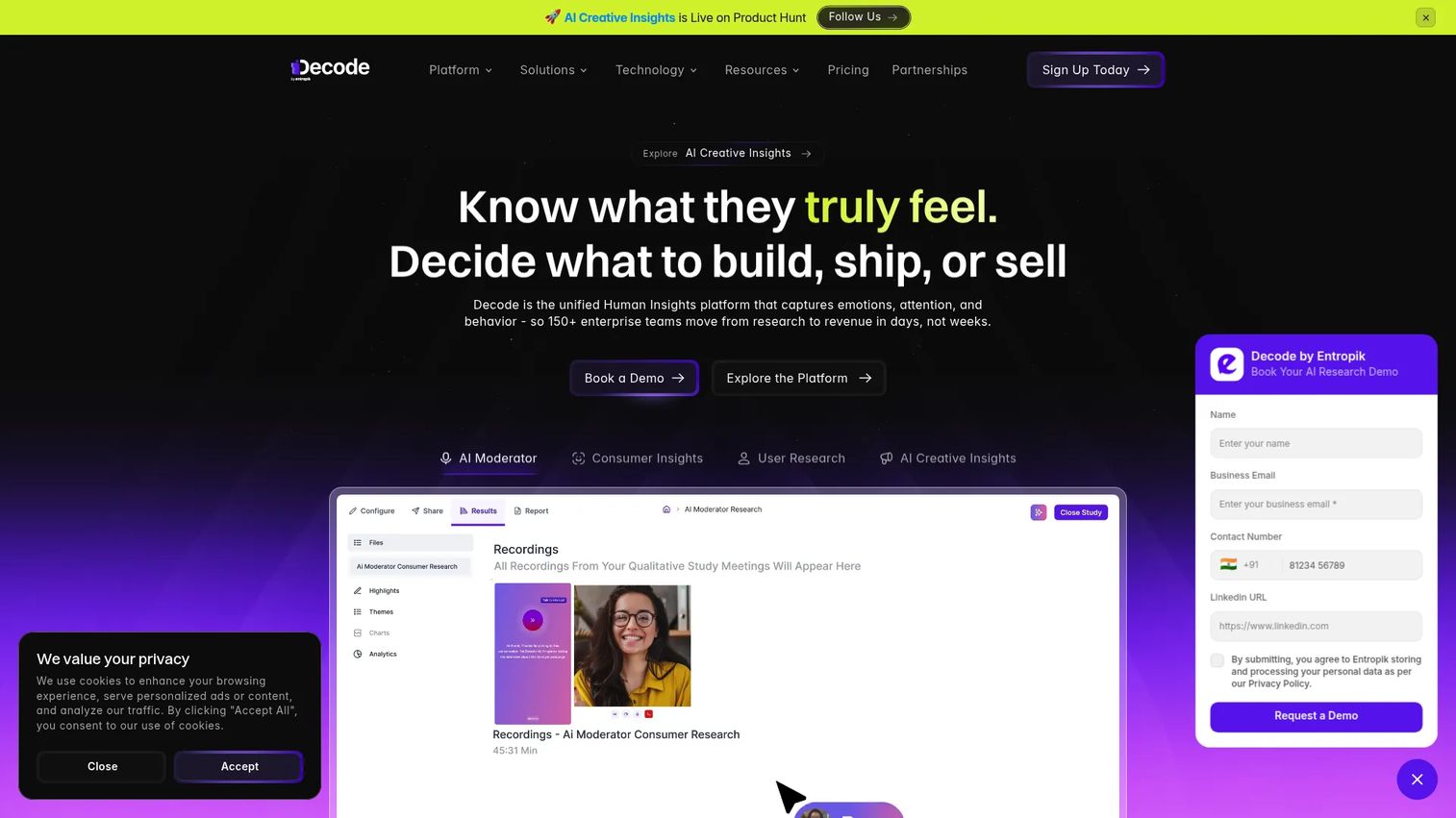
Entropik is the parent company behind Decode and operates as a consumer research and emotion AI platform in its own right. Its capabilities include facial coding, eye-gaze tracking, voice AI, text sentiment analysis, and predictive attention analytics. The Insights Hub aggregates findings across studies, and the platform's research automation features reduce manual analysis time for recurring studies.
Best for: Consumer insights, product, and marketing teams conducting AI-assisted research with emotional and behavioral signal analysis.
Key features
- Facial coding and emotion AI measurement
- Eye-gaze tracking and attention analysis
- Voice AI and text sentiment classification
- AI-moderated interviews and consumer insights
- Research automation and Insights Hub with AI synthesis
Why choose Entropik: Entropik suits teams that want a combined research workflow across qualitative and quantitative signals without managing separate tools for each method. Because Decode is Entropik's product, shortlisting both gives you one vendor, not two, so compare it against a genuinely different platform. PMs should verify how emotion metrics export into existing product analytics or BI tools, and confirm that the segmentation granularity matches their study design requirements.
Entropik pricing: A free plan is available with 100 responses per month, one researcher seat, up to three studies, 5 GB of storage, and CSV-only export. Enterprise plans cover unlimited studies, expanded seats, all modules, integrations, and dedicated support, and are priced by quote.
G2 rates Entropik Technologies at 4.5/5
6. Uniphore
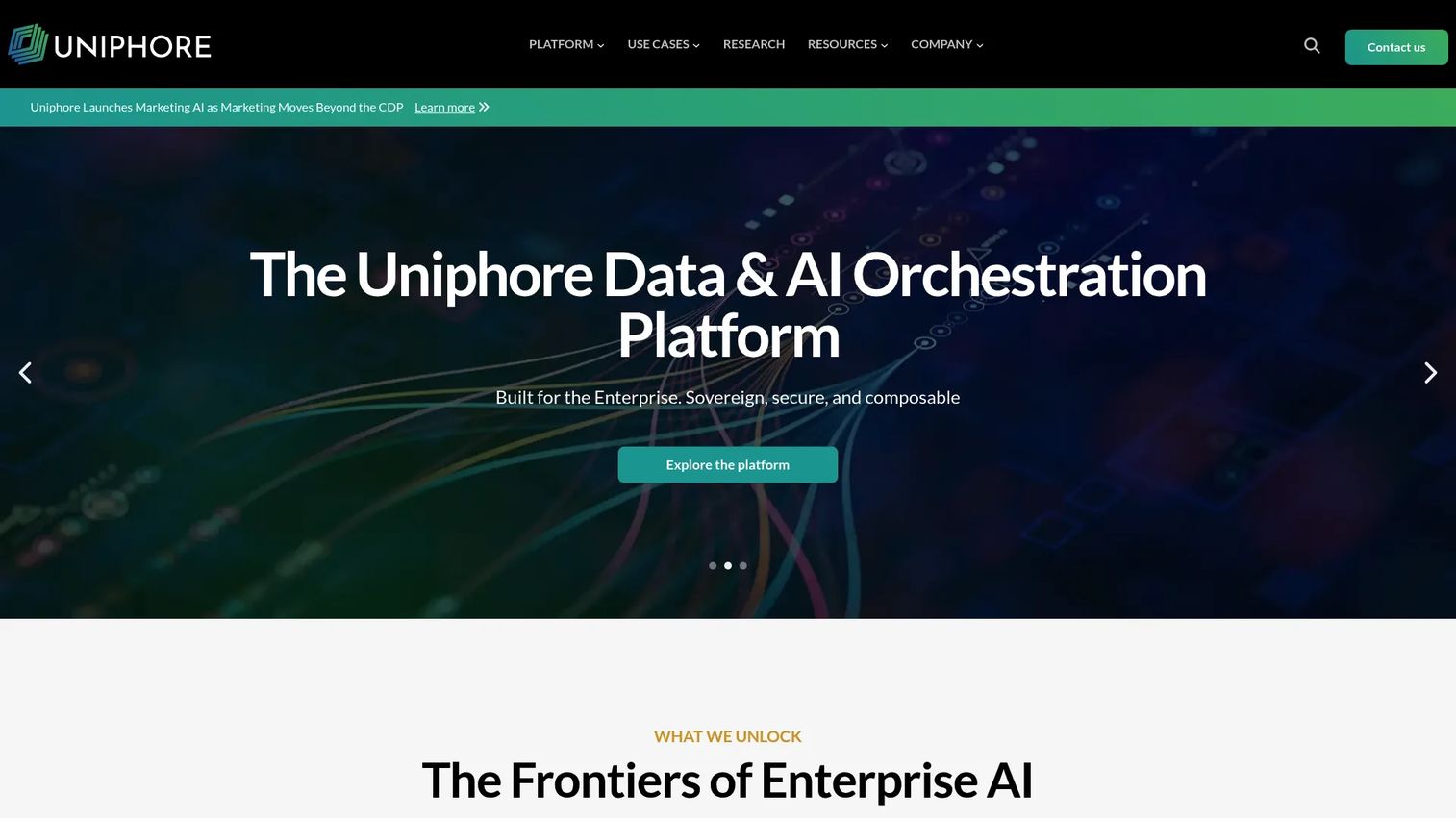
Uniphore is a sovereign, composable enterprise AI platform that connects data, models, and agents to automate business workflows. Its conversation intelligence capabilities cover voice and text analysis, multi-agent orchestration, and AI governance. The platform positions itself for large enterprises deploying governed AI agents across customer service and business operations, with domain-specific small language models designed to work with sensitive enterprise context.
Best for: Large enterprises deploying governed AI agents across customer service operations, with strict requirements for AI model control and auditability.
Key features
- Multi-agent orchestration with deterministic execution
- AI governance, security, and model control
- Voice and conversation analytics
- Domain-specific small language models for enterprise context
- Customer service workflow automation
Why choose Uniphore: Uniphore is best when AI governance, security controls, and enterprise-grade compliance are non-negotiable evaluation criteria. PMs evaluating Uniphore for emotion signal instrumentation should clarify what specific emotion or sentiment outputs the platform surfaces and how those connect to CRM or contact center reporting. Involve legal and security teams early.
Uniphore pricing: Enterprise pricing is not publicly listed. Contact sales directly.
G2 rates Uniphore at 4.2/5
7. Cogito
Cogito is now part of Verint, which acquired it in 2024. The platform provides real-time AI guidance and behavioral analytics for contact center agents, analyzing acoustic and lexical signals during live calls to surface coaching prompts, CX scores, and EX metrics. Supervisor dashboards track team-level trends, and quality analytics cover compliance and coaching effectiveness. Cogito also spun out CompanionMx, entry 8 in this list, in 2018, so those two entries share a lineage.
Best for: Large contact centers seeking live agent guidance, behavioral coaching, and customer and employee experience scoring.
Key features
- Real-time AI guidance for agents during live calls
- Analysis of acoustic and lexical signals
- Customer Experience and Employee Experience scores
- Supervisor dashboards for team-level coaching
- Quality and compliance analytics
Why choose Cogito: Choose Cogito when the primary job is improving live human conversations in a contact center, not running research studies or media tests. For PMs interested in support-to-product feedback loops, Cogito's CX and behavioral data can surface friction signals worth investigating in the product itself. Pricing, roadmap, and deployment details now route through Verint, and some Cogito capabilities are being folded into Verint-branded products, so confirm what you are buying.
Cogito pricing: Annual subscription pricing scales by functionality, user count, and telephony integration complexity. Contact Verint for a quote.
8. CompanionMx

CompanionMx was a behavioral health analytics platform that used voice and mobile signals to monitor mental health indicators. It was spun out of Cogito, entry 7 in this list, in December 2018. No active first-party product information, pricing, or G2 listing could be found for it in October 2026, and the product does not appear to be sold today. Treat it as a historical entry in this category rather than a current option.
Best for: Teams exploring voice-based mental health monitoring tools should confirm current product availability directly before including CompanionMx in any shortlist.
Key features
- Voice biomarker capture and analysis
- Mobile passive signal monitoring
- Behavioral health research data exports
Why choose CompanionMx: On current evidence there is no live product to buy. If the platform is operating under a different brand or acquirer, it may still be relevant for clinical innovation teams researching emotion-adjacent behavioral biomarkers. Verify current status, regulatory positioning, and data handling before any evaluation.
CompanionMx pricing: Contact Cogito or Verint for current status before budgeting.
9. Lightbulb
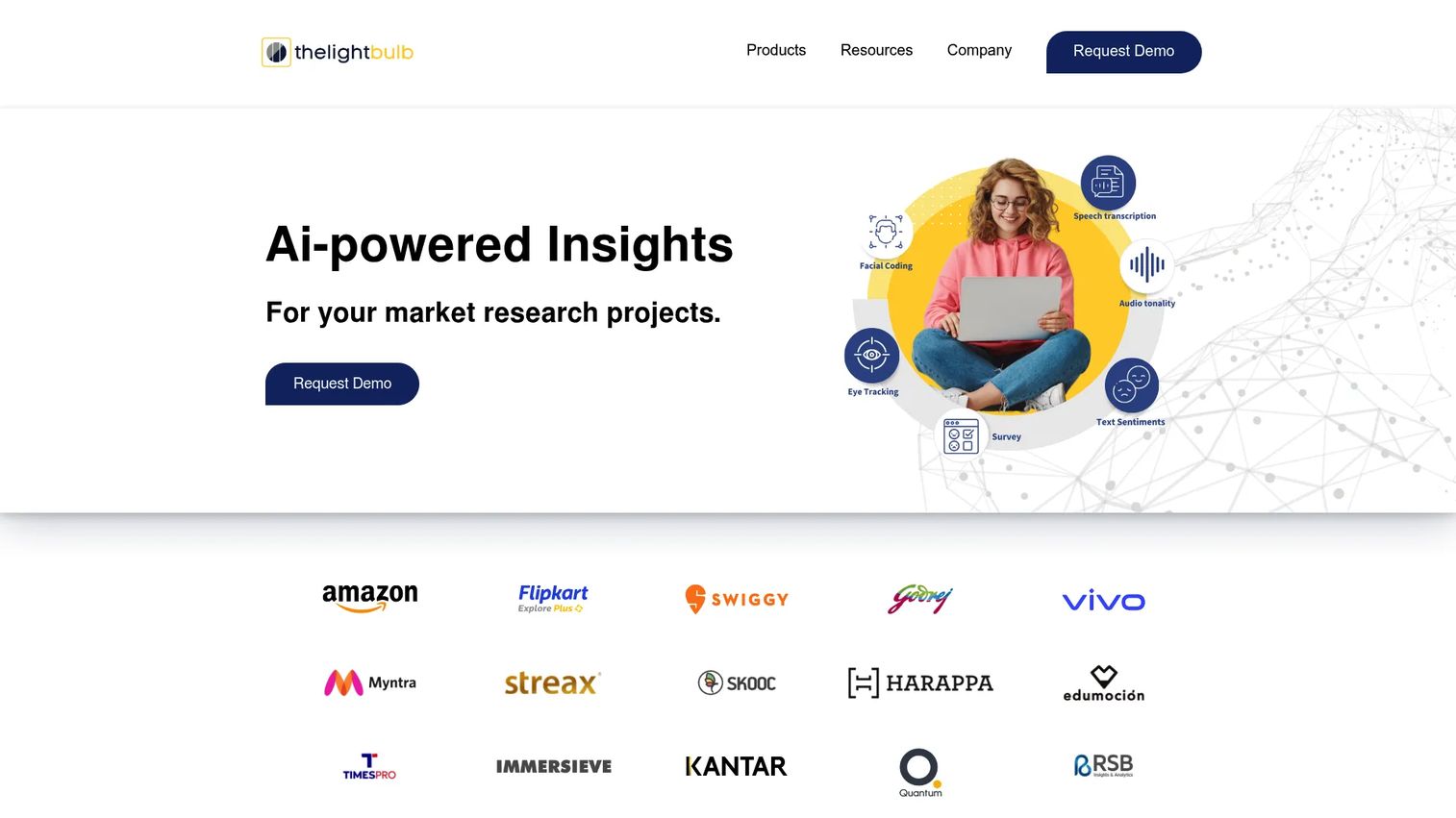
Lightbulb is an AI-powered market research platform that uses emotion-aware technologies to generate consumer insights. Its capabilities include facial coding, eye tracking, speech transcription, text sentiment analysis, generative AI analysis, and market surveys. The platform targets research teams that want emotional and behavioral signal analysis alongside traditional survey methods, and sells both API and SDK integrations and a standalone web application.
Best for: Market research teams running qualitative and quantitative studies that need emotion and engagement metrics integrated with survey analysis.
Key features
- Facial coding and eye tracking
- Speech transcription and text sentiment analysis
- Generative AI analysis of research findings
- Market surveys with behavioral signal integration
- Participant management tools
Why choose Lightbulb: Lightbulb is a research workflow tool, not a raw emotion API. PMs should verify methodology transparency, panel recruitment capabilities, and how Lightbulb exports connect to existing analytics infrastructure. Its G2 listings carry no reviews at all, so peer references and a pilot study matter more here than for better-reviewed platforms.
Lightbulb pricing: Pricing is provided through a request form on the vendor site. No self-service plan tiers are displayed. Contact Lightbulb directly for research license options.
10. TechSee
TechSee is a visual AI platform for customer service and field service operations. It applies computer vision to device recognition, issue diagnosis, guided self-service flows, and remote visual assistance. TechSee is adjacent to emotion AI rather than a dedicated emotion recognition platform: the customer experience analytics it surfaces reflect interaction outcomes and service quality signals rather than discrete emotion classification.
Best for: Enterprise support and field service organizations that need visual AI, remote assistance, and guided self-service with customer experience analytics.
Key features
- Computer vision AI for device and issue recognition
- Remote visual assistance with AR guidance and multiparty consultation
- Visual self-service flows with image capture and AI-guided resolution
- Visual job verification and automated job summaries
- Customer experience analytics and knowledge base integration
Why choose TechSee: Choose TechSee when the primary job is resolving physical product issues through visual intelligence, not analyzing emotional states in isolation. For PMs, TechSee's support interaction data can identify product usability gaps and inform roadmap decisions about self-service design. It earns a 4.9/5 on G2 from 10 reviews, the highest rating in this list, though 10 reviews is a thin sample.
TechSee pricing: Pricing is tailored by product set, scale, integrations, and implementation model. Contact TechSee for a quote
G2 rates TechSee at 4.9/5 across 10 reviews.
11. MetaSoul

MetaSoul provides digital-sentience and emotional-personality technology for AI agents, humanoid robots, games, IoT devices, vehicles, and digital humans. It is an Emoshape brand, built on that company's emotion processing unit work. Its architecture includes a synthetic emotion processing engine (Emo Matrix and EPU), an Emotion Profile Graph for emotional memory, Myers-Briggs-based adaptive personalities, and real-time facial and voice tone expression. Deployment options span cloud, hybrid, and edge, including robotics environments.
Best for: Teams building emotionally responsive AI agents, digital humans, game characters, or IoT experiences with adaptive personality behavior.
Key features
- Dynamic personalities that evolve through memories and interactions
- Real-time synthetic emotion processing via Emo Matrix and EPU
- Emotion Profile Graph (EPG) for emotional memory and learned sensitivity
- Support for facial expression and voice tone control
- Cloud, hybrid, and edge deployment options
Why choose MetaSoul: MetaSoul is for teams building emotion-aware interaction layers, not analyzing user reactions to existing products. It sits at the applied AI and digital human end of the affective computing spectrum. PMs should verify production readiness, data handling for personality persistence data, and integration scope before committing to a development project.
MetaSoul pricing: MetaSoul sells a consumer-priced entry product bundled with a period of MetaSoul Flow access, then a low monthly fee to extend it, with enterprise hardware, cloud licensing, and EPU integration priced by quote.
Considerations when choosing emotion AI software
Check who actually owns the tools on your shortlist
This category has consolidated to the point where a four-vendor shortlist can easily contain two companies. Affectiva and iMotions sit in Smart Eye Group. Decode is Entropik's product and shares its G2 listing. Cogito belongs to Verint. Before you run a bake-off, confirm each entry is a genuinely separate vendor, or you will negotiate against yourself.
Match the signal to the decision
Facial expression data, voice tone, eye gaze, and physiological signals answer fundamentally different questions. Start with the decision you need to make, then work backward to the signal. If you want to know whether a UI creates confusion during onboarding, facial coding during moderated testing is more actionable than text sentiment from support tickets.
Verify consent and data handling
Emotion AI captures biometric and behavioral signals that carry significant privacy implications. Ask vendors specifically about explicit consent mechanisms, data retention periods, storage location, video processing architecture, and deletion workflows. Users who do not understand what is being captured often react negatively when they learn, which creates trust and churn risk.
Check model confidence and demographic bias
Emotion recognition accuracy varies across lighting conditions, cultures, age groups, accents, and physical features. A model trained on a narrow dataset may systematically misclassify expressions for underrepresented groups. Ask vendors for performance documentation across demographic segments, bias testing results, confidence score reporting, and explainability features. This is not optional due diligence for production deployments.
Plan for integration and export
The signal is only as useful as what you do with it. Look for APIs, CSV export, data warehouse connectors, and integrations with your existing research tools, product analytics stack, or CRM. A dashboard that does not connect to where your team works will be checked once and forgotten.
Separate research tools from production SDKs
Several platforms on this list are built for controlled research studies with panels and lab environments. Others are SDKs or real-time operational systems. The procurement process, security review, and success metrics differ substantially. Buying a lab research tool for production instrumentation, or vice versa, is a common and costly mismatch.
Conclusion
The right emotion AI platform depends on what signal you need, where you need it, and how you plan to act on the output.
For media and consumer research, Affectiva, Decode, and Entropik cover facial coding, attention measurement, and integrated research workflows, with the caveat that Decode and Entropik are one company and Affectiva now ships its media analytics through iMotions. MorphCast fits teams that need browser-based processing without server-side video handling. iMotions is the choice for rigorous, lab-grade, multimodal studies. Uniphore and Cogito address voice emotion and conversation intelligence in contact center operations, with Cogito now sold through Verint. TechSee covers visual service intelligence for support and field teams. MetaSoul targets teams building emotion-aware synthetic characters or AI agents.
CompanionMx has no active product on current evidence, and Lightbulb carries no published review coverage, so verify availability and ask for references before including either in a formal evaluation.
Shortlist by signal type, deployment model, consent requirements, integration fit, and corporate ownership. Run a pilot with real research questions before committing to a platform, and involve your legal and security teams early for any production deployment that captures video or voice from customers.
Emotion AI tells you how people reacted to your product. It does not help you explain the product in the first place. If your team needs to show how complex software works before a buyer or a user gets hands on it, Guideflow builds interactive demos your presales and product marketing teams can share directly. Start your journey with Guideflow today!
FAQs
Emotion AI software uses artificial intelligence to infer human emotional states, attention, or engagement from observable signals such as facial expressions, voice tone, text, eye gaze, and physiological data. It is also called affective computing or emotion recognition software. These tools estimate emotional states based on measurable patterns; they do not read internal feelings with certainty.
A typical pipeline captures a signal (video, audio, text, or sensor data), extracts features (facial action units, acoustic properties, word patterns), runs those features through a trained classification model, and returns a confidence-scored output such as attention level, emotional valence, or engagement score. Reporting then aggregates those outputs across participants, sessions, or time periods.