Your product shipped. Users signed up. And still, they can't find the feature that would make them stay.
Search is no longer a simple text box. For product managers in 2026, it's the backbone of activation, conversion, and retention. A McKinsey 2026 study found that about half of consumers surveyed across 11 markets had used AI for shopping in the past three months, which signals a fundamental shift in how people expect to discover products, content, and answers. The gap between "search exists" and "search actually guides users to value" is where most products lose people quietly.
The platforms in this guide span four distinct categories: Hosted AI search, open search infrastructure, ecommerce discovery suites, and AI visibility tools. Picking the wrong one means months of re-instrumentation, misaligned KPIs, and engineering hours spent on tuning instead of features.
What's inside
This guide compares 10 AI search and discovery platforms for 2026. It is for product managers, growth teams, ecommerce teams, and digital product leaders evaluating discovery as a core product function.
Tools were selected based on:
- Category fit: Ecommerce search, enterprise retrieval, AI visibility, or answer engine coverage
- AI capabilities: Semantic search, natural-language understanding, vector retrieval, or recommendations
- PM relevance: Implementation burden, measurable outcomes, and integration with analytics stacks
- Pricing transparency: Verified against vendor pricing pages, with G2 ratings checked at generation time
The list covers platforms you'd evaluate at different stages, from quick-win hosted search to long-horizon infrastructure investments. Cross-reference with our roundup of ai search and retrieval platforms and best enterprise search software for deeper category comparisons.
TL;DR
- Best overall hosted AI search: Algolia for product and ecommerce teams that need relevance controls without building infrastructure
- Best open search infrastructure: Elasticsearch for engineering-led teams with complex retrieval and analytics requirements
- Best ecommerce discovery suite: Bloomreach for mid-market and enterprise commerce brands managing catalogues, recommendations, and customer data together
- Best commerce AI on Google Cloud: Google Cloud AI Commerce Search for enterprise retailers already running on GCP
- Best AI visibility tools: Scrunch for measurement-first teams; SitecoreAI Search for enterprise content and digital experience teams
- Best answer engine options: ChatGPT, Claude, Gemini, and Perplexity for teams studying how buyers discover answers before reaching your website
What is AI search and discovery software?
AI search and discovery software helps users find products, content, answers, or recommendations by using machine learning, natural-language understanding, semantic retrieval, and personalization instead of relying only on exact keyword matching.
The category spans several platform types: Hosted search boxes with AI ranking, recommendation engines, conversational interfaces, enterprise knowledge retrieval systems, and AI visibility measurement tools. It supports ecommerce catalogs, SaaS help centers, internal knowledge bases, and marketplace discovery.
What separates AI search from traditional keyword search is intent interpretation. A traditional system matches tokens. An AI system infers meaning, ranks by predicted relevance, learns from user behavior over time, and in some configurations generates answers directly from trusted data sources.
Core capabilities to look for
- Semantic search and vector retrieval
- Keyword and hybrid search (combined with semantic)
- Natural-language query understanding
- Personalized product and content recommendations
- Merchandising and ranking controls
- Conversational search interfaces
- Retrieval augmented generation (RAG) for grounded AI answers
- Query analytics and relevance reporting
- Integrations with catalogs, CMS, data warehouses, and analytics platforms
Key metrics PMs should track
Treat search like any other instrumented product experience. Track these after implementation:
- Zero-result rate
- Search conversion rate
- Query reformulation rate
- Click-through rate from results
- Time to first useful result
- Search exit rate
- Recommendation click-through
- Assisted conversion
- Support deflection from search-driven self-serve
If you can't move at least two of these metrics in 90 days, something in the data pipeline or relevance tuning needs attention before anything else.
When to use AI search and discovery platforms
Help users find the right product or content faster
Ecommerce catalogs, SaaS feature libraries, and help centers all suffer from the same problem: Users search with imprecise language and get irrelevant results. AI search reduces zero-result rates and improves first-click accuracy. For PMs, the downstream effect is higher activation and lower support load. If your search exit rate is above 30%, that's a signal the retrieval layer needs work.
Turn natural-language intent into better results
Users type full questions, misspelled terms, and industry jargon. Semantic and vector search map those queries to meaning rather than tokens, so a user searching "can't see my invoices" matches the billing feature even without exact keyword overlap. This matters most in complex SaaS products and large catalogs where query vocabulary varies widely by persona or segment.
Measure discovery as a product experience
Search should be instrumented the same way onboarding is. PMs who run A/B tests on ranking models, monitor zero-result rates per segment, and connect search engagement to downstream retention are treating discovery as a product lever, not just a UI component. Choose platforms that expose per-query analytics and support A/B testing in production. Platforms without this visibility create a maintenance liability as the product scales.
AI search and discovery platform comparison
The table below covers all 10 platforms with verified pricing and G2 ratings checked at generation time. See individual entries for full pricing breakdowns and feature details. G2 ratings for newer or niche products may show N/A where no current listing exists.
| # | Product | Best for | Key differentiator | Pricing | G2 rating |
|---|---|---|---|---|---|
| 1 | Algolia | Hosted AI search and ecommerce discovery | API-first search with AI ranking and merchandising controls | Free tier; paid usage-based | 4.5/5 |
| 2 | Elasticsearch | Custom search infrastructure | Open, distributed search with vector support | Usage-based from $0.047/GB/mo | 4.5/5 |
| 3 | Bloomreach | Ecommerce personalization and catalog discovery | Search, merchandising, recommendations, and customer data combined | From $60K/year | 4.6/5 |
| 4 | Google Cloud AI Commerce Search | Enterprise commerce on Google Cloud | Commerce-tuned AI, catalog enrichment, conversational search | From $2.50/1K requests | N/A |
| 5 | SitecoreAI Search | Enterprise content and AI visibility | AI prompt monitoring tied to digital experience management | Custom pricing | N/A |
| 6 | Scrunch | AI visibility measurement | Citation share and prompt-level monitoring across AI engines | From $250/mo | 4.6/5 |
| 7 | ChatGPT | General AI answer discovery | Broad consumer and enterprise answer interface | Free; paid from $8/mo | 4.6/5 |
| 8 | Claude | Knowledge work and enterprise reasoning | Long-context analysis and document synthesis | Free; paid from $17/mo | 4.7/5 |
| 9 | Gemini | Google-connected AI discovery | Multimodal AI tied to Google Workspace and search | Free; paid from $19.99/mo | 4.4/5 |
| 10 | Perplexity | Citation-led answer search | Research-style answers with inline source citations | Free; Pro at $20/mo | 4.4/5 |
Best 10 AI search and discovery platforms for 2026
1. Algolia
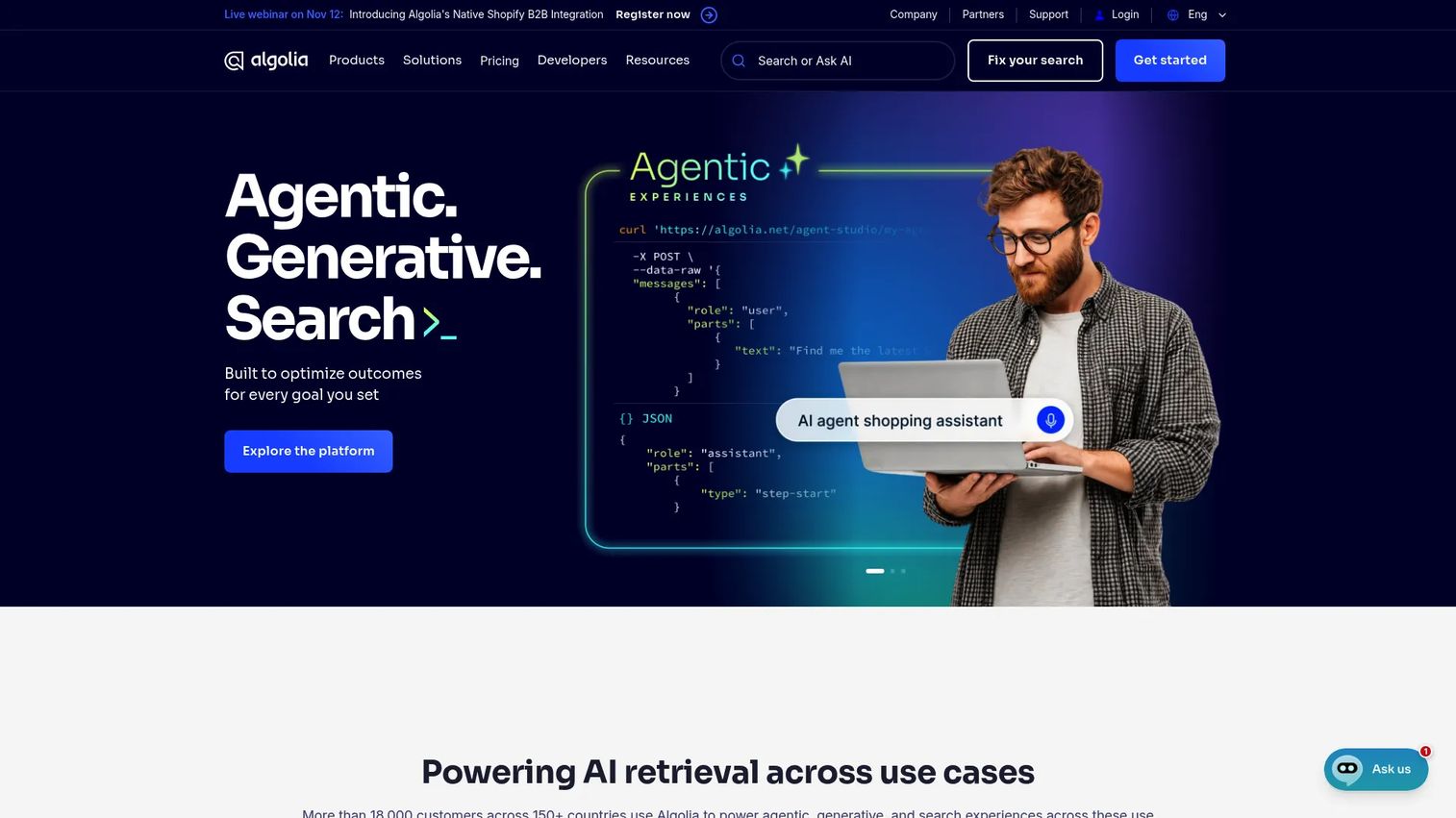
Algolia is a hosted AI search and retrieval platform for product discovery, site search, ecommerce, and application search. It combines keyword and semantic retrieval, AI ranking, merchandising controls, recommendations, and generative search experiences in a managed API-first stack. Teams without dedicated search infrastructure engineers use it to get production-quality search running without building a custom indexing pipeline.
Best for: Product and ecommerce teams that need scalable hosted search with strong relevance controls and built-in analytics.
Key features
- Keyword and hybrid NeuralSearch
- AI ranking, personalization, and query suggestions
- Ecommerce merchandising rules and controls
- Recommendations and AI-generated discovery experiences
- Search analytics for relevance and conversion tracking
Why choose Algolia: Algolia is a strong fit when product discovery is central to your activation funnel and you want a managed platform that keeps engineering involvement low during the initial rollout. Teams with clean, well-structured catalog data will see the fastest time to measurable relevance improvement. If your catalog data is inconsistent or behavioral event signals are sparse, budget time for data preparation before expecting meaningful ranking improvements.
Algolia pricing: Algolia starts free, with 10,000 search requests and 50,000 records included monthly at no cost. The Grow tier adds usage-based overage at $0.50 per additional 1,000 search requests. Enterprise-scale Elevate plans use custom annual pricing. A free trial is available with no credit card required.
G2 rating: 4.5/5
2. Elasticsearch
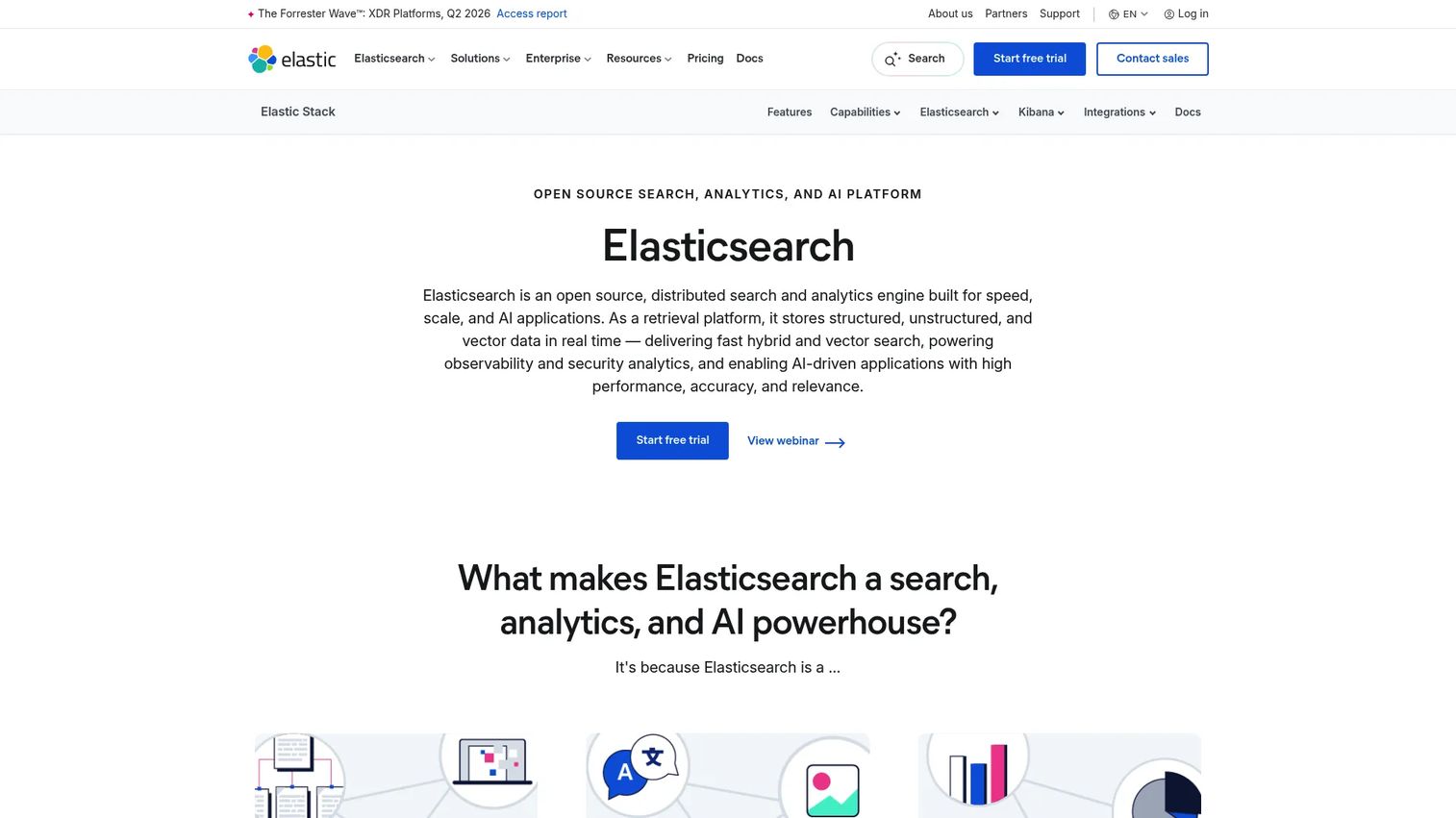
Elasticsearch is a distributed, RESTful search and analytics engine used for application search, enterprise retrieval, observability, and security analytics. It supports full-text search, vector search, hybrid retrieval, and aggregations across structured and unstructured data at scale. Teams with engineering depth use it to build custom search architectures that connect tightly to their existing data infrastructure.
Best for: Engineering-led product teams that need fine-grained control over indexing, query design, relevance tuning, and infrastructure.
Key features
- Full-text and vector search
- Distributed clustering with horizontal scalability
- Custom relevance tuning via Query DSL
- Machine-learning-based anomaly detection and forecasting
- REST APIs, Elasticsearch SQL, and EQL query languages
Why choose Elasticsearch: Elasticsearch fits teams building hybrid retrieval systems, internal knowledge tools, or product search where the query logic is complex and owned by the engineering team. PMs should plan for sustained engineering involvement. Relevance tuning, mapping design, and performance at scale are not self-service, and an under-resourced implementation will produce mediocre results even on strong hardware. For teams with that depth, it's one of the most capable platforms available. Explore more options in our best ecommerce search software guide.
Elasticsearch pricing: Elasticsearch Serverless pricing starts at $0.14 per VCU per hour for ingest and $0.047 per GB retained per month for storage. Hosted and self-managed plans are also available, with hosted running resource-based pay-as-you-go and self-managed requiring a sales conversation. A free trial is available.
G2 rating: 4.5/5
3. Bloomreach
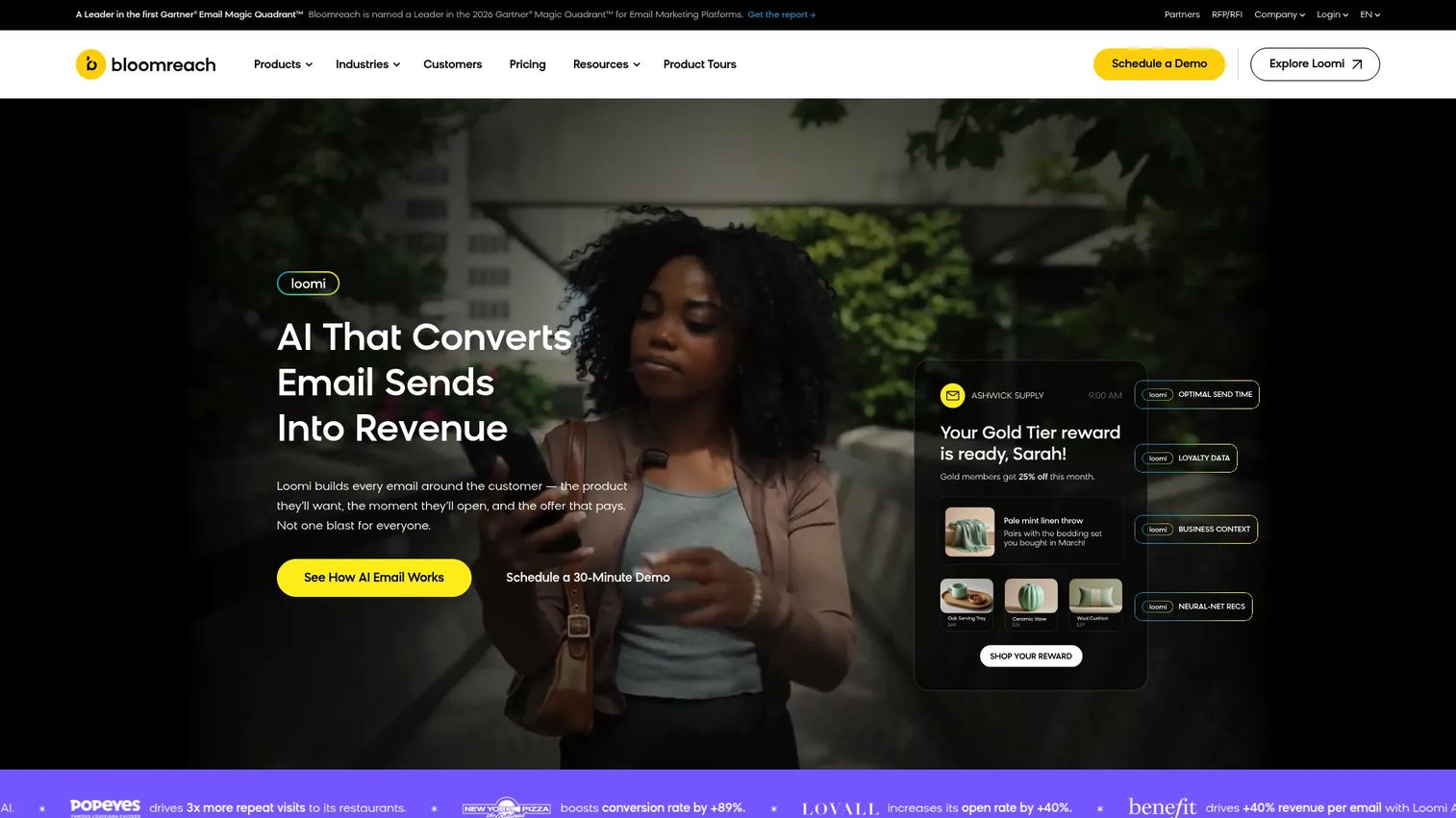
Bloomreach is an AI-powered personalization platform that combines ecommerce site search, merchandising controls, product recommendations, omnichannel marketing automation, and a real-time customer data engine. It is built for commerce teams that want to manage discovery and engagement from a single platform rather than integrating separate tools for search, recommendations, and customer data.
Best for: Mid-market and enterprise ecommerce brands that want search, recommendations, and customer data working together on the same behavioral signals.
Key features
- AI-powered ecommerce site search and browsing
- Personalized product recommendations
- Omnichannel marketing automation across email, SMS, and web
- Real-time customer data engine and unified customer profiles
- Merchandising controls for ranking and product curation
Why choose Bloomreach: Bloomreach is the right fit when discovery and customer engagement are genuinely shared problems across product, ecommerce, and marketing teams. If your merchandising team needs hands-on control over ranking rules while your data team wants behavioral personalization signals feeding the same engine, this platform is built for that combination. Teams focused only on site search without the broader personalization use case may find the platform more than they need. See related tools in our best ecommerce personalization software roundup.
Bloomreach pricing: Bloomreach uses custom annual pricing based on audience size, catalog volume, products used, and usage. Smaller brands start at approximately $60,000 per year. Contact Bloomreach for a quote.
G2 rating: 4.6/5
4. Google Cloud AI Commerce Search
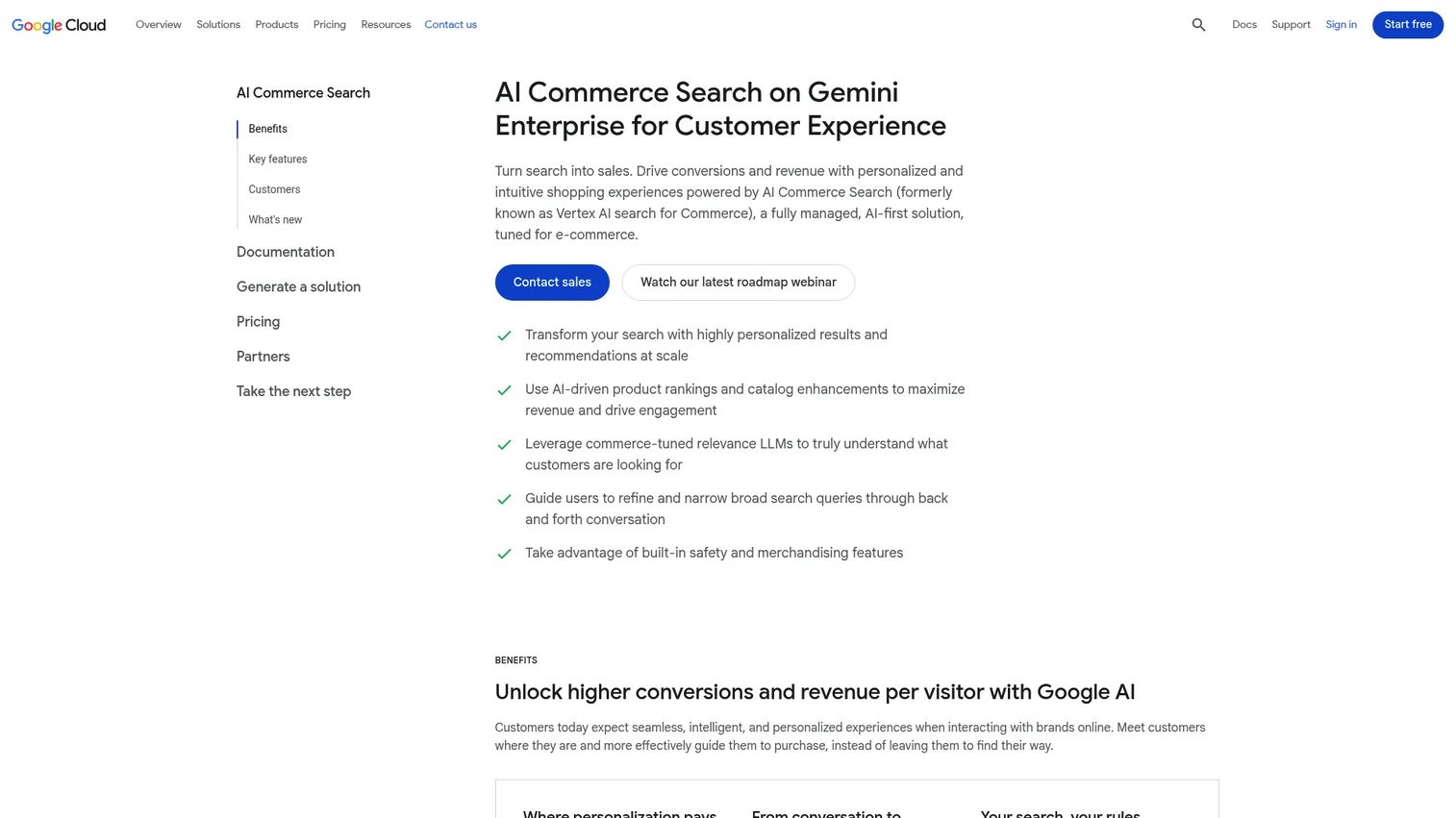
Google Cloud AI Commerce Search is a fully managed commerce search and product discovery service inside the Google Cloud ecosystem. It delivers personalized search results, product recommendations, catalog enrichment using Vision AI and Google Shopping data, and conversational search agents for guiding buyers through broad queries. It is designed for enterprise retailers with complex catalogs and existing GCP infrastructure.
Best for: Enterprise retailers with large catalogs already running on Google Cloud who want AI-powered discovery without building a custom search stack.
Key features
- Commerce-tuned AI search with personalized ranking
- Product recommendations and AI-driven browsing
- Catalog enrichment using Vision AI and Google Shopping crawlers
- Conversational and guided search for broad or ambiguous queries
- Integrations with BigQuery, Cloud Storage, and Google Analytics
Why choose Google Cloud AI Commerce Search: This platform fits retailers where Google Cloud is already the data and infrastructure layer. The catalog enrichment capabilities are genuinely strong for large SKU counts where manual attribute management is infeasible. Implementation is a cross-functional project: Plan for involvement from product, merchandising, data engineering, and your GCP team before committing timelines. Teams outside the Google Cloud ecosystem should evaluate the migration cost before treating this as a shortlist option.
Google Cloud AI Commerce Search pricing: Pricing is usage-based. Search and browse queries cost $2.50 per 1,000 requests. Recommendation predictions cost $0.27 per 1,000 requests for the first 20 million monthly predictions, with training and tuning at $2.50 per hour. New signups receive $600 in free recommendation credits to start.
5. SitecoreAI Search
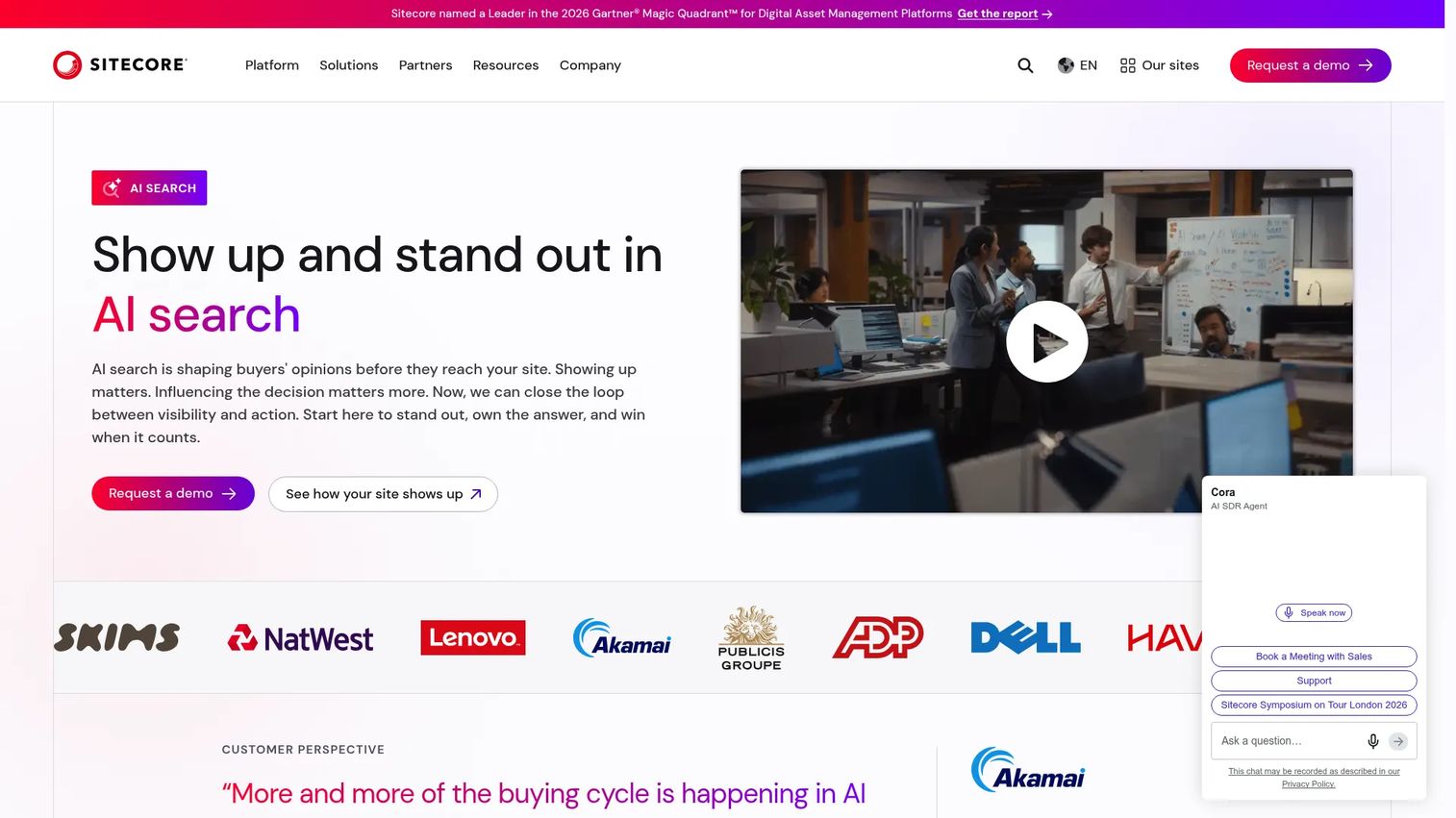
SitecoreAI Search is an AI search visibility and agent experience platform for enterprise brands managing content across digital experience systems. It monitors how AI engines discover and represent brand content, tracks citations and prompt-level mentions, identifies content gaps versus competitors, and delivers AI-optimized content at the edge. It sits at the intersection of enterprise content operations and AI visibility measurement.
Best for: Enterprise digital teams that want to understand and improve how their brand and content appear across AI search surfaces.
Key features
- AI prompt and brand-presence monitoring
- Citation tracking and AI search trend analysis
- Content gap identification against competitive benchmarks
- Agent traffic and site-map monitoring
- AI-optimized content delivery at the edge
Why choose SitecoreAI Search: This is not a product search or catalog discovery platform. It fits teams whose primary concern is whether AI engines accurately represent their brand, cite their content, and surface them in AI-generated answers. PMs evaluating it should distinguish clearly between this use case and ecommerce product search. Teams invested in Sitecore's digital experience platform will find the tightest integration. Those without existing Sitecore infrastructure should factor onboarding scope into the evaluation. For more AI visibility context, see our answer engine optimization tools guide.
SitecoreAI Search pricing: Custom pricing. Contact Sitecore for a quote.
6. Scrunch
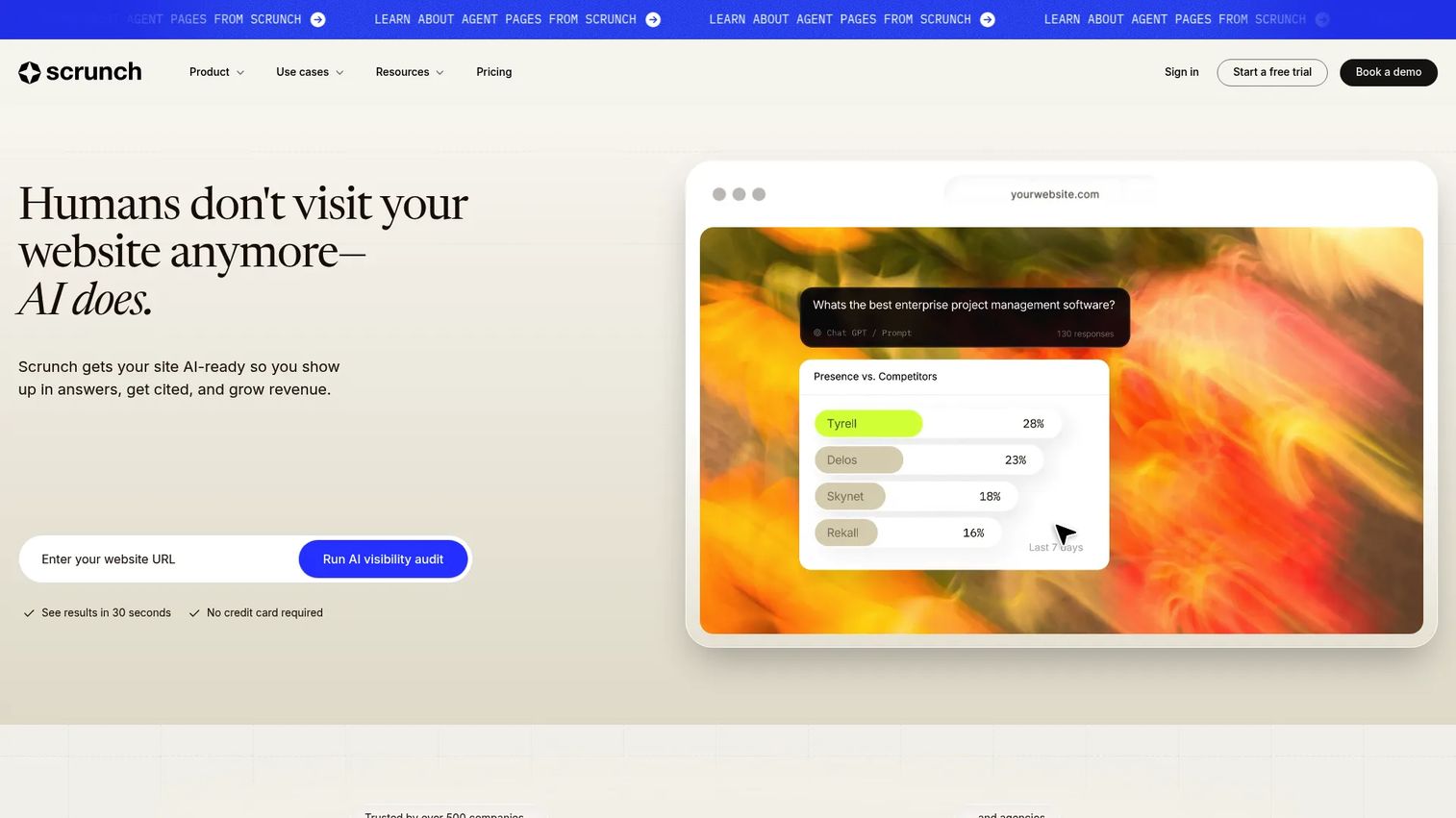
Scrunch is an AI search optimization platform covering visibility monitoring, website auditing, content optimization, and AI-agent content delivery. It tracks how a brand appears across nine major AI surfaces including ChatGPT, Perplexity, Gemini, Claude, Google AI Mode, and Microsoft Copilot, then provides citation share data, sentiment analysis, and content recommendations to close visibility gaps.
Best for: Brands and agencies that need to monitor and improve discoverability across AI answer engines before users reach the website.
Key features
- AI visibility monitoring across nine major AI engines
- Citation share measurement and prompt-level brand tracking
- Website auditing with sentiment analysis and AI bot-traffic monitoring
- Content gap insights and optimization recommendations
- Agent Experience Platform (AXP) for delivering content to AI agents
Why choose Scrunch: Scrunch solves a genuinely different problem from catalog search or enterprise retrieval. If your discovery challenge is that AI engines don't mention your brand accurately or consistently, this is where to look. A 2026 Yext study found 42.7% of global consumers used AI for local search in the past month, which makes AI-channel visibility a measurable acquisition concern, not a future bet. The Core plan at $250/month includes 125 unique prompts, 5 site audits per month, and coverage across four LLMs. That scope suits teams running initial visibility audits. Enterprise plans add expanded model coverage, AXP access, API access, and SSO.
Scrunch pricing: Core plan starts at $250/month, covering 125 prompts, 5 site audits per month, and 4 LLMs. A 7-day free trial is available. Enterprise pricing is custom.
G2 rating: 4.6/5
7. ChatGPT
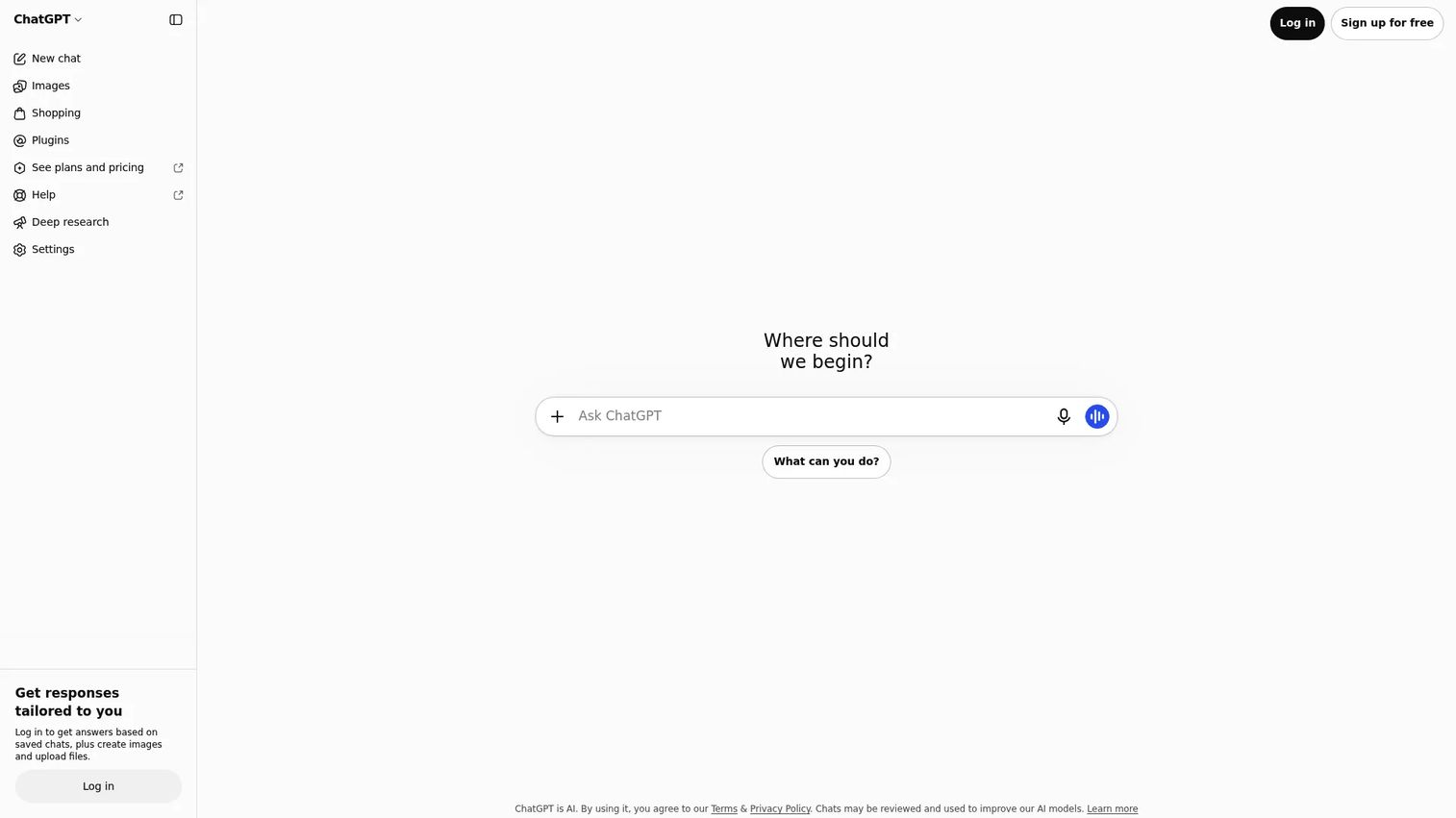
ChatGPT is OpenAI's general AI assistant and answer interface used by individuals and enterprise teams for writing, research, coding, analysis, and conversational discovery. For PMs, it matters as a channel where buyers increasingly ask comparison questions, seek product recommendations, and research software options before visiting any vendor website. A 2026 Verdane/Norstat study found 33% of active conversational-AI users prefer it over traditional search engines for finding information.
Best for: Teams studying AI-mediated buyer discovery and building internal or customer-facing answer workflows.
Key features
- Conversational AI answers with web search and browsing
- File uploads and deep research with cited outputs
- Custom GPT workflows for specialized use cases
- Enterprise admin controls and data privacy settings
- Multimodal input including images, audio, and documents
Why choose ChatGPT: Treat ChatGPT as an answer interface, not a replacement for dedicated product search infrastructure. Its value for PMs is twofold: Understanding how buyers encounter and evaluate products through AI conversations, and building customer-facing or internal answer tools using the API or custom GPT functionality. Enterprise teams get admin controls, usage monitoring, and privacy options that make it viable for internal knowledge retrieval workflows. For teams exploring the broader best generative ai tools landscape, ChatGPT is the reference point most evaluation frameworks start from.
ChatGPT pricing: A free plan is available. The Go plan costs $8/month. Plus, Pro, Business, and Enterprise plans are also available; contact OpenAI for Business and Enterprise pricing. All plans are billed monthly.
G2 rating: 4.6/5
8. Claude
Claude is Anthropic's AI assistant built for writing, analysis, research, and coding. It is particularly well-suited for discovery tasks involving long documents: Policy libraries, technical specs, research corpora, or large knowledge bases where synthesis across many sources matters more than fast retrieval of a single answer. It supports web search, file creation, memory across conversations, and API access for builders.
Best for: Product and knowledge teams working with long-form documents, research synthesis, complex reasoning, and enterprise knowledge discovery.
Key features
- Long-context document analysis and synthesis
- Web search and conversational knowledge discovery
- Projects and memory across conversations
- Team and enterprise controls with data privacy settings
- API access and Claude Code for builders
Why choose Claude: Claude excels at discovery tasks where the user needs to reason across a large body of content rather than retrieve a single answer. PMs evaluating it for internal knowledge retrieval should test it against their actual document types: Legal contracts, product specs, and research reports are where it performs most distinctly. For customer-facing search infrastructure, Claude works better as a generation layer on top of a retrieval system than as a standalone search product. Its long-context window is a genuine structural advantage over shorter-context alternatives. Find related tools in our ai copilot software guide.
Claude pricing: Free plan available. Pro costs $17/month (billed annually) or $20/month (billed monthly). Max costs $100/month and Ultra costs $200/month. Team Standard seats run $20/seat/month annually. Enterprise plans start at $20/seat/month annually with a 20-seat minimum.
G2 rating: 4.7/5
9. Gemini
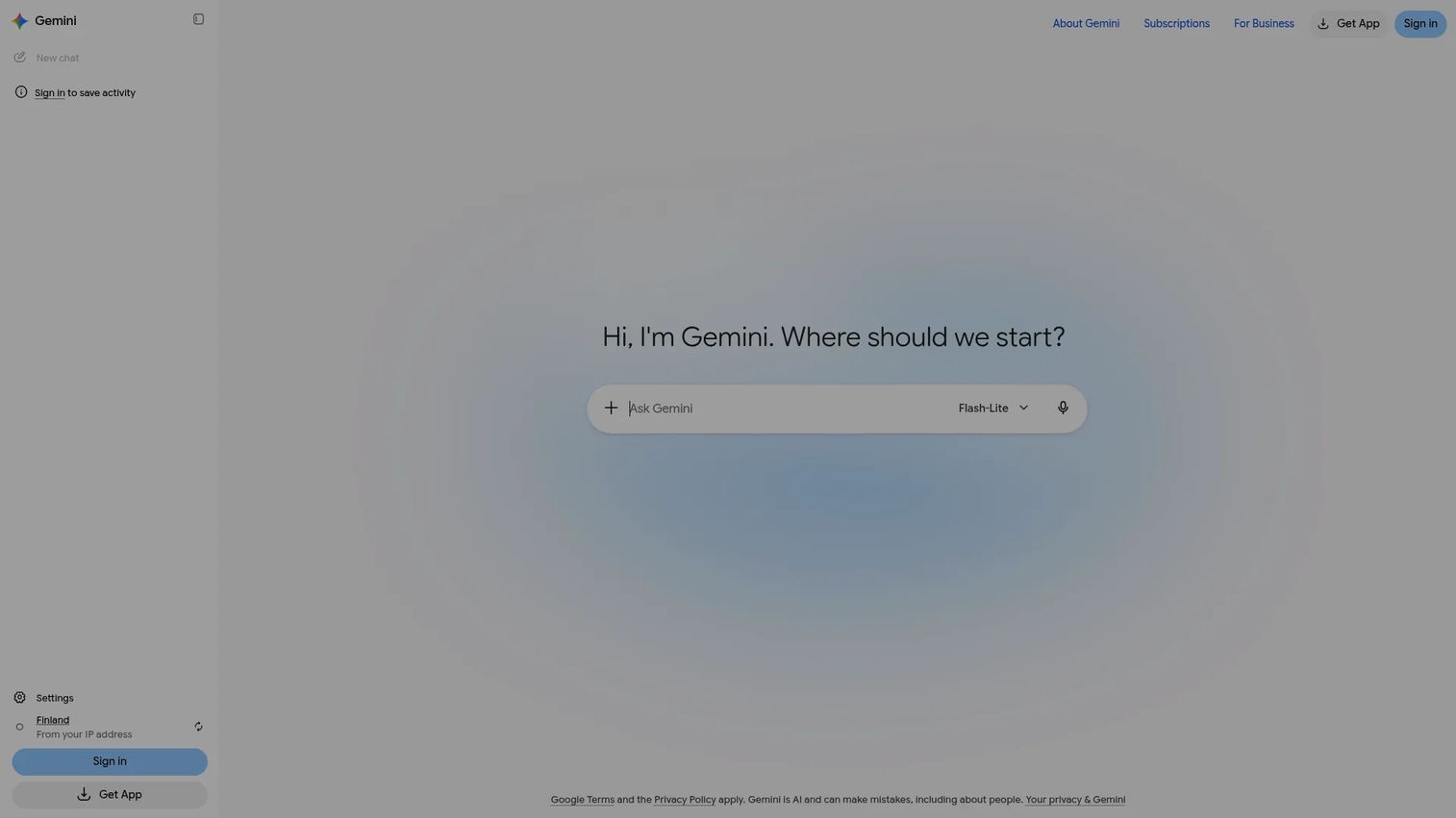
Gemini is Google's conversational AI assistant for research, analysis, productivity, coding, and creative work. For discovery-focused PMs, it matters as both a productivity tool and a signal of how users find product information through Google-connected AI surfaces. It integrates deeply with Google Workspace, supports multimodal input, and includes Deep Research and custom Gems for specialized use cases.
Best for: Teams relying on Google Workspace who want multimodal AI for research and productivity, and teams tracking how Google AI surfaces affect product discovery.
Key features
- Multimodal analysis of text, images, audio, video, and code
- Deep Research and structured report generation
- Google Workspace integration with Gmail, Docs, Drive, and Meet
- Custom Gems and agentic task execution
- Image and video generation
Why choose Gemini: Gemini belongs in a PM's evaluation for two distinct reasons. First, as a productivity tool, its Google Workspace integration means adoption friction is lower for teams already in that environment. Second, as a discovery signal, Google remains a dominant search environment and Gemini shapes how AI-generated answers surface in Google products. If you want to understand whether your content appears in AI-generated answers on Google, Gemini is both the channel and the test environment. PMs who think of Gemini purely as a ChatGPT alternative miss the second, strategically important use case. See our ai customer service software roundup for related discovery tools.
Gemini pricing: Free plan available. Google AI Pro costs $19.99/month and includes 5 TB storage. Google AI Ultra starts at $99.99/month. All plans billed monthly.
G2 rating: 4.4/5
10. Perplexity
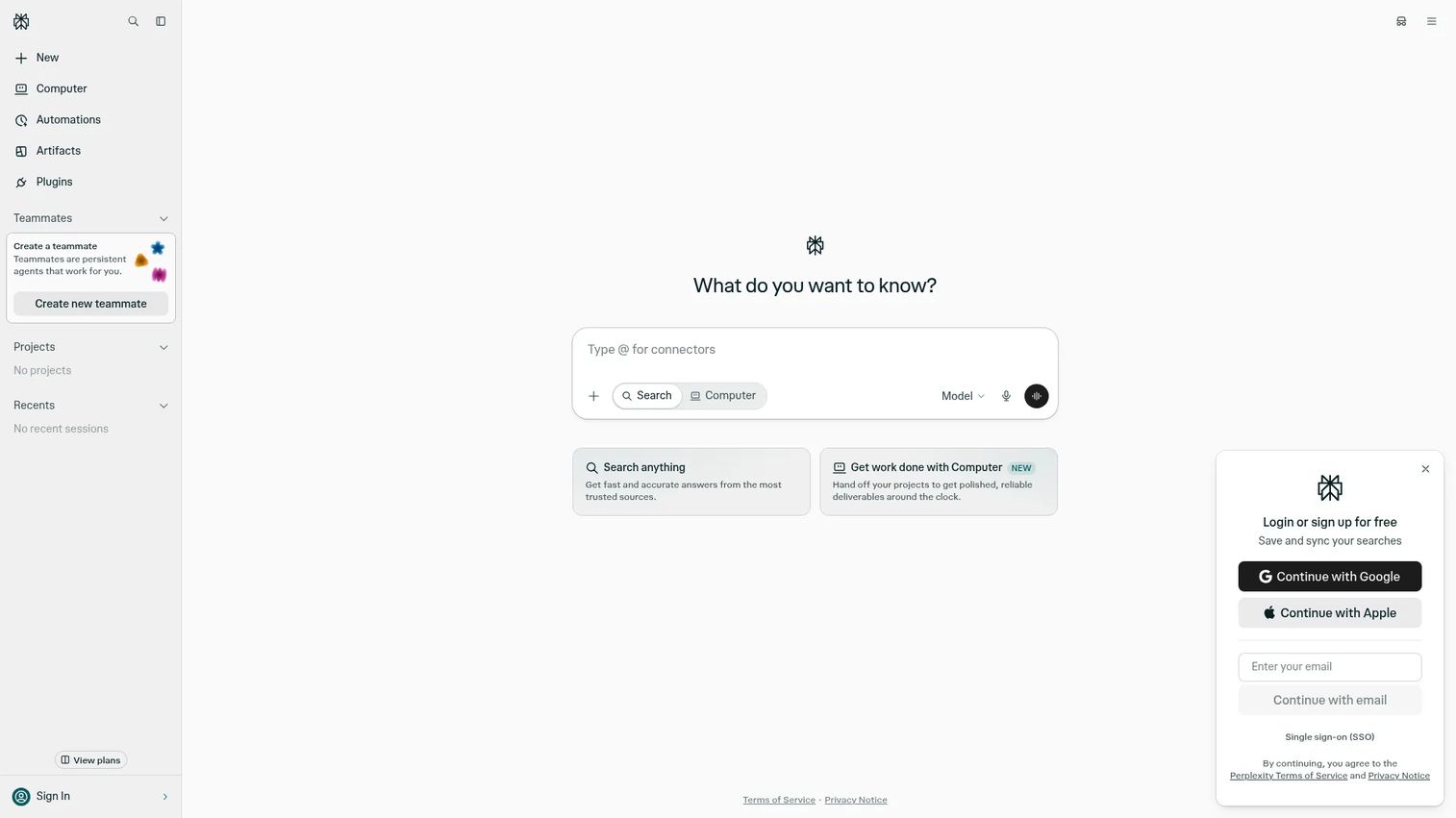
Perplexity is an AI answer engine that researches the open web and returns concise, cited answers with linked sources. Users ask comparison and recommendation questions, follow citations back to primary sources, and run multi-step research threads. For PMs and content teams, it matters because citation-led discovery means being present in the sources Perplexity references is a measurable acquisition variable.
Best for: Teams studying citation-led AI search, research-driven buyer behavior, and answer discovery that links back to primary web sources.
Key features
- Real-time web research with inline source citations
- Pro Search for multi-step and in-depth queries
- File uploads and analysis
- Create files, reports, and dashboards from research
- Enterprise Pro and Max plans with admin controls
Why choose Perplexity: Perplexity is the clearest signal of citation-led AI discovery in action. When a buyer asks "which project management tools work best for remote engineering teams," Perplexity returns cited answers with links to the sources it drew from. PMs can use it to audit whether their content appears in that citation layer. A 2026 SOCi study found 52% of U.S. consumers used AI to research a local business, up from 9% in 2025, which makes citation presence a measurable reach concern. For content teams, Perplexity's citation behavior is a leading indicator of AI-era search engine optimization. This connects to the broader answer engine optimization tools discipline that's emerging alongside traditional SEO. Enterprise Pro plans include team management, SSO, and data privacy controls.
Perplexity pricing: Standard plan is free. Pro costs $20/month or $200/year. Education Pro costs $10/month with verification. Enterprise Pro costs $40/seat/month or $400/seat/year.
G2 rating: 4.4/5
Considerations when choosing AI search and discovery platforms
Match the platform to the discovery job
Ecommerce catalog search, internal knowledge retrieval, AI visibility monitoring, and conversational answer interfaces are four different jobs with four different technology patterns. Start from the user journey your team owns: Where do users fail to find what they need, and what does that failure cost in activation or support? A platform optimized for catalog merchandising will not help if the problem is enterprise knowledge retrieval.
Check your data readiness before committing
Catalog quality, metadata completeness, behavioral event instrumentation, and content taxonomy directly determine how well any AI search platform performs. Poor attribute coverage means recommendations miss. Missing click events mean ranking models have nothing to learn from. Audit your data layer before shortlisting platforms. A strong platform on bad data produces worse outcomes than a simpler platform on clean data.
Define relevance metrics before launch
Set baseline measurements before the platform goes live: Zero-result rate, search conversion rate, reformulation rate, and exit rate by segment. Without a baseline, any post-launch change is anecdotal. PMs who instrument search the same way they instrument onboarding will have a defensible case for continued investment, or for switching platforms if the numbers don't move.
Involve engineering early and plan for release cadence
Production AI search involves indexing pipelines, API integrations, event tracking schemas, and relevance tuning cycles. A PM who scopes a search migration as a sprint-sized project usually discovers it's a quarter-sized one. Set a realistic implementation plan and align it with your release cadence. Platforms that need re-indexing on every product update will create maintenance overhead that compounds quickly. See our agentic ai platforms guide for related infrastructure considerations.
Evaluate governance, access control, and data privacy
Which users can see which content? What happens to customer behavioral data? Who owns the index and can audit its contents? These questions matter for compliance review, enterprise security sign-off, and sensitive-content handling. Evaluate each platform's access controls, data residency options, and model grounding mechanisms. Do not make compliance guarantees based on a platform's feature list alone; route specific requirements to your legal and security teams.
Conclusion
The right AI search and discovery platform depends on where in the discovery journey your users are losing value.
For hosted product and site search with built-in AI ranking, Algolia gives teams the fastest path from zero to instrumented relevance. For custom search infrastructure with full engineering control, Elasticsearch handles complexity that hosted platforms can't. Bloomreach and Google Cloud AI Commerce Search both suit ecommerce teams, with Bloomreach strongest for unified customer data and Google Cloud strongest for teams already on GCP. SitecoreAI Search and Scrunch address AI visibility: Scrunch for teams running monitoring-first programs, SitecoreAI Search for enterprise content operations teams.
ChatGPT, Claude, Gemini, and Perplexity represent the AI answer layer where buyers increasingly discover, compare, and shortlist products before they ever reach your website. PMs who ignore that layer are measuring discovery only on their own domain while the conversation is happening elsewhere.
A practical next step: Map the discovery job your team actually owns. Audit your data sources against the platform's requirements. Choose two or three platforms to test based on implementation fit, not feature count.
Start your journey with Guideflow today!
FAQs
AI search and discovery platforms help users find products, content, answers, or recommendations using machine learning, semantic retrieval, natural-language understanding, and behavioral personalization. They span several platform types, from hosted ecommerce search engines to open retrieval infrastructure, enterprise knowledge tools, and AI visibility measurement services. The common thread is that they interpret user intent rather than matching keywords literally.
Traditional search matches query tokens to indexed terms. AI search interprets the meaning behind a query, ranks results by predicted relevance using behavioral signals, and can generate direct answers from trusted data sources using retrieval augmented generation. The practical difference for PMs is measurable: AI search typically improves zero-result rates and first-click accuracy on long-tail and conversational queries that keyword systems handle poorly.
The answer depends on catalog size, data infrastructure, and team structure. Algolia suits product teams that want managed search with strong merchandising controls. Bloomreach fits commerce teams that need search, recommendations, and customer data on a shared behavioral layer. Google Cloud AI Commerce Search is strongest for enterprise retailers already on GCP with large catalogs needing enrichment. Evaluate each option by auditing your current zero-result rate, your catalog's metadata quality, and how much engineering bandwidth you can commit to implementation and ongoing tuning.
The metrics that matter most are zero-result rate, search conversion rate, query reformulation rate, click-through rate from results, and assisted conversion. Exit rate from search results indicates whether users are finding value or giving up. Recommendation click-through measures whether personalization is surfacing relevant content. Support deflection from search-driven self-serve is the downstream metric that makes a business case most legible to stakeholders outside the product team.
Yes, in most production environments. Indexing pipelines, API integrations, event tracking schemas, and behavioral signal collection all require engineering involvement. Some hosted platforms like Algolia reduce that overhead significantly through managed infrastructure and no-code merchandising controls, but even those require event instrumentation before ranking personalization works. Open infrastructure options like Elasticsearch require sustained engineering ownership. PMs should treat the implementation scope as a cross-functional project, not a configuration task.
AI visibility refers to how prominently a brand, product, or piece of content appears in AI-generated answers across platforms like ChatGPT, Perplexity, Gemini, and Claude. It's measured through citation share, recommendation share, and prompt-level monitoring: How often does an AI engine mention your brand when asked a relevant question, and how accurately does it represent your product? For teams focused on this, tools like Scrunch provide structured monitoring across multiple AI engines. This discipline is sometimes called answer engine optimization or generative engine optimization. Our answer engine optimization tools guide covers the category in detail.
Retrieval augmented generation (RAG) is a technique that grounds AI-generated answers in a selected data source rather than relying solely on the model's training data. The system retrieves relevant documents or records from a trusted corpus, then passes them to a language model to generate a contextually accurate answer. For enterprise search, RAG improves answer accuracy, allows the system to cite sources, and keeps answers aligned with current product documentation rather than outdated training data. It also enables access control: The retrieval layer enforces what data each user can see before it reaches the generation layer.
Enterprise search is about building retrieval inside your product: A knowledge base, an internal tool, or a customer-facing help center where you control the index and the query experience. AI answer engines like ChatGPT, Perplexity, or Gemini are external surfaces where users discover your brand and product independently. The choice isn't either-or. PMs need an internal search strategy for user-facing retrieval and an AI visibility strategy for the external discovery layer. The first requires data infrastructure and integration. The second requires content optimization and citation monitoring. For PMs working on SaaS onboarding and product adoption specifically, our guide to best user onboarding software tools covers the adjacent activation layer where search and onboarding intersect.