A prototype can impress stakeholders in a week. Getting that prototype into customer hands is a different kind of work: Tenant isolation, latency budgets, evaluation pipelines, cost attribution, security review, and a release process that survives model updates.
Enterprise spending on generative AI applications and infrastructure reached $37 billion in 2025, up from $11.5 billion in 2024, according to Menlo Ventures (2025). That spend reflects a market that has moved beyond experiments. Teams are now choosing operating layers, not just APIs.
For a SaaS product manager, the decision is practical: Which generative AI infrastructure platform can carry a feature from prototype to measurable production without creating a new operational burden? The question is no longer whether to add generative AI. It is which infrastructure can carry the feature after launch.
What's inside
This guide is for SaaS product managers evaluating AI infrastructure before involving engineering, data, security, and finance stakeholders. It covers:
- Eight generative AI platforms reviewed for production workload fit
- A comparison table across pricing model, key differentiator, and G2 rating
- A clear distinction between training infrastructure and inference infrastructure
- A buyer checklist covering governance, cost observability, and maintainability
Selection criteria: Existing cloud alignment, data platform fit, model flexibility, governance depth, and operational burden on the product team.
TL;DR
- Best for AWS-native teams: AWS Bedrock offers managed foundation model access, guardrails, and production integrations inside the AWS ecosystem
- Best for Google Cloud workflows: Google Vertex AI aligns model development and deployment with BigQuery and Google's managed infrastructure
- Best for Microsoft-centric organizations: Microsoft Azure AI Foundry connects AI development to Azure identity, data services, and enterprise controls
- Best for governed data-centric AI: Databricks suits teams whose AI features depend on large, carefully governed enterprise data sets
- Best for open-model flexibility: Hugging Face gives technical teams broad model choice and deployment control for specialized workloads
- Best for formal governance requirements: IBM watsonx.ai targets regulated environments that need documented model controls and hybrid deployment options
What is generative AI infrastructure?
Generative AI infrastructure is the set of compute, data, model, deployment, governance, and monitoring systems used to build and operate generative AI features in production.
The category differs from earlier AI model deployment software in one important way: Foundation models introduce new layers of application control, prompt management, retrieval, and evaluation that traditional ML pipelines did not require.
The core layers of a generative AI stack
- Compute: GPUs, TPUs, CPUs, and managed inference capacity that serves model requests at scale
- Data: Object storage, data lakes, vector indexes, ingestion pipelines, and the permission controls that govern what each model can see
- Model access: Proprietary model APIs, open-weight models, fine-tuning workflows, and model catalogs
- Orchestration: Pipelines, endpoint management, Kubernetes-based scheduling, and deployment automation
- Application controls: Prompt management, safety guardrails, evaluation frameworks, identity integration, and audit logging
- Observability: Latency, cost per request, output quality scores, failure rates, retrieval quality, and user feedback signals
Training infrastructure versus inference infrastructure
Training infrastructure supports model development, fine-tuning, distributed compute, checkpoint management, and experiment tracking. Inference infrastructure handles production serving, latency targets, throughput, autoscaling, request routing, observability, and spend control.
Most SaaS product teams should evaluate inference and application operations first. Custom foundation-model training becomes relevant only when proprietary models, specialized domains, or performance requirements cannot be met by an existing model API.
What a SaaS product team should expect from this category
- Model choice that does not require rewriting the application layer
- Production endpoints sized for expected traffic and peak demand
- Security controls that pass enterprise review without custom engineering
- Cost and usage telemetry segmented by feature or customer tenant
- A release process that keeps model changes measurable before they reach users
When to use generative AI infrastructure
Move an AI prototype into a customer-facing feature
A proof of concept rarely includes tenant isolation, rate controls, evaluation baselines, or cost attribution. When customer data enters the workflow and uptime commitments become real, you need a platform with managed endpoints, safety controls, and the observability to catch regressions before users do.
Build retrieval-augmented generation over proprietary data
Document ingestion, embeddings, vector retrieval, access filtering, citation tracking, and output evaluation are each a distinct engineering concern. The model is one part of the system. Choose RAG infrastructure that handles data freshness and permission boundaries, not just model access.
Support variable demand without manually scaling every endpoint
Traffic spikes, batch jobs, latency targets, and regional requirements all affect infrastructure architecture. Before committing to a service-level expectation, ask engineering to define the peak concurrency, acceptable p95 latency, fallback behavior, and autoscaling ceiling for each AI feature.
Generative AI infrastructure comparison
The platforms below differ more by operating model than by headline model access. The practical selection factors are existing cloud commitments, where data lives, required model choice, governance depth, and how much infrastructure responsibility the team can sustain. Ratings and pricing were verified from each vendor's pricing page and G2 listing in October 2026.
| # | Product | Best for | Key differentiator | Pricing | G2 rating |
|---|---|---|---|---|---|
| 1 | AWS Bedrock | AWS-native teams launching managed generative AI | Multi-provider foundation model access with AWS-native security | Usage-based, per token | 4.3/5 |
| 2 | Google Vertex AI | Google Cloud teams with Gemini and data-platform alignment | Integrated model development, deployment, and Google Cloud AI | Usage-based, per workload | Not listed |
| 3 | Microsoft Azure AI Foundry | Microsoft-centric enterprises building governed AI apps | Azure identity, 11,000+ model catalog, enterprise controls | Consumption-based, per service | Not listed |
| 4 | Databricks | Data-heavy products built on governed enterprise data | Lakehouse plus Unity Catalog governance and agent tooling | Usage-based, pay-as-you-go | 4.6/5 |
| 5 | Amazon SageMaker AI | Teams needing deeper ML lifecycle control inside AWS | Managed training, deployment, pipelines, and model registry | Usage-based, per compute | 4.2/5 |
| 6 | NVIDIA AI Enterprise | GPU-centric or private AI deployments | Optimized NVIDIA software stack for enterprise AI | From $4,500/GPU/year | 4.5/5 |
| 7 | IBM watsonx.ai | Regulated orgs prioritizing governance and hybrid deployment | Governance-focused AI studio with hybrid infrastructure | Free tier; Standard from $1,110/month | 4.4/5 |
| 8 | Hugging Face | Teams prioritizing open models and deployment flexibility | Broad open-model ecosystem with collaboration tooling | Free Hub; PRO at $9/month | 4.4/5 |
Best 8 generative AI infrastructure platforms for 2026
1. AWS Bedrock
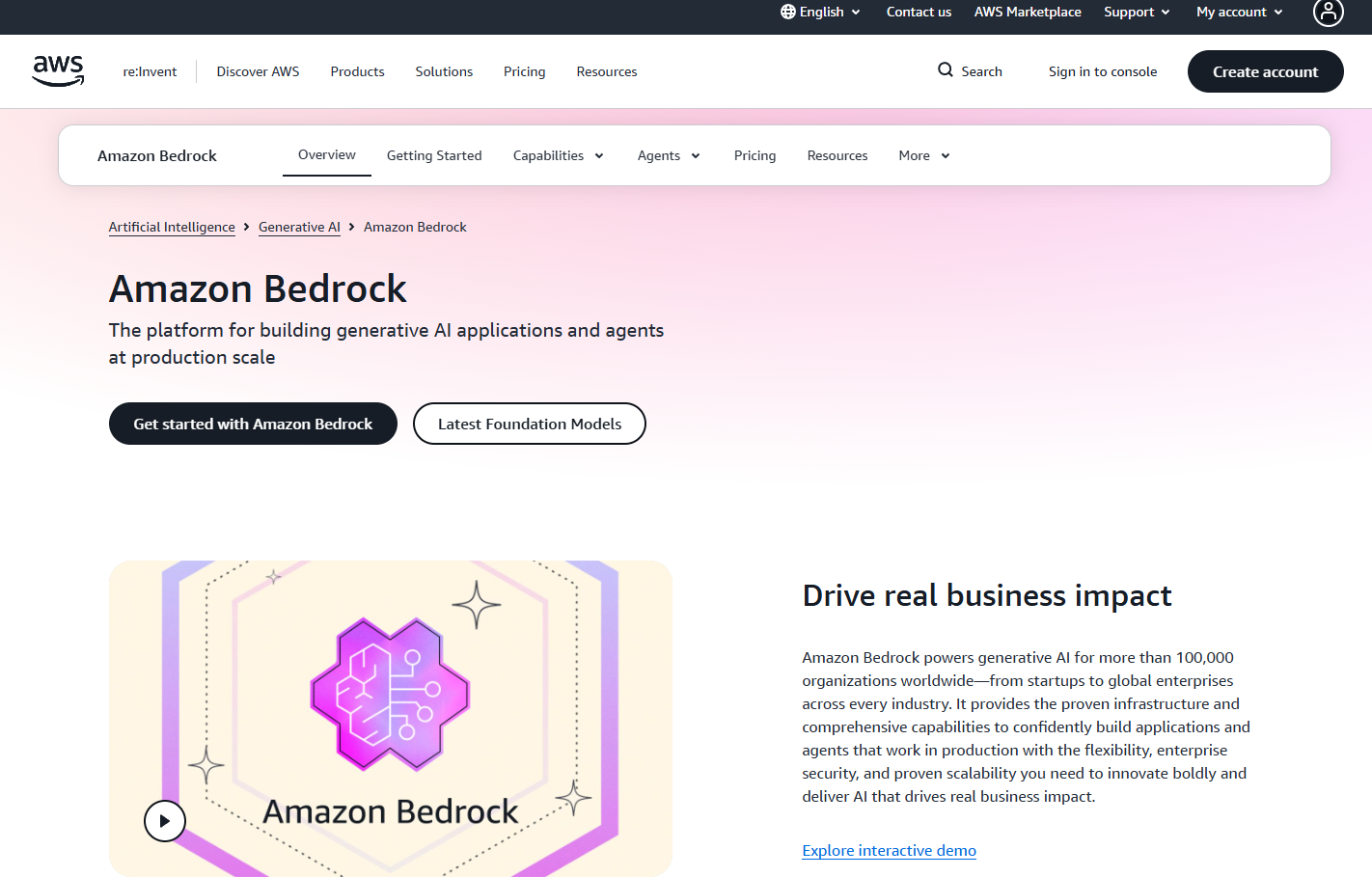
AWS Bedrock is a fully managed service for building generative AI applications using foundation models from multiple providers through a single API. It sits inside the AWS ecosystem, which means identity, logging, and network controls connect directly to the services most AWS-native teams already operate. For a product manager who does not want to build raw serving infrastructure before shipping a feature, Bedrock offers a faster path from experiment to governed production endpoint.
Best for: Product teams whose application, identity, security, and data services already run primarily in AWS.
Key features
- Managed access to foundation models from multiple providers (Anthropic, Meta, Mistral, Amazon Nova, and others)
- Knowledge Bases for RAG with built-in retrieval and vector store management
- Guardrails for content filtering, topic denial, and sensitive-data redaction
- Agents for orchestrating multistep workflows across APIs and data sources
- Model evaluation and fine-tuning workflows within the same managed environment
Why choose AWS Bedrock: If your product already depends on AWS for compute, storage, and identity, Bedrock reduces cross-cloud integration work and creates a clear operational path. Teams evaluating agentic AI platforms that need RAG, agents, and guardrails under one managed roof will find Bedrock a strong starting point.
AWS Bedrock pricing: Pricing runs per token and varies by model, provider, and region. Claude 3.5 Sonnet, as one example, is listed at $6.00 per million input tokens and $30.00 per million output tokens on the standard tier. Provisioned throughput is available for committed workloads at a fixed monthly rate.
AWS Bedrock holds a 4.3/5 rating on G2.
2. Google Vertex AI
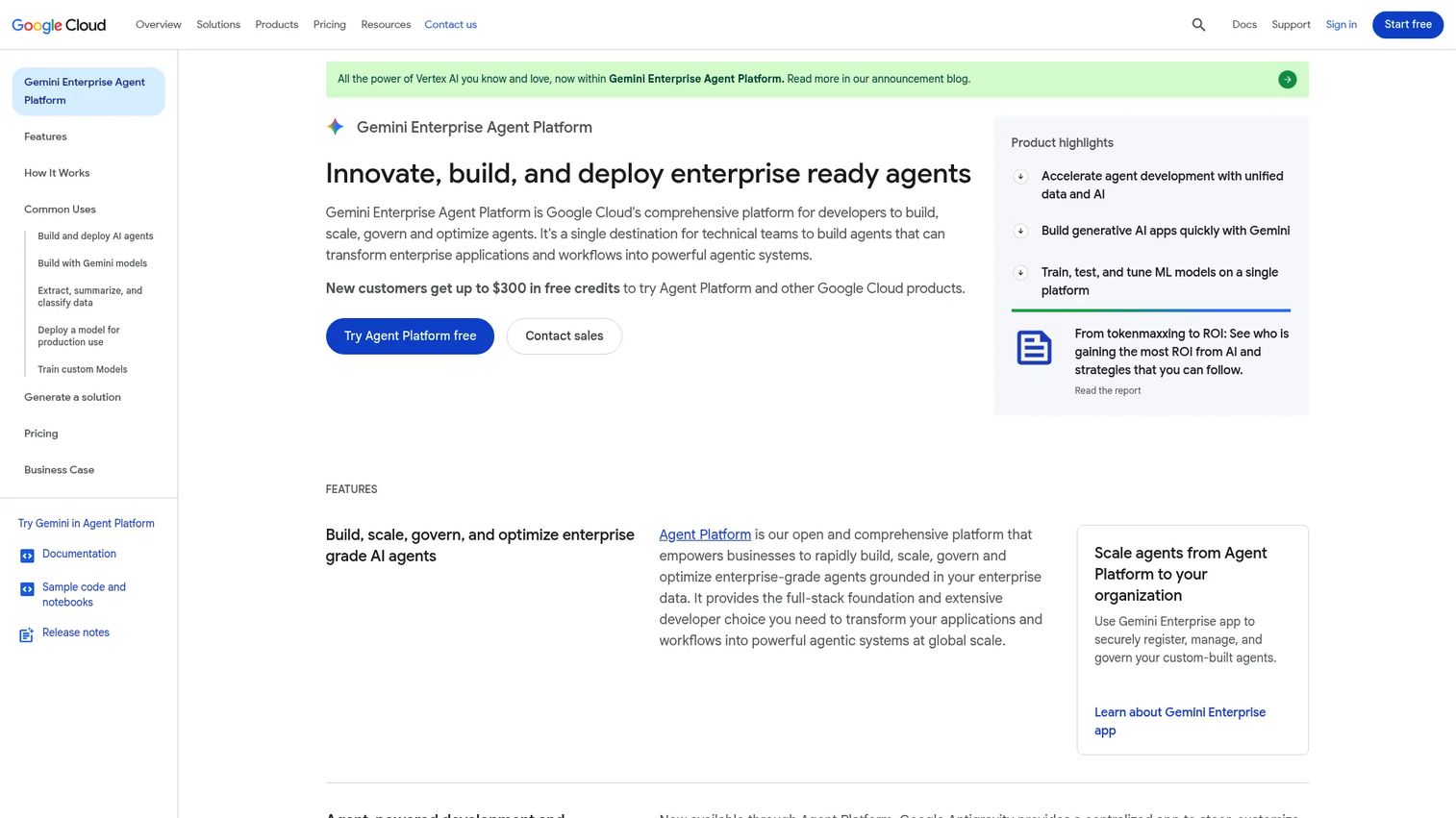
Google Vertex AI is Google Cloud's managed platform for training, deploying, and operating machine learning and generative AI systems. It brings together Gemini model access, the Model Garden catalog, AutoML, and a full MLOps layer in one managed environment. For teams whose data already lives in BigQuery or other Google Cloud services, Vertex AI reduces the integration overhead of connecting AI workloads to existing pipelines.
Best for: Product teams on Google Cloud that want AI development and production operations close to their existing data and analytics environment.
Key features
- Gemini model access alongside a Model Garden catalog of partner and open models
- Managed prediction endpoints for online and batch inference
- Pipelines, Model Registry, and experiment tracking for structured ML workflows
- AutoML for teams that need custom model training without full MLOps overhead
- Google Cloud IAM and VPC controls applied natively to model endpoints
Why choose Google Vertex AI: The strongest case is alignment: When data gravity, existing cloud operations, and TPU availability all point to Google Cloud, Vertex AI avoids the cost and complexity of a cross-cloud AI layer. Teams building on Gemini and planning to use BigQuery ML alongside inference workloads will find the integration well-suited.
Google Vertex AI pricing: Vertex AI uses usage-based pricing across models, storage, compute, and managed services. New customers receive up to $300 in free credits. Image generation with Imagen starts at $0.0001 per image; pipeline runs start at $0.03 per execution. Model API pricing varies by model and token volume.
3. Microsoft Azure AI Foundry
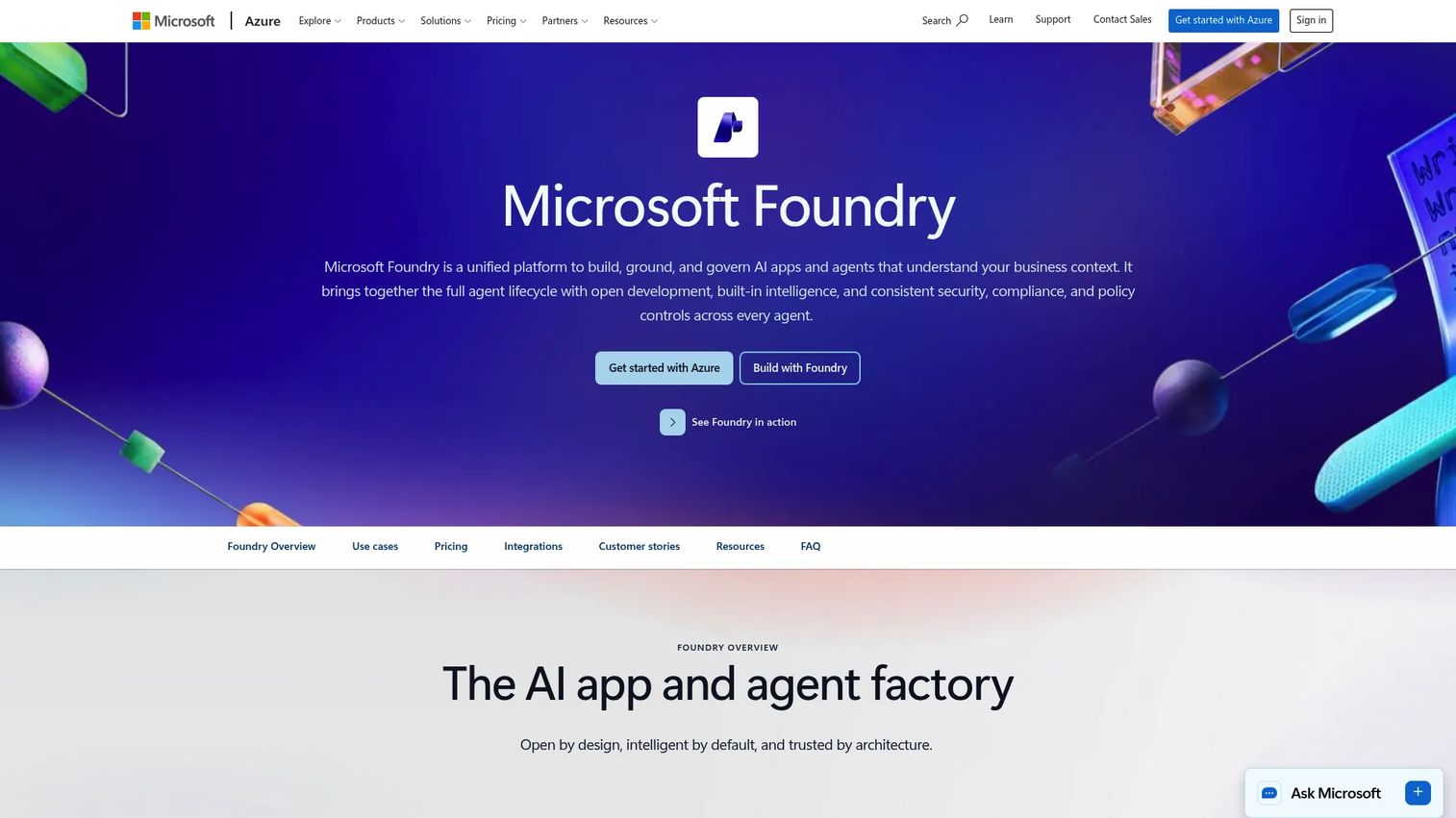
Microsoft Azure AI Foundry is an enterprise platform for building, grounding, governing, and deploying AI applications and autonomous agents at scale. It exposes over 11,000 foundation, open, reasoning, multimodal, and industry-specific models alongside Foundry Agent Service for building and scaling intelligent agents. For teams already operating in the Microsoft ecosystem, Foundry connects AI workloads directly to Azure identity, Microsoft 365 data, and enterprise compliance controls.
Best for: Product teams inside Microsoft-heavy organizations that need AI development to align with Azure governance and enterprise identity patterns.
Key features
- Access to 11,000+ models including proprietary, open, reasoning, and industry-specific options
- Foundry Agent Service for building, connecting, and scaling intelligent agents
- Real-time model routing, fine-tuning, and distillation workflows
- Unified governance with observability, security, compliance, and policy controls
- Integrations with Microsoft Graph, Microsoft 365, Azure services, and open frameworks including MCP
Why choose Microsoft Azure AI Foundry: The strongest fit appears when the product already depends on Azure services and customer security teams expect Azure-native controls. Governance from a product perspective includes audit requirements, role-based access, model change approvals, and evaluation records. Foundry treats those as first-class concerns rather than afterthoughts. For teams tracking AI governance tools across their stack, Foundry centralizes that layer alongside model access.
Microsoft Azure AI Foundry pricing: The Foundry platform itself is free to explore. Each consumed service and feature carries its own billing model. Spend scales with selected models, token volume, compute, and connected Azure services.
A G2 rating for Azure AI Foundry was not available at time of verification.
4. Databricks
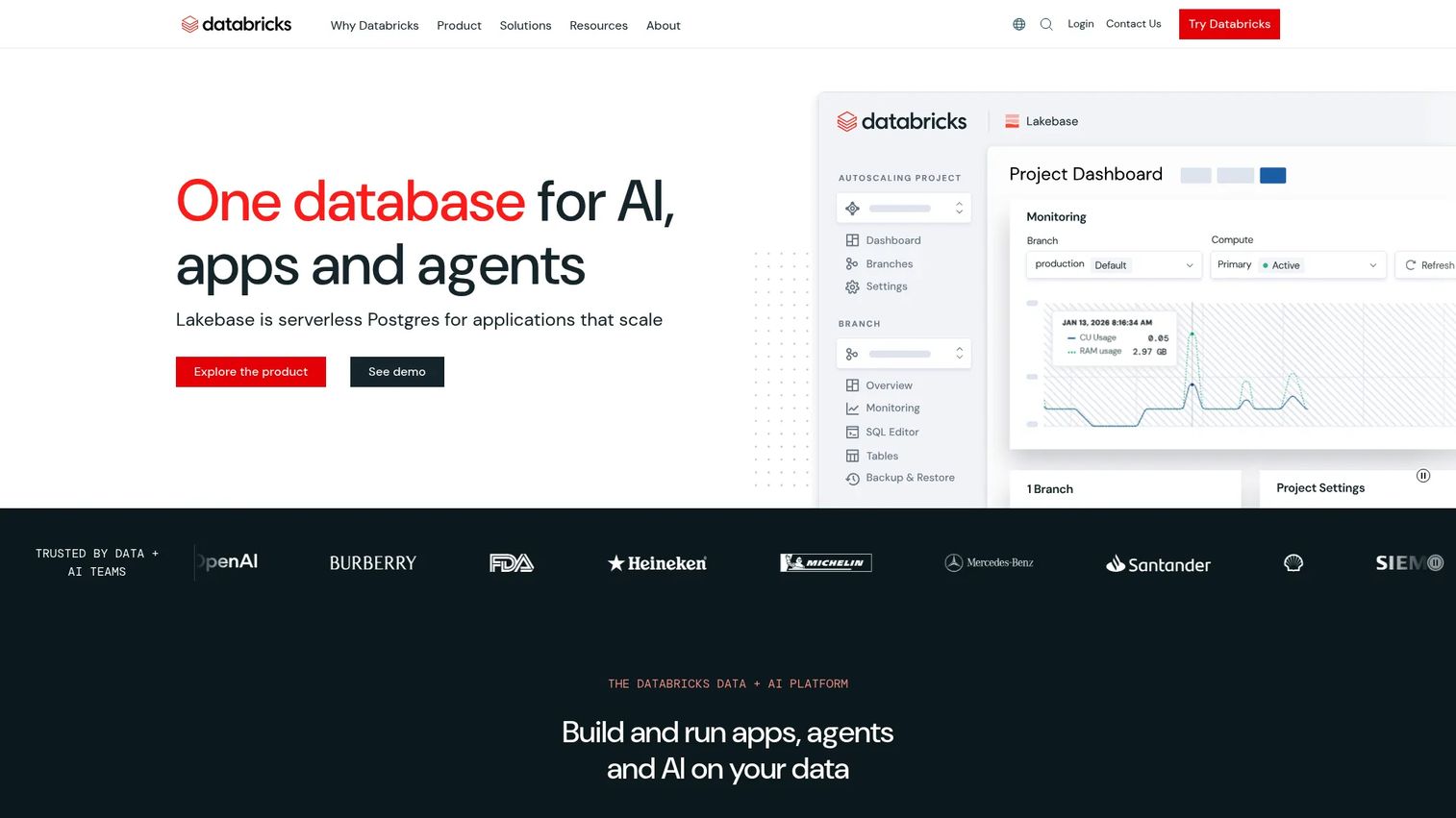
Databricks is a unified Data and AI Platform that combines lakehouse data engineering, analytics, governance, machine learning, and AI application development in one environment. Its differentiation is not generic model access; it is the ability to connect AI workloads to governed enterprise data with lineage, permissions, and evaluation built into the same platform. Teams building retrieval-heavy features over constantly changing customer data sets will find that architecture meaningful.
Best for: Product organizations building AI features on top of large, governed, constantly evolving enterprise data.
Key features
- Open lakehouse architecture supporting ingestion, transformation, analytics, and AI workloads
- Unity Catalog for unified governance, permissions, lineage, and auditing across data and AI assets
- Agent Bricks for building, evaluating, deploying, and governing AI agents
- Genie for natural-language insights grounded in business context
- Managed vector search and model serving for production inference
Why choose Databricks: Product requirements should map to data requirements before model selection begins. If freshness expectations are tight, if retrieval must respect per-tenant permissions, or if data lineage must carry into AI development, Databricks addresses those concerns at the platform level rather than through separate tooling. Teams evaluating best AI agents for data-intensive workflows will find Databricks' agent evaluation layer worth examining.
Databricks pricing: Billing is usage-based with pay-as-you-go rates; committed-use contracts are also available. A free trial is offered. Databricks does not display a single starting price; consumption is calculated through product and cloud-provider price lists.
Databricks holds a 4.6/5 rating on G2.
5. Amazon SageMaker AI
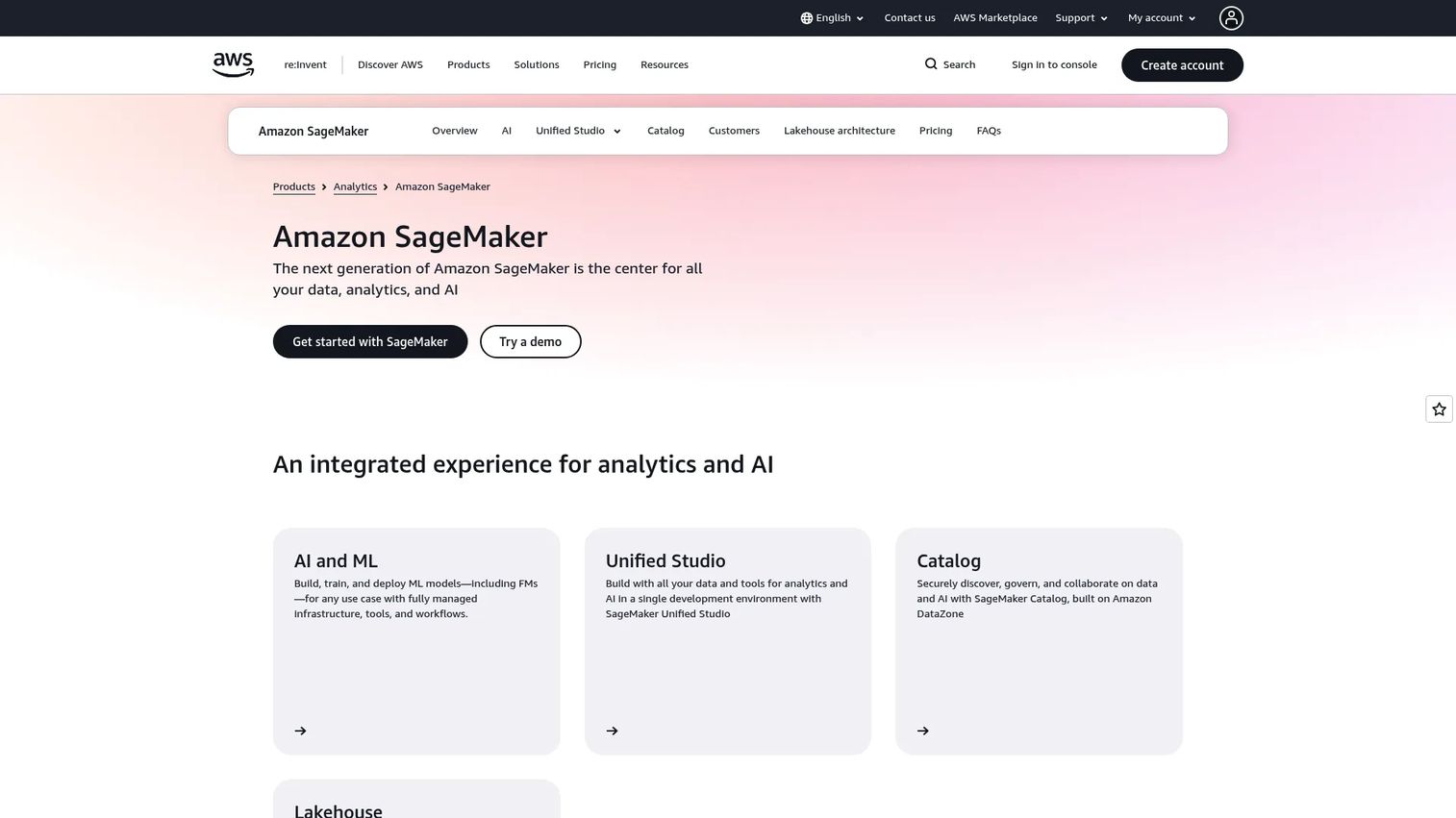
Amazon SageMaker AI is a fully managed AWS service for building, training, and deploying AI and machine learning models. Where Bedrock focuses on managed model access, SageMaker AI targets the deeper ML lifecycle: Training jobs, tuning, deployment pipelines, model registry, and production monitoring. It suits teams with ML engineering capacity and a need for lifecycle control inside AWS.
Best for: Organizations that need custom model workflows, controlled training pipelines, or more direct ML platform capabilities inside AWS.
Key features
- Managed development environments including Studio, JupyterLab, and Code Editor
- Training, tuning, and deployment infrastructure with configurable compute
- MLOps capabilities: Pipelines, Model Registry, Model Monitor, and Clarify for bias detection
- Experiment tracking across training runs and model versions
- SageMaker AI Free Tier available for new customers
Why choose Amazon SageMaker AI: Product roadmaps requiring fine-tuning, custom ranking models, or proprietary model training may justify the operating model. For features that need standard generative AI inference without custom training, Bedrock typically requires less engineering involvement. SageMaker AI earns its place when the roadmap has a concrete reason to control the training and deployment lifecycle rather than relying on a managed model API.
Amazon SageMaker AI pricing: Pay-as-you-go with no upfront commitments. Pricing varies by instance type, endpoint hours, training compute, storage, and pipeline execution. Idle endpoint capacity and training compute are the two cost areas that most often surprise teams in production. A SageMaker AI Free Tier applies for eligible new customers.
Amazon SageMaker AI holds a 4.2/5 rating on G2.
6. NVIDIA AI Enterprise
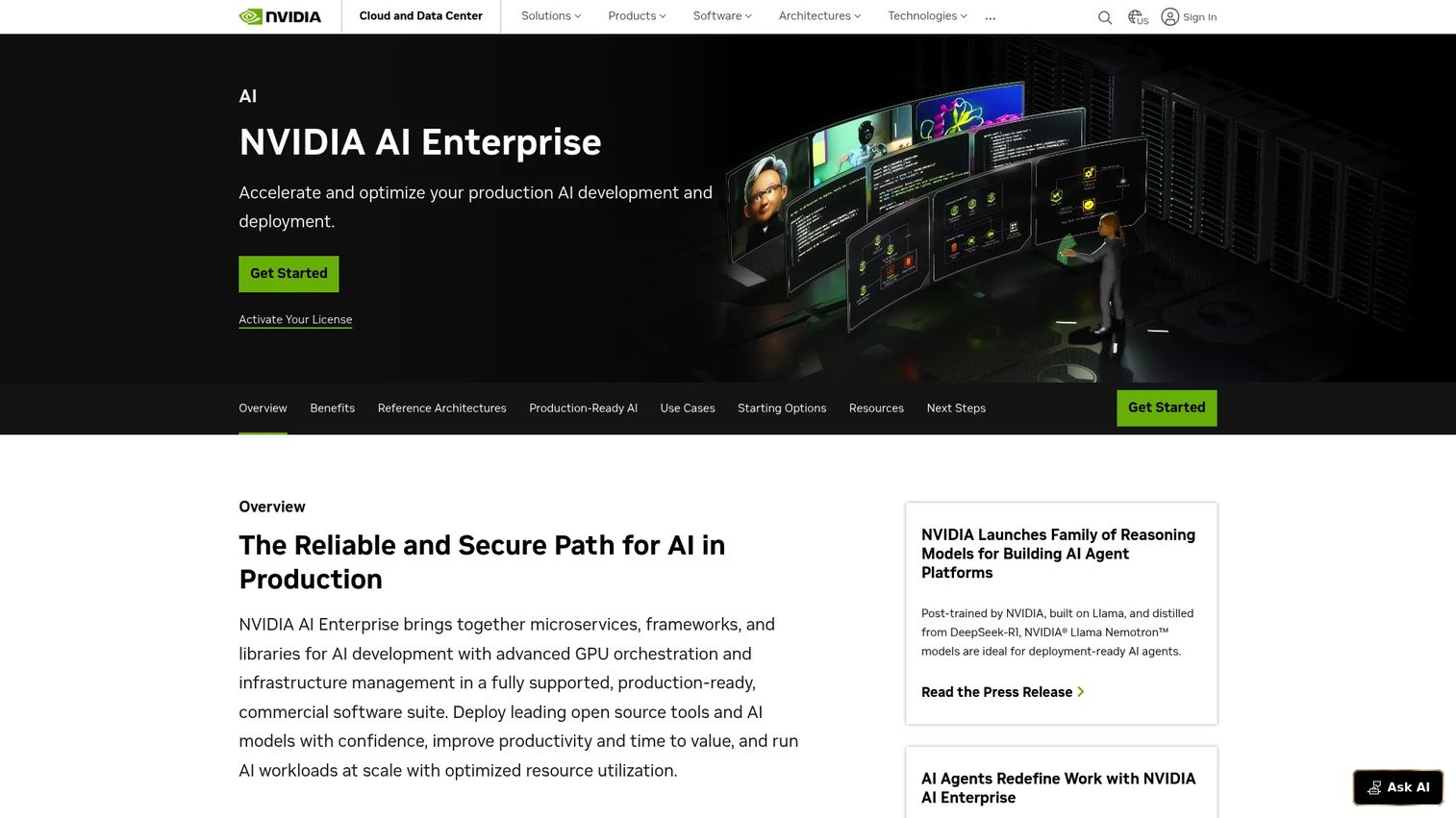
NVIDIA AI Enterprise is a cloud-native software platform for developing and deploying production-grade AI across cloud, data center, and edge environments. It packages NVIDIA NIM microservices, GPU orchestration, supported AI frameworks, and enterprise lifecycle management into a supported, security-patched software stack. For organizations where performance, private deployment, or GPU infrastructure control take priority over API convenience, NVIDIA AI Enterprise provides the software layer to operate that infrastructure reliably.
Best for: Organizations with GPU-heavy workloads, private AI requirements, or platform teams responsible for accelerated infrastructure.
Key features
- NVIDIA NIM microservices for GPU-optimized model inference
- GPU orchestration and virtualization across cloud, data center, and edge
- Supported AI frameworks with enterprise security patches and stable production branches
- Deployment tooling for private and on-premises environments
- Enterprise support, lifecycle management, and access controls
Why choose NVIDIA AI Enterprise: The fit is strongest when performance predictability, deployment location, or data residency requirements outweigh the convenience of a fully managed model API. A lightweight SaaS copilot is not the primary use case here. Teams running specialized models, high-throughput inference, or AI workloads in controlled environments will find the supported stack reduces operational risk compared to unmanaged open-source alternatives. For teams evaluating AI security posture management alongside infrastructure, private deployment options address data exposure concerns at the infrastructure level.
NVIDIA AI Enterprise pricing: Self-managed subscriptions start at $4,500 per GPU per year. Cloud production is priced at $1 per GPU hour plus cloud-provider instance costs. Development and prototyping use is free or bring-your-own-license. A 90-day free trial is available. Private offers with 1 to 3-year terms are available for larger deployments.
NVIDIA AI Enterprise holds a 4.5/5 rating on G2.
7. IBM watsonx.ai
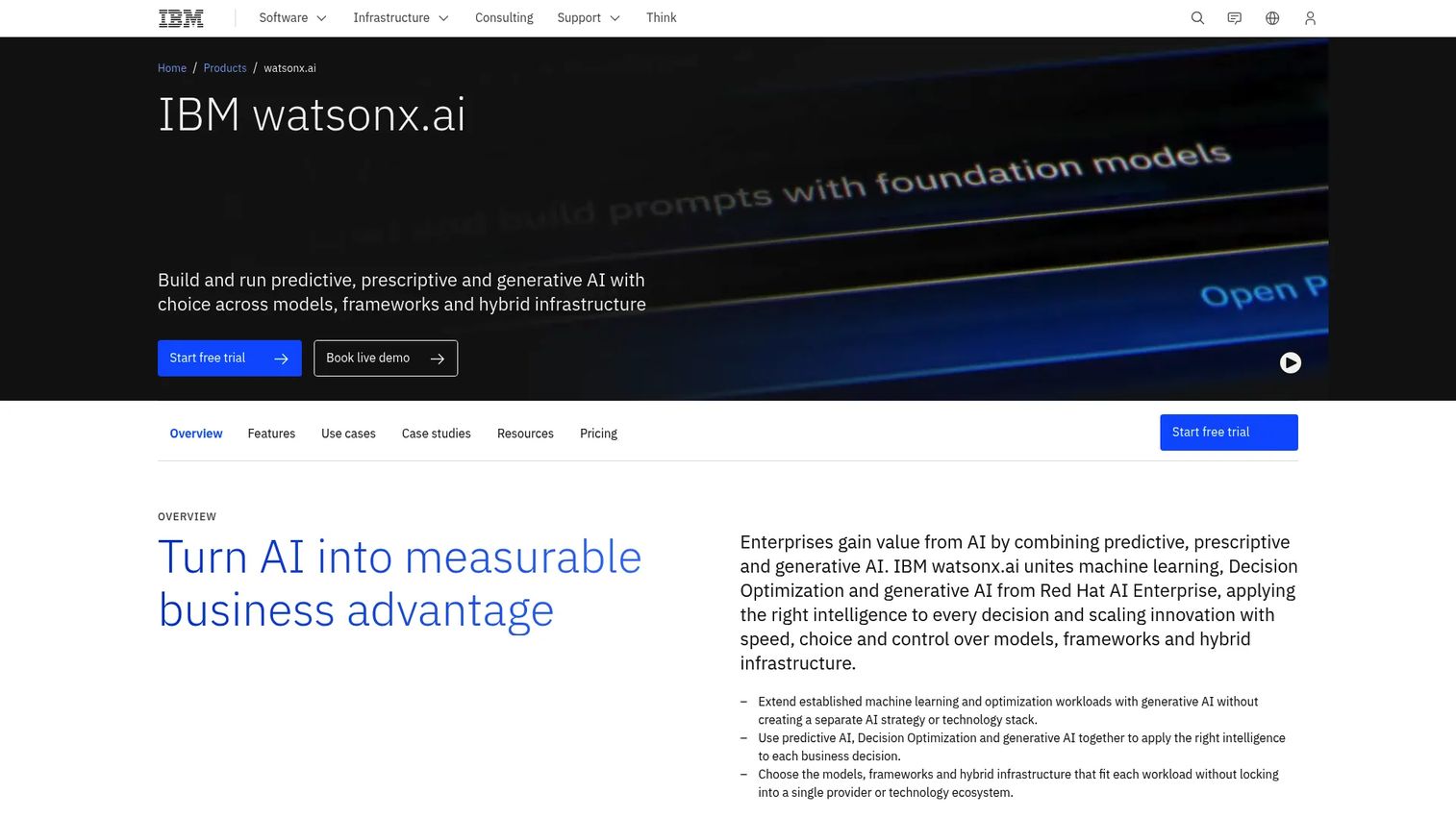
IBM watsonx.ai is an integrated AI development studio for building and running predictive, generative, and prescriptive AI across models, frameworks, and hybrid infrastructure. Its design centers on governance: Model lineage, auditability, and deployment controls are treated as core platform capabilities rather than add-ons. For product teams selling into regulated markets or enterprise buyers who will ask how an AI feature behaves, watsonx.ai provides documented answers at the platform level.
Best for: Enterprise product teams that need formal governance, hybrid deployment options, and alignment with IBM-oriented data and operations environments.
Key features
- Foundation model access alongside predictive and prescriptive AI development
- Enterprise RAG with retrieval infrastructure and grounding controls
- Model customization through prompting, tuning, and prompt engineering workflows
- AI lifecycle management covering deployment, monitoring, and evaluation
- Hybrid deployment support across cloud and on-premises infrastructure
Why choose IBM watsonx.ai: Governance and deployment control are the deciding factors. When your enterprise customers ask about model behavior, data handling, or auditability, watsonx.ai provides the documentation and controls to answer those questions from the platform itself. For teams tracking AI governance tools as a formal requirement, watsonx.ai treats governance as a first-class concern throughout the development and deployment lifecycle.
IBM watsonx.ai pricing: A free Toolbox playground is available for experimentation. The Essentials plan starts at $0 per month on a pay-as-you-go basis; the Standard plan starts at $1,110 per month. Additional charges apply for model usage, fine-tuning, text extraction, hosting, and deployment capacity.
IBM watsonx.ai holds a 4.4/5 rating on G2.
8. Hugging Face
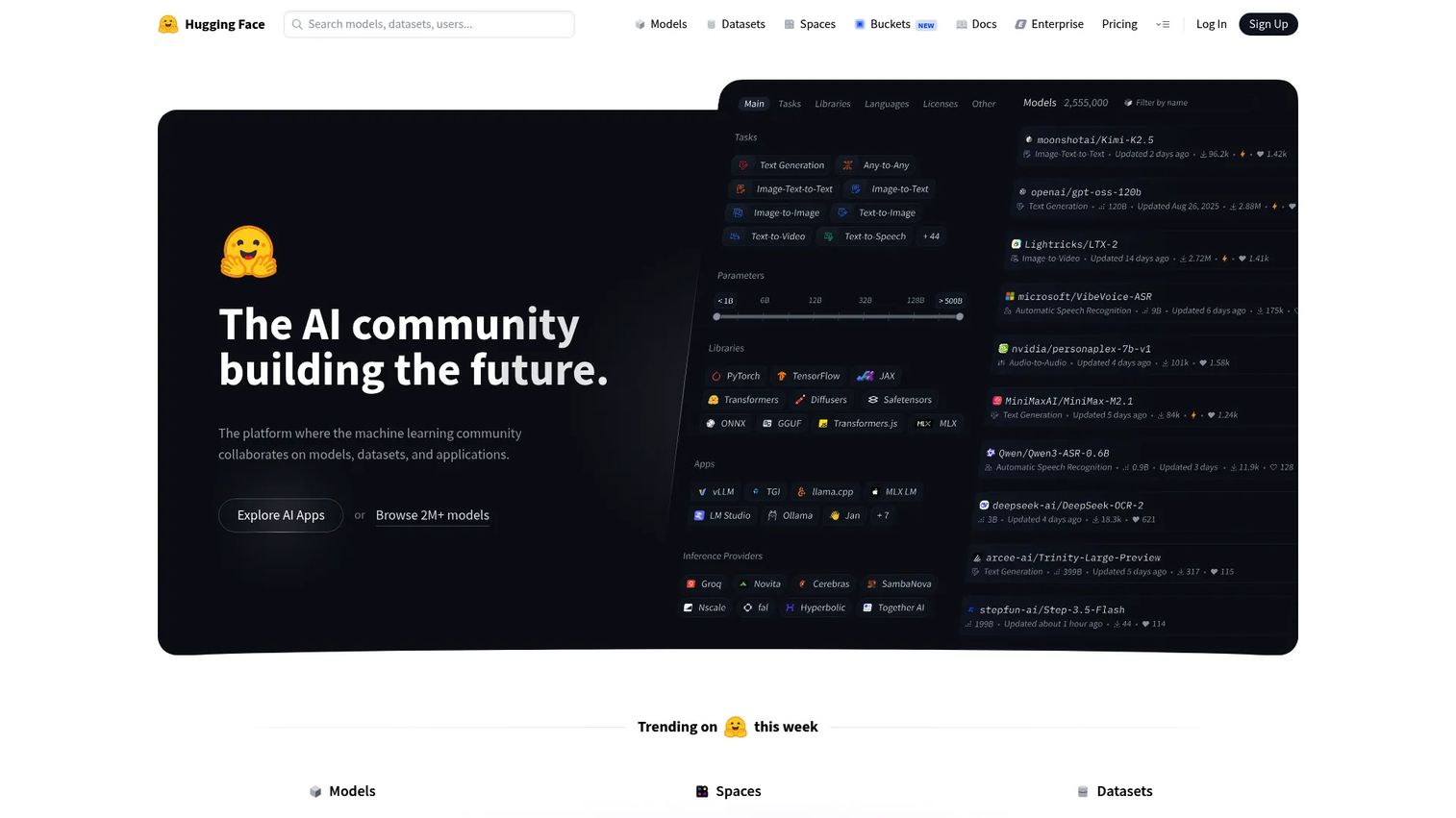
Hugging Face is an AI community and platform for discovering, hosting, collaborating on, and deploying machine learning models, datasets, and applications. Its value is model breadth and open tooling, not a managed enterprise stack. Teams that need access to specialized open models, want to evaluate model options before production deployment, or cannot meet cost, licensing, or performance requirements with proprietary APIs will find Hugging Face the most flexible starting point.
Best for: Product and engineering teams that want access to open models, specialized model families, and control over how models are evaluated and deployed.
Key features
- Open Model Hub with hundreds of thousands of community and organization-hosted models
- Dataset hosting and collaboration for training and evaluation data
- Inference Endpoints for managed deployment of Hub models
- Spaces for building and sharing ML applications and prototypes
- Fine-tuning tooling integrated with the Hub model workflow
Why choose Hugging Face: Open-model freedom introduces product decisions that managed APIs handle automatically: Evaluation, safety testing, hosting, license compliance, and support ownership. Teams that have the ML engineering capacity to manage those decisions gain meaningful control over cost at scale, model choice, and deployment location. For teams exploring best AI code generation tools or specialized domain models, the Hub's depth is hard to match through any proprietary catalog. Start on the free Hub; move to Inference Endpoints when production reliability and SLA expectations require it.
Hugging Face pricing: The Hub is free to access. The PRO subscription is $9 per month and adds expanded storage, inference credits, ZeroGPU quota, and private dataset access. Team plans are $20 per month; Enterprise plans are $50 per month with organizational controls and enterprise features. Inference Endpoints and compute resources carry separate usage-based pricing.
Hugging Face holds a 4.4/5 rating on G2.
Considerations when choosing generative AI infrastructure
Start with the user-facing workload, not the model catalog
Separate the actual inference requirement before choosing a platform. A real-time copilot, a batch summarization job, a RAG pipeline over customer data, and an agent with external tool access each have different latency, throughput, and data-access constraints. Infrastructure choice follows workload shape.
Map data access and permissions before selecting architecture
Tenant isolation, data residency, per-customer retrieval filtering, and deletion workflows all belong in the first architecture review, not after the model is chosen. Ask which data each AI feature can see, who controls that boundary, and how the platform enforces it at inference time.
Treat cost observability as a product requirement from day one
Instrument AI spend by feature, customer segment, and workflow before launch. The primary cost drivers are input and output token volume, endpoint uptime, batch versus real-time inference, retrieval and embedding volume, storage, network transfer, and idle reserved capacity. A monthly total tells you nothing useful about which feature is profitable.
Decide how much operating responsibility the team can realistically own
Managed model platforms like Bedrock and Vertex AI reduce endpoint maintenance and upgrade burden. Platforms like SageMaker AI and NVIDIA AI Enterprise give more lifecycle control at the cost of more operational responsibility. Match the platform's operating model to what the team can actually sustain between releases.
Plan for model changes before the first feature ships
Model versioning, evaluation baselines, fallback behavior, and rollback planning belong in the release process, not a separate roadmap item. Decide how model changes get evaluated, who approves them, and what the customer-visible impact of a regression looks like before that situation occurs.
How to choose the right generative AI infrastructure platform
Choose AWS Bedrock if your product already runs on AWS
Bedrock is the natural starting point when identity, data, application infrastructure, and security controls are already AWS-native. Guardrails, knowledge bases, and agents are managed within the same environment, reducing cross-service integration work. When the roadmap requires deeper training or custom ML lifecycle control, Amazon SageMaker AI extends what Bedrock does not cover.
Choose Google Vertex AI if your data and AI workflow live on Google Cloud
Vertex AI earns its place when data gravity and existing cloud operations point to Google. The strongest fit is teams using BigQuery, managed ML pipelines, and Gemini-based features that benefit from TPU infrastructure and tight data-platform alignment. Adding a cross-cloud AI layer where Google Cloud already handles the data stack adds avoidable integration overhead.
Choose Microsoft Azure AI Foundry if enterprise governance already centers on Microsoft
Azure AI Foundry fits when Azure identity, enterprise security processes, and Microsoft data services shape the operating environment. The governance layer is a practical differentiator for enterprise deals where customers ask about model auditability, access controls, and compliance documentation.
Choose by specialized operating model for the remaining four platforms
Route the remaining selection by specific need:
- Databricks for governed, data-centric product work where lakehouse architecture and Unity Catalog lineage carry directly into AI development
- IBM watsonx.ai for governance-focused hybrid environments where documented model controls and auditability are formal requirements
- NVIDIA AI Enterprise for GPU-centric workloads, private AI deployments, or performance-sensitive applications where infrastructure control matters more than API convenience
- Hugging Face for open-model flexibility, specialized model families, and engineering teams that have the capacity to manage evaluation and hosting decisions independently
Conclusion
The best generative AI infrastructure platform is the one that lets your team ship a measurable AI feature without making every release dependent on scarce platform engineering time.
AWS Bedrock fits AWS-native teams that want managed model access and production integrations without raw infrastructure work. Google Vertex AI suits Google Cloud teams that benefit from data-platform alignment. Azure AI Foundry serves Microsoft-centric organizations where governance and identity integration are non-negotiable. Databricks addresses teams whose AI features are inseparable from governed enterprise data. Amazon SageMaker AI extends coverage when the roadmap needs custom training and lifecycle control. NVIDIA AI Enterprise covers GPU-heavy or private deployment requirements. IBM watsonx.ai handles regulated environments that need formal governance documentation. Hugging Face gives technically capable teams the broadest open-model access.
The next step is concrete: Identify the first customer-facing AI workflow, define its latency, data-access, reliability, and cost requirements, then bring a one-page requirements brief to engineering, security, and finance before committing to a platform. That brief turns a vendor selection into a product decision.
Once your AI feature is ready to ship, Start your journey with Guideflow today! to create interactive product education that helps users understand and adopt what you built.
FAQs
Generative AI infrastructure is the combination of compute, data, model access, deployment, governance, and monitoring systems that support generative AI features in production. It differs from earlier AI infrastructure in that it adds application-layer concerns: Prompt management, retrieval pipelines, safety controls, evaluation, and auditability. Teams need it when a prototype moves beyond a demo environment and into customer-facing production with real uptime and cost expectations.
Generative AI infrastructure provides the systems that run AI workloads, including compute, model endpoints, retrieval stores, and application controls. MLOps is the operating discipline and tooling for developing, deploying, monitoring, and improving machine learning systems over time. In practice they overlap: Most production AI platforms include MLOps capabilities like model registries, evaluation pipelines, and deployment automation as part of the infrastructure layer.
Most SaaS product teams do not need to operate GPUs directly. Managed model APIs abstract the compute layer and bill by token rather than by hardware. GPU ownership becomes relevant for fine-tuning, self-hosting, high-throughput inference where per-token API costs exceed the cost of owned capacity, specialized models not available through managed APIs, or deployments requiring private infrastructure for data residency reasons.
Managed APIs offer faster launch, lower operational burden, and predictable reliability. Open model hosting gives more control over cost at scale, model choice, and deployment location, but introduces evaluation, maintenance, safety testing, license review, and support ownership. The decision turns on launch speed requirements, token cost projections at production volume, model availability in managed catalogs, data controls, and whether the team has ML engineering capacity to manage a self-hosted deployment.
Forecast by feature and customer segment, not by a single monthly total. The main cost drivers are input and output token volume, endpoint uptime hours, batch versus real-time inference split, embedding and retrieval call volume, storage, network transfer, and idle reserved capacity. Ask engineering to instrument each driver before launch so cost scales predictably with usage rather than arriving as a surprise at the end of the billing cycle.
Track both product outcomes and operational signals. Product metrics worth monitoring include feature activation rate, task completion or successful outcome rate, user correction rate, and retention or expansion impact by user segment. Operational metrics include p95 latency, cost per successful task, hallucination or safety incident rate, and support tickets tied to AI output. Combining both gives a complete picture of whether the feature is working and whether it is sustainable to operate.
Several platforms in this list support private, on-premises, or hybrid deployment. NVIDIA AI Enterprise is designed for private infrastructure. IBM watsonx.ai supports hybrid environments. Databricks can run on multiple cloud providers. The appropriate option depends on data residency requirements, security review outcomes, deployment team capacity, model availability outside managed APIs, and specific customer commitments around data handling.
Move when any of these conditions appear: Customer data enters the workflow, user volume makes reliability commitments real, inference cost becomes visible in the budget, model changes need evaluation before they reach users, or security review becomes a delivery blocker. Each of those conditions marks a transition from experiment to product. Waiting until after launch to address them creates a technical debt cycle that is expensive to unwind under customer pressure.
AI inference infrastructure covers production serving, latency management, throughput scaling, request routing, observability, and spend control for model endpoints. It is distinct from training infrastructure, which handles model development and fine-tuning. For most SaaS product teams, inference infrastructure is the first investment. Explore AI copilot software and related application-layer tooling once the inference layer is stable.
Governance covers access controls, model version tracking, evaluation records, audit logging, and the ability to explain model behavior to customers or regulators. Platforms differ significantly on how much governance tooling is built in versus assembled separately. IBM watsonx.ai and Microsoft Azure AI Foundry treat governance as a platform-level concern. AWS Bedrock and Google Vertex AI provide the building blocks, with governance assembled from the broader cloud platform. The right choice depends on whether governance is a checkbox or a core product requirement for your customer segment. For deeper reading, see our roundup of AI governance tools.