You built the plan in spreadsheets. Sales had their numbers, operations had theirs, and finance had a third version nobody agreed on. Then a supplier slipped a delivery date, and it took two weeks of emails to figure out what it meant for margin.
That gap is expensive. Through 2027, only about one-third of enterprises are expected to have adequate technology to fully support S&OP requirements for competitive advantage, according to ISG (2023). The rest are still reconciling by hand, and every manual consolidation is a decision delayed.
The market is moving toward fixing this. The global sales and operations planning software market was valued at $3.8 billion in 2025 and is projected to reach $8.2 billion by 2033 at a 10.5% CAGR, per Dataintelo (2025). Cloud-based deployment already accounts for 64.3% of that market. Buyers are not just replacing spreadsheets. They want one connected view of demand, supply, and money.
The right sales operations planning software turns a monthly firefight into a repeatable decision process. It links demand and supply planning to financial outcomes, runs scenario planning in minutes instead of days, and keeps a decision log so nobody relitigates last quarter's call. This guide compares seven sales and operations planning tools through five lenses: integration, governance, financial visibility, cross-functional collaboration, and scenario modeling.
What's inside
This guide is for RevOps, supply chain, finance, and operations leaders evaluating s&op software in 2026. We compared seven platforms that align demand, supply, and financial goals inside one planning cadence.
We selected each tool against four criteria that separate a real planning system from a reporting dashboard:
- Unified planning across a single source of truth
- Scenario modeling and what-if analysis
- ERP integration and CRM connectivity
- Governance, decision logging, and executive reporting
Pricing and ratings shift often, so verify current figures on each vendor's site before you buy.
TL;DR
- Best for decision-oriented S&OP: TransImpact, built around an executive dashboard and consensus workflow.
- Best for enterprise resilience and integrated business planning: Infor, with cross-functional collaboration and cloud-based planning.
- Best for teams already inside a broader stack: SAP, with deep ERP integration and AI/ML.
- Best for finance-linked scenario planning: Anaplan, with a unified data model and rolling forecasts.
- Best for fast disruption response: Kinaxis, with concurrent planning and rapid scenario analysis.
- Best for high-complexity enterprise planning: o9 Solutions, with AI-driven modeling across many inputs.
- Best for supply chain-led organizations: Blue Yonder, with end-to-end demand and supply planning tied to execution.
What is sales and operations planning software?
Sales and operations planning software is a platform that aligns demand, supply, and financial plans into a single, agreed operating plan through a structured monthly cadence. It replaces disconnected spreadsheets with one shared data model that sales, operations, supply chain, and finance work from together.
A mature s&op process moves through four stages, and good software supports each one: demand review, supply review, reconciliation, and executive approval. The demand review builds a consensus forecast. The supply review tests whether the network can meet it. Reconciliation surfaces the gaps and tradeoffs. The executive step approves the plan and logs the decision. Sales and operation planning software carries the same numbers through all four so nothing gets lost between meetings.
The features that matter most in s&op planning software cluster around a few capabilities:
- Single source of truth: one shared data model so every function plans from the same numbers.
- Scenario planning: model demand spikes, supply shortages, and margin pressure before committing.
- Consensus workflows: structured review cycles that align cross-functional stakeholders.
- Dashboarding: an executive dashboard that shows the plan, the gaps, and the financial impact.
- Integrations: ERP integration, CRM feeds, and external market or demand signals.
- Decision logging and governance: a decision log that records what was approved, by whom, and why.
- Financial impact visibility: margin, revenue, and working capital consequences attached to every plan.
The distinguishing feature of good sales and operations planning software is that it connects operational plans to financial outcomes. A demand shift is not just units. It is revenue, margin, and cash. Integrated business planning extends this further, folding finance into the same continuous cycle rather than treating it as a downstream reconciliation.
When to use sales and operations planning software
Replace spreadsheet planning
There is a point where spreadsheets stop scaling. You spend more time consolidating tabs than analyzing them. Version control breaks, someone works off last week's file, and meeting prep eats days. When manual reconciliation costs more than the decisions it supports, dedicated s&op software pays for itself in recovered planning time and fewer errors.
Improve cross-functional alignment
Sales, operations, supply chain, and finance often plan on different cycles with different assumptions. That misalignment shows up as stockouts, excess inventory, or missed revenue. Sales and operations planning software gives every function one cadence and one set of numbers. When leadership wants a single agreed plan instead of four competing forecasts, this is the trigger.
Model disruptions and tradeoffs
Demand spikes, supply shortages, margin pressure, and channel shifts all force fast tradeoff decisions. Scenario planning lets you model each one before you commit capital or inventory. When you need to answer "what happens to margin and working capital if this supplier slips a month" in an afternoon rather than a fortnight, scenario modeling is the reason to buy.
Comparison table
The seven sales and operations planning tools below are ranked by relevance to buyers who need to align demand, supply, and financial plans. Pricing across this category is largely quote-based, and ratings move over time, so verify both on each vendor's live pricing page and G2 listing before committing.
| # | Product | Intent | Key differentiation | Pricing | G2 rating |
|---|---|---|---|---|---|
| 1 | TransImpact | Decision-oriented S&OP | Executive dashboard, consensus planning, and supply, margin, and working capital tradeoffs | Quote-based | 4.4/5 |
| 2 | Infor | Enterprise integrated business planning | Cross-functional collaboration and cloud-based resilience | Quote-based | Not listed |
| 3 | SAP | Planning inside a broader ERP stack | Deep ERP integration and AI/ML | From USD 295/user/month (Cloud ERP packages) | 4.2/5 |
| 4 | Anaplan | Finance-linked scenario planning | Unified data model and rolling forecasts | Quote-based | 4.6/5 |
| 5 | Kinaxis | Fast disruption response | Concurrent planning and rapid scenario analysis | Quote-based | 4.0/5 |
| 6 | o9 Solutions | High-complexity enterprise planning | AI-driven modeling across many inputs | Quote-based | 4.2/5 |
| 7 | Blue Yonder | Supply chain-led planning | End-to-end demand and supply synchronization with execution | Quote-based | 4.1/5 |
1. TransImpact
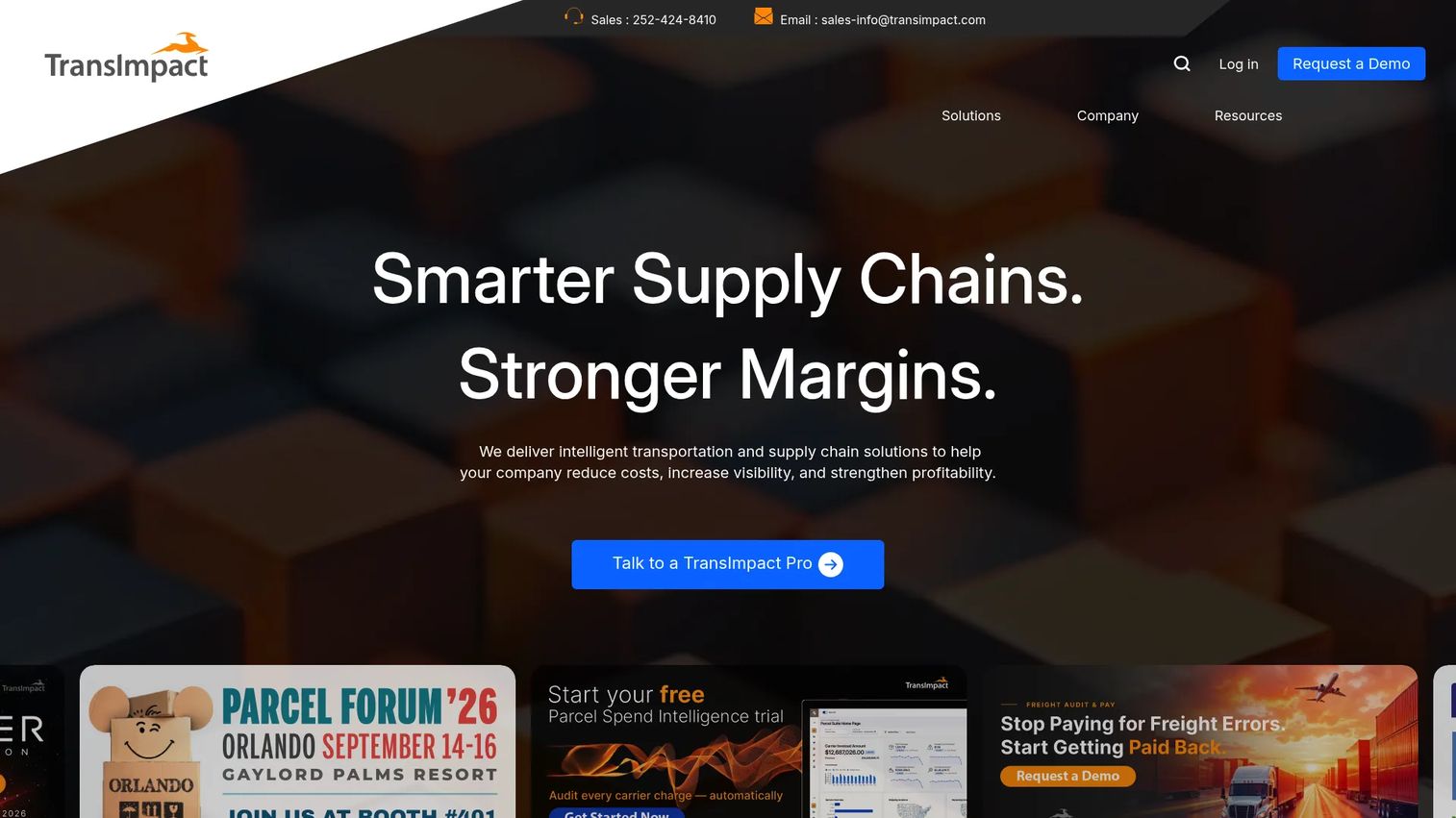
TransImpact approaches S&OP as a decision process, not just a planning report. Its platform pairs supply chain planning with parcel spend intelligence, and its S&OP tooling centers on an executive dashboard, consensus planning, and a decision log that records what leadership approved and why. That governance layer is where it stands apart from tools that stop at forecast generation.
The product is built for teams that want the monthly cadence to end in a defensible decision. It supports the tradeoffs that actually get argued in the room: supply constraints, margin protection, and working capital exposure. Scenario planning lets you test a demand shift or supply slip against those three at once, so the executive step approves a plan with the financial consequences already attached.
Best for: Mid-market and enterprise shippers that want a decision-oriented S&OP process with a clear audit trail.
Key strengths
- Executive dashboard: one view of the plan, the gaps, and the financial impact for leadership approval.
- Consensus planning: structured review cycles that align sales, operations, and finance on one number.
- Decision log: a record of what was approved, by whom, and why, so decisions are not relitigated.
Why choose TransImpact: If your S&OP meetings keep reopening old decisions, the decision log and executive dashboard give you governance most tools skip. It fits organizations that value the workflow and the audit trail as much as the forecast itself.
TransImpact pricing: TransImpact does not publish list pricing. The site runs a demo-led and quote-led sales flow, so you request a scoped quote based on your volume and modules. Expect to talk to sales to get numbers. On G2, TransImpact holds a 4.4/5 rating.
2. Infor
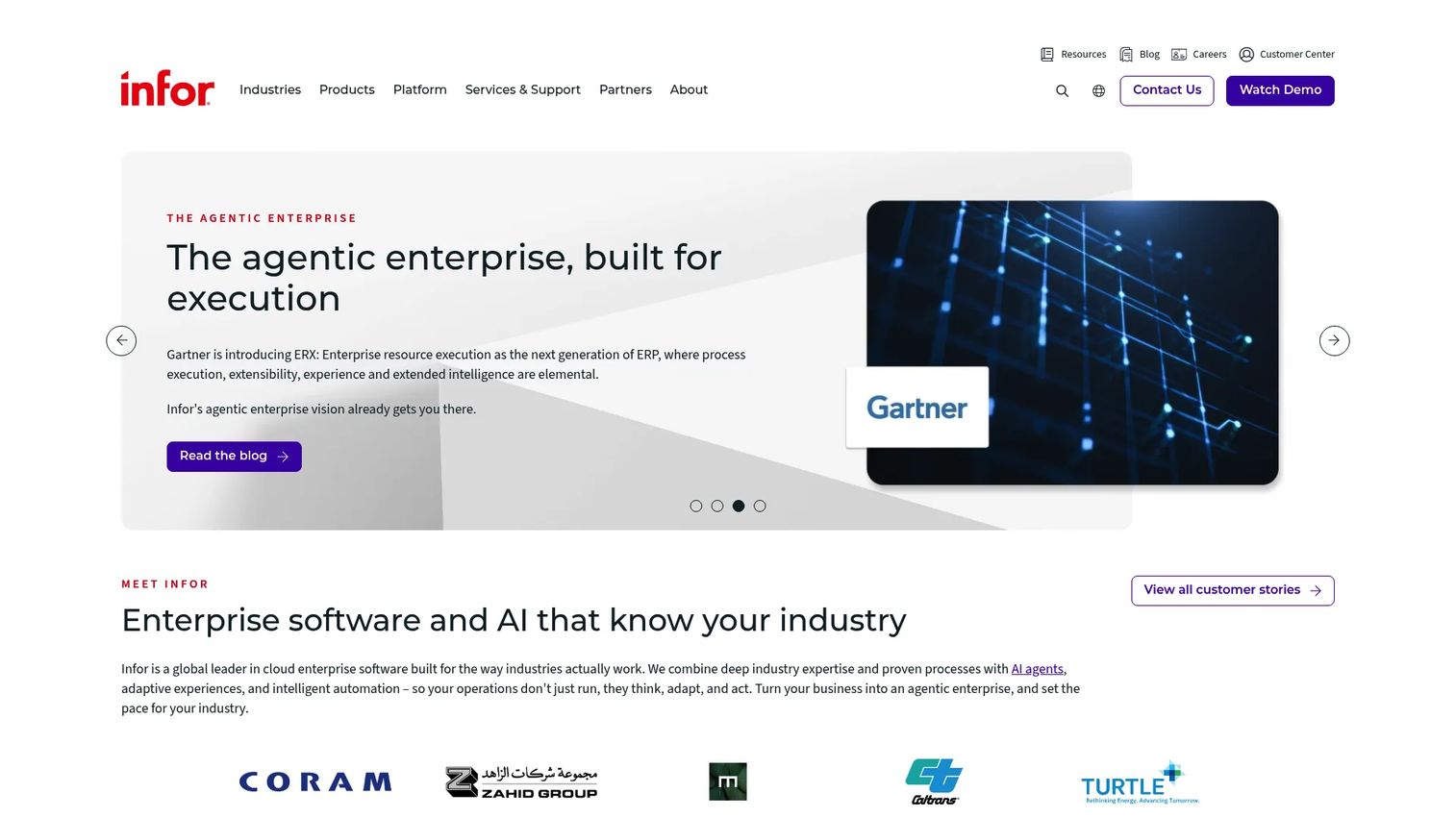
Infor positions its planning capability inside a broader suite of industry-specific CloudSuite applications. The result is integrated business planning that lives close to the ERP and supply chain systems many enterprises already run on Infor. Sales, operations, and finance align through cross-functional collaboration, and the cloud-based architecture is built for operational resilience.
Infor leans into synchronization. Demand and supply planning stay connected, dashboards give leadership a shared view, and the platform emphasizes risk mitigation so disruptions surface early. For organizations that want planning to be one module inside an integrated enterprise stack rather than a standalone tool, that industry-specific depth is the draw.
Best for: Large and mid-market organizations that want industry-focused enterprise planning tied to a broader CloudSuite footprint.
Key strengths
- Integrated business planning: planning that connects directly to ERP, supply chain, and CX modules.
- Cross-functional collaboration: one cadence across sales, operations, and finance.
- Cloud-based resilience: architecture built to absorb disruption and keep plans synchronized.
Why choose Infor: If you already run Infor CloudSuite or want industry-specific applications under one roof, planning inside that ecosystem reduces integration work. It fits enterprises prioritizing resilience and a unified suite over best-of-breed point tools.
Infor pricing: Infor does not publish readable list pricing on its site. Sales runs through contact and demo flows, so pricing is scoped to your modules and deployment. Verify the exact configuration and implementation scope with Infor before committing, since the suite spans many applications.
3. SAP

SAP brings category-defining credibility to S&OP. Its planning capabilities support the full s&op process and fit naturally into integrated business planning for organizations already running SAP for finance, supply chain, and HR. The ERP integration is the point: when your transactional data already lives in SAP, planning on top of it removes a major data-plumbing problem.
SAP layers AI/ML into its Cloud ERP packages, with Joule AI capabilities included across plans, and supports executive planning workflows within a broader business technology stack. For teams that live inside SAP, planning here means one data model, one security model, and one vendor relationship.
Best for: Large and midsize enterprises that already run SAP and want planning tightly integrated with core ERP.
Key strengths
- ERP integration: planning built on top of transactional data already in SAP.
- AI/ML capabilities: Joule AI included across Cloud ERP packages for forecasting and analysis.
- Executive planning workflow: planning inside an integrated finance, supply chain, and HR stack.
Why choose SAP: If SAP is your system of record, planning inside the same environment cuts integration cost and keeps one source of truth. It fits teams that value ecosystem consistency over assembling best-of-breed tools.
SAP pricing: SAP publishes pricing for its Cloud ERP packages. SAP Finance Base and Supply Chain Base each start at USD 295.00 per user per month, with a minimum of 15 users, billed monthly in blocks of one user. Premium tiers for both run USD 413.00 per user per month. HCM packages are priced on request. There is no free tier. SAP holds a 4.2/5 rating on G2.
4. Anaplan
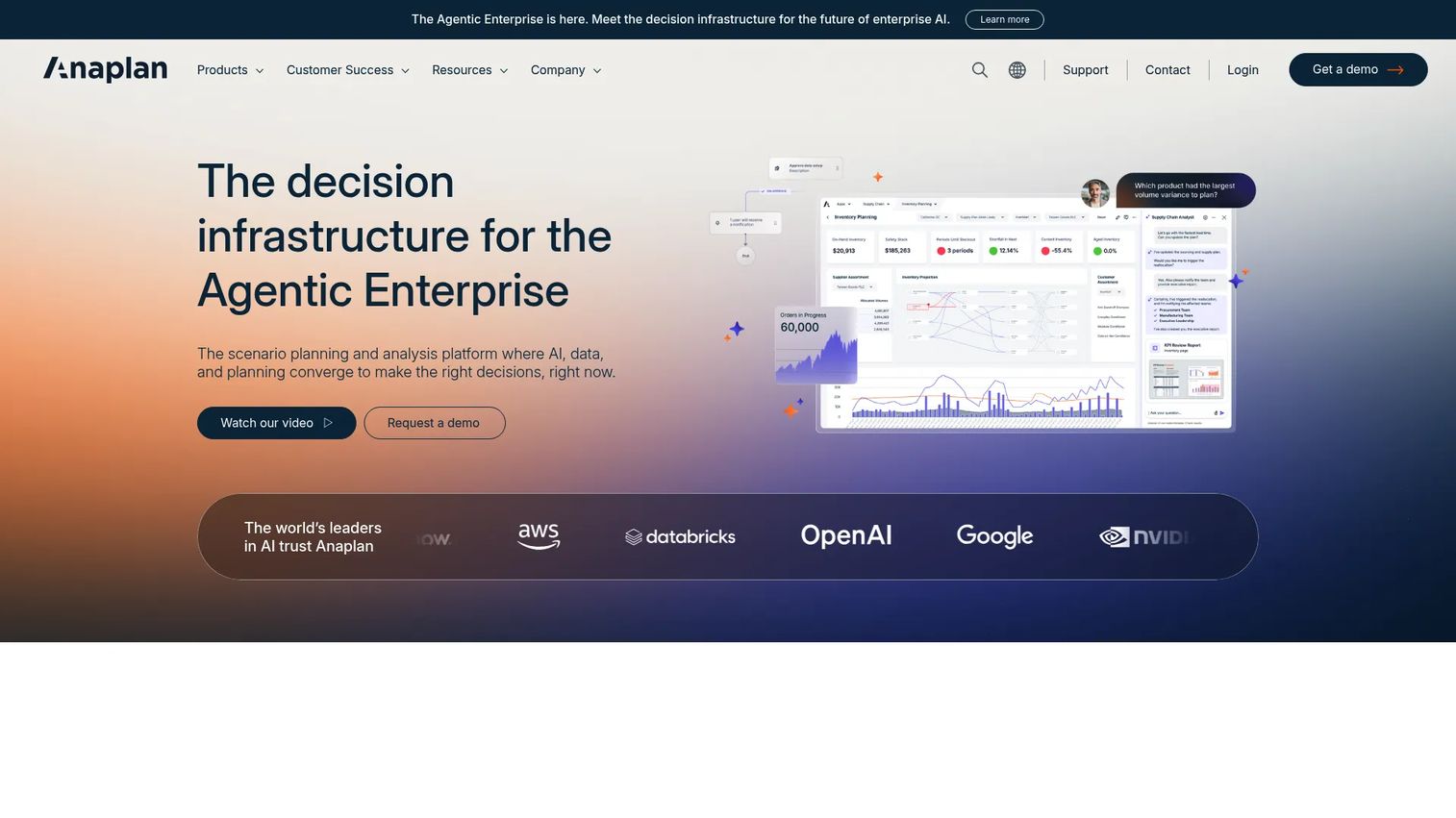
Anaplan is built around AI-driven scenario planning on a unified data model. Its calculation engine connects finance, supply chain, sales, and workforce plans so a change in one flows through to the others in real time. That connected model is why finance teams gravitate to it: revenue, margin, and cash move together, not in separate spreadsheets.
The platform supports rolling forecasts and continuous plan synchronization, treating planning as an operating system rather than a monthly event. Deterministic calculations, auditability, and governance underpin the model, which matters when finance needs to defend the numbers. For flexible modeling across revenue, supply, and operations, Anaplan is strong.
Best for: Large organizations that want connected, finance-aligned planning across multiple functions.
Key strengths
- Unified data model: one model connecting finance, supply chain, sales, and workforce plans.
- AI-driven scenario planning: model tradeoffs across revenue, supply, and margin in real time.
- Rolling forecasts: continuous plan synchronization instead of static monthly cycles.
Why choose Anaplan: If finance leads your planning and you need scenarios that flow through to margin and cash, the connected model is the differentiator. It fits organizations that want flexible, auditable modeling across many functions at once.
Anaplan pricing: Anaplan does not publish public pricing. The site routes visitors to request a demo or contact sales, so quotes are scoped per deployment. Anaplan holds a 4.6/5 rating on G2, the highest in this comparison.
5. Kinaxis
Kinaxis is built for speed under disruption. Its concurrent planning approach lets demand, supply, and capacity plans update together in real time, so a change anywhere ripples through the whole network instantly. Rapid scenario planning and what-if analysis let teams test responses to a supply shock or demand spike in minutes, not days.
Real-time supply chain visibility and AI-guided orchestration support exception management, surfacing the problems that need a decision before they compound. For organizations facing complex, multi-enterprise supply chains and frequent disruption, decision speed is the core value. Kinaxis is engineered for teams that cannot afford to wait for the next monthly cycle to react.
Best for: Large enterprises that need fast, coordinated response to supply chain disruption.
Key strengths
- Concurrent planning: demand, supply, and capacity plans update together in real time.
- Rapid scenario planning: run what-if analysis on disruptions in minutes.
- Exception management: AI-guided orchestration surfaces the decisions that matter first.
Why choose Kinaxis: If your supply chain is complex and disruption is constant, concurrent planning gives you response speed that sequential tools cannot match. It fits operations-led teams that prioritize reaction time and network visibility.
Kinaxis pricing: Kinaxis does not display pricing publicly. The site uses demo and request forms, so pricing is scoped to your deployment. Verify the configuration and implementation scope with Kinaxis directly. On G2, Kinaxis holds a 4.0/5 rating.
6. o9 Solutions
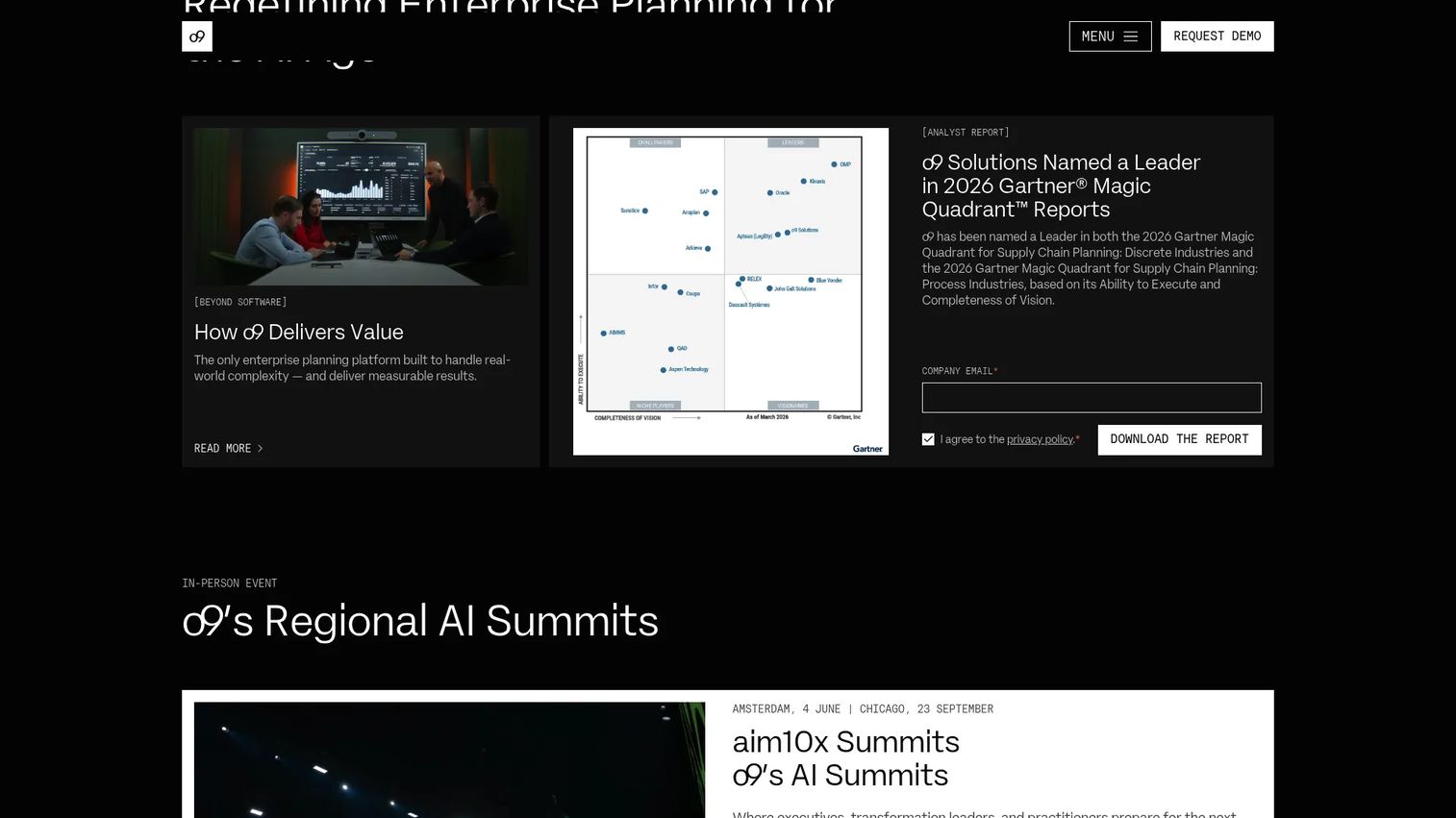
o9 Solutions is an enterprise AI planning platform built around what it calls a digital brain, a knowledge-graph model that connects supply chain, finance, sales, and marketing planning. It supports integrated business planning across all four, plus revenue growth management modules for pricing, promotions, and assortment. The scale is the point: it is built for organizations with many inputs and high planning complexity.
AI and knowledge-graph-driven scenario analysis let teams compare options across a dense web of dependencies, and the platform orchestrates planning across functions rather than in isolated silos. For large, complex enterprises coordinating commercial and supply chain plans at once, o9 handles the breadth. Its modeling depth suits organizations where planning spans dozens of interacting variables.
Best for: Large enterprises coordinating connected supply chain and commercial planning at high complexity.
Key strengths
- Digital brain modeling: knowledge-graph model connecting supply chain, finance, sales, and marketing.
- Integrated business planning: one platform spanning commercial and supply chain plans.
- AI-driven scenario comparison: evaluate options across dense dependency networks.
Why choose o9 Solutions: If your planning spans commercial and supply chain functions with heavy interdependence, the knowledge-graph model handles complexity other tools flatten. It fits large enterprises running planning orchestration at scale.
o9 Solutions pricing: o9 states that pricing is not published and is scoped per customer. Prospects are directed to a demo and pricing discussion, so expect a custom enterprise engagement. o9 holds a 4.2/5 rating on G2.
7. Blue Yonder
Blue Yonder delivers AI-powered end-to-end supply chain management, from planning through execution, on a common data cloud. Its strength is depth across the operational chain: demand and supply planning synchronize, and those plans link directly to warehouse, transportation, and merchandise execution. For supply chain-led organizations, that planning-to-execution continuity closes the gap between deciding and doing.
The Blue Yonder Platform pairs planning with analytics and risk mitigation, surfacing disruptions and helping teams reroute before they hit the customer. Because planning and execution share one data foundation, a plan change does not stall at the handoff to operations. For organizations where the supply chain is the business, that operational depth is the reason to shortlist it.
Best for: Large enterprises that need integrated supply chain planning tied tightly to execution.
Key strengths
- End-to-end supply chain planning: demand and supply synchronization across the full chain.
- Execution linkages: planning connected to warehouse, transportation, and merchandise operations.
- Analytics and risk mitigation: surface disruptions and reroute before they reach customers.
Why choose Blue Yonder: If your operation lives or dies on supply chain execution, the planning-to-execution continuity on one data cloud is the differentiator. It fits supply chain-led enterprises that need operational depth, not just planning.
Blue Yonder pricing: Blue Yonder does not publish pricing on its site. Sales runs through demo and contact flows, so pricing is scoped to your deployment and modules. Confirm the platform configuration and implementation scope directly with Blue Yonder. On G2, Blue Yonder holds a 4.1/5 rating.
Considerations before you buy
The right sales and operations planning software depends on your planning maturity, your ERP ecosystem, and how much scenario complexity you carry. Work through these before you shortlist.
ERP and CRM integration
Map the systems your planning data lives in first. If your transactional data is already in one ERP, a platform native to that stack removes a major integration burden. Confirm which CRM, ERP, and external demand signals each tool ingests before you commit.
Scenario planning depth
Not all scenario planning is equal. Some tools run fast what-if analysis on a single dimension; others model tradeoffs across demand, supply, margin, and working capital at once. Match the depth to how complex your real decisions are.
Governance and decision logging
Ask whether the platform records what was approved, by whom, and why. A decision log stops teams from relitigating old calls every cycle. Governance, versioning, and auditability matter most in regulated or finance-heavy organizations.
Financial impact visibility
The best sales and operations planning software features connect plans to margin, revenue, and working capital, not just units. Check that finance can see the money consequences of a plan change inside the same tool, so financial planning alignment is built in rather than bolted on.
Implementation and total cost
Most vendors here run quote-based pricing and multi-month implementations. Ask about deployment timelines, required modules, and ongoing support. Verify current pricing and G2 ratings on each vendor's live site, since figures shift.
Conclusion
There is no single winner in sales operations planning software for 2026, only the right fit for your planning maturity and ecosystem. TransImpact stands out when governance and an executive decision workflow matter most. SAP fits teams already living inside its ERP. Anaplan leads for finance-linked scenario planning across connected functions. Kinaxis excels at fast disruption response, o9 Solutions at high-complexity orchestration, Infor at integrated enterprise resilience, and Blue Yonder at supply chain-led planning tied to execution.
Your next step is practical. Build a shortlist of two or three that match your ERP stack and scenario complexity. Map the integrations you actually need, not the ones on the brochure. Then take one real planning scenario, a supplier slip or a demand spike, and test it inside each vendor's demo. The tool that turns that scenario into a defensible decision fastest is the one worth buying.
FAQs
Sales and operations planning software aligns demand, supply, and financial plans into one agreed operating plan through a structured monthly cadence. It replaces disconnected spreadsheets with a shared data model that sales, operations, supply chain, and finance work from together. The goal is one plan everyone commits to, with the financial impact attached.
The core sales and operations planning software features are a single source of truth, scenario planning, consensus workflows, and financial impact visibility. Governance and decision logging matter for regulated or finance-heavy organizations. ERP integration determines how much data-plumbing work you avoid, so weigh it early.
Forecasting tools predict demand. S&op software takes that forecast and reconciles it against supply, capacity, and financial goals to produce an agreed plan. Forecasting answers "what will demand be." S&OP answers "given that demand, what do we commit to, and what does it cost." The planning cadence and consensus workflow are what set it apart.
Often, yes. ERP handles transactions and execution; it rarely runs a full s&op process with consensus workflows, scenario planning, and cross-functional reconciliation. Some suites like SAP embed planning inside the ERP through deep ERP integration. If yours does not, dedicated s&op planning software fills the gap between transactional data and agreed plans.
At minimum, ERP for transactional and supply data, and CRM for demand and pipeline signals. External feeds like market data, weather, or supplier signals improve demand and supply planning accuracy. Confirm each platform ingests your specific systems before you commit, since integration scope varies widely across vendors.
Scenario planning lets you model demand spikes, supply shortages, margin pressure, and channel shifts before committing capital or inventory. Instead of guessing, you see the effect on revenue, margin, and working capital in advance. Fast what-if analysis turns a two-week reconciliation into an afternoon decision, which is often the main reason teams buy.
Finance should prioritize financial impact visibility and financial planning alignment: the ability to see margin, revenue, and working capital consequences of any plan change inside the tool. Auditability, deterministic calculations, and a decision log matter for defending the numbers. Rolling forecasts and a unified data model keep finance connected to operational plans continuously.
Start with your planning maturity, ERP ecosystem, and scenario complexity. Shortlist two or three sales and operations planning tools that fit your stack, map your required integrations, and test one real planning scenario in each vendor's demo. The platform that produces a defensible decision fastest, with the governance and financial visibility you need, is the right choice.