You hired department heads so every approval would stop routing through you. Then travel bookings, expense reimbursements, and corporate card exceptions started landing in three different systems, and somehow your VP Finance was still chasing receipts at month-end.
That pattern is common at Series B SaaS companies. Finance operations look manageable at 30 people and become genuinely painful at 80. According to American Express (2025), only 38% of executives have automated travel approvals or expense filing, which means most scaling companies are still running manual loops that consume finance time and obscure burn visibility.
The right travel and expense management software changes the operating model. Policies get enforced before money moves. Receipts surface automatically. Approvals happen in the workflow, not in Slack. Finance closes the books without chasing anyone. The global market for travel and expense management software reached USD 4.08 billion in 2025 and is projected to reach USD 12.98 billion by 2034 (Fortune Business Insights, 2026), reflecting how many companies are making this shift.
This guide helps you figure out which tool fits your operating model, not just which one has the most features.
What's inside
This guide compares 15 travel and expense software platforms for 2026, evaluated for fit at scaling SaaS companies between 30 and 150 employees.
Tools were selected based on four criteria:
- Operating model fit: Travel-first, expense-first, card-first, or procurement-first coverage
- Accounting and ERP integrations: QuickBooks, Xero, NetSuite, and similar systems
- Policy enforcement depth: Where rules are applied (booking, swipe, submission, or approval)
- Adoption realistic for a 50 to 150 person team: Not just enterprise implementation depth
Pricing and G2 ratings were verified against live vendor pages and current G2 listings.
TL;DR
- Best for travel-heavy scaling teams: Navan for companies wanting booking and expenses connected; TravelPerk if the booking experience is the primary problem
- Best for card-first spend control: Ramp (free core tier) or Brex (startup-oriented finance workflows)
- Best for founder-led SaaS teams moving beyond spreadsheets: Expensify or Zoho Expense for affordable, fast-setup expense management
- Best for enterprise policy and compliance depth: SAP Concur or Coupa, once complexity justifies the rollout
- Best for global expense operations: Emburse, Rydoo, Mobilexpense MXP, or Webexpenses for multi-currency and cross-border reimbursements
- Best for straightforward expense reporting: ExpenseOnDemand or ExpensePoint when the pain is clean reports and faster reimbursements
What is travel and expense software?
Travel and expense software helps companies book business travel, capture receipts, enforce spend policies, approve expenses, reimburse employees, and sync spend data into accounting or ERP systems.
Core jobs it handles
- Business travel booking: Flights, hotels, trains, and car rentals within policy
- Receipt capture: Mobile OCR scanning, corporate card feeds, and automatic categorization
- Expense report automation: Pre-populated forms, policy flags, and submission workflows
- Corporate card management: Physical and virtual cards with real-time spend controls
- Approval workflows: Multi-level routing tied to spend categories, amounts, or departments
- Policy enforcement: Rules applied at booking, card swipe, submission, or audit
- Employee reimbursements: Direct deposit, payroll sync, or payment runs
- Accounting and ERP sync: QuickBooks, Xero, NetSuite, SAP, Sage Intacct
- Spend reporting: Team-level, department-level, and project-level visibility
- Audit trails: Complete records for finance, compliance, and board review
Four platform types
Different tools center on different workflows.
Travel-first platforms prioritize booking inventory, traveler experience, and policy at the point of booking. The expense piece may need supplementing.
Expense-first platforms prioritize receipts, approvals, reimbursements, and accounting sync. Travel booking may be lighter or absent.
Card-first platforms center on corporate cards, spend limits, virtual cards, and real-time transaction controls. Reimbursements and bill pay layer on top.
Procurement-first platforms add sourcing, supplier management, invoicing, and broader spend governance for organizations that have outgrown standard T&E.
Why founders should care
The business case at Series B is straightforward: Spend visibility, burn control, and faster month-end close. A founder who can hand the finance workflow to a new Head of Finance on day one avoids the situation where every card exception routes back through the CEO. Board-ready spend reporting by team or department is a cleaner metric story than a reconciled spreadsheet.
When to use travel and expense software
Control spend before month-end
Spreadsheets and after-the-fact reimbursements show spend only after it happened. Travel and expense software can enforce rules at booking, card swipe, or approval, so finance sees real-time numbers rather than end-of-month surprises.
Replace manual reimbursement loops
Receipt chasing consumes finance time and frustrates employees. Automated expense management, with mobile receipt capture and direct deposit reimbursement, removes those loops and shortens close cycles.
Scale travel without founder approval
The goal is not tighter control for its own sake. It is delegating spend decisions to department heads without losing visibility. A well-configured travel and expense platform lets your Head of Engineering approve team travel within policy without the founder ever seeing the request.
Travel and expense software comparison
These 15 tools differ significantly by operating model. Some are built around travel booking. Others start with cards or expense reports. A few extend into procurement and supplier management. Match the tool to your dominant pain before evaluating features.
| # | Product | Best for | Key differentiator | Pricing | G2 rating |
|---|---|---|---|---|---|
| 1 | Navan | Travel and expense in one workflow | Point-of-booking policy controls | Free for eligible companies | 4.7/5 |
| 2 | SAP Concur | Enterprise travel and compliance | Global policy depth and SAP ecosystem | Custom pricing | 4.0/5 |
| 3 | Expensify | Receipt capture and fast reimbursements | SmartScan OCR and broad accounting sync | From $5/user/month | 4.5/5 |
| 4 | Ramp | Card-first spend control | Free core platform, real-time controls | Free core tier | 4.8/5 |
| 5 | Brex | Startup and mid-market card spend | Built-in travel booking and AI expense management | Free Essentials tier | 4.8/5 |
| 6 | Zoho Expense | Affordable multi-currency expense management | Zoho ecosystem integration and AI anomaly detection | From $3/user/month | 4.6/5 (Capterra) |
| 7 | Emburse | Configurable expense and AP workflows | Product family covering expense, invoice, travel, and cards | From $8/user/month | 4.4/5 |
| 8 | TravelPerk | Travel-first booking and policy | Large inventory and Perk.com spend integration | Free Starter tier | 4.6/5 |
| 9 | Rydoo | Mobile-first international expense management | AI receipt scanning in multiple currencies | From €8/user/month | 4.4/5 |
| 10 | Coupa | Enterprise spend and procurement governance | Full BSM suite beyond T&E | Custom pricing | 4.2/5 |
| 11 | Spendesk | Proactive spend approvals and budget controls | Pre-approved spend requests before employees spend | Custom pricing | 4.6/5 |
| 12 | Webexpenses | Policy compliance and audit readiness | Multi-approver workflows and ERP integrations | From £7.5/user/month | 4.3/5 |
| 13 | Mobilexpense MXP | Multinational compliance and VAT support | Global coverage across 70+ countries | Custom pricing | 4.4/5 |
| 14 | ExpenseOnDemand | Modular expense management | Active-user pricing and AP automation | From $6.37/user/month | 4.5/5 |
| 15 | ExpensePoint | Straightforward expense reports and reimbursements | OCR receipt capture and 36+ standard reports | Custom pricing | 4.7/5 |
Best 15 travel and expense software tools for 2026
1. Navan
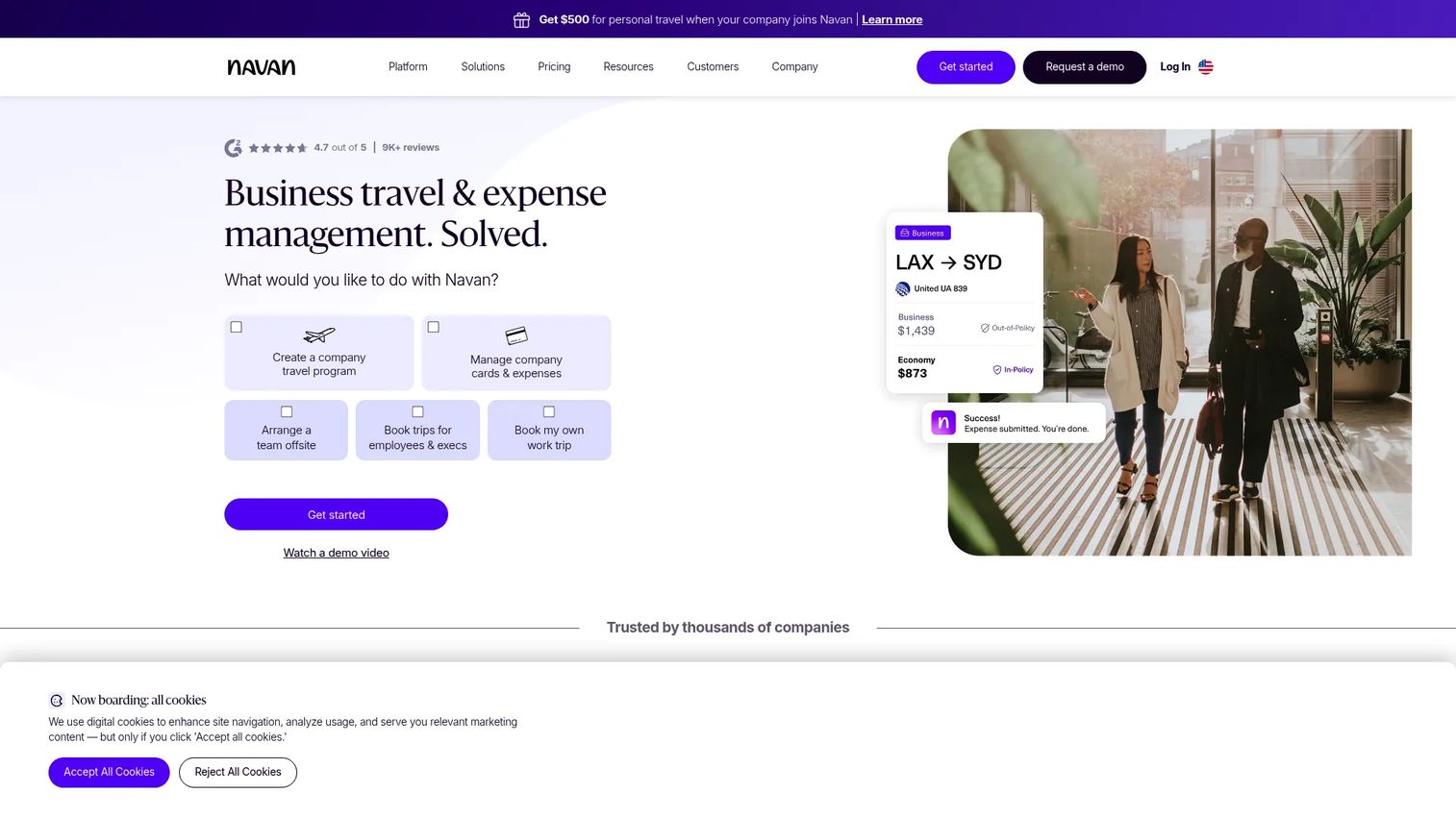
Navan is an AI-powered business travel and expense management platform that connects booking, corporate payments, and expense reporting in one workflow. Policy controls apply at the point of booking, which means employees see compliant options before they spend rather than after. Navan cards capture transactions automatically, reducing the manual receipt entry that typically clogs month-end close.
Best for: SaaS companies with active travel programs that want booking, card spend, and expense reconciliation in a single finance operating system.
Key features
- Business travel booking: Flights, hotels, trains, rental cars, and black cars
- Corporate cards with real-time spend controls
- Automated expense categorization and reporting
- Policy enforcement at booking and card transaction
- ERP and accounting integrations
Why choose Navan: Navan reduces the handoffs between booking and expense reconciliation, which is the friction point that creates the most manual work for finance teams. It is the strongest fit when travel volume is high enough that the booking experience genuinely affects employee time.
Navan pricing: Navan Travel has no platform fee for eligible companies with up to 300 employees. Navan Expense is free for the first five monthly expensing users, then $15 per user per month. Enterprise pricing requires a quote from the sales team.
G2 rating: 4.7/5
2. SAP Concur
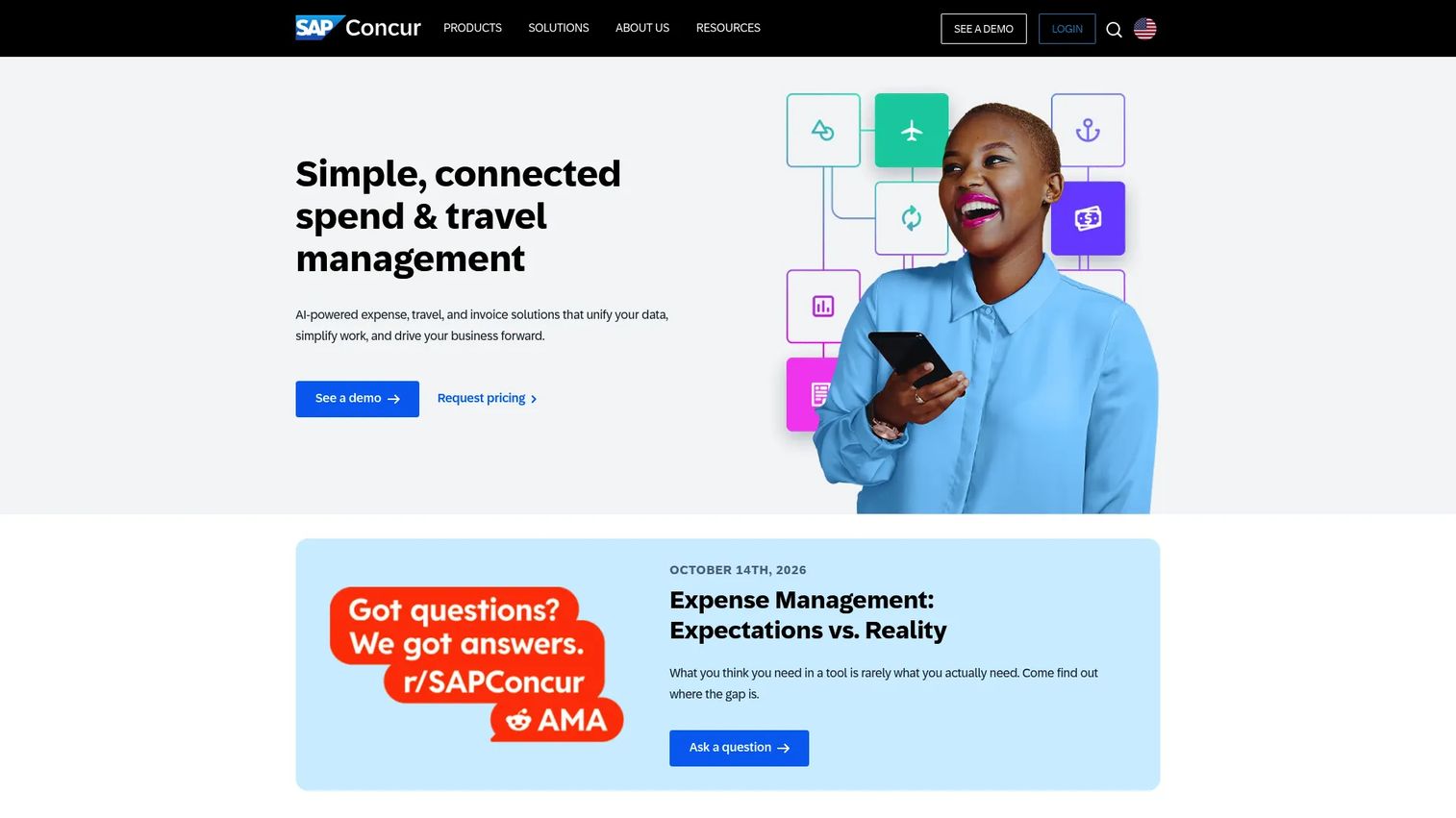
SAP Concur is a cloud-based platform for integrated business travel, expense reporting, invoice management, and spend visibility. It has a long track record in corporate travel expense management for larger organizations with complex compliance requirements, global entities, and deep SAP ecosystem dependencies. Travel booking, expense automation, accounts payable, and configurable approval workflows are all native.
Best for: Companies with global operations, mature finance teams, and strict compliance requirements that need enterprise-grade travel and expense governance.
Key features
- Business travel booking and itinerary management
- AI-powered receipt capture and expense automation
- Corporate card integration and reconciliation
- Configurable policy controls and approval workflows
- Accounts payable invoice capture with OCR and purchase-order matching
Why choose SAP Concur: Recommend it for teams that need governance depth and can support a structured rollout. For a 50-person SaaS company, this is likely more than you need today. For a 150-person company with global entities and a Head of Finance managing board-level compliance, the policy depth earns its place.
SAP Concur pricing: SAP Concur uses custom pricing across its Base, Plus, and Premium plans. Contact the sales team for a quote; cost drivers include employee count, travel volume, modules selected, and integration scope.
G2 rating: 4.0/5
3. Expensify
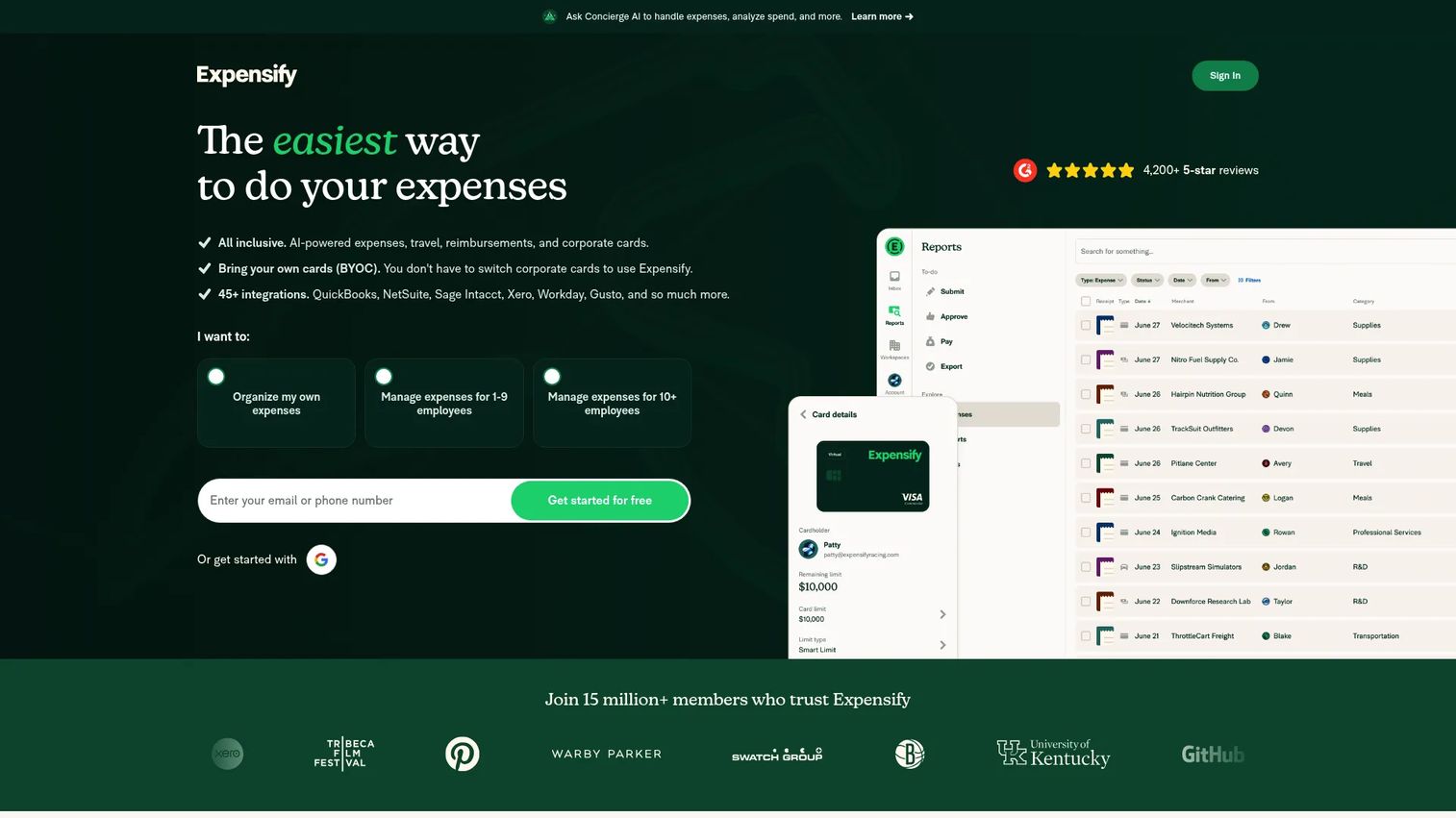
Expensify covers receipt scanning, expense reports, corporate cards, reimbursements, bill pay, and travel-related expense workflows. SmartScan OCR reads receipts automatically, and the platform integrates with QuickBooks, Xero, NetSuite, and other accounting systems that scaling SaaS companies commonly use. It is often the first serious upgrade from email receipts and spreadsheets.
Best for: Founders and finance teams that need fast expense workflows and accounting sync without enterprise implementation drag.
Key features
- SmartScan OCR receipt scanning
- Expense report submission and approval workflows
- Reimbursements and corporate card management
- Travel booking for flights, hotels, cars, and rail
- Accounting integrations including QuickBooks and Xero
Why choose Expensify: Choose it when the main pain is receipt capture and reimbursement speed. Companies that need deep travel inventory or procurement workflows may find the travel booking capabilities thinner than a travel-first platform.
Expensify pricing: The Submit plan is free and includes core receipt and mileage features. Collect costs $5 per member per month and adds reimbursements, corporate card management, and accounting integrations. Control starts as low as $9 per active member per month and adds custom approval flows, ERP integrations, and SSO.
G2 rating: 4.5/5
4. Ramp
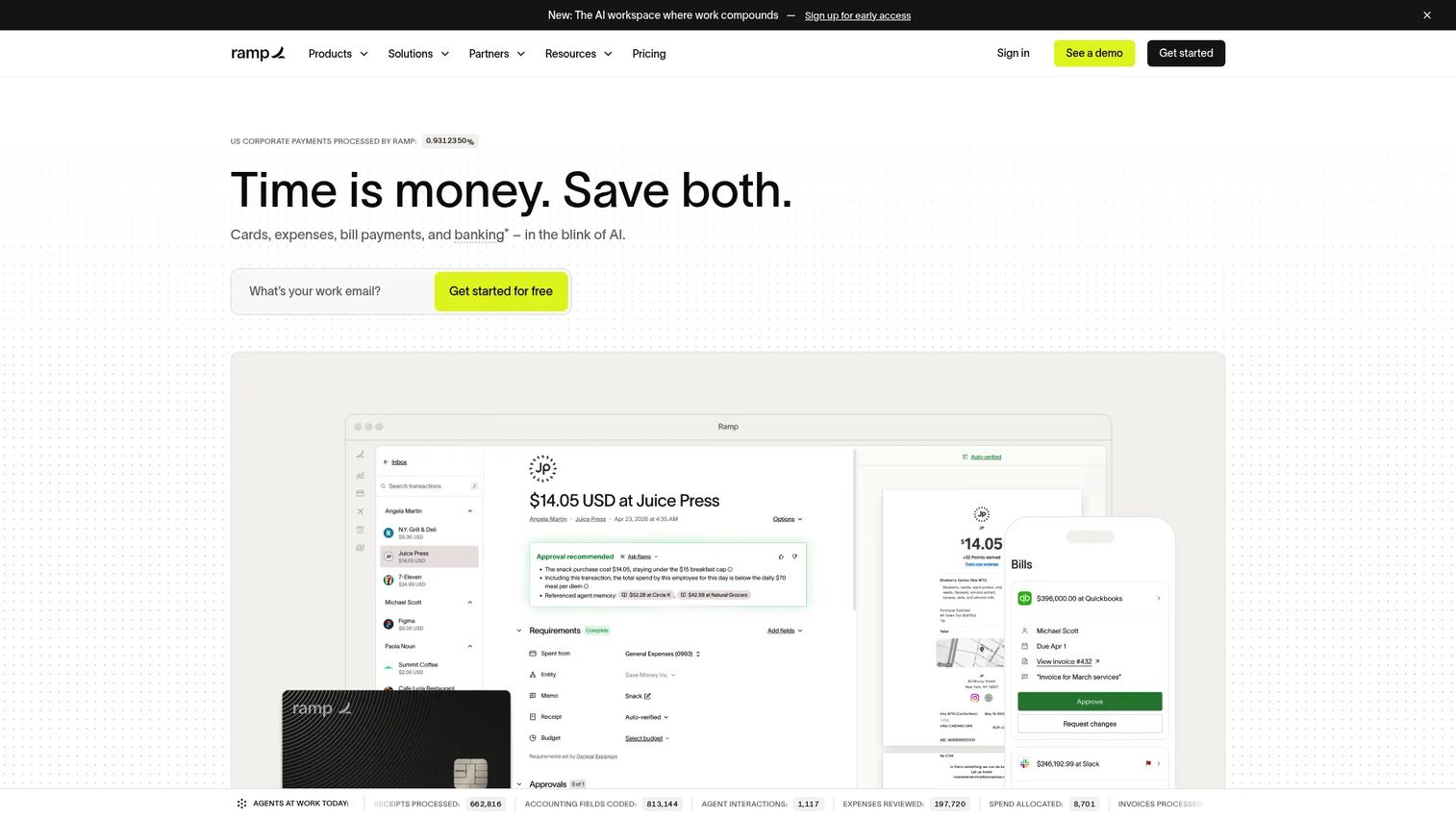
Ramp is a financial operations platform built around corporate cards, expense automation, accounts payable, and accounting integrations. Real-time spend controls mean department heads see and manage their budgets as transactions happen, not at month-end. Bill pay, reimbursements, corporate travel booking, and procurement workflows layer on top of the card-led foundation.
Best for: SaaS companies that want card controls and spend visibility before expenses reach month-end reconciliation.
Key features
- Corporate cards with granular per-employee and per-vendor spend limits
- Expense management, reimbursements, and accounting automation
- Accounts payable, bill payments, and procurement
- Corporate travel booking with automatic expense capture
- Multi-entity management and ERP integrations
Why choose Ramp: Ramp suits finance teams that want to control spend at the transaction level rather than the reimbursement level. It is especially relevant when you want cards, vendor payments, and reimbursements under one operating model instead of three separate tools.
Ramp pricing: The core Ramp platform, including cards and expense management, is free. Ramp Plus is a paid tier with advanced automation, multi-entity controls, and deeper integrations; contact Ramp for Plus pricing.
G2 rating: 4.8/5
5. Brex
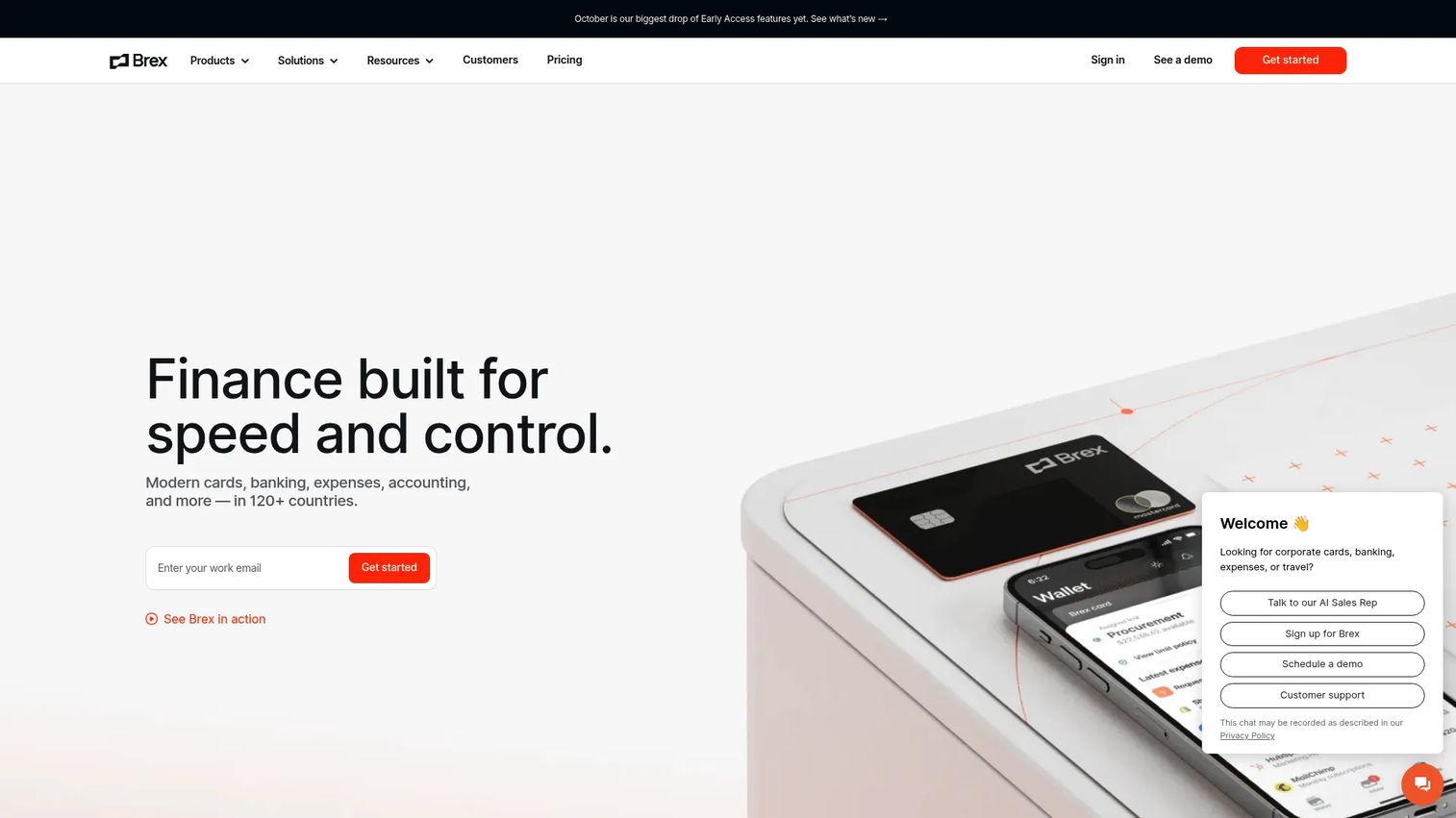
Brex is a global finance platform for corporate cards, banking, expense management, bill pay, and travel. It is built with startup and mid-market finance workflows in mind, including distributed teams, international spending, and budget controls by department. AI-powered expense categorization and automated accounting sync reduce the manual work that typically hits finance at close.
Best for: Funded SaaS companies that want card-led spend control with a platform built for startup finance workflows and distributed teams.
Key features
- Corporate cards with built-in spend controls and budgets
- AI-powered expense management and automation
- In-app business travel booking and management
- Bill pay and invoice automation
- Accounting automation and ERP integrations
Why choose Brex: Brex fits when you want to manage operating spend through cards and budgets rather than reimbursement-first workflows. Eligibility, banking setup, and finance process maturity all affect fit, so check those before committing.
Brex pricing: Essentials is free. Premium costs $12 per user per month. Enterprise and Smart Card tiers use custom pricing.
G2 rating: 4.8/5
6. Zoho Expense
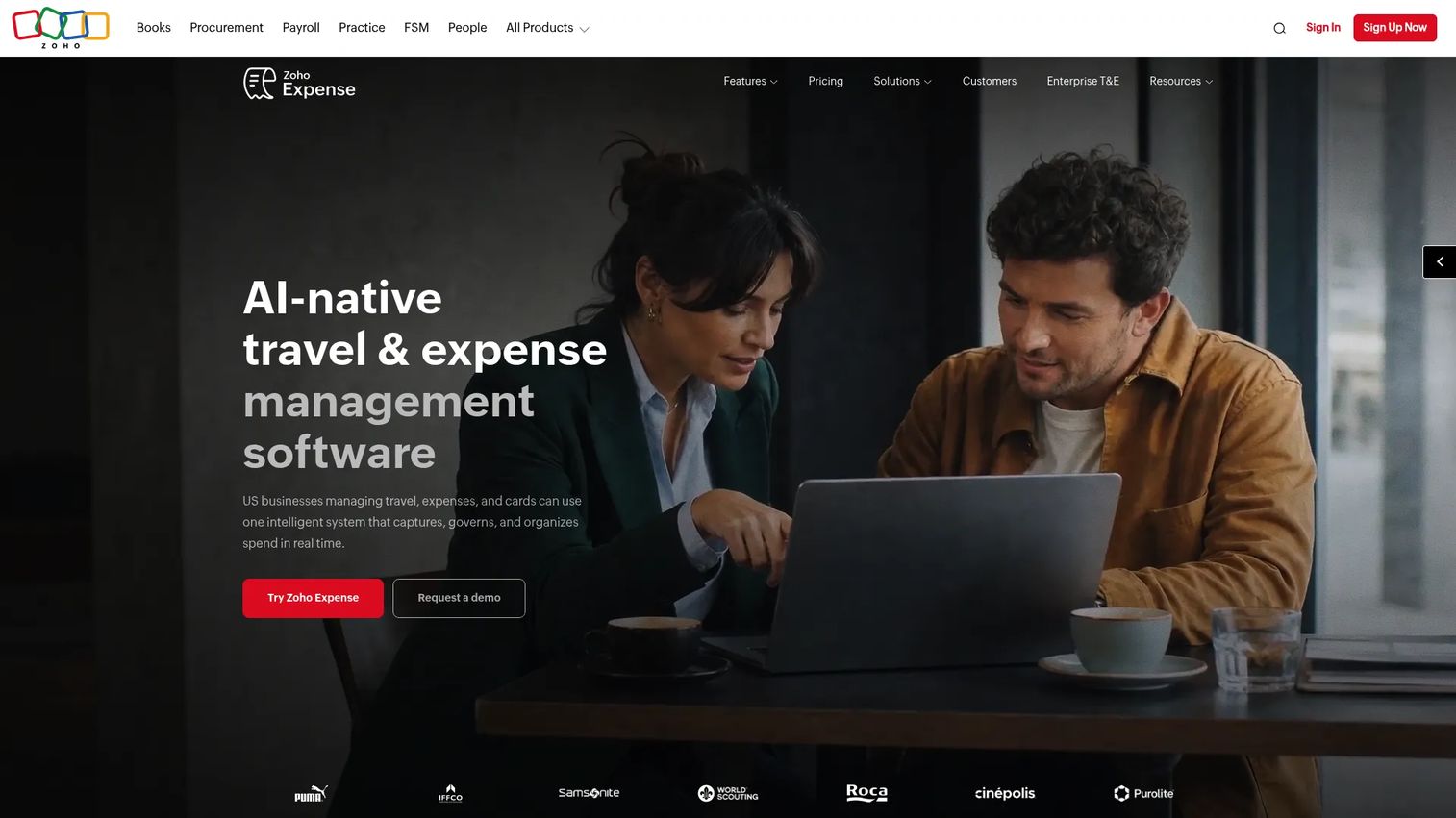
Zoho Expense is an AI-native travel and expense management platform covering receipt capture, expense reporting, multi-currency reimbursements, mileage tracking, per diem rules, and corporate card feeds. Its AI assistant Zia adds anomaly detection and spend forecasting. Teams already using Zoho Books or Zoho CRM get native integration that removes the accounting sync complexity.
Best for: Cost-conscious SaaS teams that want affordable expense management with AI features and tight accounting workflow support, particularly within the Zoho ecosystem.
Key features
- AI-powered OCR receipt capture in 38+ languages
- Expense reporting, policy enforcement, and approval workflows
- Corporate card management with real-time feeds
- Mileage tracking and per diem calculations
- Multi-currency and multi-entity expense management
Why choose Zoho Expense: Choose it when cost and finance workflow coverage matter more than premium travel inventory. It is a strong fit for founders watching burn who want to standardize basic finance operations quickly.
Zoho Expense pricing: A free plan covers up to three users. Standard costs $3 per user per month billed annually. Premium costs $5 per user per month billed annually.
7. Emburse
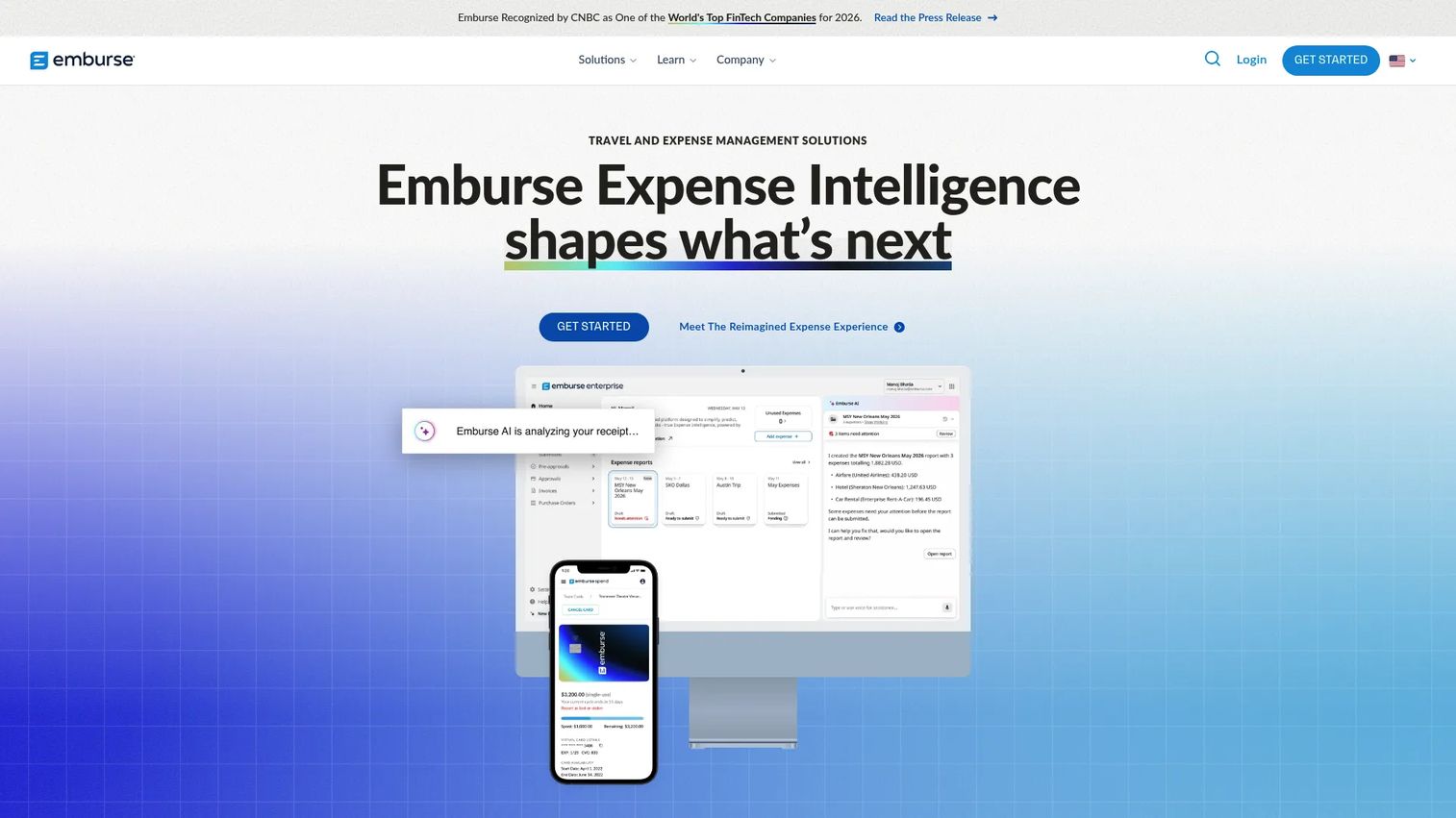
Emburse provides a family of expense, travel, accounts payable, invoice, payment, and card-related products. Rather than a single lightweight app, Emburse serves organizations that need configurable spend workflows, strong policy controls, and integration with finance systems across multiple departments. A 30-day free trial is available on the Emburse Spend product.
Best for: Mid-market and enterprise teams that need mature expense workflows, invoice automation, and a finance team ready to own configuration.
Key features
- Real-time expense submission, approval, and reporting
- AI-powered receipt capture and policy enforcement
- Corporate virtual and physical cards
- Accounts payable and invoice automation
- ERP and accounting integrations
Why choose Emburse: Emburse works well for teams that have outgrown lightweight expense reporting and need deeper policy controls across multiple spend categories. Guided implementation costs $1,500, so factor that into the evaluation for smaller teams.
Emburse pricing: Emburse Spend Basic costs $8 per user per month. Plus costs $12 per user per month. Both tiers include Emburse Cards at no additional fee.
G2 rating: 4.4/5
8. TravelPerk
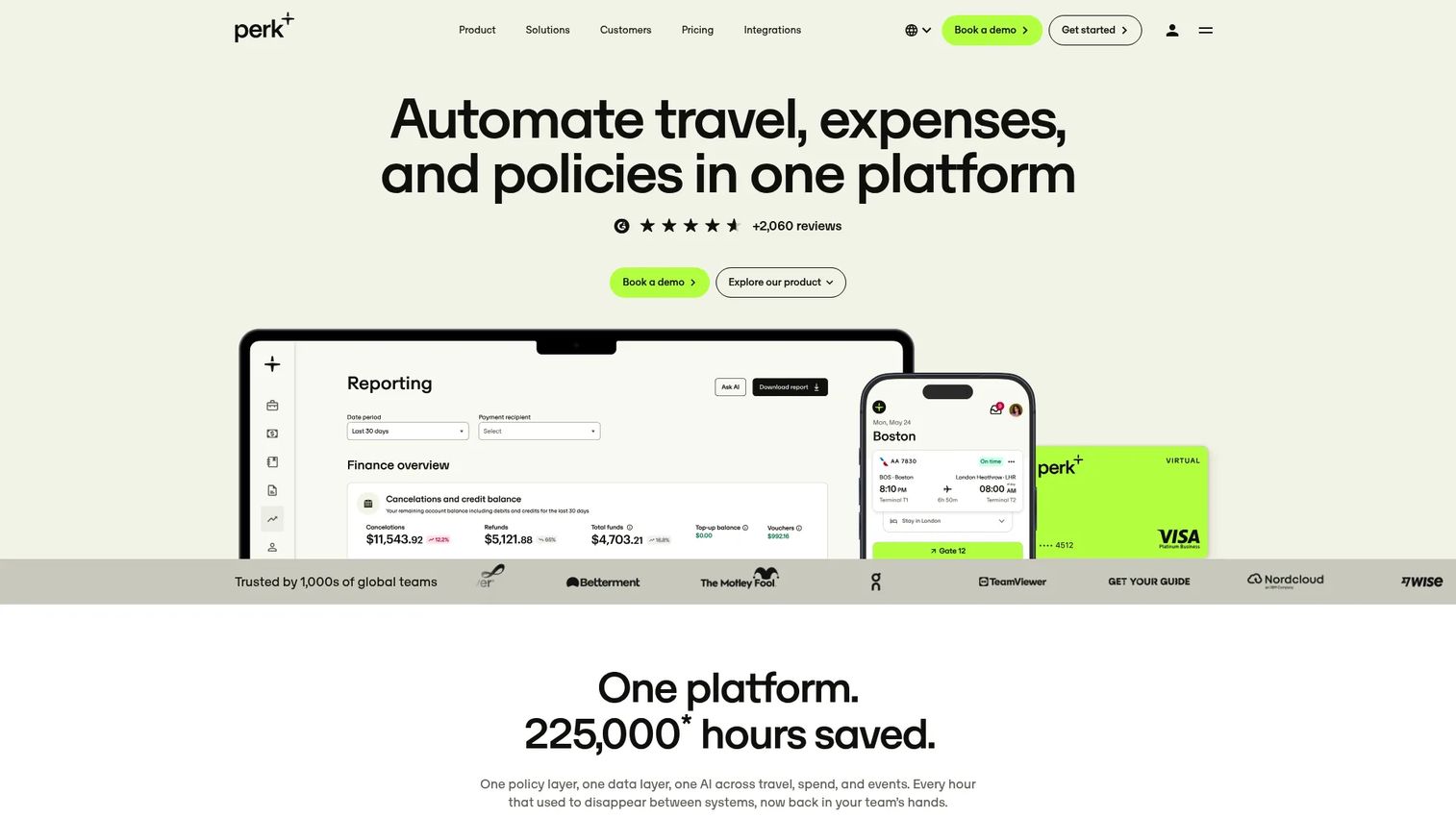
TravelPerk (now also branded as Perk) is a corporate travel management platform focused on booking inventory, traveler experience, policy settings, and approval workflows. The travel inventory is among the largest of any platform on this list. Expense processing and invoice management are available through the combined Travel and Spend offering.
Best for: Companies where business travel experience and booking inventory are the primary operational problem, and where employee booking friction is consuming finance or ops time.
Key features
- Business travel booking for flights, hotels, cars, and trains
- Travel policies and booking approval workflows
- Expense processing and invoice management
- Traveler support and itinerary management
- Reporting and spend analytics
Why choose TravelPerk: Choose it when employees travel frequently and the booking experience creates operational drag. Teams that also need deep spend management may want to evaluate whether the Spend add-on covers their reimbursement and accounting integration requirements fully.
TravelPerk pricing: The Starter plan costs $0 per month plus 5% per booking. Premium costs $99 per month plus 3% per booking. Pro costs $299 per month plus 3% per booking. Combined Travel and Spend plans start from $6 per active user per month plus 3% per booking on Premium.
G2 rating: 4.6/5
9. Rydoo
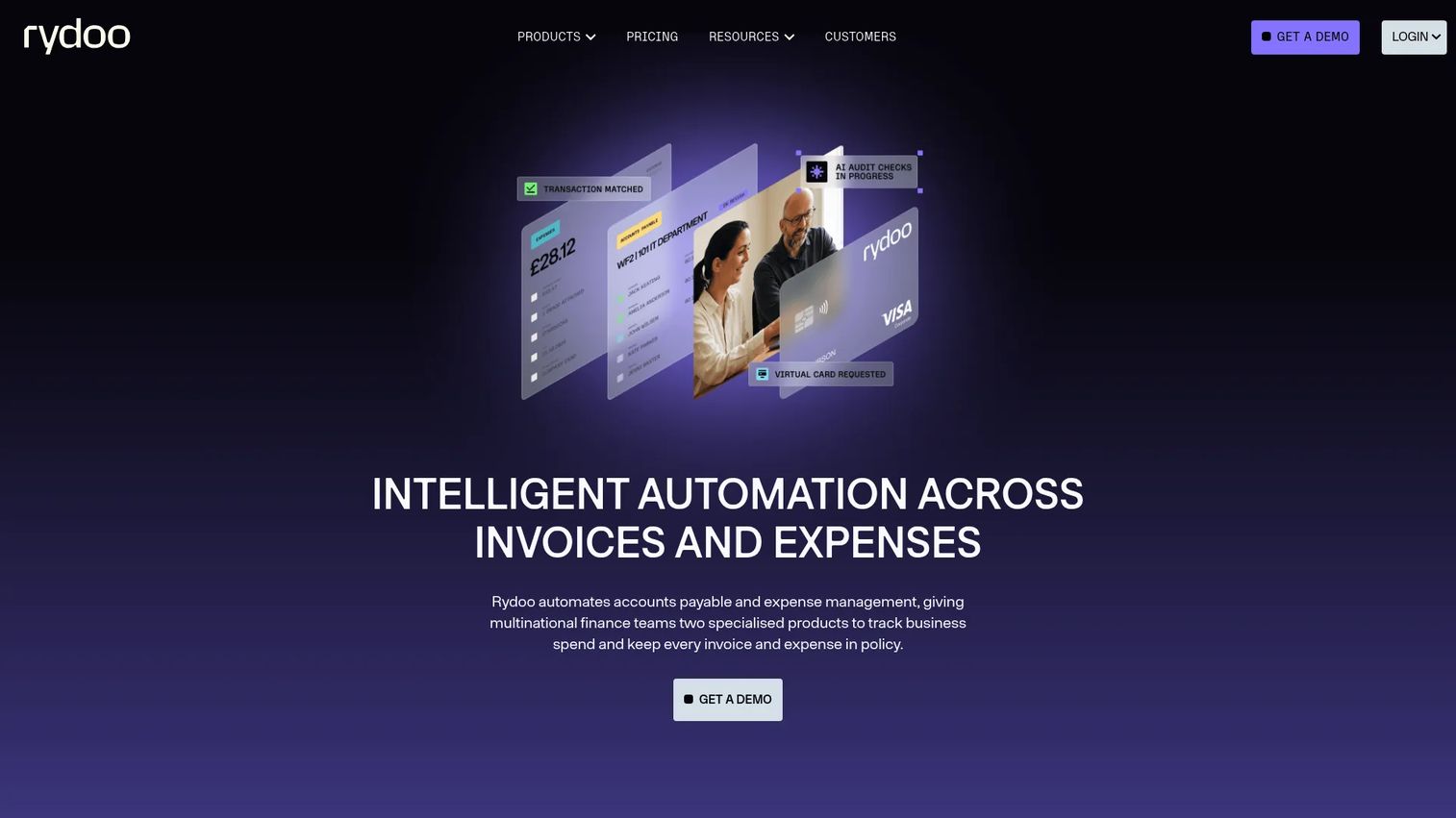
Rydoo is an AI-powered expense management and accounts payable platform built for multinational finance teams. Receipt scanning, multi-currency reimbursements, mileage tracking, per diem management, and customizable approval flows are core. The mobile experience is a focus: Employees can photograph and submit expenses in seconds, which matters for distributed teams with frequent small expenses.
Best for: Distributed teams and international companies that need employees to submit expenses quickly from mobile, with strong multi-currency and accounts payable support.
Key features
- AI-powered receipt scanning and expense capture
- Customizable expense policies and approval flows
- Mileage and per diem management
- Corporate expense cards and automated reconciliation
- Accounts payable automation
Why choose Rydoo: Choose it when employee adoption and mobile submission speed are the main blockers. It is especially useful for teams with regional reimbursement requirements and frequent small expenses across multiple currencies.
Rydoo pricing: Essentials costs €8 per user per month billed annually, or €10 per user per month billed monthly. Pro costs €10 per user per month billed annually, or €12 per user per month billed monthly. Plans require a minimum of 5 users.
G2 rating: 4.4/5
10. Coupa
Coupa is an enterprise business spend management platform covering procurement, expenses, invoicing, payments, supplier management, contract management, and spend analytics. Expense management is one module within a much broader spend governance system. This is not a lightweight T&E tool.
Best for: Large organizations that want travel and expense inside a wider procurement and spend governance system, with sourcing, supplier management, and broader finance transformation.
Key features
- Procurement workflows and strategic sourcing
- Expense management and invoice automation
- Supplier and vendor management
- Payments and contract management
- Spend analytics across the full category
Why choose Coupa: Coupa makes sense when travel and expense control is part of a broader finance or procurement transformation. For a Series B SaaS company at 50 to 80 people, this is typically more platform than the problem warrants. It earns its place once procurement complexity, multi-entity management, and board-level spend governance are all active pain points simultaneously.
Coupa pricing: Custom pricing. Coupa's pricing page was unavailable for verification at time of writing; contact Coupa sales for a quote. Cost drivers typically include modules, company size, users, and transaction volume.
G2 rating: 4.2/5
11. Spendesk
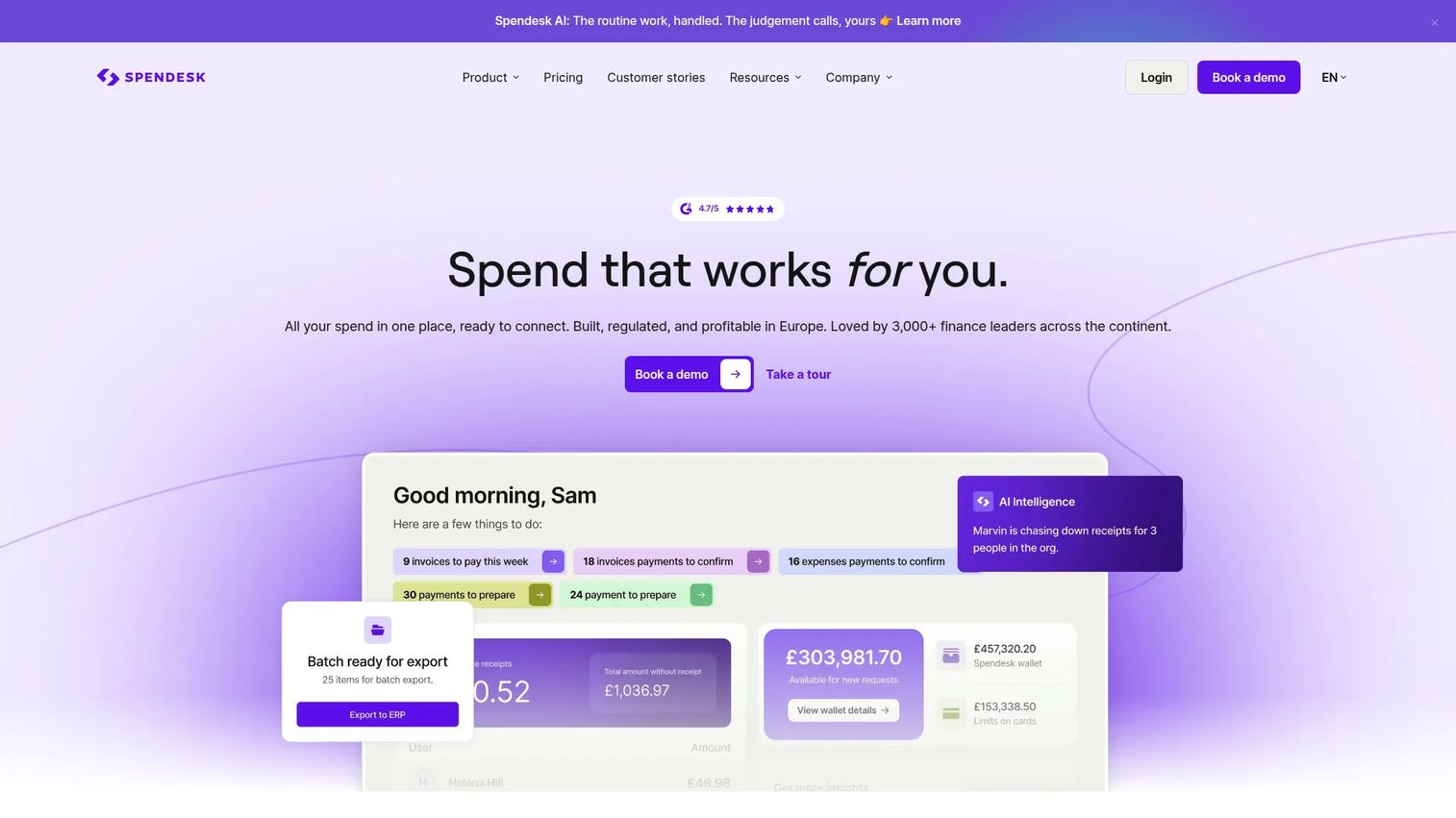
Spendesk is a spend management platform that connects corporate cards, virtual cards, expense claims, accounts payable, invoice management, budget controls, and accounting exports. The key differentiator is the pre-approval model: Employees request spending before it happens, and managers approve or decline inside the workflow. Finance gets visibility before money moves rather than after.
Best for: Finance teams that want proactive spend approvals and real-time budget visibility, particularly for European operations and distributed teams.
Key features
- Physical and virtual corporate cards with spend controls
- Pre-approved spend requests and budget controls
- Expense reimbursements and receipt capture
- Accounts payable and invoice processing
- Accounting, ERP, and HRIS integrations
Why choose Spendesk: Choose it when the finance team wants department heads to own budgets with visibility before spending occurs. It is a strong fit for founders who want to delegate spend decisions without losing central control.
Spendesk pricing: Spendesk uses a fixed monthly platform-access fee plus variable transaction fees. Numeric pricing requires a quote from the sales team.
G2 rating: 4.6/5
12. Webexpenses
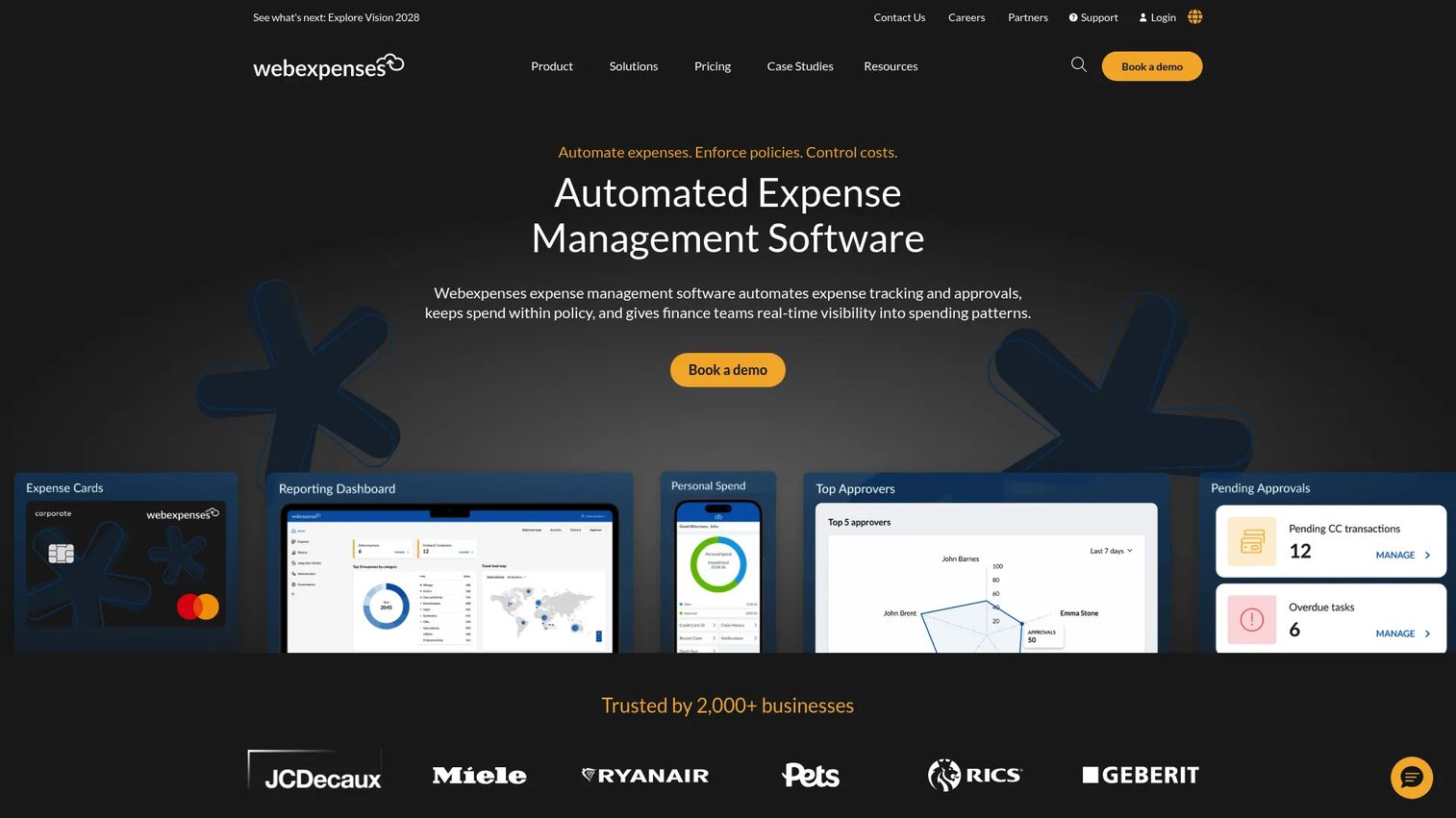
Webexpenses is an expense management platform covering receipt capture, approvals, mileage claims, corporate card reconciliation, audit reporting, and accounting integrations. Policy enforcement and audit trail quality are the headline strengths. The platform also includes carbon tracking, which matters for companies with sustainability reporting requirements.
Best for: Companies that care about audit readiness, policy enforcement, and finance team control over expense compliance.
Key features
- Receipt capture and OCR
- Mileage tracking and automated mileage claims
- Multi-approver workflows and policy controls
- Corporate card reconciliation
- ERP and accounting integrations with audit reporting
Why choose Webexpenses: Choose it when expense policy compliance and audit trail quality matter more than travel booking breadth. It works well when the biggest problem is controlling what employees can claim rather than where they can book.
Webexpenses pricing: Essential costs from £7.50 per user per month. Scale costs from £9 per user per month and adds compliance controls, corporate cards, and SSO. Pro costs from £13 per user per month and adds direct reimbursement, API access, and HRIS integrations.
G2 rating: 4.3/5
13. Mobilexpense MXP
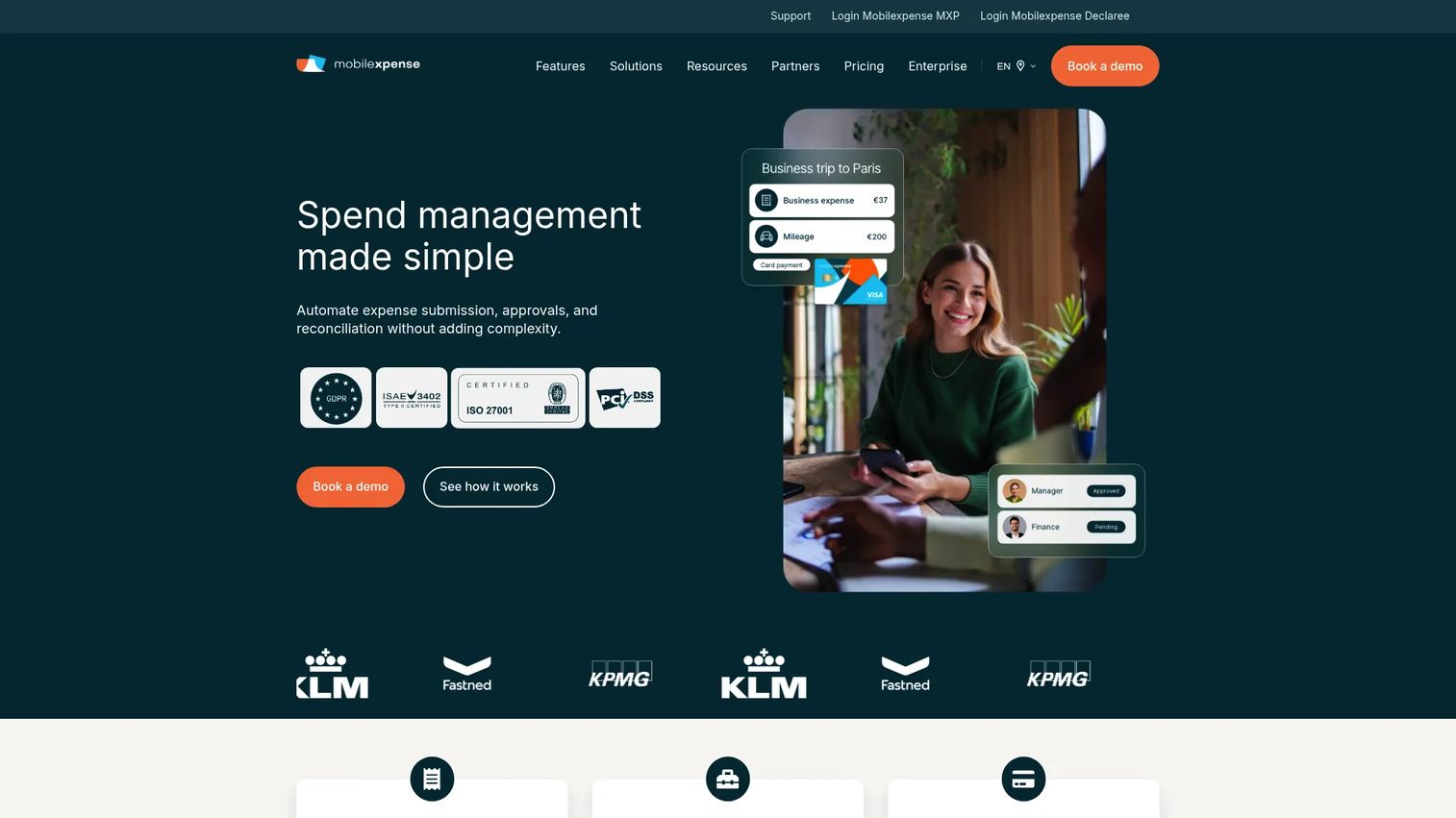
Mobilexpense MXP automates and controls global expense management for enterprise organizations operating across multiple countries. Policy automation, mileage rules, per diem calculations, VAT recovery, multi-currency support, and ERP integrations are built for the complexity of multinational reimbursement workflows. The platform covers 70+ countries and requires a minimum of 20 users.
Best for: Global teams that need expense workflows aligned with local tax rules, VAT requirements, and entity-level finance controls across multiple countries.
Key features
- Global compliance coverage across 70+ countries
- Multi-entity and multi-currency management
- Policy-driven workflows with VAT and per diem support
- Mileage tracking and travel allowances
- SSO and ERP integrations
Why choose Mobilexpense MXP: Choose it when the company operates across countries with meaningfully different reimbursement rules. For a 50-person SaaS company based in one or two markets, this is likely more compliance depth than you need. For a 150-person company with entities in the US, UK, and Germany, this kind of structured global coverage becomes a real advantage.
Mobilexpense MXP pricing: Custom pricing. Contact the sales team for a quote; the pricing page states a minimum of 20 users and notes that some features may be priced separately.
G2 rating: 4.4/5
14. ExpenseOnDemand
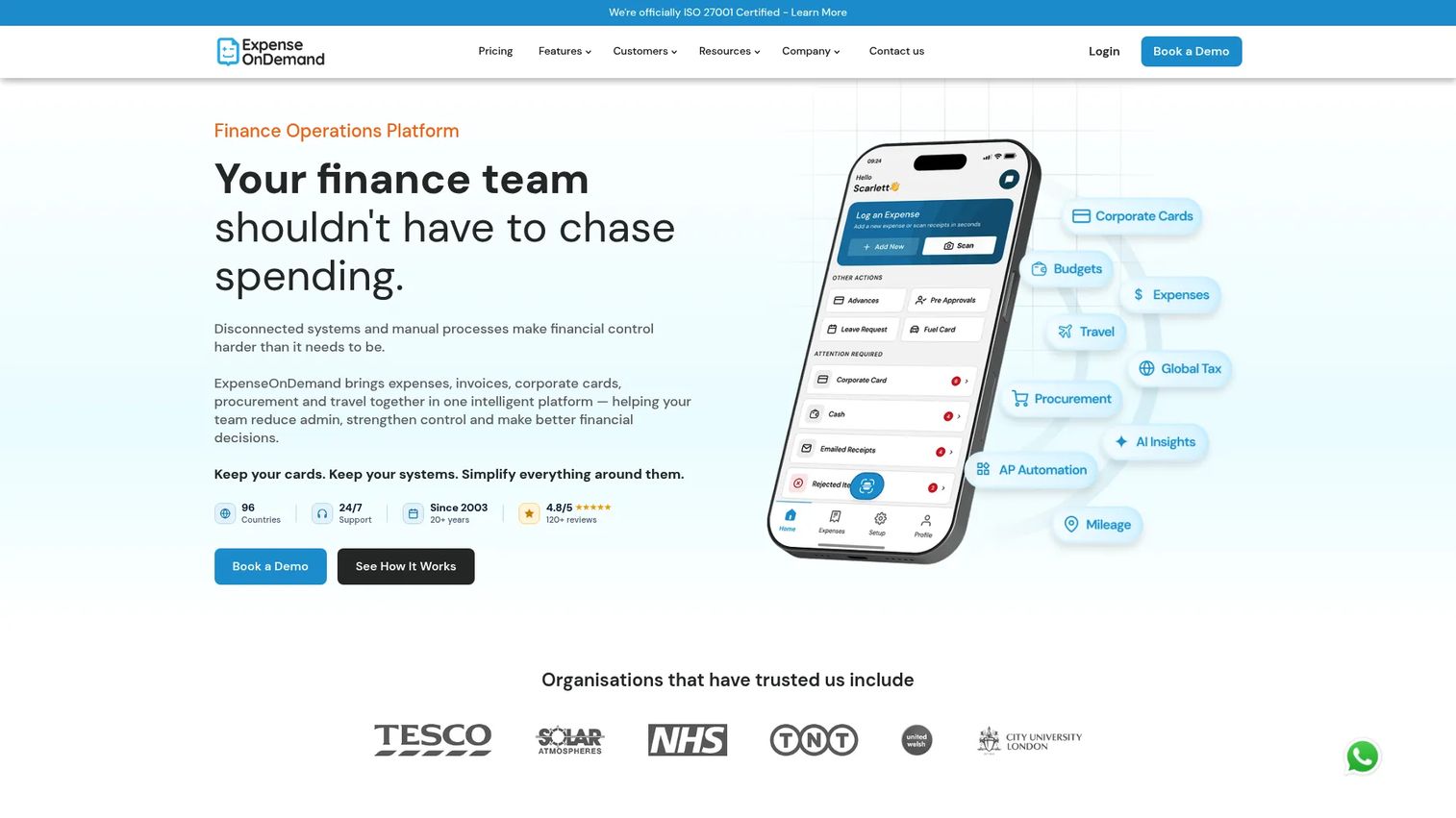
ExpenseOnDemand is a finance operations and spend management platform covering expenses, invoices, procurement, travel, corporate cards, approval workflows, and AI-powered reporting. It uses active-user pricing, meaning you pay only for employees who actually submit expenses in a given month rather than paying for every headcount seat.
Best for: Mid-market finance teams that want connected expense, accounts payable, and procurement workflows without committing to a large-scale enterprise platform.
Key features
- Expense and receipt capture with policy enforcement
- Invoice processing and accounts payable automation
- Corporate card and transaction management
- Procurement and approval workflows
- Mileage tracking and audit trails
Why choose ExpenseOnDemand: The active-user pricing model is practical for companies with seasonal or variable expense submission, and the modular structure lets you start narrow and expand. It is a reasonable fit for teams that want expense automation without over-buying on travel or procurement capabilities they do not yet need.
ExpenseOnDemand pricing: Essential costs $6.37 per active user per month on an annual contract ($10.40 per month on monthly billing). Premium costs $9.10 per active user per month on an annual contract ($12.35 per month on monthly billing). Enterprise uses custom pricing.
G2 rating: 4.5/5
15. ExpensePoint
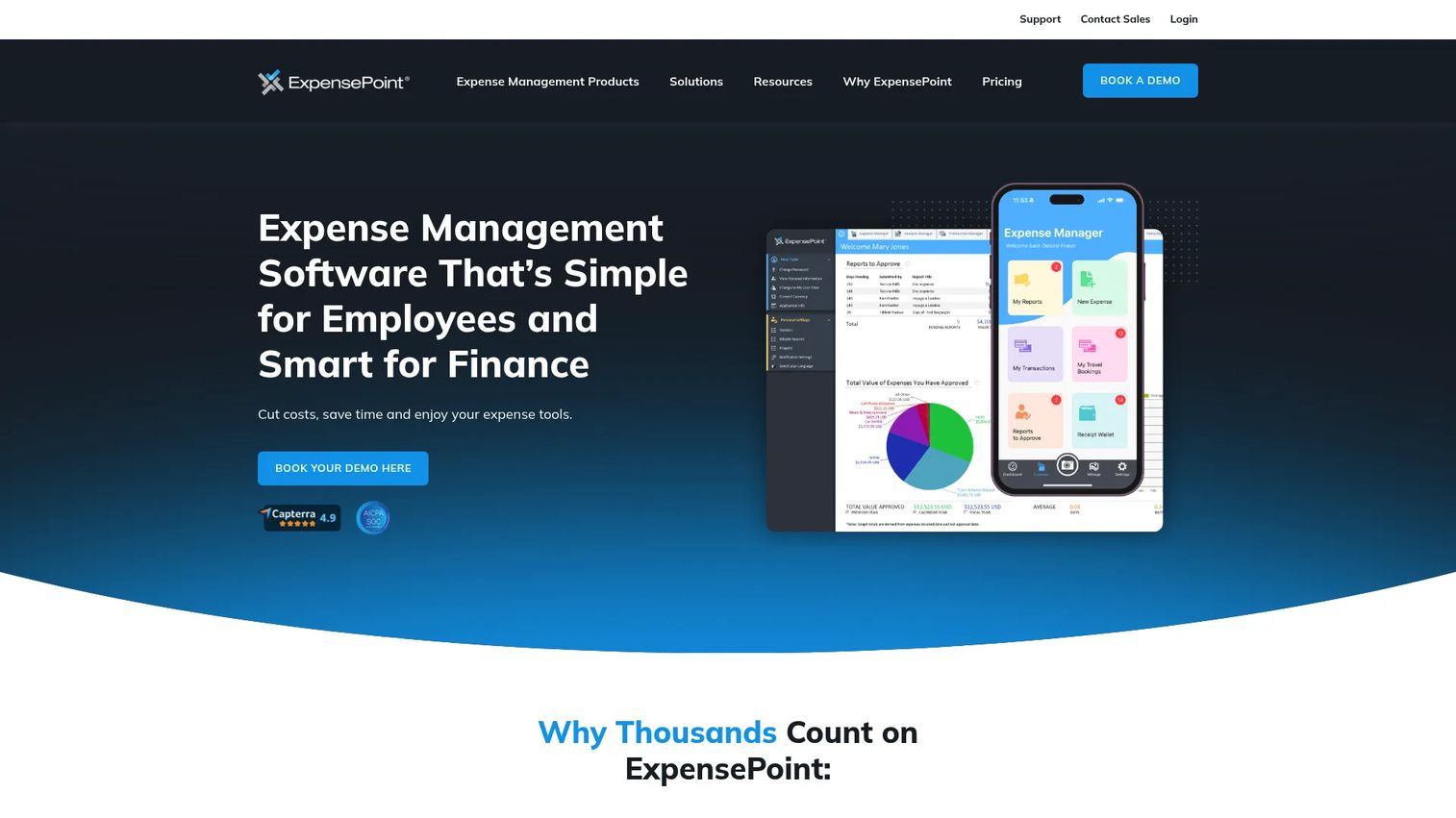
ExpensePoint is a cloud-based expense management system for creating, submitting, tracking, approving, and reimbursing business expenses. OCR receipt capture, GPS mileage tracking, credit card imports, and 36+ standard reports are included. Multi-language and multi-currency support is available without an additional module fee.
Best for: Midmarket and enterprise organizations that need cleaner expense reports and faster reimbursements without reworking their entire finance stack.
Key features
- OCR-powered receipt capture and mobile expense filing
- Credit card integration and automatic transaction matching
- GPS mileage tracking
- Custom approval workflows and policy enforcement
- Multi-language and multi-currency support with 36+ standard reports
Why choose ExpensePoint: Choose it when the problem is straightforward: Employees submit expenses inconsistently, finance spends time reconciling card imports manually, and reports are messy at month-end. It is a practical fit when travel booking is handled elsewhere and expense reporting is the focused pain.
ExpensePoint pricing: Custom pricing based on team size, usage, and configuration. Onboarding, implementation, training, and customer support are included. Contact the sales team for a quote.
G2 rating: 4.7/5
Considerations when choosing travel and expense software
Decide whether travel, expense, or cards are the center
A travel-heavy company needs booking inventory and traveler support as the primary capability. A card-heavy company needs real-time transaction controls. A reimbursement-heavy company needs receipt capture and approval workflows above everything else. Match the tool to the dominant pain before evaluating secondary features.
Check accounting and ERP integrations before the demo
For a SaaS founder handing finance to a Head of Finance, the tool only works if the accounting sync is clean. Ask specifically whether it integrates with QuickBooks, Xero, NetSuite, or whichever system your finance team will use in the next 18 months. Test field mapping, reimbursement sync, and card transaction matching before signing.
Test policy enforcement in the workflow
Do not stop at "we support policies." Ask where the policy is enforced: At booking, at card swipe, at expense submission, at manager approval, or only at audit review. Earlier enforcement means fewer exceptions reaching finance.
Model adoption across employees and managers
If employees avoid the mobile app or find submission too slow, finance still chases receipts manually. Evaluate receipt capture speed, mobile experience quality, and manager notification design before committing.
Understand implementation load relative to your stage
A lightweight expense tool can go live in a week. A global procurement platform can take months. Match rollout effort to your current finance capacity and team size. Getting a tool live quickly generates value faster than a perfect tool that takes a quarter to configure.
Conclusion
The best travel and expense software for your company depends on what is causing the most finance friction right now.
Navan, SAP Concur, and TravelPerk fit travel-led needs, with Navan offering the most connected experience at a reasonable entry price. Expensify, Zoho Expense, Rydoo, and ExpensePoint address expense reporting, receipt capture, and reimbursements at different price points and complexity levels. Ramp and Brex work well for card-first spend control, particularly for companies that want real-time transaction visibility without a heavy implementation. Coupa, Emburse, Webexpenses, and Mobilexpense MXP add governance depth for organizations managing multi-entity, multi-currency, or procurement-level complexity.
Start by mapping how your company currently operates: How employees book travel, how they pay for things, how receipts get captured, how approvals happen, and how finance closes each month. The biggest gap in that workflow should determine which category of tool you evaluate first. Then shortlist two or three options that fit that gap and ask each vendor for a demo focused on the accounting integration and policy enforcement, not just the receipt scanning.
If your team sells software with complex workflows, showing the product builds trust faster than explaining it. Start your journey with Guideflow today!
FAQs
Travel and expense software is a platform that helps companies book business travel, capture receipts, automate expense reports, enforce spend policies, approve expenses, reimburse employees, and sync spend data into accounting or ERP systems. Some products focus primarily on travel booking while others center on expense management, corporate cards, or broader spend management.
Travel management software helps employees book flights, hotels, and ground transportation within company policy, and typically handles itineraries, approvals, and traveler support. Expense management software handles what happens after spending occurs: Receipt capture, expense reports, approval routing, reimbursements, card reconciliation, and accounting sync. Many platforms now cover both, but they vary significantly in which side they execute best.
SaaS companies at the Series B stage typically need corporate cards with real-time controls, mobile receipt capture, approval routing by manager or department, accounting integrations for month-end close, and spend reporting by team. Audit trails, policy enforcement at the transaction level, and payroll or direct deposit reimbursements also matter as the finance team grows. Tie the feature checklist to your burn visibility and close speed requirements, not just a generic feature list.
Pricing varies significantly. Some card-first platforms like Ramp offer a free core tier. Expense-first tools like Expensify start at $5 per user per month. Mid-tier platforms typically run $6 to $15 per user per month. Enterprise platforms like SAP Concur, Coupa, and Spendesk use custom pricing, with cost driven by employee count, modules, travel volume, and implementation scope.
Generally yes, when receipt chasing, manual approvals, or month-end reconciliation are consuming finance time. If travel is rare and expenses are light, a focused expense tool like Expensify or Zoho Expense is enough without significant overhead. The threshold is usually when the finance team spends more than a few hours per month on manual expense work, or when board-level spend visibility becomes a reporting requirement.
Global teams should prioritize multi-currency support, regional tax and VAT handling, entity-level policy rules, and ERP integrations. SAP Concur, Emburse, Mobilexpense MXP, Webexpenses, and Rydoo all have meaningful global capabilities. Mobilexpense MXP is specifically built for multinational compliance across 70+ countries. Rydoo handles multi-currency well for mid-sized international teams at a lower price point.
Most tools on this list integrate with at least one major accounting system. Expensify, Zoho Expense, Ramp, and Brex support QuickBooks and Xero directly. SAP Concur and Coupa integrate with NetSuite and SAP at a deeper level. Integration depth differs: Field mapping, reimbursement sync, and card transaction matching all behave differently across tools. Test those specific data flows in a demo before purchasing.
Card-first teams with real-time spend control as the primary need often start with Ramp or Brex, both of which offer free entry tiers. Reimbursement-heavy teams often start with Expensify or Zoho Expense for a fast, affordable setup. Travel-heavy teams that need booking and expense together typically find Navan fits well, with no platform fee for eligible companies under 300 employees. The right answer depends on whether your biggest friction is booking, cards, or receipt-to-reimbursement speed.