Businesses worldwide lost an estimated $534 billion to fraud over the past year, according to TransUnion (2025). For presales teams helping buyers evaluate fraud controls, the problem is rarely "should we buy something?" It's "which tool actually fits our fraud type, data sources, and reviewer workflows?"
The wrong choice creates a different kind of damage: False positives that block good customers, alert queues that overwhelm analysts, and tools that don't connect to the payment stack or banking core the buyer already runs. Picking by category label alone won't get you there.
This guide cuts through 21 fraud detection tools by use case, buyer type, and integration profile so you can walk into a discovery call or technical validation with a sharper shortlist.
What's inside
This guide is written for presales teams, solutions engineers, and risk technology buyers evaluating fraud detection software across banks, fintechs, ecommerce, marketplaces, and B2B payment workflows.
Selection criteria used:
- Fraud coverage: Which fraud types does the tool actually detect?
- Decisioning depth: Rules, ML scoring, case management, and analyst workflows
- Integration fit: Payment processors, banking cores, ERPs, identity providers, and CRMs
- Buyer fit: Industry, transaction volume, compliance context, and team size
Pricing and G2 ratings were verified against each vendor's live pricing page and current G2 listing. Where no price is published, that is noted directly.
TL;DR
- Best for fintech and payments risk: Sardine combines fraud, AML, KYC, device intelligence, and transaction monitoring in one platform
- Best for digital trust and marketplace fraud: Sift covers account, payment, and content abuse with ML risk scoring
- Best for enterprise banking: Feedzai handles real-time transaction monitoring at bank scale with explainable AI
- Best for ecommerce chargeback protection: Compare Forter, Riskified, and Signifyd based on guarantee model and approval rate priorities
- Best for B2B payment fraud: Trustmi, Trustpair, and EFTsure each cover different points in the vendor payment lifecycle
- Best for identity-led fraud: Socure starts at $0.80 per evaluation; Persona starts at $250/month; Alloy offers configurable decisioning across 300+ data sources
What is fraud detection software?
Fraud detection software analyzes identity, device, behavioral, transaction, payment, and account signals to flag or block suspicious activity before it creates financial loss or compliance risk.
Modern platforms combine multiple signal types into a single risk score or decisioning layer. The core capabilities you'll encounter across this category:
- Real-time risk scoring: Instant approve, review, or decline decisions at checkout, login, or account opening
- Rules-based detection: Configurable logic that triggers on specific conditions
- Machine learning models: Supervised and unsupervised models that adapt to new fraud patterns
- Transaction monitoring: Ongoing review of payment activity across cards, ACH, wires, and digital wallets
- Device intelligence: Browser fingerprinting, IP reputation, and device signals
- Identity verification: Document checks, biometric matching, and database lookups
- Behavioral biometrics: Typing cadence, mouse movement, and interaction patterns
- Account takeover detection: Credential stuffing, session anomalies, and login risk signals
- Bot detection: Automated traffic filtering at signup and checkout
- Fraud case management: Alert queues, evidence capture, investigation notes, audit trails, and SAR filing
Key distinctions presales teams should draw during discovery:
Fraud detection finds suspicious behavior. Fraud prevention blocks or challenges it. AML targets money laundering compliance. KYC and KYB verify individual and business identity. Chargeback protection shifts or absorbs ecommerce dispute costs. Many platforms overlap, but buyers often conflate these, so map the actual fraud type before shortlisting tools.
When to use fraud detection software
Score high-risk transactions in real time
When a buyer needs instant decisions on card payments, ACH transfers, wire requests, marketplace transactions, or digital account activity, they need a platform with sub-100ms API response times. Ask the vendor for latency benchmarks by transaction type. Confirm whether the scoring model runs inline or asynchronously, because the answer changes what workflows are possible.
Detect account takeover and synthetic identity risk
New account signups, login flows, device changes, and credential reuse events all carry takeover risk. Synthetic identity fraud, where fraudsters assemble plausible-looking profiles from real data fragments, requires identity-layer detection that goes beyond document checks. During presales discovery, ask about data availability: Does the buyer have device signals, behavioral data, and identity records in a form the tool can ingest?
Reduce analyst backlog without increasing false positives
A detection tool that fires alerts without prioritization just moves the problem from fraud loss to analyst overload. Evaluate case management depth, alert routing logic, model explainability, and the feedback loop between reviewer decisions and model retraining. Tools that help fraud and risk teams manage alert workflows typically show measurable backlog reduction within the first quarter.
Fraud detection software comparison
The table below is a shortlist organized by buyer fit, not a universal ranking. Pricing reflects verified information from each vendor's pricing page or noted as custom where no price is published. G2 ratings are from current listings.
| # | Product | Best for | Key differentiator | Pricing | G2 rating |
|---|---|---|---|---|---|
| 1 | Sardine | Fintechs, banks, crypto, and payment companies | Unified fraud, AML, KYC, device, and behavioral signals | Custom pricing | 4.8/5 |
| 2 | Sift | Marketplaces and digital platforms | ML risk scoring across account and payment abuse | Custom pricing | N/A |
| 3 | SEON | Digital businesses needing fast risk checks | Email, phone, IP, device, and social signals | From $699/month | 4.6/5 |
| 4 | Feedzai | Enterprise banks and payment processors | Real-time transaction monitoring with explainable AI | Custom pricing | N/A |
| 5 | DataVisor | Teams fighting coordinated fraud rings | Unsupervised ML and graph-based pattern detection | Custom pricing | 4.4/5 |
| 6 | Forter | Enterprise ecommerce | Identity-based decisions across the buying journey | Custom pricing | 4.5/5 |
| 7 | Riskified | Ecommerce merchants focused on revenue protection | Chargeback guarantee and approval optimization | Custom pricing | 4.4/5 |
| 8 | Signifyd | Retailers and ecommerce platforms | Commerce protection with 100% fraud financial guarantee | Custom pricing | 4.6/5 |
| 9 | Kount | Ecommerce and digital businesses | Configurable identity, rules, and transaction scoring | Custom pricing | 4.8/5 |
| 10 | Unit21 | Fintechs needing fraud and AML operations | No-code rules, case management, and SAR workflows | Custom pricing | 4.6/5 |
| 11 | ComplyAdvantage | Compliance-led teams with AML requirements | Sanctions, adverse media, KYC, and transaction screening | From $99/month | 4.3/5 |
| 12 | Socure | Financial services with identity-driven fraud exposure | Digital identity verification and synthetic identity detection | From $0.80/evaluation | 4.5/5 |
| 13 | Persona | Teams needing flexible onboarding risk workflows | Modular KYC, KYB, biometric, and sanctions checks | From $250/month | 4.2/5 |
| 14 | Alloy | Banks and fintechs with complex onboarding risk | Identity decisioning across 300+ data source integrations | Custom pricing | 4.4/5 |
| 15 | Abrigo Fraud Detection | Banks and credit unions | Wire, ACH, and check fraud detection with case workflows | Custom pricing | 4.7/5 |
| 16 | Trustmi | Finance teams protecting B2B payment flows | Behavioral AI across email, vendor data, and payment lifecycle | Custom pricing | 4.9/5 |
| 17 | Proofpoint | Enterprises where fraud starts in email | Email threat detection, BEC, and account compromise defense | Custom pricing | 4.5/5 |
| 18 | Abnormal Security | Companies fighting behavior-based email threats | Behavioral AI detection of vendor and account impersonation | Custom pricing | 4.7/5 |
| 19 | Trustpair | Finance and AP teams validating vendor payments | Supplier bank-account verification across 190 countries | Custom pricing | 4.8/5 |
| 20 | EFTsure | Australian organizations with supplier payment exposure | Bank-account matching and real-time payment alerts | Custom pricing | 4.9/5 |
| 21 | Oversight | Enterprise finance and AP teams | Continuous spend monitoring for duplicates, expenses, and policy violations | Custom pricing | 4.4/5 |
Best 21 fraud detection software tools for 2026
1. Sardine
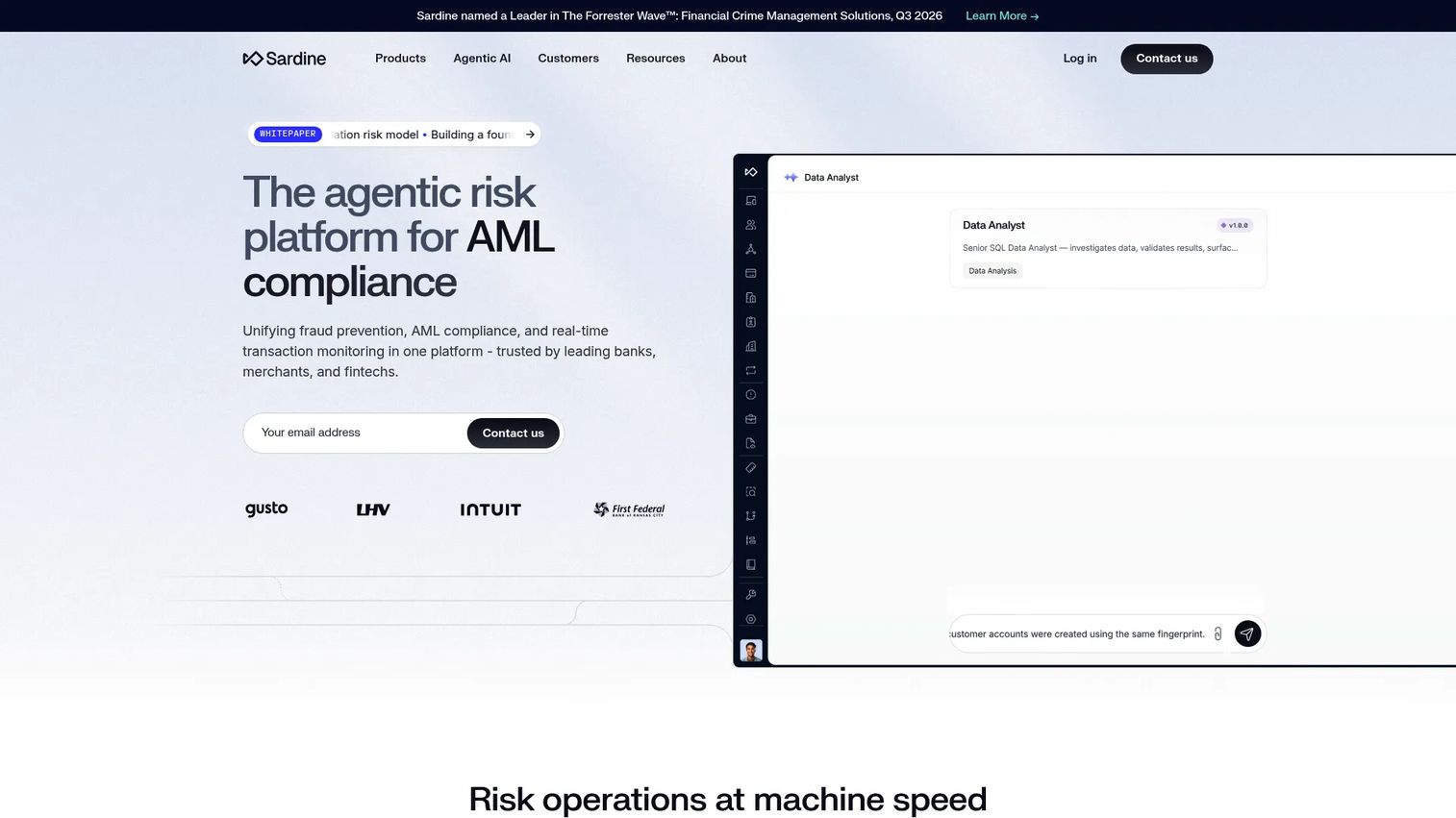
Sardine is an agentic financial crime platform built for fintechs, banks, crypto exchanges, marketplaces, and payment companies. It combines fraud prevention, AML compliance, KYC, KYB, device intelligence, behavioral biometrics, and real-time transaction monitoring into one platform. Where most buyers bolt together three or four point tools, Sardine positions itself as the single layer covering fraud and financial crime operations together.
Best for: Fintech and payments teams that need fraud, identity, AML, and transaction risk signals in one stack.
Key features
- Real-time payment fraud prevention across cards, ACH, wires, RTP, FedNow, SEPA, Zelle, checks, and digital wallets
- Device intelligence and behavioral biometrics
- Configurable risk scoring with approve, hold, step-up, and decline actions
- Transaction monitoring, sanctions screening, and case management
- AI-assisted fraud investigations and dispute management
Why choose Sardine: Strong fit when the buyer wants to avoid managing separate fraud and AML systems. Presales teams should validate which payment rails the buyer processes, because Sardine's coverage across FedNow, RTP, and Zelle is a differentiator for real-time payment environments.
Sardine pricing: Sardine directs prospects to contact sales for a quote. No standard tiers are listed on the pricing page.
G2 rating: 4.8/5
2. Sift
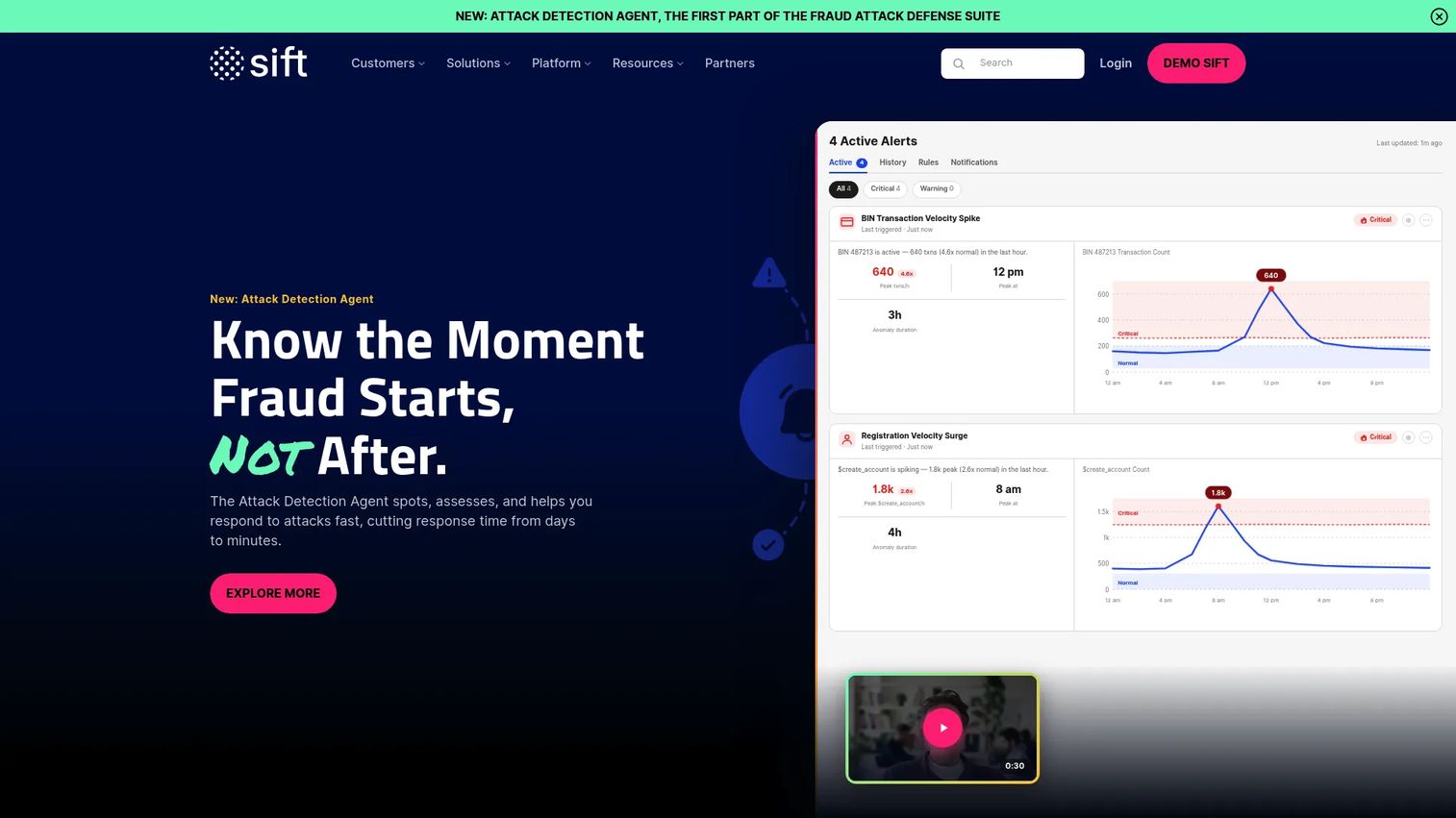
Sift is an AI-powered fraud prevention platform for digital businesses dealing with payment fraud, account takeover, fake account creation, and platform abuse. The platform scores risk in real time across user lifecycle events, from signup and login through checkout and post-purchase activity. Marketplaces, digital services, and consumer fintechs use Sift when fraud spans multiple surfaces and a single scoring layer needs to cover all of them.
Best for: Digital businesses that need fraud decisioning across user accounts, transactions, and platform-level abuse.
Key features
- Real-time ML risk scoring across the user lifecycle
- Account takeover and fake account prevention
- Payment fraud protection with automated actions
- Analyst review queues and case management
- Configurable workflows and custom event support
Why choose Sift: Good fit for platforms where fraud isn't limited to checkout. Ask the vendor to demonstrate model explainability during a technical evaluation, and confirm how custom events are ingested, because the API integration scope varies by deployment.
Sift pricing: Sift does not publish pricing. Contact sales for a quote.
G2 rating: No current G2 listing was confirmed.
3. SEON
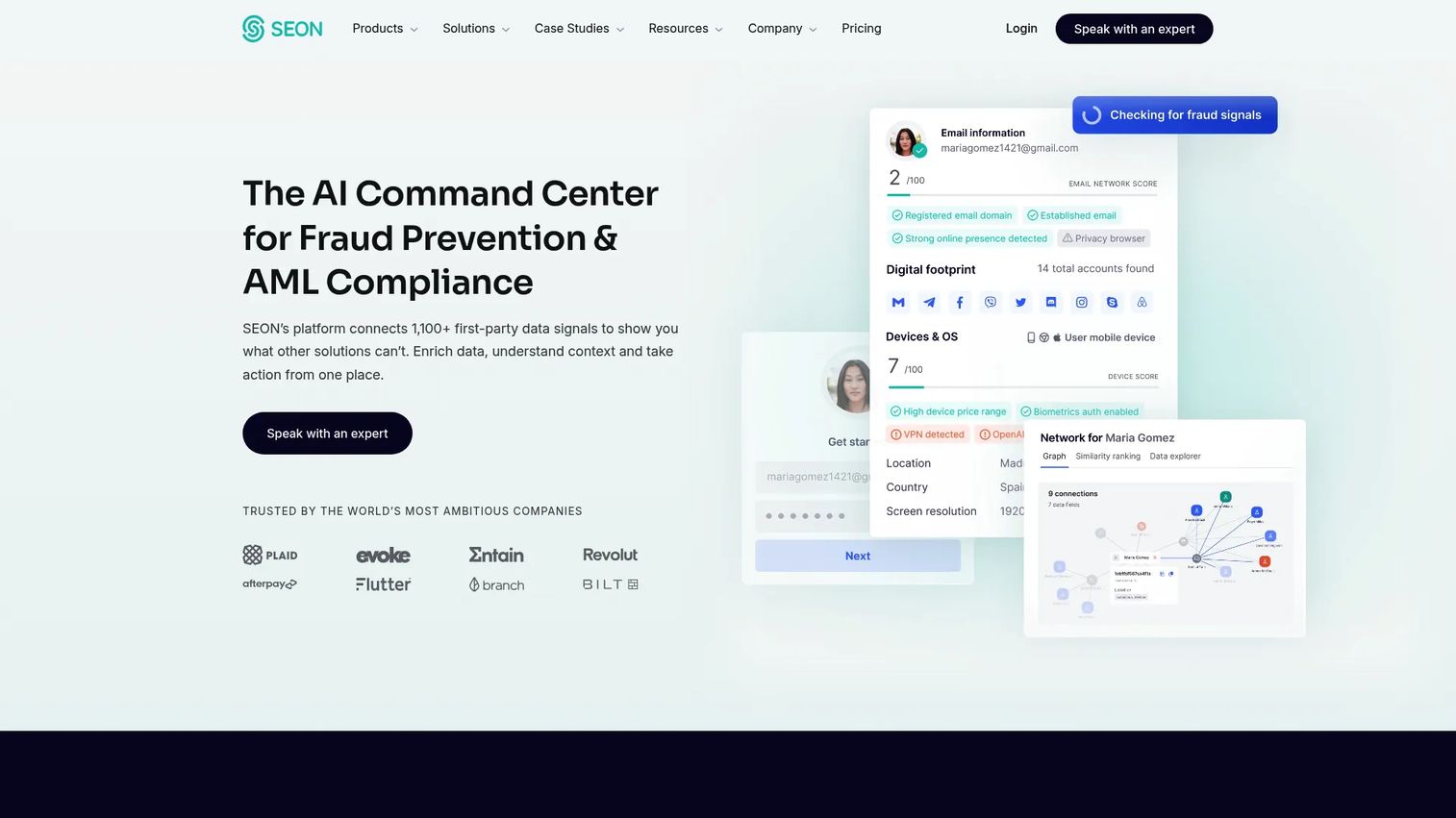
SEON is a real-time fraud prevention and AML compliance platform for digital businesses across ecommerce, fintech, iGaming, marketplaces, and lending. Its approach centers on digital footprint analysis: Email, phone number, IP address, device fingerprint, and social profile signals combine into a risk score the team can act on within milliseconds. A no-code rules engine lets fraud analysts create and adjust logic without engineering tickets.
Best for: Teams that want fast, API-first risk checks using email, phone, device, and IP intelligence without a long enterprise implementation cycle.
Key features
- Digital footprint analysis across email, phone, IP, and social signals
- Device fingerprinting and behavioral scoring
- AI and rules-based risk scoring
- AML customer and payment screening
- Case management and identity verification
Why choose SEON: Presales teams supporting buyers who need a fast deployment path will find SEON's Starter plan a practical starting point. Validate API throughput at peak transaction volume, and confirm whether the buyer needs full AML compliance or just fraud screening, because the two use cases are priced and scoped differently.
SEON pricing: The Starter plan runs $699/month and includes 2,500 fraud checks, 10 users, and 50 custom rules. The Premium plan carries custom pricing and adds unlimited API calls, AML compliance, and 24/7 support.
G2 rating: 4.6/5
4. Feedzai

Feedzai is an AI-native risk operations platform built for banks, payment processors, and large financial institutions. It handles real-time fraud detection, scam prevention, AML transaction monitoring, and financial crime case management at enterprise scale. According to KPMG (2025), 76% of financial institution respondents named fraud detection their top generative AI application. Feedzai addresses exactly that environment with explainable AI, audit trails, and model governance built for regulated environments.
Best for: Large financial institutions that need scalable transaction fraud detection with model governance and audit-ready explainability.
Key features
- Real-time fraud and scam detection across all payment channels and rails
- AI-powered AML transaction monitoring with automated SAR filing
- Unified identity, behavioral, device, and network intelligence
- Explainable AI with model governance and responsible-AI controls
- Centralized investigation, reporting, and strategy configuration
Why choose Feedzai: Technical validation should include a data mapping exercise. Feedzai's strength is its depth at scale, but the integration work into banking cores is real. Confirm the buyer's data engineering capacity before positioning this as a fast deployment.
Feedzai pricing: Custom pricing. Contact Feedzai directly for a tailored quote.
5. DataVisor
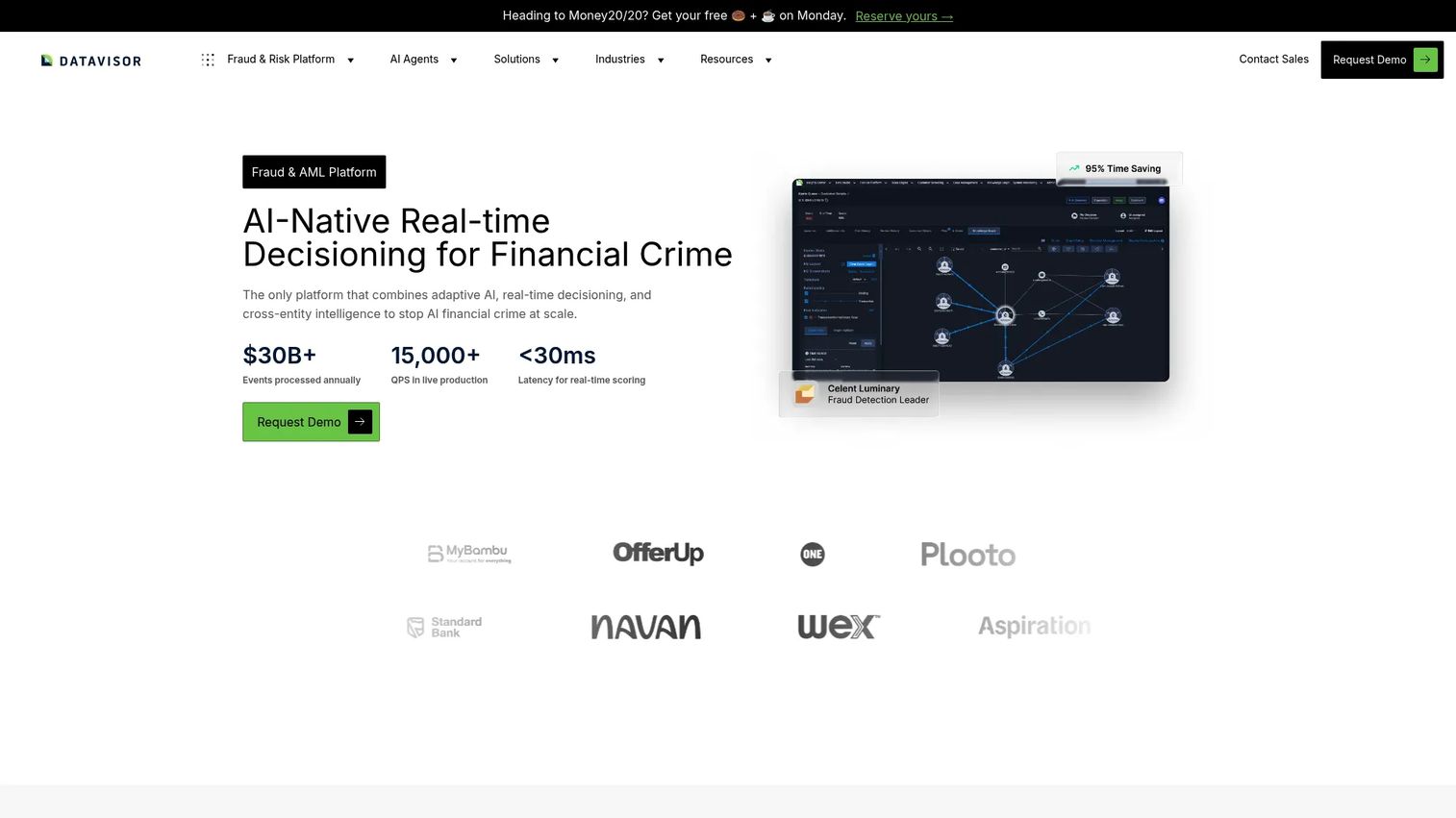
DataVisor is an AI-native fraud and financial crime prevention platform known for its unsupervised machine learning approach to coordinated fraud ring detection. Rather than flagging individual bad actors after the fact, DataVisor identifies clusters of related fraudulent accounts behaving in concert, which is the pattern behind large-scale account abuse, promo fraud, and synthetic identity rings.
Best for: Teams fighting organized fraud rings and evolving attack patterns that outpace manually configured rules.
Key features
- Unsupervised ML for coordinated fraud ring detection
- Real-time scoring using rules, supervised ML, behavioral, and graph signals
- AML capabilities including sanctions, PEP, and transaction monitoring
- Feature engineering with prebuilt fraud feature packages
- Case workflows and regulatory reporting
Why choose DataVisor: Ask about training data requirements and explainability output during the POC. Unsupervised models are powerful against novel attacks, but analyst adoption depends on whether the platform surfaces interpretable evidence or just a risk score.
DataVisor pricing: Custom pricing. DataVisor does not display plans or prices on its site.
G2 rating: 4.4/5
6. Forter
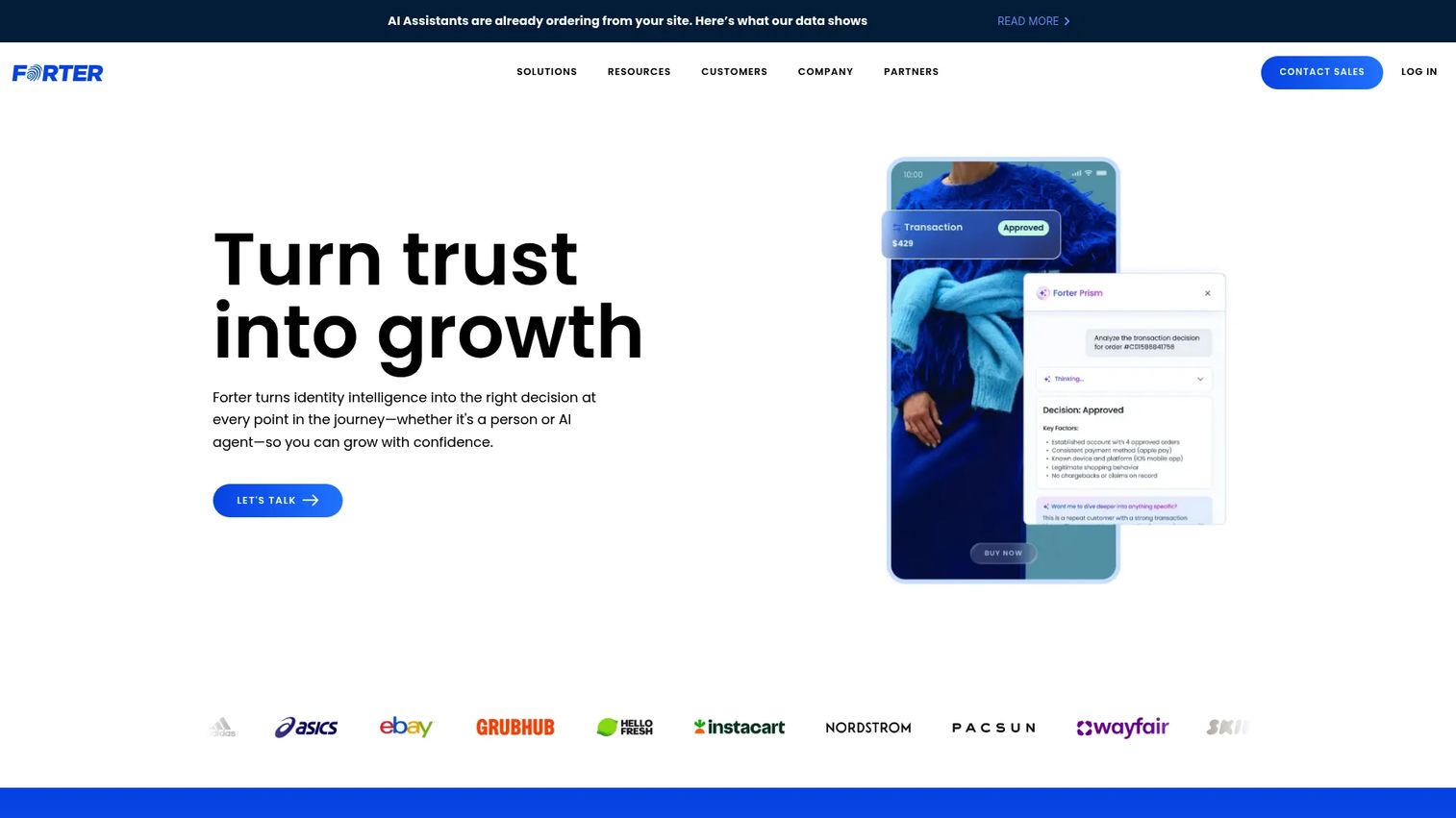
Forter is an enterprise trust platform for digital commerce, covering fraud management, payment optimization, dispute management, account protection, and abuse prevention. Its identity-based decisioning model makes approve or decline decisions based on the buyer's identity signals rather than rules alone, which supports high approval rates even at scale. Forter also covers agentic commerce scenarios, supporting AI shopping agents and headless checkout environments.
Best for: Enterprise ecommerce brands that need fraud decisions across every point in the buying journey, from account creation through post-purchase dispute.
Key features
- Identity-based real-time fraud decisioning
- Payment optimization including Smart 3DS and tokenization
- Dispute management with automated evidence enrichment
- Account protection against takeover and incentive abuse
- Policy abuse and returns abuse controls
Why choose Forter: Good fit when false declines cost as much as fraud losses. During the evaluation, ask the vendor to walk through guarantee terms, exclusion clauses for specific transaction types, and how approval rates are measured across your buyer's product catalog.
Forter pricing: Custom pricing. Forter requires a tailored quote and may offer chargeback-guarantee or uncovered pricing models.
G2 rating: 4.5/5
7. Riskified
Riskified is an AI-powered ecommerce risk intelligence platform focused on revenue protection, chargeback guarantees, and approval rate optimization. Merchants approve more orders knowing Riskified absorbs the chargeback cost on approved-but-fraudulent transactions. The platform also covers policy abuse like refund fraud, account takeover, and reseller abuse.
Best for: Ecommerce merchants where declined orders represent meaningful revenue loss and fraud liability shift changes the P&L math.
Key features
- Real-time ML order decisioning
- Chargeback guarantee on approved transactions
- Policy abuse detection for refunds and returns
- Account protection against takeover
- Decision analytics and Control Center reporting
Why choose Riskified: Clarify eligible transaction types, exclusion conditions, and how the guarantee interacts with the buyer's existing payment processor chargeback program. The economics look different across card-not-present, marketplace, and cross-border scenarios.
Riskified pricing: Custom, success-based pricing. No standard tiers are shown on the pricing page.
G2 rating: 4.4/5
8. Signifyd
Signifyd is a Commerce Protection Platform for ecommerce retailers and platforms. It uses Commerce Network intelligence, drawing on signals from a large base of shared merchant data, to make real-time fraud decisions and back approved orders with a 100% financial guarantee against eligible fraud chargebacks. It also covers account protection, checkout abuse, and returns fraud.
Best for: Retailers that need automated fraud screening with financial protection across checkout and post-purchase workflows.
Key features
- AI-powered real-time fraud decisioning
- 100% financial guarantee on eligible fraud chargebacks
- Automated order fulfillment and fraud review reduction
- Commerce Network identity and intent intelligence
- Account, checkout, and returns protection
Why choose Signifyd: The network effect matters here. Validate what share of the buyer's transaction volume falls within Signifyd's covered merchant categories, and confirm the guarantee scope for the buyer's specific verticals and geographies.
Signifyd pricing: Custom, usage-based pricing calculated as a percentage of approved order totals. The rate depends on merchant vertical, order volume, and average ticket price.
G2 rating: 4.6/5
9. Kount
Kount is an Equifax identity trust and fraud prevention platform serving ecommerce businesses, financial services, and digital companies. It combines AI scoring, configurable fraud policies, real-time transaction monitoring, and case management into three named product lines: Kount Command for fraud decisioning, Kount Control for account protection, and Kount Central for chargeback management.
Best for: Ecommerce and digital businesses that need configurable fraud, identity, account protection, and chargeback controls backed by Equifax identity data.
Key features
- AI and ML fraud detection with real-time identity trust scoring
- Configurable fraud policies and automated decisioning
- Account takeover, bot detection, and promo abuse protection
- Case management, reporting, and analytics
- Chargeback prevention and dispute management
Why choose Kount: The Equifax identity data integration is a meaningful differentiator for buyers who need robust identity signals alongside transaction scoring. Confirm which Kount product line maps to the buyer's primary fraud type before the demo.
Kount pricing: Pricing for Kount Command, Kount Control, and Kount Central is by custom quote. Contact Kount directly.
G2 rating: 4.8/5
10. Unit21
Unit21 is an AI-powered fraud and AML risk infrastructure platform built for fintechs, banks, and marketplaces. Its defining capability is configurable, no-code rule building that lets risk analysts adjust detection logic without filing engineering tickets. Case management, SAR filing, and alert queue management are all built in, making it a strong choice for teams that want to run fraud and AML operations from a single environment. For teams exploring the best identity verification software alongside fraud tooling, Unit21 handles the downstream investigation layer well.
Best for: Risk teams that need fraud detection and AML operations in one configurable platform without constant engineering dependency.
Key features
- No-code rule builder for fraud and AML detection
- Real-time transaction monitoring and automated decisioning
- AI agents for detection, investigation, and alert triage
- Case management and regulatory SAR filing
- Sanctions screening and device intelligence
Why choose Unit21: Ask about data ingestion architecture during the POC. Unit21 performs best when the buyer can feed clean, structured event data. Validate reviewer queue design and how workflow permissions are managed across analyst roles.
Unit21 pricing: Unit21 does not publish pricing. Contact the sales team for a quote.
G2 rating: 4.6/5
11. ComplyAdvantage
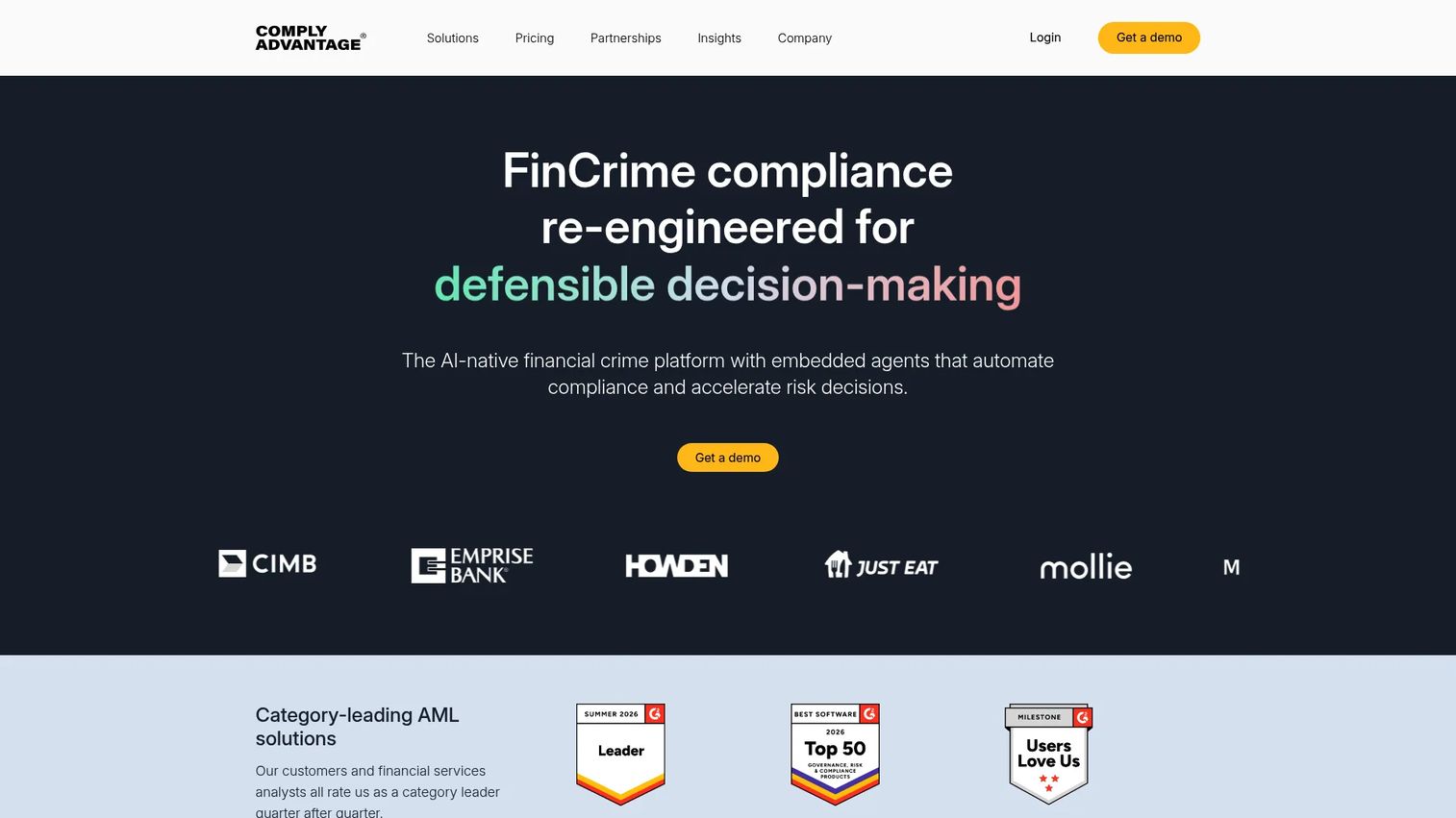
ComplyAdvantage is an AI-native financial crime risk management platform covering sanctions screening, adverse media monitoring, transaction monitoring, KYC risk data, and AML compliance workflows. Its fraud-adjacent use case is strongest when the buyer's onboarding or transaction risk overlaps with regulatory screening requirements. For teams who also need AML software as a distinct evaluation track, ComplyAdvantage often surfaces in both shortlists.
Best for: Compliance-led teams where fraud risk overlaps with sanctions screening, adverse media, and AML monitoring requirements.
Key features
- Customer and company screening against sanctions and watchlists
- Adverse media monitoring and PEP/RCA screening
- Ongoing monitoring with automated alert resolution
- Transaction and payment screening
- API, batch, and SFTP integrations
Why choose ComplyAdvantage: Separate AML requirements from transaction fraud requirements during discovery. ComplyAdvantage's differentiation is its data freshness and screening coverage, not ML-based behavioral fraud scoring, so it pairs well with a dedicated fraud detection layer rather than replacing one.
ComplyAdvantage pricing: The Essentials Starter plan starts at $99/month (billed annually) or $119/month (billed monthly) for up to 100 monitor searches. The Agentic Starter plan starts at $149/month annually. Enterprise pricing is by quote. A ComplyLaunch program offers eligible early-stage startups free access for 12 months.
G2 rating: 4.3/5
12. Socure
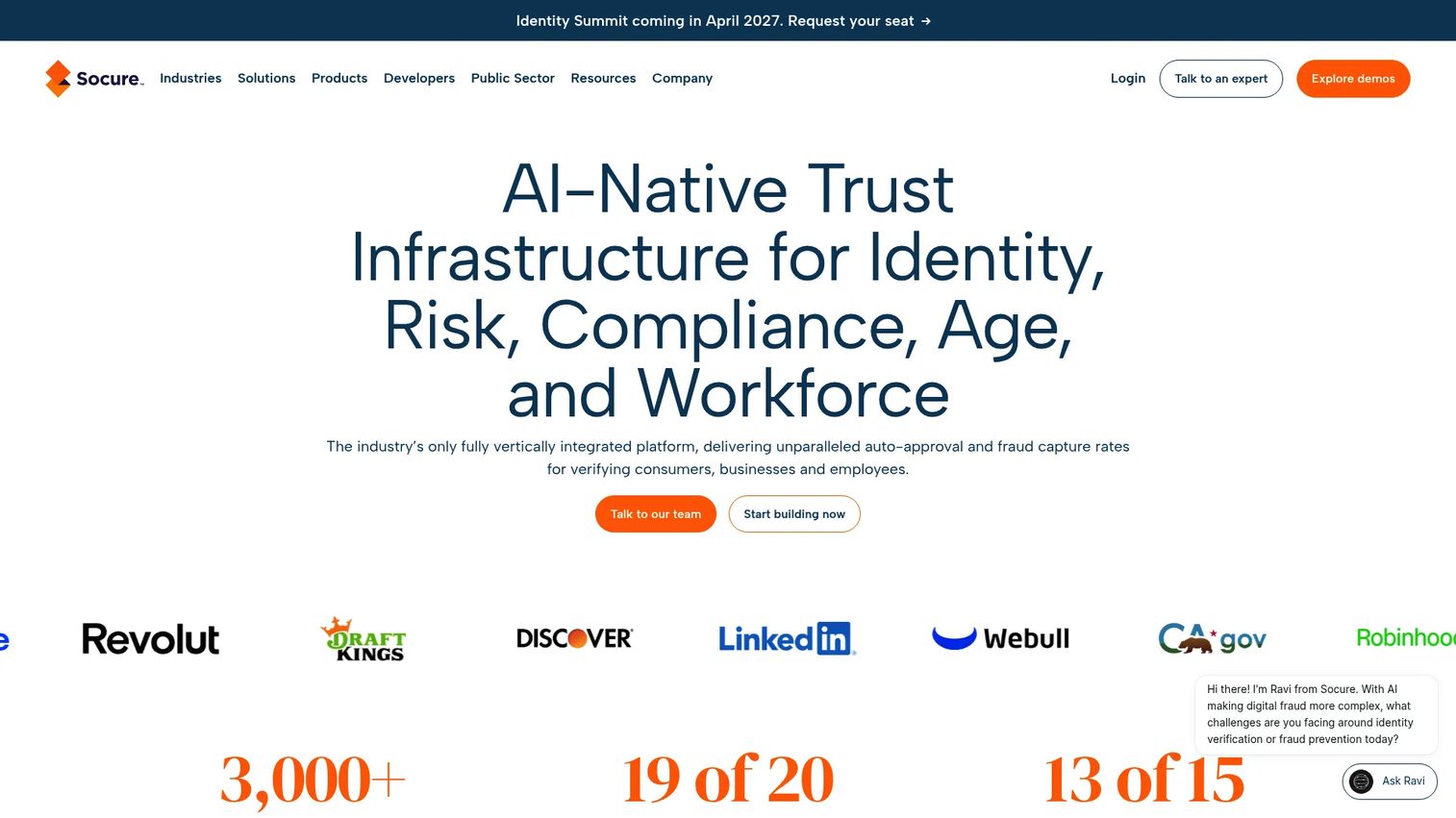
Socure is an AI-powered identity verification and fraud prevention platform built for financial services, government, and regulated industries. It covers digital identity risk, synthetic identity detection, KYC decisioning, document verification with biometric liveness, watchlist screening, and bank account verification. Its RiskOS orchestration layer lets teams build and adjust identity workflows without rebuilding core integrations.
Best for: Financial services teams where onboarding fraud and synthetic identity risk drive the largest exposure.
Key features
- Synthetic identity detection and digital identity risk scoring
- Document verification with biometric liveness detection
- KYC decisioning and watchlist screening
- Bank account verification
- RiskOS workflow orchestration
Why choose Socure: Coverage varies by geography and population segment, so validate match rates for the buyer's specific user base before contracting. Presales teams supporting buyers in underbanked or thin-file segments should ask for demographic coverage data during the evaluation.
Socure pricing: Socure Launch offers usage-based pricing starting at $0.80 per evaluation for document verification, scaling to $1.30 per evaluation for the full Prefill, KYC, Fraud, Watchlist, and DocV bundle. Socure Launch includes $1,000/month in credits. Enterprise pricing is custom.
G2 rating: 4.5/5
13. Persona

Persona is an identity platform for customizable KYC, KYB, AML, age assurance, workforce verification, and fraud prevention programs. Its workflow builder lets teams assemble verification flows from modular components without writing custom code, which makes it a strong fit when onboarding requirements differ by user type, product line, or geography.
Best for: Teams that need flexible identity verification and onboarding risk workflows across different user types and markets.
Key features
- Government ID, selfie, document, phone, email, database, and watchlist verifications
- Business verification and KYB workflows
- Customizable flows with automated decisioning and manual review cases
- Sanctions checks and fraud tools
- Graph investigations and third-party marketplace app integrations
Why choose Persona: Good fit when onboarding complexity spans multiple verification types. During presales, ask how fraud signals flow into downstream decisioning systems. The workflow builder is flexible, but integrating Persona's output into a separate transaction fraud system requires scoping.
Persona pricing: The Essential plan starts at $250/month with a 12-month minimum contract. Growth and Enterprise plans carry custom pricing.
G2 rating: 4.2/5
14. Alloy
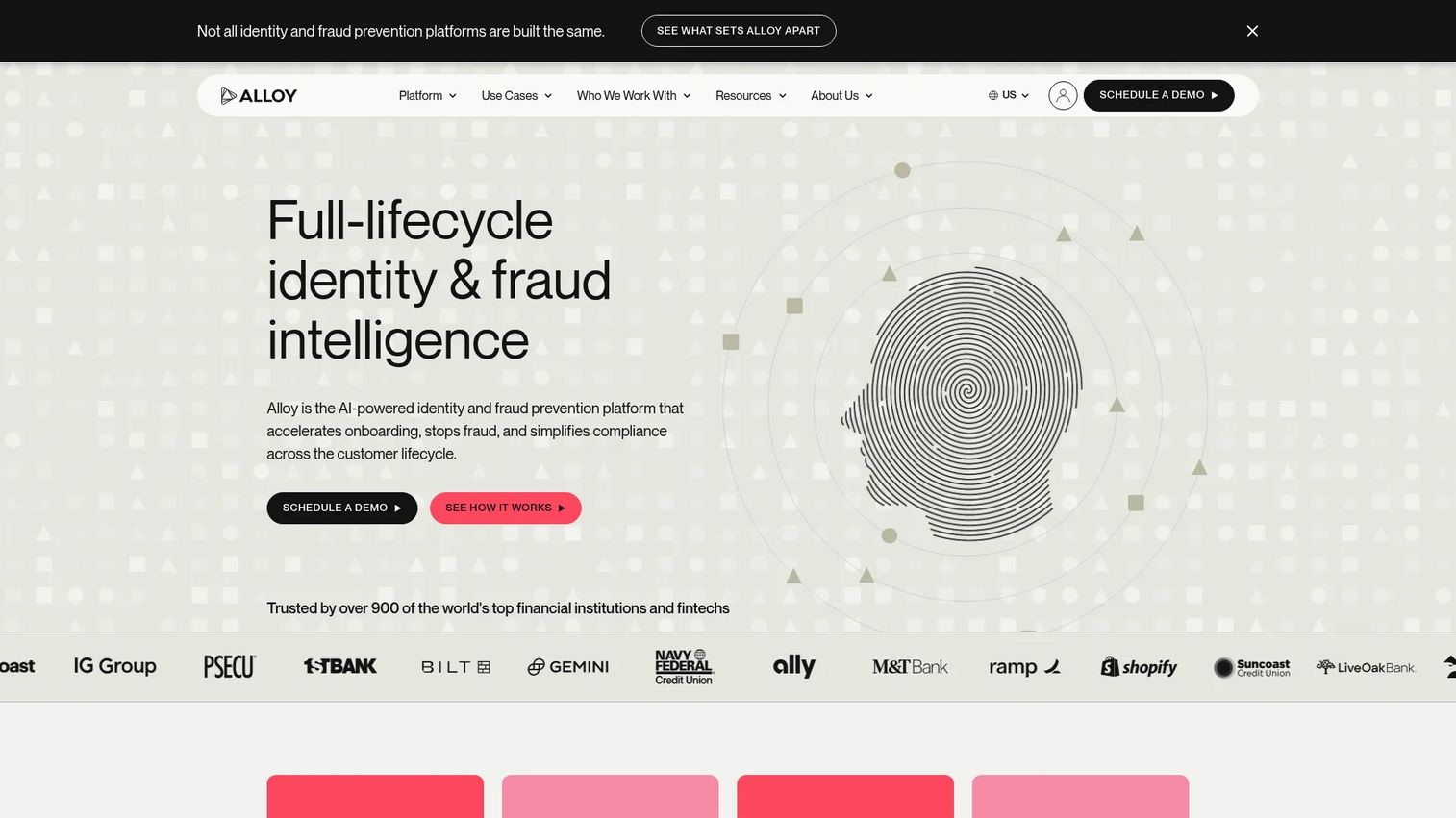
Alloy is an AI-powered identity and fraud prevention platform for banks and fintechs. It orchestrates decisions across more than 300 partner data sources, covering identity verification, KYB, fraud checks, ongoing monitoring, and perpetual KYC. The platform's Fraud Attack Radar surfaces emerging attack patterns, and its AI Assistant supports fraud and compliance operations teams. Teams evaluating best presales software tools for complex deals often encounter Alloy in financial services buyer stacks.
Best for: Banks and fintechs that need configurable onboarding risk decisioning across multiple identity and fraud data sources.
Key features
- Identity verification and onboarding workflows
- Fraud detection with Fraud Signal and Fraud Attack Radar
- Data orchestration across 300+ partner data sources
- AI Assistant for fraud and compliance operations
- Perpetual KYC/KYB and ongoing monitoring
Why choose Alloy: The multi-source orchestration is the main draw. Validate which specific data vendors the buyer needs and confirm they're in Alloy's partner network. Also check decision auditability: Buyers in regulated environments will need clean audit trails for every data source consulted.
Alloy pricing: Alloy does not publish pricing. Contact sales for a quote.
G2 rating: 4.4/5
15. Abrigo Fraud Detection
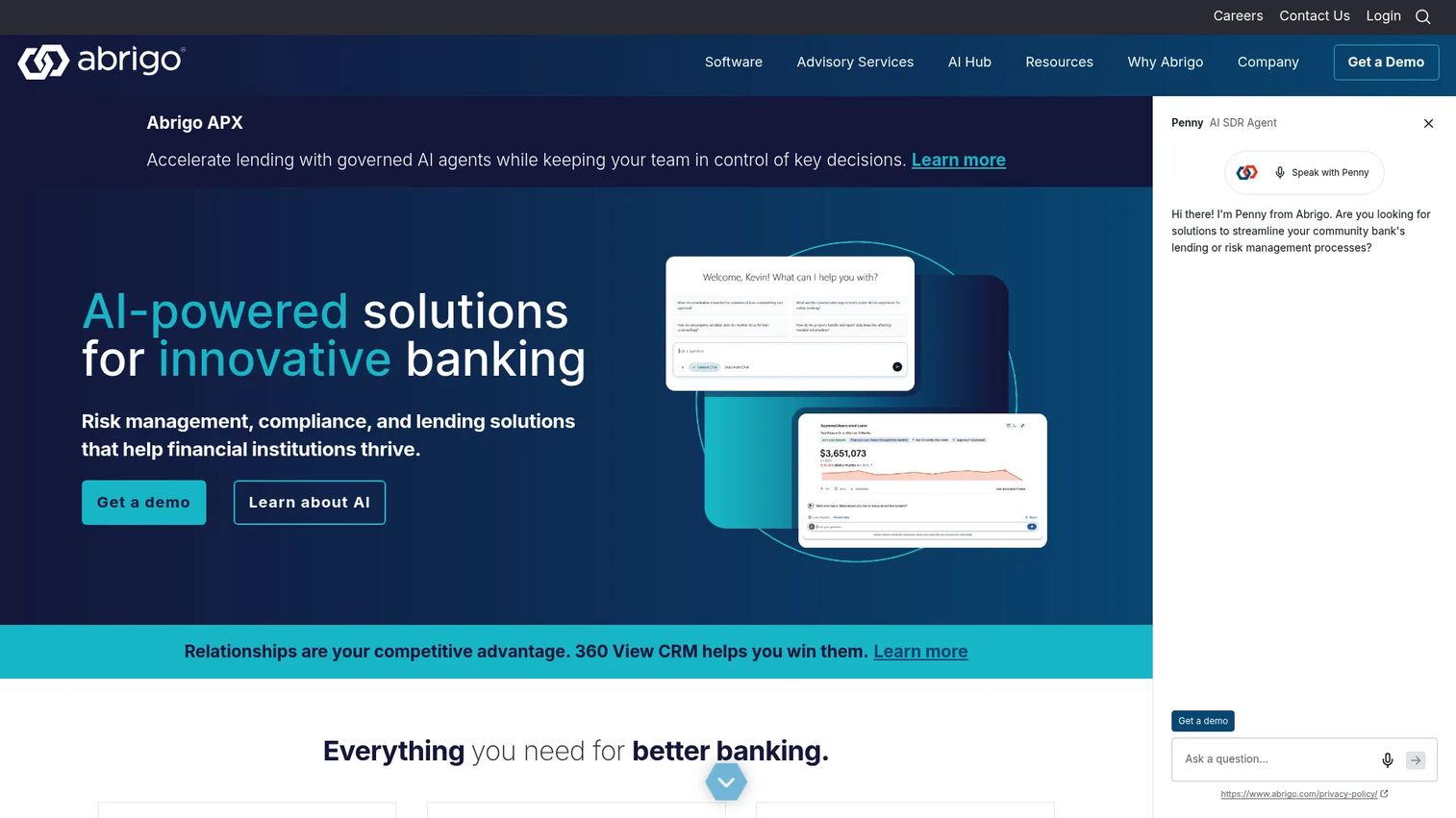
Abrigo Fraud Detection is an AI-powered fraud detection platform built specifically for banks and credit unions. It covers wire fraud, ACH fraud, check fraud, new account fraud, and debit card fraud, with an AI-powered check image analysis engine that evaluates 24 check attributes. A nationwide check-fraud data consortium supplements the platform's own models. The product is purpose-built for financial institution workflows, including case management, step-up authentication via customer text verification, and fraud reporting.
Best for: Banks and credit unions that need fraud controls aligned with financial institution workflows and compliance operations.
Key features
- Real-time detection across check, wire, and ACH transactions
- Explainable ML risk scoring and behavioral analytics
- AI-powered check image analysis evaluating 24 check attributes
- Nationwide check-fraud data consortium
- Case management, alert workflows, and step-up authentication
Why choose Abrigo Fraud Detection: The banking-specific design means less integration work against a core banking system compared to general-purpose platforms. During technical validation, confirm which cores Abrigo integrates with natively and what data mapping is required for the buyer's environment.
Abrigo pricing: Abrigo does not display pricing. Contact the sales team for a quote.
G2 rating: 4.7/5
16. Trustmi
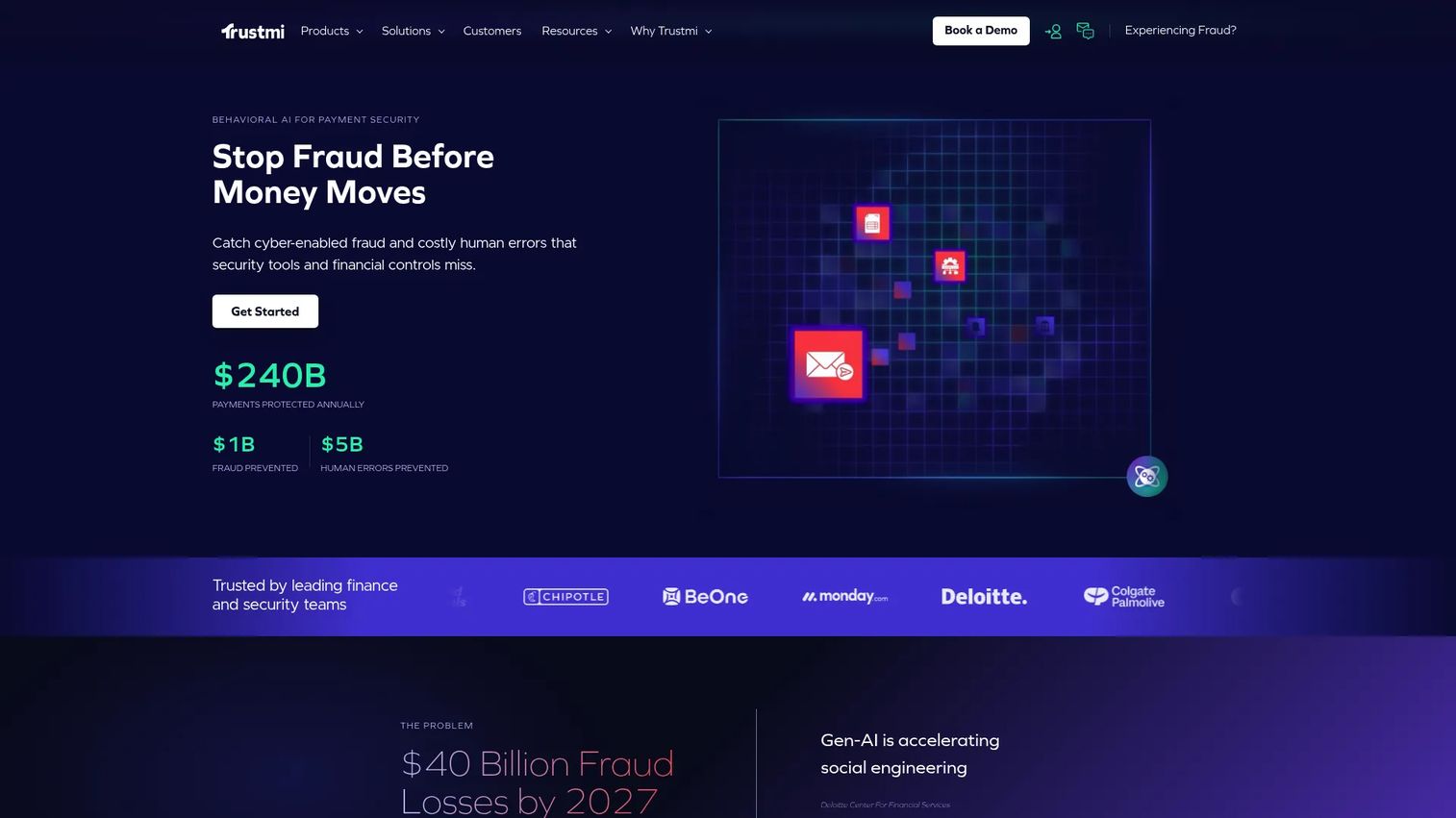
Trustmi is a behavioral AI payment security platform that detects and prevents B2B payment fraud across vendors, emails, documents, and payment workflows. It analyzes behavioral patterns across email communication, vendor master data, invoices, and payment files to catch socially engineered fraud before a payment releases. Over 30 native integrations connect it to ERP systems, AP platforms, and email environments. For presales teams helping buyers scope accounts payable software alongside fraud controls, Trustmi often becomes a complementary layer.
Best for: Finance and security teams protecting high-value B2B payment workflows from vendor impersonation, invoice fraud, and misdirected payments.
Key features
- Behavioral AI detection across email and payment workflows
- Vendor and bank-account validation
- Invoice and payment-file validation
- Real-time payment risk verdicts with blocking capability
- AI investigation agent with 30+ native integrations
Why choose Trustmi: Map every approval point in the buyer's payment lifecycle before the demo. Trustmi performs best when it can ingest signals from email, ERP, and the payment approval chain together. A gap in any one signal source reduces detection coverage.
Trustmi pricing: Trustmi does not publish pricing. Contact sales for a quote.
G2 rating: 4.9/5
17. Proofpoint

Proofpoint is an enterprise cybersecurity platform built around protecting people from email-borne threats. For fraud-focused buyers, the relevant capability set covers business email compromise detection, phishing prevention, account compromise defense, supplier impersonation detection, and threat intelligence. Proofpoint's data loss prevention extends across email, cloud, endpoints, and generative AI tools, making it relevant for buyers where fraud risk originates in the inbox.
Best for: Enterprises where fraud losses are tied to compromised email accounts, spoofed identities, or social engineering through the email channel.
Key features
- AI-powered email threat detection and protection
- Business email compromise and phishing defense
- Account compromise detection and remediation
- Supplier impersonation and vendor email compromise protection
- Cross-channel data loss prevention
Why choose Proofpoint: Separate the email security requirement from payment decisioning during discovery. Proofpoint protects the channel where fraud starts; it doesn't make payment-level approve or decline decisions. Buyers often need both layers.
Proofpoint pricing: Proofpoint does not display current pricing. Contact sales for a quote.
G2 rating: 4.5/5
18. Abnormal Security
Abnormal Security is a behavioral AI email security platform that detects sophisticated threats that rule-based filters miss. It builds a behavioral baseline for each employee and vendor, then flags deviations including vendor email compromise, business email compromise, account takeover in cloud email, and impersonation. Because attacks look normal to signature-based tools, Abnormal's behavioral approach catches what others miss.
Best for: Organizations fighting behavior-based email threats and vendor impersonation where traditional signature filters fail.
Key features
- Behavioral AI detection of targeted phishing and BEC
- Vendor email compromise and supplier impersonation protection
- Account takeover defense in cloud email environments
- Automated malicious email detection and remediation
- Collaboration application security and AI governance
Why choose Abnormal Security: Ask about mail platform support during the evaluation: Abnormal integrates primarily with Microsoft 365 and Google Workspace. Also confirm the security operations handoff process, particularly how remediated incidents are logged for SOC review.
Abnormal Security pricing: Abnormal does not publish pricing. Contact sales for a quote.
G2 rating: 4.7/5
19. Trustpair
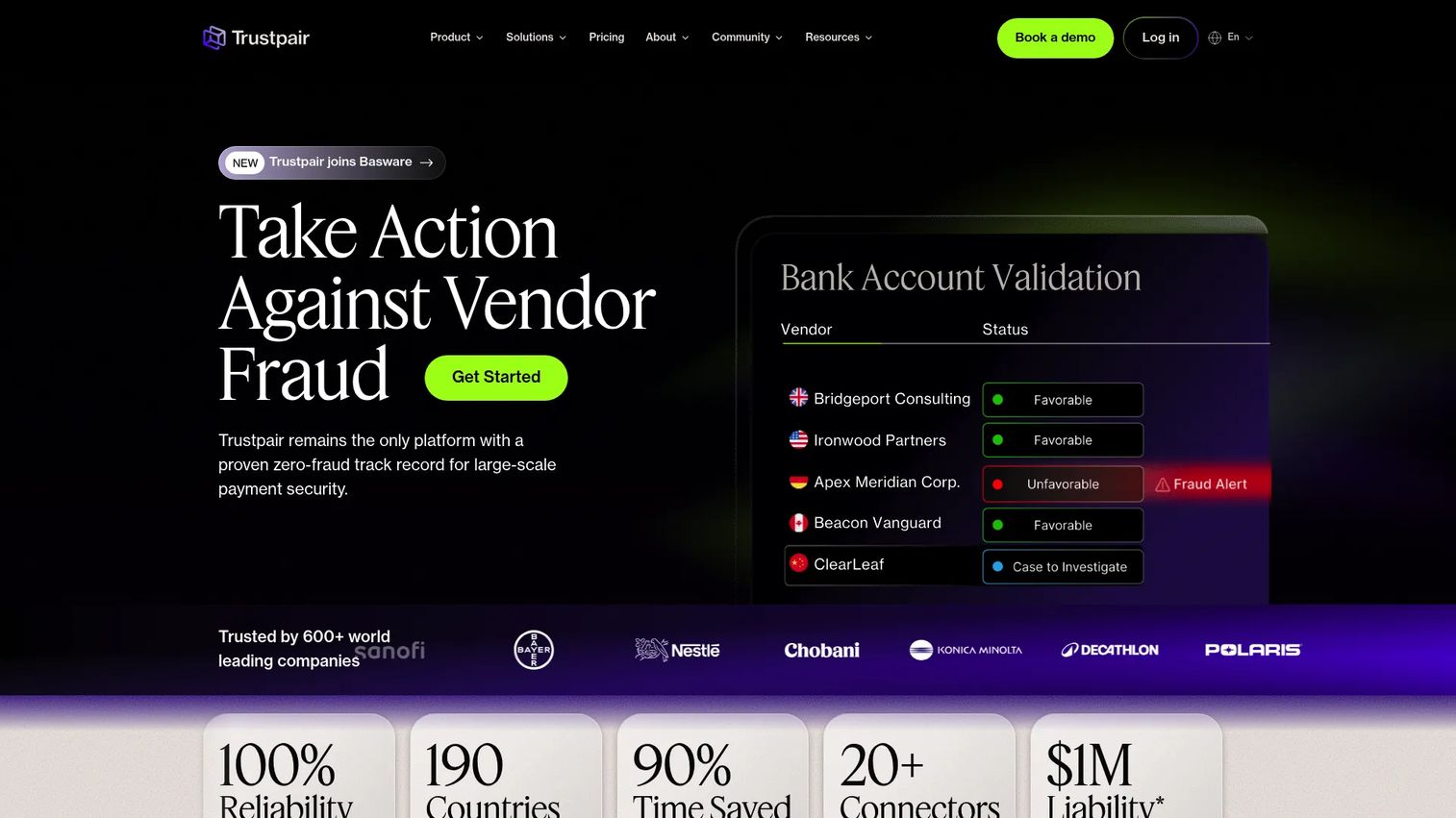
Trustpair is a B2B payment fraud prevention platform that verifies vendor bank-account ownership and monitors the vendor master file for anomalies. It runs automated bank-account validation across 190 countries, checks for unauthorized changes to vendor master data, and verifies payment files before processing. Twenty or more native connectors link it to ERP systems, payment platforms, and treasury tools.
Best for: Finance, accounts-payable, and treasury teams that need supplier verification and vendor bank-account validation at scale.
Key features
- Automated vendor bank-account validation across 190 countries
- Continuous vendor master-file monitoring and anomaly detection
- Payment-file verification before processing
- REST API, SFTP, and 20+ native ERP connectors
- Fraud dashboards, audit trails, and multi-user access
Why choose Trustpair: Map the buyer's ERP environment and payment approval chain before scoping. Trustpair's Custom Access tier adds dedicated consulting, customizable integrations, unlimited environments, and up to $1M in liability coverage.
Trustpair pricing: Trustpair offers Platform Access and Custom Access, both by custom quote. No numeric prices are displayed on the pricing page.
G2 rating: 4.8/5
20. EFTsure
EFTsure is a B2B payment protection platform that verifies vendor bank details and payment data to prevent supplier fraud and payment errors. It covers vendor onboarding and management, bank-account ownership verification, real-time payment alerts, continuous monitoring, sanctions screening, and segregation of duties controls. EFTsure has strong adoption among Australian organizations and integrates with ERP, procurement, treasury, and payment platforms.
Best for: Australian finance and AP teams exposed to invoice redirection fraud and supplier payment manipulation.
Key features
- Vendor onboarding and bank-account ownership verification
- Real-time payment alerts and monitoring
- Continuous monitoring with sanctions screening
- Segregation of duties and approval controls
- ERP, procurement, treasury, and payment integrations
Why choose EFTsure: Strong fit for Australian buyers, where coverage of local bank validation databases is a practical differentiator. Confirm regional coverage and ERP workflow compatibility before the technical validation. For teams also comparing chargeback management software, EFTsure operates upstream at the payment authorization stage rather than at the dispute resolution layer.
EFTsure pricing: Pricing is custom, based on annual expenditure volume and monthly new-vendor onboarding volume. Contact EFTsure for a quote.
G2 rating: 4.9/5
21. Oversight
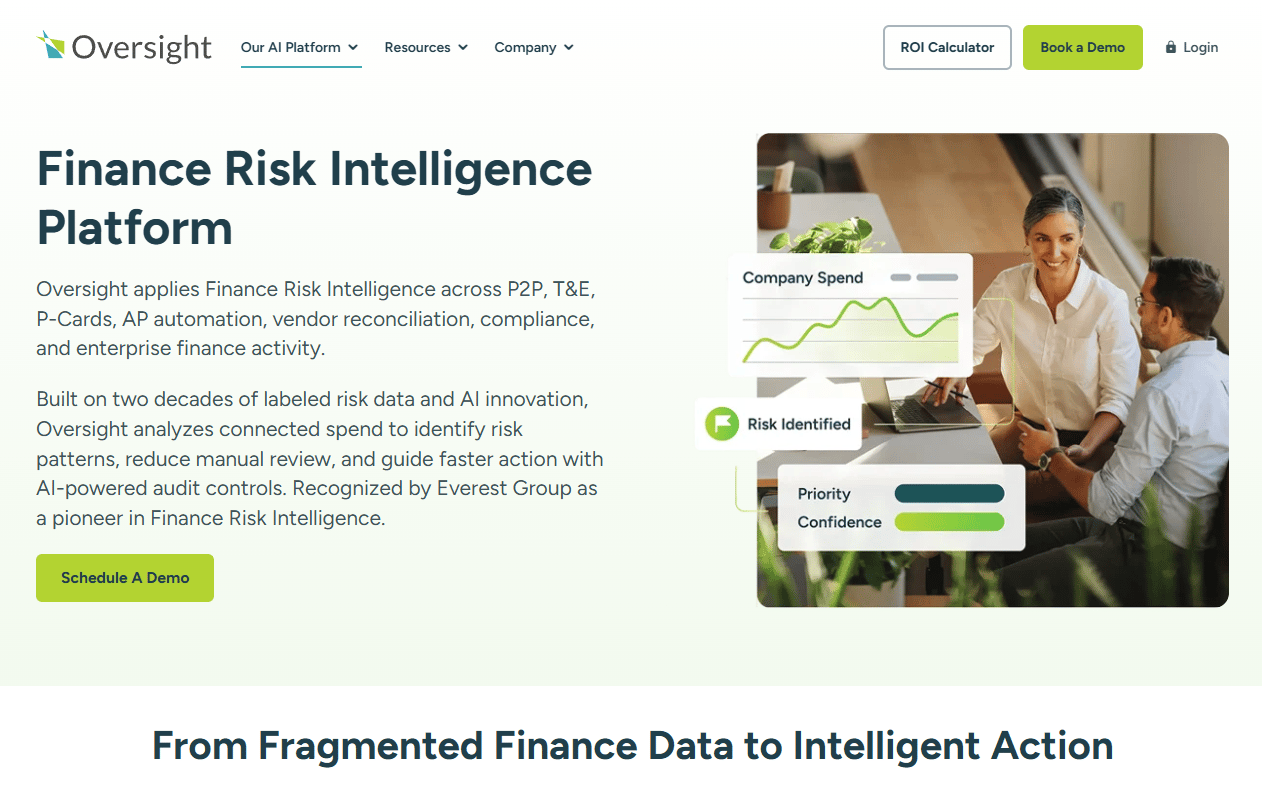
Oversight is an AI-powered finance risk intelligence platform that continuously analyzes spend transactions to detect fraud, duplicate payments, policy violations, and errors across AP, travel and expense, procurement, corporate card programs, and vendor transactions. It differs from payment fraud tools that focus on incoming transactions; Oversight focuses on what your organization spends and where anomalies appear in that outbound flow.
Best for: Enterprise finance, audit, and shared-services teams detecting AP, expense, invoice, and spend fraud buried in high-volume transaction data.
Key features
- Continuous spend monitoring across AP and corporate card programs
- Duplicate payment detection and policy violation alerts
- Travel and expense auditing
- Procure-to-pay and vendor transaction monitoring
- Risk analysis, workflow automation, and reporting
Why choose Oversight: Good fit when fraud risk lives in internal spend behavior rather than inbound transactions or external identity events. During presales, validate source systems: Oversight works best when ERP, expense, and card data all feed cleanly into the platform.
Oversight pricing: Oversight does not publish pricing. Contact sales for a quote.
G2 rating: 4.4/5
Considerations when choosing fraud detection software
Start with the fraud type
Payment fraud, account takeover, vendor payment fraud, synthetic identity, chargebacks, and email compromise each require different detection layers. A platform built for ecommerce chargebacks won't cover wire fraud at a bank. Map the buyer's specific fraud exposure before evaluating any vendor's feature set.
Validate the data sources
Fraud tools depend entirely on signal quality. Confirm that the buyer can provide device telemetry, identity records, payment event data, behavioral signals, or ERP records in the format the tool requires. A detection model is only as good as the data it ingests, so data readiness is a pre-procurement question, not a post-implementation one.
Check decision latency
Real-time fraud detection must return decisions fast enough for checkout, login, account opening, or payment release. Ask for API latency benchmarks under realistic load, broken down by decision type. Async scoring works for some use cases but eliminates others.
Measure false positives
A tool that blocks more fraud but also declines more good customers creates a revenue problem alongside the security improvement. Ask vendors for false-positive rates, model explainability output, override workflows, and how analyst feedback loops back into model retraining. Vendor-reported figures are a starting point; request a pilot with the buyer's own data before accepting them.
Inspect case management depth
Fraud detection is not finished when an alert fires. Evaluate the case management layer: Queue design, assignment rules, evidence capture, investigation notes, escalation paths, audit trails, and regulatory reporting. Buyers in regulated environments need this layer to hold up under examination. The best business process management software guide covers adjacent workflow evaluation considerations that apply here too.
Conclusion
The right fraud detection tool depends on where the fraud actually happens, not on category labels alone.
For fintech and payment risk, start with Sardine, Sift, SEON, Unit21, and Feedzai. Banks and credit unions should evaluate Feedzai and Abrigo Fraud Detection. Ecommerce teams comparing chargeback-guarantee economics should look at Forter, Riskified, Signifyd, and Kount side by side. B2B payment fraud calls for Trustmi, Trustpair, or EFTsure depending on where the exposure sits in the vendor payment lifecycle. Identity-led fraud prevention maps to Socure, Persona, and Alloy. Email-driven fraud and business email compromise point to Proofpoint and Abnormal Security.
Before shortlisting, run the buyer through four questions: What is the fraud type? What data do they have available? What latency does the use case require? Who reviews the alerts, and what happens after they fire?
Those four questions will narrow 21 tools to three faster than any feature comparison will.
Start your journey with Guideflow today!
FAQs
Fraud detection software analyzes identity, device, behavioral, transaction, payment, and account signals to identify suspicious activity before it results in financial loss or compliance exposure. It typically flags, scores, blocks, or routes suspicious events to an analyst queue for review. Modern platforms combine rules, machine learning, and case management in a single environment.
Fraud detection identifies suspicious patterns, while fraud prevention takes action on them, such as blocking a transaction, triggering step-up authentication, placing a payment on hold, or routing a case for manual review. Most enterprise fraud platforms do both. The distinction matters most when scoping integration requirements: Detection affects scoring pipelines, while prevention requires write access to payment flows or authentication systems.
Banks should evaluate tools built for transaction monitoring, case management, audit trails, explainable AI, and native banking core integrations. Feedzai handles enterprise transaction monitoring at scale with model governance built for regulated environments. Abrigo Fraud Detection covers wire, ACH, and check fraud with banking-specific workflows. Confirm which banking core the buyer runs before shortlisting either platform.
Ecommerce teams typically need chargeback protection, payment fraud screening, approval rate optimization, and policy abuse controls. Forter, Riskified, Signifyd, and Kount all operate in this space with different guarantee models and pricing structures. The right pick depends on the buyer's card-not-present volume, geographic mix, average ticket price, and tolerance for false declines. Reviewing best payment processing software alongside fraud tooling can clarify how these layers interact.
AI fraud detection software uses machine learning models to score behavior, detect anomalies, and adapt to new fraud patterns without manual rule updates. Supervised models learn from labeled historical fraud data; unsupervised models, like those in DataVisor, detect clusters of suspicious behavior without relying on prior fraud examples. AI scoring still requires rules, analyst review, and explainability output to function in regulated environments.
False-positive reduction comes from better signal coverage, tighter model tuning, risk threshold calibration, and feedback loops between analyst decisions and model retraining. A single-signal tool, one that relies only on device fingerprinting or only on rule logic, produces more false positives than a multi-signal platform combining device, identity, behavioral, and transaction data. Ask vendors for false-positive metrics on production deployments, not just benchmark datasets.
Integration requirements vary by fraud type and industry. Common integration points include payment processors, banking cores, CRMs, ERPs, identity providers, email security tools, case management systems, SIEMs, and customer support platforms. For teams building a broader best business intelligence software stack, fraud signal data often feeds into centralized analytics environments for risk reporting.
Start with discovery questions that map the fraud type, transaction volume, available data sources, decision latency requirements, regulatory context, and analyst workflow. Then build a POC scope that tests the tool against a realistic data sample, not just a demo environment. Validate model explainability, alert routing, case management depth, and the integration path into the buyer's existing payment or identity stack. Don't accept a vendor's false-positive rate without running it against the buyer's own transaction mix.