You registered the domain in five minutes. Then the renewal invoice arrived at four times the intro price, WHOIS privacy turned out to be a paid add-on, and moving the domain somewhere cheaper meant a 60-day lock you never agreed to.
That is the real cost of picking a domain registrar on price alone. The first year is a coupon. The next ten years are the actual product.
For a founder, a domain is not a line item. It is the anchor for your brand, your email deliverability, your SSL certificates, and every SSO callback URL in your stack. Lose control of it, or let it lapse, and the blast radius touches sales, marketing, and security at once. There were over 359.8 million domain registrations worldwide as of Q3 2024, and more than 1,000 ICANN-accredited registrars competing for them, according to MarketGrowthReports (2024). That choice is good news, but it also means the差异 between a clean registrar and a noisy one is now your problem to figure out.
The registrars below were evaluated on the things that actually create or remove operational drag: renewal pricing transparency, transfer behavior, DNS and DNSSEC support, WHOIS privacy, account security controls like 2FA and registry lock, TLD coverage, and support quality. If you are also standardizing the rest of your stack, it is worth browsing adjacent tooling like AI customer service software, AB testing tools, and AI writing tools for marketers while you are consolidating vendors. Teams that show their product through an interactive demo lean on the same principle we apply here: reduce friction and let the buyer see exactly what they are getting.
What's inside
This guide covers eight domain registrars chosen for founders and operators who want reliable infrastructure and fewer surprises, not just the cheapest first-year sticker. We selected each one on four criteria that matter after the honeymoon year: pricing and renewal transparency, transfer and DNS behavior, security controls (WHOIS privacy, DNSSEC, 2FA, registry lock), and support quality across a wide range of TLDs. Every entry includes verified pricing, a G2 rating where available, and a clear read on who it fits best. No affiliate ranking games, just a practical shortlist you can act on.
TL;DR
- Best all-in-one for founders who want one provider: GoDaddy, for domains plus website, email, and hosting under one login.
- Best for budget-conscious teams: Namecheap, for low domain prices and free lifetime WHOIS privacy on eligible domains.
- Best for developers and DNS control: Cloudflare, for at-cost renewals and serious DNS and security infrastructure.
- Best clean, no-surprises option: Porkbun, for transparent pricing with free privacy, SSL, and DNS bundled in.
- Best for portfolios and bulk management: Dynadot, for bulk tools and straightforward domain administration.
- Best security-first low-cost pick: NameSilo, for free WHOIS privacy and Domain Defender protection at a low price point.
What is a domain registrar?
A domain registrar is an ICANN-accredited company that sells and manages domain name registrations on your behalf, reserving your chosen name in the official registry so no one else can use it. You pay the registrar, the registrar records your ownership with the registry, and you get a management interface to point that domain wherever you need.
That definition hides a few distinctions that trip up founders, so here is the plain-language version of each.
- Registrar vs. registry: The registry operates the top-level domain (the company behind all .com names). The registrar is your retail point of contact and the party that holds your registration. You deal with the registrar.
- Registrar vs. DNS provider: Registration reserves the name. DNS translates that name into an IP address so browsers and mail servers know where to go. Most registrars include DNS management, but you can point your nameservers to a separate DNS provider (many teams register at one place and run DNS at Cloudflare).
- Nameservers: The addresses that tell the internet which DNS provider is authoritative for your domain. Change these and you move DNS control without moving the registration.
- WHOIS privacy: Registration data is public by default. WHOIS privacy masks your name, email, and address from the public WHOIS record to cut spam and reduce social-engineering risk.
- DNSSEC: A layer that cryptographically signs DNS records so attackers cannot forge responses and hijack traffic to your domain.
- 2FA and registry lock: Two-factor authentication protects the account. Registry lock adds a manual, registry-level hold that blocks unauthorized transfers or nameserver changes, which is the strongest protection for high-value domains.
- Domain transfer: Moving a registration from one registrar to another using an authorization code (often called an EPP or auth code), subject to ICANN rules like the 60-day post-registration lock.
Key features founders should weigh: renewal pricing (not just intro pricing), free vs. paid WHOIS privacy, DNSSEC and registry lock availability, transfer fee transparency, TLD breadth, and how fast support answers when something breaks at 2 a.m.
When to use each type of registrar
Choose a registrar when launching or rebranding a company
A launch is where registrar choice compounds. You want clean DNS management so pointing your domain at your site, email, and app takes minutes, not a support ticket. You want transparent renewal pricing so the domain does not become a budget surprise in year two. And you want a registrar you can transfer away from later without friction, because your infrastructure needs will change as you scale.
Choose a registrar when migrating from another provider
Migrations fail on the same details every time: an expired auth code, an unlocked domain that should have been unlocked, or DNS records that were never recreated at the new provider. Before you initiate a transfer, confirm the domain is past its 60-day registration or transfer lock, unlock it, pull the auth code, and copy your DNS records first so the site never goes dark. Point to existing DNS before flipping nameservers to avoid downtime.
Choose a registrar when security and ownership risk matter
If a domain underpins your brand or your email, treat it as critical infrastructure. Prioritize registrars with 2FA, registry lock, DNSSEC, and free WHOIS privacy. The goal is simple: make it impossible for someone to socially engineer your registrar into handing over your domain, and hard for a lapsed credit card to let it expire silently.
Domain registrar comparison table
Pricing and G2 ratings below reflect verified values captured in July 2026. Confirm current figures on each vendor's pricing page and live G2 listing before you buy, since domain pricing shifts by TLD and promotion.
| # | Product | Intent | Key differentiation | Pricing | G2 rating |
|---|---|---|---|---|---|
| 1 | GoDaddy | All-in-one | Domains plus website, email, hosting under one account | Domains from $0.01 first year (new customers) | 4.0/5 |
| 2 | Namecheap | Budget | Low domain prices with free lifetime WHOIS privacy | Domains from $0.98 | 4.3/5 |
| 3 | Cloudflare | Developer-friendly | At-cost domain renewals plus enterprise-grade DNS and security | Registrar at cost; platform free tier available | 4.5/5 |
| 4 | Porkbun | Simple management | Transparent pricing with free privacy, SSL, and DNS | .com from $11.08/year | 4.8/5 |
| 5 | Dynadot | Transfers and portfolios | Bulk and super bulk tools for managing many domains | Per-TLD pricing; builder free and $30/year Pro | 3.5/5 |
| 6 | Squarespace | All-in-one | Website and domain bundled in one platform | Plans from $19/month billed annually | 4.4/5 |
| 7 | IONOS | Business use | Bundled hosting, domains, and cloud servers for SMBs | Hosting from $6/month; servers from $0.008/hr | 3.7/5 |
| 8 | NameSilo | Security-first | Free WHOIS privacy and Domain Defender at a low price | .com from $17.29/year ($11.05 with discount program) | 3.8/5 |
1. GoDaddy
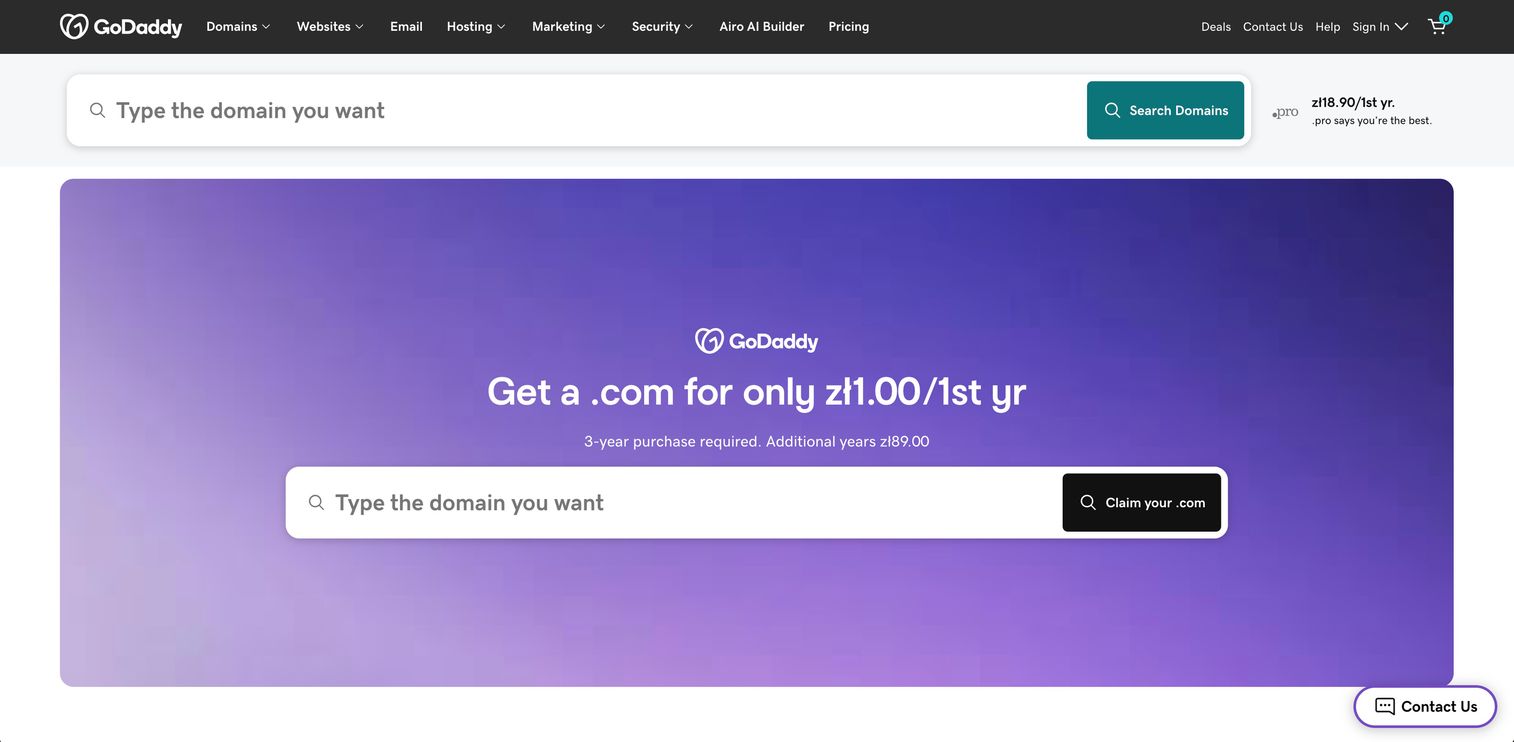
GoDaddy is the registrar most people have heard of, and for a reason: it bundles domain registration and transfer with a website builder, hosting, email, and security tools under one account. For a founder who wants a single provider rather than a stitched-together stack, that consolidation has real appeal. GoDaddy is one of the largest ICANN-accredited registrars in the world, so TLD coverage and support hours are rarely the constraint.
Best for: Businesses that want an all-in-one provider for domains and a basic web presence without juggling multiple vendors.
Key strengths
- Broad product bundle: Domains, website builder, hosting, and email in one dashboard, so you manage everything from a single login.
- Massive TLD support: One of the widest extension catalogs available, useful if you are grabbing defensive or country-code domains.
- Support availability: Phone and chat support with long hours, which matters when a DNS change breaks production.
Why choose GoDaddy: The pitch is convenience. If you would rather not run separate accounts for domains, email, and a landing page, GoDaddy collapses that into one relationship. The trade-off founders should watch is add-on pricing, since privacy and some security features are sold separately rather than bundled. Read the renewal terms before you commit for multiple years.
GoDaddy pricing: New customers can register eligible domains from $0.01 for the first year on a one-year term. Domain transfers are priced at $12.99 per transfer. The Discount Domain Club runs $9.99/month on an annual plan for buyers registering many domains, and the Domain Broker Service is $99.99 per domain plus a 20% commission. Renewal rates are higher than intro rates, so budget for the standard TLD price after year one.
2. Namecheap
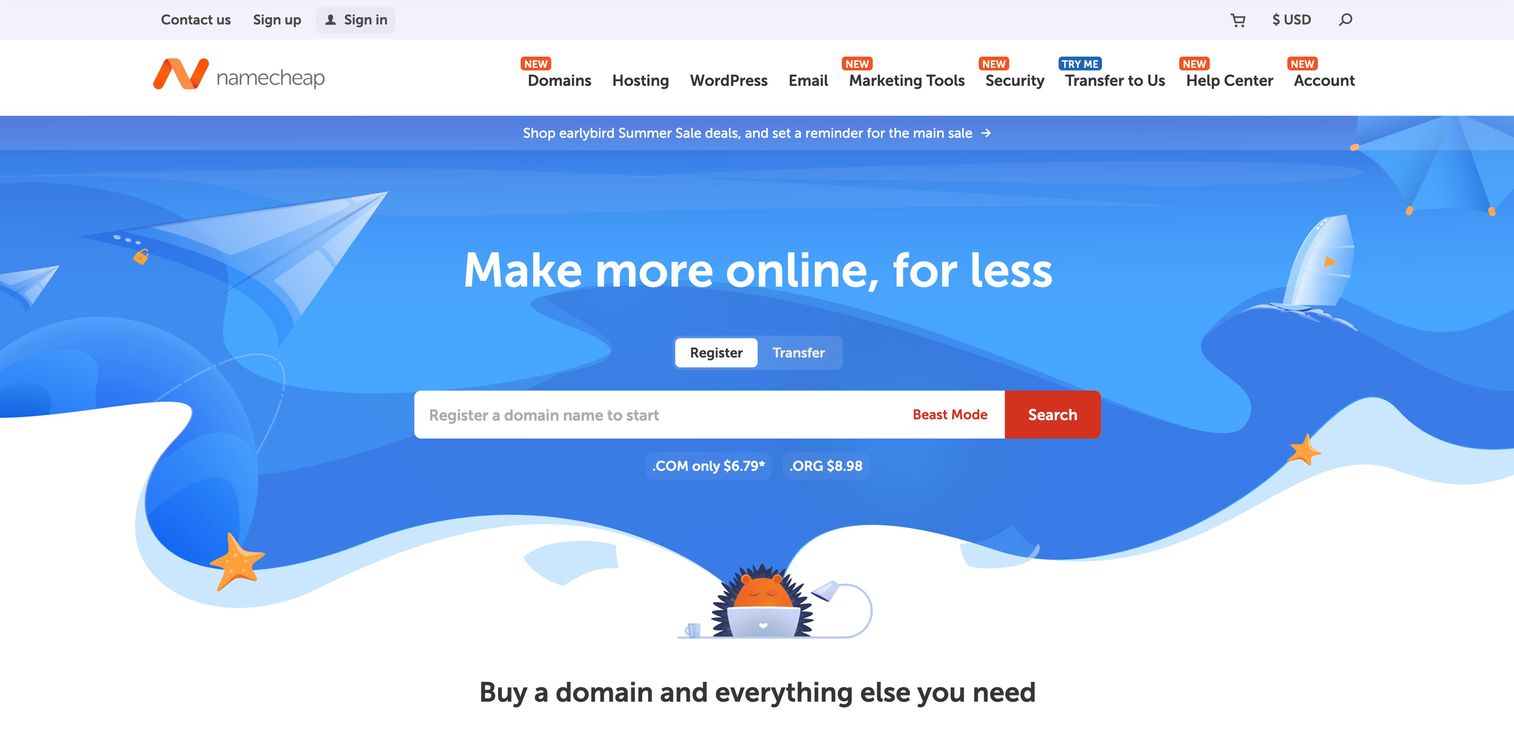
Namecheap built its reputation on doing exactly what the name promises: cheap domains without stripping out the things that actually protect you. It supports over 1,500 domain extensions, includes free lifetime WHOIS privacy on eligible domains, and offers 24/7 chat support. For budget-conscious teams that still want privacy and clean DNS basics, it is a default recommendation.
Best for: Founders who want low domain prices with included privacy protection and dependable DNS management.
Key strengths
- Free lifetime WHOIS privacy: Privacy protection is included on eligible domains rather than sold as a recurring add-on.
- Over 1,500 TLDs: Wide extension coverage for defensive registrations and niche launches.
- Free migrations and 24/7 support: Free hosting migrations and around-the-clock chat reduce the operational tax of switching.
Why choose Namecheap: Namecheap hits the value sweet spot. You get transparent domain pricing, privacy bundled in, and a dashboard that is easy to hand to a non-technical teammate. It is a strong fit when cost control matters but you refuse to trade away basic security. Renewal pricing stays reasonable relative to intro pricing, which keeps year-two surprises small.
Namecheap pricing: Domain registration starts as low as $0.98 for certain TLDs on the domains pricing page. Beyond domains, EasyWP Starter WordPress hosting runs $9.88/month after a first-month free trial, EasyWP Turbo is $13.88/month, and Private Email Starter is $14.88/year. Domain pricing varies by extension, so check the specific TLD before you buy.
3. Cloudflare
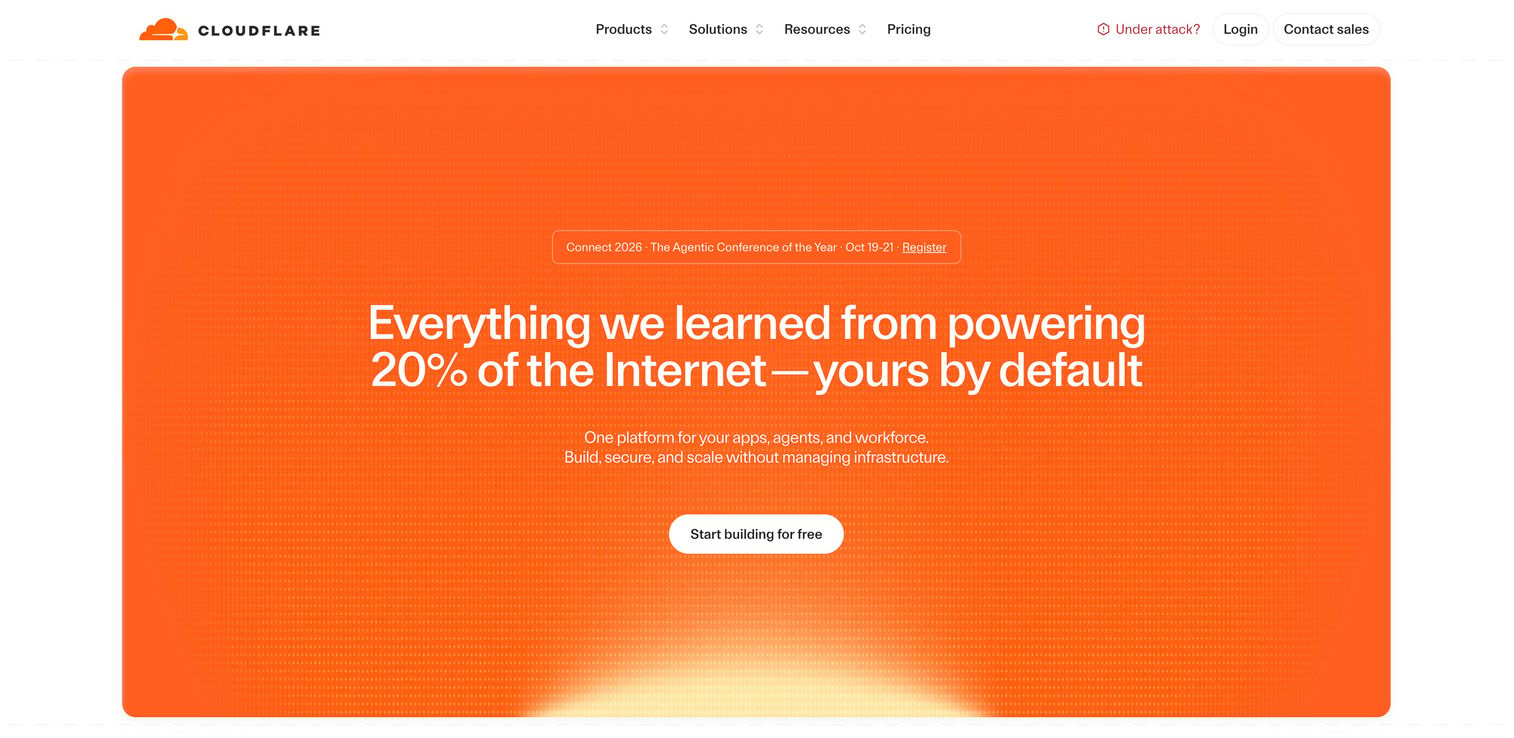
Cloudflare approaches domains differently. Its registrar sells domains at cost, passing the wholesale registry price straight through with no markup on renewals, which removes the renewal-shock problem entirely. Pair that with the CDN, web application firewall, DDoS protection, and developer platform (Workers, R2, Pages) that Cloudflare is known for, and you have a registrar built for teams that treat infrastructure as a first-class concern.
Best for: Developer-led teams that want at-cost domain economics and serious DNS, security, and edge infrastructure from one vendor.
Key strengths
- At-cost renewals: No markup on domain renewals, so your year-ten price matches the registry wholesale rate.
- Enterprise-grade DNS and security: Fast authoritative DNS, DNSSEC support, WAF, and DDoS protection on the same platform.
- Developer platform depth: Workers, R2, and Pages let engineering teams build on the same account that holds the domain.
Why choose Cloudflare: If your team already runs DNS or security through Cloudflare, moving the registration there consolidates control and kills renewal markup. It is less of a hand-holding, all-in-one provider and more of an infrastructure-grade DNS provider that happens to sell domains. That focus is exactly what developer-heavy founders want.
Cloudflare pricing: The registrar charges wholesale cost with no renewal markup. Around it, Cloudflare's platform has a free tier at $0 forever, a Zero Trust pay-as-you-go tier at $7/user/month, and custom enterprise contracts billed annually. Many product pages use usage-based pricing with generous free allowances, so a small team can run meaningful infrastructure at low cost.
4. Porkbun
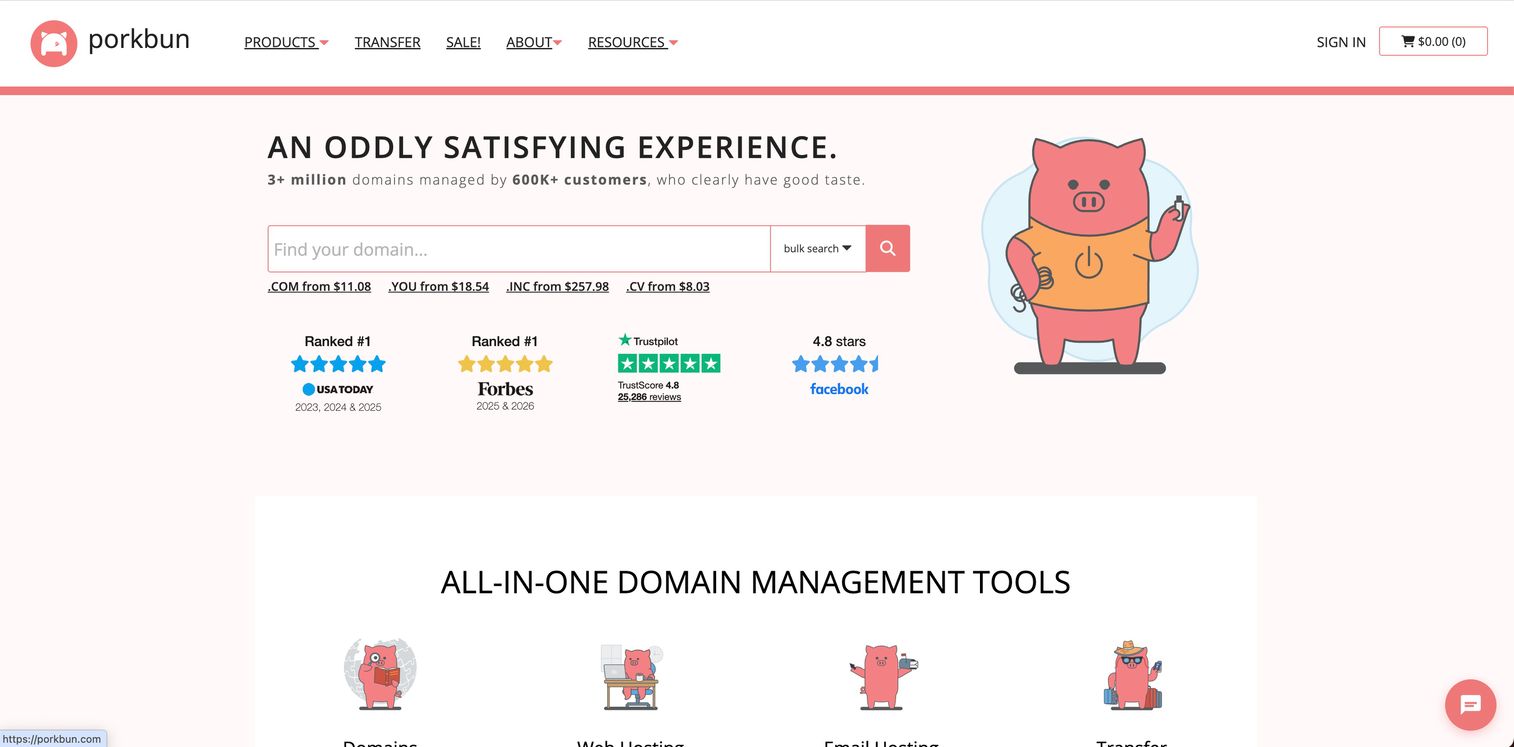
Porkbun is the clean, no-surprises option. Pricing is shown upfront, and the extras other registrars charge for come free: WHOIS privacy, SSL certificates, URL forwarding, email forwarding, and DNS management are all included. It also carries a 4.8/5 G2 rating, the highest on this list, which tells you the experience holds up after purchase.
Best for: Founders who want low-cost registration with privacy, SSL, and DNS tools bundled in and no upsell games.
Key strengths
- Free privacy, SSL, and DNS: WHOIS privacy, SSL certificates, and DNS management come included, not as paid add-ons.
- Transparent upfront pricing: Domain prices are shown clearly before checkout, so renewal costs are not a mystery.
- Free forwarding tools: URL and email forwarding included, handy for redirects and lightweight mailboxes.
Why choose Porkbun: Porkbun is what you recommend when someone asks for a registrar that just works and does not nickel-and-dime. The free bundle removes the add-on math entirely, and the high satisfaction rating reflects a genuinely tidy management experience. For a founder who values fewer line items and predictable costs, it is hard to beat.
Porkbun pricing: .com registration is listed from $11.08/year, with pricing shown upfront per TLD. Email hosting is available at $3.00/month per inbox, billed annually. Because privacy, SSL, and DNS are free, the sticker price is close to the all-in price, which is the point.
5. Dynadot
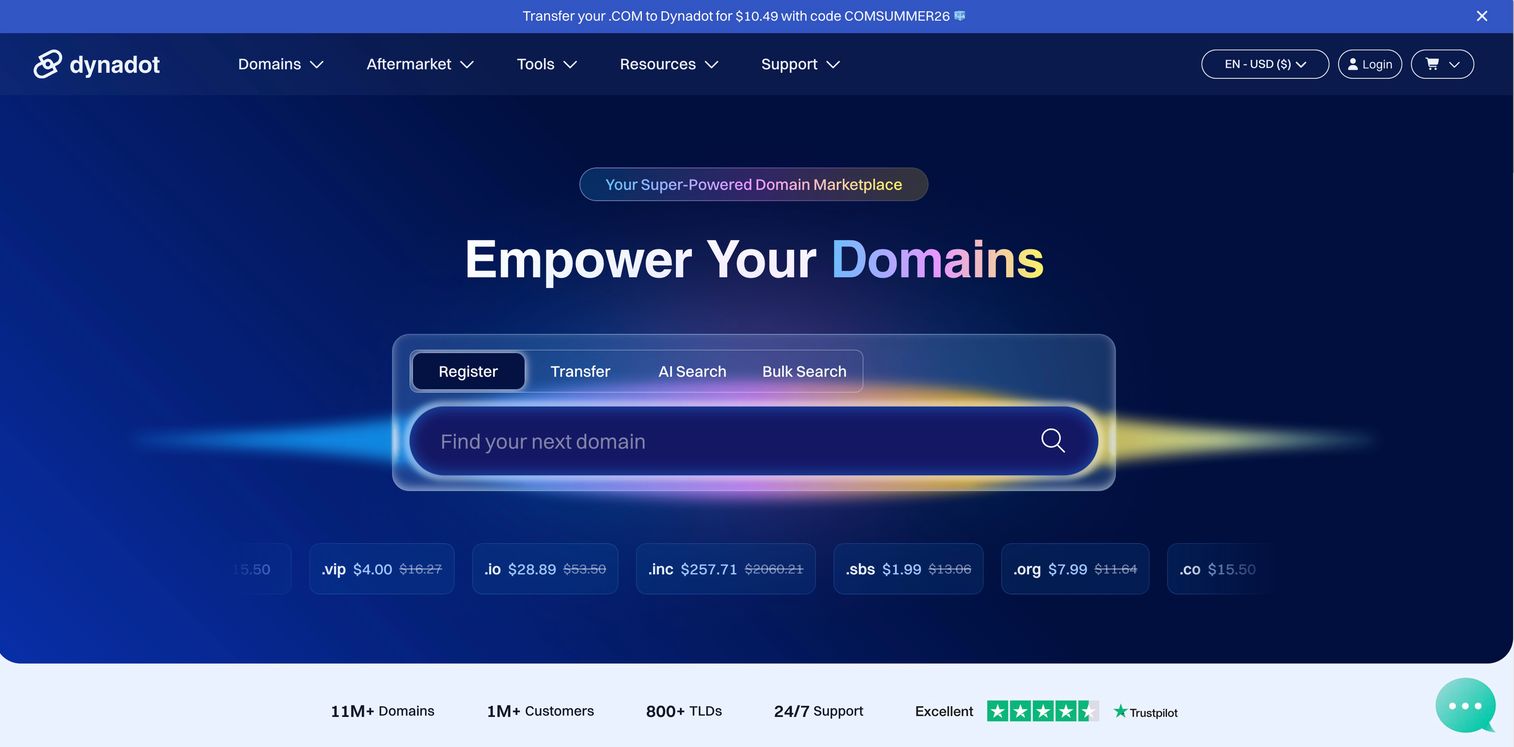
Dynadot is a registrar and domain management platform built with volume in mind. It offers registration, transfer, and renewal pricing by TLD, plus bulk and super bulk account tiers for higher-volume users, aftermarket tools, and a website builder. For founders sitting on a portfolio of brand and defensive domains, the bulk management is the differentiator, not just the price.
Best for: Teams and individuals buying, transferring, and managing larger domain portfolios who need bulk tooling.
Key strengths
- Bulk and super bulk tiers: Account tiers designed for managing many domains without per-domain busywork.
- Included essentials with domains: A free website builder, custom email address, and domain privacy come with registrations.
- Aftermarket and management tools: Marketplace and portfolio features for buying, selling, and organizing domains.
Why choose Dynadot: Dynadot earns its place when you manage more than a handful of domains. The bulk tooling and portfolio features cut the administrative overhead of renewals, DNS edits, and transfers across many names. It is a straightforward, functional platform aimed at people who treat domains as an asset class, not a one-off purchase.
Dynadot pricing: Domain registration, transfer, and renewal are priced per TLD on the pricing page. The Website Builder offers a Free plan and a Pro plan at $30/year. Domain privacy and a custom email address are included with domains, which keeps the effective cost of ownership low for portfolio holders.
6. Squarespace
Squarespace is a website platform first and a domain registrar second, which is exactly why it fits a specific founder. If your marketing site already lives on Squarespace, registering or transferring the domain there means one bill, one login, and no DNS pointing between vendors. It is an all-in-one convenience play, backed by designer templates, built-in SEO, and commerce tools.
Best for: Businesses that want a polished website and domain bundled in one platform without managing separate registrar and hosting accounts.
Key strengths
- Website and domain in one place: Domain, hosting, and site management under a single subscription.
- Designer templates and drag-and-drop editing: Launch a professional site without a developer or plugins.
- Built-in SEO and commerce: SEO tools, ecommerce, memberships, scheduling, and analytics included in the platform.
Why choose Squarespace: Choose Squarespace when the website is the priority and the domain is a supporting detail. It is not the deepest registrar for DNS power users or large portfolios, but for a founder who wants a clean brand site and a domain to match with minimal setup, the bundle removes friction. Treat it as a website platform that handles your domain, not a standalone registrar.
Squarespace pricing: Plans are paid subscriptions billed monthly or annually, starting at $19/month when paid annually, with a 14-day free trial. There is no permanently free plan. Because the domain lives inside the website subscription, evaluate the total platform cost rather than domain price alone.
7. IONOS
IONOS is a web hosting and cloud provider that bundles domains into broader business packages. You get hosting plans with domain and SSL included, a website builder with AI and SEO features, and cloud servers with pay-as-you-go pricing. For a founder who wants hosting and a domain from the same vendor with predictable business packaging, IONOS is built for that motion.
Best for: Small businesses and teams that need hosting, domains, or cloud servers bundled under one provider.
Key strengths
- Bundled hosting and domains: Web hosting plans include a domain and SSL, simplifying the initial launch.
- Website builder with AI and SEO: Build and optimize a site without stitching separate tools together.
- Pay-as-you-go cloud servers: Cloud infrastructure priced by the hour for teams that need more than shared hosting.
Why choose IONOS: IONOS fits when you want infrastructure and a domain from one bundled provider rather than best-of-breed pieces. The business packaging and included SSL lower the setup burden for a small team, and the cloud server pricing gives you room to grow. It is a practical choice for founders who value a single vendor relationship over maximum registrar specialization.
IONOS pricing: IONOS uses product-specific pricing. Web hosting Starter is $6/month on a one-year term, and Basic Cube XS cloud servers start at $0.008 per hour, roughly $5.76 per 30 days, with Basic Cube S at $0.014 per hour. Domain pricing is bundled into hosting packages, so compare the full package rather than a standalone domain rate.
8. NameSilo
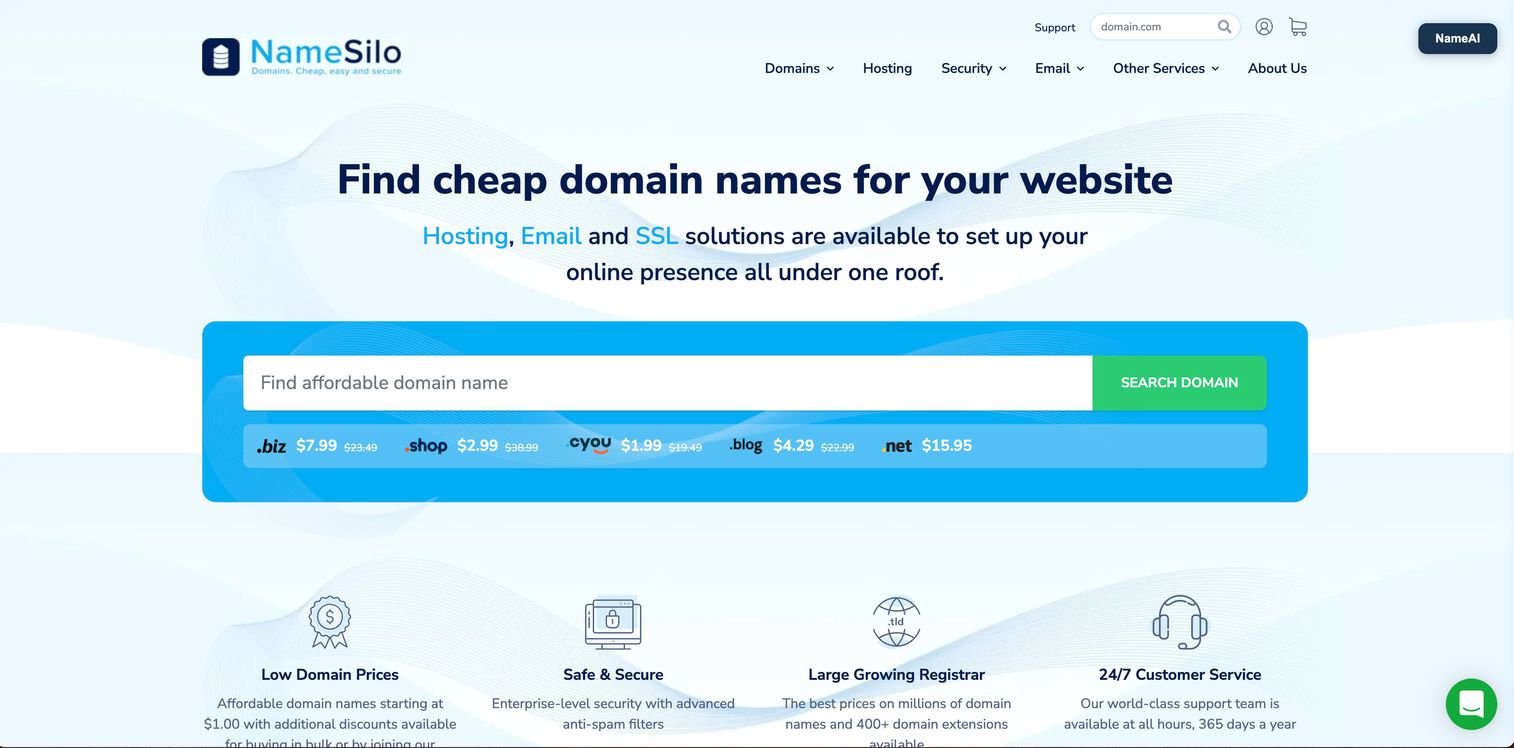
NameSilo is a low-cost registrar built around straightforward domain management and security. Free WHOIS privacy, free email forwarding, and Domain Defender protection come standard, and the pricing page lists many TLDs with discount tiers. For founders who want practical registrar basics, clean transfer handling, and security without add-on fees, NameSilo is a quietly strong pick.
Best for: Domain registration and portfolio management with bundled free privacy and basic management tools at a low price.
Key strengths
- Free WHOIS privacy: Privacy is included on registrations rather than sold separately.
- Domain Defender security: Built-in protection against unauthorized changes and transfers.
- Free email forwarding: Route domain email without paying for a separate mailbox to start.
Why choose NameSilo: NameSilo is for founders who want the essentials done right and cheaply. Privacy and security come free, transfers are handled cleanly, and the discount program lowers per-domain cost as your portfolio grows. It is not flashy, and that is the appeal: predictable, low-cost domain operations without a sales funnel attached.
NameSilo pricing: .com registration is listed at $17.29 per year, dropping to $11.05 with the Discount Program. Add-ons that other registrars charge for, including WHOIS privacy, email forwarding, Domain Defender protection, custom WHOIS records, and DNS management, are free. Hosting Starter is available at $6.99 per month for teams that want hosting alongside domains.
Considerations before you choose a registrar
Renewal pricing, not intro pricing
The first-year price is marketing. The renewal price is what you actually pay for the next decade. Pull the standard renewal rate for your exact TLD before you commit, and be wary of multi-year deals that lock in a low intro rate but reset high. At-cost registrars like Cloudflare sidestep this entirely.
Transfer behavior and lock rules
Check how the registrar handles outbound transfers before you are locked in. You want a clear auth code process, no unnecessary transfer fees, and no artificial hurdles beyond ICANN's standard 60-day rule. A registrar that makes leaving hard is a registrar that will hold your domain hostage later.
Security controls
Confirm the registrar supports 2FA, DNSSEC, and ideally registry lock for high-value domains. Free WHOIS privacy is a baseline, not a premium feature, in 2026. These controls are the difference between a domain you own and a domain someone can socially engineer away from you.
DNS ownership and portability
Decide whether you will run DNS at the registrar or point nameservers to a dedicated DNS provider. Either is fine, but confirm the registrar lets you change nameservers freely and supports the record types you need. Keeping DNS portable protects you from vendor lock-in.
Support quality
When a DNS misconfiguration takes down your site or email, support response time is the only metric that matters. Favor registrars with 24/7 chat or phone support and a track record of solving problems, not just answering tickets.
Conclusion
The best domain registrar depends on what you value most. GoDaddy and IONOS win on all-in-one convenience for founders who want domains, hosting, and email under one roof. Namecheap, Porkbun, and NameSilo lead on value and bundled privacy for cost-conscious teams. Cloudflare is the developer's choice for at-cost renewals and infrastructure-grade DNS. Dynadot handles portfolios and bulk management, and Squarespace bundles the domain into a polished website when the site is the priority.
The practical move is to pick one registrar and standardize domain ownership early. Consolidate your domains, turn on 2FA and DNSSEC, enable WHOIS privacy, and document who controls the account before it becomes a fire drill during a fundraise or a rebrand. A domain that runs quietly in the background is doing its job. If you are consolidating other parts of your stack too, browsing options like AI content creation tools, affiliate marketing software, and AI design tools can help you standardize the rest with the same low-friction mindset. And when you need to share or personalize how your product is experienced, an interactive walkthrough applies the same principle to your buyer's journey.
Start your journey with Guideflow today!
FAQs
A domain registrar is an ICANN-accredited company that registers and manages domain names on your behalf, reserving your chosen name in the official registry so no one else can claim it. They handle registration, renewals, transfers, and usually provide DNS management, WHOIS privacy, and security controls. In short, they are your point of contact and the party that holds your ownership record.
Not exactly. A registrar reserves and holds your domain name, while a DNS provider translates that name into an IP address so browsers and mail servers know where to send traffic. Most registrars include DNS management, but you can point your nameservers to a separate DNS provider, which is why many teams register in one place and run DNS at Cloudflare.
You unlock the domain at your current registrar, request the authorization code (often called an EPP or auth code), and submit it to the new registrar to start the transfer. ICANN rules impose a 60-day lock after registration or a prior transfer, so confirm the domain is eligible first. Copy your DNS records to the new provider before the transfer completes so your site and email never go dark.
Intro pricing is a promotion designed to win your first year, while renewal pricing reflects the registrar's standard rate plus the wholesale registry fee. Some registrars mark renewals up significantly, while at-cost registrars pass the wholesale price straight through. Always check the specific renewal rate for your TLD, since it is what you will pay for the life of the domain.
Namecheap, Porkbun, and NameSilo include free WHOIS privacy on eligible domains rather than charging for it as an add-on. Free lifetime privacy masks your personal contact details from the public WHOIS record, cutting spam and reducing social-engineering risk. Treat included privacy as a baseline expectation from any reputable registrar in 2026.
Weigh renewal pricing over intro pricing, transparent transfer behavior, DNS and DNSSEC support, security controls like 2FA and registry lock, TLD coverage, and support responsiveness. Match those against your situation: an all-in-one provider for convenience, an at-cost registrar for developers, or a low-cost registrar with bundled privacy for value. The best pick is the one that runs quietly and does not create operational drag.
DNSSEC cryptographically signs your DNS records to prevent attackers from forging responses and hijacking traffic, and it is worth enabling on any domain that matters. Registry lock adds a manual, registry-level hold that blocks unauthorized transfers or nameserver changes, which is the strongest protection for high-value brand or email domains. If a domain underpins your business, enable both.
Yes. The key is to recreate your DNS records at the new registrar or DNS provider and let them propagate before you change nameservers or complete the transfer. When the records match on both sides, the switch is invisible to visitors and email. Rushing the nameserver change before DNS is ready is the most common cause of avoidable downtime.