The deal does not stall when a buyer asks about APIs. It stalls when nobody can prove how those APIs will be governed, secured, monitored, and versioned after launch. Security wants auth controls and audit logs. Engineering wants to know the deployment model. The AE wants a clear next step, and you are standing in the middle trying to make all of it legible.
According to Postman's 2025 State of the API report, 82% of organizations have adopted some level of an API-first approach. That means API management is no longer a backend infrastructure decision. It is a presales conversation. Buyers ask about rate limiting, identity provider integration, developer portals, and AI gateway controls before they sign anything.
This guide gives presales and solutions teams a practical shortlist of 15 API management platforms. Each entry explains what the tool does well, who it fits, and what pricing looks like so you can walk into a technical review prepared.
What's inside
This guide is for presales engineers, solutions consultants, and technical GTM teams supporting API-heavy product evaluations.
- What it covers: 15 API management software options for 2026, compared by deployment model, gateway depth, API security, developer portal, analytics, and pricing
- Selection criteria: Gateway maturity, API lifecycle governance, protocol support, enterprise security controls, and pricing transparency
- Verification: G2 ratings and pricing figures were checked against live vendor pages at time of writing
- Reader fit: SEs preparing POCs, supporting security reviews, or helping buyers shortlist API platforms
TL;DR
- Best for Microsoft-heavy enterprises: Azure API Management integrates deeply with Microsoft Entra ID, Azure Functions, and AI gateway capabilities
- Best for cloud-native gateway operations: Kong Konnect handles multi-runtime API, AI, and event traffic with strong Kubernetes support
- Best for Google Cloud API programs: Apigee delivers mature API productization, analytics, and monetization on Google Cloud
- Best for integration-led enterprises: MuleSoft Anypoint Platform combines API management with iPaaS in a single operating model
- Best open-source-oriented options: Gravitee and WSO2 API Manager cover synchronous and asynchronous APIs with flexible deployment
- Best for API design and collaboration: Postman and SwaggerHub support API design, testing, documentation, and team workflows
What is API management software?
API management software helps teams design, publish, secure, monitor, govern, and scale APIs across their lifecycle.
It is the operational layer between your backend services and every consumer of those services: Developers, partners, internal teams, and AI agents. A basic API gateway handles runtime traffic. A full API management platform adds lifecycle governance, developer portals, analytics, and API security controls on top of that gateway.
Core capabilities
- API gateway: Routes traffic, enforces policies, handles throttling and rate limiting, manages authentication and authorization
- API lifecycle management: Covers design, versioning, publishing, deprecation, and retirement
- Developer portal and API catalog: Gives consumers a self-service destination to discover, subscribe, and test APIs
- API security: Authentication (OAuth 2.0, JWT, API keys), authorization, identity provider integration, and policy enforcement
- API analytics and observability: Traffic monitoring, error tracking, latency, consumer behavior, and usage by account
- Hybrid and multi-cloud deployment: Supports cloud-native, Kubernetes, on-premises, and edge gateway configurations
- AI gateway and MCP support: Emerging controls for AI APIs, model access, token quotas, and agent traffic
Category boundaries
An API gateway is a runtime component. API management software typically includes the gateway plus governance, lifecycle tooling, portals, and analytics. An API design tool like SwaggerHub focuses on schema, documentation, and collaboration rather than runtime control. An integration platform like MuleSoft or Boomi adds workflow and data movement alongside API exposure.
Understanding these boundaries helps you answer the buyer's real question: Do they need a gateway, a full management platform, or both?
When to use API management software
Secure customer-facing and partner APIs
When APIs become externally accessible, they become attack surfaces. API security controls including authentication, authorization, rate limiting, abuse prevention, and audit logging move from optional to mandatory. Presales teams often face this question during security review. A solid API security tools evaluation should cover how each platform enforces identity, logs access, and handles policy violations.
Standardize API lifecycle governance
Unmanaged API estates create "tribal knowledge APIs" that only one engineer understands. API governance covers publishing standards, versioning policies, ownership, documentation requirements, deprecation schedules, and retirement workflows. For enterprise buyers, this is often the deciding factor between a gateway and a full management platform.
Manage API traffic across cloud, hybrid, and AI systems
Modern API estates span multiple clouds, Kubernetes clusters, edge gateways, and now AI systems. Platforms that handle multi-cloud API management, MCP (Model Context Protocol), and AI agent traffic give buyers a single control plane for all of it. SEs should ask where gateways need to run and whether the buyer's AI workflows require token usage controls or semantic caching.
API management software comparison
Use this table as a shortlist starting point, not a final buying decision. Pricing and G2 ratings reflect figures verified at time of writing.
| # | Product | Best for | Key differentiator | Pricing | G2 rating |
|---|---|---|---|---|---|
| 1 | Azure API Management | Microsoft-heavy enterprises | Deep Azure and AI gateway integration | Custom pricing | 4.2/5 |
| 2 | Kong Konnect | Cloud-native and Kubernetes teams | Multi-runtime gateway and AI traffic management | From $25/month | 4.4/5 |
| 3 | Apigee | Google Cloud API programs | Mature API productization and analytics | From $20/1M API calls | 4.5/5 |
| 4 | MuleSoft Anypoint Platform | Integration-led enterprises | API management plus iPaaS in one platform | From $2,000/month | 4.5/5 |
| 5 | IBM API Connect | Regulated enterprise environments | Governance, security, and IBM ecosystem depth | Custom pricing | N/A |
| 6 | Tyk | Flexible deployment teams | Open-source gateway with enterprise management | Custom pricing | 4.5/5 |
| 7 | Gravitee | Event-native and federated API programs | Synchronous and asynchronous API support | From $2,500/month | 4.6/5 |
| 8 | WSO2 API Manager | Open-source-oriented teams | Full lifecycle management, free trial available | From $119/month | N/A |
| 9 | Amazon API Gateway | AWS serverless teams | Native AWS front door for Lambda and AWS services | From $1/1M API calls | 4.3/5 |
| 10 | Postman | API collaboration and testing teams | Design, testing, documentation, and team workspace | Free; from $9/month | 4.6/5 |
| 11 | SAP Integration Suite | SAP-centric enterprises | API management inside SAP integration workflows | From $1,728/month | 4.3/5 |
| 12 | Boomi | Integration and automation teams | Low-code integration with API management | From $99/month | 4.4/5 |
| 13 | TIBCO Cloud API Management | TIBCO-invested enterprises | API management within TIBCO integration stack | Custom pricing | 4.1/5 |
| 14 | Axway Amplify | Federated enterprise API programs | API marketplace and multi-team governance | Custom pricing | 4.4/5 |
| 15 | SwaggerHub | API design-first teams | OpenAPI design, documentation, and collaboration | Custom pricing | 4.5/5 |
Best 15 API management software for 2026
1. Azure API Management
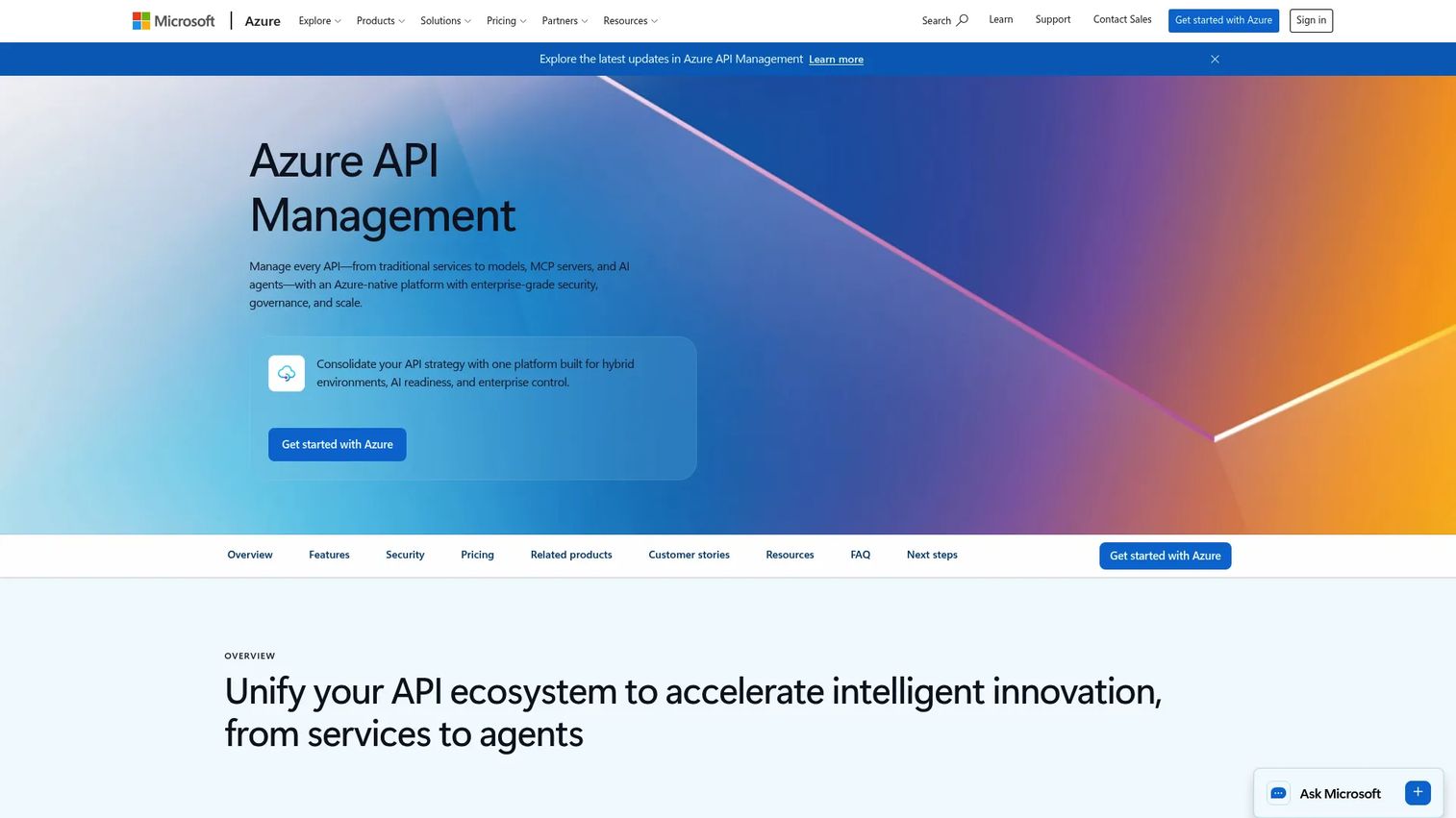
Azure API Management is Microsoft's managed platform for publishing, securing, monitoring, and governing APIs across Azure, hybrid, and multi-cloud environments. It integrates directly with Microsoft Entra ID, Azure Functions, Logic Apps, and Microsoft's broader security tooling. The platform covers everything from a consumption-based tier for low-volume scenarios to premium tiers designed for high-volume enterprise deployments, including a self-hosted gateway for on-premises or edge environments.
Best for: Enterprise teams standardizing on Microsoft Azure with existing investment in Microsoft identity and security.
Key features
- Managed API gateway with policy enforcement
- Developer portal for API discovery and subscription
- Microsoft Entra ID and identity provider integration
- Self-hosted gateway for hybrid and on-premises deployment
- AI gateway capabilities for AI API management
Why choose Azure API Management: When the buyer's technical stack is already Microsoft-heavy, Azure API Management answers security, identity, and deployment questions with familiar patterns. Presales teams can walk through Entra ID integration, usage plans, and the self-hosted gateway without asking engineering to build custom tooling.
Azure API Management pricing: Microsoft structures pricing across multiple tiers including Consumption (billed per API operation), Developer (non-production evaluation), Basic, Standard, Premium, and v2 tiers (Basic v2, Standard v2, Premium v2). The Consumption tier includes up to 1 million API operations per subscription. Specific numeric prices were not publicly displayed in the verified pricing view; contact Microsoft or use the Azure pricing calculator for a quote.
G2 rating: 4.2/5
2. Kong Konnect
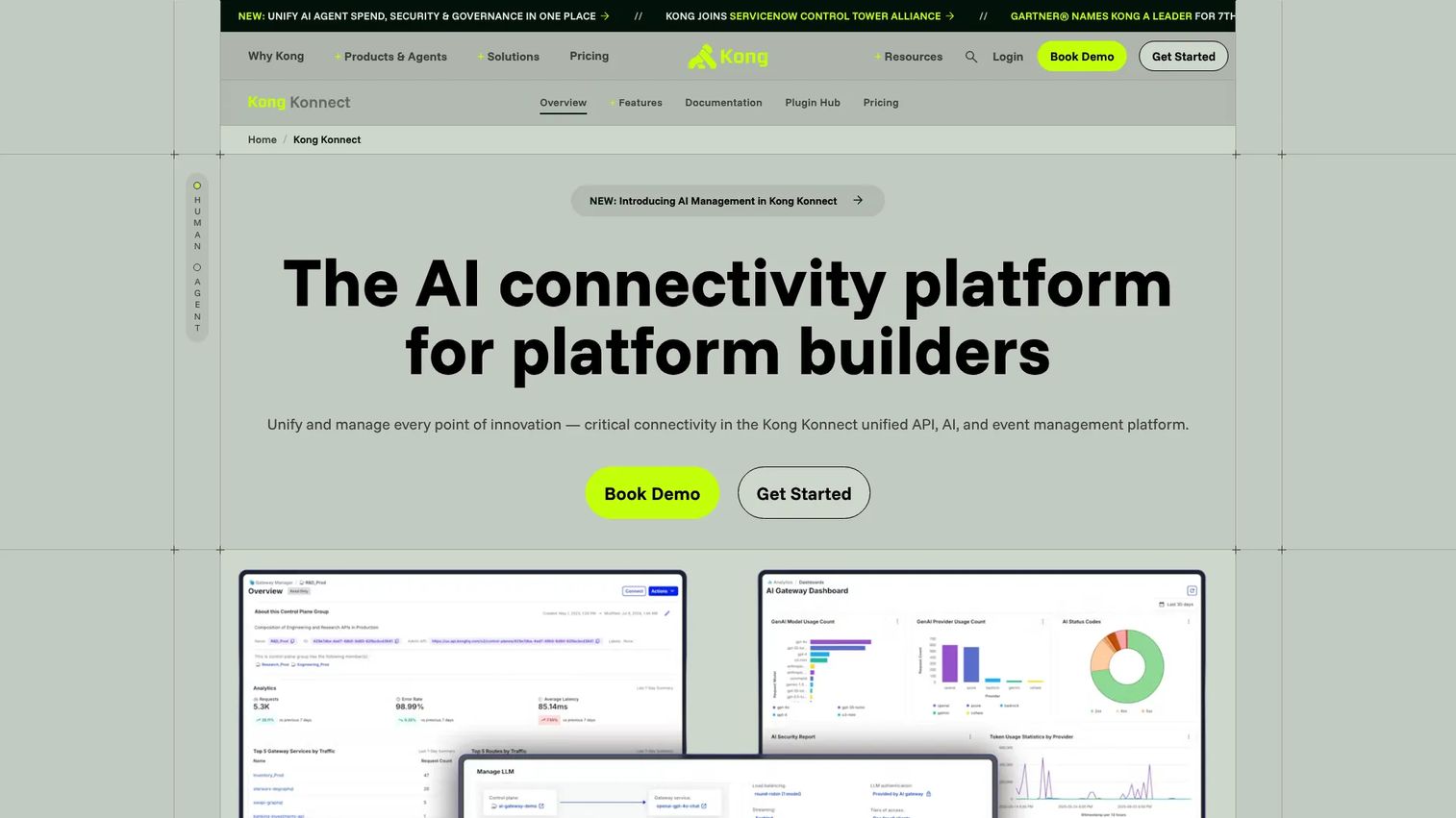
Kong Konnect is a unified API, AI, and event management platform built around Kong Gateway. It handles multi-runtime gateway deployment across cloud, hybrid, and edge environments from a single control plane. The platform includes a Developer Portal, MCP registry for self-service publishing and discovery, and unified observability across all gateways. Teams managing Kubernetes-native microservices or distributed API estates use it to enforce consistent governance without centralizing runtime execution.
Best for: Platform engineering teams managing APIs across cloud-native, Kubernetes, or multi-cloud environments.
Key features
- Kong Gateway control across multiple runtimes
- Developer Portal and MCP registry for discovery
- AI and event traffic management alongside REST APIs
- Unified observability and analytics dashboard
- Automated governance and policy enforcement
Why choose Kong Konnect: Strong fit when the buyer runs microservices across multiple clouds or needs high-performance gateway operations. For presales, it is the right answer when prospects ask about Kubernetes-native gateway control, distributed deployments, or AI API governance alongside traditional REST.
Kong Konnect pricing: The Plus plan starts from $25/month plus usage, covering smaller API programs. Enterprise pricing is custom and billed annually. A free trial is available; legacy free accounts exist but a permanent free tier was not confirmed on the current pricing page.
G2 rating: 4.4/5
3. Apigee
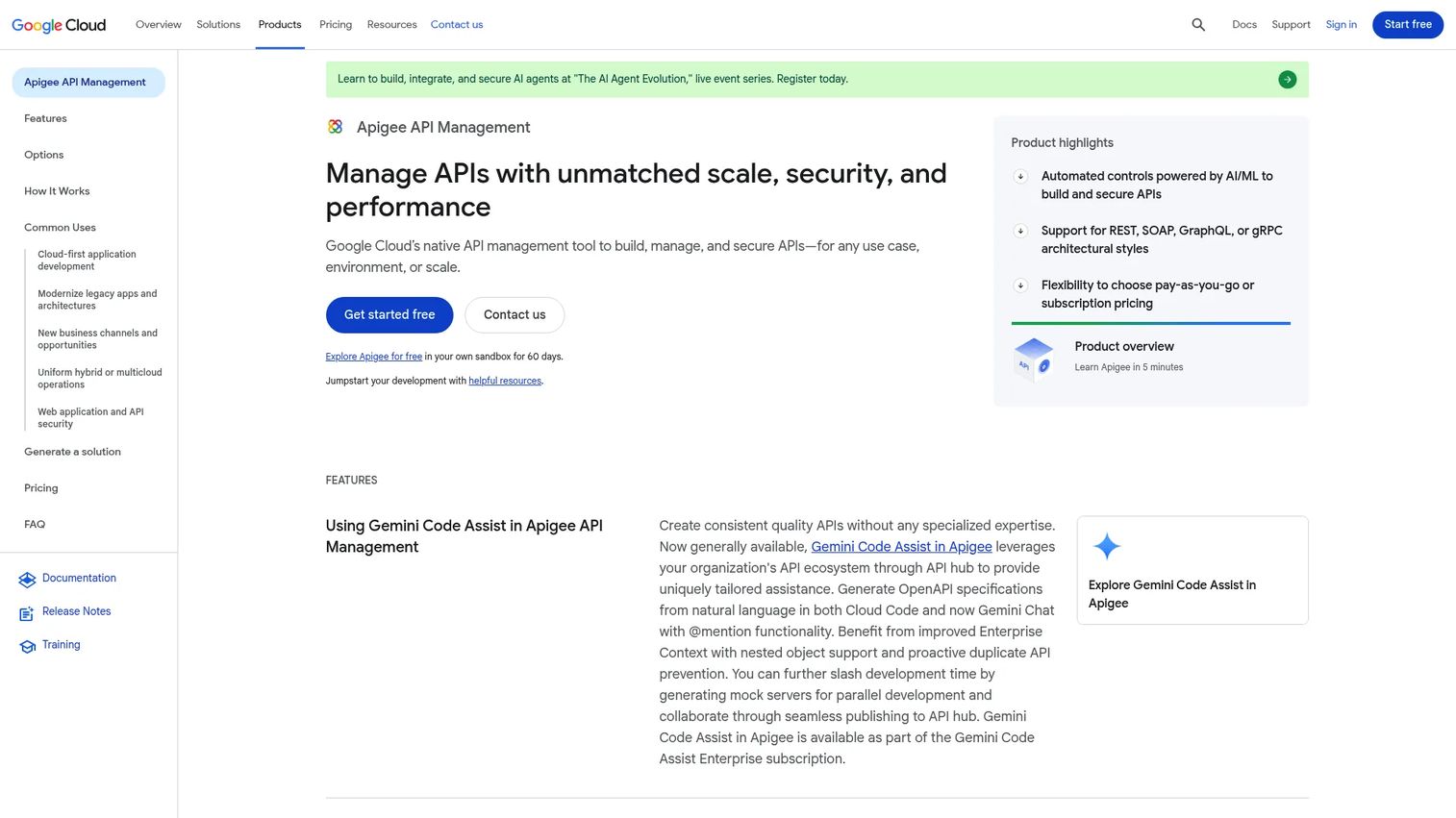
Apigee is Google Cloud's enterprise API management platform for designing, securing, analyzing, and monetizing APIs. It supports REST, gRPC, SOAP, and GraphQL proxies with traffic management, policy-based security, and near-real-time analytics. Apigee X is the current version, running natively on Google Cloud. Mature API productization features make it a strong choice when APIs are treated as products rather than internal plumbing.
Best for: Enterprise API programs on Google Cloud, or API product teams that need monetization and advanced analytics.
Key features
- API proxy management for REST, gRPC, SOAP, and GraphQL
- Traffic management and policy-based security controls
- API analytics and near-real-time monitoring
- Developer portals for self-service access
- API monetization and subscription management
Why choose Apigee: Best when the buyer's API program needs developer adoption tooling, usage analytics per consumer, or revenue-generating API products. Presales teams supporting Google Cloud-centric evaluations or product API programs will find Apigee's analytics depth answers most procurement-stage questions.
Apigee pricing: A 60-day free evaluation is available. Pay-as-you-go starts at $20 per 1 million API calls, with additional charges for environments, proxy deployments, and networking. Standard, Enterprise, and Enterprise Plus subscription plans require contacting Google Cloud for pricing.
G2 rating: 4.5/5
4. MuleSoft Anypoint Platform
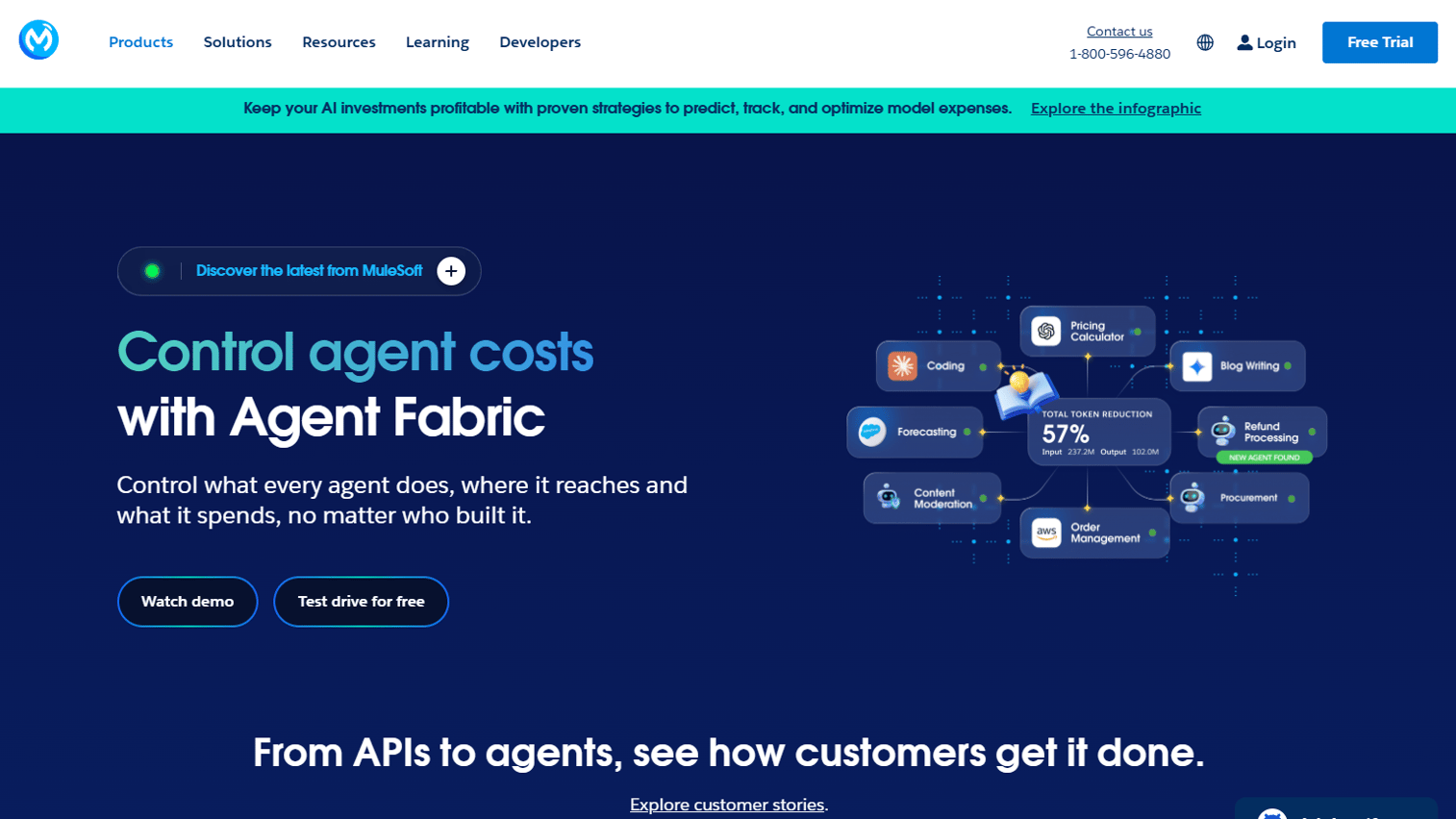
MuleSoft Anypoint Platform is an integration and API management platform for designing, building, deploying, monitoring, securing, and governing APIs and integrations. Anypoint API Manager handles runtime policy enforcement and gateway controls. Anypoint Exchange provides a reusable asset library. Flex Gateway extends deployment to Kubernetes and cloud-native environments. Organizations that need API management connected to integration flows, connectors, and enterprise system orchestration find MuleSoft covers both jobs without switching platforms.
Best for: Enterprises combining an integration strategy with API management, particularly those with Salesforce ecosystem dependencies.
Key features
- Anypoint API Manager for policy and gateway control
- Anypoint Exchange for reusable assets and documentation
- Flex Gateway for Kubernetes and cloud-native deployment
- Prebuilt connector library for system integrations
- Policy management and API lifecycle governance
Why choose MuleSoft Anypoint Platform: The right call when API management is part of a broader integration program. Presales teams should surface it when buyers need reusable connectors, system connectivity, and governance within a single operating model rather than adding a standalone gateway on top of existing integration tooling.
MuleSoft Anypoint Platform pricing: Packages start at $2,000 per month, billed annually, using shared Mule Credits across integrations, APIs, automation, and agents. A Pre-Commit tier requires a $50K minimum annual commitment. A 30-day free trial is available. Enterprise and Unlimited tiers carry custom pricing through Salesforce sales.
G2 rating: 4.5/5
5. IBM API Connect
IBM API Connect is an enterprise API management platform with strong governance, security, lifecycle management, and flexible deployment. It supports REST, GraphQL, SOAP, WebSockets, and AsyncAPI across hybrid, multicloud, on-premises, and SaaS environments. AI-assisted automated testing and IBM DataPower integration make it a fit for enterprises with formal architecture review boards and regulated workloads. Developer Portal capabilities support self-service API discovery and subscription.
Best for: Large enterprises with security-heavy, regulated, or IBM-ecosystem-centric API programs.
Key features
- API gateway with policy enforcement and security controls
- API lifecycle governance, versioning, and publishing
- Developer Portal for API discovery and self-service
- API analytics and usage monitoring
- IBM DataPower integration for regulated environments
Why choose IBM API Connect: Strong choice when governance, auditability, and enterprise security controls are central to the evaluation. Presales teams supporting regulated industries or buyers with formal IT architecture review processes will find IBM API Connect answers compliance and deployment questions with established enterprise patterns.
IBM API Connect pricing: IBM offers Pay-as-you-Go (hosted on AWS), Standard SaaS, Premium SaaS, Reserved Instance, and software (self-managed) deployment options. A 30-day free trial is listed.
6. Tyk
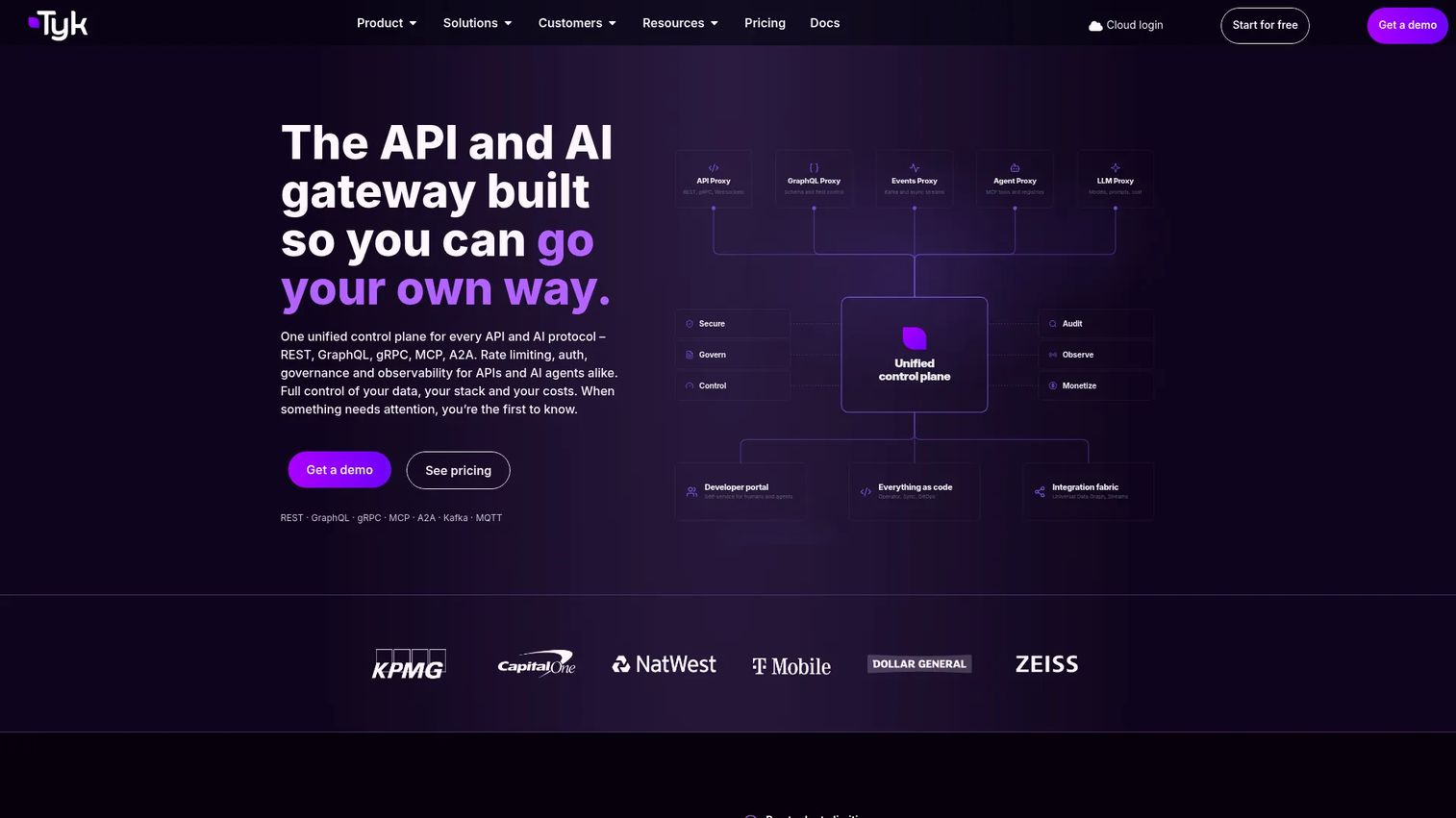
Tyk is an API management platform with open-source roots, covering API gateway control, developer portals, analytics, and authentication across cloud, hybrid, and self-managed deployments. It supports REST, GraphQL, gRPC, SOAP, and asynchronous APIs. The open-source gateway is available separately, and Tyk's commercial plans add a managed control plane, enterprise support, and multi-data-plane management. Teams that want strong gateway flexibility without committing to a single hyperscaler find Tyk a practical fit.
Best for: Teams needing flexible deployment and developer-friendly API management without hyperscaler lock-in.
Key features
- Open-source API gateway with commercial management layer
- Authentication, authorization, and rate limiting controls
- REST, GraphQL, gRPC, SOAP, and async API support
- Developer Portal for self-service access
- Multi-cloud and hybrid deployment options
Why choose Tyk: Useful when the buyer wants strong gateway control, open-source optionality, and the ability to run gateways on their own infrastructure. Presales teams can highlight it in evaluations where vendor lock-in is an objection and where the buyer's engineering team wants to extend or customize the gateway layer.
Tyk pricing: Core pricing is usage-based by APIs managed; Professional is priced by data planes and environments. The open-source gateway itself is free. Contact Tyk for a quote based on gateway scale and deployment requirements.
G2 rating: 4.5/5
7. Gravitee
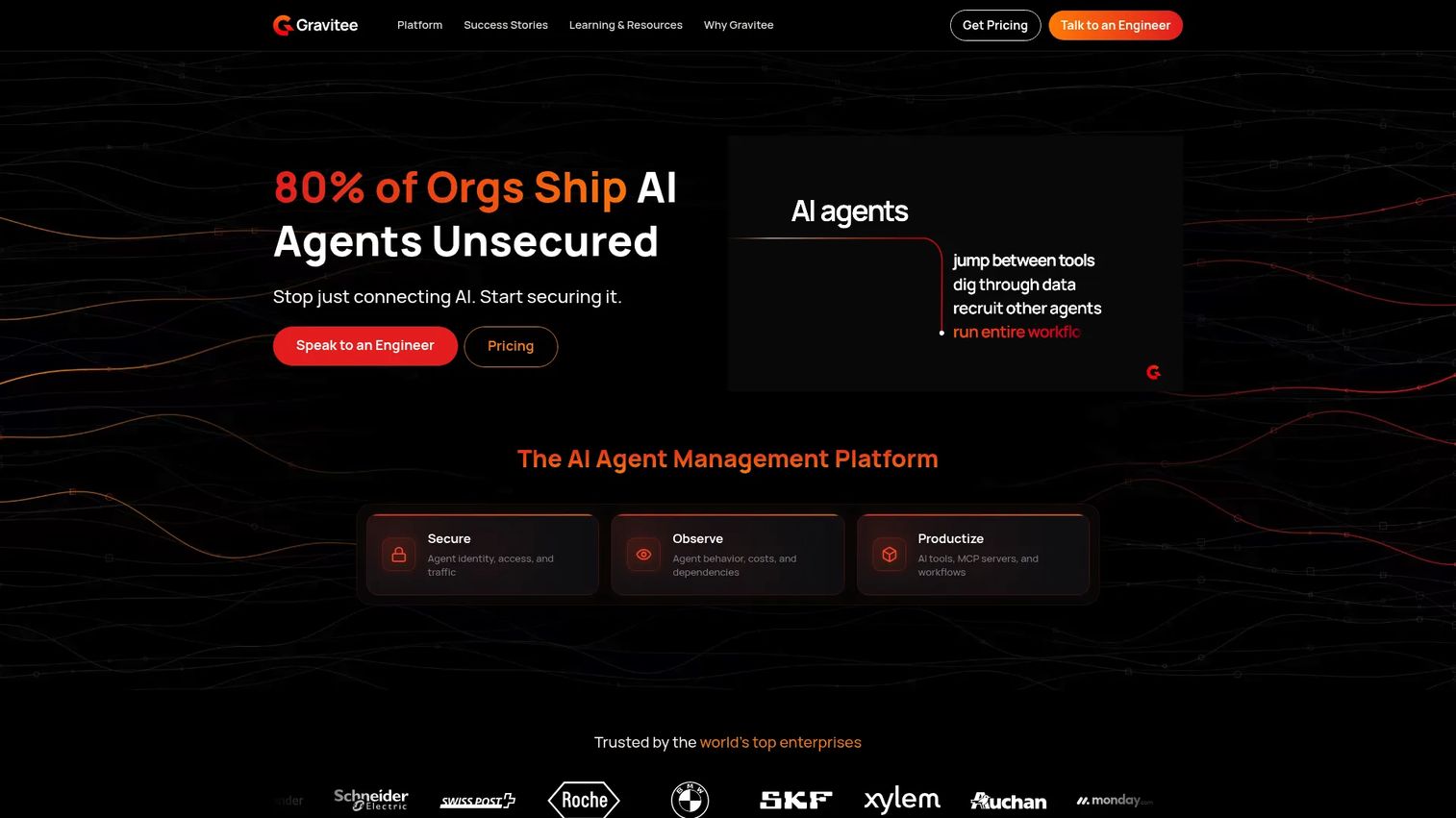
Gravitee is an API, AI, and event management platform covering full lifecycle governance for REST, GraphQL, gRPC, SOAP, WebSocket, SSE, Webhooks, and event streams including Kafka. It also includes Agent Management for LLM, MCP, and agent-to-agent (A2A) traffic. The Developer Portal supports API discovery, subscriptions, documentation, and self-service access. Policy-based security covers OAuth 2.0, JWT, mTLS, API keys, OIDC, and threat protection. Federated API management supports governance across distributed teams and multiple gateway environments.
Best for: Enterprise teams managing mixed API styles, event-driven architectures, or AI agent traffic alongside traditional APIs.
Key features
- Full lifecycle API management for REST, GraphQL, gRPC, and event APIs
- Event stream management and Kafka gateway support
- Agent Management for LLM, MCP, and A2A traffic
- Policy-based security with OAuth 2.0, JWT, and mTLS
- Developer Portal with subscriptions and self-service access
Why choose Gravitee: The strongest option when the buyer's API estate goes beyond REST. Presales teams should use it in evaluations where event-driven architecture, Kafka integration, AI agent governance, or federated management across decentralized teams comes up. The MCP and AI traffic controls address a gap most other platforms are still filling.
Gravitee pricing: The Planet plan is $2,500 per month and includes unlimited users, unlimited APIs under management, one production gateway, and Gold Support. Galaxy and Universe plans require contacting Gravitee for pricing.
G2 rating: 4.6/5
8. WSO2 API Manager
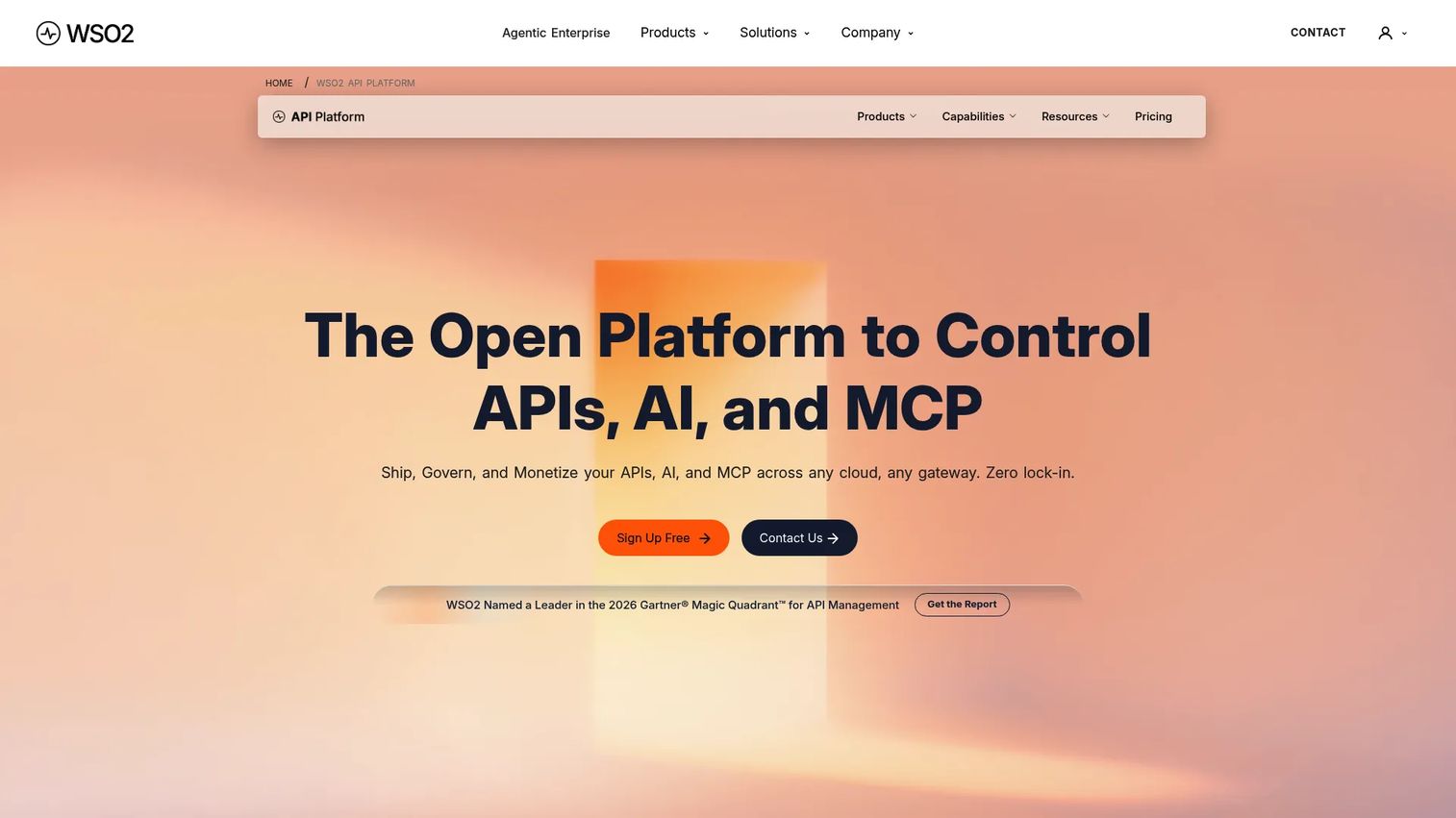
WSO2 API Manager is a full-lifecycle API management platform with open-source roots, supporting design, publishing, security, analytics, and developer portals across self-hosted, cloud, and hybrid environments. It handles REST, GraphQL, WebSocket, Webhook, SOAP-to-REST, SSE, and AI APIs. The WSO2 API Platform includes APIOps automation and monetization. Teams with engineering capacity and a preference for self-managed infrastructure find WSO2 gives deeper customization than SaaS-first alternatives.
Best for: Technical teams that need open-source-oriented, fully controllable API management with flexible deployment.
Key features
- API gateway with traffic management and authentication
- API publisher for lifecycle management and versioning
- Developer Portal for discovery and self-service subscriptions
- Support for REST, GraphQL, WebSocket, and AI APIs
- API analytics and monetization capabilities
Why choose WSO2 API Manager: Best for buyers that want deeper control over their deployment environment, prefer open-source licensing, or need to customize the gateway and portal layers. Position it carefully in evaluations where the buyer has engineering bandwidth for self-managed infrastructure.
WSO2 API Manager pricing: A free 30-day trial is available through the WSO2 API Platform pricing page. The Growth plan starts from $119 per month. Enterprise pricing is custom. Self-hosted WSO2 API Manager is available with tailored enterprise support contracts.
9. Amazon API Gateway
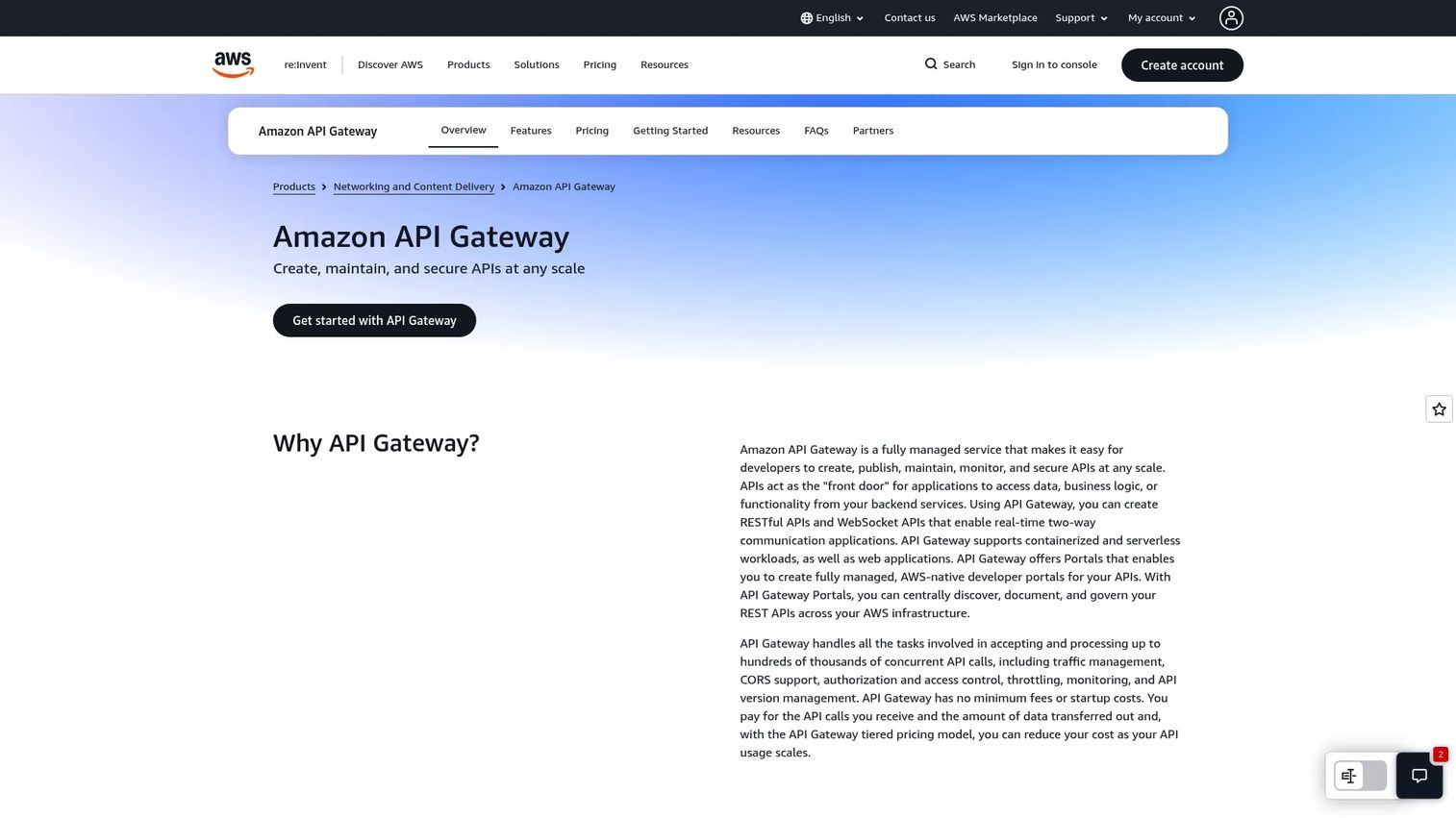
Amazon API Gateway is AWS's fully managed service for creating, publishing, maintaining, monitoring, and securing REST, HTTP, and WebSocket APIs. It integrates natively with AWS Lambda, Step Functions, IAM, Amazon Cognito, and CloudWatch. Custom domain names, usage plans, API keys, throttling, and quotas are built in. For teams already running serverless workloads on AWS, API Gateway is the obvious front door.
Best for: AWS-native teams building serverless or cloud-native APIs with tight integration to Lambda and AWS services.
Key features
- REST, HTTP, and WebSocket API support
- IAM, Lambda authorizers, and Amazon Cognito authentication
- CloudWatch monitoring, logging, and alarms
- Throttling, API keys, usage plans, and quotas
- Native Lambda, Step Functions, and AWS service integrations
Why choose Amazon API Gateway: Best when API management needs stay close to AWS infrastructure. For presales, it addresses deployment, scalability, and serverless integration questions in AWS-heavy accounts without adding a third-party gateway layer. API Gateway Portals (available at $125 per portal per month) add developer-facing API discovery.
Amazon API Gateway pricing: The free tier includes 1 million REST API calls, 1 million HTTP API calls, and 1 million WebSocket messages per month for up to 12 months (new AWS customers). After that, HTTP APIs start at $1.00 per million API calls. REST API pricing varies by volume, region, and data transfer. Charges also apply for caching and related AWS services.
G2 rating: 4.3/5
10. Postman
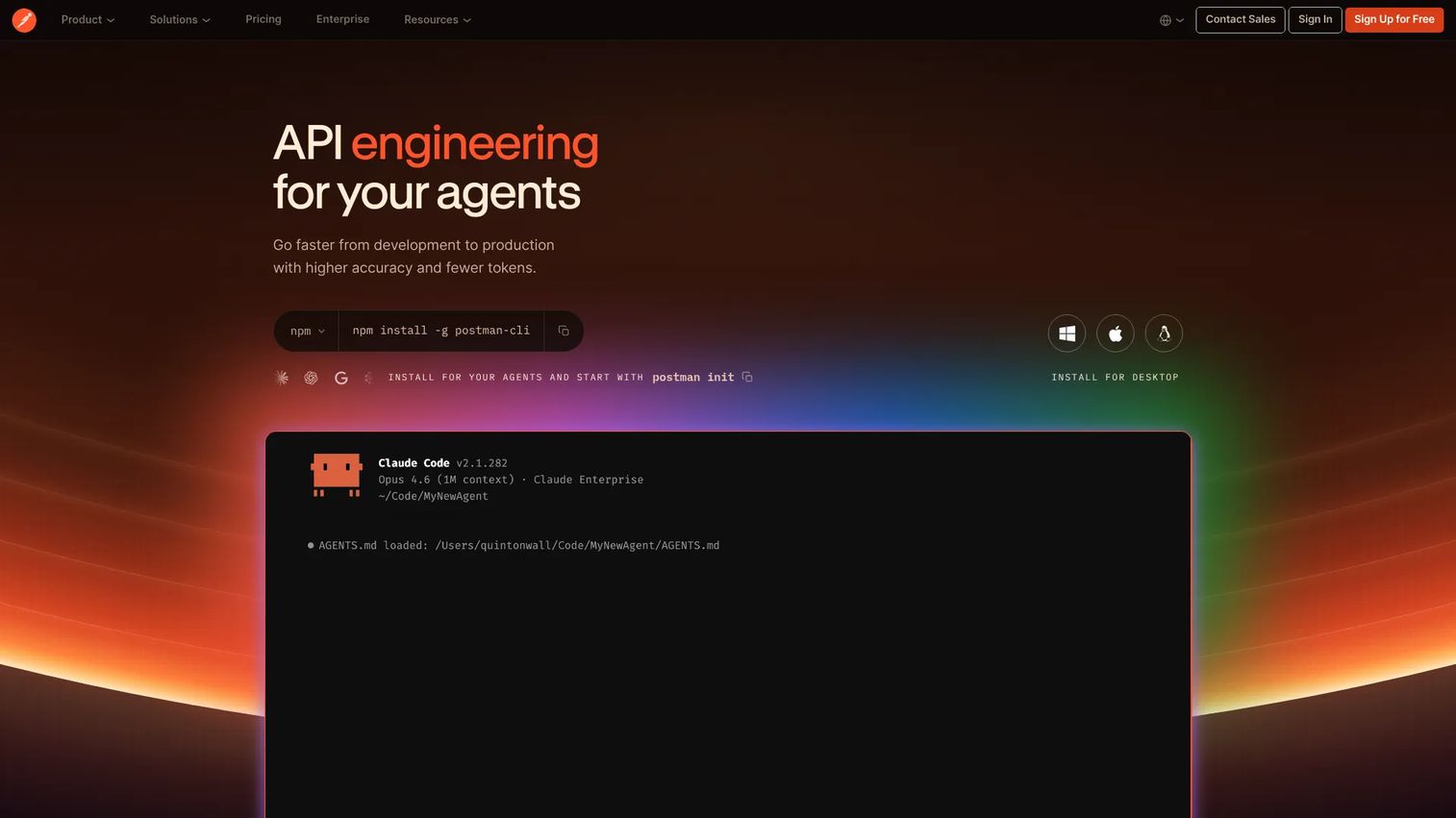
Postman is an AI-native platform for designing, testing, documenting, monitoring, and governing APIs. It is not a classic API gateway; it does not sit in front of runtime traffic in the same way as Kong or Azure API Management. Instead, it gives development and presales teams a shared workspace for API collections, mock servers, automated testing, documentation, and collaboration. For SEs, Postman is a practical tool for validating API contracts, sharing working request examples with buyers, and supporting technical evaluation without spinning up a full environment.
Best for: API development and presales teams focused on API design, testing, documentation, and technical validation.
Key features
- API client with multi-protocol support and environments
- Automated testing with Collection Runner and Postman CLI
- Mock servers for API simulation before backend is ready
- API documentation generation and hosted sharing
- Team workspaces for collaborative API governance
Why choose Postman: Best when the presales challenge is API clarity rather than runtime control. SEs can share working Postman collections with technical buyers to accelerate evaluation, demonstrate API behavior without a full demo environment, and support RFP responses with documented API contracts. For related tooling, see the API monitoring tools guide.
Postman pricing: A free plan is available. The Solo plan is $9 per month (billed annually). The Team plan is $19 per user per month (billed annually). Enterprise pricing requires contacting Postman sales.
G2 rating: 4.6/5
11. SAP Integration Suite
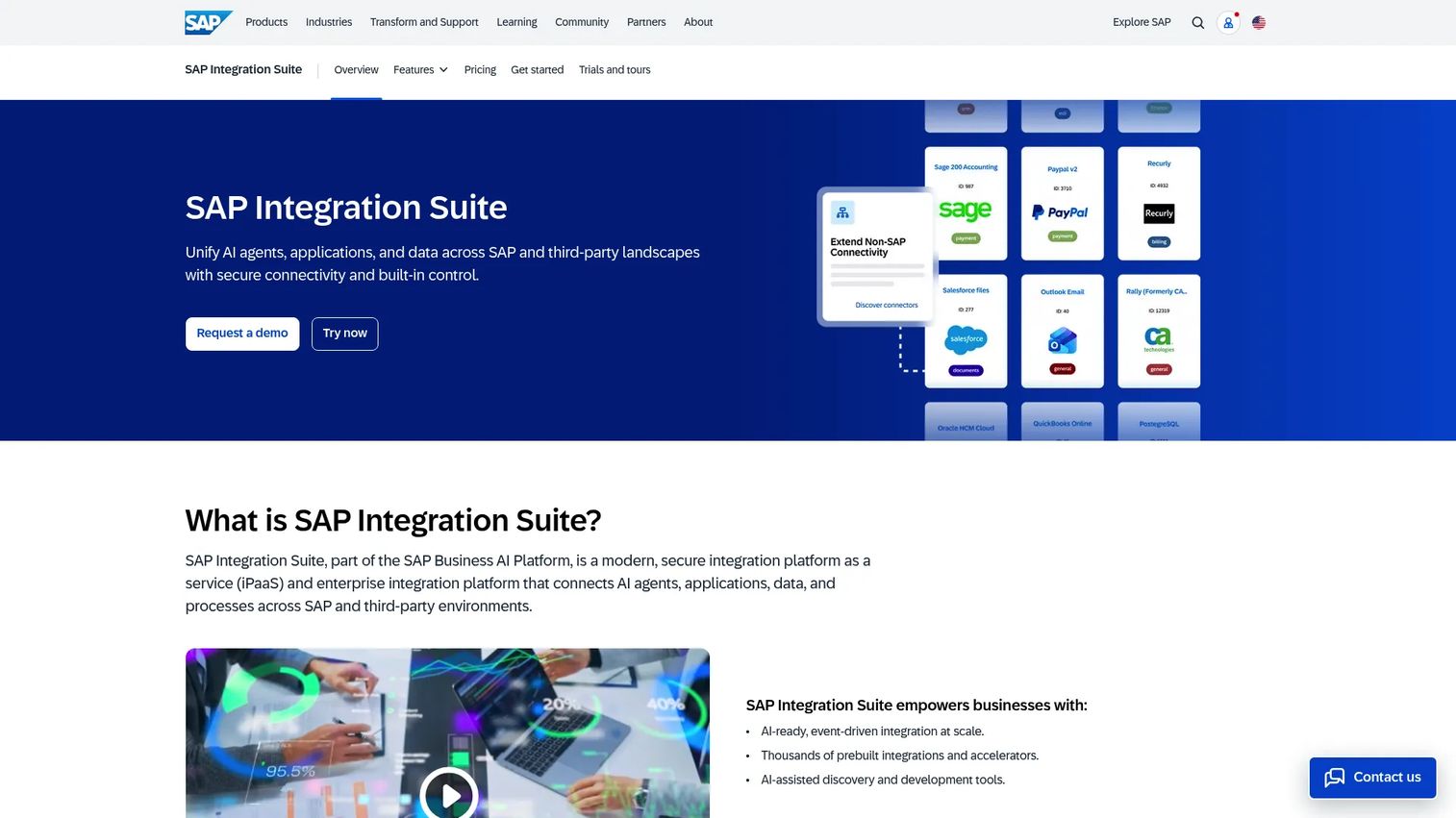
SAP Integration Suite is a cloud-based integration platform as a service that includes API lifecycle management for SAP-centric environments. It connects SAP S/4HANA and non-SAP applications through 160+ third-party connectors, event-driven integration, B2B/EDI connectivity, and API management. For enterprises where the application landscape runs through SAP, managing and exposing APIs from within the SAP integration layer avoids building a parallel governance stack.
Best for: Enterprises running SAP-heavy application landscapes that need API management inside a broader integration strategy.
Key features
- API lifecycle management within SAP integration workflows
- 160+ third-party application connectors
- Event-driven and B2B/EDI integration
- Integration monitoring and observability
- SAP ecosystem fit with S/4HANA connectivity
Why choose SAP Integration Suite: Strong fit when APIs sit inside a larger SAP integration strategy. Presales teams should position it for buyers who need to expose, secure, and govern APIs around SAP systems without introducing a separate API management platform that engineering must maintain alongside the existing SAP stack.
SAP Integration Suite pricing: Three publicly priced editions are available. The starter edition runs $1,728 per month (3 to 36 month contracts), the standard edition $5,339 per month, and the enhanced edition $7,688 per month. Pricing is monthly with contract lengths from 3 to 36 months.
G2 rating: 4.3/5
12. Boomi
Boomi is an enterprise platform for integrating and automating applications, data, APIs, workflows, and AI agents. It includes API management alongside 1,000+ prebuilt connectors, B2B/EDI connectivity, and low-code workflow automation. Teams that need API exposure as part of a broader automation and connectivity program find Boomi covers both without requiring separate platforms. Hybrid deployment across cloud, on-premises, and edge environments is supported.
Best for: Integration and automation teams that need API management inside a broader workflow and connectivity platform.
Key features
- API management with publishing and usage monitoring
- 1,000+ prebuilt connectors for system integration
- Low-code workflow automation and application integration
- B2B/EDI connectivity
- Hybrid deployment across cloud and on-premises environments
Why choose Boomi: Useful when the buyer values integration speed and workflow automation alongside API exposure. Presales teams can position it for organizations that care more about system connectivity and low-code integration than deep standalone gateway customization. It is a practical fit for mid-market buyers who want to consolidate integration and API management.
Boomi pricing: A 30-day free trial is available. The Pay-as-you-Go plan starts at $99 per month plus usage (stated rate of $0.05 per message). Annual plans carry product-specific pricing. Contact Boomi sales for details on connectors, environments, and integration process volume.
G2 rating: 4.4/5
13. TIBCO Cloud API Management
TIBCO Cloud API Management is an API management platform providing API creation, productization, security, analytics, mediation, and developer support capabilities within the broader TIBCO integration stack. It handles API routing to backend services, access control, analytics dashboards, and developer portal support. Teams already running TIBCO for integration, messaging, or data workflows can add API management without introducing a separate vendor into the architecture.
Best for: Enterprises already invested in TIBCO integration and data platforms that need API management within the same stack.
Key features
- API creation and lifecycle management
- API security, authentication, and policy enforcement
- API analytics and monitoring dashboards
- Developer Portal and API productization
- Routing to backend services and TIBCO integration
Why choose TIBCO Cloud API Management: Strong fit when API management is tied to existing TIBCO architecture. Presales teams should highlight it when the buyer already uses TIBCO for integration, messaging, or data workflows and wants to avoid adding a standalone API management vendor.
TIBCO Cloud API Management pricing: Pricing requires contacting TIBCO or Cloud Software Group sales. Cost drivers include API traffic volume, deployment model, support tier, and platform bundle scope.
G2 rating: 4.1/5
14. Axway Amplify
Axway Amplify is an AI-ready enterprise integration platform for governing and connecting APIs, applications, data, file transfers, B2B integrations, and AI across hybrid environments. It supports federated API governance across cloud, on-premises, and hybrid environments, and includes AI governance capabilities covering policy enforcement, prompt protection, model orchestration, and usage monitoring. API marketplace and multi-team governance make it a fit for large organizations managing API sprawl across many business units.
Best for: Large and regulated enterprises managing APIs across decentralized teams, complex hybrid environments, or AI-integrated workflows.
Key features
- Federated API governance across cloud, hybrid, and on-premises
- API marketplace for discovery across business units
- AI governance including policy enforcement and usage monitoring
- Low-code and event-based integration with prebuilt connectors
- Universal API management supporting multiple gateway types
Why choose Axway Amplify: Strong choice when API sprawl is the core problem. Presales teams should connect it to enterprise buyers who need a discoverable API catalog, governance across decentralized teams, and coverage for AI and agent traffic alongside traditional APIs. See also the AI governance tools guide for context on broader AI policy tooling.
Axway Amplify pricing: Plans are request-quote only. The API Management plan requires a minimum of 1 million API transactions per month. Engage and Fusion plans carry different minimum purchase metrics. Contact Axway sales for pricing based on API volume, gateway footprint, and support requirements.
G2 rating: 4.4/5
15. SwaggerHub
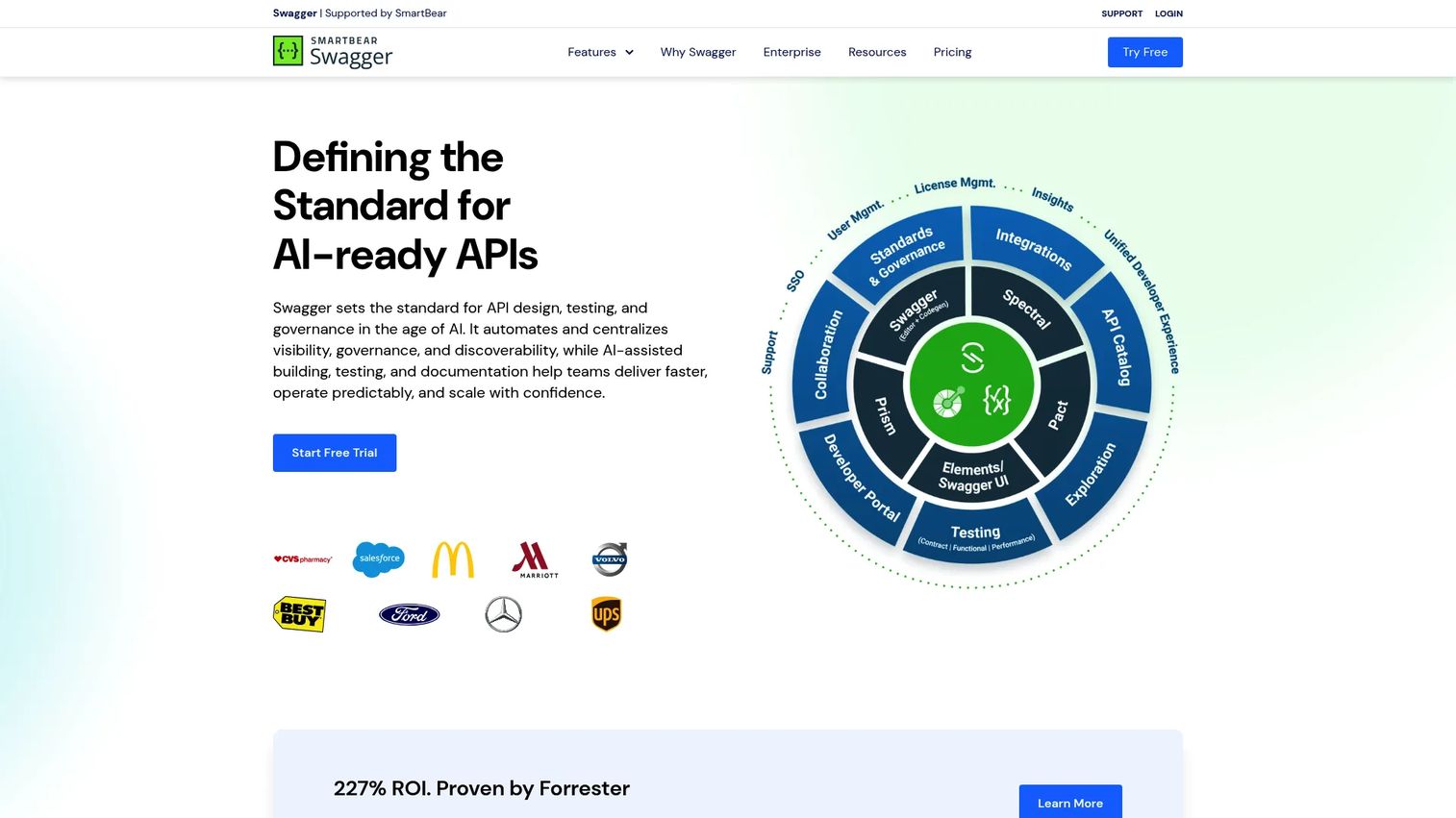
SwaggerHub is an API design and documentation platform built around OpenAPI. It provides collaborative API design and editing, interactive hosted documentation, API governance with style-guide enforcement, API mocking, versioning, and centralized API definition storage. SwaggerHub is not a runtime gateway platform. Its strength is at the design and standardization layer, before APIs are deployed and before a gateway is needed. For teams with inconsistent API contracts or documentation debt, it solves a specific problem the other platforms on this list do not address directly.
Best for: Teams standardizing API design, documentation, and governance before or alongside implementation.
Key features
- OpenAPI collaborative design editor
- Interactive hosted API documentation
- API governance with style-guide enforcement
- API mocking for pre-implementation testing
- Versioning and centralized definition storage
Why choose SwaggerHub: Best when the buyer's main problem is inconsistent API design or documentation debt across teams. Presales teams can use it to support technical validation with clearer API contracts and shareable documentation. For teams earlier in the API lifecycle, see also the API documentation tools guide.
SwaggerHub pricing: The official pricing page directs visitors to start a free trial or contact the vendor. Specific plan names and numeric prices were not publicly displayed at time of writing. Contact SmartBear (SwaggerHub's vendor) sales for current team and enterprise packaging.
G2 rating: 4.5/5
Considerations when choosing API management software
Deployment model
API management tools differ significantly across SaaS, self-hosted, hybrid, Kubernetes-native, and on-premises options. Ask where gateways need to run, who owns gateway operations, and whether the buyer's security policy allows data to leave their cloud. Some platforms (Tyk, WSO2) offer strong self-managed options. Others (Amazon API Gateway) run only inside a specific cloud provider's infrastructure.
Gateway depth and protocol support
Not every platform handles every protocol equally. REST API support is universal. GraphQL, gRPC, WebSocket, AsyncAPI, Kafka, and AI API support varies by platform. Gravitee and IBM API Connect have broad protocol coverage. Amazon API Gateway focuses on REST, HTTP, and WebSocket within AWS. Before claiming a protocol is supported, verify against the vendor's current documentation, especially for emerging formats like MCP and agent-to-agent traffic.
API security and governance
Security review is where most enterprise API management evaluations stall. Evaluate authentication methods (OAuth 2.0, JWT, API keys, mTLS), authorization models, identity provider integration, audit logging, rate limiting, and policy enforcement. For regulated environments, ask about data residency and compliance certifications. IBM API Connect and Azure API Management carry strong enterprise security positioning. See the AI security posture management tools guide for related security governance context.
Developer experience
A developer portal that is hard to use kills partner API adoption. Evaluate self-service onboarding, API documentation quality, SDK generation, testing environments, and subscription management. Apigee, Kong Konnect, and Gravitee have invested heavily in developer portal UX. Weak developer experience is a common reason enterprise API programs stall after launch.
Analytics and operational visibility
API analytics drive post-launch adoption and cost accountability. Look at traffic monitoring, error rates, latency by endpoint, consumer behavior, usage by account, and AI token usage where relevant. Presales teams can use analytics depth as a proof point during POC conversations. Platforms like Apigee and Kong Konnect offer strong analytics natively; others rely on integrations with external observability tools.
Conclusion
The right API management software depends on where your gateway needs to run, which protocols your buyer's API estate uses, and how much governance overhead the platform team can absorb.
For Microsoft-heavy enterprises, Azure API Management answers identity, security, and deployment questions without leaving the Azure control plane. Kong Konnect is the strongest choice for cloud-native, Kubernetes-native, or multi-runtime gateway operations. Apigee fits Google Cloud programs that treat APIs as products with analytics and monetization requirements. MuleSoft Anypoint Platform covers the integration-plus-API-management combination for Salesforce ecosystem buyers.
Gravitee stands out when the buyer's API estate spans event-driven architectures, Kafka, or AI agent traffic. Tyk and WSO2 offer open-source-oriented alternatives with deployment flexibility. Postman and SwaggerHub address the design, testing, and documentation layer rather than runtime control. Amazon API Gateway is the obvious fit for AWS-native serverless teams. SAP Integration Suite makes sense when API management lives inside a broader SAP landscape.
Shortlist three tools based on deployment model, protocol requirements, and governance depth. Then verify pricing and gateway capabilities against each vendor's current documentation before entering a formal evaluation.
For more related tools and presales context, explore the best presales software tools guide and the API testing tools roundup.
Start your journey with Guideflow today!
FAQs
API management software is a platform for designing, publishing, securing, monitoring, and governing APIs across their lifecycle. It differs from a basic API gateway in that it adds lifecycle tooling, developer portals, analytics, and governance controls on top of runtime traffic management. Full API management platforms handle the complete journey from API design through deprecation.
An API gateway handles runtime traffic: Routing requests, enforcing policies, managing authentication, and controlling rate limits. API management software typically includes the gateway plus lifecycle governance, developer portals, documentation, versioning, analytics, and an API catalog. Some platforms (Amazon API Gateway) are primarily gateways with limited lifecycle tooling. Others (Apigee, Kong Konnect, IBM API Connect) cover the full management layer.
The answer depends on existing infrastructure. Azure API Management fits enterprises standardized on Microsoft Azure and Microsoft Entra ID. Apigee fits Google Cloud-based API programs that need productization and analytics. MuleSoft Anypoint Platform fits integration-led enterprises, particularly those with Salesforce dependencies. IBM API Connect fits regulated industries with formal governance and security requirements. For open-source-oriented or deployment-flexible environments, Tyk, Gravitee, and WSO2 API Manager are worth evaluating.
Kong Konnect, Tyk, Gravitee, IBM API Connect, Azure API Management, and WSO2 API Manager all offer hybrid or multi-cloud gateway deployment options. The specific deployment mechanisms differ: Some use a self-hosted gateway agent, others deploy gateway nodes to Kubernetes clusters or customer-managed infrastructure. Verify gateway runtime options, control plane location, and network requirements for each platform before recommending one for a hybrid evaluation.
Pricing is driven by API call volume, number of gateways, deployment environments, user count, support tier, and platform bundle. Cloud-native services like Amazon API Gateway charge per million API calls, starting around $1 per million for HTTP APIs. Mid-market platforms like Boomi start around $99 per month. Full enterprise platforms like MuleSoft start at $2,000 per month. SAP Integration Suite editions are publicly priced from $1,728 to $7,688 per month. Many enterprise platforms (Azure API Management, IBM API Connect, Tyk, Axway Amplify, SwaggerHub) require contacting sales for a quote.
Modern platforms are adding AI gateway capabilities at different speeds. Gravitee explicitly supports Agent Management for LLM, MCP, and agent-to-agent traffic. Kong Konnect includes AI gateway options. Azure API Management lists AI gateway capabilities. MCP (Model Context Protocol) support is emerging and not universal, so buyers should verify current capabilities against vendor documentation rather than assuming coverage. Token usage controls, semantic caching, and AI API governance are features to ask about specifically during evaluation.
Presales teams typically do not own or operate API management platforms. However, SEs and solutions consultants need to understand the category when supporting technical validation, security review, integration fit assessments, and POC environments for API-heavy products. The platform is usually owned by platform engineering, architecture, or integration teams. Presales involvement peaks during security questionnaire responses, technical deep-dives, and proof-of-concept scoping conversations. For tooling that helps presales teams run better evaluations, see the best sandbox tools guide.
Verify deployment model first (SaaS, self-hosted, Kubernetes, hybrid), then protocol support for the buyer's specific API types (REST, GraphQL, gRPC, event-based, AI APIs). Confirm security controls including authentication methods, identity provider integration, and audit logging. Evaluate developer portal quality and self-service onboarding. Check analytics depth for post-launch visibility. Review pricing drivers including API call volume, gateway count, and enterprise support requirements. Finally, confirm fit with the buyer's existing cloud stack.