

Your login box is doing two jobs at once. It is your front door to every customer, and it is one of the most attacked surfaces you own. Get it wrong in one direction and customers bounce before they ever sign up. Get it wrong in the other and you hand an attacker the keys.
The numbers back this up. The 2025 Verizon Data Breach Investigations Report found that 22% of breaches started with credential abuse, and 88% of basic web application attacks involved stolen credentials. On the conversion side, Okta and Auth0 research found that 66% of consumers will abandon a website if registration feels too complex, and 83% abandon a cart because of a painful login process.
That is the squeeze CIAM software is built to relieve. Customer identity and access management (CIAM) software sits between your customers and your product, handling registration, authentication, authorization, and consent at scale. It is the layer that decides whether a stranger becomes a logged-in customer in three seconds or three minutes.
Most "CIAM" articles stop at a definition. This one does not. If you are a presales engineer, security reviewer, or product leader building a shortlist, you need named platforms, real pricing, and verified ratings, not another explainer. Below you will find 12 CIAM platforms compared head to head, with the trade-offs that actually matter during a technical evaluation. For presales teams in particular, walking buyers through these flows often means leaning on the best presales software tools to streamline evaluation.
What's inside
This guide is for technical evaluators: presales and sales engineers, security and IT reviewers, identity architects, and product leaders building a CIAM shortlist. We scored each platform on four criteria that decide real fit.
- Authentication breadth: MFA, SSO, passwordless, passkeys, social login, and adaptive or risk-based auth.
- Security and compliance coverage: support for GDPR, CCPA, HIPAA, consent management, and data residency.
- Developer experience and integration depth: SDKs, OAuth 2.0, OIDC, SAML, API quality, and documentation.
- Scalability and pricing: how the platform and its cost behave from SMB to enterprise.
Where available, we include verified pricing and G2 ratings so you can compare commercials, not just feature lists.
TL;DR
Short on time? Here are the quick decision shortcuts from the 12 CIAM solutions below.
- Best for developer-first teams: Auth0, for its extensibility and protocol depth.
- Best for enterprise scale: Okta Customer Identity Cloud, for proven governance and compliance.
- Best for Microsoft-stack organizations: Microsoft Entra External ID, for native ecosystem fit.
- Best open and self-hosted option: FusionAuth, for control and transparent pricing.
- Best for B2B SaaS multi-tenancy: Frontegg, for tenant-aware identity out of the box.
- Best for passwordless and fraud-first teams: Transmit Security, for identity security at the core.
What is CIAM software?
Customer identity and access management (CIAM) software manages registration, authentication, authorization, and profile data for external users (customers, partners, and consumers) at scale. It is the system that lets millions of people create accounts, log in safely, manage their own profiles, and control how their data is used, without your engineering team rebuilding identity from scratch.
CIAM differs from a side feature bolted onto your app. It is purpose-built for consumer identity management: high volume, frictionless experiences, and privacy compliance baked in. The best ciam solutions treat the login flow as both a security control and a conversion surface.
Core capabilities you should expect from a ciam platform:
- Registration and self-service account management: sign-up, password resets, and profile updates without support tickets.
- Authentication: MFA, SSO, passwordless, passkeys, social login, and adaptive or risk-based auth.
- Authorization and access control: roles, permissions, and fine-grained entitlements.
- Consent, privacy, and preference management: capturing and honoring user consent across regions.
- Profile and identity data management: unified customer profiles and progressive profiling.
- APIs, SDKs, and integration: clean developer tooling and connections to your CRM and analytics stack.
- Scalability and threat detection: millions of monthly active users plus bot, fraud, and breach protection.
CIAM vs traditional IAM
Customer IAM and workforce IAM solve related problems for very different populations. IAM secures employees behind the firewall. CIAM secures external customers at a far larger scale, where user experience and consent matter as much as control.
| Dimension | CIAM (customer identity) | Workforce IAM |
|---|---|---|
| Users | Customers, partners, consumers | Employees, contractors |
| Scale | Thousands to hundreds of millions | Hundreds to tens of thousands |
| UX priority | Frictionless, conversion-driven | Policy-driven, controlled |
| Consent and privacy | Central (GDPR, CCPA) | Secondary |
| Registration model | Self-service sign-up | IT-provisioned accounts |
When to use CIAM software
CIAM earns its place when external identity becomes a bottleneck for growth, compliance, or security. Three situations make the case clearly.
Secure customer logins without sacrificing conversion
Every extra field and forced password reset costs you signups. CIAM lets you add passwordless, passkeys, and social login to cut friction while raising the security floor. You reduce login abandonment and protect accounts at the same time. Adaptive authentication steps up challenges only when risk signals warrant it. Reducing signup friction is also a core goal of strong onboarding flow software, which complements CIAM at the registration stage.
Meet privacy and compliance requirements at scale
GDPR, CCPA, and HIPAA each impose rules on consent, data handling, and residency. Building that yourself is slow and easy to get wrong. CIAM platforms ship consent management, preference centers, and regional data hosting as standard. That turns a compliance project into a configuration exercise. If compliance posture is a priority in your own product, see how Guideflow approaches security and compliance.
Replace fragile, home-built identity systems
Custom identity code is expensive to maintain and risky to secure. It rarely keeps pace with new attack patterns or new regulations. Buying a CIAM solution shifts that burden to a vendor whose entire job is identity. This is also where presales and sales engineering teams lean on interactive demos to walk buyers through complex login, MFA, and consent flows during evaluation, without spinning up a live environment.
Best CIAM software platforms for 2026 compared
Here is the shortlist at a glance. The table below covers buyer intent, the standout use case, entry pricing, and G2 rating for each ciam platform. Pricing and ratings were verified against vendor pricing pages and live G2 listings, and they shift over time, so confirm current figures before you sign anything.
| # | Product | Intent | Key use case | Pricing | G2 rating |
|---|---|---|---|---|---|
| 1 | Auth0 | Developer-led CIAM | Extensible auth for customer apps | Free, then $35/mo | 4.3/5 |
| 2 | Okta Customer Identity Cloud | Enterprise CIAM | Proven scale and governance | From $3,000/mo (Enterprise base) | Not listed |
| 3 | Microsoft Entra External ID | Microsoft-stack CIAM | External identity in the Microsoft ecosystem | Free first 50,000 MAU | 4.2/5 |
| 4 | Ping Identity | Enterprise orchestration | Complex identity journeys | From $35k/yr (Customers Essential) | 4.4/5 |
| 5 | ForgeRock | Large-scale enterprise identity | Sophisticated consumer identity | From $35k/yr (Customers Essential) | 4.4/5 |
| 6 | FusionAuth | Developer control | Self-hosted, predictable pricing | Free (self-hosted), then $162/mo | 4.5/5 |
| 7 | Frontegg | B2B SaaS CIAM | Multi-tenant identity | $0/mo, then custom | 4.8/5 |
| 8 | Amazon Cognito | AWS-native auth | Auth for apps on AWS | Free tier, then usage-based | 4.1/5 |
| 9 | Transmit Security | Fraud-first identity | Passwordless and fraud prevention | From $100k/yr (Identity) | 4.8/5 |
| 10 | LoginRadius | Consumer identity at scale | Privacy and consent for B2C | Free, then contact sales | 4.6/5 |
| 11 | Stytch | Developer-first auth | Modern passwordless flows | $0/mo, then custom | 4.8/5 |
| 12 | WorkOS | Enterprise readiness for SaaS | Fast SSO and SCIM | $0/mo, usage-based | 4.5/5 |
The 12 best CIAM software platforms for 2026
1. Auth0
Auth0, now part of Okta, is a flexible, drop-in solution for adding authentication and authorization to applications and APIs. It is the platform most developers reach for first when they need to ship secure login without owning the underlying identity infrastructure. Its extensibility model, broad protocol support, and deep SDK library make it a default choice for product teams.
Best for: Developer-led teams that need secure authentication, SSO, MFA, and customer identity in their apps without building auth in-house.
Key strengths
- Extensibility: Actions and Forms let you customize login, signup, and post-authentication logic with code.
- Protocol and SDK breadth: Universal Login, SSO, and support for OAuth 2.0, OIDC, and SAML across many languages.
- Layered security: Adaptive MFA, passwordless authentication, and breached password protection guard accounts.
Why choose Auth0: If your evaluation is led by engineers, Auth0 tends to win on developer experience and documentation. It scales from a side project to a production customer base, and the extensibility means you rarely hit a wall on custom requirements. It pairs the convenience of a managed service with enough flexibility to handle edge cases.
Auth0 pricing: Auth0 offers a Free tier that includes up to 25,000 monthly active users. The Essentials plan starts at $35 per month for higher production demands with up to 500 monthly active users. Professional is $240 per month for teams needing added security, also up to 500 monthly active users. Enterprise pricing is custom and adds a 99.99% SLA, enterprise rate limits, and enterprise administration and support. Auth0 holds a 4.3 out of 5 rating on G2.
2. Okta Customer Identity Cloud
Okta Customer Identity Cloud, powered by Auth0, is a CIAM solution for secure, low-code customer login, authentication, authorization, and identity experiences. It takes the Auth0 engine and wraps it in Okta's enterprise governance, compliance posture, and support model. For organizations that already trust Okta for workforce identity, extending into customer identity is a natural step.
Best for: Organizations that need enterprise-grade CIAM for customer, partner, student, patient, or citizen-facing applications.
Key strengths
- Enterprise scale: Proven to grow user bases without compromising security.
- Layered authentication: Single sign-on, adaptive MFA, passwordless login, and threat protection.
- Governance and integrations: Social login plus governance controls and prebuilt connections.
Why choose Okta Customer Identity Cloud: When your buying committee includes security and procurement, the Okta name carries weight. You get the same developer-friendly core as Auth0 with the assurances enterprises expect during a security review. It is a strong fit when compliance diligence and proven scale outrank raw price.
Okta Customer Identity Cloud pricing: All Customer Identity solutions start with an Enterprise base platform priced at $3,000 per month, billed annually. The B2C Suite and B2B Suite are listed as inquire-for-pricing, with add-ons priced based on usage such as total monthly active users per year. Okta also offers an Okta Integrator Free Plan for non-production use up to 10 active users. A G2 rating for this specific product was not available at the time of writing.
3. Microsoft Entra External ID
Microsoft Entra External ID provides secure external identity and access management for customers, partners, guests, contractors, and other non-employee users. It is the successor to Azure AD B2C, and Microsoft publishes a migration path between the two. For teams already in Microsoft 365 or Azure, it slots into an ecosystem they know.
Best for: Organizations and developers that need Microsoft-integrated CIAM and secure B2B guest or partner access.
Key strengths
- Microsoft ecosystem fit: Native integration with Microsoft 365, Visual Studio Code, and Azure App Service.
- External-facing authentication: Registration and login for customer apps via OIDC or SAML.
- B2B collaboration: Secure partner and guest access alongside conditional access and MFA.
Why choose Microsoft Entra External ID: If your stack already runs on Microsoft, External ID reduces the number of new vendors in your security review. Conditional access and MFA come from the same platform your IT team manages for the workforce. That consolidation can shorten procurement and simplify governance.
Microsoft Entra External ID pricing: Microsoft says External ID starts free and scales with usage. The Basic tier includes the first 50,000 monthly active users at no cost. SMS phone authentication, Go-Local, ID Governance for External Identities, and Global Secure Access are described as add-ons or related paid capabilities. Prices are calculated in US dollars. Microsoft Entra External ID holds a 4.2 out of 5 rating on G2.
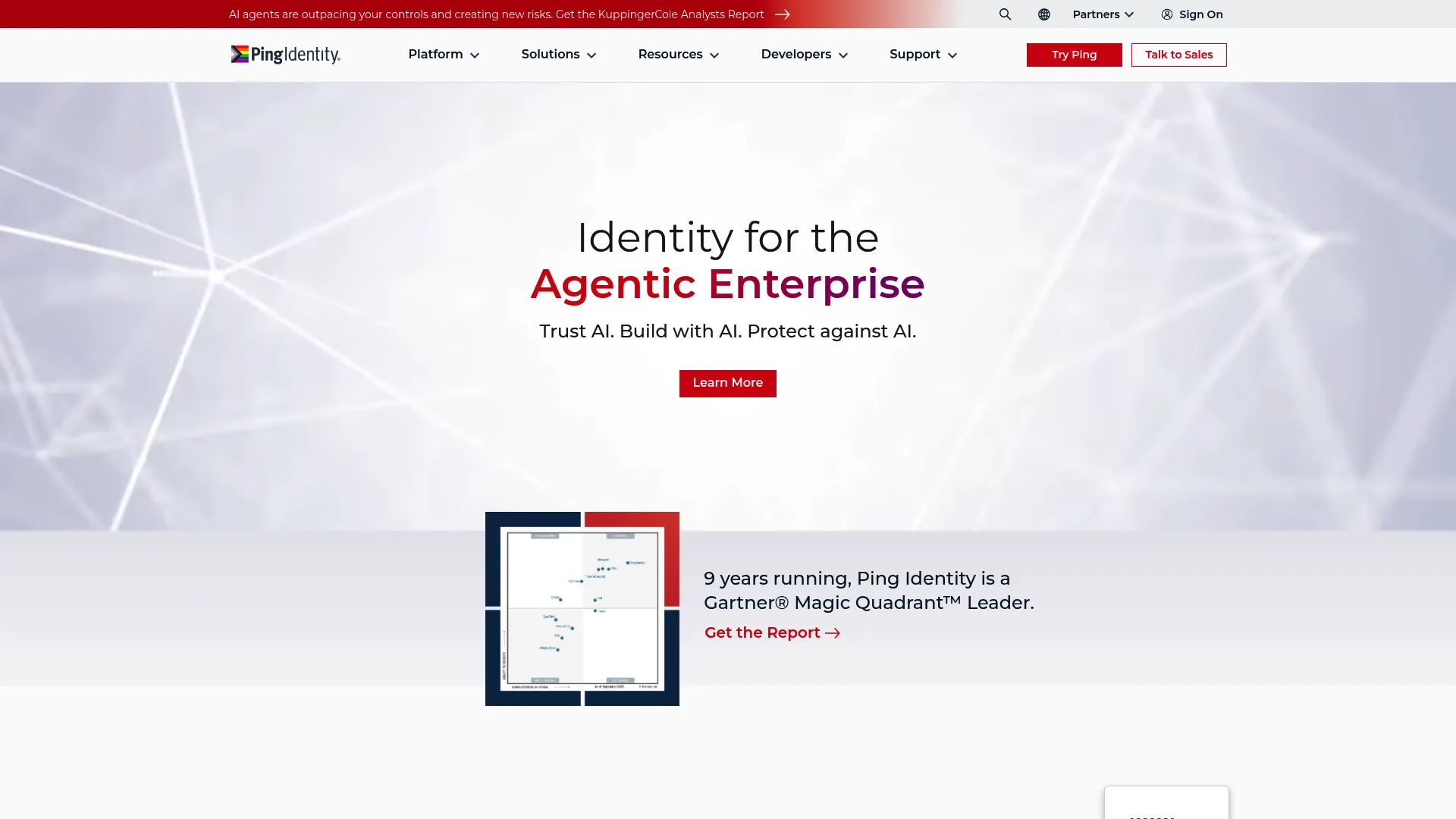
4. Ping Identity
Ping Identity provides an enterprise identity platform for secure, scalable identity and access management across customers, employees, partners, and digital experiences. PingOne for Customers is its CIAM offering, and its DaVinci no-code orchestration engine sets it apart for teams with complex identity journeys. It handles B2B and B2C flows with equal seriousness. You can explore an example of how identity platforms present their flows in this Ping Identity interactive demo.
Best for: Large organizations needing enterprise-grade customer or workforce identity with SSO, MFA, orchestration, and hybrid IT integration.
Key strengths
- Identity orchestration: PingOne DaVinci builds and adjusts identity journeys with no code.
- Adaptive security: Adaptive multi-factor authentication and risk signals tune challenges to context.
- Authentication depth: Single sign-on plus passwordless flows across customer and workforce users.
Why choose Ping Identity: When your requirements are genuinely complex, orchestration is the differentiator. DaVinci lets you wire together authentication, verification, and fraud checks without hardcoding every branch. That flexibility suits enterprises with many user types, regions, and edge cases.
Ping Identity pricing: PingOne for Customers starts at $35,000 annually for the Essential package and $50,000 annually for Plus. PingOne for Customers Passwordless requires contacting sales. PingOne for Workforce starts at $3 per user per month for Essential and $6 per user per month for Plus, based on an annual contract with a 5,000-user minimum. Ping offers a 30-day free trial but no permanent free tier. Ping Identity holds a 4.4 out of 5 rating on G2.
5. ForgeRock
ForgeRock, now part of Ping Identity, provides enterprise identity and access management for customers, workforce users, partners, and connected devices. Following the 2023 merger under Thoma Bravo, ForgeRock's full-suite identity capabilities sit within the combined Ping portfolio. It targets the most demanding large-scale consumer identity deployments.
Best for: Large enterprises needing scalable customer or workforce identity, access management, MFA, orchestration, and governance across cloud, hybrid, or on-prem environments.
Key strengths
- No-code orchestration: A visual engine for building authentication and identity policies.
- Authentication and SSO: Single sign-on with adaptive multi-factor authentication.
- Deployment flexibility: Coverage across cloud, hybrid, and on-prem environments.
Why choose ForgeRock: ForgeRock fits organizations with sophisticated requirements and a need for deployment choice. If you need self-managed or hybrid hosting alongside large-scale consumer identity, it covers ground that pure SaaS tools do not. The Ping backing brings continuity and a broad platform around it.
ForgeRock pricing: ForgeRock is sold within Ping Identity's pricing structure rather than a standalone page. PingOne for Customers Essential starts at $35,000 annually and Customers Plus starts at $50,000 annually. Workforce Essential is $3 per user per month and Workforce Plus is $6 per user per month, on annual contracts with a 5,000-user minimum. A 30-day free trial is available, with no permanent free tier. The PingOne Advanced Identity Cloud listing, which describes the ForgeRock solution, holds a 4.4 out of 5 rating on G2.
6. FusionAuth
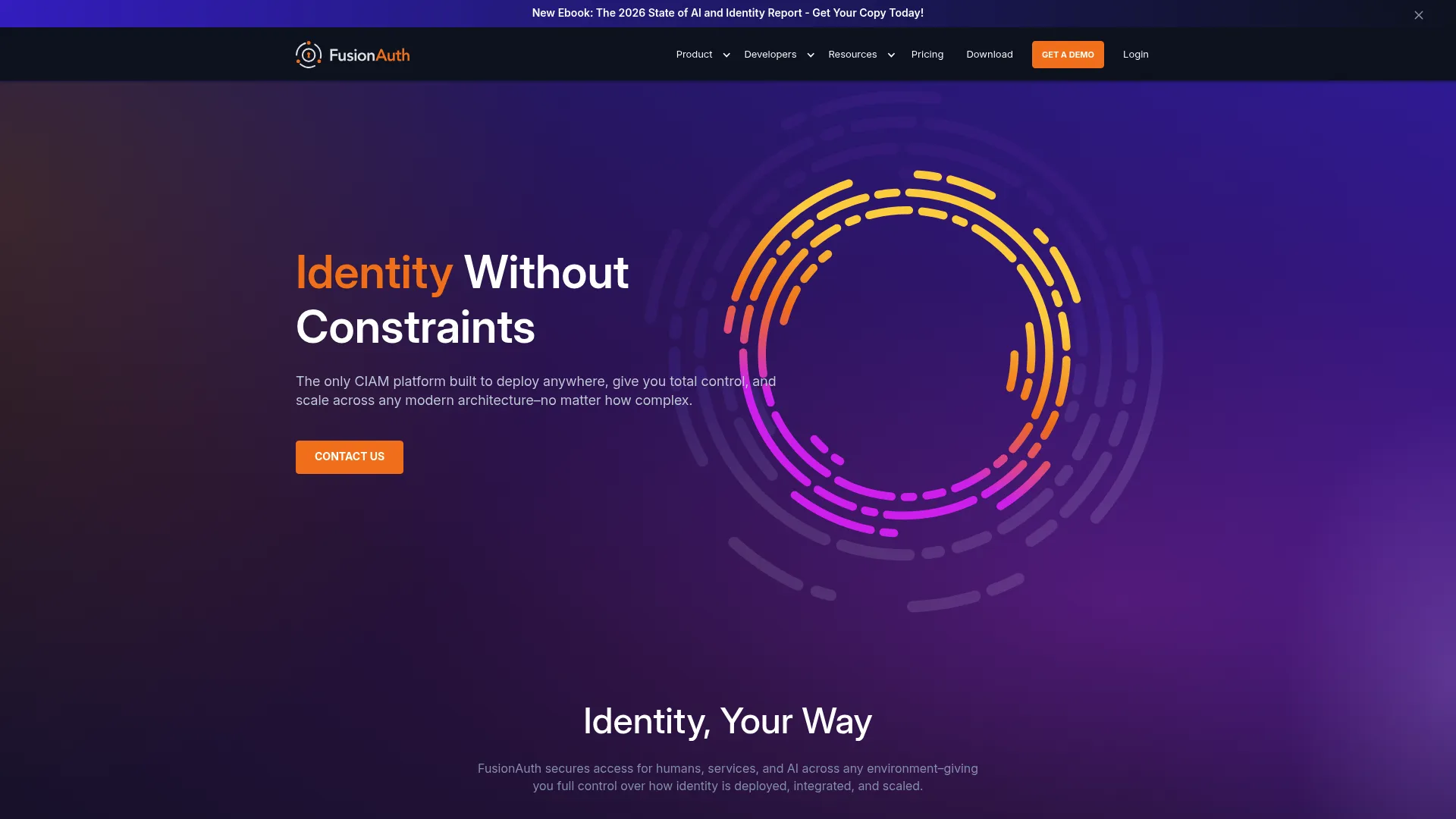
FusionAuth is a CIAM platform for authentication, authorization, user management, and identity deployment across self-hosted, cloud, on-prem, hybrid, or air-gapped environments. It is built for developers who want control over where identity runs and transparency in what it costs. The free, self-hosted community edition is a genuine starting point, not a teaser.
Best for: Developer-led teams that need controllable CIAM with flexible deployment options and transparent public pricing.
Key strengths
- Deployment freedom: Run it self-hosted, in cloud, on-prem, hybrid, or air-gapped.
- Authentication breadth: MFA, passkeys, WebAuthn, magic links, and passwordless login.
- Access control: User management, role-based access control, machine-to-machine auth, and API access.
Why choose FusionAuth: Teams that want to avoid per-MAU pricing surprises and keep identity in their own environment gravitate here. The free community tier lets you build and test without a sales conversation. Strong documentation and standard protocol support make it approachable for engineering-led evaluations.
FusionAuth pricing: The Community plan is free and unlimited for self-hosting with core authentication features. Starter begins at $162 per month, billed annually, and adds premium features like advanced MFA and theming. Essentials and Enterprise are both listed at $2,970 per month, billed annually, with Enterprise adding advanced security, 24/7 support, a private Slack channel, solution architect guidance, and high-availability hosting. FusionAuth holds a 4.5 out of 5 rating on G2.
7. Frontegg
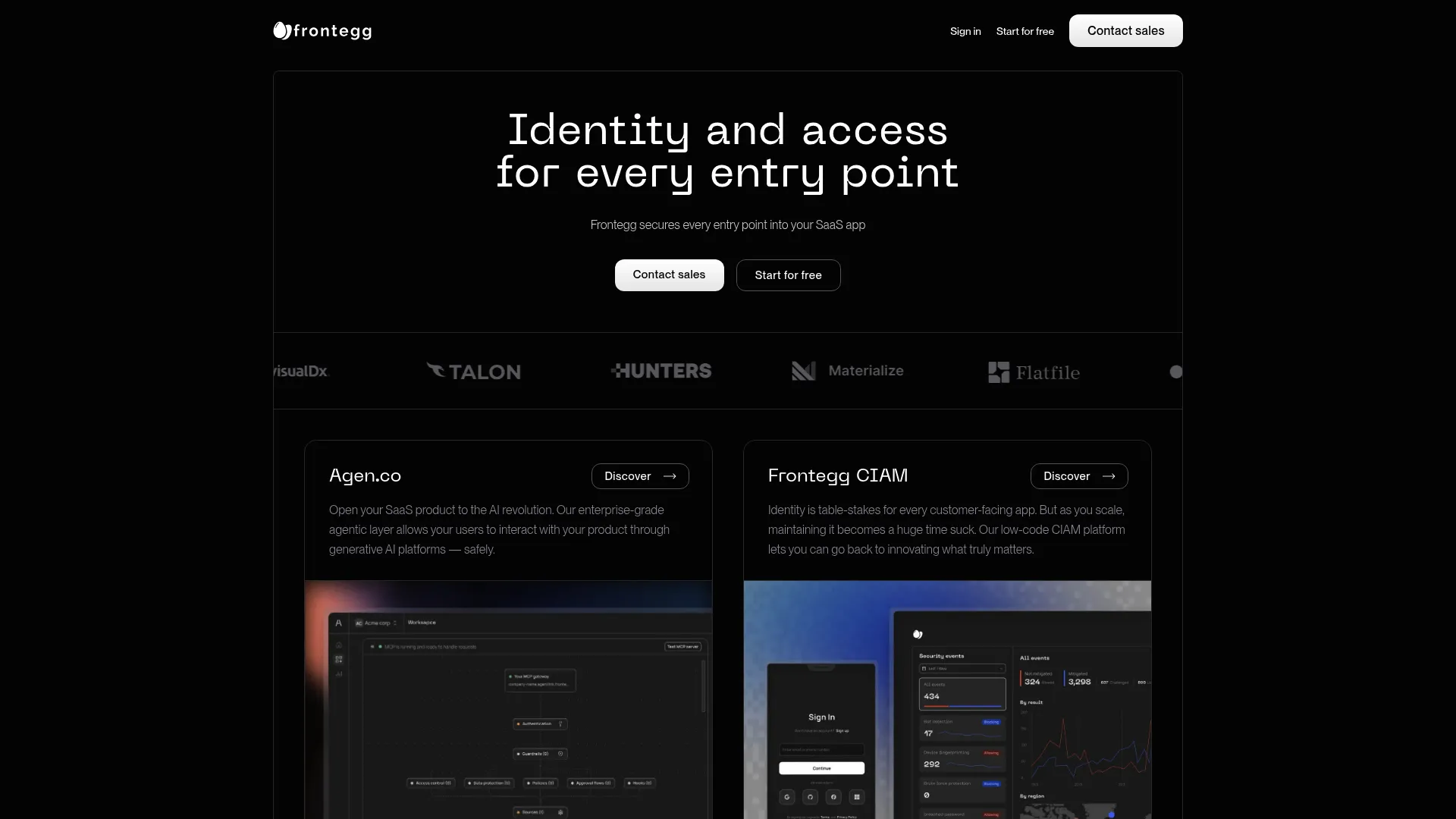
Frontegg is a customer identity and access management platform for SaaS products, covering authentication, user management, authorization, entitlements, and enterprise readiness. It is built specifically for B2B SaaS, where multi-tenancy and self-service admin matter as much as login itself. The embeddable admin portal lets your customers manage their own users and policies.
Best for: B2B SaaS teams that need to add production-ready CIAM, multi-tenancy, SSO, SCIM, roles, permissions, and self-service admin features without building them in-house.
Key strengths
- B2B identity, hosted: Customizable login with passwordless, social, enterprise SSO, MFA, passkeys, and session management.
- Entitlements and authorization: Roles, custom roles, permissions, ReBAC, feature flags, and subscription management.
- Identity protection: Bot detection, brute-force protection, suspicious IP detection, and audit log streaming.
Why choose Frontegg: If you sell to businesses, tenant-aware identity is non-negotiable, and Frontegg ships it by default. The self-service admin portal removes a common support burden as you move upmarket. It is the kind of platform that lets a B2B SaaS clear enterprise security reviews faster.
Frontegg pricing: The Pay as you go plan starts at $0 per month and includes 7,500 monthly active users, 5 enterprise connections, unlimited organizations, and a custom domain. The Enterprise plan is custom-priced and adds add-ons, multiple environments, advanced fraud protection, a 99.99% uptime SLA, and premium support. Frontegg holds a 4.8 out of 5 rating on G2.
8. Amazon Cognito
Amazon Cognito lets developers add user sign-up, sign-in, access control, and brokered AWS service access to web and mobile applications. For teams already building on AWS, it removes the friction of adding a separate identity vendor. User pools handle authentication, and identity pools broker access to AWS resources.
Best for: Development teams building scalable customer authentication and access control for web or mobile apps on AWS.
Key strengths
- AWS-native: Tight integration with the AWS services your app already uses.
- Federation: Social identity providers plus SAML and OIDC enterprise identity providers.
- Custom workflows: AWS Lambda triggers for custom authentication and user flows.
Why choose Amazon Cognito: If your infrastructure lives on AWS, Cognito keeps identity inside the same billing, IAM, and operational model. Pay-as-you-go pricing means you only pay for the users you have. Lambda triggers give engineering teams room to customize without leaving the AWS toolchain.
Amazon Cognito pricing: Cognito offers Lite, Essentials, and Plus tiers for user pools, plus add-ons for machine-to-machine authorization and higher API quotas. Lite and Essentials include a free tier; Plus does not. Past the free allowance, Lite is around $0.0055 per monthly active user, Essentials is around $0.015 per MAU, and Plus is around $0.020 per MAU. Pricing varies by tier, MAU volume, federation type, and AWS region. Amazon Cognito holds a 4.1 out of 5 rating on G2.
9. Transmit Security
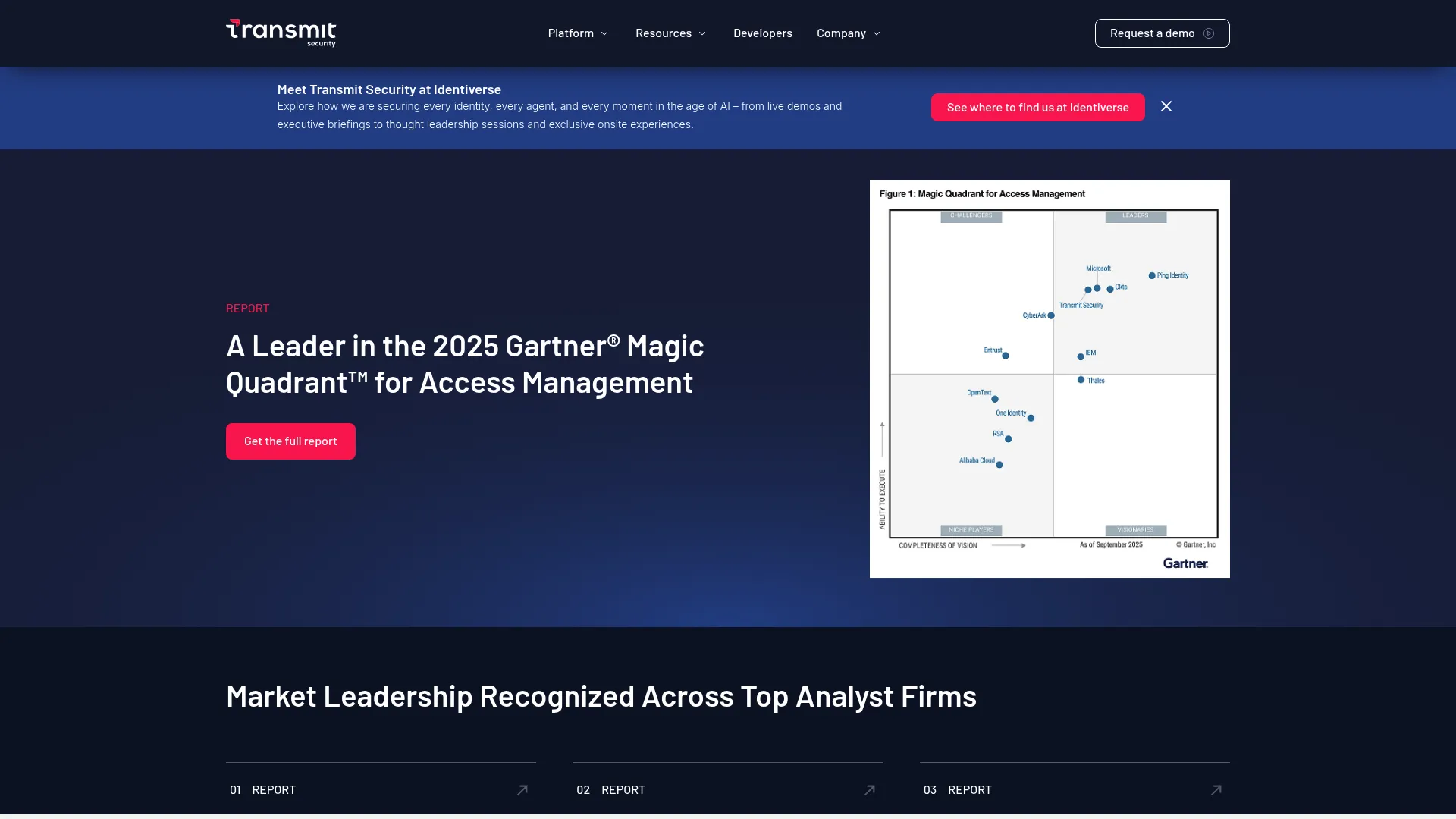
Transmit Security provides Mosaic, an enterprise identity security platform that combines customer identity management, fraud prevention, identity verification, orchestration, authentication, and user management. It approaches CIAM from a security-first angle, treating fraud and identity as one problem. For teams where account takeover and fraud are top risks, that integration is the point.
Best for: Enterprises needing an integrated identity security platform for CIAM, fraud prevention, identity verification, and authentication orchestration.
Key strengths
- Fraud detection and response: Built-in detection and response alongside identity management.
- Identity verification: Verify users at onboarding and high-risk moments.
- Orchestration: A policy engine to coordinate authentication, verification, and risk decisions.
Why choose Transmit Security: When fraud is a board-level concern, a platform that unifies CIAM and fraud prevention reduces gaps between systems. Passwordless authentication lowers the credential attack surface from day one. It suits regulated and high-value industries where a single identity security layer is worth the investment.
Transmit Security pricing: Transmit lists indicative starting pricing that depends on use case, volume, and deployment architecture, with final pricing provided within 24 hours. The full Mosaic platform starts at $200,000 per year for 100K monthly active users. Mosaic for Identity starts at $100,000 per year for 100K MAUs, and Mosaic for Identity Verification starts at $50,000 per year for 100K ID checks. Transmit Security holds a 4.8 out of 5 rating on G2.
10. LoginRadius
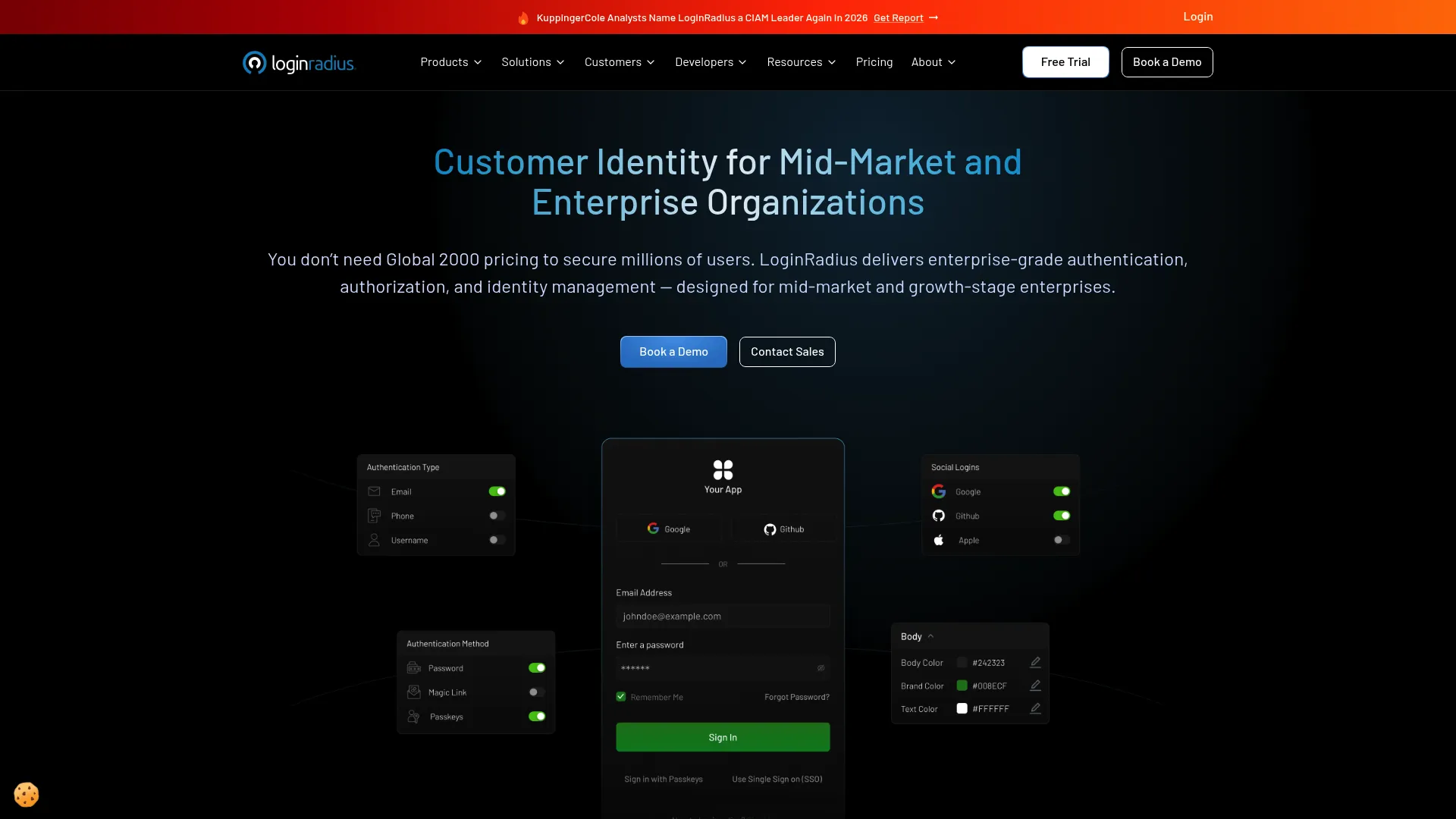
LoginRadius is a customer identity and access management platform for authentication, authorization, and identity management for mid-market and enterprise organizations. It leans into consumer identity at scale, with strong consent and data residency tooling. For B2C brands juggling multiple privacy regimes, those features carry weight.
Best for: Mid-market and enterprise teams that need customer identity, authentication, SSO, MFA, and identity-management infrastructure.
Key strengths
- Authentication options: Standard login, passwordless login, passkeys, and social login.
- Federated SSO: Support for SAML, JWT, OIDC, and OAuth.
- Privacy at scale: User management, role-based access control, adaptive MFA, consent management, and regional data storage.
Why choose LoginRadius: For consumer brands with users across multiple regions, data residency and consent management are not optional, and LoginRadius treats them as core. Progressive profiling lets you collect customer data gradually rather than at a friction-heavy signup. It is a fit when privacy compliance and B2C scale are the headline requirements.
LoginRadius pricing: LoginRadius lists Free, Professional, and Enterprise plans. The Free plan includes 25,000 monthly active users, standard login, passwordless login, passkeys, unlimited social login, and hosted login pages. Professional and Enterprise use a consumption-based model that scales with monthly active users, with pricing available via free trial or contact sales. LoginRadius holds a 4.6 out of 5 rating on G2.
11. Stytch
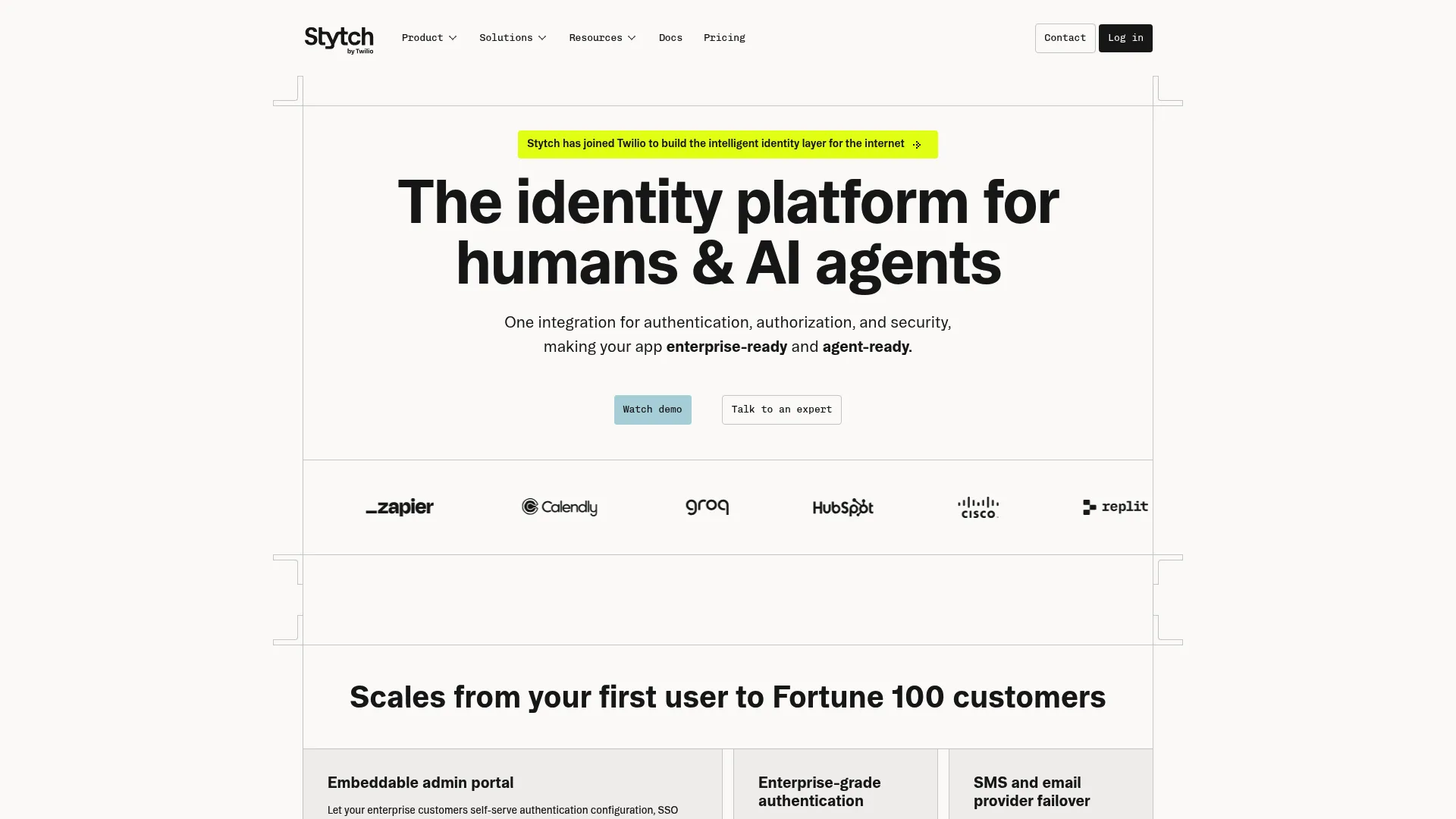
Stytch is an identity platform for authentication, authorization, and security for humans and AI agents. It is built developer-first, with passwordless and embeddable auth at the center and fraud protection layered in. Built-in multi-tenancy makes it a contender for B2B SaaS as well as consumer apps.
Best for: B2B SaaS teams that need developer-friendly authentication, SSO, SCIM, RBAC, multi-tenancy, and fraud protection.
Key strengths
- Modern authentication: Passkeys, breach-resistant passwords, and SAML SSO.
- Built-in multi-tenancy: Organization auth policies, SCIM, RBAC, and JIT provisioning.
- Fraud and risk protection: Bot detection, device fingerprinting, invisible CAPTCHA, and rate limiting.
Why choose Stytch: Product teams building modern passwordless flows tend to appreciate Stytch's API and SDK quality. Device fingerprinting and fraud tooling come built in, not as a separate purchase. The multi-tenancy support means it scales from a consumer app into B2B without a re-platform.
Stytch pricing: The Pay as you go plan starts at $0 per month and includes 10,000 monthly active users and AI agents, unlimited organizations, 5 SSO or SCIM connections, and 1,000 M2M tokens. The Enterprise plan is custom and adds discounted rates, an enterprise support SLA, private Slack support, migration support, a 99.99% uptime SLA, HIPAA and BAA coverage, and advanced fraud protection. Stytch holds a 4.8 out of 5 rating on G2.
12. WorkOS
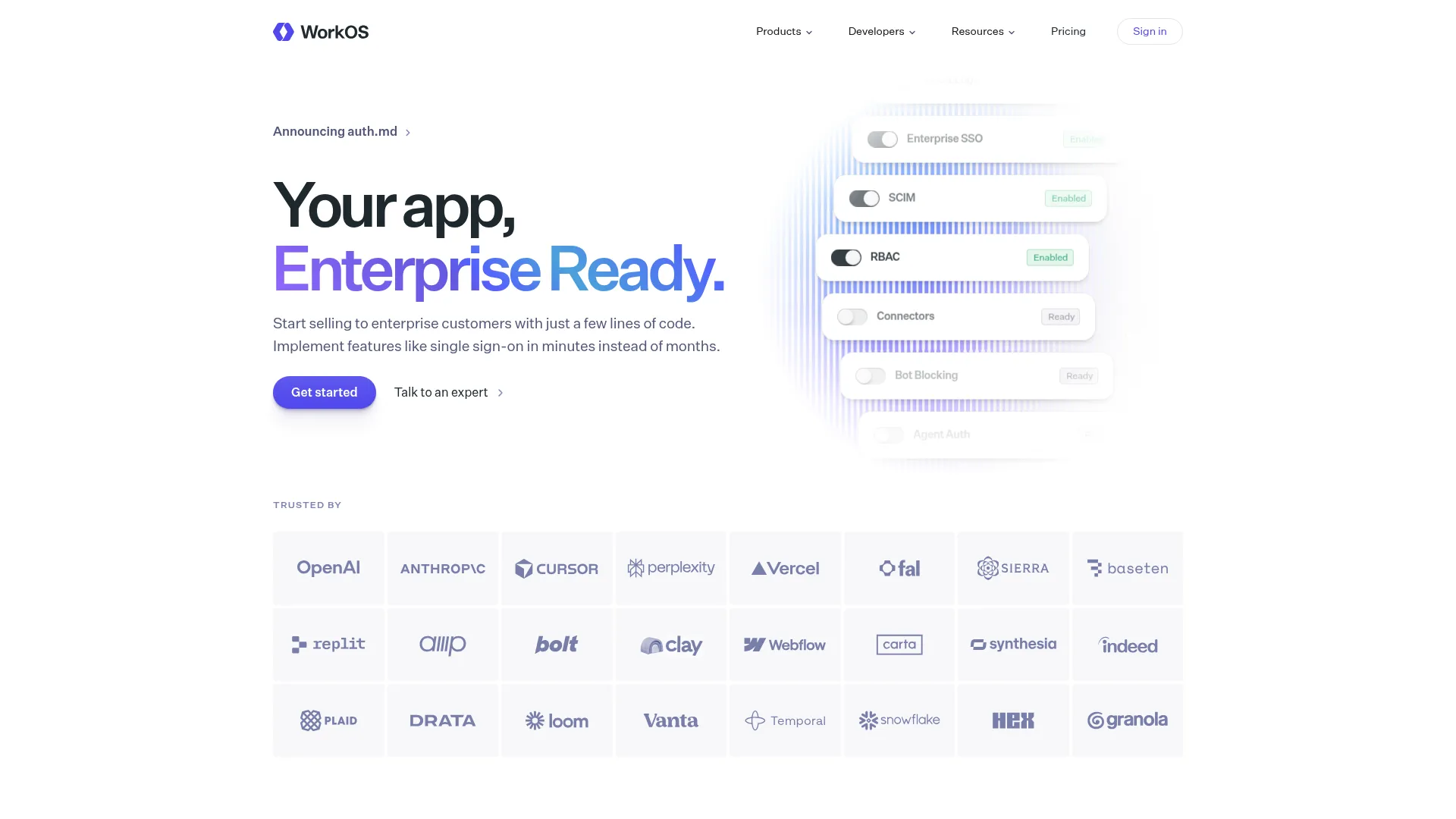
WorkOS provides building blocks and APIs for adding enterprise-ready features such as SSO, user management, directory sync, RBAC, MFA, audit logs, and bot protection to applications. It is the fast path for a SaaS that needs to satisfy enterprise buyers asking for SSO and SCIM. Rather than a full consumer CIAM suite, it focuses on enterprise-readiness primitives with clean APIs. You can see how it presents its features in this WorkOS interactive demo.
Best for: Software companies that need to add enterprise identity, provisioning, audit, and security features quickly.
Key strengths
- Enterprise SSO: SAML and OIDC identity provider support out of the box.
- Directory Sync: User provisioning, de-provisioning, and role mapping via SCIM.
- Audit Logs: Capture, export, and stream compliance events to a SIEM.
Why choose WorkOS: When an enterprise prospect blocks a deal on SSO and SCIM, WorkOS lets you ship those features in days rather than building them. The pricing model means early users cost nothing, with charges kicking in as you scale. It is the pragmatic choice for SaaS moving upmarket fast.
WorkOS pricing: The Pay as you go plan starts at $0 per month with automatic volume discounts and the first 1 million active users free. AuthKit is free up to 1 million users, then $2,500 per month per additional 1M users. Single Sign-On and Directory Sync are $125 each for 1 to 15 connections, with volume discounts. Audit Logs are $125 per month per SIEM connection plus $99 per month per million events stored. WorkOS holds a 4.5 out of 5 rating on G2.
Considerations before choosing CIAM software
A demo looks great until a security reviewer or a scaling user base exposes the gaps. Before you commit, work through this checklist with your technical and compliance stakeholders.
Authentication and security breadth
Verify the platform covers MFA, passwordless, passkeys, and adaptive or risk-based authentication. Check how it handles fraud detection and account takeover, not just login. The strongest ciam security posture treats every authentication event as a risk decision.
Compliance and data residency
Confirm explicit support for GDPR, CCPA, and, if relevant, HIPAA. Ask where customer data is hosted and whether regional residency is configurable. Consent and preference management should be native, not a bolt-on you have to build.
Developer experience and integration depth
Evaluate SDK quality, support for OAuth 2.0, OIDC, and SAML, and the clarity of the documentation. Test the APIs against a real flow during your proof of concept. Check integrations with your CRM, marketing automation, and analytics stack so identity data flows where it is needed.
Scalability and pricing model
Many CIAM platforms price on monthly active users, while others use flat or self-hosted models. Model your total cost at current scale and at projected scale, because per-MAU pricing can jump sharply. Confirm there are no hard scale limits that would force a migration later.
Deployment and vendor lock-in
Decide whether you need cloud-only, self-managed, or hybrid hosting. Ask about migration paths in and out, and what exporting your user data actually involves. Understanding the exit cost before you sign protects you if requirements change.
How to evaluate CIAM software for your stack
Technical validation is where shortlists turn into decisions. Treat it as a structured exercise, not a feature checkbox race. The goal is to prove fit against your real flows before procurement gets involved.
Map your requirements to clear RFP criteria first. Separate must-haves from nice-to-haves so a strong demo on a secondary feature does not skew the evaluation. Then run a proof of concept against your actual authentication and consent flows, not a generic sample app.
Use this checklist during technical validation:
- Run a POC against real auth flows: Test login, MFA, passwordless, and SSO with your own app, not the vendor sandbox alone.
- Test consent and privacy paths: Walk through registration, consent capture, and data export end to end.
- Validate security review readiness: Confirm SOC 2, ISO 27001, GDPR, and any industry-specific certifications upfront.
- Check integration with your stack: Wire identity data into your CRM, analytics, and alerting to confirm it flows cleanly.
- Model pricing at scale: Project cost at 2x and 5x your current MAU to avoid a surprise later.
- Probe migration and exit: Ask exactly how you would export users and move off the platform if needed.
If you are in presales, the POC is also your demo asset. Capturing the authentication, MFA, and consent journeys once lets you show buyers exactly how the platform behaves without standing up an environment for every call. A live demo keeps that walkthrough consistent across every prospect call, and you can build a reusable demo library so your team never has to recreate the same flow twice.
Conclusion
The right CIAM solution depends on who is asking and what they are protecting. Developer-first teams gravitate to Auth0, FusionAuth, and Stytch for extensibility and clean APIs. Enterprises with heavy governance needs lean toward Okta Customer Identity Cloud, Ping Identity, and ForgeRock. Microsoft-stack organizations get the cleanest fit from Microsoft Entra External ID, while AWS-native builders stay with Amazon Cognito.
For B2B SaaS, Frontegg and WorkOS solve multi-tenancy and enterprise readiness directly. Consumer brands with privacy obligations find a home with LoginRadius, and fraud-first teams should look hard at Transmit Security.
Your next step is simple. Shortlist two or three platforms that match your buyer type and stack. Run a proof of concept against your real authentication and consent flows, not a demo app. Then validate security review readiness with your compliance team before you sign. The platform that survives that scrutiny is the one worth buying.
FAQs
CIAM software manages registration, authentication, authorization, and profile and consent data for external customers at scale. It handles the entire identity lifecycle for consumers, partners, and other external users. The goal is secure, low-friction access that also keeps you compliant with privacy rules.
IAM secures internal employees and contractors behind the firewall, usually for tens of thousands of users. CIAM secures external customers, often at scales reaching millions, and prioritizes frictionless user experience, self-service, and consent alongside security. The two solve related problems for very different populations.
CIAM delivers stronger security, better login conversion, and regulatory compliance for GDPR, CCPA, and similar regimes. It unifies fragmented customer profiles into a single identity. It also reduces the cost and risk of building and maintaining identity infrastructure in-house.
CIAM platforms protect data through MFA, passwordless authentication, passkeys, and encryption. Adaptive, risk-based authentication steps up challenges only when signals warrant it. Consent management and threat detection round out the protection, guarding against credential abuse, which the 2025 Verizon DBIR tied to 22% of breaches.
Pricing models vary. Many platforms charge per monthly active user, some use per-feature tiers, and others offer flat or self-hosted pricing. Free tiers exist: Auth0 includes 25,000 MAUs free, and Amazon Cognito offers a free tier on its Lite and Essentials plans. Enterprise plans often run into tens or hundreds of thousands per year.
For most teams, buying wins. Building identity in-house is expensive to secure, slow to keep compliant, and a constant maintenance drain. A bought CIAM solution delivers compliance, scale, and faster time to value. Building can make sense only when you have highly unusual requirements and dedicated identity engineering resources.
A capable ciam platform should support MFA, SSO, passwordless login, passkeys, social login, and adaptive or risk-based authentication. The combination lets you reduce friction while raising the security floor. Adaptive auth is key, since it applies stronger challenges only when risk signals justify them.
B2B SaaS needs multi-tenancy, self-service admin, and enterprise readiness. Frontegg ships tenant-aware identity and an embeddable admin portal by default. WorkOS is strong when you need to add enterprise SSO and SCIM fast, and Okta Customer Identity Cloud suits B2B SaaS selling into large, governance-heavy accounts.