

Most churn does not announce itself. A power user goes quiet. A champion leaves and nobody flags it. CSAT slips half a point and gets lost in a dashboard nobody opens. Then the renewal call arrives, and the account is already gone, illustrating the cost of customer churn for SaaS businesses.
That is the gap voice of customer tools exist to close. They pull feedback from every channel your customers actually use, then turn the raw signal into something you can act on before the relationship cools. For a CS team, that is the difference between reacting to churn and preventing it.
The shift is real. Current voice of customer software no longer stops at sending a survey. It ingests support tickets, reviews, social posts, in-app responses, and call transcripts, then uses AI to extract themes and sentiment at scale across all of it. Sources like the modern voice of the customer workflow consistently frame the modern voice of the customer tools workflow the same way: collect, analyze, and act. The third step is where most programs break down, and where CS teams lose the most ground.
This guide is built for that problem. Not a definition essay, and not a generic CX buyer's checklist. A working shortlist of voc tools, each paired with the CS sub-segment it actually fits, with verified pricing where it exists and honest notes where it does not.
If you own retention, adoption, or onboarding, these are the platforms worth your evaluation time in 2026.
What's inside
This guide is for Customer Success Managers, CX Managers, onboarding managers, and CS leaders who need to capture customer sentiment and route it into action. We evaluated voice of customer platforms against four criteria that matter most for CS work:
- Omnichannel feedback capture: surveys, NPS, CSAT, support tickets, reviews, social, and in-app signal in one place.
- AI text and sentiment analysis: depth of open-text analysis, not just score tracking.
- Integrations with the CS stack: sync to CRM, helpdesk, and Slack so feedback reaches an owner.
- Closed-loop actioning: the ability to route, assign, and resolve, not just collect.
Every tool below gets full treatment: strengths, fit, and verified pricing where a vendor publishes it.
TL;DR
Short on time? Here are the decision shortcuts by CS sub-segment.
- Best for enterprise CX programs: Qualtrics XM and Medallia Experience Cloud, both built for omnichannel listening at scale.
- Best for AI open-text analysis: Thematic and Chattermill, purpose-built for teams drowning in qualitative feedback.
- Best for fast NPS and CSAT surveys: Survicate and SurveySparrow, quick to launch without IT.
- Best for contact-center voc software: Calabrio and Verint Voice of the Customer for support-heavy CS orgs.
- Best for unifying solicited and unsolicited feedback: InMoment.
- Best low-cost and free option: Hotjar and SurveyMonkey both offer free tiers to start.
What are voice of customer tools?
Voice of customer tools are software platforms that collect, analyze, and act on customer feedback across channels. They unify what customers say in surveys, support tickets, reviews, social posts, in-app prompts, and recorded calls, then turn that raw input into themes, sentiment, and prioritized action.
The category breaks into three core components. Strong voice of customer platforms cover all three, not just the first one.
- Data collection: Capture feedback across solicited channels (NPS, CSAT, CES surveys, voice of the customer survey distribution) and unsolicited channels (reviews, social, support conversations, IVR, in-app feedback). The strongest programs ingest more than survey responses, pulling in speech, chat, digital behavior, and operational data.
- Analysis: Run voice of customer analysis on structured scores and unstructured text. Modern voc analytics use AI to extract themes, tag sentiment, and surface patterns across thousands of comments that no human could read manually.
- Action: Route feedback to an owner, assign it, and close the loop. This is where a voc platform separates from a basic survey tool. Sources like Medallia frame this as action planning; Usersnap calls it closing the loop on customer feedback by telling customers what changed.
Why does this matter for CS specifically? Because the channels your customers use to signal frustration are fragmented by default. A renewal-risk account might leave a 2-star app store review, open three support tickets, and quietly stop responding to QBR invites, all without ever filling out your NPS survey. Voice of customer software stitches those signals together.
The category also overlaps with adjacent terms you will see in vendor marketing. Voc software, voice of customer solutions, and customer experience management platforms often describe the same core job: listen everywhere, understand why, and act before it costs you the account. The difference is depth. A survey tool collects. A full voc platform listens omnichannel, analyzes with AI, and drives closed-loop action.
When CS teams use voice of customer tools
The category is broad, but CS teams reach for these tools in three recurring moments.
Catch churn signals before renewal
Sentiment rarely collapses overnight. It erodes. A voc platform surfaces that erosion early by flagging dropping CSAT, negative theme volume, and at-risk accounts while there is still time to intervene. Sprig notes that real-time feedback resolves issues early before they become big problems. For CS, that means the renewal conversation starts months ahead of the renewal date, not on the call itself.
Turn feedback into product and onboarding fixes
The best voice of customer analysis does not stop at a dashboard. It routes recurring friction to the right owner. When the same complaint shows up across tickets, reviews, and surveys, that is a signal, not noise.
Say your analysis reveals customers repeatedly getting stuck on the same configuration flow during onboarding. Routing that theme to product is one move. The faster CS response is to build interactive product education around that exact step, so the next customer walks through a guided path instead of hitting the same wall. That closes the loop on the friction your voc data just exposed, and it scales onboarding without adding live calls. Tools like these sit at the heart of any user onboarding software stack, and they pair naturally with the right onboarding flow software to operationalize fixes fast.
Prove CS impact with sentiment and theme trends
CS impact is notoriously hard to measure. Voc tools help by tying CSAT and NPS movement to retention outcomes. When you can show that accounts with rising sentiment renew at a higher rate, you turn fuzzy relationship work into a defensible number. Sprig links voc analytics directly to customer retention strategies, which is the language leadership actually responds to.
Voice of customer tools compared
Below is a quick comparison of all 13 voice of customer platforms, sorted by relevance to CS teams. Pricing reflects publicly listed figures verified to June 2026; where vendors gate pricing behind sales, the table notes custom pricing. Use it to shortlist two or three voc tools, then read the full sections.
| # | Product | Intent | Key use case | Pricing | G2 rating |
|---|---|---|---|---|---|
| 1 | Qualtrics XM | Enterprise CX | Omnichannel listening and research at scale | Free account; Strategic Research from $420/mo; suites custom | 4.4/5 |
| 2 | Medallia Experience Cloud | Enterprise CX | Signal capture across web, contact center, social | Custom (EDR-based) | 4.5/5 |
| 3 | InMoment | Integrated CX | Unify solicited and unsolicited feedback | Custom | 4.7/5 |
| 4 | Thematic | AI text analysis | Theme analysis on large qualitative volumes | Foundation $25,000/yr; Enterprise custom | 4.8/5 |
| 5 | Chattermill | AI text analysis | Unified AI feedback analytics | Custom quote | 4.4/5 |
| 6 | Survicate | Fast surveys | Embedded NPS, CSAT, CES programs | Growth from $114/mo | 4.6/5 |
| 7 | AskNicely | NPS programs | Structured NPS and frontline action | Custom | 4.7/5 |
| 8 | SurveySparrow | Conversational surveys | Higher survey completion | Free plan; paid tiers custom | 4.4/5 |
| 9 | SurveyMonkey | Flexible surveys | Familiar, broad survey platform | Free Basic; Team from $30/user/mo | 4.4/5 |
| 10 | Hotjar | Behavior plus feedback | Pair product behavior with VoC signal | Free; paid via Contentsquare | 4.3/5 |
| 11 | Verint Voice of the Customer | Contact-center VoC | Speech and text analytics at scale | Custom | 4.2/5 |
| 12 | Calabrio | Contact-center VoC | Conversation and sentiment analysis | Custom | 4.5/5 |
| 13 | SurveySensum | Mid-market CX | Affordable NPS, CSAT, CES with text analytics | Starter CX from $3,600/yr | 4.6/5 |
The 13 best voice of customer tools for CS teams in 2026
1. Qualtrics XM
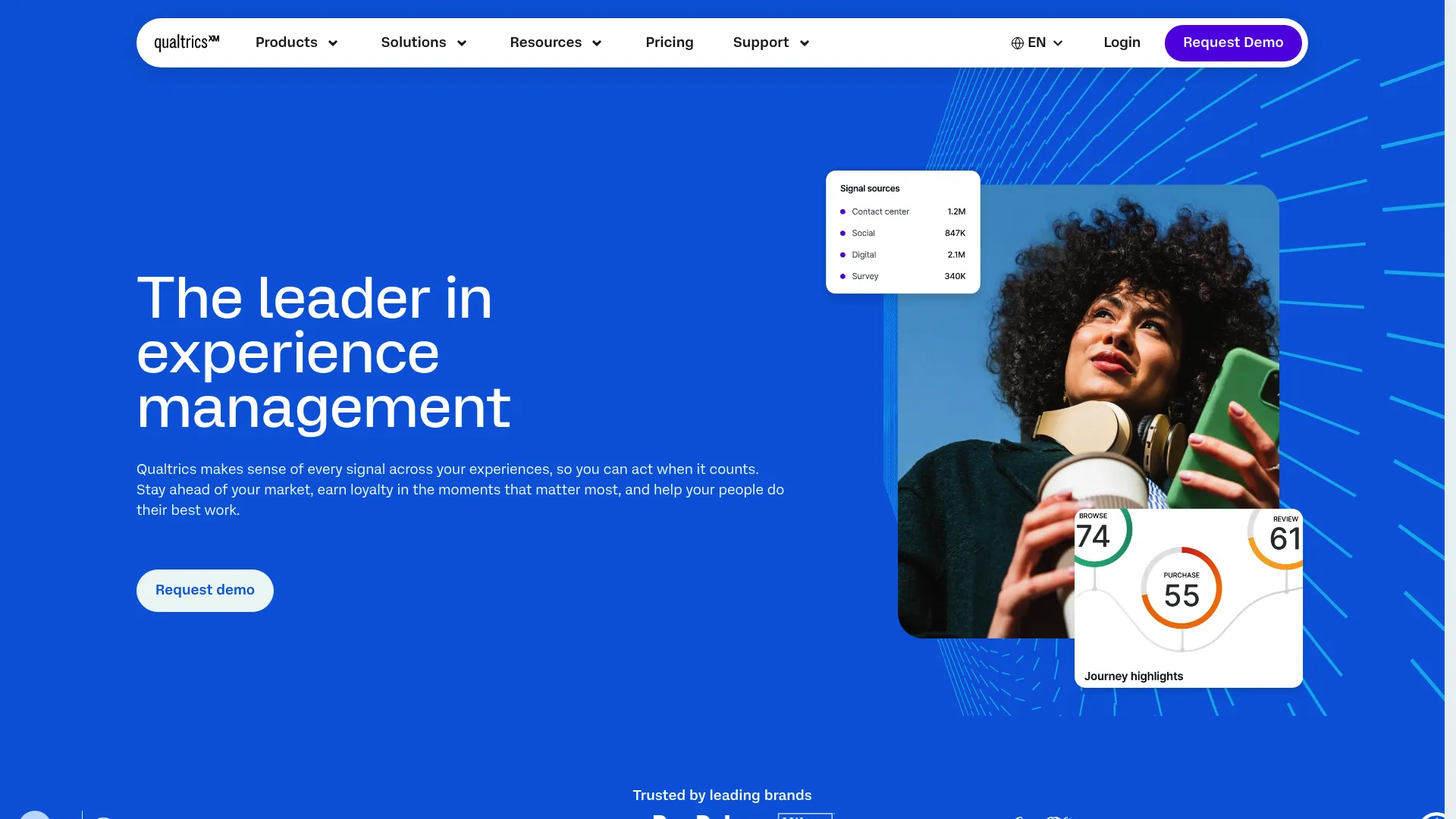
Qualtrics XM is an AI-powered experience management platform spanning customer, employee, strategy, research, product, and brand experience programs. For CS teams inside larger organizations, it is the most comprehensive option for omnichannel listening, research-grade analysis, and closed-loop workflows in one system.
Best for: Large organizations and research teams that need enterprise-grade experience management, omnichannel feedback, employee listening, and advanced research analytics in one platform.
Key strengths
- Omnichannel CX management: Capture signal across surveys, online reviews, calls, chats, website and mobile feedback, contact center analytics, and reputation management.
- Employee experience tools: Engagement, pulse, onboarding, exit, 360 development, and retention analytics for continuous employee listening.
- Strategy and research depth: Strategic market research, product and UX research, brand tracking, video feedback analysis, dashboards, crosstabs, and AI summaries.
Why choose Qualtrics XM: If your CS team sits inside a company already running enterprise CX or employee programs, Qualtrics consolidates everything under one platform. The breadth is the point. You get research-grade rigor alongside operational feedback, which matters when leadership wants both retention numbers and the why behind them.
Qualtrics XM pricing: Qualtrics offers a free Qualtrics Surveys account with no credit card required. Its Strategic Research plan for small business starts at $420 per month, billed as $5,040 annually for 1,000 responses shared across users. Most XM suites for customer experience, employee experience, and strategy are custom-priced by request. Its G2 rating sits at 4.4 out of 5.
2. Medallia Experience Cloud
Medallia Experience Cloud is a SaaS experience management platform built to collect feedback signals, analyze experience data, and drive role-based action across an organization. It is purpose-built for enterprise CX and CS programs operating at scale across many touchpoints.
Best for: Enterprise organizations running large-scale customer, employee, or citizen experience management programs across multiple channels.
Key strengths
- Comprehensive signal capture: Pulls feedback from surveys, speech, social signals, digital feedback, and video feedback in one place.
- AI-powered analytics: Text analytics, speech analytics, acoustic analytics, and survey analytics for deep voice of customer analysis.
- Role-based action workflows: Automatic alerting, case management, and closed-loop feedback routed to the people who can act.
Why choose Medallia: Medallia shines when feedback needs to reach the right role automatically. The role-based reporting and closed-loop case management mean a CSM, a frontline agent, and an executive each see the slice relevant to them. For large CS orgs where signal gets lost between teams, that routing is the differentiator.
Medallia pricing: Medallia uses an Experience Data Record pricing model, priced in annual tiers, and directs buyers to contact sales for figures. No public starting price or named plan pricing is listed on its pricing page. Its G2 rating is 4.5 out of 5.
3. InMoment
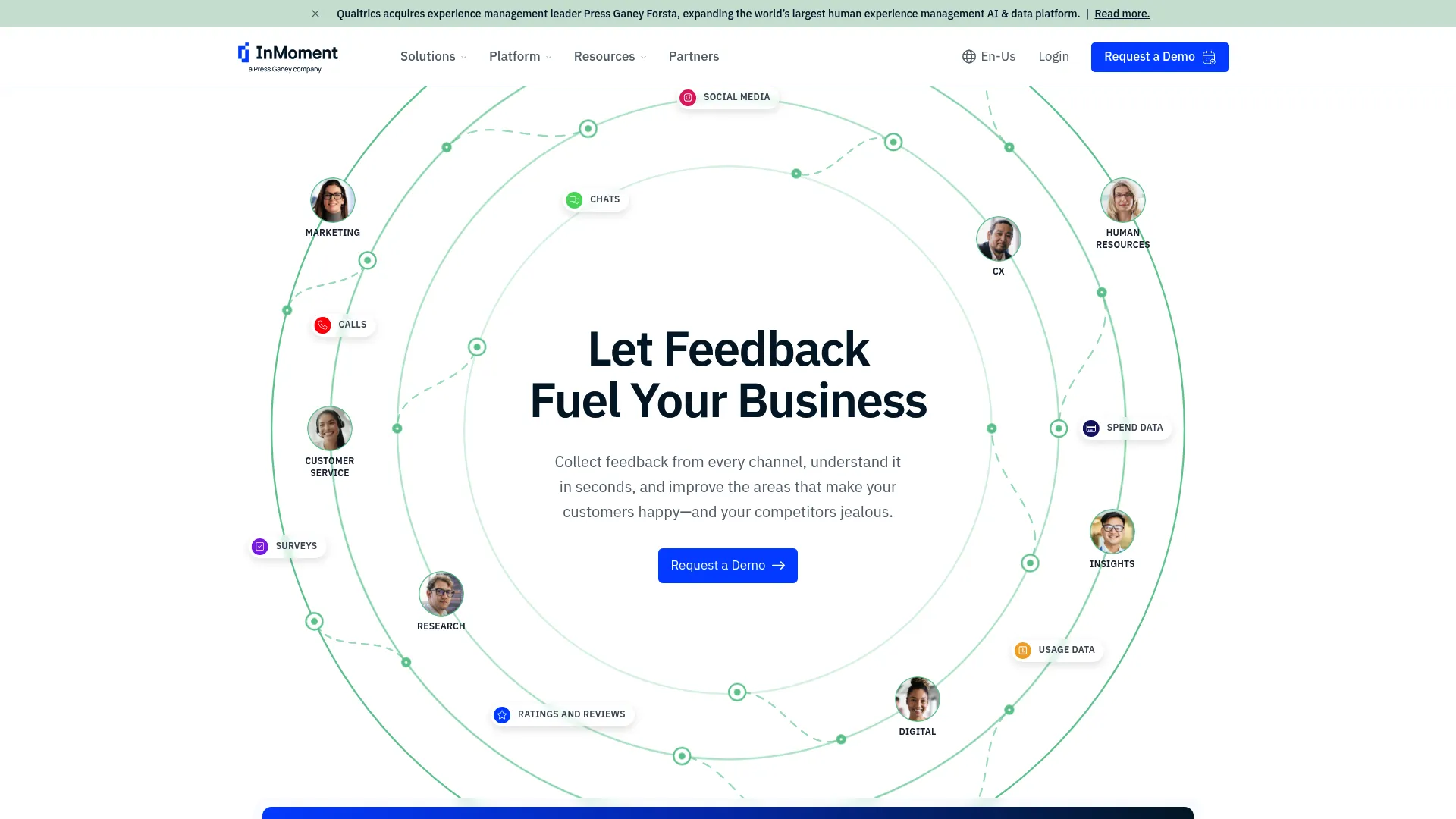
InMoment is a customer experience software and services company that helps businesses collect, connect, analyze, and act on customer, employee, and market experience data. Its strength for CS teams is unifying solicited feedback like surveys with unsolicited signal like reviews and conversations.
Best for: Mid-market and enterprise teams running customer experience, voice-of-customer, contact center analytics, reputation management, and employee feedback programs.
Key strengths
- Customer feedback surveys: AI-infused survey builder with reporting, dashboards, data exploration, text analytics, and case management.
- Conversational intelligence: Ingests and transcribes calls, chats, and email threads with AI summaries, multi-speaker text analytics, and scorecards.
- Reputation management: Social ratings and review solicitation, competitor analysis, local search rank, listings management, and AI review responding.
Why choose InMoment: InMoment fits CS teams that need one platform for both what customers tell you directly and what they say everywhere else. The combination of conversational intelligence and reputation management means the unsolicited signal, often the most honest, does not slip through the cracks.
InMoment pricing: InMoment lists packages for Integrated CX, Customer Feedback Surveys, Conversational Intelligence, Reputation Management, Advanced Analytics and AI, Digital Listening, and Employee Feedback Surveys, plus delivery models from out-of-the-box to white-glove. No public price figures are displayed on its plans page, so pricing is custom by request. Its G2 rating is 4.7 out of 5.
4. Thematic
Thematic is an enterprise customer intelligence platform that turns unstructured customer feedback into a governed, traceable source of customer truth. If your CS team is drowning in open-text responses, this is the tool built for exactly that.
Best for: Enterprise CX, VoC, research, and insights teams analyzing large volumes of multi-channel customer feedback.
Key strengths
- Connects every feedback source: Surveys, support tickets, call center transcripts, app reviews, CRM notes, existing systems, and data warehouses.
- Traceable theme discovery: Surfaces themes from customer language with traceability back to the exact words that created each theme.
- Business-impact scoring: Scores themes by predicted NPS, churn propensity, and effort, all from unstructured feedback.
Why choose Thematic: Thematic's edge is traceability and impact scoring. You do not just see a theme, you see the exact verbatims behind it and how much it moves churn or NPS. For a CS leader building a case to fix a recurring friction point, that evidence trail is hard to beat.
Thematic pricing: Thematic's Foundation plan starts at $25,000 per year and includes a full view of themes, sentiment, and categories, an assigned Customer Success Manager, full platform access, and 24/7 support. The Enterprise tier is a custom proposal with volume discounts, tailored onboarding, and partnership-level support. Its G2 rating is 4.8 out of 5, among the highest in this list.
5. Chattermill
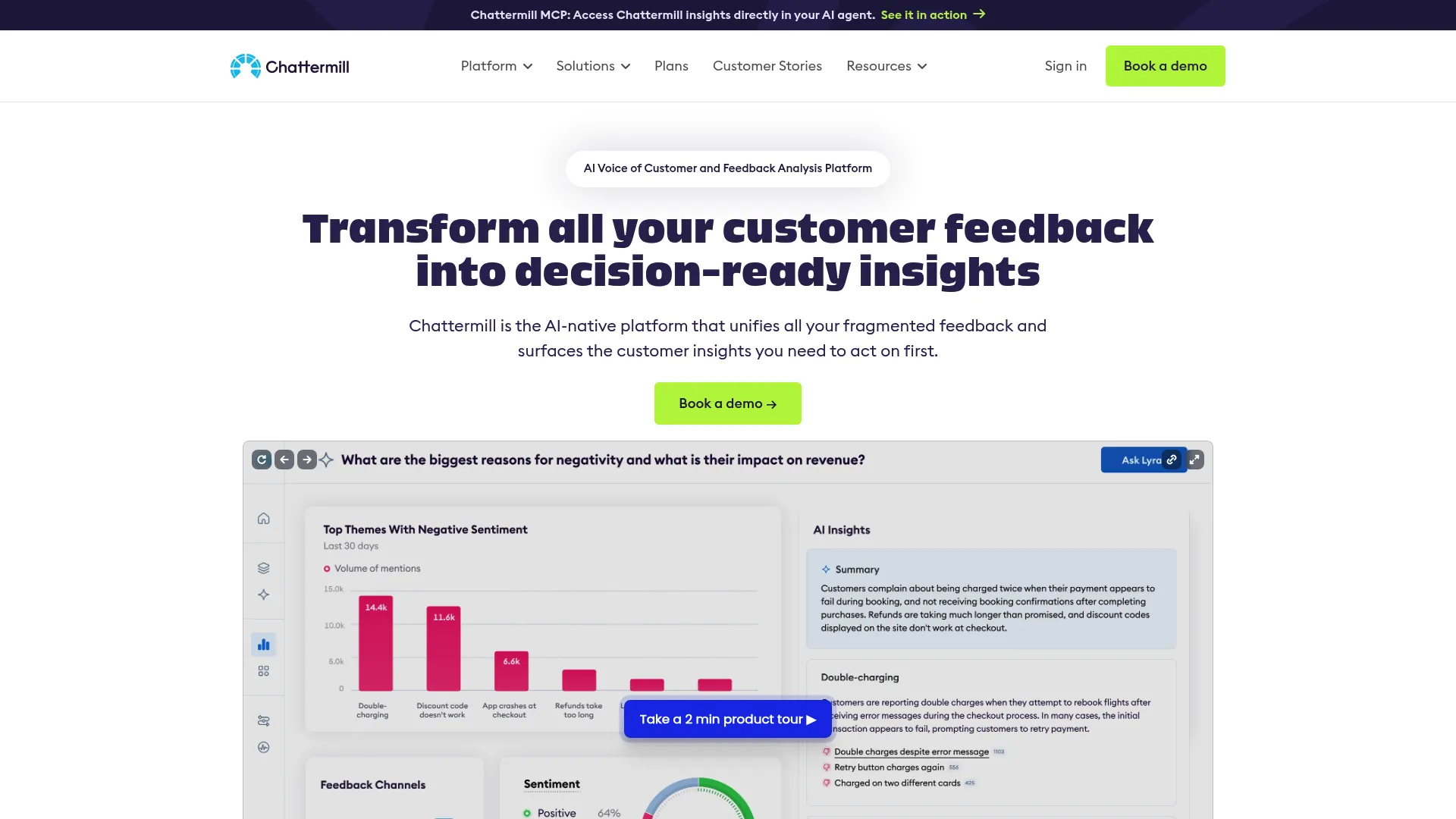
Chattermill is an AI-native customer feedback analytics and voice of customer platform that unifies and analyzes feedback across surveys, reviews, support conversations, social media, and voice calls. It is built for teams that want deep AI analysis across high feedback volumes.
Best for: CX, Product, Insights, Support, and Operations teams that collect large volumes of feedback and need AI-driven analysis to prioritize customer-impacting issues.
Key strengths
- Unified multi-channel feedback: Brings together surveys, product reviews, support tickets, social media, and voice calls in one view.
- Lyra AI analysis: Analyzes unstructured text for categories, themes, sentiment, and generative AI summaries at scale.
- Action and integration depth: Dashboards, impact analysis, proactive alerts, multilingual analysis, and integrations with Zendesk, Intercom, Slack, Jira, and more.
Why choose Chattermill: Chattermill is for CS teams whose feedback volume has outgrown manual tagging. Lyra AI does the heavy lifting on theme and sentiment extraction, and proactive alerts push customer-impacting issues to you instead of waiting for you to dig. The integration list also means insights land where your team already works.
Chattermill pricing: Chattermill prices on data sources and feedback volume. The Pro plan includes 2 data source integrations and 10,000 data credits per month, Team includes 3 sources and 30,000 credits, and Enterprise includes 5 sources and 100,000 credits. Each tier is quoted custom, and all plans include unlimited users, onboarding, a dedicated CSM, and enterprise data security. There is no free tier. Its G2 rating is 4.4 out of 5.
6. Survicate
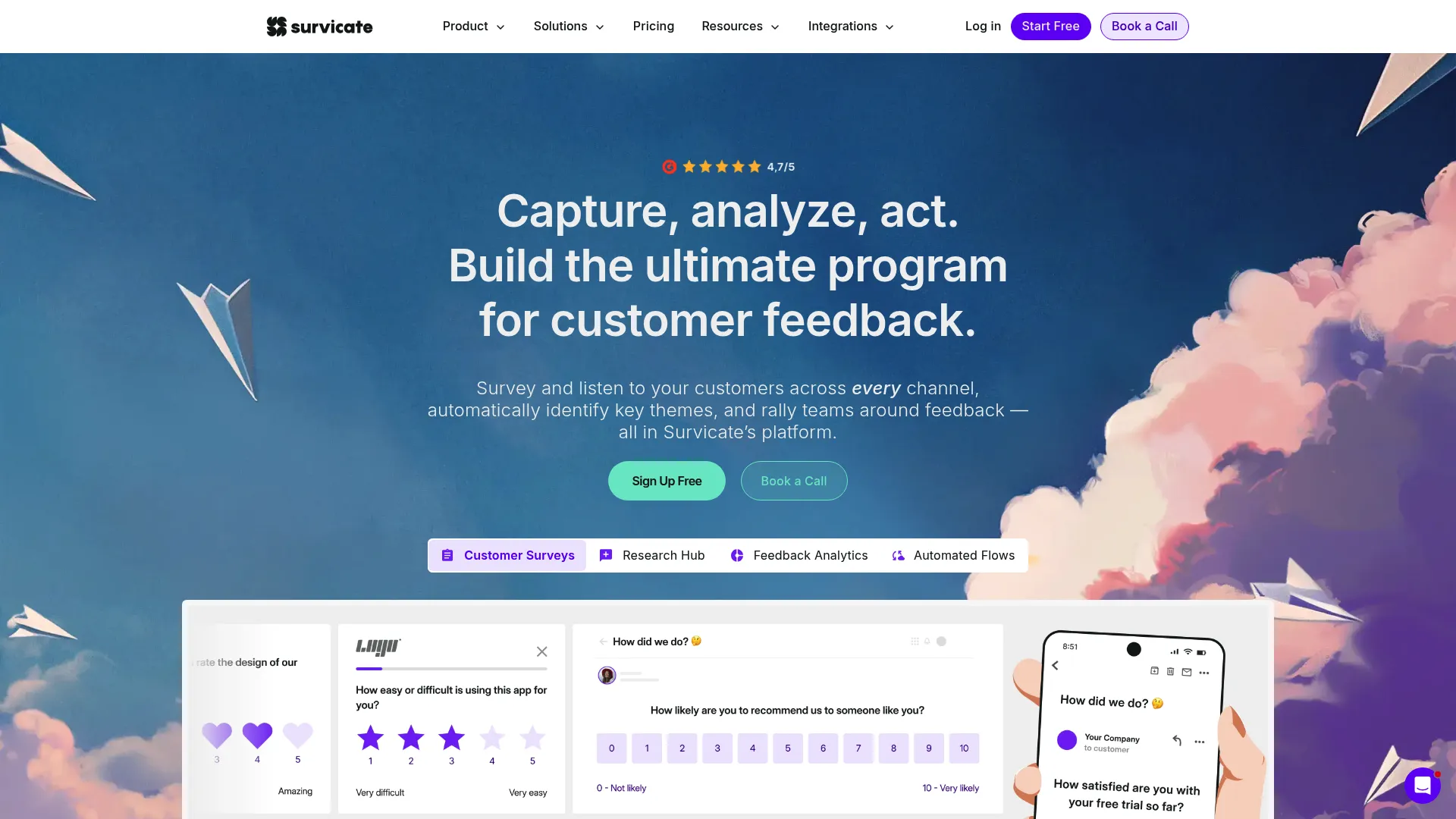
Survicate is a customer feedback platform for collecting, analyzing, and acting on feedback across channels. For CS teams that want fast, embedded survey programs without a heavy enterprise rollout, it hits a strong balance of speed and depth.
Best for: Product, research, marketing, and CX teams that need multichannel customer feedback collection with AI analysis and integrations.
Key strengths
- Unlimited multichannel surveys: Run NPS, CSAT, and CES surveys across in-app, email, and link without per-survey limits.
- Research Hub and Research Assistant: Centralize feedback and use AI to speed up voice of customer analysis.
- Broad integrations: 25+ integrations on Growth and 40+ on higher plans to push feedback into your stack.
Why choose Survicate: Survicate fits CS teams that want to launch a voice of the customer survey program this week, not next quarter. The unlimited surveys and integration breadth mean you can embed feedback at every touchpoint and route it into HubSpot or Intercom without engineering help.
Survicate pricing: Survicate's Growth plan starts at $114 per month billed annually, including 250 survey responses and 1,000 data points monthly. The Pro plan starts at $349 per month with a custom yearly response pool, and Enterprise starts at $569 per month. A 10-day trial is available. Its G2 rating is 4.6 out of 5.
7. AskNicely
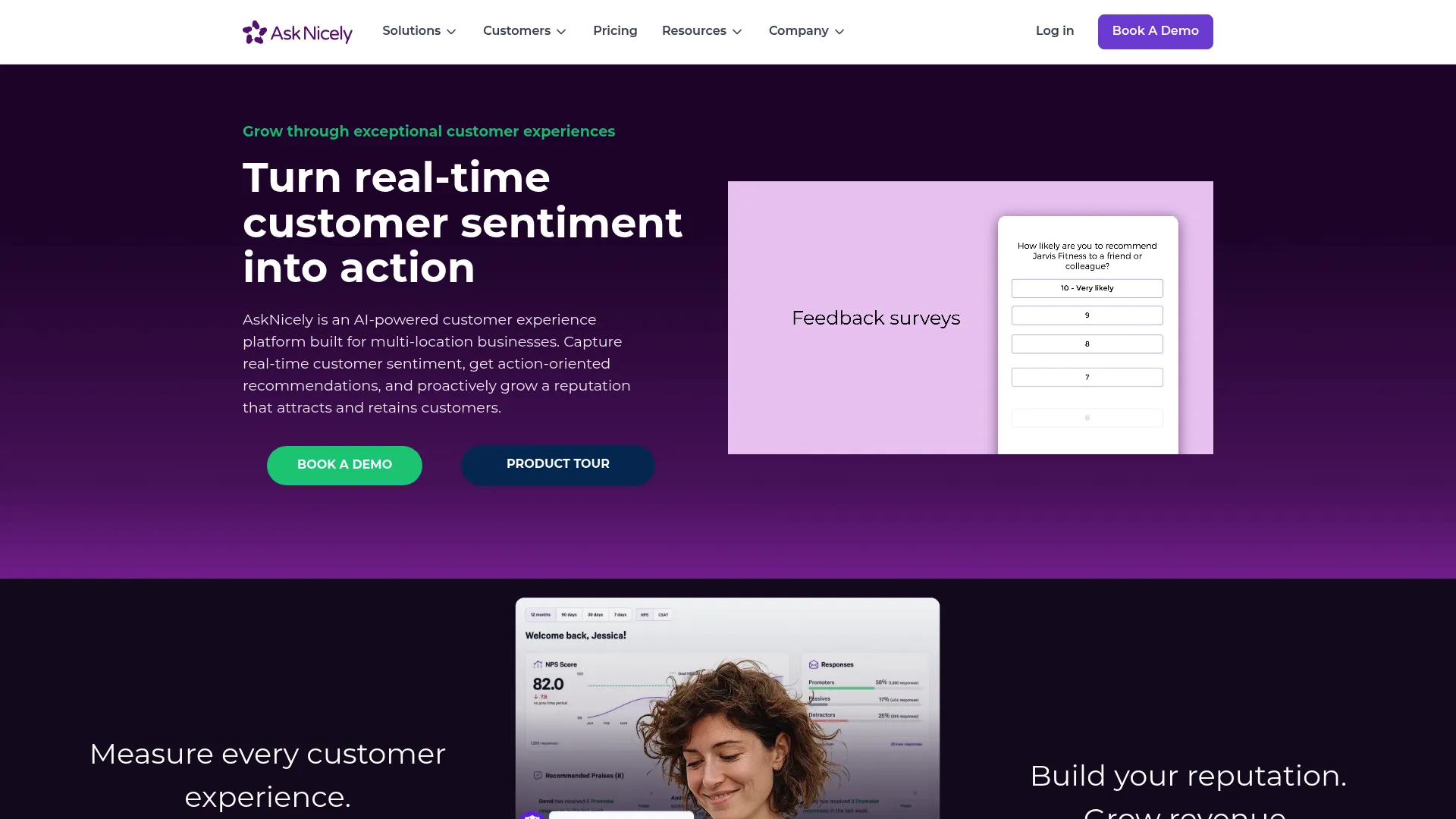
AskNicely is customer experience management software for collecting, analyzing, and acting on real-time customer feedback. It is NPS-first, with strong frontline action workflows, making it a fit for CS teams running structured NPS programs.
Best for: Service businesses that need customer feedback collection, CX analytics, review generation, and frontline coaching workflows.
Key strengths
- Multichannel CSAT and NPS: Collect feedback via email, WhatsApp, SMS, QR code, mobile app, and white-label surveys.
- AI-powered insight: AI surveys, AI insight reports, NiceAI, and AI suggested responses to speed up follow-up.
- Frontline action workflows: Automated workflows, leaderboards, case management, Google review manager, and Slack and Microsoft Teams integrations.
Why choose AskNicely: AskNicely closes the loop fast. The frontline coaching and automated workflows mean a low NPS response does not just sit in a report, it triggers an action and a follow-up. For CS teams where the relationship is the product, that responsiveness compounds into retention.
AskNicely pricing: AskNicely offers Learn, Grow, and Transform plans priced by response volume starting from 500 responses. Plan prices are quoted by sales, and there is no free trial. Higher tiers add AI insight reports, in-app surveys, white-label surveys, and frontline coaching. Its G2 rating is 4.7 out of 5.
8. SurveySparrow
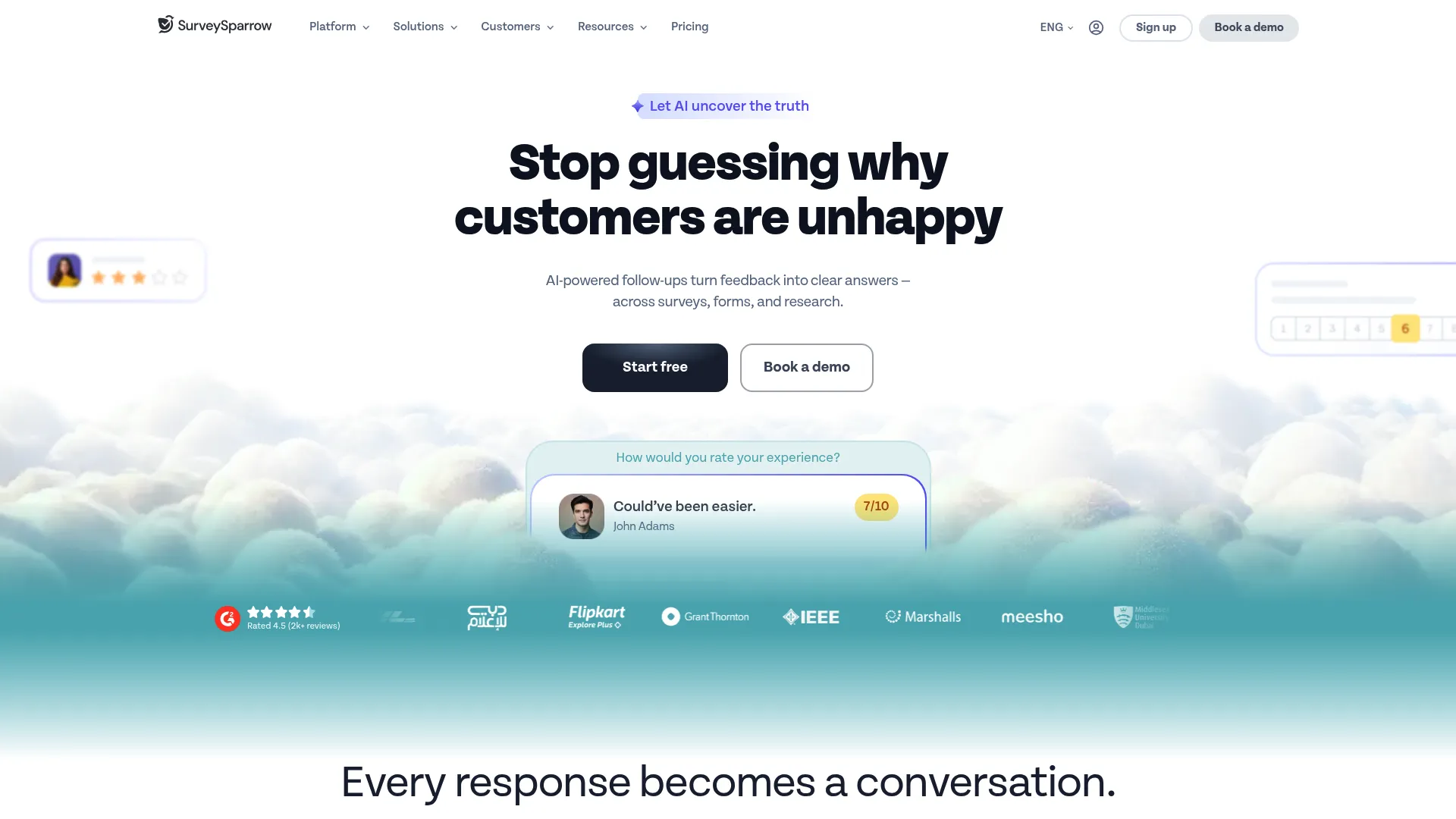
SurveySparrow is an AI-powered customer feedback platform for surveys, forms, research, and feedback analysis. Its conversational survey format is designed to lift completion rates, which matters when survey fatigue is eating your response data.
Best for: Teams that need conversational, omnichannel customer or employee feedback collection with AI-assisted analysis.
Key strengths
- Conversational surveys and forms: A chat-style format that feels less like a form and drives higher completion.
- Smart survey logic: Conditional logic, skip logic, question piping, and personalization to tailor each survey.
- Omnichannel distribution: Email, social media, web links, embedded surveys, QR codes, Slack, and offline kiosk mode.
Why choose SurveySparrow: If your response rates are thin, SurveySparrow's conversational format is the lever. The chat-style experience tends to keep respondents engaged longer than a static grid of questions, which means more complete voc data for your analysis.
SurveySparrow pricing: SurveySparrow offers a free plan plus Basic, Starter, Business, and Enterprise tiers, all billed yearly. Basic includes 2,500 responses and 1 user, Starter includes 15,000 responses, and Business includes 36,000 responses and 3 users. Enterprise covers custom limits. Its G2 rating is 4.4 out of 5.
9. SurveyMonkey
SurveyMonkey is a survey and forms platform for collecting, analyzing, and acting on feedback across customer experience, employee feedback, market research, events, and registrations. It is the familiar, flexible choice when you want a survey tool your whole team already knows how to use.
Best for: Teams and organizations that need to create surveys and forms, collect responses, and analyze feedback with templates, AI, integrations, and collaboration.
Key strengths
- AI-assisted creation: Build surveys and forms faster with AI plus 500+ expert templates for NPS, CSAT, and more.
- Broad distribution: Share via web links, social media, and a global audience panel.
- Analysis and integrations: Built-in analysis, AI insights, collaboration tools, and 200+ integrations.
Why choose SurveyMonkey: SurveyMonkey wins on familiarity and flexibility. For a CS team that wants to stand up a voice of the customer survey without training anyone, the template library and gentle learning curve get you live fast. The integration count keeps it from being a data silo.
SurveyMonkey pricing: SurveyMonkey offers a free Basic plan. Individual paid plans include Advantage Annual at $39 per month and Premier Annual at $139 per month. Team plans start at $30 per user per month for Team Advantage, billed annually from 3 users, with Team Premier at $92 per user per month. Enterprise is custom. Its G2 rating is 4.4 out of 5.
10. Hotjar
Hotjar is a product experience insights platform for understanding user behavior and feedback on websites and apps. It is the pick when you want to pair what customers say with what they actually do.
Best for: Product, UX, and marketing teams that need heatmaps, session replay, funnels, and user feedback to improve digital experiences.
Key strengths
- Heatmaps: See where users click, scroll, and stall on any page.
- Session Replay: Watch real sessions to understand behavior behind the feedback.
- Surveys: On-site surveys and feedback widgets to capture VoC signal in context.
Why choose Hotjar: Hotjar's value for CS is the behavior-plus-feedback combination. When a customer says onboarding is confusing, session replay shows you exactly where they got stuck. That context turns a vague complaint into a specific, fixable problem, which is the kind of insight that informs better onboarding flows. If behavior analytics are central to your evaluation, it is worth comparing the broader field of heatmap tools and session replay software side by side.
Hotjar pricing: Hotjar offers a free tier to start. Paid plans are now handled through Contentsquare, and named paid plan prices were not publicly listed on the pricing page at the time of writing. Its G2 rating is 4.3 out of 5.
11. Verint Voice of the Customer
Verint Voice of the Customer unifies customer experience data from multiple sources and formats to provide analytics and drive automated actions. It is built for contact-center-heavy CS orgs that need speech and text analytics at scale.
Best for: Enterprise CX teams that need to collect, unify, analyze, and act on customer feedback across digital, survey, and contact-center touchpoints.
Key strengths
- Structured and unstructured capture: Combines survey feedback with unstructured behavioral signals across touchpoints.
- Advanced analytics: Speech analytics, text analytics, digital behavior analytics, dashboards, and AI-powered predictive modeling.
- Automated action: Triggers real-time actions based on customer feedback and CX insights.
Why choose Verint: Verint is the enterprise contact-center play. If a large share of your customer signal lives in call recordings and chat transcripts, speech analytics in contact centers turn that volume into themes your CS team can act on. The predictive modeling adds a forward-looking layer for at-risk detection.
Verint pricing: Verint does not publish public pricing for its Voice of the Customer product. The page directs buyers to request a demo and contact sales, so pricing is custom by request. Its G2 rating is 4.2 out of 5.
12. Calabrio
Calabrio is a unified, cloud-based workforce optimization platform for contact centers, with strong voice of customer analytics built in. It fits support and contact-center VoC programs that want feedback analysis alongside workforce tools.
Best for: Contact centers that need workforce management, quality management, analytics, and agent engagement in one suite.
Key strengths
- Interaction analytics: Conversation and sentiment analysis with trending topics across customer interactions.
- AI-powered Auto QM: Automated quality management to score interactions at scale.
- Workforce optimization: Forecasting, scheduling, real-time adherence, and agent self-scheduling in one platform.
Why choose Calabrio: Calabrio makes sense when your CS and support functions overlap heavily in a contact center. The interaction analytics surface what customers are saying on calls and chats, while the workforce tools keep the operation running. For support-led CS orgs, that single-suite approach reduces tool sprawl.
Calabrio pricing: Calabrio does not list public pricing. Its site links to a Get a Quote flow and directs buyers to contact sales, so pricing is custom by request. Its G2 rating is 4.5 out of 5.
13. SurveySensum
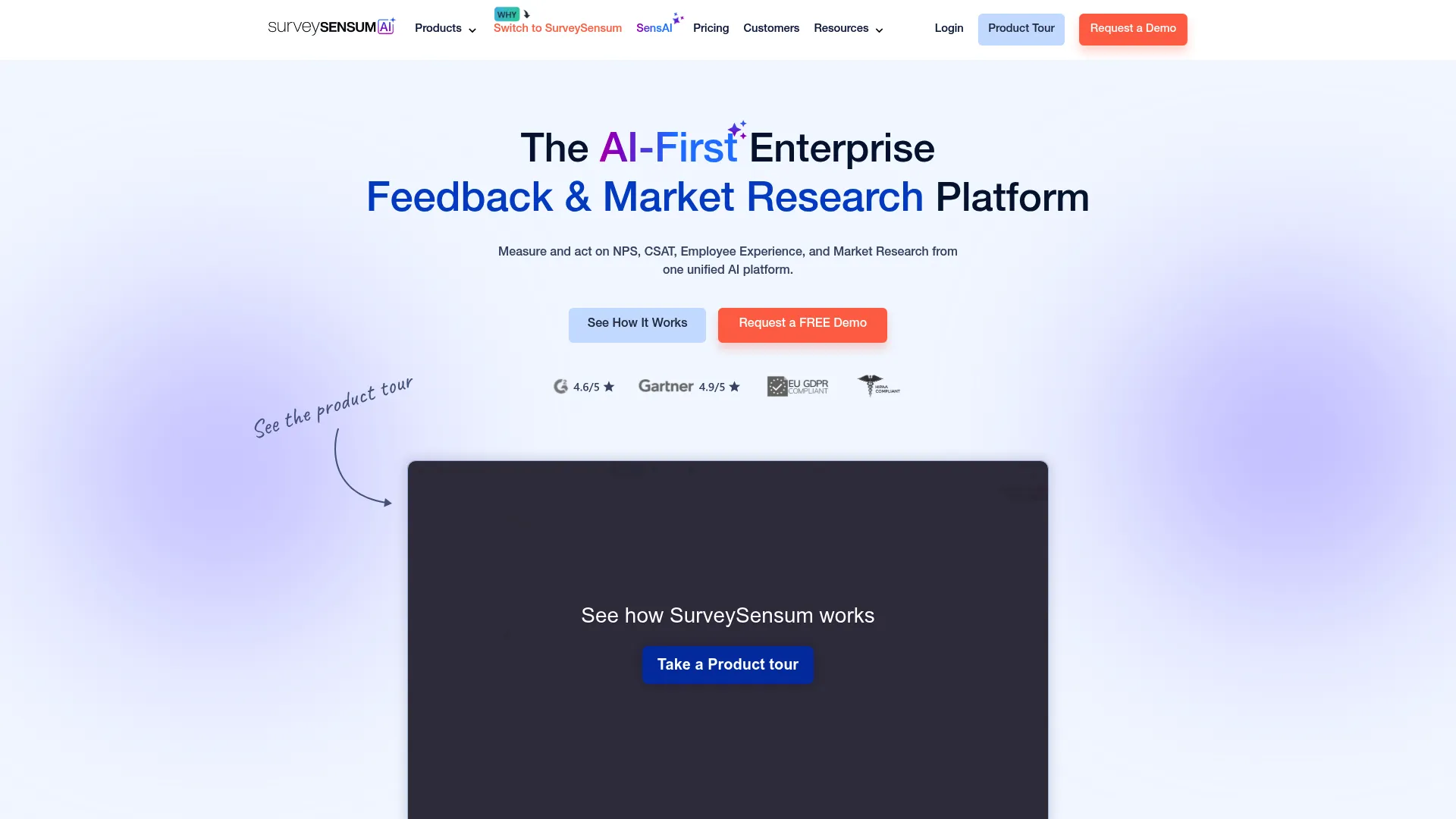
SurveySensum is an AI-first enterprise feedback and market research platform for measuring and acting on NPS, CSAT, employee experience, and market research. It earns its spot as the mid-market-friendly option with text analytics and closed-loop workflows at an accessible entry price.
Best for: Enterprise CX, EX, and research teams that need omnichannel feedback collection, AI analysis, dashboards, and managed CX support.
Key strengths
- Full survey suite: NPS, CES, CSAT, and survey software in one platform.
- AI text and sentiment analysis: SensAI extracts themes and sentiment from open-text feedback.
- Closed-loop and distribution: Closed-loop feedback system plus distribution via email, WhatsApp, in-app, SMS, and CRM.
Why choose SurveySensum: SurveySensum gives mid-market CS teams enterprise-style capabilities without an enterprise contract. You get text analytics, closed-loop actioning, and omnichannel distribution at a published starting price, which makes budgeting straightforward. The managed CX option adds a dedicated consultant if you want help operationalizing it.
SurveySensum pricing: SurveySensum's Starter CX plan starts at $3,600 per year with unlimited users, unlimited survey projects, multichannel distribution, and integrations with HubSpot, Slack, and Freshdesk. Self-Driven CX starts at $6,000 per year and adds closed-loop feedback and SensAI text analysis. Managed CX is custom-priced. A one-month free trial with 25 free responses is available. Its G2 rating is 4.6 out of 5.
How to choose a voice of customer tool
Thirteen options is a lot. Use this checklist to narrow the field to the voice of customer solutions that fit how your CS team actually works.
Integration with your CS and CRM stack
A voc platform is only as useful as the systems it feeds. Confirm it syncs to your CRM and helpdesk, whether that is HubSpot, Salesforce, Zendesk, Intercom, or Slack. If feedback cannot reach an owner in the tool they already use, it dies in a dashboard. It helps to know how your CRM software and knowledge base software connect to feedback flows before you commit.
Depth of AI text and sentiment analysis
Scores tell you what changed. Open-text tells you why. Check that the tool handles unstructured feedback at scale, extracting themes and sentiment from thousands of comments, not just charting your NPS number. This is where modern voc analytics earn their keep.
Closed-loop actioning
Collecting feedback is the easy part. Ask whether the platform lets you route, assign, and resolve, then tell the customer what changed. Sources consistently flag closing the loop as the step that separates a real program from a survey habit.
Scalability across your account book
A tool that works for 20 accounts may buckle at 500. Evaluate response limits, user seats, and how pricing scales as your book grows. Some tools price on responses, others on data sources or seats, so model your real volume.
Time-to-value and ease of setup
A small CS team cannot wait six months for IT to finish an implementation. Favor voice of customer software you can launch without engineering, with templates and integrations that work out of the box. Fast time-to-value means you start catching churn signals sooner, much like a well-designed digital adoption platform shortens the path to product value.
Conclusion
The right voice of customer tool depends entirely on your CS context, not on which vendor has the loudest marketing.
For enterprise CX programs with omnichannel demands, Qualtrics XM and Medallia Experience Cloud lead. If your team is buried in open-text feedback, Thematic and Chattermill give you AI-driven voice of customer analysis built for exactly that volume. For fast, embedded survey programs you can launch without IT, Survicate and SurveySparrow are the practical picks. And if your CS work runs through a contact center, Calabrio and Verint Voice of the Customer bring speech and text analytics to that signal. Mid-market teams watching budget should look hard at SurveySensum.
Here is the practical next step. Do not try to evaluate all 13. Pick the two that map to your CS sub-segment and your stack, then run a trial on each with real feedback from real accounts. Pay attention to one thing above all: how fast each tool gets a recurring friction theme from raw signal into the hands of someone who can fix it. That speed, the speed of closing the loop, is what actually moves retention. And when the fix involves teaching customers a better path, a demo center of guided walkthroughs turns that insight into self-serve education at scale.
FAQs
A voice of customer tool is software that collects, analyzes, and acts on customer feedback across channels. It pulls signal from surveys, support tickets, reviews, social media, in-app prompts, and calls, then turns that input into themes and sentiment you can act on. The strongest tools also route feedback to an owner so it leads to a fix, not just a report.
Survey tools collect feedback through structured questions like NPS or CSAT. Voice of customer platforms go further, adding omnichannel listening across reviews, social, and support conversations, AI analysis of open-text, and closed-loop action workflows. In short, a survey tool gathers responses, while a full voc platform listens everywhere, analyzes why, and helps you act.
CS teams use them to detect dropping sentiment early, before it shows up at renewal. The tools flag at-risk accounts by tracking falling CSAT, rising negative theme volume, and disengagement signals. That early warning lets a CSM intervene and route the underlying friction to a fix while there is still time to save the account.
Yes. Most voice of customer platforms integrate with common CS stack tools like Salesforce, HubSpot, Zendesk, Intercom, and Slack. These integrations let feedback flow into the systems your team already works in, so a negative response triggers an action rather than sitting unseen in a separate dashboard.
Closed-loop feedback means responding to feedback rather than just collecting it. The inner loop is responding to the individual customer who gave the feedback, often to resolve their specific issue. The outer loop is fixing the systemic problem behind recurring feedback, so the next customer never hits it. Sources consistently frame closing the loop as the step that defines a mature program.
Yes. Several tools offer free tiers, most often survey-led platforms. Qualtrics offers a free Surveys account, SurveyMonkey has a free Basic plan, SurveySparrow includes a free plan, and Hotjar offers a free tier. Free plans usually cap responses, integrations, or analysis depth, so they suit small programs or trials more than full-scale operations.
AI extracts themes and sentiment from open-text feedback at a scale no human team could match. Instead of manually tagging thousands of comments, AI surfaces recurring patterns, scores them by impact, and flags anomalies in real time. That means you spot the issue affecting many customers faster, and you catch patterns a manual review would miss.
Track NPS, CSAT, and CES for direct sentiment, then layer in sentiment trends and theme volume from open-text analysis. The metric that matters most for CS is the correlation between those signals and retention. When you can show that rising sentiment predicts renewals, you turn voice of customer data into a defensible measure of CS impact.